In 1930s, humorist J.P. McEvoy wrote the Post column “Father Meets Son” presented to readers in the form of letters filled with advice for navigating life’s rocky road. Employing a mix of wry humor and tough love, Dad doled out life lessons on everything from work to women. Readers loved it.
Dad continues to encourage his son to find the best in his humble job by expounding on the wisdom of Grover Cleveland, how to weed out good advice from malarkey, and why boring people are more interesting than his so-called friends.
Father Meets Son: A Disappointing Job, Part Two
By J.P. McEvoy
Originally published on October 3, 1936
“My friends drive up and I have to fill their cars and wash their windshields, and they kid the life out of me.” Illustrated by Ralph Pallen Coleman
Dear Son: I am going to save your letter received today. My boy, it’s a honey! When you are older, you will want to read it again. I thought the lamentations of Job and the passionate protests of Jeremiah were something, but you are right up in front, running one, two, three.
As you recite the litany of your sorrows, over and over you ring the old refrain: “What will my friends say? What will people say?” Son, it should cheer you to hear that most of us have suffered from this same silly, but painful, sickness. It is only when we recover — if ever — that we realize the salty truth: The people who matter don’t say anything, and what the people who don’t matter say, doesn’t matter. But old Lao-tse said it better twenty-five hundred years ago: “Those who know, do not speak; those who speak, do not know.”
“I am working in a filling station,” you lament, “and my friends who knew me in college drive up and I have to fill their cars and wash their windshields, and they kid the life out of me. When I go home at night I feel as though I just can’t go back the next morning and face them.”
Well, as Grover Cleveland used to say, we are facing a condition, not a theory. Suppose you just forget how you feel. Check your emotions with your hat and come on in. Let’s face this condition together for a moment.
Who are these friends? Pleasant acquaintances? Most so-called friends are just that. People you met yesterday, like today and will forget tomorrow. Be sure, they likewise will forget you tomorrow. How, then, can they be sincerely interested in what you do? And if they are not sincerely interested, of what earthly value is their opinion one way or the other?
“But I have friends,” you cry, “real friends. Dozens!”
Then you have nothing to worry about. You are rich. In comparison, Rockefeller is sitting on the corner with a tin cup in his hand.
But Youth is optimistic — and a good thing too. When you are young anyone who flatters you is a friend, but as you grow older these “dozens” of friends will thin out. You may have one real friend left — maybe two, rarely three, but seldom more.
Your “dozens” of friends will be up in the stand tossing their hats in the air when you make a touchdown. But if you are thrown for a loss your real friend will be the one to meet you in the shower room as they carry you off the field, and he will stay and help put your nose back in place.
Your “dozens” of friends will be around your neck and in your lap and overflowing the rumble if you have a car to drive them in, but if you are filling the gas tank and washing the windshield, your real friend will be the one who says: “Hi, pal! Aren’t you a lucky stiff to be working? But I know a better spot. I’ll go over there tonight and open it up for you, or break a leg trying.” When you have a friend like that, you can really care what he thinks and says. And as you learn to analyze your other friends in this way, you will be surprised to discover that you really don’t care what most of them think or say, and that they have lost their power to upset you, discourage you or hurt you in any way.
So much for your friends. “What will people say?” is something else again.
This is something that you will have to lick very early, or it will lick you. It isn’t enough to tell yourself that what “they” say doesn’t matter. You’ve got to believe it. And more than believe it, you’ve got to know it. Because it’s true.
First of all, people don’t know anything about you. They really don’t. Second, they don’t even know very much about themselves. So, when they tell you what you should do, ask them how they know. And if they say because they do it themselves, ask them why they do it. That will floor all but the wisest, and they are the only ones you should listen to anyway. If they give you a good reason why they do things, ask them why that reason should apply to you. And then, if they give you a good reason based on shrewd knowledge of you — not snap judgment, not a prejudice, not a conventional attitude — then you can really take what they say under serious consideration, and make up your own mind whether you want to apply it or not. You can learn to listen to everybody — you should — you must — even if they bore you. Remember, there are really no boring talkers. There are only bored listeners.
Listen patiently, critically, even to a bore. Ask yourself: “Why does this man bore me so? How can he possibly be such a bore?” If you are a writer, you may want to write a bore someday, so you should study how a real one is put together. If you are an actor, you may want to play the role of a bore. If this fellow can bore you so completely, learn the trick so you can play the part convincingly. You may want to be a salesman, and from a bore you can learn how not to bore people.
If you start learning to listen, you will find yourself listening to learn. Everybody can tell you something interesting — something old to him, but new to you. When people drive up to your filling station, listen to them when they talk to you. Keep not only your ears open but all your pores. Be a magpie. Gather every shiny scrap of information about anything and everything, and fly home to your nest with it.
But as for what people say, they will say what they have always said. They will say you mustn’t do this and that because it isn’t done. In spite of the fact that it’s being done all the time all around them, and either they can’t see it, or won’t. They will say a young man must make good contacts if he wants to get along in the world, but the truth is, if you get along in the world, you will make good contacts. Remember, if you are the best in anything, you will meet the best in everything.
Lindbergh, flying to Paris with a toothbrush and a sandwich in his pocket, carried letters of introduction to the best contacts. But what put him over was that he got over.
In 1930s, humorist J.P. McEvoy wrote the Post column “Father Meets Son” presented to readers in the form of letters filled with advice for navigating life’s rocky road. Employing a mix of wry humor and tough love, Dad doled out life lessons on everything from work to women. Readers loved it.
Dad hopes to inspire his son to view his lowly new job as a life lesson in human nature that will teach him the most effective ways to undermine his superiors.
Father Meets Son: A Disappointing Job, Part One
By J.P. McEvoy
Originally published on September 5, 1936
Dear Son: So you were afraid that I would be mortified because you had to take such a lowly job. On the contrary, let me be the first to congratulate you. There are no lowly jobs. There are only lowly jobholders. The lower down you start the better chance you have to undermine the job above. You are a filling-station attendant. That means you are practically a termite in the great oil industry. You are invisible, and, if you are smart, you can work silently and bore your way right to the top.
There is no better place than a filling station to learn about oil. Or human nature. And though your next job may have nothing to do with oil you are going to be dealing with human nature all your life. You might just as well start now taking it seriously. You can’t laugh it off. You can’t growl it away. All your life you are going to have to live with people, work with them, sell them your ideas, convince them if possible, relax pleasantly if you can’t, plan what to do about them, persist with your own plan, and finally — the neatest trick of all — don’t push.
People don’t like to be pushed. You can always start a fight with a perfect stranger who has nothing against you just by walking up and pushing him. He’ll push you right back. You can always get the same place either by walking around him or waiting until he moves away. If he doesn’t move fast enough, lure him, coax him, convince him he’d be better off somewhere else — anything but shove him.
Don’t push into the job above you. Study it. Learn all about it. Plan how you would do it better and, incidentally, the job above that one too. Don’t just wish for it — want it. Persist in wanting it. Want it more than going to the movies, more than sleeping late, more than taking your girl out dancing. If she’s the right kind she’ll encourage you to spend more time on your future and less on her. Any job you want as bad as that you’ll get — there’ll be nobody in your way, at least until you get away up there in the peaks where the eagles nest. Then you’ll need a different technique. Let me illustrate:
Once at an Olympic meet I saw a champion win the two-hundred-and-twenty-yard dash against the world. “How do you go about winning two-hundred-and-twenty-yard dashes?” I asked him, because if you want to know how things are done, always ask the champion, whether it’s running a race or a filling station.
“It’s very simple,” replied the young man. “I run as fast as I can for two hundred yards, and then I sprint.”
Learn to plan. You have just spent four years in college where everything was planned for you. When you got up, when you ate, when you studied, what you studied. Then you graduated and hollered: “Yippee, I’m free.” Well, you’re free all right, and you have the very best kind of freedom. The freedom to do your own planning. If you wanted to build a house you would first draw a plan. If you wanted to drive from New York to Los Angeles, you would get a map. If you started for China, you would expect the captain to have a chart and know how to follow it. It happens now that you’re paddling your own canoe, and you are your own captain and your own crew, and, if you want to get some place, you must first decide where you want to go, second, that you really want to get there, third, that you’re going to lay out a course, fourth, that you’re going to follow it and fifth, that you’re going to determine your position every once in a while and find out whether you’re on the course or headed somewhere else. Every day at noon a captain takes his position, or tries to. He may have been blown off his course, he may have been lost in a fog, but he doesn’t sit down and weep into his whiskers about his bad luck. He gets busy about getting back on the course. Nobody is going to hold him responsible for being blown out of his way by a typhoon or being held up by a fog, but everybody would be pretty sore if they bought a ticket to Shanghai and wound up in Alaska, and the only satisfaction they could get out of him was that the breaks were against him.
You’ll hear a lot about getting the breaks, and the element that luck plays in success or failure. You have seen football games won by what was called a lucky break. A long pass down the field intercepted by the other fullback, caught and returned for a touchdown.
Well, maybe it was luck that the fullback was on the right spot to intercept the pass, but it wasn’t luck that he caught it. He had practiced a lot of hours catching forward passes. And it wasn’t luck that he ran it back successfully. He had spent many more hours learning how to run with a ball without getting thrown on his face. You will live a long time, God willing, and a lot of passes meant for the other fellow will come your way. If you’ve learned how to catch them and hold on to them you’re bound to make a touchdown. The law of averages will take care of that.
Does planning your whole life frighten you? Then plan a year. If you can’t plan a year, plan a month, or a week, or a day. Plan one day and carry it through. Take the next one and do the same. “A journey of a thousand miles begins with one step.”
“All very noble,” says you, “but what has that got to do with me? Here I am a college graduate, filling gas tanks and cleaning windshields for sixteen dollars a week.”
Not a bad salary, my son, for learning how to clean windshields and how to please customers. Not a bad salary for the opportunity to learn about oil and gasoline and motors and maps and roads. And even from a dollars-and-cents point of view I am not complaining. Although I never kept books on it, I surmise your education cost me around two thousand a year for the four years you were in college, and maybe as much more before that. Call it sixteen thousand dollars. Well, sixteen dollars a week is 5 percent return on sixteen thousand dollars. Anything more you get will be that much velvet.
Glancing over this letter, I find too much emphasis perhaps on getting along. Perhaps I am over-anxious. Perhaps I underestimate your latent ability. Oldsters are always saying: “ Don’t do as I do. Do as I tell you.” It is only because I am fond of you that I pester you. Youth is forever blowing bubbles. Also nursing bruises. I’d like to save you from a few wounds, or perhaps show you how to turn them into honorable scars. I want you to remember to plan, to persist, and not to push. It may sound like heresy, but I don’t want you to be a go-getter. Everything comes to him who waits — watchfully. Maybe some day I’ll write you a whole letter on this subject. It may surprise you. Meanwhile, I would like to leave a little thought with you. Paste it in your hat. It was written by Epictetus nearly two thousand years ago, but don’t let that bore you. All the good things aren’t new.
Remember that you must behave as at a banquet. Is anything brought round to you, put out your hand, and take a moderate share. Does it pass by you, do not stop it. Is it not yet come, do not yearn in desire towards it, but wait till it reaches you. So with regard to children, wife, office, riches; and you will some time or other be worthy to feast with the gods.
In the 1930s, humorist J.P. McEvoy wrote the Post column “Father Meets Son” presented to readers in the form of letters filled with advice for navigating life’s rocky road. Employing a mix of wry humor and tough love, Dad doled out life lessons on everything from work to women. Readers loved it.
McEvoy starts his series at the beginning of his son’s adult life: college graduation. As his son enters the real world, Dad doesn’t so much let him fly free as kick him out of the nest.
Father Meets Son: On Commencement
Originally published on June 27, 1936
By J.P. McEvoy
Dear Son: This is your Commencement Day. That means your troubles are beginning and mine are ending. College is pushing you out of the nest and I’m pushing you off the limb. Down below you, pussycats are prowling, licking their chops. Above you, hawks are circling, ready to pounce on you. I hope college taught you how to cope with all this, because, if not, it is going to be just too bad for you.
You have been told the world is waiting for you. Boy, and how! The world has got a left hook like Joe Louis. The world has got a short inside right like Jack Dempsey in his prime. It will be all over you like Jumping Joe Savoldi. It will fall on you harder than Man Mountain Dean. Son, I could weep for what is going to happen to you.
I feel especially bad about it because somehow I can’t help thinking I am a little responsible for your present condition. I didn’t give you much thought when you were going through school, except when you wrote for money. It seems that when you could just about walk I rushed you out of the house into eight years of grade school, which prepared you for four years of high school, which prepared you for four years of college, which prepared you for nothing.
Some fellow—I think it was Shaw—said schools were invented by parents to get children out of the house. Well, thanks to the system, I’ve kept you out of the house up to date. The trick now, as I see it, is to keep you out.
“I am coming home in June, dad,” you say in your most recent letter. My reply is: “That’s what you think.” The world is waiting for you, son. You’ve had four years shadowboxing. Now you’re going to get right in the middle of it, where they hit you with everything, including the water bucket. I suppose I should have toughened you up with a little hard work, but it’s too late to worry about that now. I mean it’s too late for me to worry. You can start worrying.
I can’t help thinking how different things are today than they were when I was young and charming like you. I was brought up on a farm, where I learned how to reason with a mule. Son, if you can reason with a mule when you’re young, the world of men has no surprises for you when you grow up. I learned that you could eat a good apple in a minute, but it takes you all year to raise it. And you don’t sit around all that year singing, “Fight! Fight! Fight!” without ever lifting a hand. All winter you’re fighting the cold, and all spring you’re fighting the bugs; all summer you’re fighting the heat, and fall you’re fighting the slick buyers from the city. By the time I was fourteen I had some mighty fine back muscles, and I didn’t know as many things as you do, but they were all so.
I wish now you could have spent more time on a farm and less in a fraternity, but you didn’t, and that’s not your fault. I could have done something about it, I suppose, if I hadn’t been too busy with my own affairs to worry about yours. I hope you will forgive me on this bright June morning.
And I hope you don’t get the impression from this letter that I’m knocking college education. I think it is mighty fine for some boys. A lot of others it doesn’t do anything for at all, and certainly it ruins a lot more. I can’t help thinking you belong in that big middle group. You spent four years in a hotbed of knowledge and I had hoped you would become infected and come down with a fever. But knowledge is like good health; it’s not contagious. For four years you have been exposed to it, and judging from the results, I would say you are practically immune.
I can hear you say, “Whose fault is that?” and I reply after a certain amount of painful thinking: “Not yours, not mine, but ours.” I don’t think we have been as co-operative as we might have been. I should have taken more interest in your special problems and you could have taken a little more interest in mine. Together we might have got somewhere.
Perhaps it isn’t too late. Perhaps I won’t push you off the limb, after all. I think I’ll come out of my nest and try to teach you the first rudiments of flying. Eventually you will have to do your own flying—make no mistake about that—but school hasn’t taught you how to do it unless you call riding on my back flying.
This is your Commencement Day. I’m going to make it mine too. I take back what I said at the start of this letter—that your troubles are beginning and mine are ending. We’ll call them our troubles and face them together. The past is past. Let us salvage what we can and cut our losses. You have some mighty good assets to put in the pool. Youth, enthusiasm, health, and I hope you haven’t squandered all your curiosity.
For my part, I can contribute timing where you have speed, leverage where you have strength, and all the tricks of blocking and ducking which will keep you going long after the ability to take it has passed.
Yes, I have decided that I am going to reform. I am going to climb up into the corner with you, but you’ll have to listen to me between rounds. You have the idea now that the old man doesn’t know anything. He certainly doesn’t know as much as he has pretended to know. But he would be under the daisies long ago if he didn’t know something.
It won’t do you any harm to reform too. Stick out your ears instead of your chin. Remember, when you talk you only repeat what you already know, but if you listen, you may learn something.
In the 1930s, humorist J.P. McEvoy wrote the Post column “Father Meets Son” presented to readers in the form of letters filled with advice for navigating life’s rocky road. Employing a mix of wry humor and tough love, Dad doled out life lessons on everything from work to women. Readers loved it.
Originally published on June 27, 1936
McEvoy starts his series at the beginning of his son’s adult life: college graduation. As his son enters the real world, Dad doesn’t so much let him fly free as kick him out of the nest.
Originally published on September 5, 1936
Dad hopes to inspire his son to view his lowly new job as a life lesson in human nature that will teach him the most effective ways to undermine his superiors.
Originally published on October 3, 1936
Dad continues to encourage his son to find the best in his humble job by expounding on the wisdom of Grover Cleveland, how to weed out good advice from malarkey, and why boring people are more interesting than his so-called friends.
Originally published on October 31, 1936
When his son raves about a girl, Dad attempts to explain true love to him, saying it’s like seeing 10-foot-tall daisies, or, even better, like stepping in front of a truck.
Originally published on November 14, 1936
Dad actually agrees with his son for once: Society has changed. However, some things never vary, like how Dad is powerless against his wife and daughter.
Originally published on December 26, 1936
Dad remains unmoved by his son’s firing. It’s the war not the battle that counts most, he says, especially if you make a habit of shooting yourself in the foot.
Originally published on January 30, 1937
Watching his son grow in his new job as a chauffeur, Dad gives his sage advice on how to study and deal with man’s most important problem: woman.
Originally published on February 13, 1937
Now that his son has some money coming in, Dad offers his financial advice: Ignore the recommendations of bankers, the government, and businessmen to save your money. Spend it instead. Spending wisely is more difficult than saving wisely, but its rewards are much greater.
Originally published on May 1, 1937
When his son is in the romantic deep end after becoming the focus of the boss’s daughter, Dad offers little help on how to hold off the girl and hold on to the job.
Originally published on June 5, 1937
The son’s relationship with the boss’s daughter is getting serious! Dad encourages his son to talk to the boss about turning him into a father-in-law, but to find the emergency exit first.
Originally published on June 26, 1937
While his son suffers under the terrible taskmaster that is his new supervisor, Dad reveals the two words that can win almost any argument with one’s boss.
Professionalism and Appearances
Originally published on July 17, 1937
Dad’s “far-flung network of inscrutable spies” has reported that his son is, in short, a lazy slob, so Dad feels obligated to explain how to be a civilized adult.
The Difficulty of Marriage
Originally published on August 21, 1937
Dad wonders if his son will fall on his face when he is married, but decides that marriage is really just another kind of job — the skills he has gained from one can transfer to the other.
Popularity
Originally published on October 30, 1937
Popularity is poisonous, Dad says, encouraging his son not to place too much worth in the admiration of people his own age. Instead, focus on earning the attention and approval of older men and women — especially older women.
We all knew this was coming. What, you thought that we’d seen the last of Harry Potter?
Yup, the boy wizard is back, only this time he’s a man, and it he won’t be in a book or movie (not yet anyway — stay tuned). The adult Harry and his teen son Albus will be seen in a new play, Harry Potter and the Cursed Child, which opens in previews at London’s Palace Theatre next week. Pottermore, the official Harry Potter site, has details on the play, along with photos of the cast in costume.
Captain Anti-America?
Remember that issue of Superman where you find out the Man of Steel has always been working with General Zod, and then he kills Jimmy Olsen? Yeah, I don’t either, because it never happened. But it could!
I don’t see why not, because it seems to have happened to Captain America. In a new comic book, Captain America: Steve Rogers #1, we find out that not only is Rogers — the most American of superheroes — working with the evil Hydra organization now, he has always been working with Hydra. An editor for Marvel attempts to explain this to Time, and while he says the twist isn’t a gimmick, I think it’s safe to say it’s a gimmick.
Now, I’m not the ideal fan or even demographic for comic books. I like a lot of superhero movies (the Captain America series in particular), but I haven’t read a comic book in many years. And the story lines for comic books are really hard to follow now. There are constant reboots and the killing off (then resurrection) of characters and “re-imaginings” of a comic’s universe, so that we’re in a time when literally anything can happen. It all seems confusing and needless and inconsistent. Supposedly, hardcore fans will eventually understand why Rogers has gone to the dark side, and in a way that even old comics will hold up. I don’t buy it. On the other hand, I don’t plan on buying it, so I’ll just pretend this never happened.
Let’s just hope that the new Harry Potter play doesn’t show he’s been on Voldemort’s payroll since he was a kid.
Print Books Are Back, Too!
Harry Potter isn’t the only thing making a comeback. Apparently, print books are back, too.
Of course, they never really went away, but for the past several years all we’ve heard is that print books (and newspapers) are on the way out and they’ll be replaced by e-books and other digital offerings. The New York Times reports that in 2015, sales of print books rose 16 percent while the sale of digital books fell 10 percent from the previous year’s sales. Even younger readers like print books more.
Now, e-books and digital aren’t going away. That probably is the future, but I don’t think that print is ever really going to go away. Maybe in the far-flung future, when we’re all living like The Jetsons. But even then I think there will at least be a niche space for paper, even if our brains are hardwired directly to social media and we make all our purchases via a retinal scan.
Kimball has started Milk Street Kitchen, a new cooking venture that will include a PBS show, a magazine, books, and even a cooking school. And while that might sound an awful lot like his former venture, he’s actually taking a different route. He’s going to focus on the foods and cooking methods of other countries. As Kimball puts it, “I don’t think I have anything left to add about how to make an oatmeal cookie.” He’s currently renovating the Flour & Grain Exchange building in the Financial District of Boston, which will serve as the headquarters for the company.
Irving Benson was one of the last of the classic vaudeville performers, and he had a bunch of roles on television as well. He was on shows like Here’s Lucy, Happy Days, and The Tonight Show, and you might remember him as Sidney Shpritzer, the guy in the balcony who would heckle Milton Berle on all of Berle’s shows in the ’60s:
He must have been one of the inspirations for the Sesame Street characters Statler and Waldorf, right?
Mike Dann wasn’t a household name, but he had a big hand in many TV shows that were beamed into your household. He started at NBC and helped create both Today and The Tonight Show; then later at CBS, he gave us rural shows like The Beverly Hillbillies, Petticoat Junction, and Green Acres, along with more metropolitan shows like The Dick Van Dyke Show and The Smothers Brothers Comedy Hour, an extremely controversial show that CBS canceled even though it was popular with younger viewers.
Regular readers of this column know that I’m a big fan of old game shows like What’s My Line?, To Tell The Truth, and I’ve Got A Secret. I have this fantasy that What’s My Line? will come back in a new version, but that fantasy is tempered by the realization that it wouldn’t be the same show at all. They’d try to make it more “modern” by having the celebrities be reality show stars or C-list celebs, and the witty, urbane, classy vibe of the original show would be replaced by screaming and raunchy jokes and a loud audience. The contestants on the show would no longer have normal occupations or be in the military, they’d all be porn stars or YouTube stars, and the audience would “whoop” at all the dirty lines. They couldn’t do live commercials during the show because we’re so drenched in irony and cynicism now.
But some of the old shows are coming back. In April, I mentioned that Match Game would return to ABC this summer with Alec Baldwin as host, and we now have the previews for ABC’s reboots of To Tell The Truth and The $100,000 Pyramid. Watch these previews for both shows and see if you have the same reaction I did. At first, you’re excited these shows are back, and then, a few moments later, you’re thinking, “Oh, um, well …”
This is To Tell the Truth:
And here’s The $100,000 Pyramid:
While I don’t know if these new versions will work, it’s really great to see Betty White on game shows again, and I’ll certainly be watching. Please don’t screw this up.
Have You Cheated on Your Partner (with Netflix)?
Don’t you hate it when your significant other watches a TV show before you do and you can’t watch it together? It’s apparently a major problem in modern-day marriages and grounds for divorce in 33 states. But there’s a solution.
Introducing Commitment Rings, rings that you and your partner can wear that will actually block one of you from watching the streaming of your favorite show if the other person isn’t watching it with you. They’re from Cornetto, a British ice cream company. Yes, a British ice cream company.
I don’t really understand how it works. I mean, unless you can set up the streaming apps to not even work at all unless both rings are being used, can’t you just take off the ring and cheat on your partner? I mean, that’s how real adultery works.
June Is National Iced Tea Month
I don’t know what it’s like where you are, but Mother Nature seemed to have just flipped the summer switch this past week, as it went from rainy and cool to muggy and gross in just a day or so. The screen door is in, the windows are open, and the bugs are out in full force.
It’s a perfect time for iced tea! I’m a fan of the packaged, sugary stuff. “Real” iced tea, to me, just tastes like regular tea that’s been sitting out for a while and gotten cold. I guess you get used to a certain flavor when you’re a kid and it sticks with you forever. But if you’d like to mix up a batch yourself, here’s a classic recipe from Lipton. If you want something a little bit different, how about an Arnold Palmer, which combines iced tea and lemonade and just screams “summer.”
The first suit I ever bought, back in the ’70s, was one with the Arnold Palmer label. How many people can say they have a classic drink and a clothing line named after them?
My father disappeared at 6:30 p.m. on a Sunday in November. Since then, I’ve been fascinated by disappearances.
2
No one else I know has ever disappeared. People have sometimes gone missing. People have sometimes died. But no one else has vanished into thin air.
3
I once read a newspaper article about a hotel where small items started vanishing one by one. At first it was thought to be the work of thieves, but gradually the items starting reappearing in strange places — staplers were found in guest room showers, a large selection of bathrobes on the roof. My favorite incident involved a giant swordfish disappearing from the restaurant’s walk-in freezer. A live one was found in the swimming pool three days later.
The working theory is that the disappearances were part of an elaborate prank, but I think that’s a boring answer. Mysterious things happen every day.
4
My father had told us he was going on a business trip to Akron, but he came home a day early to surprise us. My sister opened the door for him. He walked up the stairs and into his bedroom to change and never came out. When we opened the door, all that was left was an open suitcase beneath the window. A white button-down was strewn across the bed; a faucet in the bathroom was still running.
5
My father worked for a factory that made tiny giraffe sculptures. He was fond of saying that they were only 10 years from being able to build real ones. He made a lot of bad giraffe jokes when he was still around. He liked to call them “giraffe gaffes.”
6
The contents of my father’s suitcase:
Three pairs of argyle socks
Two polo shirts, orange
One toiletry pouch containing a toothbrush, razor, and travel canister of shaving cream
One United States Passport, expiration date June 5, 2017
A Peruvian cookbook, wrapped as a gift
I still wonder who the cookbook was for. No one in our household has ever liked to cook.
7
I was 18 when my father disappeared. My sister was 15. Our mother was digging wells in Botswana.
Once in a while we receive a letter from Africa. The contents tend to be the same: My mother describes a harrowing experience undergone by someone she has met in Botswana; she describes a terrible marriage or a terrible disease, and tells us how sad she is that she can’t solve all the problems she is seeing. She tells us that she might come home next month. She usually includes a photo of herself. In the photos, she is always smiling among the villagers she has most recently saved. Her teeth are always very white.
We are also sad about the things my mother writes about in her letters. We understand, but we miss her anyway. We are probably bad people.
8
After my father disappeared, I moved from part-time to full-time at the grocery store down the road. Most of my work involves the unloading and rearranging of produce. Once in a while, I take something small — an orange, an onion — just to see if someone will notice that it’s missing.
No one ever does.
Most of the people who come into a grocery store don’t consider the possibility that their produce could disappear.
9
I think my sister took the disappearance the hardest. In the weeks after my father vanished, she rarely ate. She rarely slept. Some nights I would walk to the kitchen to get a glass of water, and I would see her in the living room. She would be sitting on the couch in the dark. Her eyes would be fixed on an empty part of the wall. It was as though she could see something that I couldn’t.
There are a lot of things, I know, that I’m incapable of seeing.
10
At our local zoo, a magician once made a tiger disappear. He worked the whole town into a frenzy over the act. It was, he insisted, going to be something Earth-shattering. Those of us who were lucky enough to see it would never feel the same way about the world again. Flyers were posted everywhere. THE VANISHMENT OF THE TIGER was printed on top in bold capital letters.
When we finally watched the act, all that happened was that the tiger was moved from one part of the cage to another with a whirl of his cape. There were many plausible explanations for this fact. Everyone forgot about the trick shortly afterward.
I sometimes wonder how the tiger felt about the whole thing. When I visit him now, he mostly looks bored.
11
When my sister was 6, she asked my mother to send her a picture of a tiger from Africa. “There aren’t any tigers in Africa,” I tried to explain, and she started crying. She thought that Africa was filled with all sorts of dangerous animals, so of course our mother could take a picture of a tiger for her. My sister didn’t speak to me for a week after that.
I can’t remember if my sister saw the magic act with the tiger, but if she did, I’m certain she doesn’t remember much of it either.
My sister asked my mother about it when she was home for Christmas one year. My mother said no, no there aren’t any tigers in Africa. “But there are giraffes,” my father said, beaming.
12
Throughout our house there are a large number of tiny giraffe sculptures made of plaster. My father had always been proud of what he did, so I suppose it makes sense that he would have wanted to show them off to guests. All of the giraffes are in exactly the same pose. The only difference is the name of the zoo written at the bottom of the sculpture. I haven’t gotten rid of any of them yet.
13
I did, however, manage to break the statue from our local zoo shortly after my father disappeared. I went to the gift shop to try to replace it, but they no longer carried statues of giraffes. Now my desk has a tiny statue of a tiger on it instead.
When she turned 16, my sister asked if I thought our mother would ever remarry. I said that I didn’t know. You can’t replace people the way you can replace objects.
14
My sister has asked me many questions that I don’t know the answers to. Other favorites include will it rain today? and what happened to the cat?
What happened to the cat is probably this: It ran away from home. Like all cats do sometimes. He might come back, and he also might not. He was an orange cat and we cared about him a lot. When my sister was six, she tried to paint black stripes on him so he’d look like a tiger.
Whether it’s a tiger or a giraffe, it’s always sad when something you love disappears.
15
I tried to talk to my sister several times after our father vanished. I explained that the universe is mysterious, that we can’t control these things, and that it’s all we can do to learn to live with them. She said I was crazy for being okay with everything. All I could say was that I wasn’t.
16
One night, while my sister was asleep, I tried reenacting my father’s disappearance. I walked in the door with his suitcase, slipped off my shoes, and carried his things up the stairs. I closed the door, took off my shirt, and turned on the faucet in the bathroom. I stood in the middle of the bedroom and stared out the window. The sky was covered by clouds and stained a quiet amber from the light pollution. Everything was dark. I closed my eyes and waited.
17
I waited forever.
18
I have a lot of ideas about how my father’s disappearance must have looked. There was probably a glowing portal, or a puff of smoke, or at the very least a mysterious humming. My father must have stepped though the portal, fallen through to another side in another universe. Or else it was like a blink. One second he was there, and the next he wasn’t.
19
We received a letter from my mother recently. It said she would be home for the holidays and might stick around a month or two longer than usual. She included a Polaroid photo of herself with a lion plodding along in the background. “Pretend that it’s a tiger” was written on the back.
20
I suspect my sister worries that one day my mother and I will disappear too. This is probably inevitable; there are many things that can drag a person away from the people they love. But with our mother so far away, it’s all I can do to say, “I’ll be here.” And I will be. Even when a person disappears, they always leave something behind.
21
Last Sunday, I discovered that the tiger statue had disappeared from my desk. I asked my sister if she knew anything, but she said that she hadn’t had anything to do with it. I tore my room apart looking for the statue, made and unmade my bed, even pulled the books off the shelves. No matter how much I tore the room apart, the statue was nowhere to be seen.
22
This morning I found a small giraffe statue on my desk, where the tiger used to be. On the bottom, where the name of a zoo is usually written, our family name is scrawled in capital letters instead.
I’ve decided not to question where it came from. Mysterious things happen every day.
The power of the Supreme Court has long been a sore point to critics who dislike the idea of lifetime-appointed judges with a supreme power to overturn the laws produced by Congress.
Writing for the Post in 1916, Reuben Melville Wanamaker argued that the Court was defying the will of the people, as reflected in the work of their representatives. Melville, a judge on the Ohio Supreme Court, was particularly outraged by the federal court’s broad interpretations of the 14th amendment. The 14th Amendment may not be as familiar to Americans as the 1st and 2nd, but it has continued to make a significant impact on Americans’ lives.
Originally, Congress passed the 14th amendment to guarantee the civil rights of black Americans recently freed from slavery after the Civil War. Wanamaker felt the amendment had been little help to black Americans, and that the Supreme Court had used the amendment to protect the interests of corporations. Wanamaker was particularly angered by the Supreme Court’s opinion that corporations had constitutional rights as people did and were entitled to equal protection under the law guaranteed by the 14th Amendment.
In the 1886 case Santa Clara v. Southern Pacific, the Supreme Court’s chief justice stipulated that the equal protection rights guaranteed by the 14th Amendment applied to corporations as well as people. Today, any act of Congress, unless otherwise stated, equally applies to corporations, associations, firms, and other legal entities as it does to individuals.
So when Mitt Romney said, “Corporations are people, my friend,” in 2011, he was only stating a legal fact.
Recent court decisions have taken the principle of corporate personhood even further. In Citizens United v. FEC (2010), the Court ruled that corporations have the same rights as people to spend money to influence the outcome of elections. And the Court’s 2014 ruling in Burwell v. Hobby Lobby acknowledged that a business may hold a religious belief that can exempt it from federal laws.
Having been with us for well over 100 years, the corporations-as-people conundrum will not soon fade away. Nor will the arguments, made by Wanamaker and others, that the Supreme Court exerts too much influence on the shape of the government.
But in his article, Wanamaker proposes a check on the Court’s ability to overturn the work of the legislature. Congress, he claimed, could require the Court to meet a higher standard of concurrence before ruling a law unconstitutional. Instead of acting on simply a one-vote majority decision, the Court would need to obtain a three-fourths vote.
We, the People, or We, the Judges?
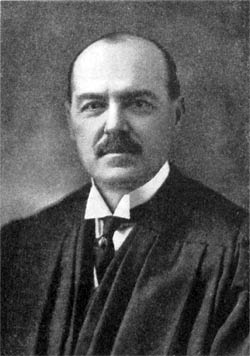
By R.M. Wanamaker, Judge of the Supreme Court of Ohio
Originally published on June 10, 1916 (excerpted)
Some years ago the New York City Library published an official statement as to the number of state and Federal statutes that had been nullified by the supreme courts of the states and nation, covering the period from 1902 to 1908 inclusive. That report showed four hundred statutes, passed mostly in exercise of the police power, which had been nullified by the courts on the ground that they were contrary to the provisions of some state or Federal Constitution.
Professor Collins, in his most excellent work on The Fourteenth Amendment and the States, by a carefully prepared chart shows that there have been fifty-five cases decided adversely to state statutes by the Supreme Court of the United States under the Fourteenth Amendment alone up to 1910; and that over eighty percent of them were during the last fifteen years of that period. Assuming that each decision affected only ten of the forty-eight states, it would show a slaughtering of over five hundred statutes as being in conflict with the Fourteenth Amendment alone — to say nothing about other statutes found in conflict with other provisions of the Federal Constitution.
Judge R.M. Wanamaker
In this same excellent work another chart shows that the Fourteenth Amendment has been invoked before the Supreme Court of the United States in over six hundred cases, in which the Supreme Court assumed jurisdiction and rendered opinions. In three hundred and twelve of these cases corporations were parties complaining of the statute; two hundred and sixty-four were individuals who were, in the main, only nominal parties, some corporation being the real party in interest; and there were only twenty-eight cases in which the negro race itself was affected, though the latter was the prime and paramount consideration for the adoption of the Fourteenth Amendment. Surprising, isn’t it?
What has caused this large increase in the slaughtering of statutes in our courts? The answer may be found in the surprising and expansive interpretation of the Fourteenth Amendment by the Federal Supreme Court, as will speedily appear.
This amendment, as every student of history knows, was intended as the great Magna Charta for the negro race, which had been but five years previously emancipated by the immortal Lincoln.
The chief part of that amendment — Section 1 — reads as follows:
“No State shall make or enforce any law which shall abridge the privileges or immunities of citizens of the United States; nor shall any State deprive any person of life, liberty, or property, without due process of law; nor deny to any person within its jurisdiction the equal protection of the laws.”
That the amendment failed as the great Magna Charta of the black race is a matter of common knowledge; that its surprising interpretation by the Supreme Court of the United States has enabled this amendment to destroy the great Magna Charta for both negro and white races, and substitute therefore a City of Refuge for the corporations of the several states, does not admit of doubt on an examination of the official record.
The first cases in the United States Supreme Court calling for a construction of this amendment were decided in 1873, and … known as the Slaughterhouse Cases.
Justice Miller, who delivered the opinion in these cases for the court, said, among other things:
FIRST. This court is thus called upon for the first time to give construction of these amendments.
SECOND. An examination of the history of the causes which led to the adoption of those amendments, and of the amendments themselves, demonstrates that the main purpose of all three last amendments was the freedom of the African race, the security and perpetuation of that freedom, and their protection from the oppressions of the white men who had formerly held them in slavery.
THIRD. In giving construction to any of those articles it is necessary to keep this main purpose steadily in view, though the letter and spirit of those articles must apply to all cases coming within their purview, whether the party concerned be of African descent or not.
FOURTH. We doubt very much whether any action of a state not direct by way of discrimination against the negroes as a class, or on account of their race, will ever be held to come within the purview of this provision. It is so clearly a provision for that race and that emergency that a strong case would be necessary for its application to any other.
The last language quoted from Justice Miller’s opinion shows that, though he was a good interpreter of the Fourteenth Amendment, as to what its primary purpose was, yet, indeed, he was a bad prophet; for just thirteen years later this same Supreme Court, in Santa Clara versus the Southern Pacific Railroad, 118 U.S., 394, decided in 1886, held, by the syllabus of that case, as follows:
“The provision of the Fourteenth Amendment to the Constitution of the United States, which forbids a state to deny to any ‘person’ within its jurisdiction the equal protection of the law, applies to corporations.”
The only reference in the opinion of this radical reversal of the doctrine laid down by Justice Miller in the Slaughterhouse Cases appears in the following language, which is self-explanatory:
“Announcement by Mr. Chief Justice Waite:
The court does not wish to hear argument on the question whether the provision of the Fourteenth Amendment to the Constitution, which forbids a state to deny to any ‘person’ within its jurisdiction the equal protection of the laws, applies to these corporations. We are all of the opinion that it does.”
The corporations referred to in this announcement were the Southern Pacific Railroad and the Central Pacific Railroad.
Are Corporations Persons?
By what legal legerdemain or judicial inspiration this Fourteenth Amendment was amended by the Supreme Court of the United States, the court does not tell us. It seems content with a Thus saith the court!
The Fourteenth Amendment is composed of five sections, and the word person appears in the first three. The language of the amendment itself, reinforced by the debates thereon, the paramount purpose of the amendment, unmistakably, and without the shadow of a doubt demonstrates that in using the word person the framers and adopters intended it to mean a human being and nothing else. Judge-made law is bad enough, but judge-made constitutions are infinitely worse.
No wonder the Supreme Court of the United States denied to counsel all opportunity to argue the question as to whether or not the word person included a corporation! This interpretation was in defiance of the Congress that framed the amendment; in defiance of the negro race, to protect which the amendment was passed; in defiance of the general public understanding and interpretation of the amendment; in defiance of the Supreme Court’s own construction of it in the Slaughterhouse Cases. And, had such an interpretation been anticipated by the states when they came to adopt it, I challenge a denial of the fact that not half a dozen states of the Union, North or South, would ever have ratified that amendment.
The natural and necessary effect of this interpretation of the Fourteenth Amendment made the Supreme Court of the United States the supreme guardian and final supervisor not only of Federal statutes but of all state statutes, and even of municipal ordinances. The Supreme Court of the United States had passed from a court of law and equity, as those words are understood in the world’s jurisprudence, and had now become a political court — I do not mean a partisan one — a court that spoke the last word as to municipal, state and national public policies.
During the first century of our Government the Supreme Court of the United States confined its doctrine of nullifying legislative acts chiefly and sparingly to questions pertaining to the organization of courts and judicial procedure; questions relating to the exercise of powers not delegated in the Constitution; interference with state powers; ex post facto laws; laws impairing obligations of contract; denial of trial by jury, and other fundamental individual rights, as recognized generally by the laws of all civilized lands. But, following the adoption of the Fourteenth Amendment, the nullified laws partook of quite a different character. It would be difficult to classify all of them, but the large majority of the laws were nullified on the claim that they were in conflict with some provision of the Fourteenth Amendment, either the “due process” clause or “equal protection of the laws” clause — or both.
A very large percentage of the statutes nullified by the Federal courts, or by the state courts following precedents of the former, may be classified as follows:
FIRST. Labor statutes: Those providing for safety appliances to protect the life and limb of the workingman; sanitary regulation in mines, workshops and factories; workmen’s compensation laws; abolishing company stores; providing for hours of labor, pay days, and so on; and the right of laborers to organize and protect themselves in such organization by denying the employer the right to coerce them out of a labor union, or, if they had not yet joined such union, to prevent membership in such union.
The Bureau of Labor, in 1910, issued a bulletin alleging that one hundred and fifty statutes and ordinances relating to labor had been held unconstitutional, either entirely or in part, by the courts of the land.
SECOND. Rate laws: Those undertaking to fix and regulate public-utility rates; for the Governmental control of public-service corporations; and also for the inspection and taxation of the same.
THIRD. Trade and occupation statutes: Those undertaking to safeguard the public interest under the police power of the state, and providing for certain qualifications, inspection and regulation of certain lines of business closely allied with the public welfare.
Numerous other lesser classes might be named, but these will be sufficient to indicate the general class of statutes that have been challenged and, too often, declared unconstitutional on the ground that they were in conflict with the Fourteenth Amendment to the Federal Constitution.
Shall this growing political power under the name of the Supreme Court of the United States go on unchallenged and uncontrolled as the guardian of our American democracy, and as a substitute for “We, the people,” not only in our Federal Government but even in our state and municipal governments?
Justice Hughes, of the Supreme Court of the United States, before the New York State Bar Association, on January fourteenth last, delivered an address in which he used the following language:
“If there were centered in Washington a single source of authority from which proceeded all the Governmental forces of the country — created and subject to change at its will — upon whose permission all legislative and administrative action depended throughout the length and breadth of the land, I think we should swiftly demand and set up a different system. If we did not have states we should speedily have to create them.”
This language is as simple as it is striking. However, there was little need for the learned justice to put the case hypothetically. The great mass of our people believe that there is today “a single source of authority from which proceed all the Governmental forces of the country — created and subject to change at its will — upon whose permission all legislative and administrative action depends.”
The Views of Lincoln and Jefferson
But they go farther than the learned justice and point their finger at the Supreme Court of the United States as that assumed “single source of authority.”
It is but fair to Justice Hughes to say that, during his six years as a member of the Supreme Court of the United States, he has been a frequent dissenter from the prevailing policy of the Supreme Court.
No state statute can be passed today without asking the question: Will the Supreme Court let it stand?
No city ordinance can be passed today without asking the question: Will the Supreme Court of the United States let it stand? But why have states at all if the states shall be mere shapes and shadows; if the states shall not be sovereign in state affairs; if the states must all the while anticipate the viewpoint and judgment of the Supreme Court of the United States, and finally be forced to surrender to the court’s view and veto on public policies?
A judicial body was what was intended to be created by the Constitution of the United States; but, instead, we have a political body passing on political questions — not partisan ones — great questions of public policy affecting not only national interests but state and even municipal interests, all the while exercising over them the right to veto, the right to supervise, the right to modify, the right to destroy. And when the people once thoroughly wake up, will they not consider the suggestion of the learned justice to, “swiftly demand and set up a different system”?
Lincoln, on the battlefield of Gettysburg, in an immortal address closed with these words:
“That we here highly resolve … that the nation shall, under God, have a new birth of freedom, and that government of the people, by the people, and for the people, shall not perish from the earth.”
Lincoln placed the paramount power of the Government in the hands of the people, and forty-six of the forty-eight state constitutions have reaffirmed this doctrine by declaring: “All political power is inherent in the people.”
From time to time various reforms have been suggested to correct this growing evil, all the way from a constitutional amendment denying such power to the recall of judges, the recall of judicial decisions, and various other ways and means of correcting this use and abuse of the power.
Federal constitutional amendments are so difficult and tedious that this method is hardly worth considering. Only two amendments to the Federal Constitution have been adopted in the last fifty years.
The recall of judges and the recall of judicial decisions presuppose that the wrong has been done in a particular case and that an effort should be made to correct it by removing the judge, though his successor may be little if any better; or by recalling the decision, which would be difficult in its practical political operation.
The Ohio Remedy
Ohio has paved the way for a remedy by the states by adopting, in 1912, as part of its constitution the following provision — Article IV, Section 2:
“No law shall be held unconstitutional and void by the supreme court without the concurrence of at least all but one of the judges, except in the affirmance of a judgment of the court of appeals declaring a law unconstitutional and void.”
I do not commend the exception. It results in this anomaly: that if the state court of appeals by a vote of two to one holds the law unconstitutional, four of the supreme court judges may hold it unconstitutional; and if the court of appeals by a vote of two to one, or unanimously, holds the statute constitutional, then six of the seven judges are necessary to hold it unconstitutional. There should not be this discrimination. The exception should have been omitted from the constitution.
As a step in the right direction this constitutional provision of Ohio is generally approved by our people and has been found to work well as an effective and salutary restraint on the judiciary.
Though Ohio furnishes the suggestion of a remedy for the several states, this remedy is of little consequence where a Federal question is involved under the Fourteenth Amendment; for there the Supreme Court of the United States would take jurisdiction, and could, by a vote of five to four, or six to three, as has been quite common of late, hold the state statute dealing with state matters as unconstitutional.
The Supreme Court of the United States, in the exercise of the power to nullify a statute, state or Federal, on the ground that it is contrary to some provision of the Federal Constitution, has uniformly held that it must be “ clearly” so; and as a standard of clearness has again and again held that the conflict must be “beyond a reasonable doubt.”
Now, how can the conflict between the statute and the Constitution be clear or be- yond a reasonable doubt when nine men, sitting as judges of the Supreme Court of the United States, presumably of equal integrity of mind and heart, equally patriotic, equally learned in the law and the Constitution, divide on the judgment of unconstitutionality by five to four or six to three?
When we deal with the criminal, no matter how atrocious or how overwhelming the evidence may be against him, he is presumed to be innocent; and before he is found guilty the twelve men in the jury box must find that guilt to a moral certainty or beyond a reasonable doubt. On that proposition all twelve must concur. On a matter affecting the millions of people of a state, and perhaps the hundred millions of a nation, the statute should not only be presumed constitutional — and this is the law — but, before that presumption can be overcome, should it not be by at least a three-fourths concurrence, or seven of the nine judges of the Supreme Court?
Melville Davisson Post, in an article in this weekly under date of December 18, 1915, uses this language with reference to the decisions of the Supreme Court of the United States:
“Out of seventy-seven consecutive decisions rendered by the Supreme Court of the United States, twenty-nine were given by a vote of five to four, and forty-six by a vote of six to three; in only two instances did as many as seven out of the nine justices agree.”
On the ordinary legal question a mere majority must be sufficient for a judgment, else in many cases there could be no final judgment. But in cases involving public policies, as defined by state and Federal statute — cases involving questions of eminent domain, taxation, police power, and the like, which are inherent and sovereign in the domestic affairs of the state and the home-rule affairs of our municipalities, questions that are more of a political nature than legal — why should not at least a three-fourths vote be required by the Supreme Court of the United States on the fact of clear conflict, before the statute or ordinance should be nullified by the Supreme Court of the nation?
When the statute clearly permits what the Constitution clearly prohibits, or the statute clearly prohibits what the Constitution clearly permits, you then have, in such a situation, that clear conflict where both statute and Constitution cannot stand. Of course the statute should yield to the fundamental law — the Constitution.
But who shall be the judge as to such clear conflict? We have seen that, in England, Parliament alone determines this question — not the courts. In France it is the Senate and Chamber of Deputies — not the judges. And in every leading nation of the world, save the United States, it is likewise the legislative body that determines whether or not there is such clear conflict; and the action of such legislative bodies is final.
The courts of those nations have nothing whatever to do with the question. Their legislative bodies are representative bodies — at least, the controlling branch is elected directly by the people.
But here in the United States, for more than a century, the courts have exercised this power without warrant of the Constitution, but by authority of judicial custom and precedent, which the courts themselves have widened and extended; so that they are not only the Supreme Court but the supreme legislature, the supreme executive, the supreme government of the nation, the states and our municipalities.
How Congress Can Mend Matters
Now the thing that is proposed is not entirely to reverse this order, but to recognize and restrain it by applying the very principles and rules that the Supreme Court itself has for a century or more announced — this doctrine of clear conflict; this doctrine of a conflict beyond a reasonable doubt, which should be clear to more than a mere majority; else it is clearly not clear.
There is nothing radical or revolutionary about requiring more than a mere majority vote in unusual or exceptional procedure. Legislatures of state and nation, when they depart from the regular order in lawmaking, frequently require a two-thirds or three-fourths vote. Why should not the courts, when they depart from the regular order by law-unmaking, be required to do so by more than a mere majority vote — by a two-thirds or three-fourths vote?
In order that Congress may propose an amendment to our Federal Constitution it is expressly provided that two-thirds of both houses shall concur; and such proposed amendment cannot become a part of our Federal Constitution until three- fourths of the states have ratified the same by their legislatures or conventions.
Of course the adoption of a Federal Amendment to the Constitution limiting the power of our Federal courts in this behalf would be effective when accomplished; but the difficulties in the way of its accomplishment would be a repetition of the time and effort made in behalf of the amendment for the election of United States senators by a direct vote of the people, and for an income tax. And it is utter folly, under the enlarged jurisdiction asserted by the Supreme Court of the United States, on the Federal questions arising under the Fourteenth Amendment and other amendments, to attempt to cure this evil through state constitutions; for, as was said of old, “Saul hath slain his thousands, and David his ten thousands.”
So it can be truthfully said today that though the state courts have assumed jurisdiction to nullify legislative acts, the chief offender in this behalf, and from whom the state courts have found precedents more or less obligatory on them, has been the Supreme Court of the United States. Now, how can this limitation on the power of the Federal courts, touching constitutional questions, be brought about?
After a careful examination of the Federal Constitution I am persuaded that there is no need of a further amendment in order to authorize Congress to place a limitation on the Supreme Court of the United States on Constitutional questions. The power and authority are there now in the clearest and most unambiguous terms. It is found in the Federal Judicial Article III, Section 2, in this language:
“In all cases affecting Ambassadors, other public Ministers and Consuls, and those in which a State shall be Party, the supreme Court shall have original Jurisdiction. In all the other Cases before mentioned, the supreme Court shall have appellate Jurisdiction, both as to Law and Fact, with such Exceptions, and under such Regulations as the Congress shall make.”
If now Congress should pass an act declaring that no state or Federal statute should be declared null and void, as contrary to public policy or contrary to any state constitution or the Federal Constitution, unless by the concurrence of a three-fourths vote of the Supreme Court of the United States, the evil would be very largely if not entirely remedied.
If this article shall have produced an interest in this subject, a discussion of the underlying principles of democracy, a consideration of the remarkable growth and evolution of this power of centralized government by the Supreme Court of the United States, and whether or not some practical and effective restraint is not highly and immediately essential to the preservation of our American system of government, then it will not have been in vain.
Norman Rockwell did Post covers from 1916 to 1963 — a remarkable 47 years. Who were the folks on his first generation of covers?
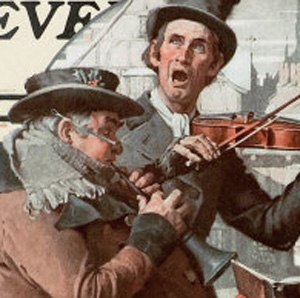
Below are some fun details about two men who transformed into new characters over and over again on the covers of the 1920s: Dave Campion and Pop Fredericks. At right, they appear together as Victorian musicians in the 1923 holiday cover, Christmas Trio. Campion is the taller man on the right, and Fredericks, left.
Dave Campion
“There was one kind of idea which I didn’t have to struggle over,” Rockwell wrote in My Life as an Illustrator, “the timely idea. In 1920 the whole country was talking about Model T Fords and Henry Ford.”
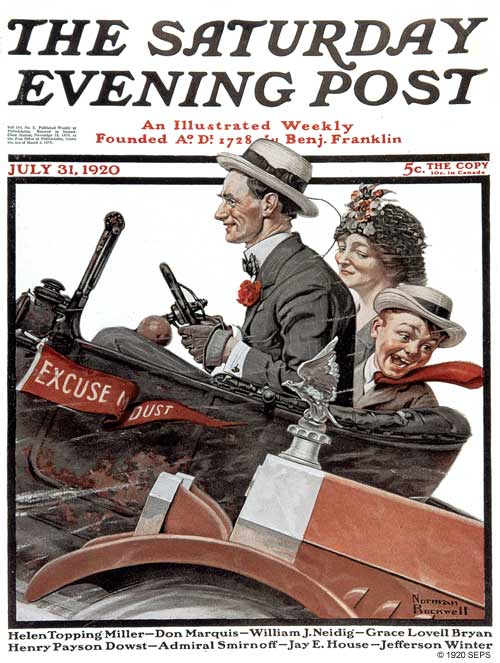
So, he created the July 1920 cover of the Campion family (below, left) in their rusty Model T, easily passing an expensive Peerless.
Dave Campion, the driver living life in the fast lane (as much as one can at 30 mph), ran a newsstand in New Rochelle, New York — where Rockwell worked and lived when this illustration was created. One can’t help but wonder what it was like for Campion to sell the latest issue of The Saturday Evening Post with himself on the cover!
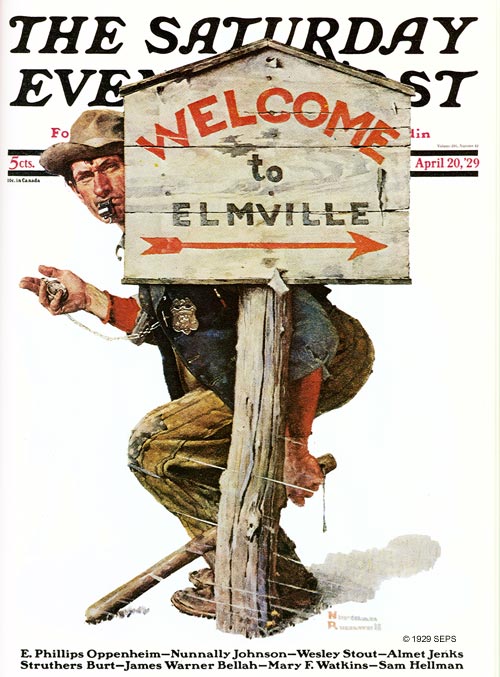
In the top right illustration, Campion, given a slouchy hat and a mean squint, transforms from the amiable dad in 1920’s Excuse My Dust, to the long arm of the law. “Welcome to Elmville,” indeed. (The arm caught Norman Rockwell speeding through Amenia, New York, giving him the idea for this cover. “That was back in the days when towns paid their taxes with speeders’ fines, and the Amenia cop really nailed me — right along the welcome sign!”)
Pop Fredericks
Unlike Campion, who had found his calling selling periodicals and papers, Pop Fredericks was an actor who never quite made it. “Pop had been, as he told it, cheated of fame,” Rockwell wrote. Fredericks was in a play that was just gaining momentum when he was replaced by a better-known actor.
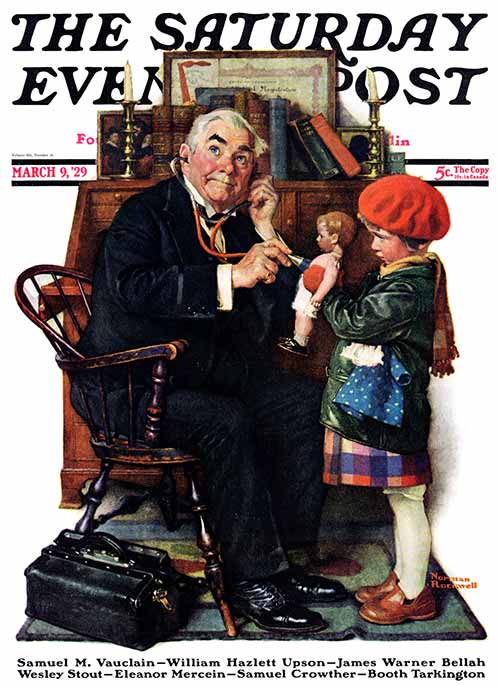
Fredericks’ acting ability allowed him to portray a wide range of personalities, making him a rugged character in one cover (below, left) and a kindly doctor in another (below, right). Like Campion in the covers above, the contrast between the two characters is significant.
Though Fredericks never became a renowned actor, he achieved immortality on Post covers: as a seasick ocean voyager, a cellist, a politician, and an obliging physician (above, right) who can’t resist allaying the worries of the little mother. The Doctor and the Doll was an all-time favorite and is one of the most collectible Post covers of all time.
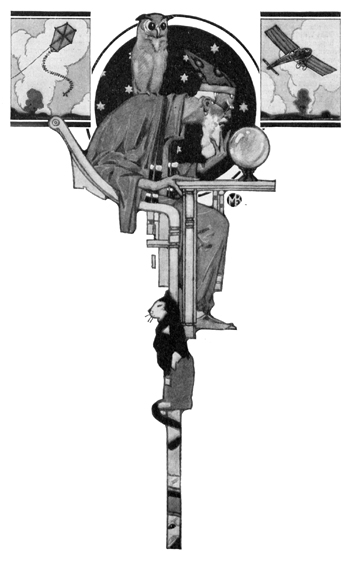
The illustration above by M.L. Blumenthal appeared in the first installment of H.G. Wells’ series “What Is Coming?”
“Prophecy may vary between being an intellectual amusement and a serious occupation; serious not only in its intentions, but in its consequences,” H.G. Wells wrote in 1916. “For it is the lot of prophets who frighten or disappoint to be stoned. But for some of us moderns, who have been touched with the spirit of science, prophesying is almost a habit of mind. … The scientific training develops the idea that whatever is going to happen is really here now — if only one could see it. And when one is taken by surprise the tendency is not to say with the untrained man, ‘Now, who’d ha’ thought it?’ but ‘Now, what was it we overlooked?’”
This was how Wells began his forecast of the remaining days and aftermath of the world’s first great war. The article was part of a 10-part series titled “What Is Coming?,” which appeared in The Saturday Evening Post in 1916.
The author had already established a reputation for prediction, based on books like The Time Machine (1895) and The War of the Worlds (1898). And he seemed a good fit to predict the outcome of World War I.
But in 1916 when the series was released, the war was far from over. After the article below (the second in the series) was published, the line of battle that stretched from the Swiss border to the English Channel would move no more than a few miles in the following 35 months. Though Wells did not predict how long the war would last, he was proved right about its ultimate conclusion: The end of the war would be “no longer about victories or conquest but about securing … the best chances of rapid economic recuperation and social reconstruction.”
What Is Coming: The End of the War
By H. G. Wells
Originally published on January 15, 1916
The prophet who emerges with the most honor from this war is [Ivan Stanislavovich] Bloch. It must be fifteen or sixteen years ago since this gifted Russian made his forecast of the future. Perhaps it is more, for the French translation was certainly in existence before the Boer War. His case was that war between fairly equal antagonists must end in a deadlock because of the continually increasing defensive efficiency of entrenched infantry. This would give the defensive an advantage over the most brilliant strategy and over considerably superior numbers that would completely discourage all aggression. He concluded that war was played out.
His book was very carefully studied in Germany. As a humble follower of Bloch I did not realize this, and that failure led me into some unfortunate prophesying at the outbreak of the war. I judged Germany by the Kaiser, and by the Kaiser-worship which I saw in Berlin. I thought that he was a theatrical person who would dream of vast attacks and tremendous cavalry charges, and that he would lead Germany to be smashed against the allied defensive in the West, and to be smashed so thoroughly that the war would be over. I did not properly appreciate the more studious and more thorough Germany that was to fight behind the Kaiser and thrust him aside, the Germany we English fight now, the Ostwald-Krupp Germany of 1915. That Germany, one may now perceive, had read and thought over and thought out the Bloch problem. There was also a translation of Bloch into French. In English a portion of his book was translated for the general reader and published with a preface by the late Mr. W.T. Stead. It does not seem to have reached our military authorities, nor was it published here with an instructive intention. As an imaginative work it would have been considered worthless and impracticable.
Getting Military Science Up to Date
But it is manifest now that if the Belgian and French frontiers had been properly prepared — as they should have been prepared when the Germans built their strategic railways — with trenches and gun emplacements and secondary and tertiary lines, the Germans would never have got fifty miles into either France or Belgium. They would have been held at Liege and in the Ardennes. Five hundred thousand men would have held them indefinitely. But the Allies had never worked out trench warfare; they were unready for it, the Germans knew of their unreadiness, and upon this unreadiness it is quite clear they calculated. They did not reckon, it is now clear that they were right in not reckoning, the Allies as contemporary soldiers. They were going to fight a 1900 army with a 1914 army, and their whole opening scheme was based on the conviction that the Allies would not entrench. Somebody in those marvelous maxims from the Dark Ages that seem to form the chief reading of our military experts said that the army that entrenches is a defeated army. The silly dictum was repeated and repeated after the Battle of the Marne. It shows just where our military science had reached in 1914 — namely, to a level a year before Bloch wrote. So the Allies retreated. For long weeks the Allies retreated out of the west of Belgium, out of the north of France, and for rather over a month there was a loose, mobile war — as if Bloch had never existed. The Germans were not fighting the 1914 pattern of war, they were fighting the 1899 pattern of war, in which direct attack, outflanking, and so on were still supposed to be possible; they were fighting confident in their overwhelming numbers, in their prepared surprise, in the unthought-out methods of their opponents. In the Victorian war that ended in the middle of September they delivered their blow, they overreached, they were successfully counterattacked on the Marne, and then abruptly — almost unfairly it seemed to our sportsmanlike conceptions — they shifted to the game played according to the very latest rules of 1914. The war did not come up to date until the Battle of the Aisne. With that the second act of the great drama began.
I do not believe that the Germans ever thought it would come up to date so soon. I believe they thought that they would hustle the French out of Paris, come right up to the Channel at Calais before the end of 1914, and then entrench, produce the submarine attack and the Zeppelins, working from Calais as a base, and that they would end the war before the spring of 1915 — with the Allies still a good fifteen years behindhand. I believe the Battle of the Marne was the decisive battle of the war, in that it shattered this plan, and that the rest of the 1914 fighting was Germany’s attempt to reconstruct their broken scheme in the face of an enemy who was continually getting more and more nearly up to date with the fighting. By December, Bloch, who had seemed utterly discredited in August, was justified up to the hilt. The world was entrenched at his feet. By May the lagging military science of the British had so far overtaken events as to realize that shrapnel was no longer so important as high explosive, and within a year the significance of machine guns, a significance thoroughly ventilated by imaginative writers fifteen years before, was being grasped by our conservative but by no means inadaptable leaders.
The war since that first attempt, admirably planned and altogether justifiable — from a military point of view, I mean — of Germany to “rush” a victory has consisted almost entirely of failures on both sides either to get round or through or over the situation foretold by Bloch. There has been only one marked success — the German success in Poland due to the failure of the Russian munitions. Then for a time the war in the East was mobile and precarious while the Russians retreated to their present positions, and the Germans pursued and tried to surround them. That was a lapse into the pre-Bloch style. Now the Russians are again entrenched, their supplies are restored, the Germans have a lengthened line of supplies, and Bloch is back upon his pedestal so far as the Eastern theater goes. Bloch has been equally justified in the Anglo-French attempt to get round through Gallipoli.
The forces of the India Office have pushed their way through unprepared country to Bagdad, but from the point of view of the main war that is too remote to be considered either getting through or getting round; and so, too, the losses of the German colonies and the East African war are scarcely to be reckoned with in the main war. They have no determining value. There remains the Balkan struggle. But the Balkan struggle is something else; it is something new. It must be treated separately. It is a war of treacheries and brags and appearances. It is not a part of, it is a sequence to, the deadlock war of 1915.
But before dealing with this new development it is necessary to consider certain general aspects of the deadlock war. It is manifest that the Germans hoped to secure an effective victory in this war before they ran up against Bloch. But, reckoning with Bloch as they certainly did, they hoped that even in the event of the war getting to earth it would still be possible to produce novelties that would sufficiently neutralize Bloch to secure a victorious peace. With unexpectedly powerful artillery suddenly concentrated, with high explosives, with asphyxiating gas, with a well-organized system of grenade-throwing and mining, with attacks of flaming gas, and above all with a vast munition-making plant to keep them going, they had a very reasonable chance of hacking their way through.
The Teutonic Air Path
Against these prepared novelties the Allies have had to improvise, and on the whole the improvisation has kept pace with the demands made upon it. They have brought their military science up to date, and today the disparity in science and equipment between the antagonists has greatly diminished. There has been no escaping Bloch, after all, and the deadlock, if no sudden peace occurs, can end now in only one thing — the exhaustion in various degrees of all the combatants and the succumbing of the most exhausted. The idea of a conclusive end of the traditional pattern to this war, of a triumphal entry into London, Paris, Berlin or Moscow, is to be dismissed altogether from our calculations. The end of this war will be a matter of negotiation between practically immobilized and extremely shattered antagonists.
There is, of course, one aspect of the Bloch deadlock that the Germans at least have contemplated. If it is not possible to get through or round, it may still be possible to get over. There is the air path. This idea has certainly taken hold of the French mind, but France has been too busy and is temperamentally too economical to risk large expenditures upon what is necessarily an experiment. The British are too conservative and skeptical to be the pioneers in any such enterprise. The Russians have been too poor in the necessary resources of mechanics and material. The Germans alone have made any sustained attempt to strike through the air at their enemies beyond the war zone. Their Zeppelin raids upon England have shown a steadily increasing efficiency, and it is highly probable that they will be repeated on a much larger scale before the war is over. Quite possibly, too, the Germans are developing an accessory force of large aeroplanes to cooperate in such an attack. The long coasts of Britain, the impossibility of their being fully equipped throughout their extent, except at a prohibitive cost of men and material, to resist invaders, expose the whole length of the island to considerable risk and annoyance from such an expedition. But it is doubtful if the utmost damage an air raid is likely to inflict upon England would count materially in the exhaustion process, and the moral effect of these raids has been, and is likely to be, to stiffen the British resolution to fight this war through to the conclusive ending of any such possibilities. The best chance for the aircraft was at the beginning of the war, when a surprise development might have had astounding results. That chance has gone by. Nor is there anything on or under the sea that seems likely now to produce decisive results. We return from these considerations to a strengthened acceptance of Bloch.
The essential question for the prophet remains, therefore, the question of which group of Powers will exhaust itself most rapidly. And, following on from that, comes the question of how the successive stages of exhaustion will manifest themselves in the combatant nations. The problems of this war, as of all war, end as they begin in national psychology.
But it will be urged that this is reckoning without the Balkans. I submit that the German thrust through Serbia is really no part of the war that has ended in the deadlock of 1915. Here there is no way round or through to any vital center of Germany’s antagonists. It turns nothing; it opens no path to Paris, London or Petrograd. It is a long, long way from the Danube to either Egypt or Bagdad, and there and there — Bloch is waiting. I do not think the Germans have any intention of so generous an extension of their responsibilities. The Balkan complication is no solution of the deadlock problem.
A whole series of new problems are opened up directly as we turn to this most troubled region — problems of the value of kingship, of nationality, of the destiny of such cities as Constantinople, which from their very beginning have never had any sort of nationality at all; of the destiny of countries such as Albania, where a tangle of intense tribal nationality is distributed in spots and patches, or Dalmatia, where one extremely self-conscious nation and language is present in the towns and another in the surrounding country, or Asia Minor, where no definite, national boundaries, no religious, linguistic or social homogeneities, have ever arisen since the Roman legions beat them down. But all these questions can really be deferred or set aside in our present discussion. Whatever surprises or changes this last phase of that blood-clotted melodrama, the Eastern Empire, may involve, they will not alter the essential fact of the great war, they will but assist and hasten on the essential conclusion of the great war, that the Central Powers and their pledged antagonists are in a deadlock, unable to reach a decision, and steadily, day by day, hour by hour, losing men, destroying material, spending credit, approaching something unprecedented, unknown, that we try to express to ourselves by the word exhaustion.
The Rigors of a War of Attrition
Just how the people who use the word so freely are prepared to define it is a matter for speculation. The idea seems to be a phase in which the production of equipped forces ceases through the using up of men or material or both. If the exhaustion is fairly mutual it need not be decisive for a long time. It may mean simply an ebb of vigor on both sides, unusual hardship, a general social and economic disorganization and grading down. The fact that a great killing off of men is implicit in the process, and that the survivors will be largely under discipline, militates against the idea that the end may come suddenly through a vigorous revolutionary outbreak. Exhaustion is likely to be a very long and very thorough process extending over years. A “war of attrition” may last into 1918 or 1919, and may bring us to conditions of strain and deprivation still only very vaguely imagined. What happens in the Turkish Empire or India or America or elsewhere may accelerate or retard or extend the area of the process, but is quite unlikely to end it.
Let us ask now which of the combatants are likely to undergo exhaustion most rapidly, and, what is of equal or greater importance, which is likely to feel it first and most. No doubt there is a bias in my mind, but it seems to me that the odds are on the whole against the Central Powers. Their peculiar virtue, their tremendously complete organization which enabled them to put so large a proportion of their total resources into their first onslaught and to make so great and rapid a recovery in the spring of 1915, leaves them with less to draw upon now. Out of a smaller fortune they have spent a larger sum. They are blockaded to a very considerable extent, and against them fight not merely the resources of the Allies, but, thanks to the complete British victory in the sea struggle, the purchasable resources of all the world. Conceivably they will draw upon the resources of their Balkan allies, but the extent to which they can do that may very easily be overestimated. There is a limit to the power for treason of these supposititious German monarchs that British folly has permitted to possess these Balkan thrones, and none of the Balkan peoples is likely to witness the complete looting of its country in the German interest by a German court with enthusiasm.
Germany will have to pay on the nail for most of her Balkan help. She will have to put more into the Balkans than she takes out. And compared with the world behind the Allies the Turkish Empire is a country of mountains, desert and undeveloped lands. To develop these regions into a source of supplies under the strains and shortages of wartime will be an immense and dangerous undertaking for Germany. She may open mines she may never work, build railways that others will enjoy, sow harvests for alien reaping. And for all these tasks she must send men. Men?
At present, so far as any judgment is possible, Germany is feeling the pinch of the war much more even than France, which is habitually parsimonious, and Russia, which is hardy and insensitive. Great Britain has really only begun to feel the stress. She has probably suffered economically no more than Holland or Switzerland, and Italy and Japan have certainly suffered less. All these countries are full of men, of gear, of salable futures. In every part of the globe Great Britain has colossal investments. She has still to apply the great principle of conscription, not only to her sons but to the property of her overseas investors and of her landed proprietors. She has not even looked yet at the German financial expedients of a year ago. She moves reluctantly but surely toward such a thoroughness of mobilization. There need be no doubt that she will completely socialize herself, completely reorganize her whole social and economic structure, sooner than lose this war. She will do it clumsily and ungracefully, with much internal bickering, but not so slowly as a logical mind might anticipate.
Germany then, I reckon, will become exhausted first among all the combatants. I think, too, that she will as a nation feel and be aware of what is happening to her sooner than any other of the nations that are sharing in this process of depletion. In 1914 the Germans were reaping the harvest of forty years of economic development and business enterprise. Property and plenty were new experiences, and a generation had grown up in whose world a sense of expansion and progress was normal. There existed no tradition of the great hardship of war, such as the French possessed, to steel their minds. They came into this war more buoyantly and confidently than any other people. Neither great victories nor defeats have been theirs, but only a slow vast transition from joyful effort to hardship, loss and loss and loss of substance, the dwindling of great hopes, the realization of ebb in the triumphant tide of national welfare. They are under stresses now as harsh as the stresses of France.
The First Heralds of Peace
We know little of the psychology of this new Germany that has come into being since 1871, but it is doubtful if it will accept defeat and still more doubtful how it can evade some ending to the war that will admit the failure of all its great hopes of Paris subjugated, London humbled, Russia suppliant, Belgium conquered. Such an ending will be a day of reckoning that German imperialism will postpone until the last hope of some breach among the Allies, some saving miracle in the old Eastern Empire, some dramatically snatched victory at the eleventh hour, is gone. Nor can the Pledged Allies consent to a peace that does not involve the evacuation and compensation of Belgium and Serbia, and at least the autonomy of the lost provinces of France. Those are the ends of the main war. Europe will go down through stage after stage of impoverishment and exhaustion until these ends are attained or made forever impossible.
But these things form only the main outlines of a story with a vast amount of collateral interest. It is to these collateral issues that the amateur in prophecy must give his attention. It is here that the German will be induced by his government to see his compensations. He will be consoled for the restoration of Serbia by prospect of future conflicts between Italian and Jugoslav that will let him in again to the Adriatic. His attention will be directed to his newer, closer association with Bulgaria and Turkey. In those countries he may yet repeat the miracle of Hungary. He will hope also to retain his fleet, and no peace, he will be reminded, can rob him of his hard-earned technical superiority in the air. The German Air Fleet of 1930 may yet be something as predominant as the British Navy of 1915. Had he not better wait for that? When such ideas as these become popular in the German press we may begin to talk of peace, for these will be its necessary heralds. The concluding phase of a process of general exhaustion must almost inevitably be a game of bluff. Neither side will admit its extremity. Neither side, therefore, will make any direct proposals to its antagonists nor any open advances to a neutral. But there will be much inspired peace talk through neutral media, and the consultations of the anti-German allies will become more intimate and detailed. Suggestions will “leak out” remarkably from both sides, to journalists and neutral go-betweens. The Eastern and Western Allies will probably begin quite soon to discuss a Zoilverein and the coordination of their military and naval organizations in the days that are to follow the war. A general idea of the possible rearrangement of the European states after the war will grow up in the common European and American mind; public men on either side will indicate concordance with this general idea, and some neutral power will invite representatives to an informal discussion of these possibilities. Probably, therefore, the peace negotiations will take the extraordinary form of two simultaneous conferences: one, of the Pledged Allies, sitting probably in Paris or London; and the other, of representatives of all the combatants, meeting in some neutral country — probably Holland will be the most convenient — while the war will still be going on. The Dutch conference will be in immediate contact by telephone and telegraph with the Allied conference and with Berlin.
The broad conditions of a possible peace will begin to get stated toward the end of 1916, and a certain lassitude will creep over the operations in the field. The process of exhaustion will probably have reached such a point by that time that it will be a primary fact in the consciousness of common citizens of every belligerent country. The common life of all Europe will have become — miserable. Conclusive blows will have receded out of the imagination of the contending powers. The war will have reached its fourth and last stage as a war. The war of the great attack will have given place to the war of the military deadlock; the war of the deadlock will have gone on, with a gradual shifting of the interest to the war of treasons and diplomacies in the Eastern Mediterranean; and now the last phase will be developing into predominance, in which each nation will be most concerned, no longer about victories or conquest but about securing for itself the best chances of rapid economic recuperation and social reconstruction. The commercial treaties, the arrangements for future associated action, made by the great Allies among themselves will appear more and more important to them, and the mere question of boundaries less and less. It will dawn upon Europe that she has already dissipated the resources that have enabled her to levy the tribute paid for her investments in every quarter of the earth, and that neither the Germans nor their antagonists will be able for many years to go on with those projects for world exploitation which lay at the root of the great war. Very jaded and anemic nations will sit about the table on which the new map of Europe will be drawn. Each of the diplomatists will come to that business with a certain preoccupation. Each will be thinking of his country as one thinks of a patient of doubtful patience and temper who is coming out of the drugged stupor of a crucial, ill-conceived and unnecessary operation. Each will be thinking of Labor, wounded and perplexed, returning to the disorganized factories from which Capital has fled.
You can’t take a character home with you or you’d go mad; at least I would,” Sir Ben Kingsley says with a laugh. “What I find is that if I leave the character until the next day’s filming, then I go back and get to jump from me to the character. I love taking that running leap from me to him.”
Sir Ben recently voiced the role of Bagheera, the black panther, in the live-action version of Rudyard Kipling’s The Jungle Book and showed his dark side as a gangster in the action-filled kidnap flick Collide. He’s also co-starring with his son Edmund in the upcoming An Ordinary Man, playing a Nazi war criminal on the run.
Jeanne Wolf: In a career spanning over 40 years, you’ve taken on an incredibly diverse range of characters — from your Academy Award-winning performance as Gandhi to some horrific bad guys in Iron Man 3 and Oliver Twist. Are you aware you can be intimidating?
Ben Kingsley: Whatever mythology surrounds me, true or false, is diffused very quickly when I arrive on the set and give everyone a hug and say, “This is exciting. We’ve got a lot to talk about.”
JW: You’re often described as a chameleon. The way you turn into someone else is magical. How do you do it?
BK: I feel quite ashamed sometimes admitting how little research I do and that I just learn my lines. Nobody wants to believe me. But I learn my lines for weeks before a film. The goal is not to let any of my actors or the director down. I’m floored with admiration for Spencer Tracy, and one of his tenets was, “Make the other guy look good.” That’s not to say that I’m not ambitious.
I think that some ambition comes from being told that you’ll never achieve something.
I remember that from my own childhood. And in my adult life I was told by a director of the Royal Shakespeare Company that I would never play leaders or kings or great men — that I would be very good at playing servants. And I knew in my heart that one day I’d prove him utterly wrong in the sense of, “How dare you judge me?” I’ve tried
to let my own kids have some freedom from that.
I try not to interrupt them when they’re working on a new thought or even a new fear — not to interrupt but to step back and watch it flower. So many parents are more interested in power than allowing the other to grow.
JW: How do you keep the work fresh? What drives you?
BK: I am always evolving; otherwise, I guess I couldn’t do my job. If I can’t surprise myself, I can’t surprise my director and my fellow actors and, therefore, the audience — so my quest is to surprise myself. Maybe it’s a little bit like a mountaineer always looking for a particularly dangerous mountain.
If I could choose one thing that I hate about the current nutrition labels, it’s that it’s not easy to figure out exactly how much you’re eating. Right now I’m looking at a bag of mini Kit Kats. According to the label, in a serving size of five pieces there are 11 grams of fat, and there are seven servings per bag. Wouldn’t it be easier just to tell me the amount of fat, calories, and so on in one piece, and then let me multiply the number by how many pieces I eat — which will probably around 20? (Side note: If you’re eating 20 mini Kit Kats in one sitting, the nutrition label is probably unimportant to you.) Other than that, I don’t think the labels are too confusing.
But the FDA is changing them. They’ve introduced a new nutrition label that is not only easier to read but has more information for you, including info on how much sugar is added to the product. But they’ve gotten rid of one or two things too. The Washington Post has a complete rundown on what’s new.
Here’s The Boston Globe’s side-by-side comparison of the old and new labels:
I’m not sure of a lot of things. I can’t swim, I don’t know how to fold a dress shirt, and I’m still not certain how the stock market works. But there is one thing I do know for sure: Gillian Anderson is not going to be the next James Bond.
That’s one of the names being floated around by … well, people who float names around. They know it’s just a silly “wish.” She’s not actually going to be the next 007. You can be sure that the next Bond is going to be what all the other Bonds have been: a man.
But according to rumors and comments he made after SPECTRE was released last year, Daniel Craig might have already quit as the secret agent. Since these types of rumors always come up after an actor does a few Bond movies and is getting a little exhausted from making them, this whole story could be completely untrue.
But if it does turn out to be true, what names actually are being bandied for the role? At the top of the list is Tom Hiddleston, who is currently starring in AMC’s The Night Manager. He’s such a popular choice that bookmakers had to actually stop people from betting on him (yes, apparently you can bet on who the next Bond will be in England). Other people mentioned include Billy Elliot star Jamie Bell (he supposedly has met with the producers); Poldark star Aidan Turner; Damian Lewis, from Billions and Homeland; and Idris Elba, who a lot of people on social media have wanted to be Bond for quite some time. And for good measure let’s throw in all the names that were mentioned just before Craig got the role, such as Eric Bana, Goran Visnjic, Tom Hardy, and Henry Cavill.
Keep in mind that a lot of these “such and such is the new contender for the role of James Bond!” stories could just be rumors created by the publicists and managers of certain actors or something spread by fans on social media. We’ll find out more officially in the next few months if Craig is going to stay or not.
RIP Alan Young and Beth Howland
Young is probably best known as the human star of the classic sitcom Mr. Ed, but he had quite an interesting career beyond having conversations with a horse.
He was the voice of Scrooge McDuck in many Disney cartoons and appeared in such movies as The Time Machine (the original and the 2002 remake), Aaron Slick From Punkin Crick, Androcles and the Lion, and Tom Thumb. He also appeared in many TV shows, from The Alan Young Show and Studio 57 to Murder, She Wrote and The Love Boat. And before all that, he was a radio star. He had his own show when he was 17 years old, and it was rather influential, even if a lot of people don’t remember that part of his career.
Young passed away last week in Woodland Hills, California, at the age of 96. Some might not know that his real name was Angus Young or that he was born in England and raised in Scotland and Canada.
Beth Howland passed away from lung cancer on December 31, but her death is just now being announced, per her wishes. She played ditsy but kind waitress Vera on Alice. I didn’t realize that she was married to Charles Kimbrough, who played anchor Jim Dial on Murphy Brown.
I’d love to have Peggy Olsen’s Royal typewriter. I would type these columns on it and then snail-mail them to my editor, who would then have to scan them to post them online. But it would be worth it! [Editor’s note: No, it wouldn’t.]
A Documentary About Rose Marie
If Mad Men is my favorite drama of all time, then The Dick Van Dyke Show is my favorite comedy. It’s like TV comfort food for me. One of the show’s stars, Rose Marie, is still going strong at the age of 92. She even has a strong presence online, with a web site and Twitter and Facebook accounts.
She’s also on Kickstarter! They want to put together a documentary on her life, so please give whatever you can (you’ll get gifts, depending on how much you donate). She’s had a long career (starting out as a child singer and actress), and I’m sure the documentary will be fascinating. She’s one cool lady.
The Qwerkywriter
I guess if I can’t get that typewriter from the set of Mad Men, this might be the next best thing. It’s the Qwerkywriter, a computer keyboard that looks like a manual typewriter keyboard. It looks well-made and has some really nice features. It even sounds like a typewriter when you tap the keys. It works with iPads, Macbooks, iPhones, Windows tablets, and all Android devices. Writer John Scalzi isn’t really a typewriter guy, but he likes it.
It costs $350, which is a little pricey, but it’s really sharp-looking and might be just the thing for the person who wants to have a little bit of the manual typewriter experience without losing access to their Facebook and email.
National Biscuit Day
I’ve never made biscuits before, and I have no idea what White Lily flour is, but if you’re going to make biscuits for National Biscuit Day — it’s this Sunday — then this recipe for the buttermilk version from Food 52 might be the way to go.
Or, if you don’t want to make a mess of your kitchen, you could wait 24 hours and celebrate National Mint Julep Day. Sounds like the perfect drink for a Memorial Day Monday.
Upcoming Events and Anniversaries
100th running of the Indy 500 (May 29)
The first Indy 500 was in 1911, but no races were run in 1917 or 1918 (because of WWI) or between 1942 and 1945 (because of WWII). This year’s race is sold out, which means Hoosiers get to watch the race on live TV for the first time since 1950.
Memorial Day (May 30)
Saturday Evening Post Archive Director Jeff Nilsson wrote about the history of Memorial Day, which was once called Decoration Day.
Lincoln Memorial dedicated (May 30, 1922)
The memorial is part of the National Park Service, which is celebrating its 100th anniversary this year.
A snowball smacked Izzy Mahler on the side of his head while he was turned toward Grundy’s Store, yearning for the assorted candies and fine bubble gums within — luxuries beyond his reach because at age 6 he was too young to carry money.
“Hey!” he cried, releasing Mary Lou’s mittened hand as Barton Bigelow and three sub-bullies surrounded them on the icy sidewalk. Each of the bullies was almost a head taller than Izzy.
“Hey, kid!” Barton said, though Izzy was certain Barton knew his name. “Who said you could use this sidewalk?”
This is terrible, thought Izzy, and Mary Lou did not help things by starting to whimper. She walked with Izzy twice a day, never to school, only home from school, at lunchtime and again at the end of the day.
Izzy had been born without an ounce of combat or contention in him. All he could do in this crisis was blubber tearfully: “But — but, we always walk home this way!”
“Well,” said Barton Bigelow, “this is our sidewalk, see? And you owe us rent.”
Rent? Izzy was speechless.
“How much cash do you have, kid?” Barton asked.
“Cash? I don’t have cash,” whined Izzy, while tears flowed down Mary Lou’s soft, round cheeks.
“You better get some,” said the bully. “Look, we’ll let you go for now. But next time you see us, you’d better have a dime for us, or we’ll beat you up.”
Barton Bigelow and his buddies relaxed their stances just a bit. Izzy pulled Mary Lou by the hand, and the four bullies laughed as he tugged her away.
“Remember, kid. A dime, next time!” said Bigelow.
***
When Izzy got home, he removed his hat, muffler, mittens, galoshes, and snowsuit, leaving them on a chair by the kitchen door.
His tall, blond mother made a soft-boiled egg, diced it on a piece of toast, and placed it and a glass of milk in front of him. She watched and hovered for a few moments, then sat down beside him, drinking coffee and smoking a cigarette while she read Ladies’ Home Journal and listened to Ma Perkins, a soap opera that drifted through the doorway from the wood-bodied Philco radio in the living room.
A confident male voice announced that women across the country were getting washes so wonderfully clean and white they could hardly believe it, with deep-cleaning Oxydol!
Then the announcer turned things over to Ma and Shuffle and the folks at the Perkins Lumberyard, who worried that Cousins Eddie and Sylvester were about to swindle Evey and Willie out of their life savings.
Izzy marveled that his mother could follow all this drama effortlessly while simultaneously reading her magazine — but her powers amazed him daily. For his part, it was all he could do to worry about the bullies who wanted to extort from him money that he did not even have yet.
“Mom,” he said, “can I have a dime?”
She raised her head from the Ladies’ Home Journal, and a faraway look came over her. Izzy toyed with his egg and toast, knowing that it would take her a few moments to get back from wherever she had gone. She knit her brows while Willie told Evey that he had given Cousin Sylvester the $2,000 to purchase the stock — whatever that means, thought Izzy.
Mom frowned. Then, abruptly, she turned to Izzy.
“What did you say, honey?”
“I said, ‘Can I have a dime?’” He looked up at her and held his breath.
The corners of her eyes crinkled, as they always did when she found something hilarious.
“Oh, that’s rare, Izzy!” she said. “Of course not. Whatever would you need a dime for?”
He opened his eyes wide, took a deep breath, and let her have it: “Because these kids are going to beat me up if I don’t give them a dime!”
His mother’s face veered abruptly from fair and sunny to impending thunderstorm. This gave Izzy hope, for she was not a woman to be taken lightly.
“Which kids are going to beat you up?” she asked.
“Barton Bigelow and his friends,” he said.
“Bullies,” she declared, “that’s what they are! Stand up to them, Izzy. Just tell them you’re not giving them any money.” She nodded her head righteously. Having solved that problem, she returned to her magazine, while Izzy’s heart sank.
However, just when he was about to head back to school, opportunity suddenly struck. His mother had left the kitchen to retune the radio for Stella Dallas, but her purse sat open on the counter. Quick as a wink, Izzy snatched a dime from the little red coin purse inside. By the time Mom returned, Izzy was sitting on the chair, snowsuited and pulling on his boots.
“Have a good afternoon,” she said. “Study hard.”
***
The dime in his pocket filled Izzy with new-minted confidence as he trod the path from his house to Horace Greeley Elementary School. He imagined the bullies swooping down on him soon, meaning to fill his heart with dread.
“Ha!” he would say. “Here’s your dime.” The magical little coin would change hands and Barton Bigelow would be vanquished. This vision, however, failed to materialize. Barton and his band of bullies were nowhere to be seen. Izzy stood in the middle of the sidewalk and craned his neck in both directions.
“Whatcha lookin’ for, Izzy?”
It was Roger Pagelkopf, Izzy’s neighbor. Roger was 11 and in sixth grade, and he carried books. He wore bright red earmuffs that matched the tip of his unshielded nose.
“Looking for?” echoed Izzy. “Oh, nothing in particular.”
Roger gave him a strange look and dashed on toward school.
As Izzy passed Grundy’s store again, he felt the tug of the glorious candy case. Since he had a few minutes to spare, he went in. He could, at least, take a look.
“Hello, Izzy,” said Mr. Grundy, an old man with sparse gray hair and suspenders. “What brings you in today?”
“I just want to look at the candy, Mr. Grundy,” replied Izzy.
“Here it is, be my guest,” said the grocer.
The case held many kinds of what was known as “penny candy,” even though some cost more than a penny. Transparent suckers in assorted bright colors, their heads wrapped in cellophane; large pink bubble-gum cigars and little boxes of candy cigarettes that mimicked the look of Camels, Luckies, or Chesterfields; paper-twisted taffy, plain and salt-water; sticks, twists, and loops of black and red licorice.
Then he suddenly saw It. More importantly, It saw him and whispered, “Take me home, Izzy.” It was a small pistol, a tiny revolver made of black and white licorice, so cunningly crafted as to resemble the real thing in all but size and hardness.
Izzy knew the little gun couldn’t really shoot. But just imagine if it could, what fun it would be to show it to Barton Bigelow, muzzle first, next time they met.
“How much is that little gun, Mr. Grundy?” asked Izzy. The dime taken from his mother’s purse was starting to burn a hole in his pocket.
“That little beauty will cost you five cents,” said the old man.
Five cents! That’s less than a dime, thought Izzy. He started to unzip his snowsuit, to fetch the dime from his pants pocket. But suddenly, he remembered Barton Bigelow. The fact that the bullies had not yet appeared did not mean they never would. And when they did, a real dime would make a far better weapon than a candy pistol. He sighed and zipped up again.
“I guess not, Mr. Grundy,” he said.
“Say hello to your mother and father for me,” called the grocer as Izzy left the store.
***
That afternoon, just after Izzy and Mary Lou passed the store on their way home from school, Barton and his pals jumped out from beyond the store’s far wall and stood around them again. Again Mary Lou cried, but this time, Izzy was prepared.
“Hey, kid, where’s that dime?” demanded Barton, grabbing him by the shoulders and shaking vigorously.
“I have it right here!” said Izzy, flailing frantically to unzip his snowsuit, as Barton continued to shake him.
“Wait a minute, Barton, it’s right here!” Izzy reached for his pants pocket, but Barton’s hands were already there, digging in, trying to empty the pocket of everything.
“Hey!” boomed a voice behind them. “What are youse doin’?”
It was Roger Pagelkopf, loping toward where they stood on the walk.
“Roger!” cried Izzy, with some relief.
“Iz, what are you doin’?” asked Roger.
“Paying rent,” Izzy explained.
“Rent!” Roger’s brow darkened. He glared at Barton and his friends.
“Come here, youse,” he said, and he led the four bullies away, into the vacant lot next to the store. The four followed warily, for Roger stood taller than any of them and also had a deeper voice.
Izzy and Mary Lou watched as Roger spoke earnestly to the bullies. He bent down to look Barton square in the eye.
“Listen,” he said. “Izzy is my friend. Youse lay off of him, see?”
They glanced around darkly and muttered.
“Leave him be,” Roger insisted, “or I’ll come after youse. Understand?”
Silence.
“Do ya?” he persisted.
The four grudgingly nodded their heads, none daring to look Roger in the eye.
“Get outta here, then,” he said. They ran off.
“It’s okay, Izzy,” said Roger. “They won’t bother you no more.” He trotted off towards home as Izzy and Mary Lou resumed their trek.
As if by a miracle, Izzy had been saved from the bullies — and he still had his mother’s dime. This unexpected windfall posed a problem: If he bought the little licorice gun, there would be money left over, which he could quietly return to his mother’s purse. But if Mary Lou were with him, friendship and courtesy would compel him to share the bounty, and probably the whole dime would be spent.
He stopped.
“I forgot something,” Izzy said. “I have to go back.”
“Go back? Where?”
“School,” Izzy quickly replied. “I forgot something at school. You go on, Barton and the boys won’t bother you any more.”
Mary Lou frowned at him, then pouted. But finally, she trudged away, down the sidewalk toward home. Half a block onward, she turned and looked back, only to see Izzy standing there watching her. Again he waved her onward, with greater urgency. When she was far down the path, Izzy doubled back to Grundy’s Store.
***
“Back again?” said Mr. Grundy. “Twice in one day.”
“Yes, I know,” said Izzy. “I’ve been thinking about that little gun. I want it.”
Mr. Grundy reached into the candy case, lifted out the darling little revolver, placed it in a small paper bag, and handed it across the counter.
“That’ll be five cents,” he said.
Once again, Izzy unzipped his snowsuit, but as he reached into his pocket and his fingers touched the thin, solitary piece of silver there, an image flashed across his mind: An image of himself stealthily returning the coin to his mother’s purse — and in that brief glimpse of the future, it was unmistakably the whole dime that Izzy would return.
Of course, he thought. That would be the perfect way to do it. If he gave back the whole dime, then it would be, to all intents and purposes, totally unstolen. But then, the sweet little licorice gun …
The solution came to Izzy in another flash — a brilliant inspiration, really. He withdrew his hand from his pocket, leaving the dime safely in place. He looked up at Mr. Grundy’s expectant face.
“Charge it,” he said.
The grocer raised his bushy gray eyebrows.
“Charge it?”
“Charge it,” Izzy said again.
“Okay, Izzy,” sighed Mr. Grundy. “Just for you — we’ll charge it.”
Izzy beamed.
“Thanks, Mr. Grundy,” he said. As he left the store, he was peeking in the top of the paper bag at his precious little candy pistol.
***
Later that afternoon, Izzy played in the kitchen with the little licorice gun. It was still intact, because he didn’t actually like licorice, as something to eat. Rather, having a little gun made of licorice charmed him. He was using it to shoot imagined enemies when his mother came into the room to start supper.
“What’s that?” she asked, towering above him.
Izzy explained that it was a little licorice gun he had gotten at Grundy’s Store.
“Mr. Grundy just gave it to you?”
“No,” said Izzy, in a matter-of-fact voice. “I charged it.”
She stood there, arms akimbo, and stared at him, tilting her head first to left and then to right, and Izzy began to get the first inkling that something might be amiss.
“Mr. Grundy let you charge it?”
“Sure, Mom,” he said. “Why not? You and Daddy always tell him to charge things.”
“Groceries, Izzy,” she said. “Not just things. Certainly not candy.”
It was deflating to learn that the ability to incur credit did not automatically make Izzy a grown-up in his mother’s eyes.
“Izzy,” she said, “do you know what it means to charge something?”
Here, thought Izzy, was his chance to shine, to redeem himself.
“Sure, Mom,” he said brightly. “It means you don’t have to pay. It’s free.”
His mother made a moue of disgust, exhaling roughly.
“You don’t understand at all, do you?” she said, instantly puncturing his self-regard. “It’s not free. You still have to pay; you just pay later, instead of right away.”
This was a whole new concept, and Izzy’s head swam. His struggle to grasp what she was saying must have been written on his face, because his mother made an extra effort, reducing the idea to practical terms for him.
“How much did that cost?” she asked.
“A nickel. Well, not a real nickel, ’cause I charged it.”
“Right,” she said. “And why did you charge it?”
“Because I didn’t want to pay a nickel.”
“But now, don’t you see? Daddy or I will have to go see Mr. Grundy and pay him a nickel — a real nickel — because you charged a nickel.”
They would have to pay a nickel for the nickel he charged. This was news to Izzy, and it electrified him.
“Do you see, now, how that works?”
Yes, indeed he did. Maybe he could make amends.
“I haven’t eaten it yet, Mommy,” he said with diffidence. “Not even a little bite. Maybe we could take it back.”
“No,” she replied. “You’ve played with it already.”
Now, aghast at his error and vaguely resentful that his All-Knowing Parents had not explained all this to him before now, Izzy made an all-out assault on the mountain of his mother’s disapproval.
“I only charged it so I wouldn’t have to use the dime,” he said. And the very moment the word left his mouth, he wished he could have it back.
“Dime?” asked his mother. “What dime?” She glared accusation at him from on high.
Izzy’s eyes darted to her purse, which still sat open on the counter.
Her eyes followed his eyes.
“Izzy Mahler! Did you steal a dime from my purse?” Her indignation was righteous, his offense vile.
“I was going to put it back!” he wailed. He dug furiously in his pocket. “Here! Look, here it is. You can put it back in your purse.” And he offered up the dime.
His mother accepted the dime from his hand, but instead of putting it back in her purse, she held it right in front of his eyes.
“You stole this dime,” she said. “Didn’t you?”
“Did I?” he said, squirming, looking for a loophole.
“Don’t talk back to me, young man,” said his mother. “I don’t recall giving you permission to take a dime.”
“But they were going to beat me up!” he cried, wounded by the unfairness of it all.
She paused to frown, as if trying to figure something out.
“So, how is it you still have the dime?” she asked. “If you stole it to give to those bullies, why didn’t you give it to them?”
Izzy’s back was against the wall. He didn’t know how he could possibly explain the whole, tangled mess to this implacable woman bearing down on him, in a way she would understand, accept, and forgive.
“Well,” he began, his eyes nervously scanning his mother’s face. “I —”
He didn’t get any farther, for her frown suddenly cleared up, as when a wind blows a thundercloud away and the sunshine reappears.
“Izzy!” she said, and the very pronouncement of his name seemed a wondrous celebration. “You did it! You changed your mind about the dime, and you stood up to those bullies and held your ground!”
Blessed, out of the blue, with a golden moment of creative misunderstanding, Izzy did his best to work with what he had been given. No need, at this point, he reasoned, to mention Roger’s well-timed intervention. He could see how that fact would only add to his mother’s confusion.
“Anyway,” he said smoothly, “since I still had the dime, I thought I’d buy this little gun. But then I thought, if I just said, ‘Charge it,’ it would be free — and I could put your dime back —”
“And I’d never be the wiser,” his mother said knowingly.
Never be the wiser? What does that mean? wondered Izzy.
“Is that okay, Mom? If you’d never be the wiser?”
Instead of answering him, she admonished.
“Don’t ever steal money again, you understand?”
“Yes,” he vowed. “I’ll never do it again.”
“And from now on, don’t charge anything at the store. That’s only for your father and me, who know how to do it.”
He nodded seriously.
Waving the dime once more before his face for good measure, she slowly, ostentatiously returned it to her purse. Then she looked upon him and smiled.
“But I’m glad you stood up to those bullies,” she said.
In the summer 1932, more than 17,000 American veterans marched on Washington, D.C., along with 26,000 family members and supporters, demanding payment of the bonuses promised in the World War Adjusted Compensation Act, or Bonus Act, of 1924.
The bonus, which was intended to make up the difference between what they were paid as soldiers and what they would have earned as civilians, entitled every veteran to $1 for each day of domestic service (up to $500) or $1.25 for each day of overseas service (up to $625). Veterans were issued certificates for these bonuses that totaled $3 billion in all, but there was a catch: The certificates couldn’t be redeemed until 1945.
Then the Great Depression hit. With the support of veterans’ groups, Congress, over the president’s veto, allowed veterans to borrow up to half the face value of their bonus certificates. But by 1932, veterans felt an urgent need for immediate full payment. So they marched on Washington to pressure Congress for an early disbursement.
The so-called Bonus Army crowded around the Capitol, camped out on public grounds, and built shantytowns on the banks of the Potomac River. In June, they presented their case to the House of Representatives, which soon voted for an early complete payment of the bonuses.
When the resolution moved to the Senate, though, it was defeated on June 17.
At this point, many veterans simply headed home. Other veterans stayed put, having very little reason to leave, and hoped President Hoover would help them.
On July 28, the Attorney General ordered the Washington police to remove the veterans from the capital. The veterans resisted; two were shot and killed by police. President Hoover, far from helping the remainder of the Bonus Army, ordered the current Army to complete the job. Commander Douglas MacArthur, disobeying orders, launched a full assault on the veterans. Cavalry and tanks backed up foot soldiers who drove the Bonus Army from their shanties, which were then burned.
Writing in the Post two months later, Al Smith, former governor of New York, blamed the summer’s calamity on the American Legion and the House of Representatives for encouraging the marchers in spite of the economic infeasibility of paying the bonuses early. But he names the overall politics that led to the Bonus Act and its various amendments and expansions as the larger perpetrator:
[blockquote]If left to the veterans themselves and to the officials of the Government who have to deal with it, there is no doubt that a just and equitable system of compensation and reward could be arrived at, but the unfortunate thing about it all is that it is bedeviled by politics. [/blockquote]
Smith believed it was irresponsible to offer benefits that the budget couldn’t afford. The politicians had used the veterans for their own purposes, and it would happen again.
Smith worried about the snowballing expense of veterans’ benefits. He estimated that, by 1945, the federal government will have spent $23.5 billion on veterans’ benefits. He couldn’t have known that amount would be dwarfed by the cost of caring for the next generation of veterans, from an even larger war.
Smith’s concerns remain a problem today. Between 2000 and 2011, aid to disabled veterans rose 166 percent, from $14.8 billion to $39.4 billion. The president’s 2017 budget includes more than $180 billion for the Department of Veterans Affairs, most of it dedicated to disability compensation and pensions.
In the 1930s, an economist predicted that the cost of armaments and lost production would soon make war too expensive to wage. That didn’t prove to be true. Perhaps the cost of caring for disabled veterans will eventually make war too expensive to be considered as a solution for international conflicts.
Veterans and Taxpayers
By Alfred E. Smith
Originally published on September 17, 1932
No questions in government are so difficult as those that give rise to emotions in the hearts of the people. Nobody will take the negative side of the question that the man who offers himself to the country in time of trouble should be rewarded. Nobody who remembers the returning American heroes who went to France to decide the war would be willing to subscribe to any theory that these soldiers should not receive from the hands of the American people the recognition for that service to which they are entitled. If left to the veterans themselves and to the officials of the Government who have to deal with it, there is no doubt that a just and equitable system of compensation and reward could be arrived at, but the unfortunate thing about it all is that it is bedeviled by politics.
It cannot be disputed that the recent gathering in Washington of veterans demanding the immediate payment of the bonus was certainly encouraged by the attitude of members of Congress. These men received the bulk of their encouragement from the fact that the House of Representatives, the popular branch of the National Legislature, that one which is closest to the people, actually did pass a bill for immediate payment of the bonus. Who can deny that politics entered there into an economic question? Public opinion throughout the country is absolutely right when it lays some part of the blame for what occurred in Washington upon the statesmen hi the Lower House who, by their votes, their speeches and their actions, lent encouragement to that gathering of the veterans. Though I dislike to say it, I feel it is true, also, that they did this in the face of the fact that they could not have believed that their action on the bill was to meet with final success.
The Growing Costs of War
Students of American history knew that when a large Army was being mobilized to strengthen the position of the United States in the World War, the American people for generations to come were incurring liabilities. That lesson was forcefully impressed upon the American people at the close of the Civil War, and the gradual increase every decade in appropriations for pensions revealed the activity of a group organized to exact as much as possible from the Government. Appropriations for Civil War pensioners, between 1880 and 1920, jumped from $55,000,000 to $203,000,000, and in 1930, after the passage of 65 years, the total cost of Civil War pensioners remained at the figure of $125,000,000. All this was brought about by a series of enactments extending veterans’ pensions and benefits, engineered through Congress by a powerful pension lobby.
Pension-Agent Activities
Bonus Marchers’ camp in Washington, D.C., 1932. Horydczak, Theodor, photographer. “Bonus veterans. Camp B.E.F.” 1932. Theodor Horydczak Collection, Prints and Photographs Division, Library of Congress.
There are times when newspaper cartoons more clearly depict the situation than do columns of reading matter, and while viewing the present situation with respect to veterans, my mind is carried back to a cartoon by Keppler in Puck.
The picture displays the pension agent auctioning off the soldier vote. The pension agent, with his arm around the veteran soldier, is offering him to the two political parties. The Democratic Party is represented on one side and the Republican Party on the other, and the pension agent exclaims: “What am I bid?”
At the time that cartoon was published, everybody knew exactly what that meant. It meant that the pension agent, who received a liberal commission for pensions which he was able to secure, was offering the soldier vote to the highest bidder of the two great political parties. There is within my own recollection a pension agent whose office was in my neighborhood. I remember people who sought him out and the thoroughly satisfactory income, which he appeared to be making from pressing their pension claims.
The United States was able to survive all the abuses that crept into the law as the result of the activity of organized pension agents, because of the phenomenal growth of the country and her industries and her population in the period that immediately followed the Civil War.
During the World War, President Wilson, a careful student of history, sought to protect the United States from the abuses that followed the Civil War by laying down a wise and farsighted plan for payments to soldiers. He began by obtaining a scale of payment for men in the service higher than anything ever paid before in this or in any other country. He established, as a further part of this program, the principle of full and complete care of those wounded or disabled during the war and those whose disabilities are traceable to the war, ‘full care and protection for widows and orphans of soldiers who lost their lives in the war, and a system of insurance for all veterans on a sound actuarial basis, with contributions by the Government and the veterans, so that, in 1917, Congress, desiring to avoid the abuses of our 100 years’ history of pensions, passed the war-risk insurance, disability and compensation act. This, as I have outlined, was planned to take care of veterans killed or injured in the line of duty, or their dependents, and to offer to all veterans term insurance upon an actuarial basis.
At the time that this program was put forth, it was accepted by the entire country, and the great army of American veterans subscribed to it 100 percent. In other countries it was regarded as the most generous plan of government cooperation in the pensioning and care of soldiers and their dependents ever offered in this or, for that matter, in any other Country. Within six years of the close of the World War, however, the bonus bill had been passed and hospitalization had been thrown open to veterans not disabled in line of duty.
When the Minority Rules
After the war, the organization of a formidable lobby not only brought about provision for Federal and state bonuses in addition to the other benefits, but the whole Wilson theory was scrapped by the large number of amendments to the veterans’ laws, all of which had for their purpose the payment of hundreds of millions of dollars to hundreds of thousands of veterans and their dependents, whose disabilities and other problems were not remotely connected with the war. It is a matter of fact, and can be proved — and let us hope that it will be — by the congressional committee charged with its investigation, that much of the huge sum now being paid is, in fact, given to men who never saw active service and to dependents of men who never had and never could have any legitimate claim on the Government.
Gradual changes in these laws have put the United States in the position of paying large sums every year to more than 400,000 veterans whose disabilities resulted from causes other than military or naval service. These figures have been issued by a group of veterans themselves, and have never been refuted. Undoubtedly they will form the basis for the congressional investigation, to take place in the fall, of all the statutes passed since the original Wilson plan was adopted by the country.
Now, it goes without saying that unless the rank and file of the American people, who must bear this burden through taxation, pay some attention to these statutes, organized groups will, from time to time, fasten new obligations upon the people, which will result in mounting costs, additional taxation and all the hardship growing from these. The return of prosperity by the encouragement of business and individuals to invest their money in commercial enterprises will thereby be the longer delayed.
It must be borne in mind that by no means all the veterans subscribe to this form of legislation. It is, in all human probability, the well-organized minority which has been successful in securing the enactment of these measures, which are entirely outside of the original program laid down, accepted by all, and adopted.
The real fact of the matter is that those in a position to know have made an unchallenged statement that 75 percent of the country’s veterans are not members of the American Legion and they may or may not agree with its views. This is in accordance with the history of the activity of the Grand Army of the Republic immediately following the Civil War. It presents another example of what can be accomplished in our country by the organization of a group, even though it may be a minority one. Nor is the American Legion the only active organization of veterans of the World War. There are a number of veterans’ organizations of the World War, to say nothing of those whose membership dates to other wars.
The Legion Falls in Line
Even the Legion as a whole, to do it justice, judging by the records of its conventions, came reluctantly to some of this program. At its first organization meeting in St. Louis, only a small minority favored a bonus payment to every soldier, and the plan was turned down. When a bonus resolution was introduced into the 1919 convention of the Legion, its action was reported as follows:
While the American Legion was not founded to promote legislation in its selfish interest, yet it recognizes that our Government has an obligation to all service men and women to relieve the financial disadvantages incidental to military service . . . but the Legion feels that it cannot ask for legislation in its selfish interest and leaves with confidence to Congress the discharge of this obligation.
It must have been the minority even in its own organization that finally forced it into action after the first bonus bill, entitled The Fourfold Adjusted Compensation Measure, was introduced in Congress. From that time on, through all its vicissitudes from 1920, through its postponement at President Harding’s request, and his veto of the bill when passed in 1922, until it was finally passed over President Coolidge’s veto in May, 1924, each successive Legion convention took a more and more decisive, positive and peremptory attitude.
This Adjusted Compensation Act was a compromise of the bonus idea. It gave extra compensation to every service man at the rate of a dollar for each day of home service and a dollar and a quarter for each day of overseas service. It limited the base amount to $500 for home service and $625 for overseas service. The money was to accumulate as an insurance fund for 20 years, the Government putting aside $112,000,000 a year to meet the total, which would be due in 20 years. The maximum amount due any one man would at that time be in the neighborhood of $1600. It was possible for veterans to borrow up to 22 percent of the full amount.
Agitating for Payment in Full
This compromise lasted for six years. Then came the business depression, and brought with it renewed demands to pay the full amount immediately and in full.
In February 1931, over President Hoover’s veto, a compromise was again made. It permitted veterans to borrow 50 percent of the face value of adjusted-compensation certificates. Nearly $1,500,000,000 has already been advanced in such loans, and the original purpose of using it as insurance has been defeated.
Nor was this enough. Agitation to pay all of it at once continued, and the President himself went to the last convention of the Legion at Detroit and succeeded in averting the demand temporarily. Still the Legion seemed to be ruled by indecision and was not unanimous. I quote an address made to the department commanders of the Legion at the end of 1931:
Now, on the so-called bonus legislation … some departments are for it, some are adamant against it, in some others a very close split. That is so right on throughout the Legion. Others cannot make up their minds as to what should be the proper procedure. … I do not think this Legion can afford to oppose the efforts of any group who are asking for the payment of the bonus, in full or in part.
At a very recent meeting of one of the Eastern departments of the Legion, resolutions were passed, from which I quote partially, which indicate that there is a growing consciousness in that organization of the situation and that they do not wish to be held responsible for all such abuses which they rightly say are often sponsored by other veteran organizations, “by politicians or by individuals, sentimental, thoughtless or self seeking.” In the resolution itself this department of the American Legion, to which I refer, “declares itself in favor of a return to the strict policy of liberal and just compensation to the actual dependents of those who lost their lives as a direct result of their war service, and compensation and care for those who were, in fact, disabled thereby; and declares itself opposed to all legislation giving special privileges, hospitalization and compensation to veterans or their dependents for death and disabilities not so incurred.”
Yet, in 1932, the bonus bill for full payment was passed in the House and defeated in the Senate. That is another evidence of the encouragement received by the bonus army in its advance on Washington. To cap the climax, President Hoover, on July 21, signed the bill, which broadens the power of veterans to borrow on their adjusted-service certificates and reduces the rate of interest charged by the Government on the money advanced. This will cost the Government an additional sum of $385,000,000, according to the Treasury statement.
How many people in the United States today have paid any attention to these various enactments as they have occurred since the time of President Harding up to the present? It is only when we run into a period of terrible depression and financial difficulty, when the burden of taxation means something to the people, that they begin to consider some of the things to which in the past they paid no attention whatever. In 1932 the people of the country have suddenly awakened to the burden placed upon them by additional taxation to meet the deficits in the Treasury of the United States, and are inquiring into the causes.
The Rising Tide of Relief Measures
In studying the Federal budget for 1933, let us pay some attention to the largest single item in it, which is for veterans’ relief. It amounted this year to $928,387,795, or approximately one-fourth of the total Federal appropriations for the conduct of the National Government in every detail. From the close of the war in 1918 to June 1931, more than $6,000,000,000 has been spent by the Federal Government in various forms of relief to veterans of the World War, their dependents and beneficiaries. State governments acting by themselves, either for hospitalization, special acts for relief of veterans or direct bonus, have spent more than $580,000,000 additional.
Statisticians have figured out that by 1945, only 13 years from date, the Government will have spent $23,500,000,000, even under existing relief commitments. It is noteworthy that this sum is practically equivalent to the total cost of this country’s actual participation in the war. Twenty years later, if Congress maintains the existing laws and should add the new laws, which are proposed by veterans’ organizations, the veterans will be costing the American people annually, not one-quarter of the present cost of the Federal Government but the whole of the cost of the present Government, which is close to $5,000,000,000.
There is probably no group in the United States today that would be more resentful of a dole system than would the American Legion and those veterans of the World War not members of it, but it is, nevertheless, the fact that the general tendency of all legislation changing the basis of veterans’ relief has had for its purpose diverting increasing amounts to men who suffered no disability due to war service. Veterans’ relief in this respect is certainly in danger of becoming a thinly disguised dole system. As a matter of fact, the United States spends in a single year nearly twice as much for veterans’ relief as the British Government spent in 11 years for its unemployment insurance — its so-called dole.
Unless and until all the facts are known, public men will be besieged on all sides by people who, for sentimental reasons, are with the soldiers without any understanding of what is sought to be done. I have had my personal experience. After I spoke about this situation in a nation-wide hook-up over the radio on May 16 of this year, I received a great many letters from well-meaning people finding fault with me for my attitude, and the general tenor of the letters was along the line that I was out of sympathy with the veterans and unwilling to be with the country in its attempt to take care of them. Of course, nothing could be farther from the fact. These letters came from people who, on the one hand, are finding fault with the cost of the Government and, on the other hand, finding fault with those who would point out injustice and inequalities and waste and extravagance because of the enactments fostered by an organized lobby and not approved even by the American Legion itself.
When Taxicabs Are War Risks
For instance, how many people know that under existing statutes a man who served for 90 days in an American cantonment and who never left this country, but received an honorable discharge at the close of the World War, if he was unable to pay income tax for a full year before he applies for relief, might be injured in a taxicab and, sustaining a permanent injury, become the beneficiary of a pension, ranging from $12 to $40 a month, during the rest of his natural life? One of the proposed enactments, passed in the House of Representatives, but defeated in the Senate, would grant a pension to the widow of a soldier whom she may have married any time after the war, upon his death from natural causes not traceable in any respect to his service to the country. He may also have been one who had never left the United States, but received an honorable discharge.
Headaches in the Pension Systems
In a recent publication, the example is cited of a former soldier who, for example, may get recurring headaches in 1923. He is told that if they can be traced to a wartime origin he can be paid for them. He then recalls that while unloading potatoes in training camp, a sack hit him on the head. He looks about for witnesses to support his story, and since the Government cannot prove that his headaches do not date from the potato-sack episode, he becomes the recipient of a monthly allowance.
The Disabled Emergency Officers’ Retirement Act, passed in 1928, awarded three-quarters retirement pay to civilians who were officers in the World War and who are now considered to be 30 percent permanently disabled because of their war service. Some 6000-odd emergency officers of this category are at the present time drawing an average of $139 a month. One of the ways this operates is shown in the case of a physician who receives a salary of $8000 from the Veterans’ Bureau. In view of his service as an emergency officer in the war, he requested a disability record. He was examined by the staff of the bureau, found partially disabled, and awarded $150 a month. Another doctor, earning $5000 a year as examining physician for the bureau, had himself examined, declared unfit for work and placed on the retired list; consequently, he gets, in addition to this salary, $125 a month.
I have not gone into the problems of preference to veterans in the civil-service laws of the nation and the various states, because I wish to deal here with the economic phase of the situation and the financial injustices brought about by these laws.
There is a vast difference in responsibility for the care of injured and disabled veterans who met with their disability in the war or who thereafter were rendered helpless or died from causes directly traceable to the war. They should be provided for to the limit of the country’s ability. Their dependents should also be cared for. It is an entirely different matter to pass out hundreds of millions of dollars a year to men — to say nothing of their dependents — who received no injury in the war, who saw no real service and who incurred no disability as a result of their enlistment under the colors of their country, pursuant to the call of the President.
It is, to say the least, a bit discouraging to the youth of the country to think that the high and idealistic patriotism spoken of during the time of the war is sought to be cashed in dollars and cents when the war is over by a small percentage of the people, who, in the height and glory of the situation calling for the defense of the flag and the principles for which it stands, were ready to take their place beside Nathan Hale, who regretted that he had only one life to give for his country.
When Leaders Are Misled
The distressing part of this whole thing is that it seems, to me, to be like a snowball going downhill. As it is encouraged, it gathers strength and momentum, and I am afraid that the public authorities in Washington have not heard the real facts from those in control. On the other hand, those agitating for these additional benefits have been encouraged by the attempt of the House of Representatives to make their pilgrimage to Washington successful. Every one of those who came to Washington with the bonus army must know of the present economic situation. Every one of them must have heard of the universal distress in all parts of the country; and certainly they would not, if their patriotism is genuine, desire to be made a favored class of the community to receive relief at the expense of countless millions just as unfortunate in their present position as they are. They were petitioning the Government, a fundamental American right.
The Government made no reply to the petition, as far as anybody is able to see, and, on the other hand, they were sufficiently encouraged to permit the situation to become so aggravated that the United States was compelled to assert its sovereignty by the force of arms.
In times of stress a great many well-meaning people — and they will be found particularly in the ranks of men willing to offer themselves to the Government in times of need — are ready victims of a false and misleading propaganda flowing from people who may not, deep in their hearts, have any great regard for the veteran himself, but who would seize upon such a gathering as the bonus marchers as an opportunity to give vent to some political doctrine contrary to the principles upon which this Government is founded. There is no doubt in my mind that many of the marchers who left the various big cities to camp in Washington were encouraged on their way by groups who had not themselves the desire or the courage to face the hardships.
It certainly must have encouraged the organized minority to have the economy bill suggested by the President — though only a drop in the bucket, with its possible saving of about 5 percent of the total veterans’ appropriations — entirely disregarded by the House of Representatives and immediately thereafter to find the House passing, without debate of any kind, a new bill to include “widows and children of deceased war veterans who die of a disability not acquired in the service.” This legislation, if adopted, would have added a further burden to the American people of $100,000,000 in the next five years, and more thereafter.
How many people in the United States today, paying these additional taxes, suffering silently because of their imposition, hidden and unforeseen victims of an impost on capital that prevents it from pouring its money into the channels of trade and increasing the chances for employment, really realize that the House of Representatives not only refused to relieve but voted to add to their burden?
Robbing the Just for the Unjust
I desire to have myself placed clearly and fairly on the record. I believe that unfair, unjust and inequitable payments to veterans who are not deserving tends to operate against the deserving veteran. It is impossible for any group to receive veterans’ benefits unjustly and unfairly without interfering with that group which is justly entitled to every single thing that this Government can do for them.
In my speech before the Jefferson Day dinner at Washington on April 13, this year, I made the definite suggestion that Congress should publicly air the whole question of veterans’ relief. I had in my mind not only economic but substantial justice to the deserving veteran as against a waste of public money to the organized group which succeeded in securing laws beneficial to those who were not entitled, by any stretch of the human imagination, to the money of the people of the United States.
Yet I deplore the published information that the investigation of the veterans’ laws by the joint congressional committee is to be delayed to a point where right and proper consideration cannot be given to it prior to the convening of Congress. It appears that the committee has notified at least one organization of veterans that it will not meet until the latter part of November, although it is to report to Congress on January 1, 1933.
Recently there has been organized a National Economy League, which is a nonpartisan citizens’ organization stating its general purpose: “To revive and restore the American principle that our Government shall truly be a Government for the benefit of the whole people — a Government of law and order economically administered for all the people, and not for the benefit or at the dictation of any special or sectional interest.” Though their immediate objective is to attempt to eliminate the abuses, which have crept into the administration of veterans’ laws generally, they state they desire, “to cooperate with other nonpartisan citizens’ organizations concerned with the reduction of governmental expenses and taxes.”
Veterans and Party Platforms
Their membership and their advisory board entitle them to the respectful consideration of thoughtful American citizens. I cite their advisory board because that should inspire confidence in the nonpartisanship and disinterestedness of the body. It contains Elihu Root, who, having been signally honored during his lifetime by the people of his own state, to say nothing of the Federal Government, must certainly be considered to speak for this country as a whole; Calvin Coolidge, honored by election to the presidency, must also be admitted to be able to speak for the country; Newton D. Baker, former Secretary of War, progressive, able and thoroughly acquainted with the problem from his personal experience in aiding with the drafting of the early legislation of President Wilson; Rear Admiral Sims and General Pershing, who must certainly have at heart the good of the men who served under them; I leave myself to the last because I am not actuated by any motive other than what is best for the whole country and all its people, including its veterans.
Another vital consideration at the present moment is where the two major parties stand with reference to this question. The Republican platform, citing the achievements of the Republican Party for the benefit of veterans and other dependents, ends the section dealing with the subject by saying:
Disability from causes subsequent and not attributable to war and the support of dependents of deceased veterans whose death is unconnected with war, have been to some measure accepted obligations of the nation as a part of the debt due.
A careful study should be made of existing veterans’ legislation with a view to eliminating inequalities and injustices and effecting all possible economies, but without departing from our purpose to provide on a sound basis full and adequate relief for our service-disabled men, their widows and orphans.
The Democratic platform is brief on the subject. It merely says:
We advocate the full measure of justice and generosity for all war veterans who have suffered disability or disease caused by or resulting from actual service in time of war, and for their dependents.
So much for the platforms. The American people have a right to know where the candidates stand. Let us have pretty plain talk — the American people are entitled to hear it. They should not only be afforded opportunity for study of what has happened in the past, and its relationship to the whole question of public money, but they are entitled to know what their candidates for high office intend to recommend with respect to the future.
There can be no mistake about the gratitude of the American people to the soldiers. Individual states, irrespective of Federal statutes, in the outpouring of their gratitude, incurred large bonded indebtedness for the purpose of showing the states’ individual gratitude to the soldiers who enlisted. In my own state of New York, the people themselves, by their own act, amended their Constitution so that they might bond the state for $45,000,000 to be distributed to the veterans of the World War who enlisted from the state of New York.
Nobody can question the feeling of the people generally for the veteran, but when the burden becomes so great that it oppresses everybody, these forms of gratuities and compensation that are not actually related to the disability or suffering as a result of the World War should be stricken out, and undoubtedly would not be found in the Federal statutes if it were not for the organized lobby.
Where Government Aid Belongs
It is also undoubtedly true that the veteran has a spirit of patriotism, and he must stand in the position of being entirely unwilling to have improper payments made for the benefit of less than 5 percent of the people of the United States when that relief must fall directly or indirectly upon 120,000,000 people through taxation.
I am satisfied that I reflect the opinion of a great majority of the veterans that they were fighting for a great principle when they offered themselves in defense of the flag of our country. They were striking at those who would question the sovereignty, the dignity and the majesty of the greatest republic in the world. They could not have had in their minds the fact that they were later to become favored charges upon the Government.
As to the men who were disabled, again I say, with emphasis: To those who were killed, to their relatives and their dependents and beneficiaries, the gratitude of the American people cannot even be expressed in dollars. For them, I say, everything; but, for those accidental beneficiaries of an organized lobby, it is time to call a halt.
I earnestly hope that a time will never come when the people of the United States will be lacking in expression of their gratitude to the men who offered themselves to the country in her time of trouble, but we must, of necessity, realize that this organized effort on the part of representatives of an organized group must cease when they go beyond the limits of justice, fair dealing and fair play to the rank and file of the American people who must foot the bills.
In 1915, Post editor George Horace Lorimer fished a short story called “Nature, Inc.” out of the “slush pile” of unsolicited manuscripts and took it home to read that night. The next morning, he wrote an encouraging letter to its young author, Harry Sinclair Lewis, accepting his story for publication. Over the next several years, the Post would publish almost three dozen more stories by the young man.
Lorimer recognized not only good writing but a kindred spirit in Sinclair Lewis. Both men saw potential for exciting fiction in the adventure of American business, and Lorimer was attracted by Lewis’ ability to mix satire and sentiment with a knowledge of sound business practices. As Lorimer once wrote, “Every business day is full of comedy, tragedy, farce, romance — all the ingredients of successful fiction.”
While other writers used formulaic settings of romances and adventure tales, Lewis captured the realities of modern American life and found a wealth of material in the lives of salesmen and clerks. Much of what he learned about salesmen, including their manners and banter, came from listening to their accounts of life, work, and travel while he was on the job as a night clerk at a popular Minnesota hotel.
But as the teens gave way to the Roaring Twenties, Lewis saw the business virtues that Lorimer celebrated — hard work and thrift — begin to fade, and his observations made it into his writing. He began, to Lorimer’s displeasure, mercilessly satirizing the sham and hypocrisy he saw in American business. This work culminated in the most celebrated satires of 1920s American society, Main Street (1920) and Babbitt (1922).
Lorimer was outraged by Babbitt, which he saw as a mockery of the conventional American values that he so prized. He wrote a scathing review of the novel, and the Post stopped publishing Lewis’ stories — at least, until 1931, after the stock market crash gave his cynicism an air of prescience.
Yet Lewis was more than a cynic. He still admired business success, and he recognized that American readers, while enjoying strong social criticism, still looked for morals and sentiment in popular fiction. Both qualities are on display in 1916’s “Honestly If Possible,” a story that reflects Lewis’ belief in business, hard work, and love.
Despite being 100 years old, the story is surprisingly modern in the way it depicts the predatory and condescending attitudes some men direct at women in business offices. And it is a more successful romance than might be expected from a writer with such a caustic reputation.
Sinclair Lewis Library of Congress
Honestly If Possible
By Sinclair Lewis
Originally published October 14, 1916
Terry Ames didn’t own evening clothes, and there was no running water in his furnished room, but every Saturday evening he paid a dollar and a half for dinner, which he always ate alone. He was one of the 300,000 solitary and industrious young men in New York. He knew no one except the office force, his dentist and two insignificant “fellows from back home.”
This gray-eyed youngster with the waist and shoulders of a half-miler, the thin, firm jaw of a surgeon, and the eager, awkward step of a young poet, this frequenter of offices and movies and beef-stew joints, was facing the blankness of life as somberly as an anchorite in a parching desert cell. If he could only be heroic or tragic or criminal or anything that would make him feel things! Any sorrow rather than row on row of unchanging gray days. He wanted to do high, vague, generous things, and the city told him to attend strictly to his desk.
He was neither a success nor a failure. He was making thirty-two dollars and a half a week with the mail-order real-estate firm of Hopkins & Gato. He wrote advertising copy, dictated correspondence, and occasionally was sent out to close up a prospect. He did have the facts of his job; he knew the difference between a blueprint and a second mortgage; but he simply couldn’t get the philosophy of the job to hang right. You would have been amused — or touched or impatient or morally edified — to see Terry trying to find out what a good, clean life really meant in the case of a young man whose boss pompously encouraged him to write advertisements that were deliberate, careful, scientific lies. He would have been discharged as dishonest if he had smuggled the truth into a single advertisement of the Terrace Valley Development. Did goodness consist in lying, then? he wailed.
When he had first come to New York, Terry had solemnly attended institute lectures that told him to be good and he would be happy, or to work hard and he would be rich, or to study shorthand and he would be famous. But most of the lecturers weren’t happy or rich or famous — or interesting. And they always rushed down and shook hands with him. Terry hated damp handshakes.
He saved up his dessert money and bought a large, gilt-edged book called Punch the Buzzer on Yourself, which claimed to give all the latest and best brands of practical wisdom. It was a chatty book. It sneaked up behind you and yelled in your ear in 14-point italics. Yet all that it said was to be good and work hard and buy the other books by the same author.
At last Terry took to asking the men in his office what this business world was up to anyway. He had chosen a peculiarly dangerous field for truth hunting, for the Hopkins & Gato office was a cranky one, boisterous and fearful and full of plots. Offices differ as much as bosses, and in about the same way. There are quiet, assured offices filled with pride of achievement. There are offices like that of Hopkins & Gato, where everybody gibes and is nervous about the gibes of others.
Old Hopkins had the habit of damning all your officemates when he was talking to you, in order to make you feel that you were on the inside with the boss, as his most trusted adviser. That was his jolly little way of influencing you to confide all the scandal you knew. If you were aware of the trick and tried to defend Harry or Mac or J.J., Mr. Hopkins would comment on Harry’s shambling feet, or Mac’s sporty wife, or J.J.’s shiftlessness, with a thin, acid smile that made you feel naive and absurd, and, first thing you knew, you were trying to prove your shrewdness by giving away every below-stairs secret. The men in the office were good fellows at heart, but they were spoiled by the bitter flavor of Hopkins. They went the rounds of one another’s desks, making beastly little jests. And they played jokes, hid hats and arranged humiliating fake telephone calls. After a few years in Hopkins & Gato’s fine, solid, prosperous office, you were qualified to go right out to the trenches and join the poison squad.
This was the font of wisdom where eager, fresh-colored, wistful, hard-working Terry Ames fished for the truth about this honesty which sounds so simple in the books and works out so jaggedly in ordinary life. He was always going out to lunch with J.J., with Mac, shrewdest of the salesmen, and with ancient Harry, the bookkeeper, who had detachable cuffs and a preternatural shrewdness in collections. While they all got on a mild coffee drunk, as is the way at business lunches, Terry persistently tried to bring the conversation round to the question of commercial honesty.
The wise elders shrieked at him:
“Oh, give your conscience a rest!”
They gave their consciences a good, permanent rest and fed them soothing sirup if they waked and cried.
Sometimes Terry could get oracles out of old Harry, who defended the Hopkins system of exaggerating in advertisements, using much retouched half tones, hypnotizing old-lady customers, and selling jerry-built houses from which the concrete peeled off during the first winter.
Harry asserted:
“It’s all right to talk, but you aren’t in business for your health, are you? Besides, everybody does it.”
The others would nod approval of Harry’s pellucid philosophy and drop into Terry’s truth-begging palm such pearls as these:
“This bull about building homes for the future and making suburbs beautiful listens well in a high-school recitation, but how are you going to support the business meanwhile?”
“Why, we’re regular angels compared with most of ’em. Look at this free-if-you-pay-for-the-abstract scheme.”
“Why, if you did tell the people the truth they wouldn’t be satisfied.”
“I guess we’re as honest as the next fellow.”
“Yes, sure, honestly — if possible!”
“When you’re as old as I am —”
“Get the dough first —”
When Terry declared that other firms — big, reputable, national concerns — must surely have a higher standard of honesty than Hopkins & Gato, the men didn’t take the trouble to argue; they merely smiled and made him feel schoolboyishly credulous. By his constant inquiring he was in danger of becoming an office pest; but in nauseated horror he realized that fact, and tried to conceal his restless fumbling for understanding.
In the city’s somber corridor of brooding gods, gigantic graven idols with hands on their brutal knees and granite eyes insolently blank above his clerkly questioning, he prayed for guidance, but only an echo answered him, and over the temple brooded the shadow of Pilatus, still asking, “What is truth?”
You — philosophers and poets and iron-jawed statesmen, foreign observers of America, and clever ladies of the literary table d’hôtes and soldiers who demand that we take your military training — you know what our offices are — just desks and cigars and rubber bands, and derby hats over a slight baldness. Yes, you know there isn’t any grave and quiet nobility or glorious struggle of youth among us who are dollar chasers.
Oh! Oh, you do, do you? Then listen.
II
Hopkins & Gato were on the jump, booming a new development. They had sold most of their Long Island suburb to unfortunates who had never seen New York State; and now, lest they seem to neglect the suckers in New York, they were taking on Tangerine Springs, “the citrus city, the best orange district in Florida,” for mail and direct selling. Mr. Hopkins had a whole pamphlet of affable government figures about the yield in orange groves not more than ten miles from Tangerine Springs, figures so convincing that the Hopkins copy writer, Terry Ames, wondered where the flaw really was as he turned out notices about “Golden fruit and a golden bank account; the way out for the city man who is tired of offices and Northern cold. Own your own bungalow among the palms and hibiscus; easy work and big returns.”
“That’s me. ‘Tired of offices and cold.’ Wonder if there’s a single darn palm in Florida. Can’t be if a Hopkins ad says there is,” he grumbled as he viciously jabbed at his typewriter with two thin fingers.
Terry had grown accustomed to lying about the Long Island property, but he couldn’t get up much enthusiasm about this new fraud. He wanted to believe in Tangerine Springs as long as he could. But he discovered the facts soon enough.
A Brooklyn man wrote in that he knew Florida, that Tangerine Springs might perhaps be all right for trucking, but certainly was too wet and low for citrus fruits. His letter closed:
“Tell the bright young man who is guilty of your ads that he might catch more fools if he said less about sunshine and bungalows and more about kumquats and mandarins. There’s just one thing that saves the public from liars like you people — that is, you don’t know how to run your own business. I bet you don’t know flatwoods from hammock.”
Did Mr. Clyde Hopkins blush at this letter? No, Mr. Clyde Hopkins did not blush. He called in Terry Ames and snapped:
“If you can’t put a little more pep and novelty in your Tangerine copy, you better quit. Here, read this letter!”
Terry marveled, as he read, that Mr. Hopkins was willing to show this exposure of his own crimes. He stammered:
“But, uh, how — how about this ‘all right for trucking, bum for citrus fruit,’ Mr. Hopkins?”
“Rats; always got to have a few kicks. How does he know it ain’t good for oranges till he tries it? Now, get a good line about all the different kinds of oranges into your copy. And you might even write this boob, thanking him for the tip. Don’t let him think we’re sore.”
Terry wanted to resign. But, if he did, Hopkins would merely laugh and go on selling Tangerine lots. As he gloomed back to his desk, Terry sketched a moving picture of himself as the young hero who would convert the office to truth, single-handed. He saw Hopkins trembling before his denunciations, and even that old cynic Harry weeping down his alpaca coat sleeves and selling his agate scarfpin to get money to refund to Hopkins’ victims.
But — Terry wasn’t a Galahad; he was about like the rest of us; he wanted to be honest and also to get that little envelope next Saturday. So he studied a bulletin on orange growing till he had an artistic inspiration and was lost in composing a blurb which began:
“Do you know that the orange industry has just started? Do you know what a kumquat is? Do you know that the whole world is begging for the chance to give you money for the kumquats you could grow at Tangerine Springs?”
When the advertisement was glowingly finished, however, Terry gravitated to Mac’s desk and complained: “Say, hang it, I don’t like this Tangerine project. Land’s no good for citrus fruits. Why not sell it for truck —”
“Say, Ames, don’t you ever give your conscience an hour off? Do you know what’s the matter with it? You smoke too many cigarettes.”
Then Mac laughed for four minutes and hustled round the office, revealing his new joke to everybody: “So I says to him, ‘Do you know what’s the matter with you? Why,’ I says, ‘you’re getting smoker’s heart in the conscience!’”
When J.J. sent Terry an office “memo” next morning, he headed it:
“To the man with the ingrowing conscience and the outsticking cigarette.”
Watkins asked Terry why he didn’t smoke cigars, like a man, and Peter had some light, elephantine pleasantries about a pipe. In fact, Terry’s general childishness was the office joke, till they had a new topic in the expected arrival of a woman to try to do a man’s work.
This gave an almost perfect opportunity for them to dig out all the good old shady jokes about women’s foibles. Hopkins was, it seemed, going to get one Susan Bratt to manage the follow-up and circularizing systems — check up the lists, tabulate returns, get out form letters, direct 12 girl
assistants. She was to replace Peter. Whenever Peter was out of hearing, everybody insinuated that he was a loafer, a borrower of small sums till Monday; but, even so, Peter was certainly preferable to this Susan Bratt.
Terry pictured her as fat, 40, faded, dumpily industrious and wheezily sniffing, staring dully from behind thick glasses and making a bad precedent by staying late. He joined the others in referring to her as “the brat.” The forlorn and lonely seeker of honesty was preparing to make it as difficult as he could for the forlorn and lonely interloper.
On Monday morning Terry woke with the usual Monday-morning shock of discovering that the holiday was over, and groaned:
“Back to the mine! Oh, I can’t stand any more rotten chirping little 50-line ads about kumquats — but I will.”
Every day in his life would be just one more dinky page in an endless desk calendar.
He entered the office with Mac, who was the local ladykiller, and who stopped just inside the door to chuckle:
“Hey, Ames, the little Bratt has came. Some dame, kid, some chicken! Me for it! My lit-tle Sue, I could love you-oo.”
At Peter’s desk was the new office woman. She looked up. Terry caught the flash of her eyes. “Gee!” said he.
A slender, curly-haired girl of 23 or 24, with the untroubled brown eyes of a gallant boy, yet with curving shoulders in a blouse of white silk that looked as though it could never be anything but fresh. A quick-moving, self-possessed girl. Mac turned, as they separated, and winked at Terry, who hated the suggestive wink and the troublesome new girl about equally. He had, at least, grown used to his round of boredom. He had invented ways of pulling through the day — sneaking out for a cup of coffee round the corner, talking to old Harry, standing out in the hall at the mail chute and warning himself to work as though he did like it. Now, this satin-cheeked young Susan Bratt would inspire new jealousies and make the office intolerable.
All day long he watched Miss Bratt smile gratefully at the men who straightened their ties and went to introduce themselves to her. He saw Gato himself call for office supplies for her — even to blue and red pencils and a letter opener, tools which the rest of them had to steal from one another. He saw the bunch maneuvering to find things to explain to her, advice to give her. And she was pleasant to all of them. Terry had to admire her modulating voice, though he hated to hear it respond to the smirking, much married Mac, who leaned over her desk and flashed his diamond ring at her. Terry found that he, too, had the most surprising number of errands that took him up to her end of the office. But he wouldn’t introduce himself to her — no, not for anything!
When he left at 5:30, she was putting on a blue linen jacket with impudent white cuffs and collar, and a small toque which sat cockily on her brown, shining hair. All the Sir Walter Raleighs in the shop galloped up to help her, while the old dependables, the stenographers who had been with the firm since Hopkins was a yearling, somehow managed to struggle into their sateen-lined, tabby black jackets without assistance.
“Good Lord, look at them, everyone but old Harry and me and the firm! With J.J. holding her bag! Well, I know one person that isn’t going to fall for the Queen of the Rancho stuff,” Terry grumbled as he clumped out.
He walked down the Bowery and had dinner in Chinatown. He peered into pawnshop windows, he watched the bums, he chose the noisiest chop-suey den in town, he made much of ordering almond omelet and “sweet and pungent.” He wouldn’t admit it, but he was trying to flee from loneliness, the loneliness that usually was merely drab boredom but to-night was a tangible, pursuing presence.
Fear was creeping into him — fear of himself, fear of the cryptic city. He rushed out of the restaurant. Through streets deserted and foreboding he swung down to the Battery, listening to his own footsteps. Among the derelicts, dark shoddy figures writhing on the benches, he sat, neat and efficient and — a derelict. Beside him sat Fear.
A barge load of immigrants was bound for Ellis Island. One of them struck up on his accordion a wailing folk song, full of the melancholy of wide brown moors, and Terry’s frantic restlessness changed to a softer unhappiness in which every memory was tender and hopelessly sad. Then he knew that all this while he had been subconsciously reviewing Susan Bratt. Her harsh name changed to a sound of music. In the mist rising from the river he saw her face. He felt himself kiss her smiling lips. He sprang up, amazed at the force of his fancy. He exclaimed:
“Why, I’ve never seen her but just one day — flirt that tries to work everybody. Why, I haven’t even met her yet. … But, by Jiminy, I will tomorrow! No, I won’t either. All this kitten stuff!”
Her luminous eyes went home with him, and he could scarce sleep for longing to see her. Then it was morning again — same old prosaic awakening to the same old raucous alarm clock in the same old room, with the same old office details ahead. He plodded uptown. He already knew that his overnight fervor about Miss Bratt was a dream; that she was merely a business female, not a princess of romance. He glanced at her.
“Yup. Nothing but a pretty girl. Woods are full of ’em.”
She had no relation to the lighted passionate face that had looked at him from the fog of the harbor.
Not till 10 or 11 o’clock did he fall in love with her again!
J.J.’s desk was near Miss Bratt’s. With J.J., late that morning, Terry had to work out a new form letter to galvanize installment payments. When he was really on the job Terry tried to be crisp, alert, practical, and in such a mood of justice he wondered if Miss Bratt really was looking for flirtations.
She seemed very busy, cross-checking two lists of alfalfa-land inquiries to be used for the Tangerine Springs circularizing.
J.J. and Terry were sitting in one of those familiar poetic abstractions, trying to think of a better phrase to close the letter which they were planning — tilted back, tapping their teeth with their pencils, heads on one side, one eye closed, the other eye screwed up and anxiously regarding the ceiling, looking tremendously wise, and both of them passing the buck and plaintively hoping that the other fellow was going to hurry up and think of the phrase. Perhaps you’ve done it yourself. Through the trance, Terry heard Mac’s voice, honeyed but slightly hoarse:
“Well, little one, things going better today? Sorry I been out this morning. Meant to stick round and slip you some more pointers.”
Terry’s tilted chair came down sharply, and he stared. Mac was beside Miss Bratt’s desk, in his very best lady-killing attitude, as used successfully with waitresses, telephone girls, and young ladies at hotel news stands — hat on one side, both hands in his pockets, his trim feet doing a little private dance by themselves, all very gay and intimate.
Terry was groaning:
“Good Lord, what a simp I am, mooning over this girl, and she standing for Mac. Urgh!”
Mac took his hands from his pockets, leaned over her desk, picked up her pastepot and fondled it. To the absurdly squeamish Terry it seemed as though Mac would be taking her hand next. Mac murmured, like a cooing jackass:
“Well, did the girlie get her hooky-wookies into the job pretty good today?”
Miss Bratt laid down her list of names, put a paper weight exactly in the center of the desk, straightened the nest of pencils and pens in front of her inkwell, and said with startling clearness:
“Mr. Mac — MacDervish, isn’t it? — I’m very busy. I’m obliged to you for your pointers of yesterday, but I didn’t really need them. I’m afraid I’m horribly competent. So if you would — how would you say it in your language? — if you would ring off you’d save me lots and lots of trouble. I think that’s all.”
And she did not smile with a sugary prissy sanctity; she did not look about for applause. She rose rather quickly and stood straight, her fingers on the edge of the desk, while for a second she seemed to look far away, sadly. Then, eyes down, she passed Mac and quietly began to flip through a file of names. As Mac shuffled away she ignored him.
Terry was glowingly happy — that is, till J.J. grated:
“Cranky little hen. … Well, have you got that phrase yet?”
During the several million hours that had still to drag themselves past before 12:30, when he would be free to go out to lunch, Terry found the needed phrase, dictated some correspondence, and came back to study the big map of Florida that hung near Miss Bratt’s desk. He had convinced himself that he needed to examine that map immediately — so immediately that he left his draft of the big Tangerine circular in the middle of a sentence. As he went up the central aisle of the office he felt kindly toward his fellow workers, toward Harry and J.J. and Gato and Watkins and this new Miss Bratt. What a good, knowable bunch of human beings they all were — all except Mac. And except Hopkins, of course. Then the office changed to a hideous tangle of dead, gaunt trees, a wilderness filled with ambushes that threatened the unconscious Sue Bratt. Mac was talking to Watkins, Mac’s rival as office masher. The two men glanced at Miss Bratt and snickered.
While Terry was examining the map near her, Watkins came forward and oozily said:
“Uh, have you, uh, a date for lunch, Miss Bratt? Be glad tuh — ”
“I have!” said Miss Bratt.
This time she didn’t flee to the files. She sat still, a slight droop to her shoulders that were so smooth and rosy under her silk waist, and she looked Watkins up and down, quiet, a little perplexed, very cool.
“Well, uh,” he went on, “some day, if you could, uh, grace the feast with your charms —”
“No. Afraid not.” Her right hand picked up a list of names. But behind the list, as Terry could see from his station at the map, her left arm pressed anxiously against her bosom, while her eyes somberly kept Watkins in view.
Terry broke in:
“Say, Watkins, come here a second. Where’s the head of navigation on the Saint John’s River? Let’s see how much you know about Florida, old fathead.”
Watkins unwillingly came over. Terry generously accompanied him back to his desk. As they passed Mac, Watkins tittered:
“I buy!”
At 12:30, to the second, Terry grabbed his hat and hastened out to Henrico’s Chop House to meet J.J. and Harry and Mac and Watkins — and large, solid food with too much coffee. He was rather keen for doing something spectacular and heroic if Mac or Watkins so much as mentioned Miss Bratt. He pictured himself slapping Mac, and he was so exalted with newborn devotion that he might actually have done something of the kind, although office lunches are not commonly the scenes of anything
more melodramatic than spearing a toasted roll across the table. He waited, panting, inspired — though not fasting. But the only word of her was Mac’s growl at Watkins:
“Stung, all right. Pretty standoffish. Pass us the chutney, will yuh, Wat?”
Thus they dismissed the tale of the weeping fair one and the secret knight.
Terry Ames wasn’t always secret-knighting about the office. He really did get out copy and correspondence, you understand. But he contrived to see how, within less than three days, Miss Bratt made a place for herself. She was pleasant to old Harry, who chewed tobacco and collected from widows but did not try to flirt with babes. She was sturdily independent in an argument with Gato. In the murkiness of this cranky, distrustful office she was a clear light that shone into the dark carelessness of former attempts at system. Tenderly he watched her march on.
Terry wasn’t trying to pick acquaintance with her. He didn’t dare! However, he was careful to be on hand when she took the elevator down, a little after 5:30, a couple of days later. Just to ride with her, be near her, perhaps feel a casual touch of her magic arm that was of a more silken substance than the busy arms of the stenographers! She seemed unaware of him as she rang the elevator bell and waited. Her face was as serenely gallant as that of a boy crusader — fresh, smooth, rather round. She was so untiring, so incisively interested in her work. She would go far. … But wasn’t she, he wondered in dismay, almost too inhumanly efficient? It wasn’t quite decent to look fresh and competent after 5:30!
Her hand, which had remained on the iron box of the elevator signal, suddenly slumped to her side. She wiped her other hand across her eyes, which remained closed for a minute, the lids bunchy and trembling with weariness. No, she wasn’t too efficient!
It seemed to him, brooding beside her in the elevator, that her little, white, soft linen collar, the blue linen of her jacket sleeve, the line of her cheek, everything relating to her, was enchantment, set off from all the commonplace feminine things in the world, standing out as peculiar and perfect.
Next morning, Terry was drawing water at the cooler that served the office as patio, garden, village green and memorial fountain when he became agitatedly aware that Miss Susan Bratt was waiting beside him. He heard himself blurting out:
“G’ morning, Miss Bratt.”
She didn’t repulse him. Easily:
“Good morning, Mr. Ames.”
“W-w-why, I didn’t kn-know you even knew my name.”
“I didn’t, till you took Mr. Watkins away from me. I was very grateful to you. Then I knew you must be Mr. Ames — I could see what you were.”
“Yes, b-but —” desperately. “But what am I?”
“Mr. MacDervish had given me a chart of the office, and he told me that Mr. Ames wasn’t practical; he said you ‘seemed to think we were in business for our health — always yelping about honesty.’ And it was so very much for my health to lose Mr. Watkins that I knew my Good Samaritan must be you.”
“I wonder if maybe you and I don’t belong to the same race of people.”
“The —”
“Yes, the cranks, the people that aren’t content with just galumphing along and making a living, but have to fuss round and take all the joy out of life by wanting people to be honest or efficient or original, or some darn thing they don’t want to take the trouble to be.”
She hesitated a little over his youthful confidences. She inspected him — his flush, his lips open with eagerness. Then she nodded.
“Yes,” she said; “though I guess I’m a frightful outsider in that race of people — just a hyphenated citizen. But I do like to fight for — oh, I don’t know what to call it — sincerity, I guess. Hard to call it anything without getting into some kind of cant.”
“Yes, and it’s hard to know what the deuce it is. Take me! Oh, I’m a fine, walloping social reformer, I am! All day long I write lies to make poor devils buy swamp land.”
“And I send out the lies for you.”
“Let’s go dig ditches.”
“Let’s — only we won’t.”
Miss Brett was beginning to glance over his shoulder. He realized that he was keeping her out in the middle of the office, to the vast interest of Mac, Watkins and the battery of stenographers. He sighed:
“Prob’ly be a scandal if we go on holding the Society for the Promulgation of Ethics among the Heathen Bosses any longer. I — it’s — Please let me welcome you to this punk office.”
She did not answer in words, yet her smile, as she turned away, took him into her friendship.
The babes in the wood, lost in a thicket of useless industry, had recognized each other, and Terry had an impulse to take her hand, to run away with her who had, over two paper cups of water, become his playmate. But with Miss Rheinstein, the boss’ stenographer, watching you, you don’t take hands and run away. No, you parade back to your desk, you go over every word you have said to Sue, and worry lest you have started out by making a bad impression.
They met again and again. And they didn’t talk of office honesty more than reasonably often. Indeed, though Terry invariably took away the impression that they had been conferring on subjects of great intellectual value, their discussions were often limited to a couple of smiles, a couple of nods and “Tired?” “Yes, rather.” “Must be a perfectly corking day out in the country.” “Yes, must be.”
Lingering needlessly over letter files, laughing while he helped her to dig out old lists from the document safe, OKing the proof of a form letter, they came to depend on each other for fire that would kindle the dry wood of routine. He knew her square, dimpled hands that hovered accurately over papers; she knew his thin, stained fingers that made amusing manikins out of wire paper fasteners.
III
The Tangerine Springs circular was out, in its glossy envelope adorned with a sketch of an orange tree and a legend which in 10 words conveyed two lies, a financial misstatement and a botanical error. Now, Miss Susan Bratt’s corner of the office was filled with scrubby girls rented from an agency. They sat at long tables and blew their noses and chewed gum and addressed envelopes in elegant script all day long. Miss Brett was mother and drill sergeant and police officer to them. She had to keep them till 6:30 and had to fight Hopkins to get overtime pay for them.
It was 6:31 now, and every single addressing girl had already piled into the elevator. Sue sat among the long tables messily piled with circulars and lists.
There was no one else in the office except Terry, who was finishing an advertisement. The yoke of the job was on him. Till he sat back, his work finished, he was not Terry Ames, a person to desire and have dreams, but a little shaggy dog in a treadmill of advertisements. Then, because he had smoked too furiously all day, and the good old family remedy for that is to groan “Oh, I oughtn’t to smoke so much,’ and light another cigarette, he tried that remedy, slouching in his chair, ruefully wriggling his
tired fingers. Slowly, as humanness began to flow again into fingers and blurred eyes and beaten-out brain, he became aware that the person who was straightening up the addressing tables was not the executive Miss Bratt, but the golden Sue.
He loafed down the office, too conscious of the stiffness of his knees, which had been rigidly crossed all day while he was typing, to be a secret knight. And Sue showed in her crinkling brow the signs of that persistent, sneaking, office headache which pinches the back of your eyeballs every time you move. Her marvelously trim hair was beginning to be disheveled; her normally unerring movements were slow and pitifully fumbling. With her superiority was gone something of her self-dependence. She looked at Terry with a smile that was worn at the edges, forlornly welcoming his presence.
“All in?” he said.
“Yes.”
“Both of us are, I guess.”
He sat on the edge of a desk, his feet in a chair.
“Got a good bunch of girls to help you?”
“Punk.”
“Yup. Mostly are.”
“Poor darlings, we’d be as bad as they are if we worked just one week in a place, addressing circulars to Bazooza, Oklahoma, and Winnepowunkus, Maine.”
“Yup. Always said that if I were a day laborer I’d get drunk every Saturday evening to try to forget it. Say, as man to man, Miss Superior Bratt, does this cigarette make your head ache?”
“As man to man, nothing could make it ache more than it does now. If you’ll give me one, I think I’ll try one myself.”
In the muted hours after the office has closed, time ceases to register. There is nothing that must be done for Mr. Hopkins in 15 minutes. Miss Bratt, who usually went straight home, sighed into a chair. She took a cigarette, lighted it unskillfully, smoked it very badly, with rapid, shallow little puffs.
She crushed it out and grumbled:
“Hang it, now you see why offices wear out women and scrap ’em. They simply can’t do some things, though they bluff that they can. I’d be almost a good office man if I didn’t wear skirts and if I could learn to smoke. I can’t. I detest smoking. Yet whenever I get as tired as this I think I want to smoke. That’s how big a little fool your superior Miss Bratt is.”
“Poor kid! Guess we’re both done up with this office grind, and no fresh air. And the object of it all … I ask you, why should we contribute all our youth to getting out these cursed lies about Tangerine?”
“The old worry about honesty?”
“Yes. Always have it. And go on writing the lies. Ain’t husky enough to dig ditches. Course, if I were a noble fiction hero I’d beat it to the open and lead a free, untrammeled life; but bein’ just folks and not liking to roll my cigarettes, I suppose I’ll stick here and go on kicking. But I’ll worry, allee samee.”
“So shall I, I guess,” she said. “Poor tired Terry Ames and Sue Bratt what want to run and play in the meadows!”
“We are just kids, aren’t we, dear? “
“Yes, and the worst of it is we can’t complain. We aren’t picturesque and heroic and romantic, like raggedy vagabonds. Nobody would let us play mandolins and things in nice rose gardens — we’re too
clean and well paid. Yup. We’re just impractical, and any good business man would tell us we don’t know when we’re well off.”
They fell silent, and round Terry was the sweetest spell, the most delicate incantation of his life. Her soft shoulders drooped so pitifully and so near him. He was enveloped by her fragrance, here in the office that usually smelled of paper and typewriter oil and eraser dust. The building seemed incredibly still — the only noises were the jarring of the night elevator and the rustle of distant sweeping. Through the windows they saw a pink glow from the lights of Broadway, the Broadway of theaters and restaurants that had so little to do with the workers who in the silence were letting the wonder of life infuse their drained hearts.
The charm was broken by the rrrrr-ram-slam of the elevator stopping at their floor and voices passing the door.
Nervously prowling about, Terry talked office gossip, and while she put her own desk in order and reached for her hat and coat, she answered him, quietly, frankly — his office mate. The wonder of being man and woman, which had begun to steal over them, was broken. But the comfort of being understanding friends endured.
“Why, it’s almost seven!” she exclaimed as she headed for the elevator.
“And I’ve kept you,” he said regretfully.
“Terribly sorry — didn’t know how late —”
“Oh, I’m glad we did stay and talk. I feel like a human being again!”
Then the elevator was waiting for them, and the bored, noncommittal face of the old watchman who ran the elevator after 6:30 forbade any more youthful confidences. They were silent in the cage, and at the street door they parted.
And then for five months he didn’t get any nearer to her than he had that evening!
So long as he saw Sue only in the office he could never know her much better. She had never invited him to call on her, and though she seemed to have formed an alliance with him against the rest of the office, yet he knew no more of her private life than he did of Mac’s or J.J. ’s or Gato’s — rather less, for these men talked of “the wife” with startling frankness.
One evening he had suggested that he might walk with her to the subway or the elevated. She had refused rather abruptly. After that he had not dared to try again.
IV
A September day of almost midsummer heat. The office force had perspired all afternoon and secretly had tried to pull down garments which kept stickily and vulgarly crawling up their backs. They had no energy for work. Even Terry, who was becoming ambitious, guiltily put off every possible task. J.J. and Watkins stopped at his desk now and then to gasp, always in the same words:
“Hot enough for you today? Going to rain. That’ll cool it off.”
All day the sky had been a dirty, even gray.
Just before closing time, the sky — and, seemingly all the air itself — suddenly turned to a terrifying greenish black. Gusts of wind scattered papers. Everyone leaped to close windows. The roar of the blast was muffled as the windows went bang-bang-bang. They all stood looking out at the storm. It was night dark. A feeling of awe and terror held them.
Terry saw Sue staring out uneasily. He also saw Mac, the irrepressible, moving toward her. He ranged down and joined her, while Mac pretended that he had been heading for another window.
“I’m scared,” Sue said.
The air seemed to boil. But no rain came yet. The world was taut, waiting for it.
The city had warded off Nature, but here was Nature trying to recapture her domain. It seemed as though the walls must be beaten flat, and wilderness creep back among the ruins. Angry supernal hands shook the windows. Fear was abroad, and turned the busily insignificant office folk into a more heroic race, more primeval and tragic.
Terry boldly laid his hand over hers as they faced the storm. He pretended that they were in the open together. They stood motionless, their hands stirringly warm to each other, unconscious of the fact that the rest of the office were muttering, “Gosh, going to rain fierce,” or “Got an umbrella, Mac? Left mine home, doggone it,” or “Wonder how I’ll get to the L,” or, very often, “Ames and Miss Bratt seem quite chummy.”
Mr. Hopkins stalked out of his office and stared about, whereupon they all guiltily left the windows and got to work — all but Terry and Sue, oblivious, shoulders comfortingly close together at the window. They did not move till the office had returned to its ordinary indifference to mere Nature, with typewriters chattering and desk lights snapped on to combat the abnormal darkness.
The cheerful yellow glow through the office made them all inattentive to the moment when the rain finally smashed down.
Terry’s leaving time came 15 minutes later. But he waited at a window, watching the rain change from a black torrent to a sheet of gray nastiness. The disappearance of the terror of the storm let him down. … Tonight he couldn’t even have a walk. Too wet. And he was inexpressibly tired of movies and of his musty room. The prospect of another evening of boredom palsied him.
She passed him. She did not speak, but her smile was confiding.
He heard himself urging:
“Gee, it’s going to be dreary. Please let me come up to your house and see you. Tonight.”
She pressed her throat. “Why —”
“Please!”
“Oh, not — not now. Terry, I’m — I don’t like myself at home. Really! I prefer the Miss Bratt of the office. I’d rather have you know her.”
“Some time?”
“Oh, perhaps.”
She flickered past him, her cheeks colored.
Terry grouchily turned up his coat collar and left. From the lower hall he saw the whole street filled with flashes of rain. Gutters were full and pouring out fanwise at corners of the street. The street doorway was packed with a constantly growing crowd of sweatshop workers, anxious girls and men without umbrellas. They were pitiful. And Terry didn’t feel in the least superior to them as he was jammed in among them. He was muttering with inexpressible longing:
“If I could only see Sue tonight. There’s nothing to do, if I can’t see her. I’m going back up to the office and ask her again. No, I can’t do that.” He gazed out, moon-eyed.
A voice at his ear, a gay voice:
“Why, you poor baby!”
She was beside him.
“Festive city!” he growled. “Munition millionaires. Crowded cabarets. Fine! I’ll go home and play solitaire — if I can get anybody to play it with.”
“You round-eyed, little bunny rabbit sulking by yourself! Do you really —”
“Do I want to come up to your house? It scares me to think of how much I want to.”
Her eyes turned from his. Her voice, which had always been so clear, was uncertain:
“Oh, do come up then. Oughtn’t to let you, ought to leave office behind but — come. Blank East Eighty-seventh Street.”
She hastily pushed by him into the crowd.
The secret silver knight sat on a high stool at a lunch counter. He was so excited that he slopped too much catchup on his beans. Also he let the trolley carry him past the right street, in his perturbed worry as to what he should wear, what sort of ménage he would find. Was Miss Susan Bratt of a family poor or well-to-do? Did she have a wholesale family or a spinster flat? Should he wear evening clothes or be cheerful and democratic in a clean shave and just clothes? Incidentally, he didn’t own evening clothes. Of course he could hire them, but what was all this stuff about black and white ties, black and white waistcoats? In short, he had a perfectly tremendous and youthful time worrying, then put on the other suit, decided that his umbrella was no good, took said umbrella, and started for Eighty-seventh Street.
He found that she lived on cliffs above the East River, in a model tenement house of tapestry brick and many windows, a hygienic but stern cranny for his flower. He forgot clothes. He was the secret knight again, and he had found her castle. He trudged up several miles of steps, deciding, on alternate landings, that she would let him kiss her at the door, and that she would be icily stately. Then he changed from a romantic lover into a realistic and abashed young man calling on an ordinary girl. The Sue Bratt, in a white frock with a broad blue ribbon filleting her hair, who met him at the door, was not the keen and self-dependent comrade of the office, nor was she any known sort of a lady of dreams. She was just a young lady, who was not so very different from the young ladies he had known back home. She murmured:
“So glad you could come. My mother will be pleased to meet you. And Mr. Meehan. He comes from our town — Wiletta.”
“Uh —”
“It’s almost stopped raining, hasn’t it?” she droned as she led him down the hall to a living room that was filled with patent rockers and niceness.
Terry felt smothered as he ducked his head before Mrs. Bratt’s creaking inquiries about his respectable health, as he grasped the flabby hand of Mr. Samuel Meehan, a thin, indigestive, baldish business grinder of 38. … “Gee, but I’d like to smoke; nothing doing here though,” he groaned. He was piloted to a red plush chair flanked by a large Chinese vase of the department-store dynasty, and they all began to converse. How they conversed! They took up, methodically and thoroughly, the topics of the weather, the church back in Wiletta, the movies, the wave of prohibition, what Mr. Meehan’s boss thought about saving money, what Mr. Meehan thought about his boss, what Mr. Meehan’s boss thought about Mr. Meehan, vacuum cleaners, Sousa’s band, and the nutritious quality of Brussels sprouts.
Sue seemed somewhat absent-minded about it all, but she responded readily — and dully — enough. She carefully divided her smiles between Mr. Meehan and Terry. At first Terry hoped that she was bored, but he gave up the hope. She showed considerable interest in the burning questions of sauce hollandaise and the passing of the tango. He became sulky, and was almost rude in thwarting Mrs. Bratt’s desire to know all about his origin, income, habits, and church affiliations.
Mr. Meehan was kind enough to go at 9:30, after dabbling at Sue’s hand and, with a watery smile, bidding her: “Be our nice little Sue now, and don’t let the suffering cats make you lose your sweet womanliness — back in Wiletta we don t believe in this shrieking suffrage sisterhood, Mr. Ames. Goodnight, Susie, and goodnight, Lady Bratt. Pleased metcha, Mr. Ames.” Mr. Meehan kept up his chirping for at least five minutes more before he flowed out of the door.
Mrs. Bratt rather unwillingly made excuses to disappear, and the golden children were left alone.
Terry rushed to open a window. He drew a deep breath. He looked to her for an intimate grin that would banish all Meehans to the old ladies’ home and make this strange alien room happily familiar. But Sue was at the small piano and was flapping the leaves of thin musical-comedy pieces. She chose “The Nagasaki-saki Rag,” and started to play it brilliantly. Terry tried to look edified. She struck two false notes, stopped, tried again, then slammed down the lid and faced him.
“I’m too tired to play tonight,” she said complacently.
The outward Terry made a polite noise like a kitten sneeze, but a somber inward Terry complained:
“Why the deuce can’t she be frank, the way she is in the office, and admit she can’t play the thing, no more’n a rabbit.”
“Don’t you just love music?” she said.
“Why, why, uh, yes — gee, I don’t know whether I do or not. Now, she was becoming as strange to him as was the room. He was uncomfortable.
“You ought to. It’s so — uh, well, cultured,” she went on. “I always thought Mr. Gato would make a good pianist, he has such sensitive fingers.”
“He’s a sensitive crook!”
“Terry Ames, if you’re going to be so disagreeable you can go right home. It’s almost time anyway.”
“Oh, gee, Sue, I didn’t mean to be grouchy!” wailed the metropolitan philosopher, very much like a young man back home. “I just meant — Honestly, now, you know he’s a crook. Sensitive fingers! For picking pockets! Oh, say, speaking of Gato, I just learned yesterday why poor old Harry is going to be fired. Struck the firm for a raise. J.J. told me —”
“I don’t think it’s nice of you to talk shop when we’ve both had so much of it.”
“Why, you brought it in yourself — about Gato —”
“Well — well, I just mentioned Mr. Gato’s artistic fingers, and I don’t think it’s very nice of you to call them pickpocket fingers, when you’re always complaining about people in the office knocking. And I do think he’s got the strongest chin, he must be quite athletic.”
“Oh, I s’pose he’s husky enough.” Terry gloomily thrust both of his unathletic hands into his coat pockets.
Without providing him with the smallest conversational bridge, she leaped to:
“But anyway … Oh, you ought to see the Russian ballet and —”
“Uh, yes — yes — I must go see —”
“Though I’d almost as soon stay home and read. Oh, Terry, have you read any of Jessica Brentwood Pipp’s Southern stories? They’re so sweet and optimistic! Oh, I would like to see the Southland and the old plantations! Mrs. Pipp makes them so real, and the old darkies must be funny.”
“Why, uh, no, I haven’t read her books.”
Terry was stunned by this conversational cabaret. He wanted to be frank, but what could he be frank about in all this flood? He was outraged at the empty talk of his goddess. And the amazing thing was that he didn’t love her any the less. So he meditated, as she opened the piano again and struck occasional chords while pattering on: “Of course I don’t mean Mrs. Pipp is a great writer, but she’s so, so optimistic … Oh Terry, do you play tennis? Don’t you love Maury McLoughlin?”
She had touched on one topic regarding which he did have enthusiasms, and he brightened up enough to carry them over the questions of golf, the subway, Lakewood, and the charms of Ethel Barrymore.
He bobbed up from his chair, pretended to look at a colored photograph of scrubby woods reflected in a second-rate lake, played with the dangles on an idiotic lamp shade, broke one, apologized perspiringly; straightened a sofa cushion; stalked up to her and, snatching her hand from the piano keys, dared to lay a finger on her pulse. He could feel her blood suddenly race, her hand tremble. They were silent. They stared at each other, frightened.
She uneasily withdrew her hand. The hot room was electrically charged with fear, hope, timid understanding. He was again, as in the office months before, conscious of her peculiar magic, which seemed to grow and glow in the spellbound room. It wasn’t true; she hadn’t chattered like a parrot; surely she hadn’t! No, she was perfect, the true goddess, and, like a worshiper, he touched her hand.
Then she jumped up from the piano stool, dragged a photograph album from the table and began:
“Oh, I must show you the pictures we got on our vacation at Long Branch last summer. See, here’s where we stayed. Isn’t it the duckiest house! And here’s the bunch on the beach.”
They were off again.
The minutes were becoming terrible now. It was growing late. Already he ought to be going. Would he ever be allowed to come again, ever conjure up that spell of silence and love’s tense wonder?
“I do adore Nature,” she was saying. “I hate to be shut up in this horrid old city. It isn’t like Wiletta; there are such pretty maples there and the —”
“Is that where our friend Meehan comes from?”
“Yes. He’s always been such a good friend of the family. So kind to my mother.”
“Huh! It’s mother’s daughter that Br’er Meehan is interested in.”
She moved to the dingy brocade settee and hugged a sofa cushion, hid her lips with it, and looked over it with tempting bright eyes as she insisted:
“Well, perhaps I’m interested in him too. I’ve known him ever since —”
“Oh, sure. You sat on his knees. I know. And he taught you in Sunday school.”
“You shan’t make fun of him. Perhaps I’ll marry him some day.”
“Sue!”
He was stern, somber, no longer boyishly jealous.
“You couldn’t do that, Sue! You do want to be big. And you do care, because I want you to be big, not — oh, not Meehany. You make believe you don’t know how much I honor you, dear, but you do know, you do!”
She tried to keep up the coquetry. She brushed the silken cord of the cushion with her lips and murmured:
“Well, Mr. Meehan never contradicts me, as you do. I must think about him seriously. He’d be —”
She stopped. Terry came and stood over her, his eyes hot. A flush came up in her cheeks, slow, painful. He sat down beside her, took the cushion away from her, took her hand and pressed it against his cheek till her fingers curved and clung there. The spell of silence began to fill the room again. Then the window shade rattled like spiteful laughter and the room seemed close, sordid.
He cried: “Oh, come up on the roof in the mist, where there’s air and sky! I don’t care if it is time for me to go! I don’t care if it is raining! Oh, Sue, Sue darling, we’re letting life get dusty. You — you who can fight the whole office alone — you aren’t going to go on pretending about love, are you?”
She hesitated, but he put an arm about her, lifted her up, drew her to the door, down the hall, up a flight of stairs to the roof. Below them was the East River, fantastically lighted from barges; and in the distant fog the huge electric signs of a factory were a throne of fire. Above them the pale, rosy sky; about them a misty breeze that blew away pettiness. He put his coat about her, stood holding it close to her shoulders, then kissed her hair, in which the dampness brought out all the fragrance.
“Oh, Terry, you mustn’t!” she sobbed.
“I will! I won’t go through all this giggling and candy toting and love making and pretending. Leave that for Meehan and Watkins and people that can’t make up their minds about love — or honesty, or anything. We’ve worked together, not just gone to parties. We buck the office together. We’ll buck life that way. We will! Come out of Wiletta!”
He cupped her wet cheeks with his two nervous, fine hands. He kissed her eyes.
“You frighten me,” she quavered.
“Dear, listen! We agree that in the office we’ll be honest — if possible. Now you be honest in love — if possible. I don’t know how I know you love me; it’s something deeper than facts; it’s just the feeling that when we’re together here, there’s something so intimate between us. And you hide it from yourself by talking of books and vacations and Wiletta! You, the worker —”
“Oh, Terry, how you talk and talk and talk! I do love you! But I’m afraid you’ll talk me out of it again. When I just want to rest!” She pillowed her cheek against his shoulder, his damp, warm shoulder.
Not for many minutes did she say:
“I was honest — as possible. I knew I was talking rot about Jessica Silly Brentwood Pipp and all, but I couldn’t think of anything else. I was so excited at having you with me, there in that quiet room. And when I tried to express it, I was so embarrassed that all I could think of was Mrs. Pipp. Only I really do like her piffle. I can have that one fault, can’t I, my perfect man?”
“Gee, the way I try to make poor Sue into a little tin god! Gato’s right about my being a crank.”
“Gato?” She grated out the name savagely. “If he ever dared to tell me you were a crank! My Terry, my boy that wants to be honest!”
“Say! Why shouldn’t I leave Hopkins & Gato and start in new, some place else? I’ve always wanted to, but before you came — just got to drifting —”
“No. That would be running away. Do you know, I’m going to hang onto my job for a while, even after we’re married — I suppose you’re going to be so kind and condescend to ask the milkmaid to marry you, sir, when you happen to think of it. And so, my little man, you won’t have me depending on you, and you can put on your boy-scout uniform and go tell Mr. Hopkins to change Tangerine from an orange development to truck farming. Do that! Do it tomorrow!”
“Um. Maybe I’d dare to buck him now with you backing me. But — suppose he fired me? Now? When I need the job for — for us?”
“Let him! That’s why I’m going to keep my job. Oh, you won’t be like the others — get cautious when you fall in love! You started me wanting to be honest, and I’m afraid you can’t stop that sort of thing, once it’s really started. You will fight it out with him! If you don’t, I will!”
“Yes. I’ll see him tomorrow. Maybe he’d do it now. Tangerine isn’t selling anything extra. Might actually go better as a truck proposition. But what a rotten, petty victory — to persuade a boss to be honest because there’s money in it for him!”
“I guess there’s nothing but petty victories in life, that and the real big thing of going on fighting — Oh, Terry, Terry, we’re talking again! Talking, talking! Tomorrow you can fight with Hopkins, but now — I’m wet and cold and tired. I’m just a bedraggled little girl, and I want to creep into your arms. Is that honest and frank enough for you, crusader of my soul?”
Great tatters of fog shut in the city children on the smug tenement, as though they stood solitary upon the roof of the world, mountain lovers, mates and fellow builders rolling boulders to make an enduring home.
Portraying a boy with a black eye was commonplace enough. Here, Rockwell gives the schoolyard dust-up a then-modern twist by painting a girl combatant who, judging by her grin, was the victor. But as he worked on the cover illustration, Rockwell found himself in a jam because his model was not, in fact, injured. And painting a realistic shiner was challenging, since a truly “black” eye contains multiple colors, none of them black.
Rockwell halted work to visit several hospitals but found no patients in the right condition. An obliging photographer ran an ad in the local paper, announcing a search for a model with a black eye. This created another diversion as the media caught wind of the story, and soon Rockwell was getting offers from across the country. But then, a bit of luck came Rockwell’s way when Tommy Forsberg of Worcester, Massachusetts, fell down the stairs and blackened both his eyes. His father drove him to Rockwell’s studio, where his injury would be immortalized, albeit on a young girl’s face.
If you find yourself confused this fall, not knowing what year it is, you probably won’t be alone.
This week saw the annual Upfronts, the time of year when the TV networks unveil their new fall shows for advertisers and viewers. A lot of the shows are new versions of things we’ve seen before, including a reboot of MacGyver; an action-drama called Timeless that looks a lot like the ’60s series Time Tunnel; TV versions of the movies Lethal Weapon, The Exorcist, Training Day, and Time After Time (yes, more time travel); and for some reason, a show based on the early career of TV therapist Dr. Phil. He’ll be played by Michael Weatherly, who left NCIS this week after 13 seasons. If you liked The Good Wife, maybe you’ll be interested in the spinoff show starring Christine Baranski, which will be on CBS streaming service, CBS All Access.
Here are the new shows coming to ABC, CBS, NBC, FOX, The CW, and TBS/TNT. By the way, Supergirl is leaving CBS but isn’t canceled; it’s moving to The CW, because it’s a better fit with existing shows like The Flash and Arrow. But CBS isn’t giving up on sci-fi. The new Star Trek is coming next year, and like The Good Wife spinoff, will be seen on CBS All Access. Maybe these shows will finally get viewers to pay for digital in a big way.
The shows that are going away? They include Nashville, Castle, The Grinder, The Mysteries of Laura, and CSI: Cyber. Here’s a complete list of the shows that won’t be coming back next season and the ones that have been renewed. Hopefully, your favorite show wasn’t canceled, though if CSI: Cyber was your favorite show … ahem.
The Catch, the ABC show I told you about a few weeks ago, was renewed for a second season. So I’m happy.
How to Embarrass a Meteorologist
What happens when viewers of a local news broadcast send in e-mails because they don’t like what the female meteorologist is wearing? Well, this:
I would think that if the station had a real problem with the dress that Liberte Chan was wearing and wanted to do something about it, they’d talk to her about it after she was finished, off-camera. But I guess if they did it that way, this whole thing wouldn’t have gone “viral.”
Morley Safer passed away yesterday. This is rather surprising news because it comes less than a week after his retirement from CBS and a special 60 Minutes tribute that aired last Sunday. CNN’s Brian Stelter is reporting that one of the reasons for that special tribute was because Safer had been in poor health recently. Safer worked for CBS for over 50 years and was the longest-running correspondent on 60 Minutes. He was 84.
Julius La Rosa was a singer, and a lot of people will remember him for songs like “Eh, Cumpari” and “Domani.” But he was also involved in one of the big radio controversies in 1953. La Rosa was a regular on Arthur Godfrey’s show and became a big star. Maybe too big. Godfrey thought that La Rosa had become ungrateful and actually fired La Rosa live on the air. It didn’t sound like a nasty firing. Godfrey tried to say that La Rosa had grown beyond the show and it was time for him to be on his own, but he actually didn’t like that La Rosa had hired an agent and “lost his humility.” Here’s audio of the incident:
The firing actually helped La Rosa, as the public seemed to side with him. He went on to guest host The Perry Como Show and appear on shows like TheEd Sullivan Show and The Tonight Show. He had his own show from 1955 to 1957, and was even nominated for a Daytime Emmy Award in 1980 for his role on Another World. La Rosa died in Wisconsin last week at the age of 86.
Bill Backer? He was one of the advertising giants of the ’60s and ’70s, sort of the real-life Don Draper of Mad Men. His name might not be familiar to you but his most famous commercial song will be. It was featured in the series finale of the show:
Backer passed away last week at the age of 89. He worked on ad campaigns for companies like Quaker Foods, Xerox, Philip-Morris, Miller Beer (“Miller Time”), and Lowenbrau (“Here’s to good friends, tonight is kind of special”).
When I was in my late teens, my best friend and I were addicted to the video games Centipede (and Millipede, its sister game) and Asteroids. We’d go to the arcade or bowling alley and play those games for hours. God only knows how many quarters we pumped into those machines.
Now we’ll be able to experience Centipede in theaters, as they’re making a big-screen version of the game. It will be done by Emmett/Furla/Oasis Films in partnership with Atari. I don’t know how well this movie will do. Movies based on video games are tricky. Sure, Lara Croft was big, but we all remember Adam Sandler’s Pixels. Or maybe we don’t.
They’re making a Missile Command movie, too, though that seems to lend itself to a big-screen action flick a little more readily than Centipede. I’m surprised they haven’t made a movie based on Asteroids, though maybe that’s what Armageddon was.
A Light in the Night
Have you ever gotten up in the middle of the night to go to the bathroom, and you’re tired and you turn on the bathroom light and get all disoriented because the light is too bright and you wish you could just leave the light off yet still go to the bathroom?
OF COURSE NOT. But that didn’t stop someone from inventing something for that very scenario. Introducing The Bowl Light (and a similar product, The GlowBowl). That’s right, it’s a light you put inside your toilet bowl! So you can actually leave the light off yet still do what you need to do!
This is the solution to a problem that doesn’t even exist. If you have to go to the bathroom in the middle of the night, you deal with the brightness for a few minutes. (And I don’t even want to discuss how dirty this light could get.)
One of the main selling points for this product is that it “lights up without waking you up.” Yeah, because who wants to actually be awake when they go to the bathroom?
How to Make a Strawberry Fool
May is National Strawberry Month, so here’s why you should brush your teeth with them. But you want a recipe too, right? How about a Strawberry Fool? This New York Times video shows you how to make it, and it’s pretty simple. The only ingredients are strawberries, cream, sugar, and vanilla.
Oh, and a bowl of some sort. You need a bowl to put it in. And it doesn’t even need to have a light in it.
Upcoming Events and Anniversaries
Norman Rockwell’s first Post cover (May 20, 1916)
Boy with Baby Carriage, Rockwell’s first Post cover, was the start of a long relationship that yielded 322 cover images over four decades. We’re marking the centennial with “100 Days of Norman Rockwell,” highlighting a different Rockwell cover every weekday for the next 20 weeks.
Richard Nixon becomes first U.S. president to visit Moscow (May 22, 1972)
In this Saturday Evening Post piece, Peter Bloch explains why Nixon was … a great President!
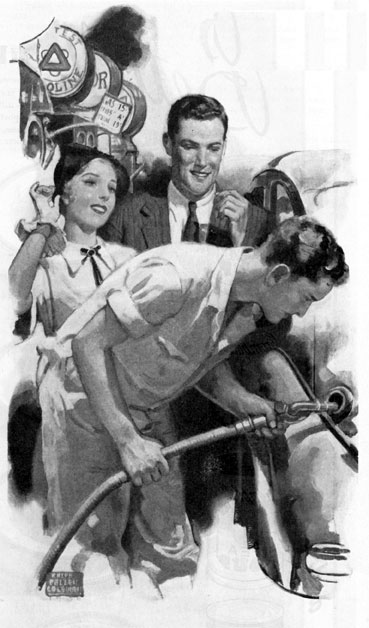
 Remember that issue of Superman where you find out the Man of Steel has always been working with General Zod, and then he kills Jimmy Olsen? Yeah, I don’t either, because it never happened. But it could!