The voice of a bull is not the voice of the cow. The bull growls, a rumble like a train in a tunnel if a train could brood, menace, resent, and pine. He calls, groans, and screams. Pastured away from the herd, a bull who has been a silent lord in their midst bawls his rage and croons his mourning.
Severn Hatch had the farm that you saw on Google Earth as a green eye-patch on a huge gray face. The face was the roofs of 6,000 houses, the farm a round-edged square. From above, it made its statement: I won’t sell. From the roads bordering it, or streets as they were now, it was a kind of theme park. It had a gate and a painted sign SEVERN swinging from a post; it had a grate for keeping cattle in, a barn, a silo, and a pond. It had tractors that could be heard in the mornings, and a bull. Hatch kept his bull long after the herd was gone.
The place and the man were named for a town in North Carolina where Severn Hatch had been born, on his grandparents’ farm where his young parents were waiting out the Depression. After giving birth, his mother had died in her childhood bedroom. Along with both of her parents, who were already known to the bootleggers, his father had fallen by the wayside. But after a few years, the father dragged himself up to Virginia where his own people were. He sent for his son, at 8 already lost to the dazed grandparents and the Carolina schools. Schools did not try to hold onto a child as they do now. He never remarried, and his son never returned to school or married either, living on by himself on the dairy farm built up by the father.
Hatch never sold an acre. He sold his herd a few at a time as the demands of milking got too much for him and as tenants came and went in the little house his father had built and kept up. A dairy that size had to have a tenant or a hired man. Every few years, he went as his father had done and painted the house, working with whoever the tenant was, until he couldn’t find one for the job.
Severn Hatch’s last Holstein bull could get past a fence and did so, as bulls do, with some regularity. When his fields had bordered another herd’s fields — for the change to house lots proceeded in a slow, circling way at first — he was just a visitor. “Lucky to have him stop by and improve the herd,” Hatch would say when a neighbor complained. And in truth the bull came from a good line, and there were still a couple of farmers in the southwestern part of the state who used him as a sire, and that was why Hatch said he kept him, even though eventually he had to drive out some way to get feed and salt blocks.
In the early days, the bull could be brought in from his searching, run back onto his own land by Hatch, a waving stick, and a good dog. Now he was taller than a man and weighed something over a ton. Older and craftier, he was harder to get back in.
Up in his 70s, Hatch could be seen in the Walmart parking lot searching for his bull. He drove all over now instead of walking the fields and roads in a grid that had at one time taken him all day. Nobody outside a few stores knew him, so nobody knew his purpose, though everybody knew the farm, noted on zoning maps as “Severn Farm, Landmark,” and the bull on the highway or growling up a ramp into a battered truck at Walmart was part of county lore. People would get out of the way, but many did not know to be afraid of an animal. Hatch’s clothing did not give him away as the owner, as people of all ages dressed like farmers by then, even in the electronics parks.
At the far end of that parking lot one day, he had a stroke. He was found lying down beside his truck, and when he woke up in the hospital, he started raving about his bull. He got his words back right away, but all he did was call out “Tarnation!” The nurse figured out it was a name. She put it all together. She became the one he talked to in his dread over the next days, when no news of the bull reached them. She was a popular nurse known in the hospital as Kimberly One, because she claimed to be the first person in the U.S. to bear the name.
“Tarnation. I’ve heard of that guy,” she said. “My grandpa farmed here.”
“He’s got to eat,” Hatch said. “Got to have feed. Got to have pills.”
“You worry about your own pills,” Kimberly said. “I’ll find out where he is. Somebody has him, I know.”
“Who would that be?” said Hatch rudely. “Holstein bull is a dangerous animal.”
“Is he mean?”
“Mean he is not. Ah!”
“What? What hurts?”
“Everything,” said Hatch. “How old are you?”
“I’m 56.”
“He’s cute,” she said at the nurse’s station.
“To each his own.”
“No, really, there must be some news of this critter.”
They did find out. The bull had been bumped and thrown by a semi coming off the freeway. By some miracle, he was alive at a large animal vet in the next county, with some stitched-up gashes but no bones broken. Hatch left the hospital in his pressure socks — they had taken his shoes from him — but Kimberly caught up with him in her car and drove him so fast they got stopped for a warning. It was a clear day in March, and the construction sites thinned out as they drove until they were passing between fields starting to show the green of some leaf crop. She said, “What’s that?”
Hatch said, “Couldn’t say,” though he knew every green thing in state soil. Despite the seatbelt she had made him put on, he had himself pressed against the door.
To Kimberly’s eyes, the bull was as big as an elephant in the hoist, gleaming stark black and white against the bandages and tape. At Hatch’s approach, he rolled his eye back and then swung his huge head to see, knocking the vet’s assistant to his knees in the straw. The head was entirely black with long eyelashes shadowing the ball-eye with its wet red corner. Streaks ran down from the eyes as if he had cried.
Getting to his feet, the assistant had had a look at Hatch’s wet socks. He addressed himself to Kimberly, making the sign of writing a bill. “Come on in when you’re done with your visit.”
“He’s beautiful,” Kimberly said. “I bet you’re gonna say don’t touch him.”
“Better not.” Hatch placed his fingers behind the black jaw and bowed his head. “Heart going,” he said after a time.
“Fever.”
“I think he’s just worked up,” said Kimberly. “Because you caught up with him. Everything he’s been through and then you show up. You love this guy.”
Though movies and popular television like to depict acts of respect and chivalry for one’s adversaries on the battlefields of yore, the idea of nonpartisan, humanitarian aid to all victims of war and disaster is not as old as you might think.
When the Civil War began in 1861, Clara Barton was just another clerk at the Patent Office in Washington, D.C. Barton’s great crusade, which helped define modern humanitarianism, began when she saw soldiers crowding into the city without food or shelter prepared for them. More importantly, there was not enough medical care for wounded soldiers returning from the front.
She began distributing food and supplies to sick and wounded soldiers in the area but soon realized there was an even greater need for her services closer to the battlefield. After receiving permission to travel to the front lines, she started delivering medical supplies and tending to wounded soldiers right on the fields of battle, often risking her life to do so. Eventually, army commanders recognized the good work she was doing and gave her responsibility for all the Union’s hospitals along the James River.
After the war, Barton continued her humanitarian work by helping relatives find the remains of 22,000 soldiers who’d been reported missing. She also helped identify — and bury — 13,000 casualties of the Andersonville Prison Camp in Georgia.
After four years of this work, Barton took a break and visited Europe. But any chance for a restful vacation ended when she learned of the International Committee of the Red Cross (ICRC), which had been founded in Geneva in 1864. She was drawn to its mission of providing international aid to protect the sick and wounded on all sides in war.
Barton stayed to help civilians caught up in the Franco-Prussian War, and when she returned to the States, she urged the U.S. government to sign the Geneva Treaty that created the ICRC. U.S. approval to join the international organization came in 1881, and the American Red Cross was incorporated on May 21 of that year.
Now, 135 years later, the American Red Cross is still going strong, providing shelter, food, and healthcare services at roughly 70,000 disasters every year, from single-home fires to earthquakes that affect millions. Its blood program collects, tests, and types over 40 percent of the country’s blood supply. It delivers needed services to 150,000 military families each year, including training and support for wounded veterans. The Red Cross also provides training in first aid, CPR, and lifeguarding.
As part of an international organization, it joins the Red Cross in 187 countries to help over 100 million people worldwide every year.
In 1878, when the item below appeared in the Post, few readers would have heard of the Red Cross, which is why the author felt the need to describe the organization’s symbol and mission. Though the ICRC’s original focus was the treatment of war wounded, this uncredited news item shows that Barton already had a broader vision for the Red Cross. Under her direction, the American Red Cross — and eventually the ICRC — would provide aid to survivors of natural disasters, including forest fires, floods, and famines.
Note: The Howard Association referred to in this article was a relief organization set up in 1855 to help victims of the viral Yellow Fever epidemic in Norfolk, Virginia.
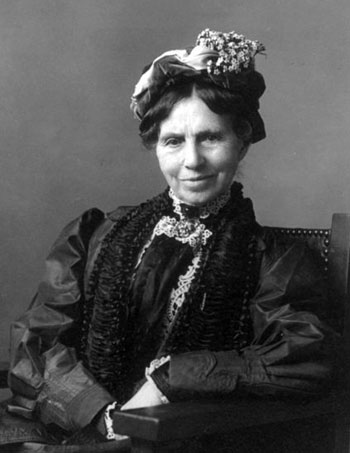
Clara Barton Elmer Chickering [Public domain], via Wikimedia CommonsOriginally published on December 28, 1878
Miss Clara Barton, who has been termed the Florence Nightingale of America, has issued a pamphlet on the subject of establishing a “Red Cross Society” in this country which will be a branch of that great international humane association whose symbol — the red cross on a white ground — has carried succor and help to so many scenes of distress.
While the aim of the relief societies which have carried on their work under the name of the Red Cross has been to ameliorate the condition of wounded soldiers, it is also intended to furnish relief and assistance to sufferers in time of great national calamities such as plagues, cholera, yellow fever, devastating fires or floods, railway disasters, mining catastrophes, etc.
The readiness of organizations like those of the “Red Cross,” to extend help at the instant of need, renders the aid of quadruple value and efficiency, as compared to that gathered together hastily and irresponsibly in the bewilderment and shock which always accompanies such calamities, and which prove to be obstacles rather than aids to the cause.
The trained nurses and also attendants subject to the relief societies, in such causes would accompany the supplies sent, and remain in action as long as needed. Organized in every state, the relief societies of the Red Cross would be ready with money, nurses and supplies, to go on call to the instant relief of all who were overwhelmed by any of those sudden calamities which occasionally visit us. In case of yellow fever, there being an organization in every state, the nurses and attendants would be first chosen from the nearest societies, and being acclimated would incur far less risk to life than if sent from distant localities.
The work of the Howard Association during the late Southern affliction is a substantial proof of the success of a trained relief organization, and the desirability of Miss Barton’s plan is so obvious, it should be heartily sustained by every state.
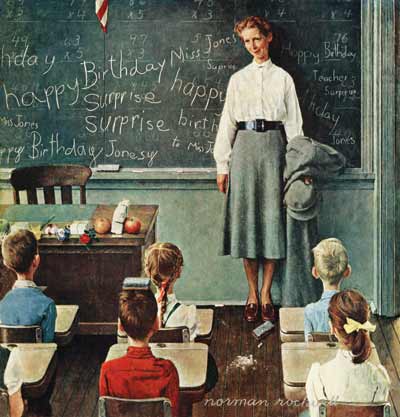
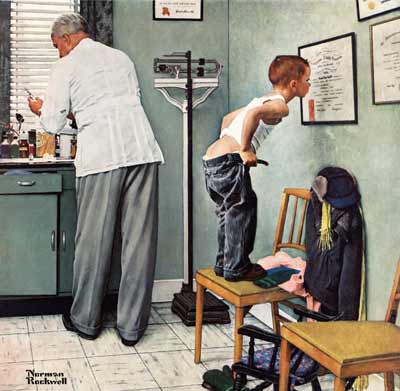
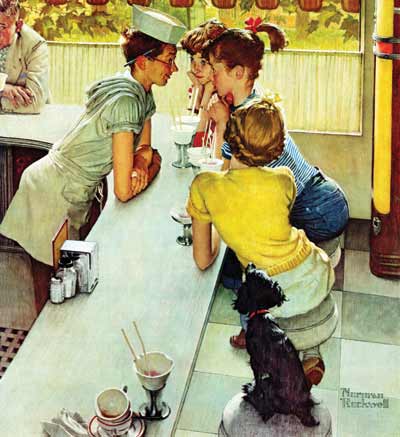
Throughout history, most great artists have been storytellers, whether in paintings scratched out on the walls of caves to chronicle the hunt or, later, in lush canvases and intricate frescoes to interpret scenes from the Bible or to record great battles. Norman Rockwell comes from just such a tradition.
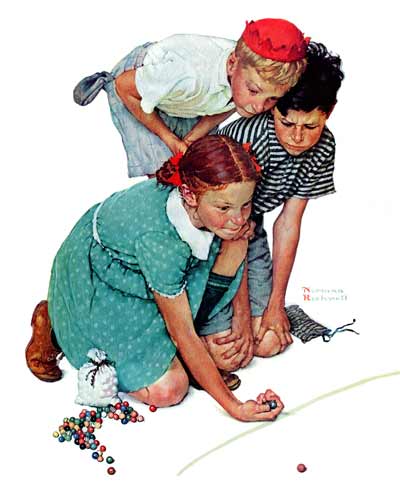
Ordinary people doing ordinary things were his subjects for the most part. “The commonplaces of America are to me the richest subjects in art,” Rockwell wrote in 1936. “Boys batting flies on vacant lots; little girls playing jacks on the front steps; old men plodding home at twilight, umbrellas in hand — all of these things arouse feeling in me. Commonplaces never become tiresome. It is we who become tired when we cease to be curious and appreciative.”
The public adored Rockwell from the start, says Laurie Norton Moffatt, director and CEO of the Norman Rockwell Museum. If, in the postwar world of abstract expressionism, folks stared in befuddlement at Ad Reinhardt’s black-on-black canvases or Jackson Pollock’s splatter paintings, Rockwell’s work was a breath of fresh air.
“We know from the fan mail received at The Saturday Evening Post that people were extraordinarily attentive to his work, even to the point of catching him out on details if something was a little off about the picture,” she says. “But most of the letters were accolades of how much they were moved, or touched, by a particular picture.”
Rockwell famously put in long hours, heading off to his studio seven days a week, holidays included. Joseph Csatari, who served for eight years as art director for Rockwell’s Boy Scout paintings, recalls that the artist needed a daily intervention just to pry him away from his easel: “Every day at 11 o’clock, Rockwell’s wife Mary would knock on the studio door to remind him to take a break. ‘If I didn’t,’ she would say, ‘he’d work through dinner.’”
Rockwell’s total production was staggering. In his lifetime, he painted nearly 4,000 images, including 800 magazine covers — 322 for this magazine alone — and ad campaigns for more than 150 companies.
Today his paintings are more popular than ever, commanding eight-figure fees from collectors and drawing crowds to museums. Among his better-known fans are film directors George Lucas and Steven Spielberg. Both speak reverently of the artist’s storytelling skills, likening his paintings to film. “He was able to sum up the story and … understand who the people were, what their motives were, everything in one little frame,” Lucas said in an interview. “I think he’s left a legacy that’ll never be forgotten.”
But for all his popularity, and, in fact, because of it, Rockwell was for most of his lifetime a flop in the eyes of the art world. “His success was his failure,” wrote Arthur Danto in a 1986 review in The New York Times, adding, “He possessed a demonic gift for likenesses, but an appalling lack of taste.”
As Moffatt tells it, he was approached by young art students during a visit to the Art Institute of Chicago in 1949 and asked by one, “You’re Norman Rockwell, right?” Touched with pride at being recognized, he was stung by the comment, “My art professor says you stink!”
Rockwell was well aware that he was out of step with the elites of the art world. “I have always wanted everybody to like my work,” he writes in his autobiography. “I could never be satisfied with just the approval of the critics (and boy, I’ve certainly had to be satisfied without it).”
Understanding the criticism Rockwell endured for much of his career requires some perspective about the history of American art, which went through seismic upheavals during his lifetime. Early in the 20th century, classically trained illustrators were national celebrities and trendsetters — admired and emulated the way sports figures and actors are today. “When you look at the 1920s, illustrators like John Held Jr., who was setting flapper fashions, or his forebears Charles Dana Gibson, who created the Gibson Girl, or J.C. Leyendecker, whose ads for Arrow shirts defined the styles and the fashions of the day — these illustrators defined how people dressed and acted, and even shaped what they should aspire to be,” Moffatt says.
But change was coming. Art historians point to the 1913 Armory show in New York as a critical turning point. Today, it’s hard to imagine the uproar the show caused. Nearly 90,000 people came to see the exhibition, which featured then-unknown-in-America artists such as Georges Braque, Mary Cassatt, Paul Cezanne, Edgar Degas, Pablo Picasso, and many others. The abstraction — Cubism! Fauvism! — was a pie in the face of the classical tradition, and many viewers were outraged.
“For the very first time, American artists were introduced to the breaking down of form, of color, anatomy not being presented realistically,” Moffatt says. “American artists realized they had a choice. Many went to Europe to study these new styles, and you began to have this division. Artists could stay in the narrative tradition, painting pictures that are about a recognizable subject — pictures that involve people or landscape — or you could choose to go into these more abstracted forms of art.”
Rockwell, born in 1894, also caught the modern art fever, if briefly. At 29, already an established artist for the Post, he traveled to Paris to study the latest fads. Right from the beginning, it was not a perfect fit, as he writes in his autobiography. But, on his return, he attempted an abstract cover for the Post that was quickly and mercifully rejected. “I don’t know much about this modern art, but I know it’s not your kind of art,” the famously taciturn editor George Horace Lorimer told him. “Your kind is what you’ve been doing all along.”
Rockwell did revert to form, of course, but throughout his life, he was occasionally troubled that he was an anomaly among the leading artists of his day. “I think any artist who is a creative genius will go through periods of self-doubt,” Moffatt says. “And what comes through in Norman Rockwell’s own autobiography, where he writes about these episodes of depression, is how he always came through them with a burst of creativity where he was painting his absolute best. It’s a measure of his great strength and of his talent and genius.”
That genius must have been evident immediately to Lorimer, who, 100 years ago, bought two of the unknown young artist’s works at first sight. “Even in those early works, Rockwell was already evidencing the deep sense of observation, that keen sense of just how people interact,” Moffatt says. “If you look at the Boy with Baby Carriage, at first it’s all about the humor — the jeering friends running off to play ball while the older brother is stuck babysitting his sister. But as you look more closely, you’re drawn to the detail: the baby bottle in his breast pocket, the bowler hat clipped onto his lapel. I think it is that attention to detail, the little things that spark the humor, and that always take you a little deeper into the picture, that is the hallmark of his great talent.
“So you have an editor who is very skilled and who knows what he likes, who knows what will work for the Post, and he gave Rockwell a tremendous chance, and of course Rockwell never looked back, and he never let Lorimer down.” (For the full story of Rockwell’s thrilling initial encounter with the Post, see “A Fruitful Relationship,” by granddaughter Abigail Rockwell.)
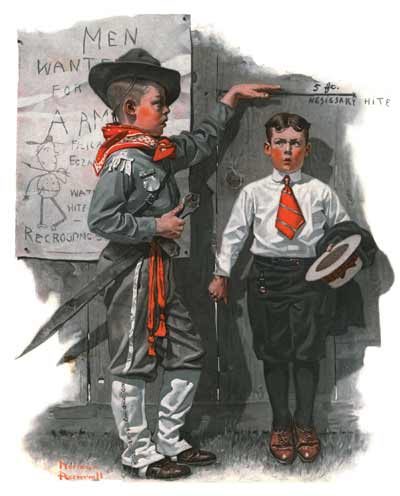
There is an additional layer of meaning when you consider the historical backdrop of many of Rockwell’s works. Citing Recruiting Officer, from the June 16, 1917, cover (above), Moffatt notes the obvious storyline — two kids are play-acting as soldiers out in the yard, and one kid isn’t measuring up: “He’s not tall enough to be recruited as a soldier, and the other young man has a wooden sword, and he has this bandana on, and he’s in his scout uniform. What one would have known at that time is that World War I was going on, so Rockwell is incorporating the larger narrative of world events into this narrowly focused microcosm of two kids in the backyard playing. There are so many things to talk about in these pictures beyond the first sort of joke that might stand out to us.”
But, always, the warmth shines through. “It has to be kept in mind that he’s doing all these paintings through the influenza epidemic, through the Great Depression, through the worst wars in the history of the world,” says Pulitzer Prize-winning historian David McCullough. “Yet he maintains a positive theme. Rockwell is like the minister who gives an encouraging sermon every week, and keeps the faith in the American ideal.”
McCullough has a unique perspective on Rockwell, having spent a day with the artist when he was still a student at Yale and contemplating becoming an artist himself.
McCullough painted an illustration that was used for the cover of the program of the Yale-Dartmouth football game. “I was a great admirer of Rockwell, and the drawing — a father and son attending a football game — was very much in the Rockwell spirit.”
A classmate of McCullough’s who lived in the Berkshires near Rockwell arranged for the two to meet. “Rockwell could not have been nicer,” McCullough recalls. “I went up to meet him at his studio, above a store on the main street of the town. He was like a character from his paintings — a small, frail, bent-over man, physically not impressive at all, but his spirit was strong. There was no sense that I was in the presence of some great artistic genius. He struck me as a man who didn’t have much time for ego. He was too busy having the best of life through his work.”
McCullough spent the better part of the day with Rockwell. He watched him paint. Then they went to Rockwell’s home and had lunch, and Rockwell was quite encouraging about the young man’s artwork. “It could not have been a more memorable experience. He was one of my heroes,” McCullough says.
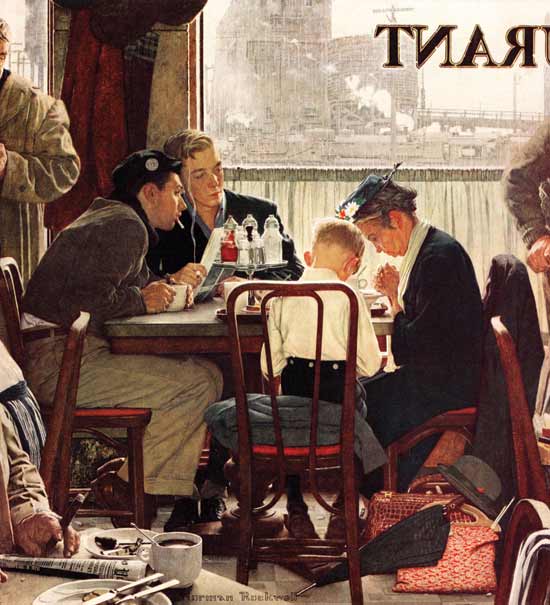
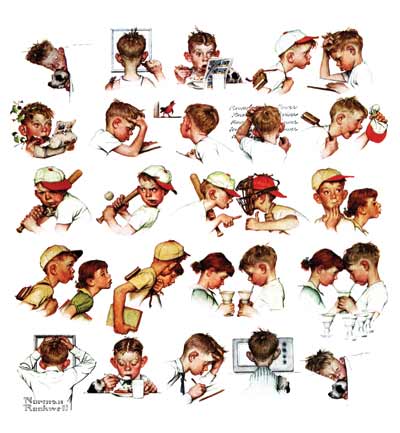
Today, the richness and depth — and yes, the earnest good nature — of Rockwell’s artwork is finally appreciated. (In 2014, Rockwell’s Saying Grace sold for $46 million, setting a record for his work.) But through much of the 20th century, while Rockwell was paid well, the paintings themselves had little or no value — they were merely the medium for delivering his pictures to the printed page. As an example, when the artist donated his canvas of Day in the Life of a Boy to the town’s Community Club for its annual raffle, the work raised a grand total of 50 cents.
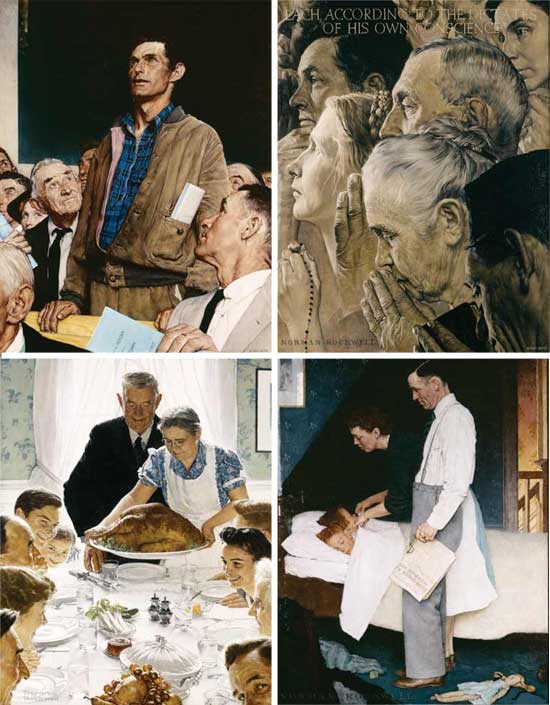
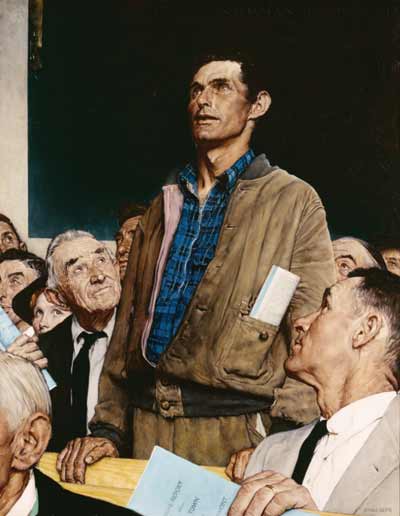
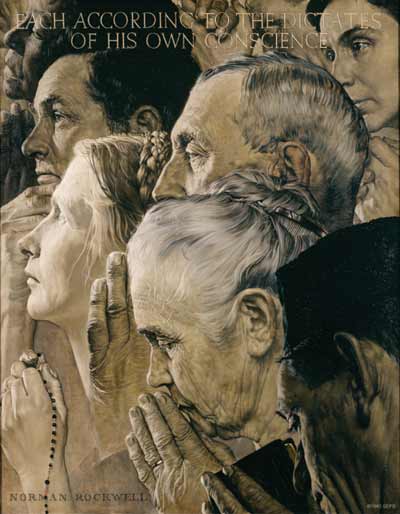
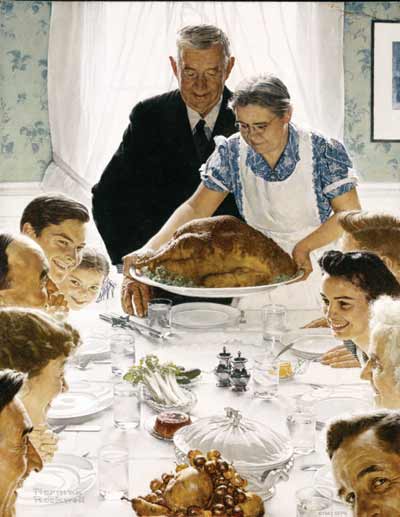
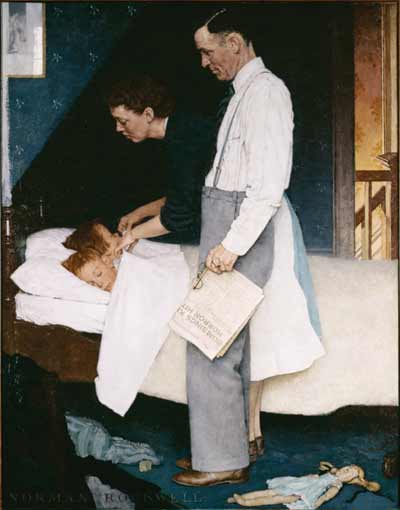
Another anecdote that reflects Rockwell’s modesty about his own canvases comes from Csatari: “On one of my early visits to Stockbridge, I took a walk over to the Old Corner House museum to see some of Norman’s paintings while he took his nap. At the museum, I entered a room that held his Four Freedoms. I remember feeling as if I were in church. But in an instant, the reverence was broken. I saw painters on ladders slapping white latex on the ceiling and spattering the paintings below. I was stunned. I hurried back to the studio to tell Norman, who was back at his easel. He took a thoughtful puff of his pipe, then smiled and said, ‘Gee, Joe, maybe they’ll improve ’em.’”
How did Rockwell’s reputation rebound? As early as 1946, the renowned author of art instruction books Arthur Guptill published Norman Rockwell, Illustrator, a book that celebrated his work, notes Moffatt. But it wasn’t until 1968 that there was any serious interest in his original canvases. Rockwell was caught off guard when New York gallery owner Bernie Danenberg called him one afternoon in July 1968 to suggest mounting a show.
“I’m sorry,” Rockwell said, “but I think you have the wrong artist.”
Danenberg insisted he was not mistaken and drove up to Stockbridge the next day with his gallery manager. Arriving in town, they proceeded directly to his studio. Treasures abounded. Danenberg instantly fell for Lift Up Thine Eyes, a painting that depicted city people rushing past a beautiful old Manhattan church, oblivious to its beauty. The art dealer offered to buy the painting on the spot for $2,500. Rockwell at first refused to accept any money for the painting, saying, “I got paid for it once. I don’t need to be paid again.”
Danenberg persisted, and Rockwell ultimately agreed to sell the painting. He also agreed to schedule an exhibition for October of the same year. As art blogger Ann Restak writes, the exhibition marked the first time that Rockwell sold an original illustration as artwork.
There was a second gallery exhibition in 1972 and another traveling exhibition organized by the Brooklyn Museum. So one could regard the early ’70s as something of a turning point for Rockwell. “He went from being an artist on the cover of magazines to an artist who had his paintings on the walls of museums and galleries,” Moffatt says.
Collectors slowly began to take notice. “We see, around 1978, the very first auctions of Rockwell’s work in the major auction houses, such as Sotheby’s and Christie’s,” Moffatt says. “But it was still rare for American illustrators to be sold at art auctions. Honestly, it wasn’t greatly admired by the auctioneer. It would be shown on the back page of the auction catalogue, and sold for very little.”
It wasn’t until 1999, when the Norman Rockwell Museum and the High Museum of Art produced a large-scale exhibition titled Norman Rockwell: Pictures for the American People, that opinion leaders in the insular art world finally came around. The show traveled to seven American cities, ending in New York at the Guggenheim Museum. Now, writes Restak, his work was finally legitimized “in the hallowed halls of a world-class art institution.”
It didn’t hurt that the exhibition catalogue included essays by such authorities as Moffatt; Ned Rifkin, director of the High Museum of Art; and Thomas Hoving, the former director of the Metropolitan Museum of Art. In his essay for the catalogue, Hoving argues that critics must take another look at Rockwell and “place him in his authentic position in art.” He calls Rockwell “one of the most successful visual mass communicators of the century” and points out that “art history, for snobbish reasons, has always been suspicious of artists considered populizers.”
Admiration for Rockwell has only grown as his paintings are exhibited with more frequency. “The experience of viewing an original Rockwell is very profound,” Moffatt says.
“The more people see Rockwell’s work in the original format, the more they are just wowed by what an extraordinary artist he was. You just can’t deny the artistry, the exquisite detail, and, of course, his keen observation of human nature.”
“He had a tremendous respect for the virtues of mankind,” Spielberg has said. “And there was a real sense of community, of family, and especially of nation.”
“Above all, Norman Rockwell was an extraordinarily kind person, and he genuinely loved people,” Moffatt says. “There’s so much anger in our nation today — and a certain amount of coarseness in the culture overall. But when people look at Rockwell’s work, not only do they respect it and like it, I think maybe they long for those qualities to be present once again. Not to go back in time, but to bring forward some of these guiding principles of how society could be.”
How will Rockwell be regarded 100 years from now? “Unabashedly I would say we’ll remember him the way we remember Rembrandt and Michelangelo,” Moffatt says. “Rockwell’s work will be held up and admired, and hold its own, alongside the greatest painters in the world.”
My grandfather once said, “The Post is my best and only opportunity to express myself fully.” He liked to come up with his own stories and tell them his way — and the Post covers were the best way for him to do that. With other illustration work, he was forced to rely on and stay true to someone else’s story. Without the unique opportunity that The Saturday Evening Post presented to him for so many years, it could be argued that Norman Rockwell would not have evolved into the incomparable and beloved storyteller we know today.
Pop, as we called him, always wanted to become a great illustrator — he was driven from the moment he started sketching while his father read Charles Dickens to the family, and later studying the work of other artists: “You start by following other artists — a spaniel. Then, if you’ve got it, you become yourself — a lion.”
His dream was to do a cover for The Saturday Evening Post, but he was haunted by doubts. Only the very best, like J.C. Leyendecker and Coles Phillips, did covers for the Post.
He began to sit alone in the studio he rented with his friend, the noted cartoonist Clyde Forsythe, a copy of the Post spread out before him, allowing himself to dream. He dared to visualize a picture he had painted on its cover. He imagined how many people would see it — one million, even two million? He pictured his name in the lower-right-hand corner. What would it be like if he were the man he wanted to be, a famous illustrator, adored by female fans, his covers displayed on newsstands and tucked in the mailboxes of families around the country? He pictured children fighting over who would get to see the cover first and explore all its details. He even saw himself dining with the Post’s larger-than-life editor, George Horace Lorimer.
One day Clyde found him on the sofa, suffering over the fact that none of this was even close to becoming a reality. Clyde had to convince Pop that he was indeed good enough to attempt a cover. Don’t be intimidated, he said: “Lorimer’s not the Dalai Lama.”
So my grandfather got to work. Two ideas came to him, conjured up from the kind of covers he had admired on the Post. The first was a Gibson Girl kind of painting with a dashing man bending over a sofa to kiss an irresistible, but removed, high-society woman; the second, a young ballerina bowing before an audience in a dramatic spotlight. Clyde took one look at the paintings and exclaimed dryly, “C-R-U-D.” The ballerina, he said, looked like a “tomboy who’s been scrubbed with a rough washcloth and pinned into a new dress by her mother. Forget about what you think the Post is looking for and paint what you do best — kids.”
Pop followed his friend’s advice, completing several paintings and rough sketches to take to the offices of The Saturday Evening Post. For his big meeting, my grandfather bought a brand-new black hat and new suit in a fashionable gray herringbone tweed. He had a custom-made “suitcase” created to take the paintings on the train to the Post in Philadelphia. The problem was, the case looked more like a small black casket. Despairing thoughts followed him all the way. But miracle of miracles, Lorimer accepted two finished paintings and okayed three sketches for future covers. His first cover, Salutation [also called Boy with Baby Carriage], would appear on the cover of The Saturday Evening Post on May 20, 1916 — Pop was only 22 years old.
My grandfather used one of his favorite models, Billy Payne, for all three boys in this first cover. The boy pushing the pram is fully realized and rendered, but the other two boys are poorly done. He should have used three distinct boys to model for the painting. And the dark hollow of the pram and barely visible baby were probably the result of nerves. Pop must have been anxious about painting his first Post cover and perhaps couldn’t quite deal with getting an actual baby as a model with its very real wriggling and crying to contend with.
In later years, he often recalled the fun and hard work of pitching his ideas to Lorimer. He would place the sketches in front of Lorimer on his desk and then act them out to bring the whole picture and story to life in an exciting way:
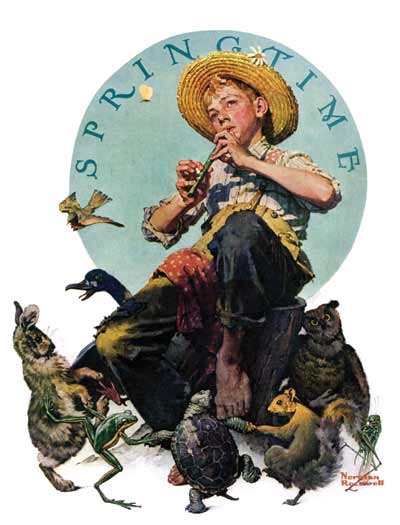
I’d get up from the chair, shake myself and point to one of the sketches on the desk. “Springtime,” I’d say, “a little boy perched on a stump playing a flute.” And I’d sit on the edge of a chair, pull up my legs from the floor in a graceful pose, and make believe I was blissfully blowing a flute. “The kid’s happy,” I’d say. “It’s spring. The sun is warm upon his neck; the bees are buzzing in the flowers. And the little animals are dancing in a ring about the stump. A rabbit, a duck, a frog” — I’d kick up my heels and dance around the chair — “a turtle, a squirrel, an owl, a grasshopper. It’s spring. Everybody’s joyful.”
“Good,” Mr. Lorimer would say, scribbling OKGHL on the side of the sketch.
That particular sketch ended up as Springtime, 1927, the April 16, 1927, cover [above].
My grandfather’s time at The Saturday Evening Post can be divided into three periods corresponding to the three editors, along with one significant art editor, who oversaw the magazine until my grandfather quietly resigned in 1964. The first period, of course, was dominated by the commanding presence of Lorimer. Pop remembered always being greeted by Lorimer standing behind his desk, silhouetted by the light from the two expansive windows behind him. “The Great Mr. George Horace Lorimer, the baron of publishing,” as my grandfather would affectionately refer to him, had a strength and unwavering decisiveness that Pop so admired. Lorimer’s square jaw and commanding eyes projected power softened with kindness. Over the years, Lorimer became a father figure and mentor to my grandfather, even as Pop remained somewhat in awe of the man. (He even sought Lorimer’s approval when marrying his second wife, my grandmother Mary.) When Lorimer resigned in 1936, it was the end of an era.
The second period was a short and difficult one for Pop. Always in fear of the Post dropping him at any moment despite his growing fame, he felt even more precarious when Wesley Stout came on board as editor, succeeding Lorimer. Stout lacked Lorimer’s decisiveness. He seemed to look for what was wrong in each of my grandfather’s paintings instead of what was right. This whittled Pop’s confidence down until he didn’t feel good about any of the work he was turning in.
But five years later, Ben Hibbs replaced Stout as editor. He was a Midwesterner, much more casual, and he genuinely liked my grandfather’s work. He resurrected The Saturday Evening Post at a time when the magazine desperately needed it. He had the cover redesigned so that full paintings were shown, not just vignettes of one or two people with almost no background. The logo was streamlined into a more modern font in the top-left corner. This freed Pop to take his stories to a whole new level of detail, atmosphere, and character. And Hibbs supported Rockwell. He was the one, after all, who enthusiastically accepted and championed the Four Freedoms, publishing them inside the Post after the government rejected them. (The government would later relent, touring the paintings around the country to raise money for war bonds. The exhibition would raise more than $132 million.)
While Hibbs was editor, Ken Stuart came in as art editor in 1945, muddying the waters somewhat. He is credited with changing the direction of the content of the covers, moving them toward the celebration of America and loftier, more expansive ideas. But Stuart was a small man with a tremendous ego; he wanted to dictate ideas to his artists and control them. He had been an illustrator himself before becoming an art editor and perhaps felt entitled to have that much input. But my grandfather felt that Stuart over-directed at times. Their relationship was conflicted at best. The low point in their working relationship came when Stuart went so far as to paint a horse out of one of Pop’s covers, Before the Date, September 24, 1949, without telling him.
Pop threatened to leave the Post. And my grandmother, Mary, was absolutely furious; she had never liked Stuart. But things settled down after it was arranged that Bob Fuoss, the managing editor, and Hibbs would oversee all matters regarding my grandfather. Pop’s attitude then seemed to soften toward Stuart. He even did what he could to butter him up, inviting him to my parents’ New York City wedding in the ’50s.
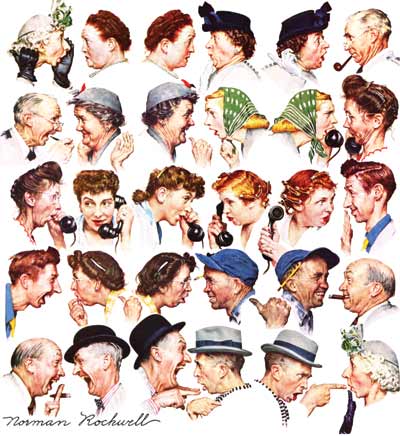
Still, that long-ago bitterness between the two men lingers today. Stuart claimed that Pop “gifted” several paintings to him, Saying Grace, The Gossips, and Walking to Church. No communications were found from my grandfather to Stuart other than Pop asking for his paintings to be returned in the ’50s and Stuart refusing this request, citing company policy. My grandfather felt that Stuart simply took the paintings out of the Curtis building one day and held on to them. The Stuart sons recently sold Saying Grace, my grandfather’s most popular cover, and the two other paintings at Sotheby’s for $57.3 million, a figure that would have astonished and probably embarrassed my grandfather.
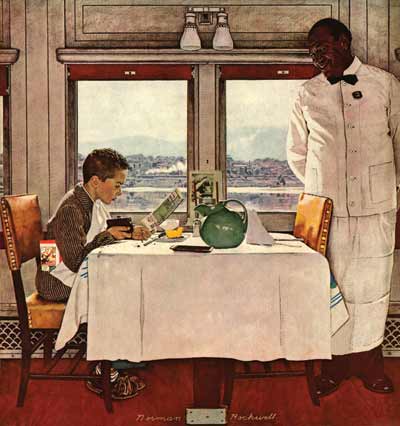
Most people today do not realize that during Pop’s tenure, The Saturday Evening Post prohibited its artists from painting people of ethnicity in any role other than a subservient one. This never sat well with my grandfather. He would sneak African Americans and people of other ethnic backgrounds into his paintings where he could — Statue of Liberty, July 6, 1946, for example. He cleverly turned this policy on its head in his December 7, 1946, cover, New York Central Diner. In it, a young boy in the train’s dining car is trying to figure out the check. But it is an African-American man, the waiter, who is the heart of this painting. The viewer’s eye goes to him because his presence is so immediately felt; he radiates such kindness and amusement at the boy’s dilemma.
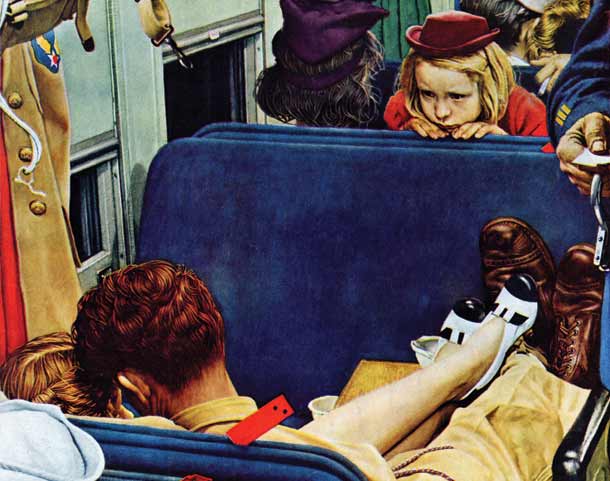
In my grandfather’s paintings, everything is said without words. The entwined legs of the two lovers in Voyeur, August 12, 1944 (page 39), reveal a quiet, unspoken, and immediate intimacy — and are the most prominent visual — though the little girl in red sneaking a look at them is sharing in their secret. It is one of my grandfather’s more intimate works, yet it takes place in a very public space, the brightly lit passenger car of a train. This contrast makes the cover touching and effective. The exposing overhead light doesn’t matter to the two lovers who are in their own private world, not even noticing the little girl leaning over the seat in front of them. We feel we are an amused, unseen observer on that train. Note the contrast between the young woman’s polished, stylish shoes and the soldier’s lived-in service boots.
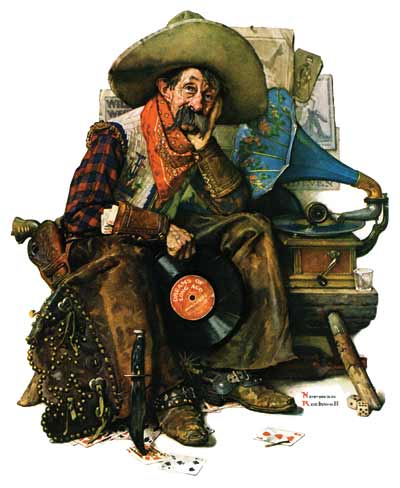
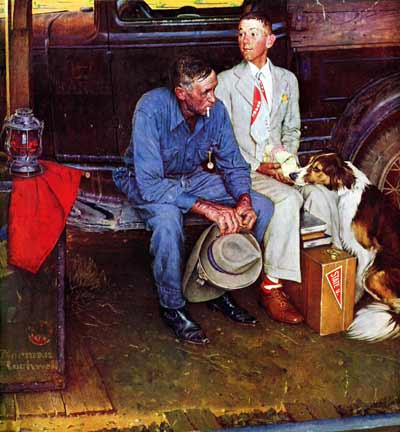
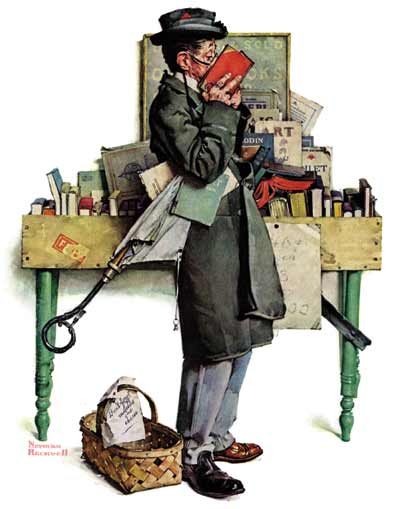
Like Van Gogh, Norman Rockwell was a master of shoes. Shoes can sometimes reveal more about the real life of a character than the face — the wear and tear, even with a good polish, still remains. One could say that the sole reveals the soul. Faces can hide aspects of personality through façades, cosmetic artifice, glasses, expressions, etc. There are many instances of Rockwell’s quiet focus on shoes in the Post — Breaking Home Ties, Tattoo Artist, Rosie the Riveter, The Game (April Fool 1943), New Year’s Eve, Willie Gillis Home on Leave, Hat Check Girl, The Cover Girl (Double Take), Dreams of Long Ago, Star Struck (Boy Gazing at Cover Girls), First in His Class, Full Treatment, Bookworm — as well as in advertising such as Crackers in Bed from the Edison Mazda series, and the list goes on and on. Bookworm actually shows a man wearing two entirely different shoes — a perfect, subtle way to show that this man is in his own world and too distracted to worry about matching shoes!
My grandfather loved to paint older people and children because of the clear contrast they represented: the old visited alongside the new, the unrelenting process of aging that we all have to move through. An older face reveals the trials and tragedies of a full life. There is either a softening or hardening of the features that occurs over time and forever etches itself onto the face — less artifice, even less of an attempt to hide the truth, the failures, the secrets and dreams. Children have an essential purity of reaction and an often unsuppressed sense of play, adventure, and possibility.
Pop always wanted to “get the feel of a place” that he was going to paint. He searched for the smallest details that would make his picture “ring true,” including the actual attire, props, and accessories of the period. That is what makes it so much fun to explore his paintings. Every detail is carefully chosen, a clue, a secret that is connected to the story. He was a “method” actor and director before anyone knew what “method acting” was. Many of his paintings and covers became a sort of sense memory exercise, capturing the atmosphere of the scene he had immersed himself in — whether the smells, sounds, and visuals of a prize fight in New York City or a blacksmith’s shop in a small town in Vermont.
All great art is a search for what is true. And Pop’s entire career was bound up in completing that search. In one example, he spent hours in Louisa May Alcott’s home for his series on Little Women, exploring the attic where she used to do her writing and contemplation. In another, he traveled to Mark Twain’s childhood town of Hannibal to prepare for illustrating Tom Sawyer and Huck Finn. He even went to the extreme of being left alone in Tom Sawyer’s famous cave, where he sketched alone by the light of a flickering lamp.
Rockwell’s vivid imagination was the engine that drove him all those years, an imagination that never tired. But it was often a constant struggle because of periods of self-doubt, and the fear that there was a lack of expansion and growth in his work. It is indeed a revelation to see the progression of his work — to see his vision, technique, and storytelling skill deepening and expanding over the 322 covers he did for the Post between 1916 and 1964. One marvels at his refusal, successful as he was, to stay in one place.
Yet, even as he grew as an artist, his core values never changed. Through almost half a century with The Saturday Evening Post, his work was always rooted in his central belief in the goodness in people. His message: We are struggling, celebrating, learning, and growing each day, and we are all in this together. That is what lives in the best of my grandfather’s work and in the best of all of us.
“It is no exaggeration to say simply that Norman Rockwell is the most popular, the most loved, of all contemporary artists,” Post editor Ben Hibbs said. “While the face of the world was changing unbelievably, Norman has amused, charmed, and inspired a great many millions of Americans. The fact that he has managed to capture the hearts of so many people is easy to understand when you know him, for somehow Rockwell himself is like a gallery of his paintings — friendly, human, deeply American, varied in mood, but full, always, of the zest of living.”
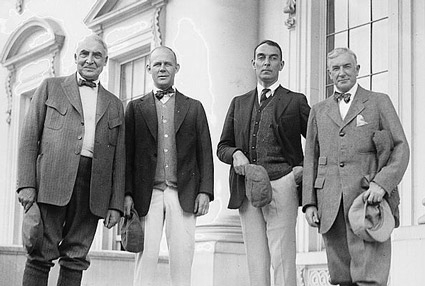
Ring Lardner (second from right) with President Warren G. Harding, Grantland Rice, and Secretary Fletcher
If anyone ever compiles a list of Great Neglected American Writers, Ring Lardner’s name should be close to the top. For years, his short story “Haircut” was routinely included in collections of great American short stories. And Lardner’s book about a bush league pitcher, You Know Me Al, was once taught in American literature classes.
In his lifetime, Lardner was widely respected for his sports journalism and his fiction. He was especially admired for his ability to write vernacular humor, as seen in this story from the Post in 1916.
Baseball writing was his specialty, and he brilliantly captured the slang and accents of ballplayers, enabling him to write about the American sport with a truly American voice. (These stories also provide a rare written record of American informal speech of the 1910s and 1920s.)
He was highly praised by such writing talents as H.L. Mencken, F. Scott Fitzgerald, and Virginia Woolf. Ernest Hemingway was such an admirer that, as a high school student, he wrote under the pen name Ring Lardner, Jr. (The real Ring Lardner Jr. became an Oscar-winning screenwriter who was jailed and blacklisted as one of the Hollywood Ten who were accused of being communists by the House Un-American Activities Committee.)
Though the popularity of his stories faded, the elder Lardner was longer remembered for his sharp, subtle wit, captured in such lines as these:
“The race is not always to the swift nor the battle to the strong—but that’s the way to bet.”
“He looked at me as if I was a side dish he hadn’t ordered.”
“A good many young writers make the mistake of enclosing a stamped, self-addressed envelope, big enough for the manuscript to come back in. This is too much of a temptation to the editor.”
And there’s this frequently quoted exchange from “The Young Immigrunts,” published in the Post in 1920.
“‘Are you lost, Daddy?’ I asked tenderly. ‘Shut up,’ he explained.”
The magazine printed 66 of his stories, most of them featuring Jack Keefe, the bumptious farmboy-turned-pitcher who recounted his baseball career in letters to his friend Al.
What made Lardner’s stories noteworthy was an effective mixture of plotting, skillful dialogue, and deftly applied pathos. Humor doesn’t always age well, but Lardner’s stories have a unique sardonic tone, occasionally edged with sorrow, that put him on the same literary footing as Mark Twain and should earn him a second look today.
Carmen
By Ring W. Lardner
Originally published February 19, 1916
We was playin’ rummy over to Hatch’s, and Hatch must of fell in a bed of four-leaf clovers on his way home the night before, because he plays rummy like he does everything else; but this night I refer to you couldn’t beat him, and besides him havin’ all the luck my Missus played like she’d been bought off, so when we come to settle up, we was plain seven and a half out. You know who paid it. So Hatch says:
“They must be some game you can play.”
“No,” I says, “not and beat you. I can run two blocks w’ile you’re stoopin’ over to start, but if we was runnin’ a foot race between each other, and suppose I was leadin’ by eighty yards, a flivver’d prob’ly come up and hit you in the back and bump you over the finishin’ line ahead o’ me.”
So Mrs. Hatch thinks I’m sore on account o’ the seven-fifty, so she says:
“It don’t seem fair for us to have all the luck.”
“Sure it’s fair!” I says. “If you didn’t have the luck, what would you have?”
“I know,” she says; “but I don’t never feel right winnin’ money at cards.”
“I don’t blame you,” I says.
“I know,” she says; “but it seems like we should ought to give it back or else stand treat, either one.”
“Jim’s too old to change all his habits,” I says.
“Oh, well,” says Mrs. Hatch, “I guess if I told him to loosen up he’d loosen up. I ain’t lived with him all these years for nothin’.”
“You’d be a sucker if you did,” I says.
So they all laughed, and when they’d quieted down Mrs. Hatch says:
“I don’t suppose you’d feel like takin’ the money back?”
“Not without a gun,” I says. “Jim’s pretty husky.” So that give them another good laugh; but finally she says:
“What do you say, Jim, to us takin’ the money they lose to us and gettin’ four tickets to some show?” Jim managed to stay conscious, but he couldn’t answer nothin’; so my Missus says:
“That’d be grand of you to do it, but don’t think you got to.”
Well, of course Mrs. Hatch knowed all the w’ile she didn’t have to, but from what my Missus says she could tell that if they really give us the invitation we wouldn’t start no fight. So they talked it over between themself w’ile I and Hatch went out in the kitchen and split a pint o’ beer, and Hatch done the pourin’ and his best friend couldn’t say he give himself the worst of it. So when we come back my Missus and Mrs. Hatch had it all framed that the Hatches was goin’ to take us to a show, and the next thing was what show would it be. So Hatch found the afternoon paper, that somebody’d left on the street car, and read us off a list o’ the shows that was in town. I spoke for the Columbia, but the Missus give me the sign to stay out; so they argued back and forth and finally Mrs. Hatch says:
“Let’s see that paper a minute.”
“What for?” says Hatch. “I didn’t hold nothin’ out on you.”
But he give her the paper and she run through the list herself, and then she says:
“You did, too, hold out on us. You didn’t say nothin’ about the Auditorium.”
“What could I say about it?” says Hatch. “I never was inside.”
“It’s time you was then,” says Mrs. Hatch.
“What’s playin’ there?” I says.
“Grand op’ra,” says Mrs. Hatch.
“Oh!” says my Missus. “Wouldn’t that be wonderful?”
“What do you say?” says Mrs. Hatch to me.
“I think it’d be grand for you girls,” I says. “I and Jim could leave you there and go down on Madison and see Charley Chaplin, and then come back after you.”
“Nothin’ doin’!” says Mrs. Hatch. “We’ll pick a show that everybody wants to see.”
Well, if I hadn’t of looked at my Missus then we’d of been O.K. But my eyes happened to light on where she was settin’ and she was chewin’ her lips so’s she wouldn’t cry. That finished me. “I was just kiddin’,” I says to Mrs. Hatch. “They ain’t nothin’ I’d like better than grand op’ra.”
“Nothin’ except gettin’ trimmed in a rummy game,” says Hatch, but he didn’t get no rise.
Well, the Missus let loose of her lips so’s she could smile and her and Mrs. Hatch got all excited, and I and Hatch pretended like we was excited too. So Hatch ast what night could we go, and Mrs. Hatch says that depended on what did we want to hear, because they changed the bill every day. So her and the Missus looked at the paper again and found out where Friday night was goin’ to be a big special night and the bill was a musical show called Carmen, and all the stars was goin’ to sing, includin’ Mooratory and Alda and Genevieve Farr’r, that was in the movies a w’ile till they found out she could sing, and some fella they called Daddy, but I don’t know his real name. So the girls both says Friday night was the best, but Hatch says he would have to go to lodge that evenin’.
“Lodge!” says Mrs. Hatch. “What do you care about lodge when you got a chance to see Genevieve Farr’r in Carmen?”
“Chance!” says Hatch. “If that’s what you call a chance, I got a chance to buy a thousand shares o’ Bethlehem Steel. Who’s goin’ to pay for my chance?”
“All right,” says Mrs. Hatch, “go to your old lodge and spoil everything!”
So this time it was her that choked up and made like she was goin’ to blubber. So Hatch changed his mind all of a sudden and decided to disappoint the brother Owls. So all of us was satisfied except fifty percent, and I and the Missus beat it home, and on the way she says how nice Mrs. Hatch was to give us this treat.
“Yes,” I says, “but if you hadn’t of had a regular epidemic o’ discardin’ deuces and treys Hatch would of treated us to groceries for a week.” I says: “I always thought they was only twelve pitcher cards in the deck till I seen them hands you saved up tonight.”
“You lose as much as I did,” she says.
“Yes,” I says, “and I always will as long as you forget to fetch your purse along.” So they wasn’t no comeback to that, so we went on home without no more dialogue. Well, Mrs. Hatch called up the next night and says Jim had the tickets boughten and we was to be sure and be ready at seven o’clock Friday night because the show started at eight. So when I was downtown Friday the Missus sent my evenin’ dress suit over to Katzes’ and had it pressed up and when I come home it was laid out on the bed like a corpse.
“What’s that for?” I says.
“For the op’ra,” she says. “Everybody wears them to the op’ra.”
“Did you ask the Hatches what was they goin’ to wear?” I says.
“No,” says she. “They know what to wear without me tellin’ them. They ain’t goin’ to the Auditorium in their nightgown.”
So I dumb into the soup and fish and the Missus spent about a hour puttin’ on a dress that she could of left off without nobody knowin’ the difference, and she didn’t have time for no supper at all, and I just managed to surround a piece o’ steak as big as your eye and spill some gravy on my clo’es when the bell rung and there was the Hatches.
Well, Hatch didn’t have no more evenin’ dress suit on than a kewpie. I could see his pants under his overcoat and they was the same old bay pants he’d wore the day he got mad at his kid and christened him Kenneth. And his shoes was a last year’s edition o’ the kind that’s supposed to give your feet a chance, and if his feet had of been the kind that takes chances they was two or three places where they could of got away without much trouble.
I could tell from the expression on Mrs. Hatch’s face when she seen our make-up that we’d crossed her. She looked about as comf’table as a Belgium.
“Oh!” she says. “I didn’t think you’d dress up.”
“We thought you would,” says my frau.
“We!” I says. “Where do you get that ‘we’?”
“If it ain’t too late we’ll run in and change,” says my Missus.
“Not me,” I says. “I didn’t go to all this trouble and expense for a splash o’ gravy. When this here uniform retires it’ll be to make room for pyjamas.”
“Come on!” says Hatch. “What’s the difference? You can pretend like you ain’t with us.”
“It really don’t make no difference,” says Mrs. Hatch. And maybe it didn’t. But we all stood within whisperin’ distance of each other on the car goin’ in, and if you had a dollar for every word that was talked among us you couldn’t mail a postcard from Hammond to Gary. When we got off at Congress my Missus tried to thaw out the party.
“The prices is awful high, aren’t they?” she says.
“Outrageous,” says Mrs. Hatch.
Well, even if the prices was awful high, they didn’t have nothin’ on our seats. If I was in trainin’ to be a steeple jack I’d go to grand op’ra every night and leave Hatch buy my ticket. And where he took us I’d of been more at home in overalls and a sport shirt.
“How do you like Denver?” says I to the Missus, but she’d sank for the third time.
“We’re safe here,” I says to Hatch. “Them French guns can’t never reach us. We’d ought to brought more bumbs.
“What did the seats cost?” I says to Hatch.
“One-fifty,” he says.
“Very reasonable,” says I. “One o’ them aviators wouldn’t take you more than half this height for a five-spot.”
The Hatches had their overcoats off by this time and I got a look at their full costume. Hatch had went without his vest durin’ the hot months and when it was alongside his coat and pants it looked like two different families. He had a pink shirt with prune-colored horizontal bars, and a tie to match his neck, and a collar that would of took care of him and I both, and them shoes I told you about, and burlap hosiery. They wasn’t nothin’ the matter with Mrs. Hatch except she must of thought that, instead o’ dressin’ for the op’ra, she was gettin’ ready for Kenneth’s bath.
And there was my Missus, just within the law, and me all spicked and spanned with my soup and fish and gravy! Well, we all set there and tried to get the focus till about a half hour after the show was billed to commence, and finally a Lilliputhian with a match in his hand come out and started up the orchestry and they played a few o’ the hits and then the lights was turned out and up went the curtain.
Well, sir, you’d be surprised at how good we could hear and see after we got used to it. But the hearin’ didn’t do us no good — that is, the words part of it. All the actors had been smuggled in from Europe and they wasn’t none o’ them that could talk English. So all their songs was gave in different languages and I wouldn’t of never knew what was goin’ on only for Hatch havin’ all the nerve in the world.
After the first act a lady that was settin’ in front of us dropped somethin’ and Hatch stooped over and picked it up, and it was one o’ these here books they call a liberetto, and it’s got all the words they’re singin’ on the stage wrote out in English.
So the lady begin lookin’ all over for it and Hatch was goin’ to give it back because he thought it was a shoe catalogue, but he happened to see the top of it where it says “Price 25 Cents,” so he tossed it in his lap and stuck his hat over it. And the lady kept lookin’ and lookin’ and finally she turned round and looked Hatch right in the eye, but he dropped down inside his collar and left her wear herself out. So when she’d gave up I says somethin’ about I’d like to have a drink.
“Let’s go,” says Hatch.
“No,” I says. “I don’t want it bad enough to go back to town after it. I thought maybe we could get it sent up to the room.”
“I’m goin’ alone then,” says Hatch.
“You’re liable to miss the second act,” I says.
“I’d never miss it,” says Hatch.
“All right,” says I. “I hope you have good weather.”
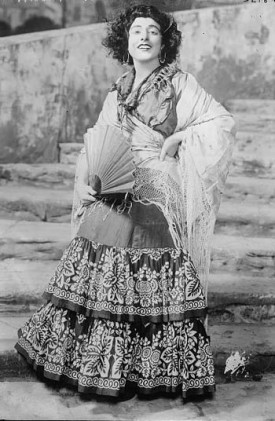
Geraldine Farrar as Carmen. Library of Congress
So he slipped me the book to keep for him and beat it. So I seen the lady had forgot us, and I opened up the book and that’s how I come to find out what the show was about. I read her all through, the part that was in English, before the curtain went up again, so when the second act begin I knowed what had came off and what was comin’ off, and Hatch and Mrs. Hatch hadn’t no idear if the show was comical or dry. My Missus hadn’t, neither, till we got home and I told her the plot.
Carmen ain’t no regular musical show where a couple o’ Yids comes out and pulls a few lines o’ dialogue and then a girl and a he-flirt sings a song that ain’t got nothin’ to do with it. Carmen’s a regular play, only instead o’ them sayin’ the lines, they sing them, and in for’n languages so’s the actors can pick up some loose change offen the sale o’ the liberettos. The music was wrote by George S. Busy, and it must of kept him that way about two mont’s. The words was either throwed together by the stage carpenter or else took down by a stenographer outdoors durin’ a drizzle. Anyway, they ain’t nobody claims them. Every oncet in three or four pages they forget themself and rhyme. You got to read each verse over two or three times before you learn what they’re hintin’ at, but the management gives you plenty o’ time to do it between acts and still sneak a couple o’ hours’ sleep.
The first act opens up somewheres in Spain, about the corner o’ Chicago Avenue and Wells. On one side o’ the stage they’s a pill mill where the employees is all girls, or was girls a few years ago. On the other side they’s a soldiers’ garage where they keep the militia in case of a strike. In the back o’ the stage they’s a bridge, but it ain’t over no water or no railroad tracks or nothin’. It’s prob’ly somethin’ the cat dragged in.
Well, the soldiers stands out in front o’ the garage hittin’ up some barber shops, and pretty soon a girl blows in from the hero’s home town, Janesville or somewheres. She runs a few steps every little w’ile and then stops, like the rails was slippery. The soldiers sings at her and she tells them she’s came to look for Don Joss that run the chop-suey dump up to Janesville, but when they shet down on him servin’ beer he quit and joined the army. So the soldiers never heard o’ the bird, but they all ask her if they won’t do just as good, but she says nothin’ doin’ and skids off the stage. She ain’t no sooner gone when the Chinaman from Janesville and some more soldiers and some alley rats comes in to help out the singin’. The book says that this new gang o’ soldiers was sent on to relieve the others, but if anything happened to wear the first ones out it must of took place at rehearsal. Well, one o’ the boys tells Joss about the girl askin’ for him and he says: “Oh, yes; that must be the little Michaels girl from up in Wisconsin.”
So pretty soon the whistle blows for noon and the girls comes out o’ the pill mill smokin’ up the mornin’ receipts and a crowd o’ the unemployed comes in to shoot the snipes. So the soldiers notices that Genevieve Farr’r ain’t on yet, so they ask where she’s at, and that’s her cue. She puts on a song number and a Spanish dance, and then she slips her bouquet to the Chink, though he ain’t sang a note since the whistle blowed. But now it’s one o’clock and Genevieve and the rest o’ the girls beats it back to the coffin factory and the vags chases down to the Loop to get the last home edition and look at the want ads to see if they’s any jobs open with fair pay and nothin’ to do. And the soldiers mosey into the garage for a well-earned rest and that leaves Don all alone on the stage.
But he ain’t no more than started on his next song when back comes the Michaels girl. It oozes out here that she’s in love with the Joss party, but she stalls and pretends like his mother’d sent her to get the receipt for makin’ eggs fo yung. And she says his mother ast her to kiss him and she slips him a dime, so he leaves her kiss him on the scalp and he asks her if she can stay in town that evenin’ and see a nickel show, but they’s a important meetin’ o’ the Maccabees at Janesville that night, so away she goes to catch the 2:10 and Don starts in on another song number, but the rest o’ the company don’t like his stuff and he ain’t hardly past the vamp when they’s a riot.
It seems like Genevieve and one o’ the chorus girls has quarreled over a second-hand stick o’ gum and the chorus girl got the gum, but Genevieve relieved her of part of a earlobe, so they pinch Genevieve and leave Joss to watch her till the wagon comes, but the wagon’s went out to the night-desk sergeant’s house with a case o’ quarts and before it gets round to pick up Genevieve she’s bunked the Chink into settin’ her free. So she makes a getaway, tellin’ Don to meet her later on at Lily and Pat’s place acrost the Indiana line. So that winds up the first act.
Well, the next act’s out to Lily and Pat’s, and it ain’t no Y.M.C.A. headquarters, but it’s a hang-out for dips and policemans. They’s a cabaret and Genevieve’s one o’ the performers, but she forgets the words to her first song and winds up with tra-la-la, and she could of forgot the whole song as far as I’m concerned, because it wasn’t nothin’ you’d want to buy and take along home.
Finally Pat comes in and says it’s one o’clock and he’s got to close up, but they won’t none o’ them make a move, and pretty soon they’s a live one blows into the joint and he’s Eskimo Bill, one o’ the butchers out to the Yards. He’s got paid that day and he ain’t never goin’ home. He sings a song and it’s the hit o’ the show. Then he buys a drink and starts flirtin’ with Genevieve, but Pat chases everybody but the performers and a couple o’ dips that ain’t got nowheres else to sleep. The dips or stick-up guys, or whatever they are, tries to get Genevieve to go along with them in the car w’ile they pull off somethin’, but she’s still expectin’ the Chinaman. So they pass her up and blow, and along comes Don and she lets him in, and it seems like he’d been in jail for two mont’s, or ever since the end o’ the first act. So he asks her how everything has been goin’ down to the pill mill and she tells him she’s quit and became a entertainer. So he says “What can you do?” And she beats time with a pair o’ chopsticks and dances the Chinese Blues.
After a w’ile they’s a bugle call somewhere outdoors and Don says that means he’s got to go back to the garage. So she gets sore and tries to bean him with a Spanish onion. Then he reaches inside his coat and pulls out the bouquet she give him in Atto First to show her he ain’t changed his clo’es, and then the sheriff comes in and tries to coax him with a razor to go back to his job. They fight like it was the first time either o’ them ever tried it and the sheriff’s leadin’ on points when Genevieve hollers for the dips, who dashes in with their gats pulled and it’s good night, Mister Sheriff! They put him in moth balls and they ask Joss to join their tong. He says all right and they’re all pretty well lit by this time and they’ve reached the singin’ stage, and Pat can’t get them to go home and he’s scared some o’ the Hammond people’ll put in a complaint, so he has the curtain rang down.
Then they’s a relapse of it don’t say how long, and Don and Genevieve and the yeggs and their lady friends is all out in the country somewheres attendin’ a Bohunk Sokol Verein picnic and Don starts whinin’ about his old lady that he’d left up to Janesville.
“I wisht I was back there,” he says.
“You got nothin’ on me,” says Genevieve. “Only Janesville ain’t far enough. I wisht you was back in Hongkong.”
So w’ile they’re flatterin’ each other back and forth, a couple o’ the girls is monkeyin’ with the pasteboards and tellin’ their fortunes, and one o’ them turns up a twospot and that’s a sign they’re goin’ to sing a duet. So it comes true and then Genevieve horns into the game and they play three-handed rummy, singin’ all the w’ile to bother each other, but finally the fellas that’s runnin’ the picnic says it’s time for the fat man’s one-legged race and everybody goes offen the stage. So the Michaels girl comes on and is gettin’ by pretty good with a song when she’s scared by the noise o’ the gun that’s fired to start the race for the bay-window championship. So she trips back to her dressin’ room and then Don and Eskimo Bill put on a little slapstick stuff.
When they first meet they’re pals, but as soon as they get wise that the both o’ them’s bugs over the same girl their relations to’rds each other becomes strange. Here’s the talk they spill:
“Where do you tend bar?” says Don.
“You got me guessed wrong,” says Bill. “I work out to the Yards.”
“Got anything on the hip?” says Don.
“You took the words out o’ my mouth,” says Bill. “I’m drier than St. Petersgrad.”
“Stick round aw’ile and maybe we can scare up somethin’,” says Don.
“I’ll stick all right,” says Bill. “They’s a Jane in your party that’s knocked me dead.”
“What’s her name?” says Don.
“Carmen,” says Bill, Carmen bein’ the girl’s name in the show that Genevieve was takin’ that part.
“Carmen!” says Joss. “Get offen that stuff! I and Carmen’s just like two pavin’ bricks.”
“I should worry!” says Bill. “I ain’t goin’ to run away from no rat-eater.”
“You’re a rat-eater yourself, you rat-eater!” says Don.
“I’ll rat-eat you!” says Bill.
And they go to it with a carvin’ set, but they couldn’t neither one o’ them handle their utensils.
Don may of been all right slicin’ toadstools for the suey and Bill prob’ly could of massacreed a flock o’ sheep with one stab, but they was all up in the air when it come to stickin’ each other. They’d of did better with dice.
Pretty soon the other actors can’t stand it no longer and they come on yellin’ “Fake!” So Don and Bill fold up their razors and Bill invites the whole bunch to come out and go through the Yards some mornin’ and then he beats it, and the Michaels girl ain’t did nothin’ for fifteen minutes, so the management shoots her out for another song and she sings to Don about how he should ought to go home on account of his old lady bein’ sick, so he asks Genevieve if she cares if he goes back to Janesville.
“Sure, I care,” says Genevieve.”Go ahead!”
So the act winds up with everybody satisfied.
The last act’s outside the Yards on the Halsted Street end. Bill’s ast the entire company to come in and watch him croak a steer. The scene opens up with the crowd buyin’ perfume and smellin’ salts from the guys that’s got the concessions. Pretty soon Eskimo Bill and Carmen drive in, all dressed up like a horse. Don’s came in from Wisconsin and is hidin’ in the bunch. He’s sore at Carmen for not meetin’ him on the Elevated platform.
He lays low till everybody’s went inside, only Carmen. Then he braces her. He tells her his old lady’s died and left him the laundry, and he wants her to go in with him and do the ironin’.
“Not me!” she says.
“What do you mean — ‘Not me’?” says Don.
“I and Bill’s goin’ to run a kosher market,” she says.
Just about now you can hear noises behind the scenes like the cattle’s gettin’ theirs, so Carmen don’t want to miss none of it, so she makes a break for the gate.
“Where you goin’?” says Joss.
“I want to see the butcherin’,” she says.
“Stick round and I’ll show you how it’s done,” says Joss.
So he pulls his knife and makes a pass at her, just foolin’. He misses her as far as from here to Des Moines. But she don’t know he’s kiddin’ and she’s scared to death. Yes, sir, she topples over as dead as the Federal League.
It was prob’ly her heart.
So now the whole crowd comes dashin’ out because they’s been a report that the place is infested with the hoof-and-mouth disease. They tell Don about it, but he’s all excited over Carmen dyin’. He’s delirious and gets himself mixed up with a Irish policeman.
“I yield me prisoner,” he says.
Then the house doctor says the curtain’s got to come down to prevent the epidemic from spreadin’ to the audience. So the show’s over and the company’s quarantined.
Well, Hatch was out all durin’ the second act and part o’ the third, and when he finally come back he didn’t have to tell nobody where he’d been. And he dozed off the minute he hit his seat. I was for lettin’ him sleep so’s the rest o’ the audience’d think we had one o’ the op’ra bass singers in our party. But Mrs. Hatch wasn’t lookin’ for no publicity, on account of her costume, so she reached over and prodded him with a hatpin every time he begin a new aria.
Goin’ out, I says to him:
“How’d you like it?”
“Pretty good,” he says, “ only they was too much gin in the last one.”
“I mean the op’ra,” I says.
“Don’t ask him!” says Mrs. Hatch. “He didn’t hear half of it and he didn’t understand none of it.”
“Oh, I wouldn’t say that,” says I. “Jim here ain’t no boob, and they wasn’t nothin’ hard about it to understand.”
“Not if you know the plot,” says Mrs. Hatch.
“And somethin’ about music,” says my Missus.
“And got a little knowledge o’ French,” says Mrs. Hatch.
“Was that French they was singin’?” says Hatch. “I thought it was wop or ostrich.”
“That shows you up,” says his frau.
Well, when we got on the car for home they wasn’t only one vacant seat and, o’ course, Hatch had to have that. So I and my Missus and Mrs. Hatch clubbed together on the straps and I got a earful o’ the real dope.
“What did you think o’ Farr’r’s costumes?” says Mrs. Hatch.
“Heavenly!” says my Missus. “Specially the one in the second act. It was all colors o’ the rainbow.”
“Hatch is right in style then,” I says.
“And her actin’ is perfect,” says Mrs. Hatch.
“Her voice too,” says the wife.
“I liked her actin’ better,” says Mrs. H.
“I thought her voice yodeled in the upstairs registers.”
“What do you suppose killed her?” I says.
“She was stabbed by her lover,” says the Missus.
“You wasn’t lookin’,” I says. “He never touched her. It was prob’ly tobacco heart.”
“He stabs her in the book,” says Mrs. Hatch.
“It never went through the bindin’,” I says.
“And wasn’t Mooratory grand?” says the wife.
“Splendid!” says Mrs. Hatch. “His actin’ and singin’ was both grand.”
“I preferred his actin’,” I says. “I thought his voice hissed in the downstairs radiators.”
This give them a good laugh, but they was soon at it again.
“And how sweet Alda was!” my Missus remarks.
“Which was her?” I ast them.
“The good girl,” says Mrs. Hatch. “The girl that sung that beautiful aria in Atto Three.”
“Atto girl!” I says. “I liked her too; the little Michaels girl. She come from Janesville.”
“She did!” says Mrs. Hatch. “How do you know?”
So I thought I’d kid them along.
“My uncle told me,” I says. “He used to be postmaster up there.”
“What uncle was that?” says my wife.
“He ain’t really my uncle,” I says. “We all used to call him our uncle just like all these here singers calls the one o’ them Daddy.”
“They was a lady in back o’ me,” says Mrs. Hatch, “that says Daddy didn’t appear tonight.”
“Prob’ly the Missus’ night out,” I says.
“How’d you like the Tor’ador?” says Mrs. Hatch.
“I thought she moaned in the chimney,” says I.
“It wasn’t no ‘she’,” says the Missus.
“We’re talkin’ about the bullfighter.”
“I didn’t see no bullfight,” I says.
“It come off behind the scenes,” says the Missus.
“When was you behind the scenes?” I says.
“I wasn’t never,” says my Missus. “But that’s where it’s supposed to come off.”
“Well,” I says, “you can take it from me that it wasn’t pulled. Do you think the mayor’d stand for that stuff when he won’t even leave them stage a box fight? You two girls has got a fine idear o’ this here op’ra!”
“You know all about it, I guess,” says the Missus. “You talk French so good!”
“I talk as much French as you,” I says. “But not nowheres near as much English, if you could call it that.”
That kept her quiet, but Mrs. Hatch buzzed all the way home, and she was scared to death that the motorman wouldn’t know where she’d been spendin’ the evenin’. And if they was anybody in the car besides me that knowed Carmen it must of been a joke to them hearin’ her chatter. It wasn’t no joke to me though. Hatch’s berth was ’way off from us and they didn’t nobody suspect him o’ bein’ in our party. I was standin’ right up there with her where people couldn’t help seein’ that we was together.
I didn’t want them to think she was my wife. So I kept smilin’ at her. And when it finally come time to get off I hollered out loud at Hatch and says:
“All right, Hatch! Here’s our street. Your Missus’ll keep you awake the rest o’ the way with her liberetto.”
“It can’t hurt no more than them hatpins,” he says.
Well when the paper come the next mornin’ my Missus had to grab it and turn right away to the place where the op’ras is wrote up. Under the article they was a list o’ the ladies and gents in the boxes and what they wore, but it didn’t say nothin’ about what the gents wore, only the ladies. Prob’ly the ladies happened to have the most comical costumes that night, but I bet if the reporters could of saw Hatch they would of gave him a page to himself.
“Is your name there?” I says to the Missus.
“O’ course not,” she says. “They wasn’t none o’ them reporters tall enough to see us. You got to set in a box to be mentioned.”
“Well,” I says, “you don’t care nothin’ about bein’ mentioned, do you?”
“O’ course not,” she says; but I could tell from how she said it that she wouldn’t run downtown and horsewhip the editor if he made a mistake and printed about she and her costume; her costume wouldn’t of et up all the space he had neither.
“How much does box seats cost?” I ast her.
“About six or seven dollars,” she says.
“Well,” I says, “let’s I and you show Hatch up.”
“What do you mean?” she says.
“I mean we should ought to return the compliment,” says I. “We should ought to give them a party right back.”
“We’d be broke for six weeks,” she says.
“Oh, we’d do it with their money like they done it with ours,” I says.
“Yes,” she says; “but if you can ever win enough from the Hatches to buy four box seats to the op’ra I’d rather spend the money on a dress.”
“Who said anything about four box seats?” I ast her.
“You did,” she says.
“You’re delirious!” I says. “Two box seats will be a plenty.”
“Who’s to set in them?” ast the Missus.
“Who do you think?” I says. “I and you is to set in them.”
“But what about the Hatches?” she says.
“They’ll set up where they was,” says I. “Hatch picked out the seats before, and if he hadn’t of wanted that altitude he’d of bought somewheres else.”
“Yes,” says the Missus, “but Mrs. Hatch won’t think we’re very polite to plant our guests in the Alps and we set down in a box.”
“But they won’t know where we’re settin’,” I says. “We’ll tell them we couldn’t get four seats together, so for them to set where they was the last time and we’re goin’ elsewheres.”
“It don’t seem fair,” says my wife.
“I should worry about bein’ fair with Hatch,” I says. “If he’s ever left with more than a dime’s worth o’ cards you got to look under the table for his hand.”
“It don’t seem fair,” says the Missus.
“You should worry!” I says.
So we ast them over the followin’ night and it looked for a minute like we was goin’ to clean up. But after that one minute my Missus begin collectin’ pitcher cards again and every card Hatch drawed seemed like it was made to his measure. Well, sir, when we was through the lucky stiff was eight dollars to the good and Mrs. Hatch had about broke even.
“Do you suppose you can get them same seats?” I says.
“What seats?” says Hatch.
“For the op’ra,” I says.
“You won’t get me to no more op’ra,” says Hatch. “I don’t never go to the same show twicet.”
“It ain’t the same show, you goof!” I says. “They change the bill every day.”
“They ain’t goin’ to change this eight-dollar bill o’ mine,” he says.
“You’re a fine stiff!” I says.
“Call me anything you want to,” says Hatch, “as long as you don’t go over eight bucks’ worth.”
“Jim don’t enjoy op’ra,” says Mrs. Hatch.
“He don’t enjoy nothin’ that’s more than a nickel,” I says. “But as long as he’s goin’ to welsh on us I hope he lavishes the eight-spot where it’ll do him some good.”
“I’ll do what I want to with it,” says Hatch.
“Sure you will!” I says. “You’ll bury it. But what you should ought to do is buy two suits o’ clo’es.”
So I went out in the kitchen and split a pint one way.
But don’t think for a minute that I and the Missus ain’t goin’ to hear no more op’ra just because of a cheap stiff like him welshin’. I don’t have to win in no rummy game before I spend.
We’re goin’ next Tuesday night, I and the Missus, and we’re goin’ to set somewheres near Congress Street. The show’s Armour’s Do Re Me, a new one that’s bein’ gave for the first time. It’s prob’ly named after some soap.
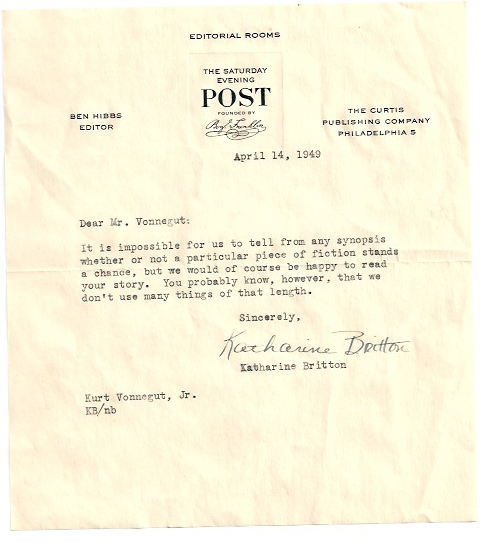
Nine years after his passing, Indianapolis native Kurt Vonnegut is still making a difference in the city that raised him. And if a fundraising effort is successful, the Kurt Vonnegut Memorial Library plans to do even more good in his name.
In January 2011, in a 1,100-square-foot space donated by a local law firm, the Kurt Vonnegut Memorial Library opened as “a nonprofit museum and cultural resource center dedicated to championing the life of Hoosier author Kurt Vonnegut and the principles of free expression, common decency, and peaceful coexistence he advocated.” From the beginning, the KVML was active in the Indianapolis community, promoting Banned Books Week, offering classes that teach teachers how to teach Vonnegut, sponsoring the annual VonnegutFest around his November 11 birthday, and hosting numerous arts and humanities events — 70 in 2015 alone. It quickly drew a nationwide audience of writers, artists, scholars, and book lovers.
“When the Vonnegut Library opened five years ago, it introduced a whole new generation to the life’s work of one of our city’s finest native sons,” Indianapolis mayor Joe Hogsett said. “The Library has been recognized as one of the things that makes Indianapolis so distinct. It is such a rare place, and indeed one of our great treasures.”
In partnership with the City of Indianapolis and other organizations, the KVML has announced that 2017 will be the Year of Vonnegut throughout Indiana’s state capital. One major milestone in this yearlong celebration will be the KVML’s move from the historic Emelie Building to its permanent and much larger home in Indianapolis’ arts district. The new location, at 646 Massachusetts Avenue, is just blocks away from both Pamela Bliss’ three-story-high Kurt Vonnegut mural and the Athenaeum Building, which was designed by Kurt’s grandfather.
[UPDATE: Because of some problems at the location, the KVML did not move to Massachusetts Avenue but to a wonderful, three-story space at 543 Indiana Avenue, not far from the Madame C.J. Walker Legacy Center.]
With the change in venue comes a change in name as well. When the new location opens on April 11, 2017, the 10th anniversary of Vonnegut’s death, the Kurt Vonnegut Memorial Library will be renamed the Kurt Vonnegut Museum and Library — still the KVML.
About a quarter of the KVML’s collection — which includes family photos, first editions and autographed editions of Vonnegut’s works, the Smith-Corona Coronamatic 2200 typewriter he wrote on during the 1970s, his Purple Heart, and even an unopened pack of his favorite cigarettes his children found behind a bookcase after he died — is confined to storage. The KVML’s current location isn’t large enough to display everything. But their new digs, with 5,400 square feet of floor space, will allow more room to display the collection. The space will also be used for a new, interactive Slaughterhouse-Five exhibit called “Time Unstuck” and a permanent exhibit centered on book banning and censorship.
The new KVML will also serve as a voter registration location.
The Vonnegut Collection also includes an assortment of Vonnegut’s drawings and doodles, as well as rejection letters he received from popular magazines — a heartening sight for any aspiring author. One 1949 rejection letter for a story proposal came from The Saturday Evening Post, though it isn’t so much a rejection letter as a send-your-story-in-and-we-will-reject-it-later letter. Unfortunately, we don’t have any records of what story Vonnegut had proposed that prompted this letter.
Image courtesy of the Vonnegut Family Archive.
Over the years, the Post accepted more of Vonnegut’s stories than we rejected — nine in all. The first, “The No-Talent Kid,” was published in 1952, the same year his first novel, Player Piano, hit shelves.
While readers revel in the joy Vonnegut’s stories bring, it’s hard to deny that much of what Vonnegut wrote came from a place of pain and tragedy: from his mother’s suicide in 1944, from the ongoing effects of PTSD and depression brought on by several hellish months as a German prisoner of war during World War II, and from his sister’s death from cancer in 1957 just days after her husband died in a freak train crash.
For Vonnegut, writing was, in part, a form of therapy. In 1973, he told Playboy magazine, “Writers get a nice break in one way, at least: They can treat their mental illnesses every day.” Taking this wisdom to heart, the KVML plans to host a creative writing workshop for veterans to help them express themselves and cope with what they have experienced.
Image courtesy of the Vonnegut Family Archive.
It also plans to team up with Indy Eleven, Indianapolis’ North American Soccer League team, to address the fact that the state ranks No. 2 for teen suicide attempts. Through a suicide-prevention and anti-bullying writing program targeting Indiana’s middle school students, the KVML hopes to teach kids the power of the personal narrative as a more constructive and creative mechanism for coping with their problems.
But the KVML’s plans to continue Kurt Vonnegut’s legacy of humanity, compassion, and free expression are no foregone conclusion. Seeing these plans to fruition hinges on finding the funds to do it. To that end, the KVML has launched a capital campaign to raise $750,000 by July 1, 2016.
Though Vonnegut’s relationship with Indianapolis was complicated, and not always complimentary, the city was at the heart of his writing. “All my jokes are Indianapolis,” he said in 1986. “All my attitudes are Indianapolis. My adenoids are Indianapolis. If I ever severed myself from Indianapolis, I would be out of business. What people like about me is Indianapolis.”
As Indianapolis was an integral part of Vonnegut’s view of the world, the KVML “is becoming an integral part of the City of Indianapolis’ identity,” said Kip Tew, former board chairman and now head of the capital campaign. “We are endeavoring to make Indianapolis his permanent home and the place where Vonnegut fans can make their pilgrimage. This city is where the tribute to one of America’s great writers should be.”
Sometimes bad things happen to good phones. Screens crack. Batteries die. Lint takes a deep dive down the headphone jack. And so on. When accidents happen, you can always head to the manufacturer — generally the safest bet if the phone is under warranty and the repair is covered. A local fix-it shop can probably handle the job, too. Or you can do it yourself. If you’re the hands-on type, a DIY phone repair can save you money. But before you crack open the phone case, check out these handy tips:
Do the research. Before you begin, make sure the fix is an easy one. iPhones, for instance, “started out being very difficult to repair — but they’ve gotten better over time,” says Jeff Suovanen, a technical writer for iFixit, a California-based company that sells repair parts and publishes DIY repair guides online. IFixit publishes Smartphone Repairability Rankings (ifixit.com/smartphone-repairability) for major mobile phones on a scale of 1-10 (with 10 being the easiest). For example, the iPhone 6S — rating: 7 — gets praise for its easy-to-replace front panel and battery, but a demerit for requiring a proprietary pentalobe screwdriver to open.
Get parts smart. The Internet is rife with vendors hawking smartphone parts, and it’s far too easy for DIYers to buy cheap and regret it later. “Not every part is made equal,” says Anthony Martin, chief of strategy and co-founder of iCracked, a Redwood City, California-based electronics repair firm. “If you go on Amazon or eBay, there are listings that sell you just the replacement cover glass for, say, $7.”
Don’t fall for that ruse. “The way a phone is assembled, there’s the display, and then a clear glass cover bonded to the top of it,” Suovanen explains. “You can’t separate the glass from the display without a lot of expensive equipment.” Instead, you need to buy a complete, pre-assembled display with the cover glass attached. For iPhone 6 users, you’re looking at a price of around $95 on Amazon — but with the right part, it’s a much easier repair.
Double up. A cracked screen and dying battery combined “make up probably 95 percent of repairs,” says Martin, who points out that if you’re already opening up the phone to fix a busted screen, it makes sense to replace the battery at the same time. That’s because a typical lithium-ion battery will last only 400 to 500 charge cycles before it loses a significant amount of capacity. If you’re anywhere close to that number, you might as well do the job while you have the phone open.
Find free help. IFixit, iCracked, and many other tech-oriented sites provide free video and text guides that step you through common repairs. You’ll find many more on YouTube, too. “Take advantage of that,” Suovanen says. “Learn from other people’s mistakes. Even those of us who do it professionally use guides for reference.”
Admit defeat. There’s a wonderful feeling of satisfaction that comes with doing it yourself. But sometimes it’s cheaper to go with a pro. In fact, even if your phone is out of warranty, a professional fix may actually cost less for some repairs. For example, Apple’s screen repair fee for the iPhone 6 is $109 plus $6.95 for shipping. By comparison, iFixit’s iPhone 6 LCD Screen and Digitizer Fix Kit is $124.95. Two additional tools needed for the job — tweezers and the “iOpener” device — bring the total parts cost without shipping to just under $150. Do the math: Apple’s repair is $41 cheaper, excluding sales tax. So even if you’re a do-it-yourselfer at heart, always remember to comparison-shop before turning the screw.
Now, this is the part of the celebrity obituary where I usually give a list of some of the TV shows and/or movies the person has been in, but if I were to do that for Schallert, it would take up the rest of the column. The man was in pretty much everything from 1947 until 2014, so I’ll just link to his IMDb page so you can read it for yourself. He received a Fulbright fellowship after graduating from UCLA and lectured at Oxford University, was a founding member of the Circle Theater, and was president of the Screen Actors Guild from 1979 to 1981. His wife of 66 years, Rosemarie Waggner (who acted under the name Leah) passed away last year. They had four sons and seven grandchildren.
I was hoping that one of the cable networks would have a tribute marathon for Schallert this week or next, but I can’t find anything. And then I remembered that there’s a tribute marathon for him that’s on every single day. It’s called “television.”
Homer Simpson Will Be Live This Sunday
Stephen Colbert has a running bit right now on The Late Show featuring Cartoon Donald Trump, an animated version of the presumptive GOP presidential nominee that he talks to. It seems like the interview is done live, not one of those situations where it’s either prerecorded or Colbert asks the questions live and via good timing the answers were animated and taped beforehand and appear natural. Colbert actually has a live conversation with him, and the animation seems to change depending on what Colbert asks. I don’t really get how they do it.
Something similar is happening this Sunday night at 8 p.m. on Fox. There’s a new episode of The Simpsons, and Homer will actually be live on the episode, answering questions from viewers via phone. They’ll do two shows, one for the east coast and one for the west. Apparently, it’s done by “motion-capture filming.” Maybe that’s how they do the Colbert segment, too.
If you’d like to ask him a question, call (888) 726-6660 on Sunday between 8 and 8:30 ET or 8 and 8:30 PT. You have to be over 18, but if you’re reading this, I assume you are.
Also at 8 p.m. this Sunday: an hour-long 60 Minutes tribute to Morley Safer, who retired this week after 46 years with CBS.
Coming Soon: Judy Garland on Tour!
If you were too young to see Judy Garland sing live, you’re in luck. She’s going on tour again.
Don’t worry, this isn’t some Walking Dead scenario, it’s going to be Garland’s hologram. It will be called “Hologram USA’s Judy Garland Hologram Tour“ and will debut in Hollywood and London at the same time in 2017. She was chosen via a poll that asked people which celebrity they’d like to sing again via hologram. I would have picked Frank Sinatra, but then I wouldn’t have put the word hologram twice in the name of the tour either.
Like Homer Simpson, the effect will be done partly via motion-capture technology. Unlike Homer, you won’t be able to talk to her.
This Summer, Budweiser Is America
I know it seems like this election season has been going on for years, but remember that we still have seven months before we choose a new president. Imagine how loooooong this summer is going to be, with the speeches and the TV ads and the two conventions. People might want to drink to get through it all.
And you can be patriotic while you drink, because Budweiser is renaming their brew “America” for the summer. They could have waited a while and come out with two different beers, one named “Donald” and one named “Hillary” (or “Bernie” if you think it’s not over yet). They could have figured out which beer was more popular and given us a prediction for what’s going to happen in November. Hey, that would be just as accurate a prediction as we’ve gotten from the media pundits so far this election.
The “America” name will only be on beer sold in the United States, so if you don’t live here, you’ll have to just to live with the old Budweiser name, at least until Christmas or so.
It’s Finger-Lickin’ Good (Literally)
If you’re going to create a product based on a slogan, I guess this seems like a natural. KFC has made a nail polish that tastes like chicken, and it’s called Finger-Lickin’ Good. There are two varieties that line up with their menu: Original and Hot & Spicy. Unfortunately, there’s no Extra Crispy version for those of you who bite your nails.
Maybe this will start a trend, and we’ll see nail polish that tastes like Ring Dings or Lay’s Potato Chips or Ben & Jerry’s ice cream. Budweiser should make a beer-flavored nail polish, though I guess that would lead to certain problems.
Space: 1969
The Gap has a new ad. You can probably see immediately what’s wrong with it.
In a defense, The Gap responded to that tweet saying they didn’t mean that there was a space shuttle in 1969. The ad just refers to the year they opened. Uh-huh. I don’t buy that explanation for the ad, and I bet you don’t either.
It’s National Apple Pie Day
It doesn’t seem quite right that Apple Pie Day is in May — feels more like a fall or winter food holiday — but it’s today. Here’s a recipe for a classic apple pie, and here’s one with a twist: a cheddar cheese crust.
Today is also Friday the 13th. So try to avoid black cats, make sure you don’t walk under any ladders, and remember to count to ten before opening a jar of pickles.
Okay, I made up that last superstition, but it makes just as much sense as the other two, and maybe we can start a new trend.
The cacophony and rhythm of clacking typewriters made Mrs. Gilbert’s typing course memorable. Sophie made it life changing.
Each class would begin the same way. We’d take a fresh, crisp piece of paper, and attempt to put it into the typewriter, properly. This meant it had to be placed on the roller holding your paper, so that it was parallel with the paper blade. Exactly one inch from the top. Mrs. Gilbert would check with the ruler she carried on her like a switchblade, to ensure you were right. And then, a mimeographed bit of text that you would have to reproduce, perfectly.
She would set the timer and say: “Now, ladies.” (I was the only male in the class, and I never had the courage to confront her on this issue.)
Sophie and I shared a desk. I had decided to take the class on the advice of my older cousin, Bethany: “You’ll be the only guy, seriously. Plus, typing is the most useful thing I did in high school.” I was sold at “only guy.”
Sophie was way out of my league. She was taller than me, with dark smoldering eyes and a smile that could cause me to dork out like Ed Grimley. I must say, I may have even typed on my tongue once, ’ya know.
The only other hiccup: I couldn’t remember to double-space after a period, which, according to Mrs. Gilbert, “was just good manners.” Many efforts were destroyed because of this failing. It was a character flaw, a deep moral lacking akin to picking one’s nose, and worthy of a rap on my hands from the teacher’s ruler. That and Sophie’s more gentle reminders helped me develop the muscle memory to double-space after punctuation.
So during Mrs. Gilbert’s class I learned to touch type, quickly, and I learned to love. Slowly.
Sophie and I became good friends during that class, and our freshman year had a wonderful tempo. We would hang out together on the days when our lunch period didn’t coincide with her (cool, popular) friends, and my (unpopular, nerdy) friends. In the spring I finally worked up the nerve to ask her out on a date. She declined. She did so as nicely as she could, but I could see it upset her. She knew what would happen. The beat was destroyed. Her answer was like ripping a sheet off the roller and tearing the paper. All that was left was a terrible clacking in my chest.
***
Eventually, I managed to get over the heartbreak of unrequited teenage love. There were girlfriends, and finally a first love that was returned.
And my cousin Bethany was right. Typing was useful. It certainly helped me through university. I could bang out an essay that looked good in a few hours because of that skill. The first love faded away, but still I needed the keyboard.
To anyone born after 1985, I feel sorry for you. You have no idea what I’m talking about. Mimeographs? Manual typewriters? Ed Grimley? Sure, you’ve never had the agony of typing an entire page of your essay, only to discover the glaring spelling error in the middle of the sheet, but you also never got the sweet, uncontaminated satisfaction of nailing it. At 75 words per minute! And by nailing it, I mean making no mistakes.
Typing helped me train to be a journalist. (For starters, I could skip the required 8 a.m. touch typing class for my classmates who couldn’t type 40 words per minute. 40 WPM? Please.) Even though I had my own computer and dot-matrix printer (all you millennials can Google that), I was still way more productive because of the skill.
On my first job in journalism, working for CBC radio, I was confronted by an old-school manual typewriter. An ancient beast that required real depth of character. And finger strength, to get through the triple-ply carbonless torture device called “greens” that would enable you give a copy of the script to the producer, the host, and the archives, all in one go. Mrs. Gilbert would have loved it, though it did put a dent in my vaunted speed. At the end of the first week my fingers — made soft by years of keyboarding on a computer — were hors d’combat, and I was reduced to using my thumbs.
That is when Sophie walked by, tutting. “If I had a ruler, I’d let you have it,” she said.
“And you’d be right. What are you doing here, Sophie?”
“Slumming. I’m doing PR for Penguin Canada. I’m shepherding the famous author your host is about to interview.”
“She’s funny. I did the pre-interview with her.”
“I know,” Sophie said. Her eyes were as beautiful as I remember, and it was as if all those years had not passed, the paper had never torn.
“So what are you doing after this?”
***
Requited love was much better, if not as melodramatic.
We dated. We weren’t Luddites, so the little love notes we wrote one another were composed on word processors. We made love. We moved in together. We started a PR company together, helping authors and other artists tell their story. Our days had a wonderful rhythm to them. Love. Coffee. Work. Love. Typing. We met one another’s parents and friends, and everyone told me how lucky I was. (I knew.)
Sometimes I wished that it had all started earlier, that we’d been high school sweethearts:
“You weren’t ready for the real me,” she said.
“Sure I was!”
“No, you were only ready for the idea of me,” she said, and kissed me on the cheek. “Besides, I wasn’t ready for you either.”
“But all that wasted time.”
“Not wasted. Life has a tempo to it, my love. Ups and downs. Fast then slow. You have to space it out right.”
Our days stretched into years. We got a goofy Jack Russell, “Ollie,” which was short for Olivetti. Eventually, we would have children, but we were waiting until the time was right.
Less of our time was spent at the keyboard; it continued to be a bedrock skill. And she still was better at it than me, even after all my years of practice. It’s how I figured out something was wrong, even before she did. Her fingers just didn’t have the syncopation they used to, and soon she was typing slower than I, and making a lot more mistakes. Sophie complained her fingers just wouldn’t do what she wanted them to do. And then she started to slur her words.
It was ALS, or Lou Gerhig’s Disease, and it robbed her of her typing first. Her speech went next. Then it stripped her of the smolder in her eyes, and soon, her breath.
***
The sound of paper ripping out of the carriage. Then silence, as grief stilled my fingers.
Eventually, much more slowly than in my teens, I returned from the loss. Life never regained its sweet rhythm that it had with Sophie. But I have good friends and a loving family. Ollie continues to amuse with his zest for life, though I worry about his hips these days.
The visceral clang of the typewriter has been forever replaced by the soft click of the computer keyboard, or even worse, the electronic blurps of a virtual keyboard. Double-spacing after punctuation is not only wrong, but an outright annoyance. A signpost of a dangerously aged muscle-memory, useless in these days of proportionally spaced fonts and perfect kerning. I can’t disagree. The extra space looks odd, especially when typeset on tiny screens. If I’m honest, I think that Mrs. Gilbert and especially Sophie would agree that a single space after a sentence is the morally correct way to type.
But every once in a while I throw in that extra space. It reminds me of her.
The Supreme Court’s decision in the case of Standard Oil of New Jersey v. United States, handed down 105 years ago on May 15, 1911, was a turning point for both the American government and interstate business. And like any important Supreme Court case, the decision wasn’t without controversy.
John D. Rockefeller founded Standard Oil in Ohio in 1870. The business grew quickly and spread throughout the United States. In 1882, Standard Oil’s principle stockholders came together to turn the business into the nation’s first trust. This trust would involve more than 40 corporations that were connected through complex, impenetrable legal structures, and would eventually control 90 percent of the petroleum business, from drilling to refinement to retail.
Fearing the effects of growing monopolies not only in oil but in tobacco, sugar, and steel, Congress attempted to establish government regulation through the Sherman Anti-Trust Act of 1890, which forbade “every contract, combination in the form of trust or otherwise, or conspiracy, in restraint of trade or commerce.” In 1892, under the terms of this act, the Ohio Supreme Court ordered Standard Oil to dissolve and distribute its share through 20 companies.
The action made little difference to Standard Oil, which operated in several states. It simply shifted its assets and interests to Standard Oil of New Jersey, well outside the jurisdiction of the Ohio Supreme Court, and continued to dominate the market.
Individual states did not have the power to restrain this interstate behemoth; only the federal government could. But the Sherman Act was so broadly worded that a literal interpretation of it would cause more harm to the country’s interstate commerce than allowing the trust to continue and the monopoly to grow. For 12 years, the act proved useless for breaking up anything but trade unions.
In 1900, journalist Ida Tarbell wrote an exposé on Standard Oil, accusing them of gaining market advantage through unfair business practices, including buying up essential supplies to keep them out of competitors’ hands, undercutting competitors’ prices until they folded, and striking secret deals with railroads for exclusive low rates for transporting oil.
With the public crying for justice and fairness, President Theodore Roosevelt took action in 1902, and his Department of Justice filed a federal anti-trust suit against the company. The case lasted over two years, called 444 witnesses, and produced a 14,500-page report, which concluded, in 1909, that Standard Oil should be dissolved. Standard Oil appealed, but on May 15, 1911, the Supreme Court upheld the ruling.
Not for the last time was the argument made that the Supreme Court was forced to do the work that Congress wouldn’t.
The Post had always supported Roosevelt and his progressive principles for both government and business, but this judicial interpretation of federal law had the editors and many others worried. Though the Post approved of the outcome — the dissolution of a monopoly — it was wary of the precedent of judicial legislation that had been established. The following two editorials from 1911 illustrated to Post readers the dilemma that was the Standard Oil Trust.
For a Commission on Trusts
Originally published on June 17, 1911
A Congressional session is so much theater, and Standard Oil’s John D. Rockefeller and Henry H. Rogers control the tune.
President Taft sent a special message to Congress in which he said, concerning the Sherman Anti-Trust Act:
“The Supreme Court in several of its decisions has declined to read into the statute the word ‘unreasonable’ before ‘restraint of trade.’”
May 15, 1911, in the Standard Oil decision, the court did read the word “unreasonable” into the statute, and Justice Harlan cogently objected that this amounted to legislation on the part of the court. But the court had to legislate because Congress persistently refused to.
The Oil Trust was formally organized in 1882, controlling about 90 percent of the country’s petroleum industry. In 1892 the Supreme Court of Ohio solemnly pronounced it an illegal combination in restraint of trade.
The trust promptly reorganized in New Jersey and continued exactly as before. Meanwhile, it had become evident that the separate states could not possibly exercise effective control over the great industrial combinations that were steadily increasing in number and power, so in 1890 Congress made a poor bluff at discharging its duty to control them by passing the Sherman Anti-Trust Act, which simply forbade them to exist. Of course they continued to exist and to multiply until a large portion of the country’s interstate industry was conducted by them.
When the Supreme Court came to decide the Standard Oil case, it faced the alternative of literally interpreting the statute, thereby disorganizing an important part of the country’s commerce, or of bringing the law into some sort of consonance with the facts. It chose the latter course, and the net result is that with regard to this important problem of control over monopolistic interstate industrial combinations the country stands virtually where it stood 30 years ago. A combination that would then have been illegal under the common law is now illegal under the Sherman Act as interpreted by the court.
More than 20 years ago another phase of this same problem — namely, the need of some sort of effectual control on behalf of the people over monopolistic interstate business — came before Congress. That phase of the problem concerned the railroads, and Congress created the Interstate Commerce Commission. For a long while the commission was moribund; but of late years it has been steadily building up an effectual control over the railroads. It has accumulated and studied a mass of facts in that relation, and Congress has added to its powers when experience has shown such additions to be necessary.
Will Congress create, along the same lines, an Interstate Trust Commission; or will it, for another 10 or 20 years, relegate this growing trust problem to nine estimable gentlemen — trained in law but not in legislation or economics, much burdened with other duties and responsible only to themselves — who constitute the Supreme Court?
What the Sherman Act Has Done
Channeling the infant Hercules, baby Teddy Roosevelt wrestles the serpents of Standard Oil, Henry H. Rogers (left) and John D. Rockefeller (right).
Originally published on June 24, 1911
The anti-trust act of 1890 reads: “Every contract, combination in the form of trust or otherwise, or conspiracy in restraint of trade, is illegal.” Deciding the trans-Missouri freight case in 1896, the Supreme Court said: “The plain and ordinary meaning of such language is not limited to that kind of contract which is in unreasonable restraint of trade; but all contracts are included and no exception or limitation can be added without placing in the act that which was omitted by Congress. … In other words, we are asked to read into the act by way of judicial legislation an exception that is not placed there by the lawmaking branch of the Government. … This we cannot and ought not to do.” If the act were to apply only to unreasonable restraints of trade, the court added, “Congress is the body to amend it, and not this court by a process of judicial legislation wholly unjustifiable.”
Fifteen years passed, during which Congress refused to amend the act; but in deciding the Standard Oil case the court did read in the word “unreasonable” — thereby, as Justice Harlan says, not only reversing its former decision but practically amending the act by judicial legislation.
This, then, is one thing the Sherman act has accomplished — caused the Supreme Court to reverse itself and to exercise a legislative function that belongs to Congress. It has also assisted powerfully in the matter of flooding Wall Street with watered stock. The device of a New Jersey holding company was resorted to primarily in order to circumvent the anti-trust law, and vast issues of watered stock have been the most conspicuous by-product of that device. If we had had in the last 20 years an intelligent law permitting and regulating industrial combinations — instead of this Sherman act, which merely prohibited such combinations — hundreds of millions of dollars of watered stock would never have been issued.
And in 20 years this prohibitory Sherman act has not checked the growth of a solitary industrial combination theretofore formed; nor in a solitary instance has it prevented the formation of a new combination. The Supreme Court decisions in the Oil and Tobacco cases hold out no promise whatever of effectual prohibition of, or control over, industrial combinations. Here and there such a combination, after several years of litigation, may be adjudged illegal and forced to reorganize; but the actual trust problem will not be touched until Congress passes new and intelligent legislation on the subject.
In 1915, legendary Post editor George Horace Lorimer received an unsolicited manuscript for a comic novel called Something Fresh from Pelham Grenville Wodehouse (pronounced “WOOD-house”). It was a bold move for the young writer. The Saturday Evening Post was the most popular magazine in the United States, and 33-year-old Wodehouse was just beginning to make a name for himself in Great Britain.
But Lorimer wasn’t particular about writers’ popularity; he wanted only the best stories, no matter who wrote them. He wouldn’t publish a second-rate story in the Post even if it was penned by a first-rate author. At the same time, he would pass over works by well-known writers if he found something better from an unknown — and that was Wodehouse.
Lorimer paid Wodehouse $3,500 to serialize that story, his first of a long line of novels set in Blandings Castle. Lorimer changed the title to Something New, though, to avoid any rudeness or lewdness that might be implied by the word fresh. That year, Wodehouse quit his job and devoted himself full-time to writing, and Something New was his first bestseller.
P.G. Wodehouse’s relationship with the Post lasted another 20 years, with Lorimer publishing 37 of his short stories and 16 of his serialized novels. But Lorimer’s expectations didn’t wane as Wodehouse’s success waxed. Wodehouse described him as “an autocrat all right, but my God what an editor to work for. He kept you on your toes.”
Wodehouse’s most well-known character is the inimitable, ever-correct, irreplaceable Jeeves, who is not a butler but a valet — a word the British Wodehouse (and his narrator) would pronounce “VAL-itt.” Jeeves would go on to play a major role in 15 novels and short story collections.
“Jeeves Takes Charge” tells of the title character’s first days in the employ of Bertie Wooster and the quandary Jeeves helps the young man untangle.
We should add that, because Wodehouse was still early in his career when this story was published, it appeared with his full name and not with the initials readers know him by today.
Jeeves Takes Charge
By Pelham Grenville Wodehouse
Originally published on November 18, 1916
I know lots of people think I’m much too dependent on my man Jeeves. My Aunt Agatha, who can make herself more offensive on any given subject than any other woman of her weight and age in the country, has even gone so far as to call him my keeper. Well, it’s quite true that I leave most of the thinking to him; but what I say is: Why not? I’m a fearful chump — ask anybody — whereas Jeeves, if he cared to take a whirl at it, could be Prime Minister or something tomorrow.
The man’s a genius. Absolutely! From the collar upward he stands alone. I gave up trying to run my own affairs within a week of his coming to me. That was about half a dozen years ago, directly after the rather rummy business with Lady Florence Craye, my Uncle Willoughby’s book, and Edwin, the Boy Scout. The thing really began when I got back to Easeby, my uncle’s place in Shropshire. I was spending a week or so there, as I generally did in the summer, for the old boy liked to have me round and, being down in his will for a substantial chunk of the right stuff, I always obliged him; and I had had to break my visit to come back to London to get a new valet. I had found Meadowes, the fellow I had taken to Easeby with me, sneaking my silk socks, a thing no chappie of spirit could stick at any price. It transpiring, moreover, that he had looted a lot of other things here and there about the place, I was reluctantly compelled to hand the misguided blighter the mitten and go to London to ask the registry office, or whatever you call those places that deal in valets and things, to scare up another specimen for my approval. They sent me Jeeves.
I shall always remember the morning he came. It so happened that the night before I had been present at a rather cheery little supper with a few of the lads, and I was feeling pretty rocky. On top of this I was trying to read a book Florence Craye had given me. She had been one of the house party at Easeby, and two or three days before I left we had got engaged and all that sort of thing. I was due back at the end of the week, and I knew she would expect me to have finished the book by then; and, being in love, and so on, I didn’t want to disappoint her. You see she was particularly keen on boosting me up a bit nearer her own plane of intellect. She was a girl with a wonderful profile, but steeped to the gills in serious purpose — one of those devilish brainy girls.
Well, I can’t give you a better idea of the way things stood than by telling you that the book she’d given me to read was called Types of Ethical Theory, and that when I opened it at random I struck a page beginning:
The postulate or common understanding involved in speech is certainly coextensive, in the obligation it carries, with the social organism of which language is the instrument, and the ends of which it is an effort to subserve.
All perfectly true, no doubt; but not the sort of thing to spring on a chappie with a morning head.
I was doing my best to skim through this bright little volume when the bell rang. I crawled off the sofa and opened the door. A thinnish kind of darkish sort of respectful Johnnie stood without.
“I was sent by the agency, sir,” he said. “I was given to understand that you required a valet.”
I’d have preferred an undertaker; but I told him to stagger in, and he floated noiselessly through the doorway like a healing zephyr. That impressed me from the start. Meadowes had had flat feet and used to clump. This fellow didn’t seem to have any feet at all. He just streamed in. He had a grave, sympathetic face as if he, too, knew what it was to sup with the lads; and there was a look in his eyes, as we stood there giving each other the mutual north-to-south, that seemed to say: “Courage, Cuthbert! Chump though you be, have no fear; for I will look after you!”
“Excuse me, sir,” he said gently.
Then he seemed to flicker and wasn’t there any longer. I heard him moving about in the kitchen, and presently he came back with a glass in his hand.
“If you would drink this, sir,” he said with a kind of bedside manner, rather like the royal doctor shooting the bracer into the sick prince. “It is a little preparation of my own invention. It is the dark meat-sauce that gives it its color. The raw egg makes it nutritious. The red pepper gives it its bite. Gentlemen have told me they have found it extremely invigorating after a late evening.”
I would have clutched at anything that looked like a life line that morning. I swallowed the stuff. For a moment I felt as if somebody had touched off a bomb inside the old bean and was strolling down my throat with a lighted torch, and then everything seemed suddenly to get all right. The sun shone in through the window; birds twittered in the tree tops; and, generally speaking, hope dawned once more.
“You’re engaged!” I said as soon as I could say anything.
I perceived clearly that this lad was one of the World’s Workers, the sort of chappie no home should be without.
“Thank you, sir. My name is Jeeves.”
“You can start in at once?”
“Immediately, sir.”
“Because I’m due down at Easeby in Shropshire the day after tomorrow.”
“Very good, sir.”
“Are you good at evening ties, Jeeves?”
“My evening ties have generally given satisfaction.”
“Because I’m rather particular about my evening ties just now.”
“Very good, sir.” He looked past me at the mantelpiece. “That is an excellent likeness of Lady Florence Craye, sir. It is two years since I saw her ladyship. I was at one time in Lord Worplesdon’s employment. I tendered my resignation because I could not see eye to eye with his lordship in his desire to dine in dress trousers, a flannel shirt and a shooting coat.”
He couldn’t tell me anything I didn’t know about the old boy’s eccentricity. This Lord Worplesdon was Florence’s father. He was the old buster who, a few years later, came down to breakfast one morning, lifted the first cover he saw, said “Eggs! Eggs! Eggs! Damn all eggs!” in an overwrought sort of voice, and instantly legged it for France, never to return to the bosom of the family.
This, mind you, being a bit of luck for the bosom of the family, for old Worplesdon had the worst temper in the Midland Counties.
I had known the family ever since I was a kid and from boyhood up he had put the fear of death into me. Time, the great healer, could never remove from my memory the occasion when he found me — then a bright stripling of fifteen — smoking one of his big special cigars in the stables. He got after me with a hunting crop just at the moment when I was beginning to realize that what I wanted most on earth was solitude and repose, and chased me more than a mile across difficult country. If there was a flaw, so to speak, in the pure joy of being engaged to Florence, it was the fact that she rather took after her father, and one was never certain when she might erupt. She had a wonderful profile, though.
“Lady Florence and I are engaged, Jeeves,” I said.
“Indeed, sir?”
You know, there was a kind of rummy something about his manner. Perfectly all right and all that, but not what you’d call chirpy. It somehow gave me the impression that he wasn’t keen on Florence. Well, of course, it wasn’t my business. I supposed that while he had been valeting Old Worplesdon she must have trodden on his toes in some way. Florence was a dear girl and, seen sideways, most awfully good-looking; but if she had a fault it was a tendency to be a bit imperious with the domestic staff. I’ve seen her reduce a butler to a spot of grease with about three words and a look. She was rather apt, I may mention, to work that look on me. It was one of those blasting gazes that make you feel as if you hadn’t shaved that morning.
At this point in the proceedings there was another ring at the front door. Jeeves shimmered out and came back with a telegram. I opened it. It ran:
Return immediately! Extremely urgent! Catch first train.
Florence
“Rum!” I said.
“Sir?”
“Oh, nothing!”
It shows how little I knew Jeeves in those days that I didn’t go a bit deeper into the matter with him. Nowadays I would never dream of reading a rummy communication without asking him what he thought of it. And this one was devilish odd. What I mean is, Florence knew I was going back to Easeby the day after tomorrow, anyway; so why the hurry call? Something must have happened, of course; but I couldn’t see what on earth it could be.
“Jeeves,” I said, “we shall be going down to Easeby this afternoon. Can you make it?”
“Certainly, sir.”
“You can get your packing done, and all that?”
“Without any difficulty, sir. Which suit will you wear for the journey?”
“This one.”
I had on a rather sprightly young check that morning, to which I was a good deal attached; I fancied it, in fact, more than a little. It was perhaps rather sudden till you got used to it, but, nevertheless, an extremely sound effort, which many chappies at the club and elsewhere had admired unrestrainedly.
“Very good, sir.”
Again there was that kind of rummy something in his manner. It was the way he said it, don’t you know. He didn’t like the suit. I pulled myself together to assert myself. You see, somehow or other I had one of those — what do you call them? — presentiments. Something seemed to tell me that, unless I was jolly careful and nipped this lad in the bud, he would be starting to boss me. He had the aspect of a distinctly resolute blighter.
Well, I wasn’t going to have any of that sort of thing, by Jove! I’d seen so many cases of chappies who had become perfect slaves to their valets. I remember poor old Aubrey Fothergill telling me — with absolute tears in his eyes, poor chap! — one night at the club, that he had been compelled to give up a pair of brown shoes which he was convinced were extraordinarily hot stuff, simply because Meekyn, his man, disapproved of them. You have to keep these fellows in their place, don’t you know. You have to work the good old iron-hand-in-the-velvet-glove wheeze. If you give them a what’s-its-name, they take a thingummy.
“Don’t you like this suit, Jeeves?” I said coldly.
“Oh, yes, sir!”
“Well, what don’t you like about it?”
“It is a very nice suit, sir.”
“Well, what’s wrong with it? Out with it, dash it!”
“If I might make the suggestion, sir, a simple brown or blue, with a hint of some quiet twill.
“What absolute rot!”
“Very good, sir.”
“Perfectly blithering, my dear man!”
“As you say, sir.”
I felt as if I had stepped on the place where the last stair ought to have been, but wasn’t. I felt defiant, if you know what I mean, and there didn’t seem anything to defy.
“All right, then,” I said.
“Yes, sir.”
And then he went away to collect his kit, while I started in again on Types of Ethical Theory and took a stab at a chapter headed Idiopsychological Ethics.
Most of the way down in the train that afternoon I was wondering what could be up at the other end. I simply couldn’t see what could have happened. Easeby, you see, wasn’t one of those country houses you read about in the society novels, where young girls are lured on to play baccarat and then skinned to the bone of their jewelry, and so on. The house party I had left had consisted entirely of law-abiding chappies like myself.
Besides, my uncle wouldn’t have let anything of that kind go on in his house. He was a rather stiff, precise sort of old boy, who liked a quiet life. He was just finishing a history of the family or something, which he had been working on for the last year, and didn’t stir much from the library. He was rather a good instance of what they say about its being a good scheme for a chappie to sow his wild oats. I’d been told that in his youth Uncle Willoughby had been a bit of a rounder. You would never have thought it to look at him now.
Well, as I say, I couldn’t think what the trouble could be; so I opened Types of Ethical Theory and sank into the dreamless.
When I got to the house, Oakshott, the butler, told me that Florence was in her room, watching her maid pack. Apparently there was a dance on at a house about 20 miles away that night, and she was motoring over with some of the Easeby lot and would be away some nights. Oakshott said she had told him to tell her the moment I arrived; so I trickled into the smoking room and waited, and presently in she came. A glance showed me that she was perturbed, and even peeved. Her eyes had a goggly look and, altogether, she appeared considerably pipped.
“Darling!” I said, and attempted the good old embrace; but she side-stepped like a bantam weight.
“Don’t!”
“What’s the matter?”
“Everything’s the matter! Bertie, you remember asking me, when you left, to make myself pleasant to your uncle?”
“Yes.”
The idea being, of course, that as I was more or less dependent on Uncle Willoughby I couldn’t very well marry without his approval. And, though I knew he wouldn’t have any objection to Florence, having known her father since they were at Oxford together, I hadn’t wanted to take any chances; so I had told her to make an effort to fascinate the old boy.
“You told me it would please him particularly if I asked him to read me some of his history of the family.”
“Wasn’t he pleased?”
“He was delighted. He finished writing the thing yesterday afternoon and read me nearly all of it last night. I have never had such a shock in my life! The book is an outrage. It is impossible. It is horrible!”
“But — dash it! — the family weren’t so bad as all that.”
“It is not a history of the family at all. Your uncle has written his reminiscences! He calls them Recollections of a Long Life.”
I began to understand. As I say, Uncle Willoughby had been somewhat on the tabasco side as a young man, and it began to look as if he might have turned out something pretty fruity if he had started recollecting his long life.
“If half of what he has written is true,” said Florence, “your uncle’s youth must have been perfectly appalling! The moment he began to read he plunged straight into a most scandalous story of how he and my father were thrown out of a music hall in 1887!”
“Why?”
“I decline to tell you why!”
It must have been something pretty bad. It took a lot to make them chuck people out of music halls in 1887.
“Your uncle specifically states that father had drunk a quart and a half of champagne before beginning the evening,” she went on. “The book is full of stories like that. There is a dreadful one about Lord Emsworth.”
“Lord Emsworth! Not the one we know? Not the one at Blandings?” A most respectable old Johnnie, don’t you know. Doesn’t do a thing nowadays but dig in the garden with a spud.
“The very same! That is what makes the book so unspeakable. It is full of stories about people one knows who are the essence of propriety today, but who seem to have behaved, when they were in London in the eighties, in a manner that would not have been tolerated in the fo’castle of a whaler! Your uncle seems to remember everything disgraceful that happened to anybody when he was in his early twenties. There is a story about Sir Stanley Gervase-Gervase, at Rosherville Gardens, which is ghastly in its perfection of detail. It seems that Sir Stanley — but I can’t tell you!”
“Have a dash!”
“No!”
“Oh, well; I shouldn’t worry. No publisher will print the book if it’s so bad as all that.”
“On the contrary, your uncle told me that all negotiations are settled with Riggs & Ballinger, and he’s sending off the manuscript tomorrow for immediate publication. They make a special thing of that sort of book. They published Lady Carnaby’s Memories of Eighty Interesting Years.”
“I read ’em!”
“Well, then, when I tell you that Lady Carnaby’s Memories are simply not to be compared with your uncle’s Recollections, you will understand my state of mind. And father appears in nearly every story in the book! I am horrified at the things he did when he was a young man!”
“What’s to be done?”
“The manuscript must be intercepted before it reaches Riggs & Ballinger, and destroyed!”
I sat up.
This sounded rather sporting.
“How are you going to do it?” I inquired.
“How can I do it? Didn’t I tell you the parcel goes off tomorrow? I am going to the Murgatroyds’ dance tonight and shall not be back till Monday. You must do it! That is why I telegraphed to you.”
“What!”
She gave me the look.
“Do you mean to say you refuse to help me, Bertie?”
“No; but — I say!”
“It’s quite simple.”
“But even if I— What I mean is— Of course anything I can do — but — if you know what I mean—”
“You say you want to marry me, Bertie?”
“Yes, of course; but still —”
For a moment she looked exactly like her old father. “I will never marry you if those Recollections are published.”
“But, Florence, old thing!”
“I mean it!”
“Be reasonable, dear heart!”
“You may look on it as a test, Bertie. If you have the resource and courage to carry this thing through, I will take it as evidence that you are not the vapid and shiftless person most people think you. If you fail I shall know that your Aunt Agatha was right when she called you a spineless invertebrate and advised me strongly not to marry you. It will be perfectly simple for you to intercept the manuscript, Bertie. It only requires a little resolution.”
“But suppose Uncle Willoughby catches me at it? He’d cut me off with a bob!”
“If you care more for your uncle’s money than for me— ”
“No, no! Rather not!”
“Very well, then. The parcel containing the manuscript will, of course, be placed on the hall table tomorrow for Oakshott to take to the village with the letters. All you have to do is to take it away and destroy it. Then your uncle will think it has been lost in the post.”
It sounded thin to me.
“Hasn’t he got a copy of it?”
“No; it has not been typed. He is sending the manuscript just as he wrote it.”
“But he could write it over again.”
“As if he would have the energy!”
“But— ”
“If you are going to do nothing but make absurd objections, Bertie — ”
“I was only pointing things out, don’t you know.”
“Well, don’t! Once and for all, will you do me this quite simple act of kindness?”
The way she put it gave me an idea.
“Why not get Edwin to do it? Keep it in the family, kind of, don’t you know! Besides, it would be a boon to the kid.”
A jolly bright idea it seemed to me. Edwin was her young brother, who was spending his holidays at Easeby. He was a ferret-faced kid, whom I had disliked since birth. As a matter of fact, talking of Recollections and Memories, it was young blighted Edwin who, nine years before, had led his father to where I was smoking his cigar and caused all the unpleasantness. He was 14 now and had just joined the Boy Scouts. He was one of those thorough kids and took his responsibilities pretty seriously. He was always in a sort of fever because he was dropping behind schedule with his daily acts of kindness. However hard he tried, he’d fall behind; and then you would find him prowling about the house, setting such a clip to try to catch up with himself that Easeby was rapidly becoming a perfect hell for man and beast.
The idea didn’t seem to strike Florence.
“I shall do nothing of the kind, Bertie! I wonder you can’t appreciate the compliment I am paying you — trusting you like this.”
“Oh, I see that all right; but what I mean is, Edwin would do it so much better than I would. These Boy Scouts are up to all sorts of dodges. They spoor, don’t you know, and take cover and creep about, and what not.”
“Bertie, will you or will you not do this perfectly trivial thing for me? If not, say so now and let us end this farce of pretending that you care a snap of the fingers for me.”
“Dear old soul, I love you devotedly!”
“Then, will you or will you not — ”
“Oh, all right!” I said. “All right! All right! All right!” And then I tottered forth to think it over. I met Jeeves in the passage just outside.
“I beg your pardon, sir. I was endeavoring to find you.”
“What’s the matter?”
“I felt that I should tell you, sir, that somebody has been putting black polish on our brown walking shoes.”
“What! Who? Why?”
“I could not say, sir.”
“Can anything be done with them?”
“Nothing, sir.”
“Damn!”
“Very good, sir.”
I’ve often wondered since then how these murderer fellows manage to keep in shape while they’re contemplating their next effort. I had a much simpler sort of job on hand and the thought of it rattled me to such an extent in the night watches that I was a perfect wreck next day. Dark circles under the eyes — I give you my word! I had to call on Jeeves to rally round with one of those life-savers of his.
From breakfast on I felt like a bag snatcher at a railroad station. I had to hang about, waiting for the parcel to be put on the hall table, and it wasn’t put. Uncle Willoughby was a fixture in the library, adding the finishing touches to the great work, I supposed; and the more I thought the thing over, the less I liked it. The chances against my pulling it off seemed about three to two, and the thought of what would happen if I didn’t gave me cold shivers down the spine. Uncle Willoughby was a pretty mild sort of old boy, as a rule, but I’ve known him to cut up rough; and, by Jove! he was scheduled to extend himself if he caught me trying to get away with his life work.
It wasn’t till nearly 4:00 that he toddled out of the library with the parcel under his arm, put it on the table, and toddled off again. I was hiding a bit to the southeast at the moment, behind a suit of armor. I bounded out and legged it for the table. Then I nipped upstairs to hide the swag. I charged in like a mustang of the prairie and nearly stubbed my toe on young blighted Edwin, the Boy Scout. He was standing at the chest of drawers, confound him! messing about with my ties.
“Hello!” he said.
“What are you doing here?”
“I’m tidying your room. It’s my last Saturday’s act of kindness.”
“Last Saturday’s!”
“I’m five days behind. I was six till last night, but I polished your shoes!”
“Was it you — ”
“Yes. Did you see them? I just happened to think of it. I was in here, looking round. Mr. Berkeley had this room while you were away. He left this morning. I thought perhaps he might have left something in it that I could have sent on. I’ve often done acts of kindness that way.”
“You must be a comfort to one and all!”
It became more and more apparent to me that this infernal kid must somehow be turned out eftsoons or right speedily. I had hidden the parcel behind my back and I didn’t think he had seen it; but I wanted to get at that chest of drawers quick, before anyone else came along.
“I shouldn’t bother about tidying the room,” I said.
“I like tidying it. It’s not a bit of trouble — really!”
“But it’s quite tidy now.”
“Not so tidy as I shall make it.”
This was getting perfectly rotten! I didn’t want to murder the kid, and yet there didn’t seem any other way of shifting him. I pressed down the mental accelerator. The old bean throbbed fiercely. I got an idea.
“There’s something much kinder than that which you could do,” I said. “You see that box of cigars? Take it down to the smoking room and snip off the ends for me. That would save me no end of trouble. Stagger along, laddie!”
He seemed a bit doubtful; but he staggered. I shoved the parcel into a drawer, locked it, trousered the key, and felt better. I might be a chump, but — dash it! — I could outgeneral a mere kid with a face like a ferret! I went downstairs again. Just as I was passing the smoking-room door out curvetted Edwin. It seemed to me that if he wanted to do a real act of kindness he would commit suicide.
“I’m snipping them,” he said.
“Snip on! Snip on!”
“Do you like them snipped much, or only a bit?”
“Medium.”
“All right. I’ll be getting on, then.”
“I should.”
And we parted.
Fellows who know all about that sort of thing — detectives, and so on — will tell you that the most difficult thing in the world is to get rid of the body. I remember, as a kid, having to learn by heart a poem about a chappie by the name of Eugene Aram, who had the deuce of a job in this respect. All I can recall of the actual poetry is the bit that goes:
Tum-tum, tum-tum, tum-tumty-tum!
I slew him, tum-tum-tum!
But I recollect that the poor blighter spent much of his valuable time dumping the corpse into ponds and burying it, and what not, only to have it pop out at him again. It was about an hour after I had shoved the parcel into the drawer when I realized that I had let myself in for just the same sort of thing.
Florence had talked in an airy sort of way about destroying the manuscript; but, when one came down to it, how the deuce can a chap destroy a great chunky mass of paper in somebody else’s house in the middle of summer? I couldn’t ask to have a fire in my bedroom, with the thermometer in the eighties. And if I didn’t burn the thing how else could I get rid of it? Fellows on the battlefield eat dispatches to keep them from falling into the hands of the enemy, but it would have taken me a year to eat Uncle Willoughby’s Recollections, besides ruining my digestion completely.
I’m bound to say the problem absolutely baffled me. The only thing seemed to be to leave the parcel in the drawer and hope for the best.
I don’t know whether you have ever experienced it, but it’s a dashed unpleasant thing having a crime on one’s conscience. Toward the end of the day the mere sight of the drawer began to depress me. I found myself getting all on edge; and once, when Uncle Willoughby trickled silently into the smoking room when I was alone there and spoke to me before I knew he was there, I broke the record for the sitting high jump.
I was wondering all the time when Uncle Willoughby would sit up and take notice. I didn’t think he would have time to suspect that anything had gone wrong till Saturday morning, when he would be expecting, of course, to get the acknowledgment of the manuscript from the publishers. But early on Friday evening he came out of the library as I was passing and asked me to step in. He was looking considerably narked.
“Bertie,” he said — he always spoke in a precise sort of pompous kind of way — “an exceedingly disturbing thing has happened. As you know, I dispatched the manuscript of my book to Messrs. Riggs & Ballinger, the publishers, yesterday afternoon. It should have reached them by the first post this morning. Why I should have been uneasy I cannot say, but my mind was not altogether at rest respecting the safety of the parcel. I therefore telephoned to Messrs. Riggs & Ballinger a few moments back to make inquiries. To my consternation they informed me that they were not yet in receipt of my manuscript.”
“Very rum!”
“I recollect distinctly placing it myself on the hall table in good time to be taken to the village. But here is a sinister thing: I have spoken to Oakshott, who took the rest of the letters to the post office, and he cannot recall seeing it there. He is, indeed, unswerving in his assertions that when he went to the hall to collect the letters there was no parcel among them.”
“Sounds funny!”
“Bertie, shall I tell you what I suspect?”
“What’s that?”
“The suspicion will no doubt sound to you incredible, but it alone seems to fit the facts as we know them. I incline to the belief that the parcel has been stolen.”
“Oh, I say! Surely not!”
“Wait! Hear me out. Though I have said nothing to you before, or to anyone else, concerning the matter, the fact remains that during the past few weeks a number of objects — some valuable, others not — have disappeared in this house. The conclusion to which one is irresistibly impelled is that we have a kleptomaniac in our midst. It is a peculiarity of kleptomania, as you are no doubt aware, that the subject is unable to differentiate between the intrinsic values of objects. He will purloin an old coat as readily as a diamond ring, or a tobacco pipe costing but a few shillings with the same eagerness as a purse of gold. The fact that this manuscript of mine could be of no possible value to any outside person convinces me that— ”
“But, uncle, one moment: I know all about those things that were stolen. It was Meadowes, my man, who pinched them. I caught him snaffling my silk socks. Right in the act, by Jove!”
He was tremendously impressed.
“You amaze me, Bertie! Send for the man at once and question him.”
“But he isn’t here, don’t you know. You see, directly I found that he was a sock-sneaker I gave him the boot. That’s why I went to London — to get a new man.”
“Then, if the man Meadowes is no longer in the house it could not be he who purloined my manuscript. The whole thing is inexplicable.”
After which we brooded for a bit. Uncle Willoughby pottered about the room, registering baffledness, while I sat sucking at a cigarette, feeling rather like a chappie I’d once read about in a book, who murdered another cove and tied the body under the dining-room table, and then had to be the life and soul of a dinner party, with it there all the time! My guilty secret oppressed me to such an extent that after a while I couldn’t stick it any longer. I lit another cigarette and started for a stroll in the grounds, by way of cooling off the old bean.
It was one of those still evenings you get in England in the summer, when you can hear a snail clear its throat a mile away. The sun was sinking over the hills and the gnats were fooling about all over the place, and everything smelled rather topping — what with the falling dew, and so on — and I was just beginning to feel a little soothed by the peace of it all when suddenly I heard my name spoken.
“It’s about Bertie!”
It was the loathsome voice of young blighted Edwin. For a moment I couldn’t locate it. Then I realized that it came from the library. My stroll had taken me within a few yards of the open window.
I had often wondered how those Johnnies in books did it — I mean the fellows with whom it was the work of a moment to do about a dozen things that ought to have taken them about 10 minutes. But, as a matter of fact, it was the work of a moment with me to chuck away my cigarette, swear a bit, leap about 10 yards, dive into a bush that stood near the library window, and stand there with my ears flapping. I was as certain as I’ve ever been of anything that all sorts of rotten things were about to happen.
“About Bertie?” I heard Uncle Willoughby say.
“About Bertie and your parcel. I heard you talking to him just now. I believe he’s got it.”
When I tell you that just as I heard these frightful words a fairly substantial beetle of sorts dropped from the bush down the back of my neck, and I couldn’t even stir to squash the same, you will understand that I felt pretty rotten. Everything seemed against me.
“What do you mean, boy? I was discussing the disappearance of my manuscript with Bertie only a moment back, and he professed himself as perplexed by the mystery as myself.”
“Well, I was in his room yesterday afternoon, doing him an act of kindness, and he came in with a parcel. I could see it, though he tried to keep it behind his back. And then he asked me to go to the smoking room and snip some cigars for him; and about two minutes afterward he came down — and he wasn’t carrying anything. So it must be in his room.”
I understand they deliberately teach these dashed Boy Scouts to cultivate their powers of observation and deduction, and what not.
Devilish thoughtless and inconsiderate of them, I call it. Look at the trouble it causes!
“It sounds incredible!” said Uncle Willoughby, thereby bucking me up a trifle.
“Shall I go and look in his room?” asked young blighted Edwin. “I’m sure the parcel’s there.”
“But what could be his motive for perpetrating this extraordinary theft?”
“Perhaps he’s a — what you said just now.”
“A kleptomaniac? Impossible!”
“It might have been Bertie who took all those things from the very start,” suggested the little brute hopefully. “He may be like Raffles.”
“Raffles?”
“He’s a chap in a book, who went about pinching things.”
“I cannot believe that Bertie would — ah — go about pinching things.”
“Well, I’m sure he’s got the parcel. I’ll tell you what you might do: You might say that Mr. Berkeley wired that he had left something here. He had Bertie’s room, you know. You might say you wanted to look for it.”
“That would be possible. I — ”
I didn’t wait to hear any more. Things were getting too hot. I sneaked softly out of my bush and raced for the front door. I sprinted up to my room and made for the drawer where I had put the parcel. And then I found I hadn’t the key. It wasn’t for the deuce of a time that I recollected I had shifted it to my evening trousers the night before and must have forgotten to take it out again.
Where the dickens were my evening things? I had looked all over the place before I remembered that Jeeves must have taken them away to brush. To leap at the bell and ring it was, with me, the work of a moment. I had just rung it when there was a footstep outside and in came Uncle Willoughby.
“Oh, Bertie!” he said without a blush. “I have — ah — received a telegram from Berkeley, who occupied this room in your absence, asking me to forward him his — er — his cigarette case, which, it would appear, he inadvertently omitted to take with him when he left the house. I cannot find it downstairs; and it has, therefore, occurred to me that he may have left it in this room. I will — er — just take a look round.”
It was one of the most disgusting spectacles I’ve ever seen — this white-haired old man, who should have been thinking of the hereafter, standing there, lying like an actor!
“I haven’t seen it anywhere,” I said.
“Nevertheless, I will search. I must — ah — spare no effort.”
“I should have seen it if it had been here — what?”
“It may have escaped your notice. It is — er — possibly in one of the drawers.” He began to nose about. He pulled out drawer after drawer, pottering round like an old bloodhound, and babbling from time to time about Berkeley and his cigarette case in a way that struck me as perfectly ghastly. I just stood there, losing weight every moment.
Then he came to the drawer where the thing was.
“This appears to be locked,” he said, rattling the handle.
“Yes; I shouldn’t bother about that one, don’t you know. It — it’s — er — locked, and all that sort of thing.”
“You have not the key?”
A soft, respectful voice spoke behind me. “I fancy, sir, that this must be the key you require. It was in the pocket of our evening trousers.”
It was Jeeves. He had shimmered in, carrying my evening things, and was standing there holding out the key. I could have massacred the man!
“Thank you,” said my uncle.
“Not at all, sir.”
The next moment Uncle Willoughby had opened the drawer. I shut my eyes. It was coming!
“No,” said Uncle Willoughby, “there is nothing here. The drawer is empty. Thank you, Bertie. I hope I have not disturbed you. I fancy — er — Berkeley must have taken his case with him after all.”
When he had gone I shut the door carefully. Then I turned to Jeeves. The man was putting my evening things out on a chair.
“Er — Jeeves!”
“Sir?”
“Oh, nothing!”
It was deuced difficult to know how to begin.
“Er — Jeeves!”
“Sir?”
“Did you— Was there— Have you by chance — ”
“I removed the parcel this morning, sir.”
“Oh! — ah — why? “
“I considered it more prudent, sir.”
I mused for a while.
“Of course I suppose all this seems tolerably rummy to you, Jeeves.”
“Not at all, sir. I chanced to overhear you and Lady Florence speaking of the matter yesterday, sir.”
“Did you? By Jove!”
“Yes, sir.”
“Well — er — Jeeves, I think that, on the whole, if you were to — as it were — freeze onto that parcel until we get back to London — ”
“Exactly, sir.”
“And then we might — er — so to speak — chuck it away somewhere — what?”
“Precisely, sir.”
“I’ll leave it in your hands.”
“Entirely, sir.”
“You know, Jeeves, you’re by way of being rather a topper!”
“I endeavor to give satisfaction, sir.”
“One in a million, by Jove!”
“It is very kind of you to say so, sir.”
“Well, that’s about all, then, I think.”
“Very good, sir.”
Florence came back on Monday. I didn’t see her till we were all having tea in the hall. It wasn’t till the crowd had cleared away a bit that we got a chance of having a word together.
“Well, Bertie?” she said.
“It’s all right!”
“You have destroyed the manuscript?”
“Not exactly; but— ”
“What do you mean?”
“I mean I haven’t absolutely— ”
“Bertie, your manner is furtive!”
“It’s all right! It’s this way — ”
And I was just going to explain how things stood when out of the library came leaping Uncle Willoughby, looking as braced as a two-year-old. The old boy was a changed man.
“A most remarkable thing, Bertie! I have just been speaking with Mr. Riggs on the telephone, and he tells me he received my manuscript by the first post this morning. I cannot imagine what can have caused the delay. Our postal facilities are extremely inadequate in the rural districts. I shall write to headquarters about it. It is insufferable if valuable parcels are to be delayed in this fashion.”
I happened to be looking at Florence’s profile at the moment, and at this juncture she swung round and gave me a look that went right through me like a knife. Uncle Willoughby meandered back to the library and there was a silence that you could have dug bits out of with a spoon.
“I can’t understand it!” I said at last. “I can’t understand it, by Jove!”
She gave a sort of frightful laugh that made my toes curl.
“I can! I can understand it perfectly, Bertie! Your heart failed you! Rather than risk offending your uncle, you —”
“No, no! Absolutely!”
“You preferred to lose me rather than risk losing the money! Perhaps you did not think I meant what I said. I meant every word! Our engagement is ended!”
“But — I say!”
“Not another word!”
“But, Florence, old thing!”
“I do not wish to hear any more. I see now that your Aunt Agatha was perfectly right. I consider that I have had a very lucky escape. There was a time when I thought that, with patience, you might be molded into something worthwhile. I see now that you are impossible!”
And she popped off, leaving me to pick up the pieces. When I had collected the debris to some extent I went to my room and rang for Jeeves. He came in looking as if nothing had happened or was ever going to happen. He was the calmest thing in captivity.
“Jeeves!” I yelled. It’s a rotten thing to have your heart broken; it gives you the pip. “Jeeves, that parcel has arrived in London!”
“Yes, sir?”
“Did you send it?”
“Yes, sir. I acted for the best, sir. I think that both you and Lady Florence overestimated the danger of people being offended at being mentioned in Sir Willoughby’s Recollections. It has been my experience, sir, that the normal person enjoys seeing his or her name in print, irrespective of what is said about them. I have an aunt, sir, who a few years ago was a martyr to swollen limbs. She tried Walkinshaw’s Supreme Ointment and obtained considerable relief — so much so that she sent them an unsolicited testimonial. Her pride at seeing her photograph in the daily papers in connection with descriptions of her lower limbs before taking, which were nothing less than revolting, was so intense that it led me to believe that publicity, of whatever sort, is what nearly everybody desires. Moreover, if you have ever studied psychology, sir, you will know that respectable old gentlemen are by no means averse to having it advertised that they were extremely wild in their youth. I have an uncle — ”
I cursed his aunts and his uncles and him and all the rest of the family.
“Do you know that Lady Florence has broken off her engagement with me?”
“Indeed, sir?”
Not a bit of sympathy! I might have been telling him it was a fine day.
“You’re sacked!”
“Very good, sir.”
He coughed gently.
“As I am no longer in your employment, sir, I can speak freely without appearing to take a liberty. In my opinion you and Lady Florence were quite unsuitably matched. Her ladyship is of a highly determined and arbitrary temperament, quite opposed to your own. I was in Lord Worplesdon’s service for nearly a year, during which time I had ample opportunities of studying her ladyship. The opinion of the servants’ hall was far from favorable to her. Her temper caused a good deal of adverse comment among us. It was at times quite impossible. You would not have been happy, sir!”
“Get out!”
“I think you would also have found her educational methods a little trying, sir. I have glanced at the book her ladyship gave you — it has been lying on your table since our arrival — and it is, in my opinion, quite unsuitable. You would not have enjoyed it. And I have it from her ladyship’s own maid, who happened to overhear a conversation between her ladyship and one of the gentlemen staying here — Mr. Maxwell, who is employed in an editorial capacity by one of the reviews — that it was her intention to start you almost immediately upon Nietzsche. You would not enjoy Nietzsche, sir. He is fundamentally unsound.”
“Get out!”
“Very good, sir.”
It’s rummy how sleeping on a thing often makes you feel quite different about it. It’s happened to me over and over again. Somehow or other, when I woke next morning the old heart didn’t feel half so broken as it had done. It was a perfectly topping day, and there was something about the way the sun came in at the window and the row the birds were kicking up in the ivy that made me half wonder whether Jeeves wasn’t right. After all, though she had a wonderful profile, was it such a catch being engaged to Florence Craye as the casual observer might imagine? Wasn’t there something in what Jeeves had said about her character? I began to realize that my ideal wife was something quite different, something a lot more clinging and drooping and prattling, and so forth.
Besides, in any case, how about marriage? Wasn’t it a bit of a mug’s game, when you came right down to it? What I mean to say is: Where’s the sense in getting married, after all? Take it by and large, a chappie is a bit of a chump, going in for that sort of thing.
I had got as far as this in thinking the thing out when that Types of Ethical Theory caught my eye. I opened it; and I give you my honest word this was what hit me:
Of the two antithetic terms in the Greek philosophy one only was real and self-subsisting; and that one was Ideal Thought as opposed to that which it has to penetrate and mold. The other, corresponding to our Nature, was in itself phenomenal, unreal, without any permanent footing, having no predicates that held true for two moments together; in short, redeemed from negation only by indwelling realities appearing through.
Well — I mean to say — what! And Nietzsche is, from all accounts, a lot worse than that!
“Jeeves,” I said, when he came in with my morning tea, “I’ve been thinking it over. You’re engaged again.”
“Thank you, sir.”
I sucked down a cheering mouthful. A great respect for this Johnnie’s judgment began to soak through me.
“Oh, Jeeves,” I said — “about that check suit.”
“Yes, sir?”
“Is it really a frost?”
“A trifle too bizarre, sir, in my opinion.”
“But lots of fellows have asked me who my tailor is.”
“Doubtless in order to avoid him, sir.”
“He’s supposed to be one of the best men in London.”
“I am saying nothing against his moral character, sir.”
I hesitated a bit. I had a feeling that I was passing into this chappie’s clutches, and that if I gave in now I should become just like poor old Aubrey Fothergill, unable to call my soul my own. On the other hand, this was obviously a cove of rare intelligence, and it would be a comfort in a lot of ways to have him doing the thinking for me. I made up my mind.
“All right, Jeeves,” I said. “You know! Give the bally thing away to somebody!”
He looked down at me like a father gazing tenderly at the wayward child.
“Yes, sir. Thank you, sir. I gave it to the under gardener the day before yesterday. … A little more tea, sir?
First Law of Etiquette: Nothing about death is supposed to be funny. Ever. But try telling that to Scott Entsminger, of Mansfield, Ohio. Actually, you can’t, because Enstminger died in 2013. He wasn’t going anywhere, however, without first sending an unmixed message to his favorite, if perennially downtrodden, NFL team. “He respectfully requests six Cleveland Browns pall bearers so the Browns can let him down one last time,” his death notice said. You could practically hear the howls all the way to the Ohio River.
These days, death notices and obituaries are increasingly, outrageously comedic. And weird. It wasn’t always thus, of course. Even now, embracing levity when speaking of the recently departed (even if you are the departee) generally invites a scornful “Shame on you.” Traditionalists would just as soon approve of an Amy Schumer sketch at a graveside service.
I suppose it’s a sign of the wackadoodle times in which we live that people have begun turning to these goodbyes — long the last bastion of reverential dignity — to even up scores, influence political voting, or crack a joke. The dead, it turns out, are just like us. Except, of course, for the not-living thing.
This year especially, death notices are being called upon to support or slam various presidential campaigns. “Do not vote for Hillary Clinton,” it said unambiguously in the notice for Larry Upright, a North Carolinian. “Please vote for Donald Trump,” Ernest Overbey Jr.’s notice instructed — in the very same sentence in which was provided the street address of the local brain-tumor center.
Well, let’s grant that it’s one of the few privileges of being gone: Who’d dare criticize you for the awkwardness of your last expressions in print?
Some folks, knowing of their imminent demise, have used the once-in-a-lifetime opportunity to write every sentence of their own obituaries. The results have been uneven. Kevin McGroarty, an advertising executive from rural Pennsylvania, said in his obit that he died after “battling a long fight with mediocracy.” He additionally confessed that he “leaves behind no children (that he knows of).” A real cut-up, that McGroarty.
The dead, it turns out, are just like us. Except, of course, for the not-living thing.
A less circumspect man, it seems, was James William Adams, late of Wyoming, who claimed in his obituary that he was “deprived of his final wish, which was to be run over by a beer truck on the way to the liquor store to buy booze for a date.”
You have to wonder if Adams, when he was alive, had somewhere crossed paths with William “Freddie” McCullough, of Georgia. They shared a punkish spirit. McCullough’s obituary, in 2013, reported that he “loved deep fried Southern food smothered in Cane Syrup, fishing at Santee Cooper Lake, Little Debbie Cakes, Two and a Half Men, beautiful women, Reeses [sic] Cups, and Jim Beam. Not necessarily in that order.”
Not only has the new obit lit taken a turn toward the decidedly odd, it’s opened wide an opportunity for a kind of what-the-hell honesty in the genre. That honesty, in itself, is not a bad thing, but it has unearthed a lot of dark humor amid what you’d normally figure were sad times.
For instance, death notices written by surviving family members, now permit one final chance to drive a shard into the unbeating heart of their unloved ones. These can be horribly unfair. Cruel. And yet spectacularly winning. Let’s have a look at the obit for Dolores Aguilar, of Northern California. It was written of her after she died several years ago that Aguilar “had no hobbies, made no contribution to society and rarely shared a kind word or deed in her life. … Her presence will not be missed by many.” Seriously. I wouldn’t make this up about someone who cannot defend herself. Even if she was a lout.
My absolute favorite of these modern obituaries was written about Douglas Legler, a North Dakotan who left us last year. He’d insisted on a remembrance that was concise. It was. The complete, unedited text of his obituary: “Doug died.” So touching.
Accidental dramatist: Describing the creation of A Prairie Home Companion, Keillor says, “I had no idea what I was doing.” (Photo by Claudia Danielson)
A little more than 40 years ago, Garrison Keillor launched a live radio variety show with the self-consciously modest, Midwest-retro title A Prairie Home Companion about the fictional town of Lake Wobegon, “where all the women are strong, all the men are good-looking, and all the children are above average.” About 12 people showed up in the audience that first time. But something about his smart (but never smart-ass) humor — delivered in Keillor’s faintly sibilant, slow rumble of a voice — struck a nerve. And the show, equal parts music, mayhem, and monologue, became a cult hit.
Keillor never expected the show to last, much less turn him into a public figure. “I was brought up by church people,” he says. “We were not in show business. My parents brought me up thinking it was wrong to go to shows. Then suddenly I became one.”
Today, millions read his books and poems and crowd his live performances. As his loyal fans know, he’ll be hosting his final show this July, but he’s still got lots to say, so he’ll be writing and touring and, as he puts it, “musing.” A new book of Keillor’s monologues will be published soon. Now, wearing his signature red socks, he has declared that he intends “to rediscover lunch and weekends.”
Jeanne Wolf:When you created this monster all these decades ago, did you have any idea how big it would become?
Garrison Keillor: I had no idea what I was doing. I was a writer looking for a social life, an enormous problem for me. I was brought up evangelical fundamentalist in a group called the Plymouth Brethren, and we were taught to separate ourselves from the world. I spent six years in college, which gave me a certain arrogance. In my early 30s, I was painfully lonely, and picked up the idea for doing a live weekly variety show, with a steady stream of musicians and performers and tech people, and we became friends, work friends. I sat alone at a typewriter all week, and on Saturday there was this big party with me as the host. I could’ve joined a church or a bowling team or found a therapist or done all three, but the radio show pulled me through.
JW: People all over the world started tuning in to your party. Look what you created.
GK: I was a writer who was looking for something interesting to do. I’m an English major. An English major is, you know, imbued with these rather grand ideas of writing novels and short stories. But I’m not that good at that. So I needed to find something else to do. And this was it.
JW: Your fans and followers marvel at your many gifts and talents. They are astonished at your stamina. What drives you? What fuels your continuing passion, creativity, and work ethic?
GK: The fear of failure is a powerful motivator. People pay money to come see my show, or they donate money to their public radio stations, and when I walk into the theater, I’m struck by how hard the crew worked to get all the gear in place — the set, the speaker system, the lights, the mixing boards, the monitors. I dread the thought of doing a show that is flat and tuneless and done by rote. The thought of disappointing stagehands is miserable. And then there are the people who share my last name.
JW: As you contemplate doing the final show, what are your plans? Will the format be the same?
GK: I arranged that show so I get to sing all my favorite duets with my favorite duet partners. It is a fine way to wind up.
JW: The show goes on with a new host; you will now be executive producer. How involved will you be? Will you be a guest on the show?
GK: I don’t want to lay the heavy hand of the past on the young man, so I won’t be involved much at all. Chris Thile (the new host) is a free spirit, and he needs to spread his wings and jump off the roof.
JW: How will your life change from the way it is now?
GK: I’ll live at my own pace, get up early, take a brisk half-hour walk, come home, pour a cup of coffee, do the Times crossword, and settle in at the computer. No big deadlines pounding on the walls. And when I get the urge to visit my relatives in L.A. or Chapel Hill or Greenville or London, I’ll just go do it. Life is short, and mine is even shorter.
JW: Your summer tours are wonderful things. Can you offer your fans hope for more?
GK: I loved the summer tours, traveling around in a bus, sleeping in a bunk, singing with the band, walking out into the crowd on a grassy slope on a summer night and singing with them — “O beautiful for spacious skies” and “Mine eyes have seen the glory of the coming of the Lord” and “She was just 17, if you know what I mean” — so if people still want to do that, I’m game.
Live from Minnesota! For Keillor’s madcap skits, voice acgtors Tim Russell and Sue Scott (center) bring beloved recurring characters to life each week. Fred Newman (left) adds a frequently zany layer of sound effects. (Courtesy A Prairie Home Companion)
JW: Your monologues that deal with winter, and especially ice fishing, are particularly evocative. The hilarious stories about driving a Winnebago out on the lake ice — are these pure invention or are they based on personal experience?
GK: I’m cautious by nature, but I’ve seen large RVs driven out onto a lake and can imagine various outcomes, and that’s where the Winnebago story came from. The boy who drove it onto the ice was trying to impress his high school pals, and there was beer involved, and it was late and they fell asleep, and in the morning there was open water and he had to gun the engine hard, and the transmission chewed itself to bits and the frame got bent, and then he had to face his father. None of that was based on personal experience. It was based on dread. I’ve been ice fishing a few times, and those few times served as the basis for numerous monologues. I have no need to do it again.
“I was painfully lonely, and picked up the idea for doing a live weekly variety show, with a steady stream of musicians and performers and tech people, and we became friends.”
JW: Lake Wobegon has always touched us with nostalgia for a time and place that seems a little distant. These days, it can seem like it’s on another planet. Is America changing dramatically for better or worse?
GK: America has been changing since the first Europeans arrived in the 17th century, and probably before that. Compared to the Revolution, the Civil War, the Great Depression, and World War II, the changes of the past 20 years have been fairly slight. But we now have a thousand times more outlets for expressing and amplifying our fear and discontent, so it sounds like a revolution, whereas it’s only a hailstorm. Our basic values are as strong as ever, and much stronger than in the 19th century, for example, when half the men in the country were schnockered half the time — and much stronger than during the era of slavery, which was a shame on the culture. There’s a lot of melodrama and self-pity going on, but it’s still America.
JW:Frustration, anger, and disillusionment bubbles up from the American public as the presidential race dominates our news. We can’t exactly recapture the so-called “simpler times.” What are your thoughts about our nation’s future?
GK: Politics has never been so crazy as now, thanks to the real-estate promoter from New York, and I’ll be happy when fall comes around and we get serious.
JW: As you look back on the ups and downs of success and fame, are there key people who stand out?
GK: Bob Altman, who directed the movie of A Prairie Home Companion, was an inspiration, an 80-year-old man who loved his work and meant to march on until he couldn’t anymore. Chet Atkins was a great man who grew up poor in East Tennessee and fell in love with a Sears Silvertone guitar and with music he heard on the radio, jazz mostly, and it dawned on him that if you could play guitar like Django Reinhardt, you’d become part of a natural aristocracy. Even if you were puny and had big ears and spoke with an accent and came from the sticks, you’d be an artist, which includes southern, northern, black, white, city, and rural. And anybody with sense would recognize it. I’m honored to have known him and Bob and other artists like them. It’s not about fame, it’s about the work.
JW:Do you feel very different from the guy we wrote about in The Saturday Evening Post in 1986?
GK: That guy was flushed with success and romance, having written a big bestseller and married his Danish sweetheart from high school. The marriage ended in sadness, and I am a better man for having gone through it. Less full of myself. More grateful for the simple, good things of life.
JW:When you hear your parents’ voices in your head, what are they saying?
GK: My mother is saying, “Be careful.” My dad is saying, “What are you waiting for?”
JW: If you could go back in time, what advice would you give yourself as a kid growing up in Minnesota? What did he learn? What would he like to do over?
GK: I’d tell him to learn carpentry and plumbing and go find work. Skip college and just read the classics. Get a life and then maybe try his hand at writing.
JW: What are you most grateful for?
GK: Grateful to be alive. Life is good. Every day, even the bad ones.
Last year’s Peanuts movie was more well received than a lot of people anticipated. I think a lot of people thought it was going to harm the memory of Peanuts in some way and were pleasantly surprised. This Monday morning, May 9, Cartoon Network will have a sneak peek of a new series of Peanuts shorts. The shorts are done by France’s Normaal Animation and they have actually been airing overseas for the past two years. The series will then move to Time Warner’s Boomerang channel, where it will be shown every day at 11:30 a.m.
This could be fun. Now I just have to figure out where Boomerang is on my cable system.
Ice, Ice Baby
I have a confession to make. I don’t like it when coffee shops or bars put too much ice in my drink. Sure, put some ice in there, but don’t assume that I want a ton. Too much ice not only makes the drink more watery if you don’t drink it fast enough, it often makes the drink overflow to the point where it’s messy and the cover doesn’t go on correctly. If it’s not “cold” enough, I’ll take full responsibility for my bad ice decision.
Now, having said that, it would never occur to me to actually sue the place that gave me too much ice, but it did occur to Stacy Pincus, who is suing Starbucks for $5 million. But she’s not suing because the drinks are watery or too cumbersome. She says that the chain advertises how many fluid ounces are in their drinks, but that the number includes the ice that is in each tall, grande, or venti cup. She thinks this is a rip-off.
The company says that customers know that an iced drink has to have ice in it.
Maybe the woman should get Jackie Chiles to represent her.
Thinking Outside the Box
Shutterstock
Hey, remember the prizes that come in Cracker Jack boxes? Well, you’ll have to remember them, because they’ve gone away.
Instead of getting a prize in every box, you’ll now have to download an app and scan the QR code that will be on a sticker inside the box. It’s all part of Frito-Lay’s attempt to make the beloved snack and its packaging more contemporary.
Is this change really necessary? Are Cracker Jack boxes not flying off the shelves fast enough, and Frito-Lay thinks it’s because of the prizes inside? Are Cracker Jacks so delicious that no one cares about the prizes anyway so they might as well get rid of them? I can’t imagine any kid who would rather scan a code than actually get the prize right away. In this day and age when everything is going digital, you’d think that Cracker Jack would want to stand out a bit and still retain their prizes for fans. Now it’s just another digital “product.”
Hopefully, this will turn out to be just an experiment, a test for baseball season to see if customers want it permanently. If the comments on the official Cracker Jack Facebook page are any indication, people already hate it. I mean, a box that says “Prize Inside!” is a lot snappier than one that says, “Download the App and Then Scan the Bar Code for a Mobile Digital Experience!”
Because I know that’s what I want when I buy my snack foods: more “digital experiences.”
The acclaimed musical set a record with 16 nominations, including Best Musical, Best Score, Best Actor in a Musical (Lin-Manuel Miranda and Leslie Odom Jr.), and several costume/design/lighting nods. The previous record was held by The Producers in 2001 and Billy Elliott in 2009, each with 15 nominations.
The Tony Awards will be broadcast June 12 on CBS.
RIP Mister Softee Songwriter
His name was Les Waas, and he was the adman who came up with the ice cream truck jingle you’ve probably heard 100,000 times every summer (and one you won’t be able to get out of your head the rest of the day if you watch this video — sorry in advance!):
It was originally written for Mister Softee ice cream but now it’s everywhere.
Waas passed away April 19 at the age of 94, though his death was first reported last week. He wrote almost 1,000 other jingles for various companies, and was even president of the Procrastinators Club of America.
Is There a Mistake in the Iconic Iwo Jima Photo?
This picture of Marines raising the flag on Mount Suribachi on the island of Iwo Jima in 1945 is one of the most famous photographs in history. But what if we’ve been wrong about it this whole time?
An investigation has started into the identity of one of the Navy men depicted in the photograph after two historians raised questions back in 2014 about who was and wasn’t in the photo. The picture was taken by Joe Rosenthal of the Associated Press. The historians aren’t sure that Navy Corpsman John Bradley is actually in the photo, based on where he was stationed, what his job was, and what equipment is being worn by the man in the photo.
One interesting piece of trivia people might not know is that the picture actually shows the second flag that was raised on that spot that day. The first was raised and taken down and replaced with a larger flag.
A bill to make the bison the first National Mammal of the United States has passed Congress. Now all they’re waiting for is a signature from President Obama. If he signs it, the bison will join the bald eagle a our national animal representative. As National Bison Association Executive Director Dave Carter says, “The National Mammal Declaration not only recognizes the historic role of bison in America, it celebrates the resurgence of bison as an important part of the American environment, diet, and an emerging part of the agricultural economy.”
The bison almost became extinct in the 19th century. At one point there were fewer than 2,000 in the U.S., and now there are half a million.
I’m actually using some barbecue sauce in the dinner I’m making tonight, but it’s a total coincidence. I’d be using it even if May were National Chocolate Custard Month.
Oh, by the way, May is also National Chocolate Custard Month.
Upcoming Events and Anniversaries
Mother’s Day (May 8)
Who’s the woman behind the third–most-popular day for sending greeting cards (after Christmas and Valentine’s Day)? Her name was Anna Jarvis.
“I sold one,” Franklin announced. They all turned to him. “To my mom.”
“Are we counting that?” Samantha asked.
Dwight shuffled his papers again. “No — we decided no, right?”
“We decided not to count that,” Jamal confirmed. “Dwight, what’re those papers?”
Dwight shuffled the papers. “Notebook paper,” he said. “From my notebook.”
“Is anything written down on them?” Jamal asked.
“No, sir,” Dwight told him.
“Fair enough,” Jamal decided. “Listen, what’re we going to do about this? Swindy Wagon’s album comes out on Saturday, and I only just got Mr. Lim to let me preorder it without having the money. The cash. The ching–bling —”
“I have an idea,” Franklin announced. “What if, instead of paper, we made the airplanes out of bubble wrap? That way, whenever you were bored with it, you could just pop it and have a whole lot of fun.”
There were a few murmurs of agreement. Jamal swiveled around in his office chair and faced the framed painting of the turkey.
“Bubble wrap, Franklin?” he asked, staring at the turkey. “How the lollipop are we going to make a paper airplane out of bubble wrap?”
“I don’t know,” Franklin said. “It was just an idea.”
Jamal swiveled around in his office chair to face them again. He pounded his fist on the long rectangular table in front of him. “We need more than just ideas, dang it! We need brilliance! We need money-making genius! And maybe it’s just me, but I don’t think there’s a way for bubble wrap to keep the fold necessary for flight. Does anyone disagree with that?”
There were, again, a few murmurs of agreement.
“I have an idea,” Samantha spoke up. “I was listening to my parents the other day, and they were talking about how Girl Scout cookies are such a great investment because of something having to do with — um — I think the word was charidy.”
Franklin and Dwight nodded and said, “Ah …”
“What?” Jamal asked, turning to Franklin and then Dwight and then Samantha. “What is charidy?”
“I don’t know,” Samantha told him. Franklin and Dwight didn’t chime in, so she continued. “But I kept listening to my parents, and it seemed like they were saying they’d buy something if it was for charidy. Maybe we sell our airplanes for charidy?”
Jamal tapped his unsharpened pencil against his lips. “Hmm,” he said. “Boys? What do you think?”
Dwight shuffled his papers. “Wouldn’t hurt to try. Is charidy a person, or—”
“We don’t know,” Franklin said. “And it would make us look unprofessional to ask. I say we go for it. Couldn’t hurt anything. I say we hit the same houses we’ve already hit, but tell them it’s for charidy. See where it gets us.”
Jamal pondered this, his pencil tapping against his lips. “You know what? I think I have an idea, too. And it involves our sweet little friend, charidy.”
***
Samantha rang the doorbell. She shifted the box of paper airplanes in her hands to present them better — with more dignity and professionalism. A man answered the door.
“Hello, there,” the man said cheerfully. “Selling paper airplanes again?”
“Hello, sir. My name is Samantha Greenwell,” she told him. He smiled knowingly. “Have you heard about the Paper Airplane Charidy?”
The man cocked his head, confused. “Charity?” he asked.
“Yes sir,” Samantha said. “I am giving away paper airplanes and taking donations. For charidy. There’s going to be a paper airplane competition at Wood Field Park this Saturday, and you can take as many paper airplanes as you want. You can even test them out if you like.”
The man smiled, still confused. “A paper airplane competition? Wow. Okay. I’ll take three — for my three sons.” She gave him three paper airplanes.
“Would you like to make a donation, sir?” she asked him.
“Oh,” he said. “Um, sure.” He fumbled around in his pocket and pulled out his wallet. He gave her two one-dollar bills. “What charity is it for?”
Samantha shoved the bills into her pocket. She nodded. “Yes sir. For charidy. Thank you very much!”
Samantha turned and walked away. She hummed as she walked to the next house. The man chuckled to himself. “Huh. That’s amazing,” he said. “Honey!” he called inside, to his wife. “Guess what Samantha Greenwell just told me?”
***
On Friday, the kids reconvened. Each of them dug into their pockets and laid nickels, quarters, dimes, dollar bills, and in one case (Samantha was quite proud of this), a five-dollar bill, which none of the kids had ever owned themselves before.
“Whoa,” Franklin said as Samantha set the five-dollar bill down on the table. He pushed his glasses up the bridge of his nose. “Five dollars …”
“What can I say?” Samantha bragged. “I’m a natural.”
“You mean charidy’s a natural,” Jamal corrected her. “Gentlemen — lady,” he nodded to Samantha, “though we haven’t counted yet, I think it’s safe to say that we did it. We made enough to buy, tomorrow, Swindy Wagon’s new album!”
The kids cheered and whooped and whistled. When the celebration died down, Jamal continued. “Now, I’ve been thinking about what to do about this paper airplane competition tomorrow, and I think I’ve come up with a plan.”
“What is it?” Dwight asked, and tried to shuffle his papers. (He couldn’t, though — he’d forgotten them that day.)
“It was a big flaw in the original plan, the competition. Because how could we get Swindy Wagon’s new album and host a neighborhood-wide competition? But I think I’ve come up with a solution. I think I have.”
“Just say it, dude,” Samantha groaned.
“We — don’t —go,” Jamal said conspiratorially. “We just don’t go! We have the money, so who cares about the competition?”
Dwight shifted in his seat nervously. “But — isn’t that sort of like lying?”
“Of course it is,” Jamal told him. “But do you want to host the paper airplane competition instead of listening to Swindy Wagon’s album?”
Dwight thought about this. He shifted in his seat again. “No.”
“Right. Besides, I don’t think it was ever about the competition. I think we all know what this was about.” He waited. “Charidy. We have charidy to thank for this, not some dumb competition.”
“He’s right about that,” Franklin said. “He is. He’s right about that.”
“So tomorrow morning, let’s meet at Mr. Lim’s. Let’s say — ten? Eleven?”
“I like to sleep in,” Samantha said, yawning. “Let’s say noon.”
“Noon it is,” Jamal announced. “Guys — we did it. We did it!” He cackled gleefully. Samantha clapped, and then yawned again.
***
“No — no!” Jamal screamed.
“Oh, boy,” Franklin said — mostly to himself.
“How could this happen?” Jamal asked.
The sign on the door of Mr. Lim’s read: Out for the day. Going to Wood Field with my daughter for the Paper Airplane Competition for Charity.
“They didn’t even spell charidy right,” Samantha mumbled.
“We could just go to Wood Field and ask Mr. Lim if he’d sell us the album later today,” Samantha said.
“Can’t you read?” Jamal asked, incredulous. “The sign says, ‘Out for the day’ — the day! It’s over! Over!” He wept.
“Well, I’m going to try and find him there,” Samantha announced. “Dwight, Franklin — want to join me?”
Dwight and Franklin shook their heads. “I’m kind of hungry,” Dwight said. “And I don’t have any more notebook paper, so I’m not really feeling up to it right now.”
“Yeah, I told my mom I wasn’t feeling well and couldn’t go to Wood Field with her,” Franklin said. “So I’m just going to go home.”
“Why?” Jamal asked the sky. “Why?”
“Whatever,” Samantha said, shrugging them off. “You dudes are lame. See you later.”
And with that, Samantha made out for Wood Field Park.
***
Samantha’s mouth was agape — the whole town was at Wood Field! Paper airplanes were zooming this way and that, some high, some low, some fast, some slow. Samantha couldn’t believe it. But what caught her eye after the initial shock wasn’t the number of people she and her friends had managed to bring together to toss around folded pieces of paper, but the vendors around the perimeter of the field — paper airplane vendors!
Samantha stomped over to the nearest one. “Hey, what’s the big idea?” she asked accusingly. “You stole our business!”
The kid behind the stand eyed her suspiciously. “Would you like to buy a paper airplane? You can get yours customized here.”
“You stole our — wait, what? Customized?”
“Yes ma’am,” the vendor said. “We have an artist-in-residence that will draw whatever you like on your personal, unique paper airplane. Yours will be the only one like it.”
Again, Samantha’s jaw unhinged. “You — have a drawer for the paper airplanes?”
“An artist-in-residence,” he corrected her. “And yes, we do.”
“How much are they?”
“Five dollars,” he told her.
“Five dollars? What’s wrong with you? That’s absurd!”
“Hey!” the vendor shouted, losing his temper. He leaned in and whispered to her. “It’s a free country, all right? We’ll charge what we want to charge. If you don’t like it,” he said, “the cheap vendor is over there. Sells his planes for a penny. If you don’t like our business model, then beat it, all right?”
Samantha was indignant. A penny? What money could a person make selling paper planes for a penny?
“Hey, what’s the big idea?” Samantha asked the penny vendor. “You stole our idea!”
“Plane for a penny?” the vendor asked with a smirk, and winked at her. “Cheapest plane around. And we have staff making them extra-double quick, so you can buy as many as you like as fast as you can buy them.” He winked at her again.
“How are you going to make any money selling planes for a penny?” she asked furiously. “And don’t wink at me! You’re a thief!”
The penny vendor put up his hands and shrugged. “I don’t make the demand, baby. I just supply.”
“What does — what does that even mean?” she stuttered.
“Say, how about I give you one for free, and you can pay me the penny some other time — if you like it. How’s that sound?” He winked at her again.
“Ugh!” she shrieked, and walked away.
Samantha sulked past the other vendors — Super Fast, Never Last!, and Military-Grade P-A bombers (P-A: Paper Airplane), and Artisanal & Organic: The Humane Way to Fly a Plane. Every vendor had its own shtick, and Samantha found them all repulsive. None of them were for charidy, she thought, and yet here they were selling paper airplanes at one, two, three dollars a pop. It was so unfair.
She had to go back and rally the boys. They had to know about this.
***
Because of hockey practice and homework, the group couldn’t meet again until Monday evening. Samantha explained to them what’d happened at the competition, and the boys were just as angry as she had been. Jamal in particular was the angriest.
He pounded his little fist on the table and swiveled around and around in his chair. “This — is — lucridous!” he said as he whirled around. He made two complete rotations and then stopped himself. “We can’t just let this happen. We have to do something about this. It’s not about the money anymore. No, this is about principle.”
“This is about the principal?” Franklin asked.
“No — principle!” Jamal repeated. “We were the first ones to go around selling paper airplanes. We were the ones who created the competition. We were the ones who thought to make the money for charidy!”
They were silent for a moment. Then, “Maybe that’s it,” Samantha said quietly. “Maybe it’s not our fault. Maybe it’s — charidy.”
The group inhaled sharply through their noses.
Dwight put his hands flat on the table. “Do you mean to say,” he started, “that charidy is the reason we were punked over? Charidy is the reason we got the money in the first place!”
“Dwight,” Jamal interrupted. “I think Samantha’s onto something. She usually is. She is a girl,” he said, and Dwight and Franklin surrendered and murmured agreement. “I think we have to do something to get back not just at those other kids, but at charidy. I say we give the neighborhood one more go-around with the paper airplanes.”
“But the competition is over,” Samantha said. “No one will want one, now.”
“Oh, they will,” Jamal said in a low voice. “Because we’re going to tell them exactly where their money is going.”
***
Franklin rang the doorbell. He pushed up his glasses with his shoulder. A man came to the door.
“Hello, there — again,” the man said unenthusiastically. “I think it’s wonderful what you guys are doing, what with the money going to charity and all—”
“Let me interrupt you for a moment, sir,” Franklin started. “I just want you to know that none of the money you might spend on a paper airplane today is going to be for that ugly, gross, greedy monster, charidy. If I can assure you of two things today, sir, it’s that these are the finest paper airplanes in the neighborhood, and that the 75 cents you spend on it will never, ever go to charidy ever again.” The man was silent. “I’m sorry for interrupting, sir. Would you like to buy a paper airplane?”
The man drummed his index finger against the doorframe. “Um, no, thank you, Franklin. I’m good for today.” He frowned.
“Okay,” Franklin said. “Thank you anyway, Mr. Weddleson.”
Franklin turned and left. Mr. Weddleson frowned again and shut the door.
***
Samantha, Jamal, Franklin, and Dwight lay on the floor staring at the ceiling. They had their hands crossed over their stomachs, and despite Swindy Wagon’s new album playing in the background, they were thinking.
“I just don’t get it,” Jamal said. He lifted his head suddenly. “Franklin — did you at least sell one to your mom with the new pitch?”
Franklin stared at the ceiling. “No. She didn’t seem too happy with me afterwards, either.”
“There must be something about charidy that people really love,” Samantha said to the group. “I wish I knew what it was.”
Swindy Wagon sang in the background.
Candy, candy, keep it around … Candy, candy, it comes in handy …
“No,” Jamal said finally. “I don’t think there’s anything else to it. People just really love charidy, I guess.”
Swindy Wagon continued into the bridge of the song.
I’ll take it no matter what … oh, there’s so much clarity … that candy … never give it to charity …
The four of them flicked their heads to the speakers. Jamal reached over and aggressively turned off the stereo.
Jamal sighed. “Swindy Wagon really sold out. Charidy!” he scoffed. “Say — anyone have a dictionary?”
Contested conventions, a possible split in the party vote, a self-funded campaign, collaborating opponents, name-calling, border walls, and bathroom rights — many of the controversies that are part and parcel of this year’s presidential campaigns are unprecedented in U.S. history.
Many, but not all. Some of the party politics and controversy of this year’s presidential election echo concerns of the same election a century ago.
In 1916, Democrat Woodrow Wilson was running for reelection with the campaign slogan, “He kept us out of the war,” and his firm neutrality had earned him popular support across the country.
To unseat him, the Republicans nominated Supreme Court Justice Charles Evans Hughes, who resigned from the Court to run for office. They hoped Hughes, a moderate progressive, could bring the White House back to the Republicans.
They also hoped Teddy Roosevelt would stay away.
The Republicans had lost the 1912 presidential election when Teddy Roosevelt decided to challenge his former friend William H. Taft for the Republican nomination. Roosevelt was extremely popular, even after spending a term away from the White House. But Taft had worked hard to build support within the Republican Party.
When the Republican establishment gave the nomination to Taft, Roosevelt left the convention and formed his own Progressive Party (unofficially known as the Bull Moose Party). When the votes were tallied, Taft and Roosevelt had split the Republican vote, while the Democrats remained united behind Woodrow Wilson.
Four years later, Republicans worried that the unpredictable Roosevelt would return to divide the Republican vote again.
They needn’t have worried. Roosevelt turned down nomination by his Progressive Party, sending it into disarray. Instead, he came back to the Republican Party and threw his support behind Hughes, bringing many former Bull Moose supporters with him.
These cartoons reflect Republicans’ political uncertainty before Roosevelt stunned the Progressive Party by turning down its nomination.
February 5, 1916: Early in the election year, Republicans feared a pro-Roosevelt faction among their voters might break out at any moment. The fretful gentlemen with the “Republican National Committee” are Pennsylvania Senator Boies Penrose and New York Senator Elihu Root, who was considered a promising candidate at the time.
February 12, 1916: Imagining Roosevelt would run again, cartoonist Herbert Johnson showed him picking possible running mates. Here, Root has been ruled out, while others await the selection process: Sen. William Borah (ID), Sen. Albert Cummins (IA), Charles Fairbanks (Roosevelt’s former vice president), Paul Morton (former Secretary of the Navy), James Sherman (Taft’s vice president), and Rep. John Weeks (VT). Hughes observes from the sidelines.
March 3, 1916: The Republican Party’s worst fears realized, though only in cartoon form.
June 3, 1916: Published just before the Progressive Party convention, the cartoon reflects Teddy Roosevelt’s continued support from Republicans. The Republican elephant’s picture is signed, “Ever Thine, 1908,” referencing his presidential victory that year; the Bull Moose in the Progressive’s picture is signed, “To My Hero of 1912,” the year of Roosevelt’s unsuccessful run with that party.
August 12, 1916: By August, Roosevelt had thrown his support behind Hughes but still hadn’t healed his rift with former protégé Taft or his supporters.
November 4, 1916: Just prior to election day, Johnson showed Hughes and Wilson displaying their wares to voters. Meanwhile, on the opposite page, the old T.R. stove keeps country voters warm with his talk of the need for America to intervene in the war.
Lastly, we include a curiosity from 1916 that presents a rare and informative look at Roosevelt’s record as a successful diplomat. This paid promotion shows Teddy not as a militant imperialist, but as one of the world’s most successful peace brokers.
“Why Roosevelt Would Be Our Best Guarantee of Peace” is highly unusual for several reasons. First, it is one of very few political ads to have appeared in the Post. Second, it is a lengthy (four-page) endorsement of a candidate who had, at this time, expressed no strong interest in running again. Third, it presents Roosevelt, who many considered to be strongly pro-war, as a strong peace candidate.
Only T.R., according to the Roosevelt Non-Partisan League, had the negotiating skills and reputation for fairness that could bring “an early and just settlement of the present European War, as he helped to bring about the termination of the Russo-Japanese War.”
In the end, even though Roosevelt’s return to the Republican Party and abandonment of his Progressive Party largely closed the rift he had cause in the 1912 election, it still was not enough to overshadow Woodrow Wilson’s popularity as the president who kept us out of the European War.
Why Roosevelt Would Be Our Best Guarantee of Peace
An Open Letter to Patriotic Americans
Originally published May 13, 1916
We believe that Theodore Roosevelt as our next President will be our country’s best guarantee of peace with the world.
That belief, based upon the actual character of the man, is absolutely proved by his own deeds when he was President. By the “character of the man,” we don’t mean mere professions. For, in July 1914, all the rulers of Europe that are now in war professed how much they wanted peace. So, professions of peace, unless they are backed up by the deeds that compel peace, are only froth.
By the “character of the man,” we do mean that character which is revealed by an unvarying, straight line of actions. In America, that is all that counts. Lincoln once said, “In lieu of a written platform, a man’s record is his platform.”
Some Obsolete Misconceptions
Theodore Roosevelt’s record for peace has been a sore disappointment to his enemies. Since the beginning of his career, they have predicted, again and again, that he was a “dangerous man who would lead the country into trouble.”
Because of his consistent doctrine that among nations weakness invites aggression, that unpreparedness invites attack, he has been called by his enemies “a menace to peace.”
Thus, when he was nominated for Governor of New York in 1898, three years before he became President, Carl Schurz wrote:
Roosevelt virtually asks us to endorse, by electing him, his kind of militant imperialism which has no bounds. According to him, we need a big navy, “a far larger regular army than we have now,” not for the purpose of keeping order at home, but for action abroad. I would not put him in a position, nor open to him the way to a position, in which he would exercise any influence upon the foreign policy of the Republic; for I candidly believe that he is very dangerously deficient in that patient prudence which is necessary for the peaceful conduct of international affairs.
I cannot support him when his election is generally admitted to be a stepping stone to a place in which his hot impulses and his extreme notions of militant imperialism might do the country more irreparable harm than anything I can think of.
That same year, 1898, The New York Times said, editorially:
Mr. Roosevelt presents himself as a great fighting man, a believer in keeping the flag wherever it has been planted, and in maintaining a big army and navy. … He is presented as a foe of closer relations for peace with our close kin across the sea, and as a man of notable dash.
In the presidential campaign of 1904, Col. Henry Watterson declared:
For the life of me I cannot see how any self-respecting mugwump can vote for Roosevelt. … Parker, the jurist, means peace with all nations, entangling alliances with none. Roosevelt, the warlord, means corruptions at home, complications abroad.
Three years later, in 1907, when Roosevelt sent the battleship fleet on its cruise around the world, the New York Sun said, in an editorial:
We are asked to believe that the expedition to the Pacific is a mere “practice cruise.” He must be a miracle of innocent credulity who believes it. What observant men perceive in this dangerous situation is a cataclysm, trained and bridled for Theodore Roosevelt to bestride and run amuck.
Right here, before going any further, the interesting aftermath of these predictions must be remarked:
Carl Schurz, seven years later, wrote congratulations to Roosevelt on his arrest of the Russo-Japanese War. The Times, after seeing his triumphant presidential record for arbitration, and for the promotion of closer friendship “across the sea,” heartily endorsed his staunchness for peace. The Sun, after longer observation of him, said, “When charged with responsibility, he is as cautious and canny as any doctor of philosophy.”
But the above sayings are samples of the many misconceptions regarding Roosevelt in former years. Many uninformed Americans still cherish them — so persistent is the memory of an old party-cry. These misconceptions are now revived and fostered by enemies who choose to forget the stainless record.
The Record of Facts
But what are the facts? They show a peace record that is 100 percent perfect.
During the seven and one-half years that he was President, he pursued one invariable and consistent foreign policy; a policy of international goodwill and consideration for the rights of others, and at the same time of steady preparedness.
During his seven and a half years in the White House, not an American rifle was fired in war.
Yet, there were no less than seven occasions when a presidential diplomacy just a shade less firm, just a word less friendly, just a thought less wise, might have produced war.
Seven critical occasions they were.
Today we see their full significance, and tremble at what we escaped. But at the time, each affair was handled so astutely by Roosevelt that the danger was scarcely realized outside his Cabinet. Indeed, the very means Roosevelt then employed to escape the danger were bitterly criticized by many who saw nothing of the menace, which, for the sake of peace, he kept out of public discussion.
Here is the record — a peace victory a year, won by astute diplomacy.
Great Britain
The first was with Great Britain. There was a bitter dispute about the boundary of Alaska. After the Klondike boom, the Canadians realized the value of the strip of coast running south. They revived a claimed ambiguity in the original treaty of 1825 between Russia and Great Britain, declaring that that coast should belong to Canada. The claim was absurd. Great Britain offered to arbitrate. Roosevelt refused because our title was so sound, and arbitrators like to compromise.
Here were the makings of trouble. If Roosevelt had let Congress and the press get into the discussion, it is easy to see how public anger would have blazed up, both here and in Great Britain, and the British would have had to humiliate themselves or else fight.
But instead, Roosevelt cleverly gave the British a chance to turn down their own claim and keep their pride. He proposed a Joint Commission, three Americans and three British, thus leaving the matter to the conscientious justice of both parties. At the same time, Roosevelt sent troops to occupy the disputed region.
When in 1903 the Joint Commission gave its decision, the Lord Chief Justice of England, who was one of the British members, had voted with the Americans — the two Canadian members sticking by their claim.
Thus Roosevelt avoided all peril of angry public discussion, with its hot and unforgivable words which would have raised the warlike issue of “national honor.” He averted the mischances of a third-party arbitration. He gave the British a noble chance to inspect and withdraw their claim.
He produced peace, fostered friendship — and kept the Alaskan strip.
Germany
The second occasion was with Germany.
Venezuela had defaulted its payments to German and other European creditors. Under Germany’s leadership, Venezuela was blockaded and a threat was made to bombard its ports and occupy its coast.
Roosevelt was watching, but not waiting too long. He announced our stand on the Monroe Doctrine: “We do not guarantee any state against punishment if it misconducts itself, provided the punishment does not take the form of the acquisition of territory by any non-American power.”
Germany professed she had no such intentions — at least no “permanent acquisition.” She felt free to make a “temporary” acquisition. But Roosevelt knew how temporary acquisitions by European powers soon become permanent. So he asked, through the German Ambassador, Dr. Holleben, the Emperor’s consent to arbitration. It was refused.
Finally, Roosevelt told the German Ambassador that if he didn’t receive the Emperor’s consent in 10 days, he would order Admiral Dewey, then south of Cuba, to take his fleet to Venezuela to prevent a foreign landing.
A week passed. The German Ambassador said no consent had come. He was sure none would come. Roosevelt remarked to him, pleasantly: “Then there’s no use in Dewey’s waiting the full 10 days. If the assurance doesn’t come in 48 hours, Dewey will sail.”
It came (in 36 hours), and Dewey didn’t sail. But the Emperor politely asked Roosevelt to become the arbitrator in the dispute with Venezuela. Roosevelt declined the honor, turning the business over to The Hague Court of Arbitration.
Roosevelt publicly applauded the Emperor’s magnanimity in the cause of peace; and for the sake of good feeling kept sagaciously silent about the inner facts. These were not known to the public till years afterwards when The Life of Secretary Hay was published.
At the time, Roosevelt simply announced to Congress that instead of accepting this courteous invitation to be the arbitrator, he had considered it “an admirable opportunity to advance the practice of a peaceful settlement of disputes between nations, and to secure for The Hague Tribunal a memorable increase of its practical importance.”
It was a masterly escape from war. Another kind of president would have kept sending notes till Germany had occupied and fortified the territory. Then to dislodge her, in defense of our Monroe Doctrine, we would have been in for an aggressive and dubious war. But instead of continuous correspondence, recorded and given to the press, Roosevelt sent one quiet, verbal, and private “Dewey-in-48-hours” ultimatum.
Japan
The third occasion was with Japan.
In 1906, California was ablaze against the Japanese. California excluded the Japanese children from her common schools. California demanded protection against Japanese coolie immigration.
But our treaty with Japan guaranteed these privileges to the Japanese.
Then Roosevelt showed his deepest skill.
In the name of the treaty with Japan, he brought legal suits to restore the school status of the Japanese children. The schools were again opened to them. (He had also quietly increased the Federal garrison in San Francisco.)
For the sake of California, he had informal negotiations with high Japanese officials who, by the way, preferred to keep their coolies at home. These were “conversations between gentlemen,” unpublished, and thus free from misconstruction by the public. The Japanese gracefully agreed not to issue passports for their coolies to come here.
Japanese rights and pride were fully protected. Californian protests were fully regarded. Japan was led to play the part of noblesse oblige, and was justly proud of her own largeness of mind.
The war menace, openly discussed in Japan, melted before our public was awake to it.
Battle Fleet
Yet, just then, lest any foreigners should fancy we were in fear, Roosevelt ordered our entire battle-ship fleet, fully equipped, to sail around the world, incidentally making a friendly call on Japan.
No other nation had ever sent its full fleet on a “round-the-world” cruise. Its physical possibility was doubted. In the press and even in Congress, the order was attacked, and the threat made to withhold funds.
But Roosevelt knew, and he persisted. The fleet was then, thanks to himself, at its highest efficiency. The world saw. Japan saw.
The happy ending of the threatening episode was due to Roosevelt’s fairness of judgment, to his firmness with California, to his adroitness with Japan — and to the big fleet.
Santo Domingo — Cuba — Colombia
Besides these three major occasions, with Great Britain, Germany, and Japan, there were three minor ones, with Santo Domingo, Cuba, and Colombia.
Santo Domingo, in perpetual revolutions, defaulted in her debts, and there was danger of European intervention, as in Venezuela. Roosevelt did an unprecedented thing. He diplomatically led the Santo Domingo Government to request an American official to finance her custom receipts. Roosevelt consented to send an American officer for that purpose who should set aside 55 percent for the debts and 45 percent for the Santo Domingans. Here not a shadow of force was shown, the natives were satisfied, the debts were paid, and Europe was kept off.
Cuba came to a deadlock in her own affairs. President Palma asked for United States forces to help him. But Roosevelt sent one man, Secretary Taft, to advise with the Cubans. When Palma resigned, Taft was there, and the Cubans wanted him to stay. Not till then did Roosevelt send American soldiers, according to the “Platt Amendment” provision, to maintain peace between the factions. As soon as the factions agreed, he withdrew our troops, with never a hostile shot, and the Cubans again realized our justness.
Panama was a case of different color. Colombian troops had sailed to fight the Panama Republic back to submission. But the American warships got there first. The Colombian general was told that fighting would endanger the lives of American citizens who were there, and he was advised to sail back again. Again, not a gun was fired. But Roosevelt was there in time, with wise advice — and with ships.
These celebrated cases are enough to prove Roosevelt’s resoluteness for peace, and his prompt practicality in producing peace.
But two other instances of his foreign diplomacy for peace, the most familiar and famous of all, must be recorded in this review.
“Perdicaris Alive or Raizuli Dead”
When one American citizen, Mr. Perdicaris, had been kidnapped for ransom by the bandit Raizuli in Morocco, Roosevelt had a case which suggests Mexico. The Sultan of Morocco was suspected of being “in with” the fierce rebel bandit. Also, a complicated game of European politics was being played in Morocco. Negotiations brought nothing to pass. Then arrived Roosevelt’s final message, through Secretary Hay, sent to the American Consul (with a war-ship in the harbor) — “Perdicaris alive or Raizuli dead.” Perdicaris was delivered the next day. A startled Europe realized that the United States had a President who was resolute to the minute when even one citizen was attacked.
Russo-Japanese Peace
Roosevelt’s greatest foreign fame rests on his promotion of the Treaty which ended the Russo-Japanese War. The credit fully belongs to him. He perceived the psychological moment for suggesting peace in that awful conflict. As a friend of both Japan and Russia, he plunged in.
He invited the Commissioners of Peace to sit in Portsmouth. When a deadlock arrived in that conference, Roosevelt dared to intrude as the pressing friend, and peace was signed.
The Nobel Peace Prize to Roosevelt
For this achievement he was endowed with the first Nobel Peace Prize, of $40,000 — (which he turned over at once to the Industrial Peace Commission). The whole civilized world warmly concurred in the sentiment expressed in that solemn award, that Roosevelt was the foremost producer of peace of this generation.
Another Peace Tribute to Roosevelt
He received, in 1906, a further foreign tribute, not only for his part in arresting the Russo-Japanese War, but also for his several forceful actions in promoting world peace by arbitration. This tribute meant even more than the Nobel Prize.
It was a spontaneous, volunteered testimonial, signed by 250 of the most powerful men of France. It was a “Recognition of the persistent and decisive initiative he has taken towards gradually substituting friendly and judicial for violent methods in cases of conflict between Nations”; and it declared that “the action of President Roosevelt has realized the most generous hopes to be found in history.”
This French appreciation is made still clearer by the personal tribute of the greatest of European pacifists, the Baron d’Estournelles de Constant, who said at that time:
President Roosevelt has already given four striking lessons to Europe — first, by having brought before the Arbitration Tribunal at The Hague the question between the United States and Mexico over the Pious Fund claims, while Europe was still scoffing at the Peace court it had created; second, in obliging Europe to settle pacifically the Venezuelan affair; third, in proposing a second Peace Conference at The Hague to complete the work of the first; and fourth, in now intervening to put an end to the hecatombs in the Far East.
Our Ablest Man Is Needed For Peace
Do not all these specifications prove, beyond the peradventure of a doubt, that as a resolute Producer of Peace, the practical, straight-seeing, prompt-acting Roosevelt towers above all those professional pacifists that belong to the class whom the Bible condemns for repeating the empty words, “Peace, peace, when there is no peace”?
For Roosevelt believes that “when there is no peace,” a strong, commonsense way must be found quickly to produce peace. He also believes that when a foreign aggressor menaces our peace, it is more surely preserved by a righteous course backed by courage, than by a vacillating course based on safety-first.
The above record, now known to all the world, is the answer to the pessimistic predictions of Roosevelt’s critics quoted at the beginning. The same old pessimism, with a fresh voice, is being uttered now by some other opponents who either are ignorant of Roosevelt’s history or are willfully blinded by prejudice. But history will repeat itself. If Roosevelt becomes President, these new voices, like the old voices, will in their turn applaud.
His attitude on peace and war is rooted in the deepest character of the man. Here is a personal declaration more convincing than idealistic oratory. He said on January 1, 1916:
Foolish people say that I want war. There is probably not in all this country a man who abhors war more and would dread more to see it come upon us. If this Nation should go to war I would go myself, and all my four sons would go, and certainly one and perhaps both of my sons-in-law; and my wife, my daughters, and the wives of my sons would suffer more than the men who went. No father or mother in this audience needs to be told of the sorrow that would be the lot of my wife and myself if we had to see our four sons go to war.
No declaration for peace uttered by any American rings with more manly sincerity. Grant said, “Let us have peace”; Sherman said, “War is hell.” With greater tenderness, Roosevelt utters the same love of peace, the same fearful dread of war. No pacifist has said words that so grip the loving family heart.
Therefore, based on a character that has been proved by deeds:
We believe that Roosevelt’s election as President would be a real guarantee of peace; for the world knows from past experience that he means what he says, and backs his professions of peace.
We believe that the Nations of Europe, remembering Roosevelt’s mighty works for peace, still rely on his fairness; and were he President today, he would be the one man to whom Europe would turn in this awful hour as a trusted counselor.
We believe, further, that if elected President, his unfailing diplomacy, high courage and wisdom, may yet aid in bringing about an early and just settlement of the present European War, as he helped to bring about the termination of the Russo-Japanese War.
We believe, finally, that, if Roosevelt were elected on the 7th of next November, on the following day every Government in the world would begin to shape its course by its abundant knowledge of Roosevelt’s past record in international affairs. But if a new man should be elected on the 7th, immediately all those Governments would say, “Here is another man we do not know; we will wait and try him out for a year or two to see what stuff he has in him.”
We urge all good citizens, of every party, to regard these momentous facts from the broad, patriotic standpoint of the Nation’s future peace, honor, and prosperity. In this crisis, or in any greater crisis that may later arise, America needs her safest man — her strongest man — her greatest man: She needs Theodore Roosevelt.
The article ends with this call for readers to join and donate to the Roosevelt Non-Partisan League.