From a modern perspective, the following sentiment may seem a trifle patronizing. But in an era marked by the one-career family — and clearly defined gender roles — this appreciation of moms everywhere was heartfelt and, we have to say, charming. Read the backstory on Mother’s Day here.
For Most Mothers It’s “Mother’s Day” All the Year Round
By Richard Attridge Originally published on May 11, 1957.
For days leading up to Mother’s Day, there will be a run on flowers, candy, and other gifts, and millions of telephone calls, telegrams, and greeting cards will crisscross the entire nation. Kids at home will make special efforts to be thoughtful and considerate, and sons and daughters who are away on their own will make long journeys, if necessary, to get back to the old home and pay their loving respects to the actual “first lady” in their lives.
The real heart of the matter, however, is that “every day is mother’s day,” and she usually observes it in her own less glamorous way: by washing and ironing, cooking and sewing, dusting and cleaning, waxing and polishing, shopping, planning, economizing, tending the furnace and the babies, worrying about her teenagers, teaching the kids their manners, and generally encouraging, exhorting, and living for all her family. A great many mothers whose children are in school have also managed to take on part-time jobs, so that time won’t hang heavy on their hands.
Apart from these routine aspects of the average mother’s day, she has her own “memorable occasions” which aren’t celebrated nationally, but always remain in the calendar of her memory: the first time she looks at her first little one in the hospital; the day any of the kids take those first wavering steps on their own two legs; the day they actually begin to talk; the day they start off bravely, spick and span, for the first grade, and then have their first date, and graduate, and get engaged and marry and have kids of their own.
All sons and daughters — and husbands, of course — gladly and happily celebrate official Mother’s Day, maybe serve her breakfast in bed, buy her presents, and go to a lot of trouble to get home if they can, or send messages. Just the same, it wouldn’t hurt any of us to keep in mind that in a different sense “every day is mother’s day” — and one of the wonderful things about her is that she wouldn’t have it different.
Flower power: In 1922, Mother’s Day founder Jarvis endorsed an open boycott against florists who raised the price of white carnations every May. Photo courtesy Mother’s Day Shrine and Museum
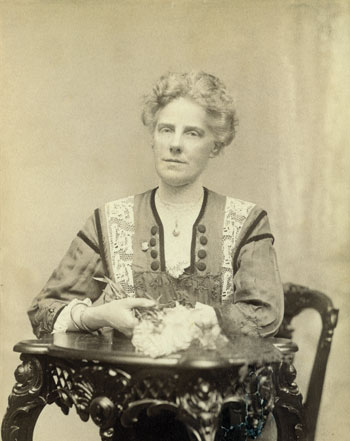
On May 9, 1914, President Woodrow Wilson signed the first congressional resolution and presidential proclamation calling upon all citizens to display the national flag in honor of American mothers on the second Sunday in May. But the credit for Mother’s Day’s popularity belongs to Anna Jarvis, who organized the first official Mother’s Day services on the morning of May 10, 1908, in her hometown of Grafton, West Virginia, and later in the afternoon in her adopted hometown of Philadelphia. Thanks to Jarvis — who wrote annually to every state governor as well as to any local or national figure she believed could advance her holiday movement, from former President Theodore Roosevelt to the humorist Mark Twain — most states already hosted a Mother’s Day observance well before Wilson gave the holiday federal recognition.
The holiday may have had an easy birth, but not an easy transition to maturity.
Anna Jarvis designed the Mother’s Day celebration in honor of her own mother, Ann Reeves Jarvis. As a young girl, Anna was inspired by a prayer she once overhead her mother give. “I hope and pray that someone, sometime, will found a memorial mother’s day commemorating her for the matchless service she renders to humanity in every field of life,” Jarvis remembered her mother saying. “She is entitled to it.”
Jarvis chose the second Sunday in May to mark the anniversary of her mother’s death and selected Mrs. Jarvis’ favorite flower, the white carnation, as the holiday’s official emblem. Jarvis’ request for children to visit or write letters home on Mother’s Day reflected the significance she placed on her own correspondence with her mother.
As a single woman in her 40s, Anna Jarvis viewed motherhood simply through the eyes of a daughter. Thus she constructed a child-centered celebration of motherhood for Mother’s Day: a “thank-offering” from sons and daughters and the nation “for the blessing of good homes.”
“This is not a celebration of maudlin sentiment. It is one of practical benefit and patriotism, emphasizing the home as the highest inspiration of our individual and national lives.”
Commercial industries quickly recognized the marketability in Jarvis’ sentimental celebration of motherhood. Her themes became central to Mother’s Day advertising campaigns. The call to write tribute letters fueled the greeting card industry. The designation of the white carnation emblem energized the floral industry. Moreover, Jarvis’ own story as a daughter dedicated to fulfilling her departed mother’s greatest wish was better than anything a copywriter could invent.
But despite her calls to the nation to adopt her holiday, Jarvis considered it her intellectual and legal property and not part of the public domain. She wished for Mother’s Day to remain a “holy day,” to remind us of our neglect of “the mother of quiet grace” who put the needs of her children before her own. She never intended for the observance to become the “burdensome, wasteful, expensive gift-day” that other holidays had become by the early 20th century.
Jarvis’ attacks on the commercialization of Mother’s Day became legendary. Media sources chronicled her frequent public condemnations of those she denounced as copyright infringers, trade vandals, and blatant profiteers. In 1922, Jarvis endorsed an open boycott against the florists who raised the price of white carnations every May. The following year, she crashed a retail confectioner convention to protest the industry’s economic gouging of the day. In 1925, she interrupted a national convention of the American War Mothers in Philadelphia because she believed the majority of the money raised by the organization’s white carnation sales went into the pockets of professional organizers rather than going to aid World War I veterans.
Jarvis identified several diverse threats to her holiday movement throughout her career. But the biggest was another holiday: a more inclusive Parents’ Day. In 1923, New York City philanthropist Robert Spero attempted to organize a large Mother’s Day celebration, complete with a parade of marching bands and singing troops of Boy Scouts and Girl Scouts. Jarvis, however, would not permit it.
Jarvis had battled with Spero before, over his role in the profitable marketing of artificial white carnations. Now she accused him of falsely claiming affiliation with her incorporated Mother’s Day International Association for sheer self-promotion. She threatened a lawsuit, and New York Governor Alfred Smith, who had originally supported the idea, successfully pressured Spero to cancel his entire holiday plan.
In 1924, Spero sponsored his first Parents’ Day celebration on the second Sunday in May. His rallies earned more holiday converts and media attention as the decade progressed. “We want fathers to feel they are more than breadwinners, that when they go off to work they have some responsibility for what goes on in the home,” Spero told The New York Times in 1926. That same year, a crowd of 4,000 attended the Parents’ Day rally in the Bronx. The holiday movement gained momentum with the 1929 official endorsement of Parents magazine publisher George Hecht. And in 1930, New York Assemblyman Julius Berg introduced a bill in Albany to legally replace Mother’s Day with Parents’ Day on the state calendar. He was confident that New York State mothers would have no complaints about sharing their day with fathers.
But Jarvis complained, vehemently. Not only did she consider the bill a personal attack on her legal copyright protection; she saw it as a patent insult to the state’s mothers. “Of all the freak and amazing attacks on the home and respected womanhood of New York State, surely this anti-mother bill sponsored by a little clique of anti-mother sons is a humiliating one,” she protested. For Jarvis, a threat to Mother’s Day was an affront to motherhood and, in turn, to family harmony. Although often criticized by her more feminist contemporaries, as well as modern scholars, for her failure to acknowledge mothers who were active in the era’s social and political reform movements, Jarvis never faltered from her defense of a mother’s preeminent role within the family.
Jarvis was not alone in her criticism of the Parents’ Day movement and its perceived attack on the veneration of motherhood. The state and national success that Spero predicted for his holiday never materialized. His annual rallies were never as well attended as predicted. Berg’s bill failed repeatedly in Albany. And even Hecht abandoned the holiday movement in 1941 to chair the newly incorporated National Committee on the Observance of Mother’s Day.
The holiday rivalry, at its heart, was a societal dispute over the shifting roles of fathers and mothers within the early 20th-century American family. Childcare advice and popular culture encouraged fathers to play an active role in the daily lives of their children by the 1930s, calling fatherhood the most important occupation a man could hold. Yet despite the new views on fatherhood, Spero still failed to kick the mother out of Mother’s Day. Perhaps the holiday’s lack of broad appeal mirrored the larger cultural recognition of the unequal division of childcare — that when contemporary childcare experts or social pundits addressed “parents,” they were still really addressing mothers.
Although many Americans certainly believed that fathers deserved regard beyond that of breadwinner, most hesitated to equate the maternal and paternal roles. Like Jarvis, they may have viewed a mother’s influence as irreplaceable and thus incomparable to a father’s role in design or status. Ultimately, Americans opted to honor fathers in a way that did not threaten the status of mothers or marginalize their role as children’s primary caretakers. As the Parents’ Day movement faded in the 1940s, the celebration of Father’s Day grew in popularity.
On a national calendar already crowded with tributes to American fathers — from Presidents’ Day to our “pilgrim fathers” on Thanksgiving — Mother’s Day is the only culturally, commercially popular holiday that explicitly celebrates women. And that explains Jarvis’ protectiveness: “When a son or daughter cannot endure the name ‘mother’ for a single day of the year, it would seem there is something wrong,” she implored. “One day out of all the ages, and one day out of all the year to bear the name ‘mother’ is surely not too much for her.” Based on the cultural longevity of Mother’s Day, Americans agree.
This girl has a radiant smile,
And it seems she has savvy and style.
This was Valentine’s Day.
No one sent gifts her way,
So she bought them and selfied the pile.
Congratulations to contest winner Deborah Dickinson-Deacon of Amherst, New York! For her limerick describing F. Sands Brunner’s illustration, Valentine’s Gifts (above), Deborah wins $25 and our gratitude for an entertaining poem. If you’d like to enter the Limerick Laughs Contest for our next issue of The Saturday Evening Post, submit your limerick through our online entry form.
Deborah’s limerick wasn’t the only one we liked. Here are some of our other favorite contest entries, in no particular order:
For me? Well, I’m just pleased as punch.
The problem: I don’t have a hunch
Who the gift could be from.
Let’s hope not that bum —
Fred Bruner — who stuck me with lunch.
—L.J. Williams, Topeka, Kansas
Valentine gifts are such fun,
No matter how often they come.
I will save them and then
I’ll thank the young men
Just as soon as I know who they’re from.
—Alfred W. Cross, Sacramento, California
Although she’s aglow with her heart,
It really would give her a start
To know that her flower
And mini card shower
Were a last-minute thought at Walmart.
—Kevin Rorabaugh, Ellis, Kansas
Such Valentine gifts make me weep —
A card with a message that’s deep,
Some candy — what’s more,
There’re posies galore.
So where is the jewelry, you creep?
—Betty Lyons, Newton Falls, Ohio
This Valentine babe — such a cutie —
Blushed at chocolates and violets as booty.
If she’d known modern taste
To maintain a tight waist
She might have requested tofutti.
—Mia Berman, New York City, New York
His girl was utter perfection,
So he sent her a lovely confection.
She blushed chin to locks
When she opened the box
‘Cause he sent her the “lover’s selection.”
—J. Janes, Marinette, Wisconsin
Perusing the many entreaties
That came from her various sweeties,
The candy she tried
Came with one downside:
The risk of type two diabetes.
—Patrick McKeon, Pennington, New Jersey
I’ve waited all year for this day,
And I’ve only got one thing to say:
While candy is nice,
It just won’t suffice;
I’d rather go roll in the hay!
—Michelle Gordon, Airway Heights, Washington
This sweet lass had suitors of three.
There was Harry and Masters and me,
Yet I thought she was mine,
This dear sweet valentine,
Till she ran off with someone named Lee?
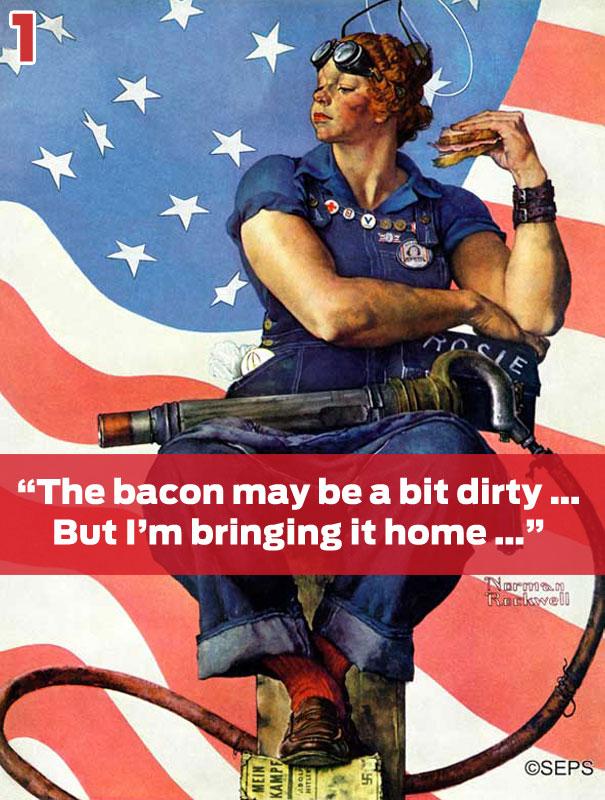
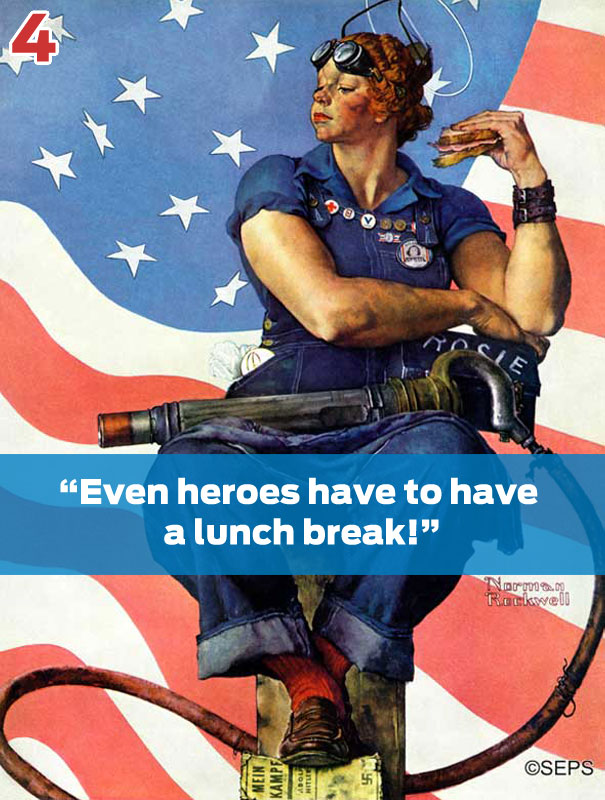
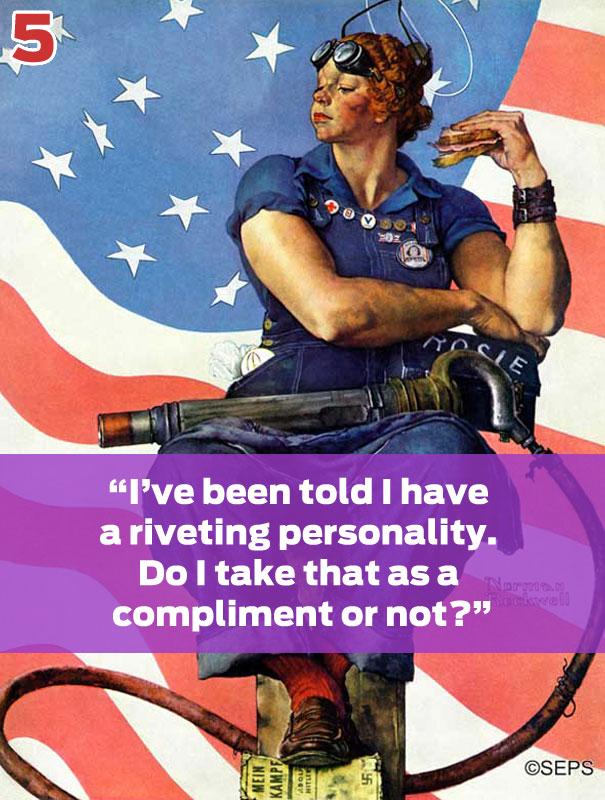
The U.S. saw Norman Rockwell’s art on The Saturday Evening Post cover for the first time on May 20, 1916 — almost 100 years ago. To celebrate the upcoming anniversary, we asked you to write a caption for Norman Rockwell’s Rosie the Riveter. Below are the five caption finalists.
To vote, simply type the number of the caption you like best in the comments below. The caption with the most votes will be published in the July/August issue of The Saturday Evening Post!
Voting closes Monday, May 30.
Click on the images below to view all 5 caption finalists:
When I was 10 years old, a skinny kid with a long neck and narrow shoulders, I wanted to be a weight lifter. So I began a program of exercises to strengthen myself. Every morning I would do pushups, deep knee bends, jumping jacks, and the like before my bedroom mirror. After a month or so, unable to detect any improvement, I gave up. Instead of becoming a weight lifter, I decided to fall back on what seemed to be my only talent — drawing. And here I am, 56 years later, still drawing.
Every so often, usually when I’m having trouble with a picture, I spread on my studio floor reproductions of the 306 Post covers I have painted since 1916, walk around them, and try to decide whether my work has progressed through all those years. If it hasn’t, I say to myself, I’m washed up.
I never seem able to decide whether my work has improved, because my memories keep intruding. Looking at all those covers, I recall their history: the models I used, the trouble I had getting the original idea, how the public reacted.
To read the entire article, pick up the May/June 2016 issue of The Saturday Evening Post on newsstands or …
Purchase the digital edition for your iPad, Nook, or Android tablet:
To purchase a subscription to the print edition of The Saturday Evening Post:
In my line of work, all that really matters is promotion. You’ve gotta move up. You have to elevate yourself, by whatever means necessary. Sucking up to a boss, especially by making a lot of money for him, usually with a very good score, is one of the best ways to accomplish this goal.
That scorching hot summer night in Las Vegas, we had it all planned out, too.
Meet the weapons dealer at Joe’s Coffee House. Get to know the guy a little bit. And then, after you get to know him — after you feel the guy out, as it were — make the deal.
This all sounds pretty simple, right?
But not really. In La Cosa Nostra, you have got to be extremely careful about the type of people you do business with. You say the wrong thing, you set off the wrong signals, and that’s it — you’re toast. The whole business transaction might go down the tube, or worse yet, somebody might snuff you out right then and there in the parking lot.
It didn’t help matters much that it was now 3 o’clock in the morning, and that Joe’s Coffee House was on the seediest side of Las Vegas: the infamous West Side, a mecca of greed and corruption.
You are supposed to be a good earner, and you’re supposed to be a real stand-up guy. So why are you dealing with all the dregs of the underworld? Why do you have to go 3,000 miles away from home, New York City, the Big Apple?
Patsy tells me why I have to: “.357 Magnums have been selling like hotcakes here, Joey. You gotta hightail it over to Las Vegas and make this here transaction with this fellow I tracked down. The guy seems totally legit; he seems to be on the up-and-up. Southern guy, speaks with a twang. A real country bumpkin type of good old boy, you know?”
I was to meet this character, who went by “Roy” — though, clearly, that wasn’t his real name — at Joe’s Coffee House.
But I had a few reservations about this here score.
“I don’t think I wanna go through with this deal, Patsy,” I said into the receiver. “I mean, I’m out there all alone; it sounds too risky.”
“Look, Joey. I already told Mr. Spirochete about this deal. His heart’s already set on having those guns. You don’t want to break the old man’s heart, do you?”
“Hell, no. I don’t want to break the old man’s heart,” I said. “That’s the last thing I would want to do, Patsy. Believe me.”
“Great, Joey,” Patsy responded. “I’ll be by your apartment tomorrow morning with your plane ticket.”
And so, there I was the next night: Standing in front of Joe’s Coffee house, scoping the joint out. There were only four cars in the parking lot at this late hour: an old Coupe de Ville, which looked like it came straight out of the 1970s; a nice 2009 apple-red Porsche with tinted windows; a Subaru from 1992 with dents galore; and, in the back alley of the parking lot, the 2013 Lincoln MKS, which I had rented just a few hours before. The two old junkers, I concluded, must have belonged to the cook and the waiter or waitress. The Porsche, especially with its tinted windows, must have belonged to our weapons dealer, Roy.
Sirens blared outside as I slowly and cautiously made my way inside the open-24-hour-a-day coffee shop.
To say Joe’s Coffee House was a dump would have been an overstatement. It wasn’t as bad as you’d imagine it to be, looks-wise. It was a competent little coffee place.
An old lady popped her head up from behind the cash register. She kind of surprised me, to be honest with you. I guess she had been fumbling around with the receipts, or trying to get the cash register to open, or something.
“What would you like to drink, sir? Can I interest you in a Multi-Latte, brewed with the finest Colombian beans?”
“Sure,” I said finally. “I’ll try your Multi-Latte.”
The old lady flashed me a smile, exposing her crooked teeth, and before she could make her way to the latte machine, I asked her outright, “Say, I’m looking for this guy, he was supposed to meet me here. But I don’t see anybody. Are there any other customers in here?”
The old lady’s face tensed up. Clearly, I had said the wrong thing. After all, this wasn’t the greatest part of town. She probably had me pegged as a stick-up man.
The old crone stammered. “Why do you want to know, know that?”
Just then, I heard a toilet flush, and this guy with short brown hair, wearing a loud, dark blue sharkskin suit, made his way out of the john.
The fellow, sounding affable enough, asked the old lady for another Multi-Latte.
“That sure hit the spot, sweetheart. You mind making me one more?” The country bumpkin smiled, exposing his teeth; they brought the old lady’s teeth to shame. Pearly white. Those frigging chompers were beyond reproach, I tell you.
Anyway, I jumped in, trying to console the frightened old dame. “See,” I said, pointing my forefinger at Mr. Sharkskin. “This is the gentleman I was supposed to meet, for our business transaction.”
The old lady looked at both of us, and then, once again, a huge smile engulfed her face. “Two Multi-Lattes. Yes, sirs.”
And then she hightailed it over to the latte machine. The country bumpkin, Roy, and I made our way to the stools and parked our asses down.
Roy looked at me; he was an interesting-looking specimen, all right. A decent-looking guy. Middle forties, probably. He had a nice, red tan — the kind that drives the ladies wild — light brown hair that verged on blonde, and dark blue eyes.
He smiled at me, as we sat down on our respective stools.
“You ordered the Multi-Latte too, huh?”
“Yeah, it’s the first thing she mentioned to me. ‘Would you like to try our Multi-Latte?’ ‘Sure,’ I says. ‘Why not?’”
Roy smacked his arm on the counter as though this were the funniest thing he had ever heard. And then he burst out in laughter. He had a loud, cackling laugh. Something about it was very upsetting to me.
“No kidding? She pushed the Multi-Latte on you? That’s what she did to me, too.”
“Yeah,” I said. “That’s what she did, all right.”
Roy laughed once again, like this was the greatest thing he had ever heard. The guy was sure jovial. You had to give him that.
“Well, I know your buddy Patsy,” he said. “He’s from New York. I’ve only spoken to him a few times, but he seems to be good people. Any friend of Patsy’s is good people too, as far as I’m concerned.”
The old lady returned with the two Multi-Lattes.
“Thanks, darling,” Roy said, smiling. The old woman returned his smile with a toothless one, and then she scuttled away, off toward the kitchen. “Well, I’m glad you’re here, partner. What say you and I go outside and complete the transaction. You brought the briefcase, right?”
“Look, I know you’re a good guy,” I said to Roy, “but if you don’t mind, I’d like to make sure everything is on the up and up.”
Roy had this quizzical expression on his face.
“Before we make this here transaction, I gotta make sure you’re not wearing any mics,” I said, sternly.
Roy didn’t laugh at this one, as well he shouldn’t have. On the street, accusing somebody of being a snitch is one of the gravest insults — it’s tantamount to saying something nasty about somebody’s mother, but a million times worse.
“Hey, don’t worry about it, my friend,” I said “This is all just a proper precaution. We do this with everyone we do business with outside of New York City.”
“Well, hell, you East Coast boys sure are mighty thorough, ain’t you? Well, why the hell not, partner?” Roy pulled up turquoise-colored dress shirt, exposing his flat-as-a-board chest to me.
No wire, I noticed.
“Okay,” I said to Roy. “Everything looks good. Let’s go outside and do some business together.”
First off, we stop in front of the 2009 apple-red Porsche, which is parked near the front of Joe’s Coffee Shop. It’s not obscured in the back parking lot like my car was.
“Let’s see what kind of hardware you’re peddling before I hand you over the briefcase,” I told him.
Roy looked around furtively a few times, making sure there weren’t any cops around, nobody who was planning on busting us; then, with one press on his keychain, we heard a light toot coming from the car, and then the trunk pops open. Whoosh.
Roy handed me a flashlight, and I flashed it inside the trunk.
I saw this big pile of metal: guns, guns, and even more guns. There had to have been 100 of them in all — all .357 Magnums, too.
I whistled impressively at the sight of these beauties. “Where’d you get all this hardware,” I asked Roy.
Roy beamed brightly, and he said, “My partner and I, we burglarized an ammunition warehouse just outside of Gilbert, Arizona. We took everything we could get our hands on, by the truckload: AK-47s, shotguns, bullet-proof vests, and these .357 Magnums you see here.”
I grabbed one of the Magnums. The thing was heavy all right. It just felt mean. You could tell how strong it was just by holding it.
“That’s what I have been trying to tell our friend, Patsy — if you guys ever need any more weapons, we can definitely help you out on that front. We have still got a bunch of AK-47s left, if your people in New York are interested.”
“I’ll let you know if we need anything more. First Patsy’s gotta run it by the old man in New York. He’s the boss, not us. What he says goes.”
Roy flashed one of his movie star smiles at me. “Sounds good, partner.”
We made it to the back of Joe’s Coffee Shop to the part of the parking lot where my rental car — the Lincoln MKS — was parked. This time around, I pressed the key-chain and, like magic, the trunk of the car whooshed open.
“Abracadabra,” I said.
I grabbed the briefcase from out of the trunk and handed it over to Roy, my jolly country bumpkin friend. “Twenty-five grand. It’s all in there. But if you want to, you’re free to count it.”
Nah, he said. He didn’t want to count it. “Anybody connected with the Spirochete clan in New York is okay by me, partner.”
***
Later that night, in my hotel room, I gave my comrade-in-arms Patsy Bravo a jingle.
“The transaction went as smoothly as you can imagine. No problems on my end over here, my friend.”
“Mr. Spirochete is gonna be so happy,” Patsy gushed.
“What about our friend Roy?” I said, breaking Patsy’s train of thought.
Patsy didn’t seem to be too concerned about Roy. “Forget about it, Joey,” he said. “The guy’s a hick, and a small fish, in the grand scheme of things. I’m not worried about him. If we have to make a move on him later, then so be it. But for right now, let’s just focus all our time and energy on nabbing Mr. Spirochete.”
I thought about what my three-year-long deep cover partner “Patsy Bravo” was telling me: Let’s just focus on our big man in New York City for right now. And if we have to do another sting operation to nab our arms dealer friend Roy and his tacky sharkskin suit, then so be it, we’ll do just that. But for right now at least, let’s focus all our talent and energy on the Boss of Bosses, the Capo di Tutti Capi, Johnny A. Spirochete — the most bloodthirsty mob boss in all of New York City, maybe in all the world.
“I can’t wait to see that old buzzard finally go down. It’s been a long time coming,” Patsy said into the receiver.
“Absolutely,” I said. “And not only that, but there’s this one other thing I’m really looking forward to, once the old man finally goes down, once we finally nab him on these weapons charges.”
“What’s that, Joey?”
“Promotion,” I said, finally. “I can’t wait till the day when I’m Special FBI Agent Joey Samento.”
That’s always one of the great dinner party questions. Are we better off now than we were 4, 8, 20, 40, 60 years ago? With Donald Trump’s slogan being “Make America Great Again,” it’s something people have been thinking about. What exactly made America “great” and what time is Trump talking about? The ’40s? The ’50s? The ’90s? Maybe the 1880s?
Morning Consult, a polling service, asked Trump supporters online what America’s greatest year was. Guess the most popular year that was mentioned. Guess! You’ll probably be wrong.
They picked the year 2000, when Bill Clinton was still president and social media hadn’t been invented yet.
Other popular years were 1955, 1960, 1970, and 1985. Now, those are wildly varied eras (and also very rounded years — what, no one liked 1957 or 1989?). There doesn’t seem to be any rhyme or reason to it. Older people probably picked a long time ago and younger people probably picked 2000. It’s almost as if they don’t know what exactly “Make America Great Again” refers to, but they like the sound of it.
I think a lot of people don’t really know when the best years were, they just know it’s not right now (it’s never right now). We have a nostalgic feeling for years ago, and a lot of people don’t understand how we could have liked those times when we had so many problems. Well, name a year or decade when we didn’t have any problems. All eras have great things about them, even the ones where terrible things happened. I think people like times when things weren’t as fast-paced and muddled and changing.
On a personal note, I really loved 1985, when I was 20. I had a fun job with access to pizza and booze, I had less to worry about, and I had so much more hair.
Get Ready to Match the Stars!
From the “things you never thought you’d see again” department comes this news: Match Game is coming back to television. And you’ll never guess who the host is going to be. I’ll give you 1,000 guesses. Never mind, you’ll never guess.
It’s Alec Baldwin! The new ABC show will be part of ABC’s “Fun & Games” block on Sunday nights this summer, along with Celebrity Family Feud and The $100,000 Pyramid. It will be filmed in New York City.
Now comes the fun part: trying to figure out which celebrities will be on the new version. Since it’s ABC, I wouldn’t be surprised if we saw Jimmy Kimmel and Whoopi Goldberg. Personally, I’d love to see Brad Garrett, Craig Ferguson, Anderson Cooper, Tina Fey, and Amy Poehler. And Betty White! We can’t forget Betty White!
What’s your dream cast?
This Part of the Column Is Brought to You by Hot Pockets
Saturday Night Live announced something this week, and depending on how you look at it, it’s a good news/bad news type of thing. First, the NBC show is dropping the number of ads the show will have by 30 percent, which equals two commercial breaks. You may think that’s good news, but you know they have to do something else, right? They’re going to starting having “branded sketches.”
Deadlineembed reports — in an article with a headline that misses the real story — that the show will “bring in sponsored content from advertisers who will partner with the show for branded sketches.” They probably want to get more people to watch the shows live, cut out the commercials, but still get the advertising in. A lot of these spots will be the pre-taped segments that seem to get a lot of viral juice the next day. (By the way, I really, really hate the term viral.)
I’m pretty sure this happened on 30 Rock. Jack ordered Liz to include more of General Electric’s products in the show’s sketches, so they had to write sketches with people suddenly talking about and buying GE dishwashers and ovens. Let’s hope this integration isn’t as clunky as that was. Actually, it might be funny if it was as clunky as that was.
The Founder
With the way that the Internet and social media and pop culture in general are these days, you’d think we’d know about every TV show/movie/album that’s coming up. But sometimes you get an album like Beyoncé’s Lemonade that seems to appear out of nowhere, and maybe even the trailer for a movie you didn’t know they were making.
Here’s the trailer for The Founder, the new film starring Michael Keaton as McDonalds founder Ray Kroc. Looks like fun. It opens August 5.
Introducing the Meat Bar
A “meat bar” sounds like some place men and women might mingle with each other, but it’s actually a new product from Hershey. Yes, the chocolate company is branching out into dried meat protein bars (mmm, doesn’t that sound delicious?).
The bars will be called Krave — which Hershey already uses for their beef jerky products — and will be a mixture of meat and other things like dried fruit and quinoa. The company has also launched a new brand called SoFit, which offers healthy snacks with more familiar ingredients, like almonds and seeds and fruit.
This could work, though they’re really going to have to find a way to market the new bars. Beef jerky is one thing; a bar made of meat is another.
Why are they doing this? Supposedly, sales of chocolate are down. Not in my house!
The Best Commercial Characters of All Time
As I’ve gotten older, I’ve noticed that TV commercials annoy me more than they used to. I didn’t think this would be the case. I thought I’d be more patient and calm when it came to things like this, but there are so many commercials that just irritate the heck out of me — from commercials that are run way too often (all car commercials) to commercials that are illogical and don’t make any sense and actually make me not want to buy the product.
But in general, I actually like TV commercials and advertising (I know, I’m in the minority). And there are some TV commercial characters I like seeing all the time. All the various Geico spokespeople/spokesanimals are fun (amazing how many different regular characters they have — it seems to go against advertising common wisdom). I like that older couple who do the Consumer Cellular ads. I’d watch them do a sitcom. I also like Flo from Progressive. She’s cute, and the commercials are effective.
But who are the best TV commercial characters of all time? Paper lists their eight favorites, and they include Flo and the gecko from Geico. It’s not a bad list because they actually remember some of the classic characters from the ’60s, ’70s, and ’80s, like Rosie (Bounty paper towels), Mr. Whipple (Charmin toilet tissue), and Josephine the Plumber (Comet cleanser). It’s really great to see a list done by someone who actually remembers that there was pop culture before Saved by the Bell (though I could have done without the Dell dude). I’d add more animated characters to the list, like The Jolly Green Giant, Mr. Clean, and some characters from cereal ads.
Since we’re talking about commercials, can someone explain to me why there are suddenly so many commercials for various brands of copper or ceramic pans? I’ve seen at least four different commercials this past week, all different ads for different brands (though they all use the same language and they all seem to do the same exact things). Is there a hostile takeover of the pots and pans industry going on, so that everything we cook with will now be made of copper or ceramic?
I’m just glad there’s finally a pan that can withstand a car running over it. That happens to me all the time.
Today Is Arbor Day
romantitov / Shutterstock.com
I remember a joke from my childhood: Arbor Day is the day when we celebrate all the ships that come into the ’arbor. I didn’t say it was a good joke.
Here’s the official Arbor Day site, where you can learn more about, well, trees. You can also check out our Tree Planting 101 to help guide you through the process of planting trees. By the way, do kids still play in tree houses? Is that still a thing?
And tomorrow is Independent Bookstore Day. Support your local brick-and-mortar bookstore (even if it is Barnes & Noble). And if you want to combine these two days, it’s easy. Books are made from trees.
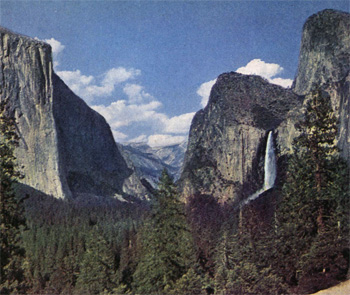
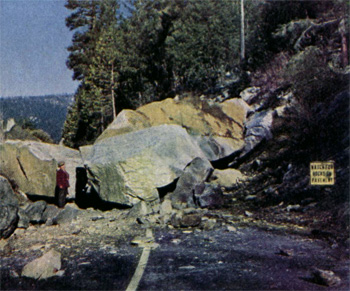
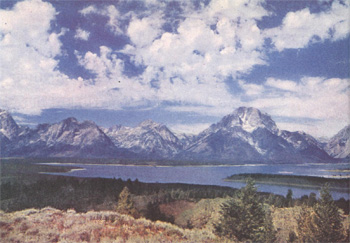
In 1954, 3,600 employees administered and cared for the National Park Service’s 24 million acres of property for the benefit if their 46 million tourists. These were some pretty big numbers, and with those numbers came some pretty big headaches, from the difficulties of conservation and preservation efforts to the problem of poachers, smugglers, and vandals.
The person ultimately responsible for dealing with that sea of troubles, as well as for convincing Congress to find the budget for it, is the director of the NPS. It takes a special breed of person to step into such a multifarious role, for the director of the NPS is at once a conservationist, a proprietor, a historian, a businessperson, a custodian, and even the chief of a small force of traffic cops.
In 1954, that man was Conrad Wirth.
That year, Post writer Robert M. Yoder wrote the following profile of Director Wirth, “Twenty-four Million Acres of Trouble,” bringing to light the challenges he faced and the aplomb with which he juggled the many components of his position.
The troubles of the NPS have not waned in the past 60 years. If anything, they have grown as the park system itself has grown. Today, over 300 million guests visit the NPS’s more than 400 properties — so much more than just the 59 national parks — including battlefields, monuments and memorials, seashores, lakeshores, rivers, parkways, trails, and other historic sites. All told, today’s NPS bears responsibility for 84 million acres of land — an area larger than New Mexico — in all 50 states, Puerto Rico, Guam, the Northern Marianas Islands, American Samoa, the U.S. Virgin Islands, and Washington, D.C.
The NPS’s duties at these sites are as varied as the properties themselves: 22,000 professionals and 221,000 volunteers protect wildlife, rescue hikers, maintain cabins, preserve historic buildings, manage traffic, prevent and repair vandalism, watch for forest fires, and so much more. Why? To protect the most beautiful parts of our country. To preserve our history and our legacy. To provide us all with access to hardy education and recreation. To ensure that future generations can learn and enjoy as we have.
And to make sure that the next time you visit an NPS site, it is a walk in the park.
As Conrad L. Wirth hikes down a corridor of the Department of the Interior in Washington, or sits at lunch in the Cosmos Club, a passing friend sometimes sings out, “Hi-ya, Connie. How are things?” Wirth is manager of a 24,000,000-acre domain which can grow problems the way Indiana can grow corn, and there must be days when he is tempted to answer this question. Even a partial account could be a little striking.
“Why, about normal,” Wirth might say. “We’re having a little trouble with crocodiles, mountain climbers, wild burros, moonshiners, poachers and smugglers, of course. There’s some question what to do with maybe five or six thousand surplus elk, and it’s going to be a fight to preserve the land-loving goose. The high cost of caves is something of a headache, and I wish we could figure out how to keep the sea cows from hanging around the business district — that’s in Miami. There are seven kinds of beetles attacking seven kinds of timber, the prehistoric ruins need some work done, and we had a complaint from a man who says that in the forest primeval there is no place to plug in his electric razor. … How are things with you?”
A husky 200-pounder in his early 50s, Wirth looks well-built to withstand work and worry, and providence keeps him beautifully supplied with both. There are men who can go to the closet of a morning and select any of 100 suits, quiet, loud, blue, brown, gray, single-breasted or double, pinstripe, check, herringbone or plaid. Wirth has a collection of problems far more extensive, far more varied.
They are perquisites of his job, clearly one of the most remarkable in the world. Wirth is director of the National Park Service, boss of our 180 national parks, monuments, historic sites, and recreation areas.
This means administering $4,000,000,000 worth of the grandest and most peculiar real estate under our flag, including glaciers, volcanoes, geysers, deserts, giant sequoias 3,500 years old, great caves, and petrified forests. It is not true, as Jim Bridger reported, that there are petrified birds singing petrified songs, but the wildlife that Wirth is charged with preserving includes some minnows native, of all places, to the desert of Death Valley.
So a multitude of plain and exotic troubles is to be expected. This is a condition so natural, in fact, that without them, Wirth probably would suffer some form of the bends, like a diver brought up too suddenly from the deep. Trouble is the park director’s element, as water is the natural element of fish — he is running out of fish — or woods the natural element of skunks, which are driving picnickers away from tables and campers out of their tents.
Wirth’s paramount problem is money; he is in a financial hole of real grandeur. The parks are running down and getting harder use, by more millions, every year. “The people,” one park man says, “are wearing out the scenery.” To get what Wirth needs will require a small miracle of salesmanship; meanwhile, he needs money so badly that it is a wonder he didn’t accept the Crater Lake offer.
Crater Lake, in Oregon, is one of the great sights of the world. The lake is blue beyond description; and you look down on it from walls of rock falling 500 to 2,000 feet. One enterprising Westerner saw an opportunity here. Thousands come every year to stand on this rim, and the sight, the gentleman figured, must strike deep into the soul, arousing an impulse he planned to satisfy. “Here’s this beautiful lake, way down there,” he wrote. “You rent me a spot on the rim, and I’ll set up a concession where, for two bits or maybe 50 cents, people can drop rocks into it.”
There was another sound suggestion for making money, though it comes a little late. A farmer visited Yellowstone in time to see Old Faithful erupt, with that reliability which makes it one of the two or three most famous sights in the land.
“Ranger,” the farmer said, “you got something there. Why, people would come from all around, just to see that geyser, if you’d advertise it.”
Whatever your problem, Wirth’s got one to match. Does your dog nip the garbage man? Wirth’s got bears which nip tourists, sometimes bringing on lawsuits — one, which the government won, for $75,000. Got aphids on the roses? It will be consoling to consider Wirth’s pest problems: on a day no worse than usual they will include beetles, tent caterpillars, webworms, loopers, sawflies, and wood ticks. His oddest gardening worry is preserving a Hawaiian plant so excessively rare that there are only two known specimens. It’s an item called Hibiscadelphus giffardianus.
Does your house keep you poor? Wirth has this problem in a curious form. The real estate in his charge includes 62 sets of prehistoric ruins which must be kept in a kind of suspended ruination. That comes high: It costs $8000 a year to maintain the ruins in Mesa Verde, Colorado, and Wirth figures those at Chaco Canyon, in New Mexico, need $65,000 worth of work to put them back in their old, terrible shape.
Wirth can expect trouble from every quarter; even so, there are surprises. Along with being the boss of 3,600 employees, with whom he gets along splendidly, Wirth is the boss of 300 statues, mostly in battlefields. One of the statues has given him a good deal of trouble. Lightning knocked both arms and the head off a thirteen-foot figure of Liberty, atop an 87-foot shaft at Yorktown, where Cornwallis surrendered. A well-known sculptor is executing a new figure, on commission, but now refuses to put it on the shaft, which he contends is an eyesore.
And while name writers are a nuisance year in and out, it was a surprise when one of them chose Half Dome, in Yosemite. That great peak, looking like half a loaf of bread, presents a face of rock 2,000 feet high. High as it is, one visitor swung down on 20 feet of rope to paint his name. He chose too big a canvas; he ran out of paint after finishing only one initial.
If repining over human vandalism gets him nowhere, Wirth can worry about vandalism by buffalo. The Yellowstone buffaloes long have been a joy but a care. Once they dwindled to 23. A small breeding stock was put inside fences and treated royally. The buffalo ranch worked fine; the buffaloes multiplied until there were hundreds.
But they got as tame as cattle, and just about as exciting to see. With free hay in winter, and no worries, they lost vigor, spirit, and tourist appeal. The duty of the Park Service is to preserve wildlife in the wild state. So it was necessary to wean the buffaloes from the easy life and turn them wild again. That was accomplished. But the buffaloes have a keen eye for luxury. About 1,000 head of the Yellowstone buffaloes come into the Firehole River region to spend their winters in steam-heated comfort beside the hot springs and geysers. It’s a good move; here they can get at the dried grass without rooting in snow.
But 1,000 buffaloes produce serious wear and tear. They have chipped away rock formations which took centuries to build. So a deal will have to be made whereby, in return for free hay, they stay away from the hot springs. The Park Service never attacked a preservation problem with such unmitigated success as in the case of the buffaloes. Where once the lordly buffalo was vanishing, there now are buffaloes all over the joint.
Preserving wildlife is tricky business. “Remove one thing,” said a great naturalist, “and you find it is hitched to everything else in the universe.” If the park rangers thin out the coyotes to protect the deer, the deer get so numerous they eat themselves and others out of browse. Then they go to town, where that is possible, and ransack garbage cans. Once they have tasted garbage, raw forage isn’t good enough.
The park director’s problems always include two or three creatures on the very brink of going extinct. Right now, the crisis cases are the black-footed ferret, the crocodile, and the nene. Only about 60 of the ferrets have been sighted in the last seven years, and a third of those were dead. An investigation is under way to find out what the ferrets need and how they can be coaxed to continue.
The nene is a long-legged, brown-necked little Hawaiian goose which may very well be the rarest creature on earth. Also called the “land-loving goose,” the nene is a waterfowl, but miserably maladjusted. It is not well equipped for swimming, nor is it much at flying. Instead, the nene prefers to walk, which it does with high steps, possibly because it walks much of the time on the rough lava slopes of the great volcano, Mauna Loa.
The nene was common enough at the start of the century, but now it is thought there may be no more than 50 left. Wirth thinks foreign birds imported to Hawaii may have brought ailments with which the nene can’t cope. Its worst visible enemy is the domestic pig, gone wild and tough. The pigs destroy the nests and young or keep the nenes too nervous to nest. Wild goats, meanwhile, devour the nenes’ favorite berries. There is hope of saving the poor slighted birds by giving them all possible protection in Hawaii National Park, but it will be a near thing. Rangers hunt down the pigs and goats, but have to stop shooting during the nenes’ nesting season so as not to disturb whatever nenes are left.
The crocodile certainly isn’t helpless and it may be a little hard to muster up a tear over the fact that this monster is scarce, but such is Wirth’s duty, as a wildlife preserver. The American crocodile never has been plentiful, even if you regard a very few crocodiles as plenty. Only one small section suits this salt-water nightmare, a strip about 100 miles long on the southeastern coast of Florida. Crocodile numbers have dwindled because anyone sighting a crocodile is likely to shoot it for its valuable hide, worth $4.50 a foot, and other crocodiles come to grief in fishermen’s drag seines.
Though the ugly creatures are classed as vanishing, naturalists think the crocodile can be saved. That’s because the Everglades National Park takes in Florida Bay, a favorite crocodile haunt, and park rangers war constantly on crocodile poachers. Along with being a sanctuary for crocodiles, and perhaps the only place in the world which is under water half the time and subject to terrific grass fires the rest, the Everglades park is also a home for put-upon manatees, so Wirth is the manatee’s foster mother as well as the comforter of the crocodile. Manatees are the weird sea cows which sailors of old mistook for mermaids, partly because it is the manatees’ sociable habit to swim flipper-in-flipper, partly because the manatee may sometimes be seen kissing, and partly because the sailors had been at sea a long, lonely time.
Killing the young for their tender flesh, said to resemble veal, has helped bring the sea cows to the verge of extermination, but these big hulks, averaging perhaps 500 pounds, are also extremely sensitive to cold air. They are air breathers, surfacing to breathe through the nose, and it is thought the cold air of the sudden Florida cold snaps gets them in the lungs.
The Everglades park is the only adequate sanctuary. Park Service officials would like to carry out a restoration program, but nobody knows just what to offer; less is known about the manatee than about almost any other form of wildlife. Wirth may have to create a duplicate of downtown Miami. The manatee seem happiest in the Miami River, in the heart of the city. On chilly days, they can keep warm next to outlets of big-city wastewater.
Short in the nene, ferret, crocodile, and manatee departments, Wirth is woefully long on elk, having far more than the parks can pasture. Last winter, in four huge corral-like traps costing $10,000 each, Yellowstone rangers live-trapped 219. The elk lift got rid of 125. The elk lift consists of hauling the elk out of the park, into open hunting country, by truck. The rest were given to various parks for stocking purposes. Still others wandered out on their own. But there were still far too many elk, so aerial elk shooing was tried. A plane and a helicopter were able to chase several herds over park boundaries. All told, the winter’s efforts may have reduced the elk population by 1,000. Good? Yes, but only a starter. It still leaves a remarkable excess — about 4,600 elk too many.
Wirth’s collection of peculiar problems includes international smugglers, dealing, of all things, in a harmless form of wax. These are rifle-toting bands, bad all out of proportion to their contraband, and given to shooting. The wax is made by cooking the candelilla plant, and is used in shoe polish, floor wax, phonograph records, and medicine. The wax runners smuggle it in from Mexico via the Big Bend National Park, in Texas, defying Mexican law, which says all such wax must be marketed through the government.
But things never are so bad as they might be for Wirth. He has one stanch ally — the grand old law of compensation. The improbable happens, but the probable desists. The wild parks are full of danger — great glaciers, cliffs, geysers throwing fountains of scalding water, steam jetting from hillsides, lakes at altitudes where the strongest swimmers tire quickly. Thousands of the park visitors never before saw country wilder than a vacant lot. Yet the fatality rate is spectacularly low. Men, women, and children survive remarkable adventures, and Wirth hears tale after tale of valiant rescue.
Burdette Yeoman and his wife were hiking in Yosemite. Yeoman leaned over a waterfall to get a drink. He slipped and was washed away. Terrified, his wife leaped in after him. Yeoman was carried a wild 100 feet, mostly down, falling, sliding, bounced against boulders. Then he scrambled ashore. But his wife was carried twice as far, into great rocks, over several cascades.
She ended in a pool, with severe injuries of head and body. A medical student gave first aid, a Boy Scout went for the rangers, a doctor drove two hours and then hiked seven miles to reach the injured woman. She was carried out by night on a stretcher — and recovered nicely. In March of 1954, 17-year-old Dolores Van Parys, of Seattle, slipped on snow in Mt. Rainier National Park and fell 175 feet to a mound of ice. But she struck a glancing blow, slid down the ice into a snowbank, and came through it alive.
Last summer, swinging down on a rope in descending Grand Teton, Norma Hart, of Lynn, Massachusetts, fell 35 feet when the rope gave. She landed in a sitting position. The terrible jolt broke her back in two places. She was at 12,000 feet. She had to be brought down in a basket stretcher, belayed down sheer cliffs, carried across hazardous slopes and snowfields. The rescue involved 27 park rescue experts, three volunteer climbers, and one professional guide. In a classic of skill and exertion they worked 24 hours, but they saved her.
Each year, recently, has brought mountain climbers in record numbers. Many get in trouble, but are rescued.
Excellent planning accounts in part for the fine safety record. Though Kilauea volcano in Hawaii had been quiet 18 years, they were ready when it erupted one midnight in 1952. In five months, 450,000 visitors flocked to look down on the great lake of fire. Nobody got hurt except a man who chose this opportunity to commit suicide. The final report said, “30,000 cars parked, one fender scratched.”
Every year children get lost in the great wild parks, but almost always the story has the same ending: the child is found intact and unalarmed, by adults worn to a frantic frazzle. Rangers found a lost boy in Yosemite, a rover so young he knew his first name, but not his last.
“We’ll identify him through the family car,” the rangers said craftily … “Jimmy, does your dad’s car have two doors on the side or one? What color is it? Do you know what kind?” Jimmy knew — a two-door blue sedan. “Now all we have to do,” said the rangers, “is to drive around the various campsites until we spot the right car.” Two fruitless hours later, they told Jimmy, “Now don’t get excited, but we can’t seem to find your dad’s car.”
Jimmy wasn’t excited, and he wasn’t surprised either. “Of course you can’t,” he said. “We came in Uncle Joe’s car.”
Wirth’s job makes him a big-time resort proprietor, the boss of 23 hotels and lodges, 4,086 cabins, 1,511 tents. Unfortunately, what that comes to is “not nearly enough.” He has 15,000 miles of roads to maintain, he has general supervision of 200 concessions doing $30,000,000 worth of business a year. Indirectly, this puts Wirth in a variety of business enterprises ranging from renting pack horses to running mineral baths. He is also the boss of 114 museums, the chief of a small force of traffic cops on the Baltimore-Washington Parkway, and the custodian of 527 buildings of historical significance, most of which need something.
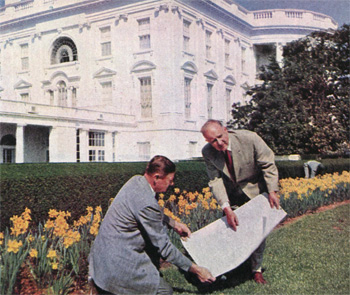
He is a man of consequence in 39 states and four possessions, and he is also chief yardbird for the White House. In a sense he is the President’s landlord, the White House being Reservation No. 1 in the capital’s park system, which is another of Wirth’s responsibilities. In a much clearer sense, he is the emergency gardener. When Queen Wilhelmina was about to visit Washington in 1952, Wirth had to raise 2,000 tulips at racing speed, so her majesty would see them blooming. He came through, and the tulips lasted long enough, but no longer; they had been forced far too fast.
No other government agency is in so many lines of business. “We don’t run any streetcars,” Wirth says cheerfully, meaning that the NPS does run everything else. In general, the customers are fairly well satisfied, though surveys produce criticism on unexpected points. Here is some of the adverse criticism: “Some of your deer have nasty dispositions.” … “Where did you hide the bears?” … “People ghastly compared to the scenery.” … “Get longer beds.” … “Have more snow.” … “How about installing bowling?” The complaint registered by two New Yorkers about Yosemite, surely one of the most beautiful spots on Earth, proves that Wirth can’t hope to please all of the people all of the time. “There’s no dancing tonight,” they said. “What are you supposed to do — look at the scenery?”
Wirth tackles his assorted duties with unfailing calm and a good deal of zest, though this isn’t the way he expected to spend his life. A landscape architect, he planned to devote himself to private practice, dealing in subdivisions and country clubs rather than geysers and battlefields. Parks were a little overly familiar: Wirth was born in one city park, raised in another, worked in parks every summer as a boy. That was enough for his older brother, Theodore Jr. He went to sea and became a rear admiral. Except for the admiral, however, it’s a park family. Conrad’s younger brother, Walter, is park superintendent at Salem, Oregon; Conrad’s older son, Ted, is in the NPS office in Omaha.
Wirth is the son of a highly successful park man, the late Theodore Wirth Sr. Theodore Wirth came here from Switzerland, after studying horticulture in France and England. For six years he was a gardener in Central Park, New York, and on private estates in Long Island, and then became park superintendent in Hartford, Connecticut. Conrad was born there, in the superintendent’s residence in Elizabeth Park.
When Conrad was nine, the family moved to Minneapolis, where his father developed a park system which won world-wide attention. A bold and imaginative builder, the elder Wirth also put forward an idea now generally accepted, but then brand-new. Parks, he held, are for recreation as well as beauty; this calls for tennis courts and baseball diamonds as well as rose gardens.
Conrad Wirth couldn’t have had a better teacher. But when he got out of Massachusetts University he went into private practice, first in San Francisco, then New Orleans. For four years he had nothing to do with parks. The Gulf country was booming, and Wirth and his partner, Harold Neale, worked on projects of considerable splendor. The biggest was the Pass Christian Island development, a 5,000-acre venture involving the creation of islands and canals and intended to rival Florida at its flossiest.
But the Florida boom collapsed, and all around the Gulf big plans went glimmering. Property was selling for ten cents on the dollar. Nobody needed landscape architects to plan multimillion-dollar dream cities. “I’d have been glad to plan a miniature golf course,” says Wirth.
Just when he needed it most, he was offered a post on the Planning Commission for Washington, D.C. There he got to know Park Service men, like their devotion to the parks, their unusual esprit de corps. When they had an opening in 1931, he took it gladly and was back in the family business, parks. His brother, the admiral, held out staunchly, but the land got him in the end. After World War II he was appointed superintendent of buildings and grounds at Annapolis, and later went into the real-estate business in California.
Wirth’s work for 20 years was long-range planning. Some of it is only now bearing fruit; one result is the new Cape Hatteras Seashore Recreational Area, a brand-new type of national playground. Nowhere in the system was there a great stretch of Atlantic seacoast still undeveloped. Wirth studied every mile of the coast and found nothing to compare with the picturesque islands making up North Carolina’s outer banks. To get what he wanted took 20 years, but in his work you have to have patience.
Adding to this park or that, Wirth handled massive land deals, in one case swapping 180,000 acres of grazing land for 10,000 acres of valuable timber owned by Montana, but inside Glacier National Park. He made himself an authority on “inholdings” and hopes before he retires to see many of these disappear. Inholdings are land privately owned, but inside the parks. Inside Mammoth Cave National Park, for instance, there are two privately owned caves. The Park Service hopes to buy them in time, but good caves run high these days; this pair will cost around $500,000. For a long time the government didn’t own the actual site where Cornwallis surrendered, in Yorktown battlefield, but Wirth bought that in 1948.
Wirth has had a hand in developing 561 city and state parks as well as the national ones. That came about in the days of the Depression, when, as Interior’s representative, he had charge of CCC camps which built or improved parks all over the land. He sighs, these shorthanded days, for the crew he had then — 95,000 young men, 17 to 23, who could do anything from stringing power lines to digging artificial lakes. For years to come, vacationists will have a better time because we had that siege of unemployment in the grim ’30s. Virginia had one state park in 1933, for example; by 1942 it had six, drawing just under 500,000 visitors a year. It is estimated that Wirth and his CCC boys put park work forward 50 years.
Wirth became director in December of 1951. He is one of the few top officials to survive the change of administration; Secretary of the Interior Douglas McKay decided that Wirth was uniquely qualified for a highly difficult job and ought not to be disturbed. “It is men like this,” says Secretary McKay, “that give to government service the prestige it deserves.” To repay his work and worry, he can reflect on solid accomplishments. The Cape Hatteras seashore — “the finest beach preservation in the world” — is his special pride. Land buying will be finished this summer. Both millionaires and bums contributed to this newest of the parks. The wealthy patrons were Paul Mellon and Mrs. Ailsa Mellon Bruce, children of the late Andrew; they put up $618,000. This is a form of philanthropy Wirth is cultivating hard. A special booklet, titled TheFifth Essence, is put before ladies and gentlemen of wealth, inviting contributions to the National Park Trust Fund. The frugal Wirth got a donation to publish this appeal, and the book carries no publication date, so it can’t get dated.
The down-and-outers who helped with Hatteras were on the Outer Banks in “transient camps” in the ’30s; some had been bonus marchers in 1932. The sea was making inroads, and the campers tied down the shifting dunes with brush fences and tough grass. One of the campers came back to show his wife where he had worked as a jobless and penniless youth, and what the pleasant consequences have been. The ex-bum couldn’t tarry. A big wheel now, he was on his way to Florida for a winter vacation, driving his expensive new car.
This year also should see the creation of Cumberland Gap National Monument, a 21,000-acre park in Virginia, Tennessee, and Kentucky, and Harpers Ferry National Monument, in West Virginia and Maryland. Another major project is under way at Independence Hall, which will stand in a setting of dignity and charm at the end of a three-block mall. And the Statue of Liberty, a shabby disgrace five years ago, has been refurbished.
There is also a new deal for concession operators, expected to produce better service for tourists. The parks now take a percentage of the gross instead of the net, and Wirth tries to extract a promise of bigger and better facilities in return. Major improvement is under way in Grand Teton, including a whole new tourist village; it is the first large-scale development in any national park in 30 years.
But these are bright spots in a dark picture. Every year brings more visitors, coming earlier, staying later. This is precisely what the parks are for, and should be a sight to gladden the eye — the free citizens of America, taking their ease in great pleasuring grounds where the wilderness is preserved for posterity. The trouble is, the parks are in no shape to accommodate so much business.
“Some of the camping grounds are so crowded,” Wirth says, “that they amount to outdoor slums. Before the war, the biggest attendance was 21 million. Last year it hit 46 million. In 1941 we had $84,000,000 to run the park system; last year we had $34,000,000. What we’re trying to do just can’t be done; it’s like trying to put two gallons of water into a one-gallon bucket.”
Badly as he needs money for development, he needs maintenance money worse. Little could be done during the war. Budgets since then have been too small to allow any catching up. The backlog of needed work — roads, buildings, additional campsites — is now a towering $600,000,000. Wirth says he could usefully and sensibly spend $60,000,000 a year for the next ten years, and that this might save the parks. “Save,” he insists, is not too strong.
“Take Yellowstone,” he says. “Yellowstone will be destroyed if things keep on as they’re going; literally destroyed. Crowds are walking all over the formations, vandalism is more and more prevalent. We ought at least to keep what we’ve got, and we’re not doing it. All we can do is put patch on patch, and that’s bad business, whether it’s a national park or a private home.”
Cabins are a major dilemma. The parks need them, and concession operators would build them — but not until there are suitable sites. That means light, sewer, and water systems. Wirth hasn’t got the money. His chances of getting as much money as he needs don’t seem bright, but Wirth tackles the job cheerfully. His best bet, he sees clearly, is to persuade Congress and the nation that it would be money well and profitably spent.
“Twenty-three states,” he says, “say travel is one of their three biggest industries. The business can’t be measured accurately, but it’s estimated to run somewhere between 12 and 30 billion a year. It is believed the parks generate more than two billion dollars of this. If so, they are responsible for 580 million which gets back to the states and the federal government in taxes. It works out to 150 million in local taxes and 430 million in federal.
“As I say, this travel business is a by-product, not our principal purpose — which is to help people enjoy and understand the God-given wonders of our country. But it’s a by-product too valuable to lose. Some say we can’t afford to put the parks in shape and keep them that way. I say we can’t afford not to. They’re making the federal government 430 million a year in taxes, and the government is spending only 33 million on them. It’s bad business to let a plant be destroyed when it produces that kind of a return.”
Half the time in Washington, half in the field, Wirth commonly works seven days a week, and seven nights. It’s a job which would give many a man ulcers in three months, and often seems thankless. There are doubtless days when Wirth feels like the Indian who was flown to Yellowstone last summer to fight a forest fire. That’s hot work, and after several days of it, he paused, leaned on his shovel and shook his head. “ Gentlemen,” he said to his Indian companions, “let’s give this country back to the white man.”
But Wirth is lively and resilient, and there is much about the job he likes a great deal. It is work with big consequences; a lot rides on Wirth’s judgment. He likes the fact that it’s “not just for today.” Americans will enjoy that new seashore at Hatteras, for instance, for hundreds of years.
Moreover he knows the Park Service has many well-wishers. In Glacier, a cigar-smoking taxpayer took Wirth aside for a pep talk. “Don’t let people run cattle in the parks,” he said. “Don’t let anybody cut those trees. The parks are for the wildlife and the people. Anything I can do, let me know.” This red-hot conservationist was Groucho Marx.
Chef Curtis Stone relies on fresh produce every day, working with local farms and farmers to bring the best seasonal ingredients for diners at his restaurant, Maude, and to his cookbook recipes. But he’s concerned about the future. According to the USDA, the average age of the American family farmer is 57 and the fastest growing group of American farmers is age 65 and older. As older farmers retire, the big question is: Who is going to replace them?
“It’s a serious issue we’re faced with,” Stone says. “If there are no younger farmers coming through, it’s pretty obvious what happens in the future.”
To raise awareness about the challenges young farmers face, Stone is partnering with the National Young Farmers Coalition, a new organization created by and for young farmers in the United States.
There are two principle ideas behind the coalition. First, if America wants active farms and sustainable food production in 50 years, we need more young farmers. Secondly, the many young people who are pursuing farming today need help. They’ve got big ideas and are ready to work, but the majority won’t be able to create viable long-term businesses without policy change, stronger networks, and training. Areas of focus for the group include: student loan forgiveness, land access, and water conservation and access.
“The lack of farmers entering the industry, and the challenges they face, is something we don’t hear a lot about, so I was really happy to see farmers and their friends and families jump into the #MoreFarmers Twitter conversation to share their experience,” says Stone during a recent interview with Modern Farmer. “I’m looking forward to continuing the conversation so that we can raise more awareness and support for these farmers.”
“When you have gorgeous fresh food in the house, it begs to be cooked,” says celebrity chef and cookbook author Curtis Stone. “This dish grew out of a trip to a summer farmers’ market, where I couldn’t resist the yellow wax beans and red radishes.”
Green and Yellow Bean Salad with Radishes, Onions, Lemon, and Basil
(Makes 4 servings)
12 ounces thin green beans, trimmed
12 ounces thin yellow beans, trimmed
6 radishes, sliced paper-thin
4 white pearl onions, peeled, sliced paper-thin
½ cup torn fresh basil leaves
1 lemon
3 tablespoons extra-virgin olive oil
Sea salt and freshly ground black pepper
In large pot of boiling salted water, cook beans until crisp-tender, about 2 to 3 minutes. Drain well, and then plunge into ice water. Once cold, drain well and pat dry.
In large bowl, toss beans, radishes, onions, and basil. Finely grate lemon zest over salad. Squeeze lemon juice over salad and drizzle with oil. Sprinkle with salt and pepper and toss to coat. Transfer salad to a serving bowl or platter and serve.
Make it ahead: The green and yellow beans can be blanched 8 hours ahead, covered, and refrigerated.
Per Serving
Calories: 146
Total Fat: 11 g
Saturated Fat: 1 g
Sodium: 90 mg
Carbohydrate: 13 g
Fiber: 5 g
Protein: 3 g
Diabetic Exchanges: 1 carb, ½ protein, 2 fat
8 ounces fresh strawberries, hulled and sliced (2 cups), plus more for garnish
1 2-inch piece fresh ginger, thinly sliced
Ice cubes
In large heavy saucepan, combine 4 cups of filtered water with sugar and bring to simmer over medium-high heat, stirring to dissolve sugar. Remove pan from heat and add hibiscus flowers, strawberries, and ginger. (Be sure to pause and take note of how beautiful the mixture looks.) Steep for about 2 hours.
Strain liquid into bowl and stir in 2 to 4 cups of filtered water, depending on your taste. Transfer punch to pitcher. Serve over ice and garnish with more strawberries.
Make it ahead: The punch can be made up to 5 days ahead, covered, and refrigerated.
Per Serving
Calories: 112
Total Fat: 0 g
Saturated Fat: 0 g
Sodium: 10 mg
Carbohydrate: 29 g
Fiber: 1 g
Protein: 0 g
Diabetic Exchanges: 2 carbs
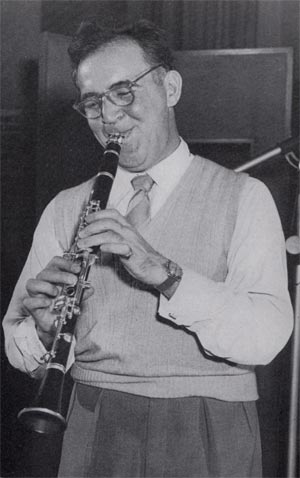
The King of Swing, clarinetist Benny Goodman, was a driving force in breaking down racial barriers in the jazz world, not so much from a crusade for equality but because he wanted to work only with the best musicians, regardless of race. One of those great musicians he discovered was percussionist Lionel Hampton.
In 1954, Lionel Hampton told Post readers about how his relationship with Benny Goodman started and how it grew, both professionally and personally. The result is an intimate homage to a man who was both musical mentor and dear friend.
This post was published to mark National Jazz Appreciation Month. You can read more of the Post’s historical stories from and about jazz legends in “Jazz History by Men Who Made It.”
Me and Benny Goodman
By Lionel Hampton as told to Bernard Seeman
Originally published on December 18, 1954
The Benny Goodman Quartet — and an enduring friendship in the frantic world of jazz — began when Benny found an unknown Negro musician, brought him across the color line into the big time. Lionel Hampton went on to the top, but he’s never forgotten his debt, which he here explains.
This past summer, at Basin Street in New York, I saw something that really stopped the clock for me. Benny Goodman was standing up there with his eyes closed, blowing the sweetest, swingingest riffs you ever heard come out of a clarinet. I sat there listening, and it brought back a lot of things — especially that bouncy, happy feeling that goes with youth.
I wasn’t the only one who felt it. There were people in the audience in their 40s and 50s, and you could tell they were feeling it, too, the way they swayed with their eyes shut or pounded out the beat on the table. You didn’t need any imagination to see that they were back in 1936 or ’37, listening to the King of Swing blow his licorice stick and make everyone swing along with him. That night in Basin Street we were all young again.
Benny was always my favorite musician, long before I joined his band. I was pretty young then myself and, even though I was a drummer and vibraharp player, I tried to do like Benny. I’d listen to all his records and then try to play the vibes the way Benny played his clarinet. 1 even tried his riffs.
The big night camp for me in September, 1936. I had a nine-piece band and we were playing in a little beer garden in Los Angeles, called the Paradise Night Club. It was on 6th and Main, what they called the “Gimmick Street” — a thoroughfare where anything happens.
Benny Goodman was playing in the Palomar Ballroom at the time and, man, it was wonderful to be so close. Well, one night in walks Benny into the Paradise, sits down at a table and starts listening to me. He’d heard about me through his brother-in-law, John Hammond, the jazz critic. I was playing the vibraharp, and Benny was very amused at it because at that time the vibes weren’t very popular or well known. The drummers just used it to play the pretty notes on — the “bing bong” they’d hang on the end of a tune. But I was playing jazz on it, and that night, with Benny there, I was inspired.
He’d been in the house about half an hour, listening, when he came over and said, “Pops.” I’ll never forget it; he called me “Pops.” He said, “Pops, I’ve been hearing a lot about you and I’d like to sit in with you.” So he took out his clarinet and began blowing.
We jammed about two or three hours. The place was supposed to close at three o’clock, but I think the whole house stayed till five that morning. The next night he brought pianist Teddy Wilson, drummer Gene Krupa, and several other boys from his band. We jammed till five or six o’clock.
Then Benny said, “Pops, how’d you like to make a record with us?” That thrilled me. Man, I was really gassed. I got home that morning after six, and about eleven Benny called and asked me to come out to the RCA Victor studio. I jumped out of bed right away and rushed down to 6th and Main to pick up my vibes. The records we made were “Moon Glow” and “Dinah” — Benny, Teddy Wilson, Gene Krupa, and I. That was the birth of the Goodman Quartet. It lasted till 1941, when Benny took sick.
The “King of Swing”, Benny Goodman
Not long after we made the records, Benny asked me would I join his band. He had left the Palomar and had gone to New York, where he was playing in the Manhattan Room of the Pennsylvania Hotel — today it’s the Statler. He was also doing the Camel Caravan show on CBS radio every Tuesday.
Man, when Benny asked me that, it was like a dream. But my wife, Gladys, happened to be a modiste at the time. She was working for Joan Crawford, Rosalind Russell, and a lot of other stars as a personal dressmaker. She had a terrific business, but I had to persuade her to give it up and come travel with us. Benny had said, “If you come, I want your wife to come.” I guess I was young and pretty wild, and Benny wanted me to have a stabilizer along. He was real sharp.
Benny talked to Gladys about it. “Come on back with us, Pops,” he told her. He even called her “Pops.” So we went and bought a little trailer, put the trunks, drums, and vibes in it, hitched it to Gladys’ little car, and drove to New York. And we never regretted it.
I made my debut on the Camel Caravan — I’ll never forget it — on a Tuesday night in November. It was like playing in heaven. Then, one day, I discovered that “heaven” could have a little trouble in it too.
Teddy Wilson and I, you should remember, were the first Negroes to be integrated into a white band. Well, one day during rehearsal I was standing behind Benny, and the producer of the show came over and asked, “Are you going to have the trio and quartet on again?”
Benny said, “Sure; that’s a prominent part of our show.”
“Well, Benny,” the producer told him, “you know we’ve been getting a lot of letters protesting Hampton and Wilson on the show.”
“Nuts to them,” Benny answered. “Either they want my band or they don’t want it. And Hampton and Wilson are part of my band.”
That didn’t end it, of course. They kept on hammering at him, asking Benny to drop us from the show. But Benny went further than just keeping us on. Each week he would have some other Negro guest star.
Ella Fitzgerald was coming out then with a record called A-Tisket, A-Tasket, that she made with the great Chick Webb band. Benny had her on as a guest, and he brought the great blues singer Joe Turner, from Kansas City, and those great boogie-woogie pianists, Pete Johnson, Albert Ammons, and Meade (Lux) Lewis to play with us.
When John Hammond told Benny about Count Basie’s band in Kansas City, Benny was so sold on letting people hear how good Basie was that he pushed the Count’s band along with his own. The radio announcers used to publicize our names on the air, but they never said anything about color. So, when we went on the road, lots of people didn’t expect us to be Negroes. We’d get into a town and someone would ask me, “Are you Mr. Goodman’s valet?”
I’d take it good-naturedly and say, “Sure,” because just to be Mr. Goodman’s valet was enough, because he was my idol.
Another time we were playing a concert in Richmond, Virginia. and the stagehands called me the “water boy.” Benny happened to hear them and he got furious. He called them aside and bawled them out. “This man is a member of my band,” he told them. “He’s a gentleman and I want you to respect him as such. Don’t bring your personal feelings on the stage. If you tear him down, he won’t give a good performance and we’ll all suffer — you included.”
This Is Why He’s the King of Swing
To tell the truth, we didn’t have too much trouble over the race question. That was because Benny would always try to pave the way in advance, so that nothing would happen to embarrass us. He would have the promoters of the tour take all the necessary precautions. Like when we played in the Texas Centennial in Dallas, Benny had us a reservation in the same hotel where he stayed. The only thing was that when we rode the elevator we were supposed to ride with the company manager, so that no one would bother us.
In the band, Benny was a strict disciplinarian, in general behavior as well as music. If the ball was supposed to be snapped on “17,” you snapped the ball on “17.” Benny always insisted on his program, and the men backed him. Harry James is a good example. He comes from Beaumont, Texas, and he used to say to me, “Man, we’re all together, and if anyone bothers you, he bothers us.” Harry knew the score.
What Benny wanted was good music, and he didn’t care whether a man was white, green, black, yellow, or blue, so long as he could play. Some people say he’s hard. I say no. He just has high principles and he doesn’t pussyfoot around with them. As far as I’m concerned, what he did in those days — and they were hard days, in 1937 — made it possible for Negroes to have their chance in baseball and other fields. He was a real pioneer and he didn’t grandstand about it. He used to tell me, “If a guy’s got it, let him give it. I’m selling music, not prejudice.”
Benny was and is a musician — one of the greatest. He was the man who brought out Negro music as a true art form. In my tour of Europe last year, the Europeans all seemed to think the same thing — that the most important art form developed in the United States is Negro jazz. Well, it took a guy like Benny to bring it out. That why he’s the King of Swing.
Lots of people talk about swing, but it’s a hard thing to put into words. You’ve got to hear it to know it. Negro music is rhythmic; it’s got a beat to it — a beat you can feel inside you as well as hear with your ears. Well, we Negroes never did push our music like we should have; we kept it too much to ourselves. Maybe we were ashamed of it, thought it wouldn’t stand up. But Benny saw how good it was. He brought it out, made the music swing by giving it that beat, that happy lift. And the people who heard it, they would swing right along with him.
The arrangements Benny played with our band were the same ones that Fletcher Henderson made and played with his own band back in 1922 or ’24. They are just as fresh today as the day they were written. I caught Benny’s sneak preview out in New Haven last year when he started his concert tour after his Columbia Jazz at Carnegie Hall records proved so popular. The ovation he got was tremendous, and the younger generation was hollering, “Go, go, go, Benny! Go, go, go!” And he was playing the same arrangements Henderson wrote about 30 years before. The way Benny feels about it is, he says, that in their way the Henderson arrangements will stand up like the work of Mozart, Debussy, or any of those guys. They are real classics.
Benny believed that a man had to have a calling to be a musician. He could pick out the greatness in a musician and know whether he was a “school musician” or had a great soul — something of God that he was born with. If a man had that, Benny wouldn’t care if he couldn’t read a note.
He had strict beliefs about talent. If you were supposed to be a swing musician, swing like mad. If you were supposed to be a concert musician, be the best. He wanted perfection, no matter what you did. “You got to have respect for your audience,” he would tell me. “They’re paying for the best you’ve got —and you’ve got to give it to them.”
Benny didn’t allow any fooling around about rehearsals. He always wanted us on a job an hour ahead of time, so we could get ready. You had to be clear-minded and clear-thinking. No false stimulants. If you did what he said, he wouldn’t cross you. But if you didn’t — well, he was liable to throw the clarinet at you.
You didn’t hit any wrong notes in Benny’s band. If you did, you only had one more time to do it. And he wouldn’t give any two weeks’ notice. He’d pay you off on the spot for the two weeks.
When Benny got engrossed in his music, he kind of got lost and just left this world. But he always knew what the men in the band were doing. If a guy accidentally hit a wrong note, Benny would give him the “ray.” That was an expression we had in the band. Some of the men even used to call Benny “The Ray.”
He’d look over his glasses and stare at you, really nail you down with his eyes. And all the time he’d keep on playing, making some of the most difficult passages on his clarinet. Two minds working with him all the time. He’d be playing with one mind, chastising you with the other. He wouldn’t stop playing and he wouldn’t stop glaring.
And at the end of a piece, Benny would stop playing, but he’d keep on giving you the ray. Then he’d turn around and say, “The next number will be so-and-so.” But if you did something wrong the next time, as I said before, he would pay you off.
Nobody in the band liked to get the ray. I remember Ziggy Elman was picking up a mute off the floor and didn’t get it in his trumpet fast enough. He said later, “The old man give me the ray and it stayed with me four days. I couldn’t sleep.”
Benny was a real fanatic about rehearsals and arrangements. If some idea hit him, he would call a rehearsal at 7:00 in the morning. Sometimes we would get off a train and Benny would say, “Rehearsal.” And you’d be there. Harry James, Ziggy Elman, and Chris Griffin would have to hit high F or high G at 7:00 in the morning just as sharp as they hit it at 7:00 at night.
The trumpet players used to say, “Man, my chops are down.” They were talking about the lips. Well, your chops had to be always up, really cooking and smoking with Benny.
Just because Benny was so serious about music doesn’t mean he wasn’t human. He always had a fine sense of humor. Back in the old days he had the slang, like everyone else. I gave him a couple of things when I first came to the band. I was working down on the Gimmick Street and I got a lot of the common talk — the hip jive talk. Like killer-diller. When an arrangement was great, knocked the crowd out, I’d say to Benny, “Pops, call that a killer-diller.” I called him Pops too.
Then we used the term gassin’ in. “That gassed me, man.” Of course, today they say, “It’s a gasser.” That means something is great enough to make you flip. Then we used the word hip. “Man, that’s really hip,” meant it was on the ball.
Once in a while, Benny would say something that passed way over me. Like the time we played in the Paramount Theater in New York. It was January 1937, before we did the Carnegie Hall concert, and it was the first time, I think, that the band and quartet played together in a theater.
It was real wild. The kids lined up at 6:00 in the morning — you just couldn’t stop them. They were dancing in the aisles, on the stage, on one another’s heads — wherever there was room.
Today, a lot of those kids are married and have kids of their own. Benny introduced the quartet, and we went over terrific. When it was over, I asked Benny, sort of kidding, “Pops, how you think we did?”
He said, “Oh, man, we hog-tied the show.”
That got me mad and I sulked all day because I thought he meant something went wrong.
Later on, the Variety reporter came by, and I asked him what Benny meant by “hog-tied.” He told me, “When you hog-tie something, can’t nothing else follow it.”
Benny really taught me something with that quartet. We played about 1,000 shows, and we sure stopped them. “Once you stop a show,” Benny told me, “get off that stage and don’t come back on. You might do lots of encores, but hit one bad note and you spoil it all. So get off.”
Sometimes you hear people say Benny is absent-minded. I say he is just unexpected. Every once in a while, when you think you have him all figured out, he might do something that throws you off.
Once we were riding in a train together, and Benny was eating bacon and eggs in the dining car. He asked the waiter for some catchup. Benny didn’t see the top on the bottle, so he started to pour it and the top fell off right in the middle of his eggs.
I looked at Benny and waited for him to pick the top off. I was wrong. He just put the bottle back on the table and ate all around the top, ate all the eggs and left the top sitting there in the middle of the plate.
Another time we were on a train and the steward poked a pad and pencil into the compartment so Benny could write his breakfast order. Benny looked at it, signed it, and said, “All right, there’s my autograph.”
Another thing about Benny, he left the business end of his band to his sister, Ethel, but he was no fool about money.
Once — I think it was in Pittsburgh — we went to a spot called the Harlem Club. The audience was throwing money at the performers, and a coin happened to roll down by Benny’s foot. Benny saw it and said, “Gee, Abraham Lincoln is smiling at me. Abe is winking at me.” He picked it up and put it in his pocket. We were all amused by this because we’d been sitting around that table feeling too good to pick up a penny.
Benny knew the value of a penny and a dollar, but he sure was no tightwad. When he took sick in 1941 and had to go to the Mayo Clinic, I got his blessing to start a band of my own. I felt so grateful and indebted to him because he really gave me my start that I made a deal with Joe Glaser, who became my booker and manager, to set aside 5 percent of my earnings for Benny and call it the Benny Goodman Fund.
Around 1942 and ’43, business got real good, and up to 1946 my band was one of the top-grossing outfits in the country. So the 5 percent kept adding up and I’d be telling Benny, “Pops, I’ve got that fund set up because I figured that if I had a band you should profit in it.”
He would say, “Sure, sure, Popsy. Just go ahead. I’ll see you later.”
By 1946 that 5 percent came to over $130,000, so I decided to bring Benny to a showdown.
“Go ahead and take that money,” I told him. “Take it because it keeps piling up.”
Benny, he smiled and he said, “You made a great name for yourself and I feel proud of you. You earned that money; go ahead and keep it.”
Every once in a while, when Benny and I have a reunion, we naturally get around to talking about the old days. The other night we were talking about “Flying Home.” He said he’d heard that I’d made a 28-minute version with Oscar Peterson, Buddy Rich, Buddy De Franco, and Ray Brown for Norman Granz on the Clef label.
“Did we write that song together?” he wanted to know.
I said, “We certainly did. Don’t you remember when we were flying from Los Angeles to Atlantic City? And I was up in the airplane humming this riff and you were sick to the stomach — you were the only one sick on the trip. Then you started humming along with me, and you put the middle to the tune and wrote it all down. Then we both got to singing and, man, we sang it all the way to Atlantic City.”
Then Benny smiled. “Yeah, I remember,” and he remarked how “Flying Home” has gone through all these years, getting bigger and bigger. Les Brown, Ellington, Art Tatum, all have made records of it. Even some rumba band has just made a record of it. That piece of music is a classic already.
Recently I’ve been hearing about this movie Universal is making about Benny. If anyone deserves it, he does, because Benny is a really great man who cemented a wonderful relationship between colored and white. Don’t get the idea Benny was one of those crusaders who are always playing for headlines. A crusader has an ax to grind. Benny had no axes; he’s just interested in music and people, and he wants the best of both to get a chance to come out. I hope they can show that in the picture.
Listening to Benny in Basin Street was a thrill — you can’t imagine how much of a thrill, because it brought back all those wonderful days when we were playing together. The technique he has, the soul and expression are still amazing. He hasn’t lost anything. His new records are sensational. I buy them all.
Yes, Benny’s still my favorite — just like he was when I played the Paradise Night Club.
Admiring Benny as I do, I know it will be sometime along the road that he and I will play together again. We’ve just got to. I fit right in with him, like ham and eggs. When Benny and I used to play together, we never had to sit down and figure out a riff. If Benny started a riff, I could play a third to him, I could play a fifth, just automatically. I don’t care how hard or complicated it was. And he could do the same thing with me. He and I can just play together so good.
Jake Gyllenhaal’s rise to the top in Hollywood began with his first role at 11 playing Billy Crystal’s son in City Slickers. Many other parts followed, and, of course, there was an Oscar nomination as the gay cowboy in Brokeback Mountain. Hard to believe that movie came out 10 years ago.
As a full-fledged star today, Gyllenhaal is the first to tell you he wants to be an actor who can disappear into the characters he plays. Last summer, the 35-year-old transformed himself into a tattooed and torn-to-shreds boxer in Southpaw. That was followed in September by the harrowing true-life story Everest, about a climber who struggles to survive when he and his group are trapped in a deadly snowstorm. Now, Gyllenhaal is once again suffering on the big screen in Demolition. Hitting theaters in April, this intense drama is about an investment banker whose carefully ordered life falls apart after the death of his wife.
Jeanne Wolf: While you are hurting emotionally in Demolition, you trained hard and felt real pain in Southpaw. What was it like the first time you got hit for real?
Jake Gyllenhaal: I deserve and need a little smack in the face occasionally. My mother would definitely tell you that. Actually, that was motivating for me. Part of knowing what it’s like to be a boxer was that feeling that you’re going to take some punches. You have to know that feeling or it seems false to the audience.
“I deserve and need a little smack in the face occasionally. My mother would definitely tell you that.”
JW: You are making the effort to challenge yourself and go to some very intense places. Why push this hard?
JG: I can’t do the same thing over and over. It’s just not the way I am. I am about variety, and I am fascinated by all different types of people. I love discovering things and I love being pushed. In the last couple of years, I’ve played characters that have sort of been in different, darker worlds, but I always like finding the humor in those places, too. It’s not all about darkness.
JW: With all the temptations that come with fame and big hits, you have a work ethic that truly impresses people who expect any kind of diva behavior.
JG: As I keep on acting, I don’t forget that it’s a job. My dad was a very successful film director, but he was never pretentious about it. He’d always go, “If I were a plumber, you’d probably have been a plumber too.” There’s some truth in that. I’m doing this because my parents started doing it. They influenced me to follow them and use acting as a way of saying something politically, not just to have a great lifestyle. It’s been a very interesting ride.
This three-part series by Pete Martin was originally published in The Saturday Evening Post, May 5–19, 1956:
The New Marilyn Monroe
By Pete Martin Originally published on May 5, 1956
A Post editor’s surprisingly candid report on the girl with the horizontal walk. He reveals things about the phenomenal blonde that even Marilyn herself doesn’t know.
I said to Marilyn Monroe, “Pictures of you usually show you with mouth open and your eyes half closed. Did some photographer sell you the idea that having your picture taken that way makes you look sexier?”
She replied in what I’d come to recognize as pure Monroese. “The formation of my lids must make them look heavy or else I’m thinking of something,” she told me. “Sometimes I’m thinking of men. Other times I’m thinking of some man in particular. It’s easier to look sexy when you’re thinking of some man in particular. As for my mouth being open all the time, I even sleep with it open. I know, because it’s open when I wake up. I never consciously think of my mouth, but I do consciously think about what I’m thinking about.”
Tucked away in that paragraph like blueberries in a hot muffin were several genuine Monroeisms. I had studied the subject long enough to be able to tell a genuine Monroeism from a spurious one.
When I asked her, “Has anyone ever accused you of wearing falsies?” she came through with a genuine Monroeism.
The Golden Age of Hollywood
Relive The Golden Age of Hollywood with this new collection of behind-the-scenes interviews — straight from the pages of The Saturday Evening Post — with the celebrities who defined “glamour” for a generation.
“Yes,” she told me, her eyes flashing indignantly. “Naturally,” she went on, “it was another actress who accused me. My answer to that is, quote: Those who know me better know better. That’s all. Unquote.”
Another Monroeism followed hard on the heels of that. I said, “I’ve heard that you wowed the marines in Korea when you climbed up onto a platform to say a few words to them, and they whistled at you and made wolf calls.”
“I know the time you’re talking about,” she said. “It wasn’t in Korea at all; it was at Camp Pendleton, California. They wanted me to say a few words, so I said, ‘You fellows down there are always whistling at sweater girls. Well, take away their sweaters and what have you got?’ For some reason they screamed and yelled.”
Another example came forth when Marilyn was asked if she and the playwright, Arthur Miller, were having an affair. “How can they say we’re having a romance?” she replied. “He’s married.”
Still another Monroeism had emerged from a press conference in the Plaza Hotel, in New York City. It was held to announce her teaming with Sir Laurence Olivier in an acting- directing-producing venture — a get-together described by one of those present as “one of the least likely duos in cinematic history.” The big Monroeism of that occasion was Marilyn’s answer to the query, “Miss Monroe, do you still want to do The Brothers Karamazov on Broadway?”
“I don’t want to play The Brothers,” she said. “I want to play Grushenka from that book. She’s a girl.”
Listening to her as she talked to me now, I thought, Nobody can write dialogue for her which could possibly sound half as much like her as the dialogue she thinks up for herself.
Nunnally Johnson, who produced the film, How to Marry a Millionaire, costarring Marilyn, told me, “When I talked to her when she first came on the lot, I felt as if I were talking to a girl under water. I couldn’t tell whether I was getting through to her or not. She lived behind a fuzz curtain.”
Johnson also directed How to be Very, Very Popular, and when Sheree North took Marilyn’s place in that film, he announced: “Sheree will not use the Monroe technique in How to be Very, Very Popular. She will play the entire role with her mouth closed.”
Marilyn’s last sentence to me: “I never consciously think of my mouth, but I do consciously think about what I’m thinking about” seemed a trifle murky, but I had no time to work on it, for, without pausing, she said, “Another writer asked me, ‘What do you think of sex?’ and I told him, ‘It’s a part of nature. I go along with nature.’ Zsa Zsa Gabor was supposed to write an article for a magazine on the subject: ‘What’s Wrong With American Men,’ and I did marginal notes for it. The editor cut out my best lines. I wrote, ‘If there’s anything wrong with the way American men look at sex, it’s not their fault. After all, they’re descended from the Puritans, who got off the boat on the wrong foot — or was it the Pilgrims? — and there’s still a lot of that puritanical stuff around.’ The editor didn’t use that one.”
I carefully wrote down every word she said to me. She told me that she’d rather I wouldn’t use a tape-recording machine while interviewing her. “It would make me nervous to see that thing going round and round,” she insisted. So I used pencils and a notebook instead. But I didn’t use them right away.
I had to wait for her to walk from her bedroom into the living room of her apartment, where I sat ready to talk to her. It took her an hour and a half to make that journey. At 3:45, Lois Weber, the pleasant young woman who handled the Monroe New York publicity, admitted me to the apartment Marilyn was occupying. She pushed the buzzer outside of a door on the eighth floor of an apartment building on Sutton Place South, and a voice asked, “Who is it?”
“It’s me,” said my chaperone.
The lock clickety-clicked open, but when we went in, Marilyn was nowhere in sight. She had retreated into a bedroom. Her voice said to us through the door, “I’ll be out in just seven minutes.”
A publicity man to whom I’d talked at Marilyn’s studio in Hollywood had warned me, “She’ll stand you up a couple of times before you meet her. Then she’ll be late, and when I say late, I mean real late. You’ll be so burned at her before she walks in that you’ll wrap up your little voice-recording machine and get ready to leave at least three times — maybe four times — before she shows. But somebody will persuade you to wait, and finally Marilyn will come in, and before you know it, she’ll have you wrapped up too. For she’s warmhearted, amusing and likable, even if her lateness is a pain in the neck. And after that, if somebody says, ‘That was mighty thoughtless of old Marilyn, keeping you waiting like that,’ you’ll want to slug him for being mean.
“What you won’t know,” that studio publicity man went on, “is that while you’re having hell’s own headache waiting for her, whatever publicity worker is trying to get her to see you is having an even bigger headache. Marilyn will be telling that publicity worker that her stomach is so upset that she’s been throwing up for hours; she hasn’t been able to get her make-up on right; or that she’s got a bum deal in the wardrobe department and hasn’t anything to wear.”
So, in an effort to be witty, when Marilyn said, through the closed door, “I’ll be out in just seven minutes,” I said, “I’ll settle for eight.” Time was to prove it the unfunniest remark I’ve ever made. One hour later I asked Lois Weber, “What do you suppose she’s doing in there?”
“You know how it is,” my publicity-girl chaperone said soothingly, “a girl has to put on her face.”
“What has she got, two heads?” I asked politely. A half hour later I suggested that Lois Weber go into the next room and see what was causing the delay.
Waiting for Lois Weber, I roamed the apartment. On a table lay a play manuscript. Typed on its cover was: Fallen Angels, by Noel Coward. Among the books which seemed in current use were Bernard Shaw’s Letters to Ellen Terry, Shaw’s Letters to Mrs. Patrick Campbell, Gertrude Lawrence as Mrs. A., by Richard Aldrich.
Mute evidence of Marilyn’s widely publicized drama studies at the Actors’ Studio, where she was said to be seeking out the secrets of artistic acting, was a copy of James Joyce’s Ulysses. Several lines of dialogue from that volume had been penciled on a piece of paper, obviously to be recited by or to a group of drama students; then the piece of paper had been thrust part way into the book. Lying on the floor was a large recording of John Barrymore as Hamlet.
That dialogue from Ulysses and the Barrymore recording represented one of the reasons why I was there. I’d read that Marilyn had gone “long hair” and “art theaterish,” and I wanted to see for myself. Just seeing it in print didn’t make it true.
Millions of words had been written about the alluring blonde in whose living room I sat, but most of those words had been of the “authorized” or “with-Marilyn’s-blessing” variety. Several millions of them had appeared in fan magazines — after having first been O.K.’d by the 20th Century-Fox publicity department.
I’d read a lot of those words, but I still felt that I didn’t understand this dame and I was sure that a lot of other people felt the same way about her and that, like myself, they’d been asking themselves for years, “What’s she really like?”
On top of that, they were probably asking themselves other questions — as I was doing. “Why did she blow her marriage with Joe DiMaggio? Why did she walk out on a movie career which was paying her heavy money? Why did she duck California in favor of New York? Why, after she holed up there, did she attend the art-for-art’s-sake Actors’ Studio — surely an unlikely place for a girl who, up to that time, had done most of her acting with her hips?”
I hoped that when I talked to her she would tell me the answers to some of these things. Maybe I’d even see the “new Marilyn Monroe” I’d heard existed.
Lois Weber came back to report: “She thinks the maid must have gone off with the top of her tapered slacks. She’s running around without a top on.”
In an effort to keep me from brooding, Lois Weber said, “The azalea people down in Wilmington, North Carolina, want her for a personal appearance in April, but I told them they’d have to call me in April. Who knows where she’ll be then?”
The minutes crawled by and I thought of various things that people had told me about Marilyn before I’d begun my marathon wait in her Sutton Place apartment. Every male friend I had told I was doing a story about Marilyn had asked me, “Can I go along to hold your notebook?” or “You call that work?” or “You get paid for that?” or “Can’t I go along and hold the flash bulbs?” Apparently they felt that if they failed to go into a blood-bubbling, heman routine at the drop of her name, their maleness was suspect. When Marilyn appeared breathless and friendly as a puppy, I told her of this phenomenon. “How do you explain it?” I asked. “Have you become a symbol of sex?”
She gave my query thought before answering. “There are people to whom other people react, and other people who do nothing for people,” she said. “I react to men, too, but I don’t do it because I’m trying to prove I’m a woman. Personally I react to Marlon Brando. He’s a favorite of mine. There are two kinds of reactions. When you see some people you say, ‘Gee!’ When you see other people you say, ‘Ugh!’ If that part about my being a symbol of sex is true, it ought to help at the box office, but I don’t want to be too commercial about it.” Quite seriously she said, “After all, it’s a responsibility, too — being a symbol, I mean.”
I told her I’d heard that among the titles bestowed upon her were Woo-Woo Girl, Miss Cheesecake, The Girl With the Horizontal Walk. “I don’t get what they mean by ‘horizontal walk,’” she said. “Naturally I know what walking means — anybody knows that — and horizontal means not vertical. So what?” I thought of trying to blueprint it for her; then decided not to.
The Hollywood publicity worker who had warned me that she would be “real late” had talked to me quite frankly about Marilyn; he had pulled no punches; but since it is unfair to quote a publicity worker by name, I’ll call him Jones. And since “flack” is Hollywood slang for publicity man, I’ll call him Flack Jones.
Jones worked for 20th Century-Fox during the years before Marilyn staged her walkout. Since then he has moved on to bigger — if not better — things. He has opened his own public-relations office, with branches in Paris and Rome. He is bald as a peeled egg. He is as broad as a small barn door; a junior-executive-size Mister Five-by-Five. He wears black-rimmed glasses instead of the clear tortoise-shell plastic variety.
“A thing that fascinates me is this,” I told Flack Jones: “the first time I ever saw her I was sitting with a friend in the Fox commissary and this girl came in without any make-up on. She was wearing a blouse and skirt, and she sat against the wall. She bore no resemblance to anybody I’d ever seen before, but, to my amazement, my friend said, ‘That’s Marilyn Monroe.’ What I want to know is: Does she have to get into her Marilyn Monroe suit or put on her Marilyn Monroe face before she looks like Marilyn Monroe?”
“This is true of all platinum blondes or whatever you call the highly dyed jobs we have out here,” Flack Jones said. “If their hair isn’t touched up and coiffured exactly right; if they’re not gowned perfectly and their make-up is not one hundred per cent, they look gruesome. This is not peculiar to Monroe; it’s peculiar to every other synthetic blonde I’ve ever known in picture business. There are very few natural blondes in Hollywood and, so far as I know, there have been no natural platinum blondes in mankind’s history, except albinos. They are strictly a product of the twentieth century. They’re created blondes, and when you create a blonde you have to complete your creation with make-up and dramatic clothes, otherwise you’ve got only part of an assembly job.”
I also talked to a member of the Fox Studio legal staff, who told me a Monroe story I found provocative. “One day,” he said, “she was in this office, and I said to her, ‘It would be better for you to sign this contract this year instead of next. It will save you money.’ She looked at me and said, ‘I’m not interested in money. I just want to be wonderful.’ Then she walked out.” The legal light looked at me helplessly and shrugged. “What do you suppose she meant by that?” he asked. I said I had no idea, but that I’d try to find out.
And I asked a friend high enough up in the Fox hierarchy to know the answer, “Why do you think your studio let her come back to work for it after she walked out and stayed in New York for fifteen months?”
“Our attitude was that she’d never work on our lot again,” he announced firmly; then he grinned, “unless we needed her.”
One of my longer talks was with Billy Wilder, who directed her in the film The Seven Year Itch.
“What do you want to know?” he asked when I went to see him in his Beverly Hills home.
“One of the interesting things about this Monroe girl, to me,” I said, “is she seemed in danger of spoiling what had begun as a successful career by running away from it. I began to ask myself: How long can a movie actress afford to stay away from moviemaking and still remain a star? The mere strangeness of her staying away gets her a terrific press for a while and makes everyone in the country conscious of her, but is it possible to stay away so long that you’re forgotten? Was that about to happen to Marilyn?”
“I don’t think there was any danger of Marilyn sinking into oblivion,” Wilder said. “A thing like her doesn’t come along every minute.”
I asked, “What do you mean ‘a thing like her’?”
“She has what I call flesh impact,” he told me. “It’s very rare. Three I remember are Clara Bow, Jean Harlow and Rita Hayworth. Such girls have flesh which photographs like flesh. You feel you can reach out and touch it.”
“I’ve heard that it’s a moot question as to whether Marilyn’s an actress or not,” I said.
“I’ve heard that, too,” he replied. “Before we go further I must tell you that I like the girl, but it’s also moot whether you have to be an actor or an actress to be a success in pictures. I’m sure you’ve heard the theory that there are two kinds of stars — those who can act and those who are personalities. I’ll take a personality any time. Something comes down from the screen to you when you see them, in a way that it doesn’t always come from the indifferently paid actors, although they may be perfect at their jobs.”
“It’s nothing against them or for them,” Flack Jones said, when I repeated Wilder’s idea to him. “It’s the way this business is put together. If the public likes a personality, he or she goes over. You take Tab Rock,” he said (only Tab Rock is not the name he used). “Old Tab’s a terrific personality. I doubt if he’s ever made a flop picture, but he’s never made a really good picture. This fellow can’t pick up his hat without instruction, yet he’s always picking up villains and throwing them across a bar singlehanded. He can clean up any barroom on the frontier, but he can’t clean up a kitchen. He’s a nice guy, but no one has ever called him an actor. You take Lloyd Nolan now, or Van Heflin. That’s acting for you. You believe them. There are lights and shades and meaning to what they do. But when old Tab Rock comes on the screen, he’s got to throw somebody around to prove his art. He can do this quicker than anybody in Hollywood, and this is his great value.”
“He sounds brave,” I said.
“No one is braver or more scornful about it,” Flack Jones said. “His bravery is without parallel in the industry. He’s the only man I ever saw who could take a forty-five and go to the Near East and clean the whole mess up in a day or two. He never fails. That’s the difference between a personality and an actor.”
When I talked to Wilder I said that I’d read that when Marilyn had announced that she wanted to appear in a movie version of The Brothers Karamazov, some people hooted.
“The hooters were wrong,” Wilder told me. “She meant that she wanted to play the part of Grushenka in that book, and people who haven’t read the book don’t know that Grushenka is a sex pot. People think this is a long-hair, very thick, very literary book, but Dostoevsky knew what he was doing and there is nothing long-hair about Grushenka. Marilyn knows what she’s doing too. She would be a good Grushenka.
“It was after she said that she wanted to be in The Brothers Karamazov,” Wilder went on, “that she started going to the Actors’ Studio School of Dramatic Arts in New York. She didn’t do it for publicity. She’s sincerely trying to improve herself, and I think she should be admired for that. She could have sat here in Hollywood on her pretty little fanny and collected all of the money any ordinary actress would ever want, but she keeps trying.
“Right now, as of today, no matter what she thinks, Marilyn’s great value is as a personality, not as an actress. [Wilder told me these things while Marilyn was still in New York being groomed by the Actors’ Studio. It may be that what happened to her during her Eastern schooling in new dramatic ways may change his opinion, but 1 haven’t talked to him since her return to Hollywood.] If she sets out to be artistic and dedicated, and she carries it so far that she’s willing to wear Sloppy-Joe sweaters and go without make-up and let her hair hang straight as a string, this is not what has made her great to date. I don’t say that it’s beyond the realm of possibility that she can establish herself as a straight dramatic actress — it is possible — but it will be another career for her, a starting all over.”
Back in New York, when Marilyn made that long, long journey from her bedroom to her living room in her apartment, I said to her, “I’ve heard your childhood referred to as ‘the perfect Cinderella story.’”
“I don’t know where they got that,” she told me. “I haven’t ended up with a prince, and I’ve never had even one fairy godmother. My birth certificate reads Norma Jean Mortenson. I was told that my father was killed in an automobile accident before I was born, so that is what I’ve always told people. There was no way I could check on that because my mother was put into a mental institution when I was little, and I was brought up as an orphan.”
I had read that she spent her childhood being farmed out to foster parents and to orphanages, but, talking to her, I discovered that there’d been only one orphanage, although it was true about the foster parents. “I have had eleven or twelve sets of them,” she told me, “but I don’t want to count them all again, to see whether there were eleven or twelve. I hope you won’t ask me to. It depresses me. Some families would keep me longer; others would get tired of me in a short time. I must have made them nervous or something.”
She thought of something else. “I had one pair of foster parents who, when I was about ten, made me promise never to drink when I grew up, and I signed a pledge never to smoke or swear. My next foster family gave me empty whisky bottles for playthings. With them I played store. I guess I must have had the finest collection of empty whisky bottles any girl ever had. I’d line them up on a plank beside the road, and when people drove along I’d say, ‘Wouldn’t you like some whisky?’ I remember some of the people in the cars driving past my ‘whisky’ store saying, ‘Imagine! Why, it’s terrible!’ Looking back, I guess I used to play-act all the time. For one thing, it meant I could live in a more interesting world than the one around me.
“The first family I lived with told me I couldn’t go to the movies because it was sinful,” Marilyn said. “I listened to them say the world was coming to an end, and if I was doing something sinful when it happened, I’d go down below, below, below. So the few times I was able to sneak into a movie, I spent most of the time that I was there praying that the world wouldn’t end.”
Apparently I had been misinformed about her first marriage, to a young man named Jim Dougherty. I’d got the idea that she’d married him while they were both in Van Nuys High School; that she’d got a “crush” on him because he was president of the student body there, and a big wheel around school.
“That’s not true,” she told me. “In the first place, he was twenty-one or twenty- two — well, at least he was twenty-one and already out of high school. So all I can say is that he must have been pretty dumb if he were still in high school when I married him. And I didn’t have a crush on him, although he claimed I did in a story he wrote about us. The truth is the people I was staying with moved East. They couldn’t afford to take me because when they left California they’d stop getting the twenty dollars a month the county or the state was paying them to help them clothe and feed me. So instead of going back into a boarding home or with still another set of foster parents, I got married.
“That marriage ended in a divorce, but not until World War Two was over. Jim is now a policeman. He lives in Reseda, in the San Fernando Valley, and he is happily married and has three daughters. But while he was away in the merchant marines I worked in the dope room of a plane factory. That company not only made planes, it made parachutes.
“For a while I’d been inspecting parachutes. Then they quit letting us girls do that and they had the parachutes inspected on the outside, but I don’t think it was because of my inspecting. Then I was in the dope room spraying dope on fuselages. Dope is liquid stuff, like banana oil and glue mixed.
“I was out on sick leave for a few days, and when I came back the Army photographers from the Hal Roach Studios, where they had the Army photographic headquarters, were around taking photographs and snapping and shooting while I was doping those ships. The Army guys saw me and asked, ‘Where have you been?’
“’I’ve been on sick leave,’ I said. “Come outside.’ they told me. ‘We’re going to take your picture.’
“‘Can’t,’ I said. ‘The other ladies here in the dope room will give me trouble if I stop doing what I’m doing and go out with you.’ That didn’t discourage those Army photographers. They got special permission for me to go outside from Mr. Whosis, the president of the plant. For a while they posed me rolling ships; then they asked me. ‘Don’t you have a sweater?’
“‘Yes,’ I told them, ‘it so happens I brought one with me. It’s in my locker.’ After that I rolled ships around in a sweater. The name of one of those Army photographers was David Conover. He lives up near the Canadian border. He kept telling me, ‘You should be a model,’ but I thought he was flirting. Several weeks later, he brought the color shots he’d taken of me, and he said the Eastman Kodak Company had asked him, ‘Who’s your model, for goodness’ sake?’
“So I began to think that maybe he wasn’t kidding about how I ought to be a model. Then I found that a girl could make five dollars an hour modeling, which was different from working ten hours a day for the kind of money I’d been making at the plane plant. And it was a long way from the orphanage, where I’d been paid five cents a week for working in the dining room or ten cents a month for working in the pantry. And out of those big sums a penny every Sunday had to go into the church collection. I never could figure why they took a penny from an orphan for that.”
“How did you happen to sign your first movie contract?” I asked.
She tossed a cascade of white-blond tresses from her right eye and said, “I had appeared on five magazine covers. Mostly men’s magazines.”
What, I asked, did she mean by men’s magazines? “Magazines,” she said, “with cover girls who are not flat-chested. I was on See four or five months in a row. Each time they changed my name. One month I was Norma Jean Dougherty — that was my first husband’s name. The second month I was Jean Norman. I don’t know what all names they used, but I must have looked different each time. There were different poses— outdoors, indoors, but mostly just sitting looking over the Pacific. You looked at those pictures and you didn’t see much ocean, but you saw a lot of me.
“One of the magazines I was on wasn’t a man’s magazine at all. It was called Family Circle. You buy it in supermarkets. I was holding a lamb with a pinafore. I was the one with the pinafore. But on most covers I had on things like a striped towel. The towel was striped because the cover was to be in color and the stripes were the color, and there was a big fan blowing on the towel and on my hair. That was right after my first divorce, and I needed to earn a living bad. I couldn’t type. I didn’t know how to do anything. So Howard Hughes had an accident.”
I wondered if I’d missed something, but apparently I hadn’t. “He was in the hospital,” she went on, “and Hedda Hopper wrote in her column: ‘Howard Hughes must be recuperating because he sent out for photographs of a new girl he’s seen on five different magazines.’ Right after that Howard Hughes’ casting director got my telephone number somehow, and he got in touch with me and he said Howard Hughes wanted to see me.
“But he must have forgotten or changed his mind or something,” she said, “because instead of going to see him, I went over to the Fox Studio with a fellow named Harry Lipton, who handled my photography modeling. Expensive cars used to drive up beside me when I was on a street corner or walking on a sidewalk, and the driver would say, ‘I could do something for you in pictures. How would you like to be a Goldwyn girl?’ I figured those guys in those cars were trying for a pick-up, and I got an agent so I could say to those fellows, ‘See my agent.’ That’s how I happened to be handled by Harry Lipton.”
Harry took her to see Ivan Kahn, then head of Fox’s talent department, and also to see Ben Lyon, who was doing a talent-scouting job for Fox.
I asked her how it happened that she changed her name from Norma Jean Dougherty to Marilyn Monroe.
“It was Ben Lyon who renamed me,” she said. “Ben said that I reminded him of two people, Jean Harlow and somebody else he remembered very well, a girl named Marilyn Miller. When all the talk began about renaming me, I asked them please could I keep my mother’s maiden name, which was Monroe; so the choice was whether to call me Jean Monroe or Marilyn Monroe, and Marilyn won.”
I asked Flack Jones, “What happened when she came to your studio?”
“She came twice,” he said. “The first time was in 1946. We did our best with her, but she just hadn’t grown up enough. She was great as far as looks went, but she didn’t know how to make the most of her looks — or what to do with them. That came with practice. Not that you have to mature mentally to be a star. In fact, it can be a holdback. It might even defeat you. Stars who are mature mentally are in the minority. But actually we had no stories lying around at that time in which she would appear to advantage. So we tried her out in a picture or two in which she played bit parts — secretaries, the pretty girl in the background. Then we let her go, and she went over to RKO and did a picture with Groucho.”
“I didn’t see the film,” I said, “but you’d think with the Marx Brothers chasing her, like a bosomy mechanical bunny romping about the sound stage a couple of jumps ahead of the greyhounds, the fun would have been fast and furious.”
“The trouble was that while the Marx Brothers always chased a dame in their pictures,” Flack Jones told me, “they never caught the dame. And usually the dame never became a star, so the whole thing was a waste of time. It was amusing while you were watching it, but the girls usually outran the Marx boys and a career.”
Marilyn gave me her own version of Flack Jones’ story:
“Most of what I did while I was at Fox that first time was pose for stills. Publicity made up a story about how I was a baby sitter who’d been baby-sitting for the casting director and that’s how I was discovered. They told me to say that, although it strictly wasn’t true. You’d think that they would have used a little more imagination and have had me at least a daddy sitter.”
Flack Jones had filled me in on some more Monroe chronology: “After she left us she went to Metro and appeared in The Asphalt Jungle, directed by John Huston,” he said. “Marilyn’s role was small. She was only a walk-on, but she must have looked good to Darryl Zanuck, for when he saw it, he re-signed her. Asphalt Jungle was one of those gangster things. There was a crooked legal mouthpiece in it, a suave fellow, played by Louis Calhern. Marilyn was his ‘niece’; which was a nice word for ‘keptie.’ She’d say a few lines of dialogue; then she’d look up at him with those big eyes and call him ‘Uncle.’”
“When did you first notice her impact on the public?” I asked.
“Once we got her rolling, it was like a tidal wave,” he said. “We began to release some photographs of her, and as soon as they appeared in print, we had requests for more from all over the world. We had the newspapers begging for art; then the photo syndicates wanted her; then the magazines began to drool. For a while we were servicing three or four photos to key newspapers all over the world once a week — and that was before she had appeared in a picture.
“Once this building-up process started,” Flack Jones explained, “other people got interested in her. We called up the top cameramen around town who had their own outlets, and we told them what we had, and we asked them if they’d like to photograph her. They said, ‘Ho, boy, yes.’
“We told them what the deal was,” Flack Jones went on. “We said, ‘We think this girl has a great future; she’s beautiful, her chassis is great, and are you interested?’ Each guy had his own idea of what he wanted, and he let his imagination play upon her. This is the way such things get done. They’re not created by one person. They’re the creation of all of the press representatives who cover Hollywood for all the publications in the world, which means about three hundred and fifty people.
“Everybody in the studio publicity department worked on her.” Jones ticked them off on his fingertips, “The picture division, the magazine division, the fan-magazine division, the planters who plant the columnists, the radio planters, and so forth. Then, when you make a motion picture, a ‘unit man’ or ‘unit woman’ is assigned to cover its shooting, and he or she handles publicity for that film alone. In addition, the whole department works on the same picture. Our department is highly specialized, but each specialist makes his contribution to the personality we’re erecting in the public’s mind.”
“I’ve met a couple of press agents who’ve been unit men on Marilyn’s films,” I said.
“But the unit man is not always the same for a certain star’s pictures,” Jones said. “Sonia Wilson’s been unit woman on Monroe pictures, and Frankie Neal’s been a unit man on her pictures, but Roy Craft has been her unit man more than anyone else. Roy likes her. He gets along with her fine.”
There was something else I wanted to know. “In addition to distributing her photographs,” I asked, “did you have her show up at different places where you thought her appearance would do her good?”
“We took her to all of the cocktail parties we thought were important,” Flack Jones said. “For instance, one picture magazine had its annual cocktail party, and we told Marilyn she ought to show so we could introduce her to various editors, columnists and radio and TV people. She waited until everybody had arrived; then she came in in this red gown. That gown became famous. She’d had sense enough to buy it a size or two too small, and it had what Joe Hyams calls ‘break-away straps.’
“When she came in, everybody stopped doing what they were doing and their eyes went, ‘Boing, boing,’” Flack Jones went on. “The publisher of the magazine who was picking up the tab for the party shook hands with her a long, long time. After a while he turned to one of his associate editors and said, ‘We ought to have a picture of this little girl in our book.’ Then he looked at her again and said, ‘Possibly we should have her on the cover.’”
Flack Jones grinned. “So that’s the way things went,” he said. “Some months there were as many as fifteen or sixteen covers of her on the newsstands at once. She came back to the Fox lot in 1950 to appear in All About Eve, but she was not anyone’s great, big, brilliant discovery until we got our still cameras focused on her and started spreading those Marilyn Monroe shots all over the universe.”
“What did she do in All About Eve?” I asked. “I don’t remember.”
“She’s the dumb broad who walks into a party at Bette Davis’ place leaning on George Sanders’ arm,” he said. “There’s dialogue which shows you that Sanders is a critic, like George Jean Nathan; and he brings this beautiful dish Marilyn in, and he sights a producer played by Gregory Ratoff. Sanders points at Ratoff and says to Marilyn, ‘There’s a real live producer, honey. Go do yourself some good.’ So Marilyn goes off to do herself some good while Sanders stays in his own price class with Bette.”
“Do you remember the first day she came to work?” I asked.
“Do I remember?” he said. “She was in an Angora sweater out to there. While we were shooting her in photography, the word got around and the boys rushed across the hall to get an eyeful. Next we did some layouts with her for picture magazines. We put her in a negligee, and she liked it so much that she wouldn’t take it off. She walked all over the lot in it, yelling, ‘Yoo hoo’ at strangers as far away as the third floor of the administration building. Pretty soon the whole third floor was looking down at her. The first and second floors looked too.”
Flack Jones did an abrupt shift into the present tense, “It’s a bright, sunny day; the wind is blowing and she has Nature working with her. It has taken Nature quite a while to bring her to the ripe-peach perfection she reaches on that day, but it finally makes it. The wind does the rest. She walks all over the lot, has a ball for herself, and so does everybody else.”
Then he shifted back again, “After that we took her to the beach with a lot of wardrobe changes. But the basic idea was that this is a beautiful girl with a great body, and that idea was always the same, although we had different approaches to it. We had color shots, we had black-and-white shots, we had mountain shots, we had field shots, faked water-skiing shots — every type of approach we could think of. Picnicking, walking — anything a person does, we let her do it. When we began to see what she did best, we concentrated on it.
“Women always hate the obvious in sex,” Flack Jones said, “and men love it.” Apparently he had given this matter a lot of thought. He had even worked out a philosophy about it. “Guys are instinctively awkward and blundering and naïve — even worldly-wise ones — and subtlety in sex baffles them. Not only that, but they don’t have the time. Women who are not supporting a husband have all the time in the world for it. But men have other things to do, like making a dollar; and they like their love-making without preliminaries which last four or five hours. Instinctively Marilyn knows this. She is very down-to-earth, very straightforward.”
I asked Marilyn when I talked to her back on Sutton Place, “Do you think men like their sex subtle or fairly obvious?” This was a double check. I already had the male answer.
It seemed to me that she hedged. “Some men prefer subtleties and other men don’t want things so subtle,” she said. “I don’t believe in false modesty. A woman only hurts herself that way. If she’s coy she’s denying herself an important part of life. Men sometimes believe that you’re frigid and cold in the development of a relationship, but if they do, it’s not always your fault. Religion has to do with it and how you’re brought up. You’re stuck with all that.”
I remembered something else Wilder had told me before Marilyn’s recent return to Hollywood to make the film version of the New York stage hit Bus Stop. “You take Monroe, now,” he remarked. “Aside from whether she’s an actress or not, she’s got this lovely little shape, it twitches excitingly, and the public likes to watch it, either coming toward them or going away. There are two schools of thought about her — those who like her and those who attack her — but they both are willing to pay to watch her. Their curiosity is good for eighty cents or a dollar and a quarter or whatever the price of the ticket.”
He shook his head thoughtfully. “And she went back East to study at a slow-take arty place, where they feature understatement. Here’s a girl who’s built herself a career on overstating something, and she’s made up her mind to understate. It won’t be long before we’ll know whether she’s right and whether she needs the wardrobe department and the hairdressing department as much as she needs artistic lines to say. It’ll be interesting to watch and I hope it works out the way she wants it to, but the lines that the public really wants from her so far are not written in English. They are her curves.”
The voice of Flack Jones echoed in the back of my head. “I forgot to tell you. When she finished that Marx Brothers picture, she went over to Columbia for a couple of shows, but she didn’t click, and they released her too. After that she was around town for a while going broke. It was then that she posed for that famous nude calendar — the composition of glowing flesh against a red velvet background which threw the public into a tizzy when they learned about it.”
I asked Marilyn to tell me the story of that nude calendar herself, and she said, “When the studio first heard about it, everybody there was in a frenzy. They telephoned me on the set where I was working in a quickie called Don’t Bother to Knock. The person who called asked me, ‘What’s all this about a calendar of you in the nude? Did you do it?’
“‘Yes,’ I said. ‘Is there anything wrong with it? So they’ve found out it’s me on that calendar. Well, what do you know!’
“‘Found out!’ he almost screamed. ‘There you are, all of you, in full color!’ Then he must have gotten mixed up, for first he said, ‘Just deny everything’; then he said, ‘Don’t say anything. I’ll be right down.’”
Although William Shakespeare died 400 years ago, his work lives on today. But what if the man himself lived on today? How would he suffer the slings and arrows of outrageous modern life? We’ll never truly know, of course, but we can have fun guessing.
The quotations below, collected by Al Graham, show how we think the Bard of Avon might respond to modern life, work, and recreation.
Shakespeare’s Commute to Work
I hope I am not too late.
—King Henry VIII, Act 5, Scene 2
I take … the train. …
—King Henry VIII, Act 4, Scene 1
’Tis more than time that I were there.
—King Henry IV Part I, Act 4, Scene 2
An you get it, you shall get it by running.
—King Lear, Act 4, Scene 6
I have speeded hither with the very extremest inch of possibility.
—King Henry IV Part II, Act 4, Scene 3
Do you not see, that I am out of breath?
—Romeo and Juliet, Act 2, Scene 5
I ran when I saw others run.
—King Henry IV, Part I, Act 2, Scene 4
The gates shut on me.
—Titus Andronicus, Act 5, Scene 3
Shakespeare Tries Bubble Gum for the First Time
Blow … and crack your cheeks! … blow!
—King Lear, Act 3, Scene 2
You must borrow me Gargantua’s mouth first:
—As You Like It, Act 3, Scene 2
Puff!
Puff in thy teeth … !
—King Henry IV Part II, Act 5, Scene 3
I am scarce in breath, my lord.
—King Lear, Act 2, Scene 2
O Proteus! let this habit make thee blush:
—The Two Gentlemen of Verona, Act 5, Scene 4
Therein do men from children nothing differ.
—Much Ado About Nothing, Act 5, Scene 1
A knack, a toy, a trick …
Away with it!
—The Taming of the Shrew, Act 4, Scene 3
Have we eaten on the insane root
That takes the reason prisoner?
—Macbeth, Act 1, Scene 3
O, what a noble mind is here o’erthrown!
—Hamlet, Act 3, Scene 1
O Time, thou must untangle this, not I.
—Twelfth Night, Act 2, Scene 2
Shakespeare Considers Buying a House
Whose roof’s as low as ours!
—Cymbeline, Act 3, Scene 3
You have here a goodly dwelling.
—King Henry IV Part II, Act 5, Scene 3
These are now the fashion.
—Hamlet, Act 2, Scene 2
’Tis a meritorious fair design.
—Lucrece, Line 1692
It is shaped, sir, like itself.
—Antony and Cleopatra, Act 2, Scene 7
… and room enough
When there is in it but one only …
—Julius Caesar, Act 1, Scene 2
See … out of the window.
—The Taming of the Shrew: Act 5, Scene 1
… some fence!
—King John, Act 2, Scene 1
I like this place.
—As You Like It, Act 2, Scene 4
Who lets so fair a house … ?
—Sonnet 13
What are thy rents?
—King Henry V, Act 4, Scene 1
Shakespeare Builds His Dream House
Hew down, and fell the hardest-timber’d oak.
—King Henry VI Part III, Act 2, Scene 1
He talks of wood: it is some carpenter.
—King Henry VI Part I, Act 5, Scene 3
… busy hammers closing rivets up
Give dreadful note of preparation.
—King Henry V, Act 4, Prologue
When we mean to build.
We first survey the plot, then draw the model.
And, when we see the figure of the house,
Then must we rate the cost of the erection; …
—King Henry IV Part II, Act 1, Scene 3
… if money go before, all ways do lie open.
—The Merry Wives of Windsor, Act 2, Scene 2
… this goodly frame, … this majestical roof …
—Hamlet, Act 2, Scene 2
A forted residence ’gainst the tooth of time…
—Measure for Measure, Act 5, Scene 1
Steep’d me in poverty to the very lips …
—Othello, Act 4, Scene 2
… I was green in judgment: …
—Anthony and Cleopatra, Act 1, Scene 5
Well, thus we play the fools with the time, and the Spirits of the wise sit in the clouds, and mock us.
—King Henry IV Part II, Act 2, Scene 2
… write me down an ass!
—Much Ado About Nothing, Act 4, Scene 2
Shakespeare Does His Taxes
I tax not you, you elements.
—King Lear, Act 3, Scene 2
Help, angels!
—Hamlet, Act 3, Scene 3
So many hours must I contemplate.
—King Henry VI Part III, Act 2, Scene 5
You have not the book of riddles about you, have you?
—The Merry Wives of Windsor, Act 1, Scene 1
This week he hath been heavy, sour, sad,
And much different from the man he was.
—The Comedy of Errors, Act 5, Scene 1
Truly, the souls of men are full of dread.
—King Richard III, Act 2, Scene 3
A thing of custom: ’tis no other;
Only it spoils the pleasure of the time.
—Macbeth, Act 3, Scene 4
Shakespeare Attends a Baseball Game
Tybalt, you rat-catcher, will you walk?
—Romeo and Juliet, Act 3, Scene 1
Thou canst not hit it …
Thou canst not hit it, my good man.
—Love’s Labour’s Lost: Act 4, Scene 1
O! let him pass!
—King Lear, Act 5, Scene 3
Who makes that noise there?
—Measure for Measure, Act 4, Scene 3
… a broad and powerful fan.
—Troilus and Cressida, Act 1, Scene 3
Stop his mouth,
and let him speak no more.
—Titus Andronicus, Act 5, Scene 1
Set thee down … !
—Love’s Labour’s Lost, Act 1, Scene 1
Another hit; what say you?
—Hamlet, Act 5, Scene 2
… one sweet sacrifice.
—King Henry VIII, Act 2, Scene l
He’s safe …
—The Tempest, Act 3, Scene 1
Safe … safe enough.
—Julius Caesar, Act 5, Scene 4
Thou art a robber …
—Cymbeline, Act 4, Scene 2
Shakespeare Doesn’t Like Pop Music
Fair prince, here is good broken music,
—Troilus and Cressida, Act 3, Scene 1
Music do I hear? Ha, ha!
—King Richard II, Act 5, Scene 5
What fire is in mine ears?
—Much Ado About Nothing, Act 3, Scene 1
Ay, Hal; ’tis hot, ’tis hot.
—King Henry IV Part I, Act 5, Scene 3
Too hot, too hot!
—The Winter’s Tale, Act 1, Scene 2
… ’tis no matter how it be in tune.
So it make noise enough.
—AsYou Like It, Act 4, Scene 2
Host: I perceive you delight not in music, Julia: Not a whit, when it jars so.
—The Two Gentlemen of Verona, Act 4, Scene 2
What sayest thou to this tune, matter, and method?
—Measure for Measure, Act 3, Scene 2
O fie! the treble jars.
—The Taming of the Shrew, Act 3, Scene 1
The general so likes your music, that he desires you,
For love’s sake, to make no more noise with it.
—Othello, Act 3, Scene 1
Shakespeare Vacations at a Dude Ranch
Now my soul hath elbow-room; …
—King John, Act 5, Scene 7
These shadowy, desert, unfrequented woods,
I better brook than flourishing peopled towns.
—The Two Gentlemen of Verona, Act 5, Scene 4
Give me my boots, I say; saddle my horse.
—King Richard II, Act 5, Scene 2
For my voice, I have lost it with hollaing, and singing …
—King Henry IV Part II, Act 1, Scene 2
I have held familiarity with fresher clothes; …
—All’s Well That Ends Well, Act 5, Scene 2
Motley’s the only wear.
—As You Like It, Act 2, Scene 7
Where’s the cook? Is supper ready … ?
—Taming of the Shrew, Act 4, Scene 1
I eat, and eat I swear—
—King Henry V, Act 5, Scene 1
Shakespeare Ponders the Ski Jump
O what men dare do! what men may do!
—Much Ado About Nothing, Act 4, Scene 1
… a faint cold fear thrills through my veins …
—Romeo and Juliet, Act 4, Scene 3
And if they fall, they dash themselves to pieces.
—King Richard III, Act 1, Scene 3
The attempt and not the deed
Confounds us.
—Macbeth, Act 2, Scene 2
… I will not jump …
—The Merchant of Venice, Act 2. Scene 9
I … am not shaped for sportive tricks …
—King Richard III, Act 1, Scene 1
A chilling sweat o’er-runs my trembling joints …
— Tius Andronicus, Act 2, Scene 3
O judgment! thou art fled to brutish beasts.
And men have lost their reason.
—Julius Caesar, Act 3, Scene 2
… let’s to billiards …
—Antony and Cleopatra, Act 2, Scene 5
Shakespeare’s World Series Color Commentary
… five in the first …
—Love’s Labour’s Lost, Act 5, Scene 2
… hit it, hit it, hit it …
—Love’s Labour’s Lost, Act 4, Scene 1
Run, boy; run, run, …
—The Two Gentlemen of Verona, Act 3, Scene 1
O! ’tis a foul …
—The Two Gentlemen of Verona, Act 4, Scene 4
Let me be umpire …
—King Henry VI Part I, Act 4, Scene 1
And I would call it fair …
—The Tempest, Act 5, Scene 1
There’s but one down: …
—Macbeth, Act 3, Scene 3
Two of them …
— Much Ado About Nothing, Act 4, Scene 1
… the third’s away.
—Titus Andronicus, Act 4, Scene 2
Shakespeare Visits a Gentleman’s Club
Heigh, … yare, yare!
—The Tempest, Act 1, Scene 1
O, … brother !
—Troilus and Cressida, Act 5, Scene 6
I see … a pip …
—The Taming of the Shrew, Act 1, Scene 2
La, la, la, la!
—Timon of Athens, Act 3, Scene 1
What a woman … !
—The Merry Wives of Winsdor, Act 4, Scene 2
A most fine figure!
—Love’s Labour’s Lost, Act 1, Scene 2
… get her picture.
—Much Ado About Nothing, Act 2, Scene 3
Ay, me … ! what a dream … !
—A Midsummer Night’s Dream, Act 2, Scene 2
Hear the shrill whistle …
—King Henry V, Act 3, Prologue
A wolf…
He’s in a suit of buff.
—The Comedy of Errors, Act 4, Scene 2
Hey day, what … comes this way!
—Timon of Athens, Act 1, Scene 2
The mayor is here. …
—King Richard III, Act 3, Scene 7
Shakespeare Balances His Checkbook
I can get no remedy against this consumption of the purse …
—King Henry IV Part II, Act 1, Scene 2
… welcome the sour cup of prosperity!
—Love’s Labour’s Lost, Act 1, Scene 1
What prodigal portion have I spent that I should come to such penury?
—As You Like It, Act 1, Scene 1
… now do I play the touch …
—King Richard III, Act 4, Scene 2
Who steals my purse, steals trash …
—Othello, Act 3, Scene 3
How cam’st thou in this pickle?
—The Tempest, Act 5, Scene 1
I am ill at reckoning …
—Love’s Labour’s Lost, Act 1, Scene 2
… I am now, sir, muddied in fortune’s mood, and
smell somewhat strong of her strong displeasure.
Sharknado Creators Are Making a Movie About … Elvis Presley?
The people behind the Sharknado films, along with Mark Cuban’s AXS TV network, have a new project in the works, and for some reason it involves Elvis Presley. It’s called Elvis Lives! (which is, oddly, an anagram).
Cuban says the writers and producers are “crafting a unique and original storyline that explores the well-known conspiracy theories and allows our viewers to form their own conclusions.” The producers say that they “intend to do for the life of Elvis Presley what Sharknado did for flying sharks.” In other words, Elvis Lives! is going to make the Sharknado movies look like documentaries.
By the way, the Sharknado series is still going strong. The fourth film is titled Sharknado: The 4th Awakens. It debuts July 31 on Syfy, so make a note to either watch it or avoid it.
Grab a Broom
Quidditch, the game played in the Harry Potter novels and movies, has made its way into real life.
That’s right, the game that has players flying around on brooms and trying to score goals is now a real thing. People have been playing it since 2005, and there has even been a documentary made about the game. CBS Sunday Morning did a story about the game this week, and I just can’t get past how odd it looks having adults run around a field with a broom between their legs.
Some day, The Hunger Games will be real. It will be shown live on ESPN, it’ll be sponsored by Pepsi, and we’ll all make our bracket picks every summer.
RIP Prince, Doris Roberts, and Guy Hamilton
Prince has died at the age of 57.
The words icon and genius are thrown around way too casually these days, but Prince — born Prince Rogers Nelson — was both of those things. He was an amazingly talented guy, prolific, influential. This is a true loss for music and pop culture in general. It’s hard to find a bigger name in pop music the past 30–40 years.
I don’t know what song I could post here for Prince. How do you choose? But here’s some nice guitar work from him in a 2004 “While My Guitar Gently Weeps” tribute to George Harrison:
Every year is a bad year for celebrity deaths but 2016 is turning out to be one of the worst, isn’t it?
Everybody Loves Raymond’s Marie Barone is one of the great sitcom moms, and I can’t imagine anyone else but Doris Roberts playing her. She had a conniving, nosy persona, but you also liked and understood her. That’s not always a combo that’s easy for someone to pull off. Roberts passed away this week at the age of 90.
Roberts had a big career before Everybody Loves Raymond. She played secretary Mildred Krebs on Remington Steele and was a regular on shows like Angie, Maggie, and The Boys. She also appeared in a million other TV series and movies — too many to list — starting with a CBS show called Starlight Theatre in 1951.
Ray Romano released a statement about Roberts, and co-stars Patricia Heaton and Brad Garrett spoke out via Twitter:
Guy Hamilton also passed away this week. He directed what many consider one of the best James Bond movies, Goldfinger, as well as Diamonds Are Forever, Live and Let Die, and The Man With the Golden Gun. Beyond Bond, he also directed Remo Williams, Funeral in Berlin, Battle of Britain, The Mirror Crack’d, and many other films. Hamilton was 93.
Michael Strahan Now Down to Just One Morning Show
I haven’t watched Live with Kelly & Michael at all since Regis Philbin left the show (and it was called Live with Regis & Kelly, because having Michael in the title wouldn’t have made any sense). I tuned in because I like Philbin, and the young/old contrast between the two was always a source of amusement. But now that Kelly Ripa is in charge and there’s an ex-football player/current NFL analyst as a co-host, I don’t find anything interesting about it.
But this week, Michael Strahan announced that he’s leaving the show this September after four years. He’s going to be on Good Morning, America full-time now, as a co-host.
And if we’re to believe the behind-the-scenes goings-on, Ripa was “blindsided” by the news and she was “beyond angry” because Disney and ABC didn’t tell her in advance. Supposedly she’s so angry she decided to take off the rest of the week from the show without any explanation. Ana Gasteyer sat in for Ripa on Wednesday, and Erin Andrews filled in yesterday and today. Ripa will also be gone from the show this Monday, though Friday and Monday are part of a planned-in-advance vacation.
Now the search for a new co-host begins. Who could it be? Anderson Cooper is always great when he fills in, but he probably wouldn’t want to leave his CNN/60 Minutes gigs. But Reege is available!
Goodbye Andrew, Hello Harriet
Harriet Tubman is going to replace Andrew Jackson on the $20 bill. Treasury Secretary Jacob J. Lew made the announcement this week, adding that other women and people of color will appear on bills starting in 2020. Tubman was chosen because she helped free thousands of slaves via the Underground Railroad (and her spy work!).
Of course, they can’t make this move without causing some controversy. Tubman will be on the front, but there will still be a picture of Jackson on the back. I’m sure there will be protests over the fact that they couldn’t give the entire bill over to her.
As for Alexander Hamilton, who — spoiler alert! — was shot and killed by Aaron Burr, he’s staying on the $10 bill. Lew had planned to replace Hamilton but decided to put a woman on the $20 instead. Part of the reason he’s staying on? You can thank the success of the Hamilton musical, (which is now a Pulitzer Prize winner).
Somewhere in Hollywood right now, someone is creating a TV series where Alexander Hamilton and Harriet Tubman team up together to solve crimes.
Eating Corn on the Cob, Bublé Style
A picture of singer Michael Bublé eating corn on the cob caused a small uproar on Twitter the past week. I have no idea why (or even how) he eats it this way, but here’s the pic:
Next time you're feeling down just remember that Michael Buble doesn't know how to eat corn pic.twitter.com/z7XufccskT
Corn on the cob is not a food you eat with one hand, Michael. It’s not a corn dog or a Popsicle or a cup of coffee. Your other hand is free — use it! And put some butter on it (the corn, not your hand).
Bublé had a good response to it, though, saying the controversy was “vegetable harassment.”
Should Texting in Movie Theaters Be Allowed?
The answer? No. Hey, that was quick. Thanks for playing!
For a short time this past week, AMC Theaters CEO Adam Aron actually believed that texting should be allowed in his movie theaters because “you can’t tell a 22-year-old to turn off their cellphone.” But in one of the few instances in which social media freaking out actually did some good, AMC quickly put the kibosh on that idea. They reversed their position almost before the controversy could start trending:
NO TEXTING AT AMC. Won't happen. You spoke. We listened. Quickly, that idea has been sent to the cutting room floor. pic.twitter.com/JR0fo5megR
Maybe they realized that doing something that would make people stay home with their deluxe home theater setups and stay away from AMC wasn’t the best business strategy.
Look, we could sit here and discuss all the reasons texting (and cellphone use in general) shouldn’t be allowed in places like movie theaters and churches. The light from the phone, the ringing, the talking. But here’s another reason: Can’t you go two hours without checking your phone? Remember when going to a movie theater was for escapism, to bond with fellow moviegoers for a while? Unless you’re on the waiting list for a kidney, maybe you can just shut the phone off and enjoy the film.
How to Eat Spaghetti
Here’s some more how-to-eat-something news, this time involving spaghetti. I agree with the conclusion of this Time article, but I don’t think they had to title it “You’ve Been Eating Spaghetti Wrong This Whole Time.” Hey Time, how do you know how I’ve been eating spaghetti this whole time?
But as I said, I agree with the conclusion, which Time explains was first proposed in a 1942 article in Life. As an Italian, I’ve always twirled my spaghetti with a fork. It’s easier, it’s convenient, and you’re less prone to see the pasta fall off the fork. I’ve seen people twirl it right on the plate, which isn’t as smooth a process as using a spoon. I’ve even seen people cut up their spaghetti with a fork and knife. You can even buy “cut spaghetti” now in supermarkets. It’s great for many pasta dishes, but if it’s all cut up, it’s no longer spaghetti, is it? So just grab that fork and spoon and do it that way.
I don’t even want to know how Michael Bublé eats spaghetti. The horror …
Upcoming Events and Anniversaries
Tehran rescue attempt fails (April 24, 1980)
The mission, code named Operation Eagle Claw, was aborted after helicopters failed. One of the copters crashed, killing eight servicemen.
Hubble Space Telescope put in orbit (April 25, 1990)