The boys in Mufti Joe’s place had just returned from a fortunate crap game in the Shore hotel down the street. Now they were sitting around the pool hall in various attitudes of relaxation. Fever the Five, however, remained a little apart from them, listening alertly to their conversation. Louis Parconi had a newspaper, and it was, therefore, upon Louis Parconi that Fever the Five bestowed his closest attention.
Although Fever the Five had an enormous interest in contemporary events, particularly those occurring in South Chicago, he numbered among his superstitions a positive conviction that it was bad luck to gain firsthand knowledge of anything from a newspaper. Just how this idiosyncrasy had crept upon him Fever neither knew nor cared; it existed, and hence was worthy of respect. Whenever the latest editions were at hand, Fever the Five invariably could be found lurking in the background, where he might assimilate verbal comments on the news of the day before perusing the sheet for himself.
“I see,” Louis Parconi was saying, “where they fry this Nick Kosteff in the morning. The governor just turned thumbs down on a reprieve.”
The observation elicited a round of sympathetic tongue cluckings. The habitues of Mufti Joe’s place themselves lived so perilously on the hairline of crime that they were bound to take a melancholy interest in one who had slipped irrevocably to the other side.
“No!” breathed Ziggety Dockstadter. And then, morbidly: “Read us about it, Louis.”
Fever the Five leaned against a pool table and listened intently.
“As the sun faded upon his last day of life,” read Louis Parconi, “Nick Kosteff, protection racketeer and convicted murderer of two Chicago fruit merchants, tonight received word from the chief executive’s office that his appeal for a reprieve has been rejected. Kosteff, who inherited the organization of the so-called Sicilian Syndicate, was convicted in August, after two previous trials had resulted in hung juries. With the governor’s denial of reprieve, his long fight for life comes to an end. He will march from the death cell to the electric chair at eight o’clock tomorrow morning.”
Louis Parconi lapsed into a silence which endured for almost a minute before it was broken by Ziggety Dockstadter, who had followed the case from its inception with avid interest. “It shows,” pointed out Ziggety Dockstadter, “that shooting fruit peddlers is the wrong way to beat a depression.”
“And such a young guy too,” mourned Willie Jeems sentimentally. “Oh, well, in one ear and gone tomorrow.”
“Yeah.” Louis Parconi grunted, and gave a little shudder. “Tomorrow he’ll be so hot he’ll melt and run down his own leg.”
At this point, Fever the Five decided he might risk looking at the newspaper himself. He sauntered to a position directly behind Louis Parconi and glanced obliquely at the item. There it was, just as Louis Parconi had pointed out:
GOVERNOR DENIES KOSTEFF REPRIEVE
KILLER OF TWO DOOMED TO CHAIR
Having verified the item with his own extraordinarily skeptical eyes, Fever the Five went into a one-man huddle. To his mind, the case presented interesting possibilities, and interesting possibilities played a large part in Fever’s financial well-being.
Fever the Five, fundamentally, was a very slick guy. He could spot a doped bobtail at fifty paces, a phony game of twenty-one at fifty feet, and a loaded set of dice in fifty seconds. And why shouldn’t he? He came from that section of Loo’siana where they nourish their young on whisky and ‘lasses, teach the ABC’s from a racing chart, and abandon all hope for a ten-year-old who can’t run the family roulette wheel to a heavy house percentage.
At seventeen, in his father’s Mississippi waterfront saloon, Fever the Five had handled three telephones simultaneously, quoting odds from his own fertile mind on every up-and-up track in the country. Now, at twenty-eight, his eyes were smart, and his ways were smart, and his clothes were even smarter than anything else about him.
In addition to his better-known virtues, Fever the Five—the name intoned by the priest at his christening had been John Baptist Edwin Michael Joseph LeFevre—had the rare gift of analyzing his talents, estimating his limitations, and keeping rigidly to the safe side of both. In his own circle, bounded by the four walls of Mufti Joe’s Chicago billiard parlor, he was nonpareil. He went around with his head full of long-shot figures, and he made his bucks as he needed them.
He had never been in serious difficulties with the law, either. Oh, a hot crap game here, perhaps, and a raided bookie joint there, but nothing that fifty fish wouldn’t sweeten. Of late, however, he had been afflicted with police trouble of a most irritating nature. It was his misfortune closely to resemble one Waddles Bellefonte, newly risen larcener who was achieving spectacular publicity for his ability to steal other people’s property—chiefly negotiable jewels— and the state’s inability to convict him. More conscientious citizens than you might think, seeing Fever the Five here and there in brightly lighted spots, had been impelled by this coincidence to sum- mon the gendarmerie, with results which were never serious, but which were bound to be intensely annoying to a man of Fever the Five’s vanity.
By now, of course, most of the police were aware of his unhappy likeness to Waddles Bellefonte, and didn’t bother him more than once or twice a week. But there had been a period when Fever the Five had scarcely dared thrust his nose beyond Mufti Joe’s doorway. Time had enabled him to accept the circumstance with philosophical resignation. His disposition was not soured by it, and the only permanent effect upon his character was, naturally enough, a deep resentment toward conscientious citizens.
But now, listening to conversation about a murderer he had never seen and for whom he could gen- erate only professional interest, Fever the Five felt that the injustice of his resemblance to Waddles Bellefonte was about to be turned into profit. Having pondered over the miserable fate of Nick Kosteff for an appropriate period, he delivered himself of a remark which was destined to a high place in the annals of Mufti Joe’s billiard parlor.
“You’re never sure a guy’s dead until he’s dead,” observed Fever the Five. “Anything might happen.”
Louis Parconi wheeled slowly in his chair and stared up at the speaker. Experience had taught him that Fever the Five’s remarks were never ill considered, yet in the present instance he felt that the condemned man’s fate was a matter beyond academic or even philosophical discussion.
“Nuts,” he stated simply. “One appeal’s been thumbed. The guy’s got no dough to go higher. The governor says to turn on the juice. That’s enough for me. As far’s I’m concerned, the guy is six feet deep right now.”
“I hear the exits to that death house are very, very strong,” pointed out Willie Jeems.
“ Um-m-m,” murmured Fever the Five enigmatically. “Just the same, I wouldn’t give too big odds on it if I was you.”
“ Odds !” exclaimed Louis Parconi. “I’d give 20 to 1 any time.”
“Would you give 10 to 1 right now?” gently inquired Fever the Five.
Silence crashed over Mufti Joe’s place like a pineapple in a dry-cleaning joint. The faces of Louis Parconi and Ziggety Dockstadter and Willie Jeems and Ace Cardigan and even of Mufti Joe himself fell into blank defensive masks. Like sheep startled by an interloper, they stared at Fever the Five. They stared placidly, stolidly, and waited for him to repeat his incredible proposition.
“I said would you give 10 to 1 right now?” insisted Fever the Five’s suave monotone.
“ You want 10 to 1 this guy don’t fry,” stated Louis Parconi contemplatively.
“No. I want 10 to 1 he’s alive tomorrow night.”
A nervous shifting of positions seized the boys in Mufti Joe’s. Louis Parconi glanced sleepily from face to face. Not a feature changed, not an eyelid twitched, yet by the time he had completed his inventory Louis Parconi knew precisely how each man felt about the proposition.
“How much?” he inquired languidly.
“I’ve got fifty that’s waiting for five C’s to cover it,” declared Fever the Five.
“Personally,” averred Louis Parconi, with elaborate disinterest, “I don’t care to lay out so many bucks in one stack. But I might scrape up a C if the rest of the boys would like to climb on.”
Again a faint restlessness passed through them. Dockstadter’s voice froze them to immobility.
“Maybe you’ve got inside dope on this party,” said Ziggety Dockstadter irritably. “Before I send a C out after a ten-spot, I call up the newspaper and find out if this yarn is not a phony.”
“Call now,” urged Fever the Five.
With the eager haste which had won him his mon- iker, Ziggety Dockstadter scuttled up front to the telephone booth. During his absence Louis Parconi calmly turned the pages of his newspaper. Fever the Five retired once more to a discreet distance, while the others resumed the stances which had been disturbed by his aberration. Then Ziggety Dockstadter returned.
“It’s straight,” he announced. “The guy says the only thing can save him from cooking is a short circuit.”
Although no one said anything, the very air of Mufti Joe’s place crackled with thought. They all had sufficient money to cover the bet, because it was their business to have money. But the wisdom of risking so much for so little was another matter. On one hand, they had the facts of the case—apparently legitimate—and the facts were entirely in their favor. On the other side of the coin, they had Fever the Five, who was notoriously reluctant to play fast and loose with his wampum. Either Fever the Five was operating on a hunch or upon inside information. • Since they knew his friends and enemies, his women and his party spots, they were comfortably certain that he had no informant who could learn of a reprieve in advance. Hence, weighing all visible factors in the equation, they were forced to conclude that Fever the Five was backing a crazy premonition.
“It’s worth a whirl, Fever,” said Louis Parconi, smashing the silence to fragments. He tossed two fifties onto the green baize of the pool table. “Mufti Joe here all right to hold stakes?”
“Sure,” agreed Fever the Five. “Only, since five is my lucky number, I don’t plan to bet unless I get coverage for the whole fifty.”
Ziggety Dockstadter, hypnotized by the sight of Louis Parconi’s money on the table, shook off his hesitance, broke out a hundred dollars and reverently laid it beside the two fifties. He wet his lips, but no words issued from them.
“I always say there is no worse bet than the long end of crazy odds,” commented Ace Cardigan. “But on the other hand, I don’t believe in miracles either.”
He placed the third hundred on the table.
Willie Jeems said, “Gosh! I didn’t come out near as good up at the Shore as the rest of you guys. But I got fifty here that is very hungry for another fin.”
“I’ll take the odd fifty,” murmured Louis Parconi.
“That leaves a hundred open,” pointed out Fever the Five suggestively.
For an instant they gazed blankly at one another, as if each expected his neighbor to break the impasse. Then Mufti Joe spoke.
“If you don’t mind about the stakeholder coming in, I’ll take that last piece,” he announced softly.
“Shoot,” said Fever the Five.
Mufti Joe peeled one bill from his roll. Five hundred and fifty dollars lay temptingly on the baize.
“Tuck it in your safe, Joe,” directed Fever the Five.
Mufti Joe went up front and stuffed the money into a little safe behind his cash register.
“Watch it,” he said to Frankie Fink, his assistant.
Each man resumed the position which had been his when the fate of Nick Kosteff first became a topic of conversation. Ziggety Dockstadter and Willie Jeems started chalking their cues. Ace Cardigan, his hat well down over his eyes, sank into his high observer’s chair and seemed gently to fall asleep. Louis Parconi buried his head once more in the newspaper. Mufti Joe began to set down figures in a little book which he always carried. But each of them, sidewise out of slanted eyes, watched Fever the Five as he moved jauntily toward the front door.
“So long,” said Fever the Five, giving a little more tilt to the brim of his pearl gray. “ So long, and good-by all.”
—
Fever the Five walked briskly through a sea of varicolored lights toward his hotel two blocks southward. He paused only once, and that time before Hennfinger’s Cut Rate Nut Shop. In the window of the Hennfinger emporium sat a jar of peanuts, beside which a placard proclaimed that ten dollars would be awarded to the lucky customer who came nearest to estimating the correct number of nuts in the jar. Such a proposition was calculated to appeal to the sporting instincts of any South Side gentleman, and Fever the Five was no exception. He read the placard twice and squinted appraisingly at the jar.
Such was the depth of Fever’s cynicism that he confidently believed Papa Hennfinger for a half of the ten-dollar prize would be not at all loath to reveal to him the correct number of peanuts, thereby netting an easy fin both for Fever and Papa. Although it was not what one might call a big deal, Fever had learned in a hard school that twenty fins make a C, and that a C is worthy of any man’s devotion. But of course the current business was too important to delay. Perhaps tomorrow—
“Figurin’ where your cut comes in?” inquired a pleasant voice behind him.
Fever the Five whirled to see who had interpreted his thoughts so correctly. It was Mike Geraghty, a member of the constabulary who upon several occasions had mistaken Fever for Waddles Bellefonte, with much accompanying confusion.
“Flattie,” responded Fever affably, “that’s one reason you’re pounding a beat—while you think of ten bucks, I’m geared to five C’s.” Fever tapped his own immaculate chest to emphasize his point. “I’ll be wearing diamonds as big as those nuts when you’re still shining brass buttons.”
”Sure,” said Mike Geraghty soothingly, “sure you will, Fever.”
Fever the Five felt that the conversation was getting nowhere. Moreover, he had affairs afoot.
“I’ll be going,” he told the grinning policeman. “Every minute I’m standing here talking to you, I’m throwing coin to the ducks and geese.” He moved away from Hennfinger’s window, pausing only long enough to deliver himself of a final insult: “Those bunions’ll freeze on you one of these days unless you give ’em more exercise.”
Without a backward glance, he continued his journey hotelward.
In his room with bath he rummaged through a bureau drawer, from which he presently withdrew a sheet of hotel stationery. With great care he tore the heading from the page. Then he extracted a gold pencil from his vest pocket—at least the man in the hock shop had sworn by Abraham that it was gold, although Fever the Five was prone to discount such protestations. He sat down by the nightstand and began to write. When he had finished, he read his handiwork twice, grunted pleasantly, and folded it into his inner coat pocket.
Although it was a hot summer’s night, he lifted a natty blue double-breasted overcoat from its rack in the closet and swung it over his arm. He inspected his reflection in the mirror, twitching his eyebrows in a manner which he considered fascinating to women.
At the door he paused, taking quick mental inventory. Then, well satisfied, he swung from the room.
On the street again, he hailed a taxi, drove six blocks and debouched. In a corner drugstore he carefully closed the telephone-booth door behind him, consulted the directory and dialed The Call. He was familiar enough with newspaper argot to ask for the city desk. When the Cerberus in charge issued his tersely professional challenge, Fever the Five spoke softly and swiftly:
“Listen to what I say, and listen close, because it’s the last time you’ll ever hear it. There won’t be time to trace this call, and I’m not answering any stall questions you throw to me. If you send somebody around to the Painter Street telegraph office in the next ten minutes, they’ll find something very interesting which might make a swell story for the midnight edition. That’s all, toots. So long, and good-by all.”
He killed a protesting yelp from the other end of the wire by the simple expedient of snapping the receiver to its hook. Then he walked from the drugstore and entered a second taxi. This one he permitted to transport him within two blocks of the Painter Street telegraph office. There he dismounted and paid the driver.
He strolled nonchalantly through the crowds until, in the middle of the block; he spotted the conveyance for which he was searching—a limousine flaunting a “For Hire” sign. Lolling in its front seat, the driver smoked a cigarette and meditated upon the dark traceries of a chauffeur’s fate.
“Hey, toots,” said Fever the Five. “How’d you like to make fare and a ten-spot?”
The driver regarded Fever the Five thoughtfully, but he did not permit the suggestion to take him by storm.
“If there’s any shooting, it costs fifty bucks,” he declared in a flat voice.
“No shooting,” protested Fever the Five. “ It’s very simple.”
“It’s gotta be simple for a ten-spot,” averred the driver. “What’s the angle?”
“Cover your license plates and drive me four blocks. If the cops get you on the plates, I pay the fine. When we hit the corner just beyond the telegraph office, you pull to the curb. I step out and talk to a newsboy for a minute. I step back again. You drive me two blocks farther to the taxi stand. There I leave you. You circle the territory and come back here with plates uncovered. That’s all. How’s it sound?”
“It sounds good,” said the driver, after the fashion of a man accustomed to making prompt decisions.
He climbed out of his seat and produced two rags from a side pocket. These he affixed to his license plates fore and aft. No one noticed, because no one ever notices. The driver’s knowledge of this fact enabled him to perform the illegal task with magnificent aplomb.
“Climb in, brother,” he invited as he dusted his hands against trousers.
“Pay you first,” said Fever the Five softly, pressing fifteen dollars into the suddenly outstretched palm. “Understand,” he cautioned, “this is strictly confidential.”
The driver closed one eye, nodded waggishly and opened the eye again.
As they passed the telegraph office, Fever the Five noted with satisfaction that three men were loafing beside the counter, and that none of them was sending a telegram. The Call had not failed him. He leaned forward and wriggled into the blue double-breasted overcoat. At the corner, the limousine slid gently to a stop. Fever the Five stepped out and hailed a newsie. The collar of his coat was hoisted, the brim of his pearl gray drooped, and all that remained visible of his face was a nose and a mouth.
“Hey, bud,” greeted Fever the Five.
The newsie ran to him, paper extended.
“No, not that!” With a little grimace of horror, Fever the Five waved the paper aside. “Want to make a fin?”
“Yar!” said the youngster, his eyes gleaming with anticipation.
“All right. Here’s a pencil and paper. Now copy what you read off this piece of paper onto the clean one.”
Fever produced the note he had written in his hotel room. The newsboy had seen too many strange things in his young life to ask questions. With the utmost care he copied Fever’s words onto the blank piece of paper.
“Now give me that.”
The boy handed back the original note.
“What you have there is a message,” explained Fever precisely. “Take it into the telegraph office. Don’t pay them for it, because you can see it’s marked ‘collect.’ Hand it to the man in charge and run like hell. You don’t have any idea what I look like, or that I’m wearing an overcoat, or that my plates are covered. Understand? Because I’m taking it on the lam. Compre?”
“Sure, I compre.”
“Right. Here’s the five. Now remember what I told you, baby—and don’t get mixed up!”
“Okay, mister! And thanks very much for the —”
The response faded rapidly, because Fever the Five was already back in the limousine, moving sedately toward the taxi stand two blocks distant. There he climbed from his equipage for the second time. His overcoat was hanging across his arm. He stood on the curb and made a flat-palmed, circling gesture of farewell.
The driver grinned, clashed his gears and departed. Around the corner he pulled to a stop and removed the rags from his license plates. Then he continued happily back to his stand for a resumption of interrupted meditations.
Fever the Five, leaning back against the cushions of his cab, considered the two hours which lay immediately before him. He resolved upon a movie as the most agreeable time-killer. Before one which heralded Wild for Women in flaming red letters, Fever the Five ordered a halt.
“One ticket, beauty—and the change is for you,” he chortled to a ticket girl whose hair was as red as the house sign.
“Sixty cents, mister,” chanted the girl through her nose. “Another dime, please—and keep the change!”
Fever the Five produced another coin and grinned. He glanced at his wristwatch. It was two minutes until nine.
—
At 11:30 the city blossomed with dingy white flowers that were tomorrow morning’s newspapers. Fever the Five, coming out of the theater, avoided them fastidiously. It required all his will power, however, to refrain, from stealing a quick glance at the headlines. He strained his ears to the cries of newsboys, but they were shouting trivialities about Congress and the Supreme Court, in neither of which Fever the Five had ever been able to sustain the slightest interest. He passed rapidly down the street, wondering how he was going to obtain the information he needed without reading it.
Then sheer inspiration descended upon him. He turned in his tracks and headed for Abe Bernstein’s Kosher Restaurant. There was a good chance one of his friends would be dropping by for a bite to eat, and if not, the place was always infested with old men who solemnly dissected the newspapers item by item, making each story the subject of acrimonious debate. When he reached Abe Bernstein’s, he took a seat at the counter, ordered a cup of Java and watched the door alertly.
The sight of Sammy Schiff shuffling through the entrance was a thing to cheer Fever the Five’s heart. Sammy Schiff had a small piece of a minor slot-machine racket, and was usually a very pleasant guy. Besides, he carried a morning newspaper.
”Hi, toots!” greeted Fever the Five. “Howsa boy? I been waiting for you to come in, so’s I could buy you a pastrami sandwich!”
Sammy Schiff regarded Fever the Five with mild surprise.
“Sure,” he said in a puzzled voice. And then to the waiter: “My friend wants I should have a pastrami sandwich.”
He spread his newspaper flat on the counter and, starting with the upper left-hand corner, began methodically to go over the front page. Fever the Five rolled his eyes upward, downward, toward the door, backward to the tables, but never toward Sammy Schiff’s newspaper.
“I see,” ruminated Sammy Schiff, “where it says that another old bat has plugged her meal ticket and a young skirt. It goes to show that no dame should ever be let have a gat.”
“Yeah,” said Fever the Five. “That’s the hot spot for her. They burning anybody in Joliet today?”
“They’re always burning somebody in Joliet.”
Fever the Five sighed and took a sip of his coffee.
“A rich guy across town has been slugged for a diamond ring, and also I see where they’re talking about they should strike again,” said Sammy Schiff implacably. “What I can’t understand is how us working guys are ever going to get along if there is always someone agitating us to stop working. It don’t make sense.”
“No,” said Fever the Five firmly. “And strikes always end up in shootings, and shootings cause guys to be cooked. Personally, I wonder if anybody is getting ready to be cooked in state prison today.”
“Somebody is always getting ready to be cooked in state prison,” declared Sammy Schiff. “It says here that gents’ clothing is going to be brighter, with a big revolution against dull tints and all that quiet stuff.”
Fever the Five clutched his coffee cup, but made no comment.
“Now, here,” said Sammy Schiff, “is a funny thing.”
“Yeah?” said Fever the Five eagerly through his nose.
“Yeah. It seems that Nick Kosteff is scheduled to be fried this morning. Only now the governor has slipped him seven more days.”
“Oh, no,” tantalized Fever the Five. “You must be reading that wrong.”
“How do you mean—reading it wrong?” demanded Sammy Schiff hotly. “Here, read it yourself!”
Fever the Five almost fainted as Sammy Schiff thrust the newspaper under his nose.
“No!” he babbled despairingly. “It hurts my eyes to read in this light. You read it, Sammy.”
Sammy Schiff looked surprised, then shrugged his shoulders and addressed himself to the paper.
“Nick Kosteff,” he read, “the West Side protection racketeer, scheduled to die this morning for the murder, last May, of two fruit dealers, was snatched from doom at eleven o’clock last night by virtue of executive reprieve. Kosteff’s execution was delayed one week as the result of a telegraphic confession signed ‘Mr. X,’ filed yesterday at 8:56 P.M. with the Painter Street telegraph office. Mr. X is believed by authorities to be Waddles Bellefonte, police character and asserted jewel thief.
“The telegram purporting to confess the double crime was addressed to the governor, and presented at the Painter Street office by Tony De Cenza, a newsboy. De Cenza had received it a moment previously from Mr. X, who stepped from a high-powered limousine to send him on the errand. De Cenza copied the message from one handed him by Mr. X, thus precluding any chance of identifying the sender by handwriting. The car’s license plates, according to De Cenza, were covered. Police obtained a detailed description of Mr. X from the newsboy, after which he was conducted through Rogues’ Gallery. It was there that the youth positively identified Mr. X as Waddles Bellefonte. Two passersby who witnessed the transaction between Mr. X and the newsie have since verified the Bellefonte identification.
“Although authorities are inclined to discount the telegram as a hoax, the mysterious circumstances surrounding its presentation and the injection of the Bellefonte angle determined the governor to postpone Kosteff’s execution until a fuller check can be made.
“‘I cannot stand by and see an innocent man electrocuted,’ began the amazing message which —”
Fever the Five coughed discreetly.
“That’s enough, Sammy,” he interrupted, gulping his coffee and slapping a half dollar onto the counter. “Besides, I just remembered a date. About that newspaper story”—his voice sank to a confidential monotone—“I don’t think anything will ever come of it.”
Sammy Schiff stared up at Fever the Five in milkish bewilderment. Fever the Five clapped him lightly on his pudgy back as a token of farewell, and moved toward the door.
Fever hailed a taxi outside and went directly to his hotel, where he left his overcoat. Eight minutes later he arrived before Mufti Joe’s place. Through the window he saw Louis Parconi and Ace Cardigan and Willie Jeems and Ziggety Dockstadter and Mufti Joe standing by the cash register, reading an outspread newspaper. As he entered, they turned gray faces from its front page to Fever the Five. Automatically, but with the exaggerated deliberation of a slow-motion picture, Mufti Joe reached into his safe. When his hand returned to the counter, it pushed a roll of bills toward the newcomer.
“You win,” he intoned reverently. “The governor just signed a reprieve for Nick Kosteff.”
“Thanks, toots !” said Fever the Five. And then, in a lower tone: “I got 10 to 1 says he don’t sign another.”
—
Fever the Five was back in the street and heading for his hotel when he felt heavy hands upon his shoulders. He whirled to face Mike Geraghty and Slim Bowen, who often traveled with Mike on the night beat. Fever was shocked to see that their faces were grim; he was nearly paralyzed to discover that they also had a gun jammed against his stomach.
“Hey, soft arch,” objected Fever the Five, “you can’t do this to me! What’s the rap?”
“Robbery, me lad,” said Mike Geraghty. “You should of stuck to the ten-buck rackets.” Fever heaved a sigh of relief. A dozen lesser charges would have filled him with consternation, but the obvious absurdity of robbery seemed so amusing that he burst into hearty laughter.
“All right,” he gasped after the laughter had passed, “I’ll bite. Who’d I rob?”
“You ask the questions,” murmured Mike Geraghty approvingly as he snapped a pair of handcuffs over Fever’s wrists, “and we got the answers. Fellow the name of Rankin. Got clipped on the jaw tonight in his room at the Kipp-Harris Arms across town. He woke up missin’ an eight-carat sparkler.”
“Nuts!” stated Fever the Five.
“That’s right,” said Mike Geraghty; “it was you told me you’d have diamonds the size of nuts, wasn’t it? I been tryin’ all night to remember who that was.”
“Go on and let me hear some more,” said Fever the Five, “because I got an alibi that’ll knock your eye out.”
“Glad t’accommodate,” purred Mike Geraghty. “Couple of fellows saw a guy in a blue suit and a gray hat scram out the back door of the Kipp-Harris Arms just about the time Rankin caught it on the button. We took ‘em down to the gallery, and they kinda figure that your mug matches pretty well with the guy they saw.”
Fever glanced sharply at the detective. He felt that the joke was being carried a bit too far.
“What time was the job pulled?”
“Rankin says just about nine straight up.”
Fever the Five tittered nervously.
“You mugs got me mixed up with Waddles Bellefonte again!” he giggled. “The only thing dumber’n a Chicago copper comes with hair all over it!” Gazing at the skeptical faces of the two detectives, Fever was gripped with sudden panic. “Don’tcha understand? It was Waddles Bellefonte pulled that job, because at nine o’clock I was —”
“Forget it,” interrupted Mike Geraghty paternally. “We got three witnesses saw Waddles on a corner next to the Painter Street telegraph office at five minutes to nine. I don’t hardly guess he could have got clear across town in five minutes. Waddles was wearin’ an overcoat too. That double-exposure stuff’s been good for quite a while now, Fever. But I wouldn’t advise you to pull it right this minute, ‘cause the way things look, Waddles is stuck for a nice long sentence himself.”
Fever the Five’s forehead wrinkled with baffled concentration.
“Let me get this straight,” he demanded. “What’s Waddles gotta stretch comin’ up for?”
“Oh, maybe a murder, maybe a conspiracy to impede the execution of justice, or maybe just a false information charge. Any one’ll add up to plenty of years. Come on, boy; let’s go.”
“No!” protested Fever. “You guys got nothing on me. Search me. Go ahead!”
“Okay, mister.”
They went through his pockets with swift efficiency. Mike Geraghty whistled to himself as he drew a sheaf of bank notes from Fever’s wallet and began counting them.
“Five hundred and sixty-seven fish,” he announced reprovingly. “Not so good for an eight-carat rock, Fever. But then, I ‘member you told me you was geared to five C’s.”
As they began hustling him toward the curb, Fever the Five’s heart ached with a great sickness for Loo’siana, where a guy wasn’t always being framed. Mike Geraghty’s voice came dimly to his ears.
“When you graduate from Joliet,” Mike was saying, “the first thing I’d do would be to take a healthy poke at the fence who give me five C’s for a sparkler worth ten grand. ’Twasn’t fair, Fever. He’d never of got away with a deal like that on Waddles Bellefonte.”
Did you see that the classic sitcom Leave it to Beaver was in the news this week? It wasn’t in a good way, though. Here’s the quick back story: GOP Presidential contender John Kasich angered people — people are so quick to be “angered” nowadays — because he explained during a town hall in Virginia how he first got elected back in 1978:
“I didn’t have anybody for me. We just got an army of people who — and many women — who left their kitchens to go out and go door to door and to put yard signs up for me all the way back, you know, when things were different.”
Can you pick out the part that has everyone flipping out? That’s right, he dared to say that women left their kitchens! My God, this must mean he absolutely hates women and thinks they should quit their jobs and just go home and raise babies!
There are so many silly reactions to this story, like this blog post at Jezebel and this unfair piece at The Daily Beast, which comes complete with a doctored photo that replaces Hugh Beaumont’s face with Kasich’s (a picture that’s supposed to be insulting but I think is actually a compliment) and a snarky headline about being “a ’50s dad” (thereby insulting all ’50s dads). First of all, what’s wrong with a mother (or a dad) putting their home first? Kasich talked about all people in his quote and said it was a different time (even if he could have said it in a less clunky way). Second, this isn’t current thinking — he was referencing something that happened almost 40 years ago, and while even in the ’70s women had been in the workplace for many years, many were homemakers or juggling both home and career, and he was referring to a real grass-roots campaign. Kasich released a statement explaining his quote a little more clearly, and of course he doesn’t think what people are accusing him of thinking.
In the past 30+ years, it has become the default position that the 1950s were bad, and it’s not a time we want to return to. It’s not? Why? Sure, there were “bad” things about the ’50s, but that means you can’t like the ’30s (the Depression!) or the ’40s (war!) or the ’60s (assassinations and riots!) or the ’80s (all that greed and cocaine, and if you’re on the left, there was Reagan!) because some of it was “bad.” Lots of terrible things about 2016, too, if you haven’t noticed, even if we do have snazzy smartphones and easy access to antibiotics. No era is perfect. But when people wax nostalgic about a certain period, they’re not doing it because they miss the bad stuff; it’s because they want some of that good stuff today.
And to defend Leave it to Beaver specifically, have you watched it lately? It contains a lot more wisdom than you might remember, and we could do worse than listening to the advice of Ward Cleaver.
Believe me, the current presidential candidates are saying plenty of things that we should be angered about. Many, many things. Kasich’s comment isn’t one of them.
The Anger Is Out There
Another finale, another controversy.
Fans of The Sopranos and Lost were upset with those shows when they ended their runs with less-than-satisfying final episodes. But at least those episodes were actual conclusions. You may have hated the way they were handled, and maybe you didn’t like the answers, but at least they were answers. This week’s season (series?) finale of The X-Files ended ‑— SPOILER ALERT — with Mulder (and millions around the world) dying from a mysterious illness, Scully trying to find an antidote to save the world, and an alien spacecraft shining a light on our heroes, about to either abduct them or kill them. Roll credits!
Creator Chris Carter says that this is nothing new, that the episodes and season finales of the show often ended on a cliffhanger. True, but back then we knew the show was absolutely coming back. There’s no guarantee it will this time, though Carter and stars David Duchovny and Gillian Anderson would like to see it continue. Sure, if I were a betting man, I’d say they’ll do another season (or a movie to end the story). The ratings were good and the fans are loyal. But I think those fans were looking for things to be just a little more wrapped up in this short, six-episode run.
Saving America’s Radio Heritage
Shutterstock
The Radio Preservation Task Force is not a new NCIS spinoff coming this fall to CBS; it’s actually part of the National Recording Preservation Board, an organization that is trying to save the many recordings and other historic information that often vanish after a radio station changes hands or goes out of business. RPTF chair Christopher Sterling is trying to save all of that American radio history.
The answer is: People of this country are currently banned from becoming contestants on Jeopardy!
That’s right, if you live in Canada and want to be on the popular game show, you’re out of luck. Because of a change in Canada’s online privacy laws, including an anti-spam law passed in 2014 and a digital privacy law passed in 2015, you can’t apply to be on the show online. It will probably be cleared up in the future, but it’s really sad that it will be a long, long time before we see Justin Bieber on the show.
The only Canadian allowed on Jeopardy! right now? Host Alex Trebek.
Cereal Killers
Another quick question: Can you guess why millennials don’t eat cereal? (I know, why would that question occur to anyone, but just play along.) Is it…
too much sugar
terrible taste
too expensive
Actually, it’s none of those reasons. In a rather fascinating piece for The New York Times about the future of cereal, Kim Severson cites a 2015 report that says that almost 40% of Millennials — people born roughly between the years 1981 and 1996 — don’t like eating cereal “because they had to clean up after eating it.”
Is cereal really that messy? I mean, you pour it into one bowl and eat it with a spoon. You just close the box and then clean the bowl and spoon. Seems like one of the more fast and convenient meals. God help these people if they ever have to make spaghetti and meatballs, nachos, or steak.
Here’s another question about a food problem you might have: What do you do if you open a bag of chips and don’t finish them? You could just use a chip clip to close the bag, but according to this instructional video at Slate, you could also close the bag using a series of really tedious and time-consuming folds that will seal the bag to the point where you might not be able to open it again.
I think that after you watch the video you’ll come to the same conclusion I did: just use a chip clip.
National Pistachio Day
It occurs to me that I’ve only eaten pistachio nuts in their original form: right out of the shell. I’ve never had pistachio ice cream or used them in salads or rice dishes or in pastries. I don’t know why, because I certainly use almonds and cashews and peanuts in all kinds of recipes.
But since today is National Pistachio Day, I can rectify that by making the recipes above, and so can you. I’ll have to get a bag that has already been shelled because, let’s face it, there’s no way I’m going to sit there and take them out one by one.
Upcoming Events and Anniversaries
The 88th Academy Awards (February 28)
You can print out a list of Oscar nominees and make your own predictions. The show airs at 8:30 p.m. on ABC, but of course you’ll want to start watching at 7 for all the red carpet hoopla.
Wilt Chamberlain’s 100-point game (March 2, 1962) Chamberlain’s feat is one of those sports records that will probably never be broken.
Pioneer 10 launched (March 2, 1972)
It was the first spacecraft to fly by Jupiter. It carries a plaque with a message of greetings if anyone finds it out there.
Hector toasted with arroqueño mezcal brought in from Oaxaca by the bar’s owner. “To the new heavyweight champion of Luchadores Club!”
“This week, anyway!” Alex added.
Ramon grinned. The gold-buckled belt hung over the back of his bar stool, trophy of Ojos Rojos’ victory over El Ruiseñor an hour before. “Gracias, amigos. Salute!”
They clinked glasses, sipped liquid fire. Only gringo frat boys shot mezcal.
Luchadores Club met in a Quonset hut beside Marco’s Bar on Jerry Street. Unless rust over the door counted, the building had no sign. It didn’t need one. Neighbors for blocks around packed the place twice a week to watch lucha libre wrestlers grapple and drop-kick for a cut of the gate. It was half the price of a movie, twice as much fun. If the city cared, concern ended at insurance requirements and the occasional parking ticket.
Hector was El Lobo Gran Malo — The Big Bad Wolf. Dark gray-and-black trunks, matching Chuck Taylor sneakers with extra-high tops that reached mid-calf, a gray mask with yellow trim around the eyes, and jagged white trim — teeth, if you please — around the mouth. He used three signature moves: Huff, Puff, and Blow. He loved hearing the crowd chant, “Soplas la casa abajo!” — Blow the house down! — when he laid the third move on his opponents.
Ramon set his glass, asked Hector, “Has Emilio decided what he wants for his party yet?”
“No.” Emilio was Hector’s son, on the cusp of turning nine. “He’s gone through 20 ideas. Batman. Star Wars. Iron Man. Something called Minecraft. He’s come up with stuff I didn’t even know was stuff.”
“Kids love the luchadores,” Alex hinted. Alex wrestled as El Loco Hombre Azul — the Crazy Blue Man. Crazy about being a luchador, Hector figured. It was Alex’s answer for everything. Flat tire? Call a luchador. Termite problem? Call a luchador.
“It’s Emilio’s choice. He’s never expressed interest in a party with friends before, so he’s getting whatever he wants.”
“What’s wrong with luchadores?” As if Alex had been passed over for a promotion. Labor dispute? Call a luchador.
“Nothing. He’s a kid. Kids have lots of choices. But he needs to decide soon. Three weeks isn’t much time to set something up.”
Alex snorted. “Three hours, you could have a half-dozen wrestlers.”
#
It was after dark when Hector pulled into his driveway. From the porch, Lydia fixed him with a glare learned from her abuela. She swore it wasn’t the evil eye. It looked evil enough.
“You have a problem,” she said as he reached the steps.
“It was just a couple mezcals with the guys.”
“Not booze. The boy. He’s chosen his party entertainment. Came out of his room, said, ‘Mama, I’ve made my decision,’ and gave me this.” She handed Hector a folded sheet of paper.
“That’s not a problem. It’s an answered prayer.”
“Maybe if mass was at the Improv.”
Hector unfolded it. Black letters in a sea of white bond declared:
XYLO THE CLOWN
Hector studied his wife. “You’re messing with me.”
“No.”
“C’mon. This isn’t funny.”
“Billy Miller told Emilio about the clown at his party. Balloon animals. Magic tricks. The folding xylophone.”
“The confetti cannon?”
“On and on about the confetti cannon.”
Hector rubbed the back of his neck. “Do you think Emilio knows?”
“No. I think you’re a victim of your own showmanship.” Lydia opened the door. Her voice dropped. “And that big lie you live.”
“Lie is such an ugly word.”
Hector followed her. Inside, his daughters Katie and Elizabeth python-hugged his legs.
***
In Peninsula, Texas — incorporated 1872 along the Guadalupe River, population 254,000 — luchadores and clowns did not mix.
Peninsula birthed one of the first rodeo clown schools in Texas, circa 1903. Before long, the program expanded to include circus and independent performers. Two of Barnum and Bailey’s boss clowns passed through Peninsula zip codes. One saw them everywhere.
By contrast, the city didn’t meet lucha libre until after World War Two, when Salvador Lutteroth’s traveling exhibition from Mexico City passed through on its way to Houston. The acrobatics, the pageantry, the unashamed fun — the descendants of Mexico cleaved to it. Two recreational leagues popped up in the months following Lutteroth’s visit.
A few still recalled the League Night Fracas of 1961 at the AMF lanes on Brazos Street, but the original slight was lost to history. Whether clowns believed their livelihood impinged upon or luchadores felt marginalized, the blood between them ran black. They entertained in their own neighborhoods and kept to their own sides of the street. No one was bold enough — or stupid enough — to mingle squirting daisies and flying tackles.
Except for Xylo the Clown. El Lobo Gran Malo. Hector Ramirez, plumber.
***
Lost in the shuffle of six siblings, Hector became class cut-up for attention. Acting up shortened to acting, begat drama club, talent shows, roles in local theater productions. He attended LSU, eyes on a dramatic arts degree. When told, his father shook his head and wished Hector luck. “Just never let me see you in tights.”
Xylo, outfitted in a lime green jacket and ruffled shirt, baggy pants, and oversized shoes, was born at LSU. Tuition, fees, textbooks, meals — those demanded every piece of change. One professor suggested greasepaint as a sidelight. “You can read a room. You’re a natural entertainer.”
As a middle child, Hector enjoyed making someone else’s birthday special. Laughter and applause were lagniappe. It beat scrubbing dishes in the dining hall. Dirty cookware didn’t applaud.
Xylo went into a box when Hector met Lydia, was a wistful memory by the time they settled in Peninsula with two kids. He met Ramon on the job with Palmer Plumbing. Ramon introduced him to lucha libre. Hector was a cruiserweight, took to the acrobatics with gusto. It was a year before he even heard about issues with clowns.
Then the economy tanked, killed by the announcement that Lydia was pregnant again. Hector scoured classified ads, seeking another job for months before stumbling across Xylo’s box while cleaning the garage.
Parties paid well. Weekends were typically free. Both wrestling and clowning covered his face. Hector mapped where it was safe to perform as Xylo when not appearing as the Wolf. His double life worked without a hitch for three years until Billy Miller, third grade braggart, soured the deal.
***
Hector knocked outside Emilio’s open door. The boy glanced up from a web page about the Aztecs, smart brown eyes reading Hector from behind gold-rimmed glasses. He frowned. “Mama told you.”
“Yeah.”
“You mad?”
Hector sat on the bed. Old springs squeaked. “No. Why would I be?”
“Because I want a clown for my party, not a luchador.”
“I’m not mad. Surprised, maybe. You really like wrestling.”
“Yeah. But the guys know all the wrestlers, like how you’re Big Bad Wolf, and King Bee is Cousin Juan. It’s not as much fun. I want something … different.”
“Different isn’t always better.”
“How come ‘different’ is always better when Mama cooks something weird?”
“Because she’s Mama.”
“Anyway, Billy Miller knows cool clowns. He goes to the circus every summer. And a clown at a luchador’s house? The guys will talk about it for weeks!”
And there it was. When you’re nine, you want to impress the guys. Too soon, Hector thought, it would be about impressing girls instead. His left eye twitched at the notion. “It’s your birthday. You want a clown? You get a clown.”
“Thanks.”
“You sure you want this Xylo? He sounds kinda goofy.”
Emilio turned back to his computer. “They all would to you. You’re not allowed to like clowns. It might be a law.”
***
“Did Juan bang your head into a turnbuckle again?” Lydia snapped off the lamp and snuggled against her husband.
“No, really. I know how I can perform at the party.”
“In two hours, you’ve got a plan?”
“A bulletproof plan.”
“Wow. Luchador, clown, criminal mastermind. My mother was wrong. I did hit the jackpot.”
“The week of the party, when I’m around Emilio, I’ll mention it’s my on-call weekend.”
“It’s not.”
“He won’t know that. The day of the party, an hour before, I’ll get called in. I’ll have my props in the van. I’ll drive around the block, suit up, and come back on foot as Xylo. I’ll do the gig, leave, clean up, come back, and no one’s the wiser.”
Despite the dark, he could feel Lydia staring at him again. It was a strange sensation. Prickly. “Suppose the other luchadores show up to play ‘Suplex the Clown’?”
“I’m going to encourage them to come. They’re my brothers. They’ll posture, but none of them will come intending to start a ruckus. They’ll let the clown take the first swing, which he’ll never do.”
“Won’t they figure out you’re not on-call and not at the party? Doesn’t some little thing always reveal a secret identity?”
“They’ll be to busy fretting about a clown.”
Lydia was quiet for a time. “Emilio will be upset if you’re not there.”
“He’s nine. He’s elastic.”
“And you don’t think he’ll recognize you?”
“Kids fall for this all the time. Look at Clark Kent and Superman.”
Lydia kissed his neck, under the ear. “Except Superman is bulletproof.”
***
Commotion ensued at practice the next night, word spreading about Emilio’s clown. Hector was the Lawrence Olivier of Jerry Street: exasperated luchador and long-suffering father, trying to make his child happy. He played on their sympathies, begged their indulgence. “Don’t let Emilio’s party go bust. Let your kids come. If you’re really concerned, hang around to see the show.”
Everyone manned up in Hector’s time of need. Even Alex, who had no children. “I just want to see this joker up close.”
***
Emilio’s frown was the Grand Canyon the day of the party, when Hector grabbed his tool belt from the peg beside the door. “But I wanted you to see him.”
“Mama will shoot video. If I’m late, we’ll watch it together tonight.” He tussled Emilio’s hair. It brought the boy no solace. “I’ll try to be quick, but it sounds like a pretty bad leak.”
Emilio offered a half-smile. “Will you come in your mask?”
“Sure. Then you can have a luchador and a clown.”
Having both proved a non-issue. When Xylo the Clown entered the yard through the side gate an hour later, 11 masked faces greeted him with grim silence. The luchadores formed a row before the tall wooden fence, arms crossed, jaws firm. They returned neither Xylo’s smile nor wave. They might have been wrestling-themed lawn ornaments.
Xylo was setting up on the deck when Lydia motioned him to the side yard. Xylo shuffled down the steps and across the yard, rocking side to side.
“Did you call the cavalry?” Lydia pointed up the street.
A dozen clowns ambled single-file down the sidewalk, a rainbow waiting to be curved across the sky. Hector recognized several of them: Sprinkles, Polka Dot, Clapper. The others were strangers, but the show of solidarity was unmistakable.
Led by Sprinkles, they marched up the driveway to the side gate. Sprinkles tipped his neon blue bowler hat to Lydia, gloomy. “Good day, ma’am. We understand one of our brethren is performing here.”
Xylo waved. Sprinkles grinned and waved back, then grew dour again. “We also understand there are luchadores present.”
“Yes. Friends of my husband.”
“We’re here to ensure there are no unfortunate incidents.”
“Oh, everyone’s on best behavior.”
“With your permission, we’d like to tarry in your driveway until Xylo’s done, and afford him safe passage home.”
Lydia bit her lip to tame her smile. “It’s your show, Xylo.”
Xylo gave Sprinkles a thumbs-up. “See you soon!” he squeaked, a cartoon. He could feel an unfunny sweat on his brow.
***
Maybe it was the pressure, but Hector gave the best performance of Xylo the Clown’s life. The children clapped, stomped their feet, whistled in all the right places. Lydia and the other mothers shouted encouragement while tending the party.
The luchadores were noncommittal, eyes like hawks in the holes of their masks. Only Alex tried to stir the pot, when Xylo unfolded his namesake instrument. Xylo cupped his hand to his ear, asked the kids for requests. They shouted classics — “Old MacDonald,” “This Old Man,” “Pop Goes the Weasel.”
From the back, Alex called, “El Carretero.” The luchadores chuckled.
Xylo pointed at Alex and nodded, excited. He licked a gloved fingertip, tested the breeze. He gripped the two mallets, raised them, and banged out a simple version of the Mexican folk song with which Alex had tried to stump him.
The kids cheered. Cowed, Alex leaned against the fence. Hector caught Ramon smiling.
Xylo fired the confetti cannon to a hearty ovation. He led a chorus of “Happy Birthday” for Emilio. Mothers dished ice cream and cake. The kids ate around a long table set up under a tent, and Xylo packed, the show complete.
He’d secured the cannon when Lydia stopped beside him. “Emilio’s miserable.”
Xylo squeaked, “Didn’t he enjoy the show?”
Words worse than any body slam. “Yes. But he thinks his father skipped the party because of the clown.”
“Where is he?”
Lydia tipped her head towards Emilio, sitting alone, sullen, poking cake with a plastic fork.
Xylo sashayed across the yard and sat beside the boy. “What’s wrong, Emilio?”
“My dad missed the party.”
“I’m sure he’ll be here soon.”
The boy shook his head, fine strands of hair waving at the sun. “I think he’s mad at me because I wanted you at my party. He said it was okay, but then he said he had to work. He’s not even on-call. I checked his calendar.”
In his head, Hector saw Lydia mouthing the word bulletproof.
“Your act was great,” Emilio continued, “but I guess I wanted my dad here more.”
The sadness in his son’s voice was a nail through Hector’s heart. No ruse was worth it.
“Emilio, can you keep a secret?”
Emilio glanced, curious. Xylo unzipped the fanny pack slung around his waist. He withdrew the luchador mask, the face of El Lobo Gran Malo, and handed it to the boy.
Emilio turned it in his hands, studied it. Glanced at Xylo, then the mask again. Hector waited for the boy to connect the dots. Then Emilio shouted, loud enough to be heard on the other side of the neighbor’s house, “What did you do to my dad!?!”
***
One seldom witnesses the instant all hell breaks loose. Recording a tender father/son moment, Lydia caught one on video.
Emilio bolts from the chair, runs to the luchadores, screaming, waving El Lobo’s face like a battle flag.
The luchadores see the mask in Emilio’s hand. A luchador’s mask is his identity. They know El Lobo would never willingly surrender it, especially to a clown.
“What did you do, you payaso bastardo?” Alex shouts. The luchadores advance.
Hearing the budding commotion, the clowns in the driveway become a technicolor wave into the yard.
Children scatter, mobile air-raid sirens.
Pockets of chaos bloom like flowers. Luchadores launch themselves. Wigs fly. Clowns leap on wrestler backs, steer them by the eye-holes in masks. Ramon headlocks Sprinkles, crushes his bowler. Polka Dot levels Alex with the meanest left hook ever thrown by a lady clown.
Xylo stands on a chair and shouts, squeaky lilt replaced by Hector’s voice. Commanding. Resonant. Terrified. “Knock it off! Stop! All of you!” The chaos abates but doesn’t end until he adds, “Do you want the neighbors to call the cops?”
When he has their attention, Xylo rips the lime green wig from his head, pulls the matching bulb from his nose, and drops them on the ground. “It’s me! Hector! I’m fine! I’m Xylo the Clown! Everyone relax!”
For a moment, everything stops. Hector starts to explain when Alex cries, “I won’t let them convert you!” He knocks Hector from the chair with a flying tackle.
That’s when Lydia stops recording.
***
“I can’t believe you missed my speech.”
“It’s been four days,” Lydia said. “Let it go.”
“Maybe after you travel back in time and record it.”
“The exciting part was over.”
Hector sipped his beer with braced wrist. “At least all the injuries were minor. No one got arrested. We probably won’t get sued. And some good came out of it.”
“Good?” Lydia toweled a plate dry. “Suspended by the Brotherhood of Clowns and Luchadores Club. None of them are even speaking to you.”
“See? I united them against a common foe.” He took another sip. “The Brotherhood won’t pass me gigs, but they can’t stop me from performing. It’s not a union. The guys will come around. Ramon’s more hurt by me keeping a secret than anything.”
“No, but Marco can keep you out of the ring.”
“Marco’s a businessman. He’ll make me a villain for a while. El Payaso Lobo — The Clown Wolf. It’s like being in a sideshow.”
“Understatement of the year.” Lydia stacked plates in the cupboard, hung the damp dishtowel on a hook, and hugged Hector around the shoulders. “You’re a good man. But that was a lot of hassle for a birthday party. Was it really worth it?”
Emilio popped into the doorway, grin and waving hands, Kermit the Frog with a bowl haircut. “The ‘Luchadores versus Clowns’ video just reached 500,000 hits on YouTube! I think it got linked by Boing-Boing. It even has a comment from some guy in the Maldives. I don’t even know where that is!” Then he was gone again, down the hall with a whoop, his sisters joining him in the joyful chorus that filled the house end-to-end.
Hector glanced at Lydia, lips curled in a smile. “I’m sorry. What was your question?”
The views expressed here do not represent the opinions of The Saturday Evening Post.
Dear Reader: In an election year, one hears many disparate views. But no politician would dare challenge the most sacred tenet of our belief system, namely that American is the greatest nation on Earth. For that, you need to go back to outspoken midcentury theologian Reinhold Niebuhr, best known for having the Serenity Prayer adopted by Alcoholics Anonymous. The following is his essay published in the Post on November 16, 1963:
America the Smug
By Reinhold Niebuhr
Perhaps our gravest fault as a nation is our exalted sense of American virtue. We see the United States as something unique in the world, a nation whose concerns soar above petty national ambitions, whose generosity and goodwill are unequaled. God, we assume, is invariably on our side, thanks to a special covenant with the Almighty.
In one of his books, Sen. Barry Goldwater ^v e voice to this feeling. “We are the bearers of Western civilization, the most noble product of the heart and mind of man. . . .” he said. “Providence has imposed upon us the task of leading the free world’s fight to stay free.” The Republican presidential contender was expressing not merely his own patriotism but also a notion deeply rooted in our history and national character.
This sense of special virtue—with its dear implication that disagreement with us is tantamount to godlessness—offends our allies and affronts the weaker peoples of the world. It tends to obscure the fact that we are actually a normal country, normally seeking our own interests. And it greatly impedes our legitimate and worthwhile endeavors as the world’s most powerful nation.
The news of the day illustrates our moral pretensions and their consequences. When India, for example, asked our help in building a desperately needed steel mill, strong opposition arose in Congress. The mill, congressmen complained, was to be owned by the Indian government, and our aid. therefore, would serve to encourage socialism. The congressmen gave no weight to the Indian feeling that a measure of socialism is beneficial, given India’s problems. In effect, the congressmen were saying that no matter how desperate the need, the Indians would have to follow the American economic pattern or do without its aid. The Indians chose to do without. Tactfully they withdrew their request. And the future prosperity of the Indian economy which is important to the free world, was correspondingly impaired.
Or consider our relations with the new Europe. In the years following World War II the United States stood as the sole protector of Western Europe against the Soviet threat. The Europeans then were weak and could not defend themselves. Today, thanks in part to U.S. assistance. Western Europe is strong and vigorous. It not only is able to assume a larger share of its own defense costs but wants to make its own defense decisions. To the United States, the idea is unthinkable. We have grown so accustomed to dominance in European affairs that we cannot bear to relinquish the role. We fume at our “uncooperative” allies. We paint General de Gaulle, who embodies the new European spirit of independence, as something close to sinister. To a large degree our reaction stems simply from violated self esteem.
We were born with a sense of having a virtuous mission. Thomas Jefferson expressed it succinctly and admirably: “We exist and are quoted as standing proofs that a government, modeled to rest continually on the whole of society, is a practical government. As members of the universal society of mankind, and as standing high in our responsibility to them, it is our sacred duty not to blast the confidence that a government based in reason is better than one of force.” These sentiments, a typical expression of 18thcentury liberal idealism, claimed more democratic uniqueness for our Government than it possessed. For the nations of Western Europe—including Britain, whose government we had mistakenly defined as an absolute monarchy—were slowly developing democratic institutions and changing into constitutional monarchies. Certainly this exaggeration was excusable in Jefferson’s day. America was a weak infant, and to keep its self-esteem in a world of old and powerful empires, it had to believe that it was new, different and better than any other country ever founded. Jefferson the idealist was enough of a realist, however, to see the potential national domain in the wide open spaces of our virtually uninhabited continent. He engineered the purchase of the Louisiana territory from Napoleon and prompted the Lewis and Clark exploration of the northwest. Nor did Jefferson’s idealism in any way cloud his practical sense of power. “We must marry ourselves,” he said, “to the British fleet and nation.” Already self-interest and virtue were thoroughly entangled in our national character.
The normal expansive impulses of a young nation and the land hunger of our pioneers began to press against all the vestigial European sovereignties on this continent. We risked war with Britain for the sake of Oregon and had a war with Mexico for the sake of Texas. Significantly, we veiled this expansive impulse under the concept of “Manifest Destiny.” “It is our Manifest Destiny,” said the diplomat John Louis O’Sullivan in 1845, “to overspread the continent allotted by Providence for the free development of our yearly multiplying millions.” Our sense of virtue, in short, was both a spur and a veil for our sense of expanding power. Thus early in the 19th century we laid the foundation for a confusion about the relation of our power to our virtue. We have never quite overcome that confusion. It still troubles us in the days of our great power, and lies at the base of what the English scholar Denis Brogan has denned as “the illusion of American omnipotence.”
The real conflict between our sense of virtue, power and responsibilities on the one hand, and our normal concern for the national interest on the other, did not begin until the First World War. The war was our first encounter with the forces which were to lead us to the pinnacle of global responsibility. The encounter, fittingly, occurred under the last of our Jeffersonian idealists, Woodrow Wilson, who thought that America was “the most unselfish of the nations,” and was elected for a second term with the slogan “He kept us out of the war.” Idealism, however, had little to do with our entry into the war. Rather, it was in our national interest that Britain keep her influence in Europe; our peace depended on the power of the British navy. The nation was only dimly conscious of this fact, and Wilson never explicitly acknowledged it. Once embarked on the war, he defined it idealistically as a war “to make the world safe for democracy.” His most cherished object was the League of Nations.
America reacted to this first venture in world politics in almost neurotic proportions. The idealists were naturally affronted with the harshness of the Treaty of Versailles. The nationalists scorned the peace and the League because our national interests were not sufficiently protected. The period between the two world wars proved only to be a long armistice; and in the long “interventionist” debate our nation tried desperately to escape its obvious role in the world and to crawl back into the now impossible continental security. The nationalists and the idealists formed a coalition against involvement so strong that we might not have made the plunge into World War II had the Japanese not made the decision for us by attacking Pearl Harbor.
During the interventionist debate í was a member of a committee advocating an affirmative responsibility toward the war in Europe, The very name of the committee was an indication of our moral ambivalence. It was the ‘Committee to Defend America by Aiding the Allies.’ The very name of the committee would have outraged Woodrow Wilson; but it was shrewdly designed to avoid his too consistent idealism. Many Americans were not willing to admit that the Nazis had to be defeated at whatever cost, because both the national interest and a human value were at stake.
The Second World War raised the old tension in our national soul—between our senses of virtue, power and responsibility—to a global dimension. For we emerged from the war the strongest democratic nation. The war had increased our productive capacity and had impoverished Europe. We were cured of our old nostalgia for innocence at the price of irresponsibility; the very degree of our power made our responsibilities all too clear. In 1946, American mothers were pleading to “bring the boys home by Christmas,” a sentiment that resulted in our leaving our potential foes, the Russians, in possession of much of a defeated and devastated Europe. But by 1948 we were engaged in the Marshall Plan, and our wealth and power were turned to European reconstruction. We had learned our lesson. A powerful and wealthy nation must assume responsibilities commensurate with its power and wealth.
But the old problem of virtue and power assailed us in a new way. We claimed a unique virtue for a policy which actually was an act of wise self-interest. We almost spoiled the virtue of our prudence by remarks such as that of the politician who crowed, “The Marshall Plan was the most generous act ever undertaken by any nation.” That claim prompted derision even among our allies and friends in Europe. The Marshall Plan was not generous but prudent. It saved the European continent for democracy, when all of its wealth, skills and talents were imperiled, and when their loss would have meant our isolation.
The fact is that a nation with a sense of virtuous mission finds it difficult to understand that the moral norm for nations, as distinct from individuals, is not generosity but a wise self-interest— a self-interest that lies somewhere between the parochial and the general interest. Since the Marshall Plan we have wisely sought to help the nations of Africa and Asia up the steep path to modern industrialism and consequent freedom from age old poverty. Our foreign aid program does not exceed one percent of our gross national product and is only a tenth of our total defense budget. Yet it is an unpopular part of our budget, perhaps because there is no bloc of voters to defend it. We constantly worry that we may have become “too generous,” letting the designing nations of Europe and the world take advantage of our pure hearts. However, we are dealing here with moral realities, and moral realities do not fit neatly into the usual moral categories of “unselfishness” and “generosity.” Foreign aid involves relations in which our interests are inextricably intertwined in a whole web of mutual interests.
Many circumstances, in fact, make it difficult for us to view our responsibilities soberly, without undue pretensions of unique virtue. Our living standards, for example, arc twice those of the more advanced nations of Europe and are beyond the dreams of avarice of the Asian and African continents. Further complicating the problem of keeping our national self-esteem in sober bounds is our outrage over the “ingratitude” of widespread anti-Americanism. Some of this anti-Americanism is prompted by envy. Some of it, as in the case of Gaullist France, may be prompted by aspirations to national glory. Some of it is also due to the fact that no human agent is ever as wise or as disinterested as he thinks he is. Criticisms will be directed at us because of our errors and because of our achievements.
Since we are bound to occupy the eminence of world hegemony for a long time (if the uneasy peace of a “balance of terror” does not make an end of us and our civilization in a nuclear catastrophe). We must be prepared to exercise our power with more soberness than our original sense of virtue inclines us to. We have become one of the two “super nations” in the modem world; and the only one of the two which must deal with the great and small allies in the spirit of free accommodation of competing interests. We must be prepared to be unpopular, even if our decisions in crucial issues are right, and to accept unpopularity because our decisions may be wrong. For we are not as omniscient as we seem to be in the day of our seeming omnipotence, and certainly not as virtuous as our whole tradition has persuaded us that we are.
An end to arrogance
One of our chief problems will be to avoid what has been called the “unconscious arrogance of conscious power” as we deal particularly with our great allies, many of them in Europe. Their greatness cannot be diminished by the new magnitudes of modern “super nations,” and their memories of past glories and experience of present frustrations are bound to lead to jealousies.
The moral problems of our national life are so complex that they cannot be understood by the simple categories of good and evil—of “selfishness” and “unselfishness”—which individuals recognize. It is ironic, in view of our early passion for displaying the purity of our virtue, that today the responsibilities of our role should include the mounting of a nuclear deterrent, thus involving us in the proleptic guilt of a nuclear catastrophe. The moral ambiguity of the political order, which we have desperately tried to veil or to ignore, has been raised to the nth degree in our experience of power and responsibility.
Our best chance of avoiding the moral pretension that besets us is to analyze the circumstances that have brought us to this perilous condition. Two points are especially significant. First, it is our power, not our unselfish virtue, that makes the survival of Western civilization depend upon our own survival. Second, the degree of our power is not the fruit of the virtue of our own generation—the generation that wields the power. We are strong because many “gifts of Providence” have contributed to our power. Among them are a hemisphere richly stored with natural resources; the fact that the expansion of our nation coincided with the industrial revolution, enabling us to unify a whole continental economy; and, of course, the fact that the Civil War preserved our national unity.
By steadfastly keeping these two points in mind, we can prevent such virtue as we possess from exuding the sweat of self-righteousness.
For an event that happens only once every four years (well, almost), leap day doesn’t get much attention. At best “leaplings” — those born on February 29 — might get a birthday discount at the local bar (thanks, this one falls on a Monday). But what about those of us unlucky enough to be born on one of the other 365 days of the year?
To find out how to make this leap day more than just another Monday, we turned to the archives to discover how people celebrated leap days past. And we found this bit of inspiration from humorist Parke Cummings, who laid out his grand plans for leap day in 1952:
I’ll Be Busy
by Parke Cummings
February 16, 1952
This is Leap Year, which means that in February we get an extra day gratis. Instead of wasting it by doing the usual mundane things like worrying about bills, snarling at the children and breaking pencils, I intend to take advantage of this extra twenty-four hours by accomplishing things I’ve never got around to.
First of all, I intend to find out how cricket is scored. Every once in a while I find myself baffled by a dispatch reporting that Lancashire, trailing by 471 runs, scored 311 in its last innings and thereby achieved a tie. This may be a type of arithmetic with which I’m unfamiliar, and I intend to get to the bottom of it even if it entails an overseas phone call to some British sports expert.
Next I’m going to memorize the license number of my car. Some people succeed in doing this, but I never have. If I leave it in a parking lot and the attendant asks me for the number, I always have to reply, “It’s the one with the big dent in the left rear fender.” The dent is going to be fixed tomorrow, so that won’t do any more. I don’t know how long it’s going to take me to memorize this perfectly, but perhaps a jingle will expedite matters. The number is — wait till I look now — ah, yes. For at least an hour on the twenty-ninth I’m going to recite: “Let’s put this down and keep it straight: The number’s CK-428.”
You may already know that our calendar is based on the solar year — the time it takes for the earth to fully orbit the sun and arrive at the same starting point. Unfortunately, this orbit takes 365.25 days, and our calendar is based on whole days. So we add a whole day every four years to adjust for the quarter day.
You may not know that our calendar makes two other adjustments, because that fraction of a day is actually not, in fact, six hours long, but 5 hours 48 minutes 46 seconds. This item, from an 1884 Post, explains one additional adjustment.
The year 1900 will not be a leap year, although it is divisible by four without a remainder. In order to make calendar and solar time agree as nearly as they can be got for many years to come, the Gregorian calendar drops three leap years out of every four centuries, and these omissions are upon such leap years as will not divide 400 without a remainder, although they can be divided evenly by four. The year 1600 was a leap year, but 1700 and 1800 were not, and 1900 will not be.
And, consequently, the year 2000 was a leap year. We won’t have another leap year at the start of a century until 2400. The other adjustment? To bring our calendar and solar time even closer, there’s no leap year in any year evenly divisible by 4,000.
According to a 1606 tome Courtship, Love, and Marriage quoted in 1884 leap year articles across the country, the leap day was once reserved as a time for women to propose to men. Imagine that! Furthermore, some sources claimed a man couldn’t refuse such a proposal without paying a hefty fine to the spurned lover, variously described as a large sum of cash, enough fabric for a silk dress, or 12 pairs of gloves. With that background, the following is a collection of leap year stories from the pages of the Post:
Civil War Personal Ad
March 12, 1864
A Chicago girl, tired of waiting for the young men who don’t “propose” — probably on account of the expense, or the preponderance of the girls since the war broke out — takes advantage of the season, and speaks out boldly in her own name in the “Wants” column of the Chicago Tribune, as follows: “This is leap year. I’ll wait no longer. So here I am, twenty-one years of age, prepossessing, medium size, healthy, educated, prudent, large sparkling eyes, long black flowing hair, and as full of fun as a chestnut is full of meat, born to make some man happy, and want a home. Does anybody want me?”
Nowhere to Hide, April 12, 1864
A man, in order to avoid the annoyances of leap year, wore a card on the breast of his coat, with this inscription: “I am engaged.” Despite this, a woman tackled him and married him inside of two weeks.
Mother Knows Best, July 2, 1892
Here is the story of a servant girl, who has not found leap year a failure. She lives in Portland, Me.
A Boston paper says the girl told her mistress that she was going to get married, and showed her some wedding clothes and a hat that she had bought. “What does the young man do?” asked the mistress. “Shure, an’ I aint seen him yit,” was the reply, “but me mother says I must git married this year, anyway.” The two had actually arranged everything before the man was even thought of.
Soon after the girl told her mistress that she met a young man and was going to make him marry her. She began to send him various little presents, boxes of candy, etc. She couldn’t read or write and got the children of the household to direct the parcels for her. So well did the girl and her mother manage that, contrary to the wishes of the young man’s family, he was courted and married and settled down in less than three months from the time he first met his bride.
Ladies’ Night Etiquette, March 2, 1872
The following are the leap-year ballroom regulations established by the ladies of St. Louis: “Gentlemen are expected to be as lady-like as possible, therefore, no gentleman will be allowed to enter the ball-room except on the arm of his escort or one of the managers; no gentleman can dance unless invited to do so by a lady; no gentleman can enter the supper-room unless escorted by a lady; the lady managers will see that no gentleman is neglected.”
St. Valentine’s Day in Leap Year — A Solemn Warning to Single Men
February 12, 1876
Bachelors all, of St. Valentine’s Day beware!
This year is Leap Year: the ladies may choose!
How then you get in the fair sex’s way beware,
Or both your hearts and your freedom you’ll lose.
Princesses-waitresses,
Curly or straight tresses,
Fond hearts or traitresses,
Short ones or tall;
Elderly—youthful,
Deceitful or truthful,
Unfeeling or ruthful,
Beware of them all!
Theirs is the question this year; and for popping it,
No opportunity will they omit.
They may propose; and you’ve no chance of stopping it;
“Please ask mamma” does not answer a bit.
They’ll grant no truces,
Delays or excuses;
Resistance no use is
To Leap Year’s mad freak,
That one chance of Hymen.
For nervous and shy men,
(The girls can’t think why men
Are frightened to speak.)
As for myself; I am terrified awfully—
“No” to a woman ne’er yet have I said,
So run a great risk of behaving unlawfully
Marrying all who may ask me to wed.
In fear, dash my wig, am I
Standing of bigamy,
Not to say trigamy;
Oh, what a fix!
There is no hope escape of;
I’m in for the scrape of
My fate, in the shape of
The year seventy six.
Then bachelors all, be advised-take warning,
There’s a great deal more danger than many suppose
Who are treating my sad admonition with scorning,
And make bosom friends of their poor bosom’s foes.
Of their dreams they will wake out,
And find the mistake out.
When the fair ones they break out
On Valentine’s day.
And kneeling before us,
Declare they adore us,
And sing in a chorus-
“Be mine, love, I pray!”
What’s your monthly cellphone bill — $70, $80, $90? More? It’s far too easy to drop $1,000 a year on cell service from one of the big four U.S. providers: AT&T, Sprint, T-Mobile, and Verizon. Sure, second-tier players like Virgin Mobile and Straight Talk offer cheaper plans ranging from $30 to $50 per month, but you can do even better. In fact, if you’re willing to make a few compromises, your monthly cellular service could dip below $20 — or cost nothing at all.
Ultra low-cost providers typically aren’t household names: Consumer Cellular, FreedomPop, PureTalk USA, Republic Wireless, and Ting, to name a few. They don’t own their own cellphone towers, but rather lease network capacity from the major carriers. Let’s take a closer look at two of these carriers — FreedomPop and Republic Wireless — to see how they work.
Free … Seriously?
In one case, yes. FreedomPop uses Sprint’s network and offers a no-frills, no-cost plan. The free Basic option includes 200 minutes of voice calls, 500 text messages, and 500 megabytes (MB) of data per month. If you’re not a big caller or texter, it’s worth a look. The data restriction is pretty tight, though. Say you watch just a minute a day of HD video over your cell connection. That alone would use up nearly all of your monthly data allotment. The free MyFreedomPop app lets you track your voice, text, and data usage right on the phone. You also can earn free data by completing surveys, signing up for free trials, or buying services from third parties.
FreedomPop has two paid cell plans: $20 a month for unlimited voice/text and 1 GB of data per month; or $80/year (about $6.67/month) for unlimited voice/text and 500 MB per month. There’s a Wi-Fi-only option for $5/month too. Over half of FreedomPop customers “don’t pay us a penny, literally,” Tony Miller, FreedomPop’s VP of marketing, told me via email. The carrier’s margins come mostly from upselling added-value services such as international calling and data rollover plans, virtual numbers, and online security tools.
Caveats? You bet. FreedomPop sells a limited number of Apple and Android handsets, which at press time included the popular iPhone 6/6s and Samsung Galaxy S5. If you have a Sprint- or Verizon-compatible phone, it might work on FreedomPop’s service too. To find out, go to freedompop.com/byod.
Hybrid Calling
You know how you’re never more than a few feet from a spider? Well, you could say the same for Wi-Fi, which is increasingly ubiquitous at work, home, and everywhere else we hang out. So why use pricey cell service when good ol’ Wi-Fi can do the job? That’s the logic behind Republic Wireless’ clever cellular/Wi-Fi hybrid network, which jumps from one wireless hotspot to another, but falls back to Sprint’s cell network when Wi-Fi isn’t available.
And, hey, it’s really cheap too. Republic Wireless plans start at $5/month for Wi-Fi-only service, but that’s pretty limiting. (Try making a Wi-Fi call when you’re stranded on a highway in the middle of nowhere.) It’s wise to buy a little cellular action. The Republic Refund Base Plan starts at $17.50/month for Wi-Fi plus 500 MB of data. The 1 GB option costs $25. Free? Nope, but here’s the good news: You’ll get a refund for the data you don’t use. Example: If you’re on the $25 (1 GB) plan and use a little over 0.5 GB of cell data, your bill that month will be $17. The average Republic Refund customer paid just $13.79 in September 2015, the company says.
So how does hybrid calling work? The phone automatically detects public Wi-Fi — say, at the local Starbucks — and posts a small alert on the screen, asking if you want to connect. If you choose to, the browser pops up and takes you to the Wi-Fi provider’s login page. Since Republic’s “captive portal technology” saves this information in your phone’s memory, you’ll typically only have to log in once, although this varies by hotspot.
Bad news: If you’re an iPhone user hoping to switch to Republic Wireless, fuhgettaboutit. The service supports a small number of (very good) Android phones from Motorola, including the Moto E, G, and X models. But since Apple doesn’t let third parties fiddle with its iOS mobile software, Republic’s hybrid scheme isn’t iPhone-friendly.
Other Cheapskate Options
Consumer Cellular offers several low-cost plans designed for seniors who don’t use their cellphones often. Example: $15 for 250 voice minutes, plus $2.50 for 300 texts and a measly 30 MB of data. Monthly total: $17.50. (You can mix/match different voice and data bundles to meet your needs.)
At PureTalk USA, $25/month buys unlimited voice/text and 100 MB of data.
And Ting has an a la carte pricing system. For instance, if you have one device ($6), and use up to 100 voice minutes ($3), 100 text messages ($3), and 100 MB of data ($3), your monthly bill comes to $15. The average Ting customer bill is $23, the company says.
Jesse Owens wrote a series of Post articles about great U.S. Olympians in 1976. In this article from the January/February issue, Owens recalls his own moment of triumph in 1936 Berlin and the people who inspired him to become a champion.
1936: Golden Moment of Triumph
By Jesse Owens
Originally published January/February 1976
Jesse Owens (Illustration by Robert Charles Howe)
Editor’s note: In the Olympic Games of 1936, held in Berlin, a superb American athlete by the name of James Cleveland “Jesse” Owens won four gold medals. He won his first two medals with astonishing performances in the 100- and 200-meter sprints, setting new records in both. His leap in the broad jump won him a third medal, once again for a record, 26 feet 5 5/16 inches. And finally, Jesse ran in the 400-meter relay to help set another world record and to win a fourth gold medal for the United States. As a mere boy in junior high school in Cleveland, Jesse had run the hundred yards in 10 seconds flat, a phenomenal feat. That was the beginning of fame for a youngster born in 1913 on a tenant farm in northern Alabama, one of seven children who worked with their parents in the cotton fields. This splendid man who was a great-grandson of slaves, who was called by Dr. Paul Goebbels, the Nazi propagandist leader, “a black American auxiliary,” has made everyone in America proud of his lifetime contributions as a citizen. Goebbels had to eat those words that day in ’36 as Jesse swept the field time after time, and in due time was selected by sportswriters’ polls as the world’s “top track performer since 1900.”
Jesse’s fame has not dimmed through the years, as he has continued to represent the character of American athletic competition as an inspiration to youngsters, and an image of integrity that has never wavered since the days of his track triumphs. Arthur Daley once commented, “Owens was so matchless in his sheer grace and speed that his like may never be seen again.”
Today, Jesse Owens is scarcely a pound heavier than in his running years. Trim, erect, square-shouldered, he walks on those marvelous legs, still, like some relaxed panther ready to burst into galvanizing energy at a moment’s notice. His own story of his Olympic victories tells you much about the kind of man he is.
Since I was 13 years old, it was my dream that I might someday participate in the Olympics. It all came about simply because our junior high school coach, Charles Riley, who happened to develop quite a lot of good runners for this country, brought to our school, Fairmount Junior High School in Cleveland, Ohio, a man who at that time was known as the “World’s Fastest Human Being,” Charles Paddock, the great United States sprinter famous for his leaping lunge at the finish of every race.
Charlie Paddock had just returned from the 1920 Olympics in Amsterdam, Holland, and he was a very nice man who settled down and just told us kids all about it.
When Charlie Paddock was through talking to us, the coach came down to where I had been sitting in the front row in an end seat in the auditorium and he whispered in my ear that since there were a lot of youngsters who might want to get Charlie Paddock’s autograph, perhaps I could take the problem in charge and help them line up. I did this, and as a reward after the last of my schoolmates got the great man’s autograph, I was invited into the coach’s office to meet the famous runner.
I can remember facing this great athlete as he sat on the coach’s desk with one leg hanging down, and he and the coach seemed to be in such deep conversation that I was afraid I was interrupting them. But they didn’t seem to mind my standing around and the great Paddock shook my hand as he left.
Afterward the coach asked me, “Well, what do you think about him?” And I said, “Well, gee, coach, I sure would like to be known as the ‘World’s Fastest Human Being’ some day.” So, then, Charles Riley told me something I have never forgotten.
“Everybody should have a dream,” he said. “Every man must remember that dreams are high and that you must climb a ladder to reach them. Each rung of that ladder has a meaning of its own as you climb. The first rung of that ladder, of course, goes back to one important point — just how dedicated are you? How much of what you have are you willing to give to the dream? And the next rung of the ladder is your determination to train yourself to reach the dream at the top. And the third rung of that ladder is the self-discipline that you must display in order to accomplish all this. The fourth rung, which is one of the most important rungs in that ladder to your dream, is the kind of attitude you have in going about all this. By this I mean, are you capable of giving every moment that you possibly can to making this dream come true and of throwing your whole heart and soul into the effort?”
I remembered that moment nine years later when I stood at the starting line of the 100-meter race in the Olympic Stadium in Berlin, waiting to run against the finest competitors that the world had to offer. I looked down that field to the finish 109 yards and 2 feet away and then I began to think in terms of what it had taken for me to get there, the number of people who had counseled and coached me; and the people who believed in me — the community from which I had come and the school which I attended.
And as I looked down at the uniform of the country that I represented and realized that after all I was just a man like any other man, I felt suddenly as if my legs could not carry even the weight of my body. My stomach said that it wasn’t there. My mouth was dry as cotton; the palms of my hands wet with perspiration. And as we stood there, unnoticed — unnoticed because a German boy had won an Olympic victory in another part of the stadium, and the crowd was giving him an ovation that was due an Olympic champion — this was the sight that I saw within that wonderful arena. As my eyes wandered across the field, I noticed the green grass — the red track with the white line. A hundred-and-odd-thousand people crowded into the stands. And as my eyes looked upward, I noticed the flags of every nation represented there at the Olympic Games underneath that German blue sky.
Now, my attention was diverted from that beautiful picture, because the whistle had been blown and we were to assemble around the starter to receive our final instructions for this historic event. After our instructions had been given, every man went to his mark and adjusted hands and feet. Every muscle in his body was strained. And suddenly the gun went off. The athletes ran neck and neck for some yards, but our Ralph Metcalfe of Marquette University led the field at the 50-yard mark. From then, the 70 to the 90, Ralph and I ran neck and neck. And then for some unknown reason I cannot yet fathom, I beat Ralph, who was such a magnificent runner.
The greatest moment of all, of course, was when we knelt and received the Wreath of Victory, and standing there facing the stands, we could hear the strains of the Star Spangled Banner rise into the air and the Stars and Stripes was hoisted to the skies. It was then that I realized the immensity of my ambition of nine years to become a member of Uncle Sam’s Olympic Team and to emerge as a victor in the Olympic Games. Yes, this was the moment I had worked for all those years. And let me say that as you stand there and watch your flag rise above all others because of your own efforts and you can say to yourself today, “I am an Olympic champion,” there cannot be a greater thrill. But we have to remember that more than victory itself, the Olympic Games teach us a sportsmanship that transcends all prejudices and national and racial lines. That year was a very difficult year because Hitler had declared the dominance of the German Aryan race and we had the impudence to come over and prove him wrong in so many cases.
But there was one incident that happened in those Olympic Games which I shall never forget and which represents to me an example of how friendship and sportsmanship can transcend all obstacles when given the opportunity. The broad jump was an event that I was supposed to win with some ease because in the past I had failed only once to win first place in every track meet in which I had participated in my entire athletic career. But on this day, something was going wrong. I couldn’t imagine what was happening to spoil my jumping technique, but I had jumped only 23 feet 6 inches as a qualification effort and apparently was about to be eliminated. But there happened to be a young German broad jumper, Lutz Long, the greatest of them all in his own country, who was watching as I took my qualifying jumps. I had already fouled twice, and it looked as though I might not even be able to survive in the competition. But he came over and remeasured my steps, remeasured my takeoff mark, and he laid out my sweatshirt right next to the takeoff board as a marker to help my jump. Thanks to his suggestions and confidence in me, I was able to produce a leap which qualified and opened up the pathway to ultimate victory. Lutz Long jumped 25 feet 9 27/32 inches for a new Olympic record. I managed 26 feet 5 5/16 inches and so won. Lutz was second; but in my book of sportsmanship he ranks first.
You can imagine how touched I was at such sportsmanship. My friendship with Lutz Long, which commenced so brightly on the field of competition, continued after the Games. We became great friends and we corresponded regularly. But during World War II, sometime during the invasion of Poland, the last living traces of Lutz Long were obliterated in the Holocaust.
In 1951 I returned to Germany and among a delegation, which came to visit me at the hotel where I was staying, there were a woman and a boy who came up and introduced themselves to me. This boy was the son of my lost friend, Lutz Long, and his name was Kai. Lutz Long had been only 22 at the time of the Olympics, and as the preparation for World War II rushed across Germany, it transpired that this little boy had seen his father only three times in his life. And so I began to correspond with Kai, and then we developed our own friendship that arose from the father’s noble and self-sacrificing sportsmanship and generosity. Kai Long and I continue to correspond and whenever I hear from Lutz’s son, my mind goes back to that afternoon in the Olympic Stadium when an athlete sacrificed his fame and victory for the sake of pure sportsmanship. And then I know that the Olympic ideal is something that should be cherished and never forgotten.
From November 7, 1936, the true story of what Jesse Owens went through after the 1936 Olympics, as told by his coach.
I don’t want this to sound like a personal bellyache. If I do any complaining in it, I want to complain on Jesse’s behalf, and not my own. What happened to me is not important, except in relation to him.
The main thing I hope to do is give a picture of the greatest athlete in the world today. I want to talk about what makes him tick, what it is that makes his wheels go round, what happened to him in Europe this summer, and what happened to him in New York when he got back to this country.
The famous Friday at Randall’s Island, the Jarrett case, the case of the two Olympic orphans, Glickman and Stoller, the Bronx whistles for the American pole vaulters, the so-called Hitler snub — all these things are not for me to talk about, because I wasn’t even an assistant coach. I was just a college coach, who tagged along because the Olympic Committee broadcast the information that if any coach had a boy from his college on the team, that coach could come along at his own expense to take care of his boy.
My part in the Battle of Berlin began after the Olympic Games were over.
I first saw Jesse Owens back in 1934, when a 19-year-old colored boy reported to me for track practice. I found out that he had been born in Alabama, that he had started picking cotton to help out at home when he was six, that he had been run over by a cotton drag — I am not recommending that as part of a readying for running routine — and I found out his name wasn’t Jesse at all.
A grammar-school teacher talked him into it. When his family moved up from the South, a Cleveland schoolmarm asked him his name. He said, “J.C. Owens” — the “J.C.” stood for “James Cleveland.” He served the initials up Southern style, so that they were long and drawly and sort of ran together. She said, “Jesse Owens?” He shook his head and said, “J.C., ma’am.” When she asked him once more if he meant “Jesse,” he let it go the way that she seemed to want it to be. “ Yes, ma’am, Jesse Owens,” he said.
When he came to State, he had been a champion in the 100, 220, and the broad jump in high school. Every coach in the Big Ten was watching me with a critical eye, to see how I would handle him. They all wanted him, but somehow he got it fixed in his head that a boy who lived in the state of Ohio should go to Ohio State.
I didn’t have any trouble with him. We got along great. The news about how good he was was no secret out our way. Then he broke three world’s records in one day and tied another, and everybody knew about it.
The Tale of the Rambling Pain
There is a story behind that day. I call it the story of the rambling pain. Jesse rolled downstairs in a horseplay wrestling match and landed at the bottom, with his back so sore that he couldn’t bend over. It got worse each day before the meet. The pain seemed to be moving south, and finally worked its way from his back down into the great hamstring muscles of his thigh. On the day of the preliminary heats for the Big Ten championships at Ann Arbor, he lay in a tub of hot water for an hour and a half, trying to soak out the soreness. The bath chased the pain down into the little cup just behind his knee joint. He didn’t tell me about its change of address and he didn’t tell me that it hurt worse than ever. He was afraid I wouldn’t let him compete. He was wrong about that. I have always believed that an injury that didn’t come from running won’t be hurt by running.
He ran his heats, and the sore spot felt better each time. But it stiffened up again at night, although nothing like as painful as it had been. By the next morning it had moved on down to his foot and off the end of his toes into space.
Saturday was a perfect track day. There was just enough wind at his back. It was just under the three-miles-per-hour wind allowance for a following wind. If it had been more than that, his records wouldn’t have stood. And it was the first really hot day of spring. He was just out there to win. That was important too. The only time I ever sent him out to break a record, it worked on his mind so much that he finished second.
This time he took only one crack at the broad jump. He stuck a piece of paper in the ground at the twenty-six-foot mark, and when he made his try, he didn’t even touch the paper. He sailed right over it. Ralph Young, athletic director at Michigan State, who was standing beside the jumping pit, told me afterward that Jesse sailed past him in the air even with the top of his head, and Ralph stands five feet eight. I wasn’t surprised. You have to get up that high if you are going to jump six inches better than the world’s record.
After the first two events, the crowd began to realize that they were seeing history made. When he got on his marks for his last race, the 220 low hurdles, they were sitting there so quiet that you could hear them breathe. They didn’t even yell encouragement to him after he started. It wasn’t because they weren’t excited and keyed up. They were just concentrating on pulling him up that track.
When the time was announced, they made up for it. The noise had almost the solid quality of the blast of air that comes back at you from an airplane propeller.
In the 220, he was eight yards ahead of the field at the 150 mark. It was the only time I have ever seen him lay everything he had on the line. Everybody said he did it easily. He didn’t do it easily. He had tension in his neck and shoulders.
That meant lots to me, for, as a usual thing, he runs as smoothly and relaxed as the average runner does when he’s jogging up and down running pretty for the camera.
Saturday night after a track meet was his big time. He loved his Saturday nights. I used to tell him, “Put on your glad rags and get going. This is your night.”
He was working, studying, and running, and it was good for him to bust loose once in a while.
But this past year these Saturday nights were out. “You’ve got two big things in front of you this year,” I told him: “Randall’s Island and Berlin. And they’re bigger than your Saturday nights.” All I had to do was tell him about it. He didn’t complain. Not even once.
On the boat going over, I had my first taste of those meetings that the Olympic Committee seemed to have every hour on the hour, like the trains from New York to Philadelphia. Only the New York–Philadelphia trains get somewhere. Later they came out of the huddle with the announcement that the athletes would have to furnish their own running shoes. Jesse had brought three pairs east with him for the tryouts — one old pair and two new ones. But he had managed to lose the two new pairs at Randall’s Island. I wasn’t upset about that. He had lost at least twenty pairs of running shoes since he came to Ohio State. When he put them down to pose for a picture, somebody would grab them up as souvenirs, or he would leave them in a dressing room and just plain forget about them.
A Problem in Shoe Leather
But I was upset by the committee’s decision. In one pair of old secondhand shoes he was expected to train for ten days in wet weather, run ten races, and take ten broad-jump trials against the greatest competition he had ever faced. I thought about how a sprinting shoe is made, like a tight-fitting glove of thin kangaroo hide, with practically no sole at all, and what sole there is is full of spikes embedded in it that are trying to pull it loose. I remembered the hundreds of spikes that he had bent coming down on broad-jump take-offs, and I fully expected to see him galloping down the track in the 100-meter run wearing only one shoe, or maybe none at all, on the opening day of the games.
The members of the committee held another meeting when they got to Berlin to discuss the matter of buying Jesse a pair of shoes.
Finally it was decided to order him one pair from England. If he had to have two pairs, Ohio State would have to pay for the other pair.
In the meantime, I had taken the bull by the horns and had combed Berlin for a sporting-goods store. I finally found a pair for him and paid for them myself. They gave him a beautiful set of corns, but it was a good thing I bought them, for the pair ordered from England never arrived at all. Jesse wasn’t half so worried about the corns as I was. “They’ll make me jump farther when they begin to hurt,” he told me.
The next problem we bumped into was the bus rides. The officials had three small American-made cars brought over for them, in which they could dash from banquet to banquet and from meeting to meeting. But the athletes had to make the journey out to the Olympic Village and back for lunch in buses which took three-quarters of an hour each way. Jesse drew the 12th and last heat in the 100 meters on the opening day, which meant that he wouldn’t have to run until around noontime, but he had to leave for the stadium bright and early in the morning when the bus left, just the same. He had to warm up and stand around slowly cooling off, waiting his turn to run. He waited so long that he had hardly broken the tape in his heat before the bus left for lunch at the Olympic Village, and he barely made it.
Maybe it was a little thing to worry about, but it wasn’t the way we took care of our boys in college. In college circles, we have a silly idea that an athlete should be taken care of between races and that proper care at that time will help him win them. There was only one rubbing table in our dressing room for a tired boy to lie down on between heats and restore his wasted tissues, although we stole the Spanish rubbing table when that delegation went home to the wars.
Then I had a stroke of luck. I ran into Fred Martin, of Los Angeles, who could talk German. I asked him if he knew where I could beg, borrow or steal a cot for Jesse. He knew. He talked his way into the Red Cross station attached to the stadium, he talked the people in charge not out of one cot but two, and he talked his way back with them through battalions and squadrons of guards at every gate along the way.
After that they didn’t let Jesse take that ride back to the village. They brought steak sandwiches, and coffee and milk, in vacuum bottles, along from the village in the morning.
The sandwiches were cold and soggy when noontime came, but it was better than taking a runner with a tense, tight stomach and rapidly cooling muscles for a buggy ride when he should have been resting and gearing his heart and lungs down to normalcy.
The only event Jesse got to see was the 1500-meter victory of Jack Lovelock. We just didn’t dare come out of our hole for the others. As it was, I took him by the arm, after he won the 200 meters, and ran him to the contestants’ section. Even there, surrounded by other athletes, he wasn’t safe. The autograph maniacs grabbed him and twisted him around, and people poked the snouts of cameras into his face.
They woke him up in the morning, shoving autograph books in through the windows of his sleeping quarters. We tried closing the windows, although it made it pretty hot in the small, enclosed place where he lived, but that didn’t stop them. They shot him with clicking shutters through the windowpanes.
I thought it was pretty bad at the Penn Relays, when we had to smuggle him out through a window of the shower room, but it wasn’t a patch on Berlin.
In between times, I was driving it into him about keeping his feet on the ground and not letting himself get stuck up and strutting a cakewalk. I never studied psychology, but I qualified as a psychology professor this summer all right. He was too likable a boy to let himself be spoiled, and I wasn’t going to allow it if I could help it.
It sounds sappy to say it, but once we both got so emotionally worked up during one of those sermons that I preached to him during his freshman year that we both had tears running down our faces before it was over.
Sometimes it was tough, going. The Germans applauded the moment he stuck his head out onto the field. I had braced him for a stony, forbidding silence, because I had read all about the Germanic worship of the Aryan-supremacy idea. But they crossed me up. The German athletes were fine to him. Borchmeyer, the leading German sprinter, had been to the games at Los Angeles and could talk a little English. He brought his coach over to meet Jesse. Borchmeyer’s coach spent all of his time looking at Jesse’s legs. I don’t know whether he bored through them into the secret of Jesse’s speed or not, but he studied them like a scientist studying a rare specimen of fauna.
It seemed to me that Jesse spent most of his time in Berlin smiling at the birdie, with a dozen or so foreign athletes clustered around him or hanging on him, so that they might have a souvenir to take back home. When he turns on a smile, it’s something to see. Hitler must have seen those white teeth shining in the sun all the way from his box.
Jesse swears he saw Der Fuehrer wave to him. Maybe he did and maybe he didn’t. I wouldn’t know. Maybe Hitler made some sort of gesture in the course of his conversation with a henchman sitting near him. Anyhow, Jesse’s account of that exchange of greetings took some of the sting out of Hitler’s famous exit just before Jesse and Albritton were awarded their laurel wreaths. Maybe Jesse was trying to fix things up so there wouldn’t be any unpleasantness; maybe he was a sort of instinctive ambassador of goodwill.
Europe on the Run
I don’t think the story of Jesse’s being shipped around Europe on a post-Olympic barnstorming tour has I been told. Certainly not as I would like to tell it.
I was in the dressing room with Jesse after the 400-meter relay, when I found out that he was supposed to leave for Cologne the next day, to run in a track meet. I was so hot under the collar that all I could do was splutter for a while. Here was a boy who had run ten races in seven days and had broad-jumped to boot. He had won four world championships, and if ever I an athlete deserved a rest, it was Jesse. I talked to the man who was arranging the junket.
“About this trip to Cologne,” I said. “That’s out. You can’t run him the day after the relay. You can’t ask him to do that.”
He said, “The contract has been signed for him to be there. I asked Jesse and he said ‘O.K.’”
I knew all about Jesse’s saying, “O.K.” to the trip. An official comes up to a boy and says, “How about a trip to Cologne, or Moscow, or Hong Kong?” Naturally, the boy says yes. It sounds like fun to him, and a chance to see the world without joining the Marines. Half of the time he doesn’t have the foggiest notion where Cologne or Hong Kong is. How far away it is. How long it will take him to get there. Whether they will go by train or plane. Or where they will ask him to go after that.
I told Jesse, “You don’t go.”
Sunday evening Jesse called me up and said, “ Larry, I’m packing my bag. They say I have to leave on a train in forty-five minutes.”
I didn’t find out until later that they had sent Ralph Metcalfe down to Cologne to run against Jesse. Ralph is the second-best sprinter in the world, and was much fresher than Jesse, having taken part in only two events — the 100 meter and relay — instead of four. In addition to that, Ralph would have the added incentive of trying to beat the newly crowned world’s champion.
The Metcalfe-Owens Duet
Why, after a week such as Jesse had put in, running his legs off for the United States, they fixed up a grueling test for him like that, I will never know. I was told that it meant 15 percent of the gate would go back to America if Jesse went. Without him, the rake-off would have been only 10 percent. Maybe the extra 5 percent called for a Metcalfe-Owens duel. There were plenty of good German sprinters who could have run against Jesse and given the crowd a thrill for their money.
Jesse told me afterward: “Larry, when I saw Ralph, waiting there on the mark and realized what I was up against, and the kind of party that had been arranged for me as a reward, I just didn’t care. I hope Ralph enjoyed winning that one. He can have it.”
The Cologne meet started at six o’clock at night. It was over at about 8:00 or 8:30. But the usual compulsory banquet lasted until 12. Jesse had to get up at 8:30 the next morning to catch a plane for Prague. He had some American money, but not a mark in his pocket. A man on the plane bought him a sandwich and a glass of milk, or he wouldn’t have eaten all day.
He arrived at Prague at 4:30 and ran again at six. He was not seeing many of the Old World sights so far.
In the meantime, I had been told to take a group of athletes to Prague for the same meet. I had the same group in Dresden on the day Jesse ran in Cologne. We got to Dresden at four and ran at six.
We arrived in Prague at 2:30 in the afternoon and went to our hotel to rest. The boys didn’t see anything of Prague, except what they could see from the taxi windows.
We never knew where we would be from day to day. After we got to a town, we would be met by a man who told us, “You’re going to run at our town tomorrow,” and hand us train or plane tickets.
But our percentage of the gate had to go back to headquarters. I had to stay after the meet to count it. Even though the track budget was announced as oversubscribed $17,000 when we left New York, need for money to pay Olympic Village expenses was given as the reason for the daily meets. The boys said, “We are running to pay for the potatoes we ate in the village.” I got instructions that our expenses for food and lodging must be met by the towns in which we were running. We weren’t running for a town, actually; we were running for clubs in those towns, or newspapers that sponsored the meets. We jumped from Prague to Bochum, making a plane stop at Berlin on the way, but we weren’t there long enough to eat lunch, not even a sandwich. And two of the boys were too sick to eat anyway.
We were running for a police club, which had the concession for the meet and the usual contract. We were handed out luncheons at four o’clock and ran at six; still giving our all for that good old percent divvy. We had run for it four days in a row.
Jesse had run on Sunday, Monday, Tuesday, and Wednesday. Then on Saturday, Sunday, Monday, Tuesday, and Wednesday again. And then was to run again on Saturday in London. Remember this, when you are thinking about the trip to Sweden that Jesse was “ungrateful” and “unethical” enough to pass up.
We arrived at the Croydon Airport, London, at 11:30 at night. At midnight, after arriving, we ate sandwiches which had been made for us at six that afternoon and had, naturally, lost some of their pristine freshness. Accommodation arrangements had been made for the athletes. Some of them slept on cots. The second section of trained seals, who had been competing in other foreign parts, arrived from Hamburg at two o’clock in the morning, having had an educational view of the English Channel by lantern light.
The Cinder Path to Trouble
Everything that happened only served to drive it home to me that the boys who were doing the running and were pulling in the crowds were the last thing anybody thought about. The slogan seemed to be: “Just go out there and do your stuff, boys, and let’s have no back talk.”
The Swedish trip was still hanging heavy over our heads. There was always an out on that trip for those who had arranged it and no out for those who were to go on it. Whenever it was mentioned by an official, it was qualified with: “If everything goes all right, we’ll make it,” or, “If everybody is satisfied, we’ll go.”
When it was first mentioned to me, I wanted to go. This trip was first mentioned to me on the Manhattan on the trip over to Berlin. I was told, “You probably will take this group to Sweden. I’ll have to check with the committee before that becomes official.” They left the gate open so that at any time before the trip actually started to Sweden I could be pushed aside. But as time went on and I found out what making a trip with the American Rover Boys meant, my enthusiasm diminished to practically a minus quantity, and so did Jesse’s.
I came to the conclusion, going across the English Channel on the way to Croydon, that they were using Jesse for bait. They were running his legs off. He was sick and tired of it all, just as lots of the other disillusioned “sightseers” were. I felt, and everyone else I talked with who had Jesse’s best interests at heart felt, that he should get back to the U.S.A. as fast as possible. If anybody was going to use the boy for bait, it seemed to me that he ought to use himself and get something tangible out of it for himself. Offers for his services in various capacities began to pour in, and it began to look as if he was in a position to make more for himself in a few months than he could otherwise make in a lifetime.
Two days after we landed in London, the representative of the Swedish meet promoters — we were to run for a Swedish newspaper — got in touch with me. He came over to deliver the plane tickets. I told him that Jesse and I wouldn’t be able to make it. I told him we were taking the first boat back to America.
Breasting the Red Tape
Dan Ferris called me from Berlin. “What’s all this I hear about you and Jesse not going to Sweden?” he asked.
“You heard right,” I said. “Jesse’s got a big chance. He’s got a break that comes once in a lifetime and never comes at all to a lot of people. It’s tough for a colored boy to make money, at best. What kind of a friend would I be to stand in his way?”
Ferris said, “You can’t do that. I’ve signed a contract with these people.” That word contract sort of got under my skin. I had heard it used so many times in the past few days that it was working on me like the Chinese water torture. Jesse had never signed an entry blank for the Swedish meet. He was told he could make the trip. He never felt that it was obligatory. He understood that they were giving him the opportunity to make the trip.
The A.A.U. rules fill a thick book. But I have read them over and, unless I have misread them, they state that a boy has to sign an application to appear in a track meet before he can be suspended for nonparticipation. Jesse hadn’t signed anything.
“Well, I’ll have to suspend him,” Ferris said.
“You can’t suspend him in the Big Ten,” I told him, “because that’s one organization you don’t run. And listen,” I told him; “you’re spending money on this call that could be spent on making up Olympic deficits,” and hung up.
Lu Valle, of U.C.L.A., and five others had been asked if they wanted to go to Vienna and Prague and points west for a series of track meets. Frank Wykoff was to be in charge. They started off, but found no tickets, no expense money, no mysterious man to walk up to them and tell them where to pitch their circus tent on the next day. They wired and got no response. Finally they telephoned and found that the trip had been called off. But they couldn’t suspend anybody, although they had passed up other trips to go on that one. So they just sat there in a hotel like lost sheep.
When I made up my mind to help Jesse cash in on his big chance, I took one long last look at those four first places he would be pretty sure to knock down for Ohio State next spring in the N.C.A.A. and Big Ten meets and kissed them goodbye. They were mighty hard to lose, but they didn’t stack up very high in my mind balanced against his future and security for his old age.
I told myself, “They’ll never hold a benefit for him if I have my way. If he grabs off any of this world’s goods, I’m going to try to see to it that he socks it away in annuity bonds.” He wants to come back to college and get his degree, and after that he’s got his eye on a coaching job at one of the colored universities or a berth as a sports supervisor for a colored public-school system.
I was in a funny position when I was going to the mat with the theatrical bookers in an effort to get Jesse the best possible deal. Inside of me, I was hoping all the time that he wouldn’t get to be too good as an entertainer. I didn’t want him to stick to that life after he had made his pile.
I thought I had had a headache at Randall’s Island and a nine-day headache on the Berlin-bound boat, but after Jesse hung up his quadruple world championship, I found out what a headache really was. Cablegrams began to arrive from every part of the U.S.A., saying:
DON’T DO ANYTHING UNTIL YOU TALK TO ME STOP I WILL DEPOSIT TWENTY GRAND FOR YOU
We didn’t know what for, and don’t yet.
HAVE OFFER FROM SO AND SO WHO REPRESENTS JOE WHOSIS TOPPING COMBINED OFFERS OF OTHERS STOP SUGGEST SIGNING AT ONCE APPOINT ME YOUR PERSONAL REPRESENTATIVE STOP I REPRESENT — WHO REPRESENTS — — AND — WILL HAVE REPRESENTATIVES MEET YOU IN NEW YORK STOP DON’T SIGN UNTIL I TALK TO YOU
There were lots of them, but these will give the general idea.
But they were only warming up for the main event. When we arrived in New York they really turned on the pressure. We had been warned about the stunts they would try to pull on us. We had schooled ourselves to be cagy. But we needed three firms of Philadelphia lawyers before we got through.
Friends of friends wrote, giving advice, tipping us off about this company and that company. Then the friends’ friends began to arrive in droves. Some of them were as honest and fine as anybody I have ever met. There were plenty of others whose working tool, the chisel, was evident in every calculating phrase.
An Olympic Winner Comes Home
It was mighty interesting to this Buckeye track coach to see them go into action. Going into action with them meant finding out what other offers Jesse had and then tearing the rival bidder to small and bleeding pieces before our eyes.
Bill Robinson — better known as Bojangles — was our strong and sturdy rock through all the negotiations. He advised Jesse and helped him, even putting through a shore-to-ship telephone call to the Queen Mary when we were on our way home, to tell Jesse to sit tight and think everything over before he jumped.
Jesse is the only man who ever beat Bojangles at his specialty, which is running backwards. Bo would race any man in the world, running 75 yards backwards while his opponent was running a full hundred in the regular way. He held a record of 8.5 seconds for the odd event. He beat Ralph Metcalfe and Frank Wykoff, but he couldn’t beat Jesse.
Jesse gave Bo one of his four big round golden Olympic medals in gratitude for all Bo had done and was trying to do for him. Jesse has won 25 trophy watches in his time, and he doesn’t have any of them left. He gave them all away.
It was not Bojangles’ fault that all the negotiations and little squabbles and petty chiseling led nowhere, and in the end it was decided that Jesse should swing around the old big-time Nurmi circuit, competing with a lot of the Olympic stars, as the feature attraction. That is, always provided he could manage to get reinstated by the A.A.U., which, at present writing, seems somewhat dubious. It should be a great show, and it will be better for him than running against greyhounds and motorcycles, as some promoters suggested. There is no doubt in my mind that Jesse would be a great hit on the stage or in the pictures. His infectious grin, smile, and winning personality will put him over any time any place. However, he loves to run and jump and will probably go on breaking records for another year or so, if reinstated. If he is not, maybe he can reconsider some of those entertainment offers.
No piece on Jesse or about Jesse would be complete without some effort being made to explain the sudden rush of the colored race to the front in track-and-field athletics. Of course there were great ones in the past — Howard Drew, Ned Gourdin, and De Hart Hubbard, among others. But this year, with nine of them on the Olympic team and half of our Olympic victories scored by them, it must be more than a coincidence.
A New Race of Stars
As I see it, there are a number of explanations. Put them all together and you will come close to having the answer.
1. There are more colored boys in college today than ever before. At Ohio State, for example, ten years ago there were around ten enrolled as students. Today the number is closer to a hundred.
2. There may be an answer to the question in the striation of the muscles of the race and the cell structure of the nervous system.
That strong stimulus, that energy released all at once, must come from an extra-sharp nervous impulse.
As far as bone structure is concerned — and I have heard that theory advanced, too; something about the feet being hung onto the leg in a novel manner — Jesse’s legs are no different from any other athlete’s legs, except that they are better formed than any legs I have ever seen in eight years of running and ten of coaching.
Jesse’s coordination is perfect. There is no pounding of the track when he runs; his feet kiss the track like a billiard ball when it clicks; he doesn’t bruise the cinders.
3. Most colored boys take to coaching very readily. They have perfect confidence in their coach, as a usual thing, and are willing and glad to leave their training, their form, and the perfection of their technique up to him. They can watch you showing them how to do a thing and imitate you perfectly. They will try anything, not once, but many times; and if it turns out that you have been wrong in asking them to do it, they will forget about it and start all over again with never a backward look or brooding over their coach’s mistake.
4. Perhaps the fact that colored athletes have excelled at sprinting and jumping naturally puts it into the heads of growing colored boys to go out and do likewise. They want to be another Tolan or Hubbard. If Tolan and Hubbard and Metcalfe can do it, they can do it, they figure. Now that Woodruff, of Pitt, and Fritz Pollard Jr., have demonstrated that their race can run the half mile and the high hurdles in close to record time, I expect to see a rush of colored athletes take up these two events. Perhaps this reason is more important than all the others put together. I have a hunch that it is.
There is a widespread belief that colored boys are constitutionally and temperamentally happy-go-lucky and are possessed of the bounce of a tennis ball. If it’s true it’s all right with me, for there is something mighty appealing about the simplicity of that kind of mentality. And I hope Jesse never loses it if it means that he is going to change to the smart-alecky, know-it-all type.
Somehow, I don’t think he’s going to, and one of the reasons why I feel that way about it is tied up with what happened at Princeton when we were working out there for the Randall’s Island tryouts. For the final Wednesday workout before the trials, I told him to take half a dozen starts, rest for a while, then a trial at 300 yards just about as fast as he could go.
I got to the track half an hour before he showed up. I was working on the opposite side of the field with Charlie Beetham, our half-miler. When Jesse arrived, he got in his practice starts before I could finish with Beetham. When I finally got over to him, he had taken five of them. I didn’t have to talk to him to find out something was wrong. That dazzling smile was gone.
As a usual thing, he would ask me about his body angle and arm action. “How they doin’, coach?” he would say, but this time he just worked in silence. I said, “Just take one more start, then rest. Then we’ll get that 300 out of the way. If you do it right, you’ll know you can pour plenty into that 200 meters next Saturday.”
Still he didn’t say anything.
He took his start, picked up his sweater and clothes, and started down the field. I yelled after him, but he mumbled something that sounded like “I’m not goin’ to run any old 300.”
I thought I knew what was bothering him, but I figured that a private conversation was indicated rather than a cross-examination on a crowded field. As soon as he had taken his shower and had put on his clothes, I said, “ Well, Jesse, let’s have it. Get it off your chest, whatever it is.”
He said, “Why, there’s nothin’ the matter with me, Larry, except I ate some ice cream about an hour before practice and I didn’t feel very good.” I looked at him for a while. Then I said, “That’s too bad, but we’ll get up at seven and get that 300 in the morning.” We didn’t talk any more about it.
About 6:30 the next morning he came in and said, “Larry, I know you can’t give me all your time and I know you wanted Charlie to be right for the tryouts, but when you stayed over there on the backstretch with him all that time and didn’t pay any attention to me, it made me mad. I guess I was jealous or somethin’. But I got some sense about it now. Let’s go over and get that 300 over with.”
I didn’t let him run it hard — it was too close to the tryouts; a lot closer than the night before — but he strode through a pretty good one and we both felt a lot better.
I told him that coming to me that way and telling me the truth meant more to me than anything he had ever done, and that included setting ten world’s records. And I wasn’t just sounding off. I meant it.
That’s why I’m not worried about him getting his head turned by all the hullabaloo in Berlin and London and New York. He’s got his head screwed on right, and I like to think I helped screw it on for him.
Two of Jesse Owens’ daughters, Gloria Owens Hemphill (left) and Marlene Owens Rankin pose with Race star Stephan James at the Chicago premiere. (Photo by Meg Faber)
Based on the life story of African American Olympic gold medalist Jesse Owens, Race is a film that celebrates determination, courage, and friendship. Race chronicles the challenges and victories faced by Jesse Owens (played by Stephan James) on his path from Ohio State track star to the 1936 Olympic Games in Berlin.
The film not only addresses the racial inequality in 1936 Nazi Germany, but documents bigotry in the U.S. as well. The film also celebrates the relationship between Owens and legendary Ohio State coach Larry Snyder (Jason Sudeikis), whose support became an integral part of Owens’ journey. The film opened nationwide, February 19.
As the film premiered, we found a deep trove of reporting by and about the famous runner:
By Jesse Owens
January/February 1976
In 1976, Jesse Owens wrote a series of articles for The Saturday Evening Post on U.S. Olympians, including himself. In “1936: Golden Moment of Triump,” Owens recalls the games in Berlin and the people who inspired him to become a champion. Read more >>
By Larry Snyder
November 7, 1936
From November 7, 1936, the true story of what Jesse Owens went through after the 1936 Olympics, as told by his coach. Read more >>
I went down to the lobby at 8 a.m. to collect my mail, and re-entering my flat, I saw that somebody had slid a letter under my door. I lifted the envelope, then engaged all three deadbolts on the door: routine, routine, routine. The creamy envelope smelled of vanilla, and the handwriting was formed of delicate yet confident curlicues. Immediately I thought this had to be a mistake, but my name was on the envelope — Eóin.
I’d returned to the eighth floor by lift, which meant that the note-dropper had taken the stairs. Walking down took 52 seconds exactly. I rushed into the living room, and turned the television to the channel connected to the entrance surveillance camera; insomnia meant I often watched the drunks lurching home when the pub on the corner of my building closed.
Now I studied the screen for two minutes. Nobody exited.
I realized I was late for work. I sloshed coffee into a thermal mug, grabbed a handful of dates, and began my daily commute. It was a nightmare: rushing to my office in the spare bedroom, I spilled coffee on the hallway floor; I couldn’t continue until it had been cleaned. I went to my desk, powered my laptop on, and read through the mail I’d collected: bills and bollocks—nothing unexpected, except for the cream envelope. Judging by the handwriting and the perfume, it was from a woman.
A woman?
I didn’t know any women, not since my abysmal breakup with Aileen six months ago.
But the handwriting was familiar. I experienced a moment of frisson, the hairs on my forearms lifting. I tore the envelope open:
Eóin,
I thought maybe we could chat some time, go for a drink. Call me on 077 00986 371.
Ciara
Ciara? The nurse from the seventh floor?
My hands were trembling, and I set the letter to one side. This brouhaha had knocked me completely off kilter.
I write for an online magazine. It’s demanding but pays well. I upload a new article each day. I’ve discovered that once you get into the habit of doing something, it becomes a comfort. For the previous six months I had written an article every day without fail. Routine. Routine. Routine.
I stared at the blank page onscreen. The cursor blinked monotonously. I waited for the magic.
Nothing happened.
I typed the word the and deleted it letter by letter for the next hour.
Ciara’s note had broken my concentration.
I lifted her letter and my stomach roiled, a queasy sensation I’ve learned to recognize as the collywobbles — a regular affliction since Aileen had crushed me underfoot like a done cigarette.
I hid Ciara’s note beneath a pile of history textbooks and then ate a date. Fruit of the Phoenix dactylifera, Algerian Deglet Nour variety. A sweet, caramel taste. I swallowed, and excruciating pain flared in my esophagus.
I. Couldn’t. Breathe.
Growling like the Incredible Hulk, I thrashed around, slapping at my back. Collapsing to my knees, everything darkened … is darkened the correct word? Scratch that: Everything darkled.
I gagged, wheezed, convulsed.
Trumpets heralded the battle-cry in Ride of the Valkyries from Wagner’s Ring cycle. Brünnhilde the shieldmaiden sat in judgement of the outcome of my mortal combat with this worthy nemesis. She pointed her finger derisively.
Date stems from Ancient Greek dáktulos — meaning finger.
I made a fist, channeling Edward Norton from Fight Club, and punched my stomach. My mouth hinged open like a Pez dispenser and something shot out.
Gulping air like a decked fish, I checked to see that I thankfully hadn’t voided my bowels. The worst part (had I died) would have been that nobody would have noticed for ages. Ruairí, my next-door neighbor, came over monthly to raid my DVD collection.
The date stone was stuck to the far wall, two meters away. I wondered if I’d broken any world records for distance. Could projectile vomiting be an Olympic sport? The stone was the size of my pinky and made a tobacco-colored stain on the cream paint. Jesus jumped up Jehoshaphat, I’d almost died scoffing a date. Had it not been for the chanking …
I rushed to the laptop with an idea for an article. I typed:
10 Things You Never Knew Had Names
Chanking
Food that is spit out, like pits or seeds; a portmanteau of the words choking and yanking.
Zarf
The cardboard sleeve used on a disposable coffee cup to prohibit the transfer of heat from the boiling-hot beverage, whereupon after taking two steps from the café, it is discovered that your fingertips have been welded by searing heat to this diabolically thin torture device.
Vagitus
A newborn baby’s cry, or the soul-rending shriek of the lonely adult male at 3 a.m. after his failed attempt to attract females in a nightclub by proving manliness through consuming his own bodyweight in whiskey and Jello shots.
Darkle
To become gloomy, or concealed in dark. More commonly recognized as the opposite of the sparkle effect of the vegetarian vampires in Twilight.
Rhinorrhea
Diarrhea of the nose; the condition wherein mucus is overproduced by the membranes that line the nasal cavities, causing a significant excess. It’s considered rude to blow your nose in Japanese society: sniffling is exalted.
River
The white spaces that coincidentally line up in a paragraph of text, creating a straight line. It’s not a coded message from the Illuminati. Probably.
Collywobbles
That strange feeling in your stomach brought about by a state of nervous excitement, agitation, or fear. Similar to intestinal cramps from scoffing yesterday’s leftover burrito.
Grawlix
Go %&@$ yourself. Typographical symbols used to represent an expletive! Also called jarns, nittles, or quimp.
Overmorrow
The day after tomorrow. Use if you’d like to appease the Dickensian urchin lurking deep within us all.
Frisson
A sudden strong feeling of excitement or fear triggered by an emotional response. Your hair will stand on end, technically called piloerection.
I finished writing the article and forwarded it to my editor.
Thinking about Ciara’s note, I recalled another note I had found last month in the lift, titled “Ciara’s Stuff.” A shopping list of personal and grocery items. She had also headed a section “Pete’s Stuff.”
Ciara was gorgeous. A shallow face with indented eyes that dazzled like emeralds. Liked to wear a pencil skirt and knee-high boots when she wasn’t in scrubs. We were lift buddies. Outside of the lift, I hadn’t seen her in real life. Our conversations had been restricted to the 35 seconds it took to get to her stop on the seventh floor.
But why had Ciara sent me a note? She already had a boyfriend—Pete—for whom she purchased toothbrushes, underwear, and tissues. Quite the catch.
I realized it was 5 p.m. I always went to the supermarket at 5 p.m. Routine is important. It’s why I hadn’t committed suicide.
*
I entered my block of flats. Ciara was entering the lift, her blue scrubs ruffling out from beneath a corduroy jacket. I sprinted across the lobby and jammed my hand into the closing doors, even though I envisioned it being chopped off like a guillotine.
I pressed the button for the eighth floor, moved toward the rear, and saw Ciara reflected in the burnished metal walls. Straight brown hair and rouge lips. Eyes green as new leaves. She glanced back and caught me staring.
I needed to say something. Anything.
But the words wouldn’t come.
My palms slicked. A needling pain at my temples. My breathing staccato.
Another minute of this and I’d need a brown paper bag. Not because of hyperventilation: the bag would be to put over my head.
Why couldn’t I talk to her?
Jeez, say something. Anything.
I noticed the greeting card poking out of her handbag.
“Not exactly true,” I stammered. “What it says on your card, that birthday cake doesn’t count as carbs.”
“Don’t ruin my day,” she replied and glanced at the chocolate birthday cake she was holding.
“I didn’t realize, I mean, I … y’know. Happy birthday.”
“It’s not my birthday, you goof,” she replied. “The cake was discounted. And I bought it — to eat alone. An opportunistic impulse. So I bought the card out of shame, in case the till operator caught on.”
She smiled, actually smiled at me. Felt like I had been walloped in the kidneys.
Now she was staring at me. Waiting.
Say something, Eóin. Anything. You’re too gangly to be the strong, silent type.
Five more floors before she disappeared from my life.
“I used to write greeting cards,” I blurted out.
“Aren’t they written by computers?”
“No, quality work like that requires good old-fashioned slave labor, intimidation, and a sweat shop mentality.”
She looked me in the eyes. Four floors remained.
“My birthday card said, ‘Let’s face it, you survived another year, which is better than the alternative.’”
Three floors. Two.
“People go crazy for that kind of wholesome stuff,” I continued. “It was the agency’s top seller. I had a whole range of them. Like, ‘My favorite thing to do is you,’ and, ‘Every time we argue, you make me wish I had more middle fingers.’”
The lift opened at the seventh floor. Ciara got out, turned back, and put her foot in the door. She was grinning at what I’d said, but then her eyes went serious.
“Eóin, why haven’t you mentioned my note?”
“Don’t you have a boyfriend? Pete. Pete the boyfriend?”
“We broke up,” she replied. “He cleaned out our joint account. I almost didn’t make this month’s rent. Pig.”
I wondered if Pete took his toothbrush. His underwear and tissues, too?
Quite the catch.
“The doorman told me Aileen scarpered, six months back,” she continued.
“Has it been that long? Time really flies when you’re … mortally wounded.”
She chuckled. Tucked a ribbon of hair behind her ear. Smiled that grand piano smile of hers.
“I’ve made the first move, Eóin. Now, it’s down to you.”
“I don’t know, um, if I’m ready to, y’know …”
If Aileen had torn my heart out, why then was it pulsing in my throat?
She said, “What’s the worst a date can do?”
*
I stood on my balcony. My flat faced west toward Black Mountain, which glittered frostily in the setting sun. Black Mountain was 389 meters high, and now that it had snowed, Belfast looked like she was wearing an expensive ermine about her shoulders. I made dinner at 6:30 p.m., same as I did every night. Routine got me though the tough times. Everything planned out, nothing unexpected.
Until Ciara.
What’s the worst a date can do?
Asphyxiation.
Then again, Ciara’s a nurse.
In all probability, she knew the Heimlich maneuver.
That’s page one of the Kama Sutra.
I lifted my mobile phone and dialed her number, heart ricocheting around my chest. Before the call connected, I hung up.
I wasn’t ready.
My phone rang, slipping through my hands like a bar of soap in the shower. I punched the answer button and jammed the phone to my ear, breathlessly mouthing Ciara’s name. She’d obviously seen that I’d called and decided to call me back even though I’d chickened out.
I had to say her name, make it sound effortlessly suave, cool.
But the words wouldn’t come.
“I tried your buzzer yesterday, and the day before,” Diarmuid said. “Are you never bleedin’ home, Eóin?”
“Maybe the buzzer’s on the blink,” I replied. “Otherwise, I’d have let you in. For sure.”
“Quit avoidin’ me, Eóin.”
“Things are, um, complicated right now, Diarmuid. Okay?”
“No, not okay. Not okay in the slightest. Mate, you need to get outta that flat, get back to reality.”
“I go outside every day now. Do my own shopping. Cooking. I even bought dates. So, yeah, I’m moving on, Diarmuid. No need to worry about me.”
Diarmuid had been there for me during my darkest moments. He’d been the one to bring food supplies, wash my clothes, help me piece my life back together. I’m his Humpty Dumpty.
“You’ve been holed up too long,” Diarmuid said. “Like some anemic zoo lion, or those self-abusing monkeys on YouTube. We need to move you onto Level Two.”
Diarmuid was a man of levels. Every problem could be solved as long as you followed the correct sequence of steps. And I had been doing what he said, following his sage advice.
“Nobody mentioned anything about level two,” I said. “I’m not ready.”
“Of course you’re ready.”
“For what?”
“Tae Bo,” he replied. “Or maybe Jazzercise.”
“Then I’d have to time travel back to the nineties.”
After the iPod silhouette ads, the world changed. It’s okay to be alone now. I wanted to be alone.
I glanced at Ciara’s letter on the coffee table.
“We’re going for a drink this Thursday,” Diarmuid said. “Seven. The James Joyce.”
I didn’t answer.
“You stand me up again,” he continued, “I’ll throw you off that balcony myself.”
I chuckled. Diarmuid knew how to make me laugh.
*
I jerked awake at 2:19 a.m. My dreams were always about Aileen. The girl that I loved, that I’ll always love. If there were a pill that would erase memory, I wouldn’t take it. We had great times together. Met her my first week at college. Five great years together. My first and only love. Then she found someone else to love.
I brewed coffee and took it on the balcony. When it wasn’t raining, which it always is in Ireland, Aileen and I would eat breakfast here. I peered over the edge. The yellow city streets were coiled like snakes 26.4 meters below. From this height, it would take 2.32 seconds to hit the ground. At the point of impact, I’d have a velocity of 81.9 kilometers per hour. I’ve made this calculation many times.
I went inside and slumped on the couch. Ciara’s letter was on the glass coffee table. I watched the letter, and the letter watched me.
Next door, repetitive grunts emanated from Ruairí’s flat. He’d picked up a new lady friend, same as most nights. Just as quickly, it was over.
*
I retrieved my mail from the lobby at 8 a.m. Entering my flat, I scanned the floor for a letter from Ciara. Nothing. I lifted the doormat, still nothing. I peered through the peephole — no Ciara. What was I doing? Obsessing, that’s what. Fantasizing too. I was hoping she’d seen my missed call and had decided (even though I was obviously a coward) that I’m definitely primo boyfriend material.
I realized I was late for work and rushed to my laptop.
10 Reasons Why We Needed “Scientific Gossip”
Scientific Gossip was a New York Times column that began over a century ago. At that time, it was the peak of scientific discovery and solved many mystifying issues, such as
Should prisoners be used as batteries?
Do camels actually exist?
Are fish racist?
I wasted five hours and that was all I could come up with. I kept thinking about Ciara. Her note had changed everything. I’d worked hard to establish routine and wrestle back control of my life. Order and predictability, that’s what got me through each day.
It was late afternoon, and I realized I wouldn’t finish my article before the deadline; this would be the first time I’d failed to do so. I didn’t care. My mind kept returning to Ciara’s note, and our conversation in the lift. What’s the worst a date can do? I rehashed the conversation word by word, each syllable drawn out to long points in time, sustained notes of concentration. She’d made the first move: now it was my turn.
I dialed her number confidently.
The call connected.
Feebly, I hung up.
I stared at the phone, wondering how amazing it would be to hold Ciara’s hand, stare into her green eyes, kiss her lips. Things I hadn’t thought about in forever, that I never thought I’d want to think about again.
I lifted the phone, pressed it to my ear, put it back down.
I wasn’t ready.
My stomach ached, my whole body shivering with the collywobbles. Please, just let me forget about this letter, and return to my routine. My mouth tasted sour. I grabbed a date from the bowl on my desk, and ate it.
I lifted my mobile phone, deciding this time I wouldn’t chicken out. I dialed her number and dry swallowed.
What’s the worst a date can do?
The stone lodged sideways in my throat. I fell to my knees, hands clawing at my seizing throat. Brünnhilde the shieldmaiden was trumpeting now, coming for me on a winged chariot, caterwauling about our journey to Valhalla.
Ciara said, “What the heck’s happening, Eóin?”
The call had connected, but the phone had fallen from my grasp. I was on all fours, staggering like a drunken dog. Gasping and panting now, like a creepy prank caller. Then everything drained away and I went down, down, down into darkness.
*
The world blinked into existence. I was laid flat on the floor. Ciara was leaning over me, a pair of tweezers in hand, clasping that sickly sweet death stone. I wondered if she had given me mouth-to-mouth. Hoped she had.
Staring into her eyes, I knew she’d never want to see me again. What a terrible, wretched state I was in. This had been a horrendous mistake.
She glanced at the date stone, then me.
“I can’t believe you actually literally called me for a date.”
Gripping my hand, she leaned closer and pressed her lips to mine. This was the best first date I’d ever had.
She leaned back, and her green eyes were sharp as stinging nettles.
“You didn’t lock your front door.”
I’d forgotten to lock my door. I’d never forget again. But I could get rid of a few deadbolts too.
NYC Street to Be Renamed in Honor of Norman Rockwell
We love the iconic American artist Norman Rockwell here at The Saturday Evening Post, of course. But it turns out that the younger generation loves him too. Thanks to several students at Edward A. Reynolds West Side High School, the southeast corner of Amsterdam Avenue at 103rd Street in New York City is being renamed “Norman Rockwell Place” in honor of Rockwell. The students spent a year on their campaign, doing research, visiting the Rockwell museum in Stockbridge, Massachusetts, and making t-shirts, and they even went around the neighborhood to garner support for the name change.
Paul McCartney Not Allowed into Grammy Party
Let’s say you’re a really famous musician, maybe one of the 4 or 5 most famous musicians in the world. Let’s say you were at the Grammy Awards and you wanted to go to one of the after-parties. Do you think you could get in, or would the bouncer at the front door shoo you away?
That’s what happened to Paul McCartney this week after the Grammy Awards broadcast on CBS. In this video shot by TMZ we see McCartney and Beck being turned away from the Tyga party. Before this, I didn’t know if Tyga was the name of a musician, a band, a company, or a shoe, but they tried to get in and couldn’t. So they went back to their car and drove away.
Speaking of TMZ
Have you ever wondered how the gossip site TMZ always seems to get the scoop on celebrities’ dirty laundry? In this revealing New Yorker article, you’ll find out how they get their information, what they pay for it, and how they sometimes partner with celebrities on certain stories.
This could be the start of something. Other chains could get into the act. Going to Dunkin’ Donuts for some coffee? Get your oil changed! Picking up a snow blower at Home Depot? You can get your hair done there, too!
RIP Justice Scalia, George Gaynes, Vanity, Johnny Duncan
George Gaynes also passed away this week. He was 98. You might remember him from the TV shows Punky Brewster and The Days and Nights of Mollie Dodd and movies like Tootsie.
You might remember Vanity, aka Denise Matthews, from her work with Prince. She passed away this week too, at the age of 57.
You might not remember the name Johnny Duncan at all, but you’ve probably come across his work. He played Robin in the 1949 Batman movie serial, which TCM sometimes shows. He passed away at the age of 92. Here’s the first episode (and here are the other 14):
And RIP Harper Lee
Friday morning, we lost American novelist Harper Lee at the age of 89. People speak in awe of the tens of millions of copies her To Kill a Mockingbird has sold since it was published in 1960, but more impressive still is the effect the book has had on readers. In a January 2011 Post article called “Does Fiction Matter?” mystery writer Brad Meltzer answered the title’s question with a resounding “Yes” by pointing out a Library of Congress study that said that when asked which books had made a difference in their lives, the only book people cited more often than To Kill a Mockingbird was the Bible.
“Happy Birthday” Lawsuit Settled
I used to joke that you couldn’t sing “Happy Birthday” at a birthday party anymore without paying a royalty to the two sisters who wrote the song and the company that owned the copyright to the lyrics. Turns out that wasn’t true; you only had to pay for a public performance of the song. But no one has to pay now, because a federal judge has ruled that Warner/Chappell Music actually doesn’t own the rights to the lyrics. Under a deal, the record company will return $14 million in fees it had charged, and it will also no longer charge for the song’s use.
Warner/Chappell actually made over $2 million a year from the song. Every time I hear stories like this, I think of this scene from an episode of Sports Night:
National Grapefruit Month
It doesn’t seem right to have February be the month we celebrate the grapefruit, when it’s more likely to be cold and windy and we’re using the snow blower we just bought at Home Depot. But it’s here, and you still have a couple of weeks to celebrate. We know it’s good for your health — though you should make sure it doesn’t interfere with any medications you’re taking — and it’s a lot more flexible when it comes to recipes than I thought.
On August 25, 2016, the U.S. National Park Service celebrates its 100th anniversary. We all have our own, personal relationship with the national parks. For some, it’s a world of untouched, natural beauty; for others, it’s memories of fun vacations with family and friends. This series offers perspectives on the history and importance of the NPS.
In the feature story from our March/April 2016 issue, author and consummate hiker Karen Berger writes about the past, present, and future of America’s “best idea” as she describes her personal relationship with our national parks. Read more »
“America the Beautiful” is certainly an appropriate description. From the thundering power of the Niagara Falls, the panoramic splendor of the Grand Canyon, and the towering proportions of Mount McKinley, residents are surrounded by some of the most majestic places on Earth. But what about all the places in between? Read more »
Interview by Jeanne Wolf
Documentarian Ken Burns talks about what the national parks system means to him and what he hoped to accomplish with his 2009 documentary The National Parks: America’s Best Idea.Read more »
From 1938 to 1941, the National Park Service employed WPA-FAP artists to create promotional posters for the parks. Only 14 designs were created before the project was suspended at the onset of World War II. Of the 14 produced, few survived. Read more »
In 1954, Conrad Wirth, the director of the National Park Service, was responsible for 24 million acres of properties and the myriad troubles that came with them. Today, NPS sites cover an area larger than New Mexico, and the problems keep coming. Read more »
In 1950, a Pulitzer Prize–winning historian warned the American people to keep an eye on the Bureau of Reclamation’s Colorado River Project, which proposed a dam that would cover most of Dinosaur National Monument. Read more »
Long before there was a National Park Service, Americans were traveling to the parks on horseback and in stagecoaches. After the railroads began building spur lines to the parks, they started advertising their park routes to Post readers. Read more »
The Post showed its support for the establishment of the National Park Service from day one. A January 1, 1916, editorial warns that not passing the National Park Service bill waiting before Congress would be a careless mistake. Read more »
The Post voiced support for the National Park Service bill again in February of 1916. Here, he argues that the wisdom of the plan to preserve these parks for future generations “is so self-evident that no room is left for argument.” Read more »
In March 1916, the Post drummed up more support for the creation of the NPS by tapping into readers’ sense of patriotism. The editorial compares America’s mismanaged national parks with the unified (and more popular) Canadian parks system. Read more »
The National Park Service was formed by an act of Congress on August 25, 1916. Prior to that, most of our national parks fell under the jurisdiction of the Department of the Interior (DOI), which was underfunded and responsible for eight different divisions that managed, among other things, patents, Indian affairs, education, railroads, and the census.
Some parks were staffed by the U.S. Army, which had to enforce laws against poaching, grazing, and vandalism. Other sites were managed by civilians. National monuments had minimal staffing. Historic battlefields were run by the U.S. War Department, whose interest in maintaining these sites was low on its list of priorities.
By 1916, thanks to the Model T, millions of Americans actually had the means to visit the parks. But the parks were poorly maintained — many had only rough dirt roads. At the core of the problem was a fragmented management system that couldn’t share resources or information from one park to the next. “The present situation is essentially that of a city with a dozen splendid but largely undeveloped parks, each of them under a separate management,” the Post commented in an editorial from February 1916. “Of course no city would tolerate any such absurd arrangement. It would immediately establish a park board or bureau to manage all the parks coordinately.”
One of the biggest challenges was a lack of agreement on whether conservation meant protecting park land for its wilderness or usable resources. The dispute came to national attention in 1913 when a valley in Yosemite Park was dammed to provide water supply for San Francisco. Fears that the parks’ resources would be squandered prompted the drive to unify the parks.
Post editor George Horace Lorimer was a fierce supporter of the National Park Service bill, which proposed a unified system to run all the nation’s parks and monuments from within the DOI. In the year before the bill was finally passed, he ran no fewer than seven editorials endorsing it, sometimes as frequently as two weeks apart. The Post’s nature writer, Emerson Hough, also wrote in support of conservation and the parks. And his “Made in America” series in 1915 promoted the parks to American travelers who wouldn’t be vacationing in war-torn Europe.
In the aftermath of the bill’s passage, many credited the Post for its drumbeat of support: As Richard B. Watrous, secretary of the American Civic Association, said in a statement before the House of Representatives after the bill’s passage in April of 1917, “I might cite The Saturday Evening Post, which has had an editorial in it every two or three weeks for the past three months by its managing editor, Mr. George Horace Lorimer in very marked approval of the idea of having a national park service.”
Click the blue headlines below to read three of those impassioned editorials:
In 1916, Post editor George Lorimer wasted no time voicing the magazine’s support for the formation of a National Park Service to unify and manage the nation’s four dozen or so parks and monuments, which at that time were maintained separately. The following editorial appeared in the Post on New Year’s Day of that year.
In February of 1916, Post editor George Lorimer showed his support once again for the passage of the National Park Service Organic Bill of 1916, which would establish the NPS as a bureau within the Department of the Interior. In “Parks for Posterity,” he argues that the “wisdom of this plan is so self-evident that no room is left for argument.”
In the Post of March 18, 1916, George Lorimer compared the success of Canada’s national park system to the relative failure of America’s parks, adding a note of patriotism to his arguments in support of the creation of the U.S. National Park Service. He contended that it wasn’t a question of quality, but of management.
In 1916, Post editor George Lorimer wasted no time voicing the magazine’s support for the formation of a National Park Service to unify and manage the nation’s four dozen or so parks and monuments, which at that time were maintained separately. The following editorial appeared in the Post on New Year’s Day of that year.
National Park Service
January 1, 1916
Mirror Lake, Yosemite, c. 1865 (Photo by Carleton E. Watkins, via Library of Congress)
A very simple bill to unify the management of the national parks will come before Congress this winter. It provides for a bureau in the Department of the Interior, in charge of a director who shall receive $6,000 a year, with such clerical, technical, and other assistance as the Secretary of the Interior deems necessary; and for an advisory board of three members, to serve without pay, on whom the director may call for engineering, landscaping, and like advice.
There are 12 national parks, besides some 30 national monuments. Each of them is appropriated for and managed separately. Something over a year ago, the superintendent of Yosemite Park was an army officer. A movement of troops ordered by the War Department would have taken him away, and there was nobody to take his place. An electric-power concern, with a concession in Sequoia Park, wished to make a change in its installation. Nobody in the Interior Department, 3,000 miles distant, knew whether this change ought to be permitted or not, nor was there an expert available to send there. Problems of engineering and of landscaping, the right solution of which requires the best expert advice, are continually arising in the various parks. It would be rather extravagant for any one park, operated as a separate unit, to maintain a staff adequate to deal with these problems, and under the present system, with each park appropriated for and managed separately, there can be little cooperation. But one staff under a unified management could serve all the parks.
President Taft, Secretary Fisher, and Secretary Lane heartily endorsed a unified park management such as this bill proposes to create, for the new bureau would have all the parks and monuments under its charge. The chief obstacle seems to have been merely congressional carelessness; but the national parks are too valuable a possession to be careless about. We trust the present Congress will see it that way.
Read more about how the Post showed continued support for the National Park Service through George Lorimer’s editorials in “The Post and the Parks.”
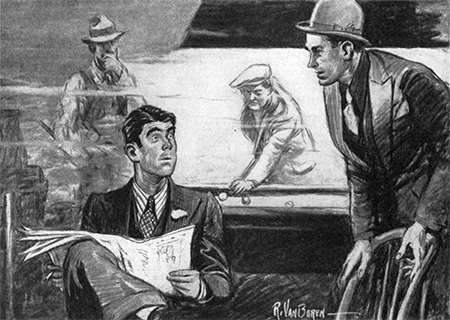
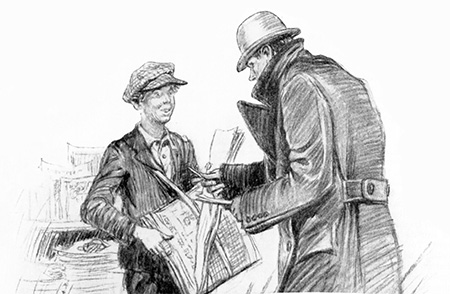
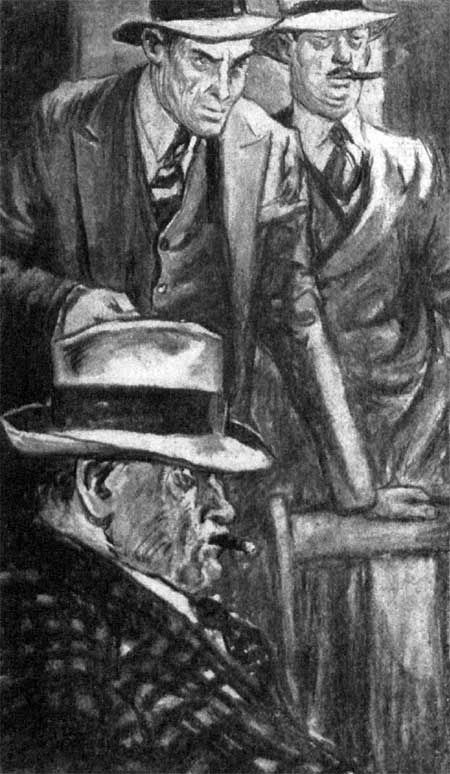

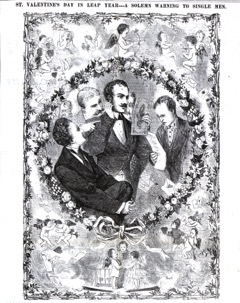
 In one case, yes. FreedomPop uses Sprint’s network and offers a no-frills, no-cost plan. The free Basic option includes 200 minutes of voice calls, 500 text messages, and 500 megabytes (MB) of data per month. If you’re not a big caller or texter, it’s worth a look. The data restriction is pretty tight, though. Say you watch just a minute a day of HD video over your cell connection. That alone would use up nearly all of your monthly data allotment. The free MyFreedomPop app lets you track your voice, text, and data usage right on the phone. You also can earn free data by completing surveys, signing up for free trials, or buying services from third parties.