Months of almost constant combat had made the war-weary sergeant depressed and homesick. That is, until he was given a dog-eared paperback copy of A Tree Grows in Brooklyn by Betty Smith. The bestselling novel’s heartfelt story of life back home had a rejuvenating effect on the sergeant, who felt compelled to write to the author. “When I first picked up your book, I was down in the dumps, a sad sack, as the boys say,” he wrote. “But as I read, my spirits rose until at the end I found myself chuckling over many of the amusing characters. I haven’t laughed so heartily since my arrival over here eight months ago.”
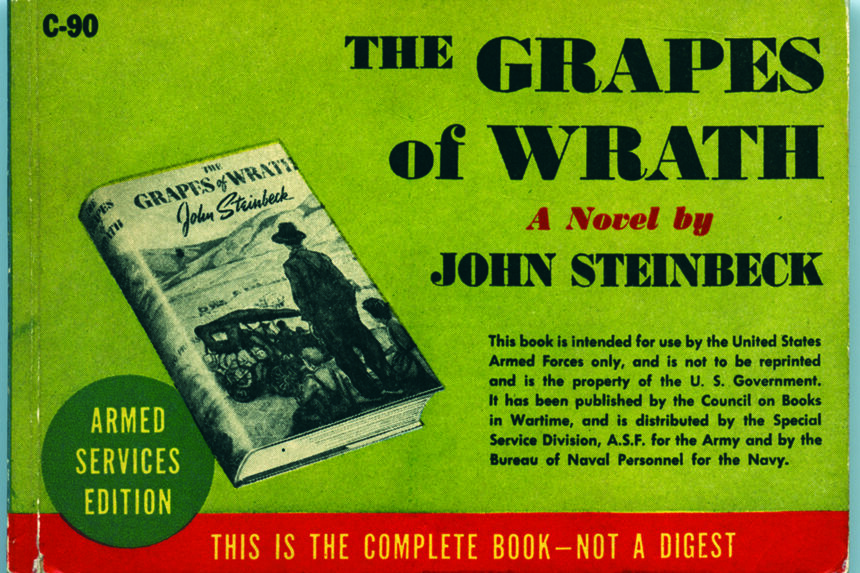
Thousands of reflective moments like this took place over the course of World War II. From 1943 through 1947, the Army Library Service — guided by a consortium of publishers, booksellers, and librarians known as the Council on Books in Wartime — distributed more than 122 million paperback copies of 1,324 books free of charge to American service members in every theater of combat around the world. They were called Armed Services Editions, and they were as essential as bullets and bombs in helping to defeat the Axis.
As the Nazis burned books deemed “un-German,” the importance of books and the freedom to read became a clarion call for the United States. Early in the war, the Victory Book Campaign had called upon Americans to donate books for the men and women fighting overseas. Tens of thousands were donated, most of them hardcover books, which were heavy and difficult to carry. A smaller, lighter book was needed.
The Council on Books in Wartime worked with Col. Ray Trautman, Chief Librarian of the Army, to develop a lightweight paperback book that fit easily in a soldier’s pocket. The resulting Armed Services Editions were more horizontal than traditional books, and were stapled rather than glued. Printed on magazine presses because of the lightweight paper, they could be published for pennies each and easily shipped around the world.
But the program was a hard sell in the beginning. “Many military leaders believed sending books to troops would be a distraction,” says Molly Guptill Manning, author of When Books Went to War: The Stories That Helped Us Win World War II. “They also feared that books would promote independent thinking as opposed to group thinking, and that time reading would be better spent on military activities such as drilling and learning to shoot. At the same time, publishers were initially reluctant to participate because they feared the inexpensive Armed Services Editions would flood the domestic market.”
Col. Trautman, however, understood what books meant to the troops and pushed hard for the ASEs. President Franklin Roosevelt also supported the program, and though he never mentioned the Armed Services Editions by name, he propelled the program with a passionate letter to the American Booksellers Association about the power of books overall.
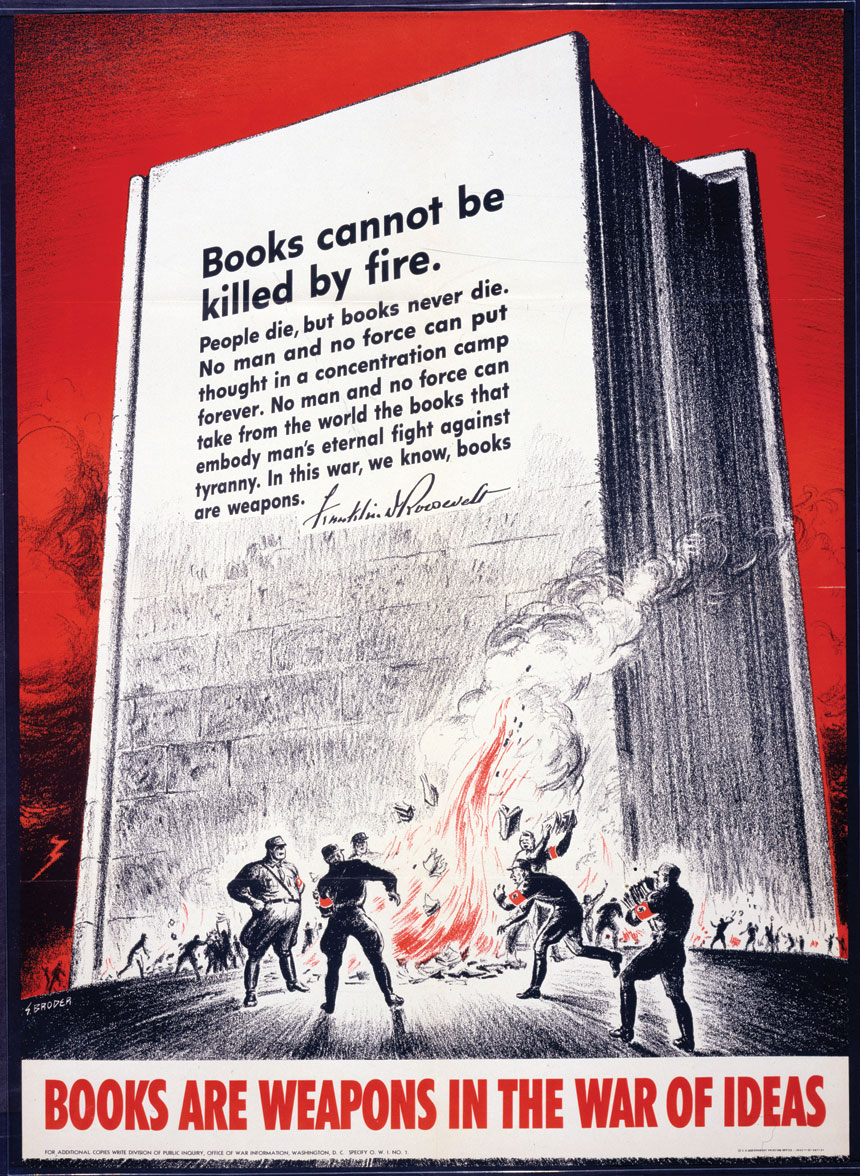
“We all know that books burn — yet we have the greater knowledge that books cannot be killed by fire,” Roosevelt stated. “People die, but books never die. No man and no force can abolish memory. No man and no force can put thought in a concentration camp forever. No man and no force can take from the world the ideas that embody man’s eternal fight against tyranny of every kind. In this war, we know, books are weapons.”
“Roosevelt knew how absolutely important it was to print books and get books into the hands of Americans,” Manning told me. “He understood that the best way to fight authoritarianism was to spread ideas, and he sincerely believed that books were the answer.”
Propaganda posters bearing the president’s powerful words were distributed nationwide. Meanwhile, Gen. Dwight D. Eisenhower, Supreme Commander of the Allied Expeditionary Force in Europe, showed his support by doing all he could to put an ASE in the pocket of every serviceman who assailed Normandy’s beaches on D-Day.
According to the Library of Congress, which maintains a complete collection of Armed Services Editions, titles were selected to appeal to a wide range of reading tastes. Westerns by the likes of Max Brand and Ernest Haycox were extremely popular, as were mysteries, works of humor, and historical novels. But servicemen could also select from books of poetry, collections of stage plays, and nonfiction books on an array of subjects. Very few titles had a military theme — soldiers read to escape the war, not relive it.
Understandably, books with perceived “adult” content were prized among servicemen. Writer David G. Wittels, in the 1945 Saturday Evening Post article “What the G.I. Reads,” quotes a soldier who noted that books with “racy” passages were as “popular as pin-up girls.”
ASEs, according to Manning, were so popular that there never seemed to be enough of them to go around, despite the herculean effort of the Council on Books in Wartime. Soldiers often went to extraordinary lengths to find a specific title, and when a new batch of books arrived, a waiting list was soon created within the unit. In some cases, individual pages were passed from one eager reader to another.
“Books ended up being a precious reminder of home,” says Manning, who owns a near-complete collection of Armed Services Editions. “A lot of the stories took place in the United States, so it was almost like going on a mental vacation at a time when you couldn’t have been further from home. It created a sense of nostalgia, a sense of connection to home.”
Many soldiers wrote to the authors they read, often to tell them how much a particular title reminded them of home. A Tree Grows in Brooklyn was among the most popular Armed Services Editions; author Betty Smith received nearly 10,000 letters from service members over the course of the war, many asking for an autographed photo. “Smith felt it was only right for her to respond to all of them, because they would bare their hearts to her about what that book meant to them,” Manning notes. “In one letter, a Marine wrote, ‘I felt hard and cynical about the world, and I didn’t think I’d ever feel love again.’ Then a hospital nurse gave him a copy of A Tree Grows in Brooklyn, and as he read it, the Marine said he felt his heart come alive again. Betty Smith received many letters like that.”

Interestingly, many service members who came to love the Armed Services Editions hadn’t picked up a book since high school. They weren’t readers, but the ASEs were often the only entertainment available to them, and many became lifelong bookworms.
“The hunger for these books, evidenced by the way they are read to tatters, is astounding even to the Army and Navy officers and the book trade officials who conceived Editions for the Armed Services,” wrote Wittels. Servicemen “are reading far more books than such a cross-section of American men ever read before. Some are reading books for the first time since childhood.” As a result, the ASEs were partially responsible for a higher level of post-war literacy, and were instrumental in encouraging many returning veterans to go to college.
The Armed Services Editions also had a dramatic impact in popularizing paperback books in the post-war years. Before the war, most publishers avoided paperbacks because of their small profit margin compared to hardcover books. But returning veterans clamored for paperbacks, and it soon became clear that there was a huge market for the inexpensive volumes.
“Publishers realized that here was a group of people who never in their life would buy a hardcover book, but who feasted on paperback books during the war, and couldn’t get enough when they returned home,” Manning says. “It was then that publishers realized that by printing paperbacks, they weren’t going to lose sales for hardcovers.” Manning notes in When Books Went to War that the sales of paperback books skyrocketed from 40 million in 1943 to 95 million in 1947. By 1959, the sales of paperback books exceeded that of hardcover books.
The Armed Services Editions were created to boost morale, and their role in that endeavor cannot be overstated. The books were an essential lifeline that helped many service members make it from one day to the next. “The books provided catharsis and solace, a way to express emotions they could not show,” reports the Library of Congress. “They provided laughter when nothing in their current situation was funny, and helped them overcome fear.”
“For most, the Armed Services Editions were the only positive thing about the war,” Manning says. “They were something that added to their lives, and they gained a habit that they wanted to keep for life. There was much about the war they wanted to forget, but there was also pride in the fact that they served their country when their country needed their help. Books represented their war service, because the Armed Services Editions were only for troops, and were a very affirmative thing for them.”
Don Vaughan is a freelancer writer whose work has appeared in Writer’s Digest, Mad, Scout Life, and elsewhere. To learn more, visit donaldvaughan.com.
This article is featured in the September/October 2025 issue of The Saturday Evening Post. Subscribe to the magazine for more art, inspiring stories, fiction, humor, and features from our archives.
Become a Saturday Evening Post member and enjoy unlimited access. Subscribe now


Comments
I’m sure the soldiers appreciated the reading material available to them per the article for both entertainment and keeping their reading skills sharp otherwise.
Another reason publishers were reluctant to see their books in paperback is pre war paperbacks were thought sleezy, “dime novels” without literary merit.
I came along a decade or two after the war and have acquired my share of well-worn Armed Forces Editions. The “racy” bits may have included works by the late Thorne Smith, whose books became even more popular in paperback editions after the war and helped inspire fantasy sitcoms like “Bewitched.”