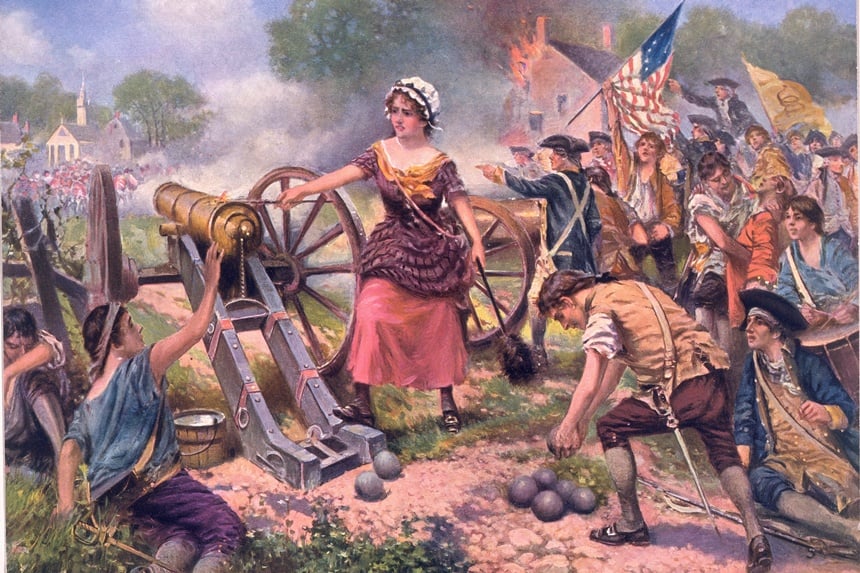
In 1969, a new musical opened on Broadway, bringing the Founding Fathers to life on stage. 1776 brought viewers front and center to the debates over drafting the Declaration of Independence. For the first time, many Americans could visualize scenes that had previously existed primarily in history books. A filmed version soon carried the story to an even wider audience, while revivals in 1997 and 2022 have ensured that the show continues to shape how Americans imagine the nation’s founding.
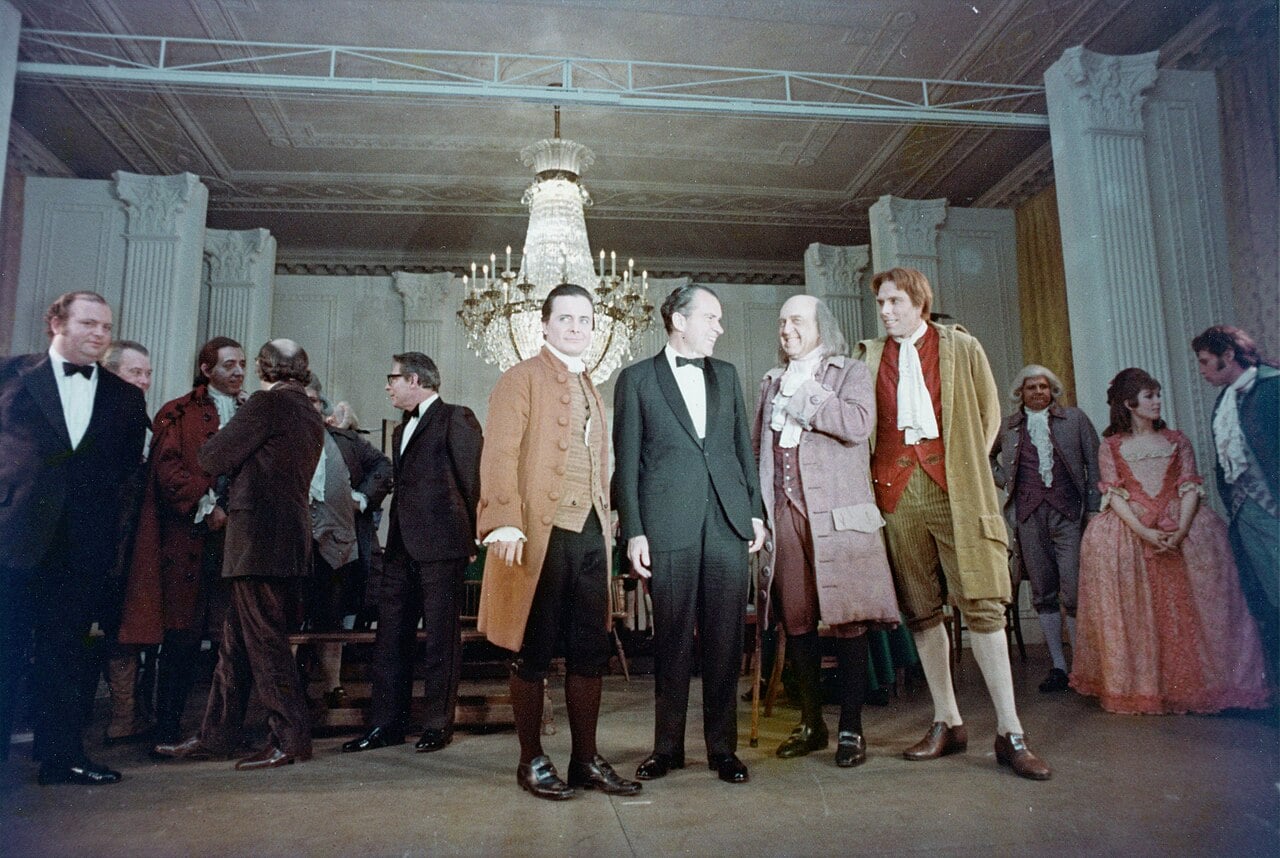
Almost half a century later, Hamilton offered a new interpretation of the revolutionary story many Americans thought they already knew. With fast-paced rap and diverse casting, the musical invited audiences to reconsider the world of the revolutionary generation.
Both shows have given Americans a chance to explore how the Founding Fathers imagined the future of the United States. In some ways, that task seems easy enough: The men left behind documents and records that preserved their ideas. They wrote the Declaration of Independence, the Articles of Confederation, and the Constitution, leaving historians a detailed record of their debates. Most Americans can name at least a few of the men who helped breathe life into the United States.
In Hamilton, Eliza Hamilton famously burns the letters her husband sent her; in composer Lin-Manuel Miranda’s words, she’s “erasing herself from the narrative.” Yet many more American women were never included in the original story. Their political engagement rarely took the form of speeches in Philadelphia, signatures on founding documents, or indeed in musical reenactments. Instead, it often appeared in the choices they made in their homes and communities — political engagement of a kind that rarely makes it into song-and-dance numbers on a Broadway stage.
More than ten years before the Declaration of Independence, American women began protesting the new laws that British Parliament imposed on them. After the French and Indian War ended in 1763, Britain needed more money, taxing the American colonists through the Sugar Act in 1764 and other laws. Protests began immediately, but the 1765 Stamp Act spread dissent to new levels. In August 1765, Boston men rioted under the leadership of the Sons of Liberty.
Women, meanwhile, became known as the Daughters of Liberty, participating in boycotts and other forms of protest. As the household purchasers, they could shape resistance through their choices. One of the first successes came with the Stamp Act’s repeal in 1766, celebrated with household objects like teapots inscribed “No Stamp Act” and silver spoons engraved “Repeal of the American Stamp Act.”
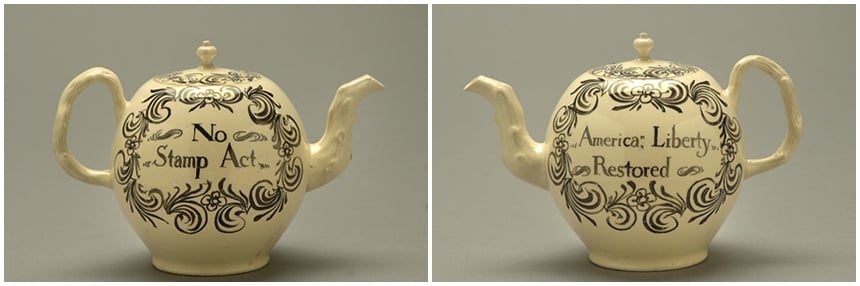
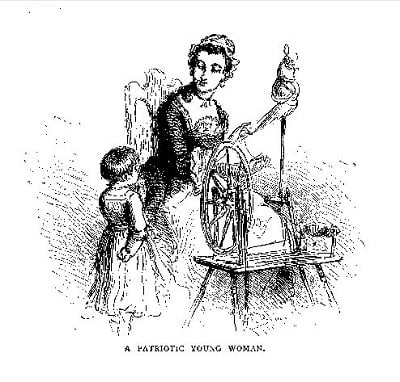
These items allowed women to express political views during everyday activities. Even after the repeal, many continued to limit their reliance on British goods. As historian Mary Beth Norton has shown, communities of women gathered to spin cloth. In the late 1760s, women organized public “spinning bees,” gatherings where they made cloth to replace British textiles. The Essex Gazette reported in May 1769,“I presume there never was a Time when, or a Place where, the Spinning Wheel could more influence the Affairs of Men, than at present,” referring to the Daughters of Liberty spinning in Newport, Jamestown, North Kingston, and Long Island. The spinning wheel had become more than a household tool; it had become a political instrument.
All too soon, those celebratory Stamp Act Repeal teapots themselves became ironic. The 1767 Townshend duties taxed a range of imported goods, including tea, leading to another boycott. The boycotts went even further when, in 1773, Parliament imposed the Tea Act, which gave the British East India Company control over all sales of tea in the North American colonies. In response to both these laws, many American women began brewing “liberty tea,” using materials on hand such as red root bush or red sumac berries to create alternatives to the tea imported by Britain.
The Tea Act famously prompted the Boston Tea Party, now the stuff of American legend. The following year, a group of 51 women in North Carolina staged their own protest called the Edenton Tea Party. The Morning Chronicle and London Advertiser printed an excerpt from a letter signed by the women, explaining their action: “[W]e cannot be indifferent on any occasion that appears nearly to affect the peace and happiness of our country.” While the Sons of Liberty had disguised themselves as they threw tea into Boston Harbor, the women of Edenton took ownership of their own, smaller action for all to see.
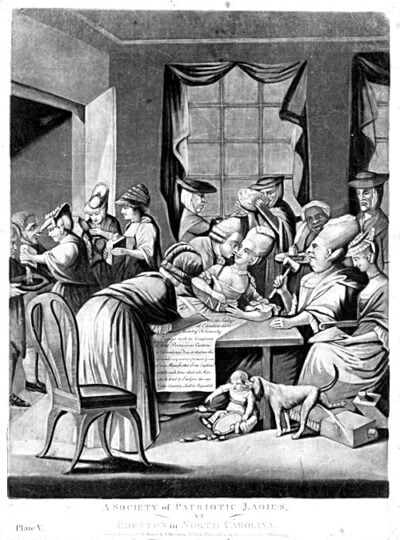
By 1776, women had already spent a decade invested in the struggle against Great Britain. They were not yet imagining their roles in a new nation, but they were asserting their stake in the society they inhabited. Through boycotts, spinning bees, and the brewing of liberty tea, women made clear that political decisions affected them. It was in this context that Abigail Adams wrote one of the most famous letters of the American Revolution.
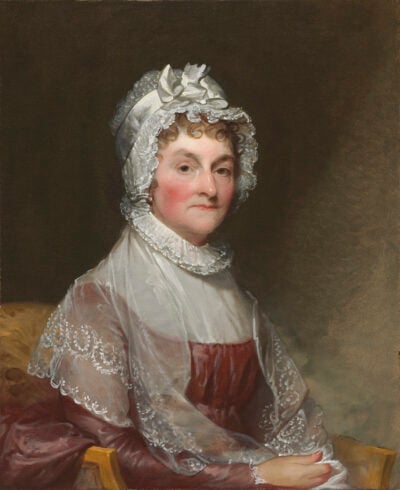
While her husband John was in Philadelphia helping determine the future of the colonies in early 1776, Abigail Adams remained at home in Massachusetts with five young children ranging in age from four to eleven. By the end of March, John had been away for weeks, and there was no news from Congress. But on March 31, Abigail wrote to John that she wanted him to consider America’s women as he and the delegates did their work.
In the new Code of Laws which I suppose it will be necessary for you to make I desire you would Remember the Ladies, and be more generous and favourable to them than your ancestors. Do not put such unlimited power into the hands of the Husbands. Remember all Men would be tyrants if they could. If particular care and attention is not paid to the ladies we are determined to foment a Rebellion, and will not hold ourselves bound by any Laws in which we have no voice, or Representation.
Congress was still months away from even debating independence when Abigail penned those words. That did not matter. In reminding her husband to “Remember the Ladies,” she carried forward a tradition that American women had been building for more than a decade: asserting that their voices mattered, even if they were excluded from formal decision-making.
As the United States approaches the 250th anniversary of the Declaration of Independence, Americans are once again reflecting on the nation’s origins. Productions like 1776 and Hamilton have helped audiences imagine the debates that shaped the United States and the men who led them. Yet the founding was never only the work of the delegates at Independence Hall. Long before independence was even a consideration, women across the colonies were asserting their stake in the political future.
Become a Saturday Evening Post member and enjoy unlimited access. Subscribe now


Comments
That we have a president who befriended a sex trafficker and has a felony conviction for sexual abuse himself, there is reason for American women to fear that their progress may be eroding. The right to control their bodies has been abridged by the Supreme Court, Their assurance of equal treatment in the military has been met with disdain by the so-called secretary of “war.” The idea of diversity in college admissions and the workplace has been derided as “woke.”
How Trump can claim, as he does about everything, to be the president who has been most “women friendly” of any presiden, can be considered true only in most crude sense.
This is an important feature on American women any time, but particularly again now with our nation’s 250th birthday upon us. All of them, in particular the Daughters of Liberty for all their efforts, including successful boycotts and more against the British trying to undermine the 13 Colonies In the 1760’s and ’70s in our quest to be an independent nation from England for too MANY reasons, with the list growing ever longer by the day!
As a nation, we still owe so much to women like Abigail Adams in her personal efforts she undertook such as ‘Remember The Ladies” message to her husband in giving women a voice that otherwise wouldn’t have had one. She was a busy woman with a lot of responsibility caring for her children with her husband away. While she understood and appreciated the importance of the future of the colonies, she made her declarations clear in no uncertain terms a Rebellion would have to be fomented if her words weren’t heeded. In other words, do as I ask so this drastic measure shan’t be necessary.