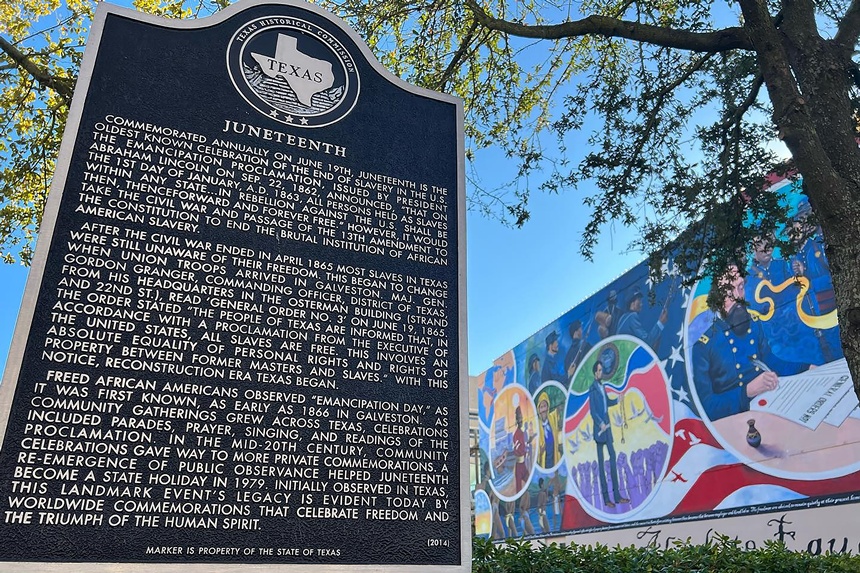
I grew up in Texas thinking Juneteenth was just…a normal holiday everyone observed. My mom worked for the state, so she always had the day off, and I remember hearing about Juneteenth from a young age without really questioning whether the rest of the country recognized it the same way. It wasn’t until I was older that I realized two things: Not everyone celebrated Juneteenth, and not everyone fully understood what it commemorated.
Juneteenth marks June 19, 1865, the day Union troops led by Major General Gordon Granger arrived in Galveston and issued General Order No. 3, informing enslaved Texans they were free — more than two years after the Emancipation Proclamation. Although the holiday has been celebrated in Black communities for generations, it only became a federal holiday in 2021. And while Juneteenth is now recognized nationwide, Galveston remains central to the story.
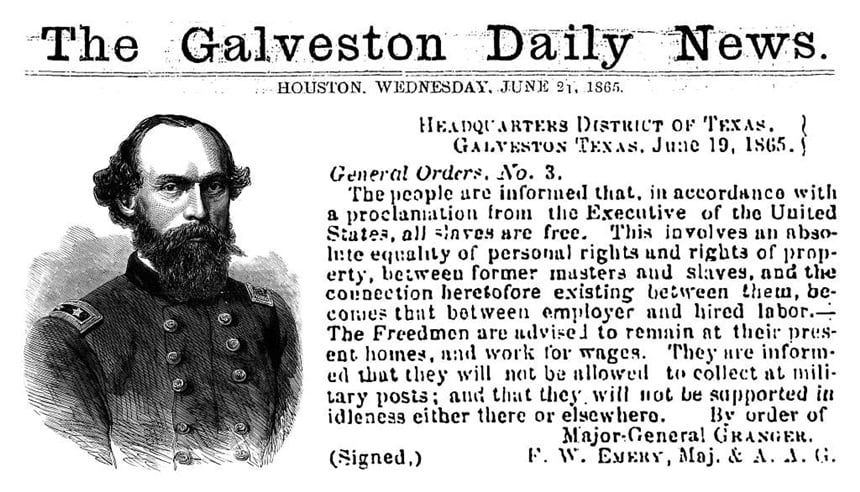
Juneteenth History That Most Visitors Miss
Today, Galveston is best known as the United States’ fourth-largest cruise port. Millions of travelers pass through each year on their way to Caribbean vacations, filling the island’s beaches, restaurants, souvenir shops, and historic downtown before boarding ships.
Walking through Galveston today, you can easily miss its rich history. The Strand is busy with tourists buying T-shirts, eating seafood, and stocking up on sunscreen before cruises. But this same area was once a place where human beings were bought and sold.
Nineteenth-century Galveston was a major Gulf Coast port tied to trade, commerce, and slavery. A docent at the Nia Cultural Center, a nonprofit interpretive center on Strand Street, pointed out the building across the street in The Strand. “See that Disney ship? See that blue building with the white railing right in front of that?” He pauses to make sure I was following the direction of his finger, and when I nod, he continues, “That’s where they used to auction people. They’d line them up right there.”
Inside the Nia Cultural Center
Inside the center are exhibits, artifacts, artwork, and guided interpretation that place the city’s modern identity alongside its deeper history. The Nia Cultural Center describes its Juneteenth Headquarters and Art Gallery as a storytelling space that traces the journey “from enslavement to the pursuit of freedom.” A large mural outside the building references Juneteenth and Black history in Galveston, setting the tone for the unique blending of history, art, and community space in a way that feels both educational and deeply personal.
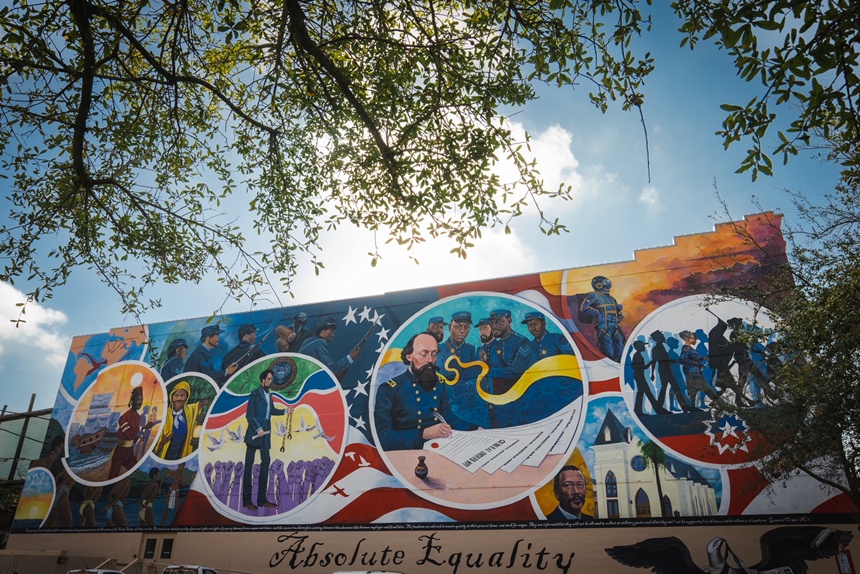
“This is now one of the country’s largest cruise ports, but this was also the same port that brought enslaved people here,” says Alex Thomas, Director of Marketing and Outreach at Nia Cultural Center. “It helps people think about how far we’ve come.”
The center places Juneteenth within a longer history of Black life in Galveston before and after emancipation. Visitors learn about slavery, Reconstruction, and the generations of Black communities that shaped the city long after June 19, 1865. It’s an excellent, robust selection of Black history you probably won’t read in most history books. Thomas points out that Galveston was home to some of Texas’s earliest Black institutions, including some of the state’s first Black churches, schools, and libraries. “There are a lot of firsts here,” he says. “People traveled from different places because there was nowhere else for them to go.
A few things stay with me. One docent explains the history behind the term “monkey wrench,” connecting it to racist caricatures in a way that completely changed how I thought about a phrase I’d heard casually my entire life, although historians generally do not consider that origin story established fact.

Nearby an artwork shows a Black father doing his daughter’s hair. “You don’t think of Black fathers like this,” the docent says matter-of-factly. He explains that the artist wanted to push back against stereotypes of absent Black fathers by highlighting an everyday moment that rarely gets centered in conversations about Black fatherhood: a dad doing ponytails and managing hair elastics before the school day starts. The drawing is part of a series called Fatherhood Scenes by artist Pamela Moore. In a space focused heavily on history, injustice, and survival, the it stands out because it depicts something so familiar and human. It’s an ordinary, intimate moment that stops me just as much as the historical displays do.
Historic Sites That Help Tell the Story
If you want to explore Galveston’s connection to Juneteenth beyond the annual celebrations, several sites help provide historical context.
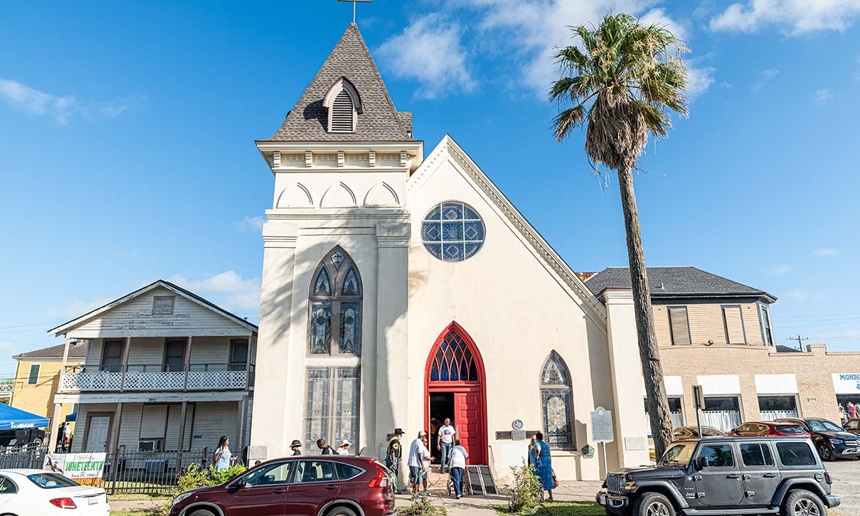
Ashton Villa is closely associated with Juneteenth commemorations and annual public readings of General Order No. 3, although historians debate whether the original 1865 reading actually took place there. Reedy Chapel AME Church, one of the oldest Black churches in Texas and the first AME church in Texas, remains deeply connected to Juneteenth traditions and Galveston’s Black community.
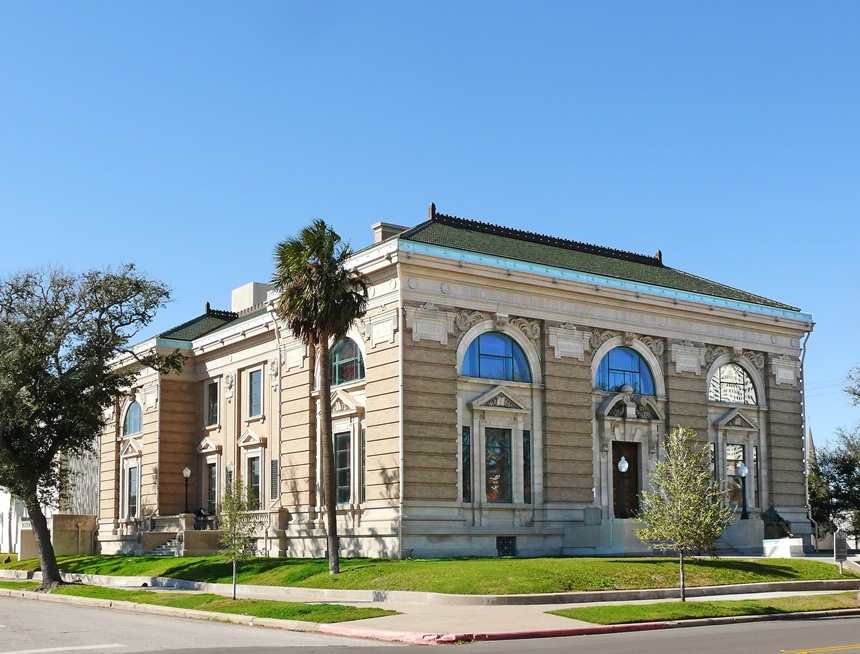
The Rosenberg Library has a museum floor that’s worth a stop for visitors interested in Galveston’s history beyond the tourism version of the island. The collections include photographs, maps, archives, and historical materials tied to Galveston’s development, hurricanes, immigration history, and life in Texas before and after emancipation.
Visitors can also head to the Galveston Historic Seaport, home of the 1877 tall ship Elissa. While the museum focuses primarily on maritime trade and immigration, it also helps illustrate Galveston’s importance as a Gulf Coast port during the 19th century, when the city’s economy was deeply tied to shipping, commerce, and slavery.
Why the Story Still Matters
More than 150 years later, Galveston’s connection to Juneteenth remains relevant because the history behind the holiday still shapes national conversations about race, equality, and historical memory. Visiting the places tied to that story adds context that’s difficult to fully grasp from textbooks or annual celebrations alone.
Many leave with a deeper understanding of the city’s place in American history — and of the long distance between freedom promised and freedom fully realized.
Become a Saturday Evening Post member and enjoy unlimited access. Subscribe now


.jpg)

Comments
It’s fascinating to learn how Galveston’s significance in the Juneteenth narrative goes beyond just being the birthplace. The way the city has preserved its history is truly commendable.