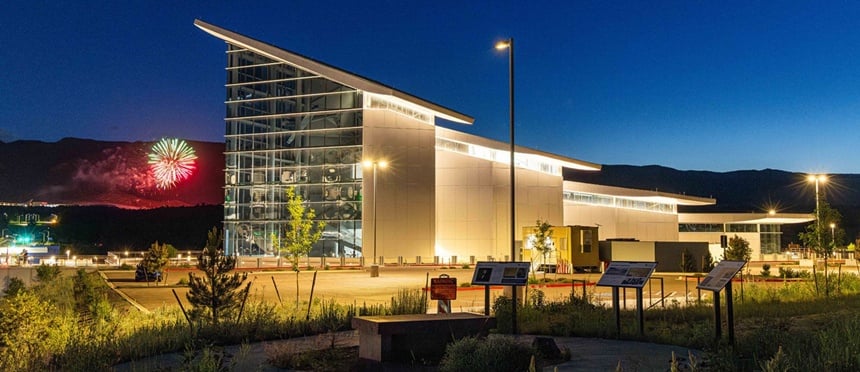
On the northside of Colorado Springs, against the backdrop of the Rocky Mountains, the U.S. Air Force Academy prepares its next generation of officers for military service. From the freeway, the campus appears as a low line of buildings with only Polaris Hall, angled into the shape of an aircraft tail, breaking the flow. The campus’s 17-spire Cadet Chapel, which normally catches the eye, currently hides under a towering square structure during renovations.
Most people see little more than this. While families can visit cadets on select days and the public can enter for football games and planetarium shows, military checkpoints prevent tourists from exploring the grounds.
But the General Bradley and Zita Hosmer Visitor Center is the next best thing.
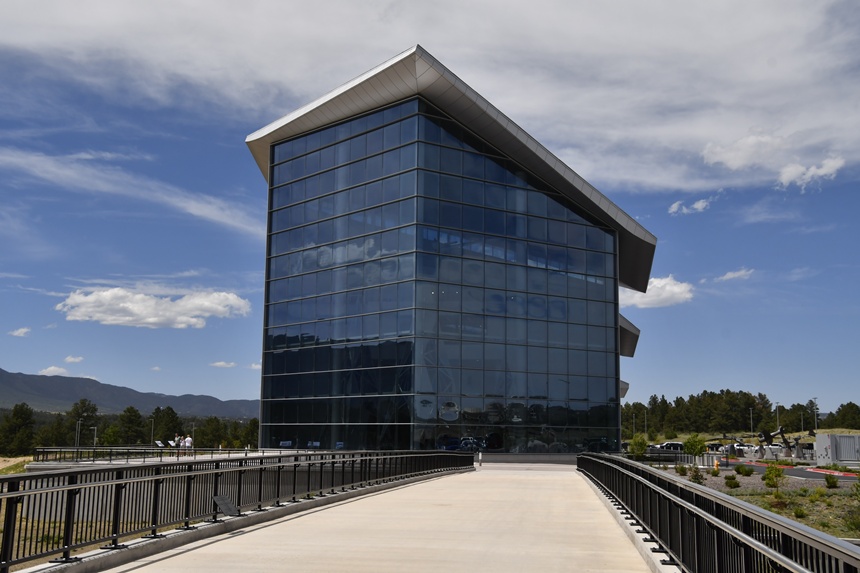
Opened in May 2026, the center ushers visitors through cadet life, from taking their Oath of Office to graduation day. Hotel Polaris, connected to the center by a ramp over North Gate Boulevard, provides further insights into daily cadet life.
Hosmer Visitor Center
Named for General Bradley Hosmer — a member of the Academy’s first graduating class in 1959 and the first graduate to serve as Academy Superintendent — and his wife, Zita, the 34,000-square-foot center sits between Interstate 25 and the North Gate entrance. Almost every design element connects it to the campus. The roofline suggests a fighter plane taking off, sculpted metal aircraft “fly” over the grounds, and visitors enter through the plane’s tailpipe into a lobby painted Academy blue.
In the first of seven galleries, visitors get an overview of the Academy’s history, including its site selection, architectural design, and construction. Take a moment to linger here for fun insights, like how Hollywood director Cecil B. DeMille designed the cadets’ uniforms, and to explore the crests of each class through the years.
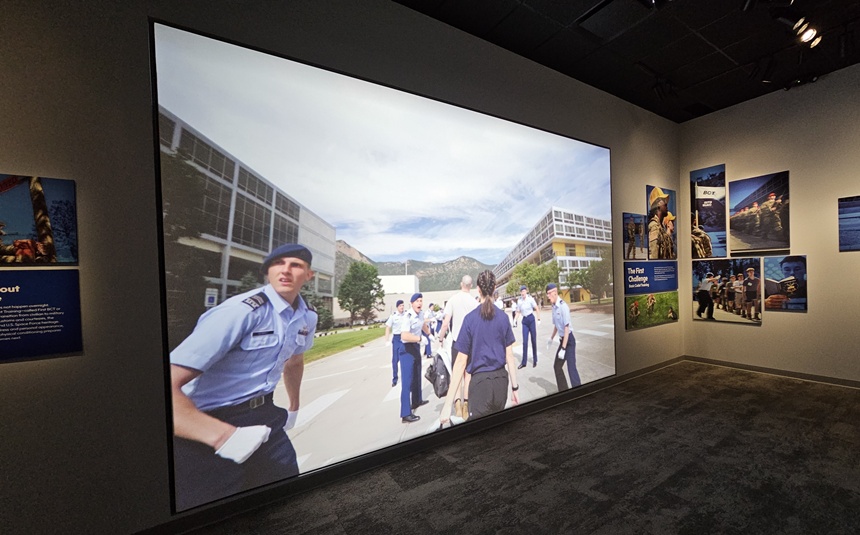
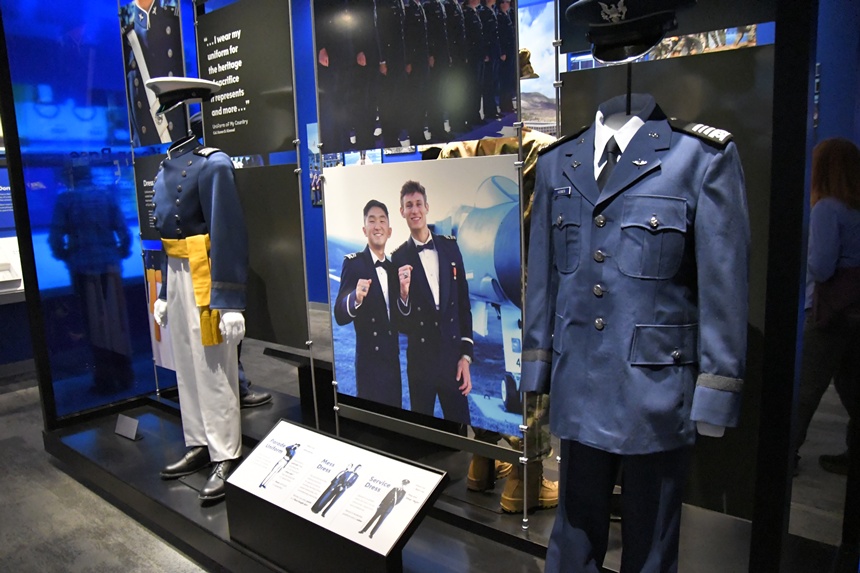
The second gallery invites guests to stand on painted footprints as audio of cadets repeating the Oath of Office plays, then view photos depicting cadets’ first day at the Academy. A wall-sized screen in the next area shows what they experience when they arrive. Nearby, an exhibit displays examples of cadet uniforms, and a video demonstrates how cadets must make their beds to pass inspection. (Most don’t sleep under their sheets once they get it right.)
Mike Peterson, Chief of the Outreach Division in the Strategic Communications Directorate at the Academy, says the center focuses on the everyday experience.
“This building is the 47-month cadet journey,” he says. “It’s not a museum. It’s detailing what the cadets are going through right now and throughout their careers here.”
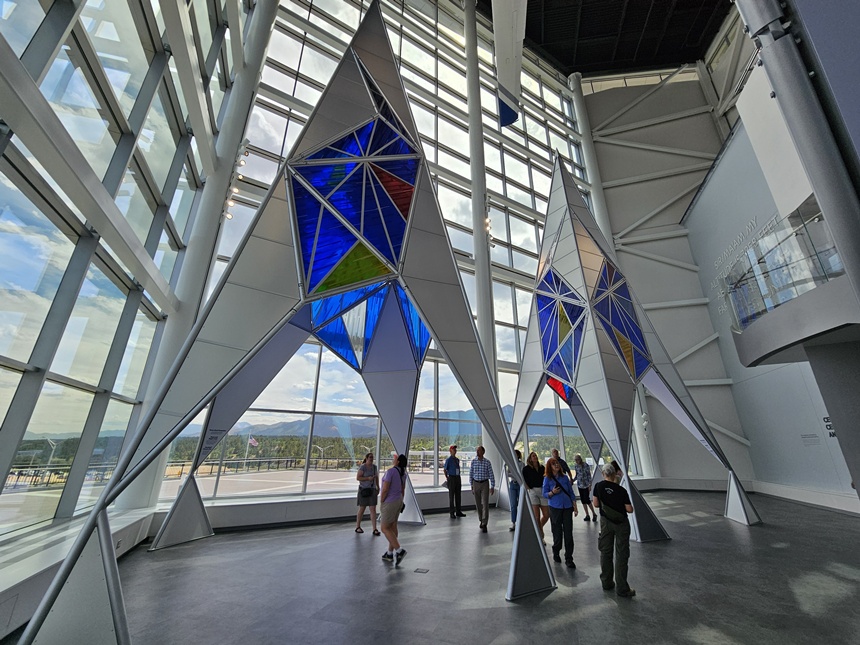
Gallery 4 features films of cadets discussing classes, athletics, and military training as they progress through the program. From there, the center opens into a 108-foot-tall glass atrium where three 40- to 50-foot tetrahedrons stand. Inspired by the Cadet Chapel’s spires, these tetrahedrons each have a theme — celebrations, ceremonies, and unity — that you can learn more about when you step underneath their metal and glass frames.
Although the upstairs gallery has yet to open, its 40-seat theater will present a film “similar to a year in the life of a cadet,” according to Peterson, while two smaller theaters will play 360-degree surround sound footage of jumping out of a plane or running the assault course. The final gallery focuses on graduation and military careers in air, space, and cyber fields.
Eventually, the center hopes to give tours of the Academy’s campus, but for now, visitors wanting to immerse themselves more in Academy life will have to cross the pedestrian bridge to Hotel Polaris. Admission to the Hosmer Visitor Center is free. It is open daily 9 a.m. to 5 p.m.
Hotel Polaris
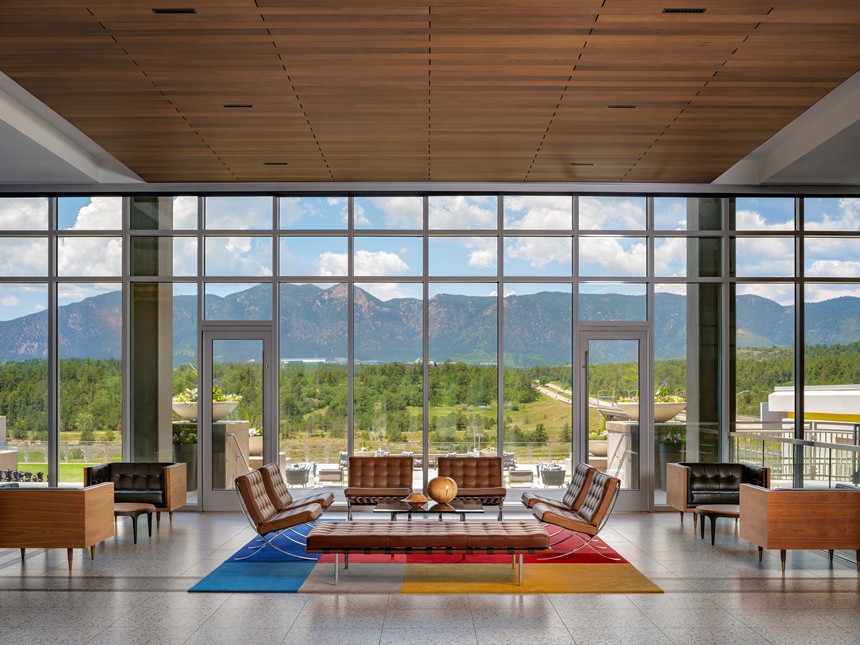
If Hotel Polaris’s exterior looks less than exciting, it’s by design — the blockish, institutional structure has a similar mid-century aesthetic to the dorms at the Academy. It’s the first of many instances where small details — some obvious, some not — link the hotel and campus. As you enter, though, it’s hard to miss the distant Academy through the lobby’s floor-to-ceiling window.
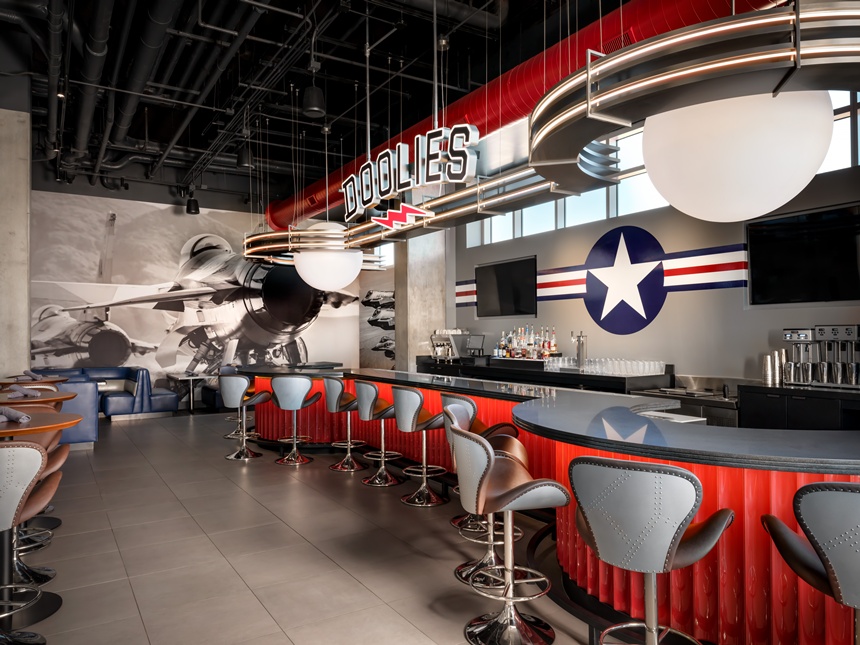
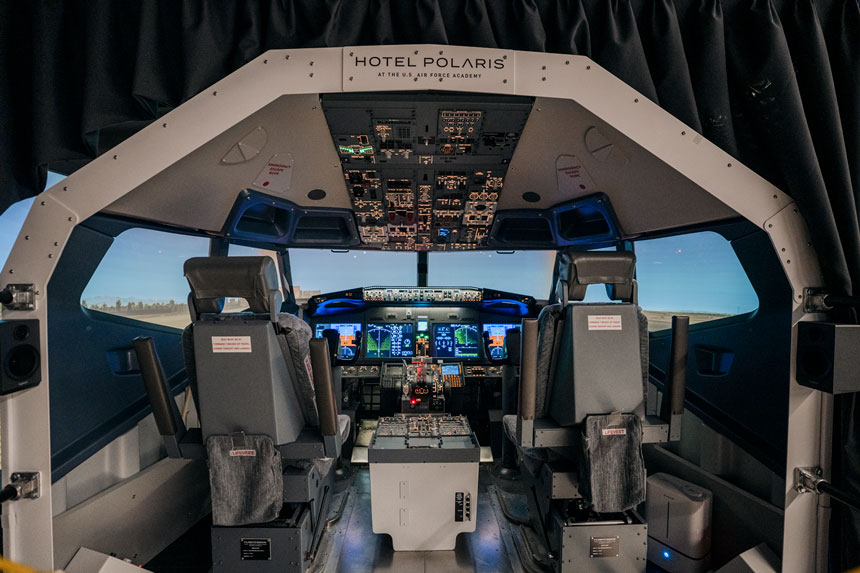
Several other touches are easy to spot. The counter at the front desk resembles an aircraft’s wing, and at its tip, teddy bears, dressed in their Air Force best, are for sale. Down the hall, near the guest elevators, Doolies operates as an aviation-themed diner, and on the floor below it, you can choose between flying in a 737 MAX or one of two F-16 flight simulators (additional charge). Academy-themed artwork decorates the walls of the common areas and rooms.
But if you know what to look for, you’ll make even more connections to the Academy, according to Curtis Bova, general manager of Hotel Polaris. For example, the lobby floor mimics the pattern of The Terrazzo, a large pavilion on campus with marble lines, and a lobby rug features the Academy class colors of blue, silver, red, and gold. The 375-room hotel’s three entrances embrace those colors, too: The main entrance is blue, the entrance from the Hosmer Visitor Center is gold, and the entrance to the hotel grounds is red.
While nods like these exist, the hotel doesn’t offer guided tours to point them out or provide information for self-guided tours.
“Hotel Polaris was never intended to act or feel like a museum,” Bova explains. “It was designed to be a gateway and a place where people can experience the spirit of the Academy in a welcoming, approachable way and leave with a deeper appreciation for its mission and its impact.”
The more time you spend at the hotel, the more you pick up on little details you’d miss during a quick walk-through. For example, The Pathfinder, a bourbon-based cocktail served at Hotel Polaris’s rooftop bar, comes with an orange peel twisted into the Academy’s mascot, a falcon. And, if you spend the night, the welcome letter in your room gives instructions on how to craft it into a paper airplane.
Eventually, Hotel Polaris will partner with the Hosmer Visitor Center, serving as a starting and ending point for Academy campus tours. For now, an overnight stay is the best way to experience both the hotel. Rooms start at $229.
National Museum of World War II Aviation
While the Hosmer Visitor Center and Hotel Polaris focus on the Air Force’s future, the National Museum of World War II Aviation, also in Colorado Springs, honors its past. The museum showcases 28 fully restored aircraft and more than 4,000 artifacts and historical documents from that era but also looks at the story of flight leading up to World War II.
Visitors have the choice to take either a self-guided or a guided tour ($5 extra) of the museum. Although I opted for the guided option, I soon ditched the group because my tour took a deep dive into the planes’ mechanics. If you prefer a historical look at the subject or want to move at your own pace, the self-guided tour may be the better option.
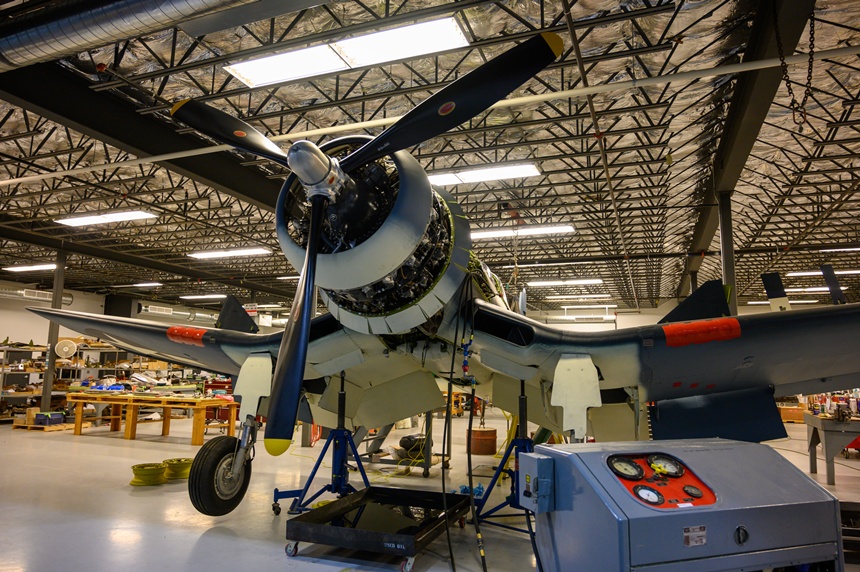
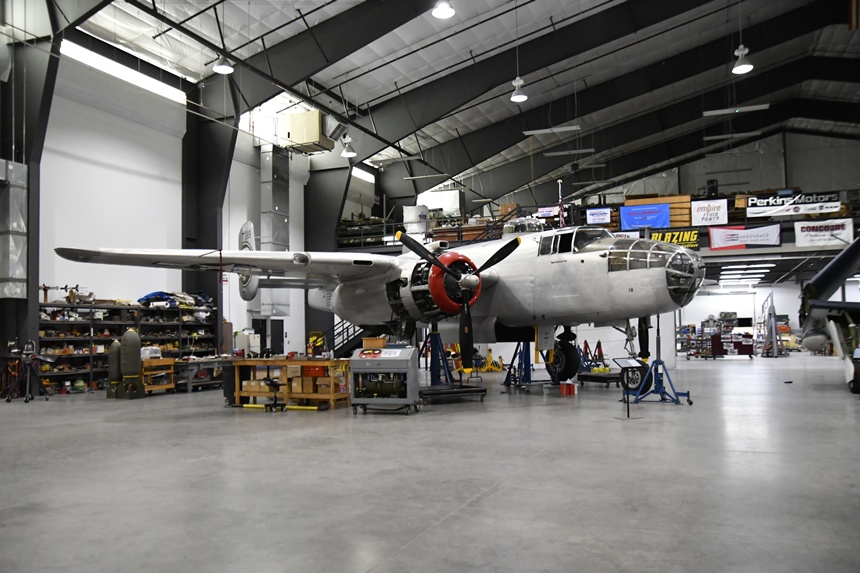
Don’t skip the free Westpac Tour, offered every hour on the half hour. The tour takes visitors to the Westpac restoration facility where a docent describes how the museum restores and maintains its planes. You may also hear stories about the planes in the facility or learn about the facility’s propeller shop, one of only three able to certify propellers for flight.
Become a Saturday Evening Post member and enjoy unlimited access. Subscribe now