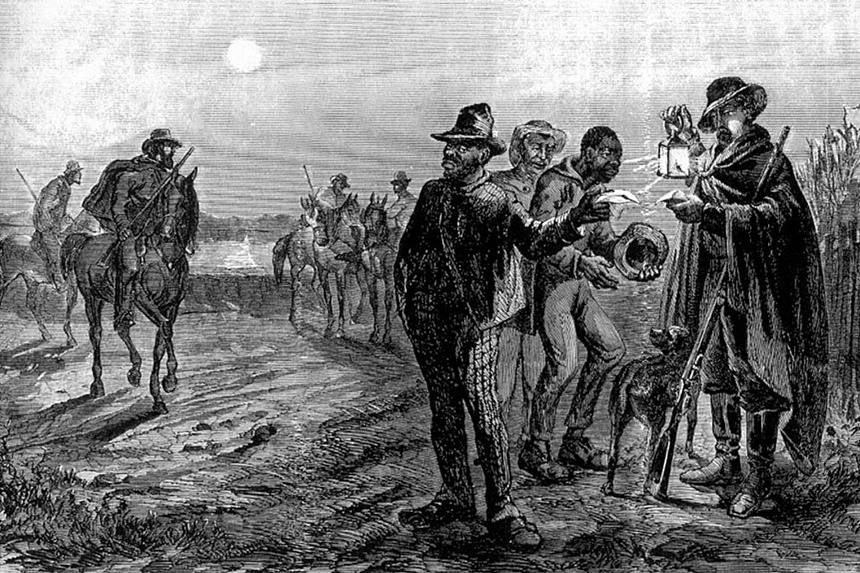
In an April 22, 1820, letter to Massachusetts representative John Holmes, Thomas Jefferson encapsulated the nation’s struggle over the vexing issue of slavery: “As it is, we have the wolf by the ear, and we can neither hold him, nor safely let him go.”
Jefferson’s quote underscored both slavery’s power and fragility: It was a brutal system that enslaved millions and delivered great wealth but required constant vigilance and filled enslavers, like Jefferson, with nightmares of rebellion.
Maintaining slavery necessitated the construction of large surveillance apparatus driven by fear and held together by the deployment of violence. This surveillance was meant to control enslaved people as well as freed Black people (who were seen as a dangerous contagion carrying the disease of freedom). But this larger infrastructure also impeded the rights of white Americans and contributed to future violations of civil rights.
Securing labor in North America was always difficult. As a result, controlling workers required the threat and deployment of violence. Virginia, which heavily influenced slave control structure across the colonies and states, enacted coercive measures to control labor — first over indentured servants and later the enslaved. In his study of colonial Virginia, American Slavery, American Freedom, historian Edmund S. Morgan wrote, “Virginians dealt in servants the way Englishmen dealt in land or chattel.” Servants, and later slaves, were little more than “machines,” Virginia’s treatment of labor “producing fortunes for a few, misery for many.”
One of the key methods used to oppress and control enslaved and free Black people was the use of slave patrols. Slave patrols did not formally coalesce until the second half of the seventeenth century, based on the widely imitated Barbadian slave code passed initially in 1661. South Carolina, the first colony to organize slave patrols, replicated the Barbadian code in its 1696 law, which “enjoined town constables to organize white men in to groups which would capture, whip, and jail slaves from the countryside found in town on Sundays,” writes historian Sally E. Hadden in her 2001 work, Slave Patrols.
Slave patrols did not limit themselves to the enslaved; rather they regulated all “suspicious groups” including indentured servants, fleeing debtors, and Native Americans, observes Hadden. Though initial patrols varied in their membership, they were later drawn from colonial militias, which were dedicated to battling external threats — foreign invasion and conflict with indigenous peoples — and patrolling the enslaved.
Virginia took longer to adopt slave patrols. Its militia first focused on repelling threats from Native Americans until, in 1727, the House of Burgesses passed a law mandating that the militia form slave patrols. Though some historians have argued that only the lowest class whites served on slave patrols, others like Hadden suggest they were drawn “from virtually all social classes.” The expansion of tobacco, rice, and cotton production led to an increased dependence on slavery, and to more slave patrols.
Initially, the fate of a runaway or unruly slave was thought to be a private concern of the slaveholder, but as agricultural production expanded, so too did the public interest — or the public interest as defined by planters — in controlling the movement of enslaved people.
During the second half of the seventeenth century, planters convinced colonial legislatures to commit their respective colonies to approve and fund a “rudimentary policing power to [preserve] a white supremacist labor system and a vision of public order” while also establishing “pass laws” that required enslaved workers to carry documentation issued by their enslaver approving their movement, writes historian Gautham Rao in his new book on the topic, White Power: Policing American Slavery. The free movement of enslaved people, as well as free Blacks, was perceived as a threat that needed to be controlled.
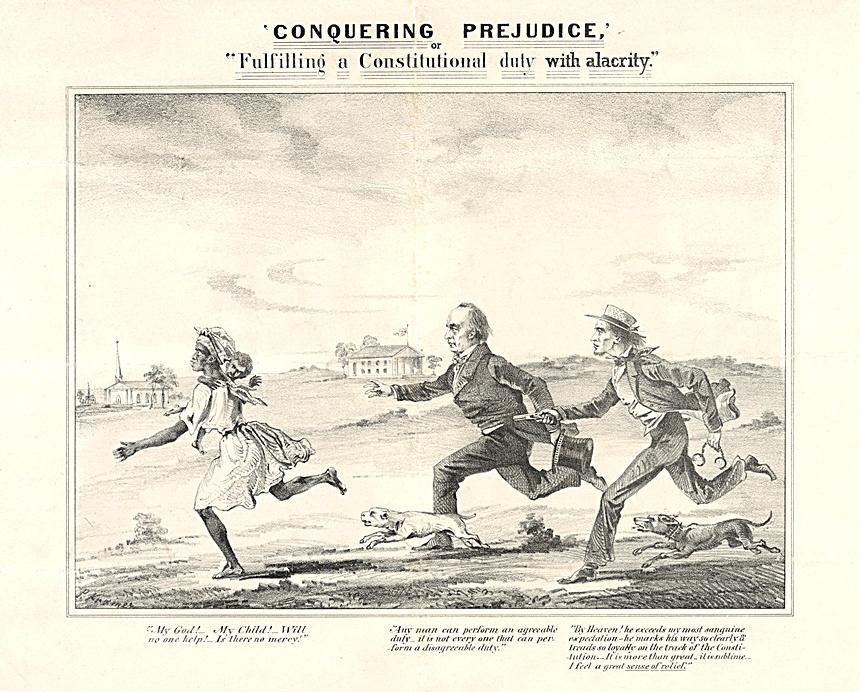
Following independence, the United States Constitution codified the practice by requiring that escaped enslaved people be returned to their owners. It was followed by additional laws such as the Fugitive Slave Law of 1793 and the Fugitive Slave Act of 1850, to say nothing of state laws in Virginia, Alabama, South Carolina, Maryland, and elsewhere that strengthened the power of enslavers and enacted a larger infrastructure of slave control.
Slave patrols preceded even the formation of formal police forces, although the distinction between patrols and police may have been negligible to the enslaved population, according to interviews with formerly enslaved persons conducted by the Works Project Administration during the 1930s. “They jes’ [sic] like policeman, only worser,” W.L. Bost told WPA interviewers in 1937. In urban areas like Charleston, the slave patrols often operated at night and carried out functions we might associate with policing, such as the night watch. Rural patrollers held similar responsibilities. According to historian Jennifer Tucker, it was in the South during the antebellum period that “an unfettered constitutional right to carry weapons in public originated.”
The deputization of whites as the bulwark against the enslaved carried long term influence. Deputizing all white men to address “public danger” — as unattended enslaved people were viewed — functioned to “criminalize Blackness,” Rao notes. Additionally, slave patrols meant the state was explicitly funding racial violence while political leaders stoked fears by describing the potential for a burgeoning racial “apocalypse” should slavery end or the enslaved go unsurveilled.
What did this policing of slavery encompass? It required public arrests, beatings, and sometimes killings. After all, what looked like a “corn shucking party, prayer meeting, or loud gathering could well serve as a prelude to a slave rebellion,” Rao writes in White Power. “Enslavers could never be too careful.”
But the perceived threat to the antebellum way of life came not only from local tensions, but also from larger geopolitical forces — namely war. Indeed, nearly every military conflict from the American Revolution through the Civil War threatened the state of slavery because the need for men at the front compromised enslavers’ ability to police the enslaved.
One enslaver, recounted in Rao’s book, commented that war “destroys our efforts against the external Enemy paralyzes everything like vigilance & Police in respect to the more dangerous internal population.”
“The heart of the entire story is white fear,” Rao notes. Such fears were both contrived and real, and persisted even without war. The Stono Rebellion of 1739 serves as a very tangible instance of violent revolt, and its memory reverberated among enslavers for decades. On September 9, 1739, 20 enslaved Africans secured weapons by robbing a local general store in Wallace, South Carolina. Joined by between 40-60 more Africans, the rebellion proceeded to march toward Florida in hopes of gaining their freedom, killing 20 white people before local militias put down the insurrection.
The 1811 German Coast Uprising and the 1831 Nat Turner Rebellion furthered such fears and led to increasingly brutal systems of control based on the Virginia example, which established a more centralized “heavily militia based” approach, according to Rao. Eventually, the Virginia system became the dominant model, a result that Rao says, “speaks to the growing fears over time of the possibility of slave rebellions and the idea of armed Black resistance.”
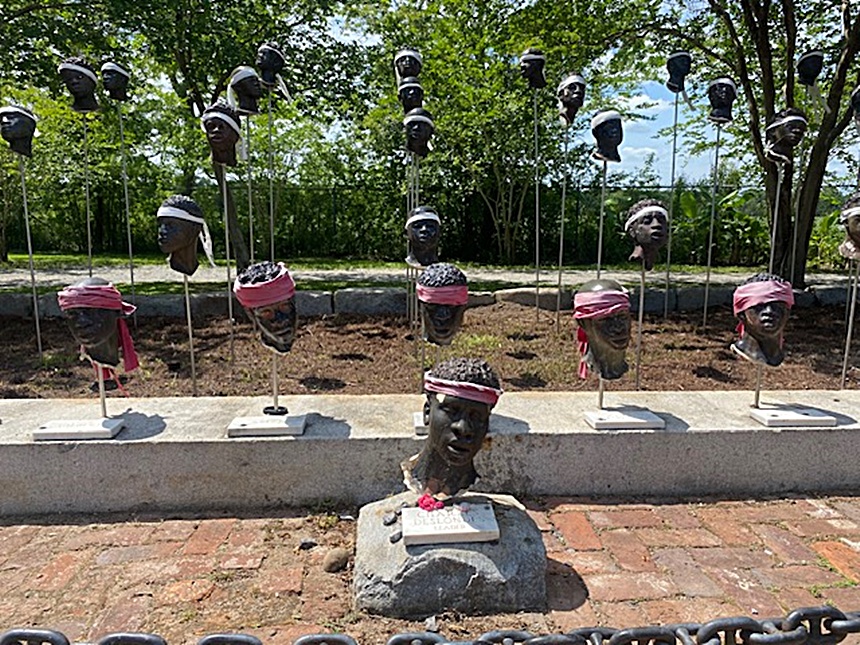
Simultaneously, many enslavers believed enslaved people to be satisfied with the perceived benevolence of slaveholders. These same slave owners expressed shock that their enslaved workers would desert them, before and during the Civil War. Regardless of their beliefs regarding the satisfaction of their enslaved workforce, enslavers expressed great fear that, given the opportunity, rebellious enslaved people would murder white families and sexually assault their wives and daughters. While slaveholders often made self-serving paternalistic arguments regarding their enlightened treatment of enslaved peoples, many, consciously or unconsciously, understood that their own treatment of the enslaved deserved retribution, Rao points out.
While obviously targeting America’s Black population, slave patrols and the various fugitive slave laws passed over the course of American history affected white Americans too, compromising their own freedoms in the name of maintaining the nation’s fealty to slavery.
South Carolina, a colony in which enslaved people outnumbered whites, serves as an example. In addition to establishing slave patrols in the early 1700s to control the movement of enslaved workers, South Carolina also passed legislation that enabled constables to force free whites into these slave patrols. This model privileged whiteness, but also forced whites to enforce slavery.
In North Carolina, a 1729 law asserted that any “’loose, disorderly or suspected person, black or white” discovered in the proximity of an enslaved person at night was subject to apprehension, an appearance before a justice of the peace, and a possible lashing.
Because most whites did not have enslaved workers, impressment into slave patrols by local authorities on behalf of enslavers sometimes heightened class tensions. Enslavers recognized that “poor white populations were also threats to their hegemony,” says Rao. Deputization of whiteness through racial slavery and slave patrols did unify whites in the South to some extent, but class tensions persisted.
The nation’s highest court facilitated the growing power of enslavers at the expense of others. The 1842 Supreme Court decision in Prigg v. Pennsylvania ruled that states could not pass laws infringing on the rights of an enslaver to recapture fugitive slaves. The Court, Rao writes, threw away civil liberties and “radically rewrote what were once accepted boundaries of state and federal authority.”
Sympathetic members of Congress used the decision to craft the more expansive Fugitive Slave Act of 1850. The law furthered tensions as it enabled the dragooning of local whites in Northern states where slavery had been abolished into patrols to retrieve fugitive slaves. “A fugitive slave meant that any free persons could be turned into a slave catcher,” Rao writes. The law served as the fulcrum upon which the Civil War would tilt roughly a decade later.
Even in the absence of slavery following the Civil War and Reconstruction, totalitarian systems of control over the Black population persisted as a combination of racist state governments and violent paramilitaries like the Klu Klux Klan sought to maintain the racial hierarchy established under the slavery regime. Though paramilitaries never entirely “usurped the rule of law,” writes Rao, “they scored their greatest successes by stationing their bayonets next to the voting booth … [V]iolence and politics were one and the same.”
The Supreme Court here too played a role: Several rulings during the Reconstruction era undermined federal efforts to protect Black populations against violations of their civil rights and political violence. This represented a sharp legalistic change: Earlier in the century, the Court had emboldened federal power on the part of enslavers through fugitive slave laws, but then shifted to a states’ rights perspective that neutered federal efforts to protect Black Americans.
Fear played a role in the absence of slavery as well. Following the passage of the 13th Amendment and the conclusion of Reconstruction, many white political leaders and paramilitaries spoke of “vengeful Black people” “killing and murdering our people” as part of a larger paranoid fictional racial apocalyptic landscape used to justify violent repression of Black voters and the implementation of Black Codes and Jim Crow segregation, writes Rao.
Slavery ended more than 150 years ago, but the systems built to control it, namely slave patrols, the larger infrastructure of surveillance, and the fear that drove it have persisted over time. “The ghosts of this old system are not dead but woven and knotted in the fabric of American political culture,” Rao asserts. We still see fear driving “division and discord” in key national moments: the Yellow Peril hysteria of the late nineteenth century, the rise of the Know Nothing Party and anti-immigrant sentiment of the same period that seeped into the early twentieth century, and the Red Scare of the 1950s serve as just a few examples.
A system built to control one group never limits itself. The same concepts and forces that drove slave patrols inspired campaigns to drive out Asian immigrants on the West Coast, established a government of surveillance of them in the late nineteenth and early twentieth century, and enabled the internment of Japanese Americans during World War II. The lynch mobs of the late nineteenth and early twentieth century — whether targeting Jews, immigrants, or African Americans — sprang from the same impulses and legal structures established by the slave control systems decades earlier. As William Faulkner famously wrote, “The past is never dead. It’s not even past.”
Become a Saturday Evening Post member and enjoy unlimited access. Subscribe now



Comments
State legislatures funded slave catchers, who also functioned as draft enforcers for the so-called Confederacy depicted in the movie “Cold Mountain” set in Asheville NC.