In the summer of 1909, Alice Ramsey was a 22-year-old housewife and mother to a two-year-old boy. She was also an accomplished automobile driver who logged 6,000 miles around her home state of New Jersey, not to mention a “perfect score” in a 1908 long-distance drive of about 100 miles. By the time summer ended, Alice Ramsey would also make headlines as the first woman to drive across the United States in a car. On June 13, the Los Angeles Herald carried the story, “Woman Starts Across Nation: Mrs. Alice Ramsey Leaves Gotham for Frisco; Will Do All Driving and Make All Repairs.” She wouldn’t be alone, however: Ramsey set out with two sisters-in-law and a good friend, as the Herald noted. “Enthusiast Is Accompanied by Three Woman Companions, and No Men Will Be Tolerated.”
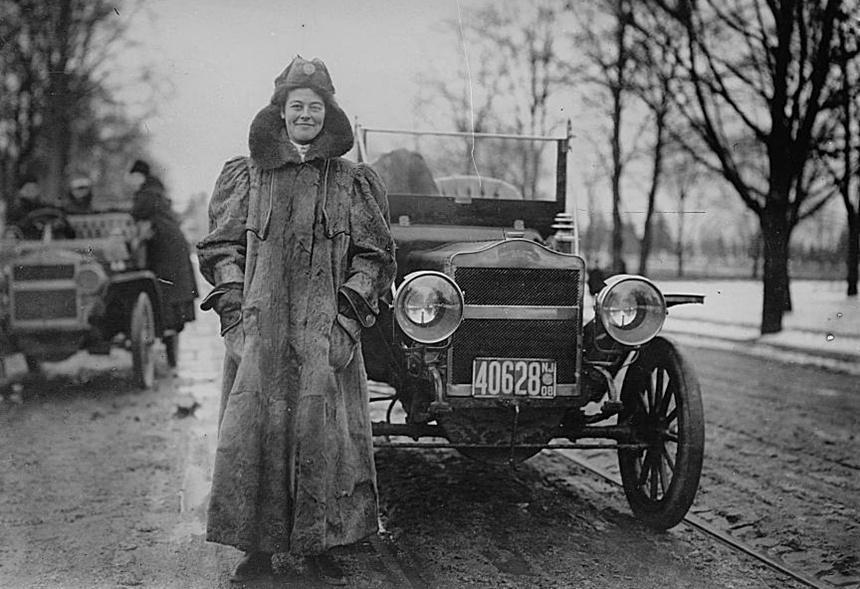
There was no national road system in 1909. Most Americans did not yet own cars: There were about 50 cars for every 10,000 people in the country. The now-famous Model T from Ford Motor Company had been on the market for only eight months. Ramsey, however, drove a Maxwell Model DA, provided by the manufacturer. The Maxwell-Briscoe Automotive Company reportedly suggested the cross-country endeavor as a way to promote cars and driving. As they saw it, if women could drive, anyone could drive.
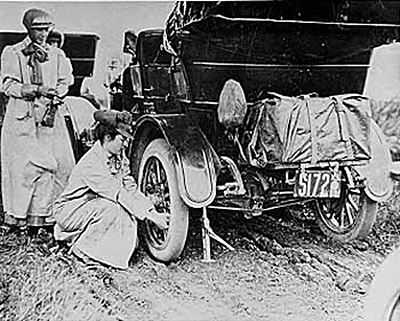
For her part, Ramsey just loved driving. She once told an interviewer that, with regard to women driving, “Good driving has nothing to do with sex.” Ramsey later explained that the premise of the trip had certainly been “a challenge, if I ever had one. It sounded like a magnificent adventure, and I liked it.” Her 59-day cross-country journey included approximately 41 days of driving and took Ramsey and her companions more than 3,500 miles coast-to-coast, mostly on unpaved roads.
To the company that sponsored her, the cross-country drive was a way to prove something to consumers. Alice Ramsey saw the experience as an adventure. Seven years later, Adeline and Augusta Van Buren, sisters from New York, would also take to the road, but they had the opposite problem: although they had no sponsors, they had something particular to prove to the United States Army.
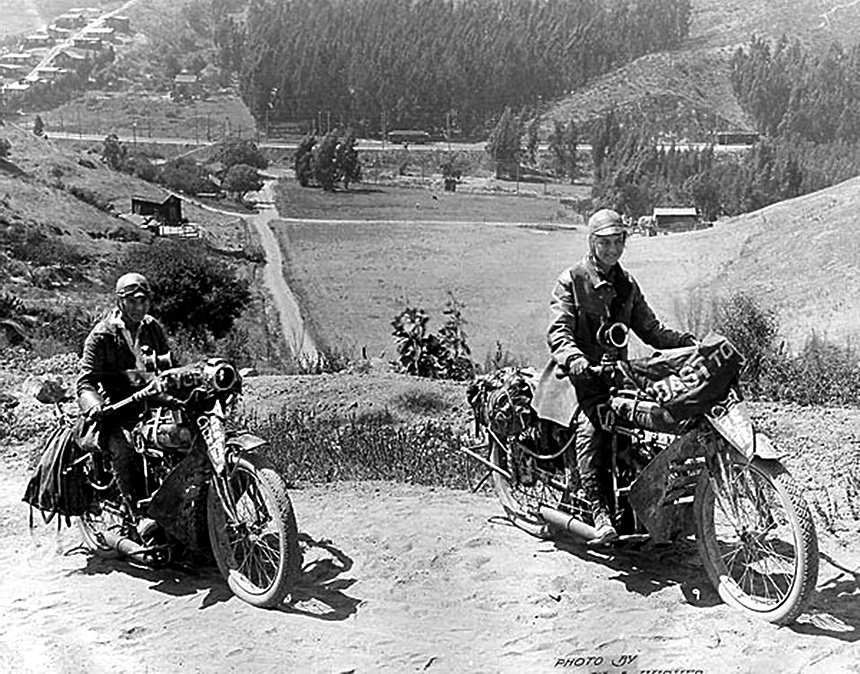
By 1916, Europe was at war. The U.S. was neutral, but some Americans believed the nation needed to be prepared in case their country had to step in. The Van Burens agreed with this cause, and this led them to their own personal challenge: to become the first women to cross the country, driving solo on motorcycles. More than just the thrill of the ride, however, the Van Burens wanted to prove to the U.S. Army that women could be of use in wartime. An article in Motorcycle Illustrated explained that, women could be of use in wartime: “they have in mind such a nerve-trying task as despatch carrying in times of war.” Women, they believed, could transport military communications via motorcycle for the military.
The journey was also an adventure. As Adeline explained in an article printed in the Montgomery Advertiser, “With a motorcycle all roads lead to the end of the world if one has but the courage to follow them.” The Van Burens’ trip took a little longer than Ramsey’s, running from July 4 to September 8. In part, the drive was longer because of side trips — they became the first women to reach the top of Pike’s Peak by motorcycle — and because they were arrested for violating local clothing laws. While they were never detained for long, the sisters seemed to face the biggest challenges in small towns in the western half of the country. There, they stood out for wearing leather riding pants in place of the skirts or dresses expected of women at the time. Even dressed in this manner, Motorcycle Illustrated described them as “refined in appearance” and noted that the women “expect to show that ladies can ride and still not lose their most valuable asset, their femininity.”
The U.S. Army, however, was not interested in recruiting women motorcyclists when the country entered the war the following year. The Van Buren sisters found new roads to travel, following Augusta’s own maxim, “Woman can, if she will.” Adeline left her teaching career, went to law school at New York University, and became a lawyer. Augusta took on airplanes in the years that followed, qualifying as a pilot and joining Amelia Earhart’s group, the Ninety-Nines.
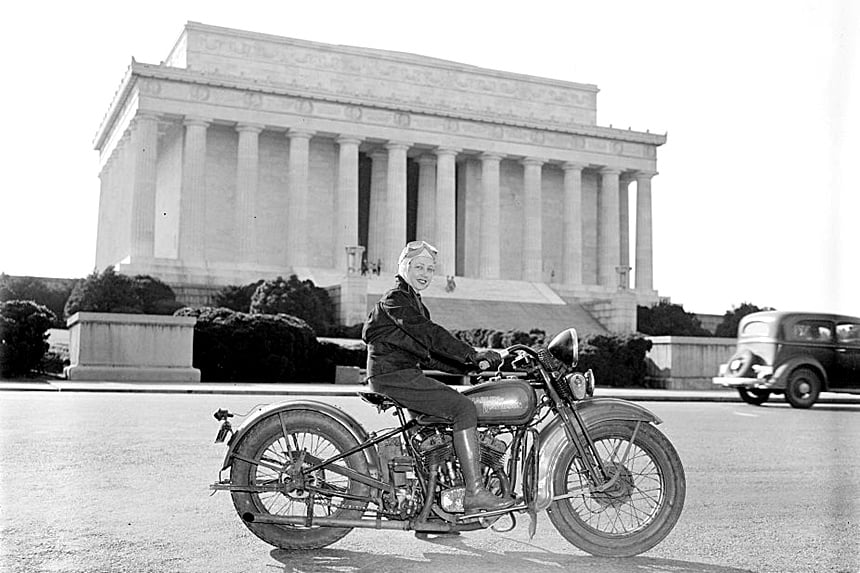
In 1916, Bessie Stringfield was a small child, too young to be aware of the Van Burens’ journey. Born either in Jamaica or North Carolina, depending on the source, Stringfield spent much of her life in the Deep South. She got her first motorcycle at 16, and in 1930, at age 19, Stringfield began what would become eight cross-country motorcycle trips. She simply “tossed a penny over a map and rode to wherever it landed.”
Bessie Stringfield – The Motorcycle Queen of Miami (Uploaded to YouTube by Portraits of History)
As a Black woman motorcyclist, Stringfield’s experiences looked different than the Van Burens’. Where they had encountered protests because of their clothing, Stringfield had to hope to find Black residents who would give her a place to stay for the night, or sleep outside of gas stations. Stringfield continued to ride throughout the 1930s and ’40s and beyond. During World War II, Stringfield accomplished what the Van Burens had dreamed of three decades earlier, becoming one of a few civilian motorcycle dispatchers for the military. By the 1950s, she had settled in Miami, where she became known as the “Motorcycle Queen of Miami” and helped create the Iron Horse Motorcycle Club, according to a 2025 Harley-Davidson Museum exhibit about her life. In 2002, the American Motorcycle Association inducted Stringfield into their Hall of Fame.
On the open road, Alice Ramsey, Adeline and Augusta Van Buren, and Bessie Stringfield all found opportunities to be themselves and to follow the roads and lives they dreamed of. Ramsey drove on paths that wouldn’t even qualify as roads today. The Van Burens climbed a mountain and found new directions when the Army ignored what they could do. Stringfield drove where she pleased, building a life that became part fact, part legend. The roads they traveled have been expanded and built upon over the years, and many of the landscapes they knew have long since transformed, but the spirit that drove them remains. They forged a path for women to take on the open roads that were yet to come.
Become a Saturday Evening Post member and enjoy unlimited access. Subscribe now