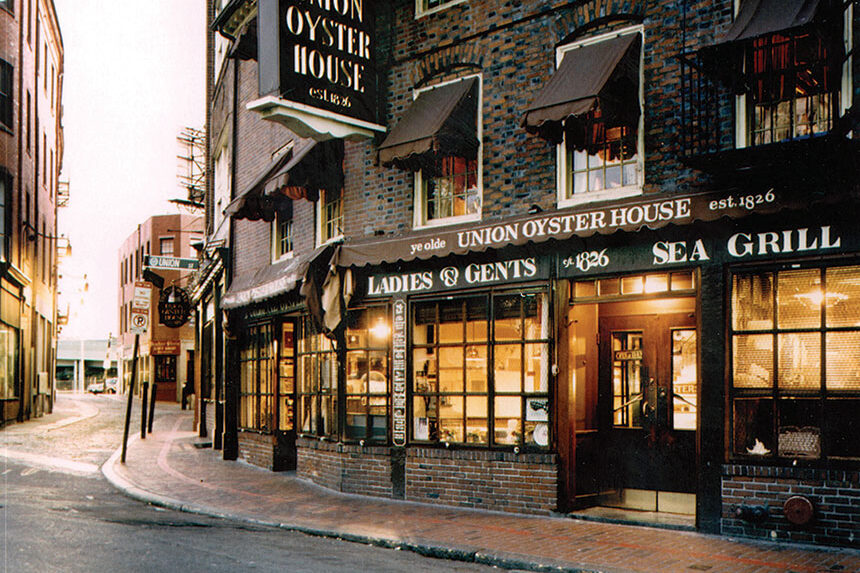
On one particular day in 1983, diners at Boston’s Union Oyster House heard the waitstaff strike up the familiar tune “Happy Birthday to You” to serenade a celebrating customer. A diner at a nearby table joined in, and his booming voice stopped everyone in their tracks; that surprise singer was legendary tenor Luciano Pavarotti.
The Union Oyster House has many such tales to tell, but then it has been operating for a remarkable 200 years, making this establishment only 50 years younger than the nation itself.
Inside the restaurant, a plaque from the National Park Service, dated 2003, officially declares Ye Olde Union Oyster House, to give it its proper title, a National Historic Landmark and the oldest continuously operating restaurant and oyster bar in the United States.
On a little curvy street directly on the Boston Freedom Trail history walk, though not officially a part of it, Union Oyster House is city history writ in brick and food. It now occupies a trio of three-story brick buildings at 41-43 Union Street, a block now dwarfed by latter-day skyscrapers. The NPS recognizes it as Boston’s oldest standing brick Georgian-style building; construction began as early as 1704, when number 42 was built as a private residence.
At that point, before the massive landfill that created Back Bay began, the property sat waterfront, near the bustling commercial harbor. “The boats came up right to the back of the restaurant,” says owner Joe Milano. “Though at that time it wasn’t a restaurant, but a dry goods store.”
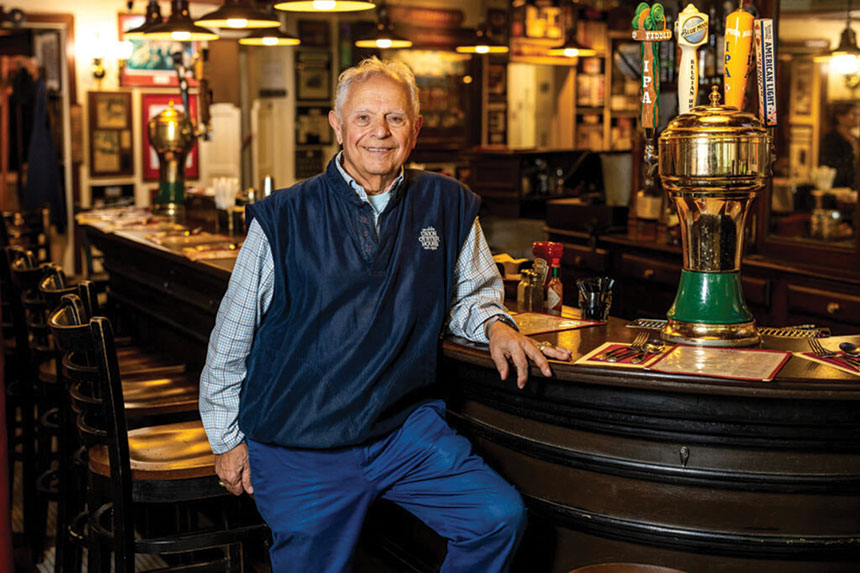
Later, the upstairs rooms were also publisher Isaiah Thomas’s print shop, where, from 1771 to 1775, he secretly published the Massachusetts Spy newspaper. The Spy rallied the colonial population around Boston merchants like John Hancock and Samuel Adams in their stand against the Crown, fomenting revolutionary fervor. “This place made me love history,” says Milano. “It’s a lot of fun researching all that.”
The upstairs rooms also housed exiled French King Louis Philippe for several years from 1796, but most surprising is its current double use as Milano’s office and a Consulate of Thailand. Brigadier General Joseph Milano, U.S. Army (Ret.) — Joe’s full military title — has served as an Honorary Consul General to Thailand for over 26 years. “We often say you’re actually in Thailand,” he jokes about stepping into his office.
It was Hawes Atwood and Allen Holbrook Bacon, oyster farmers, who set up the storefront at number 42 as Atwood and Bacon’s Oyster House in 1826, copping to a regional trend in guzzling oysters. Atwood and Bacon installed the semicircular oyster bar still used today (though the wood has been renewed since then).
When the opportunity to enter the business arose in 1970, Milano’s father bought in and Joe began working there. By the early 1980s, as full owners, the Milanos expanded from the original 250-seater center building, eventually taking ownership of the two adjacent buildings, too, and creating the labyrinth of upstairs and downstairs dining rooms we see today.
Despite the expansions, it all feels tied together and “olde.” “It would be heresy,” says Milano of modernizing the interior. “Tradition is not just a word. You change sometimes, as long as you maintain the actual feeling people expect to see. You just kind of clean the pearl of the oyster.”
Owning the real estate protects the legacy, says Milano, who mourns the passing of the city’s other old restaurants, like Jacob Wirth, Anthony’s Pier 4, Jimmy’s Harborside, Durgin Park (founded in 1827 and the city’s second-oldest restaurant before closing in 2019), Locke-Ober, and Clarke’s — all linchpins, now lamentably gone as a staunch Bostonian way of dining fast disappears. “That bothers me,” says Milano with a sad note to his voice. “We’re the survivor in the pack.”
The Union Oyster House was popular from the get-go and a favorite of 19th-century Boston-based Senator Daniel Webster. According to the Union Oyster’s website, Webster supped a “tall tumbler of brandy and water” and knocked back a half-dozen oysters, “seldom having less than six plates” — daily!
More recently, America’s beloved foodie and chef Julia Child was known to hug the restaurant’s old wood oyster bar (still in use) as often as she could; and a panoply of celebrity customers — from former New England Patriots star Tom Brady to actor Leonardo DiCaprio — are commemorated with brass plaques forming a lengthy fan roster on a wall inside the restaurant. “We call it the Wall of Fame,” says Milano.
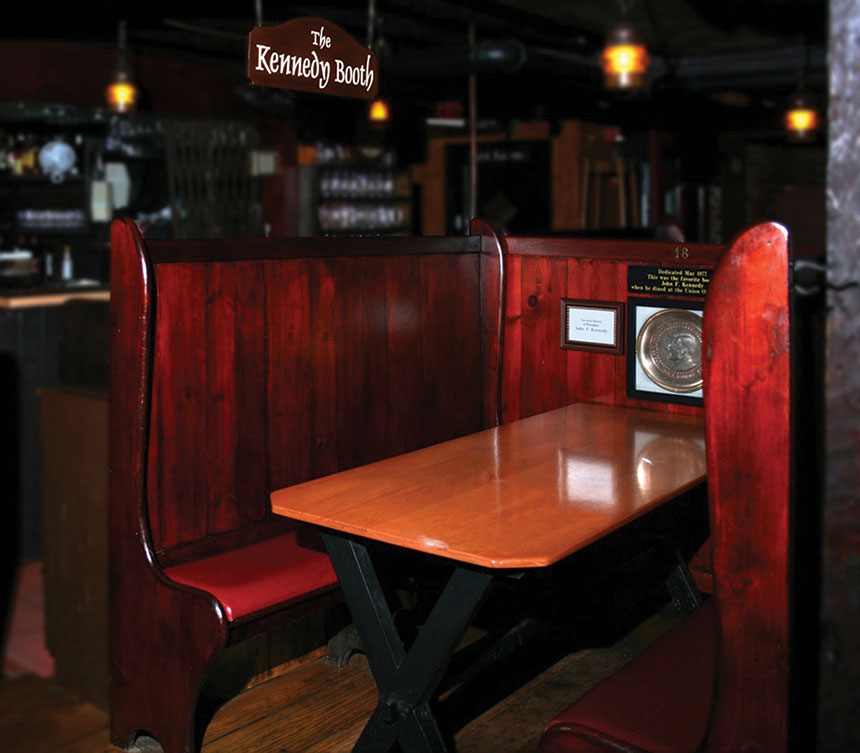
Another plaque upstairs marks John F. Kennedy’s favorite booth. Kennedy ate here once a week before he was president and a busier life took him away from his hometown. “He would come in on Sundays,” says Milano. “He was a congressman, then he became a senator, so he was well known and it began to shadow the aspect of coming to a restaurant. This was a place he enjoyed for some quiet and solitude. He’d bring in newspapers and read them. He would enjoy, it’s often written, the oyster stew or the lobster stew.”
In 1977, Milano officially dedicated Kennedy’s regular booth, table 18, and marked it with the plaque. “He was a Bostonian, and after the tragedy in ’63, it’s a nice way to respectfully honor his memory,” says Milano.
“You just never know who you’ll see eating there,” says Heleena Criswell, who was raised in Brookline and often visited Union Oyster House with her family, and still goes regularly.
And she’s right. Besides JFK, many presidents have supped here: Franklin Roosevelt, Carter, Clinton, Obama, and George H.W. Bush among them; the late Massachusetts Senator Edward Kennedy, JFK’s younger brother, regularly visited. Other famous patrons include acting legends like Clint Eastwood, Paul Newman, Meryl Streep, Robert Redford, and Al Pacino; comedic giants like Robin Williams, Carol Burnett, and Billy Crystal; sports icons like Larry Bird, Muhammad Ali, and Bobby Orr; and musical stars as varied as Ozzy Osbourne and Liza Minelli. And, of course, Pavarotti, who was that day dining with Green Acres actor Eddie Albert, who reportedly also joined in on the Happy Birthday singalong.
In 2003, Milano commissioned New Jersey sports artist Stan Kotzen to paint a fantasy gathering with all the famous faces known to have eaten there.
But the mainstay customers are Bostonians. Damian de Magistris, co-owner of The Wellington and il Casale restaurants in his native Belmont and nearby Lexington, remembers his parents taking him there as a child. “I still remember the old wood tables, worn wood bar, and the character in every piece of furniture,” he says. “And, of course, that hot, creamy clam chowder served with those perfectly salty crackers — it’s simple, but it stays with you.”
Even Milano, whose family lived in the neighboring North End, recalls going as a child. “My parents took me,” he says fondly, “but it wasn’t for any particular reason. It was just a good place to eat.”
The Union Oyster House is a lively living museum, but food is the main draw, especially traditional New England comfort food like fried clams, fish and chips, and breadcrumb-topped baked scrod.
“My grandma loves seafood,” says Criswell, who works in finance. “It’s still one of her favorites to visit, even at 91 years young. To this day, I personally love their lobster roll, clam chowder, amazing cornbread, and I can’t leave without the warm apple cobbler. They’re all must-haves in my book.”
The rib-sticking, rich and creamy New England-style clam chowder is quite popular. “When it’s chilly out, sales of chowder are high,” says Milano. “Ours is well known and we’ve received a lot of awards. That kitchen’s been making chowder for 200 years.”
Oysters remain the biggest seller, though, says Milano, checking his computer and noting the count for this busy Saturday. “It’s already about 18 bushels. We’ll go through about 25 to 30 bushels today,” he estimates of the final tally. A bushel is about 100 oysters. “We go through a lot of oysters,” he emphasizes.
Usually, three different varieties are offered, often plucked from Massachusetts coastal waters: from Wellfleet and Chatham on Cape Cod, or Duxbury on Boston’s south shore. “They’re just as good as they get,” says Milano. He is not wrong.
Linda Laban is a freelance writer covering arts, travel, design, and life in its most inspiring forms. Split between Los Angeles and London, she can often be found on the road with her trusty copilot, Winnie the Cat.
This article is featured in the July/August 2026 issue of The Saturday Evening Post. Subscribe to the magazine for more art, inspiring stories, fiction, humor, and features from our archives.
Become a Saturday Evening Post member and enjoy unlimited access. Subscribe now

Comments
I love that Ye Olde Union Oyster House has been around for so long and still attracts a diverse crowd! It’s fascinating how it manages to blend history with modern dining.