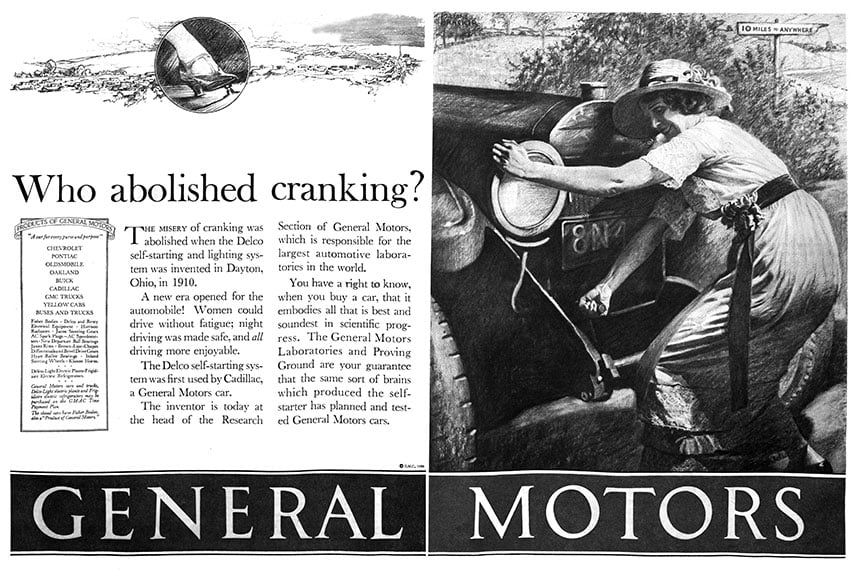
In the early years of motoring, drivers couldn’t start their engines without a crank handle and muscle. Aside from the inconvenience, hand-cranking an engine was dangerous. If the engine backfired, the crank could fly backward to break your thumb or wrist, or even dislocate your shoulder. The risks only increased as engines became larger and more powerful.
Adding to the unpleasant task of manually turning over your engine was the fact that it often had to be done in rain, snow, or darkness.
The first automobile to feature an electric starter was the Cadillac Model Thirty of 1912. It enabled drivers to start their engines inside the car simply by pressing a button on the floor. The next generation of starters doubled as generators; once the engine started, they could power the car’s lights.
By 1920, virtually all automobiles had the option of electric starter motors, even — over Henry Ford’s objection — the Model T. And now that hand cranking was eliminated, many women and elderly drivers were encouraged to get behind the wheel.
This article is featured in the July/August 2026 issue of The Saturday Evening Post. Subscribe to the magazine for more art, inspiring stories, fiction, humor, and features from our archives.
Become a Saturday Evening Post member and enjoy unlimited access. Subscribe now



Comments
While I was aware of early autos having to be manually hand cranked, I didn’t know it was this difficult and dangerous. The electric starter after 1920 was a huge advancement, and can see why cars from then on had a much more mass appeal.