
—Originally published in the June 17, 1922, issue of The Saturday Evening Post
- Of course I talk to myself. I like a good speaker, and I appreciate an intelligent audience.
- Beauty is only skin deep but ugly goes clean to the bone.
- A hangover is the wrath of grapes.
It’s unfortunate that Dorothy Parker is mostly remembered today for her one-line witticisms. She was actually a gifted writer of short stories and poetry who published frequently in The Saturday Evening Post in the early 1920s. Most of her work here was in verse, but she also contributed several prose pieces. She published her first poem in 1914, and around 300 more followed, many of them appearing to be sardonic, sadder-but-wiser commentaries on her own love life. She later became an editor at the start-up New Yorker magazine. Her contributions as an irreverent book and theater critic were instrumental in developing the distinctive style of that magazine’s writing. She was a rigorous editor of her own work, once saying that for every five words she wrote, she’d change seven. She is one of the few American humorists whose works are still funny a century later.
- That would be a good thing for them to cut on my tombstone: Wherever she went, including here, it was against her better judgment.
Men I’m Not Married to
By Dorothy Parker
Parker had a tumultuous love life, which she was happy to use as inspiration for her work.
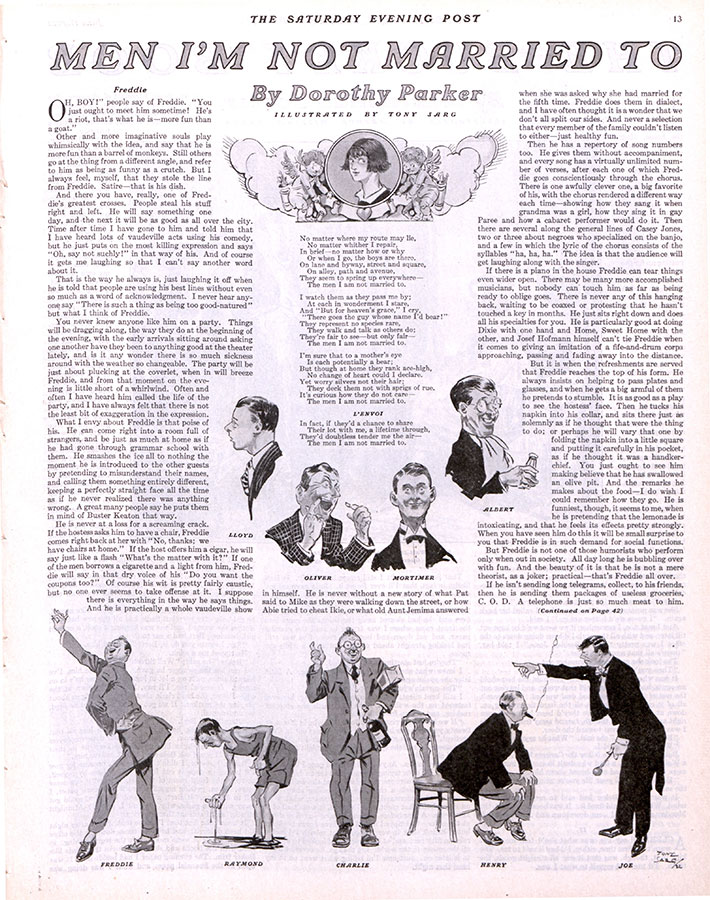
Raymond
So long as you keep him well inland Raymond will never give any trouble. But when he gets down to the seashore he affects a bathing suit fitted with little sleeves. On wading into the sea ankle-deep, he leans over and carefully applies handfuls of water to his wrists and forehead.
Charlie
It’s curious, but no one seems to be able to recall what Charlie used to talk about before the country went what may be called, with screaming effect, dry. He must have been one of those strong silent men in the old days. Those who have not seen him for several years would be in a position to be knocked flat with a feather if they could see what a regular little chatterbox Charlie has become. Say what you will about prohibition — and who has a better right? — you would have to admit, if you knew Charlie, that it has been the making of him as a conversationalist. He never requires his audience to do any feeding for him. It needs no careful leading around of the subject, no tactful questions, no well-timed allusions, to get him nicely loosened up. All you have to do is say good evening to him, ask him how everybody over at his house is getting along, and give him a chair — though this last is not essential — and silver-tongued Charlie is good for three hours straight on where he is getting his liquor, how much he has to pay for it, and what the chances are of his getting hold of a couple of cases of genuine pinch-bottle, along around the middle of next week. I have known him to hold entire dinner parties spellbound, from cocktails to finger bowls, with his monologue.
Now I would be well down among the last when it came to wanting to give you the impression that Charlie has been picked for the All-American alcoholic team. Despite the wetness of his conversation he is just a nice, normal, conscientious drinker, willing to take it or let it alone, in the order named. I don’t think I ever saw anyone who could get as much fun as Charlie can out of splitting the Eighteenth Amendment with a friend.
Henry
You would really be surprised at the number of things that Henry knows just a shade more about than anybody else does. Naturally he can’t help realizing this about himself, but you mustn’t think for a minute that he has let it spoil him. On the contrary, as the French so well put it. He has no end of patience with others, and he is always willing to oversee what they are doing, and to offer them counsel. When it comes to giving his time and his energy there is nobody who could not admit that Henry is generous. To a fault, I have even heard people go so far as to say.
If, for instance, Henry happens to drop in while four of his friends are struggling along through a game of bridge, he does not cut in and take a hand, thereby showing up their playing in comparison to his. No, Henry draws up a chair and sits looking on with a kindly smile. Of course, now and then he cannot restrain a look of pain or an exclamation of surprise or even a burst of laughter as he listens to the bidding, but he never interferes.
And that is the way Henry is about everything. I have even known him to follow his friends all the way around a golf course, offering constructive criticism on their form as he goes. I tell you, in this day and generation, you don’t find many people who will go as far out of their way for their friends as Henry does. And I am far from being the only one who says so too.
Lloyd
Lloyd wears washable neckties.
Oliver
Oliver has a way of dragging his mouth to one side, by means of an inserted forefinger, explaining to you, meanwhile, in necessarily obscured tones, the work which his dentist has just accomplished on his generously displayed back teeth.
Albert
Albert sprinkles powdered sugar on his sliced tomatoes.
This article is featured in the September/October 2026 issue of The Saturday Evening Post.
Become a Saturday Evening Post member and enjoy unlimited access. Subscribe now


Comments
I read the whole 1922 feature, Jeff. I can see why she wasn’t married to any of them, all while telling us with a drink in one hand, and a long cigarette holder in the other, taking the occasional puff that would go poof.