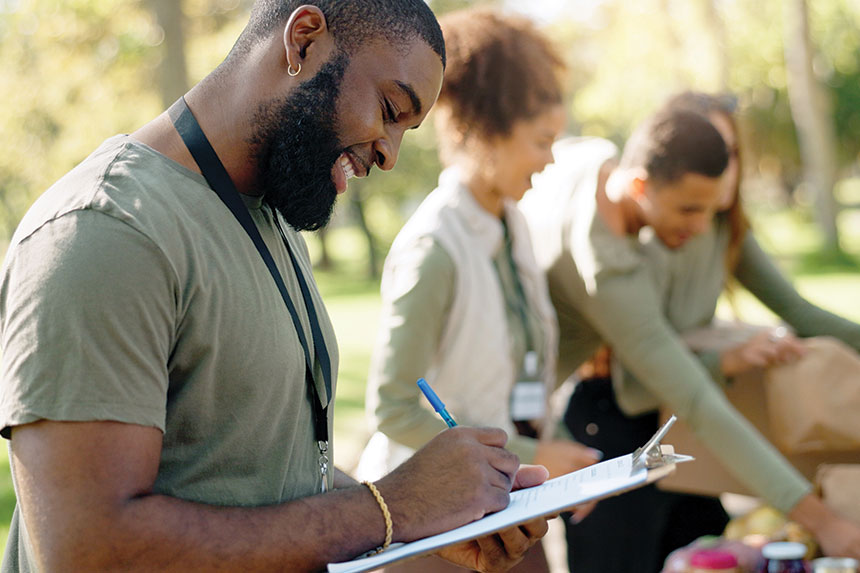
My wife, Rachel Noble, wondered if it was time to end her small nonprofit. She formed the Allay Foundation in 2014 to provide mental health care to Washington, D.C.-area mothers who can’t afford it, and the organization has distributed $50,000 to assist pregnant women, moms with children, and women who’ve miscarried. But running even a small foundation is a challenge. Rachel — the foundation’s president — and her fellow board members are all volunteers with busy, full-time jobs. Growing the foundation would mean more time, more effort, more fundraising. And yet when Rachel asked board members if maybe, maybe, it was time to stop their work, the unanimous response was … Are you nuts?
“Everyone was like, ‘Oh my God, no — of course we want to keep going,’” says Rachel, a licensed mental health therapist with a Washington, D.C.-based practice. “All of these people have high-pressure jobs, none of us gets paid for this, we do the work on nights and weekends, and yet nobody wanted to give it up.”
Their commitment is partly due to the foundation’s life-changing work for women. But that work also benefits the volunteers themselves, especially those in fields such as finance, academia, and tech.
“They all say the same thing: This is what makes them the happiest,” Rachel says. “Nothing in their jobs gives them an opportunity to help their fellow humans. One board member was like, ‘This is the only thing that makes me feel good about my talents. I would do this all the time if I could.’”
As a longtime volunteer myself, I understand their feelings. About 20 years ago, at the age of 40, after the unexpected death of my father, I embarked on a quest for meaning as a global volunteer. My then-wife and I didn’t have children, my job seemed unimportant — I felt that my life didn’t matter. So I volunteered short-term in six countries, from Costa Rica (teaching English at a rural elementary school) to Ecuador (assisting researchers on a climate change project). Later I volunteered locally with FACETS, an organization that assists the homeless and near-homeless in Northern Virginia, and Capital Caring Health, a hospice and palliative care organization. I’m currently the volunteer board chair of Fall for the Book, a local literary festival.
I’ve seen firsthand how much this work matters. But many organizations are struggling to recruit volunteers while also coping with funding cuts. If you’ve been thinking about offering your time and talents to serve others, now’s the time to do it, for your community and your well-being. Here are seven reasons why.
- Nonprofits need you. Greater needs, fewer resources: That’s the challenge facing many nonprofits. In the Center for Effective Philanthropy’s 2026 “State of Nonprofits” report, 81 percent of nonprofit leaders said they’re seeing or they anticipate greater demand for their organization’s services. Yet 30 percent of respondents said their organizations had been forced to reduce services due to funding cuts from at least one source, whether it’s government or foundations or individual donors. That decrease in funding can increase the need for volunteers.
- You build connections in a disconnected world. Loneliness is a growing problem in America. In the American Psychological Association’s 2025 “Stress in America” survey, 50 percent of adults said they lacked companionship and 54 percent felt isolated often or some of the time. Volunteering can ease the sting of loneliness by introducing you to new people, whether it’s staff, other volunteers, or the people you serve. I was a pantry volunteer with FACETS, and sometimes I would meet families who were struggling to find homes, who came to the organization for food, diapers, and other supplies. Volunteering there made me feel part of something larger than myself.
- Volunteering can change how we see each other. When you volunteer, you meet people. Sometimes they’re just like you. Sometimes they’re not — and that’s good. As a volunteer in places such as China, Kenya, and the West Bank, I met people I would never have met otherwise. I would ask about them, they would ask about me, and we’d learn about each other, about our different countries, cultures, and lives. When those exchanges happen, stereotypes start to disappear. In Costa Rica, for example, I was shocked to learn that many people thought Americans were lazy. How could that be — we have the American work ethic! I thought. But their perceptions were formed by television. They watched U.S. shows like Friends, where the gang spends hours at Central Perk drinking coffee, and it formed an unflattering image. But when you’re working with people, sweating with people, laughing, talking, sharing, listening, those perceptions begin to change — not just overseas, but when you volunteer in your own community.
- You’ll meet incredible people. Several years ago, I volunteered in India with Kansas City, Missouri-based Medical Missions Foundation, which sends surgical teams to impoverished areas (and no, I am not a doctor: I volunteered as a blogger for the communications team). The volunteer doctors and nurses worked up to 16-hour days in the operating rooms. Their dedication was astounding. Here were people taking a week off from their jobs so they could fly 15 hours and do their jobs without pay. I have met so many passionate, committed people like this, and they have restored my at-times wavering faith in humanity.
- Volunteering boosts your mind, your mood, and more. Numerous studies have confirmed the health benefits of volunteering. With its potent combo of social interactions and purpose, volunteering can reduce anxiety and even depression, research shows. Social interactions are also good for brain health. People who volunteered a few hours a week, or even just informally helped others (like relatives or neighbors), showed a slower rate of age-related cognitive decline than those who didn’t, a 2025 study in the journal Social Science & Medicine found. Volunteering may even improve longevity. Adults over 50 who volunteered at least 100 hours a year (roughly two hours per week) had a substantially reduced risk of mortality — along with higher levels of physical activity and an improved sense of well-being — compared to those who didn’t, according to a 2020 study in the American Journal of Preventive Medicine.
- People are reminded that they matter. When I was volunteering globally, I worked with a friend at a special-needs school in China. We were limited in what we could do, mainly because of the language gap — Chinese is hard to learn, and the teachers knew minimal English — but I always thought our most important act was just being there. These women worked incredibly difficult jobs and we were like a welcome novelty, a break in their challenging routines. They would study a Chinese-English dictionary and try out new words, or laugh when I did something stupid, which, alas, was not infrequent. At the time, special-needs kids in China were stigmatized, and the idea that my friend and I traveled so far to be with these children was meaningful to the parents and teachers alike. That same validation, that same sense that someone cares, can be true whether you volunteer in a neighborhood library or hospital or school.
- Small actions have big impact. Before my dad died, he said something I’ll never forget: “Success comes from helping others succeed.” Helping others doesn’t have to mean performing some massive act or writing a huge check. Most of us aren’t Bill Gates. Serving others can be as simple as sorting food at a food bank, coaching a Little League team, or reading a book to a child. It can mean giving attention to someone who doesn’t always receive it. Even the smallest action can change someone’s life. And when we all engage in small acts, those small acts become large.
That is why Allay’s volunteers are so determined to keep serving. In the summer of 2026, Allay assisted a new mom who had escaped an abusive home. She was living in a homeless shelter and struggling with postpartum depression. Allay paid for an eight-week support group program that included six other moms and a therapist.
“We were so proud to pay for her care,” Rachel says. “It changes the life and the trajectory of that mom and the baby and the family. It has such a ripple effect.”
That ripple effect, that care — the enduring sway of kindness — that is the power of volunteering.
Ken Budd has written for The New York Times, Smithsonian, The Atlantic, and National Geographic and is the author of The Voluntourist. For more, visit thevoluntouristbook.com.
This article is featured in the November/December 2026 issue of The Saturday Evening Post.
Become a Saturday Evening Post member and enjoy unlimited access. Subscribe now