The Legend of The Blair Witch Project
It’s every film student’s dream. You get your friends together to make your little independent movie, and it takes the world by storm. In 1999, Daniel Myrick, Eduardo Sánchez, and their friends founded Haxan Films to make a new kind of horror movie, one that combined the aesthetic of folk and urban legends with a documentarian approach. They screened the movie at a midnight showing at Sundance, which led to an immediate sale; word-of-mouth rolled into a groundbreaking marketing campaign that relied heavily on the internet, a novelty at the time. When The Blair Witch Project premiered 20 years ago this week, the modestly budgeted movie erupted into one of the biggest indie successes of all time. What made it work, how did the marketing drive the movie, where did the Sci-Fi Channel fit in, and exactly what happens in that last scene? Follow along to find out; just don’t lose your map.
1. Crafting a Company
Häxan (Uploaded to YouTube by YouTube Movie Trailers
Myrick and Sánchez studied film at the University of Central Florida in the early ’90s. Their mutual interest in paranormal documentaries and horror film led to them conceive of an idea that was a hybrid of both, much like the 1980 Italian film Cannibal Holocaust. In order to get the movie made, the pair, along with Gregg Hale, Robin Cowie, and Michael Monello, founded Haxan Films; the production company takes its name from Häxan, the silent witchcraft documentary from 1922. Myrick and Sánchez wrote a short script that shaped the story while allowing the dialogue to be mostly improvised by the actors. An audition pool of 2000 actors was whittled down to three: Heather Donohue, Joshua Leonard, and Michael C. Williams.
2. Directing by GPS
Shooting took place in Maryland in 1997. The bulk of scenes were shot in Seneca Creek State Park along the Potomac River, with other scenes filmed in Burkittsville and one particularly important sequence filmed at the Griggs House in the unincorporated community of Granite. As the actors were playing a documentary crew investigating a local legend, they were outfitted with a combination of film and Hi8 video cameras. The trio of performers used GPS to find marked crates along a preplanned route in the park; inside each crate were instructions for the day including “scenes” to improvise with specifics given to each character. An initial 20 hours of footage was cut and edited to a runtime of less than two-and-a-half hours.
3. Fabricating a Legend
The filmmakers were surprised when The Blair Witch Project got accepted into the 1999 Sundance Film Festival. The movie became a surprise hit with audiences after a midnight screening. Artisan Entertainment paid $1.1 million for the distribution rights; the original production budget had been in the neighborhood of $60,000. With the ability to manage a wide release in place, the filmmakers and Artisan went to work on a ground-breaking marketing campaign.
Artisan leaned all the way on the documentary aesthetic of the film. They promoted the film as footage that was discovered in the woods after the three-person crew disappeared. Building on that, the website for the film employed old photos of the cast and fabricated news articles to cultivate the idea that the trio were missing. Even the nascent IMDB.com for the film listed the actors as “missing.” These tactics caused an explosion of interest online; USA Today posited that it was the first film to “go viral,” despite the lack of social networks at the time.
Perhaps the crowning piece of marketing was The Curse of the Blair Witch, a one-hour special that ran on the SciFi Channel on July 11, 1999, ahead of the film’s release. Using documentary stylings comparable to contemporaneous programs like Unsolved Mysteries, the special wove together fake news clips and interviews with pieces of footage from the film and a created mythology surrounding Burkittsville, the legend of the Blair Witch that haunted the woods, and the missing filmmakers. The initial airing receiving huge ratings, and the special ran repeatedly over the summer; it was even offered for sale as a stand-alone VHS release.
4. The Release
Trailer for The Blair Witch Project (Uploaded to YouTube by Movieclips Classic Trailers)
The film got a limited release on July 14 before opening wide on July 30. In its first weekend of wide release, The Blair Witch Project was number two at the box office; it came in just behind the Julia Roberts’ hit The Runaway Bride, but edged out a surprisingly crowded horror field that included Deep Blue Sea (third) and The Haunting (fourth). When horror phenomenon The Sixth Sense debuted in the top spot one week later, Blair Witch held firm at number two. During its box office run, the movie made just under $150 million in the U.S. and $248 million around the world.
Critics like Roger Ebert and Peter Travers showed up with enthusiastic support; Ebert called it “an extraordinarily effective horror film.” In fact, most critics praised the movie, with only a few dissenters. Audiences were more divided, in part because of the unconventional narrative and its abrupt ending. (Many of the viewers who didn’t “get” the ending hadn’t remembered an interview earlier in the film that mentioned Rustin Parr and the child-murders of the 1940s). Nevertheless, the film itself was a key component of end-of-the-century film conversation and was discussed, along with Sense, as part of a horror renaissance in film.
5. The Legend Lives
The trailer for Quarantine (2008)(Uploaded to YouTube by Sony Pictures Entertainment)
The longest-lasting impact of The Blair Witch Project is its popularization of the “found-footage” technique. That approach has become a subgenre of horror unto itself, including the Paranormal Activity series, the V/H/S series, the REC and Quarantine series, The Den, the original Cloverfield, and others. It has also been employed for comedy (Project X), crime (End of Watch), and super-hero films (Chronicle). Since its release, the film has been celebrated on a number of lists, including the Top 100 Scariest Movies (Chicago Film Critics Association), 50 Best Movie Endings of All Time (Filmcritic.com), Top 25 Horror Movies of All Time (IGN.com), 25 Scariest Movies of All Time (Cosmopolitan), and more.
Though it entered the culture 20 years ago, the Blair Witch isn’t done with us. Though there have been a pair of (not as successful) sequels and other media tie-ins, like books and comics, interest in the concept still persists. In 2017, Sánchez said that he and the other co-creators are developing the Blair Witch for television. The series will apparently be released by Studio L, the digital release arm of Lionsgate (who purchased Artisan in 2003). While the film’s scariness and effectiveness is still debated in some quarters, no one would argue that it’s naturally frightening to be lost and alone, somewhere in the woods in the dark. The Blair Witch itself may not have been real, but its legend can live on in the shadows.
Movies for the Rest of Us with Bill Newcott: Our Favorite Movie Moons
It’s been 50 years since Neil Armstrong landed on the moon, and even longer since Hollywood’s love affair with the lunar landscape. Here are Bill Newcott’s favorite scenes featuring moons in the movies.
True Grit vs. The Wild Bunch: The Week of Peak Western
They opened one week apart 50 years ago. One featured the matchless giant of the genre; the other came from one of its great directors. True Grit opened first, followed just seven days later by The Wild Bunch. These two films reflected different views of the Western, but also proved how versatile and durable the form could be in the right hands.
Charles Portis’s True Grit first saw light as a novel serialized in The Saturday Evening Post in 1968; the following year, it was adapted into a screenplay by Marguerite Roberts. John Wayne had campaigned for the lead role of Rooster Cogburn after reading the book, and championed Roberts as a writer despite her having been “blacklisted” during the Red Scare. Wayne would later recall the script as the best he’d ever read.
Wayne, of course, typified the Western genre in the American consciousness. Of the approximately 170 films he appeared in, over 80 of them were Westerns. Wayne was conservative politically and curated his reputation to the point where he declined to appear in the Western comedy film Blazing Saddles because he felt that the raunchy material went against his family-friendly image. That image actually made a for a good fit with the material of Grit, where Wayne’s cantankerous U.S. marshal develops a vaguely paternal relationship with young Mattie (played by Kim Darby), who hires him to track down her father’s killer.
The original trailer for True Grit (Uploaded to YouTube by Paramount Movies)
Despite pushing against the boundaries of the traditional Western by highlighting the fact that Cogburn is an aging protagonist, much of the plot fits within the confines of what people were expecting of the genre and Wayne. The curmudgeonly Cogburn is a decent and heroic man, as is the third member of his and Mattie’s group, Texas Ranger Le Boeuf (country star and occasional Beach Boy substitute Glen Campbell). Justice is served, evil is punished, and Mattie even promises to have Cogburn interred at her family plot when he dies. The film traffics in themes of “found family” as much as it does in the well-worn revenge and justice tropes of the Old West.
Released just one week later on June 18, 1969, The Wild Bunch leans into a very different sensibility. Directed by Sam Peckinpah, who rewrote the film from an original screenplay by Walon Green and Roy N. Sickner, The Wild Bunch captures the same ethos of the aging cowboy, but flips it from lawman to outlaw. The film taps into the idea of “honor among thieves,” challenging the audience to identify with a cast of hardened criminals while suggesting that they do indeed adhere to their own version of a code.
The original trailer for The Wild Bunch (Uploaded to YouTube by Warner Bros.)
The overall plot of The Wild Bunch, which involves a group of outlaws (led by William Holden and Ernest Borgnine) chasing their last score, isn’t that unusual. Neither is the subplot of the group being pursued by a now-deputized former ally (played by Robert Ryan). What sets the story apart is the way in which the steady approach of the modern world is transforming the West. The characters are aging, and the country they knew is changing around them; they recognize their own mortality and the fact that they are, in a sense, outdated characters.
But the larger, and more shockingly revolutionary change, is the frank depiction of violence. Peckinpah leans into the brutality. His shoot-outs pull no punches. They are bloody, messy affairs that strip away the lie of the clean gunfights that filled earlier movies of the type. Civilians, including women and children, die in public crossfires. Bodies are riddled with bullets. And the blood doesn’t just flow; it bursts. This is the same frank depiction of violence that began in part with Arthur Penn’s Bonnie and Clyde in 1967 and continued throughout Peckinpah’s own work, including Straw Dogs and Cross of Iron, signaling the beginning of what was called “the new Hollywood,” which placed a greater emphasis on realism and cinema as visceral experience.
The two films met with very different receptions. Wayne won both the Golden Globe and Academy Award for best actor for True Grit, while the title song (sung by Glen Campbell) was nominated for both distinctions, as well. The movie turned out to be a solid box-office performer, as well.
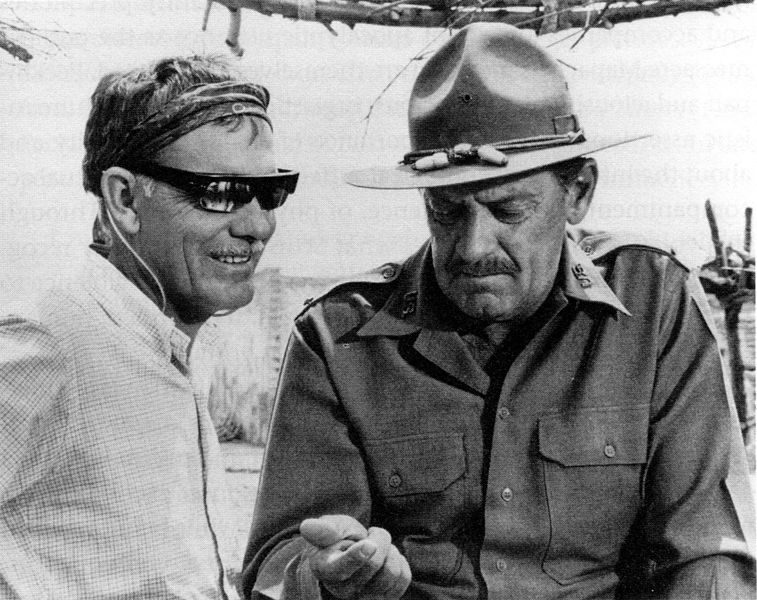

The Wild Bunch was instantly polarizing; the late critic Roger Ebert recalled that, at the initial screening, he stood to defend the film against an attack from the critic for Reader’s Digest, who had questioned why such a film had even been made. A number of prominent critics did praise The Wild Bunch, including Vincent Canby of The New York Times; Time also weighed in with positive notices, offering unabashed praise of Holden and Ryan and going on to state that “[the film’s] accomplishments are more than sufficient to confirm that Peckinpah, along with Stanley Kubrick and Arthur Penn, belongs with the best of the newer generation of American filmmakers.”
One person that wasn’t a fan of The Wild Bunch was, perhaps unsurprisingly, John Wayne. Wayne noted privately and in interviews that he felt that that film destroyed the myth of the Old West. The actor commented on Clint Eastwood’s similarly nihilistic High Plains Drifter in 1973; in a 1993 interview with Premiere magazine, Eastwood recalled that Wayne wrote him directly and said, “That isn’t what the West was all about. That isn’t the American people who settled this country.”
Over the years, True Grit continued to be held in high esteem, while The Wild Bunch grew in reputation among critics and film scholars. Peckinpah’s command of violent action and quick editing can be seen today in the work of directors like John Woo and Quentin Tarantino. True Grit received an acclaimed remake in 2010, while The Wild Bunch has managed to avoid multiple efforts at a new version. It’s fair to say that Bunch helped usher in the age of the revisionist Western, seen in films like Unforgiven that take a more unflinching look at consequence of violence. It’s perhaps strange that two genre classics that were so different from one another were released in the same week, but it did seem to mark a tidal shift when the narratives of American film grew darker and the myth of the American West began to be resigned to just that: a myth.
It Can’t Rain All the Time: How The Crow Captured the Angst of a Generation
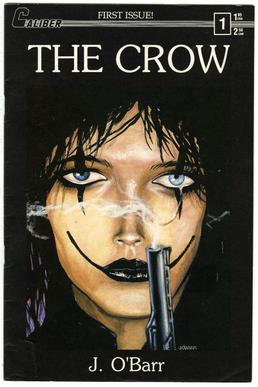
Arriving in theaters before the decline of the first Batman film franchise and weeks after the death of Kurt Cobain, Alex Proyas’s The Crow, based on the independent comic by James O’Barr, managed to have a lasting impact on film, comics, music, and the soul of a generation. Steeped in a sense of loss that was magnified when leading man Brandon Lee was killed during filming, The Crow emerged as a cultural touchstone due to all of the forces contained in its 102-minute runtime. Now, 25 years later, we look back at why so many pieces of the work still resonate.
1. It’s Personal
A central theme of The Crow is loss, and that comes from a very honest place. O’Barr started working on the story after losing his fiancée to a drunk driver. That tragedy, along with a local news story about a young couple murdered for an inexpensive engagement ring, provided the fuel to O’Barr’s tale of Eric Draven, a man who comes back from the dead to avenge the loss of his own fiancée; the title comes from the supernatural guide that accompanies Draven on his quest.
2. Brandon Lee’s Unfortunate Passing Added a Deeper Layer
Brandon Lee had been a working actor with a cult following for several years when he took on The Crow. The son of film and martial arts legend Bruce Lee, Brandon Lee grew up learning Kung Fu and had expressed an interest in acting before his father’s death in 1973. The younger Lee made his acting debut in the television sequel to the Kung Fu TV series in 1986, and soon after moved to major studio action films. His casting in The Crow was considered big entertainment news at the time.
On March 31, 1993, with three days left to film, Lee was killed in an on-set accident. Ironically, this occurred during the scene in which his character is killed prior to his supernatural resurrection. Lee died after being shot with an improperly prepared prop gun; the revolver still had a dummy bullet lodged in the chamber, and the discharge of the loaded blank provided enough force to fire as if it were a live round. Lee was struck in the stomach and died after six hours of surgery.
In another unfortunate coincidence, Lee had been engaged to be married to Eliza Hutton, who also worked in the film industry, the week after completing the film. Hutton, along with Lee’s mother, Linda Lee Cadwell, supported director Proyas in his effort to complete the movie. Using a combination of stand-ins and nascent digital effects, Proyas completed scenes and edited the film in way to make the process seamless.
Lee’s tragic death drew wider attention to the film and propelled interest in it. The studio Dimension Films, which at the time was the genre label within Miramax, marketed it aggressively. The movie would open at #1 at the box office in the United States while receiving solid reviews. While the atmosphere, action, and music were widely praised, a number of critics offered raves about Lee himself. In particular, Roger Ebert wrote, “It is a sad irony that this film is not only the best thing he accomplished, but is actually more of a screen achievement than any of the films of his father, Bruce Lee.”
3. Alex Proyas Brought the Style
The recently resurrected Eric’s memories of Shelly drive him to revenge; the music is “Burn” by The Cure. (Uploaded to YouTube by Movieclips)
The pages of O’Barr’s comic are steeped in Gothic style. The black and white book relies heavily on the shadows and sharp angles of German horror films and film noir. The striking look of the lead character’s make-up (which leads one film character to refer to him as “a mime from hell”) is amplified by lyrical passages from bands like Joy Division and The Cure that O’Barr quotes throughout. The visual achievement that director Alex Proyas essays is a very direct transposition of this atmosphere from the page to screen. The Crow was only the director’s second feature; his first film, Spirits of the Air, Gremlins of the Clouds had been nominated for two AFI Awards and took the Special Prize at Yubari International Fantastic Film Festival in Japan.
In The Crow, Proyas not only echoed the look of the comic, but also employed other innovations. He occasionally used distorted lensing to capture scenes from the point of view of the titular bird. Proyas also used unusual lighting, such as one scene in a bathroom that’s illuminated only by the lights over the mirror; those choices play into the dark-and-shadow visual aesthetic of the original while doing something different with the scene. The action and music-performance scenes remain top-notch as well.
4. The Music Mattered
“Time Baby III” by Medicine (Uploaded to YouTube by Medicine / Atlantic Records)
The mid-90s saw seismic shifts in music. Among the most important movements was the ascent of alternative rock, fueled in part by the breakthrough of the Seattle bands like Nirvana and Pearl Jam in 1991. The overall style played to alienated youth, which was exactly the kind of audience that had found the original comic. By 1994, dozens of these new acts (like Nine Inch Nails and Stone Temple Pilots) had made deep impressions, while pioneering older acts like The Cure and Joy Division were being rediscovered. O’Barr’s own taste in music lined up with this new soundscape, and Proyas recognized that. The soundtrack of the film brought in a number of of-the-moment acts and veterans, including The Cure themselves. Nine Inch Nails covered “Dead Souls” by Joy Division, which was referenced in the original comic. Other acts included Pantera, Stone Temple Pilots, the Jesus and Mary Chain, Rage Against the Machine, Violent Femmes, and Jane Siberry. Medicine and My Life with the Thrill Kill Kult both appear in the film, performing their songs from the soundtrack.
The 14-song album hit #1 on the Billboard album chart, selling nearly four million copies. The Stone Temple Pilots song “Big Empty” was released off of the soundtrack as a single; it hit the top ten of both the Mainstream and Modern Rock charts. A second album, featuring the instrumental score written by celebrated composer Graeme Revell, was released; it includes “Inferno,” the rooftop guitar solo played by Lee’s character in the movie.
5. It Was Good
Trailer for The Crow (Uploaded to YouTube by YouTube Movies
There’s a lot to be said for simply making a good movie. The Crow combined a solid roster of talent in terms of the cast (not just Lee, but veteran actors like Ernie Hudson, Michael Wincott, David Patrick Kelly, and Tony Todd, plus an affecting child-actor turn from Rochelle Davis). The director, the musicians behind the soundtrack, and a talented crew, notably in sound, lighting, and stunt work produced great material. The film arrived at precisely the right time, with the music fitting the times. Tim Burton’s darker comic-book work helped paved the way with two prior Batman features in 1989 and 1992. Lee’s death, as well as the then-recent death of Nirvana frontman Kurt Cobain weeks before the film’s release, cast long shadows that played into the melancholy in the air and in the film. Dimension also showed savvy in the marketing of the movie, making large ad buys on MTV and prominently featuring the music in the ads. The film still carries an 81% positive critic score and 90% audience score at review aggregator Rotten Tomatoes, with strong notices coming from outlets like The New Yorker, Variety, and the L.A. Times. TV Guide offered rapturous praise, calling the film “A gorgeous black valentine that captures the essence of adolescent misery, coupled with a wildly romantic vision of the power of pure love to overcome all obstacles — even the grave.” Rolling Stone critic Peter Travers was wowed by Lee, writing “Draven is the rocker as avenging angel, prowling the streets cracking jokes and heads but also capable of expressing great feeling. Lee is sensational on all counts in a final performance that brims over with athleticism and ardor.”
Today, James O’Barr continues to create The Crow in comics, with the most recent series published last year. Three additional Crow films were made in 1996, 2000, and 2005, bracketing a 1998 television series. Director Colin Hardy and actor Jason Momoa were said to be involved in a new film, but both departed the project in 2018. There have also been novels, card games, and a video game. Still, the most iconic version of the character outside the written page continues to be the one brought to (after)life by Brandon Lee. The Crow remains a unique snapshot of its time, creating an effective parable about love and loss. The work deals in some serious darkness, but as Lee’s character himself says, “It can’t rain all the time.”
Endgame Pre-Game: A Novice Avengers Guide to the Movie of the Year
Let’s say you’re a hardcore Marvel fan. You’ve seen every film in the Marvel Cinematic Universe. You’ve waited by your device for the split-second those advance tickets went on sale. You’re wearing your Avengers T-shirt, you’ve pre-ordered your Marvel Legends figures, and you’ve watched the previous 21 films one more time to get prepared for Avengers: Endgame.
This article isn’t for you.
Don’t get us wrong. You can still read and enjoy it, but this piece is for the Casual Observer. The parent or grandparent that isn’t steeped in Marvel lore, the person that has trouble separating Ant-Man from Spider-Man or wonders why there’s a talking raccoon with a gun. Maybe you’ve heard that this Avengers: Endgame movie is a big deal, breaking box-office records before it even opens, or maybe you just want to go with your more versed family and friends for some blockbuster fun. Whatever the case, you might like a quick guide to the end of this phase of the MCU. And we’re here to help.
Note: Includes spoilers to earlier Marvel movies.
1. What’s Happening?
Avengers: Endgame is the 22nd film in the Marvel Cinematic Universe (MCU), and it’s directed by Anthony and Joe Russo. Starting with Iron Man in 2008, the various Marvel Studios movies have common threads that eventually wove all of the major players together for last year’s Avengers: Infinity War. The main plot concerns intergalactic villain Thanos (Josh Brolin) gathering the six ancient and powerful Infinity Stones; though the combined forces of the Avengers and the Guardians of the Galaxy tried to stop him, they failed. Thanos combined the six stones into his Infinity Gauntlet, which he used to wipe out half of all life in the universe in his own twisted vision of bringing balance to existence. In Avengers: Endgame, our surviving heroes (with some help from new arrival Captain Marvel) will take one last desperate gamble to make things right.
2. Who Survived?
We’ll answer that question and its flipside, which is “Who got dusted?”
The survivors are:
- Captain America (Chris Evans)
- Iron Man (Robert Downey Jr.)
- Thor (Chris Hemsworth)
- Black Widow (Scarlett Johansson)
- Hawkeye (Jeremy Renner)
- Bruce Banner/Hulk (Mark Ruffalo)
- Okoye (Danai Gurira)
- War Machine (Don Cheadle)
- Ant-Man (Paul Rudd)
- Captain Marvel (Brie Larson)
- Nebula (Karen Gillan)
- Wong (Benedict Wong)
- M’Baku (Winston Duke)
- Pepper Potts (Gwyneth Paltrow)
- Rocket Raccoon (voice of Bradley Cooper)
Among the heroes that disintegrated when Thanos snapped were:
- Winter Soldier (Sebastian Stan)
- Falcon (Anthony Mackie)
- Black Panther (Chadwick Boseman)
- Scarlet Witch (Elizabeth Olsen)
- Star-Lord (Chris Pratt)
- Drax (Dave Bautista)
- Mantis (Pom Klementieff)
- Groot (voice of Vin Diesel)
- Doctor Strange (Benedict Cumberbatch)
- Nick Fury (Samuel L. Jackson)
- Maria Hill (Cobie Smulders)
- Shuri (Letitia Wright)
- Hank Pym (Michael Douglas)
- Janet Van Dyne (Michelle Pfeiffer)
- Wasp (Evangeline Lilly)
- Spider-Man (Tom Holland)
Gamora (Zoe Saldana), Vision (Paul Bettany), Heimdall (Idris Elba), and Loki (Tom Hiddleston) all fell to Thanos prior to his use of the Infinity Gauntlet. So yes, the odds are stacked against the good guys.
3. Hey, Some of Those People Weren’t in the Last Movie, Were They?
Good eye, Hypothetical Question Asker. Hawkeye was completely absent from Infinity War, having retired after the events of Captain America: Civil War to spend time with his family. But trailers and merchandising have indicated that not only does Clint Barton return, he does so in his Ronin persona, a costumed identity that comes from the comics and has served as a rotating incognito mantle for heroes in need of hiding, like Hawkeye, Echo, and Blade. Ant-Man was trapped in the Quantum Realm at the end of Ant-Man and The Wasp, which also showed several members of his supporting cast falling victim to Thanos’s snap. In Nick Fury’s final moments, he activated a pager; if you saw Captain Marvel, you know the significance of that moment and know from that film’s post-credits scene that the good Captain hauled it back to Earth to answer her old friend’s call.
4. Do I Have to Have Seen All 21 Previous Movies to Understand This One?
No. And yes. Think of it like this: you’re essentially tuning into the equivalent of a season finale. The Marvel Studios films have told an interconnected story (with some chapters more essential than others) that introduced the heroes, slowly rolled in the Infinity Stones and the threat of Thanos, and established important character relationships and locations, all of which came to a head in Infinity War. You can probably get by with seeing Infinity War and still be okay. If you wanted to knock out a quick marathon of the most essential chapters, watch, in order of release, Avengers, Captain America: The Winter Soldier, Guardians of the Galaxy, Avengers: Age of Ultron, Ant-Man, Captain America: Civil War, Black Panther, and Avengers: Infinity War.
Alternatively, you could watch Jimmy Fallon’s rundown of the MCU set to a parody of Bill Joel’s “We Didn’t Start the Fire” as performed by the cast. That might do it.
Jimmy Fallon and the Avengers recap the MCU to “We Didn’t Start the Fire.” (Uploaded to YouTube by The Tonight Show Starring Jimmy Fallon)
5. Why Do People Keep Acting Like It’s the End If There Are More Marvel Movies Coming?
Avengers: Endgame is the next-to-last film of the so-called Phase 3; Marvel has grouped their films into loosely connected “phases” since 2008’s Iron Man. Marvel Studios President Kevin Feige has indicated that July’s Spider-Man: Far from Home is the official end of this Phase, and that the next film will initiate Phase 4. Endgame, however, does mark the end of the story of the Infinity Stones and the original six-member line-up of the Avengers team. A number of actors may be departing the franchise after this chapter, so it’s seen in many ways as a conclusion and passing of the torch, even as we wait on upcoming films like The Eternals and Shang-Chi.
6. Do They Still Make Marvel Comics?
YES. Comic books are a vibrant, thriving medium, and Marvel is in the thick of it. You can find your nearest local comic shop using the Comic Shop Locator. Moreover, the annual Free Comic Book Day is on May 4; that’s when comic shops and other locations that stock graphic novels (like Barnes & Noble and your local libraries) offer free comics from a variety of companies for audiences of all ages.
If you’re curious as to where the actual story of the films started, the Marvel Universe as we know it is grounded in the work of hundreds of creators, but most notably the late Stan Lee and Jack Kirby. Writer-artist Jim Starlin created Thanos in 1973; the villain’s obsession with the Infinity Gems (same thing) originated during a run of appearances in Silver Surfer in 1990, and led to a two-issue Thanos Quest special that saw him working to acquire them. The following year’s Infinity Gauntlet mini-series provides a very large amount of the inspiration behind Infinity War and Endgame. You can get some more in-depth Marvel history at the character sections of their own site.
7. Is There Anything Else I Absolutely Need to Know?
It’s three hours long with no intermission, so make a pit-stop ahead of time. Also, according to advance, non-spoilery reviews, it’s allegedly an action masterpiece, an emotional rollercoaster, and unexpectedly funny (even for Marvel). No less an authority than legendary comics writer Mark Waid (whom himself has written Avengers, Captain America, and Spider-Man comics and has seen his own work make it into animation, television, and film), wrote on his Facebook page that, “I have not experienced such unbridled joy at a super-hero movie since I first saw Christopher Reeve.”
Hopefully you’ve picked up enough info to allow you to slide comfortably into what’s likely the biggest film event of the year. Remember to arrive early, dress comfortably, and join the millions that have already gotten their tickets to assemble. As a wise man once said, “Excelsior!”
Featured image: Shutterstock
The Deadpan Dame of Old Hollywood
When the opening night of Meet the People, a musical comedy revue in a Los Angeles playhouse, came in 1939, Virginia O’Brien was scared stiff. The 17-year-old performer had stage fright, and her solo didn’t go as planned. Instead of delivering the bombastic, Ethel Merman-inspired number she had practiced, O’Brien found herself dancing with stiff movements and singing with a frozen stare. Reduced to tears in the wings after her debut that left the audience in laughter, the actress had no idea that her nervous energy would afford her the attention of Louis B. Mayer, of Metro-Goldwyn-Mayer, and jumpstart her career as a comedic singer in some of the greatest movie musicals of the era.
“Say That We’re Sweethearts Again” from Meet the People (1944) (Uploaded to YouTube by FlashHarry621)
Within two weeks of that opening night, O’Brien signed a seven-year contract with MGM, and, a few weeks after that, she was on her way to make her Broadway debut in Keep Off the Grass. Throughout the ’40s, O’Brien was featured in the titanic studio’s glossy and expensive musicals alongside stars like Judy Garland, Lucille Ball, Frank Sinatra, and Red Skelton. The actress’s shtick was unique, though, and especially unusual in Hollywood musicals. Rather than performing with a hyper display of facial expressions and gestures, O’Brien delivered most of her numbers looking directly into the camera with a deadpan stare, and her vocals bounced and stalled unexpectedly. As a comic tour de force with a borderline-rock ’n’ roll style, “Miss Deadpan Frozen Face” was a one-of-a-kind Hollywood girl ahead of her time.
“Lullaby” from the Marx brothers’ The Big Store (1941)(Uploaded to YouTube by clickelliott)
Watching O’Brien’s scenes from films like Panama Hattie, Du Barry Was a Lady, and Ziegfeld Follies is like viewing a number stitched into a classic musical with the comic timing of a later era. The gag was always self-aware: in Panama Hattie, Red Skelton introduces O’Brien’s character as “a face that was set for seven, but it didn’t go off!” and “it looks like Leon Henderson’s freezing everything nowadays!” In turn, she stares through him like she doesn’t get the joke.
Sometimes — as in Meet the People and Ship Ahoy — O’Brien’s cold comic presence is combined with dark pathos as she sings lines like “Our love is great. No love can match it. Darling, please put down that hatchet.” and “Poor you. I’m sorry you’re not me. For you will never know what lovin’ you can be.” Her refrains of unrequited love given with a vacant look brought complex comedy to big box musicals. If Lucille Ball filled the silver screen with vivacity and slapstick, O’Brien countered that with a more focused, obscure energy. O’Brien’s characters often came across as intimidating and mysterious, and her singing was full of technical surprises. Unfortunately, her potential as a movie star was cut short.
“Did I Get Stinkin’ at the Savoy” from Panama Hattie (1942)(Uploaded to YouTube by Warner Archive)
The frozen-faced actress was dropped from MGM at the end of her contract in spite of her numerous well-received performances and first-rate work ethic. As she said in a 1992 interview, O’Brien was pregnant while filming The Harvey Girls, and Judy Garland “wasn’t showing up at work.” As O’Brien got bigger, and filming was delayed, her role in the western romp was scaled back and her songs assigned to other actresses. The supporting singer met a similar fate in Till the Clouds Roll By, another huge MGM musical in which she only took part in a few numbers.
“In a Little Spanish Town” from Thousands Cheer (1943)(Uploaded to YouTube by Classics)
O’Brien was having her hair done in a beauty parlor when she read in the newspaper that her contract hadn’t been renewed. Although dejected, she didn’t hold any grudges about being cut from the studio. She treasured the time she spent with MGM, saying, in 1984, “MGM was a wonderful place to be. Everything you needed, they had it right there for you. They treated you like kings and queens. I liked Louis B. Mayer. He was a friend of my dad’s.” She expanded her family and took her routine on the road, performing her own shows for decades. Though it was hard work, she said she regained her passion for having a live audience. She appeared on Ed Sullivan, Steve Allen, and Merv Griffin, and in the ’80s she put on a retrospective tour of all of her MGM songs and released an album. O’Brien’s film career may have been cut short by the ruthless practices of the old studios, but the intriguing allure of her niche performance style has aged well.
“Salome” from Du Barry Was a Lady (1943)(Uploaded to YouTube by wetcircuit)
Featured Image: Wikimedia Commons

How Generation X Ruined Movies (Hint: They Didn’t)
When CBS News recently ran a snapshot of generational groups, they did something that no one could have guessed. Scratch that; they did something that members of one generation could have guessed. CBS left out the group known as “Generation X,” which actually didn’t surprise the people in my generation at all. In a culture that still thinks of Millennials as pre-teens (they’re presently 22-37 years old) that ruined everything, Generation X, so named because of the Douglas Coupland book and its antecedents, is used to being left out. Born between 1961 and 1981, they were the original latch-key kids and the first ones raised with video games and the loose collection of BBSes (online bulletin boards) that would become the internet. As the “MTV Generation,” they were there for the rise of hip-hop, punk, and the various branches of alternative rock.
The baby boomers, when they were younger, used to say that you shouldn’t trust anyone over 40; Generation X had a hard time trusting anybody, especially, as writer Chuck Klosterman explained, after Darth Vader turned out to be Luke’s dad. But one thing that GenX always had was the movies; as the first generation to have HBO, satellites dishes, expanded cable, and all of the various home video platforms in addition to movie theaters, films were just as important as music to the generation’s development and sense of itself.
With the 25th anniversary of the release of Reality Bites this week, we look back at some of the most significant movies (all with killer soundtracks) about what is apparently the new Forgotten Generation.
1. Reality Bites (1994; directed by Ben Stiller)
The original theatrical trailer for Reality Bites.
We’ll start here because its anniversary occasioned our piece and because Generation X learned to love the nonlinear narrative. Reality Bites has a reputation that’s only grown because it encapsulated a number of narratives that were essential to the generational experience. This one film encompasses the struggle of making art versus finding a regular job, the idea of compromising one’s ethics for work or success, the fear inherent in getting tested for HIV, the weight of coming out to one’s parents, and the realization that success may earn the contempt of one’s peers. It also delivers one of the earliest, and most lacerating, critiques of MTV and reality television.
See also: The Last Days of Disco (1998).
2. The Breakfast Club (1985; directed by John Hughes)
The original theatrical trailer for The Breakfast Club.
The Breakfast Club dove right into the social stratification present in U.S. high schools. While it wasn’t the first film to do it (Fast Times at Ridgemont High and others took this on), Club applied an almost stage-play-like ethos by picking one character to represent different ideas (brain, athlete, basket case, princess, criminal) and putting them in the bubble of daylong detention. Hughes displayed a unique sensitivity to all of the characters, making each one rise above their stereotype (we still give a thumbs-down to Ally Sheedy’s makeover, though).
See also: The aforementioned Fast Times at Ridgemont High (1982) and Hughes’ other teen classics, like Pretty in Pink (1986), Ferris Bueller’s Day Off (1986), Some Kind of Wonderful (1987), and the “wow, that wouldn’t get made today” Sixteen Candles (1984).
3. Better Off Dead (1985; directed by Savage Steve Holland)
The original theatrical trailer for Better Off Dead.
Savage Steve Holland can do it all, from animation to voice acting to writing and directing. In the mid-1980s, he made a set of three films that put an absurd, but intellectually truthful, spin on the life of GenX teens. The first, Better Off Dead, took the topic of teen romance and, shockingly, teen suicide, and made it into a farce that includes such disparate elements as a ski race, a Claymation sequence, and the much-quoted paperboy that wants his “Two dollars!” While much broader and off-the-wall than other films that directly applied to the lives of this particular audience, it still resonates as a good time.
See also: Holland’s One Crazy Summer (1986) and How I Got Into College (1989), and The Last American Virgin (1982), which also features Better Off Dead actress Diane Franklin.
4. The Lost Boys (1987; directed by Joel Schumacher)
The original theatrical trailer for The Lost Boys.
The Lost Boys does what Stephen King excels so well at — it integrates social concerns and fears along with fright. Part of the plot engine stems from the fact that brothers Sam and Michael are dealing with a move brought on by their parents’ divorce. Michael’s interest in a girl and struggle to fit in puts him with a bad crowd (in this case, vampires). Sam and his buddies, the Frog Brothers, play into the aesthetic first laid down by King in ’Salem’s Lot, and carried on in films like Fright Night and The Monster Squad, that the nerds and outsiders are frequently the best mentally equipped to deal with the supernatural. It may also contain the best final line of the ’80s.
See also: On the related teen-horror side, Fright Night (1985), The Monster Squad (1987), and ’Salem’s Lot (1978 version). On the purely GenX side, Schumacher’s St. Elmo’s Fire (1985).
5. Heathers (1989; directed by Michael Lehmann)
Trailer for Heathers.
If Better Off Dead deployed farce to deal with teen suicide, Heathers hits it with the darkest of black comedy. Shocking at the time and still controversial today, Heathers treats the high school popularity wars as a kind of bloodsport; at one point, Winona Ryder’s Veronica even writes in her diary that “My teen angst bullshit has a body count.” Christian Slater cemented his teen-star status with his malevolent performance and a plot that seemed over-the-top at the time, but is much more uncomfortably plausible now.
See also: The Doom Generation (1995).
6. Do the Right Thing (1989; directed by Spike Lee)
The original trailer for Do the Right Thing.
Spike Lee caught lightning in a bottle when he released his third feature-length film. An Academy Award-nominated work of staggering power, Do the Right Thing focuses on a single block in Brooklyn as tensions rise during the hottest day of the summer. The raw examination of racial relations served up an emotional gut-punch, with many white viewers realizing for the first time what it might be like to be young and black in America. It remains one of the most acclaimed films of its decade and frequently appears on lists of the best films of all time.
See also: Lee’s School Daze (1988) and Crooklyn (1994).
7. Slacker (1990 local/1991 wide release; directed by Richard Linklater)
The first trailer for Slacker.
Richard Linklater began his storied career with this indie gem that details a day in the life of a number of people in Austin. Many of the characters talk about big-picture social concerns, but never for very long, as Linklater’s clever approach follows people from conversation to conversation without a typical scene structure. Slacker’s low-fi technique inspired a number of other filmmakers (like Kevin Smith, later on the list). Linklater would visit this generation over and over, even following some as they aged in his Before trilogy.
See also: Linklater’s catalogue, including Dazed and Confused (1993), Suburbia (1996), Waking Life (2001), Everybody Wants Some!! (2016), and the Before trilogy (Before Sunrise, Before Sunset, and Before Midnight).
8. Pump Up the Volume (1990; directed by Allan Moyle)
The original trailer for Pump Up the Volume.
One thing that the films of the very early 1990s didn’t anticipate was how social media would reshape everything. That makes the premise of a pirate radio station almost quaint. However, Moyle’s hard gaze at the kinds of problems and alienation that afflicted GenX teens is dead-on. Christian Slater gives another dynamic performance as a painfully withdrawn student by day and a wild man behind the anonymity of his secret radio identity at night. His willingness to talk about real problems and encourage his listeners to rebel puts him in the crosshairs of educators and the law. Even today, Pump Up the Volume remains one of the few films to tackle the idea of corruption and intentional student record mismanagement that can occur in schools.
See also: Moyle’s earlier film Times Square (1980) and the radio-themed Talk Radio (1988).
9. Boyz N the Hood (1991; directed by John Singleton)
The original trailer for Boyz N the Hood.
The music of N.W.A. put a spotlight on the difficulties of life in South Central Los Angeles, so it was more than appropriate that Ice Cube would make his film debut in this story of a group of friends trying to make their way, or make it out. The concerns of Boyz (itself named after an N.W.A. song) are pretty far from those of the films of, for example, John Hughes, but that’s one of the reasons it remains important. The question of gang involvement was a real and pressing one to many young black men of Generation X, and it’s never been as simple as “just don’t do it.” The power of Singleton’s work lies in its lack of judgement coupled with its stark examination of the consequences.
See also: The Friday series, co-written and starring Cube, looks at South Central through a comedic bent. Singleton’s Poetic Justice (1993), Higher Learning (1995), and Baby Boy (2001) offer more of his studied examinations of young people in and from similar environments.
10. Singles (1992; directed by Cameron Crowe)
The original trailer for Singles.
Talk about serendipity. Fast Times at Ridgemont High writer Crowe set this film about a group of GenXers living in the same apartment building in his then-wife’s hometown of Seattle. His wife happened to be Nancy Wilson of the band Heart, and that plugged Crowe, previously a writer for Rolling Stone magazine as a teen, further into the city’s music scene. As a result, the soundtrack and supporting cast of the film are suffused with members of local bands, like Soundgarden, Mudhoney, Pearl Jam, and Alice in Chains. However, the film was shot in March of 1991, several months before the breakthrough releases BadMotorFinger (Soundgarden), Ten (Pearl Jam), and Nevermind (by fellow Seattle band Nirvana). That meant that when the film was released in the fall of 1992, it was bracingly of-the-moment, juxtaposing romantic and commitment concerns of the time with a cutting-edge soundtrack.
See also: Crowe’s vast filmography, but notably his GenX romantic classic Say Anything and his semi-autobiographical Almost Famous.
11. Clerks (1994; directed by Kevin Smith)
The original trailer for Clerks.
If there’s one thing that GenX viewers could relate to, it was terrible retail jobs. Kevin Smith, having worked terrible retail himself, brought his age group’s attitude and immersion in pop culture to the story of two friends, one a convenience store clerk and one a video-store employee, dealing with one long, crappy day at work. Inspired by filmmakers like Linklater and confined to a small budget (Smith sold his beloved comic book collection to finance the film), the writer-director made a movie with extremely frank, and hilariously profane, conversations about things like careers, sex, and Star Wars.
See also: Smith’s Mallrats (1995), Chasing Amy (1997), and Clerks II (2006) are just a few of his “View Askewinverse” films, but they most closely follow the generational concerns approached in Clerks.
12. Empire Records (1995; directed by Allan Moyle)
The original trailer for Empire Records.
Moyle earned a second entry on the list largely because Empire Records is wildly different in tone than Pump Up the Volume. An ensemble comedy with dramatic elements that takes place during one day in a record store that’s about to close, Empire is a time capsule of a period when independent record stores were beginning to be endangered, and class, college, and identity were conflicts that people tried much harder to sweep under the rug. Issues like choosing a school over a relationship or how choices rightly or wrongly impact a reputation might have occasionally stung, but at least viewers knew they weren’t experiencing those things alone.
See also: In the following year, the three female leads would each make other fine films with applications to our audience; they were That Thing You Do! (Liv Tyler), The Craft (Robin Tunney), and Jerry Maguire (Renee Zellweger).
13. Grosse Point Blank (1997; directed by George Armitage)
The original trailer for Grosse Point Blank.
If there’s one thing about which Generation X kids espoused a shared dread (aside from college, careers, parenting, war, the environment, etc.), it was the ritual of the high school reunion. Grosse Point Blank magnifies that in two ways: the star is ’80s teen film fixture John Cusack, and his job is professional assassin. That plot point takes the film to lofty heights of comedy and discomfort, frequently in the same scene. Nevertheless, it’s an excellent film about ruminating on your choices, making up for mistakes, and realizing that it’s very hard to go home (especially if it’s been turned into a convenience store).
See also: High Fidelity (2000).
Featured image: Shutterstock.com
Captain Hagen’s Bed & Breakfast Awaits Your Visit
Independent film can be something of a loaded term. With the indie film boom of the ’90s, a number of pictures that represented the independent spirit still had big money or big studios behind them. During the 17 years that Miramax was producing critical darlings like Pulp Fiction, it was nevertheless owned by Disney. With that in mind, the act of actually making a truly independent film becomes all the more impressive. Rafael Friedan has done just that; his film, Captain Hagen’s Bed & Breakfast, is making the major leap from festival winner to iTunes and Amazon this weekend. It’s an achievement that does more than defies the odds; it actually inspires.
Unlike some filmmakers who grew up in front of the television, Friedan himself didn’t have a TV in the house until he was in seventh grade. “But,” he says, “[my parents] took me to the movies a lot when I was younger.” His desire to make films happened later. He says, “Through high school and the first half of college, I spent the summers working as a camp counselor in the Hamptons section of Long Island (where I would later film Captain Hagen’s Bed & Breakfast). After my sophomore year at the University of Pennsylvania, my parents told me it was enough already with the camp counselor thing — I needed to get a summer internship that was career-oriented.”
Friedan was asked to join one of his fraternity brothers who was going to Los Angeles for a film internship. His duties included the usual, like making copies, but he also had the opportunity to read film scripts and write “coverage.” He says, “Coverage is basically like a book report for a script (synopsis + analysis), so that an executive doesn’t have to take the time to read the whole script. This is the part of the job that I enjoyed and that I got very positive feedback from my employers about. They told me I should become an executive at a studio or production company.”
After college, Friedan got a job as an assistant with a production company. The experience helped shape his notions of what he didn’t want to do in film. Friedan ultimately decided that he was going to write his own script, and that experience would drive him further.
The trailer for Captain Hagen’s Bed & Breakfast.
Even with some experience in the industry, that makes getting a picture made no less a challenge. Friedan says, “In 2015, I was a filmmaker who had never made a film. I had been living in L.A. and writing spec scripts for a number of years without getting anywhere. Then I saw Mark Duplass’s South By Southwest keynote speech. In it, he said take the resources available to you and write a movie around that, and go make it with whatever money you have.”
Friedan’s late grandmother, feminist icon Betty Friedan, had a house on Long Island that the filmmaker could access. With the setting in mind, he decided to write a comedy centered around a bed and breakfast that could all take place in that one location. Friedan says, “Then I quit my job in L.A., moved to NYC, scraped together a few bucks, put together a ragtag cast and tiny, inexperienced crew, and shot the movie over 15 straight grueling days, while we all lived together on the set.”
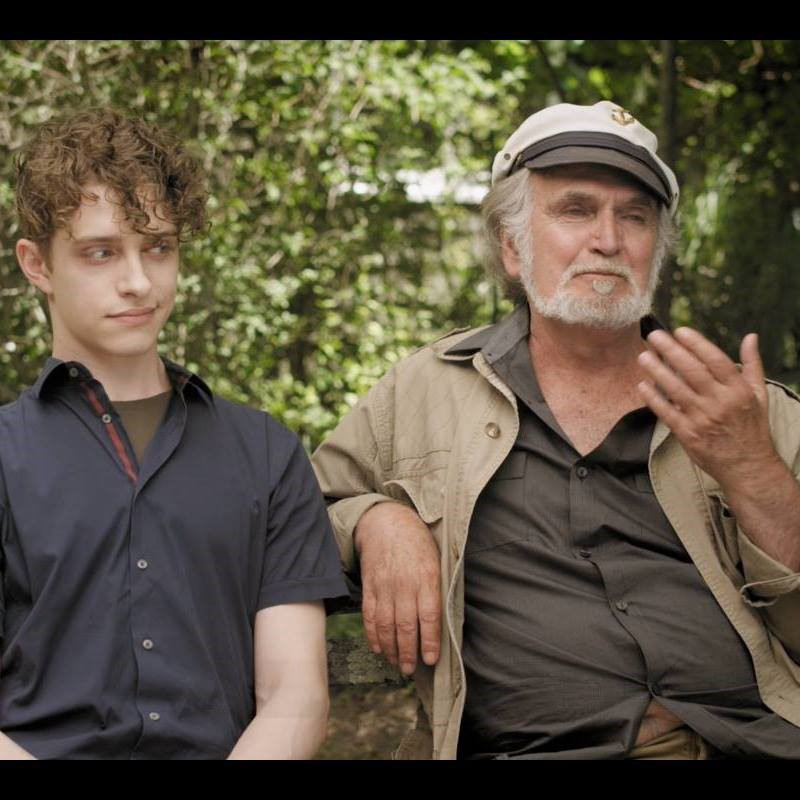
The film, Captain Hagen’s Bed & Breakfast, evokes the feel of the indie comedies of the 1990s; it’s the kind of story that you might have expected to see Parker Posey or Catherine Keener in at the time. In the movie, four pairs (a middle-aged married couple, male and female besties, a young couple, and a pair of surfer dudes) stay at the titular location, which is run by an eccentric family. Friedan submitted the film for festival consideration, and it won Best Comedy Feature at both the New York City Independent Film Festival and the Twin Tiers International Film Festival. Friedan says that was one of the best things about making the movie: “The movie plays great to a live audience, and getting to experience that was the most rewarding part of this process.”
However, even with festival wins under your belt, it’s still tough out there for someone making a truly independent film. Friedan points to a number of obstacles, which includes “getting your material seen/read by people with the resources to make movies. There’s so many scripts, so many shorts, so many low budget movies even, it’s hard to get to the top of the stack on anyone’s desk, or even to the bottom of the stack . . . just to get on someone’s desk and not “returned to sender” is the biggest challenge.”
Friedan also talked about the movie with NewFilmmakers of Los Angeles.
Friedan has the chance for the film to make a much wider impact as it becomes available for streaming on iTunes and Amazon today. Streaming has been seen by many as a potential game-changer in indie film, and Friedan recognizes that impact. He says, “It’s a lot easier to make your movie accessible to a lot of people (via streaming), but it’s a lot harder to make money. Whereas prior to streaming, a distribution deal meant a substantial amount of money upfront to the filmmakers, now not only is that rare, but some distributors now charge the filmmaker money to distribute their movie. And with so much content on these platforms now, getting people to watch your movie is tough without a big marketing budget. So even though it’s accessible to a lot of people, it doesn’t mean a lot of people will actually watch it because it’s competing with so many other movies and shows.”
In today’s climate, rentals and viewer reviews are incredibly important. He points out that the reality is that first-weekend views and reviews have a huge impact as to whether the film gets in front of more pairs of eyes and shapes more growth for the film’s audience. As he says, “There’s no studio behind this movie running a multimillion dollar marketing campaign . . . it’s just me.” That’s the definition of a truly independent spirit.
How Popular Films Reflect the National Mood
The German philosopher Georg Wilhelm Friedrich Hegel called it Geist der Zeiten; that’s “the spirit of times.” Over the years, we’ve shortened the phrase to zeitgeist as a reference to forces or coincidences that dominate or emerge at particular points in history or culture. You can find flashpoints in literature or film where prevailing themes took over and a number of stories that hit the same plot buttons emerged, all commenting on or reflecting the times in which they were created. A recent study by researcher Bo McCready examines the popularity of different film genres across the decades, and his statistical analysis gives us an interesting window in the national mood of the United States.
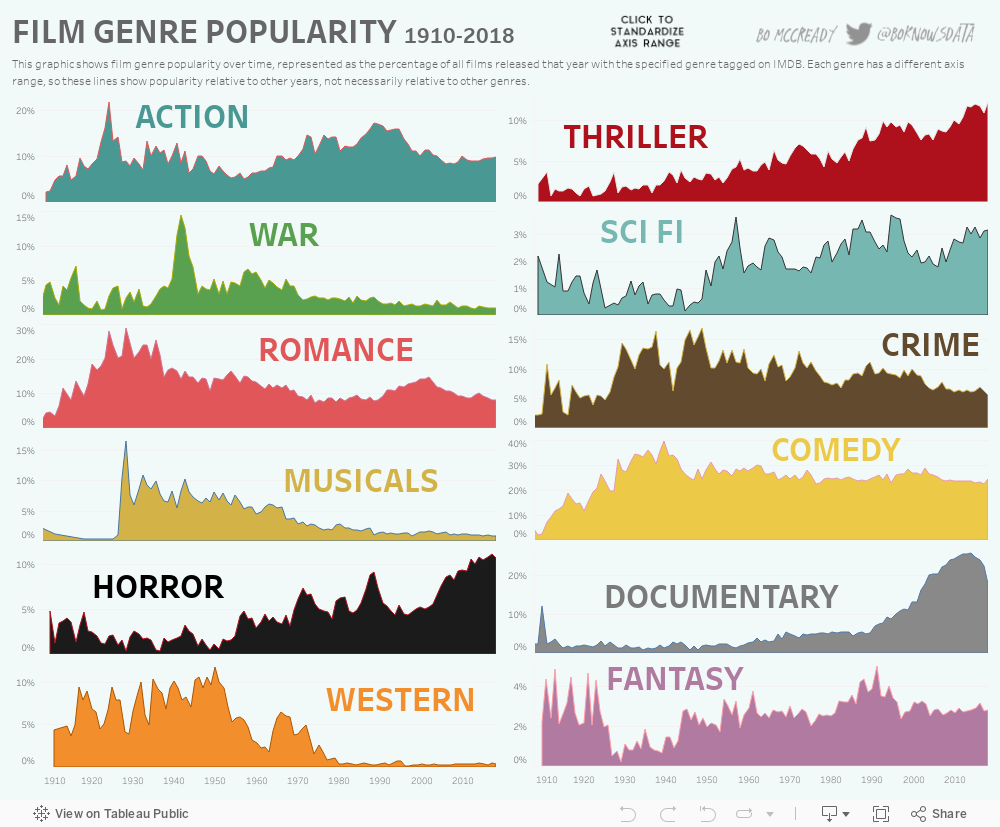
McCready’s Film Genre Study, posted at Tableau.com (©Bo McCready; used with permission)
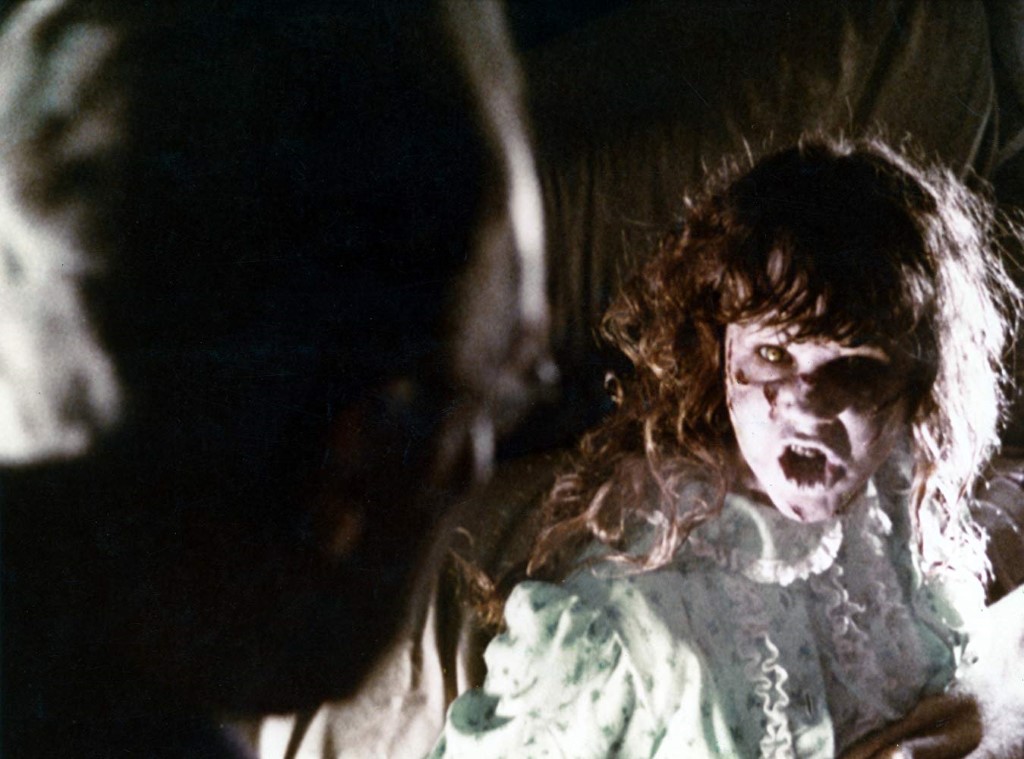
The notion of tying current events or general trends in culture to the popularity of films isn’t a new idea; in fact, it’s a staple of film criticism and serious writing about literature. In his 1981 non-fiction book on the horror genre, Danse Macabre, Stephen King discusses these ideas at length, particularly in the chapter called “The Modern American Horror Movie—Text and Subtext.” King suggests that cultural connections can power popularity, noting that The Exorcist blew up at a time when tension between adults and teenagers was particularly high (in the early 1970s during the Vietnam and Peace Movement eras), while The Amityville Horror reflected fear of losing a house during times of economic uncertainty. King also notes that other countries might have different concerns that produce different effects, such as the social paranoia of 1970s West Germany manifesting in the popularity of Dawn of the Dead there. Similarly, film historian and author David J. Skal has written about a number of social connections through the decades. In his book, The Monster Show, he draws parallels like the explosion of Universal horror films during the early years of the Great Depression, the rise of science-fiction horror during the Cold War and Space Race of the 1950s, and the resurgence in the popularity of vampire films during the AIDS crisis of the 1980s.
David J. Skal explored the connections between film and culture in The Monster Show. (©Penguin Books and David J. Skal)
These connections aren’t just limited to the horror genre. As Skal notes, war films generally attract more attention in wartime. The Western boom of the 1950s and their optimistic view of “manifest destiny” and the nation’s expansion coincided with a positive American self-image after World War II. The more intense and complex dramas of the early 1970s sprang from the turmoil of the Vietnam era. The runaway success of films like Star Wars reacted against the post-war malaise that afflicted both the American mood and economy in the latter half of that decade. Today’s apparent super-hero dominance at the box office is driven in part by the fact that special effects finally caught up to what you see on the comic book page, but is also powered by a combination of clearer hero/villain narratives in an increasingly complicated world.
McCready found similar beats and patterns in pop culture when he began his study. A researcher and analyst in education, his interest in quantitative data was initially sparked by the book Moneyball. He launched his genre study when he found out that the Internet Movie Database made their rating information available for download. A horror fan, he started there. McCready said, “I dove in and produced a visualization about the evolution of the horror genre. I thought the trends were interesting and I started swapping in other genres. Once I graphed war films and saw the peak during the Second World War, I figured I had something worth digging into!”
The numbers bore out trends that people like Skal and King had been writing about. McCready said, “I was surprised to see how well genre trends tracked with our history. War films peaking during wartime, a bump in science fiction after the launch of Sputnik… there are tons of little stories within the data.”
McCready is used to following numbers, but the stats that surprised him were his own. When he tweeted the graph of his findings, he didn’t realize that he was about to go viral. The interactive version has more than 170,000 hits, and the image version made the front page of Reddit.
As you might expect, the general public’s data literacy is a concern for McCready. The researcher outlines several things that the layperson should note when digging for their own numbers. He says, “The first is trusting everything — if you see a number, it must be true, because numbers appear objective. The second is trusting nothing — once you learn about the limitations of data, you can pick holes in pretty much anything if you want to. And the third is being a critical consumer — recognizing that almost all data is flawed and imperfect, but that doesn’t mean it can’t teach us a lot!”
In fact, McCready admits that his own work can exist outside the realm of perfection. He explains, “The data I used for this project absolutely is ‘biased,’ particularly when you’re looking at something like user ratings, but it also tells one interesting story after another. We should all be critical consumers of the data we see, but we also shouldn’t dismiss the good and useful in the quest for the perfect, which we’ll never really get. There’s a big difference between imperfect and meaningless, and I think people too often mistake the former for the latter.”
While it’s easier to find examples of how these film comparisons play out over time, we can still sense how certain trends are happening today. Of particular note is the sheer number of films that attempt to reckon with the country’s record on race. From Get Out to Green Book, from Black Panther to BlacKkKlansman, a larger number of movies grapple with that difficult topic from a variety of perspectives. The success of these films and others, like Crazy Rich Asians, demonstrate that the movie-going public is not confined to one audience and is in fact hungry for different American experiences receiving representation.
Even if you agree with McCready’s premise that no number is perfect, it’s still interesting to see how the popularity of genre lines up with certain decades (westerns with the 1950s, for example) or how some are doggedly consistent (the percent of comedies is remarkably consistent since 1949). Whether it sets out to or not, art always ends up reflecting the time in which it was created. No matter what genre is popular in which decade, we’re always going to have a better understanding of ourselves when we consider what entertains us, and why.
Featured Image: Scene from Avengers: Infinity War (©Marvel Studios/Disney)
Seven Reasons Why Aquaman Is No Joke
As the big-budget Aquaman film opens in the U.S. on Friday, December 21, a certain segment of the population continues to ask with disbelief, “Wait, Aquaman gets a movie?” This sentiment is based on years of jokes and pop culture punchlines associated with a character many people have dismissed as “the guy who talks to fish.” But if you take a deep dive into the history of this DC Comics mainstay, who was created in 1941 by Mort Weisinger and Paul Norris, you’ll find that he has a much more complicated background than that. Here are seven reasons why Aquaman is no joke.
1. He’s Royalty
Batman comes from crime, and Superman comes from science fiction, but Wonder Woman comes from mythology, and so does Aquaman. Like the Amazon princess, Aquaman is royalty. Known as Orin in his kingdom of Atlantis and Arthur Curry on the surface, Aquaman is the son of a human lighthouse keeper and an Atlantean princess. The combination makes him a meta-human, possessed of Atlantean abilities like aquatic telepathy (the talking-to-fish bit), enhanced strength, and remarkable swimming abilities. In Atlantis, though he is occasionally deposed through various plot twists and machinations, he’s recognized as a rightful heir to the throne and as a just king.
2. He’s Co-founded the Justice League
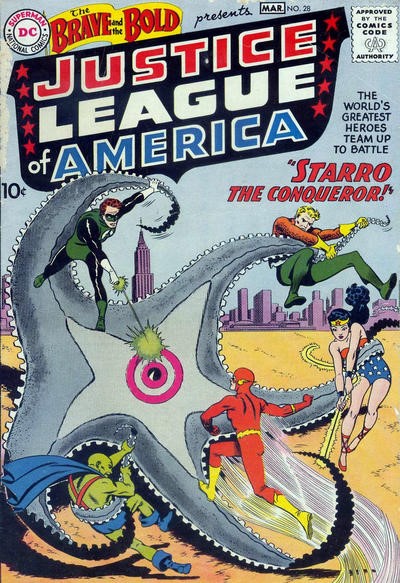
In The Brave and The Bold #28, Aquaman becomes one of the founding members of the Justice League of America, a new and modern take on the 1940s Justice Society. Aquaman’s teammates include Batman, Superman, Wonder Woman, The Flash (Barry Allen), Green Lantern (Hal Jordan), and the Martian Manhunter. Aquaman has been a vital part of the JLA throughout its history, and even serves as its leader for a period in the 1980s.
3. He Was the First Major Superhero to Get Married
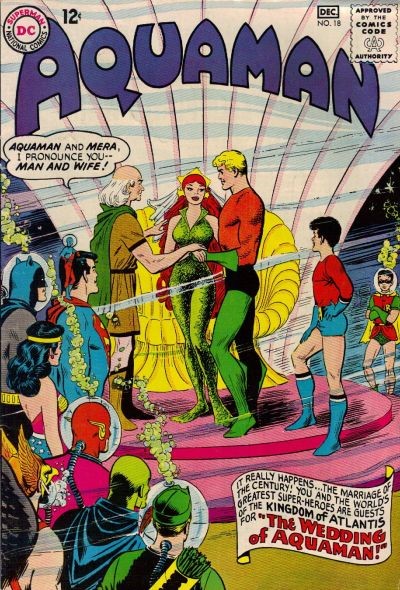
Mera debuted in September 1963, appearing for the first time in Aquaman #11. A queen from another dimension, Mera recruits Aquaman and his sidekick, Aqualad, to win back her throne. Mera later leaves her kingdom to join Aquaman. The couple marries in Aquaman #18 (1964) as Aquaman ascends to the throne of Atlantis. In tying the knot, Aquaman became the first major superhero to wed in his own book without it being a gimmick or imaginary story (something that was particularly common in Superman books of the time).
4. He Was the First Superhero to Become a Parent (and to Lose a Child)
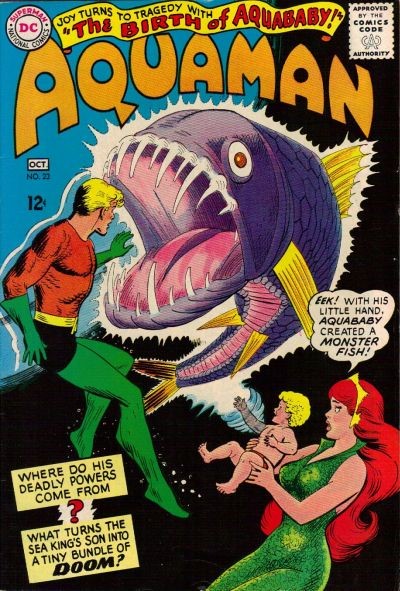
Aquaman and Mera waste no time starting a family. In 1965’s issue #23, Mera gives birth to Arthur Jr., making Aquaman and Mera the first major superheroes to welcome a proper legacy character who isn’t just a sidekick. Arthur Jr. (nicknamed Aquababy) preceded the first appearance of famous superhero progeny Franklin Richards (son of Marvel’s Mr. Fantastic and the Invisible Woman) by three years.
Sadly, Arthur Jr. becomes a pawn in the ongoing war between Aquaman and his nemesis, Black Manta. In Adventure Comics #452, Arthur Jr. suffocates and dies in a trap laid by Black Manta. Issue #60 of Aquaman depicts the devastating aftermath: Mera returns from a journey to her home dimension for a device that could save her son and is informed that he has already died. The gravity of the situation underscores the seriousness that settled into comic storylines during that decade, which would continue into the “grim and gritty ’80s.”
5. He’s New to Movies, but Had a Long Life in Television
Aquaman became a television fixture beginning in 1967. That’s when the character made his animated debut in The Superman/Aquaman Hour of Adventure on CBS. The show, while certainly directed at kids, is fairly faithful to the comics, and includes Mera, Aqualad, and a number of their animal companions, like Tusky the walrus. The following year, Aquaman was spun off into its own 30-minute timeslot on Saturday mornings, partially repackaging segments from the original show.
The opening sequence for every season of Super Friends.
In 1973, Aquaman was chosen as one of the five leads of Super Friends, alongside Superman, Wonder Woman, Batman, and Robin. The series proved to be a major Saturday-morning hit that ran in various iterations until 1986. Aquaman was present in every season, but it’s here that the “I’ll check the coasts” cliché surrounding his effectiveness came into being. Though he occasionally presents the solution to problems or provides critical assistance, Aquaman frequently plays in the background to the Big Three. He was well represented in merchandising of the time, receiving action figures in various lines from Mego and Kenner, and appearing on lunchboxes and, yes, Underoos.
Attacking Aquaman with water is a poor plan. From Justice League Unlimited.
After the modern DC Animated Universe kicked off in the 1990s, Aquaman shows up for the first time in an episode of Superman: The Animated Series. Unfortunately, Aquaman wasn’t a founder of the Justice League in the subsequent Justice League and Justice League Unlimited series, but he did appear a number of times as an ally. Here, the character has the long hair and beard from his ’90s comic look (we’ll get to that in a minute). Aquaman is also referenced in the future-set Batman Beyond, as his daughter is a member of the future Justice League.
Aquaman wants out of his family vacation on Batman: The Brave and The Bold.
An extremely popular take on the character appeared regularly in the more humorous Batman: The Brave and the Bold series of 2008-2011. Voiced by John DiMaggio (the comedian also known for voicing Bender on Futurama and Jake on Adventure Time), Aquaman is depicted as a swaggering, memoir-writing braggart of the Errol Flynn variety while simultaneously being utterly romantic about the concept of heroism. His frequent cry of “Outrageous!” became a fan catch-phrase, and an episode devoted to a family RV trip that Mera forces him to take with her and Arthur Jr. was a series highlight. Since then, Aquaman has popped up in both serious and comedic series like Young Justice (serious) and Teen Titans Go! (not so much).
Aquaman, Mera, and Green Arrow appear in the “Patriot” episode of the 10th season of Smallville.
On the live-action side, model and singer Alan Ritchson played Aquaman in four episodes of Smallville between 2005 and 2010. A spin-off pilot called Mercy Reef was shot with actor Justin Hartley in the role, but it wasn’t picked up. However, the CW liked Hartley enough to cast him as Green Arrow in Smallville, and he and Ritchson would appear together as the two heroes before the series concluded.
The final trailer for the Aquaman film.
Today, of course, Aquaman swims on the big screen. The new Aquaman film will be actor Jason Momoa’s third outing as the Sea King, after a cameo in Batman v Superman: Dawn of Justice in 2016 and full participation in Justice League in 2017. The Hawaiian-born Momoa is no stranger to the water, having worked at a surf shop before landing the role of lifeguard Jason Ioane for 38 episodes of Baywatch. He’s also used to heroic team-ups: He played high school soccer alongside Brandon Routh (Superman of Superman Returns and The Atom on The CW’s Legends of Tomorrow).
6. He Replaced His Severed Hand with a Harpoon
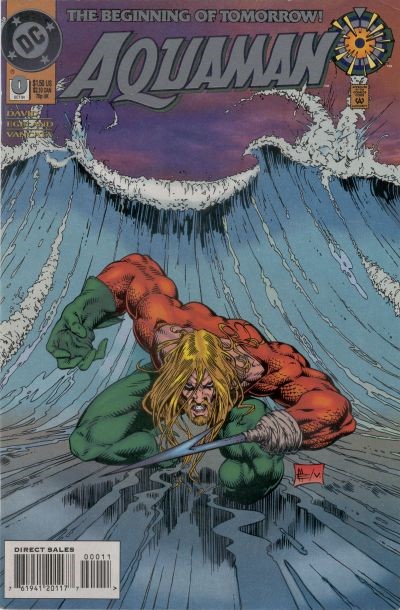
This is where we clarify the long hair thing. Yes, Aquaman had short hair for the first 50 years or so of his fictional existence. In a brand-new series launched in 1994, partially due to the modernization of comics and partially due to the general excellence of writer Peter David, Aquaman sports a more Poseidon-esque long-hair-and-beard combination. In the second issue, Aquaman loses his hand battling the villain Charybdis and replaces it with a harpoon. The new look and now hardened attitude brought new reader interest, and David repaid it with a strong run of stories featuring some long-neglected ocean-related characters like Dolphin, Neptune Perkins, and Tsunami, as well as new characters Deep Blue and Koryak.
Soon after, when the JLA was rebooted under writer Grant Morrison, it was this version of Aquaman that Morrison used. Morrison built on David’s foundation, coming up with new power stunts for the Sea King (like using his aquatic telepathy to incapacitate humans by affecting the basal ganglia in their brains) and incorporating his rough attitude into well-characterized team dynamics. Both the David and Morrison runs are considered highlights of 1990s superhero comics.
7. He’s Way More Powerful Than You Think
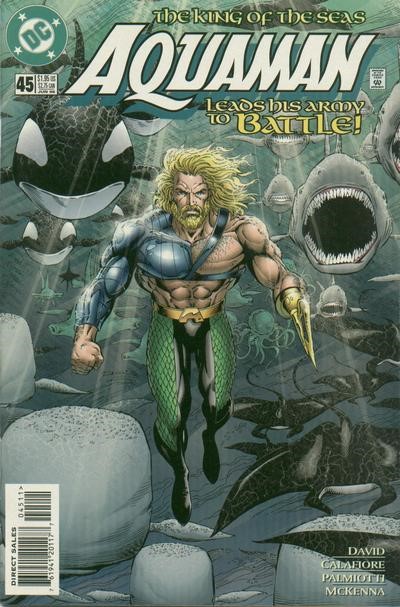
Look at it this way: Aquaman patrols the seas, and therefore has to protect more than 71 percent of the planet. He’s the King of Atlantis, so he has to deal with all of the problems of rule. Then again, he has a massive army at his back, and the sea life of the Earth is his to command. His Atlantean physiognomy makes him super-humanly strong, with the endurance to go with it. It’s hard to hurt him because his body can withstand the pressures of the deep. He swims faster than a speedboat and can breathe underwater. On land, he loses none of his overall toughness, and he’s learned to modify his aquatic telepathy for attack. Though he’s not as skilled at it as Mera, he’s also shown that he can perform feats of hydrokinesis — the telekinetic shaping and control of water into weapons. He frequently uses tridents in serious battle, some of which have additional powers bestowed upon them. His best friends are the most powerful superheroes in the universe, and alongside them he’s fought homicidal villains, alien invaders, and extradimensional demons. In no way, shape, or form is Aquaman just “the guy who talks to fish.”
So if you’d been wondering why Aquaman gets a movie, maybe it’s time to actually consider this: What took Hollywood so long?
Halloween Hijinx: 15 Scarily Funny Horror Films
Anyone Who’s ever laughed at someone taking a blow to the head on America’s Funniest Home Videos knows that there’s a fine line between the comedic and the serious. That fine line also exists in our relationship with horror movies; every time we’re startled when a cat jumps into frame, , we laugh. Some filmmakers have made art from walking that fine line by combining genuine scares with genuine hilarity. It’s a tough trick, and not everyone who tries it manages the same measure of success.
We identified a few of the very best scarily funny horror films. We hope they bring you some laughs, but you might want to keep the light on, just in case.
Abbot and Costello Meet Frankenstein (1948)
The original Abbot and Costello Meet Frankenstein trailer.
From 1931 until 1945, the monsters of Universal Studios ruled Hollywood. The very first cinematic universe featured Dracula, Frankenstein’s monster, the Wolf Man, and more; they began crossing over with Frankenstein Meets the Wolf Man in 1943.
Meanwhile, Abbot and Costello spent the ’40s building up an incredible resume as comedy hit makers, amassing 21 films together by 1948, mostly for Universal. Knowing that their monsters were hitting the end of their run, Universal decided to combine two of their big franchises in Abbot and Costello Meet Frankenstein.
The film was the Infinity War of its day, with the comedians running into Dracula (Bela Lugosi, in the only other time he played the count after the 1931 classic), Frankenstein’s monster (Glenn Strange), the Wolf Man (Lon Chaney, Jr., for the fifth time), and the Invisible Man (voiced by Vincent Price). Simultaneously spooky and funny, the film was a hit and led to four more horror team-ups for the comedic pair.
The Fearless Vampire Killers (1967)
The original trailer for The Fearless Vampire Killers.
Incredibly problematic today — because it stars and was cowritten and directed by Roman Polanski — The Fearless Vampire Killer nevertheless retains a strong critical reputation for combining authentic scares with loads of comedy. It wrings a lot of humor out of incompetent vampire killing and turns the notion of using a crucifix as a weapon on its head by proving it to be ineffective against Jewish vampires. Noted for Douglas Slocombe’s striking cinematography, particularly a treacherous journey across the top of a snowy castle and a show-stopping ballroom sequence featuring vampires that flit in and out of site as they fail to cast reflections in a room-length mirror, TFVK still contains much to be admired on a cinematic level.
On a depressing note, it was during the filming of TFVK that Polanski met and fell in love with his eventual wife Sharon Tate, who would be murdered by the Manson family just two years later. Despite the tragedy that surrounds it, the film maintains its craftsmanship and many funny moments.
Young Frankenstein (1974)
The original Young Frankenstein trailer.
Considered by many to be among the finest comedies of all time, Mel Brooks’ ode to Universal Monsters succeeds in part due to its scholarly attention to detail. Brooks used props from the 1931 Frankenstein in the lab, and he shot the film in black and white to echo the overall look and feel. The script, written by Brooks and star Gene Wilder, worked in nods to the earlier films while layering in plenty of sight gags and ribald comedy. It’s an approach that worked, as the film became an immediate success with a reputation that’s only grown. The American Film Institute considered it the 13th greatest comedy on its list of the 100 funniest American films.
The Rocky Horror Picture Show (1975)
The “Time Warp” from The Rocky Horror Picture Show.
Richard O’Brien created the concepts for The Rocky Horror Show while working as an actor in England. He wrote it as a musical love letter to the B-grade science fiction and horror films that he grew up loving. O’Brien and director Jim Sharman put it together for the stage in 1973. Producer Lou Adler saw it and bought the rights to turn it into a film. Sharman directed, O’Brien played Riff Raff, and history was in the making.
Initially panned by critics, The Rocky Horror Picture Show became a staple of midnight showings beginning with Waverly Theater in New York. It soon turned into the ultimate audience participation film, with viewers dressing as characters, bringing props, and clutching an alternative script with lines to shout in response to the actors on screen. Though the film only boasts a couple of outright horror moments, it’s steeped in the tradition and is full of funny moments and memorable tunes.
Love at First Bite (1979)
The original Love at First Bite trailer.
George Hamilton has been famous simply for being, well, the very-tanned George Hamilton for so long that people forget that he’s a skilled comedic actor. His entry on this list comes from this classic skewering of Dracula. Made in the same vein (yes, we went there) of affection that Mel Brooks hit for Young Frankenstein, Hamilton plays a Lugosi-esque Dracula who comes to New York in the ’70s in pursuit of the model he believes to be the reincarnation of his lost love. Much of the humor comes from Dracula’s interaction with the modern world of the 1970s, including discos and taxis. A high point is Dracula and Renfield’s (Arte Johnson) heist at a blood bank.
An American Werewolf in London (1981)
The trailer for An American Werewolf in London.
Some people hear that An American Werewolf in London is classified as a horror-comedy and are completely baffled; they remember it as being supremely scary. Amazingly, it does exist in a near perfect balance of bloodcurdling and gut-busting thanks to writer-director John Landis, an able cast, and the groundbreaking effects and makeup work of Rick Baker. A good portion of the humor is provided by Jack Goodman (Griffin Dunne) in a supporting role; after he dies in the initial attack that infects David Kessler (David Naughton) with lycanthropy, Goodman continues to haunt his friend through advancing stages of decomposition. The most profound memory most have of the film is Kessler’s transformation into the wolf. At nearly three minutes long, it’s a tiny epic of effects and acting that sticks with audiences long after the final frame.
Gremlins (1984)
The original Gremlins trailer.
Director Joe Dante keeps things light for the early stages of Gremlins, but once Spike and his buddies turn, he goes for broke. In fact, this is one of two films (the other being Indiana Jones and the Temple of Doom) that directly led to the creation of the PG-13 rating. The scene most at issue is Lynn Peltzer’s kitchen showdown with a group of Gremlins in which she dispatches them via blender, microwave, and butcher knife. Despite the occasionally gruesome nature of the action, the film comes stocked with solid laughs, including a scene of a theater full of Gremlins becoming enraptured by a showing of Snow White and the Seven Dwarfs.
Evil Dead II (aka Evil Dead 2: Dead by Dawn) (1987)
The original Evil Dead 2 trailer.
Sam Raimi’s original Evil Dead was as brutal as they come. Well-regarded for its innovative camera work and effects that were managed on a meager budget, it included few scenes that you would describe as funny. For the sequel, Raimi, co-writer Scott Spiegel, producer Rob Tapert, and star Bruce Campbell decided to lean in to more slapstick humor, echoing films that Raimi and Campbell had made together when they were younger. The result is a fiendishly funny gross-out, powered by a manic and quotable Campbell performance as hero Ash. An instant cult classic, the film went on to generate another sequel, Army of Darkness, in 2003, and a television series, Ash vs Evil Dead, that ran for three seasons on Starz.
Killer Klowns from Outer Space (1988)
The original Killer Klowns from Outer Space trailer.
Even without this film, the three Chiado brothers would have a strong reputation as puppeteers and creators of effects. You can see their work in movies like Pee-wee’s Big Adventure (they did the “Large Marge” scene), Critters, and Team America: World Police. On Killer Klowns, they took their knack for prop creation to delirious heights, turning every manner of circus paraphernalia into something deadly. The film owns its deliberately goofy tone, but also manages to work in genuine scares. And if you’re already scared of clowns … stay far away. You’ll never look at cotton candy the same way again.
Beetlejuice (1988)
The original Beetlejuice trailer.
Much more funny that it is scary, Beetlejuice sprang from a screenplay by horror novelist Michael McDowell and writer-producer Warren Skaaren. But the real heartbeat of the film comes from famously eccentric director Tim Burton. Burton infuses the film with his patented goth surrealist aesthetic, wringing comedy out of social discomfort, surprising music cues, and a hilariously over-the-top performance by Michael Keaton. While some very little ones might still be freaked out by various depictions of the afterlife and some unsettling claymation effects, this film really can be enjoyed by the whole family.
Tremors (1990)
The original Tremors trailer.
Witness the birth of a franchise that just refuses to die! Ron Underwood’s Tremors manages to juggle a number of tones, notably suspense and comedy. He also makes the bulk of the protagonists regular people from the wilds of Nevada, pulling additional laughs from unlikely heroes stranded in town surrounded by subterranean monsters that are driven by noise to attack. Kevin Bacon, Fred Ward, and Finn Carter do great work as two handymen and a grad student who try to warn the town and end up as the central characters. Country legend Reba McEntire, in her film debut, earns big laughs with Family Ties dad Michael Gross as a pair of overly enthusiastic survivalists who play a big role in battling the “graboids.” The movie was liked by critics, did moderate business at the box office, and positively exploded on video. It’s surge in popularity led to six more Tremors films and a short-lived TV series.
Peter Jackson’s Combined Early Work (1987-1992; 1996)
The trailer for Braindead (aka Dead Alive).
This one’s a bit of a cheat, but this is definitely a case of a career that adds up. Peter Jackson earned an Academy Award nomination for his screenplay for Heavenly Creatures in 1995 and conquered the film world with The Lord of the Rings. But before that, he had the reputation for deliriously funny gross-out cinema driven by inventive camera moves and clever writing. His feature debut, 1987’s Bad Taste, was the tale of aliens invading New Zealand to harvest the new intergalactic fast food delicacy: humans. Meet the Feebles, from 1989, was a demented take on the Muppets long before Avenue Q or The Happyland Murders. Jackson took a swing at the zombie apocalypse in Braindead (aka Dead Alive) in 1992. Cult successes all, they eventually led to Jackson landing Heavenly Creatures, which told the story of real-life murder while introducing Kate Winslet in her film debut. Jackson stepped back to his familiar horror vibe for The Frighteners in 1996, a movie that drew some praise for effects and stylish photography. The common thread in Taste, Feebles, Braindead, and The Frighteners is comedy of excess offset by a few truly shocking moments.
Shaun of the Dead (2004)
The original Shaun of the Dead trailer.
Edgar Wright made his mark as a director of television in Britain, including the much-loved comedy series Spaced, which starred its creator and writer, Simon Pegg. During the course of that series, the pair discovered their affinity for the zombie films of George Romero while doing a horror spoof episode. The two subsequently teamed up to write Shaun of the Dead; Wright would again direct, with Pegg as the star. The film became the first cinematic calling card for Wright’s signature visuals, involving frenetic camera moves, quick cuts, split-screens, and more. Populated by familiar faces from British television (notably Nick Frost), the film takes place during a zombie apocalypse in London; however, it’s also quite clever in occasionally making that the backdrop to another story about the relationship between Shaun (Pegg) and Liz (Kate Ashfield).
Filled with incredibly funny sequences and an obvious affection for the source material, Shaun of the Dead garnered critical praise and a number of awards while launching Wright, Pegg, and Frost into greater stardom. Wright recently directed the acclaimed Baby Driver, Frost is a regular on AMC’s Into the Badlands, and Pegg plays ongoing roles in both the Mission: Impossible and Star Trek franchises.
Zombieland (2009)
The trailer for Zombieland.
Every horror film and movie monster comes with a particular set of rules. This concept becomes central to many genre entries, including the Scream series. However, the rules for zombies have never been so frequently updated, addressed, and reiterated as they were in Zombieland. Beginning with a zombie apocalypse premise, the film follows four survivors (who only identify themselves to one another by their cities of origin) who try to reach the alleged safety of a California theme park. The four leads (Woody Harrelson, Jesse Eisenberg, Emma Stone, and Abigail Breslin) have crackling chemistry and make the material work on levels both human and humorous. And if you ever had any doubts about the genius of Bill Murray, this one will eliminate those. It’s extremely entertaining overall, with some excellent scare sequences (especially Amber Heard’s zombified rampage in Eisenberg’s apartment).
What We Do in the Shadows (2014)
The trailer for What We Do in the Shadows.
Taika Waititi had already established himself with his directorial work on HBO series Flight of the Conchords and his feature film Boy. Conchords co-creator and star Jermaine Clement teamed up with the director to write and star in his vampire “mockumentary.” Following four vampire housemates in Wellington, New Zealand, Shadows takes the formula established by shows like The Real World and turns it on its head with horror, humor, and occasional shocks of violence. The film was well received by critics and audiences alike and has spun-off a mini-universe of sorts; a sequel called We’re Wolves is in preproduction, a spin-off television series called Wellington Paranormal just aired in New Zealand, and American network FX is preparing an American series version of the original film. The movie also helped catapult Waititi’s career forward, landing him at the helm of recent worldwide hit Thor: Ragnarok.
Featured Image: Young Frankenstein film poster. (Art by John Alvin; © 20th Century Fox.)
Five Scandalous Film Rating Controversies
Sex and violence. Foul language. Gore. Socially unacceptable behavior, including the glorification of criminals. Dark subject matter and gallows humor. In others words, a good time at the movies.
But what might be a good time for one person might be a little too much blood and guts for another. How’s a moviegoer supposed to know what they’re in for?
For years, different offices and local review boards tried to apply different standards and rules to acceptable content in motion pictures. This was in addition to a strict Motion Picture Production Code. Fifty years ago, the Motion Picture Association of America tried to take the reins and codify a system that could be employed across all of the film.
That became the modern MPAA film rating system — the G, PG, PG-13, R, NC-17, and X ratings we all know and love (or hate) today.
The Motion Picture Production Code debuted in 1930 from the MPAA’s forerunner, the Motion Picture Producers and Distributors of America. It applied a number of standards that might be considered humorous today, including a three-second on-screen-kiss time limit. By the 1960s, the envelope was constantly being pushed by young directors and foreign filmmakers, a need to separate what was available on film versus what was widely available on television, and an audience that had become more sophisticated about adult themes that had once been considered off-limits for film].
The MPPDA had evolved into the MPAA in 1945, and by the late 1960s, its president, Jack Valenti, knew the old code was out of date; he went so far as to say that it had “the odious smell of censorship.” With a goal of acknowledging “the irresistible force of creators determined to make ‘their films,'” and to avoid “the possible intrusion of government into the movie arena,” the MPAA created a new system.
The original version from 1968 contains four ratings: G (General Audiences); M (Mature audiences with parental guidance suggested); R (Restricted, no one under 16 without a parent or guardian); and X (no one under 16). That was tinkered with over the next two years, with some age adjustments (the 16s were increased to 17) and M being changed to GP and then PG. By 1972, the system was G, PG, R, and X, and it would remain that way for years. That makes it a great place to stop and examine five scandalous film rating controversies.
1. Midnight Cowboy Gets an X and Three Oscars (1969)
The Midnight Cowboy trailer.
Midnight Cowboy courted controversy right from the start. Based on the novel by James Leo Herlihy, the John Schlesinger-directed film drew the attention of the ratings board for its frank depiction of sex, male prostitution, and themes of homosexuality. Though initially granted an R, executives at United Artists decided to accept an X; according to Tino Balio’s book, United Artists Volume 2, 1951–1978 : The Company That Changed the Film Industry, the studio made the move after being advised by a psychologist that the film could be a “possible influence upon youngsters.” The X didn’t stop the film from being critically acclaimed; in went on to take Best Picture, Best Director, and Best Adapted Screenplay (for writer Waldo Salt) at the 1970 Academy Awards. In a bit of irony, when the age ranges were moved in the 1972 MPAA ratings change, Midnight Cowboy was reclassified an R and has retained that rating since.
2. Steven Spielberg and Friends Force a New Rating (1984)
The Red Dawn trailer, featuring the first PG-13 rating “green screen.”
Steven Spielberg was the undisputed King of Hollywood in 1984. He’d already directed future classics and huge hits like Jaws, Close Encounters of the Third Kind, Raiders of the Lost Ark, and E.T., and produced the hit Poltergeist. In 1984, he’d direct the Raiders sequel Indiana Jones and the Temple of Doom and produced Gremlins. Temple and Gremlins both carried PG ratings, which left a number of parents concerned when the saw the films with their kids. Temple featured some significant violence, including one scene where a man’s still-beating heart is removed from his chest; Gremlins featured a number of gross-out special effects and Phoebe Cates’s infamous monologue about the death of her father (while trying to surprise her while dressed as Santa, he attempted to climb down the chimney, became stuck, and died, leading to the young girl learning that there is no Santa). When the MPAA looked at the ratings in light of the complaints, they the challenge of determining what might be appropriate, considering that the definition of what was okay could be unique for different parents and different children. Spielberg himself suggested an intermediate rating between PG and R, and the result was the MPAA’s creation of PG-13. PG-13 came with the verbiage “Parents Strongly Cautioned – some material may be inappropriate for children under 13,” and it was first applied to John Milius’s Red Dawn later that year.
3. X Gets Replaced (1990)
Gene Siskel and Roger Ebert fiercely criticized the MPAA in their review of Henry: Portrait of a Serial Killer from their program Siskel & Ebert & The Movies in 1990.
During the independent film boom of the late 1980s and the early 1990s, it became apparent that the MPAA had a X rating problem. A lack of copyright for ratings allowed any producer of pornography to apply an X rating to their film, leaving no distinction between an artistic film that might push boundaries and a pornographic work. This problem came into sharper focus with the production of three challenging films: Henry: Portrait of a Serial Killer (1989), The Cook, The Thief, His Wife, and Her Lover (1990) and Tie Me Up! Tie Me Down! (1990). All three films were released unrated because the MPAA declined to rate them lower and the studios would not take an X rating, given its association. Mainstream theatre chains were also declining to show films with an X, severely limiting the film’s opportunity to be seen and make money. This left a void for movies made for adults that dealt with graphic violence (as in the case of Henry) or frank depictions of sexuality (as in the other two). A new rating was proposed; NC-17 meant “No Children Under 17 Admitted.” The first film to be released with the new rating was Henry & June, Philip Kaufman’s adaption of Anaïs Nin‘s book about her affair with author Henry Miller and his wife, June. In 1996, NC-17 was revised to mean “No One 17 and Under Admitted,” effectively raising the bar of admission to age 18.
4. Clerks Talks Dirty (1994)
The original trailer for Clerks.
This was a first: a film that almost drew an NC-17 rating for language only. Such was nearly the fate of Clerks, the debut film from New Jersey writer-director Kevin Smith. Smith sold part of his comic collection to raise the $27,000 he needed to make the film, a black-and-white comedic look at one long day in the lives of two twentysomething shop clerks. The outrageous humor and pop-culture-fueled dialogue made it an audience favorite and an award-winner and nominee at Sundance, Cannes, and the Independent Spirit Awards. When the film was acquired by Miramax for distribution, it got slapped with an NC-17 solely for the language; the film features almost no violence and no nudity. Famed attorney Alan Dershowitz represented Miramax on appeal, and the film was released with an R with no changes.
5. South Park: Bigger, Longer & Uncut Fights the MPAA Six Times (1999)
The original trailer for South Park: Bigger, Longer, & Uncut.
South Park courted controversy for its crude humor from the moment in debuted on Comedy Central. When a film version was announcement, everyone expected there to be some wrangling the MPAA. No one expected that the film had to be reviewed six times by the board before it would be granted an R rating. The process ran up until two weeks before the film was due to be released. South Park co-creator and director Trey Parker expressed his incredulity to The New York Times at the time; he noted that there was no discussion of the violence in film, saying, “The ratings board only cared about the dirty words; they’re so confused and arbitrary.” The film went on to be a huge hit and earned an Academy Award nomination for the song “Blame Canada.”