Jar Roses
“Starting jar roses takes balls. Do you have balls, Maria?” I say to my friend over the phone.
“Well, yeah,” she starts, sounding uneasy.
“Okay, then change into all black and come right over,” I tell her.
I gather up a reusable grocery bag, work gloves, and scissors, zip up my blue hoody, and take a seat on the front porch to wait for her.
The geraniums are still in their pots flanking the front steps, barely hanging on as the temperature falls, a notch each night; the scooters and skateboards are still leaned up by the front door, though the boys have been back in school for nearly two months.
Maria pulls up in her little silver Toyota, and so often a literalist, is dressed in black from head to toe, her blond curls peeking out from beneath a black Mickey Mouse ball cap. She doesn’t exactly look like a criminal, or even very sneaky for that matter, as she approaches the porch in long strides, kitchen scissors in hand.
“Will these work?” she asks with doubt in her voice, not just about the scissors, but about the whole enterprise we are about to embark on.
“Oh, yes, that is all you will need,” I answer, trying to sound like a criminal mastermind.
I’ve been talking to Maria about starting her own jar roses for at least two years (a rose propagation technique my grandmother shared with me), but each year we miss our window of opportunity to start them together; this is a trick that needs to be taught, not written out. The cutting and planting has to happen on the same day, so, depending on how many Maria wants to plant we have to block out a good chunk of time for the project.
We hit a nearby park first. I’ve obtained permission to clip the necessary 12” segments I want from a few of the rosebushes here, but since Maria seems pumped about breaking some rules I don’t mention that we’re legal. This particular park has some of the finest roses around and I have cloned several of the bushes in other years. We each take about six clippings, do some ninja rolls back to the car, and head to our next stop—Burger King.
Since June I’ve had my eye on what I think is a Tropicana rose, one of the most brilliant orange roses I’ve ever seen. In the game of jar roses you can’t make your move very much before the first frost, so I’ve had to bide my time. Just as I’m poised to clip my 12” segment Maria says, “Wait! Shouldn’t we buy something first?”
I holster my scissors and we head in for some orange juice and mini cinnamon rolls. Ten minutes later, satisfied, and a little less guilt-ridden, we take what we’ve come for.
We add our Tropicana clippings to our bags that already hold some Carefree Sunshines, Nearly Wilds, and Magic Blankets. “You can plant as many roses as you have jars and time,” I tell her as she speeds to our next stop through the late morning traffic of our Kansas City suburb. “I started ten one year and nine survived the winter, though my greatest achievement, I must say, was last year when I started sixteen Knock-Outs for an older couple at church and they all survived,” I brag, drawing out the last few words and nodding smugly.
So far this morning we’ve gone unchallenged. Maria hops out of the car at the next park with a bit of a swagger now that she has some clippings under her belt, and tucks her scissors into her waistband. This park is bigger than the first one and just off a busy road, so I’m a little edgy about who we might encounter. I look around nervously, but she’s revving high and lets out an uncharacteristically loud laugh, which startles me. I turn to shush her but she’s disappeared.
I spot the top of her head near the Toyota’s headlights and whirl around to see a park ranger across the asphalt lot. I lunge to get back in her car but she’s already locked the doors so I shuffle around the front and crouch down next to her. “Why didn’t you say something?” I whisper frantically at her.
“I just saw him; I didn’t have time,” she says, her eyes huge. “Do you think he knows what we’re here for?” That is unlikely.
I rise slowly and see the ranger driving toward us in his golf cart. I stand and try to look casual, a bag full of roses over my arm, large kitchen shears hanging from my gloved fingers, my friend dressed in black kneeling on the pavement at my feet.
“Anne, what are you doing? Get down! Are you crazy? He’ll see you!” she squeaks loudly at me as the ranger rounds the end of her car. She gets to her feet. “Good morning, ociffer,” she says, brushing dirt from her knees.
Great, now he’ll think we’re drunk, too.
He gives us a once over then checks out the PTA sticker in her rear window and the boosters in her back seat. “Good morning, ladies,” he says, not moving from his cushioned seat. He glances at our scissors one last time, begins to say something, then turns his cart around and drives down the garden path.
We’ve left ourselves wide open to stereotype, just not the kind that concerns a lawman.
We split up, urgency in our movements now, and frantically scamper through the couple dozen rows of roses. “Maria! This one makes tiny pink pom-poms—do you want one?” I call to her in the loudest voice I dare. She’s found a pale pink rose edged in red, which she holds up questioningly. I nod at her that I’d like a clipping too.
An old lady creeps up from the parking area. A younger woman is milling around near the tree line and I wonder how I hadn’t noticed her a moment ago. A jogger flies up from the street. We’re surrounded.
“Hey! How many do you have,” I say, returning to a stage whisper. She holds up six fingers and mouths, “Let’s go!” Her eyes look crazed, darting from me to the other park-goers.
We hustle back through the rows toward her car but must pass the old lady.
“Just what are you two girls doing?” the old woman asks in an accusatory tone.
Maria and I make eye contact and I know she’s wondering what I’m wondering: bolt for the car or take a minute to explain?
It’s up to me. This was my idea. “Umm, we’re gathering clippings of roses to start new bushes at our houses,” I nervously tell her, knowing it sounds ridiculous.
“Well, now how do you expect to do that?” she asks, scowling.
“Uhh, you see, well, you cut a 12” segment from a rose you would like in your yard, then take a trowel and poke a hole in the ground 6-8 inches deep, stick the cutting in, pack down the dirt, pop an old pickle jar over it, then wait till April to see what you get.”
The old lady laughs and shakes her head. “Interesting,” she says. “Does it really work?”
“Usually, but only if you start them as close as you can to the first frost, and remember to uncover them as soon as you think the last frost has happened—they’ll cook if you forget them after that.” I wait while she looks us over.
“Huh. I just might try that,” she says and turns away, clearly musing as she heads into the rows of roses.
“That was too close,” Maria said as we get back into her car. But I could tell she loved the rush.
Dog Food No-Nos
Though dogs are man’s best friend, they shouldn’t eat like your human friends. The foods below may be perfectly good for people but they can be harmful if fed to your dog. Don’t let a simple mistake in diet end in an emergency trip to the vet’s office.
Alcohol

Alcohol is a heart risk for dogs. Keep liquor, beer, wine — and household items containing alcohol, such as mouthwash — out of range.
Chocolate

Chocolate contains caffeine and theobromine. Both can cause rapid heartbeat, seizures, and tremors in dogs.
Garlic/Onions

These contain a chemical that breaks down into a substance that damages the red blood cells of dogs.
Dough

Most dough can produce gas, causing a dog’s stomach to become twisted or even torn.
Avocado
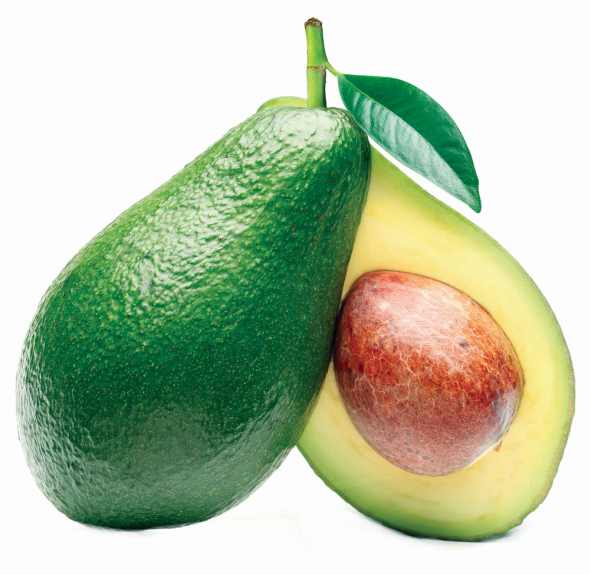
Avocado plants and their fruit contain a toxin that can be harmful to pets.
Grapes

Grapes, fresh or as raisins, can sometimes cause kidney failure in dogs.
Caffeine
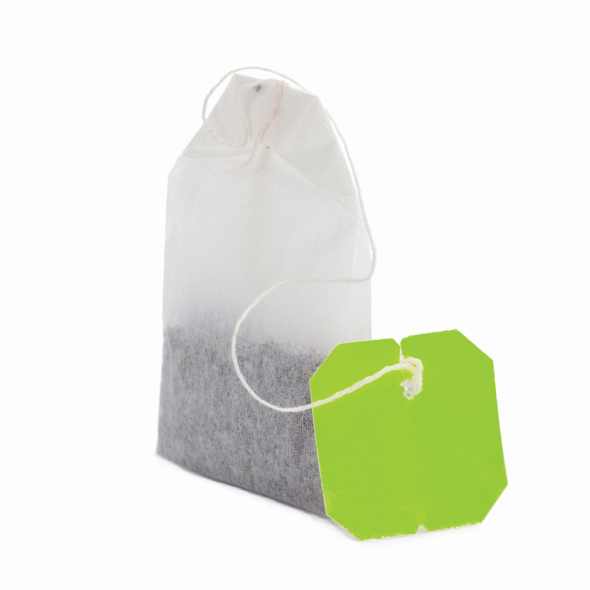
Caffeine is toxic to your dog. So protect your pooch from coffee, tea, and other caffeinated drinks.
Xylitol

If ingested by a dog, this ingredient found in sugar-free gum and candies can cause insulin levels to soar.
Macadamia Nuts

As few as six nuts can cause muscle tremors, weakness, or paralysis.
Bones

Bones can get stuck in the esophagus or break into sharp pieces that may cause internal bleeding.
Kind but Final Words for President Harding
Recent paternity tests have brought Warren G. Harding back into the news. Genetic testing has now proven that Nan Britton told the truth in 1927 when she claimed she and Harding had been lovers, and that Harding was the father of her child.
She had written a book about their affair because, she claimed, Harding had promised to provide support for their daughter. But then he died, suddenly, in 1923 without making any provisions for the child. So The President’s Daughter was published, prompting cries of outrage from Harding’s supporters.
The Post never mentioned the affair, of course. The editors were strong supporters of Warren G. Harding back in those days. Harding needed friends. His administration had been blackened by scandal. Corruption in the Veterans Bureau prompted its director to flee to Europe and its general counsel to kill himself. Shortly afterward, the private secretary of the Attorney General, who’d been involved in subverting Prohibition laws, also shot himself. Meanwhile, the investigation into the Teapot Dome Scandal threatened to implicate the president.
So it was with understandable pleasure that President Harding saw the Post article in the July 28, 1923, issue: “A Calm Review of a Calm Man.” As he rested in bed on August 2, recovering from illness and stress, he listened to his wife reading Samuel G. Blythe’s comforting words, “I think that as an American, as President, and as a human being, the Hon. Warren G. Harding hasn’t had and isn’t having fair treatment from all this gang of knockers, maligners, self-seeking politicians, disappointed applicants for his favor, theorists and fanatics and fools who want to reform the world in half an hour.”
Somewhere during the reading, Harding said, “That’s good! Go on — read some more.” They were the last words he ever spoke, for he suddenly died a few minutes later.
His death left many questions unanswered, such as his knowledge of the scandals that sent several members of his administration to jail. It also left the paternity of Nan Britton’s child in question. Until now.
News of the Week: Too Much TV, Just Enough Burger, and Fewer LOLs
Is There Too Much Television?

You don’t often hear a TV fan saying that there’s too much TV. And you certainly never hear those words coming from the president of a TV network.
But that’s what FX CEO John Landgraf said at the annual Television Critics Association get-together, that “there is simply too much television”. Now, as someone who watches a lot of television (and I mean a lot — around 5 hours a day every day since 1970) I was intrigued and confused by his comments. Why would anyone want less television? Landgraf thinks that “2016 or 2017 will represent peak TV in America, and then we will see a decline.” Needless to say, he’s getting some pushback from other TV execs and fans.
At first I thought it was a ridiculous concept. As long as the television is good, what’s the problem? I don’t mean the business of television and the programming of it and whether or not networks should produce less, I mean on a personal level. I have to admit that sometimes I feel overwhelmed by the number of channels we have now and the choices. I would never say there are too many books published or too much music recorded, but television is somehow different. I find myself having to set my DVR constantly or write down a reminder or put something on my calendar if there’s something I want to watch. I have to admit that sometimes I’ll sigh a quiet sigh of relief when a TV show — maybe even one that I really like — is canceled, and I don’t have to deal with it anymore.
Of course, I’m writing these words in August. Speak to me in a month or so when the fall TV season starts and I replace all of the shows I’ve stopped watching or were canceled with five or six new ones.
McDonald’s Math
You may not have heard, but McDonald’s just increased the weight of their Quarter Pounder. It’s now 4.25 ounces compared to the four ounces it was before. Though that’s before cooking. It shrinks when cooked. It’s another of many changes the fast food chain has made, which include a streamlined menu, the introduction of all-day breakfast starting this fall, and the hiring of a new CEO.
Now we just have to wait for the class action suit because of false advertising. You said it was a quarter pound, but it’s not!
What else are they lying to us about? Is Ronald even a real clown? Was Mayor McCheese voted into office legally? Are the French fries even French?
RIP, LOL

How do you laugh online? Are you an “LOL” person? A “hahaha” type of person? Or maybe you like one of the alternate words to indicate you find something humorous or that you’re not serious about something you just wrote, a “tee-hee” or a “heh,” the latter I find myself using way too much.
But the LOL is on the way out. According to Facebook, LOL (or “laugh out loud”) has been replaced by “haha” and emojis. How did the social network come up with this data? They monitored what you were posting on the site and how you depicted laughter. They found out that LOL is being replaced by haha, hehe, and little pictures of people laughing or smiling.
So to summarize, language is dying and we’re all doomed. Soon we won’t speak in complete sentences to each other at all. We’ll just text or post emojis and emoticons because we’ll forget how to actually communicate with each other. Insert sad face here.
The Next iPhone Won’t Bend

Two weeks ago we told you about the privacy concerns from butt-dialing. Now comes even more phone-in-your-pants news.
A new video from Unbox Therapy says that the next iPhone is going to be just a little bit thicker, which means it won’t bend like the iPhone 6 reportedly does. Apple, of course, has no comment on this yet, but I hope a spokesperson comes out and simply says, “You shouldn’t be carrying around your phone in your back pocket anyway. Would you carry your eyeglasses back there too?”
Apparently this controversy is called “Bendgate,” because we have to call everything controversial “—gate” now. Don’t people understand that Watergate was the name of the hotel, so adding “gate” to everything doesn’t even make any sense?
Columbia House Files for Bankruptcy
If you’re of a certain age you remember the TV and print ads for The Columbia House Record and Tape Club. You’d send them a penny — a penny! — and they’d send you several albums of your choice, as long as you promised to buy other albums later at the regular price. Oh, I wonder just how many people threw away the reminders they got because they just wanted their several albums for a penny? In a sign of the digital times, the company has filed for bankruptcy.
Now, this is the part of the story where I say I didn’t even know that Columbia House still existed. Yup, it was still around, though they had moved on to selling DVDs. While they made $1.4 billion in 1996, they only made $17 million last year. Now, this is the part of the story where I gasp in italics: Columbia House made $17 million last year?!?
On a related note, I was at Barnes & Noble this weekend and noticed that they’re now selling vinyl albums and turntables. I have no idea what this means.
Happy Birthday, Julia Child
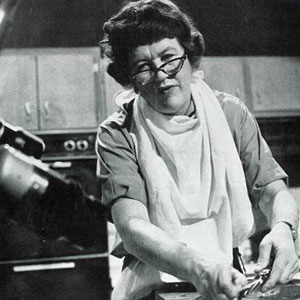
Last week I watched Nora Ephon’s last film, Julie & Julia. It’s good, not great. It jumps from a present-day story about writer Julie Powell starting a blog and making her way through Julia Child’s cookbook Mastering the Art of French Cooking to scenes depicting Julia and her husband living abroad decades earlier. The Julia scenes are better than the Julie scenes, but it’s an entertaining movie overall.
In honor of Julia Child’s birthday tomorrow, here’s a site that gathers several of her classic recipes, including her Beef Bourguignon, Roast Duck with Orange Sauce, Scrambled Eggs, Lamb Stew, and Chocolate Mousse. You can watch episodes of her TV show and read tributes on the PBS website and read SEP Archives Director Jeff Nilsson’s thoughts on what made Julia Child so special.
And by the way? Julia loved McDonald’s original French fries!
National Tell a Joke Day
Sunday is National Tell a Joke Day. Or, if you’re a comedian, it’s Sunday.
Here’s one of my favorite jokes (yeah, it’s a knock-knock joke but I like it):
“Knock knock?”
“Who’s there?”
“Interrupting cow.”
“Interrupting co…”
“MOOOOOOOOOO”
Come on, that deserves an LOL or, at the very least, a tee-hee.
Upcoming Events and Anniversaries
Elvis Presley dies (August 16, 1977)
Thirty-eight years after his death, Presley is still making a ton of money.
Charles Bukowski born (August 16, 1920)
One of the great things about doing this column is finding sites you never knew about before, like this one on the writer. There’s also a new movie titled Bukowski coming out later this year.
President Bill Clinton born (August 19, 1946)
Wikipedia has an exhaustive look at the life of the 42nd president.
The Beatles launch first U.S. tour in San Francisco (August 19, 1964)
A Beatles fan takes a trip to Liverpool to experience the world of the Fab Four.
Hawaii becomes the 50th state (August 21, 1959)
If you’ve never been to the Aloha State you might be surprised at some of the things you’ll find.
Cleanup, Aisle Three
After weeks of staring at the calendar and trying to ignore the late August date circled aggressively in red, Clara grabbed her keys and jumped in the car. Here, now, in the middle of the grocery store, she was finally taking action. Clara knew that staying on task was what would save her. She clutched her shopping list a little too tightly, exhaled loudly, and pushed her cart onward.
David had made his early decision last fall, something to celebrate at Thanksgiving, and sailed through the rest of his senior year. But now that he was actually going to school seven states away from home, their one and only home together, Clara was close to losing it, losing him.
This, she could do as the good mom. She pulled the toilet paper onto the lower ledge of the cart, a wall of softness for the precious butt she had diapered so long ago. The toothpaste she chose was non-fluoride, non-Day-Glo, made in the wilds of Maine. Probably by some old hippies with savvy marketing skills. In her timeless mother mind, David’s first tooth was falling over and over, landing with a plop — almost bloodless — into her palm after his last tongue wiggle. Everything here relating to her boy’s body. The razor blades and best shaving gel for his face, grown even more handsome than the memory of his father. She would leave hair products up to him.
Clara knew very well her son could do his own shopping, but this was a last chance before Christmas to exert a benevolent influence. She zoomed over to the healthy snack aisle and grabbed too many packets. Nut bars, runner’s energy goo packs, superfood bars with chia seeds and dried exotic fruits, and bags of baked veggie chips formed a mound in front of her. No empty carbs. She didn’t care if it took four cartfuls; she was going to send him off with daily reminders of home.
In aisle three, she stood staring at the organic baby food, considering the wisdom of the rounded jars. Carrot mash, sweet pea puree, yam almost soup. Without thinking, she picked up a carrot jar, opened it with that satisfying pressure and pop. She stuck her finger in and tasted it. Sweet and simple.
“Hey, Clar.” It was Jeannie, her cart similarly loaded with anxiety for her youngest, Amber. They looked at each other’s massed supplies.
“Doesn’t it get any better?” Clara grateful and/or sorry she had to do this only once. This was Jeannie’s third time around.
“Give me that,” was Jeannie’s answer. The tennis doubles partners took turns emptying the carrot mash into their mouths and empty gullets and remembered. Pangs of loss came at each of them so fast. It was like that one time the tennis ball machine went haywire and repeatedly fired serves without giving them time to respond.
Soothed somewhat after sharing memories of their kids, from David’s early fascination with hummingbirds to Amber’s latest piano composition, Clara and Jeannie headed for checkout number four. Jeannie first. She grabbed the three empty baby food jars and put them on the conveyor belt. The cashier looked a little puzzled at their emptiness, but then blipped them through after sensing the air of despair of these two moms. It had been filling the store this week with parents having a sentimental shop before college started.
“My treat,” Jeannie winked.
“Thanks,” Clara mumbled.
When Jeannie was ready and packed, she squared her shoulders. Clara whispered in her ear, “Amber will do great.” Something relaxed in Jeannie’s stance, just like when her perfect backhand sent the ball spinning to land just over the net.
Clara meanwhile zombied through the packing up and gratefully received the bagger’s help to get the unwieldy load to her car. She got in the driver’s seat and sat there texting David. Waiting for his reply, she held the receipt up to the late summer light. It unfurled out the open window and trailed from her hand, the white flag of surrender.
Tuning Out
When Pope Francis recently confessed to a reporter that he stopped watching television 25 years ago, it reminded me that several of my friends had gone TV-free as well. I recollect them sharing the news with great braggadocio. One would have thought they were declaring their exit from a domestic terrorist cell. My oh-so-media-savvy buddies had quit TV? It seemed totally improbable.
And so it was. It turns out that most Americans who boast about “cutting the cord” are not dumping their TV sets at the curb. What they’re doing, like my pals, is canceling their cable — or satellite — TV contracts. Not such a major move, but a nice cost savings. You can still watch lots of TV programming these days on your computer or TV by subscribing to an online streaming service. Netflix is currently the most popular of those.
There is, however, a tiny subset of the population that has adopted a true zero-tolerance policy when it comes to television. Who are these people? According to Marina Krcmar, a Wake Forest University professor who wrote the book Living Without the Screen, the TV averse fall into three categories. The first group, which includes religious conservatives, simply detests the content, thinking it too sexual or violent. The second group believes that TV viewing disrupts family life. And the third, which tends to harbor a free-flowing countercultural bias, rejects outright the very notion of a TV industry. “They don’t like Hollywood, they don’t like being treated as consumers,” Krcmar told me.
Not surprisingly, intellectual elites got a head start on that trend. Listen to what was said about TV by none other than Randy Pausch, the Carnegie Mellon professor who wrote the best-selling book The Last Lecture. In 2007 following his terminal cancer diagnosis, he called out TV as the enemy of productivity. “If you really want to have time back in your life,” he told an audience at the University of Virginia, “unplug [your TV] and put it in a closet and put a blanket over it.”

Being ill, as Pausch was at the time, invariably helps set life in perspective. My friend Laura Schiff, a former journalist who was diagnosed with multiple sclerosis in 2008, appreciates that point all too well. “Television always felt like a waste of time,” she told me the other day. When her old TV failed, she opted not to replace it. “No regrets. Without TV, I get a much deeper understanding of the world and what’s going on around me.” The amazing irony: Schiff’s late father, Arthur Schiff, was the genius behind such memorable TV marketing catchphrases as “Act now and you’ll also receive …” and “But wait, there’s more!”
For some Americans, there is no “more.” There is already way too, too much — too much onscreen sex, too much stupid programming, too many commercials for products no one needs (the Snuggie, anyone?). Most of all — and indisputably — “TV robs us of our time, our most precious asset,” as author Joshua Fields Millburn said in his acclaimed memoir, Everything That Remains.
Few will be shocked, then, to learn that even Krcmar, the Wake Forest communications professor, has given up on TV. No more cable. Occasionally she and her husband will watch something via Netflix.
People who have sworn off television “are highly contemptuous of the programs,” Krcmar told me. “They think of themselves as unique and iconoclastic.” She stresses that she’s not gone quite that far. Yet.
A few nights ago, coincidentally, an iconoclast who knows I’m an unregenerate watcher of TV, sent a text message that more or less sums up where we’re headed in the 21st century. “TV?” he wrote to me, mockingly. “So 2014.”
The Great Berlin Escapes
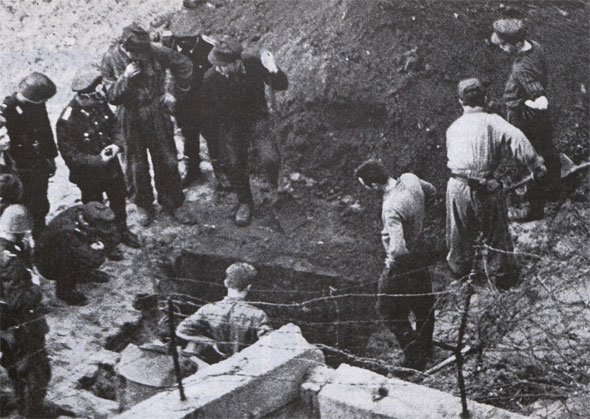
Early on Sunday, August 13, 1961, German guards began uncoiling barbed wire across streets in Berlin. Soon, every street leading from the eastern half of the city to the west was blocked. This was the beginning of the Berlin Wall, which would become far more formidable in coming years. The barbed wire was replaced, first by concrete blocks, then by concrete slabs 12 feet high.
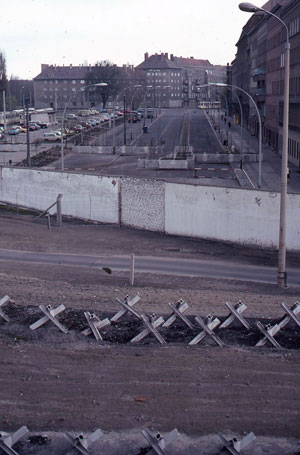
When completed, the Wall was 97 miles long and surrounded West Berlin, making it an island of democratic rule inside Russian-controlled East Germany.
The Berlin Wall was, in fact, two walls, separated by an open area longer than a football field. To slow down escapers who made it over the first wall, the East German border police had installed a number of deterrents: vehicle-stopping obstacles and trenches, coiled barbed wire, guard dogs, rifle pits, bunkers, floodlights, and guard towers.
In those Cold War days, communist regimes maintained control over Eastern Europe from the Baltic to the Adriatic Seas. In that long border with the west, no area was under heavier control than Berlin. And yet East Berliners continued to escape to West Berlin.
Americans were heartened when they heard stories of escape from the Russian-controlled eastern sector. They regarded the fleeing East Berliners as heroes, not just for braving death or imprisonment for freedom, but also for disproving all the Soviet claims that life under communism was a “worker’s paradise.”
The wall wasn’t part of the Russians’ original plans for Berlin. They expected the American, British, and French armies would abandon their occupation of the German capital after World War II. When they withdrew, the Russians would assume full control of Berlin and bring it into the East German “republic.” But the armies remained in West Berlin while its citizens were rebuilding their homes, their government, and their businesses.
In those early days, Berliners were still free to move from the Russian zone in the east into the American, French, or British zones. But East Berliners noticed their neighbors to the west were enjoying greater freedom and fewer food shortages. So they began moving across town in large numbers.
Every day in June 1961, an average of 630 East Berliners moved west. In July, the daily emigration average reached 967. On August 12, the day before the barbed wire was put up, roughly 2,400 émigrés headed out of the Russian zone.
Russian Premier Nikita Khruschev had seen enough. He had to end this embarrassment and loss of manpower. That night, he ordered the East German forces under Russian control to close off traffic to the west.
But some East Berliners had already committed themselves to flee communist rule. As they watched a concrete wall replace the barbed wire, they began looking for other avenues of escape. They found buildings adjacent to the wall where they could jump from a window and land in the west. A father rigged a zip line sent his family over the wall. A driver modified a low-profile sports car so it could drive underneath the crossing gate at a checkpoint. A pilot flew a stolen light aircraft into the west.
Some got out by hiding inside telephone cable spools being shipped to West Germany. Some walked through the checkpoint in homemade Russian uniforms. Some tried crashing their vehicles through checkpoints. And others tunneled.
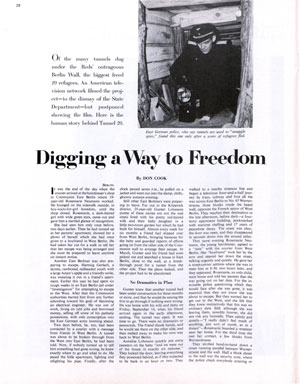
In September 1962, a group of students dug a 400-foot tunnel 15 feet beneath street level. When finished, the tunnel would let escapees crawl to the west through a corridor less than three feet high and three feet wide. On September 14, 1962, it brought 29 people out of East Berlin, earning it the nickname Tunnel 29.
(Three of the students working on the tunnel sold NBC television the rights to film the project, which can be seen here)
The tunnel couldn’t have been built without the dedication of university students in West Berlin. They risked their lives, and possible capture by East German border guards, to help the escapees because they believed they should do something to fight oppression. One of the students told Post writer Don Cook, “Our parents did nothing about the Nazis, and we have been reproving them in silence for it for years … I’m not going to have my children asking me 15 or 20 years from now, ‘What did you do to fight Communism?’ I’m here to do something.” (Read the entire article “Digging a Way to Freedom” by Don Cook from the December 1, 1962 issue of the Post.)
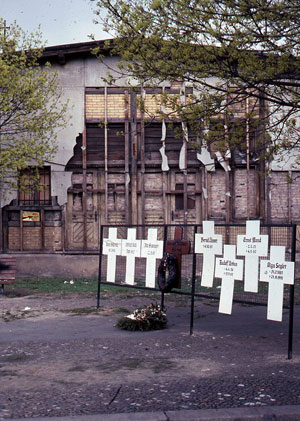
While Cook honored the heroism of the diggers, planners, and escapees, he didn’t ignore the many who failed in their escape attempts. In 1962, the East German courts had already sentenced over 1,000 people who’d attempted to flee the East, and another 895 were under arrest and awaiting trial. Over 50 escapees, he added, had already been shot and killed trying to cross the Wall. Before the wall was knocked down in 1989, at least 130 people had been killed while trying to escape.
For years, West Berliners placed white crosses beside the Wall where Germans died in their attempt reach freedom. With the Wall destroyed, the crosses have now been moved to a central memorial site.
The Berlin Wall is in a thousand pieces, spread around the globe in museums and private collections. A few sections have been left standing in Berlin, monuments to a barrier that was once formidable but never impenetrable.
Just Beachy
Celebrate a century of beachgoing with these sun-sational covers. You might have sand in your shoes for a week afterward, but that’s a small price to pay.
For guys and gals alike, sharp style is a must to complement even the most radiant bronzed glow.
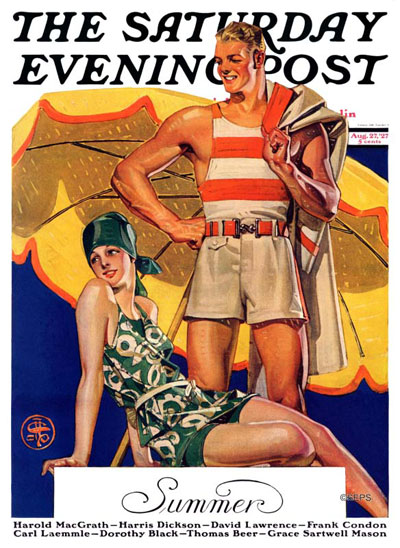
August 27, 1927
Armed with trusty life preserver, the guard holds court over his sun-toasted subjects with all the regality of a king and twice the jawline.
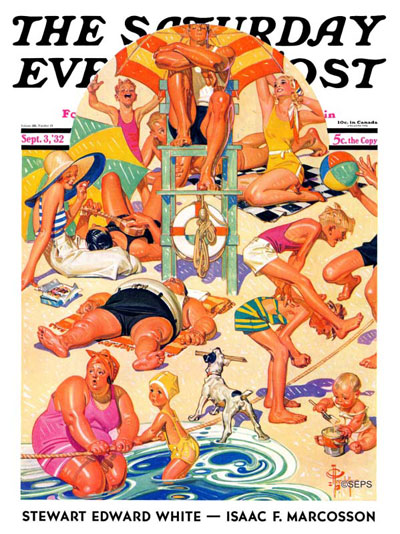
September 3, 1932
Et tu, ice cream? Getting lost in a spiraling forest of umbrellas isn’t especially ideal when you’ve got cool treats on hand rapidly turning to Neapolitan soup.
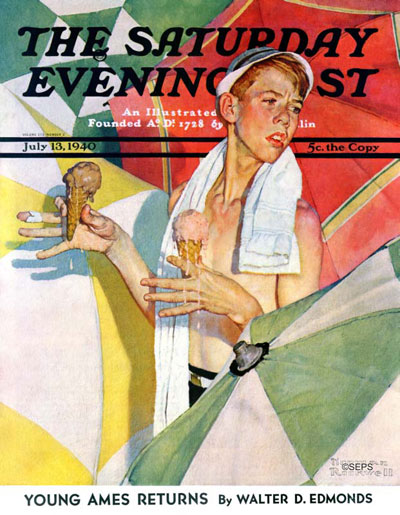
July 13, 1940
A prayer for some cloud cover might be in order if this ghostly couple wants to remain distinguishable from overcooked lobsters by day’s end.
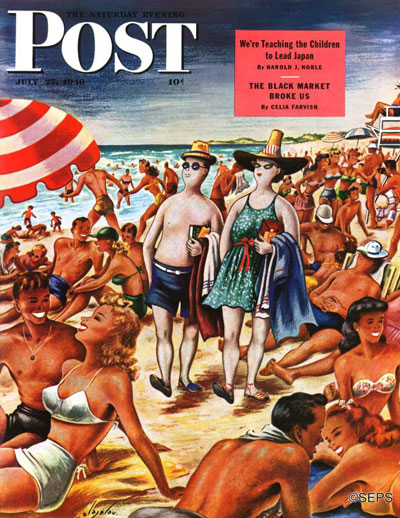
July 27, 1946
The tugboat may capsize when the tide arrives, but for one new to the sights and smells of the seaside, witnessing the frothy waves curl into the sand probably beats just about any plastic trinket.
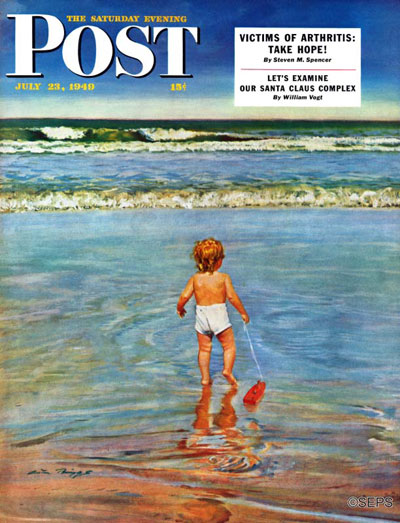
July 23, 1949
With Mom preoccupied, this baby can pick up a few early glamour lessons, though it would appear she hasn’t quite mastered coloring inside the lines.
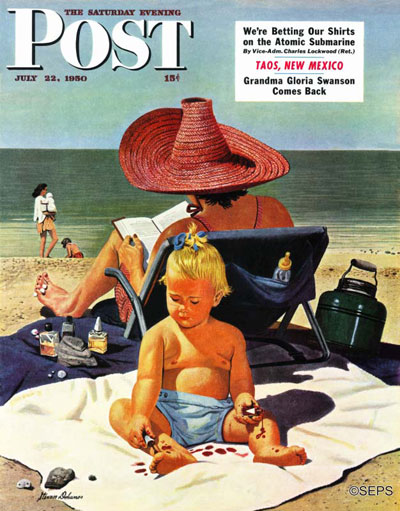
July 22, 1950
So much for fun in the sun. If the obsidian cloudbursts weren’t enough, a few peals of lightning are good reason to send sunbathers and picnickers packing.
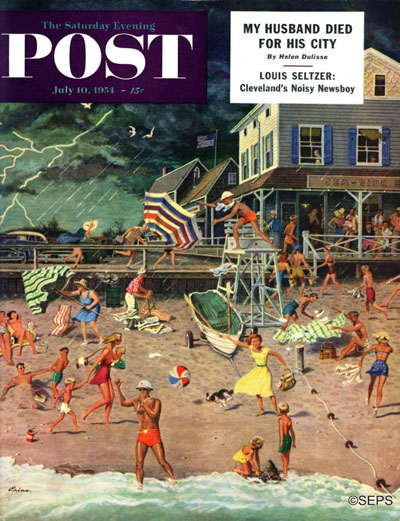
July 10, 1954
Who says you can’t mix work and play? Sipping a soda and rocking a bonnet-clad tot, this babysitter just might perfect the art of multitasking as long as that begrudging chef doesn’t boil the milk.
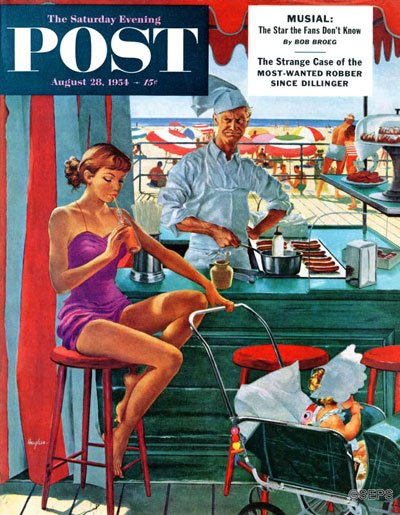
August 28, 1954
There’s plenty of fish in the sea, but the odds of this fellow catching one bigger than a guppy might be doubtful, especially with a snickering chorus of freckled critics present.
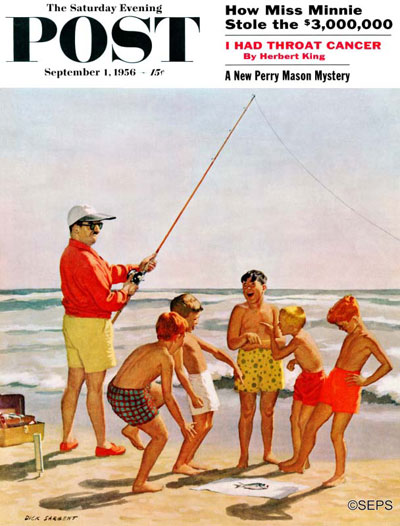
September 1, 1956
Even with enough lotion globbed on to withstand most natural disasters, some are just bound to flake under the harsh afternoon rays. Of course, where some see searing obstacles, others see opportunities to pick up a glorious golden sheen.
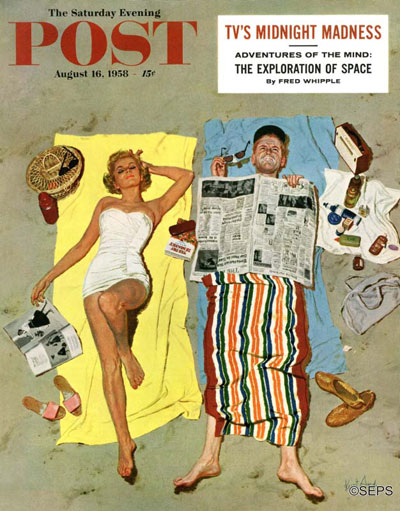
September 16, 1958
Forget frolicking in the surf when there’s romantic comedy of this caliber to be had.
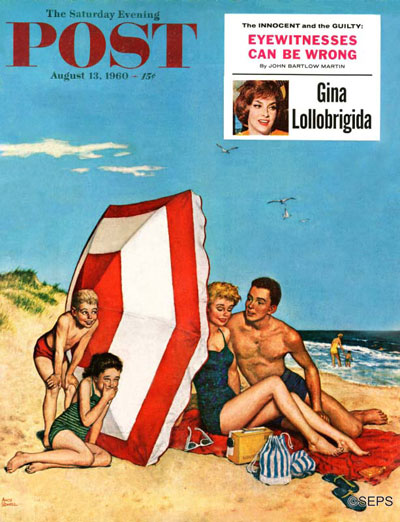
August 13, 1960
Perhaps auditioning for the Polar Bear Club under the disgruntled gaze of that swaddled lifeguard, this brave swimmer can have the entire shore to himself, as long as he doesn’t mind a touch of hypothermia. Like age, temperature is just a number.
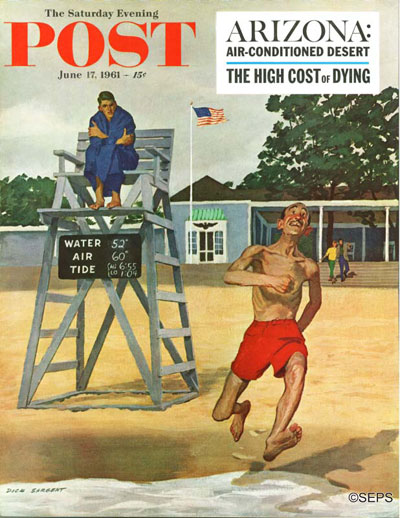
June 17, 1961
Drop and Give Me Zero
I just scheduled my annual physical, and unless there’s a surprise lurking, I expect the results to be the same as the last three or four exams. I also expect my doctor to advise me (once again) to exercise more; or in my case, to simply exercise at all. I’ll smile and agree, but I won’t follow his advice.
Sure, I should lose 20 pounds, my blood pressure’s a bit high, and I take a statin for cholesterol maintenance, but all in all I’ve managed to stay in reasonably good shape for a guy my age, without any kind of regular workout routine. You see, I don’t like to exercise, never have, and I’m not about to start, especially when I look around and see what’s happening to my friends who are exercise devotees.
As I see it, exercise is a dangerous proposition.
There’s the lifelong jogger, who is about to undergo her third or fourth (I’ve lost count) back operation. There’s the competitive tennis player, facing yet another knee operation. From others, I frequently hear tales of torn tendons and severe sprains. The bicyclists I know suffer concussions and broken bones. And then there are fitness enthusiasts you’ll read about in the paper who keel over and die while running a charity 10K.
Mind you, I am by no means sedentary. I power up and down the stairs at least 30 times a day, and I have a pair of 10-pound free-weights that I fling about every so often to let off steam. Beyond that, I take a daily half-hour walk (weather permitting). I believe walking to be the perfect exercise. Heck, I can cover miles before stopping for a cocktail. (I’ll leave the endorphin high to others.)
Now I’ll admit such a no-impact, no-risk routine doesn’t come close to meeting my doctor’s definition of exercise — or most anybody’s — and I’d probably lose some of that unwanted weight if I added in a few sit-ups and jumping jacks (and cut back on the craft beers). But I’m sticking with the tried and true for now. So far, so good, I say: No pain, no sprain.
Meeting the Beatles
When I stepped off the bus in Liverpool I zipped my thin jacket all the way up against the damp May weather and dragged my much-too-heavy suitcase thumping along the cobblestones of Mathew Street. I was here to get a feel for the four boys behind the music, but I wasn’t quite sure what to expect.
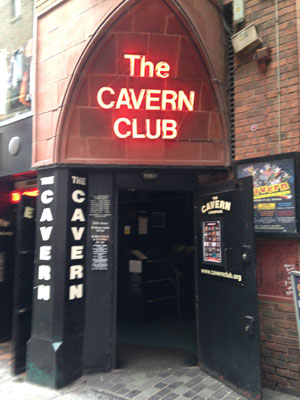
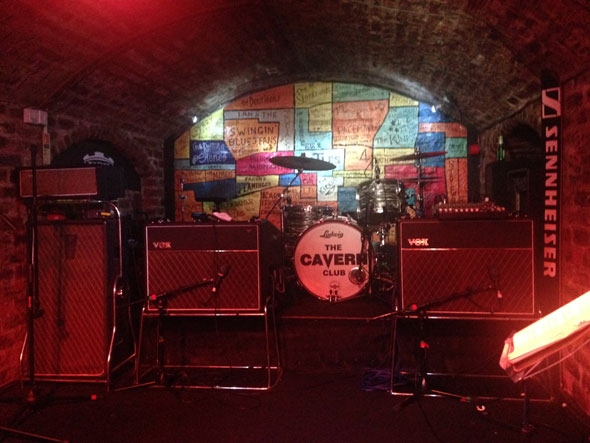
Passing the Cavern Club, the famous venue where the Beatles got their start, I was practically assaulted by memorabilia. This was Fab-Four central all right. Souvenir shops lined the road, their windows crammed with pictures, posters and Beatles bobbleheads. Similarly the lobby of my lodging, The Hard Days Night Hotel, featured more Beatles photos, a bar stocked with specialty beverages (Strawberry Fields with Pepper, anyone?) and a bright yellow Beatles jukebox.
The trip was part of a course I was taking called The Beatles at 50. How much of a Beatles nerd am I? Well, I have to admit a good part of my motivation for enrolling in the class was that it included a trip to England. My best friend was studying there. It would be an easy course and a good excuse to travel and visit her. As for the Beatles, I’d always liked them. Their music had been a constant in my life since I was a kid, but I confess I didn’t quite get the magic, didn’t understand why my Mom loved them so much. Maybe the course would spark a deeper understanding of the band.
Over the semester, I’d listened to every Beatles song on every Beatles album, studied Beatles history, and tried to comprehend how a band could leave such a lasting impact on our world. By the time I arrived in Liverpool, I was already in pretty deep. It was no longer just an excuse to visit England.

That night in Liverpool, a day full of flights and bus rides left me sleepy. Dropping onto my hotel bed, I stared at the huge framed portrait of Paul McCartney hanging over me. I confess the commercialism was getting to me. Could the Beatles magic still exist here? Or was it all a Vegas-style charade trumped up for visitors?
I knew the stories behind the Beatles albums and the backgrounds of the band members, yet I was still waiting to feel the impact of this pop band. Even the Liverpudlians I ran into that first day questioned, “Why would you spend an entire semester studying the Beatles?”
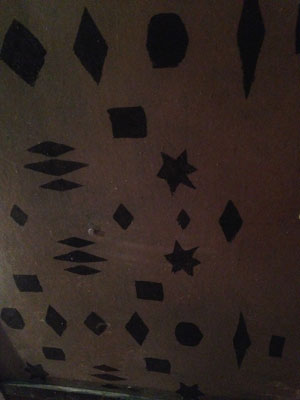
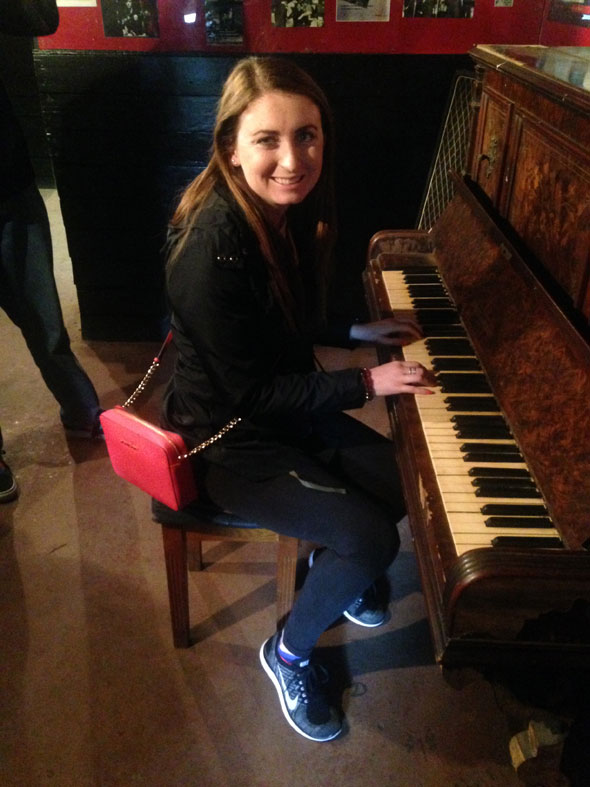
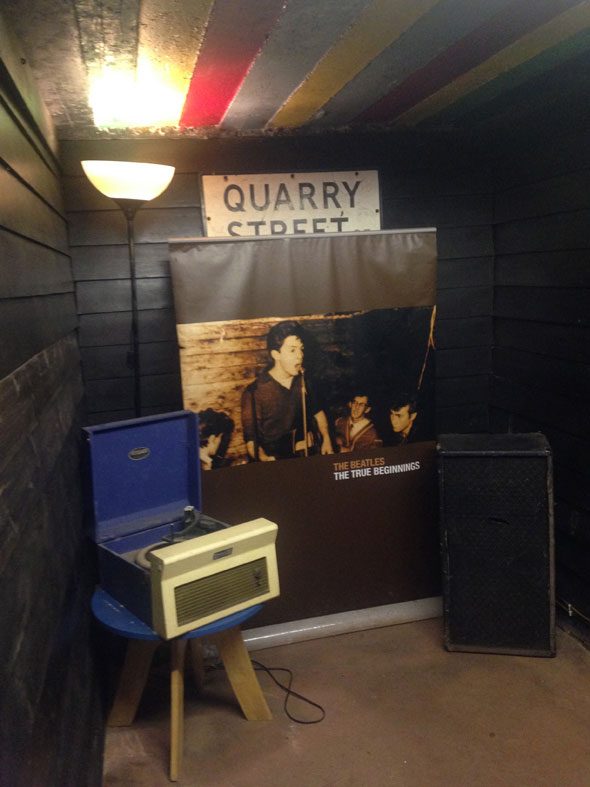
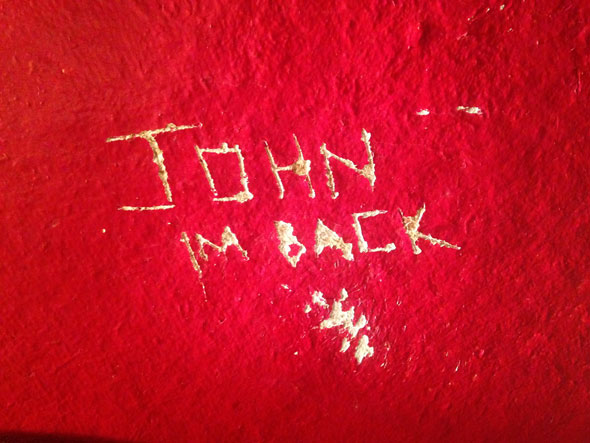
A few days later, I was beginning to find an answer. My class of nine toured the Casbah Coffee Club, a basement club opened in 1959 in the home of Pete Best, the Beatles’ original drummer, who, as everyone knows, was unceremoniously ditched in favor of Ringo. Today the Casbah is still owned by the Best family. Pete’s brother, Rory, gave us a tour and recalled memories of thousands of teenagers lining up in his yard, hoping to squeeze into the tiny underground rooms. I sat at the same piano Paul and John once played. I touched the walls that the four boys painted with stars and dragons and rainbows, ran my finger across the place where bad-boy John carved his name into the wall — before being yelled at by Mrs. Best. Touchingly Rory’s wife described the quiet depression Pete sank into after the Beatles went on without him. Behind the main room, pinched between two larger rooms was a small nook, with ceiling panels painted in bright colors and black wooden walls, barely big enough to contain a drum set. This tiny area was where the Beatles (then called the Quarrymen) first took the stage.

My classmates moved on to snap photos of the other rooms. But I stayed a few minutes, alone in this small space. The air was damp and scented with mildew. If I stretched my arms out, I could almost reach the width of the room, touch the walls with my fingertips. This was real. This tiny, dank basement was where they first performed, at a time when no one knew their names.
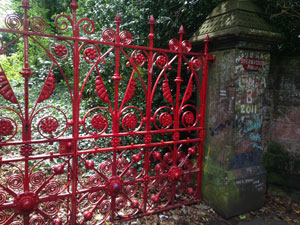
After touring the Casbah Club, I continued to look for ways to make a connection. I looked through the gates of Strawberry Fields. (Yes, it’s a real place, as is Penny Lane.) I toured the insides of the childhood homes of Paul and John. I saw the bathroom that John used to sneak into at Paul’s house, where they would practice while Paul was skipping school. I stood outside the homes where young Ringo (known in his youth as Ritchie) and George grew up.
As a former percussionist, I know the importance of music. As a teenager, I performed in one of the best high school symphonic bands in the country. At one point we even performed at Carnegie Hall —where the Beatles played on in 1964. I know how timeless music is, and I know that by being a musician, you learn a whole lot more than scales and rhythms.
On my last night in Liverpool, I walked down the black, winding stairs of the famous Cavern Club, the Beatles’ venue after they outgrew the Casbah. My classmates and I snaked our way through the crowd to the front row, where we stood inches from what some consider the most famous stage in the world. A Beatles cover band called the MonaLisa Twins came out blasting “Please Please Me,” and the urge to sing along was irresistible. Young and old—all singing the same songs in the same place where thousands of sweaty kids once stood to hear the Fab Four.
Something clicked that night and I was momentarily transported to an earlier time. Despite the tacky souvenir shops, and the touristy atmosphere, I had glimpsed what it must have been like, years ago, to stand in this same spot among all of those screaming teenagers and hear music in a way that it had never been heard before.
As the live music pounded in my ears, I closed my eyes and I could see them, black leather jackets, shaggy hair, grinning to each other with the knowledge that they’d created something original. I knew, of course, what they didn’t know then: That they’d go on to sell over 600 million albums worldwide and have 20 hit singles in the U.S; that they’d become legends and their music timeless. Still, what impressed me was how they began — in that musty cellar room, where the walls are still covered with their handwriting and the stage barely fit four people. It began where I stood, and it never ended. I clapped my hands and sang along, and I was taken beyond Beatles biographies and the souvenir bobbleheads. I was in 1963, my hand reaching out to Paul McCartney; then I was back in the present, wondering if any other music would ever sound quite so magical.



News of the Week: Goodbye Jon Stewart, Hello F. Scott Fitzgerald, and Happy Birthday to You
Goodbye Jon Stewart

s_bukley / Shutterstock.com
Wait, that makes it sound like he died. I just mean that last night’s episode of The Daily Show was the last one for host Jon Stewart, after hosting the show for 16 years. Stewart’s final guests were Amy Schumer, Denis Leary, and Louis CK, along with some surprise guests to celebrate Stewart’s tenure on the show, the show that made Stephen Colbert and Steve Carell household names.
Everyone is celebrating the departing host this week, with retrospectives and best-of lists and essays. Time’s James Poniewozik reveals what he’ll miss most about Stewart. The Wall Street Journal’s Speakeasy blog has a rundown of some of his more odd guests. Newsweek delves into the comic and crusader parts of The Daily Show , and and the show itself showcased some of the craziest interviews earlier this week. Note: some NSFW moments in that last link.
What will Stewart do now? Don’t expect him back on television anytime soon. I would think he’s going to write more, direct more, and maybe even do more standup. He did a surprise gig at Comedy Cellar in New York City last week with Louis CK. I was just going to call him “CK” but that doesn’t sound right.
Trevor Noah takes over as host of The Daily Show on September 28. I think it would have been funny to have Craig Kilborn return as host. He hosted the show before Stewart, and on Stewart’s first night he said that Kilborn was on assignment in Kuala Lampur. It would have been great to have Kilborn finally come back from that assignment to resume hosting duties again.
New F. Scott Fitzgerald Story Published
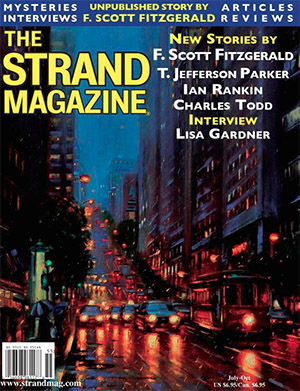
The discovery of new works by writers continues! Now we have a long-lost short story by F. Scott Fitzgerald. It’s called “Temperature,” and it’s about a writer who drinks a lot and then finds out he’s sick. And before you even make a joke about how art imitates life, Fitzgerald beat you to it. He says at the beginning of the story, “And as for that current dodge ‘no reference to any living character is intended’ -no use even trying that.” He wrote it in the summer of 1939, when he was hospitalized twice for alcoholism. (According to a letter Fitzgerald wrote his agent, he submitted the story to The Saturday Evening Post, and it was rejected. Sorry, Mr. Fitzgerald!)
The story is in the current issue of the magazine The Strand. The managing editor of the magazine, Andrew Gulli, found the manuscript while he was looking at the Fitzgerald archives at Princeton.
So besides Fitzgerald, we’ve also had new works from Harper Lee, Dr. Seuss, Sir Arthur Conan Doyle, Raymond Chandler, Orson Welles, and probably a few others I’ve forgotten about. Quick, someone check Dorothy Parker’s attic!
Happy Birthday to You

Have you ever sang “Happy Birthday to You” at a party? Then you probably owe someone some money.
Yup, that’s a copyrighted song, even if it is sung 57 bajillion times a day (a conservative estimate). Like every other “cover song,” you’re supposed to pay to sing it. Warner/Chappell is the publisher and they make around $2 million in royalties from it every year. The song, originally titled “Good Morning to You,” was written by two sisters in 1893.
But now there’s a lawsuit (there’s always a lawsuit) brought by a filmmaker who wanted to use the song in her movie but was told she had to pay $1,500. She wants everyone to be able to use the song free of charge because it’s in “the public domain” and everyone sings it. It all comes down to when the “happy birthday” lyrics were added to the song. A federal judge will rule on it later this month.
By the way, even if you’re singing the song only in your head right now, you owe some money.
It’s Official: Kermit and Miss Piggy Have Broken Up
Jaguar PS / Shutterstock.com
This has been a big couple of weeks for celebrity breakups. Reba McEntire and her husband are divorcing after 26 years of marriage. Country stars Blake Shelton and Miranda Lambert are also going their separate ways, as are rockstar couple Gwen Stefani and Gavin Rossdale. But the most shocking split comes from two celebrities that aren’t even human.
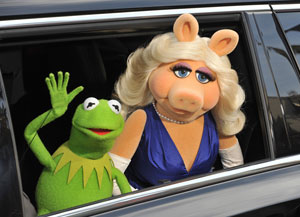
Kermit and Miss Piggy are no longer dating. The frog and pig announced the breakup during a Q&A session at the annual Television Critics Association get-together, where they were promoting ABC’s update of The Muppets, which will debut this fall. Kermit said that Miss Piggy made his life “a bacon-wrapped hell on Earth.”
If these two can’t make it work…
And the Highest Paid Actor in the World Is…
Featureflash / Shutterstock.com
…Ian Ziering, star of the Sharknado movies. I know, I was surprised too!
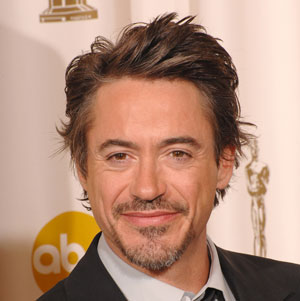
Okay, that’s not true. The highest-paid actor in the world – for the third year in a row – is Robert Downey Jr., according to the annual list compiled by Forbes. Thanks to all of the superhero movies he’s doing, he raked in $80 million last year. Second on the list is Jackie Chan, with $50 million, followed by Vin Diesel ($47 million), Bradley Cooper ($41.5 million), and Adam Sandler ($41 million).
Adam Sandler. One of the richest movie stars in the world.
August is National Sandwich Month
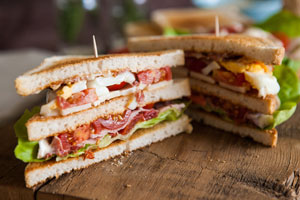
I usually provide a few links to recipes in this section, but how do you do that with sandwiches? There are literally thousands, if not millions, of different sandwiches a person can make, depending on the bread you use, the filling, whether you toast it or not, etc. So instead why don’t I provide a link to something and you can all get into an argument?
Here’s a list from Thrillist that lists the 50 best sandwiches of all-time. Let me just say that number 36 should be a lot higher. And I’m sure that some people are going to question why a hamburger wasn’t considered – because it’s not a sandwich – but “hamburger sub” is on the list because they took the burgers and shoved them into a sub roll. And peanut butter and jelly, one of the classic sandwiches of all-time, should be in the top 10, not 26.
By the way, as we all know, the sandwich was named after the man who invented it, Alexander Hoagie.
Upcoming Events and Anniversaries
The Smithsonian Institution established (August 10, 1846)
A lot of people might think the Smithsonian is just one museum, but it’s so much more.
Victory Day (August 10)
Did you know this once federal holiday is now only celebrated in Rhode Island?
Alfred Hitchcock born (August 13, 1899)
The BBC recently released their list of the 100 Greatest American Films and Hitchcock grabbed several of the spots. But come on: everyone knows North By Northwest is better than Psycho.
Berlin Wall construction begins (August 13, 1961)
USA Today has 9 things you might not know about the fall of the wall.
Steve Martin born (August 14, 1945)
Check out the scary hand on his official site.
Woodstock opens (August 15, 1969)
The official title for the event was The Woodstock Music & Art Fair, though no one really talks about the art.
Saving Grace
Around 9 a.m. Billy Roland saw the water tower and the first cluster of buildings in the distance, steered his rented Ford to the shoulder of the road, and stopped. He sat there for a moment, adrift in memories, looking through the windshield at a wooden sign that said, “Welcome to Rosewood—Pop. 8,400.” After all these years, he was home.
Five minutes later he passed a barrier of orange traffic cones and the still-smoking remnants of a recent accident, and a mile after that he parked in the visitor’s lot at the regional hospital. Catherine Roland’s room was easy to find. He knocked softly on the door, then inched it open. She was asleep, her chest gently rising and falling underneath a light blanket.
Billy pulled a chair up to her bedside. His mind whirled with a mixture of love, sorrow, and guilt. Love because she was his mother, sorrow because of her sudden illness, guilt because it had been so long since he’d seen her in person. He talked often with her via telephone and sent her gifts and Christmas cards — but he hadn’t come home to visit. He certainly could have. Billy was single and unattached, and traveling was no problem for a novelist anyway; a writer can write anyplace. The truth was, he hadn’t come home because the town of Rosewood — even the mention of Rosewood — made him uneasy.
But he was here now. He was clinging to that thought when finally he slumped deeper into the chair, rested his chin on his chest, and slept.
He awoke to find a nurse in the room with them. She was middle-aged, her head tilted slightly and her hands tucked into the pockets of her uniform as she studied Billy’s sleeping mother. After a moment she looked up at him.
“You’ve been out for a while,” the nurse said, smiling.
Billy assumed she meant his nap rather than his estrangement. “I drove most of the night.” He squinted at his watch. “Got here about an hour ago.”
“Did you hear about our accident? It’s made things pretty busy here.”
“I drove past it,” he said, stretching and wiping his eyes. “Looked serious — I saw a car and a school bus under an overpass, both burned to a crisp.”
The nurse nodded. “It would’ve been deadly, if not for a bystander. He saw the wreck and pulled half a dozen kids and the driver from the burning bus — thankfully it wasn’t full — then rescued two ladies from the car. Carried the last one out just before the whole thing blew up, according to the victims.”
Billy thought about that. “Guess I’m lucky I missed it, in more ways than one.” He looked down at his mother. “From what the doc said on the phone, I thought I might be too late.”
“Actually, your timing’s good. She’s doing better.”
Billy saw the nurse studying his face over the top of her glasses. Her eyes were blue and friendly, her hair graying under her white cap. He didn’t know nurses wore caps anymore.
“You know me,” he said. “Don’t you?”
“I know you’re a writer now. My name’s Elaine. I remember you, from when your sister was here for surgery.” She hesitated. “And …”
“And from what happened before that. Right?” He felt the old, familiar discomfort ripple down his backbone. He never stopped thinking about that summer. It was why he hadn’t come back in so long.
She nodded slowly. “Yes. Most folks around here remember you, Billy.”
He could only shrug. “Long time ago.”
“It’s hard to forget a hero,” the nurse said, smiling again.
“I’m no hero. If you remember what happened, you also know why I was there at that house that day, at that moment. You know I did something I’m ashamed of.” He motioned toward the door — the outside world. “That good Samaritan you told me about, at the school bus wreck? He’s a hero. Not me.”
A silence passed. At last she said, “I also heard there was a good reason you were there that day, at the Westbrooks’ house — a reason you did what you did.”
Billy didn’t reply. He focused on the clear blue sky beyond the room’s single window, remembering that midsummer morning 25 years ago when he and fellow fifth-grader Jerry Goldman sat hidden on the wooded hillside across from the Southgate subdivision, looking down at the fancy house on the far side of the road. It was sunny that day too, sunny and warm. Jerry rode there on the back of Billy’s bike — doubleheading, they called it. From where they were watching, they could see one side of the house and part of the backyard, above the board fence. The swimming pool winked silver in the sun.
The thought made Billy’s stomach feel queasy. The nurse must have noticed, because she said, “You’re not gonna DFO on me, are you?”
“DFO?”
“Faint. As in the patient ‘Done Fell Out.’”
He felt himself smile. “No. I’m okay.”
“Good.”
After a pause Billy sighed and looked her in the eye. “I had to do what I did that day.” He turned again to the window, and to his memories. “I remember saying to Jerry, I don’t want to, but I just —”
“— don’t have any other choice.”
Jerry Goldman’s young face looked worried and frightened at the same time. “I know you don’t.” He checked his watch, a cheap Timex with an orange band. “Sure you don’t want me to wait here for you?”
“No. I need you to take my bike home. If things go well, I’ll have too much stuff on me to ride it back. I’ll call you later.” Maybe from the police station, Billy thought. While he was mulling that over, they saw a car back out of the house’s garage, then head out of the subdivision and east on Valley Road. It was what they’d been waiting for.
“Showtime,” Billy said, rising to his feet. He realized his hands were shaking. The two 11-year-olds exchanged a long look.
Without another word, Billy left the cover of the woods, jogged down the hill and across the road to the side of the house, and then crept around the corner and out of Jerry’s sightline. At the front door he took a deep breath and turned the knob. If it was locked, he planned to try the garage door — but it wasn’t. He eased it open. He already knew the wife was out back because they’d seen her there a moment ago, with her young son and a dog. The house should be empty.
Billy shut the door and hurried down a long hallway.
The master bedroom, he found, was at the rear of the house. He crept inside and looked around. The room was bright, and even though a picture window covered most of the south wall he doubted anyone outside could see in. Billy felt himself relax a bit. This room had no outside doors. The husband was gone, and through the window Billy could see the wife and little boy in chairs beside the swimming pool. If they decided to head back inside, he could retrace his steps and be out the front door and gone in seconds.
He drew another long breath. He hoped he wasn’t making a mistake — but as he’d told Jerry, this was something he had to do. There was no other solution.
The plan had taken shape quickly, once he understood the situation. The thing was, his 6-year-old sister, Grace, suffered from a steadily worsening heart defect, and a meeting between his parents and Grace’s doctor last week revealed that it must be corrected quickly. It was also revealed that the surgery would cost more than $20,000 — money the Rolands didn’t have. Billy’s father had been laid off and they were mired in debt. The hospital expressed its sadness but stood firm: the head of the surgery department could allow no procedures, no matter how necessary, that could not be covered by the patient or by insurance. Billy saw his parents arrive back home in tears. They simply had no options.
The following day Billy received two pieces of news that sparked an idea. His friend Linda overheard her mother, a waitress at a hotel restaurant downtown, telling her dad that the wife of a local doctor named Westbrook had supposedly shown up at a banquet wearing a $100,000 diamond necklace. A hundred grand, she’d said. No wonder doctors charge so much.
The second piece of information came from another friend, Scruffy Morgan. (Actually, most of Billy’s friends were scruffy, and all belonged to families on the lower rungs of the economic ladder.) Scruffy said he knew someone who fenced items like jewelry and electronics for 30 cents on the dollar. When Billy confessed that he didn’t know what “fenced” meant, Scruffy explained that this guy would take stolen goods off your hands for a third of what it was worth, no questions asked. Instant cash.
It took Billy Roland less than a minute to reach a decision. He would somehow locate the home of this rich wife, somehow get inside her house, and somehow find and steal enough to pay for his sister’s surgery. He even thought of how to explain the small fortune in cash he would receive from Scruffy’s contact: He’d tell his dad he found it in an abandoned shack in the woods where he and Jerry sometimes played. Billy knew his parents, painfully honest, would normally turn the money over to the police … but these were not normal times. Grace’s life was at stake.
As things turned out, Billy indeed located the house — there was only one Dr. Westbrook in the phonebook — and he and Jerry staked the place out for several days to check the comings and goings of the parents and their toddler son. Now, a week after the hospital gave the Rolands the news that would practically sign Grace’s death warrant, here Billy was, on the verge of giving her back a chance at living.
It was all way too much for an 11-year-old to handle, but he thought that so far he was doing pretty well. Now he just had to find the necklace and beat feet out of Dodge. Was it wrong, what he was doing? A crime? Sure it was. He tried to justify it by reminding himself that anyone who can buy things that expensive can also afford to do without them.
He took another look through the window. The little boy was sitting in a beach chair and his mother was standing and saying something and wagging her finger at him. Off to one side, also watching them was their big golden collie. Billy thanked his stars that the dog was outside and not in.
But who knew how long they’d all stay outside? That thought made him get down to business, riffling through drawers and jewelry boxes. He quickly found what he figured must be the diamond necklace, some other items, and a thick wad of 20s in a bank envelope. He stuffed everything into his pockets. He had one bad moment when he looked out the window again and didn’t see Mrs. Westbrook — but then spotted her, standing in the distance, talking to a plump neighbor lady through a gate in the fence. The earlier instructions and finger wagging must’ve been to convince her child to remain sitting in his chair while she took a gossip break.
But the kid hadn’t done that. As Billy watched, the little boy — maybe 2 or 3 years old — climbed down and was walking unsteadily toward some toy blocks near the edge of the swimming pool. That would’ve probably been okay, except that the dog picked that moment to bound over and nuzzle the boy, who stumbled — And fell into the pool.
Billy heard no splash, and apparently Mrs. Westbrook didn’t either; she and her neighbor were still chatting away. And for some reason the child didn’t cry out. Billy could see him struggling in the too-deep water.
Billy stood there thunderstruck. For a long moment he did nothing, staring in horror. He felt an almost overwhelming urge to take what he’d found and leave right now, get his crazy self out the front door and get away. He could do it. He had what he came for.
But he couldn’t. Instead he dropped his latest handful of loot, picked up a heavy stone carving from the dresser, and threw it. The window exploded. Billy heaved a chair through it also, to break out most of the rest of the glass, then burst through the broken window onto the patio, sprinted to the pool, and dived in.
The child was silent now, and sinking. Billy grabbed him, pulled him to the surface, and lifted him out onto the concrete. He wasn’t breathing. Billy knelt beside him and pushed on his chest the way his schoolteacher taught them. Billy could hear Mrs. Westbrook’s screams and her running footsteps, but they seemed unbelievably distant, not even a part of his world. He kept pushing, waiting, pushing again, water dripping from his face onto the little boy’s, and finally — as Mrs. Westbrook arrived, her face as pale as the white patio — the child coughed up water and took in a huge, hitching breath.
Billy moaned his relief; he could feel hot tears in his eyes. He raised his head and looked up at the woman, who stood there a second longer, her face frantic and both hands clapped over her mouth. Then she stooped down and swept her child into her arms. He was coughing but he had some color now, Billy saw.
He also saw Mrs. Westbrook turn to look at the jagged hole in the window, and the broken glass and the overturned bedroom chair on the patio. Her gaze shifted to Billy. “You were … you were in my house.”
He didn’t reply. He was caught, and he knew it. His pockets bulged with stolen goods.
Dazed, clutching her child to her chest, the woman blurted to her even more dazed-looking neighbor, “Call my husband. Tell him to come quick.” In a trembling voice she told the neighbor the phone number. Neither she nor Billy said another word. Her son, however, did. He pointed a chubby finger at the dog and whimpered, “Oscar pushed me in the water, Mama.”
Five minutes later the boy’s father arrived, storming in through the side gate with his tie loosened and eyes as big as quarters. He fell to his knees beside his wife and his son, who now looked listless but otherwise good as new. The neighbor had vanished, probably to tell everyone on her phone list about all the excitement.
Mrs. Westbrook didn’t seem to know whether to be grateful or outraged. Her husband just knelt there and listened as she told him about leaving little Richie, then hearing the window break, then realizing she couldn’t see Richie, and then watching this boy here dive into the pool and pull their drowning son to safety.
Westbrook turned then to stare at Billy, and spent the next few minutes listening to his explanation. Billy didn’t try to sugarcoat it — what good would that do? He said he’d needed money badly, had entered their unlocked home looking for cash and jewels, and had seen the little boy fall into the water.
“You were stealing from us?” the man said, with another look at the shattered window.
“Yes, sir.” Billy wondered if his voice sounded as miserable as he felt.
A long silence passed. “Why did you help my son?” Westbrook asked quietly. “You could’ve left, right? No one would’ve ever known.”
Billy swallowed. “I would’ve known,” he said.
More silence. As if at a signal, both of them looked down at Richie, watching him breathe, staring into his eyes, realizing just how close a call it had been.
Then Westbrook turned back to Billy. “Why’d you need money so badly?”
Again Billy stuck to the truth. In a shaky voice he told them about his sister, and the surgery she needed, and that his family couldn’t afford it.
Suddenly Westbrook’s face changed. “What’s your name, son?”
“Billy Roland.”
He studied Billy carefully for several seconds. “A man named Edgar Roland came to one of my physicians last week, about a small child with valvular stenosis —”
“That’s my sister, Grace. Edgar Roland’s my father,” Billy said. “What do you mean, your physicians?”
“I’m head of surgery at the hospital. Your parents talked to a Dr. Lancaster, didn’t they?”
“Yes, sir.”
Another long silence.
Finally Westbrook said, “Let’s go see your dad.”
“Sir?”
He rose to his feet. “Come on. Your sister’s going to have her operation.”
Billy’s head was spinning. “But — you don’t understand. My parents — they don’t have the money to pay for it.”
Dr. Westbrook looked at him then, and though he didn’t actually smile, his eyes sparkled. “They do now,” he said.
And they did. Or someone did — because two days later little Grace Roland underwent successful surgery to repair a defective heart valve. There were no charges of any kind, for the operation or the medicine or the hospital stay. The one time Billy’s father took Dr. Westbrook aside to ask about it, he was told not to worry. Everything was covered.
But, as is often the case in life, everyone did not live happily ever after. A month later Grace developed an infection, and this time they couldn’t save her. To Billy, his “solution” had only delayed the inevitable. Then tragedy struck yet again. Shortly after Grace’s funeral, his father died of a massive heart attack.
Flat broke now, Billy’s mother began cleaning houses — a job she kept for the next 15 years, long after Billy worked his way through college and moved north and launched a successful writing career. He seldom visited her but faithfully mailed her a portion of every royalty check. He had a feeling she would’ve preferred the visits.
In a less immediate form, heartbreak found the Westbrook family as well. According to the letters Billy received from his mother, the boy he’d saved from drowning became a disappointment to everyone he knew. Richie Westbrook rebelled more and more as the years passed, not only against authority but against all things good or decent. He was thrown out of half a dozen schools and into half a dozen jail cells and rehab centers, and by the age of 20 had a rap sheet as long as his needle-tracked arms. His family finally gave up on him, and when his parents died most of their estate went to their older son in Atlanta, who cared little about Rosewood and even less about his brother; what money Richie did get went straight up his nose or into his veins. The last thing Billy had heard from his mother about the matter was that little Richie Westbrook was 27 and homeless and living on the streets on the wrong side of town.
“So what did I accomplish?” Billy asked the nurse.
His mother was still asleep, and he knew his voice was bitter but couldn’t help it.
The nurse didn’t answer.
“I guess I bought my sister another month or so,” he said. “But all I really did was build up false hope for everyone. As for the Westbrooks, I committed a felony but got away with it — and I’m not even sure pulling their son out of that pool was a favor. I wound up saving him so he could lead a life of misery.” He heaved a sigh. “Am I wrong?”
The nurse — had she said her name was Elaine? — merely nodded. “Yes. Yes, you are.”
“What do you mean?”
“Let me ask you a question. You ever see the movie It’s a Wonderful Life? Jimmy Stewart, Donna Reed?”
“We used to watch it every Christmas. Why?”
At one point,” she said, “when they’re in the cemetery and it’s snowing, Clarence — the angel — tells George Bailey that all those soldiers on the transport died because his brother Harry wasn’t there to save them. And that Harry wasn’t there because, long ago, George hadn’t been there to save Harry.”
“I remember,” Billy said.
“Well, my real question is, do you believe that? That present events can alter future events?”
“Of course I do.”
“You should,” she said, smiling. “George did. Never doubt the words of an angel, Billy.”
He studied her face. “What are you saying, exactly?”
The nurse leaned forward, pinning him with her gaze. “I’m saying you’re wrong. You are a hero.”
Billy just shook his head. “I don’t understand.”
She smiled again. “You will.”
She turned then, bent down, lovingly touched his sleeping mother’s cheek, and walked out the door.
He was staring after her, feeling puzzled but strangely comforted, when his mother’s wavering voice interrupted his thoughts. “Billy?” she said. “Is that you?”
He sat forward and took her hand. “It’s me, Mom. I’m here.”
She examined him as if fascinated, her eyes wide and alert. “You look good, Billy. You look … peaceful.”
He thought again of the nurse’s level gaze, of her confusing yet reassuring words. “I am, Mom. I’m just glad to see you.”
Moments later his mother’s eyes closed again, but the smile that had been on her lips lingered. He thought she looked peaceful as well.
When he was sure she was asleep again, Billy gently released her hand and left the room. Halfway to the nurses’ station a stooped old man in a hospital gown staggered along in front of him, holding onto the handrail that lined the corridor and pulling an IV stand along beside him.
Billy started to go around him then paused. What the nurse had said to him, and the sincerity with which she’d said it, echoed in his mind.
“Excuse me,” Billy said. “Have you been out here long, in the hallway?”
The old fellow’s grin revealed that his dentures were someplace else. “What do you think? Takes me 10 minutes to go 10 feet, these days.” He gave the IV pole a yank. “I’m better today, though. First time I’ve been out of that room in a week.”
“Good. I just wondered if you saw a nurse go by, a few minutes ago. Tall, eyeglasses, 50 or so, grayish hair.”
“No,” he said, “but she sounds like the one who came to see me last night. I was having a bad time coughing and wheezing, figured I was done for. Never told me who she was — thought later I might’ve dreamed her.”
“Okay. Thanks anyhow.”
As Billy moved away the old man called after him, “I didn’t think nurses wore those little white caps anymore.”
At the nurses’ station Billy introduced himself and told the three ladies there about his mother waking up and speaking to him.
“That’s a good sign,” one of the nurses said, rising to her feet. “I’ll go check on her.”
“She was sleeping again, when I left.”
“I’ll check anyway. We have more time now, after all the hustle and bustle this morning.” She picked up a chart and headed off down the corridor.
“I guess she meant the school bus wreck,” Billy said to the remaining two nurses.
One of them — her nameplate said, “J. Galloway” — nodded. “Most of the accident victims went down to the children’s floor, but almost all of us were out there meeting the ambulances. Scary — but it could’ve been worse.”
“So I heard.” Remembering why he was here, he said, “Could you tell me how to find —”
“It was a miracle,” Nurse Galloway continued quietly, as if speaking to herself. “He came out of nowhere, saved the lives of every one of those kids. The grownups too.” She blinked, focusing again on Billy. “The most unlikely person in the world, to do something like that.”
Billy frowned. “What do you mean?”
“I mean we all knew him.” She added, with a hint of disapproval, “At least we used to.”
“Knew him?”
“Richie Westbrook. Dr. Westbrook’s son.”
Billy froze. Richie Westbrook?
“He rescued them all,” she said.
Suddenly Billy remembered the earlier nurse’s words to him, and what Clarence had said to George in the movie. Harry wasn’t there to save the men on the boat because George wasn’t there to save Harry.
Those six kids on the school bus … the driver … the people in the car …
What if Richie had drowned that day long ago? What if he hadn’t been there today, near the scene of the accident? Because Billy had no doubt, now: Richie Westbrook had been living underneath that overpass.
Billy swallowed and looked again at the nurses, who were watching him with a mixture of concern and suspicion.
“You okay, Mr. Roland?”
He took a deep breath. “I’m fine.”
They didn’t look convinced. They must’ve figured he was about to DFO. The one named Galloway said tentatively, “Weren’t you about to ask us something?”
“Right.” He paused, still shaken. “I’m looking for a nurse named Elaine. Tall lady, glasses, pretty blue eyes, white cap. I was talking to her earlier.”
She blinked. “That sounds like Elaine Nelson.”
“I met her years ago when my sister was a patient here,” Billy said, “She’s been looking in on my mother.”
The two nurses exchanged a glance. Galloway said, “We knew her too, back then.”
“And …?”
“I’m afraid she’s no longer here, Mr. Roland.”
He blinked. “Excuse me?”
“You must’ve seen one of our volunteers. Ms. Nelson hasn’t been on duty here for — well, for a long time.”
“She’s retired, you mean?”
Another uncomfortable look passed between Galloway and her colleague. And suddenly, somehow, Billy knew — Never doubt the words of an angel, Billy — what she was going to say next.
“Elaine Nelson died 10 years ago,” Galloway said.
Billy spent the rest of the day at his mother’s side. She woke up again around noon, and after an examination her doctor reported, with a hint of wonder in his voice, that she was much improved.
Later, when Billy and his mother were alone, she said, “That nurse who was here earlier — Elaine — she told me I would get well. And she said … ”
Billy watched her eyes fill with tears.
“She said she had seen Grace, Billy. She said, ‘Grace sends her love.’”
It was suddenly very quiet in the room.
“Do you believe that?” she asked him.
“Yes.”
As crazy as it was, he did believe it.
“The nurse … do you think she’ll be back?”
Billy felt himself smile. I’m better, the old man in the hallway had said to him. First time I’ve been out of that room in a week.
“No,” he said. “I think she’s done what she came to do.”
Mrs. Roland seemed to think about that awhile. Finally she squeezed his hand, studied his face. “I’m glad you’re here, son.”
“Me too.”
For a long moment they sat there silently, holding hands, watching the afternoon sun slanting in through the window.
Maybe he was home, he thought.
A writer can write anyplace.
John M. Floyd wrote “Margaret’s Hero” for the May/June 2014 issue and has five collections of short fiction, including Fifty Mysteries: The Angela Files (2014).
Naked Bunch
It’s a Hollywood fact of life that TV producers who lack naked ambition are TV producers who lack hit TV shows. Sad, but that’s showbiz. Lately, however, something is different. That roiling naked ambition has putrefied into just plain naked. As in: actually naked-on-the-screen TV. Specifically, reality TV. It’s all the rage, ladies and gentlemen, and it has sparked both condemnation and veneration because, well, it’s nekkid.
Paid exhibitionists can be found practically everywhere on cable these days. The shows on which they appear come with provocative titles. Among them, Naked and Afraid, The Naked Truth, Dating Naked, Buying Naked, Naked Castaway. What they share is an assumption that American audiences are libidinous, voyeuristic, a bit creepy.
But let’s not get too excited. The unspoken reality of naked TV is that it’s manifestly sexy-less. Observing all that unsecured flesh rumbling around beyond the confines of clothing can only lead to the gross suppression of one’s sexual appetite. And yet TV producers are aggressively seeking ways to disrobe talent. A colorful take on all this was offered by Teresa Strasser, co-host of The List, a syndicated TV program about popular culture. She sent along a note saying, “If I were working on a TV pitch right now, it would involve a family of little people who run a pawn shop while getting into massive cat fights drunk on Moscato. Naked.” Okay, she’s kidding. Barely.
From a producer’s point of view, it’s easy to see the advantage of going commando. All you need is men, women, and a location. What you don’t need: a fleshed-out script. Or wardrobe. It’s cheapo television. Even better, based on the evidence, viewers and advertisers love it. Why so? Did I mention nekkid?
Me, personally, I don’t do nude in public; it would amount to a full-frontal assault on others’ aesthetic sensibilities. Unless you’re a figure model or someone who could be on the cover of a fitness magazine, few adults should ever be unclothed within 1,000 yards of a lens. Clearly, though, not everyone shares my inhibitions. That’s too bad, because it leads to TV programs such as The Naked Office, the very title of which frightens the pants off me — a horrifying visual. Eric Streit, a longtime producer of low-budget reality programming — his New Girls on the Block, about transgender couples, just aired on the Discovery Life Channel — concedes that “Hollywood generally plays to our darker angels.” Still, he said to me recently, even the most reviled shows can perform a social benefit. How so? “Because of our puritanical history, we may never actually normalize a subculture of people walking around the street naked. So, these shows can serve as a good thing. They could have redeeming social value.”
They could. Or, on the other hand, not. I checked in with Samantha Joy Pearson, who was a participant last year on the Naked and Afraid series. A 41-year-old Texas marketing consultant, Pearson says she was afraid going in and exuberant coming out of her 21-day filmed adventure. But, surprisingly, she claims it never dawned on her that viewers would actually flock to her show or others like it. “It’s a bad trend. I’m not sure what good comes of it,” she told me. “People watch just to see [someone else’s] assets. What purpose does it serve?”
For those offended by TV’s latest thrust, here’s some good news. Biblical series are trending, big time. Culturally, a coarse correction may be on the way.
News of the Week: Peg Lynch, Potato Chips, and the Post’s Debut
Peg Lynch: 1916-2015
When you think of the sitcom, you think of Lucy, right? But there was someone before her, and her name was Peg Lynch.
That might not be a name that immediately comes to mind but she pretty much invented the situation comedy. And it wasn’t easy. As The New York Times reports, she was a woman who not only acted in her radio and TV shows (Ethel & Albert and The Couple Next Door, as well as sketches on The Kate Smith Hour and a radio show in the ’70s titled The Little Things in Life), she wrote 11,000 scripts herself! And many of the shows were done live. She was also a copywriter, wrote the scripts for tons of commercials, a half-hour daily show, news programs, and various other shows and sketches. Remarkable.
Peg passed away last Friday in Massachusetts at the age of 98. A huge part of the history of pop culture is now gone (and we’re losing more and more of these people every week it seems), but she lived a long, full, important life. Her story is, really, the story of radio and television itself.
Peg’s daughter, Astrid King, has set up a terrific website, where you can listen to and watch episodes of her shows and read a detailed bio of Peg. And James Lileks of The Minneapolis Star-Tribune, who got to know Peg over the past couple of years, has a nice remembrance of a fantastic woman.
Lay’s Contest Finalists Have Been Announced
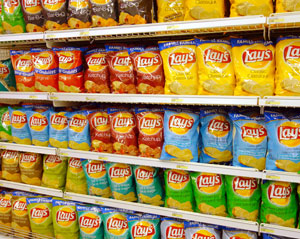
I entered the Lay’s Do Us a Flavor contest several months ago. I thought I came up with some great flavors, but apparently they weren’t good enough, because the finalists have been announced and I didn’t make the cut. The finalists are New York Reuben, Southern Biscuits and Gravy, West Coast Truffle Fries, and Greektown Gyro. Three of the finalists get $50,000 and their names on the bag and the winner gets … $1 million! The chips are now in stores, and you can vote for your favorite at the official site.
For the record, I’ve tried all four and the chips I’d eat again are the Truffle Fries.
Earth’s Twin

Pack your bags, it’s time to move to another planet!
Okay, maybe we’re not at that point yet, but NASA’s powerful Kepler telescope has discovered what they’re calling the most Earth-like planet yet. It’s called Kepler-452b, and it’s 1,400 light years away, so it’s not going to be something we visit while on a Sunday drive. But NASA scientists are quite excited. The planet is bigger than Earth, but its year, 385 days, lasts about as long as our year. It probably has water and mountains, and since its distance to a nearby star is similar to the distance between Earth and the sun, it would feel a lot like our planet. Hopefully we’ll come up with a better name for it though.
By the way, do people still go on Sunday drives?
Adult Coloring Books?
No, not that kind of adult coloring book. Get your mind out of the gutter!
According to bookstores and publishers, coloring books have suddenly become popular among adults, especially those born after 1980. They’re not really the types of coloring books your 5-year-old might color in; these are more based on designs and patterns. Maybe people are just looking for something that reminds them of their childhoods, or maybe they simply find it fun and relaxing. I just noticed that there’s an entire Amazon category dedicated to adult coloring books, and they sell rather well.
This makes sense to me. People love to doodle or scribble things down to either relax or figure things out, and who says that the activity of coloring has to be a kids-only thing? Hey, I like watching cartoons.
If You Make a Call With Your Butt, Don’t Expect Any Privacy
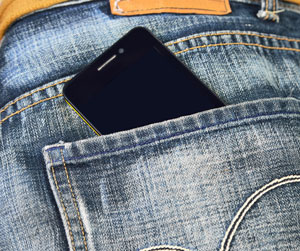
Everyone eventually has cell phone problems. Maybe your reception drops right in the middle of a phone call or your battery dies, or maybe you’re a famous quarterback and you destroy it and have to get another one. But there’s also the common ailment of “butt-dialing.” That’s when you sit on your phone and accidentally call someone. It can be embarrassing because the person you call can often hear what you and your friends are saying and the caller doesn’t even realize they’ve called someone.
And now we have an official ruling from a Cincinnati federal appeals court: If you do butt-dial (or pocket-dial) someone you can’t have a reasonable expectation of privacy.
It’s funny how modern technology — whether it’s cell phones or drones or social media — has created all of these problems that we would have never thought of before. In the era of landline phones, you couldn’t butt-dial anyone. Well, you could, but it was very, very difficult.
Today Is National Jump for Jelly Beans Day

Did you know that there are recipes for Jelly Belly jelly beans? I don’t mean a recipe to make the jelly beans, I mean mixtures of Jelly Belly jelly beans that create the flavor of something we all know and love? For example, if you mix two blueberry Jelly Bellys with a buttered popcorn Jelly Belly, you get the taste of a blueberry muffin. If you mix two draft beer Jelly Bellys (yes, there are beer-flavored jelly beans) and a red apple, you get Apple Cider Shandy. There’s a whole list of recipes at the Jelly Belly site, or you can experiment to see what you come up with.
There’s even a combination of jelly beans that will give you the flavor of a banana split, but I’ve seen less complicated physics equations, and you have to shove a half-dozen of them in your mouth at the same time.
Upcoming Events and Anniversaries
President Harding dies (August 2, 1923)
Here’s the story behind Harding’s infamous Teapot Dome scandal.
First issue of The Saturday Evening Post published (August 4, 1821)
Here’s a selection of some of our earliest covers.
Lizzie Borden’s parents found dead (August 4, 1892)
Anne Frank captured (August 5, 1944)
The Anne Frank Museum in Amsterdam has an official web site where you can learn all about her.
Hiroshima bombed (August 6, 1945)
An interesting article from the SEP archives: “How to Survive an A-Bomb Blast”.
Lucille Ball born (August 6, 1911)
Speaking of Lucy, that scary statue is still up, but it will eventually be moved and replaced with a new one.
Long Gone
Sam flinched as a rivulet of rainwater soaked through the tarpaulin roof of his cardboard shack and inched its way down his neck. He tipped the pint of whiskey and waited in vain for a drop of warmth to land on his tongue. One dry thing in the place, and it had to be his bottle. The ground shuddered, or was he unsteady? He decided to visit the strip mall and find a place to hole up until the storm passed.
A year ago, Sam had stumbled upon this spot — a copse of trees thick enough to hide his shack from prying eyes, yet close to stores and dumpsters. After winters up north, Florida seemed like paradise. But now they were clearing his woods, breaking ground for condos. He was still hidden from the mall, but visible from the construction site on the opposite side.
By the time Sam reached the mall, rain streamed from his clothes. His fingers gripped a soggy $5 bill. As he pushed open the door to the liquor store, a buzzer sounded. The owner glared. “Show me your money.” Sam held up the grungy five spot. “Get your bottle and leave. You smell like the Swamp Thing.”
Sam grabbed a quart of Red Bird wine, resisting the temptation to twist off the cap and have a swig. The owner snatched the grubby five from his fingers, thought better of putting it in the cash drawer, and dropped it on the counter. He gave Sam a few cents change and said, “Now beat it.”
Sam kept his eyes down. “Could I stay a while? There’s no other customers.”
“You’re stinking up the store. Go back to that palace of yours.”
“The ground’s shaking.”
“Look, old timer, you’re the one shaking. Drink your wine and go to sleep. Maybe when you wake up the sun will be out.”
Sam slid the bottle into the pocket of his sweat pants and returned to the rain. The pizza joint was lit up, so he sloshed down the sidewalk. A gust of wind rattled the glass door and propelled him into the store. Setting down a cell phone, the pie man said, “If it isn’t Sodden Sam. Make it quick, the boss just told me to close up.”
“Any pizza left?” Sam asked, staring at a platter with two slices on it.
“Any money?”
Sam rummaged in his pockets and let his few coins rattle on the counter. “What will that buy me?”
“A piece of bubble gum, if I sold it.”
The wind howled and a bang came from the kitchen. “That damn back door will tear right off its hinges some day,” the counterman said. “Be gone when I get back.” He tipped the slices into the trash and moved through the swinging door into the kitchen.
Sam opened the front door, banged it closed, but didn’t leave. Instead, he dropped to his hands and knees and crawled behind the counter, below the sight line of the single window in the kitchen door. He eased open the trash and pulled out the slices of pizza. When he reached for a napkin, he spotted the cell phone. Sam slid it into a pocket, and crawled for the door, his meal clutched in one hand.
Back in his hut, Sam felt much better. Alternating mouthfuls of pizza with gulps of Big Red he could almost forget how wet he was. Licking the last of the tomato sauce from his grimy fingers, he pulled out the cell phone. He ran his finger across the words “slide to unlock.” The screen filled with colorful badges. He flipped the phone over. There was the picture of an apple he was looking for. Benny had shown him one like this and promised $50 for every one he brought him. And the pie man deserved it, throwing food away rather than giving it to a hungry man.
Drowsy, Sam lay back on his cot. He found a picture of a flashlight on the phone and tapped it with his finger. A beam lit up his leaky roof. Amazing. This would come in handy as he needed to tap a kidney.
Sam was nearly done watering a tree when the ground gave a violent lurch. He pointed the phone at his camp just in time to see his worldly possessions disappear into the earth with a great, sucking whoosh. He waved his arms in disbelief and the phone shot from his hand. It landed no more than five feet in front of him, quivered, and was lost in the rapidly expanding hole.
Half crawling, half running, Sam stumbled through the woods, low branches whipping his face and arms. Gasping for air, he burst into the service alley behind the strip mall. Rain pummeled him, drops smashing into the pavement and bouncing past his knees. Where could he find shelter?
He ran blindly, until he smacked his head on the lift bar of the liquor store’s dumpster. He raised the lid. Unlike the pizza parlor’s, there was no rotted food in this one. And it was almost watertight. If he stayed near the center, he would be dry. Sam climbed in and lowered the lid after himself. Thanks to the wine, he slept, his dreams a tumult of sirens and voices booming through megaphones.
The Florida sun heated the dumpster and woke Sam early. The morning was as beautiful as the night had been ugly. Climbing out, he was amazed to see that the strip mall had been turned into a staging area for emergency vehicles. Every type of fire truck, ambulance, and police car was parked, many with lights flashing. Sam did what he usually did when confronted with authority. He skulked away.
His feet carried him toward the town doughnut shop, even though he had been barred from the place. The smell of hot coffee and sugary grease had him salivating by the time he reached it. A sign on the glass door read, “Under New Management.” Maybe his luck was changing.
Sam slithered inside and hunched his shoulders, ready to be challenged. But everyone, customers and workers alike, were standing at the counter, staring at the television mounted on the wall. Sam was more hungry than curious. He darted from table to abandoned table, scooping pastries from trays and stuffing them into his pants. Grabbing the biggest container of coffee he could find, he eased toward the exit. A wallet sitting in an open purse hopped into his pocket. He stopped to take a newspaper and that was nearly his undoing. A uniformed policeman opened the door just as Sam reached it. To Sam’s surprise, he stepped aside and waved for him to pass. “Hurry up, Bud. My unit’s been up all night and they’re jonesing for coffee.”
Sam ducked under the officer’s arm and scuttled down the street. He flopped onto a park bench where he inhaled a croissant and a scone, washing them down with liberal jolts of black coffee. Then he turned to the newspaper. The front page made him spill what was left of his drink. “Mega Sinkhole Swallows Site — Homeless Man Feared Dead.”
Sam wondered if he were dead, and that was why no one had seen him filch his breakfast. Then he remembered the door-holding policeman. Reading more, he learned that there was a massive rescue operation underway. The pie man, whose name turned out to be Gino Barretti, said that he had activated the Find My Phone app on his home computer. When he gave the police the coordinates, they realized the phone and presumably Sam were in the sinkhole. Gino reported that he had given Sam a free meal and was surprised that he had taken his phone.
The liquor store owner commented on how friendly Sam was. He said he had offered to drive him to a shelter, but Sam had refused. Others, people Sam had never heard of, were quoted as having conversations with him on a daily basis. Everyone agreed that he was a wonderful person, temporarily down on his luck.
Sam knew he should turn himself in, save the community the expense of trying to find his remains. But he liked being spoken of so fondly. Maybe some of these clowns would be nicer to the next down-and-outer they ran into.
He used the newspaper to conceal the wallet from nosy eyes. The billfold held three 20s, and there was a fourth hidden behind the owner’s drivers license. Sam pocketed the money, crumpled the wallet inside the newspaper, and deposited it in the nearest trash bin. Then he headed for the bus station. Before the authorities reached the bottom of that sinkhole, he would be long gone.
The Slow Emergence of the Women’s Vote
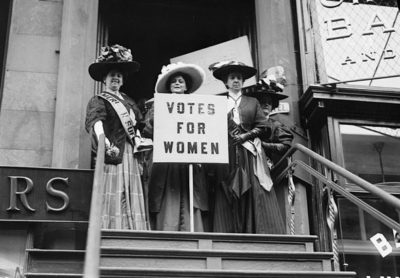
(Image courtesy of The Library of Congress)
The year was 1920 and U.S. politicians were worried.
Women had set aside their differences in income, education, and background to win the right to vote. They’d applied pressure to legislators and built support among the American public. Now, having achieved suffrage with the 19th Amendment, there was no telling what they might do next.
Some men feared women would take over the country’s political system. If women voted together, as a bloc, it would outweigh the male vote that was divided mainly between the Republican and Democratic parties.
To prevent women voters from creating a political party of their own, Republicans and Democrats began recruiting women. They also supported legislation on what we’d call “women’s issues.”
For example, Congress passed the Sheppard-Towner Act of 1921 to help reduce maternal and newborn deaths. At the time, one in five infants died in their first year, and childbirth was the second leading cause of death for women. The new law provided federal funds to help states establish maternal and child health centers.
The bill was originally introduced by Jeanette Rankin, the first woman elected to Congress, but in 1921 it was voted down by 39 members, including the only woman holding a seat in Congress in 1921, Alice Mary Robertson.
It soon became apparent there would be no women’s bloc. Having won the right to vote, the women’s coalition broke apart. In subsequent elections, women’s voting patterns were nearly indistinguishable from men’s.
Realizing they didn’t need to pass targeted laws to obtain women’s votes, politicians ended the funding for the Sheppard-Towner Act in 1929.
In the following decades, women seemed to make little progress toward the equality suffragettes thought the vote would bring them.
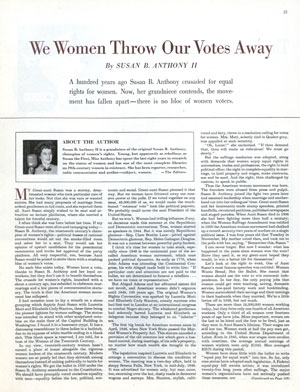
In 1948, the grandniece of Susan B. Anthony looked back at what women had accomplished politically since women’s suffrage passed and was not impressed. As she concluded in her Post article, “We Women Throw Our Votes Away.”
“Women have frittered away our massive power at the polls,” Susan B. Anthony II wrote. “If we voted together on any issue … we probably could name the next president of the United States. … Our economic, political, and social position is only slightly better now than it was in 1920, when we got the all-powerful vote. The right to vote, in fact, is the only unqualified victory we have gained in a century.”
Because they wouldn’t cast a united vote for their rights, Anthony wrote, America’s women were barely represented in the government and in the workplace.
Much has happened since Anthony’s Post article. While women still don’t enjoy full, legal equality, there have been significant changes.
- “Women … form only one-fourth of all American workers,” Anthony wrote in 1948.
- According to the Department of Labor in 2010, 47 percent of America’s work force is female.
- “Women work at half the pay men get.”
- “About half of our hospitals don’t take women interns or let them hold staff positions.”
- “There are more than 50 men lawyers in the country for every woman lawyer.”
- “Only seven women sit in Congress today; men hold the 524 other seats.”
- In the 114th Congress, 104 of the 535 members are women; 84 women in the House of Representatives, and 20 in the Senate.
- “There are 7,500 state legislators in the United States, but fewer than 200 of them are women.”
- Nearly 1,800 women served in state legislatures (7,383 seats available).
There are several explanations for these changes. One would be a gradual shift in thinking about gender roles. For instance, many Americans began to rethink their ideas about women’s capabilities after seeing them take over men’s jobs during two world wars.
Another change was a shift in women’s voting. Beginning in 1952, Gallup polls noticed a 10 percent difference between men’s and women’s voting patterns in the presidential election.
Politicians realized they could no longer count on gathering women’s votes with the same appeal that worked for male voters. At least the presidential candidates would need to address women’s concerns.
The gender gap narrowed to 4 percent in 1992, but rose to 11 percent when Bill Clinton ran for re-election. By the 2012 election of President Obama, it had grown to 20 percent.
Today, women are not only becoming more independent in politics, they are also voting in greater numbers than men. But they are still a long way from flexing enough political muscle to obtain legal equality. American society can be highly resistant to change. Keep in mind that all the progress noted above took place over more than 60 years. And while the gender gap in pay continues to shrink, the change is coming at glacial speed. If it continues to narrow at today’s rate, it will take over 120 years before women earn equal pay for equal jobs.