How Technology is Driving Americans Toward Faith
“Tell me one last thing,” said Harry. “Is this real? Or has this been happening inside my head?”
Dumbledore beamed at him, and his voice sounded loud and strong in Harry’s ears even though the bright mist was descending again, obscuring his figure.
“Of course it is happening inside your head, Harry, but why on earth should that mean that it is not real?”
—J.K. Rowling, Harry Potter and the Deathly Hallows

What is it about this moment in time that supports the enormous growth in belief in a personal God? After all, in the mid-20th century, most social scientists thought spiritual faith would simply disappear.
In scientifically oriented and culturally diverse societies, these scholars argued, religious allegiance became voluntary. Spirituality was thought to have become a consumer good that adherents would sample and discard as if they were buying cosmetics in a department store aisle.
And so these midcentury scholars assumed that faith would soon diminish or disappear. They anticipated a church retracting its claims to supernatural miracles and pulling back its commitments to God’s creation, in the face of geology and evolutionary theory. They predicted that in an open society, Jesus would become understood as a wise but human teacher whose life story had been embellished by myths and metaphors.
We now know that those scholars were wrong. There are pockets of liberal Christianity left in America and in Europe, but Christianity around the world has exploded in its seemingly least liberal and most magical form—in charismatic Christianities that take biblical miracles at face value and treat the Holy Spirit as if it had a voltage. This kind of supercharged God is the vehicle through which Christianity spreads most easily, and it has been stunningly successful. A few years ago, Newsweek found that nearly 40 percent of Americans said that the main reason they practice religion is “to forge a personal relationship with God.” There are still theologically conservative Christians who do not believe that God will speak back; they still hold, as they put it, that revelation is “closed.” But membership in charismatic congregations has exploded since the 1960s while mainstream denominations have seen their membership plummet relative to the population size.
This history tells us that the liberal Christian God has failed. The mainstream churches are often empty now, their pews unfilled, their hymns unsung, while the churches of the supernatural God blaze with life. For most Americans—and for many people around the world—understanding God in a de-supernaturalized way just doesn’t keep them in their seats on Sunday morning. But the way conservative Christianity has changed is just as striking. For perhaps half or more of those who call themselves born-again, their God has become more supernaturally present than he was in the days when the fundamentalists first set themselves apart. The miracles are no longer true only in the past. They are true now, and any congregant can encounter them.
What makes this conception of God so successful in a late modern world? Why does it bring people to church and keep them there? Part of the answer is the intense attention this intimate and personally real God demands. In these experiential evangelical churches, the way Jesus and God are imagined insists that a congregant pay constant attention to his or her mind and world, seeking God’s presence, listening for something God might say.
This person-like God can comfort, like a friend, and respond directly, like a friend. He can be a real social relationship for those who make the effort to experience him in this way. But because that social relationship lacks so many features of actual human sociality—no visible body, no responsive face, no spoken voice—such a theology demands constant vigilance from those who follow it. They work to build up a model of God by interpreting it out of their own familiar experience in a way shaped by the social world of the church and the sacred text, and then they work to reorient their own interior emotional responsiveness by matching it to this representation. Faiths that imagine God differently make fewer demands on attentional habits. But it may be, perhaps, that such a God is easier to take for granted. Paradoxically, this high-maintenance, effortful God may appeal to so many modern people precisely because the work demanded makes the God feel more salient. More real.
At the same time, the practice of this attention may produce actual perceptual evidence of God’s presence. As congregants learn to pray and to practice prayer, they sometimes experience God with their senses. They may feel the touch of his hand or the sound of his voice; they may catch a glimpse of a vision he wants them to see. Such experiences cannot be willed, and the more sensory they are, the more rare they become. Those rare moments can be quite powerful, even transformative. When someone hears God—directly hears, with his ears—say “I will always be with you,” it can make God real in a way that feels definitive. The more common but less powerful sensory moments when you sense God’s presence, feel his response, have a thought pop into your mind that you know comes from him—these experiences make God come alive in a way no sermon can match.
This way of paying attention shifts the reality of God into a form grasped by the mind and experienced in the mind, and that too has consequences. God becomes more real—you heard him speak—but also more private.
Here, for example, is the way one woman describes her response when someone else reports what God has said to him or her: “You know, if that’s what someone else is experiencing, I can’t discount that experience. I might see different ways in which they might be thinking from a falsehood rather than a truth, but it’s fundamentally up to them to decide what they experience or didn’t experience or feel or didn’t feel.”
This woman is sharply aware that because God speaks to each in his or her own mind, as an observer she will never really know whether God spoke to someone else and, if so, whether that other person interpreted God accurately. “Prayer is often an introspective conversation,” she told me. “You know, I am asking my conscience, which is really the Holy Spirit, ‘What do you think about this idea?’”
Almost every Christian I met tells other people straightforwardly and unambiguously that they are Christians and that they believe in God. And yet every one of them, when talking among themselves or at the end of an interview with me, uses expressions that acknowledge an acute consciousness that their belief has a complicated relationship to the everyday world in which they live.
One evening as women gathered for prayer group, all of them long-standing and firmly committed members of the church, Susan regaled us with a description of her afternoon. She told us that she had seen her 5-year-old daughter outside in the pool without her floaties, those air-filled pillows that beginner swimmers wear on their arms, and ran to yank her out. “She said to me, ‘Mom, if I had gone down to the bottom of the pool, God would have whispered into your heart and told you I was down there.’” Gales of laughter from the women. “I wanted to say,” Susan went on, “‘Honey, I know this God. You wear your damn floaties.’” More riotous laughter.
A woman who had recently dumped her boyfriend for bad behavior gasped that we all need floaties. A different woman, finding this vaguely sacrilegious, said piously that we should all believe in God like that little girl. But another woman responded, “Yeah, I dunno, I think those floaties aren’t a bad idea.” Nor was that kind of laughing ambivalence so uncommon. After a bad week, the woman who had convened the group—a deeply devout woman—opened the evening with this: “I don’t believe it but I’m sticking with it. That’s my definition of faith.”
It is my belief that the God of the late 20th and early 21st century has become imagined as magically real because that way of imagining God helps those who wish to hang on to God manage the doubts that surround them. This God is so real, so accessible, and so present, and so seamlessly blends the supernatural with the everyday, that the paradox places the need for the suspension of disbelief at the center of the Christian experience.
A great deal of sociological data also suggests that the American experience of relationship is thinner and weaker than in the middle of our past century. Sociologist Robert Putnam’s landmark book, Bowling Alone, documented the decline of civic engagement in the United States. He makes the case that American citizens have become increasingly disconnected from friends, family, and neighbors. His data also suggests that American citizens might feel more lonely. They are certainly more isolated. More Americans live alone now than ever before.
Meanwhile, the radical technological innovations of our time have fundamentally altered the conditions of our perception and the very way we experience the world. Television, the virtual reality of the Internet, and the all-encompassing world of music we can create around us are techniques that enhance the experience of absorption, the experience of being caught up in fantasy and distracted from an outer world. We put on headphones on buses and subways specifically to create a different subjective reality from the frazzled one that sways around us. We park our children in front of videos so that they will be absorbed into their own little universes, and we can cook or clean around them undisturbed.
These social changes have facilitated the modern faith practices that build an intensely intimate relationship with God. Our strange new absorbing media probably make us more comfortable with intense absorption experiences. As we switch our DVD players on and off, we practice living in multiple realities. And it seems quite likely that the closely held sense of a personal relationship with God, always there, always listening, always responsive, and always with you, diminishes whatever isolation there is in modern social life. The route to this God is complex and subtle, at once childlike and sophisticated, drawing on skills and practices found throughout human history but doing so in a form specific to this time and space. It is a process through which the loneliest of conscious creatures can come to experience a world awash with love.
Watch videos of Luhrmann discussing her research here.
From When God Talks Back: Understanding the American Evangelical Relationship with God
Transformed in Cork, Ireland
Twenty years ago I rafted the Colorado River in the Grand Canyon. For 16 days, we dug our paddles through the crest of frothing waves and hiked up to side canyons with names like the Silver Grotto and Vasey’s Paradise. I camped out and stared up at clusters of stars so close I could almost grab them, and awoke to the sound of bighorn sheep clacking horns. I’d never felt more free or happy in my life, so when I came back to NYC, I shed a husband who was not interested in having adventures, sold my film production company, and became a freelance writer.
These days, I crisscross the country and circle the globe, often writing about the best suites of the most luxurious hotels, the swankiest restaurants, and the hottest in-spots. If there comes a day when I have to slow down, lay down or die, I hope people will say, “Remember how Margie Goldsmith went everywhere and did everything? Wouldn’t that be fun?

Source: Shutterstock.com
I lay on my back on a cold stone plinth in the Irish countryside in Country Cork waiting for something to happen. The coffin-sized slab was part of James Turrell’s Sky Garden Crater, an artwork built on a prehistoric site and said to be a transformative experience. Ireland’s ancient earthworks have always resonated with me, especially Newgrange in County Meath, a 5,000-year-old megalithic mound where, on the winter solstice, a beam of sunlight creeps across the floor to the end of the passageway.
I looked up at the blue sky and watched the clouds float across it. The slab was at the bottom of a crater surrounded by a grass wall, like a green womb. I closed my eyes and breathed slowly, but I still didn’t feel transformed. After half an hour, I still felt nothing so I gave up.
To get out of the crater, I had to go back through a dark, dingy tunnel–which I didn’t want to do–so instead, I climbed to the top of the hill. From my bird’s-eye view the whole thing looked like a sacrificial spot but not much else. Why did so many people rave about it? What was all the brouhaha about? I pulled out my harp–not the golden harp with silver strings, Ireland’s coat of arms, but a blues harmonica whose gritty notes wafted into the air and took away my disappointment.

Later, as I finished dinner at Liss Ard, home to Terrell’s giant earth and stone work, the general manager approached and asked if I’d had a chance to visit the Sky Garden. Did I like it?
I loved it, I lied. Why couldn’t I tell her it was like the Emperor’s New Clothes?
“It’s extraordinary at night,” she said. “Do you want to see it in the dark?” I nodded. Maybe the dark would make the experience transformative.
Carrying bamboo kerosene torches, we walked along the driveway; under an arch; down the stairs; past the pond; along a forest trail through the dark tunnel; and down the steep stairs to the plinth. We blew out our torches and lay foot-to-foot on the stone slab. Neither of us spoke. I stared up into the inky darkness but it was too cloudy to see stars. After a few minutes it began to rain. “Oh, what a pity,” she said.
We made our way back to the country house. “What exactly are you supposed to feel when you’re there?” I asked.
“It’s personal,” she said. “But if we could only see the stars, it would really be something.”
I sure didn’t come all the way to Ireland to see the stars, so I said “There’s live music in town. Would you like to go?”
I love Irish music, especially the uilleann pipes and Bodhran drum. Unfortunately, by the time we got there, the town of Skibbereen was closed down except for one pub. Inside was a bartender and a three-piece band playing soft rock. “Hey,” the guitar player said as we entered, “Can either of you sing? We need a female singer.”
We both shook our heads and took seats at the bar. The band launched into Neil Young’s “Down by the River.”
“Don’t stay at the bar,” the guitar player said, “Come sit here.” We pulled up chairs and they played Van Morrison’s, “Brown Eyed Girl.” The guitarist asked, “Are you sure either of you don’t sing? We really need another vocalist.” Again we said no. “That’s too bad,” he said.
They played the introduction to Paul Butterfield’s “Born in Chicago,” a song I’d been practicing for the last month. Without thinking, I pulled my harmonica from my pocket and held it up. “I can’t sing,” I said, “but if you play in the key of A…”
“Go way outa that!” The guitarist’s grin was so wide I figured what he’d said was a good thing. I started playing softly, but when it came to the harp solo, I let loose.
“Jasssus, go,” the guitarist said and pushed the microphone toward me. I cupped it with my hands, closed my eyes, and wailed.
They begged me to play a second song and then a third. And maybe it was because I hadn’t felt anything special at the Sky Garden, or maybe it was because I was in a pub in the middle of nowhere, but whatever it was, for me, playing the blues with the Skibbereen boys in Ireland was a transformative experience.
Spring Covers: A Perennial Favorite
The spring equinox occurred weeks ago, March 20 to be exact, which means this winter’s tale has (finally!) come to a welcome end.
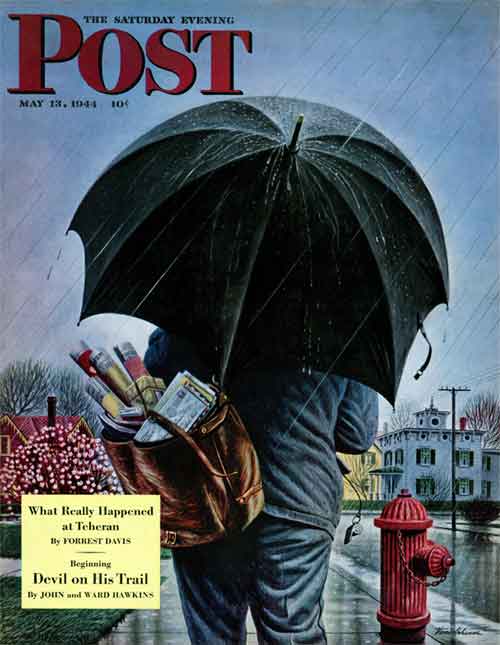
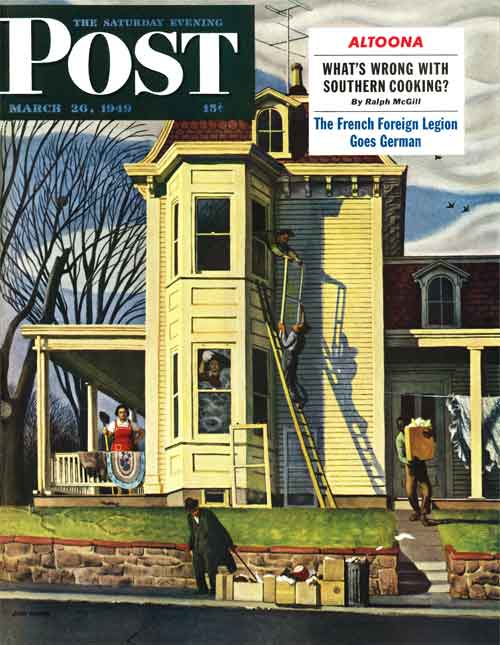
Here at The Saturday Evening Post, we have historically welcomed each spring with delightful covers from some of our greatest artists and illustrators, each cover offering a different take on varied spring themes. The following three covers show the range of springtime weather, and the ways we take advantage (or don’t) of the change in season.
The most prevalent activity of spring is the tending of of gardens. In Thornton Utz’s, “Spring Yardwork” from May 18, 1957, the viewer sees an entire neighborhood planting, watering, mowing, mulching, raking, and so on and so forth down the straight line of synonymous 1950s homes.
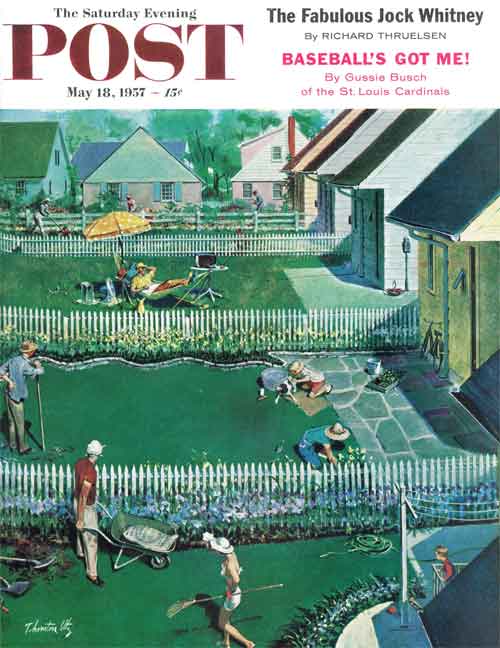
At the far end of the street, we view a man sunbathing in a yard completely lacking any cultivation. There are no perennials, no sprouting annual bulbs planted the previous fall, and he is not planting for the summer harvest. If anything, the old parable of the grasshopper and the ant comes to mind.
The lazy grasshopper homeowner at the far end looks out jealously from his lawn chair and barren yard to see the fruits of his ant neighbors’ labors. It’s not too late for him to make hay while the sun shines, but he looks awfully comfy drink in hand.
From sunshine to April showers, “Mailman” by Stevan Dohanos, which appeared on the May 13, 1944 issue, shows a devoted neighborhood staple, the rain-or-shine employees of the United Sates Postal Service completing his daily duties in a solemn, light afternoon shower. The mailman is an American ideal of civil service, the difficulty of his responsibilities unknown to those who conveniently find their mail waiting, as if by magic, in their mailboxes.
In contrast, “Spring Cleaning” by John Falter, from the March 26, 1949 cover, shows people who, unlike Dohanos’ mailman, have the luxury of finishing their chores on a beautiful, sunny day. Most would rather have fun on a sun-kissed afternoon, but completing a task in good weather is certainly preferable to the rain.
This season has much to offer, so take advantage! It’s time to head outside, to enjoy warmer weather, to plant our gardens, and to take charge of our spring-cleaning procrastinations (or eh, maybe next year). This season of early awakenings only comes once a year, so make sure to take a moment and appreciate this singular spring season.
The Man Behind Hazel
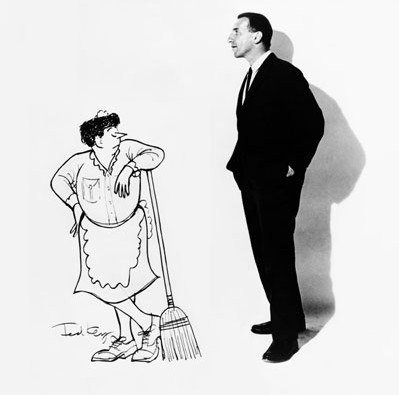
Hazel with her famous creator Ted Key.
Images courtesy Peter Key
© The Estate of Ted Key. Used with Permission.
Ted Key was born Theodore Keyser in 1912. By the middle of the 20th century, his Hazel cartoons were arguably the most popular single feature in The Saturday Evening Post, better known even than Norman Rockwell’s famous illustrations.
In 1961, Hazel was transformed into a TV show that ran for five seasons with Shirley Booth in the lead role.
Not just a cartoonist, Ted Key wrote the stories for three Disney movies and the script for one, The Cat from Outer Space; he wrote four children’s books, one of which was made into the movie Digby, the Biggest Dog in the World; and he created a long-running series of inspirational posters for corporate clients.
Along the way, Key invented a raft of lovable characters, from Diz and Liz–featured in a long-running cartoon in Jack and Jill magazine, a sister publication to the Post–to Johnny Daydream and his pet Beware the Dog. If you haven’t heard of the latter, it’s because by the time they aired on television in 1959 as part of Rocky and His Friends they had become Mr. Peabody (the time-traveling dog scientist) and Sherman (his adopted boy). The pair soon gained their own cult following and hit the big screen earlier this spring in DreamWorks Animation’s Mr. Peabody & Sherman.
Ted Key passed away in 2008, but his wit and his characters occupy a permanent place in our collective memory. Late last winter, The Saturday Evening Post met with Peter Key, the youngest of Ted’s three sons, to ask about life with his famous dad.
The Saturday Evening Post: As your dad once wrote, he wasn’t really proud of Hazel as she first appeared, but she morphed into something wonderful. Can you recall her evolution?
Peter Key: Well, this happened before I was born. But he always said the idea came to him in a dream. At first, Hazel was skinny and not too bright, the kind of maid that got everything wrong. The cartoons worked; they sold right away. But he didn’t like her being stupid. Gradually she got smarter and more full-figured. And in the process, Hazel became a much more interesting and endearing creature.
SEP: What does this say about your dad?
PK: He truly was a very nice guy. He seemed to get along with everyone. He would chat up bank tellers, people at the post office, the mailman.
SEP: No dark side at all?
PK: I remember him getting angry at stupid stuff we kids would do. But, no, he really didn’t have a dark side.
SEP: Where did the name Hazel come from?
PK: My dad maintained that the name Hazel came “out of the blue.” But, funny story, he later found out that Bob Fuoss, then the managing editor of the Post, was given the silent treatment by his sister for three years when the cartoon first started running. Her name was Hazel, and she thought Fuoss had selected the name to ridicule her.
SEP: Your father worked for the Post for many years. Did he ever meet Norman Rockwell?
PK: For a few years, he submitted ideas to the Post for Rockwell covers.
SEP: Were his ideas used?
PK: Well, yes, but Rockwell didn’t like having cover ideas dictated to him. So, it was a bit of a dance. My father would sell cover concepts to Ken Stuart, the art editor at the time. Then Stuart would call Rockwell and ask him what he was working on. Rockwell would tend to say he had several projects going, but if he wasn’t specific, Stuart would run my dad’s ideas by him, and typically Rockwell would reject them all. Then a few weeks later Stuart would call Rockwell and again ask what he was working on. Rockwell would say, “Oh I have this great idea!” and it would be one of my dad’s concepts. In fairness, Rockwell always made these ideas his own.
Purchase the digital edition for your iPad, Nook, or Android tablet:

To purchase a subscription to the print edition of The Saturday Evening Post: 
The Obsession

The bus was late, today of all days. Might not make it before Bailey’s closed at 5:30, better walk instead. Each footstep on the rain-soaked cement mocked him like a giant pocket watch in slow motion—step, tick; step, tick; step, tick. He felt he’d gladly sell his soul to the devil to buy a few minutes.
He half-walked, half-stumbled past each familiar landmark—the old Vietnamese woman with her flower stand, 5:05; Mrs. Kasick walking Tony, the deaf poodle, 5:07; Abraham and Mohammed arguing politics over espresso at the café on 15th and Broad, 5:08; the jazz trio practicing in the basement of the old Freemont Hotel, 5:10. And finally at 5:15, there it was, the shining beacon that burst through the fog of his anxiety, the plate glass window of Bailey’s as it mirrored the orange and cobalt layers of twilight behind him.
But would she still be waiting? What if someone had gotten there first and fallen in love as he had? Although she’d arrived several weeks ago, the minute he’d laid eyes on her bewitching curves he knew in his soul they were destined to be together. Each night thereafter, her black and white contours transformed his dreams like something out of Casablanca.
He tremblingly crossed the threshold, held his breath, and cast a gaze toward his prize. Horror of horrors—she was gone. She had been right there, in the corner like a shrine, below the stained glass panel with the blue and gold angel, his good-luck omen. As he marched over to the sales desk to demand the name of the infidel who’d stolen his treasure, he caught a glimpse of her, looking forlorn in her unaccustomed spot next to the men’s room.
He approached her reverently. His ink-stained hands caressed the smoothness of the lid and almost shook as he ran a finger silently across the keys. He sat down at the bench and tried the pedals.
Benton Bailey, Jr., materialized almost magically next to him. “How are we doing today, Mr. King?”
“You moved her.”
“We had to rearrange inventory to make room for a new shipment. But she’s still here, waiting as usual. I was afraid you weren’t going to make it today. You’ve really taken a shine to this one, haven’t you?”
“The Yamaha wasn’t quite right. This little Steinway, though…” His voice trailed off, choked with emotion. “Mr. Bailey, sir, I think I’ve decided to take her.”
Bailey’s smallish eyes widened, and with his needlepoint nose and jaw hanging open, King thought he looked a little like a cod. King carefully counted out a wad of hundred-dollar bills. “Will this be enough for the down payment?”
Bailey beamed, “This is plenty for a down payment. But I thought your wife—”
“She’ll get used to the idea.”
He knew what her reaction would be. The blazing eyes of a Chinese dragon, disapproval oozing out every pore, hands on her hips where he swore they’d become permanently affixed as if by superglue. Her state of perpetual anger had transfixed her face into a wreath of wrinkles, all pointing downward toward the eternal fire and damnation where she was certain he was headed.
In his wallet he kept a picture of her from the days when they were dating, the blue-eyed smiling nymph with the auburn hair and a wicked sense of humor. He looked at it from time to time to remind himself that the demon now haunting his days had once possessed human form.
*****
On the walk home he felt like dancing. Let them mock. Tell him what a fool he was. He knew the angel in the stained-glass window wanted him to have the piano, and you just don’t argue with divine intentions.
When he was eight years old, he’d wanted a piano, or at least piano lessons. But his father refused. He said “music is for pansies” and forced his son to play football instead. And how King hated football. He could still taste the resentment filling his fragile boy psyche with acid memories that ate away at his self-confidence far into his adult years. Even now, as he longed to feel the cool sensuality of the ivory and ebony keys underneath his fingertips, he imagined his father’s stern lectures raining down on him from the cloud tops above.
Disapproval, disappointment, disillusionment. The three daughters, he called them, the fruit of his sorry existence. His flesh-daughters, Rachel and Renée, were their mother’s creation, springing like lemon trees from the manure-laden soil she’d so thoughtfully provided.
The trio of harpies, wife and daughters, were waiting when he climbed the three flights to his apartment. He’d hoped when he married them off, his children would move away and make a new life with husbands and children. And move, they did. About half a mile. He secretly wondered if the reason they spent so much time with him and their mother was at the encouragement of the exasperated husbands wishing for some respite of their own.
Rachel and Renée shared everything with their mother, including laughing away his dream of owning a piano. And so with great pleasure the first thing he told them coming through the door was, “I made a down payment on a piano.”
Silence. The ambient temperature seemed to drop ten degrees. Rachel chimed in first. “You’re kidding, aren’t you?”
He shook his head, sat down in his favorite chair, and grabbed the Times.
Renee was next. “Oh, Father, you can’t be serious. You don’t even know how to play the piano.”
“I’ll learn.” The sports section needed some revamping, he thought, as long as they didn’t take out his favorite horseracing. The writing just wasn’t what it used to be, at least the non-football part. He never looked at the football scores.
His wife took her turn at bat. “We’ve talked about this hundreds of times. We can’t afford it.”
“I’ve saved some money.”
“You mean to tell me you’re wasting our savings on a measly piano? How about retirement? Vacations? Something to leave the kids when we’re gone? For God’s sake, we need a new couch.”
“I started a piano fund when I was a boy and I’ve added to it every year. I put it in a savings account, it accrued some interest, it’s not a fortune, but it’s enough. Checks from my high school days working at Carl’s Grocery, a Christmas bonus here and there, proceeds from the sale of the old rust-bucket Chevy and some spare change. They’re going to deliver it next week.”
They chimed in all at once.
“Where are we going to put it?” (Wife)
“You know, you’ve been getting a little senile lately.” (Rachel)
“You’ll bother the neighbors. And you’ll be the laughingstock of the block.” (Renée)
“You’re too old to learn to play the piano.” (Wife)
Too old to learn to play the piano? That was the final straw. He dropped the paper, drew himself up to his full five-feet-nine, while a force like Mount St. Helens erupted in his veins.
He did not shout. His voice was almost a whisper, but it carried to the darkest shadows in the cobwebbed corners. “For fifty years I’ve been listening to people tell me how to run my life. You’re aiming too high, they said. You’re not smart enough to be an attorney, they said. You need to settle down and get married, they said. And I did what was expected. I’m an honest man who’s worked hard providing for you three.”
He was just getting warmed up, his lungs working like the bellows of the tracker organ at St. Paul’s Episcopal. “There comes a time in every man’s life when he should run with the wolves, fly with the eagles.” His wife would say he was full of clichés, if not something worse, but he didn’t care.
He paused and jabbed his finger in the air like a conductor’s baton. “The piano will go over in the corner where the television is now, and if any of you don’t like it, you can simply leave. I pay the rent, I put the food on the table and I don’t want any more arguments.”
He sat back down in his chair and resumed reading. There were whispered exchanges behind him, and then the door closed gently. His wife settled on the sofa and pulled her knitting from its basket. The only sound was the clicking of her needles.
He got up, turned on the radio and was pleased to hear a Beethoven piano sonata. Another fine omen. Victories were few and far between in his life, but he had the feeling the angel in the window at Bailey’s was watching over him. The piano would look quite at home in that corner. Like a proud black thoroughbred after winning the Kentucky Derby.
Margaret’s Hero

Edward Kindy stood at his window and studied the crest of the ridge a mile away. He paid no attention to the budding trees, or the cloudless sky, or the grazing cattle sprinkled like pepper over the hillside. He was watching for a red Ford pickup. It wouldn’t be hard to spot–the hills and pastures were green, the sky blue, the dirt road a bumpy strip of brown.
And the two people inside the truck…He smiled as he thought about them. They were as different from each other as daylight and dark, those two, and yet alike in so many ways. For one thing, they were both children, though one was more than 70 years old. You had to be a child, Edward decided–at least in your mind–to do what they were hoping to do. Or even to try it. Edward wanted to share that hope; he really did. But he couldn’t. He was too practical, too realistic. And he knew Bud McAfferty far too well.
He sighed. The trip the two friends were making had been futile from the start, a complete waste of time. And the sight of the pickup wouldn’t even mean they were bringing home good news–it would only mean they had returned. Still, he stood there chewing his lip, watching for it.
After a while Edward checked the clock on his desk. He had a dozen other things to attend to. Unpaid bills, unanswered phone messages, a half-finished speech for the Rotary Club. There was even a burglary to be solved: Last night someone had broken into one of the equipment sheds and stolen some of his hunting gear. The first crime he could remember ever happening on the farm. And what was he doing about all these things? He was standing here at the window, like a schoolgirl waiting for her first date.
He ran a hand over his face, circled his desk, sat down for a full five seconds, then rose again and went back to the window.
Where were they?
IN FACT, EDWARD KINDY wasn’t the first man to stand at that window and stare out at the road leading to the top of the ridge. Edward’s father, and his grandfather too, had watched traffic–horses and wagons at first, and eventually automobiles–flow up and down that trail for almost a hundred years. For it wasn’t just the road to places like Bud McAfferty’s. It was the road to the outside world.
Nestled deep in the hills of Fulton County, Mississippi, Kindy’s Farm was as huge as it was prosperous. Technically, it could’ve been called a ranch: a rambling house, dusty yards and corrals, clusters of outbuildings, cattle as far as the eye could see. Edward’s father, Amos, even made a big thing of riding around the place on horseback all the time, checking on his holdings like a modern-day Ben Cartwright. Edward’s wife joked that they should call it the Pinederosa.
But here in the South in the late 1970s, it was merely a farm. The idea that “ranch” might sound a little more glamorous had probably never occurred to Amos Kindy–and even if it had it wouldn’t have prompted much of a reaction. The truth was, not many thoughts crossed Amos’ mind these days, and when one did, it didn’t stay long. Old Amos was a simple man, in both appearance and mentality.
According to those who knew him well, Amos Kindy was more lazy than dumb. He had never had to do much of anything, and as a result he didn’t do much of anything. He was blessed, however, as fools and laggards often are, with a guardian angel. In this case, three of them–his son Edward, his daughter-in-law Rebecca, and his foreman Gus Newberry. They ran the place, and together managed to keep old man Amos out of trouble and out of the poorhouse. Despite their current run of good fortune, neither outcome was ever far away, Edward knew. And he and Rebecca had more to worry about than just themselves and his father. There was now another reason for them to keep the business solvent and their future secure.
Her name was Margaret.
AT THE AGE OF 5, Margaret Elizabeth was the shining star of the Kindy realm. She was both clever and quiet, and had inherited the golden-haired beauty of her mother, a Delta girl Edward had met and married during their years at Ole Miss. An only child, little Margaret was admired by everyone who knew her, with the possible exception of Amos himself, whose only love was climbing onto his aging horse and loping through the pastures with a blank look on his face. Oddly enough, the one person who seemed to care about Margaret the most was the foreman, Gus Newberry.
Gus was a tall African-American man of indeterminate age, though most guesses put him in his early 70s. “I never really wrinkled a lot,” he once explained to Edward, “I just expanded.” And he had certainly done his share of that: Gus weighed in at 220 or so, and was still as strong as a bull. He had a bushy mustache and wire-framed glasses and seven identical pairs of bib overalls that he rotated throughout the week. Except for Sunday mornings, when he dressed up in a stiff white shirt and suspenders and a gray felt hat and drove the 15 miles to church, he always looked the same, right down to the blue baseball cap that sat squarely on a head of short gray hair.
A kind and loving man with a huge family, Gus Newberry was painfully aware of old Amos Kindy’s indifference to little Margaret. It just wasn’t natural, Gus thought. A grandchild was to be cherished, not ignored. She had the love of her parents, of course, but since her grandmother was deceased and her mother worked in town all day and Edward was always occupied with farm business, she was usually left in the care of a maid who had little time and less patience. At 5 years of age, Margaret was showing signs of becoming a sad and lonely child.
And then one day Gus asked Edward to let him take Margaret fishing. The two of them spent most of that afternoon with a pair of cane poles on the bank of the pond behind the main house, and afterward Gus took her along on his rounds. She was thrilled. The next day he let her ride the old mule he sometimes still used for plowing his personal garden, and the following week he taught her to feed the cows and plant okra and set the wooden poles for running-beans.
As the months passed the two grew ever closer. On most afternoons that summer–and almost every weekend–they went fishing or rabbit hunting. Together they built campfires and repaired fences and shucked corn and braided bullwhips, and sometimes spent hours just sitting on a log at the edge of the north pasture, talking about faraway places Gus had seen, like New Orleans and Atlanta. He took to calling her “Little Bit,” not so much because of her size but because of his, and she called him “Augustus”–a name that seemed to delight him, though no one else on the farm would have dared use it.
By the time she was 6, Margaret loved Gus Newberry with all the affection denied her by her grandfather, and the feeling was clearly mutual. The strange thing was, everyone seemed to approve of their relationship. Even here, in the heart of the Deep South, where racial tensions often ran as deep as the bottomless swamps along the river, the simple bond between these two people–one old and black and one very young and white–was accepted by all who knew them. On the rare occasions when someone asked Gus about it, his response was prompt and gruff and honest: There was nothing in this world, he said, that he wouldn’t do for little Margaret.
American Pop: Toilets to Die For

Let’s talk toilets. This most familiar of household fixtures has long been the butt of cheap cracks, off-color jokes, and a million indignities both foul and (admit it) funny. Who hasn’t hurled a juvenile remark in the direction of the common can?
Well, enough already. The toilet is getting its moment. Manufacturers are bringing it out of the closet and offering to consumers an array of gee-whiz thrones that transform everyday bathroom visits into an experience that can practically be described as “transcendent.” (OK, maybe we can agree on “pretty darn fine.”) Given the economics, it’s a wonder it has taken so long to get here. Fact is, attending to our private business is a pretty big business–$8.5 billion a year divided among several companies that do battle in the global toilet wars.
Surprisingly, in the realm of high-tech toilets, America was, for a long time, well behind. Europe, Asia, and the Middle East were first to recognize the benefits of machines that use sophisticated engineering, science, and electronics to produce better all-around hygiene. And while the vast majority of American buyers still settle on basic commodes for their homes–the sweet spot is about $300–those who live in places like New York, Los Angeles, Miami, and Chicago are increasingly opting for the luxe marvels that feature, among other things, light-emitting bidet wands and self-opening lids.
It seems we have at long last arrived at a point in our cultural evolution where a quasi-robotic toilet is among the symbols of Big Dreams realized. No question but that you have got to be pretty flush to put one of these units in every bath: a lavishly outfitted model can go for as much as $6,000. It’s a huge deal, witnessing your first high-tech toilet being installed, its fittings glistening, its stainless steel bowl beckoning. Ever encounter someone who has just gotten one? (And you think sports fanatics are obnoxious?)
The bottom line is that washlets, as they’re commonly called by industry vets, do a superb job of keeping our anatomies (and themselves) sparkling clean. And, yeah, they burnish our egos too.
“At first, some people giggle” when they set eyes on these newfangled multifunction devices, says Brian Hedlund, senior product manager of toilets and bidets at Kohler, the top U.S. manufacturer in this segment. “Americans prefer toilet paper to bidets. It’s a difficult discussion to have with buyers. We do it as graciously as possible.”
For example, Hedlund might typically explain to a waffling shopper that his top-of-the-line Numi models can be had with an iPad-style remote controller that allows for preset ambient lighting, music (via FM radio or Wi-Fi), seat temperature, and bidet spray power. The Numi, like some other washlets at this price, automatically raises its lid when one approaches, relies on its internal sensors to activate the timing and intensity of its flushes, and uses electrolyzed water to clean itself at a predetermined hour every night. Embarrassed by the sounds you emit in the bathroom? Touch a button and masking noises will play. We’re not kidding; this is the real poop.
What’s next? At this very moment, scientists in California, Singapore, and the Netherlands are working on futuristic technologies to extract human waste from our homes. Several of these projects involve converting the waste into fuel. Perhaps that’s enough said.
For now, what matters most, says David Krakoff, president of sales for the Americas at Toto, a Japanese company that’s the international leader among toilet aficionados, is giving consumers a lovely pot that is delightful to use, flushes with the power of Niagara Falls, and improves our personal cleanliness. “One thing I’ve found,” Krakoff says, “is that consumers the world over are remarkably similar: We have the same bodily functions.”
Beyond the Canvas: Imagination survives despite the influence of television
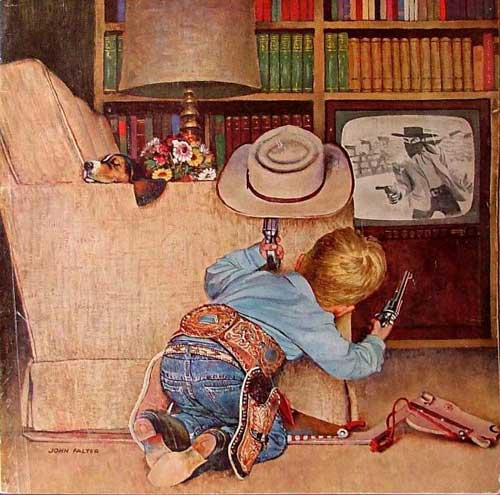
A young imagination has the power to make a 1950s living room into the Wild West, turning a playful child into a ruthless gunslinger.
Artist and illustrator John Falter once said he tried “to put down on canvas a piece of America, a stage set, a framework for the imagination to travel around in.”
Falter takes a subtle moment to comment on the abilities of a child’s mind for his November 9, 1957 cover of The Saturday Evening Post with the illustration “Good Guys Wear White Hats.”
I once inherited my baby-boomer father’s cap gun and broomstick-horse from my grandmother. Apparently, my father used to believe he was The Lone Ranger’s trusted ally. The now 60-year-old family heirloom of western wars won and lost in front of the television screen passes down the family line of childhood cowboys. I have since given the faux-weapons to a niece, furthering the generational creativity.
In this 1950s image, a time when parents first began to worry about the lethargic effects of television on young minds, we see creativity at work. The little boy interacts playfully with the television housed among bookshelves whose tales and stories older generations valued for creative fictions. The television is the boy’s interactive source of afternoon entertainment.
Could the work’s title hold a deeper observation about the purity and innocence of childhood? The title evokes a common assertion: the one who wears white is a good guy. Except in this illustration, our boy is not wearing his white hat. The little man uses one of his two pistols to hold up the white hat as a decoy while he prepares to trick his on-screen enemy. Is the boy still a “good guy” even though he does not wear the hat?
The answer may be in the color pallet elsewhere in the illustration. The little boy hides behind a beige couch, and he’s kneeling on a khaki colored carpet. His hair is blond and his skin is white. On the opposite end of the frame, the bandit exists inside the dark brown television set surrounded by books. The black-and-white screen further accentuates the bandit’s dark attire. In the end, we know who the bad guy really is.
Uniformity
© SEPS 2014
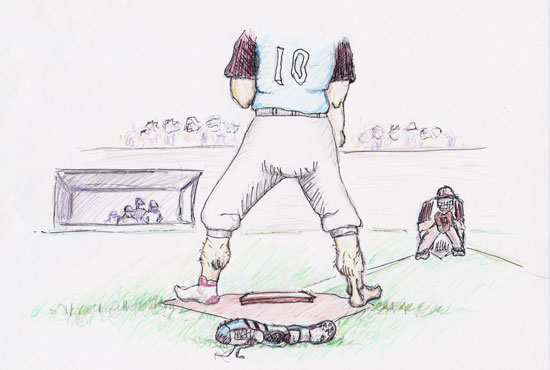
The oddest game I ever managed? That’s easy. Back in ’70 or ’71 I took my squad, the Overton Beavers, across the state to play Piscataw. We needed a win to make the playoffs. The Piscataw Picadors were going nowhere, but they were tough to beat on their home field. During the bus ride, I fretted about ground rules, strategy, the umpires–everything except uniforms. Ironically, it was our uniforms that decided the game.
My club was banged up. Only ten players were healthy enough to make the trip, and one of them was Splinter Jones, who couldn’t field a lick. Otherwise, Splinter was the perfect bench player. He never bugged me to put him in a game, and he was willing to do anything from keeping the scorebook to filling the water buckets to earn his keep.
It was Splinter who brought a problem to my attention during pre-game warm-ups. Our slugging first baseman, Joe “Bigfoot” Mulvaney, couldn’t get over to cover the bag. Every time he tried, he’d fall flat on his face while the baseball sailed into the seats. That was a head-scratcher. Joe usually only tripped on every third or fourth play, so I knew something was wrong.
Splinter pointed at the ground. I eyeballed Joe’s dogs and feared the poor boy was injured. Both sets of toes pointed toward the outfield instead of at each other. I looked back at Splinter. He said, “It’s his shoes.”
Now my vision has slipped a little from the days when I could count the stitches on a baseball as it sped toward the plate. But I could see well enough to realize that Joe was wearing two left shoes. “He doesn’t always dress like that, does he?” I asked.
Splinter shook his head. I hitched up my pants and trotted out there. “What’s the idea, Joe?” I asked.
The big fellow was on his knees, spitting dirt, so he took a moment to answer. “Well, Skip, I grabbed some gear from my locker and crammed it into my gym bag. When we got here, I noticed I brought two left shoes. Any chance I could borrow a pair?”
That remark wouldn’t have been half so funny if Joe didn’t have the biggest feet in North America. About the only way we were going to get a replacement pair was if one of the elephants in the Piscataw zoo had extra cleats lying around his cage. I said, “No, son, I don’t think we’re going to find any.”
Joe struggled to his feet and threw an arm over my shoulder. He hopped toward the dugout, flipping his mitt to an ashen faced Splinter when we got there.
“Skip, I can’t play. This game is important,” Splinter whined.
“Then think of something,” I replied.
As soon as he reached the bench, Joe yanked the shoe off his right foot and tried to massage some feeling back into the toes. I slipped off my size 11 and held it up for comparison. It was hopeless. Unless Joe folded his toes underneath like an old time Chinese maiden, there was no way his foot was going to squeeze in.
I racked my brain for ideas, but all it produced was a headache. Splinter led our team in as the Picadors took the diamond. Rubbing a fresh bruise on his left forearm, he made a suggestion. “Maybe Joe could play barefoot.”
Joe pulled off his left shoe, which was his way of saying he was willing to try.
Splinter breathed a sigh of relief and swapped Joe’s mitt for the scorebook.
*****
The game started, and we went down in order on a couple of weak grounders and a pop-up. Joe was in the on deck circle when the inning ended. He grabbed his mitt and gimped out to first base. Well, the sight of those giant flippers protected only by a pair of white socks that had seen better days, drew the crowd’s attention. The laughter started as a low murmur, and grew to a roar by the time Joe reached his position. The big fellow stood on the bag wiggling his toes in embarrassment.
The base umpire, a rogue named Finley, tapped Joe on the shoulder. When Joe turned to face him, Finley gave an elaborate wave toward the dugout that brought the crowd to a new level of merriment. Terrified, Splinter said, “Aren’t you going to fight for him, Skip?”
I hustled out, signaling Joe to hold his ground. Finley folded his arms and waited. “What’s wrong?” I asked. “Haven’t you heard of Shoeless Joe Jackson? This here’s his grandson.”
That didn’t get the laugh I was hoping for. Finley said, “Either he gets in uniform or he leaves the field.” I was so desperate that I tried the truth. Finley had no sympathy. “Rulebook says all players must dress uniformly,” he insisted.
I fumed and kicked my hat a couple of times for form’s sake. Just as I put my arm on Joe to lead him to the dugout, Splinter dashed out, waving the rulebook. He really didn’t want to play first base. “It’s no use,” I told him. “Finley’s right.”
“No, he’s not, Skip. Rule 1-11 says all players must be uniform. Why can’t the whole squad play shoeless?”
That loosened my dentures. “I can’t ask the team that,” I said, although I was turning the idea over in my mind. Anything was better than replacing my power hitter with a guy who weighed a hundred twenty pounds after a big meal.
By now, half the squad had gathered, despite the efforts of the home plate umpire to shoo them away. Shortstop Chick Harley pulled off his cleats and hurled them toward the dugout. The rest of the boys followed suit. That sent Finley and the other ump into a conference. The Piscataw fans hooted and howled while my boys minced around the infield, trying to get their feet used to the torment.
At last, Finley shrugged his shoulders and turned to me. “Anyone gets hurt, it’s on you.” I thought that might bring Ace Riley, the Picadors manager out to argue, but he sat in the dugout, arms folded, a nasty smile plastered on his puss.
Artie Johnson, our starter, threw his eight warm-up pitches. Clink Evans whipped the ball to second base, the infielders threw it around the horn, and at long last, we were ready to start.
*****
Personal Essay | ‘Leap of Faith’
I was a middle-aged scaredy-cat. While others braved roller coasters, I stayed behind and held their purses and cameras. So no one was more surprised than I was the day I signed up for a tandem skydive.
My husband, Joe, was approaching his 65th birthday, when he suggested a drive to Skydive Miami in Homestead, Florida. As a young man, he had made hundreds of jumps with the round, military parachutes, but the newer wing style fascinated him. Seeing those athletic young people swooshing in to a perfect, stand-up landing reignited memories of his youth. I could tell he wanted to try it, and for once, I decided, I wouldn’t be watching from below. Time for some faith in myself. I was going up!
When Joe pulled out his credit card and asked for an application, I stepped up to the counter.
“Make it two, please.”
His incredulous look morphed into a wide grin.
“Are you sure?”
“Yes! I want to experience this with you.”
We filled out the paperwork, signed the liability releases, and swore we were of sound mind and body, a questionable statement at best.

Photo taken by Skydive Miami.
After a pre-flight training session, we zipped ourselves into one-size-fits-most electric blue jump suits. Trainers handed out altimeters, helmets and goggles, and strapped heavy black harnesses onto our arms and legs. Soon we would be connected to the two strangers we had elected to trust with our lives.
My instructor, Pete, a tall, good-humored Brit, provided comic relief at just the right moment. Strolling into the waiting area, he read aloud from a beginner’s skydiving manual, scratching his head in mock confusion. Later he would admit to logging over 10,000 jumps.
When our flight was called, we proceeded to the small Caravan airplane where we sat in pairs on the floor, instructors directly behind their students. Harnesses were clipped together as the plane roared down the runway. Through the clear, roll-up door, I caught a final glimpse of the trees as the reality hit me: there was only one way out of this airplane. My mouth was dry as cotton, my palms sweaty and shaking. What was I doing here? Why did I sign up for this?
A glance at Joe’s eager face did little to assuage my fear. This guy was afraid of nothing. He’d done this hundreds of times without an experienced jumper strapped to his back. If anything, the crazy nut probably wished he could go solo!
At 13,500 feet the jumpmaster gave a thumbs up, and to my horror, the clear door slid open like a roll-top desk. Didn’t they realize how dangerous it was to fly with an open door? Someone could fall out!
Joe and his instructor were first in line. On their knees, they shuffled like chain-gang prisoners toward the deadly aperture. I watched in disbelief as they nodded three times in unison and tumbled out. There are some things in life you can prepare for, but watching your husband fall out of an airplane isn’t one of them. My heart was in my throat.
Still trembling, I was pulled to a kneeling position and pushed toward the gaping hole. To steady myself, I clung tightly to a metal bar overhead. Pete tried to pull my hands away but I refused to let go of the one solid object between me and certain death.
As impatient jumpers began to pile up behind us, I resigned myself to the inevitable and released my death grip on the bar. Following our pre-flight instructions, I crossed my arms, Dracula-style, over my chest and arched my back. Pete rolled us out of the plane.

Photo taken by Skydive Miami.
The sense of falling lasted only seconds until we achieved the welcome stability of terminal velocity. Pete tapped my shoulder, the signal to spread my arms like wings. At 120 mph, the wind resistance made it seem as if we were flying.
The noise was deafening, and G-forces assaulted my face, turning an attempted smile into a freakish grimace. I remembered the instruction to face the videographer, who was flying directly in front of me, no doubt documenting this for my next of kin. “Hi, Mom!” I mouthed, although in space, as they say, no one can hear you scream.
After sixty seconds, Pete pulled the ripcord and the free fall came to an abrupt end. Our bodies jack-knifed from horizontal to vertical, legs flying out in front like two rag dolls, as the harness held tight and the chute flared open.
It was peaceful now. Quiet. We floated through the air like two giant butterflies. Pete pointed out landmarks on the horizon, and I admired the beautiful patchwork of the surrounding farmland. As we soared gently toward the earth, my only regret was that we couldn’t stay up longer.
Skidding safely into the drop zone, we unhooked our gear, and I ran into Joe’s arms. A camera captured our celebratory embrace. The look of admiration on my husband’s face said it all. This was huge. His former middle-aged scaredy-cat had jumped out of a perfectly good airplane.
Late Bloomer: Michigan man joins police force after 35-year delay
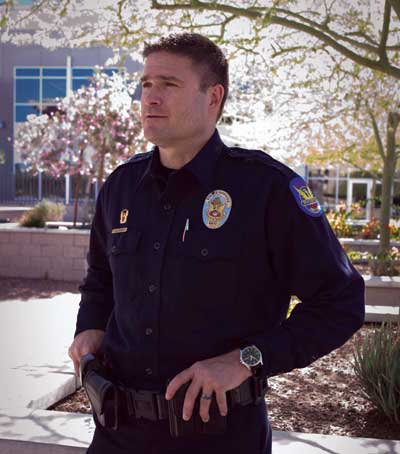
Photo courtesy C.J. Tyler / Phoenix Police
Sean Reavie stared in disbelief at the unexpected email in his inbox. Could he really turn his life around this late in the game? Was this the miracle he’d been wishing for or just another false hope?
He was approaching 40, alone, in debt, financially and emotionally bankrupt. His dream of being a police officer had loomed in front of him, unreachable, for so long. At times, he’d been close, but he’d never quite made it. Was it possible that this time would be different?
It would take a whole lot of faith and a whole lot of hard work to find out.
Sean grew up in tiny St. Ignace, Michigan, with a banker father and a homemaker mother. It was there Sean had an experience that would alter his life. It was a seemingly small thing: His dad’s friend, Paul Sved, a Michigan State Trooper, drove Sean’s father home from work in his police car. Sean was an impressionable 5-year-old, and he was smitten. “The car, the lights, the uniform–it was so exciting to meet this larger-than-life hero in the flesh. Here was a man who was ready to put himself between a total stranger and harm’s way. That very day, I made a pledge to Paul that I would follow in his footsteps.”
Many young boys dream of becoming policemen or firemen or pilots. Then, well, most of them grow up and develop other interests. Sean was different. He held onto his vision for years. Until, that is, a well-intentioned high school English teacher squashed it. The teacher argued that he had natural writing talent and owed it to himself to put it to good use. “Don’t waste your talent being a police officer,” she told Sean.
Swayed by her logic, he put the dream aside. But still, “She broke my heart,” he says. He would ultimately earn a journalism degree from Central Michigan University. Soon after, he would take a job as a reporter and marry. But his heart really wasn’t in the job or the marriage. “Nothing in my life was satisfying me back then,” Sean recalls. “So I just kept looking, hoping eventually something would click.”
He quit that job and took another, but nothing felt right. That’s when he realized he’d never really given up his childhood wish. He still wanted to be a cop.
This time it was his wife who talked him out of it. “She thought it was too dangerous,” Sean explains. “I was trying to make the marriage work, so I agreed not to pursue it. But I was so unhappy. Every time a police car passed, I knew that’s where I belonged. It eventually took its toll on our marriage.”
After the couple split in 1999, Sean was ready to start fresh. There was nothing to stop him now, so he took the test for the Michigan State Police and passed with flying colors. But then, incredibly, just as he was supposed to start his training, a hiring freeze went into effect. “It was so crushing,” Sean reveals. “To be so close and have it disappear.”
A girlfriend convinced him a fortune could be made in the mortgage business. “I thought that would fill this void in my life,” recalls Sean. “But, of course, money can never do that.”
The Best Scones in Ireland from Hayfield Manor
During a recent trip to Ireland, I traveled from north to south, from shore to shore, in the search of the perfect scone. And at Hayfield Manor, an ivy-clad estate within walking distance of the city center of Cork, I found it–the best scone I’d ever tasted. Freshly baked and oh-so-lightly browned, the scones are quite simply delicious. And the folks at Hayfield Manor know it, emphatically declaring that they have “perfected the art of scone making!” I completely agree.
They were generous in sharing the best-kept secret to scone making with me. And I now pass it along to you.
Hayfield Manor Scones

Photo courtesy Hayfield Manor.
Ingredients
- 6.5oz cream flour
- 1.2oz white sugar
- 1.4oz butter (preferably salted)
- 1oz raisins
- 1 teaspoon baking powder
- 2.9oz buttermilk
- 1 egg
Directions
- Preheat oven to 356°F
- Place all dry ingredients and butter in a mixer with a flat attachment and blend until it resembles breadcrumbs.
- Add egg.
- Add buttermilk.
- Mix in raisins.
- Roll out dough and use a scone/cookie cutter with 4cm diameter
- To make the glaze for the scones, beat one egg and add a splash of milk. Brush the top of the scones with the egg wash.
- Place on a tray and put into preheated oven for 17 minutes.
- Enjoy with plenty of fresh cream and jam of your choice. If you’re feeling especially decadent, butter the scone first!
Beyond the Canvas: ‘The Hurried Cleanup’ by Thornton Utz
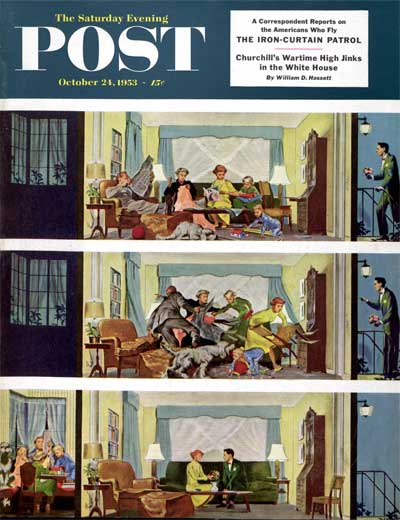
Click here to license “The Hurried Cleanup” by Thornton Utz.
Click here to purchase artwork from Thornton Utz at Art.com.
This three-paneled illustration from the October 24, 1953 cover of The Saturday Evening Post tells a humorous story about the reality of life in the home of an American nuclear family. In the 1950s era of perfectionist “Honey, I’m home!” television shows such as Leave it to Beaver and The Adventures of Ozzie and Harriet, this cover gently tweaks American sensibilities by presenting the messier side of family life.
It’s an amusing story, in which a family must react to the arrival of an unexpected guest by engaging in a frenzied cleanup. But behind the charm of the subject matter lies a great deal of skill and engineering. If, on the surface, we are looking at three simple scenes that progressively tell a story, the artist, Thornton Utz, skillfully uses compositional framing of the work to guide viewers’ eyes across the piece in a precise way.
Let’s start with his use of contrast. There’s the bright yellow living room at the center of the first frame. To the right of the living room, the front stoop is depicted in the fading light of dusk. On the left, the kitchen is pitch black with little light entering the window. The dark frames on either side of the living room serve to encapsulate the important family space as a kind of cocoon. Our eyes look at the overly lit middle column placed in a warm setting of early evening.
Because he’s in motion, the young man walking to the door gets our immediate attention. By the illustration’s second frame, the action shifts to the middle column as the family rushes to make their home presentable. In the third frame, calm has returned. But the sharp contrast of the now-lit kitchen draws the eye to the bottom left frame. In effect, the artist has moved the story forward from the top right frame across the middle, down to the bottom left of the picture.
Notice, too, how the horizontal white lines clip each frame of the illustration like a filmstrip. They keep the spatial settings separate, clarifying the progression of the story as if we were looking at an actual motion picture. But unlike a movie, the illustration is divided into three horizontal frames and three vertical columns. Each ninth of the illustration affords the viewer an opportunity to look in on individual aspects of a scene as it unfolds.
In the final panel, the rest of the family, having moved to the kitchen, has reverted to a state of relaxation in the now available third room. Just as the artist employed visual contrast to tell the story, he is describing a psychological contrast between our messy interior lives and the neat façade we present to the outside world. The viewer relates to the mess, the frenzy, and the successful maintenance of proper etiquette. This family has quickly and effectively made their reality live up to the ideals of the era—but it was a close call.
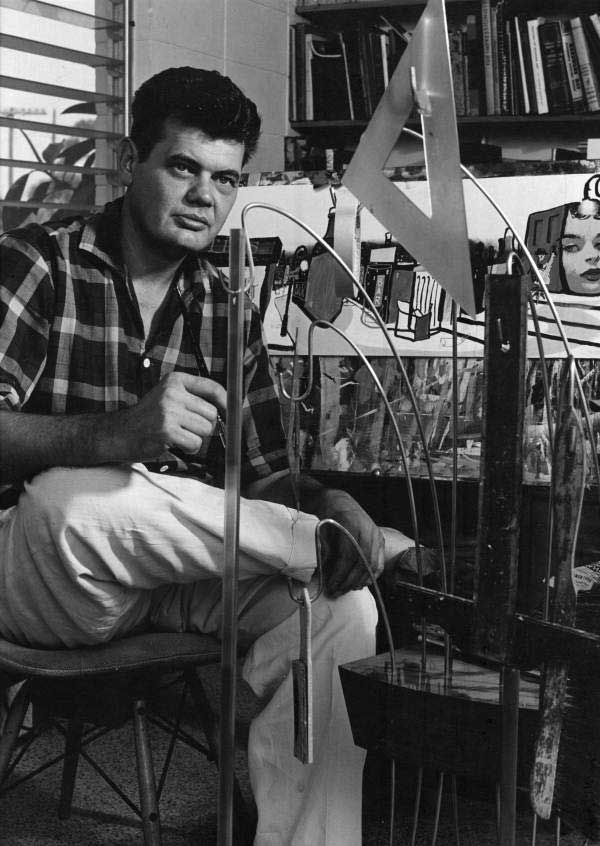
3 Questions for Ken Burns
Ken Burns first gained national attention and acclaim with his 1981 PBS special on the construction of the Brooklyn Bridge — a show that earned him an Oscar nomination. Since then, Burns has turned his eye to numerous aspects of American history from the Civil War to baseball and prohibition. His latest project, The Address, focuses on a school that helps learning-disabled kids by challenging them to memorize and deliver the Gettysburg Address.
Jeanne Wolf: What got you interested in history?
Ken Burns: My mother died of cancer when I was 11. That is a crucible that still affects me. I think about her every day. I wouldn’t be doing what I do if had I not had to go through the pain of anticipating of her death and, then, all the years of trying to not deal with it. So, what do I do for a living? I wake the dead. I make films that make Abraham Lincoln and Jackie Robinson come alive. Who else do you think I’m trying to wake up?
JW: Why do your films always seem to go beyond the bare facts?
KB: We live in a rational world in which one plus one equals two. But if we examine our hearts or our art, we find that we really want one plus one to equal three. The combination of two things — a man and a woman in love, brush strokes on a canvas, the emotion of a song — we want it to add up to something more. I’m always reaching for those moments in life and in film.
JW: There’s a lot of cynicism about world leaders and politicians past and present. Do they deserve it?
KB: We think that our heroes should be perfect, but if you go back to the Greeks you discover that heroes aren’t perfect. They have very obvious strengths and maybe not so obvious weaknesses, and it’s the negotiation between those two that defines heroism — whether it’s Abraham Lincoln or the Roosevelts or, for a more current example, Chris Christie. But studying the past arms you with a kind of optimism, because when people say, “It’s so bad right now with this economic meltdown that it’s like the Depression,” I can answer, “No, it’s not. During the Great Depression, in some cities, the animals in the zoo were shot and the meat distributed to the poor. Is that happening now?”
The world is chaotic and we’re trying to figure out some order. The painter puts a frame around it; the playwright puts a proscenium arch above it; a documentarian puts it on a screen. We invent stories, we tell them to each other. We achieve a kind of immortality with the stories that we tell and that’s the way we abolish the wolf at the door that’s gonna come knocking eventually.
Tough Enough to Leave

“If you want a pet, buy one.” said Neil. “Why rent for a few months?”
The nine week old yellow lab was hers for a year. Leah’s job was to housebreak Ace, teach her basic commands. If Ace wasn’t skittish, if she was willing to learn, one day she would be a service dog.
Some people volunteered because it was a good thing. Others volunteered because they needed to. For Leah, Ace filled an emptiness inside her. It felt like she’d been starving and suddenly the hunger was no longer there. Within days an invisible cord connected Leah to the dog. The puppy’s breath smelled like oatmeal. Leah’s fingers raked the thick fur.
“You’re sending the dog messages all the time.” The trainers told her. “Look how she watches your feet. How she responds to your voice.”
At first the commands weren’t automatic. Each night Leah practiced hand signals in the bathroom mirror, her wrists bobbing and weaving like a crazed puppeteer. But soon she and Ace had their own special language. The dog was easy to read. A playful bow, an upright tail, a paw that clamored like a child.
“The puppy needs to feel safe.” the trainers said. “You have to earn her trust.”
*****
It had been three years since Leah found out about Neil’s affair. He had been working fourteen hour days six days a week, or so he told her. That’s what it took to get ahead, he would say. But his hello kiss every night reeked of liquor. Somehow he found time to work out at the gym. His new muscles bulged underneath his clothes.
“I need new shirts,” he said one night. “The old ones are bursting at the seams.” That’s when she figured it out. Leah had gone into his hamper and scooped up a week’s worth of laundry. The scent of gardenias made her gag. She ran to the medicine chest, held the inhaler to her nose and took long deep breaths. Leah was allergic to perfume and cologne. Neither of them used any.
At first she hadn’t said anything. Leah came from a family that rarely talked. They just swatted their problems like a game of badminton. Swish, tap tap, swish. It was just the three of them. Her mom waitressed at Friendly’s, and her dad managed the local Dollar Store. They’d had their full of chitchat at work and looked forward all day to peace and quiet at home. Swish, tap tap, swish. Her dad hit the green naugahyde barcalounger every night at 5:30, chainsmoked. Didn’t move for hours. Dinner would be on a folding tray, his eyes glued to the TV.
Her mother cleaned like a northeaster, all whirling arms and legs spinning in mad circles. Ran the vacuum until the rugs were beaten flat. Waxed the wood furniture until the finish wore off. Hours every night of mopping, wiping, mopping again. Leah would park herself at the kitchen table, do her homework, and listen to the buzz of electric appliances. Then after a glass of milk and a peck on the cheek she’d be sent to bed. Swish, tap tap, swish.
She had been working at the bookstore when she met Neil. Leah had a plan then: take one course at a time at the community college and maybe in ten years she’d have a degree. But the more people she waited on, the worse she felt about herself. Sure she knew how to dress, how to play the part. She wore tortoiseshell glasses and black turtlenecks. Tasteful cubic zirconium studs in her ears. But when she met someone like Neil, someone whose casual banter screamed prep schools and Ivy League, she felt like a fraud.
She fooled him. Leah was a good listener and Neil took care of his end of the conversation as well as hers. He spoke about his dreams and his ambitions and swept Leah like a tidal surge. She needed to love, and Neil needed to be worshiped.
*****
For weeks she carried a shopping tote of his perfumed shirts wherever she went. “Here comes the bag lady,” her friends teased her. She made them stick their noses in. Do you think the perfume was expensive, she‘d ask? She could never, she told them, compete with Chanel No. 5.
Finally she confronted Neil. “It was nothing,” he blurted. In his panic he offered a list of promises Leah knew he’d never keep. Spend more time at home, even help with chores. Leah didn’t ask for much. Perhaps that was part of the problem.
“Let’s go to Europe,” he offered. “Take the big trip we could never afford.” Every day he brought home brochures and left them splayed on the dining room table. Leah lined them up like tarot cards, trying to read their future.
But when the vacation ended, before their photos were even Facebooked, their relationship returned to the old groove. Cold dinners and empty conversations. When he was home, Neil used his iPhone and his iPad and his laptop to create a wall of pixels between them. He typed fast so she couldn’t guess the passwords.
“It’s time we invested in a house,” he told her one Sunday. Their apartment was in a neighborhood people called transitional. For years it was supposed to be the next best place. But there were still bars on the window fronts. A falafel cart set up shop on their sidewalk every summer.
“But this is home,” said Leah. Panic stuck in her throat. The delicate threads of their relationship seemed torn and frayed. She pictured it unraveling like a skein of yarn rolling on the floor.
Neil drew red circles on the real estate section of the newspaper. “But this is where my friends live!” Leah wanted to shout.
“You see,” Neil continued, his head still down, penning bull’s-eyes on the classifieds, “prices are cheaper in the suburbs.”
For weeks he searched the new listings, schmoozing to realtors on the phone like they were lifelong pals. He’d hang up and repeat the sales pitch word-for-word, his voice bouncing with fake pep. “You can finally get the dog you always talked about,” said Neil. “Get a whole menagerie if you want.”
*****
They found a midsized Colonial shaded by dogwood and maple trees. Several of Neil’s partners lived on the same street. Leah bought two rocking chairs for the front porch and planted azaleas. She was surprised by how happy she was. Gardening became her passion. Every packet she emptied into the soil seemed to pop up with a new surprise. Basil, oregano, thyme. Three varieties of tomatoes shimmied up trellises. Leah spent hours with her spade, enjoying the sweat and the dirt and sheer exhaustion of it.
“You’re a regular Martha Stewart,” Neil teased.
But his commute now was even longer. On the worse days he stayed downtown. Their problems were like cold hard seeds Leah tried to bury. She was so lonely she talked to herself, chatting with photographs on the mantle, mumbling in the laundry room. It was her friends in the city who told her about the organization.
“I’m training a puppy,” she said to Neil. “It’s just for a year.”
She and the dog settled into a routine. In the mornings Leah gently snapped Ace’s red vest in place and slipped the metal collar over her neck. Then they visited churches, shopping centers, even restaurants. Your job, the trainers told her, is to expose Ace to loud noises, children, sudden movements. To make her hardened and resilient. To make her tough enough to leave.
The Middleman

Ralph looked at Agatha, sitting ramrod straight in her rocking chair on one side of the fireplace. Didn’t she know people were supposed to relax in rocking chairs?
Across from her Frank slouched comfortably in his rocker. Now there was a man who knew what a rocker was for.
Agatha mumbled something, leaned forward to look more closely at the afghan she was knitting, and said, “Ralph, it’s time His Honor there took his heart pills.”
Ralph looked at Frank, tilted his head, and made a small noise in the back of his throat.
Frank sighed, lumped himself slowly out of his chair and shuffled to the kitchen cupboard where he doled out pills from three sets of vials. He ran a glass of water, washed the pills down. “Thanks, Ralph,” he said and sat in his chair again.
Ralph snorted, thinking, what would they do without me? They haven’t talked to each other in five years. Ralph was getting on himself, and in good health…but what if he got sick? Who would help them? Would they just stop talking altogether?
Agatha was old and Frank was even older. Still, they kept up the house pretty well. There was plenty of room for the three of them, and a cheerful fireplace on a winter afternoon like this.
Ralph had been very young when he moved in with the Wilsons. It hadn’t been easy, at first; he’d been used to a lot of commotion in the home he’d been born into. But Ralph was nothing if not philosophical about life. Whatever came, came; he just lived with it. And if food and lodging were part of the package, well, so much the better.
Looked like this was going to be an afternoon even quieter than most. Ralph shut his eyes and took a little nap.
“Ralph!” Frank’s voice woke him. “The mail’s here!”
“Let it wait,” Ralph thought, squeezing his eyes shut. “What’s the hurry?”
“Ralph!” The old man’s voice sharp. “Do your job. You don’t have that much around here to do.”
Ralph yawned, stretched, and headed for the small pile of envelopes that lay inside the front door. He brought them to Frank.
“Thanks, Ralph,” said Frank. He shuffled through the pile, flinging two into the fire. “Damn junk,” he said. “Well, what’s this? A letter for Agatha.”
Ralph took it and laid it in Agatha’s lap, not interrupting her stitch counting. He knew better; he’d been chastised before.
“Ask her what that’s all about,” said Frank, setting his chair rocking. “She don’t get much mail.”
Agatha kept knitting, ignoring the old man. “None of his business, Ralph,” she said. “Never you mind.”
Frank harrumphed and rocked faster. “Long time since I got a letter, Ralph,” he said. “Long time for her, too.”
Ralph closed his eyes again. They’d tell him when they wanted to; he’d deal with it then.
“Well, what do you think of this, Ralph!” Agatha’s voice woke Ralph from a very satisfying dream. She waved the letter toward him. “A family reunion! My side, of course, that’s why I got the letter. Wonder should we go?”
Ralph looked at Frank, who was trying to look uninterested. “Where would her family have a reunion?” he asked the ceiling. “Can’t be but a handful of them left in this world anyway.”
Agatha leaned back in her chair, her knitting forgotten in her lap, and nodded her head. “Mary Apple’s lake house. That’s the very place, Ralph. Couldn’t be better! We’d best call right away, tell her we’ll come. That is, I’ll come. If His Honor there wants to, he can come along.”
His Honor cleared his throat. “If she’s going, I better, too. Otherwise they’ll think I’m dead and she didn’t tell ’em. Mary Apple, huh? She was always a looker.”
Agatha picked up her knitting. “No fool like an old fool, Ralph,” she said.
Mary’s lake place was beautiful. Ralph appreciated the long, smooth lawn that ran down to the clear water, the schussing pine trees that rimmed the yard, and all the running, laughing children that belonged to Agatha’s family. It was fun to romp around with kids again. Living with Frank and Agatha was comfortable but not very stimulating.
Only trouble was, Agatha kept calling him back to the old folks sitting around on the porch. Like she and Frank weren’t whole people unless he was nearby. They talked to everybody else without any trouble; why did he have to be their go-between?
Agatha smiled at Ralph as he came up on the porch. “Ralph,” she said, “remember the time we went down to the Dells? And Frank fell out of the boat when we were going on shore. Got wet right up to his waist, he did. Ha, ha, that was so funny! Frank should tell these folks about it, shouldn’t he?”
Frank said, “Go on back and play with the kids, Ralph, we don’t need you here for this kind of abuse.”
Ralph left gladly. The kids were more fun and at his age he needed all the exercise he could get.
Life settled back into the old dull routine when they got home from the reunion, except for the barbs that flew back and forth through Ralph. The reunion seemed to have loosed a dam of venom over old hurts and slights that had been unspoken for too long.
“And did you see what a simpering silly that old man was around the young girls at that reunion, Ralph? Made a darned spectacle of himself he did, embarrassed me all git out.”
“She said the damnest things to her scruffy relatives, Ralph, you should be glad she didn’t make you sit on that porch and listen.”
“His Honor there drank way too much beer, yes he did, Ralph, and then you couldn’t stop him from telling stories on me! I never—”
“She forgets a lot of what she said, too. But that’s all right, Ralph, people can forgive a senile old woman—”
“Did you hear that, Ralph? Calling me senile. Well just you wait and see if I ever invite him to go along to my family’s reunion again.”
Ralph sincerely hoped she wouldn’t. As time went on, he found himself trying his best to keep clear of the arguments that caromed like the ball in a racquetball game, bounding off Ralph, back to Ralph, to the other opponent, on and on…it gave him a headache. And it made him sad.
He had become a living dartboard impaled day after day with the poison of their accusations thrown against each other.
I’ve been their go-between too long, Ralph thought, and I’m tired to death of the whole thing. He made a plan.
He began to refuse food. No matter how good it looked, how delicious it smelled, he refused to eat.
“This will never do, Ralph,” Agatha pleaded with him as he turned away from yet another plate of home-cooked roast and mashed potatoes. Damn, it was hard to give up that gravy, but it had to be done.
Days passed. Before long, he actually did lose his appetite. Agatha began to cook him special meals, but he just wasn’t hungry. He lost weight, he lost strength.
“Ralph, let’s take a walk, get you out of this house,” Frank said. “You’ll feel better, get your appetite back. If that old woman would cook your favorite stuff, you’d be okay again, wouldn’t you?”
Agatha snorted. “You know I am cooking your favorites, don’t you, Ralph? Don’t you? Don’t listen to him. I’m doing my best!”
“Her best stinks,” said Frank, standing by the open door. “Come on, Ralph, let’s walk.”
Ralph refused. Truth to tell, he was getting too weak to walk far. This plan wasn’t working the way he’d anticipated. He lay back on his pillow and shut his eyes. How many days had it been, now. Was it worth going on?
His eyes flew open as Agatha stamped her foot, looked straight at Frank and said directly to him, “You old goat! Can’t you see what’s the matter here?”
Ralph’s head came up. Was it true? Was she actually talking to the old man straight out? What would he do?
Ralph watched as Frank took a step backwards and stared at Agatha. “You talking to me?”
“You see any other old goats in here?” she demanded.
Frank closed the door and swallowed. “What do you mean?”
Ralph almost jumped up but he was too weak to do it. He watched. Frank had actually spoken directly to Agatha!
“I mean we’ve broken Ralph’s heart, all our bickering, that’s what I mean. I don’t care how bull headed you’ve been for the past how many years, I am tired of playing your game.”
“My game? It’s not my game. You started it. You started it when you made such a fool of me.”
“When? Tell me when! When did I ever make a fool of you?”
“You know.”
“I don’t. When!”
Frank lowered his head and said sheepishly, “I don’t remember.”
Ralph held his breath for a long moment before Agatha said, “Well, I don’t either.” She straightened her back. “Can’t you see? We have to work together to get Ralph well, or we’ll never forgive ourselves.”
“Woof!” said Ralph, meaning, give me back that plate of meat and potatoes. Things are looking up.