North Country Girl: Chapter 35 — The High Cost of College
For more about Gay Haubner’s life in the North Country, read the other chapters in her serialized memoir.
My romance with our dorm’s drug dealer was torrid, tempestuous, and exhausting. It was almost a relief when school ended in June and Steve went off to Outward Bound, to be molested or not, and I went to spend my first summer in Colorado Springs, where my mother had moved in pursuit of her second husband (third if you count her teenage elopement with Bill Bailey, a traveling salesman). My mom, my two sisters, both of them unhappy with the move and miserable in their new schools, and most of our French Provincial furniture from our six-bedroom house back in Duluth were shoehorned into a two-bedroom apartment that had all the character and quality of a roadside motel. Skyway Village Apartments did have a pool, where during the day I sunned and read and tried to ignore our across-the-hall neighbor who kept plopping down next to me to ask why I didn’t own any bras. A few blocks away from Skyway Village Apartments was a restaurant called Mr. Steak, which hired me on the spot before I realized what a complete shithole it was.
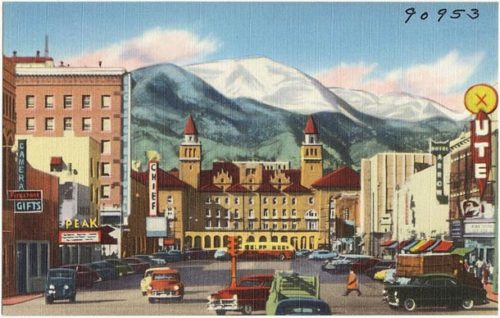
Mr. Steak was a grubby, sad place targeted toward unsuspecting tourists on a budget, tourists on their way back from ruining their cars’ transmissions and brakes making the crazy drive 13,000 feet up the top of Pike’s Peak and back down again. The steaks at Mr. Steak looked exactly like rubber dog toys, the baked potatoes were hard as a rock, and most of the lettuce in the skimpy salad was brown. No wonder I so often went home empty-handed. It was amazing that people actually paid to eat that crap, and I should have been grateful that they didn’t slug the waitress who brought it.
I went back to Minneapolis my sophomore year with even less pocket money than the previous fall. I was not returning to the dorm, but to the thrill of a completely unsupervised off-campus apartment. After much cajoling of all parents, my pals Nancy, Liz, and Sarah and I were allowed to leave the protection of the college dorm and move into that rarest of all things, a four-bedroom apartment. My father only agreed because the rent split four ways was less than half of what the dorm cost; I could forage for my own food, or have Steve kill me a squirrel.
Despite the money he saved, my dad was suspicious of the whole set-up and took to making unannounced pop-in visits every time he was in Minneapolis. Early one Sunday morning his pounding on our door woke everyone up and forced us to herd a quartet of half-naked, hungover boyfriends into the farthest back bedroom before putting on robes and nighties and coming out to say hello to Dr. and the second Mrs. Haubner.
We eventually acquired a fifth roommate, my friend from high school, Gretchen. Gretchen was a long-haired hippie chick, with a big heart, a dry wit, and a hooting laugh. Gretchen was also going through a bad time, which we should have suspected when she showed up at our Halloween party wearing only a grass skirt, her breasts painted (with house paint) as twin red, white, and blue targets. Her bad time erupted into kleptomania: Gretchen was a preternaturally talented shoplifter. She was never caught, although after I watched her pull t-bone steaks out of her pants I never again risked going to the supermarket with her. Gretchen slept on the living room couch on top of and under dozens of articles of clothing, all with the price tags still attached. The day Gretchen came back to our apartment proudly brandishing two huge silver candlesticks she had boosted from a Catholic church was the day we put her on a bus back to her family in Duluth. Gretchen did recover, and ended up in Yemen working for the Peace Corps.
My meager savings from waitressing at Mr. Steak quickly evaporated. I found a job at Lancers, a ginormous warehouse of a store, with acres of stacks of jeans—Levi’s, Lee’s, Wranglers—plus weird off brands, in hundreds of colors, styles, and sizes, from pants that would fit a smallish dwarf to ones with a 50 inch waist and 38 inch inseam. My job was to follow customers around, not to help them find a needle in this denim haystack, but to pick up every pair of jeans they had touched, shake them out, refold them, and arrange them back in a perfectly aligned stack of pants. The $2.50 hour I was paid was not enough to make up for the intense hatred I had for every person who walked into that store; I knew their sole intention was to mess up my piles of jeans.
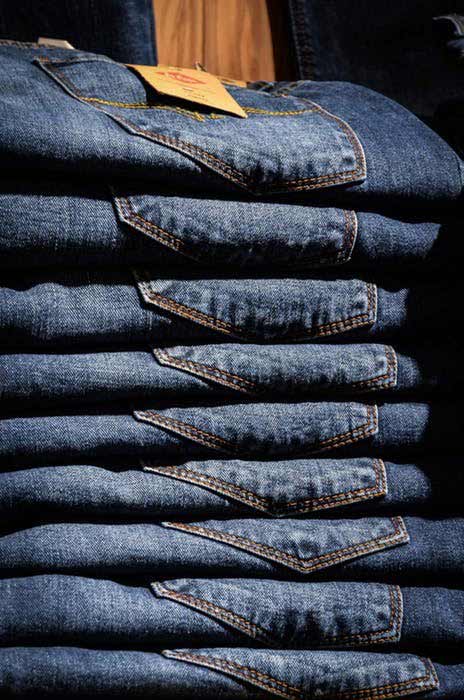
After my first week at Lancers, I realized that everyone was stealing clothes from the joint: the manager, the sales clerks, the delivery guys who dropped off another thousand jeans to be folded and stacked somewhere, and probably even the mailman. Every day more jeans were stolen by the staff of Lancers than were sold to customers. While I would have gladly burned Lancers to the ground, I resisted taking anything until the manager told me that everybody thought I had been planted there by Mr. Lancer as a spy. To prove my innocence, I stole a pair of baby pink, brushed denim elephant bells that billowed around my platform shoes; the three-button fly ended palm’s width below my navel. There were adorable and fit me so perfectly I felt not a twinge of guilt.
The tiny paychecks I got from Lancers managed to cover my living expenses, even after Gretchen left and I could no longer save money by dining on stolen groceries. But I was not earning enough to afford a Spring Break trip to Florida, the Shangri-La of every Minnesota college student. For me, Spring Break was the impossible dream, a dream I indulged while trudging through snowbanks to campus and back, or spending untold hours folding jeans.
As a kid, all winter long I bundled up and went out even in near-blizzard conditions to build snowmen and make snow angels and join the neighbor kids for snowball fights, until the indigo four o’clock twilight fell and I couldn’t feel my fingers or toes and required several mugs of hot cocoa to thaw out. As a teenager winter meant high school ski trips, with shared cigarettes on the chair lift, Fitgers beers bought by the kid with the best fake ID, and the erotic possibility of sitting next to a cute boy on the bus ride home. All through my childhood and high school years winter had enough pleasures to totter on the border between bearable and enjoyable.
For students at the University of Minnesota, the only good part of winter was the anticipation of Spring Break, a week away from snowdrifts and wet socks and chapped cheeks and lips. A week dedicated to the best part of college: boys and drinking. As I folded jeans, I imagined myself wearing a cute bikini and holding an umbrella drink, surrounded by handsome college guys. But every time I cashed my paycheck, I was reminded that it was only a dream.
My roommate Liz, however, was determined to enjoy a real Spring Break, and finally convinced me that for our sanity, the two of us needed to get away somewhere it wasn’t 10 below. Liz claimed to also be short of ready cash (I believe she said this in solidarity, as her father was a prominent Mayo Clinic heart specialist).
Liz and I pooled our money and devised a plan for a Bargain Basement Florida Spring Break. We would buy one-way plane tickets to Daytona Beach, stay at the cheapest place possible, get guys to buy us drinks and meals, and then hitchhike back to Minneapolis. Yes, we were that young and stupid.
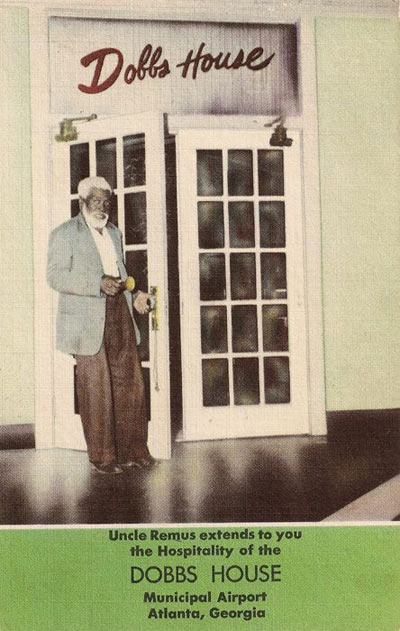
On our flight to Florida, we changed planes in Atlanta with just enough time to have a cup of coffee and split a plate of eggs. A gracious white-bearded black man ushered us into to Dobbs House, the airport cafeteria, where every wall was decorated with murals of Br’er Rabbit and friends in a black-face minstrel style that made Disney’s “Song of the South” look like a contender for an NAACP award. As we sipped our coffee and passed the fork for our scrambled eggs, we were surrounded by the most extreme, pop-eyed, thick-lipped depictions of Uncle Remus, who was himself surrounded by grinning, nappy-headed, raggedy black children. I am sure they had only recently taken down the “No Negros Served” sign: all the customers were white, all the waiters black. Sitting in this homage to racism was shocking; it felt evil, oppressive. (When I was living in Atlanta I could not find a single person who had a memory of these murals, but my pal Liz will attest that they were there.) We choked down our breakfast and ran to catch our plane.
We splurged on a taxi into Daytona Beach and discovered that every motel set their Spring Break prices under the assumption that between eight to ten kids were smashed into a single room. There was nothing Liz and I could afford, as we did not have another six roommates to split the cost of a motel with.
After hours trudging from one place to the next, looking longingly at cute drunk boys and bikinied girls playing chicken in motel pools—just like I had imagined!—we ended up at the Palmetto, an old-fashioned rooming house that had one tiny twin bedded room left. After we had paid our fifteen dollars a night, Liz and I discovered that we were the only people under 80 in the joint, something we should have realized from the pervasive old person smell. The ramshackle house had three bathrooms, one on each floor, which were shared by tenants of both sexes. In a fit of madness on a rainy day, Liz and I locked ourselves in the third floor bathroom, where we dyed my hair blonde while an old man pounded relentlessly on the door, claiming he had to poop.
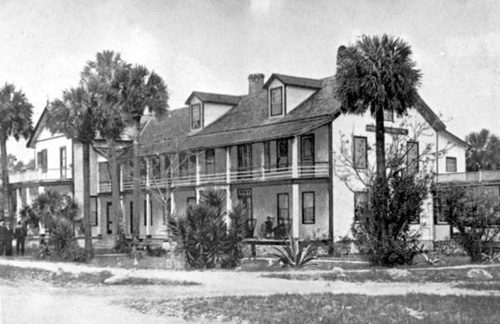
Worst of all, The Old Folks Arms had a curfew: the front door was locked at midnight. What were those ancient, arthritic codgers getting up to in the middle of the night that they needed a curfew? Liz and I examined the rickety fire escape and decided that we did not want “Spring Break Coed Dies in Fall” to be a headline in the Minneapolis Tribune. We were doomed to be the Cinderellas of Daytona Beach, unable to stay out too late at the ball.
As it turned out, our Spring Break nights ended well before twelve. At nineteen, Liz and I were not old enough to drink legally in Florida. And contrary to what we had assumed, bouncers did not happily allow cute underage girls into their bars.
We spent our days on the famous Daytona Beach, trying not to get run over by the 70,000 cars and trucks zooming across the sands, driven by drunken, cat-calling yahoos. We were determined to go back tan, proof that we had spent Spring Break in an exotic tropical locale. We managed to achieve not too painful sunburns.
We did accomplish our main goal, to meet boys, some of whom actually took us out to nice restaurants, where Liz and I were spared the indignity of being asked for IDs when we ordered our before-dinner White Russians. On our last night we were picked up by two boys from Ole Miss, who had almost impenetrable accents (“Carfish? We’re going to eat carfish?”). We rode in one of their daddy’s Lincoln Continental deep into a pitch dark bayou (“Did he say the restaurant is a fur piece?”). As we bounced around the rutted road, insects smashing by the thousands on the windshield, Liz turned to me and mouthed “Deliverance,” which we had seen the year before. I shot her back a should-we-jump-for-it look just as we pulled up to a shack where I had my first and most delicious catfish and hush puppy dinner and even managed to get tipsy on Dixie beer, as no White Russians or any other cocktails were served.
Liz and I had to cut our Spring Break short, as we estimated it would take us a day and a half to hitch-hike back to Minneapolis in time for our Monday morning classes. After our bayou adventure, we decided we needed to be on guard on our way home.
“One of us should always stay awake in the car.”
“We’re not going to get in if there’s more than one person in the car.”
“No accepting drinks from the driver.”
At seven in the morning Liz and I walked to the curb of the main road heading north, stuck out our thumbs, and immediately got a ride. It was a yellow two-door sedan, dented and rusty, with as expected, a male driver on his own. He leaned over, pushed the front seat down, and opened the passenger door. I clambered in the back so long-legged Liz could have the front. From where I sat, I could see the driver’s pale nape and unfashionably short hair; the rearview mirror reflected a slice of his eyes, shifting back and forth.
“Where you girls headed?”
I had a fleeting fantasy that maybe this guy was somehow a solo Spring Breaker, a fellow Golden Gopher, headed back up north straight to Minnesota. I said “Actually, we’re going all the way to Minneapolis. You wouldn’t—”
Liz jumped in. “No we’re not. We’re getting out here.”
“What Liz, no, we—”
“We’re getting out here!” she yelled while turning around to glare at me, then threw her door open. The car was still moving. The pasty driver hit the breaks, and Liz scrambled out, throwing the seat forward and pulling me out of the car with one motion. She slammed the door, turned and marched back the way we had come.
I caught up with her. “What the hell Liz—”
“He had no pants on.” This fruitcake was driving around Daytona Beach at seven in the morning dressed only in a tee shirt. He must have thought he hit the pervert jackpot when he came upon two blonde nineteen-year-olds looking for a ride.
Liz and I sat on the curb for a minute to pull ourselves together. We had to get home somehow and we had less than $30 between us. Neither of us were about to call our parents; I don’t know how they would have gotten money to us anyway. We waited until we felt sure the pale creep was gone, stood up, and stuck out our thumbs again. The goddesses of youth and hitch hikers smiled upon us: we made it from Daytona Beach to Minneapolis in three rides, all of them with nice guys driving alone, wearing pants. Our third ride was a very concerned dad from Stillwater, Wisconsin, who bought us breakfast and lunch and insisted on driving us all the way to our front door, where he waited until he saw we were safely inside before driving away. God bless you, sir.
In June I shipped my bike out to my mom in Colorado Springs, so I could work somewhere, anywhere other than Mr. Steak. My family’s life at Skyway Village had become even more chaotic. Alimony and child support checks from my dad arrived on a schedule of their own and only after several screaming, threatening phone calls from my mom. A second marriage to the man she had followed out to Colorado did not seem to be happening anytime soon, as my mom’s intended, a former pillar of the Catholic Church and father of six, could not get his wife to divorce him and no fault divorce had not yet been invented. Heidi, my youngest sister, had spent the school year being bullied, beaten up, and having her head shoved in the toilet in the girls’ washroom and probably could have used professional counseling; fourteen-year-old Lani was working illegally at Kentucky Fried Chicken and dating the manager.
I would have been happy to waitress ‘round the clock to get away from that mess, but settled for the eight p.m. to two a.m. shift at Hof´s Hut, a blindingly bright downtown diner a thirty-minute bike ride from Skyway Village Apartments.
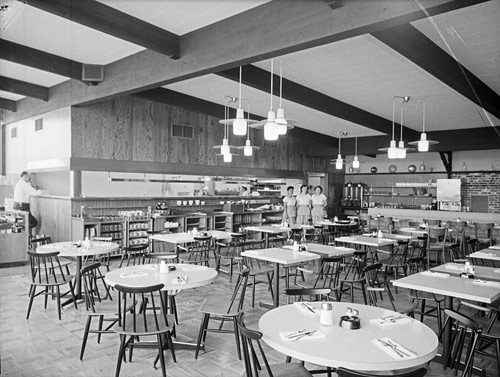
During the day, Hof’s Hut was a run-of-the-mill vinyl and stainless diner, breakfast served all day accompanied by bottomless white china mugs of coffee. At night, its neon sign and bluish fluorescent lighting drew an ugly bunch of customers. There were drunken GI’s and even drunker cowboys trying to sober up over hamburgers and chili and cheese omelets before driving back to barracks and bunkhouses. There was always at least one table of heavy-lidded junkies unscrewing the salt shakers to sweeten their coffee. Worst of all were the completely wrecked underage cadets from the Air Force Academy, who even at their most intoxicated believed in their flyboy status. They shoved their hands up my skirt when I refilled their coffee and thought it was hilarious to stagger into me, steadying themselves with a hand grasped firmly on my left tit. They puked in the men’s room, on the front sidewalk, and in the parking lot, and I felt so sorry for the Mexican bus boys and the Sisyphean task they faced every Sunday.
One Saturday night, after six hours of scooping up sticky quarters and grimy dollar bills, wiping down ketchup bottles, and wrestling clammy hands off of my thighs, I wheeled my bike out the back door of Hof’s Hut and headed home, down broad, deserted but very well-lit Colorado Avenue. That half hour of thoughtlessly, rhythmically, pumping my legs, gliding through the warm, quiet night was the one moment of calm in my life. I had just started to relax, loosening up my shoulder muscles when out of the corner of my eye I saw a gleam of white and recognized it as a human being, a man, a man with absolutely no clothes on, who dashed out after me. The adrenaline hit me faster than one of Steve’s Black Beauties and I threw the bike into high gear and Tour de France mode. I cracked my neck back, watched my pursuer dwindle into the dark and wondered: could that somehow be the pantsless guy from Daytona Beach? How had he tracked me here in Colorado Springs?
At least I was making more money than I had at that outpost of hell, Mr. Steak. Drunks tend to overtip cute waitresses. I needed every quarter. I had registered for a grueling schedule of courses for the fall and wanted to save enough money so I could just concentrate on my studies and not have to serve slop to freshmen or fold hundreds and hundreds of Levi’s.
In August Liz called me to report that over the summer our other two roommates decided they had better things to do with their lives than go to college and had dropped out.
“So I drove up to Minneapolis and there were hardly any apartments left, but I found one for us.”
I needed to send her a check to cover my half of the security, first month’s rent, and deposits for telephone and electricity. I scratched down the horrifying large amount and got the OK from my mom to make the dreaded long-distance call. My dad picked up for once; the phone was usually answered by his dumb, heavy-breathing second wife who always lied about him being home. I rushed through the small talk, not caring about what milestones his two toddlers had achieved.
“ I need you to send a check to Dr. Hepper in Rochester, he’s already paid for everything for our new place.”
A few moments of silence passed.
“The divorce agreement says that I have to pay for tuition and dorm. Are you going to live in the dorm again? I’m not paying for you to live in an apartment.” He said the word apartment when he meant whorehouse. My heart sunk. I realized that we had not hidden those boys well enough during my father’s Sunday morning pop-in visits. I hung up, furious.
“Yeah, he’s a jerk,” my mom shrugged. I took a big chunk of my summer savings, bought a money order at the post office, and sent it off to Liz’s dad.
On Labor Day I poured coffee for one last drunk cowboy, cleaned my final ketchup bottles, and turned in my Hof’s Hut uniform. I kissed my mom and sisters goodbye, and my bike and I flew back to Minneapolis.
Ready-to-Waste: America’s Clothing Crisis
No one sets out to dump half their body weight in clothing into landfills each year, presumably, but somehow it still happens. Rubber, leather, and textiles make up more than 9 percent of municipal solid waste in the U.S. according to EPA estimates. That means the average American throws away about 81 pounds of clothing every year.
“That’s a lot,” says Jackie King, the executive director of the Secondary Materials and Recycled Textiles international trade association. She says this is unfortunate: while 95 percent of used textiles can be recycled, 85 percent land in the trash. One reason for this disparity could be public perception of waste and recycling. Though American recycling rates have more than tripled in the last 30 years, textile recycling has not enjoyed the same popularity as glass, plastics, and paper. “So much of the time, people aren’t aware, they think no one would want something because it’s out of date or has a rip or is broken. They don’t realize it could be recycled,” King says.
King’s SMART represents for-profit textile reuse and recycling firms all over the world. Companies like USAgain and American Textile Recycling Service are involved in collecting, moving, sorting, and recycling all kinds of materials. You might recognize some of these “rag yards” from the donation bins they’ve peppered throughout cities in the last 10 years or so. Even nonprofit organizations like Goodwill Industries and The Salvation Army sell to such companies what they cannot use or store.
The — sometimes illegally placed — clothing donation bins of for-profit textile firms might seem problematic. Even if the bins aren’t blocking the sidewalk, people tend to think of clothing donation as a charitable act that should benefit someone living in poverty, preferably in their own neighborhood. As Elizabeth Cline explains in her book, Overdressed: The Shockingly High Cost of Cheap Fashion, there are far more textile donations to charities than can be resold in-house, and clothing donation should instead be thought of as recycling. According to the Council for Textile Recycling, 80 to 90 percent of donations to charities are sold to recyclers. From there, 45 percent is exported for reuse — mainly in Africa and Asia — and about 50 percent is recycled.
“We want people to think of textiles like they think of paper, glass, and plastics in terms of recyclability,” King says. The reason for this much-needed paradigm shift is that clothing consumption has risen sharply: from 1999 to 2009, U.S. post-consumer textile waste grew by 40 percent.
So-called “fast fashion” can bear at least some of the blame for America’s stuffed closets. The term has been used to characterize retailers like H&M, Zara, and Forever 21, who flood clothing markets with quick-turnaround trends and cheap threads. Marc Bain wrote about the neurological draw to fast fashion in The Atlantic, saying “If seeing items you want and getting a bargain both elicit waves of shopping joy, you couldn’t engineer a more pleasurable consumer culture than the modern, globalized West… First, the clothing is incredibly cheap, which makes it easy to buy. Second, new deliveries to stores are frequent, which means customers always have something new to look at and desire.” And the rise of online shopping presents even fewer impediments to snatching new garments.
Besides providing an unlimited supply of future landfill fodder, retailers have been under fire for pitching unsold clothing themselves. In 2010, a Times article documented trash bags full of apparel that had been cut with scissors outside of an H&M store, including coats and shoes. A similar incident at Eddie Bauer last month prompted a New York councilman to suggest fining the practice. The idea behind destroying and disposing of unsold apparel is that it protects the value of the brand and prevents fraudulent returns.
Trashing good clothing, however, has proven to be a bad look for corporate retail. In 2013, H&M started a garment collection program in which stores give vouchers in exchange for used clothing. Patagonia, The North Face, and American Eagle Outfitters have all launched similar programs that funnel used textiles into the recycling sector and spread awareness of textile waste.
This sort of retail advocacy for textile recycling is refreshing to Jackie King, of SMART, since it advances their mission of keeping clothes out of the garbage. She says there are other things for consumers to consider, however, such as buying for quality instead of quantity. Well-made, durable clothing can stand up to several lives of wear, which means it’s better for reselling and reuse.
As far as recycling goes, textiles made up of one material — 100 percent cotton, linen, etc. — are the easiest for current operations. King says a future could be possible with technology to separate fibers or further streamline the recycling process, but right now the goal is to get people thinking about the end of life for their clothing.
SMART’s associated companies have varying scopes and focuses in the post-consumer textile world. Phoenix Fibers, in Arizona, works largely with denim, turning it into a substance called “shoddy fiber.” This is used in housing insulation, sound dampening, and even prison mattresses. The process for breaking down and repurposing textiles differs from plant to plant. At Phoenix Fibers, it starts with a guillotine, chopping the clothes into workable parts. Next, a proprietary machine is used to extract metal buttons and clasps from the textiles, a seemingly pesky step made easier by equipment developed by the company. After the metal pieces are “liberated” from the fabric, it is sent through a series of rotating cylinders covered in sharp pins that shred the fibers. Phoenix Fibers processes around 2.5 million pounds of material this way each year.
King says that other companies turn shoes into rubberized asphalt and sheets and towels into industrial wiping rags. Whatever the textile may be, in order to be recycled it must be dry and clean — free of stains by solvents or mildew.
With the rise of for-profit rag houses, and the omnipresent opportunities to use charities as middlemen, there is nary an excuse for your 1982 Iron Maiden tour tee to end up in a landfill.
Featured image: Roger Rag Bag on Flickr
Your Weekly Checkup: The Raw Water Fad
“Your Weekly Checkup” is our online column by Dr. Douglas Zipes, an internationally acclaimed cardiologist, professor, author, inventor, and authority on pacing and electrophysiology. Dr. Zipes is also a contributor to The Saturday Evening Post print magazine. Subscribe to receive thoughtful articles, new fiction, health and wellness advice, and gems from our archive.
While we rafted down the Snake River in the U.S. Rocky Mountains on a family vacation many years ago, our guide encouraged us to taste the sparkling clear mountain stream water. We did, and it was wonderful—until we got home. That’s when my wife, three children, and I began to experience abdominal cramps and diarrhea. The diagnosis, later confirmed by the hospital lab, was obvious: giardiasis, an intestinal infection caused by giardia, a protozoan parasite found in food or water contaminated by feces from infected animals. Treatment with an antibiotic cured us, but not before we had each lost five to ten pounds.
Drinking unfiltered, untreated “raw water” has become the rage in many places, particularly on the west coast. Proponents claim unprocessed water has healthy and natural minerals normally removed from treated or filtered water, and eliminates contamination from chemicals found in tap water, such as fluoride or lead leached from old pipes. They ignore the fact that raw water can still contain pesticides and a plethora of bacteria—giardia being just one—from animal excreta. That hasn’t stopped companies from bottling and selling 2.5 gallon bottles of “natural spring water” for thirty-five dollars and more.
Drinking “natural” water is risky. Millions of people living in developing countries would love to have our access to water treated to remove bacteria, parasites, pesticides, and other contaminants, instead of being exposed to water-borne diseases such as cholera, which is still a global threat.
It’s important to stress that everything “natural” is not necessarily good for you: poison ivy is natural; a bee sting is natural; and so is a snake bite. And everything “processed” is not necessarily bad. Fluoride in the drinking water is considered one of the top ten health achievements of the past century because of its ability to prevent tooth decay. I wish it had been in my drinking water when I was growing up; I could have avoided the five or six cavity fillings at each dental visit!
Why people shun advances known to improve health, under the mistaken belief that “the old ways were best,” is one of life’s mysteries. This brings to mind the anti-vaccination movement I touched on in a past article on the shingles vaccine. While many alternative approaches to health care can be beneficial and complementary to “usual” medicine, one must be wary of bogus claims and an attitude of “don’t confuse me with facts.”
It is true that we suffer from an aging and crumbling infrastructure, and that many locations still use lead pipes, tragically exemplified in Flint, Michigan. However, the challenge is to fix the system, not to add more risk by drinking unprocessed water. My advice: Don’t do it.
A Minute Asleep Could Mean a City Destroyed
We all have bad days at work: you lose your biggest client, your program is buggy, your boss raked you over the coals. Regardless of how bad your day was, it’s likely it didn’t result in an entire state living in terror for 40 minutes. This was the fate of one luckless emergency management employee in Hawaii who clicked on the wrong item on a dropdown menu. That led to a false alert of an incoming ballistic missile being sent out to everyone in the state. The employee has since been reassigned pending an investigation.
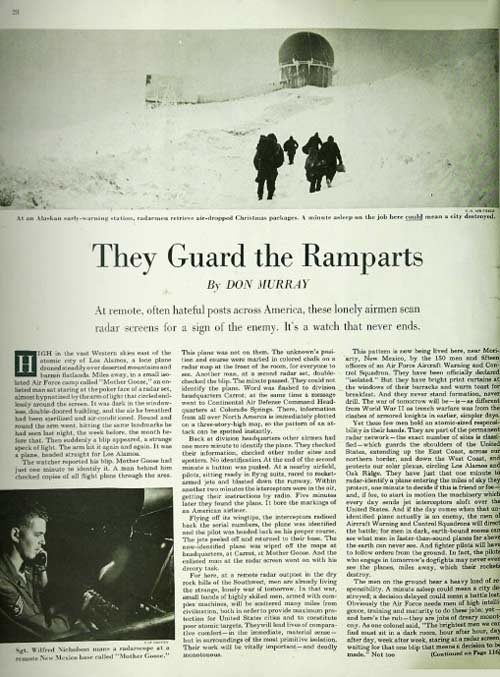
If anyone can empathize with high price of such mistakes, it’s the military personnel responsible for monitoring incoming nuclear threats. At the height of the cold war, the Post profiled the work of such men in the June 11, 1955, article “They Guard the Ramparts” by Don Murray. He points out the predicament of such work: that it’s “vitally important—and deadly monotonous.”

The men who worked for the Air Force’s Aircraft Warning and Control were responsible for staring for hours at a radar screen, waiting to catch an unexpected blip. Their secret locations were tucked into remote spots — in the Rockies, atop a Tennessee mountain, and even a Midwest millionaire’s resort — anywhere a first nuclear strike was unlikely to hit.
Despite every attempt to make these isolated locations homey with cheerful curtains, excellent food, and pinball machines, the work was dreary and tedious: almost no one re-enlisted. The Air Force faced the problem of needing thoughtful, imaginative, intelligent workers to do work that was deadly dull 99% of the time. And they realized the gravity of such a dilemma: “The men on the ground bear a heavy load of responsibility. A minute asleep could mean a city destroyed; a decision delayed could mean a battle lost.”
Heroes of Vietnam: The Battle for Nam Đȏng
 This article and other features about America in Vietnam can be found in the Post’s Special Collector’s Edition, The Heroes of Vietnam. This edition can be ordered here.
Everything was quiet in Camp Nam Ðông as I finished my round of the inner perimeter that night. I went up to the mess hall to check the guard roster. My watch said 2:26 a.m. At that moment the roof erupted in a blinding brilliance. The roaring concussion knocked me back through the door.
I scrambled into the command post next door. Master Sgt. Gabriel Ralph Alamo, my team sergeant, was already on the phone to Staff Sgt. Keith Daniels in the communications room, calling for a flare plane.
Now more mortar rounds rocked the camp. Grenades burst in volleys, their sound lighter than the mortars’ thunderclaps. Small arms and automatic weapons rattled from all sides. The mess hall was blazing.
When the blast of the first mortar round jolted Daniels out of bed, he flicked on the radio. Bare to the waist, Dan strapped on his holster but kept the gun in his hand, cocked, and watched the door, waiting to get a tone on the radio transmitter.
The minute he did, he sent his message: “Hello, Ða Năng … Nam Ðông calling … I have an operation-immediate message.”
“Roger. Roger. Go ahead, Nam Ðông.”
“Request flare ship and an air strike … We are under heavy mortar fire.”
The crashing, rending blasts of the mortar shells walked closer. A direct hit exploded on the supply room next door. Dan reckoned the communications room was next. Holstering his .45, he picked up his rifle, grabbed a belt of ammunition, and raced out the door.
Behind him, the communications room blew up. Already the whole long house was burning, flames crackling in the dry thatch of the roof and along the rattan walls.
We had known that the Viet Cong might attack at almost any time. But that weekend, the threat of attack seemed to have become much greater.
Close to the borders of both Laos and North Vietnam, Camp Nam Ðông had been set up to give some protection from the communists to the 5,000 inhabitants of the nine villages in our valley. To provide this protection, the camp commander, Ðai-uy (Captain) Lich, had a force of 311 Vietnamese.
The Special Forces detachment I commanded had been assigned as advisors to the camp commander — to give some protection and, even more important, to aid the villagers. Recently, for example, our medics, easygoing Sgt. Thomas L. Gregg and husky young Sgt. Terrance D. Terrin, had successfully handled an epidemic of encephalitis — “sleeping sickness.” Besides the 12 of us in Team A-726, there were only two other Westerners in the camp: Kevin Conway, an Australian warrant officer, and Dr. Gerald C. Hickey, an American expert on the Vietnamese mountain tribes.
On Saturday night, Sgt. Michael Disser, patrolling the villages farthest up the valley with a squad of night fighters, had radioed: “The villagers are scared, but they won’t tell me or my interpreters why.” Terry Terrin reported that his men had found the bodies of two murdered village chiefs. And tempers in the camp had flared in a quarrel — fomented by communist agents, I felt sure — between the South Vietnamese strike forces and our contingent of 60 Nungs, the tough mercenaries, ethnically Chinese.
I think that all of us in the team had a sense of foreboding that night — Staff Sgt. Merwin “Woody” Woods, I later discovered, wrote his wife: “All hell is going to break loose here before the night is over.”
At the blast of the first enemy mortar shell, Gregg rolled out of his bed in the dispensary, picked up his shotgun, and stepped outside.
The burning mess hall cast an eerie, dancing light over the camp, spectacular now with swirling smoke and the flashes of exploding shells. The V.C. mortars were zeroed in on us.
In the glare of the fire, Gregg saw crouched figures moving forward, not more than 20 yards away. He raised his shotgun and fired. The blasts caught six V.C. almost point blank. Gregg took a quick look around, then rushed back to the burning dispensary to save as much equipment as he could.
Racing to man his 81 mm mortar position near the dispensary, Sgt. 1st Class Thurman R. Brown pulled up short when he suddenly saw grenades arcing toward him from the direction of his own mortar pit. There, at the top of the concrete bunker at the rear of the pit, were at least two V.C. grenadiers. A 57 mm shell slammed into the wall a few feet away, blowing the wall apart and hurling Brown through the air. He ran to the C.P. to get some hand grenades.
By then the C.P. was burning. Alamo and I were trying to save what we could of the ammunition, arms, radios, and other equipment we had stored there. Brown grabbed a supply of grenades and headed back toward his position. A few yards ahead of him, one of the Vietnamese interpreters, George Tuan, was hit. Brown ran to Tuan, who was struggling to sit up. Both legs were off just below the knees. In 30 seconds he was dead.
Brown doubled back and ran through the burning buildings. A mortar shell landed right behind him, and he went flying through the air again. Stunned, he shook his head clear and glanced toward his mortar pit. Nobody in sight. He dashed over and jumped in. But when he looked up, he found himself staring down the barrel of a submachine gun held by one of two V.C. lying on top of his ammunition bunker. He raised his rifle, but the men rolled out of sight. Brown leaped to the edge of the pit and shot them both.
Back in the pit, he peered inside the bunker. Two Nungs were there. They couldn’t get out, and the V.C. couldn’t get in. The men Brown had killed had been about to blow up the bunker.
“Illumination rounds!” Brown ordered. The flares, floating overhead, would light up the area until the flare ship flew over.
As Brown started across the few feet between the bunker and his mortar, another burst hit. He tumbled through the bunker door.
When he tried to get up, he found he couldn’t move. His right leg felt dead. “Oh, Lord,” he mumbled. “I’ve lost a leg.”
Then he discovered he was sitting on it. In 30 seconds he was up and firing the mortar. As fast as he could move, he fired for illumination, bathing the scene in light so we could see the attackers.
Brown had awakened, seen a man die, helped fight a fire, survived four brushes with death, killed two men, and given us a fighting chance with his illuminating shells. All in five minutes.
Pop Alamo and I were still hauling stuff out of the burning C.P. when I saw Sgt. 1st Class Vernon Beeson running toward us. Mortar shells and grenades exploded within 25 feet of him, but nothing touched him. He took off through the burning buildings to his 81 mm mortar position. His Nungs were already there, breaking out ammunition. Bee knew that what we wanted was light.
“Gimme illumination!” he cried, and started firing as fast as he could drop the shells into the big tube.
Only 10 minutes had passed since the first V.C. shell landed.
From his quarters, Woody had seen that first shell explode — a ball of burning white phosphorus with “14,000 different-colored flames shooting out of it.”
Rolling off his bunk, he thumped to the floor, grabbing his .38 Smith & Wesson Special. Bullets were buzzing through the room. Woods reached up to his gun peg and took down his AR-15. Wearing only his GI drawers and pistol belt, he started crawling out the door to his mortar pit. The rocks outside were too rough on his knees, so he stood up and ran barefoot through the enemy fire to his position overlooking the helicopter pad.
The mortar on the other side of the gate was Mike Disser’s. Mike and Staff Sgt. Raymond “Whit” Whitsell, the team’s engineers, had elected not to waste time unlocking the door of the supply room where they slept. They left by the window, only moments before the room took a direct hit.
Whit scurried down the concrete steps into his 60 mm mortar pit. In easy reach, where he had laid them out as a precaution, were 18 rounds of illuminating shells. He plunked them in as fast as he could move.
The situation in Mike Disser’s pit was quite different. When he reached it, he found that six Nungs had preceded him, and that they were firing their carbines in the direction of the camp’s main ammunition bunkers. Then he peered over the rim of his pit. By the light of his flare, he saw what he has since called the most frightening sight of his life.
Hundreds of men were moving in on the camp. They were the main assault force of the two reinforced V.C. battalions — 800 to 900 guerrillas — that had ringed Camp Nam Ðông in the night. The first wave had overrun Strike Force Company 122 and was now less than 30 yards away.
Kneeling by his mortar and firing into the attackers as fast as he could, Mike glanced over his shoulder and saw Australian Warrant Officer Kevin Conway suddenly pitch headlong down the steps. He rolled over and Mike saw the wound. It was neat and round, smaller than a dime, almost exactly between the eyes. Conway was unconscious but alive. He moaned with each shallow breath.
By this time, Team Sgt. Alamo, painfully burned from the collapsing C.P., had dashed to Mike’s mortar pit through a hail of fire. When Conway fell, Alamo was at the front of the pit, picking off V.C. a few yards away with his AR-15. A few minutes later, a one-man army in the person of my executive officer, Lt. Jay Olejniczak (always called “Lieutenant O,” naturally), joined them.
Conway was sprawled in the dirt near the steps on the right of the pit when Jay got there. Alamo was in front of him, firing at figures flitting among the three ammunition bunkers 33 yards away. Disser, with his AR-15 cradled in his arms, was uncasing illuminating rounds and launching them in a steady, unfrenzied rhythm.
Jay took off his jacket and pillowed it under Conway’s head. A half-hour after he was hit, Conway quietly died. Jay joined Alamo at the parapet. With his M-79 launcher pointed almost straight up, he arched grenades among the ammunition bunkers.
Doc Hickey had decided to make for the dispensary, at the rear of the camp. When a mortar burst tossed him high in the air, he calmly felt himself all over for blood or broken bones; finding none, he continued on his way.
In the brief time of battle so far, I had been fully occupied with the need to save equipment we would need to fight with. Now I had to locate my men and organize the camp’s defenses.
In the flickering light from the fire, I saw movement at the gate, 20 yards away. “Mike!” I yelled. “Illuminate the main gate.”
He popped one over there and I saw three V.C. already within the inner perimeter. I squeezed off a half-dozen rounds. Two of the V.C. slumped. The third started crawling into the grass. I threw a grenade and he stopped.
Somewhere along the line I had been hit. My left forearm was bleeding, and there was a shrapnel wound about the size of a quarter in my stomach. It was belt-high, on the left side, and it was bleeding. But nothing hurt too much, and my legs were okay.
Nearby, Brown and his two Nungs were operating with precision. As quick as they handed him the 81 mm projectiles, he pulled off all the increment charges from the tail assembly — no need for boosters at that point-blank range — removed the safety clip, set the timing, and popped the shell into the muzzle of his mortar.
“Cover me,” Brown said to Dan. “They’re coming over the fence.”
A dead V.C. hung on the barbed wire of the inner-perimeter fence about 10 feet away. Brown had shot him only minutes before. Muzzle flashes and shouts indicated a cluster of V.C., perhaps 30 yards away. They seemed to be grouping for a charge.
An illuminating round lit up the scene. At least a hundred men were out there. One group of 10 or 15 made for the fence in a line of skirmishers. Dan fired fast with his AR-15. A couple of Nungs entered the pit and joined him at the rim. To his left, Dan heard the roar of a shotgun. He gave a quick look and saw, with relief, that Gregg had come into the pit too, and was booming away at anything that moved. Together they knocked down the first wave. But another came on, and another, and another.
The Nung alongside Dan let out a yell, wheeled and fired three quick carbine bursts at the top of the bunker in the rear of the pit. Dan turned in time to see a V.C. there, crumpling backward, a dynamite grenade in his hand.
Working my way to the rear of camp, I yelled for a medic and was rewarded with a shout from Gregg in Brown’s pit. I jumped in. Smiley, carrying the hand radio, followed.
“Did you call Ða Năng?” I asked Dan. He said he had. I couldn’t understand where the reaction forces were. We had been fighting for almost an hour. It was only 32 miles to Ða Năng. Where was the flare ship? Where was the air strike?
Smiley and I headed back to Disser’s position to see how things were going at the front gate. As we passed by the supply room, the ammunition blew apart with a tremendous explosion. For the third time, I was knocked down hard, and for the first time I felt real pain. My left leg hurt where it was torn by shrapnel. I pulled myself up and made it to Disser’s pit, the faithful Smiley right behind me.
It was a hellhole.
The V.C. had breached the outer perimeter and completely overrun Strike Force Company 122. They were at the inner perimeter barbed wire. Our mortar and automatic-weapons fire made them keep their heads down and move with caution. But they were within easy grenade-throwing distance. They bombarded us with grenades in volleys — five, six, seven at a time.
Jay heard a thud behind him and looked back. A fragmentation grenade rolled around by his feet. Inches away, it hit like a sledgehammer blow against the soles of his boots. He knew that the bones were broken. He carefully tightened his boot laces and tied them securely around his bare ankle, hoping to stop the bleeding and keep the bones together.
More grenades went off in the pit. Disser, crouched alongside his mortar, was wounded in the knees, the arms, and the legs. He kept on firing.
A grenade bounced into the bunker and landed in an ammunition box alongside Disser. Jay and Alamo dove to the right, Mike to the left. The blast tore into Mike’s foot and lower leg. He crawled back to his mortar and started firing it again.
Alamo slumped on the steps, bleeding from the shoulder and from a fresh hole just below the eye. Jay, sitting in the bunker doorway and passing ammunition to Disser, was a mass of wounds. He was hit in both legs, the left hand and elbow, the shoulders, and the back. The grenade barrages had jarred him loose from his weapons, and he looked about for something, anything. He resolved to leap upon the first V.C. to enter the pit and fight him with his bare hands.
Knocked down by an exploding grenade, trying to shake off the bewilderment, I fired into the darkness. Mike was trying to keep his mortar going, with two Nungs now helping him and Jay passing them ammunition.
“This is for Pop!” Jay yelled, passing Mike a round. Mike grabbed it, shouted, and launched it.
“This one’s for Conway!” Jay yelled, passing another round. They worked that way, yelling and firing, talking it up in a frenzied rhythm, performing in their own private hell. But the bedlam of bursting grenades was too much. In desperation we were picking up grenades and throwing them out of the pit before they could go off.
“Let’s get the hell out of here!” Mike yelled.
“Right!” I yelled back.
As if for emphasis, a concussion grenade exploded, knocking Mike and me down. Mike’s whole side was numb and he moved like a drunken man.
“Get out!” I cried.
Mike and Smiley evacuated the pit first. Jay and the Nungs followed them. Jay, as chopped up as he was, went out the same way he came in, loaded with weapons. I fired cover for their withdrawal to an 18-inch-deep ditch we had dug for burying communications wire.
Pop Alamo was sitting on the steps, bleeding from the face, the shoulder, and the stomach. I yelled to Mike and Jay to cover me, got one of Pop’s arms around my neck, and started to straighten up. I was in about a half-standing position when a tremendous blast went off in my face. It must have been a mortar hit at the top of the stairs. I could hear myself screaming as I flew through space. I had the sensation of falling backward off a cliff. I am going to die, I thought.
I came to with my head and shoulders inside the ammunition bunker, the rest of me outside. My left shoulder was all bloody, and intense pain shot from there down to my fingertips. My head, which had been aching since the first explosion, was bloody, too, and pulsed with pain. My stomach wound was bleeding. But I was alive.
Alamo was sprawled in the pit. He was dead.
I picked up the 60 mm mortar and moved out. Thirty yards away, I ducked behind a pile of cinder blocks. Four wounded Nungs were there. One of them had half his scalp torn away. I took off my jacket and my T-shirt and tore the T-shirt into bandages and patched up the men. I had a little piece left over, and I stuffed this into my stomach wound to try to stop the bleeding. I used one of my raggedy socks as a tourniquet on one of the men.
“Come on, you fellows are going to be all right,” I said to the Nungs. “You can still fight. Here’s your weapons. Cover me.”
I propped them up along the cinder blocks, their carbines in their hands. I shoved the mortar behind them and started to run back. But I couldn’t straighten up for the pain. I had to stay bent over, walking.
I went back to Woody’s pit, yelled out who I was so the Nungs wouldn’t shoot, and lay down on the rim, too exhausted to climb down inside. Woody’s feet were cut and bleeding.
I asked him how he was.
“Hell, I’m all right,” Woody said. “But I think my right eardrum’s busted. I felt some liquid running out of it. How’s everybody else?”
I hesitated. We used to argue in training about whether it was wiser to lie to your men when they were taking heavy casualties. There are two schools of thought. I decided that with these men, the bitter truth would make them fight harder. I was right.
“Alamo’s dead, Houston’s dead, Conway’s dead,” I told him. “Lieutenant ‘O’ and Disser are wounded. Brown’s wounded. Terry’s wounded. I don’t know about Beeson. I can’t get to him.”
Woody took the news without a word of comment. But I know now that he thought it was the death sentence for all of us. Isolated as he was, all he knew of his certain knowledge was that three men of our 12-man team were yet alive; he and I and Whitsell, out of contact but obviously firing furiously. Where were our planes?
A few minutes later, when I ran into Gregg, he insisted on checking me over. “You’re all shot up,” Gregg said. “Hold still and I’ll fix you up.”
“No,” I said. “There are a lot of them worse off than me. Take care of them and catch me later.”
I left for the main gate. I had an idea there would be a determined assault in that area. Perhaps I could get the Nungs to move the 60 mm mortar back into Disser’s pit. We would need it as a strong point. I saw no end to the pressure. We had been fighting for more than an hour and a half, without even a five-minute breather. Did anybody know?
And then I heard it. The distant hum of an airplane engine. It grew louder and louder.
The skies lit up. The flare ship had arrived. It was 4:04 a.m.
The plane brought a lot more than light. It brought hope to us in the camp, and it must have discouraged the V.C., for little by little their firing tapered off. A flare ship is usually followed by an air strike, and they knew it. Within minutes they began to withdraw. But they were far from through with us.
In the flare-lit gloom of the broken terrain in front of Brown’s mortar pit, a loudspeaker suddenly cut on. A man’s voice began speaking excited, high-pitched Vietnamese. It shocked both sides into silence.
Dan grabbed Tet, the interpreter, and demanded, “What’s he saying?”
“He say lay down weapons. V.C. going take camp and we all be killed.”
Dan, Gregg, and Brown exchanged hard looks of anger.
“Over my dead body,” Dan said.
“We’ll lay down our weapons when we’re too dead to pick ’em up,” Gregg said. But the silence held. Nobody in that sector was firing at all. The silence was unnerving. And then it was broken by the voice from the loudspeaker again, this time in English.
“We are going to annihilate your camp; you will all be killed!”
Brown was already adjusting the elevation on his mortar. “Where do you think it is?”
“Over here,” Dan said, pointing.
Brown fired about 10 rounds of high explosive and white phosphorus as fast as he could. The bursts broke the spell. The Nung machine gun on the right began chopping again. Small-arms fire resumed all around the pit. Incoming fire answered back.
There was another new sound; 60 mm mortar shells were walking toward the pit from within the camp.
“That mortar’s close,” Brown said.
They could hear the thunk of the shell sliding down the tube, the small explosion of its launching, and the roaring impact of its landing in back of them.
Off to the left, the loudspeaker came on again. Brown wheeled his mortar to the left and smothered the place where the sound was coming from with high explosive and white-phosphorus rounds. That was the last we heard of it.
Daylight was coming on by the time I finally got to Beeson. Gregg was in the pit, treating a wounded Nung, when I arrived. It was five, going on six, and the spaces between the V.C. mortar volleys seemed to be getting longer.
“Sit down, Captain,” Beeson said gently.
“Naw, I’m all right,” I said automatically.
“Sit down, sir,” Beeson said, still gently, “or I’m going to have to knock you down.”
He sat me on an ammunition box and started looking at my wounds. I felt the strength draining out of me.
Beeson put a bandage on my shoulder, but I wouldn’t let him work on the stomach wound. I had to go make the rounds again to brace for a possible new attack.
I walked out of Beeson’s pit without bothering to duck. After all those hours of twisting, crouching, and crawling, I was sick of it all. To hell with it, I thought. A hand grenade went off and knocked me down. I got up and walked to the makeshift C.P. that had developed behind the cinder blocks near Whit’s and Woody’s positions at the main gate.
About 50 yards in front of Woody’s, I saw four or five V.C. behind some tree stumps.
“Can you drop an 81 on them that close, Woody?” I called out.
“I never did it before, but I could damn well try,” Woody said.
Without using the sights, he put the tube almost straight up. The tree stumps blew sky high, and with them the last of the V.C. Except for sporadic small-arms fire, the battle for Nam Ðông was over.
A lot has happened since then. While I was in the hospital, Team A-726 was reactivated and saw more action — Brown, Beeson, Dan, Gregg, and Whit forming the nucleus — until last November when those five and I flew home together.
Pop Alamo and John Houston — God rest their souls — were posthumously awarded the nation’s second-highest military decoration, the Distinguished Service Cross. They were the only members missing when we assembled at the White House last December 5 as one of the most decorated units in Army history — Silver Stars to Olejniczak, Brown, Disser, and Terrin; and Bronze Stars with “V” for Valor to Beeson, Daniels, Gregg, Whitsell, and Woods; as well as nine Purple Hearts among us (all but Bee, Dan, and Gregg were wounded).
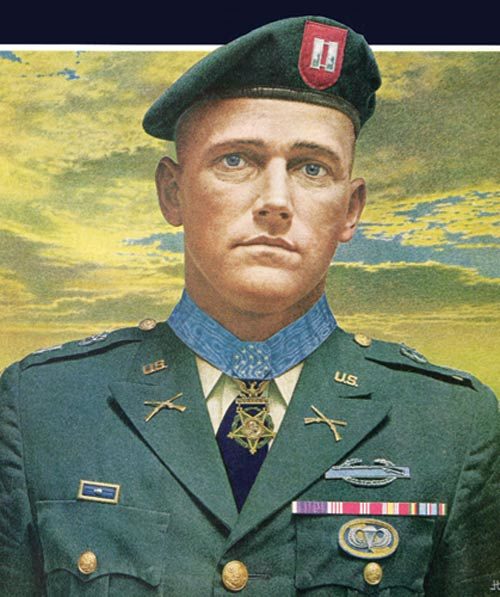
The Medal of Honor which President Johnson awarded me belongs equally to all of us. I solemnly pledge that whatever good flows from it for me will be passed on, intact, to the valiant men of my team, Detachment A-726 of the 7th Special Forces Group (Airborne).
—“The Battle for Nam Đông,” October 23, 1965
Excerpt from Outpost of Freedom by Capt. Roger H.C. Donlon, as told to Warren Rogers. ©1965 McGraw-Hill Education. Reprinted with permission. All rights reserved.
Healthy Weight, Healthy Mind: Tips for Eating Smart, Part 2
We are pleased to bring you this regular column by Dr. David Creel, a licensed psychologist, certified clinical exercise physiologist and registered dietitian. He is also credentialed as a certified diabetes educator and the author of A Size That Fits: Lose Weight and Keep it off, One Thought at a Time (NorLightsPress, 2017). See all of David Creel’s articles here.
Last week I offered four eating tips to help you lose weight and keep it off in a healthy manner. Here are three more helpful hints to help you manage calories and develop sound eating habits.
5. Choose Whole Grains
Our bodies like to operate on sugar (glucose), especially when we exercise at high intensities. When we eat whole grains, complex carbohydrates break down and sugar slowly enters our bloodstream, ready for use by our brain and working muscles. Whole grain foods such as wheat bread, brown rice, quinoa, and oats are rich in vitamins and minerals as well as fiber. Whole grains can be slightly higher in calories, which you will see if you compare white bread to whole wheat bread, because they contain the germ of the seed — a source of healthy fat. Despite the slightly higher calories, you’ll probably feel fuller longer because the whole grain fiber slows the rate at which food empties from the stomach. In addition, many foods made with refined grains (crackers, muffins, pastries, cookies, etc.) have added fats and sugars that boost the calorie count and increase our drive to overeat them.
6. Eat Lean Protein at Meals and Snacks
Calorie-for-calorie, protein tends to be more satiating than fat or carbohydrates. If I asked you to rate your fullness after eating 300 calories of pasta with red sauce (carbohydrates) versus the same calories worth of cheesecake (a tiny piece loaded with fat), compared to boneless skinless chicken breast (almost entirely protein), which would fill you up the most? Studies show it would be the chicken breast. Protein is important to help us feel satisfied after eating. Thus, adding an egg to your breakfast or a low-fat cheese stick to your afternoon snack may help curb overeating later in the day.
7. Watch for Hidden Fat
For several summers during college I worked breakfast and lunch room service in a high-end hotel. Each morning, dressed in my white Oxford shirt, black pants, and bow tie, I would grab something quick to eat between orders. Oatmeal was my favorite. I wasn’t sure why, but this was the best oatmeal ever. I thought maybe the hotel ordered exotic oats from overseas, which would explain the silky texture and rich flavor. Each morning I scarfed down a bowl or two of what I thought was the healthiest thing I could get my hands on. One morning I happened to enter the kitchen when Ms. B, as we called her, was making a large batch of the good stuff. Ms. B was a sweet black lady from Alabama who called everyone Honey. She seemed to cook from the depths of her soul and her food tasted better because you know she prepared it just for you. I can only imagine she learned to cook from her mother, who learned to cook from her mother.
Having family from the South, I knew all about the fat-is-flavor style of cooking. But I couldn’t believe my eyes when I walked in on Ms. B mid-oatmeal and saw her pouring a large carton of half-and-half creamer into the oats. I never imagined someone could do that to oatmeal! That day I learned a valuable lesson about hidden fat, especially when dining out. People often underestimate the calories in food because they don’t account for added fat, especially when others prepare it. Remember, one gram of fat has nine calories. A teaspoon of butter contains about four grams of fat or 36 calories. A stick of butter has over 800 calories (think cookies), compared to an equally sized banana of around 90 calories.
Follow This Diet
In summary, there is no best diet for weight loss and weight loss maintenance. But consuming a diet that’s rich in vegetables, lean protein sources, fruits, whole grains, and low-fat dairy will make weight loss more likely and give you the best chance of preventing diet-related diseases. In addition, eating a balanced diet can make you feel more energetic and give you the fuel to exercise consistently.
Come back each week for more healthy weight loss advice from Dr. David Creel.
Frank Zappa on Why You Can’t Stand Your Kids’ Music
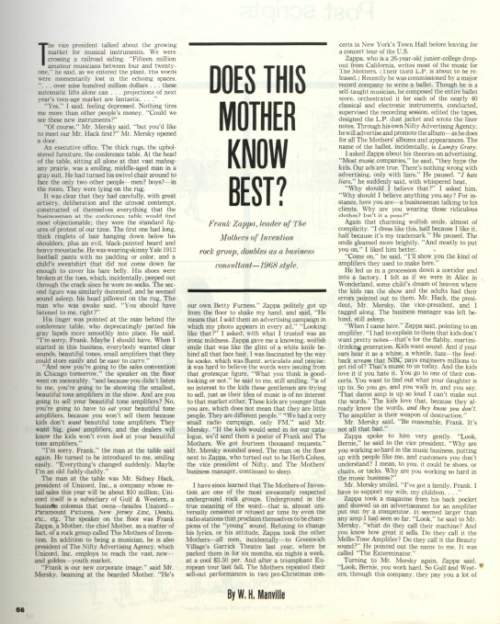
 When I came here,” Frank Zappa said, pointing to an amplifier, “I had to explain to them that kids don’t want pretty notes — that’s for the flabby, martini-drinking generation. Kids want sound. And if your ears hear it as a whine, a whistle, fuzz — the feedback scream that NBC pays engineers millions to get rid of? That’s music to us today. And the kids love it if you hate it. You go to one of their concerts. You want to find out what your daughter is up to. So you go, and you walk in, and you say, ‘That damn amp is up so loud I can’t make out the words.’ The kids love that, because they already know the words, and they know you don’t. The amplifier is their weapon of destruction.”
—”Does This Mother Know Best?” by W.H. Manville, January 13, 1968
This article is featured in the January/February 2018 issue of The Saturday Evening Post. Subscribe to the magazine for more art, inspiring stories, fiction, humor, and features from our archives.
Post Puzzlers: January 11, 1873
Each week, we’ll bring you a series of puzzles from our archives. This set is from our January 11, 1873, issue.
Note that the puzzles and their answers reflect the spellings and culture of the era.
RIDDLER
CHARADE.
WRITTEN FOR THE SATURDAY EVENING POST
My first in used as a means of defence.
‘Gainst thieves of every kind;
My second, about the dinner hour,
Quite handy you will find.
On your gun you have my whole, no doubt,
For it would be of no use without.
Fort Totten, D. T. GAHMEW.
RIDDLE.
WRITTEN FOR THE SATURDAY EVENING POST
My 1st is in village, but not in town.
My 2d is in clergyman, but not in clown.
My 3d is in mountain, but not in vale.
My 4th is in tempest, but not in gale.
My 5th is in magnificent, but not in grand.
My 6th is in water, but not in land.
My 7th is in silver, but not in gold.
And now before you my whole is told.
Seaboard, N.C., F. E. F.
ANAGRAMS
WRITTEN FOR THE SATURDAY EVENING POST
NAMES OF ISLANDS
- Near a chasm.
- Ira came.
- No lad.
- A staff.
- Do learn.
- Call no ire.
- Can we aid Leon?
- An idler.
- Six left.
- Thomas Upton.
- Go, pen torn.
- Rain aids.
EUGENE.
RIDDLE
WRITTEN FOR THE SATURDAY EVENING POST
Seven letters comprise my name entire,
The name of a book which many admire.
The first three letters will bring to view
A Scripture character known to you.
The other four (if you rightly place)
Is something oft found on the human face.
Fort Totten, D. T., GAHMEW
ANSWERS
CHARADE—Look-plate.
RIDDLE —Letters.
ANAGRAMS—
- Mascarenha
- America
- Orland
- Staffa
- Ladrone
- Caroallim
- New Caledonia
- Ireland
- St Felix
- Southhampton
- Negropont
- Sardinia
RIDDLE—Lothair. (Lot-hair.)
Movies for the Rest of Us with Bill Newcott: January Gems
Join our movie review video podcast, Movies for the Rest of Us with Bill Newcott. This week, Bill reviews some January movies worth seeing, including Humor Me with Elliott Gould and Jemaine Clement and Mom & Dad starring Nicolas Cage and Selma Blair. Also don’t miss Bill’s quick hits on the latest DVD and Blu-ray releases.
News of the Week: Vegas Does Tech, Oregon Pumps Gas, and Boston Makes Burgers (Sort Of)
Finally, a Fridge That Will Call Uber for You
Every winter, journalists and geeks … I mean “technology enthusiasts” … get together at the Consumer Electronics Show in Las Vegas to oooh and ahhh over the latest gadgets invented by companies. This year’s week-long event ends today.
A lot of the new inventions are things most of us will never use — but some are fun. Travis the Translator can translate 80 languages almost instantly, which sounds very Star Trek-ish. Buddy the Robot is like an Amazon Echo crossed with your pet, though there’s no way I’m spending $1500 for it. Or how about this 65-inch LG television that rolls up like a newspaper? I’m sure that LG has to explain to younger people what exactly a “newspaper” is. There was nothing from Apple, because they skip the show every year.
I find myself getting less and less interested in the “new” tech as the years go by. All the fancy this and web-connected that just make things more complicated, and I find myself shrugging more than saying “wow.” I’ll still take landline phones, desktop computers, and typewriters over most of the new things being introduced.
As I’ve said before, I’m waiting for someone — Apple, Amazon, Google, Tom Hanks — to launch a line of manual typewriters. Not electronic typewriters or typewriters that have USB or Wi-Fi. I just mean old-fashioned manual typewriters. If they want, they can put an “i” in front of the name to make it sound more modern.
Maybe We Need New Tech to Control Falling Satellites
How many people remember the Skylab space station? It was launched in 1973 and fell back to Earth in 1979, which caused some panic and a lot of news coverage. The sub shop around the corner from my house even had a special Skylab sandwich on the menu. I think it had ham in it. It burned up in the atmosphere (the space station, not the sandwich), and several pieces landed in Australia.
Now there’s another space object falling to Earth, and right now scientists don’t know exactly where or when it’s going to fall. It’s a Chinese satellite called Tiangong-1 and it’s scheduled to fall back to Earth some time in March. Not only do they not know where it will fall, there’s also no way to control it.
Maybe this satellite should pick up our latest issue, where we explain the right way to fall.
Self-Serve

Did you know that until recently there were still two states where it was against the law to pump your own gas into your car? Now there’s only one, because Oregon has passed a law saying, yes, you can now pump your own gas.
A lot of people see this as a positive thing, that it’s about time residents of Oregon were able to do something almost every other state has been able to do for decades. But some people are, well, freaking out. They think it’s dangerous, they think it’s complicated, they don’t want to be bothered doing something a gas station attendant should do, and most of all, they don’t want to go to work smelling like gasoline.
Now the only state where you can’t do it is New Jersey.
The Fire and Fury Book (No, the Other One)
You’ve probably heard of a certain book that’s causing a lot of controversy in the worlds of Washington politics and New York media. Michael Wolff’s Fire and Fury is selling like hotcakes (or whatever similar cliché you’d like to plug into this sentence). It’s currently No. 1 on Amazon and sold out at stores around the country. But if you buy books based on the title alone, maybe there’s another Fire and Fury you might like.
I don’t really understand how someone can order a book and not actually look at it to see what they’re getting, but University of Toronto professor Randall Hansen is happy that several people are making that mistake. He wrote a book in 2008 that also happens to be titled Fire and Fury, and some people are buying it, not realizing it’s a book about World War II battles and not about the inner goings-on at the Trump White House.
I’m going to write a cookbook and title it Harry Potter and the Chamber of Secrets.
RIP Jerry Van Dyke and John Young
Just a couple of weeks after the death of Rose Marie comes the passing of someone else with a Dick Van Dyke Show connection. Jerry Van Dyke, the real-life brother of Dick who played Rob’s brother Stacey in four appearances on the sitcom and later went on to star in My Mother the Car and Coach, died last Friday at the age of 86. He also had a recurring role on The Middle, playing Patricia Heaton’s dad.
John Young was an astronaut who walked on the moon and commanded the first Space Shuttle flight. He also sneaked a corned beef sandwich onboard for the Gemini 3 mission in 1965. He died last Friday at the age of 87.
The Best and the Worst
The Best: My favorite story this week is about Virgil Westdale, a former Army Air Corps pilot who was stripped of his wings after the attack on Pearl Harbor because his father was Japanese. Westdale recently got those wings back, on his 100th birthday.
The Worst: I’m disheartened by all the store closings! Macy’s, Sears, Kmart. All the stores we shopped at when I was a kid are closing more and more locations. So far, none of the store locations are close to me, but I know that day is coming.
I still remember vividly how I would go through the Sears Christmas catalogue (the “Wish Book”) every year and make a detailed list of the toys I wanted. I’d make a chart for my mom, letting her know exactly what I wanted, the price, and even on what page of the catalog the item could be found (I was just trying to be helpful). Today I’d probably use PowerPoint.
This Week in History
Schoolhouse Rock Debuts on ABC (January 6, 1973)
I haven’t seen this in 40 years, and I’m amazed (and a little bit frightened) that I remember most of the narration and the songs. Zero, my hero, how wonderful you are. How wonderful you arrrrrrrrrrre!
First Typewriter Patent (January 7, 1714)
It was granted to Henry Mill, an English inventor and engineer. Post Archive Director Jeff Nilsson takes a look back at some great vintage typewriter ads that ran in the magazine.
This Week in Saturday Evening Post History: Park Street, Boston (January 7, 1961)
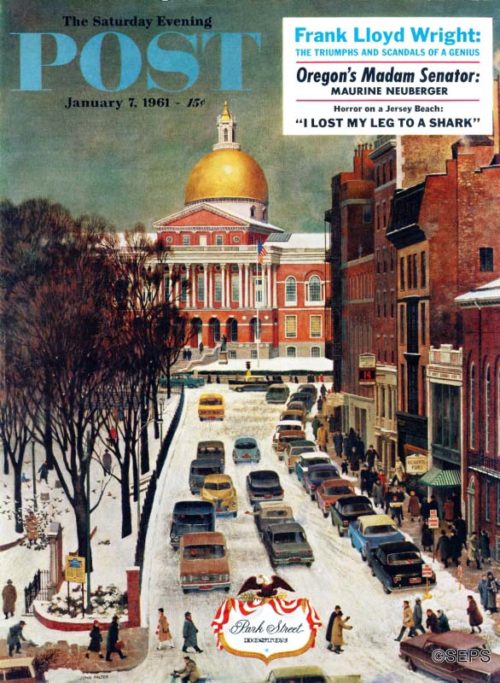
Park Street, Boston
January 7, 1961
They’re aren’t many Post covers where I can say, “Hey, I’ve been there!” Besides this cover by John Falter that depicts the State House and Park Street in Boston (click on this page to see the entire painting), the only other cover I have a personal connection with is this one by John Clymer, published just a month later, which shows an area that’s just a couple of blocks from where I’m typing these words.
January Is National Whole Wheat Bread Month
I don’t know how exciting I can make National Whole Wheat Bread Month, but since we’re on the subject of Boston, how about making these Boston Cheeseburgers, which can be made using either wheat or white bread.
Note: There’s no burger.
Next Week’s Holidays and Events
Martin Luther King Jr. Day (January 15)
After King’s death, the idea for a national holiday came from Representative John Conyers of Michigan and Senator Edward Brooke of Massachusetts. The bill they introduced failed to pass by five votes, but another bill was passed in 1983 and signed by President Ronald Reagan. The federal holiday was first celebrated in 1986.
Winnie the Pooh Day (January 18)
This day celebrates the birth of A.A. Milne, the man who invented the yellow bear (with inspiration from his son Christopher Robin, who later grew to hate the books). The two were subjects of the 2017 movie Goodbye Christopher Robin.
Lloyd and Mary
Lloyd had been sitting out by the shore all day, and it was nearly sunset before Mary came down to bring him a glass of tea, marching through the sand like it was snowdrifts.
“Well,” he said. “Where you been?”
“Oh, Lloyd, Abe and Janice are here; can’t you come up? Just for a while. Abe was asking—”
He took a sip of tea and let it ease down his throat, which had grown dry and cracked. He wondered what had kept her. She stood before him now with her dimpled knees, white shorts folded up above and a flowery blouse that whipped in the wind. He tried to read her face: disgust, he thought. Yes, there it was, like a shadow in the eyes. Guilt dropped over the disgust like a curtain, and behind that, love. That was it — that last part — love; that’s the part that interested him.
“It took you long enough to bring the tea,” he said.
“How’s the sugar?” she said.
“Not enough. Almost, but not quite.”
“Abe and Janice want to play euchre. We got four if you come up.”
“This hat’s got a hole in it,” he said, showing her a frayed point on the straw. “It’s got my head sunburnt.”
His voice had a whiny edge to it now, and she watched him rub his fingers along the hat, tracing the hole, and wanted to rip it from his hands and throw it to the sand.
“There’s another one up at the house,” she said.
“You’ll bring that down,” he said. It wasn’t an order, just a plain fact, like the sand or the water or the hole itself.
In the early days, when Mary first married Lloyd, he had been interested mainly in honeybees. He was in real estate, selling multimillion-dollar summer properties along the North Carolina coast, which he could do — he wore bow ties and rolled up his sleeves, he combed his hair over his bald spot, he made jokes — but at dinner he talked about honeybees.
“Did you know, Mary, that the honeybee’s wings beat at up to 200 times a second? Can you imagine that, Mary? Two hundred times!”
He wanted to get a house with room for wild overgrowth so he could get his own hive. Though Mary had no use for honeybees herself, she encouraged him. He was, after all, a successful man, and that counted. She sent him off in his bow ties every morning with two ham sandwiches in his lunch box and one Golden Delicious apple, and he would come home every night and say, “Did you know, Mary, those were the most delicious sandwiches I’ve ever had?”
She spent her mornings smoothing that mayonnaise to the edges just for him — it was like coloring a picture in the lines, getting the white to stop precisely at the crust. It seemed silly to her even as she did it, but she knew in half an hour he would be gone to work, and she could sit out back and read while the wind rattled the page corners. At dinner, he was back to the honeybees soon enough.
“Mary, did you know it would take 1,100 honeybee stings to kill a man? Can you imagine?”
In some ways, having Lloyd was like having anything, or anyone. It was just a matter of getting to know the peculiarities of him, where his corners started and stopped. Once Mary managed it, Lloyd seemed perfect, just exactly what she had imagined. She sent him to work, and every day he returned at near-exactly the same time and wanted exactly the same thing: A tall glass of sweet tea and his copy of Beehive magazine.
Mary’s parents, Buster and Nora, had been preparing her for marriage since she was a little girl with a round face and straight, dust-colored hair. They never mentioned a career or asked what she wanted to be when she grew up, although sometimes the teachers in school would ask. Once, she said she wanted to have a shop that sold snow globes. “But sand instead of snow,” she explained. “And tiny families playing on the beach. And a dog, a spotted one.” She imagined herself sitting on a white stool behind a cash register like Mrs. Lindie Comstock in her gift shop on Center Street. She would play flute music in the background and burn cinnamon sticks and offer little cups of sweet tea while shoppers picked out just the right globe. When she told her parents, they laughed and her mother ran her fingers along her fat cheek and said, “Aren’t you ambitious.”
When Buster and Nora really meant business, though, they talked about How to Find a Husband. It was one of their favorite subjects, even when Mary was small enough to be interested only in wearing the same purple-flowered dress to church every week and forgetting to brush her teeth. Nora would comb Mary’s hair, which was so fine it frayed with static, and say, “You’re going to be a beautiful woman one day, Mary, and you’ll marry yourself a good Christian man. You wait and see.” Over dinner, they would lay out the specifications: “He’s got to have at least a little money,” Buster was always saying. “He’s got to be kind, to you and the children,” Nora would say.
When Lloyd came along, which wasn’t until Mary was 22 and Buster and Nora were beginning to panic, they were pleased. Buster’s eyes lit up when Lloyd shook his hand, and Nora asked if he wanted her to turn on the furnace. “Are you cold, Lloyd? I feel a bit of a chill in the air; can I bring you a sweater?” Mary felt satisfied. She had found her parents a man. A symmetrical little fellow, too. His socks matched his shirt, and his tapered shoes were tied in delicate, tight knots.
“Oh, you’ve landed a good one, Mary,” Nora gushed when they passed in the hall. “Do you see how he looks at you?”
Only he hadn’t looked at her. He had been looking at Buster all evening, talking about honeybees, which was all right with her.
“And then, they eat their own honey all winter long,” Lloyd was saying. “That’s how they live!”
When they moved to a house with wild overgrowth and Lloyd got his beehive, Mary came out one afternoon to find Lloyd flat on the ground, blue in the face, spittle streaming down his chin. It turned out he was allergic to bees. It wouldn’t take 1,100 honeybees to kill him, just one or two, is how it turned out. Lloyd survived but was worse for it. The hive went, and with it Lloyd’s spirit. For months he sat in the den in the evenings and stared at the wood paneling while Mary watched TV.
Mary was secretly glad not to hear about honeybees anymore, though she had smiled indulgently through thousands of bee facts and through Lloyd’s bubbling enthusiasm at putting up the hives and stomping around out back wearing nets. Now that Lloyd had so much less to say, she found herself growing fonder of him.
When Mary went out into town, she would talk about Lloyd in that fond, exasperated, eye-rolling way all women talked about their husbands. “Lloyd only eats ham,” she told Sarah at the grocery. “Every day I tell him, ‘Lloyd, now why don’t you try turkey?’ and he says, ‘Mary, I know I like ham, and that’s what I want.’”
Mary felt satisfied as she pushed her cart of groceries to the car and then arranged them in the hatch according to size and shape. Eggs secured along the sides. Ham in the middle. Bread on top. Life seemed orderly, as if everything had been properly distributed and Mary’s only job was to organize it. She had to manage Lloyd and the house and read novels, mysteries mostly. In the latest one, a man had been cut into sections and parts of his body hidden around a small city in Maine. Mary devoured the book and a box of ginger snaps in a single afternoon. “My Lord,” she said, slamming it shut. “The things people will do.”
Mary was happy. She came to like the way Lloyd’s back swayed and his chest puffed out and his eyes gleamed when he saw the creamed chicken over biscuits they had every Thursday night. On Saturdays, Lloyd came to bed in only his Hanes boxer shorts, and Mary knew that was the night, and hung onto the sharp edges of his shoulder blades while he worked his way around her complicated nightie, which had ties and snaps both.
What Mary didn’t want was children. She passed them in town, clinging to their mothers, their faces mottled with rage, begging for this or that. She didn’t like the way they push out of you, coated with slime. But when she started to go to the grocery store and her friends were buying rubber nipples and eight-packs of bibs, she began to feel less satisfied.
“Lloyd, what do you think about having a baby?” Mary said on a creamed-chicken-over-biscuits night.
Lloyd didn’t reply. He didn’t say anything about it for three straight days, but then he brought home a book about baby facts he began to recite to her at the dinner table.
“Did you know, Mary, that babies have more bones than we do when they’re born? They fuse into each other as they grow!”
While Mary was pregnant, people would stop in town to run their hands over her stomach, claiming to feel kicks or bumps Mary didn’t feel. Even so, as they walked away, Mary found herself feeling satisfied again. She bought spit-up towels and packs of diapers and joked about the cost of babies with other women. The world felt orderly again. Like something had been rightly distributed to her, and all she had to do was put it in the right place.
When Petey was born three months early, he was the size of her fanned-out hand, veiny and bright red. He cried in long, thin, keening wails, an otherworldly sound. “I can’t stand the sound of it,” she told the nurse, who frowned at her. Mary spent an hour studying the vein that threaded up from his ear to the top of his skull. She imagined the tiny river of blood-flow through it. When she was finally able to hold him, she could barely stand to touch his translucent skin. But when she did, under the stern gaze of the nurse, he was warm to the touch, and soft. Touching his skin seemed suddenly like touching a part of herself, something deep and precious and old.
“He looks like my Uncle Bernie,” Lloyd said.
“Oh, he doesn’t either,” Mary said.
Petey grew like a bird: wobbly-legged and big-headed, his upper lip pointed downward like a beak. His brow was always furrowed, and his mouth was always in a slight wrinkle, and the keening wail continued through the first grade. Mary treated him like a mystical creature whose wisdom outstripped hers by the time he could form words. “What do you think, Petey? Tide or Arm and Hammer?” she would ask him.
“Tide,” Petey would squeak, seeming weary from the question.
“Should we drive by the cemetery on the way home or take Crawford Street?”
“The cemetery.”
Petey liked the cemetery for reasons that mystified Lloyd and enchanted Mary. She balanced him on the edges of mausoleums and took his picture while he furrowed his brow. “Such a handsome little thing,” she would say, showing the pictures to Buster and Nora.
“Honey, do you think — I mean, why the cemetery?” Nora would ask.
“Oh, we just like it,” Mary said.
The pictures seemed a lot more ominous after Petey died. He came down with pneumonia and got infections in the hospital, one after another. He was 7, but looked no older than 4. He’d had thin brown hair that Mary combed herself before the wake, spitting it down as she had when he was alive. Inside the casket was a print of the two of them posing in front of the Parker Family mausoleum, one thin arm linked into her fat one. “It’s such a good picture of us,” she said, pressing it into the silken lining next to him.
After Petey was gone, Mary returned to her mystery novels with a certain satisfaction. She’d had her child and bought the onesies and rubber nipples — the whole bit — and she’d cared for the boy and loved the boy, and now it was done. She wiggled her painted toes on the deck, letting the breeze flow through, closed her eyes and let the sun shine on her face.
But Lloyd began drifting off in the evenings, watching the wood paneling instead of the TV. He remembered what TV shows Petey liked and how he picked at his macaroni, eating each one separately, and not very many of them at that.
“If only we’d gotten him to eat,” Lloyd said.
“We gave him a good life,” Mary said matter-of-factly, in a voice that finalized the subject. It had been done, after all. What was expected.
In the years after, Mary began to bring people to their house, which was near the shore and two stories high with catwalks and balconies, and which had walls painted deep robin’s-egg blue and dusty yellow, and which had one tall antique grandfather clock from her parents’ house that chimed in the front hall. She served them tea and coffee and shortbread cookies cut into the shapes of flowers. Lloyd would come home and greet their guests with a smile and a joke, maybe, and then he’d disappear. Mary might find him in the basement, or the upstairs bathroom. She would knock on the door and he would say, “I’ll just be a minute, Mary,” but he wouldn’t be a minute. He would be in there for hours. When even Saturday would come and Mary would get into her nightie, and fasten the buttons and ties she hoped Lloyd would later undo, and Lloyd would be on the back deck listening to baseball on the radio instead of undoing them, she decided enough was enough.
“Lloyd, I’m calling Dr. Chandler,” she said.
Lloyd started taking little blue antidepressants with his coffee in the morning. He had noticed, over time, that something had changed between him and Mary. They used to have their own compartments: He had his work, which was expected. She had her mystery novels and decorators, and trips to town; she liked to keep up with whether the deck needed stained and whether the plaster needed fixed and that sort of business. Petey had connected them for a while, but even then, there was his Petey and her Petey. Mary’s Petey was the wizened hero of his own story, perfect in his dimensions, glorious in his limitations. Lloyd admired how Mary would deflect the pitying glances she received from the other women in town, or the statements they would sometimes make. “It must be so hard on you,” they would say in hushed tones while Petey was right there in his stroller, his tiny, waxy ears taking in every word. “I could not possibly feel more blessed,” Mary would reply in a high, queenly voice. And she meant it, too. Petey would look up at her solemnly with an expression only Mary and Lloyd knew to be love. “Don’t you pay any attention,” she would tell him.
Peculiar though Petey was, he somehow bore unmistakable signs of being his and Mary’s, even if it was only a shadow that sometimes fell across his face, or the way the ends of his mouth fluttered up when he tried to smile, as Lloyd’s did. It was enough to evoke involuntary spasms of love from Lloyd, which he took great pains to hide from the boy. “Eat your breakfast,” he would order, gruffly, as his father had done to him. Petey didn’t miss it.
He looked at his father solemnly and said, “I’ll try, Daddy.”
Petey spent his days at school hanging onto a teacher’s hand or sleeve, watching the rest of the children play. If a teacher gave him some paper and crayons and a quiet place to sit, he would draw faces, thousands of them, all in blue and purple and black, with skill and detail a boy so small and with such brittle-looking fingers shouldn’t have.
“It’s like a ghost drawing ghosts,” Lloyd remarked when Petey brought home one of these works of art.
“He is a prodigy,” Mary replied matter-of-factly.
“But there is something strange about him, Mary. Don’t you think?”
“He is handsome and smart. Why, he read me an entire chapter out of Gone with the Wind yesterday.”
When Petey died, Lloyd felt like someone had scraped out his insides and left them to rot on the sidewalk, truth be told. It was a great quaking, watching Petey struggle to breathe and, in the end, failing. His translucent skin went blue and then white, and when his heart stopped, the part of Petey that held Lloyd’s interior went up like smoke. Who was he without Petey to tell him?
But Mary, who had instructed Petey to cough and to eat and to take his medicine, also ordered him, when the time came, to let go.
“Just let go, baby,” she said. “Daddy and I will be okay.”
We won’t, Lloyd was thinking. I won’t.
The afternoon Petey died, Mary picked out a little white casket from a book like it was the JC Penney catalogue. “Oh, Petey would like that, wouldn’t he?” Lloyd stared straight at the picture of the funeral director’s family on his desk, two golden-haired girls and a wife with what looked like a frosted bouffant, and wondered how he would keep from sliding to the floor.
After the funeral, right after the funeral, after the last person had hugged them and offered condolences, Mary looked at Petey’s car seat, which looked unused even though he was light enough to have to used it until he died. Petey had been so light and careful, even as a baby, to not leave chewed-up bits of cookie in the fabric. Mary said, “Well, we’ll have to get that out of the back seat,” and it was as if she was thinking of running through the car wash.
That was when Lloyd announced he was going to live with his mother, Bernice.
He packed light: some work suits still in their dry-cleaning bags and two lightweight polo shirts he could wear sitting outside in the evenings. He forgot his shaving bag, and therefore a reddish beard sprouted over the next few weeks.
“You should go home to Mary,” his mother told him.
“Did you know almost half of marriages end in divorce?” Lloyd said, vacantly, staring out his mother’s kitchen window at the backyard soft and striped from a recent mowing.
When he did go home to Mary, three weeks later, he wore a flannel shirt and a straw hat over his long hair, which was curling up at the ends. His eyes were buried in his cheekbones and had a strange shine to them: not the liveliness they once had, but not the dullness after Petey died either.
“I’ve retired,” he told Mary. Mary had gotten somewhat used to his absence. She had started a Thursday-night card club, which happened to be the very night of the week Lloyd returned home looking like a mountain man. But she gasped at Lloyd’s announcement. It was so unusual for her to gasp that, in response, Lloyd also gasped. “Does that surprise you, Mary?” he asked.
“Well, Lloyd. What we will live on?”
“Well, I’ll think it over. I’m going right out to the sea to think about that very question. Look at it, rolling in, rolling out. It looks a bit green today.” He dragged the plastic Adirondack chair to the beach and sat while the sun set.
When it was dark, Mary came down to get him and saw tears rolling down his cheeks and getting caught in his beard. “What on earth,” she said.
“Remember the honeybees?” he said.
“The honeybees?”
“The way they’d hover, vibrating like little motors were attached to ’em. Ooh, could they work. They only got upset if you provoked ’em, moved their combs or jabbed a stick in their hive. Otherwise it was all work, all the time. I wonder, Mary. I’ve often wondered if they were happy.”
“You’ve wondered if they were — Lloyd, I believe I’m going to call someone.”
Lloyd looked up at her like a child might, eyelashes long and flush against his skin, brown eyes big and deep and filled with something. What? The desert, Mary thought, squinting at his irises. It’s like the desert in there, dry and sun-scorched. “Who, Mary,” he asked. “Who will you call?”
Dr. Chandler came the next day and suggested sewing some white sun flaps to Lloyd’s hat. He was getting baked red all over, the hair on his arms springing up white against his skin. Mary sewed the flaps herself. Then she called her mother.
“You never told me about this,” she said, hissing angrily into the phone. “Not one time did you ever say, ‘Mary, your husband may sit on the beach every day and quit his job and think about honeybees he got rid of 15 years ago.’ You never said it.”
“All you needed was a husband who would be good to you and your child,” Nora said. “And you tell me right now, Mary, and tell the truth. Wasn’t he?”
When the credit cards were canceled, Mary decided enough was enough. It had never occurred to her to get a job. Not one time in her life had she so much as thought of it, getting up in the cold morning air to put on skirts and hosiery and showing up someplace. And now that the idea had occurred to her, a sickening feeling accompanied it. Dread, she thought. Disapproval even. Who would spend their days in this manner? She brought a book to her first job interview, which was at the Middleton and Middleton Law Offices downtown. She knew Chubby Middleton from grade school.
“They call me Charles now,” Chubby said, looking perplexed. “Listen, Mary, I’d love to help you out, but you have to be trained to be a law clerk. You can’t just —”
“Oh, trained. What does it take, a little filing? I can learn. Oh, Chub-arles! You must have seen so much, doing this work. In this book I’m reading, they just found a head in a suburban neighborhood? Buried to its neck but there wasn’t a body. And the FBI had to get involved — do you know what they had to do to gather evidence off that head before it was even removed?”
He hired Mary as the secretary in the end, but not the main one — that was Mrs. Critz. Mary was the one they called on Mrs. Critz’s days off, and there were a lot of those. Mrs. Critz was near retirement and despised the law office, the lawyers and the clients alike, and spent her hours there making snide remarks to the bright blue beta fish in the bowl on her desk. “I guess they couldn’t have told me about this two days ago. No they could not. Just ‘Here, could you do this, Mrs. Critz?’ Of course I can do it. Do I want to do it is the question. Nobody asks that.” Mary envied Mrs. Critz her impending retirement. Already the job seemed too strenuous, even pulling the nylons past her thighs and fastening her skirt around her middle in the morning. She stopped eating her morning muffins, for the effort of all that. “I might be getting a little pudgy,” she said to Lloyd, who was breaking up a half-loaf of uneaten bread to throw to the birds later.
“Nonsense,” he muttered, but didn’t look up.
At work, as soon as she opened her book, pressing the pages eagerly flat, someone would come out and ask her to make a phone call. It seemed preposterous, though some more sensible part of Mary assumed it wasn’t. Just at the point that she rose up to go to lunch, someone would ask her to arrange a conference call or find a file. The whole thing was beginning to depress her. The very worst of it was, Middleton and Middleton was not a criminal law office. It specialized in tax law. Mary could not imagine anything duller, though it was occasionally interesting to see who needed representing: Phil Clifford for tax evasion; Eunice Miller for not even knowing she had to pay taxes. “Somebody might have mentioned it,” she told Mary, who smiled with genuine sympathy. But no one was discussing the contours of a missing human head, or keeping samples of it in evidence jars, as she had imagined.
“I do not understand the world,” she announced to Lloyd on the week of her one-month anniversary with Middleton and Middleton.
“Yes,” Lloyd agreed. “I might take issues with its roundness if it weren’t for those images from space.”
“My God. You have lost your mind. Of course the world is round, Lloyd; that is not what I mean.”
“What do you mean, Mary?”
“I just do not understand what people do. That is what it is. I don’t understand what it is they’re doing, and why they’re doing it.”
“Well,” Lloyd said. “You never did it before, did you?”
Mary supposed she hadn’t. Even having Petey had been a reluctant exercise in keeping up with the world. It’s what people did, but not necessarily what she, Mary, wanted to do. She had been raised to marry, and that was why she did that. It had worked out. But what she had really wanted to do was keep all of her porch swept and the walls painted.
“But now that I am doing it,” she said, “I want to know how one can devote his whole career to tax law. Every day, Charles and his father come to work and talk to clients and go over piles of paperwork. Numbers and rules. Now, why ever would they do that?”
“Perhaps it is not for you, Mary.”
Whether or not it was for Mary seemed less important than the fact that their house was being foreclosed on. They would have to move into an apartment in town. After the move, Lloyd decided to adopt a dog, which he picked himself at the pound — a cream-colored mutt he named Petey.
“Petey,” Mary repeated.
“They do resemble one another,” Lloyd said, preparing to argue. But Mary relented without argument. She didn’t argue even when people heard him calling after the dog in the park and cast them the oddest glances. Lloyd spent hours at the dog park near their apartment, talking to other dog owners about Petey’s eating habits and bowel movements. He bought grain-free dog food while he and Mary ate frozen lasagna and macaroni and cheese from a box. Over time, Lloyd began to gain his color back. The vacant look in his eyes gave way to focus, and he announced one day that they would be making a trip to the cemetery.
“Who?” Mary asked.
“Me and Petey.”
“To see Petey?”
“That’s right.”
Lloyd brought flowers, all in pale yellow the way Petey had liked. It was a girl’s color, but Petey had favored it, picking soft yellow shirts off clothing racks on the rare occasions they found that color in boys’ sections.
“This was my son,” Lloyd told the dog. “Petey. Petey the First.”
The flowers bent up against the stone, spraying yellow in a cheerful shock against it, and Lloyd thought the whole scene seemed somehow too bright for Petey. Despite his fondness for yellow, he had been a morose child. Lloyd, too, was morose; the caverns of himself were crumbling and caved in. He could feel it. He felt a pulsing hurt that pressed outward, like cancerous cells cracking bones; now, it pressed the tears from him so they rolled down his cheeks. He was not crying for Petey, who had managed the Great Transition already and was therefore free, he imagined. Pushing out of life had seemed as difficult as pushing into it, past pelvic bones each way, one’s skull bones sliding out of alignment in the great effort. For Petey, all of that was done now.
Lloyd was crying for himself.
He realized, as he swiped at his tears, that he stank. He hadn’t noticed before this moment the stench that rose from his skin, a pungent human smell, like unwashed hair.
“Oh, Lord,” he said, though it didn’t mean anything. It was a moment of discovery, is all. Back in the car, he stared at the worn corners of his steering wheel and said aloud, “So, Petey. This is how it is.”
He didn’t know if he was talking to the boy or the dog. But that, too, meant nothing, or nothing he could make any sense of. It was just one of those moments when everything seemed new, or clear in some way, or louder or brighter or more loving, maybe. Even his tenderest feeling for his son Petey did not compare to what he felt now. It was a softness toward himself, like soft hands cupping his elbows. The feeling was soft, as the air was, blowing against his cheek while he sat.
Vintage 10-Cent Pudding and Dessert Recipes
Treat yourself to a “10-cent dessert” from author Mary Harrod Northend, 20th-century New England’s precursor to Martha Stewart. Even in 2018, Northend’s recipes are easy on the mobile wallet. A hundred and five years later, one serving of any pudding, custard, or fruity delight will set you back between 20 and 205 cents.
—
Good Ten-Cent Desserts
Originally published in The Country Gentleman, March 29, 1913
To prepare dishes which are palatable and yet are not too expensive is sometimes a difficult task. There are many good and nourishing dishes which, when prepared with care, need not add materially to the cost of the dinner — that is, if careful thought is given to making just enough and allowing for no leftovers.
Often in preparing a dessert for, say, four people, a recipe is followed which will serve twice that number. This is both thoughtless and costly. The following recipes are made out and carefully tested for a family of four people. An approximate estimate is given, eggs being purchased at the rate of 25 cents a dozen and butter at 30 cents a pound. The cost of each dessert is 10 cents.
(21st-century note: We roughed out the cost per serving of each dessert for 2018 — shown in parentheses below. For 2018 estimates, eggs = $2.50/dozen; butter = $3.25/lb.)
FRENCH BREAD PUDDING ($1.17/serving)
Butter lightly slices of stale bread, allowing two slices to each person. Dip in milk and brown on each side in a frying pan. Serve the separate slices with a sauce made from one beaten egg, half a cupful of sugar, flavored with vanilla.
COTTAGE PUDDING ($0.24/serving)
One egg, one tablespoonful of beef dripping, a scant cupful of flour, a third of a cupful of milk, one teaspoonful of baking powder, and a little nutmeg. Bake and serve with a sauce made as follows: Brown about half a cupful of sugar, add half a cupful of water and one teaspoonful of cornstarch dissolved in a little milk with a small piece of butter. This makes a delicious caramel sauce.
INDIAN PUDDING ($0.97/serving)
Mix two cupfuls of milk, scalded; one cupful of water, three teaspoonfuls of tapioca, two tablespoonfuls of Indian meal, a pinch of salt, and three-fourths of a cupful of molasses. Bake slowly one hour, and serve with a sirup made from prune juice.
COFFEE JELLY ($2.05/serving)
A fourth of a box or package of phosphated gelatin soaked fifteen minutes in a fourth of a cupful of cold water. Pour over this one cupful of boiling coffee and about two tablespoonfuls of sugar. Strain and cool in four small molds. When partially cold add about four nuts, finely chopped. Serve with whipped cream — a third or half a cupful would be sufficient.
CHOCOLATE CUSTARD ($0.23/serving)
One pint of milk, one egg, one tablespoonful of cornstarch, one tablespoonful of chocolate or cocoa, a third of a cupful of sugar. Scald the milk in a double boiler, beat the yolk of the egg with sugar and cornstarch, the latter being dissolved in a little of the cold milk. Pour the hot milk on this and cook like a soft custard, adding a tablespoonful of cocoanut [i.e., coconut] before it has fully thickened. Beat the white of the egg to a stiff froth and add two teaspoonfuls of powdered sugar. Heap this meringue on top of each serving.
LEMON RICE PUDDING ($0.31/serving)
Wash the rice and cook it in a sirup made as follows: Peel a lemon and slice the pulp, putting it in a saucepan with a third of a cupful of sugar and a little water. When boiling add the rice, about a third of a cupful. When soft put it in a baking dish with three cupfuls of milk, a little more sugar if necessary, and half a teaspoonful of salt. Bake about two hours, allowing it to brown slightly at the last. The pulp of the lemon should be removed from the sirup before the rice is added. Serve hot or cold.
BAKED APPLES WITH DATES ($0.86/serving)
Wash and core four small apples. Fill the centers with sugar and two dates. Bake and serve with half a cupful of thin cream, whipped and sweetened with a little sugar.
RICED APPLES ($1.08/serving)
Boil half a cupful of rice fifteen minutes. Then pare and core four apples, cooking them until rather tender in hot water and then putting them into a sirup made of half a cupful of sugar and two cupfuls of water. The rice may be cooked in this sirup if preferred, as it gives it a better flavor. The apples are filled with the rice and served cold with little bits of jelly on top.
APPLE SNOW ($0.86/serving)
Steam three large tart apples and rub them through a sieve. Beat the whites of three eggs stiff, add half a cupful of sugar and beat again. To this meringue add the apple pulp and beat lightly.
WHOLE-WHEAT PUDDING ($0.74/serving)
Two cupfuls of whole-wheat flour, half a cupful of molasses, one chopped apple, half a teaspoonful of salt, half a teaspoonful of soda; steam two hours and a half. Serve with a plain sauce made with two cupfuls of hot water, one cupful of sugar, two tablespoonfuls of cornstarch, a small piece of butter, and half a teaspoonful of lemon extract or a teaspoonful of fresh lemon juice.
QUINCE TAPIOCA ($0.70/serving)
This requires three-fourths of a cupful of tapioca cooked, until clear in four cupfuls of boiling water. Add half a teaspoonful of salt and half a teaspoonful of cinnamon. Fill a round baking dish with pared and quartered quinces, or the preserved fruit will answer if the uncooked is not obtainable. Pour the tapioca over them and bake until soft. Serve with milk and sugar. Peaches are also delicious served this way.
DATE PUDDING ($1.99/serving)
Stone and chop half a pound of dates. Put them on the back of the stove with two cupfuls of water. When boiled down to the thickness of a cornstarch pudding, set away until cold. Serve with whipped cream, about a third of a cupful being sufficient, sweetened with powdered sugar.
COCOANUT PUDDING ($0.20/serving)
Place a teaspoonful of cocoanut in the bottom of individual glasses and make a custard out of two cupfuls of milk, the yolk of one egg, half a tablespoonful of cornstarch, and three teaspoonfuls of sugar. Pour the custard over the cocoanut and allow it to stand for an hour or so before serving. The whites of the egg is beaten and used for a meringue on top.
CRACKER PUDDING ($0.38/serving)
To about four soda or butter crackers rolled finely, add two cupfuls of milk, a quarter of a cupful of sugar, the yolks of two eggs, beaten lightly, and a pinch of salt. Bake in a well-buttered baking dish in a moderate oven. When the custard is firm, cover the top with a meringue made of the whites of the eggs and half a cupful of powdered sugar; flavor with vanilla. Set in the oven until the meringue is a delicate brown.

Top 10 Winter Reads
Every month, Amazon staffers sift through hundreds of new books searching for gems. Here’s what they chose especially for Post readers this winter.
Fiction

The Largesse of the Sea Maiden
by Denis Johnson
A luminous collection of short stories about mortality and transcendence by the recently departed literary master.
Random House

The Immortalists
by Chloe Benjamin
In the late 1960s, a mystic reveals the exact death dates of four children living in NYC. This debut novel explores the power of family and the tension between destiny and choice.
G.P. Putnam’s Sons

White Houses
by Amy Bloom
The bestselling author imagines an unexpected and forbidden affair between Eleanor Roosevelt and Lorena Hickok in this work of historical fiction.
Random House
The Woman in the Window
by A.J. Finn
This Hitchcockian thriller features an agoraphobic woman who sees a murder committed next door. Or does she?
William Morrow

The Widows of Malabar Hill
by Sujata Massey
The atmospheric, page-turning murder mystery is set in 1920s Bombay and introduces Perveen Mistry, Bombay’s first female lawyer.
Soho Crime
Nonfiction
The Road Not Taken
by Max Boot
A compelling biography of Edward Lansdale, a CIA agent who encouraged “hearts and minds” diplomacy in the Philippines and Vietnam but was ultimately ignored.
Liveright

Off the Charts
by Ann Hulbert
A profound, sensitive look at what it takes to make a child prodigy, and the unexpected ways that brilliance can play out in the long run.
Knopf

Here Is Real Magic
by Nate Staniforth
A unique memoir by a magician who spent his entire life trying to understand the power of wonder, and how he eventually rediscovered it in his own life.
Bloomsbury
The Wizard and the Prophet
by Charles C. Mann
Through the opposing views of two 20th-century scientists, this book explores how we might face environmental and social challenges on an overcrowded Earth.
Knopf

Doctor Who: The Book of Whoniversal Records
by Simon Guerrier
The must-have reference for fans of Doctor Who, this fully illustrated compendium contains facts, figures, and fun about science fiction’s longest-running TV show.
Harper
Considering History: How Immigration Laws Can Destroy American Families
This column by American studies professor Ben Railton is the first in a series that explores the connections between America’s past and present.
One of the great unknown American short stories, “In the Land of the Free [PDF]” (1912) by Sui Sin Far (Edith Maude Eaton), describes the effects of the first American immigration laws and policies on a Chinese American family. In Far’s story, Chinese American merchant Hom Hing and his wife Lae Choo have immigrated to and live in the United States at the turn of the 20th century. But Lae Choo has returned to China to care for her husband’s dying parents; while there she gives birth to their first child, a son. When she and her infant child return to her San Francisco home, they are detained by customs officers; eventually her son is forcibly taken away from her and held in a detention facility.
After ten long months of efforts to secure his release—“ten months since the sun had ceased to shine for Lae Choo,” Far writes—the family finally succeeds. Yet when Lae Choo reunites with her son, he “shrunk from her and tried to hide himself in the folds of the white woman’s skirt.” The story’s tragic final line is, “‘Go ‘way, go ‘way!’ he bade his mother.”
Immigration laws and policies might appear to focus entirely on new arrivals to the United States. But as exemplified by the earliest national immigration laws, the development of immigration policy has also consistently affected families and communities already in the United States. Many elements of these discriminatory first immigration laws were created precisely to disrupt both new and existing immigrant American families, and through them communities deemed less desirable or less “American.”
The first national immigration law was the Page Act of 1875 [PDF], a very specific act that defined three particular categories of arrivals as “undesirable”: those considered convicts in their prior country, forced laborers, and Asian women coming to the U.S. “for the purposes of prostitution.” The third category engaged in stereotypical (and enduring) images of Asian women as by nature “lewd and immoral” (the act’s own terms). But in an era of rising anti-Chinese sentiment, the true goal of that category was to make it more difficult for Chinese Americans to establish multi-generational families and communities: many of the first such Chinese arrivals had been men, and limiting female arrivals would thus limit such multi-generational growth.
In fact many such multi-generational Chinese American families and communities already existed in the United States as of the 1870s. The 1880 census (the first to record ethnic/national identity) identified more than 100,000 Chinese Americans, a number likely much lower than the actual one given the difficulty of documenting those living in crowded mining camps and tenement houses. Limiting future arrivals would not be enough to eliminate, or even necessarily contain, such a significant, longstanding, and rooted American community.
Which is why the next national immigration law, the Chinese Exclusion Act of 1882, went significantly further still. The act deemed virtually every category of future Chinese arrival as now illegal, including “both skilled and unskilled laborers and Chinese employed in mining.” It also made it impossible for any Chinese American to gain citizenship and stripped the citizenship of all those who had already earned it. The act’s preamble argued that Chinese immigration “endangers the good order of certain localities” within the United States, and of course such a sentiment would have to apply to present and past arrivals just as fully as future ones.
Follow-up laws in the aftermath of the Exclusion Act further clarified these goals of dismantling existing families and communities. The Scott Act of 1888 made it illegal for any Chinese American living in the United States to leave the nation and attempt to return, an odious extension of the Exclusion Act designed explicitly to sever multi-national family and community relationships and implicitly to make it far more difficult for Chinese Americans to continuing living in the U.S. The Geary Act of 1892 extended and amplified those difficulties, requiring Chinese Americans to carry at all times a “resident permit” or risk immediate deportation.
Lae Choo and her infant son in Far’s story were thus breaking the law (indeed, likely multiple post-Exclusion Act laws), making them “illegal immigrants” who were officially deserving of whatever punishment the customs officers and the government deemed appropriate. Yet Far’s story underscores two fundamental historical realities: that immigration laws have artificially constructed categories like “legal” and “illegal” through the development of particular, discriminatory immigration laws; and that those laws have been applied not only to categorize certain arrivals as “undesirable” and thus “illegal,” but also and especially to do the same for existing American families and communities.
The fictional account of Lae Choo closely parallels a multitude of actual victims of these discriminatory laws. Yung Wing, one of the 19th century’s most famous Chinese Americans, had come to the United States as a teenager, brought to Connecticut by missionaries in the late 1840s. He would go on to become the first Chinese American college graduate (graduating Yale in 1854), an American citizen, and a prominent diplomat and educator. His crowning achievement was the 1872 founding of the Chinese Educational Mission (CEM) in Hartford, a program that brought 120 Chinese young men to the U.S. Yet the school was closed in 1880 due to rising anti-Chinese sentiments, and Yung experienced even more destructive results of the Exclusion era: His citizenship was stripped and he was kept out of the country and separated from his family for years. His wife passed away and his young sons were fostered out to friends. He was never legally allowed to return to the United States.
In contrast to these more exclusionary histories, America has also seen moments and laws with more inclusive visions of immigrant arrivals, families, and communities. The Immigration and Naturalization Act of 1965, for example, prioritized immigrants with existing connections in the United States, focusing on “immediate relatives” such as spouses, parents and children, grandparents, and siblings in an attempt to build upon and strengthen immigrant family and community ties. The 1965 law has made it possible for multi-generational immigrant families from many previously excluded nations and cultures—Chinese Americans among them—to once again develop and flourish in the United States.
These immigration policy choices not only affect the opportunities and experiences of new and future arrivals, but also help create and strengthen a national community in which such families and communities can exist and grow openly and successfully. Every debate over immigration law and policy, such as those unfolding in our own moment, affect American families and communities in purposeful and significant ways. Understanding past laws and how they affected families like the one depicted in “In the Land of the Free” can help us make informed and thoughtful decisions about the effects of immigration on our country and our communities.
North Country Girl: Chapter 34 — The University of Drugs and Boys
Editor’s note: After much pleading by the Post, Gay Haubner has graciously agreed to continue her weekly series into her college years.
For more about Gay Haubner’s life in the North Country, read the other chapters in her serialized memoir.
In the fall of 1971, I arrived at the University of Minnesota in the big city of Minneapolis, having finally emerged from the cocoon of the corn-fed Midwest middle-class. My parents deposited me into my fancy dorm (a bathroom that was shared with just three other girls! A comfy TV lounge on every floor! A soft serve dispenser in the cafeteria!), at the coed Middlebrook Hall. I had shed my high school boyfriend and had adopted a new persona, intellectual hippie chick. I was ready to put on my headband and purple fringed leather jacket and dive into this new world of college, a place filled with my favorite things: books, boys, and drugs.

I reveled in this Brave New World: curling up and trying to look adorable on a boy’s narrow dorm bed, buying sugar cube acid, five dollars a hit, from a pharmacy major, crossing the resplendently treed Minneapolis campus in still balmy September, heading to a fascinating class on Human Geography (“Today we’ll look at the consequences of the Irish Potato Famine.”)
I loved living in a place dedicated to learning, no matter how obscure the subject (I was also taking “Poets of the Russian Revolution”) and to rampant drug use, random sexual partners, and parties that featured garbage pails filled with a deadly mixture of Welch’s Grape Drink and Everclear, an overproof liquor with zero redeeming qualities. If the scales of my college life began to tip too far on the fun side, I had before me the cautionary example of Jean the Machine, who I shared a bathroom with, and who, after passing out face down in her dorm room, had to be ambulanced to the University Medical Center for alcohol poisoning, and who dropped out after two weeks without attending a single class.
My dad, who had exited from my life after his quickie second wedding and the birth of his son the following day, had been ordered by Judge Erman in the divorce settlement to pony up for my college tuition and dorm. Everything else—drugs, tampax, long underwear, emergency baked rigatoni dinners at Mama Rosa’s when I just couldn’t face another night of cafeteria cuisine—came out of my savings from my summer waitressing job. Since I had worked at a roadside café that catered to cheap ass tourists who figured they’d never be back so why tip more than a quarter, my stash of spending money vanished into pot smoke and red sauce.
By November I was standing behind the counter at my dorm cafeteria, wearing an ill-fitting yellowy-beige uniform with a dingy white collar and cuffs and a hair net. I had become a lunch lady, doling out helpings of pale haddock squares, runny lasagna, and grey Salisbury steaks that, three months into the school year, all of us Middlebrook residents were thoroughly sick of. I was paid $2.00 an hour but I had access to all the soft-serve ice cream I could eat between shifts, which turned out to be quite a lot.
I didn’t care. I was out of stuffy and stifling small town Duluth, and in a place where the boys were smart and funny and the wild weekend parties welcomed cute girls with open bottles. Since I cannot live without girlfriends, the universe gave me some new ones: my roommate Nancy and our remaining bathroom-mate, Liz, who after the departure of Jean the Machine, luxuriated in a dorm room all to herself. And every day I sat spellbound in my classes, enthralled by my brilliant professors. All the knowledge and culture and history of Western Civ was laid out for me like a smorgasbord. When I wasn’t in class or working in the dorm cafeteria, I was reading or taking drugs or meeting new guys. I was in heaven.

After a few weeks of flirting with every freshman, I landed a boyfriend of sorts. I have a talent for sniffing out the dangerous boys. When I inhale that mix of cigarette smoke, bit of unwashed skin, fairly recent sexual encounter, and a pheromone that tells me this boy would first fight and then take flight one step ahead of the law, that smell that lurks in a bad boy’s neck where it dips into his shoulder, I am head over heels in trouble.
My unfailingly stupid nose led me to the one juvenile delinquent in Middlebrook dorm, which was otherwise filled with the white-toothed, clear-skinned, shiny-haired sons of doctors and lawyers and Babbits of Minnesota. Steve Jones (could there be a more anodyne name?) was the first person I had ever met who affected an urban black swagger and patois lifted straight from Shaft, behavior as mystifying to me as it must have been to the residents of his hometown of Austin, famous mostly for acres and acres of Hormel Meats stockyards and slaughterhouses. The boys on his floor gave Steve the mocking nickname Jive Time. Steve took this as a compliment and adopted it himself, shortening it to JT.
In looks Steve was as unremarkable as his name: dirty blonde hair not quite long enough to be cool; a snub nose and a mouth that curved naturally into a sneer; medium height but with a taut, strongly muscled body that seemed ready to throw a punch.
Steve found me late one night while I was hanging out in the lounge on the freshman boys’ floor, kibitzing around a table of bridge players; a bunch of us had caught the bridge bug, so twenty-four hours a day there was a foursome shuffling and dealing cards, fueled on coffee or Coca-Cola. The other boys ignored Steve, as he jive walked up to me and leaned in so our arms touched. Every little hair on my body stood on end and gravitated toward him.
Steve said, “If you sissies played a real card game like poker, I’d beat all your asses.”
“Get lost, Jive Time,” chorused the bridge players, as if they had practiced this line for weeks. Steve cocked his eyes at me and I followed, a lamb to the slaughter, down the hall to his dorm room. His roommate looked at us as if we were slime, shook his head, and left. Steve kissed me and the top of my head went shooting off and my clothes dropped to the floor.
Steve had dabbled in a variety of crimes: joy riding, shoplifting, breaking and entering, arson, and drug dealing, which is what finally caused him to be hauled into Austin’s juvie court, next stop the infamous Red Wing Reform School for Boys. (When I was a teenager, Red Wing seemed a mythic place of punishment, like Hades or Limbo. The few boys I knew who got into serious trouble were shipped off to the Judson Ranch, a boarding school in the Arizona desert a million miles from nowhere.)
Steve was miraculously rescued from what would surely have been a life of petty, ill-fated criminality. The judge gave him a choice: he could do three months at Red Wing or spend the summer learning outdoor survival skills with Outward Bound’s program for wayward youth. The judge was swayed by the argument that if you can teach a boy to find his way out of the woods with three matches and a compass, that boy can learn to find his way in the world. Steve, who fancied himself more of an urban survivor, was ready to take on anything that wasn’t the boys’ reformatory.
Steve surprised himself by flourishing in Outward Bound. He learned rock climbing, rappelling, navigating by the stars, and how to catch, skin, and cook a squirrel. His instructors loved him, the juvenile delinquent they had transformed into Daniel Boone. Steve was the success story, trotted out by the head of Outward Bound at every speech, pitch, and fundraiser, the proof that learning to kill your own food can redeem a boy headed in the wrong direction, teaching him responsibility, self-reliance, and not to sell drugs or steal. Steve went along with the Outward Bound poster boy act; he knew which side his squirrel was buttered on.
Outward Bound made Steve an offer. Spend his summers as a counselor, teaching other kids to make lean-tos and start a fire from two sticks and, if he could keep his grades up and his nose clean, he would get a full ride to college, including a room in the fancy new dorm, that luckily for me, was just a few floors above mine.
Steve did not make friends with the privileged children of surgeons and bankers; even his roommate didn’t like him. He was all rough edges. Surviving in the woods did not teach him social graces or skills. He did, however, despite his promise to Outward Bound, supply our entire dorm with drugs. He was looking for customers, not friends.
One night, the two of us speedy and restless on Black Beauties, we drove to Steve’s hometown of Austin. It was after midnight when we pulled up in front of a ramshackle shotgun shack, that in my unpleasant altered state I barely recognized as a house. The entire structure could have fit into my family’s kitchen and dining room.
Steve’s mom was still awake, wearing what my subconscious identified as a “housecoat,” smoking Kools and drinking Schell’s beer in front of a flickering TV that sat upon a larger, dark TV. The floor was littered with empty beer cans. Steve kissed his mom, who ignored me as she launched into a slurred speech on the shortcomings of Jim, whom I assumed was her boyfriend. Steve watched the TV and nodded while I looked for a place to sit down where I wouldn’t have to move anything. Mom finally passed out while lighting a cigarette, and Steve gently transferred the cigarette from her lips to his, then led me into his old bedroom. We lay down, still ripped on the uppers, gritting our teeth, miserably awake and uncomfortable on that rack of a bed, which consisted of a bare, torn up blue ticking mattress, no sheet, no pillows, set on a metal frame. We both lay flat on our backs, staring at the ceiling, too amped to even blink. Every time we moved, the bed squeaked and the springs found new places to poke us. One spring must have hit a weird nerve in Steve.
“You know that money I get from Outward Bound?”
“Yeah.”
“There’s another reason they give it to me. The guy in charge, the chairman, he wanted me to do some things…he said if I did, Outward Bound would pay for college.”
It was like being back in the claustrophobic dark confessional at Holy Rosary Cathedral, except I was the confessor. A real Catholic priest would have demanded all the sordid details: as Steve rambled on more and more incoherently I couldn’t tell whether he had turned the guy down, actually done something sexual with him, or was still doing it. Waves of hot shame radiated off of Steve, pushing me into an ever more uncomfortable place. I hated this guilt-ridden version of my bad boyfriend, I hated the amphetamine buzz, the tortuous squeaky bed, the squalid house in the stinky town. Steve suddenly sat up, swallowed another Black Beauty dry, and said “Let’s go.” We drove back to Minneapolis in the silent dawn and never spoke of Steve’s mysterious pact with Outward Bound again.
Black Beauties and other amphetamines were among Steve’s top sellers, especially during the weeks before midterms and final exams. Any kind of pill was popular at Middlebrook. We were constantly threatened that if we were caught using drugs we would be kicked out of the dorm, and probably out of college as well. But the only drug you could really be caught with was pot, with its pervasive, lingering aroma no cone of incense could mask. There were Resident Advisers on every floor, seniors who lived in the corner single dorm rooms rent-free, whose main responsibility was to be on the look-out, or smell-out, for marijuana. It didn’t take us druggies long to realize if you’re caught smoking pot, you’re screwed. But you could ingest a wide variety of interesting drugs right under the noses of the RAs with no problem, as long as you didn’t strip off your clothes and run around naked or toss yourself out of an upper story window.
The one exception to the no pot rule was Middlebrook’s dorm rooms for handicapped students, the only ones on campus. These rooms were in a wing on the ground floor; if someone forgot to put a towel under the door, marijuana smoke would stream into the dorm’s lobby, causing raised eyebrows but never any repercussions from whoever was in charge. I guess nobody wanted to bust the handicapped kids for smoking pot.
Steve’s best customer was a wheelchair-bound student who lived in one of those ground floor dorm rooms. Number One Customer was mostly torso and had an oversized head with a six-inch high forehead topped with stringy white blonde hair, which he wore to his shoulders. His arms were stunted, like tyrannosaurus rex arms, and his legs were small, shriveled appendages.
My cotton wool upbringing meant that I had rarely been exposed to death, poverty, or seriously damaged bodies. Once, at the Norshsor theatre watching 101 Dalmatians, a girl sat down next to me and propped her arm, which ended at the elbow, on the rest between us. I had no idea anything that awful could happen to a kid my age and spent the entire movie trying not to stare at her stump while leaning as far away from it as possible. The same scary, sick feeling sat like a stone in my stomach every minute I spent in that smoky, weirdly equipped dorm room. I was emotionally stunted, unable to dredge up a twinge of empathy or sympathy.
Number One Customer had two things I had never seen before: a bong and an electric wheelchair. He was supposed to be brilliant, a proto-Stephen Hawking. He also had a huge pot and psychedelics habit. At least once a week Steve and I would be sitting on his couch, Steve in full salesman mode, pitching whatever he had that day, while I tried to look at anything other than the guy in the motorized wheelchair cradling a two-foot bong between his tiny palms. Number One Customer gobbled LSD, mescaline, and psilocybin, in alarming doses and was always trying to get us to trip with him. But Steve didn’t like psychedelics and I was completely freaked out by the whole scene; for me it was already a bad trip. Making it even weirder was the fact that Number One Customer had a full-time student aide, Kit, who lived with him and who I had slept with during freshman orientation week. Kit did not partake in this feast of drugs: he just smiled at me through the clouds of pot smoke, as I outwardly beamed and looked friendly and inwardly squirmed, sending out a desperate telepathic message: “Let’s go, Steve let’s go, Steve, let’s go…”
Illegal substances popped, snorted, and smoked, fueled my romance with Steve, a romance that was fiery, melodramatic, and slightly stupid, but as addictive as a bad drug. Steve and I would cheat on each other as if it were an Olympic competition, and since neither of us bothered to hide our tracks, these infidelities spurred raging, nasty fights. Sexual jealousy ran hot in our veins, made pits in our guts. It stopped short of violence; we used words to batter each other.
“You’re a stuck up bitch. Go on back to those card-playing chumps. Get your s**t and your ass out of my room.”
“And you go ahead and screw any other girl who’ll have you, we’re done. You think you’re all cool and black but you’re just an ignorant, dirty greaser.” On the tip of my tongue was “You wouldn’t even be in college if some old man hadn’t wanted to…” but I always bit it back.
We would break up for weeks, looking away when we ran into each other in the dorm cafeteria or lobby. I made regular trips to the floor Steve lived on, for bridge or TV or just to hang out, to make sure that Steve would see me flirting or kissing or vanishing into a dorm room with other guys.
Making up was inevitable; our hormones demanded it, and it was as intense and exhausting as our fights. We would declare a truce, tumble into bed, and then spend every day and night together, transforming his dorm room into a fuggy, musky nest, interrupted occasionally when his disgruntled, disgusted roommate knocked to retrieve his clothes or books. I only left Steve’s bed to serve cafeteria haddock or to go to class. And then we would break up again.
Coping with Estranged Adult Children, Part 2: When Mia Came to Visit
This article is a follow-up to Karen Westerberg Reyes’ article, “Coping with Estranged Adult Children,” from the September/October 2017 issue of The Saturday Evening Post.
I don’t know what I expected when my semi-estranged daughter Mia came to visit. It was the first Thanksgiving we would be together since she left home some 30 years ago. These were difficult and tense years during which our relationship eroded to the point of almost non-existence despite my numerous attempts to keep it alive.
I had high hopes for this holiday get-together. At best I fantasized that Mia would tell me she was sorry for being so distant, she would beg my forgiveness, and I would again be reunited with that happy, funny, outgoing person she was during her younger years. We would talk way into the night and determine that the whole thing was a huge misunderstanding. We would laugh and maybe cry a little about the collection of absurd breakdowns of communication, the silly disagreements, and the unintended sleights that took place over the years. We would resolve to never let them occur again.
Unfortunately, that didn’t happen.
What did take place was a slow, almost imperceptible coming to terms with the fact that each of us was still nursing a collection of emotional wounds that we learned (were still learning) to live with, to rationalize, to understand. There was the realization that neither one of us really understood what the exact problems were, and maybe we never would. There was no blaming, no finger pointing, no censure. And, sadly, there was no dramatic reconciliation. What we found was a sort of benign coming to terms with the reality of our blood relation, our inevitable and undeniable connection, and most important, our intact — albeit fractured — love for each other.
We both agreed that it was that love that has held us together all these years: A thin, sometimes fraying connection, but one that had, despite periods of complete estrangement, never completely broke. It was during this coming-to-terms moment that I asked her what she thought of the article I had written about her. Her answer: “Different perspectives, Mom, different perspectives. You’re going to have to accept that I’m never going to be your little girl again.” That statement brought home to me in glaring color my own culpability for many of the problems in this relationship. Maybe a lot of the problems. I owned up to my unrealistic expectations, we talked about them, and I immediately felt the relief of confession and, most important, of Mia’s absolution.
We eventually came to a quiet agreement that we would proceed from here with fresh intentions. Mia would not give me fodder for my guilt about mistakes I might have made raising her. And I would not continue to expect her to resurrect her childhood attitudes. It was less than I wanted but more than I expected.
The first night after Mia flew home I had a dream. I was standing outside of a locked door looking through its window into a room where I could see Mia. She was setting the dinner table. That used to be her responsibility when she lived at home. Apparently she was unaware of my presence even though I was knocking very hard. Still no reaction. I started pounding on the door and screamed her name. I became desperate and more distressed because I didn’t know if she was ignoring me on purpose or if she really didn’t hear me. I didn’t know whether to be angry or concerned. Then, all of a sudden she looked up. She saw me, smiled, and started walking toward me.
Lying there after I woke up, I decided the dream was an apt metaphor for our past relationship. Mia, detached and unresponsive; me fretting and second guessing Mia’s intentions. But the end of the dream captured my hopes for our future relationship: Mia finally hearing me knocking.