News of the Week: The End of the World, the Start of School, and the Joys of the TV Dinner
Not with a Bang, But…
How will the world end? Now there’s a happy topic! Don’t worry, I haven’t heard any breaking news on the subject, though if it does happen it will be broadcast live on all the 24-hour news channels (and with a countdown clock in the corner). But 50 Nobel Prize winners are talking about it in this survey conducted by Times Higher Education.
The number-one prediction on how the world will end? Population growth and environmental degradation. Number two on the list is that old standby, nuclear war (which doesn’t seem so outlandish right now). Number three? Taylor Swift videos.
Okay, number three is actually infectious diseases and drug resistance. But I’m more scared by number 10. It’s Facebook.
RIP Shelley Berman, Walter Becker, John Ashbery, Larry Elgart, Louise Hay, and Susan Vreeland
Shelley Berman was an influential comic and actor. He was more of a “sit down” comic than a stand-up, and he won a Grammy for his 1959 comedy album Inside Shelley Berman. After a tirade was caught on camera (he was angry that a phone went off during a performance — sounds like a very contemporary problem), he got a reputation as a troublemaker. He made tons of appearances on variety shows like The Tonight Show and The Ed Sullivan Show and acted in tons of movies and TV shows, including a stint as Larry David’s dad on Curb Your Enthusiasm. Berman died last Friday at the age of 92.
Walter Becker was co-founder along with Donald Fagen of the group Steely Dan, known for such songs as “Reelin’ in the Years,” “Rikki Don’t Lose That Number,” “Hey Nineteen,” and “Josie.” He died Sunday at the age of 67.
John Ashbery was considered one of the world’s greatest poets. He won the Pulitzer Prize, National Book Award, and National Book Critics Circle Award in 1976. He died Sunday at the age of 90.
You might not know the name Larry Elgart, but you know some of the songs he recorded. With his brother Les he did the theme song to American Bandstand, and later he had an unlikely hit with “Hooked on Swing,” a modern medley of big band songs he played while a member of the bands of Tommy Dorsey and Woody Herman. Elgart died last week at the age of 95.
Louise Hay was an incredibly popular author of self-help and inspirational books, including You Can Heal Your Life and The Power Is Within You. She died last week at the age of 90.
Susan Vreeland was a popular author too, but of novels, including The Girl in Hyacinth Blue, What Love Sees, and The Passion of Artemisia. She died August 23 at the age of 71.
You Can’t Pay Library Fines With Chuck E. Cheese Tokens
That may seem like a no-brainer to most people, right up there with “you can’t pay for a trip to England with your Costco card,” but it seems some people aren’t aware of it. At the Peabody Institute Library in Danvers, Massachusetts, people are trying to pay for their library fines with the tokens you can get at Chuck E. Cheese and Bonkers restaurants. The library is showing restraint by not being snarky and simply stating, “Since they are not legal tender, we cannot accept them.”
Oddly enough, you actually can buy dinner at Chuck E. Cheese with your library card.
Celebrating the &
I never use the &. It’s just easier to type the word and than to hit the Shift key & bring my finger up to the 7 key. But today is National Ampersand Day, so maybe I should just retype this entire column & replace every and with an &. Oh, never mind.
Some things I learned from the official site: The ampersand is a joining of the letters e & t (which is where we get etc.); the ampersand used to be part of the English alphabet in the 1800s; & the word itself comes from “and per se and,” the phrase school kids used to say when they came to the end of their recitation of the alphabet.
Mark Felt: The Man Who Brought Down the White House
There’s an old joke by Dennis Miller that goes something like this: “I developed the pictures from my vacation the other day, and Michael Caine was in most of them. This guy …” He was referring to the high number of films Caine was in at the time. I thought of that joke when I saw the trailer for Mark Felt: The Man Who Brought Down the White House, because Liam Neeson is the star. He seems to be in every other movie these days.
The film tells the All The President’s Men story from the viewpoint of Mark Felt (Neeson), the FBI Associate Director who turned out to be informant Deep Throat, the man who gave information to Washington Post reporters Bob Woodward and Carl Bernstein. The info eventually led to the resignation of President Richard Nixon.
The 40th Anniversary of Voyager
Tuesday was the 40th anniversary of the launch of Voyager I, the interstellar spacecraft launched by NASA to explore the planets. But the mission of Voyager I (and its partner, Voyager II, which was launched two weeks earlier) didn’t stop there. Both spacecraft hurtled farther and farther away from Earth into the unknown regions of space. Voyager I left the solar system in 2013, and Voyager II will follow in a few years.
Both I and II also have something else on them, golden records that contain messages from humans in 55 languages, electronic information from the Earth, as well as samples of Earth sounds and music, including songs from Mozart, Beethoven, Stravinsky, and Chuck Berry.
NASA has created some fantastic posters to celebrate the anniversary, and you can download them for free.
This Week in History
V-J Day (September 2)
It stands for Victory Over Japan Day, and it’s the day that Japan surrendered in World War II. In some places around the world, V-J Day is August 15, when the announcement of the surrender was made. It is celebrated in the United States on September 2 because that’s when the surrender document was officially signed.
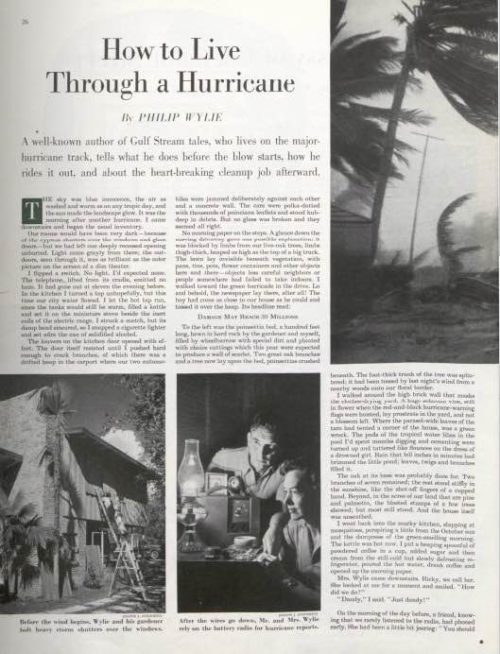
Galveston Hurricane Kills Thousands (September 8, 1900)
The recent devastation caused by Hurricane Harvey reminds one of the even deadlier hurricane that hit Texas 117 years ago. The Galveston storm (they didn’t give them names back then) killed at least 6,000 to maybe even 12,000 people and caused incredible damage to the area.
Speaking of Harvey, CBS Evening News correspondent Steve Hartman focused on how the worst of the storm brought out the best in people in his weekly “On The Road” segment.
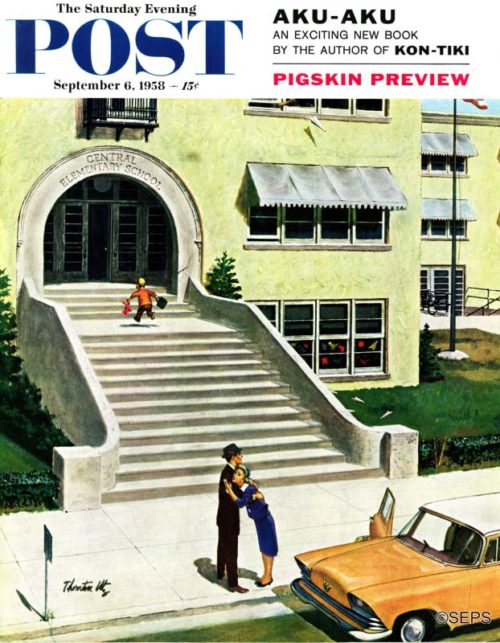
This Week in Saturday Evening Post History: “First Day of School” (September 6, 1958)
Thornton Utz
September 6, 1958
I have a vivid memory of my first day in first grade. My mom dropped me off in the classroom and stood in the doorway as I took my seat. When the teacher came in, my mom left, and my eyes began to get all teary and I my lower lip started to quiver. When the teacher, Mrs. Hinckley, said something to the class, I couldn’t quite hear her, and I leaned over to the kid sitting next to me and asked in a blubbering voice, “What … did … she … say?” I remember it like it was yesterday.
I thought of that day after seeing this cover by Thornton Utz, though the kid is running up the stairs and seems to be pretty happy to be in school. It’s the mom who’s having a hard time accepting it.
National TV Dinner Day
Are TV dinners still a thing? I mean, I know they exist, but whether or not you call them TV dinners or frozen dinners probably depends on your age. I don’t think the terms streaming dinners or Netflix dinners will ever catch on.
Sunday is National TV Dinner Day. The concept was introduced by C.A. Swanson & Sons (with an ampersand) in the early 1950s, and in 1986, the original Swanson’s TV dinner tray was inducted into the Museum of American History. Swanson is now owned by Pinnacle Foods, the company that owns Birdseye, Duncan Hines, Vlasic, Aunt Jemima, and Lenders.
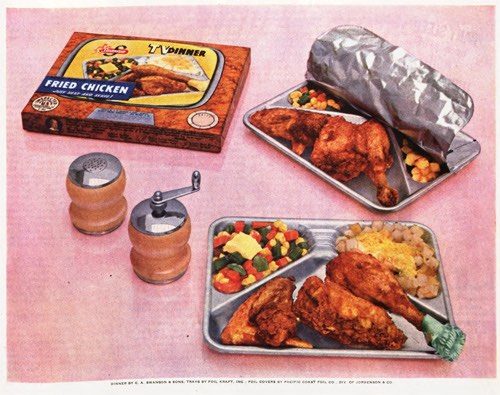
Sometimes I wonder how many Swanson dinners I ate as a youth. Probably over 1,000? I think I was fascinated by the design and concept, the meat in the large section, and the veggies and dessert in the smaller sections. And you cooked all of that at once! I used to wonder how that worked. I never liked it when some of the dessert would ooze over into the corn or potatoes section during cooking.
I still eat frozen dinners. I’ll often have three Lean Cuisine meals for dinner, though when you’re eating that many in one sitting, I’m not sure the term lean still applies.
Next Week’s Holidays and Events
Grandparents Day (September 10)
Every single member of your family gets a special day, including grandparents. And of course there’s an official site for the day.
Hurricane Harvey Telethon (September 12)
This fundraiser for people devastated by the hurricane — which could turn into a benefit for people affected by Hurricane Irma as well — will be one of those rare TV events that will be telecast simultaneously on all the major networks —ABC, CBS, Fox, and NBC—along with Country Music Television (CMT). It will be headlined by George Clooney and Beyoncé and will feature guests like Barbra Streisand, Oprah Winfrey, Julia Roberts, Rob Lowe, and Blake Shelton. It starts at 8 p.m. ET.
Uncle Sam Day (September 13)
Unlike Grandparents Day, this isn’t a day to celebrate your uncle, even if he happens to be named Sam (though if you want to do that, no one’s going to stop you). It’s the day to celebrate the iconic symbol of America, the guy who pointed at you on those U.S. Army posters and smiled at you in those hot dog commercials.
He was possibly named after Samuel Wilson, but radio broadcaster Paul Harvey once said that “some of us grew up thinking that Uncle Sam’s real name was Norman Rockwell. I still do.”
Movies for the Rest of Us with Bill Newcott: The Toronto International Film Festival, Hugh Bonneville, and Dolores Huerta
Award-winning film critic and writer Bill Newcott has been covering Hollywood for more than 40 years. He is the creator of AARP’s Movies For Grownups franchise and the movie critic for The Saturday Evening Post.
Join our movie review video podcast, Movies for the Rest of Us with Bill Newcott. This week, Bill interviews Hugh Bonneville, star of Viceroy’s House; discusses the book, Starring the Plaza, which tell the story of the New York hotel’s unique relationship with Hollywood; andinterviews Dolores Huerta, an activist for the California farm workers in the 1960s and ‘70s and the subject of the revealing new documentary, Dolores.
God-Ray
Childess found the creek first, in late March after the short rainless California winter. He’d scored a pint of something off the counter of the AllNight on Fourth when the owner’s back was turned, and he’d needed somewhere out of sight to drink down the evidence.
The creek cut via gullies and culverts between houses of the residential west end of town. Narrow, deep, and lined with scrubby bush willows and feral bamboo, it served as a highway for deer, coyotes, and others from the sunburnt hills to the sprinkler-fed greens and trashcan paradise of suburbia. The shade in the rock-strewn bottom was cool and green, invisible from the busy street at head-height above.
The pint bottle proved to be gin, a clean bitter blast mixed with the creek smell of moss and wild sage, and the cops drove past twice without slowing down. That afternoon, Childess dragged his duffel and the suitcase with one wheel from the alley behind the Vinnies soup kitchen and set up camp.
By mid-June, Childess’ bloodstream was a battleground between tick-borne babesiosis, anaplasmosis, and rabbit fever. The early symptoms — swelling, confusion, headaches, paranoia, the shakes — were not so different from his accustomed state. He treated himself with his usual regimen of cheap booze, an even coating of salt over whatever the Vinnies were serving that day, and aspirin when he could lift a bottle from Walgreens.
By the Fourth of July his vision was shot and his sense of time and space submerged in the rising churn of disease. The mile into town was a voyage on markless waters; the currents of his confusion dragging him north onto the exposed ridge over town or east onto the shoulder of the highway where tires screeched and coughed dust at him. But he could always find his way back to the creek.
“Like a green light on my face. Like the sun but green and dark water I can smell, know what I mean? Smell it like a wolf or some shit, like it’s singing me back,” he said to Dan, even though Dan was in Modesto and dead.
That creek sense was steady but sly. It sent him down different ways every time, or if they were the same ways they seemed different; what was a weed-choked alley became a leafy boulevard, what was a corner became a cliff that had to be navigated hand by hand. That’s how Childess found the camera, fumbling through a stack of boxes for a handhold to pull himself over a suddenly precipitous curb.
It was a digital point-and-shoot with a built-in flash and a tiny LCD display on back; the sort you’d buy for a child who’d take pictures for an afternoon and then lose it on her way to school the next morning. Childess ran his thumb over the smooth silver plastic, the nubby black buttons, just for the pleasure of the touch, took a photo of his left foot.
Pawn it and buy a full quart of the cactus schnapps on discount at the AllNight, was Childess’ first thought. He turned back toward B Street and Shulty’s, but Shulty’s with its case of stilled watches and its hanging forest of guitars wasn’t there, closed or moved or maybe it was on some other B Street in some other town.
Childess sat in the shade of a Starbucks’ umbrella at the corner of Fourth, prodded the camera with a shattered nail. The LCD went green. Childess squinted against the delirious light, saw it was the photo of his foot with all the half-seen details of the creek sense laid clear: the granite precipice of the curb, the grassy humus of the sidewalk, the lichen-spattered stone of his boot. A strange thrill rang in his ears, shook his limbs such that he almost dropped the camera. He steadied it on his knee, fumbled at the buttons until he found the shutter.
The screen was a tiny window into the world under creek light. The photos revealed the open doors of Starbucks as a vine-curtained cave, the customers as trees, between their roots the trickle of the creek itself.
“That man is taking pictures of me,” the girl at the next table over said. Her mother half-turned to glare at Childess, one hand out to shield the girl’s knees that were bent birch through the camera. A barista within, whose wide-paunched torso Childess could have curled, wiped his hands on his apron, leaned in close. “Get lost, you pervert, before I beat the crap out of you,” he said.
“Wasn’t her, it’s the water running through like light, some miracle shit, right through her legs,” but Childess’ breath lagged behind his vision and only the last few words made it out. The barista swore and grabbed for the camera. Childess got an elbow in the way, staggered up knocking the table back, one leg slipping off the curb to send the umbrella toppling into the street, where it lay like an arrow on a crumpled map. Childess stumbled along that line, one hand on the hot hood of the car that stopped, screeching in the far lane. The barista shouted something about cops. Childess’ vision had gone a gritted gray; he navigated by camera, picture at a time. It was long hours before he caught the scent of the creek again.
Childess stuck to camp for the next couple of days, drinking from the rivulet of lawn runoff and scavenging the dregs of abandoned bottles.
“Ain’t hungry, Dan. It’s the creek making me stronger, see?” he explained to the coyote that slumped in quiet decay at the mouth the culvert under the road. “Filthy son of a bitch bastard,” by which Childess meant not Dan but the Starbucks barista, who had grown to a shambling bear-shagged giant in his recollection. The coyote’s opalescent eyes took no offense.
The camera showed the creek as it was, no more or less, but photos of the road above taken through the low arch of tree limb revealed a field of rough grasses and flowered shrubs through which cars grumbled like cattle. The long golden legs of the joggers who passed morning and afternoon shone and shifted on that field like the sun through clouds.
God-rays, Childess thought, and conceived a desire to photograph himself in that light.
He found a perch on the culvert and an angle with the camera at arm’s length that placed him at the feet of the oblivious passersby. He shed his clothes, keeping only his boots for their grip on the concrete culvert, in an urge less carnal — the meat had long since spoiled — than vital, a notion of the warmth and nourishment of light on skin.
The joggers’ arrival was heralded by a chatter like birds before a storm, a static stirring of the hair on his neck and shoulders. Childess fumbled for the shutter with his thumb, pressed it once but the camera twisted into his palm, worked it straight in suddenly shaking fingers, and hit the shutter again. A moment’s warmth against his back, a whirlwind of laughter, and then they had passed.
The first photo was black. The second showed a curtain of light hanging over the meadow of the road, a light so alive and essential it shimmered and shifted on the camera screen. In the foreground, a bank of stone and root rolled down to the creek. Of Childess himself there was no sign.
The rest of that day was lost to blackness, as if Childess himself had twisted in hand, was pointed at nothing. The empty bottles had were now truly empty, and he waited for the need for alcohol to drive him up and out of town, but even that defining urge had gone missing, was no more evident in his self than he was in the photo.
Childess dreamed that night for the first time in memory, and though those dreams were black and silent, there was a warmth like light against him, and when he woke he found a fawn curled against him.
It was a tiny thing, not much bigger than his chest on which it nestled. Childess reached a trembling hand to trace the thin ridge of its neck, the lines of its ribs; it was only after it opened its eyes and licked his fingers that he began to accept that it might be real, and not some creek-made manifestation of his own self. To be sure, he took a photo of it as it wobbled over to drink from the creek. On the screen, the fawn was crisp and clear and its eyes marked by the same light with which the creek was lined.
The fawn limped around the camp; its left rear leg was short and loosely hinged. It paused to sniff cautiously at the matted clump of fur in the culvert. “That’s just Dan,” Childess said. “He don’t mean nothing by it.” Satisfied, it staggered back to curl up in his arms.
Childess woke up that afternoon, or maybe it was the next, to the cold caress of the fawn’s nose within his shirt.
She’s hungry, Dan said.
“The creek’ll take care of that,” Childess said. The fawn looked up at him. Childess pulled a tick from between its eyes, flicked it away. “Look at me, don’t need it no more, not even the booze.”
She’s a child of the dry, Dan said.
The camera came on, the shaded stone that was Starbucks on the screen. Somewhere in those depths were pitchers full of milk.
“What can I do about it? Damn filthy bear.”
The fawn flinched at his tone. Dan just stared, head cocked at the angle at which the skull had settled. Childess couldn’t meet that gaze, thumbed the camera instead.
“I ain’t even really here no more,” he said to the fawn. “See?” He scrolled back to the image of the joggers whose light had passed him by. But in the dim at the bottom of the creek, he saw details in the foreground he had missed before: the mossy line of beard, a mica glint of eye, shoulders of that root that can split stone.
“Verdamned. I’m a verdamned man,” Childess said. “It means green,” he told the fawn.
Childess left the fawn under Dan’s watchful eye and made his way, one photo at a time, down Fourth to Starbucks. There were moments of fear along his path, but the cop at the corner of D proved to be a low scrub oak; the stream that was B Street was shallow and easy to wade. The bear was slumped and somnolent within the cave that was the cafe; the thicket of tree people and shrub people and stone people that had seemed at first a barrier proved to be welcome cover, shadowed in the creek light and stilled in the camera sight.
He filled one cup with whole milk and two with half-and-half, tucked them into the ragged pockets of his jacket and wedged them upright with packets of sugar. As he wove his way out again, the bear lifted its ragged head and looked about, nostrils flared, but without camera, without creek sense, it could not see Childess through the thicket.
“Verdamned,” Childess told it.
The fawn drank a bit of the half-and-half, laced with sugar, splashed in the creek with renewed vigor, came back and drank the milk, tipping the cup over and licking it from the grass. Childess poured a bit of the second cup of half-and-half out for Dan, drank a little for himself. It sat heavy and strange in his belly, but the weight was not unwelcome; after his descent and return from Starbucks Childess felt light, untethered, like he might drift up under the leaves with the suspended dust and the gnats, beyond the leaves, even, where the clouds sprawled orange and pink.
“Better to sink down right here into the creek, ain’t it, Dan?” he said.
Dan reserved comment. The fawn licked his fingers.
Sometime after midnight Dan, woke Childess with a touch of tongue to his forehead, a rumbled growl. The fawn was awake as well, eyes wide and luminous, like the moon on water, but there was no moon, no light at all, not even the streetlamps on the road above, and the creek muttered to itself and spat drops against his leg.
There was a cracking and a low chesty shudder to the west. Childess’ first thought was earthquake, but the sound was followed by a sharp gust and the smell of wet earth, a progression so rare in California that Childess’ understanding of it came from some other life entirely.
“Storm coming,” he told the fawn, who shook and shoved itself closer against him.
The crack came again, and a flash of light and another crack and a low rumbling that did not fade but grew louder and lower. Lightning again. The fawn huffed and flicked its ears against Childess’ cheek.
“Just a flash,” he told it. “Like the camera. Creek light.”
He took a photo, showed it to the fawn; the creek was a green tunnel around a darkness as clear and deep as the fawn’s eye. Dan was trying to tell him something but the rumbling drowned him out. The fawn struggled to its feet. Childess hugged it to his chest, got the camera’s strap around his wrist. He took another photo, but this one was all dark and then the water hit.
There was no transition; he was on the ground and then he was under the water. The lightning was everywhere, his vision clearer in that moment than it had been since he’d found the creek. He held the fawn in one arm, reached down with the other to grab Dan as they were swept into the culvert. Dan’s body had long since gone down into the creek but his pelt streamed behind his skull like he had been reborn to this new world of water.
They spilled from the far end of the culvert, tumbling so that the lightning was one moment to their side, the next beneath their feet. Childess thought that, verdamned as he was, he might be able to breathe the water, but before he could try it, the creek overflowed its channel; the churning edges spread wide and the center where he floated grew calm and swift.
Fast as they were flowing, the storm was faster; it caught up with them, such wind and water in its wake so that the surface was not much different that the tumbling depths.
The fawn slipped from under his arm, spun round as its leg churned uselessly beneath it. Its head went under. Childess kicked once, twice, got a hand under its quivering belly. The fawn snorted, shook the water from its face, looked wild-eyed at him through the surface as he went under in turn.
Childess pulled himself up, pulled the fawn close. “Ain’t your fault,” he said into its ear. “You was born to the dry.”
He kicked again, caught at a hedge that had once marked a lawn and now only served to spread the water wider. Dan’s pelt swirled away, but Childess had his thumb through the hole of Dan’s eye, the white of the skull and the plastic gleam of the camera on the end of its leash the only things visible in the flash.
They were in the churn again at the edge of the flood; Childess spun around, hit something with his feet. It was a car, half submerged, and next to it a minivan whose roof ran entirely above the flow. Childess shuffled sideways on the windshield of the car, boosted the fawn up onto the slope. It scrabbled over the branches that had washed up against the cars, stood clear among oak leaves at the top.
Childess tossed Dan up to clatter among the branches. The fawn nosed the skull upright, shook its own ears out. They looked down at Childess.
“Like a green light on my face,” he told them. “Like it’s singing me back.” And then the creek pulled him under for a long while.
When he came to again, Childess had lost the camera. But he didn’t need the camera to see that the lightning which struck in long golden perfect all along the ridge above was the legs of the storm; god-rays, he thought. If he’d had the camera he would have taken a picture of himself with her as she passed, but then she stopped, the storm did, and leaned down and saw him and lifted him from the water.
In the Midst of Natural Disasters, America’s True Spirit Reveals Itself
Nothing illustrates Americans’ nature better than how they response to disaster. It was proved again during the devastation in Houston wrought by Hurricane Harvey. Americans once again showed their compassion and generosity as relief aid and workers have poured in from across our national community.
It was alive back in 1900, when a Gulf hurricane ravaged the Texas coast and created the worst natural disaster in American history. On September 8, Galveston was hit by 145 mph winds and a 15-foot wave that swept over a town just eight feet above sea level. The storm left at least 8,000 dead and 3,600 homes destroyed.
Within days, help was on its way to Galveston from every state in the union. State and federal officials worked together to restore order to the city. The railway companies offered free transportation to any Galveston resident wanting to escape the city. Officials enforced price controls to make sure merchants didn’t raise prices to profit from the disaster. Volunteers worked for days tending the injured and unearthing the dead.
National unity was not particularly high in 1900. A presidential election pitting Republican incumbent William McKinley against Democrat William Jennings Bryan had raised partisan division between southern Democrats and the Republican voters in the north. But the country came together in one of the first national responses to tragedy.
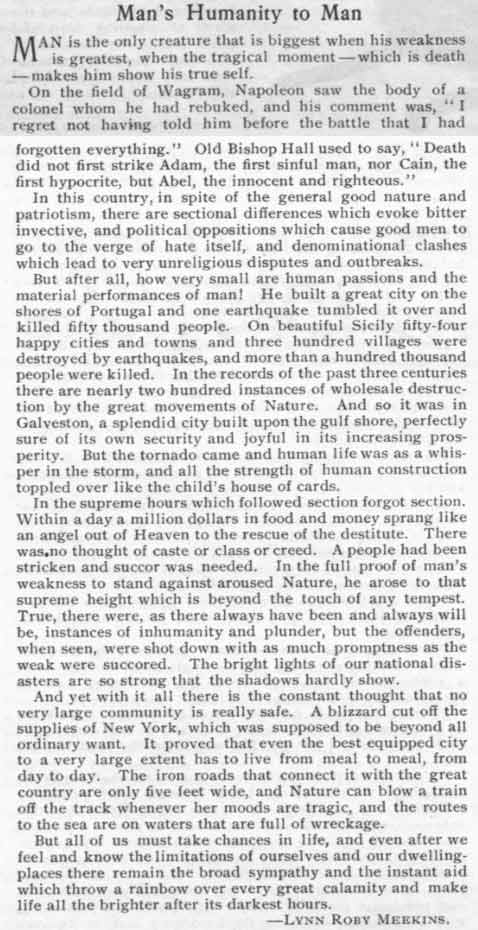
In a Post editorial shortly after the hurricane, Lynn Roby Meekins observed that the one benefit of great tragedies is that they enabled the most humane and generous sides of people to emerge: “The bright lights of our national disasters are so strong that the shadows hardly show.”
Mid-Century Bowl-O-Rama
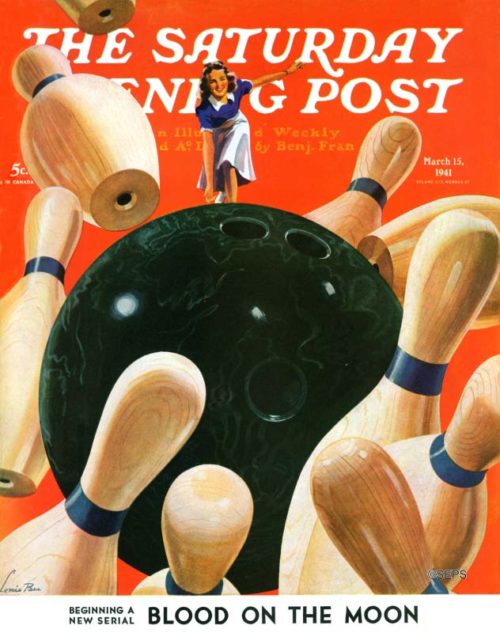
Lonie Bee
March 15, 1941
Bowling was taking over America in 1941. An enjoyable pastime to take one’s mind off of the looming war in Europe, this covers by Lonie Bee showed that it was an activity that could be pursued by women as well as men.

December 27, 1941 (Click to Enlarge)
Bowling was popular enough in the 1940s to serve as an effective enticement for a four-year Post subscription.

January 3, 1942 (Click to Enlarge)
Who could resist signing up for the Brunswick Bowling Carnival?

January 31, 1942 (Click to Enlarge)
In 1942, this Camel ad featured bowling champ “Low” Jackson. “Light up a slower-burning Camel and watch this champion of champions in action.”

August 29, 1942 (Click to Enlarge)
“Even in 1911, when lady bowlers wore clothes like this, the fine, distinctive flavor of Beech-Nut Gum made bowling more pleasant.”

May 1, 1943 (Click to Enlarge)
“For ‘strike-bowling’, you need the extra freshness that keeps you going—results in accuracy, rhythm and timing. In blackouts, man-made or natural, WINCHESTER Batteries too, keep going—now remain FRESH 50% LONGER!”
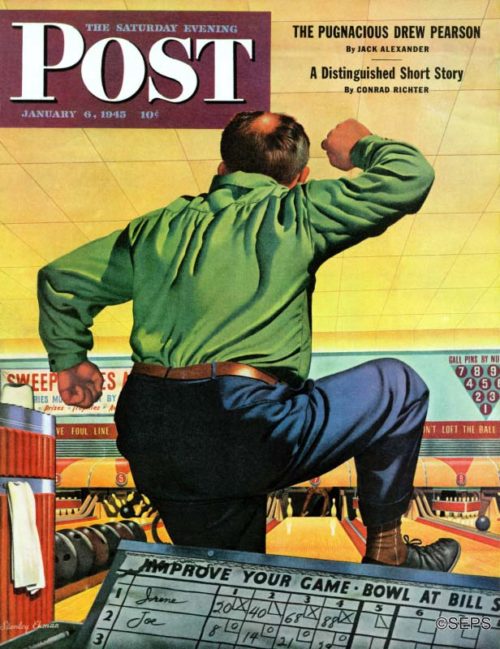
Stan Ekman
January 6, 1945
The idea for this Post cover came to Stanley Ekman when he was having a very tough night on the alleys in his neighborhood Glen Oaks Acres League at Wilmette, Illinois. “To top it all,” Mr. Ekman says, “my wife was trimming me badly.” The interior details of the cover were sketched in the King Pin Alleys in Wilmette and the Arena Alleys, Chicago.
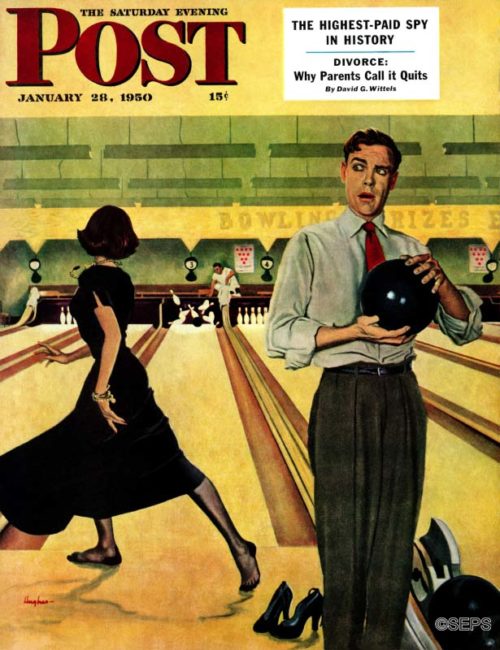
George Hughes
January 28, 1950
What do you do when your date blithely kicks off her heels, grabs a ball, skates forward on her slippery nylons, lets fly, and all ten pins rise into the air and disappear in clattery triumph?
North Country Girl: Chapter 16 — Junior High School: Abandon All Hope, Ye Who Enter Here
For more about Gay Haubner’s life in the North Country, read the other chapters in her serialized memoir. The Post will publish a new segment each week.
The back to school letter from Congdon did not bring good news. The enrichment program at Endion was supposed to be for two years: fifth and sixth grade. But yet another revolution in educational theory had hit Congdon, and the school pulled the five of us smarty pants out of the program, so we could enjoy all the benefits of the new system.
A modern extension had been wadded on to the old brick school building for Congdon fifth and sixth graders; we were to be the guinea pigs for a new “modular” elementary education. Someone had finally realized that teachers who graduated from college before World War II, and whose educational ideal was a pin-drop quiet classroom with seasonally decorated bulletin boards might not be capable of instructing students in higher math skills or science that wasn’t a slowly dying terrarium. Miss Ritchie, I’m afraid they were looking at you.
Instead of a single classroom teacher, we now had four, each one with a specialty: English, Social Science, Math, and Science. The new teachers were all under forty and to our shock, two of them were male—I didn’t think men were allowed to be elementary school teachers. The teachers each had their own room with new lightweight desks, so we had four different desks to keep our stuff in. Since each class of students moved from room to room during the school day, none of us except the most anal of twelve-year-old girls ever had the right books, pencils, or writing paper for the class we were in. The first ten minutes of every class was spent repositioning our desks in small groups or a big circle or in rows, or an original configuration, if the teacher could think of one, with chair legs screeching against the linoleum, and “ouches” and “ows” as we banged into each other, jockeying for position next to the most popular kids. The next ten minutes was spent scrounging for supplies that had been left in the previous classroom. Under this new regime, art and music fell by the wayside. I guess the amount of time we had spent in previous years creating shoebox dioramas and learning to sing “White Coral Bells” as a round was considered adequate.
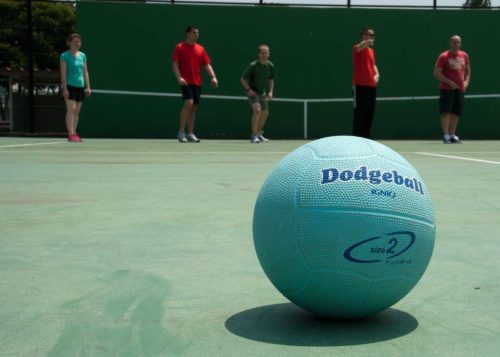
The male teachers took over gym, and competitive games ruled. Out went square dancing, in came high velocity dodgeball. I was not only always chosen last, but also managed to get hit as soon as possible by placing myself directly in front of the first ball languidly tossed over by a girl on the other side. In this way I avoided being concussed by one of the boys’ vicious fastballs, and I got to spend gym period sitting dreamily on the sidelines, missing my wonderful enrichment class and imagining I was watching the Olympics in ancient Greece before strolling down to the Acropolis. During one particularly brutal game, when it got down to two players on each side, husky Mr. Levine, nominally our math teacher, pointed at Billy Shaw and called “Out!” to which Billy Shaw replied “F**k you, Mr. Levine.” Mr. Levine charged Billy like a freight train and proceeded to beat the shit out of him all around the gym. The rest of us huddled together, like wildebeests watching one of our own being devoured by a lion, and tried to get as far away as possible from the pummeling. This incident did not result in a dodgeball ban, or even in a reduction of the fierceness of the competition, which remained at major head injury level; there was just less audible cursing from the boys, and I continued to be able to avoid getting any exercise in gym.
For the first time in our collective student memory, there was a new girl in our class. Becky Sweet, a blonde so slight and pale she looked in danger of toppling over, was a pro at being the new kid: her father was a minister of some obscure Nordic-based Protestant denomination and was assigned to a different Minnesota town every few years. Becky had vast experience in recognizing which girl needed a friend the most and lit on me as her new best friend. I had never had another kid choose me for anything before, and fell into best friendship without a thought.
Becky was obsessed with sex and George Harrison and had the oddest family life I had every seen. She would not come to my home, but insisted that I sleep over at her house every Friday. I never once met her father. His work took him all around upper Minnesota and Wisconsin, driving to small farm towns to stand in for ministers who had dropped dead or shot their wives or been caught tampering with the livestock. Or he was at church, counseling parishioners, or rarely, in his study, NOT TO BE DISTURBED.
Becky’s mother was also a ghostly presence. I would catch a glimpse of her when I walked into their house, wafting from room to room before vanishing into her bedroom. Becky and I were left with her older sister, who supervised the making of huge bowls of popcorn, dinner for the three of us, washed down with Hawaiian Punch, about as transgressive a dinner as I could imagine. Then a car pulled up, a boy shouting and blasting the horn, and big sis would take off for the night. Becky and I settled down on her couch to watch the Friday Night Fright Fest, old black and white sci-fi movies where radiation would create giant women, tiny men, and plants that could walk and eat people. When the Duluth broadcasting day ended at midnight, Becky and I climbed into her bed, back to back. I fell asleep listening to her explicit fantasies about having sex with George Harrison, the important details of the act having been supplied to her by her sister. Had I met Becky the year before, I wouldn’t have cared about missing the “Becoming a Woman” educational film and I would have been voted Most Knowledgeable About Sex at Camp Wanakiwin. Becky’s obsession was almost innocent: she didn’t try to touch me and I don’t think she touched herself. Unlike the other Beatle-crazed girls I knew, Becky didn’t press me to pick a favorite Beatle. I was the audience for her stories about George Harrison and his undying lust for her pre-pubescent body To me it was far from erotic; it was just another piece of Becky’s Bizarro World, like the missing parents, the wooden crosses on every wall, and the fridge that held nothing except can after can of Hawaiian Punch.
These Friday nights were a dark, musky secret at the heart of our friendship. My mom was too busy with an infant and a missing six-year-old to ask about my sleepovers at Becky’s, so she never knew about the popcorn dinners, staying up until midnight, or the lack of adult supervision. Since Mrs. Sweet never seemed to leave the house, she was far out of my mother’s social orbit; mom felt no compunction to invite Becky to sleep over at our house, as she would for a daughter of a matron of long Duluth standing. Becky never showed the least desire to come to my house; a real dinner might have been a serious blow to her digestive system.
Then in the spring, Becky was gone, her father sent off to another parish. Because I had been away from Congdon at the enrichment program for half the year during fifth grade and held in isolation by Becky Sweet for most of sixth, I was now completely friendless. I read, watched TV, held my baby sister, and kept an eye out in case Lani reappeared.
***
The street where I lived, Lakeview Avenue, was on the very border of zoning for two Junior High Schools, Ordean and Woodland, so I could opt to go to either one. I was the only one in the Congdon sixth grade to occupy this geographic odd spot; all of the other kids lived in the Ordean zone and were headed there.
I took stock of my friendless state and decided that I needed a fresh start. I was the four-eyed bookworm, the eternal teacher’s pet, the kid you did not want on your dodgeball, volleyball, or softball team. But if I went to Woodland Junior High, I could re-invent myself! I could be a woman (girl) of mystery. Girls would want to whisper to me about other girls and pass notes about which boys they liked, and boys would want to walk me home, carry my books, and hold my hand. I could be cool.
My fantasies were not unlike Becky’s. Somehow she would meet George Harrison and he would be smitten with love for her. Somehow I would enter Woodland Junior High and be popular. Before our pre-school shopping trip to Minneapolis, I pored over Seventeen magazine, noted that grape and rust were the in colors for fall. From the “Back to School” racks of clothing I carefully selected skirts and dresses in those hideous shades, all at a slightly above knee length, as I had been instructed by Seventeen. My mother, the shopaholic and former beauty queen, was delighted that I was turning into a real girl.
I thought I was ready to conquer Woodland Junior High, an uninspired white brick two-story building, bland as boiled rice on the outside; inside held a disturbing whiff of chlorine from the pool and all the miseries of being a pre-teen girl. The boys contributed their own smell: sweat, Clearasil, Right Guard, and the Jade East cologne worn by sophisticated ninth graders. This smell permeated the halls we streamed through, every hour, year after year, as we traveled from one classroom to the next.
I had been overconfident in my ability to transform myself; the scratchy new sweater the color of Welch’s Grape Jelly and the coordinated plaid skirt were not enough. Clothes do not make the seventh grade girl, a lesson I seemed incapable of learning.
The first morning of Junior High was filled with the excitement and confusion of a hundred new students trying to find their different classrooms, prompted by a confusing buzz of the school bell every fifty minutes, overseen by bored teachers trying to determine if you were in the right class. When the noon bell sounded, I followed the seventh grade shift of lunchers into the gigantic cafeteria.
I waited in the endless school lunch line and wished I had brought a packed lunch, looking out at the tables already crowded with kids pulling sandwiches out of brown paper bags. When I finally got my tray I stood in the center of the cacophony in my new duds, grinning like Alfred E. Newman, and waiting for someone to wave me to their table. My stomach and my heart squeezed together as I realized that my plan was not going to work. All the girls already had their cliques from elementary school; new comers need not apply. And I am sure that not a single seventh grade boy noticed that I was dressed out the pages of a Seventeen magazine.
I tossed the contents of my tray into the garbage and spent the rest of the lunch hour weeping silently in a bathroom stall.
A New Wave of Board Games is Breaking Parker Brothers’ Rules
Of all the industries shaken and destroyed by the fast-paced development of technology, one would assume board games to be sunk by their video counterparts. In reality, “tabletop gaming” is in the midst of a golden age. According to The Guardian, sales of board games is rising 25% to 40% each year.
Millennials aren’t necessarily playing Parcheesi, though. The new wave of games includes titles like Secret Hitler, Ex Libris, Dragonfire, and Pandemic. On the rise are role-playing games, connection games, Eurogames, and, sometimes, analog versions of existing video games, like Fallout and Sid Meier’s Civilization. Many are steeped in complicated fantasy worlds with Vikings and labyrinthine backstories, but others are simple logic contests. Still more are not competitive at all and only aim for players to work together in pursuit of a desirable conclusion. Yes, everyone can lose.
The internet has played a significant role in this revolution, creating a space for independent game makers to fund and sell their ideas. The independent tabletop game company Floodgate Games released their Spanish basilica-inspired dice game, Sagrada, this year after a Kickstarter campaign that raised over $150,000. The visually striking board game involves using colored dice to “construct a stained-glass masterpiece” with rules reminiscent of Sudoku.
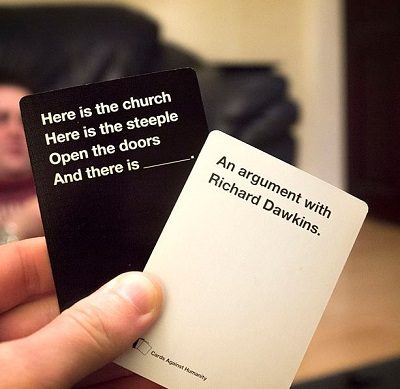
Another Kickstarter success was the wildly popular — and risqué — Cards Against Humanity: A Party Game for Horrible People. Derivative of the family card-comparison game Apples to Apples, Cards Against Humanity ditched wholesome cultural and historical references for politically incorrect phrases like “demonic possession” or “a homoerotic volleyball montage,” or “actually taking candy from a baby.” The ribald and racy game earned an estimated $12 million in its first two years of production despite being free for download online (1.5 million downloads took place as well). The small Chicago group in charge of the debauchery continues to churn out expansion card decks, and they refuse to sell the brand.
Small-time board game publishers have seen enormous success given a platform to market and sell their games. This wasn’t always viable, though, with tabletop gaming. At the advent of commercial board gaming in the U.S., the late-1800s, Parker Brothers was the big name in board game development and manufacturing. Early games like Banking and Mansion of Happiness rewarded capitalistic pursuits and moral values.
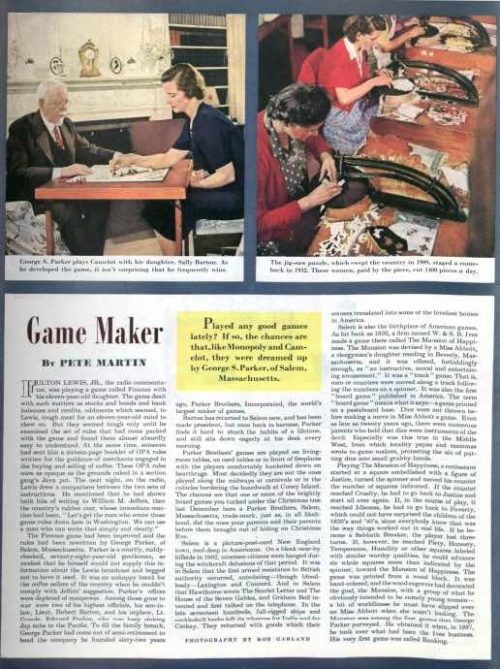
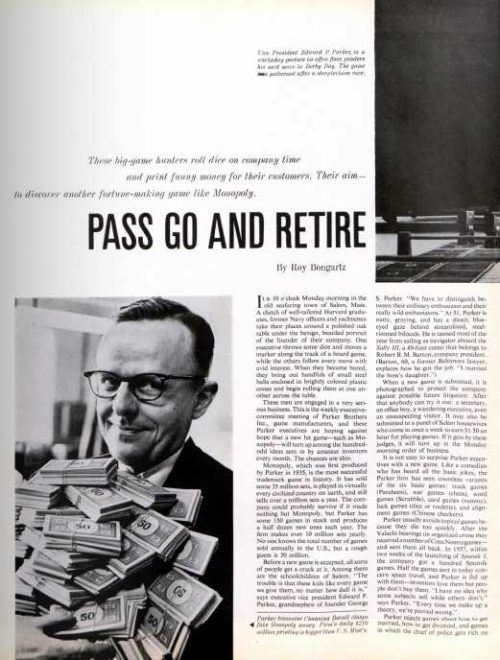
In a Post story from 1966, “Pass Go and Retire,” Parker Brothers executives divulge their strategy of crowd-sourcing to find another Monopoly-tier hit: people from around the country would send their ideas with hopes that it would strike a fancy with the gatekeepers of fun.
“The inventors of successful board games are invariably amateurs, and not one has ever struck it rich more than once,” Parker Brothers disclosed. No one person was ever certain of what would become a hit, and the company relied on numerous test groups of various demographics. There were some gaming no-nos though, like witches and — early on — dice.

Pete Martin’s 1945 profile on Parker Brothers, which was located in Salem, Massachusetts, tells that “The game of Witchcraft was dropped when the embarrassed descendants of those New Englanders who took part in the seventeenth-century witch hunt asked that it be discontinued,” and, “Even as late as twenty years ago there were numerous parents who held that dice were instruments of the devil.” It is safe to say that Dungeons & Dragons would have been rejected vehemently.
Many newer board games laugh in the face of Parker Brothers’ old unwritten rules of what makes one popular: “A successful game should be simple, shouldn’t take too long to play, and even children should find it easy to learn.” In defiance of this advice, a 2016 cooperative game called Gloomhaven features a 52-page encyclopedia of a rule book whose contents are as foreign as a specialized medical textbook to those not in the know: “Monster statistic cards give easy access to the base statistics of a given monster type for both its normal and elite variants. A monster’s base statistics will vary depending on the scenario level.”
Still, for want of less time in front of screens or for lack of cash for extravagant entertainment, people keep playing games. Maybe it isn’t a consequence of anything other than the unbridled joy that they bring. One gamer wrote to Parker Brothers around 1966, “My cousin got married and went to Germany for her honeymoon, and she said they played Monopoly every night for enjoyment.” For some, the pastime has always been more than a necessity on a rainy day.
Check out the hidden history of Monopoly in the Post’s recent article, “Who Really Invented Monopoly?”
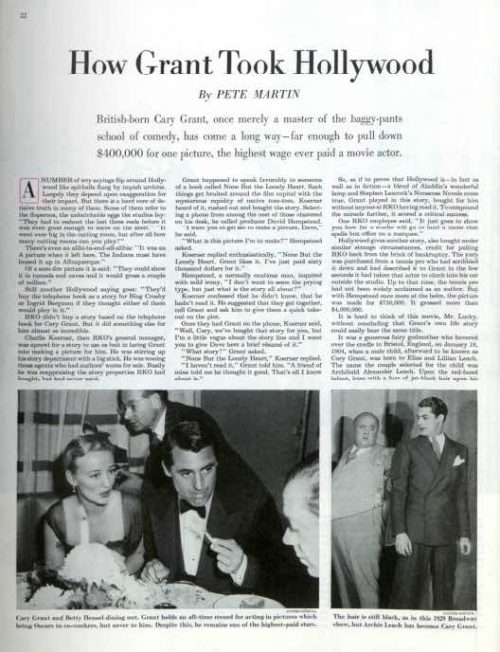
Leading Men of Hollywood: Cary Grant
Adapted from a story by Pete Martin in the February 19, 1949, issue of The Saturday Evening Post.
This article and other features about the stars of Tinseltown can be found in the Post’s Special Collector’s Edition, The Golden Age of Hollywood. This edition can be ordered here.
There’s a Hollywood legend that proves Cary Grant’s appeal in the lm industry. e story goes that Charlie Koerner, then RKO’s general manager, was aprowl for a story to use as bait in luring Grant into making a picture for him.
Grant happened to speak favorably to someone of a book called NONE BUT THE LONELY HEART. Koerner heard of it, rushed out and bought the story. Selecting a phone from among the nest of those clustered on his desk, he called producer David Hempstead.
“I want you to get set to make a picture, Dave,” he said.
“What is this picture I’m to make?” Hempstead asked.
Koerner replied, “NONE BUT THE LONELY HEART. Grant likes it. I’ve just paid $60,000 dollars for it.”
Hempstead, a normally cautious man, inquired with mild irony, “I don’t want to seem the prying type, but just what is the story all about?”
Koerner confessed that he didn’t know, that he hadn’t read it. He suggested that they get together, call Grant and ask him to give them a quick take on the plot.
Once they had Grant on the phone, Koerner said, “Well, Cary, we’ve bought that story for you, but I’m a little vague about the story line, and I want you to give Dave here a brief résumé of it.”
“What story?” Grant asked.
“NONE BUT THE LONELY HEART,” Koerner replied.
“I haven’t read it,” Grant told him. “A friend of mine told me he thought it good. at’s all I know about it.”
So, as if to prove that Hollywood is— in fact as well as in fiction—a blend of Aladdin’s wonderful lamp and Stephen Leacock’s Nonsense Novels come true, Grant played in this story, bought for him without anyone at RKO having read it. To compound the miracle further, it scored a critical success.
One RKO employee said, “It just goes to show you how far a studio will go to land a name that spells box o ce on a marquee.”
Hollywood gives another story, also bought under similar strange circumstances, credit for bringing RKO back from the brink of bankruptcy. The yarn was purchased from a tennis pro who had scribbled it down and had described it to Grant in the few seconds it had taken that actor to climb into his car outside the studio. But with Hempstead once more at the helm, the picture grossed more than $4,000,000.
It’s hard to think of this movie, MR. LUCKY, without concluding that Grant’s own life story could easily bear the same title.
It was a generous fairy godmother who hovered over the cradle in Bristol, England, on January 18, 1904, when Archibald Alexander Leach, afterward to be known as Cary Grant, was born. Upon the infant she bestowed a quality that was afterward to stand him in good stead in his chosen profession. Now, in the midst of Hollywood’s present panics and alarms, it is a quality that bids fair to keep him from joining those stars who are tumbling downward with a falling box office.
That quality is being able to climb down from the screen, get inside of a fan’s skin, walk out into the street inside of him and stay there for a while after the lights have flickered on in a palace of the cinema.
Those who work this special kind of screen magic have a thing in common. They meet the frustrations, misadventures and worriments of life as shown in the flickers, jauntily and with an amusing air of superiority. They counter the low blows the plot concocters deal them as if slapping away gadflies.
But the trick behind the aforementioned quality does not necessarily depend upon acting ability or losing oneself in a role. Those who possess it are usually first of all themselves. The character they portray comes second.
While his fairy godmother’s gift is the keystone of Grant’s screen appeal, it is more complex than that gift alone indicates. Queried about the Grant appeal, a studio messenger girl offered this slant: “He’s got finesse. And he’s sophisticated. His charm is boyish, only it’s kind of mature. Of course, the fact that he’s tall, good-looking and has a cleft chin doesn’t hurt any.”
The truth is that a large part of Grant’s success as a comedian is due to his ability to coordinate physically. is ability was born of the fact that he was at one time a tumbler and stilt walker. Coordination breeds timing, and timing is the most important element of comedy. Grant’s particular brand of light comedy amounts to a kind of stylized buoyancy.
In essence, he has taken the baggy-pants comic’s slow burn and double take and has lifted them to a high plane. It’s the same brand of clowning, but it’s done with tall, dark and handsome overtones. Raising his eyebrows and looking straight at his audience, Grant seems to say, “Well, whaddaya know? I’m being bopped by Fate’s inflated pig bladder again!”
When most stars hit the heights, they think they’re magic. They have a notion that anything they do is right. Not Grant. It’s his conviction that it’s up to him to find out what people like in Grant; what they expect of him, then do it. Many Hollywood stars don’t see their own pictures. If they do, it’s usually in the plush-insulated solitude of a studio projection room. Grant sees each of his films in the regular-run movie houses. He studies the reactions of different audiences. If one of his pieces of stage business or one of his gestures rings the bell, it’s apt to be in his next picture two or three times.
Grant’s reaction to the annoyances that a star must endure is explosive. It is his conviction that hounding movie stars for their autographs is ridiculous.
“Actors,” he says with some justice, “should be judged by their talent, not by their penmanship.”
The Man and the Actor
Grant has been known to tell the gangs who clot the doors of New York hotels, ready to jump a star when he emerges and tongue-whip him into giving them his autograph, that they are “morons.” “I don’t mind autograph hounds, but I don’t like rude ones,” he says. “Fifteen kids descend upon you. It would be nice if they just said, ‘How are you?’ or ‘It’s good to see you,’ but they say, ‘If you don’t sign our books, we won’t go to see your lousy pictures.’ My reaction is to say, ‘Fine. Don’t go!’”
He has even had women come up to him and say, “I’ve made a bet I can kiss you.” It may not be the best kind of public relations, but he tells them gravely, “Madam, you’ve lost your bet!”
But while all the available evidence suggests that while early vicissitudes may have taught him canniness, he is not stingy. When he hears that a friend is dropping in at a vaudeville actors’ club, he asks him to find out if anybody there is broke, and when the friend reports back, Grant gives him money for them. ere is only one string attached to such gifts. He insists that no one know where the dough comes from. Prior to, and during, World War II he contributed $200,000 to the British Red Cross. He gave an equal amount to the American Red Cross. But he is inclined to belittle such beneficences. When asked about them, he says, “There’s nothing to generosity… if you can afford it.”
An analogy he has worked out between Hollywood and a streetcar fascinates Grant. The analogy had its genesis in a Charlie Chaplin comedy. In that comedy Chaplin was a part of a queue waiting to board a streetcar. He got into the car first alright, but there were so many in line that they pushed him on through the car and he fell out the other end. Getting to his feet, he ran around, climbed on again and hung on as best he could.
As Grant sees it, Hollywood is that streetcar. “The car just goes around in circles, not going anywhere,” he says. “ ere is room on it for just so many, and every once in a while, if you look back, you’ll see that someone has fallen o to let a new passenger on. When Ty Power got on, it meant we left someone sprawled out on the street; and somebody had to fall o to make room for Greg Peck. Some fellows who get pushed o run around and climb back on as character actors. Adolphe Menjou is one. Ronald Colman sits up with the motorman. And Gary Cooper is smart. He never gets up to give anybody his seat. After much confusion and waiting, I finally got a seat. But I lost it temporarily when I got up to make room for a young lady named Joan Fontaine, who costarred with me in SUSPICION and won an Oscar in that movie. So there I am, just standing up, hanging onto a strap and being jostled around.”
Contrariwise*: (I Don’t Want No) Satisfaction Survey
Before we get started…
Would you be willing to take a few minutes to answer a brief survey about your experience reading this column?
YESNOGETLOST
All right, just kidding about that. But seriously, how annoying are the ubiquitous online “customer satisfaction surveys” that arrive in your email inbox almost immediately following a significant purchase or an encounter with a “service representative”?
You know the ones I’m talking about. Questionnaires that, among other things, ask you to rate your satisfaction on a scale from 1 to 10, with 10 being completely satisfied; or reckon the likelihood of your recommending whatever-it-is-they-do to a friend, ranging from an enthusiastic “highly likely” downward to a damning “never.”
These surveys purport to assist whoever-it-is “to better serve you in the future.” Baloney! They’re asking you to do their marketing research for them — for free. That, or it’s all a sop to make you think they actually value your input — hey, they’re listening! — when they couldn’t actually care less. Either way, they’re mostly a bloody nuisance.
For example, last month I leased a spiffy Chevrolet Cruze, fully loaded, at a local dealership. As it happened, the salesman was knowledgeable, professional, and got me a great deal. Now, I’m all for giving somebody their props for a job well done, so I happily answered an email survey I received about a week later and let GM know how nicely things had transpired.
Baloney!
Mere days after that, I was sent not one but two more surveys, which I set aside. Well, at that point GM began to send me urgent but polite reminders to please complete the surveys which had been sent blah, blah, blah. Eventually I caved and answered them, just so the pestering would end.
In the last year, I’ve also grudgingly answered satisfaction surveys from the cable company, the urologist, the dentist, Macy’s, Best Buy, Wells Fargo, American Express, and more. I’ve also declined plenty of others. After all, what’s the incentive? There’s no reward for your time and trouble, not even a future discount or a token gift card. Am I supposed to be stoked that I’m being asked to contribute my opinion, being given a chance to sound off? My nifty new car took two months to be delivered, which bunged up my finances a bit. Did I ever get a follow-up inquiry or apology for either? Nah.
Probably most obnoxious are the surveys that ask you to describe some aspects of your experience in your own words (as a writer, I especially resent this; I want to get paid for my work) and then want to know if they can “share” your comments with God-knows-who in marketing or sales or whatever.
Listen, at my age, those “10 to 15 minutes to participate” are precious. I don’t want to waste them providing personal information to corporate data geeks to analyze and utilize for who-knows-what purpose. Much better to spend that time calling someone close to you and asking them about their experience today.
The sad fact is there’s no way to hide from the scourge of online customer satisfaction surveys. Anybody you do business with nowadays has your email address and the means to approach you. So, going forward, if I can offer some praise, I will, hoping that it gets heard. Otherwise, I’ll be selective and participate only when I think I’ll be taken seriously.
By the way, if you want to rate this essay, please send your comments to [email protected].
So I can better serve you in the future, of course.
*“Contrariwise,” continued Tweedledee, “if it was so, it might be; and if it were so, it would be; but as it isn’t, it ain’t. that’s logic.”
This article is featured in the September/October 2017 issue of The Saturday Evening Post. Subscribe to the magazine for more art, inspiring stories, fiction, humor, and features from our archives.
Who Really Invented Monopoly?
For decades, the story of Monopoly’s invention was a warm, inspiring, Horatio Alger narrative. A version of it, tucked into countless game boxes, told the tale of an unemployed man, Charles Darrow, who went to his Great Depression-era basement desperate for money to support his family. Tinkering around, he created a board game to remind them of better times, and finding modest success selling it near his home in Philadelphia, Darrow eventually sold it to the American toy and game manufacturer Parker Brothers. The game, Monopoly, became a smash hit, saving both Darrow and Parker Brothers from the brink of destruction.
The creation story is laced with persistence, creative brilliance, and an almost patriotic presentation of work ethic.
The problem is — it isn’t exactly true. What’s more, Monopoly’s origin story teaches us that innovation can be a complicated affair and that the “light bulb” moment of how things get made is, in fact, sometimes a myth. (The scale of Thomas Edison’s own contributions to the invention so associated with his name, fittingly, is now debated.) In the case of Monopoly, the journey of American invention was less a linear path and more a messy room shared by several people. The game was, in fact, created in 1903 — long before Darrow’s mythical basement revelation — by Elizabeth Magie, the daughter of an abolitionist who was herself a staunch anti-capitalist crusader. Magie created Landlord’s Game, the forerunner to Monopoly, not as a celebration of wealth but as a protest against the evil monopolies of the time.
Three decades before Parker Brothers and Darrow took credit for it, her game was embraced by a constellation of notable left-wing Americans of the time, as well as on various college campuses in the Northeast. ACLU chairman Ernest Angell played it, and so did Scott Nearing, a radical professor at Wharton, champion of academic freedom, and a father of the “green” movement. It flourished in Arden, Delaware, a tiny utopian village founded by followers of popular political economist Henry George’s “single tax” theory, a belief system Magie was passionate about. Among the residents of Arden who embraced the game was Upton Sinclair, author of The Jungle, who corresponded with, and possibly met, Magie.
In the 1920s, homemade copies of Magie’s game found their way to what was then a flourishing Quaker community in Atlantic City. Quaker teachers in Atlantic City incorporated it into their teaching — with some modifications. Dice, associated with gambling, were discordant with their religious beliefs. The Quakers, practitioners of silence, also did away with the loud auctioning associated with the game, added fixed prices to the board, and modified it to be more child-friendly.
It was a version of this game — Magie’s Landlord’s Game with some of the Atlantic City Quaker modifications — that a friend taught Darrow to play. Darrow then sold it to Parker Brothers.
Darrow and Parker Brothers made millions for “creating” Monopoly, whereas Magie’s income from the game was reported to be a mere $500. She died in 1948, having outlived her husband, with no children and few knowing of her role as the true originator of the game that became Monopoly. She had worked in Washington, D.C., in relative obscurity as a secretary, and her income as a maker of games, according to the 1940 U.S. Census, was “0.”
Magie’s story would have been lost if not for Ralph Anspach, an economics professor at San Francisco State University whose legal battle over his own Anti-Monopoly board game in the 1970s unearthed the whole scandal. Anspach, today in his 90s and retired from teaching, but still selling his game, became a tireless detective of Monopoly’s origin story and spent a decade fighting for the right to talk freely about what he’d discovered. Although Magie and Anspach never met — Anspach was a child refugee of Danzig at the time Magie was close to dying — their fates became linked together unexpectedly. Anspach’s fate partially hinged on proving Magie was the inventor; Magie’s story would not have been told without a digger and advocate like him.
Over the five years it took me to research The Monopolists and in the two years since its publication, I’ve seen many a jaw drop as I told the tale of Monopoly’s lost inventor and her unlikely exhumation. The most common question is, “How did this happen?”
In Magie’s time, it was far too easy to suppress the voices of marginalized groups, including women. At the time she patented her game, she didn’t have the right to vote. The head of the U.S. Patent Office was actively discouraging women from applying for patents. Job opportunities were extremely limited, and it was common in the press to talk about how “weak,” “delicate,” and “smaller-brained” women were.
The greater astonishment maybe isn’t just that Magie lived the life of a game designer and political thinker far before her time, but that any shreds of her story survived at all. In my research, I stitched together enough of Magie’s trail — newspaper articles, Census records, her own writings, photographs — to get a sense of who Magie was and what she was trying to say to the world. But it’s hard not to think of her peers in her time who left far less behind, including female branches of my own family tree. Their contributions were large, but often silent, an untold quantity of labor that helped build this country. History is full of Lizzie Magies, Quaker teachers, friends who share ideas, the kinds of people who help shape our world and go largely unnoticed for doing so.
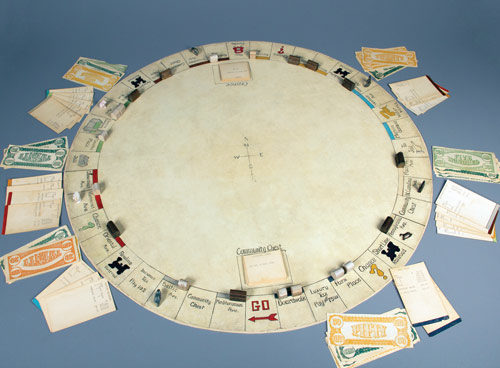
Courtesy of The Strong National Museum of Play, Rochester, New York.
The “light bulb” idea and the Darrow myth persist, in part because we want them to. On some level, we all fantasize about a lightning bolt of brilliance hitting us. The instantaneous nature of that seems particularly American: fast food, fast cars, fast road to becoming an innovative — and wealthy — genius.
Part of the reason today’s incarnation of Monopoly is so fun to play is that it was tweaked from Magie’s original design for better play. The core of the game is Magie’s, but the Atlantic City properties, the fixed prices, and the graphics all helped make it better. In today’s era of selfies, being one’s own publicist on social media, and the egotism wrapped around one’s Twitter follower count, perhaps Monopoly’s creation story reminds us that, together and connected, we are better. The “light bulb” narrative of invention, by definition, largely omits much chance for collaboration, a force that can be as vital for creation as the air we breathe.
Perhaps it’s always been more than a game after all.
Mary Pilon is the author of The Monopolists, a New York Times bestseller about the history of the board game Monopoly. This essay is part of What It Means to Be American, a partnership of the Smithsonian’s National Museum of American History and Zócalo Public Square. The essay originally appeared at Zócalo Public Square.
This article is featured in the September/October 2017 issue of The Saturday Evening Post. Subscribe to the magazine for more art, inspiring stories, fiction, humor, and features from our archives.
For more on board games, check out “A New Wave of Board Games is Breaking Parker Brothers’ Rules.”
Not Because We Will
The doves stare through the bars of their cage, the opened slats of the blinds, the tight mesh of the window screens, into the dismal, sunless morning. They are mystified, it seems — the world is as much a mystery to them as they are to Anne. She watches them while she waits for the water to boil. She can smell the newly ground coffee.
She wakes Tennyson with a kiss and a glass of orange juice. He is the only little child she has ever known — heard of — who likes to sleep in, but this morning, he wakes with a huge smile and throws his arms around her neck, surprising her and spilling a few drops of her coffee onto his favorite pajamas.
“Oops!” he says. “I got it dirty.” She smiles.
“It’ll wash out,” Anne tells him.
He sits up, takes the OJ, and swallows it in one large gulp. “My,” Anne says, “somebody was thirsty.”
“I was thirsty,” Tennyson replies, “not somebody.”
Anne kisses him again. Naming their children after other poets was Jesse’s idea. She’d been reluctant when he mentioned it — “Who’d want to be called Hughes? Or Plath?” — but when he suggested Tennyson, the idea had grown on her. It was, after all, appropriate for either gender, and there were both singularity and inherent poetry to its sound.
“You’re somebody, all right,” she tells him.
“I am?” he says.
“Yup,” Anne answers. “Get dressed. We’re having bacon and eggs this morning.”
“Neat-o keen-o!” he says, echoing Jesse’s favorite phrase, and scrambles from the covers.
“The sky is dirty,” Tennyson notes.
“Uh-huh,” Anne says as she sips the coffee. Tennyson’s appetite astonishes her. Food at 8 o’clock in the morning repels her, but he eats — as he does most everything else — vigorously. “It’s going to rain.”
“I don’t think the doves like it.”
“The rain?”
“The sky. They like sunlight.”
“So do I,” she says.
“Me, too!” Tennyson exclaims.
“Well, we’ll just have to order you a whole day full of sunlight.”
He looks confused. “How do we order one?” he asks.
Anne smiles. “Well, when you get home, we’ll … write a letter to the Sun and ask him to make tomorrow sunshiny all day. Can you do that?”
Tennyson looks crestfallen. “I don’t know how to make all the letters yet, Mommy,” he says. “We’re only up to M.”
She kisses the top of his head. “I’ll make the letters you don’t know. Okay?”
He smiles. She loves his wide, toothy smile that looks just like Jesse’s little-boy grin. “Okay!”
Despite the overcast, he’s buoyant in the car en route to pre-K: School is an adventure, and Tennyson loves adventures. Anne kisses him goodbye at the curb, tells him she’ll pick him up at 1:30. She checks her watch: 9:26. He’s right on time today; she’s been late twice this week. Some mornings, she still can’t get herself going. She hasn’t yet reacquired the habit of waking up alone. She watches her son take the two dozen steps up the canopied walkway to the door by himself — his choice — then he turns and waves. She waves back, watches him go inside, and returns home. She prefers to have him with her but she’s learned that 4-year-olds aren’t prepared to deal with the concentration demanded for writing. Before, she and Jesse took turns. Now … well, now is now.
She takes a shower, washes her hair, dries in front of the mirror, looks at herself. “There is nothing wrong with me,” she says, then shakes her head. She talks to — at — herself, her reflection, the objects in her life, too often. “That has to stop,” she says.
The computer is still on from last night. She sorts through the stacks of papers, disks, pencils, coffee cups, and curiosities that clog her chair, her desktop, and rereads what she has written, makes a minor correction, reads it again, then looks out the window. It’s busy: Women with strollers pass, trucks blow their horns, leaves fall. Downstairs the doves are cooing at the top of their oddly powerful lungs. Their cage needs to be cleaned. Her office needs to be cleaned. The house needs to be cleaned. Domesticity was never her strength, and over the past five months, it has become utterly incidental to her life. Everywhere, she is surrounded by dust and disorder. She tries, more for Tennyson’s sake than her own, but, she acknowledges, it’s a half-hearted effort.
She sighs and stares at the screen, her fingers poised on the keyboard. She types:
As through a dream
The glimmer softens
And there stands
And she stops. And there stands — what? who? Jesse, of course. But she loathes confessional poems, and this has all the symptoms of one. What would he think?
I’d hate it. But it would be a good confessional poem, he says.
She sits back and looks at him. The urn is exquisite. And dusty. She looks at it, daily, of course, but she hasn’t touched it since she put it on top of the low bookcase a week after the funeral. It has stayed there, an indelible scratch blemishing the otherwise cluttered-but-ignorable landscape of her office. Now she gets up, takes a T-shirt — one of Tennyson’s — that’s draped across a chair, left for some distraction on its way to the laundry hamper, picks up the urn, and carefully, slowly strokes it clean. Then she sits on the chair, the covered gray marble bowl between her legs, and reaches for the lid.
When she first brought the urn home she sat with it, like this, alone, at night, arguing with herself whether to open it, to smell its contents, to touch them. She started to lift the lid — her fingers closed around its spired handle — but stopped. What, after all, was there? Ashes? Bits of bone? Dust become dust.
That was — exactly — five months ago. The urn has since remained on the bookcase in her office, undisturbed. Tennyson has forgotten it. In his youthful resilience, he has adjusted. No nightmares, no recriminations. The occasional “I miss Daddy,” but he has accepted his absence. We forget because we must, not because we will. Wrong, Mr. Arnold, she thinks, and lifts the lid.
Inside is a small mound of gray-brown-blackness, its contour interrupted by tiny protrusions. She takes a deep breath, then touches one. Bone. But there is no sensation in the contact; it’s as insignificant, as asymbolic as the residue of last night’s chicken.
She lifts her finger to look at it. It’s no different. Flesh, soft and unsullied. She reaches down again. This time, her left index finger probes. She lifts it. There, on the tip, are specks of the gray-brown-blackness. And suddenly she is terrified: What can I do with it? she thinks. I can’t wash it off, it’s part of Jesse. But I can’t leave it on, Tennyson will see it.
He won’t mind, Jesse answers.
She stares at it. She tries to think: It’s just so much dirt. It’s not Jesse.
No, it’s not, she hears him say.
Keeping her index finger extended, she closes the urn and replaces it on the bookcase. She stares at the finger. The ash is still there. Should she just blow it away and get on with her life? Anne shakes her head. It is Jesse.
You think so. Hmh. You really think so?
She sighs, and sighs again. What will she do with the rest of the day? She can’t type, she can’t read, she can’t wash the dishes.
She goes downstairs. Sappho is in the nest. Catullus is standing beside it, preening her. They need baths — it’s been three days since she sprayed them. She can do that! If it were sunny she’d lug the cage outside, but the rain looks imminent. Using her right hand, she gets the water bottle and opens the cage door.
The doves look unconcernedly at this intrusion into their sanctuary. She’s had them for six years now, a wedding present from one of their close friends (who thought they were a pair, not just a couple — “Sappho” was intended as irony), and they are as unaware of her as they were the day they arrived. But if they’re not affectionate, neither are they perturbed by her presence. With her clean hand, Anne reaches in, presses a finger gently against Cat’s chest, and says, “Up.” Cat flaps her wings once; then, obediently (or instinctually, she’s never been sure which) the brown dove hops onto Anne’s finger. Anne moves her just below the perch. Cat hops up and onto it. Saph stares — longingly, Anne thinks. The doves dislike any separation.
She sprays Catullus through the bars of the cage. She blinks, lifts one wing, then the other, tucks one leg, and stretches both wings in what Anne calls the birds’ tai chi routine. Clearly, Cat enjoys this. So does Sappho, but her bath will have to wait until Cat replaces her on the eggs. If there is one thing they are deadly serious about, it’s caring for their eggs. That in the six years not one has hatched is irrelevant. Hope springs eternal in their soft breasts, too. The thing with feathers.
So there is the rest of the day. One-handedly, Anne pours more coffee, drinks it, watches her left index finger as if it’s ordained that the ash will somehow envelop the rest of her hand, her arm, her body. Despite her shower she feels unclean. This tiny fleck of residual love on her finger has scratched her soul, leaving a faint tarnish.
“It would be easier if I could cry,” she says to the coffee cup. The therapist told her there was nothing wrong with that, that it was, in fact, the best thing she could do. But tears, on the rare occasions they’ve come, haven’t helped. She wants to cry out: Why? But she’s done that, too. And there’s been no answer forthcoming. She and Tennyson will sit in front of the TV on Saturday mornings, watching cartoons, and the coyote’s car will crash into the side of the mountain, and it will spring up to chase the roadrunner again (like Jesse chased a howling Tennyson around the room), and Tennyson will laugh, and Anne will smile, but she can feel the tautness at the corners of her mouth. People do not spring up. They lie among the ruins of the car and the dust along the road, and they will never chase anything again.
The morning has managed to pass. She’s finished four cups of coffee and is a little wired. In an hour, she can pick up Tennyson. But in the meantime, there is still the matter of her left index finger. The ashes remain, reminding her vaguely of the wedding ring she decided she couldn’t wear any longer, but which left its impression for weeks after she took it off, an itch she could not — cannot — scratch.
She sits at the dining table, the breakfast dishes still on it. She can see into the living room, where books, magazines, newspapers, the occasional blouse or pair of shoes are randomly piled or left, in an abstruse pattern of loneliness. She watches the doves. On the wall is their wedding picture: Jesse and Anne, his curly tresses flowing over his collar, her straight hair severely short. They are smiling, both dressed in white: his tuxedo, her gown. We looked so happy, she thinks. We were, he says.
“Were we?” she asks the picture.
Of course. Newlyweds are always happy.
“That was then.”
His smile broadens. She squeezes her eyes in disbelief, and when she looks again the picture is exactly as it was.
Wash it off, he says. You won’t ever be renewed, but you’ll be fresh. -Ened.
“I can’t,” she says.
He recites for her:
I struggle towards the light; and ye,
Once-long’d-for storms of love!
If with the light ye cannot be,
I bear that ye remove.
“Matthew Arnold did not have all the answers, Jesse!”
And you have them?
“No.” She sighs, sees that Saph has left the nest and Cat is settling in, gets the water bottle, coaxes the smaller white dove to the perch and sprays her. She thinks Sappho almost smiles as she fluffs her feathers, discarding the motes of dust, the bits of seed among them.
The clock strikes one. The mouse ran down, she thinks in honor of Tennyson’s favorite nursery rhyme. She opens the door to find the day surprisingly warm and — expectedly — muggy, gets an umbrella, her bag, the keys. She decides she will take Tennyson for pizza, a special treat. Besides, it will be another hour she doesn’t have to face this: She looks around the living room, the dining room, the staircase. All the places she lives her life.
Anne opens the door, still wondering what she will do about the ashes on her finger. She can see them, clearly. She uses her right hand to lock the door, to open the car, to put the keys into the ignition. She drives that way to the pre-school. As she turns in she hears the thunder. She sees Tennyson standing among a group of children under the canopy of the walkway. She waves, but he doesn’t see her.
She parks the car in the lot, and as she walks the hundred steps to meet him, there is a flash of lightning and another thunder roll. Damn it, she thinks, I left the umbrella in the car. She waves again and calls his name. He turns and calls, “Mommy.”
The rain breaks just as she reaches the covering. He runs up to her, gives her a big hug and pulls a large envelope from under his shirt. “Look!” he says. “I made it.”
He holds the envelope as, with her right hand, she opens the clasp and gently slides out the crayoned construction paper. On it, there is a neatly drawn picture of a roadrunner, a mountain, and a man in a car. A lump comes to her throat. “That’s very nice,” she says.
Tennyson points. “That’s Daddy.”
“I recognized him right away,” she says.
“You did?”
“Yup.” She looks at her son, closes her eyes a long moment. Behind them she sees Jesse, hears him murmur, but though she listens as hard as she can, the words are indistinct.
“Mommy?”
“Yes, sweetheart?”
“Are you okay?”
She opens her eyes. “Absolutely. Hey. How ’bout some pizza?”
“Neat-o keen-o!” he says and looks at the rain. “Then can we go home and write the Sun the letter?”
“You, bet.” Anne breathes deeply and stares into the downpour. She tucks the envelope carefully into her bag and says: “Let’s go!”
They walk briskly through the rain. With her right hand, Anne holds Tennyson’s small left hand. She reaches out with her left and lets the water spill across it.
News of the Week: Fall Movies, P.J. O’Rourke, and a Big Birthday for the Microwave Oven
The Venice Film Festival
I’m never going to visit the Venice Film Festival. At my age, it’s just one of those things I’m going to have to come to terms with. I’m never going to fly to Italy and watch movies in a tuxedo, just like I’m never going to climb Mount Everest, run with the bulls at Pamplona, or date Scarlett Johansson. All three of those activities are equally exotic and probably equally dangerous.
But I can still eventually enjoy the movies that premiere at the festival, which started Wednesday and runs until September 9. There are some rather interesting films making their debut, including George Clooney’s new directorial effort starring Matt Damon, Suburbicon, about how a home invasion affects a town in 1950s America; Mother!, the creepy new film directed by Darren Aronofsky that is so shrouded in mystery that not even the trailer will help you understand what it’s about; and Our Souls At Night, a Netflix original drama that brings Robert Redford and Jane Fonda together again.
There’s also a movie titled The Shape of Water, written and directed by Guillermo Del Toro. Judging from the trailer below, it looks like a cross between a small, quirky romantic drama and … The Creature from the Black Lagoon.
American Consequences
That could be the title of a political documentary or possibly a really dark new game show, but it’s actually the name of a new, free, online magazine edited by writer P.J. O’Rourke.
American Consequences will focus on the financial world and how it affects “your retirement, your money, and your financial safety in the coming years,” as the site says. It will try to cover the stuff that the media and Wall Street don’t talk about much. And if you think that means the magazine is going to be boring, check it out. It’s not all dry numbers and stock reports and business-speak. There’s some fun stuff here, including this essay from O’Rourke, in which he tries to figure out this new mutant capitalism where the top companies are Google, Amazon, Facebook, and Apple. He’s baffled by them. He knows what the former top companies do, places like General Motors and Exxon and AT&T. He’s not sure what Facebook does. He just knows he doesn’t want it.
The 100 Greatest Comedy Films of All-Time
Were there lists before the web existed? There were, but you didn’t see them as much as you do now. It seems like every day there’s a new “Best Movies” or “Worst Sitcoms” or similar list on a website, which pretty much takes away any gravitas that these types of lists used to have. If there are so many of them, then they don’t really mean anything. But they’re fun to read and always good for an argument. Everybody loves lists!
Like this list of the greatest comedy films of all-time. The BBC polled various critics and came up with the 100 top films. While there are many films on the list you’d expect to see — Some Like It Hot, Airplane, This Is Spinal Tap, His Girl Friday — there are some movies on the list that I think will surprise you. The Philadelphia Story and Pulp Fiction are on there, and I don’t know if I’d even consider them comedies in the strictest sense, but they’re good movies, and there you go. Three Jerry Lewis movies made the list, two that he directed (The Ladies Man and The Nutty Professor) and one he starred in (The King of Comedy).
Some Like It Hot at number one? It’s an overrated movie. Sorry, I had to say it. Let the arguments begin! What comedy movie is your favorite?
Jerry on TCM
It’s appropriate that Turner Classic Movies is going to run a marathon of Jerry Lewis movies this Monday. Lewis, who died last week at the age of 91, hosted the Jerry Lewis Muscular Dystrophy Association Labor Day Telethon from 1966 to 2010 (and his work with the organization actually goes back to the ’50s). Here’s a list of the movies that will be shown starting at 8 p.m. ET.
Too bad The Delicate Delinquent isn’t on the list. That was his first movie after breaking up with Dean Martin, and it’s one of his best.
50 Years of the Microwave Oven
I still remember when my family got our first microwave oven. It must have been the late ’70s or early ’80s. For the first several months, I remember we had this general fear that the thing was either going to explode if we put anything metal in it, and even if that didn’t happen, at the very least we’d get cancer if we even looked at it while it was cooking.
But those fears are over, and now I use it mostly to cook frozen dinners, warm up leftover pizza, and pop popcorn (though lately I’ve been thinking about buying Jiffy-Pop again). Sure, we could get by without microwave ovens, but it’s nice that they’re around.
This month marks the 50th anniversary of the home version of the microwave oven, first introduced by Amana in 1967. There were other versions before that, but they were way too large to fit in the home.
RIP Tobe Hooper, Richard Anderson, Larry Sherman, Bernard Pomerance, and Jeannie Rousseau de Clarens
Tobe Hooper directed many classic horror films, including The Texas Chainsaw Massacre, Poltergeist, and the original TV movie version of Salem’s Lot. He also directed several TV shows, including The Equalizer, Nowhere Man, and Amazing Stories. He died Sunday at the age of 74.
What an interesting life Larry Sherman led. Not only did he appear in such movies as North by Northwest, Midnight Cowboy, Manhattan, and When Harry Met Sally, and on TV shows like Law & Order, The Late Show with David Letterman, The Sopranos, and Royal Pains, but he was also Donald Trump’s publicist in the 1980s. He was also a sports reporter for several newspapers, a writer on the original ’50s quiz show The Joker’s Wild, and even appeared on Broadway.
Sherman died Saturday at the age of 94.
Richard Anderson is probably best known for his role as Oscar Goldman on The Six Million Dollar Man and The Bionic Woman, but he also had regular roles on The Lieutenant, Perry Mason, Dynasty, Zorro, Dan August, The FBI, and Cover Up and made appearances in movies like Forbidden Planet, Paths of Glory, and Seven Days in May. He died yesterday at the age of 91.
Bernard Pomerance was a playwright who wrote The Elephant Man, which won the Tony Award for best play in 1979. He also wrote several other plays and poetry. He died Saturday at the age of 76.
Jeannie Rousseau de Clarens was a French interpreter who became a spy and collected secret information about German rocket plans and passed the information on to the British. She spent time in three different concentration camps. She almost died in one in 1945 but was rescued by the Swedish Red Cross. She died August 23 at the age of 98.
This Week in History
Martin Luther King Jr.’s “I Have a Dream” Speech (August 28, 1963)
The speech was given during the March on Washington for Jobs and Freedom, in front of a crowd of 250,000 that had gathered at the Lincoln Memorial. Post Archive Director Jeff Nilsson has a look at the man some called “the dangerous Doctor King.”
World War II Starts in Europe (September 1, 1939)
The war started when German troops invaded Poland. Britain and France officially declared war on September 3.
This Week in SEP History
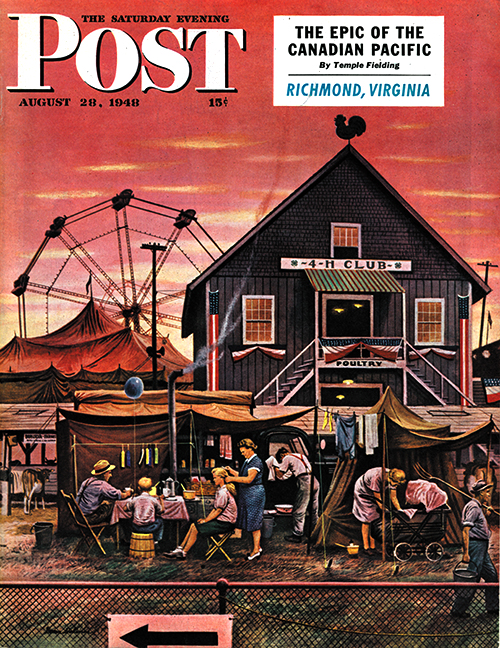
Stevan Dohanos
August 28, 1948
This Stevan Dohanos cover depicts the Skowhegan State Fair in Maine. Do you know what 4-H stands for? It comes from the 4-H pledge: “I pledge my head to clear thinking, my heart to greater loyalty, my hands to larger service, and my health to better living, for my club, my community, my country, and my world.”
If 4-H were created now, they’d have to add a fifth, for “hashtag.”
September Is National Chicken Month
There are approximately 90,224,359 chicken recipes online. How can I possibly pick a few to give you for National Chicken Month? Well, by throwing a virtual dart and seeing what comes up, like these Individual Chicken Pot Pies, these Cornflake Chicken Tenders, and this Skillet Rosemary Chicken.
But don’t cook chicken in the microwave, even if it is the 50th anniversary. That hardly ever works out well.
Next Week’s Holidays and Events
Newspaper Carrier Day (September 4)
This is the day you support your local newspapers and the people who deliver the paper to you. The day was picked in honor of Barney Flaherty, the first paperboy hired on this day in 1833.
This would also be a good day to explain to younger people what newspapers are.
Labor Day (September 4)
You know what you’re doing Labor Day night — watching the Jerry Lewis marathon! — but during the day, maybe you can spend time at the grill in a “Kiss the Cook” apron, making some Grilled Shrimp and Asparagus from Curtis Stone, some Grilled Corn with Sweet Pepper Butter, and maybe that Grilled Pizza you’ve heard about and have been wanting to try.
Germany’s Invasion of Poland Launches World War II
On September 1, 1939, over 1.5 million German soldiers crossed the border into Poland. The German government declared that they were coming to the aid of German people in Poland who were being persecuted by the Poles, but few people were fooled into believing it was anything more than Hitler’s grab for more territory.
Hitler knew France and England were allies of Poland who had promised to come to its aid if attacked. But he doubted they would act. Many people in France and England felt the same way.
Yet both governments declared war on Germany on September 3. Unfortunately, neither country was in the position to provide Poland with much help turning back the German blitzkrieg, which overran the country in a month.
In “Poland in Chains,” which appeared in the Post 19 months after the invasion, one of the Post’s war correspondents describes the aftermath of the German conquest. His report was a chilling introduction to Germany’s treatment of Jews in occupied countries.
America’s First Subway
Just four years after the Civil War, New York began constructing the first subway in America. It opened in February 1870 but never became more than a block-long prototype of a pneumatic-powered system.
At the time, engineering “experts” warned investors away from the subway system. It would be crushed, they said, by the weight of those enormous buildings overhead, like the five-story-tall Astor House hotel!
So the honors for the first operating subway went to Boston, which opened its 1.5-mile long underground system on September 1, 1897. It marked the beginning of an underground movement as cities began burying parts of their infrastructure.
New York finally launched its own subway system in 1904, and it soon became the world’s largest.
By 1936, it had become part of New York’s many subterranean systems that fascinated Post writer Milton MacKaye.
In “Underground Empire,” which the Post published on month, date, 1936, MacKaye describes the system that handled 1.6 billion fares every year and supervised 1,100 miles of subway track. Underground travel had become such an essential part of life that subway stations featured stores, hotels, restaurants, movie theaters, and night clubs.
With Manhattan so crowded, it made sense for the city to bury its rapid transit, as well as its utilities. Beneath the sidewalks, as MacKaye writes, lay thousands of miles of gas and water mains; steam and sewer pipes; power, telephone, and telegraph lines; and the wiring for police and fire-alarm systems.
He also reported that New York had a 28-mile pneumatic-tube system that pushed 28-pound mail-filled torpedoes across the city to 23 post offices.
Today, New York’s subway is as vital to the city as it was in 1936. Its 1,500 miles of track connect 472 stations, helping to deliver over 5 million passengers to their destinations every day. And much of its old pipes and wiring are still in service. But the pneumatic mail system that fascinated MacKaye is no more. It was shut down in 1953.
Featured image: 59th Street Circle, 1901 (New York Public Library)
King of the Board: The Soviet Collusion Against Bobby Fischer
After a 1964 Post profile of Bobby Fischer that painted the young chess master as a rancorous loner, one reader wrote in with a prescient plea: “Please, please someone save this young man before it is too late. He needs to finish his education, find a nice girl, settle down and raise a family. He can’t spend the rest of his life just playing chess and expect to be happy.”
As it turned out, the writer of the letter, Lana Jacobs from Moline, Illinois, was right. Fischer was infamous for his anti-Semitism, paranoia, megalomania, and overall intolerability up until his death in 2008. No one ever disputed his genius at the game of chess, but — like so many at the top of their field — Fischer’s compulsiveness for the game was a likely factor in his troubled mental state.
“Have Pawn, Will Travel” described 20-year-old Fischer’s standoffishness during the 1963-64 U.S. Championship, calling his presence “demoniac.” After whipping several amateurs for one dollar per game and curtly answering the reporter’s questions, Fischer scurries off to another game: “On the way down in the elevator he frowned ominously at the other passengers and toyed with the chess pieces that he carried in his pocket.”
The article goes on to describe Fischer’s distrustful relationship with the World Chess Championship, citing that he “has never managed to win such a tournament, a failure he apparently attributes to a Communist conspiracy rather than to any shortcomings of his own.”
Two years earlier, Fischer had described his experience in the Curaçao Candidates’ tournament in a Sports Illustrated manifesto (“The Russians Have Fixed World Chess”), claiming a rudimentary grasp of Russian allowed him to sniff out their cheating: “They would openly analyze my game while I was still playing it. It is strictly against the rules for a player to discuss a game in progress, or even to speak with another player during a game — or, for that matter, with anyone.” Fischer also posed that the format of the tournament was problematic as it allowed the numerous Soviet players to collude in a series of draws and fixes, saving their energy for the finals. His suspicions were validated by several witnesses, including a Soviet grand master. One statement of Fischer’s from the article was proven false: his proclamation to never play in a World Chess Championship again.
In the World Chess Championship of 1972 — the final game of which was played 45 years ago to the day — Fischer defeated Boris Spassky and ended the 24-year-long Soviet holding of the title. The event was hugely publicized as a pitting of the West and the Communists during the Cold War, and the game of chess as a metaphor of strategy and domination didn’t hurt. The Reykavik faceoff was PBS’s highest-rated show at the time, and the whole experience even spawned a Broadway musical.
After his win, Fischer — perhaps unsurprisingly — disappeared for two decades. In the years leading to his death his anti-Semitism and anti-Americanism became hyper-inflammatory, culminating in a rant on Philippine radio on 9/11 that caused the U.S. Chess Federation to denounce the once-great player.
Fischer’s rise and fall is a tragic and puzzling tale of, perhaps, the only American household name in the game. It runs counter to most perceptions of a quiet, friendly competition that Frank Brady, the 1964 editor of Chessworld magazine, call’s “more exciting than sex.”
Weathering a Hurricane in 1950
In 1950, author Philip Wylie shared his story, “How to Live Through a Hurricane.”
Wylie was a regular contributor to The Saturday Evening Post. He was well known for his series of saltwater-fishing stories featuring Captain Crunch (no relation) and Des.
In our December 30 issue that year, he narrated the passage of a hurricane over his house in Miami. He describes how small matters, like violations of building codes, could mean the destruction of a house. Of particular interest are the preparations he made at his house before the storm: hanging heavy shutters on the window, cooking all food that would spoil if they lost power, cutting back foliage on trees, determining what to bring inside or to tie down outside.
This particular hurricane was quite different from Harvey: The major concern was wind, not flooding. And he fared much better than many residents of Houston because he had luck, time, and money on his side. What he did share with Houstonians was experience: He’d been through five hurricanes before.