Movies for the Rest of Us with Bill Newcott: Films Directed by Women
Award-winning film critic and writer Bill Newcott has been covering Hollywood for more than 40 years. He is the creator of AARP’s Movies For Grownups franchise and the movie critic for The Saturday Evening Post.
Saturday Evening Post movie critic Bill Newcott reviews several of the nine new movies directed by women, including Wonder Woman, Paris Can Wait, The Beguiled and Maudie. Plus, he looks at new DVD and Blu-ray releases of three classics: Michael Caine’s A Shock to The System, Al Gore’s An Inconvenient Truth, and Bob Hope’s visits with U.S. troops overseas.
Listen to all of Bill’s podcasts.
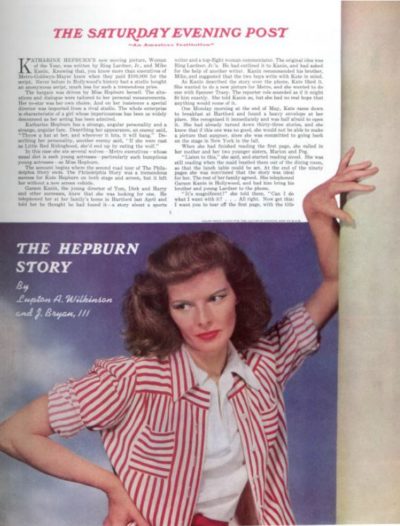
Katherine Hepburn Storms Hollywood
Originally published December 13, 1941.
When David O. Selznick, RKO’s chief of production, and George Cukor, director of A Bill of Divorcement, first approached a then-unknown Katharine Hepburn to appear in the film, they offered her $500 a week. Kate replied coolly that she “would prefer $1,500.”
At the end of two weeks, Selznick had come up to $1,250 a week. Kate asked her family whether they thought she should trim her sails a bit. Her mother said she’d be insane not to. Her father said she shouldn’t. So she told casting agent Leland Hayward, “I said $1,500 a week.” Selznick told Hayward, “I like her, but she’s got no right to demand $1,500. I won’t meet any such figure. That’s final!” Hayward knew that Selznick meant what he said. But by this time he also knew Kate. “She’ll never give in,” he told Selznick, “but look here: In the theater she’s used to rehearsing free, and she’s green. I’ll tell her you’ll meet the $1,500 figure for four weeks, but that she’ll have to give you a rehearsal week free. That’s the equivalent of five weeks at $1,200.” Selznick said at once, “I’ll do it.”
Today both he and Kate regard the deal as the triumph of their lives. Selznick got a leading woman for $6,000. Kate set a per-week rate that was not far from the very top of the payroll. And neither had given in.
When she arrived in California, Hayward and his partner, Myron Selznick, met her train at Pasadena. They will never forget the sight. One of Kate’s eyes was swollen shut from an injury she’d suffered on the ride. The other was inflamed sympathetically. Her freckles seemed as big as potato chips. She was wearing a bizarre blue suit and a pancake straw hat that in 1941 might be called “stylishly insane” but in 1932 was merely insane.
“My God,” Selznick whispered to Hayward. “Did we stick David $1,500 for that?”
The agents delivered her to David Selznick in silence and disappeared. Selznick, too, took a single look, then stepped into the next office and phoned Cukor. “Your star is here, George. I’ll send her down.”
Cukor had a sheaf of dress designs spread out. Still “busy being superior,” Kate leafed through them contemptuously. Her only comment was, “Not quite the sort of thing a well-bred English girl would wear, I’m afraid.”
“No?” said Cukor. “And what do you think of what you’re wearing now?”
“I think it’s very smart,” she said.
“Well, I think it stinks,” he retorted.
Cukor has described Kate’s mood, during her first Hollywood phase, as “sub-collegiate idiotic.” The incident of the dress designs was his first clue.
In her first meeting with RKO’s press department, she announced, “Publicity? Not for me — none at all!” She wanted to wait until she knew whether she deserved it, and she remembered her father’s creed: “Do your work. Keep out of the papers. Your private life’s your own.”
Having alienated the RKO press department before noon on her first day, she looked around for more trouble. She found it quickly. A studio photographer had taken some stills of her with co-stars John Barrymore and Billie Burke. An RKO official sent prints of the pictures for the three stars to autograph as souvenirs for visitors. Kate told Cukor haughtily, “I never give autographs.”
Cukor handed the stills back to the messenger. Then he turned to Kate. “You! Do you really think anyone would want your autograph alongside Barrymore’s and Miss Burke’s? Those two are actors! If you study for 25 years, maybe your signature will be worthy to go with theirs.”
That hit home. Afterward, Kate was humble toward acting. Her supercilious attitude toward Hollywood fell away. She flung herself into the 10-hour-a-day schedule with all her intensity. From the first moment she appeared on screen, Cukor saw in her something fine, and he maneuvered with skill and patience to evoke it.
Barrymore helped her develop her talent further. They also developed a friendly repertoire. One day he stared at her until she squirmed.
“What’s that for?” she asked.
“Isn’t it the customary thing to stare at beautiful young girls?”
Kate wouldn’t accept the explanation.
“Well,” said Barrymore, “I was just thinking how much you reminded me of my second wife.”
Kate smiled.
“Or was it my third?”
To his delight, Kate swore right back at him.
Barrymore says, “I remember every hour of working with her. … Miss Hepburn’s talent was so clearly perceptible, and she was so intelligent in learning, that working with her was all pleasure. But Lord, she was innocent!”
Without ever having seen the picture, she and her husband sailed for Europe. They were still there when A Bill of Divorcement was released. It was an instant success.
RKO’s urgent cables finally caught up with her in Vienna. They wanted her to return at once. Kate agreed and sailed for home. Reporters swarmed aboard her ship at Quarantine. Kate’s back went up at once. Even more unfortunate was the interview that RKO forced her to give a group of fan-magazine writers. She might better have kept silent, but “they asked a lot of asinine questions, so I gave them asinine answers.”
“Are you married?” they asked.
“I don’t remember,” she said.
“Have you any children?”
“Yes, two white and three colored.”
“How does it feel to be a socialite in Hollywood?”
That was the last straw. White with fury, she strode from the room.
Cover Gallery: Celebrating America
These Post covers and illustrations honor the land of the free and the home of the brave. Happy Independence Day!
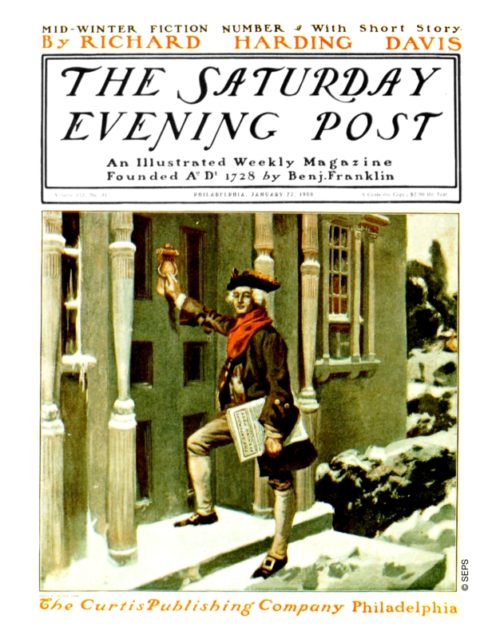
George Gibbs
January 27, 1900
George Gibbs painted over 40 covers for the Post during the first decade of the 20th century. He was a competent illustrator who could depict romanticized historical scenes and subjects to the taste of editor George Horace Lorimer.
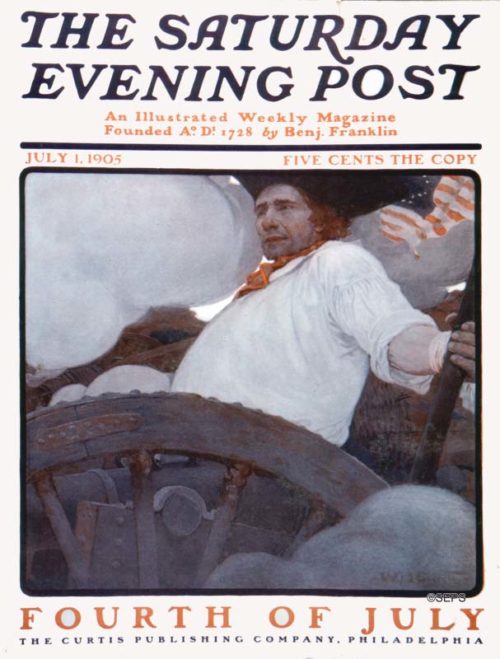
Walter H. Everett
July 1, 1905
Walter H. Everett created covers for the Post during a time when war dominated the magazine. Many of his covers feature soldiers and pirates and occasionally a beautiful woman.
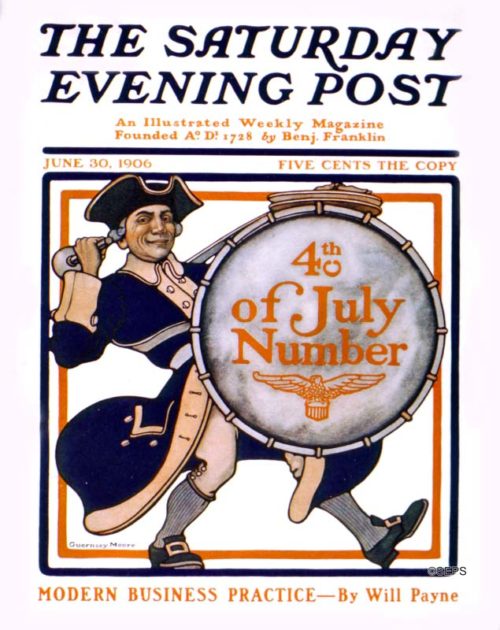
Guernsey Moore
June 30, 1906
Guernsey Moore illustrated the first colored cover for the Saturday Evening Post. In 1900, he illustrated new lettering for the Post’s masthead and in 1904 became the art editor of the magazine.
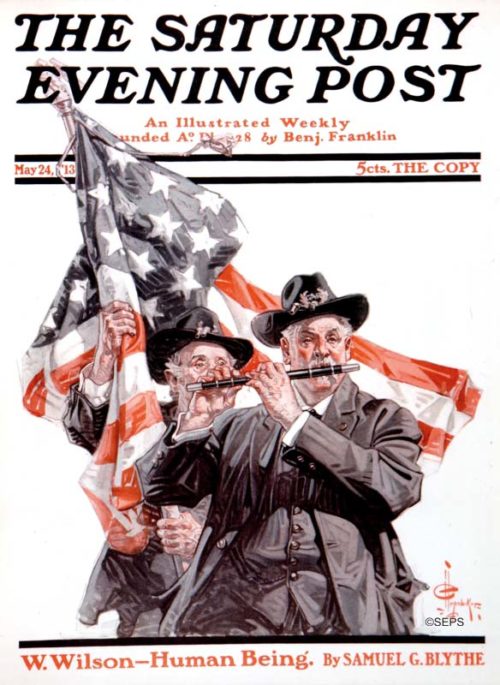
J.C. Leyendecker
May 24, 1913
J.C. Leyendecker was only one of the four major artists from the first decade to continue illustrating Post covers after 1910. Over the course of the next decade, Leyendecker painted well over 100 covers for the magazine, including these patriotic Civil War veterans in 1913.
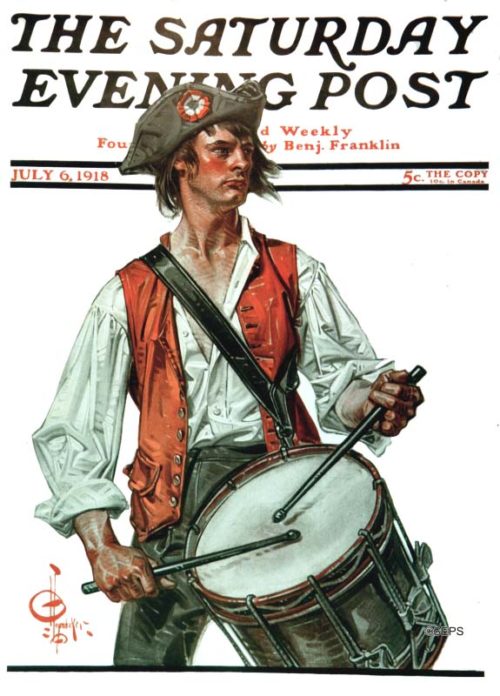
J.C. Leyendecker
July 6, 1918
For several years, war influenced the covers of the Saturday Evening Post, and many were painted by J.C. Leyendecker. This 1918 cover of a colonial drummer was painted by Leyendecker despite his anti-war views, which he got to express with his famous New Year’s babies.
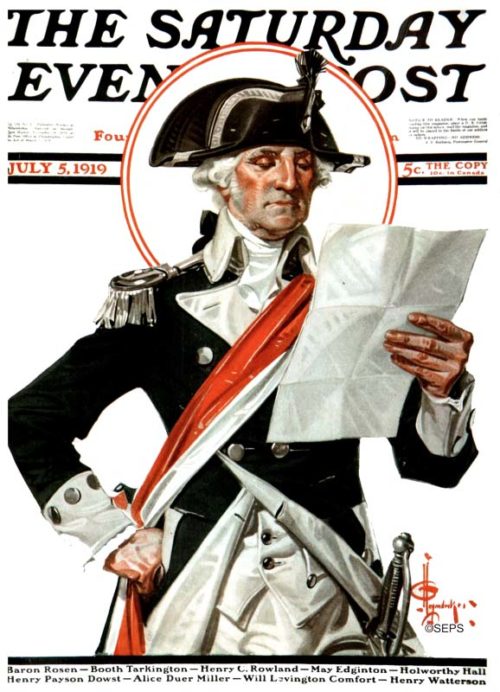
J.C. Leyendecker
July 5, 1919
J.C. Leyendecker experimented with a variety of subjects and attitudes, but his most noteworthy work marked and celebrated America’s holidays. He painted covers for several holidays from 1910-1919 and some, like the Fourth of July and the New Year, belonged to him almost exclusively.
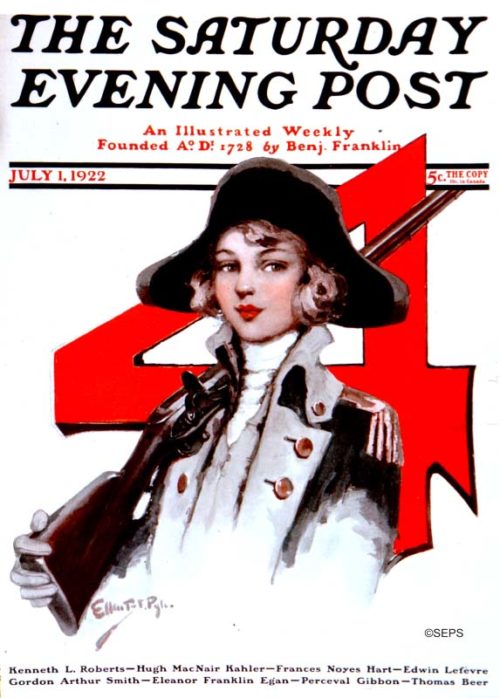
Ellen Pyle
July 1, 1922
This 1922 cover was created by one of the Post’s most well-known female artists, Ellen Pyle. Known for painting children and beautiful young women with a goal of capturing the “unaffected natural American type,” Pyle’s four children became models in most of her covers.
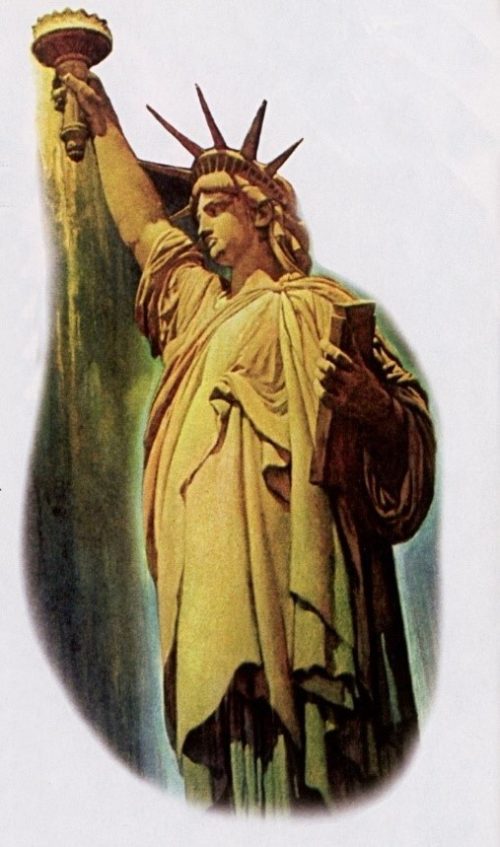
Norman Rockwell
October 11, 1941
This Norman Rockwell Statue of Liberty is part of a more detailed illustration with Lady Liberty shooting from the sky like a meteor as onlookers watch from below.
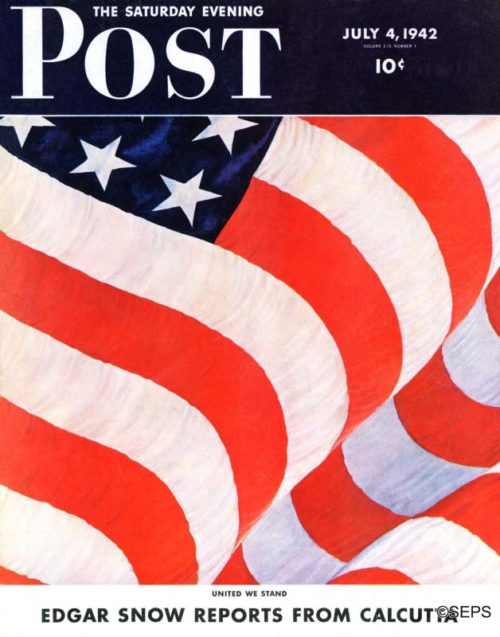
John Clymer
July 4, 1942
John Clymer created 80 Saturday Evening Post covers from 1942-1962. He often painted patriotic scenes covering vast landscapes, making this close-up of the American flag something unique.
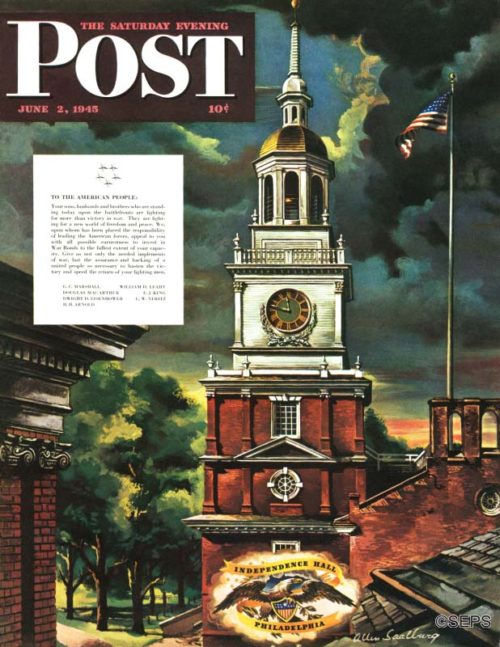
Allen Saalburg
June 2, 1945
In 1945, Independence Hall was just across the way from the Post offices, and, more than any other structure, it is a symbol of American perseverance and love of liberty. Saalburg’s painting is a view of Independence Hall looking west. The building at the left is The American Philosophical Society. The Post‘s offices were directly behind the trees in the left foreground.
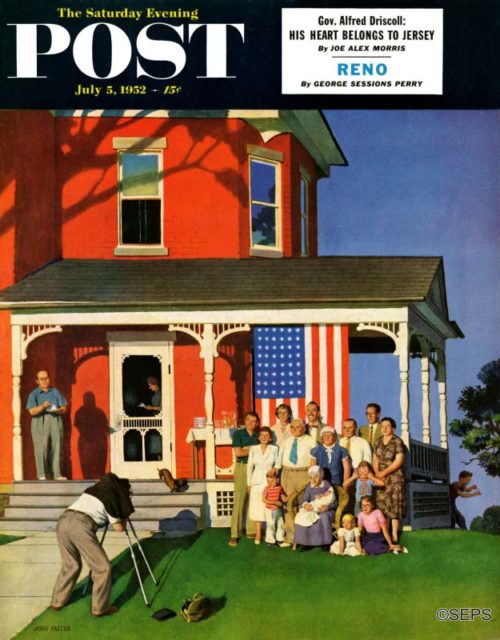
John Falter
July 5, 1952
John Falter painted more than 120 covers for the Post. He loved to illustrate Midwestern Americana, which he perfectly captures in this idealized family reunion scene. After the Post started using photographs rather that illustrations on its covers, Falter turned to portrait painting and book illustration. Many of those had a patriotic bent as well: he illustrated a special edition of Carl Sandburg’s Abraham Lincoln – The Prairie Years and Houghton-Mifflin’s Mark Twain series.
North Country Girl: Chapter 6 — A Very Ratty First Communion
For more about Gay Haubner’s life in the North Country, read the other chapters in her serialized memoir. The Post will publish a new segment each week.
For my semi-devout Catholic father’s sake, my skeptic mother gamely took meat off the menu for our own Friday dinners, which I made a trial for her, as I couldn’t stand cheese or eggs or fish. Pancakes were my Friday dinner of choice.

Eating meat on Friday was a mortal sin, as I learned in my catechism class, which I had to attend every Wednesday afternoon, along with a handful of other Catholic kids who didn’t go to parochial school. The class was held at Holy Rosary School, where frightening nuns in full habit prepared us to make our First Communion by drilling us with the Baltimore Catechism. We went over and over questions such as “Why did God make you?” until we could parrot the word-perfect answer: “God made me to know Him, to love Him, and to serve Him in this world, and to be happy with Him forever in the next.”

The nuns hated everyone in the catechism class. We were practically heathens; good Catholic children went to parochial school. The nuns assured me that I was not going to heaven as I did not have a saint’s name, and that my mother wasn’t going to meet St. Peter either, as she wasn’t Catholic. I was pitched into existential despair by this knowledge. It was also bone-chilling to have to make my first confession, required before taking communion. I had to learn yet another series of correct responses to questions I didn’t understand before I could enter the dark, velvet-curtained booth to make my confession. I knelt in the dim light until I heard the swoosh of the screen sliding back; even then the priest’s face was blurred through wavy plastic panels that were punctuated with holes so we could hear each other. I had to confess my sins, sins that I pretty much made up. I was seven years old. I didn’t steal, I didn’t lie, I didn’t take the Lord’s name in vain. I mostly did exactly as I was told. Did fighting with my sister count?
Having gotten that horrible ordeal over, I made my First Communion on a gloomy, rainy April Sunday, wearing a frilly white dress and a dainty veil bobby-pinned to my head, like a tiny bride. My Catholic grandmother made a big fuss over me, and gave me a small white missal with brightly colored illustrations of gospel scenes, and a pink and gold watch.
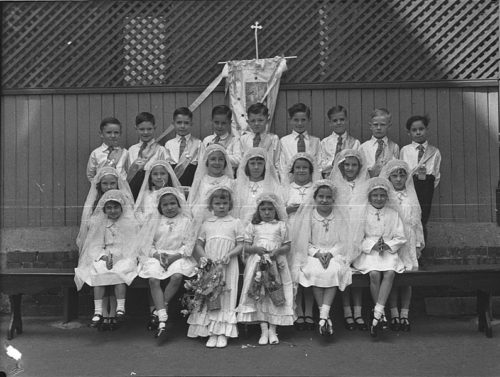
After that endless mass (dozens of little communicants lined up at the rail, all of us terrified lest we drop the Host out of our mouth and onto the floor, which according to the nuns, went so beyond a mortal sin that death by lightning was to be expected), our family went to breakfast at Perkin’s Pancake House, a huge treat, as it was always jam-packed on Sundays, and my father hated to wait for a table anywhere. Because I had to fast for two hours before taking communion, I was starving. Alas, the chocolate chip pancakes I always craved were still forbidden, even on the occasion of my First Communion; not by the Church but by my dentist dad who viewed them as candy for breakfast.
When we came back to our house, our happy, blessed party was greeted with a rat infestation. Duluth is a port city, built on a hill, and snowmelt and steady rains must have driven the rats up from the lake all the way to our “nice” neighborhood. My most vivid recollection of that day is not receiving the body of Christ for the first time, but watching my grandfather, the great hunter, beat a rat to death with a shovel. Poison was set out, and for the next few weeks I had to check carefully when I went down into my dad’s basement workroom to play with my Creepy Crawler set to make sure I didn’t step on a dead rat.
I loved my Creepy Crawler set; I squeezed bottles of red or blue or green liquid plastic into metal molds in the shape of insects, and then inserted the molds into a heater to set them. There was a flimsy wire handle to remove the red-hot molds, and a prescribed time to wait before peeling your new insects out of them, but burnt fingers inevitably ensued. To my great joy, my sister Lani was expressly prohibited from playing with my Creepy Crawler, or even being in the workroom while I used it.
Toys were plentiful, arriving as birthday presents and from Santa. Each December brought the thrill of new toys from Mattel and Hasbro. The commercials on TV and the photos in the Sears catalog made each doll and toy look irresistible, promising hours of fun. My mother long resisted getting me a Barbie; she thought there was plenty of time for girls to be clothes-obsessed, starting at age twelve. And every Barbie outfit came with the dreaded little pieces, accessories of tiny shoes and jewelry.
When Santa finally brought me one, a blond bubble-hair doll with a wasp waist and deformed feet, arched so high that the Barbie mules did fall off and get lost immediately, a girl about my age moved in across the street (only to move away a few months later). She also loved to “play Barbies,” which did indeed involve nothing other than making up reasons why our Barbies needed to change clothes every few minutes. I eventually acquired a Ken, who was boring, and a cardboard Barbie House, that my hung-over, fumbling, grumbling dad put together for me on Christmas morning. I never got the pink Barbie convertible the girl across the street had that I was consumed with desire for and would have pilfered if given the chance. Then I would have something to confess.
I never got the cotton candy machine or the snow cone maker I begged Santa for, in letters and in person, year after year. I did get the much-lusted after E-Z Bake Oven, but after I had used up the two boxes of cake mix and the one box of brownie mix that came with it (cakes and brownies that came out medium rare), I had nothing left to bake with. It never occurred to me that I could just use part of a box of grocery store cake mix. I thought because I had a miniature oven, I needed miniature boxes of mix.

Board games seem to have been thoughtfully distributed among my friends. Judy Lindberg had Operation, which my mother refused to buy, certain I would immediately lose the pieces. To prove her wrong, I actually managed to hold on to all of the components of Mouse Trap, which was much more fun, for years. I also had Lie Detector, where you had to determine the guilty party among twenty or so suspects. I played this over and over until I learned to figure out who dun it within three guesses, which happened about the same time the batteries died, and since we never had batteries in the house, that was the end of that game. Nancy Green had Mystery Date and Careers, which let us pretend we were teenagers or adults. Those games taught me to judge boys based on their looks and that secretary was a good job. My one Congdon school pal, Nancy Erman, had The Game of Life, which I adored. So much better than slow, stodgy, unwinnable Monopoly, with useless Water Works and endless passings of Go. Life had the little cars which you filled up with your peg husband and children. Then there was the heartbreaking decision you had to make, almost at the beginning of the game, to go to college or to start working and making money. We should have figured out then that The Game of Life was rigged.
My deal with Nancy was that we would have one game of Life and then play trolls. She had at least a dozen troll dolls, in various sizes: homely, grinning, sexless, squat figures with long, neon-colored hair. I only had a few, as I had to buy mine with my own money. My mother, the toy tsar, refused to pay for anything so ugly.
When I was seven I set my heart on a Chatty Cathy, the star of seemingly every pre-Christmas toy commercials. Chatty Cathy was the most marvelous doll ever. She talked! You had to pull a string on the back of her neck to make her speak, and then she only said about five things. I was desperate for her. On Christmas morning Chatty Cathy was perched under the tree, reinforcing my belief in Santa Claus despite Nancy Green’s best efforts.
That was the year that we took an odd vacation to St. Petersburg, Florida, with the Lindburgs. Our family drove down, they flew; a week later they drove back in our car and we flew home. I have no idea whether it was to save money or see the country. I only have two memories of the car trip down: driving past an ancient kerchiefed black woman sweeping a dirt yard with a broom made of sticks, and my dad, pushed beyond human endurance by hearing “My name is Chatty Cathy” for the eight thousandth time, flinging my new doll out the car window somewhere in Alabama.
The Lobsterman’s Commute

Each dawn the shores of down-East Maine awake to the hollow “pip-pip” of the outboards and the “crump-crump” of the inboards as the lobstermen start making their rounds of the bays, inlets, and off-shore shallows to collect the day’s catch.
It is this misty interregnum between night and day, sleeping and waking, the past and the present — that dismal interval known to newspapermen as the “lobster trick” — that the photographer has caught, with the delicate immobility of a fossil print, at Prospect Harbor, Hancock County, Maine. The time is 5:30 of a midsummer morning, and the lobstermen you see are using their skiffs to ferry out to their larger lobster boats.
Maine water is cold, Maine lobsters — together with those of the neighboring Canadian Maritime Provinces — are the best in the world, and this picture is what a Maine lobsterman, stroking his chin, would call a “cocker.”
—“Lobster Trick,” Face of America, July 16, 1960
This article is featured in the May/June 2017 issue of The Saturday Evening Post. Subscribe to the magazine for more art, inspiring stories, fiction, humor, and features from our archives.
“Black Snowflakes” by Paul Horgan
“Richard, Richard,” they said to me often in my childhood, “when will you begin to see things as they are?”
But I always learned from one thing what another was, and it was that way when we all went from Dorchester to New York to see my grandfather off for Europe, the year before the First World War broke out.
He was a German — my mother’s father — and it was his habit, all during the long time he lived in Dorchester, New York, to return to Germany for a visit every year or two. I was fearful of him, for he was large, splendidly formal in his dress and majestic in his manner, and yet I loved him for he made me know that he believed me someone worthwhile. I was ten years old, and I could imagine being like him myself someday, with glossy white hair swept back from a broad, pale brow, and white eyebrows above China-blue eyes, and rosy cheeks, a fine sweeping moustache and a well-trimmed white beard that came to a point. He sometimes wore eyeglasses with thin gold rims, and I used to put them on and take them off in secret. I suppose I had no real idea of what he was like.
There was something in the air about going to New York to see him off that troubled me. I did not want to go.
“Why not, my darling?” my mother asked as I was going to bed the night before we were to leave home. Before going down to dinner, she always came in to see me, to kiss me good night, to glance about my room with her air of giving charm to all that she saw, and to whisper a prayer with me that God would keep us.
“I don’t want to leave Anna.”
“What a silly boy. Anna will be here when we get back, doing the laundry in the basement or making Apfelkuchen, just as she always does. And while we are gone, she will have a little vacation. Won’t that be nice for her? You must not be selfish.”
“I don’t want to leave Mr. Schmitt and Ted.” Mr. Schmitt was the iceman, and Ted was his horse.
My mother made a little breath of comic exasperation, looking upward for a second. “You really are killing,” she said in the racy slang of the time. “Why should you mind leaving them for a few days? What is so precious about Mr. Schmitt and Ted? They only come down our street twice a week.”
“They’re friends of mine.”
“Ah. Then I understand. We all hate to leave our friends. Well, my darling, they will be here when we get back. Don’t you want to see Grosspa take the great ship? You can even go on board to say good-bye. You have no idea how huge those ships are, and how fine.”
“Why can’t I go the next time he sails for Germany?”
At this my mother’s eyes began to shine with a new light, and I thought she might be about to cry, but she was also smiling. She gave me a hug. “This time we must all go, Richard. If we love him, we must go. Now people are coming for dinner, and your father is waiting downstairs. Now sleep. You will love the train, as you always do. And in New York you can buy a little present for each one of your friends.”
It was a lustrous thought to leave with me as she went, making a silky rustle with her long dress. I lay awake thinking of each of my friends, planning my gifts.
Anna, our servant, was a large, gray, Bohemian woman who came to us four days a week. I spent much time in the kitchen or the basement laundry listening to her rambling stories of life on the “East Side” of town. She had a coarse face with deep pockmarks. I asked her about them one day, and she replied with the dread word, “Smallpox.”
“They thought I was going to die,” she said. “They thought I was dead.”
“What is it like to be dead, Anna?”
“Oh, dear saints, who can tell that who is alive?”
It was all I could find out, but the question was often with me. Sometimes in the afternoon, when I was supposed to be taking my nap, I would hear Anna singing, way below in the laundry, and her voice was like something hooting up the chimney. What should I buy for Anna in New York?
And for Mr. Schmitt, the iceman. He was a heavy-waisted German-American with a face wider at the bottom than at the top, and when he walked he had to swing his huge belly from side to side to make room for his steps. He had a big, hard voice, and we could hear him coming blocks away, calling, “Ice!” in a long cry. Other icemen used a bell, but not Mr. Schmitt. I waited for him to come, and we would talk while he stabbed at the great cakes of ice in his hooded wagon, chipping off the pieces we always took — two chunks of fifty pounds each. His skill with the tongs was magnificent, and he would swing a chunk up on his shoulder, over which he wore a sort of rubber chasuble, and move with heavy grace up the walk along the side of our house to the kitchen porch.
“Do you want to ride today?” he would ask, meaning that I was welcome to ride to the end of the block on the high seat above Ted’s rump, where the shiny, rubbed reins lay in a loose knot, because Ted needed no guidance and could be trusted to stop at all the right houses and start up again whenever he felt Mr. Schmitt’s heavy, vaulting rise to the seat. I often rode to the end of the block, and Ted, in the moments when he was still, would look around at me, first from one side, and then the other, and stamp a leg, and shudder his harness against flies, and in general treat me as a member of the ice company, for which I was grateful
What could I buy for Ted? Perhaps in New York they had horse stores. My father would give me what money I would need, when I told him what I wanted to buy. I resolved to ask him, provided I could stay awake until the dinner party was over, and my father, as he always did, would come in to see if all was well. How much love there was all about me, and how greedy I was for even more of it.
The next day we assembled at the station to take the train. It was a heavy, gray, cold day, and everybody wore fur except me and my Great-aunt Barbara Tante Bep. She was going to Germany with my grandfather, her brother.
This was an amazing thing in itself, for, first of all, he usually went everywhere alone, and second, Tante Bep was so different from her magnificent brother that she was generally kept out of sight. She lived across town on the East Side in a convent of German nuns, who received money for her board and room from Grosspa. She resembled an ornamental cork that my grandfather often used to stopper a wine bottle. Carved out of soft wood and painted in bright colors, the cap of the cork represented a Bavarian peasant woman with a blue shawl over painted gray hair. The eyes were tiny dots of bright blue lost in wooden crinkles, and the nose was a long wooden lump hanging over a toothless mouth sunk deep in a poor smile.
Now, wearing her jet-spangled black bonnet with chin ribbons, and her black shawl and heavy skirts that smelled like dog hair, she was returning to Germany with her brother. I did not know why.
But her going was part of the strangeness I felt in all the circumstances of our journey. On the train my grandfather retired at once to a drawing room at the end of our car. My mother went with him. Tante Bep and I sat in swivel chairs in the open part of the parlor car, and my father came and went between us and the private room up ahead.
In the afternoon I fell asleep after the splendors of lunch in the dining car. Grosspa’s lunch went into his room on a tray, and my mother shared it with him. I hardly saw her all day, but when we drew into New York, she came to wake me. “Now, Richard, all the lovely exciting things begin! Tonight the hotel, tomorrow the ship! Come, let me wash your face and comb your hair.”
“And the shopping?” I said.
“Shopping?”
“For my presents.”
“What presents?”
“Mother, Mother, you’ve forgotten.”
“I’m afraid I have, but we’ll speak of it later.”
It was true that people did forget at times, and I knew how they tried then to make unimportant what they should have remembered. Would this happen to me, and my plans for Anna, and Mr. Schmitt, and Ted? My concern was great — but, as my mother had said, there were excitements waiting, and even I forgot, for a while, what it had seemed treachery in her to forget.
We drove from the station in two limousine taxis, like high glass cages on small wheels. My father rode with me and Tante Bep. It was snowing lightly, and the street lamps were rubbed out of shape by the snow, as if I had painted them with water colors. We went to the Waldorf-Astoria Hotel on Fifth Avenue, and soon after I had been put into the room I was to share with Tante Bep, my father came in to make an announcement. He lifted me up so that my face was level with his. His beautifully brushed hair shone under the chandelier, and his voice sounded the way his smile looked.
“Well,” he said, “we’re going to have a dinner party downstairs in the main dining room.”
I did not know what a main dining room was, but it sounded superb, and I knew enough of dinner parties to know that they always occurred after my nightly banishment to bed.
“It won’t be like at home, will it?” I said. “It will be too far away for me to listen.”
“Listen? You’re coming with us. And do you know why you’re coming with us?”
“Why?”
“Grosspa specially wants you there.”
“Ach Gott,” Tante Bep said in the shadows, and my father gave her a frowning look.
We went downstairs together a few minutes later. I was dazed by the grand rooms of the hotel, the thick textures and velvety lights, the distances of golden air, and most of all by the sound of music coming sweetly and sharply from some hidden place. In a corner of the famous main dining room was a round table sparkling with silver, glass, ice, china and flowers, and in a high-backed armchair sat my grandfather. He leaned forward to greet us, and seated us about him. My mother was at his right, in one of her prettiest gowns. I was on his left.
“Hup-hup!” my grandfather said, clapping his hands to summon waiters. “Tonight nothing but a happy family party, and Richard shall drink wine with us, for I want him to remember that his first glass of wine was handed to him by his alter Miinchner Freund, der Grossvater.”
At this, Tante Bep began to make a wet sound, but a look from my father quelled it, and my mother, blinking both eyes rapidly, put her hand on her father’s and leaned over and kissed his cheek.
“Listen to the music,” Grosspa commanded, “and be quiet, if every word I say is to be a signal for emotion!”
Everybody straightened up and looked consciously pleasant. For me, it was no effort. The music came from within a bower of gold lattice screens and potted palms — two violins, a cello and a harp. I could see the players now, for they were in the corner just across from us. The leading violinist was alive with his music, bending to it, marking the beat with his glossy head, on which his sparse black hair was combed flat. The dining room was full of people, and their talk made a thick hum; to rise over this the orchestra had to work with extra effort.
The rosy lampshades on the tables, the silver vases full of flowers, the slow sparkling movements of the ladies and gentlemen at the tables, and the swallowlike dartings of the waiters transported me. I felt a lump of excitement in my throat. My eyes kept returning to the orchestra leader, who conducted with jerks of his nearly bald head, for what he played and what he did seemed to emphasize the astonishing fact that I was at a dinner party in public.
“What are they playing?” I asked. “What is that music?”
“It is called II Bacio,” Grosspa said.
“What does that mean?”
“It means ‘The Kiss.”‘
What an odd name for a piece of music, I thought. All through dinner — which did not last as long as it might have — I inquired about pieces played by the orchestra, and in addition to the Arditi waltz, I remember one called Simple Aveu, and the Boccherini Minuet. The violins had a sweetish, mosquitolike sound, and the harp was breathless, and the cello mooed like a distant cow, and it was all entrancing. Watching the orchestra, I ate absently, chewing hardly at all, until my father, time and again, turned me back to my plate. And then a waiter came with a silver tub on legs, which he put at my grandfather’s left, and took the wine bottle from its nest of sparkling ice and showed it to him. The label was approved, and a sip was poured for my grandfather to taste. He held it to the light and twirled his glass slowly; he sniffed it, and then he tasted it.
“Yes,” he declared, “it will do.”
My mother watched this ritual, and over her lovely heart-shaped face, with its rolled crown of silky hair, I saw memories pass like shadows, as if she were thinking of all the times she had watched this business of ordering and serving wine. She blinked her eyes again and, opening a little jeweled lorgnon she wore on a fine chain, bent forward to read the menu that stood in a little silver frame beside her plate. But I could see that she was not reading, and I wondered what was the matter with everybody.
“For my grandson,” Grosspa said, taking a wineglass and filling it half with water, and then to the top with wine. The yellow wine turned even paler in my glass, but there was too much ceremony for me not to be impressed. When he raised his glass, I raised mine, and while the others watched, we drank together. And then he recited a proverb in German which meant something like:
When comrades drink red wine or white,
They stand as one for what is right,
and a flourish of intimate applause went around the table in acknowledgment of this stage of my growing up.
I was suddenly embarrassed, for the music had stopped, and I thought all the other diners were looking at me; many were, in fact, smiling at a boy of 10, ruddy with excitement and confusion, drinking a solemn pledge of some sort with an old gentleman with a pink face and very white hair and whiskers.
Mercifully, the music began again, and we were released from our pose. My grandfather drew his great gold watch from his vest pocket and unhooked from a vest button the fob that held the heavy gold chain in place. Repeating an old game we had played when I was a baby, he held the watch toward my lips, and I knew what was expected of me. I blew upon it, and — though long ago I had penetrated the secret of the magic — the gold lid of the watch flew open. My grandfather laughed softly in a deep, wheezing breath, and then shut the watch.
“Do children ever know that what we do to please them pleases us more than it does them?” he said.
“Ach Gott,” whispered Tante Bep, but nobody reproved her.
“Richard, I give you this watch and chain to keep all your life, and by it you will remember me,” my grandfather said.
“Oh, no!” exclaimed my mother.
He looked gravely at her and said, “Yes. Now, rather than later,” and put the heavy, wonderful golden objects in my hand. I regarded them in stunned silence. Mine! I could hear the wiry ticking of the watch, and I knew that now and forever I myself could make the gold lid fly open.
“Well, Richard, what do you say?” my father urged gently.
“Yes, thank you, Grosspa, thank you.”
I half rose from my chair and put my arm around his great head and kissed his cheek. Up close, I could see tiny blue and scarlet veins under his skin.
“That will do, my boy,” he said. Then he took the watch from me and handed it to my father. “I hand it to your father to keep for you until you are 21. But remember that it is yours and you must ask to see it anytime you wish.”
My disappointment was huge, but even I knew how sensible it was for the treasure to be held for me instead of given into my care.
“Any time you wish. You wish. Any time,” repeated my grandfather, but in a changed voice, a hollow, windy sound that was terrible to hear. He was gripping the arms of his chair and now he shut his eyes behind his gold-framed lenses, and sweat broke out on his forehead. “Any time,” he tried to say through his suffering, to preserve a social air. But, seized by pain too merciless to hide, he lost his pretenses and staggered to his feet. Quickly my mother and father helped him from the table, while other diners stared with neither curiosity nor pity. I thought the musicians played harder all of a sudden to distract people from the sight of an old man in trouble being led out of the main dining room of the Waldorf-Astoria.
“What is the matter?” I asked Tante Bep, who had been ordered, with a glance, to remain behind with me.
“Grosspa is not feeling well.”
“Should we go with him?”
“But your ice cream.”
“Yes, the ice cream.”
So we waited for the ice cream, and in a moment or two the flow and rustle of rosy-shaded life was once again in the room.
My parents did not return from upstairs, though we waited. Finally, hot with wine and excitement, I was led by Tante Bep to the elevator and to my room and put to bed. Nobody came to see me, or if anyone did, I did not know it.
More snow fell during the night. When I woke up and ran to my window, the world was covered and the air was thick with snow still falling. Word came to dress quickly, for we were going to the ship. Suddenly I was consumed with eagerness to see the great ship that would cross the ocean.
Again we went in two taxicabs, I with my father. The others had gone ahead of us. My father pulled me near him to look out the window of the cab at the falling snow. We went through narrow, dark streets to the piers on the west side of Manhattan, where we boarded the ferryboat that would take us to Hoboken.
“We are going to the docks of the North German Lloyd,” my father said.
“What is that?”
“The steamship company where Grosspa’s ship is docked. The Kronprinzessin Cecilie.”
“Can I go inside her?”
“Certainly. Grosspa wants to see you in his cabin.”
“Is he there now?”
“Probably. The doctor wanted him to go right to bed.”
“Is he sick?”
“Yes.”
“Did he eat something — ” (It was a family explanation often used to account for my various illnesses at their onset.)
“Not exactly. It is something else.”
“Will he get well soon?”
“We hope so.”
He looked out the window as he said this, instead of at me, and I thought, He does not sound like my father. But we had reached the New Jersey side now, and the cab was moving past the docks. Above the gray, snowy sheds I saw the funnels and masts of ocean liners. The streets were furious with noise, horses, cars, porters running, and suddenly a white tower of steam rose from the front of one of the funnels, to be followed in a second by a deep, roaring hoot.
“There she is,” my father said. “That’s her first signal for departure.”
It was our ship. I could see her masts with their pennons being pulled about by the blowing snow, and her four tall ocher funnels.
We went from the taxi into the freezing air of the long pier. All I could see of the Kronprinzessin Cecilie were glimpses, through the pier shed, of white cabins, rows of portholes, and an occasional door of polished mahogany. A confused, hollow roar filled the long shed. We went up a canvas-covered gangway and then we were on board. There was an elegant creaking from the shining woodwork. I felt that ships must be built for boys, because the ceilings were so low and made me feel so tall.
My father held my hand to keep me by him on the thronged decks, and then we entered a narrow corridor that seemed to have no end. The walls were of dark, shining wood, and there were weak yellow lights overhead. The floor sloped down and then up again, telling of the ship’s construction. Cabin doors were open on either side. There was a curious odor in the air, something like the smell of soda crackers dipped in milk, and faraway — or was it right here, all about us in the ship — there was a soft throbbing sound. It seemed impossible that anything so immense as this ship would presently detach itself from the land.
“Here we are,” my father said, at a half-open cabin door.
We entered my grandfather’s room, which was not like a room in a house, for none of its lines squared with the others but met only to reflect the curvature of the ship. Across the room, under two portholes whose silk curtains were drawn, my grandfather lay in a narrow brass bed. He lay at a slight slope, with his arms outside the covers, and he wore a white nightgown. I had never before seen him in anything but his formal day and evening clothes. He looked white — there was hardly a difference of color between his beard and his cheeks and his brow. He did not turn his head, only his eyes. He seemed suddenly dreadfully small, and fearfully cautious, where be- fore he had gone his way magnificently, ignoring whatever threatened him with inconvenience, rudeness or disadvantage. My mother stood by his side, and Tante Bep was at the foot of the bed, wearing her black shawl and peasant skirts.
“Yes, come, Richard,” Grosspa said in a faint, wheezy voice, looking for me without turning his head.
I went to his side, and he moved his hand an inch or two toward me — not enough to risk such a pain as had thrown him down the night before, but enough to call for a response. I gave him my hand and he tightened his fingers over mine.
“Will you come to see me?” he said.
“Where?” I asked in a loud, clear voice. My parents looked at each other, as if to inquire how in the world the chasms which divide age from youth, and pain from health, and sorrow from innocence could ever be bridged.
“In Germany,” he whispered. He shut his eyes and held my hand, and I had a vision of Germany which may have been sweetly near his own; for what I saw were the pieces of brilliantly colored cardboard scenery that belonged to the toy theater he had once brought me from Germany.
“Yes, Grosspa,” I replied, “in Germany.”
“Yes,” he whispered, opening his eyes and making the sign of the Cross on my hand with his thumb. Then he looked at my mother, who understood at once.
“You go now with Daddy,” she said, “and wait for me on deck. We must leave the ship soon. Schnell, now, skip!”
My father took me along the corridor and down the grand stairway. The ship’s orchestra was playing somewhere — it sounded like the Waldorf. We went out to the deck just as the ship’s whistle let go again, and now it shook me gloriously and terribly. I covered my ears, but still I was held by that immense, deep voice. For a moment, when it stopped, the ordinary sounds around us did not come close. It was still snowing — heavy, slow, thick flakes, each like several flakes stuck together.
A cabin boy came along beating a brass cymbal, calling out for all visitors to leave the ship.
I began to fear that my mother might be taken away to sea after my father and I were forced ashore. I saw her at last. She came toward us with a rapid, light step and, saying nothing, turned us to the gangway, and we went down. She was wearing a little spotted veil, and with one hand she lifted it and put her handkerchief to her mouth. She was weeping and I was abashed by her grief.
We hurried to the dock street, and there we lingered to watch the Kronprinzessin Cecilie sail.
We did not talk. It was bitter cold. Wind came strongly from the West, and then, after a third great whistle-blast the ship slowly began to change — she moved like water itself as she left the dock, guided by three tugboats that made heavy black smoke in the thick air. At last I could see all of the ship at one time.
I was amazed how tall and narrow she was. Her four funnels rose like a city’s chimneys against the blowy sky. Stern first, she moved out into the river. I squinted at her with my head on one side and knew exactly how I would make a small model of her when I got home. In midstream she turned slowly to head toward the Lower Bay. She looked gaunt and proud and top-heavy as she ceased backing and turning and began to steam down the river and away.
“Oh, Dan!” my mother cried in a broken sob, and put her face against my father’s shoulder. He folded his arm around her. Their faces were white. Just then a break in the sky across the river lightened the snowy day, and I stared in wonder at the change. My father, watching after the liner, said to my mother: “Like some wounded old lion crawling home to die.”
“Oh, Dan,” she sobbed, “don’t, don’t!” I could not imagine what they were talking about. I tugged at my mother’s arm and said with excitement, pointing to the thick flakes everywhere about us, and against the light beyond, “Look, look, the snowflakes are all black!”
My mother suddenly could bear no more. She leaned down and shook me, and her voice was strong with anger: “Richard, why do you say black! What nonsense. Stop it. Snowflakes are white, Richard. White! White! When will you ever see things as they are! Oh!”
“Come, everybody,” my father said. “I have the taxi waiting.”
“But they are black!” I cried.
“Quiet!” my father commanded.
We were to return to Dorchester on the night train. All day I was too proud to mention what I alone seemed to remember, but after my nap, during which I refused to sleep, my mother came to me.
“You think I have forgotten,” she said. “Well, I remember. We will go and arrange for your presents.”
My world was full of joy again. The first two presents were easy to find — there was a little shop full of novelties a block from the hotel, and there I bought for Anna a folding package of views of New York and for Mr. Schmitt a cast-iron savings bank, made in the shape of the Statue of Liberty, to receive dimes. It was harder to think of something Ted would like. My mother let me consider many possibilities among the variety available in the novelty shop, but the one thing I wanted for Ted I did not see. Finally I asked the shopkeeper: “Do you have any straw hats for horses?”
“What?”
“Straw hats for horses, with holes for their ears to come through. They wear them in summer.”
“Oh. I know what you mean. No, we don’t.”
My mother took charge. “Then, Richard, I don’t think this gentleman has what we need for Ted. Let’s go back to the hotel. I think we will find it there.”
“What will it be?”
“You’ll see.”
When tea had been served in her room, she asked, “What do horses love?”
“Hay. Oats.”
“Yes. What else?”
Her eyes sparkled playfully. I followed her glance, and knew the answer.
“I know! Sugar!”
“Exactly” — and she made a little packet of sugar cubes in a Waldorf envelope from the desk in the corner, and my main concern about the trip to New York was satisfied.
At home I could not wait to present my gifts. Would they like them? Whether Anna and Mr. Schmitt did or not, I never really knew. Anna accepted her folder of views and opened it up to let the pleated pages fall in one sweep, and said, “When we came to New York from the old country I was a baby and I do not remember one thing about it.” Mr. Schmitt took his Statue of Liberty savings bank, turned it over carefully, and said, “Well. . . ”
But Ted — Ted very clearly loved my gift, for he nibbled the sugar cubes off my outstretched palm until there were none left, and then he bumped at me with his hard, itchy head, making me laugh and hurt at the same time.
“He likes sugar,” I said to Mr. Schmitt.
“Ja. Do you want to ride?”
Life, then, was much as before until the day, a few weeks later, that we received a cablegram telling us that my grandfather had died in Munich. My father came home from the office to comfort my mother. They told me the news in our long living room, with the curtains drawn. I listened, a lump of pity came into my throat for the look on my mother’s face, but I did not feel anything else.
“He dearly loved you,” they said.
“May I go now?” I asked.
They were shocked. What an unfeeling child. Did he have no heart? How could the loss of so great and dear a figure in the family not move him?
But I had never seen anything dead; I had no idea of what death was like; Grosspa had gone away before and I had soon ceased to miss him. What if they did say now that I would never see him again? They shook their heads and sent me off.
Anna was more offhand than my parents. “You know,” she said, letting me watch her work at the deep zinc laundry tubs in the dark, steamy basement, “that your Grosspa went home to Germany to die, don’t you?”
“Is that the reason he went?” I asked.
“That’s the reason.”
“Did he know it?”
“Oh, yes, sure he knew it.”
“Why couldn’t he die right here?”
“Well, when our time comes, maybe we all want to go back where we came from.”
Her voice contained a doleful pleasure, but the greatest mystery in the world was still closed to me. When I left her, she raised her old tune under the furnace pipes, and I wished I was as happy and full of knowledge as she was.
My time soon came.
On the following Saturday, I was watching for Mr. Schmitt and Ted when I heard heavy footsteps running up the front porch and someone shaking the door knob, as if he had forgotten there was a bell. I went to see. It was Mr. Schmitt. He was panting and he looked wild. When I opened the door, he ran past me, calling out, “Telephone! Let me have the telephone!”
I pointed to it in the front hall, where it stood on a gilded wicker taboret. He began frantically to click the receiver hook. I was amazed to see tears roll down his cheeks.
“What’s the matter, Mr. Schmitt?”
I heard my mother coming along the upstairs hallway from her sitting room.
Mr. Schmitt put the phone down suddenly and pulled off his hat, and shook his head. “What’s the use?” he said. “I know it is too late. I was calling the ice plant to send someone.”
“Good morning, Mr. Schmitt,” my mother said, coming downstairs. “What on earth is the matter?”
“My poor old Ted,” he said, waving his hat toward the street. “He just fell down and died up the street in front of the Weiners’ house.”
I ran out of the house and up the sidewalk to the Weiners’ house, and sure enough, there was the ice wagon, and still in the shafts, lying heavy and gone on his side, was Ted.
There lay death on the asphalt pavement. I confronted the mystery at last. The one eye that I could see was open. Ted’s teeth gaped apart, and his long tongue touched the street. His body seemed twice as big and heavy as before. His front legs were crossed, and the great horn cup of the upper hoof was slightly tipped, the way he used to rest it in ease. In his fall he had twisted the shafts that he had pulled for so many years. His harness was awry. Water dripped from the back of the hooded wagon. Its wheels looked as if they had never turned. What would ever turn them?
“Never,” I said, half aloud. I knew the meaning of this word now.
In another moment my mother came and took me back to our house, and Mr. Schmitt settled down on the curbstone to wait for people to arrive and take away the leavings of his changed world.
“Richard,” my mother said, “don’t go out again until I tell you.”
I went and told Anna what I knew. She listened with her head to one side, her eyes half closed, and she nodded at my news and sighed.
“Poor old Ted,” she said, “he couldn’t even crawl home to die.”
This made my mouth fall open, for it reminded me of something I had heard before, and all day I was subdued and private. Late that night I woke in a storm of grief so noisy that my parents heard the wild gusts of weeping and came to ask what the trouble was.
I could not speak at first, for their tender, warm, bed-sweet presences doubled my emotion, and I sobbed against them as they held me. But at last, when they said again, “What’s this all about, Richard? Richard?” I was able to say brokenly, “It’s all about Ted.”
It was true, if not all the truth, for I was thinking also of Grosspa crawling home to die, and I knew what that meant now, and what death was like. I imagined Grosspa’s heavy death, with one eye open, and his sameness and his difference all mingled, and I wept for him at last, and for myself if I should die, and for my ardent mother and my sovereign father, and for the iceman’s old horse, and for everyone.
“Hush, dear, hush, Richard,” they said.
A pain in my head began to throb remotely as my outburst diminished, and another thought entered. I said bitterly: “But they were black! Really they were!”
They looked at each other and then at me, but I was too spent to continue, and I fell back on my pillow. Even if they insisted that snowflakes were white, I knew that when seen against the light, falling out of the sky into the dark water all about the Kronprinzessin Cecilie, they were black. Black snowflakes against the sky. Black.

The Art of the Post: Forgotten Art Treasures from World War I
A hundred years ago, a select group of talented artists worked on the front lines of World War I, drawing and painting the human drama of The Great War. They captured the bravery and fear along with the boredom and exhaustion. But after the war ended, their eyewitness art was exhibited just once and then placed in storage at the Smithsonian Institution in Washington. Pictures of the human cost of the war — of flaming aerial combat around observation blimps, of poison gas attacks, of sacrifice and dedication — were quietly filed away in dark drawers where they’ve remained ever since, for the most part unseen and unappreciated by the public.
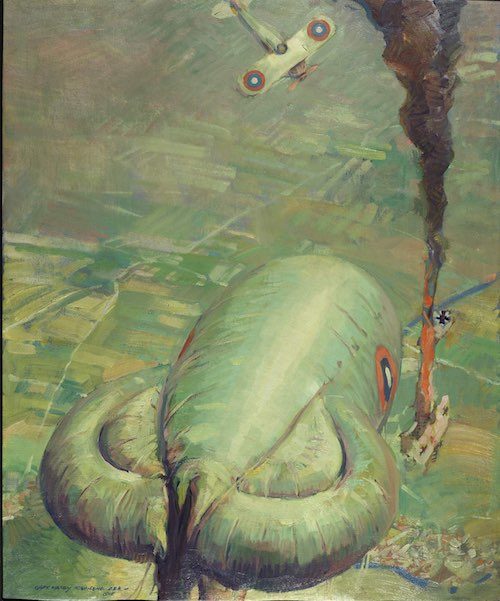
Now with the hundredth anniversary of America’s entry into World War I, these artworks have been rediscovered and placed on display in a wonderful and fitting exhibition by the Smithsonian, a joint project of the National Air and Space Museum and the National Museum of American History.
Our story begins in 1917, when some of America’s finest illustrators left their comfortable homes and families to work on the front lines of the “war to end all wars.” One of the artists, Harry Townsend, later wrote in his war diary, “I had gotten drunk, as it were, with the future pictorial possibilities in what I saw, and what my imagination saw, in the warfare that was so soon to come.”
Eight artists were chosen to accompany the American Expeditionary Force (AEF). The artists were commissioned as officers and given free rein by both the U.S. and French military authorities to depict everything from war preparations to the terrible toll of combat in the trenches. These “artist soldiers” included Saturday Evening Post illustrators Harry Townsend, Harvey Dunn, Wallace Morgan, William Aylward, and George Harding.
Townsend’s story was not atypical. He grew up in a small farming town in Illinois but was eager to see the larger world. Townsend’s war diary records his excitement about his upcoming adventure with the AEF: “I left New York in a blinding snow, into the submarine zone with its constant alarms, and through it. My trip through London … with an air raid thrown in …. and the nervous excitement of finding myself suddenly in the war zone, for, while one realized at all times the dangers on the sea, one really felt he had arrived when he found himself in the midst of the bursting of enemy bombs and the sight of enemy planes. …”
It didn’t take long for Townsend and his seven fellow artists to witness the effect of those bursting enemy bombs: “Everywhere among the blownup trenches and in the shellholes are pieces of what were once men. Here and there, a whole or a piece of bone; here and there a shoe with a foot still in it.”
Working at an astonishing pace, this team of artists produced approximately 700 works of art. The new exhibition has divided 65 of the best of these works into five categories:
- Engineers go to war
- Life at the front
- The technology of World War I
- The battlefield
- The human cost
Some of these pictures introduced Americans to the new sights and technology of modern warfare, but the exhibition’s curator, Peter Jakab, made clear in an interview that he thought the real contribution of this art was its human perspective. “Paintings by Harvey Dunn, such as The Sentry, Off Duty, and On the Wire exemplify the idea of the exhibition. They depict the soldiers’ war experience in a powerful, in-the-moment way, offering a realistic sense of the fatigue, loneliness, and stress of war. The AEF artists were the first true combat artists, attempting to capture the soldiers’ experiences in varied and intimate ways. The exhibition reminds us that all great, sweeping historical events are made up of the actions and experiences of individuals.”
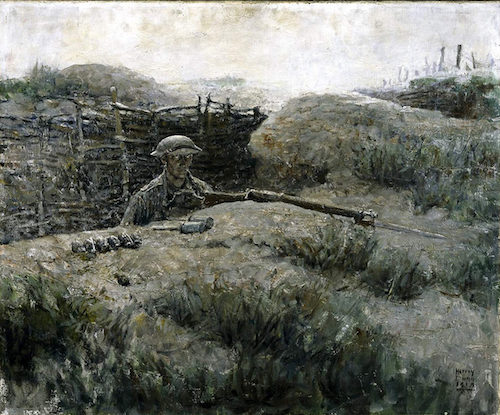
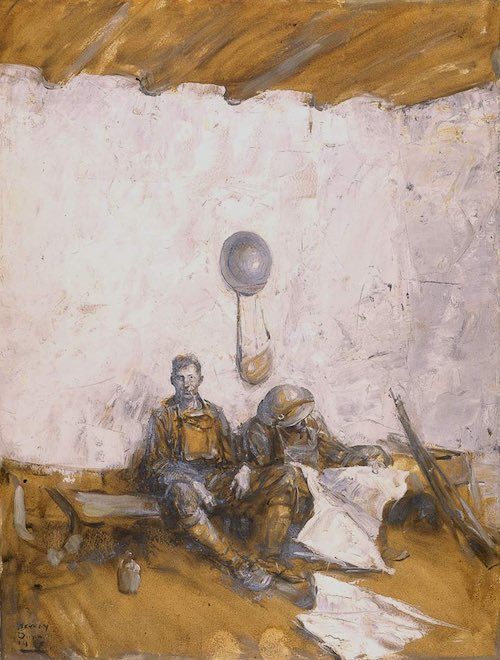
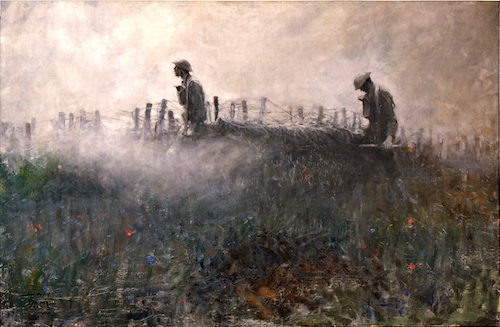
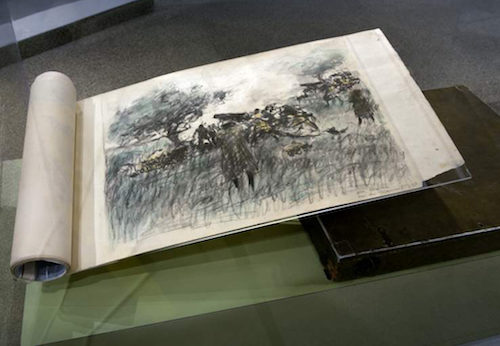
As the “first true combat artists” working in a brand-new kind of war, the resourceful eight were forced to improvise. Often they worked in rain and cold, which created challenges for their artistic ambitions. Yet they found practical solutions, so the quality and the quantity of their art remained quite high. For example, Harvey Dunn designed a protective metal sketch box that doubled as his drawing board and also contained a long roll of paper. This enabled him to continue to work seamlessly in the field.
Often the artists would sketch sights and experiences in the field and then return behind the lines to develop them into fully completed easel paintings. Many of the pictures created in the calm of a studio retained a power and vitality as a result of the artists’ preliminary sketches. Among my favorites was this powerful drawing in charcoal by Harry Townsend.
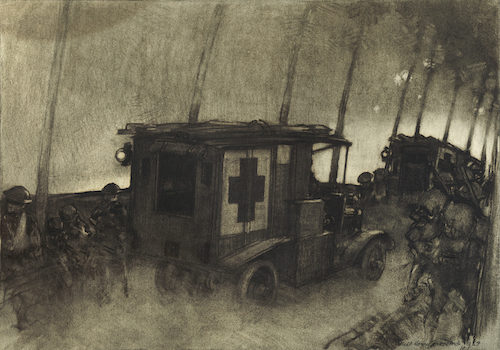
The talented William Aylward specialized in nautical illustrations for the Post but proved with his work for the AEF that he was an artist of great range and depth.
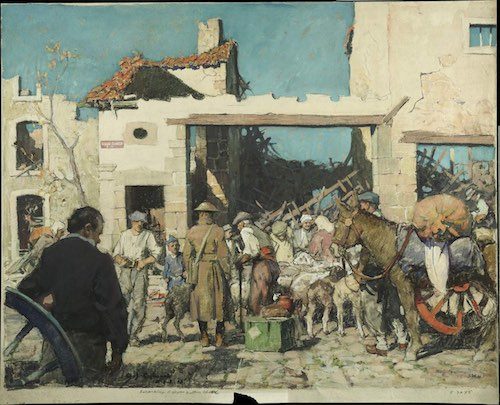
With World War I, the battle became more accessible to the public through mass communication, so images took on a different role. It is therefore not surprising that war art also changed. Before the artist soldiers of the AEF, official war art depicted war as heroic and romanticized battles. Even the great artist Goya, who privately lamented The Disasters of War in his unpublished series of etchings, continued to paint flattering portraits of pompous generals and aristocrats as brave commanders. But there is nothing false or regal or flattering about the pictures at the Smithsonian exhibition. They are as tough and practical as the Yanks who created them.
The exhibition at the Air and Space Museum has been well received by visitors. Says curator Jakab: “The idea that World War I, an event affecting millions, was fought by individuals, each with their own story, has relevance for today’s conflicts. Unless you have a family member or close friend in the service, it’s easy to think of one soldier as being pretty much like the next. Military families who come through the exhibition recognize and appreciate what this art reveals about the lives of individual soldiers in World War I, and the lesson it provides for our own time.”
The exhibition will be on display through November 11, 2018. For those unable to make the trip to Washington, many of the works, along with the background of the exhibition, can be found on the website for the National Air and Space Museum.
Rockwell Video Minute: The Fourth of July
To celebrate the Independence Day, Norman Rockwell painted an iconic image of America, but with his own unique twist.
See all of the videos in our Rockwell Video Minute series at www.saturdayeveningpost.com/rockwell-video.
Simply Summer Recipes from Curtis Stone
In the Stone household, we use any excuse to bring great food and good friends together. I love to entertain and grill outdoors, especially during the summer months when fresh, locally grown produce is at its peak. By choosing the season’s best, you’re almost guaranteed a successful dish. And grilling enhances the flavors of so many fresh vegetables — from corn to zucchini to peppers.
A perfect main-course summer salad brimming with vegetables, Grilled Chicken with Arugula and Zucchini Salad and Lemon-Caper Vinaigrette is one of my favorite ways to put a healthy meal on the dinner table. I like the flavorful, earthy combination of chickpeas and quinoa in Quinoa and Chickpea Salad with Feta, Walnuts, and Parsley. For dessert, toss halved nectarines, peaches, and plums on the grill for a few minutes and top with a dollop of Greek yogurt and a drizzle of honey — just delicious!
Grilled Chicken with Arugula and Zucchini Salad and Lemon-Caper Vinaigrette

Photo by Quentin Bacon
(Makes 4 servings)
- 2 tablespoons finely chopped shallots
- Finely grated zest of 1 lemon
- 3 tablespoons fresh lemon juice
- 1 tablespoon coarsely chopped drained nonpareil capers
- 1 tablespoon finely chopped pepperoncini
- 1 tablespoon finely chopped fresh flat-leaf parsley
- 2 teaspoons champagne vinegar or white wine vinegar
- 1/4 cup extra-virgin olive oil
- 4 skinless, boneless chicken breast halves (about 6 ounces each)
- 1 tablespoon olive oil
- 5 ounces baby arugula (about 8 cups not packed)
- 1 cup halved cherry tomatoes
- 2 small, thin zucchini
To make vinaigrette: In medium bowl, whisk shallots, lemon zest, lemon juice, capers, pepperoncini, parsley, and vinegar together. Gradually whisk in extra-virgin olive oil. Season to taste with salt and pepper.
To cook chicken: Preheat grill for medium-high heat. Coat chicken with olive oil and season with salt and pepper. Grill chicken 4 minutes per side, or until cooked through and grill marks form. Transfer to cutting board.
To assemble salad: In large bowl, combine arugula and tomatoes. Trim ends of zucchini. One at a time, lay zucchini flat on work surface and, using vegetable peeler and working from stem end to blossom end, shave off long, thin ribbons until you reach seedy center. Turn zucchini around and repeat on second side, then repeat on third and fourth sides. Add ribbons to bowl and discard seedy centers of zucchini.
Using your hands to avoid breaking ribbons, gently toss salad with enough vinaigrette to coat. Season with salt and pepper.
Cut each chicken breast crosswise into thirds. Transfer a cut chicken breast to each dinner plate and heap some salad alongside. Drizzle chicken and salad with remaining vinaigrette and serve immediately.
Make-Ahead: The vinaigrette can be made up to 8 hours ahead, covered, and refrigerated. Let vinaigrette stand at room temperature for 15 minutes and re-whisk before using.
Per serving
- Calories: 342
- Total Fat: 21 g
- Saturated Fat: 3 g
- Sodium: 563 mg
- Carbohydrate: 7 g
- Fiber: 2 g
- Protein: 32 g
- Diabetic Exchanges: 6 meat, 3 fat, 3 vegetable
Quinoa and Chickpea Salad with Feta, Walnuts, and Parsley

Recipe courtesy Curtis Stone. Photo by Jenifer Gomez
(Makes 4 servings)
- 1 cup quinoa (preferably red quinoa)
- 1 tablespoon olive oil
- 2 tablespoons finely chopped shallots
- 2 tablespoons red wine vinegar
- 1 tablespoon fresh lemon juice
- 1/3 cup extra-virgin olive oil
- 1 15-oz can chickpeas (garbanzo beans), drained, rinsed
- 1/2 English cucumber, halved lengthwise, seeded, and diced
- 1/2 cup diced red bell peppers
- 1/2 cup walnuts, toasted, coarsely chopped
- 3 green onions, thinly sliced
- 1/2 cup fresh flat-leaf parsley leaves, thinly sliced
- 2 ounces feta cheese, crumbled
Put quinoa in fine-mesh sieve and rinse under cold running water. Set aside to drain well. Heat medium saucepan over medium-high heat. Add oil and quinoa and cook, stirring frequently, for 2 minutes, or until quinoa is fragrant and toasted. Add 1 ½ cups water and ½ teaspoon salt and bring to simmer. Cover, reduce heat to medium-low, and simmer 20 minutes, or until quinoa is tender and water has been absorbed. Spread quinoa on baking sheet and let cool, then fluff with fork. Meanwhile, to make vinaigrette: In small bowl, whisk shallots, vinegar, and lemon juice. Gradually whisk in oil.
In large bowl, combine cooled quinoa, chickpeas, cucumber, bell peppers, walnuts, green onions, and parsley. Toss with vinaigrette and season with salt and pepper.
Transfer to large platter or divide among four plates. Sprinkle with feta and serve.
Make-Ahead: Quinoa can be cooked up to 1 day ahead, cooled, covered, and refrigerated.
Per serving
- Calories: 476
- Total Fat: 26 g
- Saturated Fat: 5 g
- Sodium: 288 mg
- Carbohydrate: 48 g
- Fiber: 10 g
- Protein: 16 g
- Diabetic Exchanges: 5 fat, 4 starches, 1 meat
Excerpted from What’s for Dinner? by Curtis Stone. Copyright © 2013 by Curtis Stone. Excerpted by permission of Ballantine Books, a division of Random House LLC. All rights reserved. No part of this excerpt may be reproduced or reprinted without permission in writing from the publisher; photo by Quentin Bacon.
This article is from the July/August 2017 issue of the Post. Subscribe to the magazine for more art, inspiring stories, fiction, humor, and features from our archives.
Also see Curtis Stone’s Cool-down Recipes for Summer.
Screen Sirens of Hollywood: Ava Gardner’s No Tomato
This article and other features about the stars of Tinseltown can be found in the Post’s Special Collector’s Edition, The Golden Age of Hollywood. This edition can be ordered here.
In view of the things that have happened in her career, it is certainly ironic that Ava Gardner should be known to many as “the girl who married Mickey Rooney and Artie Shaw” and as nothing more. This identification is still made automatically, although there are signs that indicate that the ex-Mrs. Rooney and ex-Mrs. Shaw is well on her way to achieving her own identity. Her services as a movie actress are in such demand that when, within a single week, cinema star John Payne was approached by four producers offering him starring roles, each of them held out “We’re hoping to get Ava Gardner as your co-star” as an inducement for signing with them.
More significant still, after seeing her in The Hucksters, a film critic for the New York Morning Telegraph wrote that, although heretofore she had been considered just another bit of Hollywood fluff, she had played the role of the ambitious nightclub singer in that film in a way that showed unexpected talents as an actress, and she had demonstrated that she possessed a personality full of sincerity and warmth, plus a not-inconsiderable beauty. On the basis of this one performance alone, The Telegraph’s critic predicted that she was headed for stardom.
It is equally sardonic—but not at all unusual in Hollywood—that she should have spent four long years at her home studio (Metro-Goldwyn-Mayer) posing for leg art and uttering an average of a little more than one line per movie in a wearying succession of B films, only to have pictures produced by outside studios make movie fans suddenly conscious of her existence. Hollywood took a long, whistle-punctuated look at the sultry gun moll in The Killers and the bosomy hometown girl in Whistle Stop and christened her “M-G-M’s tomato surprise.” (Editor’s Note: In the 1940s, “tomato” was slang term for a pretty, but unintelligent, woman.)
She may have been a surprise to M-G-M, but she is definitely no tomato, as disappointing as that statement may be to collectors of pinupiana. “It depends entirely on the girl,” she says sagely. “I’ve never had to slap the hands of the men who really know me to get them to behave.” But the fact that she has been thought of in tomato terms has given rise to still other examples of irony. Recently, when she visited her bank to make a withdrawal, her shoulder-length red-brown hair flowed helter-skelter. She wore her favorite costume: saddle shoes and socks, a ballerina skirt, a blouse. Her face was innocent of makeup. The cashier looked at her suspiciously, then retired to the rear of the bank to check her signature and consult with the head cashier. When he came back, he apologized and explained, “You just don’t look like Ava Gardner.”
Not only bank cashiers but some of Hollywood’s plushier hostesses seem convinced that when they ask her to a party, one of the screen demimondaines she has played will show up. Not long ago the secretary of a movie mogul’s wife reached her on the phone to say, “Mrs. — expects you for dinner next Friday evening. She is sure you will amuse the stags.”
When such things happen, Ava Gardner is annoyed, but not surprised. “People are always expecting to see a girl like Kitty from The Killers or Jean Ogilvie from The Hucksters instead of me,” she says.
Even in a community with heavy dragon lady and femme fatale content, she is often visualized by the public as a leading member of the breed; out till all hours every night with a new beau, dripping in orchids and mink, and probably having a heavy late date, or two, afterward.
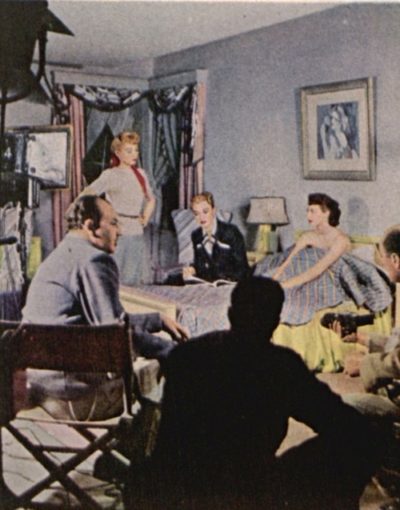
One Touch of Venus.
Photo by Gene Lester
But a number of people in Hollywood who know Ava Gardner when she’s not working in front of a movie camera disagree sharply with the public. If they are to be believed — and they pack a lot of conviction into what they say about her — the hussy-seeming Gardner whom the public meets in newspaper photos, Sunday feature sections and picture magazines is largely a creation of makeup, clever lighting, slick camera work and gossip columnists striving to gratify their readers’ wishful thinking.
According to her lawyer-manager’s wife, Ruth Rosenthal, “Ava is a cushion plumper at heart, a girl who ought to go back to North Carolina, marry some nice man and have a flock of babies.” It doesn’t make for inflammatory copy, but the truth is that Ava spends a lot of time acting as a babysitter for the children of such friends as the Rosenthals.
A Hometown Girl
Ava herself says, “Sometimes as much as two weeks will go by and I won’t have a date. I can’t see any percentage in stepping out just for the sake of stepping. Two months ago I showed up at a drive-in with a boy, and right away the columnists said we were going to be married. The trouble with most of the people in this town is that they believe everything they read in a column, even if they’ve paid a planter to plant it there for them.”
But had it not been for a photographer brother-in-law, Larry Tarr, the North Carolina–born “second-look girl” would have drawn second looks only in her native Tarheel bailiwick. When she was 18, the youngest member of the Gardner family packed her saddle shoes, washed and blocked her sweater collection, and took off to spend a vacation with a married sister, Mrs. Larry Tarr, in New York.
Tarr, a great one for taking people’s pictures in his mind, made a mental snapshot of his young sister-in-law, who sat half asleep across the breakfast table from him. Afterward he strove to capture the same effect in his studio and sent copies of the portraits he had taken to Ben Jacobson, a New York Metro-Goldwyn-Mayer representative. So melting was the result that Jacobson asked to see the original. When Ava was ushered into his office, he gave her a script to read. When she read it, he couldn’t understand a word she said. The girl standing before him not only had the South in her mouth but a large slice of North Carolina’s farming country as well. When Jacobson asked her name, she replied “Aa-a-a-vah Gahd-nah.” She pronounced the word “five” [as] “faave” and dropped her g’s all over his office, like shattered magnolia blossoms.
Jacobson shook his head in dazed fashion and said, “We’ll make a silent test. If I send a soundtrack out to the Coast with nothing on it but vocal spoonbread, they’ll have my head examined.”
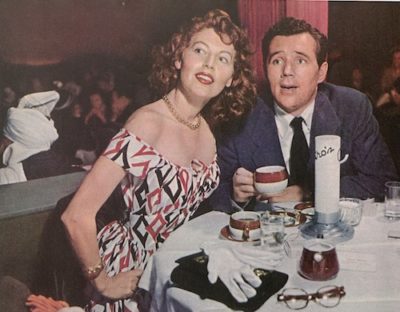
actor Howard
Duff at Ciro’s
nightclub.
Photo by Gene Lester
Hollywood legend has it that when her silent test arrived in California, M-G-M’s brass reached for their telephones and yelled, “She can’t act; she didn’t talk; she’s sensational! Get her out here!”
But it wasn’t until later that The Killers set Ava Gardner’s feet tentatively on the stardom road. Then The Hucksters established her as a star personality. Yet, ironically, she was reluctant to appear in it. Her reluctance stemmed from two things. One of them she explains thus: “I’d begun to think that playing bad girls had served its purpose so far as I was concerned, and I didn’t want to play that kind of role exclusively.” The other reason was the fact that she was still suffering from an her ingrown inferiority complex stemming from a combination of her “tomato” reputation and her failed marriages, and playing opposite a star of Clark Gable’s magnitude frightened her. Studio pressure was brought to bear upon her, and numerous individuals warned her that she was passing up a fine opportunity.
In the end, she yielded, but when the cameras rolled, she still felt unsure of herself. When she was called upon to sing a song to Gable, she was so embarrassed at warbling a torchy ditty to a star on whom she had had a crush as a teenager that she couldn’t continue until he left the set. “They gave me a chair to look at instead of Clark,” she says. “After that it was better.”
Thankfully, being jittery didn’t stop her from turning in a grade A performance. She even contributed a switch that gave her part more warmth. Her Jean Ogilvie role had been written as that of a rapacious dame, bent upon using her sex to get ahead. Ava didn’t dilute this sex element, but the girl she played was human and understanding, rather than rapacious. She managed to seem the kind of girl who’d rather whip up a cozy meal in her apartment for a man and feed him a shot of after-dinner brandy than blow his coin at a hot spot.
In an interview, Gable said, “Would you like to know who I think is the most glamorous girl on the horizon? Keep your eye on Ava. I think she’s great. I believe that in another two years you’ll find she’s the best young actress in Hollywood.”
Plastic Cockroaches and Toenail Clippings: America’s Obsession with Collecting
Let us descend for a harrowing moment into the mind of a passionate collector of things. “I like plastic cockroaches, which I have by the hundreds. I like the fact that people find them revolting,” the collector said when we talked recently. “I also like plastic fake food, which fills the linen cupboards in my house. And I collect Lee Harvey Oswalds, and —”
Wait. Assassin Oswald? That Lee Harvey? Yes, the collector affirmed. “He’s been demonized for too long.”
“Isn’t that just a little bit creepy?” I wondered.
The swift reply: “Well, some people think I could be insane.”
He’s not. He’s actually the highly regarded theatrical set painter Paul Wilson, of Phoenix, who in his leisure time is a serious collector of improbable items large and small. Which, if you want to call that insane, feel free.
There’s nothing crazy about the undisputed fact that Americans have long devoted themselves to building all manner of personal collections. That’s different from being a hoarder, but it can sometimes, in extreme cases, seem nearly as disturbing.
Several weeks ago, out of perverse curiosity, I went in search of the oddest, most bizarre collections I could find — the nuttier the better — which is how I stumbled upon Paul Wilson, who collects everything Lee Oswald. I didn’t need to wait long to hear from other folks on this subject. A day after I put the word out on social media, my inbox was flooded.
From a well-known Kentucky journalist who’s on the country-music beat: Among her most prized samples of historical hair are clippings from Abraham Lincoln and his wife, Mary Todd Lincoln. From a New York investment banker and a Connecticut editor: Each reported on the whereabouts of notable beer-can collections, three said to be worth at least a million bucks apiece. From an L.A. photographer: able to direct me to a massive trove of toenail clippings. From an art collector in Wisconsin: specializes in amateur films documenting monkey acts. Monkey acts! Isn’t that fantastic in a barely normal sort of way?
Many of the messages I received were freaky and delightful in equal measure, detailing personal collections that suggest either a sick state of mind or discerning curatorial skills. Harry Rinker, who has long written a newspaper column about collections, told me, “Collectors are the last bastion of individualism in a world of conformity.” Further, he said, English-speaking countries are where you will find the most avid collectors, adding that, according to an eBay study, 60 percent of Americans collect something. “If you haven’t discarded certain things, then you’re a collector,” he said. Maybe — but it seems to me it may just as easily mean that you’re lazy.
Of the messages that rolled in when I inquired about peculiar collections, one of my favorites pointed me toward Chuck Diehl, a Baltimorean who had fallen hard for washing machines. “It just turned me on completely!” Diehl once told People magazine about his first encounter with the appliance. For decades, Diehl carefully archived old washers, storing many in his apartment. He so ideally captured the eccentric collecting phenomenon that I thought I should try to find him. The trace ran dry at a Home Depot, where Diehl, not unexpectedly, had sold washers. Ah, well. I’d like to imagine that his career eventually spun to an end there because, of course, he’d been too much of an agitator.
In the last issue, Neuhaus wrote about his adventures with DNA testing.
This article is featured in the May/June 2017 issue of The Saturday Evening Post. Subscribe to the magazine for more art, inspiring stories, fiction, humor, and features from our archives.
March/April 2017 Limerick Laughs Winner and Runners-Up
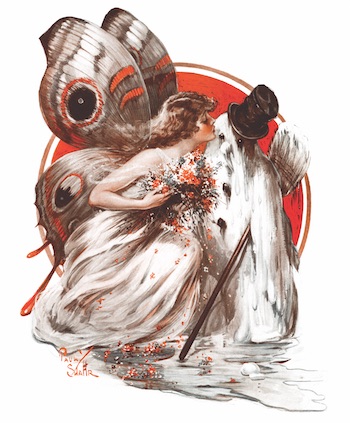
A nymph in the first blush of spring
Spied a snowman and fancied a fling.
But her kiss was his last;
He was melting, and fast,
While pondering love and its sting.
Congratulations to Karen Eastlund of Raritan, New Jersey! For her limerick, Karen wins $25 and our gratitude for her witty and entertaining poem describing Paul Stahr’s March 7, 1925, cover Kissing Winter Goodbye.
If you’d like to enter the Limerick Laughs Contest for our next issue of The Saturday Evening Post, submit your limerick through our online entry form.
We received a lot of great limericks. Here are some of the other ones that made us smile, in no particular order:
“As she kissed his cold cheek on that day,
The snowman began to decay.
The kiss, so sublime,
Was construed as a crime.
But the evidence melted away.”—Al Cross, Sacramento, California
A butterfly’s kiss and a cuddle
Left Frosty the man in a muddle.
He winked at his mate,
Resigned to his fate,
Then promptly dissolved in a puddle.—Michelle Gordon, Airway Heights, Washington
A pretty young moth of a miss
Gave a snowman a very wet kiss.
He cried, “Please don’t do it.
I cannot but rue it.
I’m melting without your assist!”—Louis Hirsch, Vallejo, California
Frosty could tell things weren’t right
By his sweltering feeling that night.
He shouldn’t have broke
With his cold icy Coke
And ordered that sweet steamy Sprite.—Suellen Mayfield, Venice, California
The snowman was Lord of the farms;
The fairy was known for her charms.
He invited her in
for a kiss on the chin,
then melted away in her arms!—Carl Nord, Bainbridge Island, Washington
Are these two really a match?
Not sure either one is a catch.
Top hat and a broom
Don’t suggest bride and groom —
Are they part of a plot that might hatch?—Dolores Sahelian, Mission Viejo, California
It was time for warm spring to draw nigh,
And the delicate snowman knew why.
But he had lots of pride.
So he took it in stride.
“I’m averse to a mushy goodbye!”—Roy Skibiski, Lawndale, California
Frosty, your weight loss is drastic.
Your waistband will need an elastic.
If you keep on this way,
I’m sorry to say,
Next year you’ll be made out of plastic.—Matt Stewart, Peterborough, Ontario
The fairy came down with a flutter.
“I love you snow-boy,” she did utter.
But her feather-light touch
warmed him up way too much,
and he melted and ran down the gutter.—Adrian Turner, Nottingham, Nottinghamshire, UK
Truth as a Possibly Illegal and Addictive Substance
The cloak and dagger dangles,
madams light the candles.
In ceremonies of the horsemen
even a pawn can hold a grudge.
—Bob Dylan
To tell the truth about those years, you’d have to begin with the observation that truth was, like all precious commodities, in very short supply. Like LSD from Sandoz or pharmaceutical cocaine, truth was rumored to be everywhere but became scarce when you attempted to score.
If your ambition was to make a market in Truth Futures, you were in business. No problem and plenty of willing buyers and sellers. But if you just wanted some truth of your own, to get you through the night, your head was straightened on that score in no time. After a few attempts to lay your hands on some actual truth, you came to understand that such a quest was against the secret rules. Scoring pure, uncut truth was not even a part of the game. It wasn’t what was “happening, man.”
What was happening wasn’t, to be sure, the only game in the big BeHereNow Casino out on Sunset Strip, but it was the most fun and everyone, well, almost everyone, wanted to play at its table hoping that their new and improved revolutionary system for revolution would beat the dealer. After all, not to be part of what was happening in those years was, in a sense, not to be.
So you learned that as long as you confined yourself to speculation of what the Revolution might be like and what the world after the Revolution would be like, there was no end to truth. But if this made you nervous and you asked any of the fellow players for a little hard truth, a little coin of the realm to cover your margin and theirs, they were quite content to drop a brick of Acapulco Gold on your head and call it The Philosopher’s Stone. And because stone was a state of mind, you were left with a headache, a heartache, and overdrawn at the First National Bank of Angst.
Man, you weren’t happening.
What was happening was all that mattered. It was the predominant concern of the decade. “What’s happening?” was a greeting and a secret sign that would determine if you were one of the elect and the saved. It was later compressed, as was most of our secret language, into a statement: “Happening, bro.” Hard to translate now, but it made sense at the time.
Like the ancient and biblical phrase “What is truth?”, “What’s happening?” did not demand any response more specific than a shrug and a suitably stoned smile. A verbal response would be offered only as long as it began in and returned, at regular intervals, to a rippling fog that covered all our shared mental landscapes like the mist in a Japanese samurai movie.
The decade was burnt as crisp and dark as a napalmed child; was as grotesque as a president dangling beagles by the ears or lifting his shirt to display a scar the shape of Southeast Asia on his paunch. But although the grotesque darkness was visible from a distance, it was nearly impossible to discern in close-up. Only perspective makes proportion visible and perspective was, like truth in those years, something always in very short supply.
The world beyond our sheltered enclaves was etched in high relief and we despised it. Our own little hamlets and personal universes were said to exist somewhere beyond the linear-verbal, over the rainbow, on another bardo, and boasted sweeping views of the Twilight Zone. It was a housing development constructed in the ether and, as such, it contained no firm place to stand. It had lots of golden levers of great length and a host of theories that would serve as crystal fulcrums. In conversations fueled late into the nights by espresso, tobacco, jug wine and gage, hashish, and Tijuana Gold, the levers and fulcrums were manipulated without pause and with great skill. But with the elimination of the ether and the sphere of the fixed stars there was, at the end of those long nights and their dreams, no way of using these ornate tools — no matter how long, no matter how precise — to alter the orbit of the Earth.
So it was that we spent most of those years polishing the levers and fulcrums while blithely ignoring the absence of foundations. This didn’t faze us. We were the Cosmic Commandos. To us, truth and lies, granite and quicksand, were mere illusions, shabby manifestations of the material plane, that old rusty reality that everyone on Earth would junk as soon as they saw what we saw, and we saw The Light.
Read more of Gerard Van der Leun’s “Ceremonies of the Horsemen” at American Digest.
Paladin
The night the wildfire burned to the ridgeline, Pop and the rest of the neighborhood men and older boys grabbed hoes and shovels and scrambled uphill to help fight the blaze. Our house and maybe 40 others lined a dead-end street in a narrow little valley on Santa Barbara’s West Side, surrounded by fields of wild oats and Spanish oaks. I begged Pop to let me go with him. But he told me to stay at the house and help pack up our family’s important stuff in case we had to evacuate.
Mom and I and my kid sister, Judy, dashed around, throwing crap into suitcases and bags and cramming our ’58 Studebaker so full that its rear springs barely kept it from dragging the ground.
The smoky orange moon had disappeared before Pop and the other dog-tired but grinning men returned with blackened hands and smudged faces. Pop went inside, grabbed a cold beer from the fridge, sat on the back step and watched the rest of us unload the car. When we finished, I rolled open the heavy garage door. Pop started the Studie and pulled on its lights. And there it lay, curled against the back wall, tail tucked under its body, head resting on its front paws, trembling.
“Look, Mom,” Judy said and moved toward the garage.
Mother grabbed her arm and glared at Pop. “Didn’t I tell you to keep the garage door shut? We’ll get raccoons, possums, and all sorts of vermin in there and I have ta shoo them out.”
“Rose, that’s not a ’coon, it’s a dog, a young one.”
“She looks scared,” Judy said.
“Honey, that’s a boy dog,” Mom corrected her.
I felt glad that it wasn’t a coyote or a fox, or even the field mice that invaded Pop’s workshop. I hated going into the darkness where some animal with a foaming mouth might be waiting.
Pop got out of the car, moved inside the garage slowly, and knelt next to the dog, stroked its back, scratched behind its ears, all the while talking to it in a soothing voice. The mutt struggled up and stretched, its bottlebrush tail beating the air. It looked small, not even reaching Pop’s knees. He picked it up, held it against his body, and moved toward us, talking all the while and stroking its head.
“Easy kids, this little guy’s really frightened.”
We moved forward and offered our hands for the dog to sniff. He licked our fingers with a coarse pink tongue and whined. We petted him gently. He had a short stiff coat, with a white chest and socks and a brindle-colored back surrounding a white diamond. His long snout ended in a black nose, his ears, floppy and folded over.
“Looks like a Heinz 57 to me,” Pop said and chuckled.
The dog squirmed in his arms. He set it down, but it didn’t run, sat on its haunches and stared up at all of us, waiting.
“It wants food,” Judy said. She bent and encircled the dog in her arms and headed for the house.
“I don’t want that flea-bitten thing in my —”
“Ah, come on, Rose.” Pop pleaded. “It’s just a pup. We can feed it something.”
“Well, all right,” Mom said and sighed. “But tomorrow, I want you kids to go around the neighborhood and look for his owners. Have either of you seen this dog before?”
“Nah, I’ve never seen ’im,” I replied.
Judy shook her head.
Mom fixed a plate of leftover meat scraps, filled a bowl with water, set them on the service porch, and closed the connecting door. We retired to the living room to watch a late-night movie on our flickering 17-inch Zenith. But in a few minutes a loud scratching and whining came from the porch and I got up to check. When I opened the door, the dog shot past me, through the kitchen and dining room and into the living room where it slumped next to Judy’s feet, rolled onto its side, and fell asleep.
During the following week, I fed the dog cans of Alpo and made sure to let him out to do his business — the euphemism Mom preferred — in the back lot among Pop’s prized avocado trees. My sister and I went door to door along our street, asking folks if they’d lost a dog, and spread our search to the over-the-hill neighborhoods, some of which had been scorched by the fire. During our quest, we decided to put off naming the dog, since it would be more painful to part with something that had a name. We also didn’t look too hard, and skipped the ramshackle places.
One morning, I sat in the kitchen eating my Post Toasties and contemplating what to do on that already-hot summer day. The dog scratched at the back door, wanting to be let out. I obliged him. But instead of heading for the avocado trees, he tore off down the walk toward the driveway. I hurried to catch up.
He ran down the drive, stopped at the bottom to check for cars — at least that’s how it looked — then crossed the street to the Vargases’ house. He moved with a sort of three-legged hop, like he had a dislocated knee. Looked funny. Without hesitating he scrambled onto their porch and began to whine outside their front door. I hurried to grab him up before he disturbed our new neighbors. The Vargas family had moved in about three months before. I hadn’t gotten up the nerve to talk with them, especially with their pretty daughter, Camilia, who was in some of my freshman high school classes.
I crept onto their porch and bent to grab the dog and spirit him away. The front door flew open. A barefooted Camilia wearing a bathrobe and a broad grin stared at us.
“What are you boys up to?” she asked, chuckling.
“I, er, the dog got away from me. Sorry for the … the —”
“Hey, you’re Jerry, from across the street, right?”
“Yeah, I mean, yes.”
“Why haven’t you come over before, ya know, we’re neighbors? Besides, I coulda used some help with my algebra homework, and you look smart enough.”
I felt my face burn. “Sure, I can help, if, ya know, ya need …”
The dog looked up at me, its tongue hanging out, panting. He seemed to say, What an idiot! Talk to the girl, she wants to be your friend.
“So what are ya doing today?” Camilia asked.
“I, er, haven’t really decided … maybe go to East Beach and mess around.”
The dog stepped on my feet and whined. Just ask her, stupid.
I bent and took the mutt into my arms. Camilia moved close and let it lick her perfectly manicured fingers. I stared into her glowing brown eyes and trembled.
“Ah, say, do you, ya know, ah, want to come to the beach with me?”
“Yeah, sure. That sounds like fun. I have to help my Mom this morning. Maybe after lunch?”
Only then did I realize that I still wore my pajama top with its flying ducks motif over a sagging pair of jeans with no underwear. I backed away slowly.
“Yeah, after lunch is good. I’ll come get you … we can take the bus downtown then walk from there.”
“Great. See ya, Jerry, and thanks for finally coming over.”
I crossed the street in a daze, still clutching the dog, and set it down in our backyard. He tilted his head and stared at me as if saying, Jeez, do I hafta do everything? He headed for the avocado trees and his morning business.
Every time the phone rang, Judy and I would jump, afraid that the dog’s owners had finally tracked us down and would come to reclaim their prize. And all sorts of new families seemed to be moving into the neighborhood, with vacant lots becoming homesites for three-bedroom, single-bath houses with glistening white rocks on their roofs. Judy made friends with another 9-year-old girl at the end of our street. During the last days of August, she’d walk uphill to Molly’s place to do girl stuff.
One day I was weeding the front flowerbeds when she came skipping down the hill, her cheeks covered in scarlet rouge, eyes encircled with mascara, with brilliant red lips and a beauty mark on her right cheek. I started to laugh. But the Hinton’s German shepherd stood up in their front yard. Normally, Charlie kept his beast inside or chained on their back patio. The shepherd lowered its rear end and charged toward Judy, making a ferocious sound, something between a bark and a growl.
Judy screamed and ran toward me. But before the monster could chase her, our dog charged up the street and circled the stunned attacker, snarling and snapping at its legs. The German shepherd lunged at the mutt but missed, leaving our pooch an opening to give it a quick nip on the ear. The beast howled and chased our terrier around the yard, but without success.
“What the hell’s goin’ on out here?” Charlie Hinton complained from his front porch, a can of Brew 102 in one hand and a smoking Camel in the other. The German shepherd gave a final woof then slipped through the door into the dark house.
“Keep that mutt outta my yard, Jerry. I’ll call the pound on him.”
“Yeah, well, keep that beast from chasin’ my sister, or I’ll call the cops.”
“She musta done somethin’ to make him mad.” Charlie snorted. “Too many smart-ass kids around the neighborhood … and more on the way.”
Our dog sat at my feet, trembling. I took it inside where Judy fed him doggie treats and sat petting him until he fell asleep on the sofa.
The next week, a For Sale sign appeared on the Hintons’ front lawn and a month later, the Shermans moved in, an old couple that kept to themselves, except when Mrs. Sherman baked cookies and shared them with the neighborhood kids.
When school started in September, the arguing began. Mom and Pop would wait until after Judy and I went to bed to have their discussions, as Mom called them. But the more they talked, the louder they got, until Pop stormed out and spent a few hours in his workshop, building the most god-awful furniture. I could almost recite verbatim how the arguments would go, and this time was no different.
“Look Rose, if I reenlist in the Marines, we would get free housing and medical care for all of us, buy stuff really cheap at the PX. And I could retire from cooking at the end of 20 years.”
“You really want to live in base housing again? I sure the hell don’t. And where would they ship us? Someplace where the state bird is the mosquito and most IQs are in the two-digit range?”
“But by the time I’d retire, the kids would be long gone, and we could afford to come back to the West Coast. Live in comfort.”
“And do what, stare at our belly buttons? And what about all the friends I’ve made here … and the kids in school?”
“Come on, Rose. Do you really like living paycheck to paycheck?”
“No, of course not. But I’d rather be poor here than safe in some hellhole. Besides, have you paid any attention to what’s going on in Southeast Asia? They could ship you out as some advisor. Wasn’t World War II and Korea enough?”
The sound of something metallic slamming against a wall made me jump. I peered around the doorframe into the living room. Pop had heaved a beer can, spraying the TV and our fireplace.
The howl started low and soft but slowly gained volume and rose in pitch. Our dog stood before the sofa, head tilted back, making the most mournful sounds. Mom and Pop stared at the pooch open-mouthed as the howl went on and on, climbing, dropping, then climbing again to a new height.
Judy nudged my elbow. “What’s going on?”
“They’re having a discussion, and the dog doesn’t like it.”
The dog finally quieted, crept slowly to the couch, hopped into the space between my parents and laid whimpering, tail tucked between its legs.
“Look, not even the dog likes your idea,” Mom said.
“Yeah, well, maybe he can tell us how to fix things?”
“Why ask the dog? Why not ask your wife?” Mom reached over and ran her fingers along Pop’s clenched jaw.
He grinned and sucked in a deep breath. “So, Wonder Woman, whaddaya got?”
“Well, Judy will be old enough to stay by herself in a couple-three years. In the meantime, I could work as a bookkeeper in the mornings after the kids are off to school. Pearl up the street said her husband’s plumbing company could use some help and —”
“I don’t like you working. It makes me feel … like I’m not doing enough.” Pop slouched on the couch and reached for an imaginary beer can.
“I’ll be home when the kids need me. And Jerry can help too. We can do this, just give me a chance.”
The dog seemed to whine his approval. Pop kissed Mom on the lips. I turned and shoved Judy back along the hallway to her bedroom, giving my parents privacy to finish their discussion.
I looked for four days over the Thanksgiving break, searched the neighborhood and the hills and valleys beyond, checked with the local vets, nailed lost-posters onto telephone poles, and called the police and the dog catcher. I had no luck. Judy cried every night and wouldn’t be consoled. One minute, the dog had lain in her lap as we watched TV. The next, he had disappeared.
“He probably slipped out when you went to your workshop,” I accused Pop.
“The hell he did. I woulda seen that white tail in the dark, no matter what.”
We ate a somber Sunday dinner, with Mom and Pop drinking too much wine, the reheated turkey and stuffing dry and tasteless. Afterward, we slumped into our seats as Pop checked the listing in the newspaper, then clicked on the TV and selected a channel.
“I don’t know how that man ever got a job in acting,” Mom groused.
“Who?” Pop asked.
“Richard Boone.” She pointed at the television.
“Why, what’s wrong with him?” I asked.
“Are you kidding me?” Mom smiled for the first time that day. “He’s so ugly it hurts, and here they have him wooing all those fine western ladies, a gentleman gunslinger with a business card. What nonsense.”
“I don’t think he’s ugly,” Judy piped up. “I like his mustache and those dark eyes.”
“Who cares about any of that,” Pop said. “He rides in, helps the poor out of a jam, then leaves. The perfect hero. No muss, no fuss.”
We quieted down to watch the rest of Have Gun — Will Travel. My mind drifted to an image of our dog, pushing his way across open fields and up hills with his funny three-legged hop, searching for some poor family to help. I sat there grinning. I had finally decided on a name to call him.
News of the Week: Wonder Woman, Watergate, and Way Too Many People Confused about Chocolate Milk
In Her Satin Tights, Fighting for Her Rights (To Equal Pay)

I’m sick of hearing about all of this “fake news” nonsense, but one story appeared this week that might actually deserve that title.
It all started with a Forbes story from 2016 about the making of Batman vs. Superman, which was reinvigorated by a new story at The Daily Dot. Supposedly, Wonder Woman star Gal Gadot only made $300,000 for her role, while Henry Cavill got $14 million for his role as Superman. That’s unfair! That’s sexist! Where’s the equality? Why do female stars have to put up with making only a fraction of what their male counterparts make? They both wore colorful costumes!
You can probably tell where this story is going. It turns out to be not true. That $14 million number for Cavill was based on a number from another website (are you following this?) that said Cavill’s entire net worth was $14 million. The exact amount that Cavill made is unknown, but you can pretty much rest assured that it’s closer to what Gadot made.
It’s amazing how fast an obviously bogus meme can spread on social media.
But whatever actors get paid, Daniel Day-Lewis won’t be getting it. He has quit acting altogether.
RIP John Avildsen, Stephen Furst, and Bill Dana
John Avildsen directed several films, including the first and fifth Rocky movies, three Karate Kid movies, Save the Tiger, and Lean on Me, as well as many others. He died last Friday at the age of 81.

Gage Skidmore / Flickr.com
Stephen Furst was probably best known for playing Flounder in Animal House and for his role as Dr. Axelrod on St. Elsewhere. He also had regular roles on Babylon 5 and Buzz Lightyear of Star Command and appeared in many other movies and shows. He passed away last weekend at the age of 63.
Bill Dana was a comic actor who had his own show in the 1960s called The Bill Dana Show. He created the “Jose Jimenez” character seen on such shows as The Steve Allen Plymouth Show and The Ed Sullivan Show. He performed with people like Frank Sinatra and Don Adams, wrote the “Would You Believe?” jokes for Adams on Get Smart, and wrote for other TV shows, including the famous All in the Family episode where Sammy Davis Jr. kisses Archie. He died last week at the age of 92.
Does Chocolate Milk Come from Brown Cows?

Well … no. No it doesn’t. But according to a new study by the Innovation Center of U.S. Dairy, 7 percent of American adults think that it does. And if you think that 7 percent isn’t a lot, it comes out to over 16 million people.
I really don’t know what to say, except to point out that monkey bread isn’t really made by (or of) monkeys, and tomatoes aren’t all grown by a guy named Tom.
Now I have to wonder where people think a Black Cow comes from.
New York City: 1911
The Museum of Modern Art (or MOMA) has posted at their website restored footage of New York City taken in 1911. You can see the Statue of Liberty, Broadway, the Flatiron Building, the Bowery, Battery Park, Madison Avenue, and other famous locations.
I’m always fascinated by the people in these videos, just ordinary citizens going about their day. Who were they? What did they do? What happened to them? Could I be related to anyone in the video or know someone who knew them? At one point, a one-legged guy on crutches walks toward the camera. What’s his story?
The video was taken by a Swedish company that also filmed at Niagara Falls and cities like Paris and Venice.
Real Athletes, Fake Steroids
Megyn Kelly has been in the news the past few weeks. Her new Sunday Night with Megyn Kelly show on NBC debuted with big interviews (even if the ratings weren’t as big). Her husband is novelist Douglas Brunt, and he might be making his own news because of what he says in his latest book.
The novel is called Trophy Son, and it’s about the pressures that a teenage tennis prodigy is getting from his father and others to become number one. Since it’s a novel about pro sports, performance-enhancing drugs are part of the plot. But Brunt made an interesting decision. He names real tennis stars, including Rafael Nadal, Novak Djokovic, Andy Murray, and David Ferrer and has a fictional trainer strongly imply that they have either used performance-enhancing drugs or have been investigated for using them. Needless to say, this could be a little … controversial?
Brunt says he doesn’t mean to imply that he thinks these players actually use the drugs; he just wanted to use real names to make the novel more realistic.
50th Anniversary of the Summer of Love and Monterey Pop
Besides the extensive coverage that you’ll find in our current issue of the music and culture of 1967 and the festival that many call the birthplace of rock festivals, CBS Sunday Morning did a report on the Monterey Pop Festival this week:
This Week in History
Watergate Break-In (June 17, 1972)
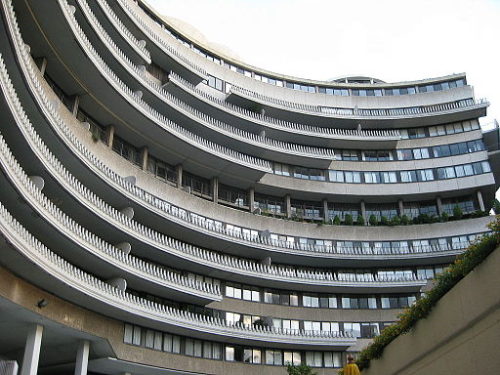

Watergate has been in the news a lot lately, partly because many news organizations are finding parallels to current investigations, but mostly because it’s the 45th anniversary of the break-in. When I was a kid, I had no idea what the word Watergate referred to. I didn’t even know it was a hotel until many years later.
Julius and Ethel Rosenberg Executed (June 19, 1953)
The two sons of the married couple executed for spying have been trying to clear their names.
This Week in Saturday Evening Post History: “Bicycle Tricks” (June 18, 1955)
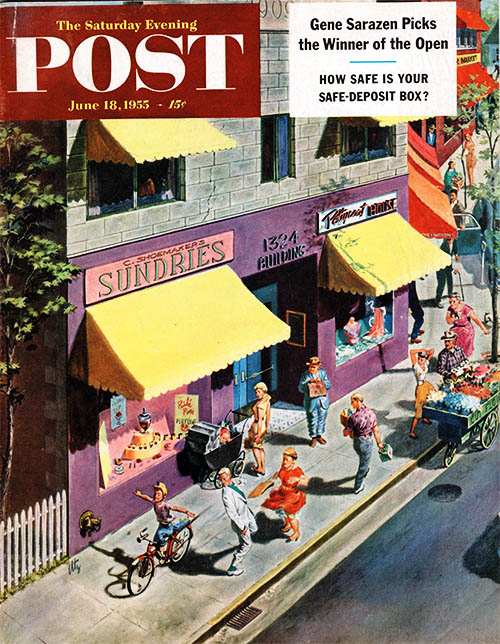
Thornton Utz
June 18, 1955
I always say I love old Saturday Evening Post covers, but I really do. I enjoy looking closely at the various people and activities in the paintings to see what everyone is doing. Like in this painting from Thornton Utz.
And because I once missed winning the lottery because I ignored a four-digit number I came across on a box a few years ago, I’m going to play the address etched in the building.
Tomorrow Is National Pralines Day

I’m not sure if I’ve ever had pralines. Here’s a recipe by an expert from New Orleans, Anne Leonhard, who looked really familiar to me when I saw her picture. Turns out she won Food Network’s Clash of the Grandmas a couple of years ago. And if you want something to help keep you cool during these hot summer days, here’s a recipe for Praline Ice Cream from Country Living.
The big question, of course, is how does one pronounce the word? Do you say “PRAY-leans” or “PRAH-leans?” I have to go with the former.
Next Week’s Holidays and Events
Great American Campout Day (June 24)
I have camped out exactly one time in my life. It was around 30 years ago, during a canoe trip. I enjoyed it but found out that I’m just not a tent/canoe/bugs/outdoors type of guy. But the National Wildlife Foundation’s website has information about Great American Campout Day if you’re interested.
Paul Bunyan Day (June 28)
Who’s Paul Bunyan? He’s the giant, bearded lumberjack who has a big blue ox. He’s been a part of American folklore for over 100 years.
World Social Media Day (June 30)
Here’s one way you can celebrate World Social Media Day: QUIT SOCIAL MEDIA! Delete your Facebook account, end your Twittering, and stop snapping your chats. It will be the last time you ever have to celebrate World Social Media Day, but believe me, it will be worth it.
‘Hell, No, We Won’t Go!’: Protesting the Vietnam Draft in 1968
[Editor’s note: This story on the Vietnam War draft was first published in the January 27, 1968, edition of the Post as “Hell, No, We Won’t Go!” We republish it here as part of our 50th anniversary commemoration of the Summer of Love. Scroll to the bottom to see this story as it appeared in the magazine.]
A big interstate bus noses into the checkpoint on the Canadian border near Rouses Point, New York Canadian customs officials come aboard, accompanied by two FBI men. The agents have fugitive warrants in their pockets, and they are looking for young Americans of draft age trying to flee the country. They tap one boy on the shoulder. …
It’s 10 a.m. in the offices of a big utility company in Chicago. Two FBI men and two federal marshals enter a supervisor’s cubicle and ask to speak with a young clerk. The youth is called out into the corridor, and the agents put him under arrest for violation of the Selective Service Act. They snap handcuffs on the young man’s wrists. …
A Pfc. is standing at attention in the orderly room of a quartermaster company at Ft. Knox in Kentucky. A reservist, he is wearing civilian clothes. His company commander says to him. “I’m giving you a direct order to put on your uniform and report for duty.” The young soldier says, “I cannot, for reasons of conscience.” The company commander orders the soldier taken to the post stockade, where he is stripped and put in a steel isolation cell. …
Two FBI men are working their way up Avenue A in New York City’s East Village hippie colony. They are asking about a boy named Johnson who failed to register for the draft in his hometown, Sacramento, Calif. and then disappeared. They walk right past Johnson without knowing it. Johnson hasn’t been Johnson for a long time. Hiding out with the hippies in San Francisco, Los Angeles, Chicago, and New York, he has used half a dozen names. In the East Village he is known simply as Scuby. …
Across the country such scenes are taking place nearly every day. “Open resistance to the draft,” says columnist Clayton Fritchey, “is greater than at any time since the Civil War.”
The anti-draft demonstrations last month in New York and elsewhere, part of a series of draft protests planned for this year and next, were merely the noisiest and most noticeable signs of the defiance. Less obvious but considerably more significant is the exodus of young Americans to Canada. According to the private groups in Canada that assist the exodus, some 10,000 men have slipped across the border to evade the draft, choosing to live as aliens and to cut themselves of from friends and family and all things familiar; if they return to the United States, they face jail sentences of up to 15 years. The Justice Department says that only 200 men have been indicted for fleeing to Canada, but the government figures are misleading. With the ponderous legal machinery of Selective Service, it takes nearly a year to get an indictment and a fugitive warrant through the courts, and the greatest flow to Canada has come in the past few months.
Altogether the Selective Service System lists 15,310 “delinquents,” men who have not responded to calls or correspondence from their draft boards. Some 2,000 of these belong to a loose national federation of draft-defying groups the one in Chicago is called CADRE (Chicago Area Draft Resisters.) The members have pledged themselves to go to prison rather than into the Army; they have turned in their draft cards and are awaiting indictment. Slowly, but with increasing speed, the Government is obliging them. In the fiscal year 1966, some 650 young men were indicted for violations of the Selective Service laws; in fiscal 1967 the number doubled. Convictions have doubled too — from 372 in 1966 to 748 in 1967. Last month the Justice Department, declaring that prosecutions were “at an all-time high,” said it was forming a “special unit” to prosecute more vigorously. There is still another factor in gauging the resistance: More than 22,000 men (not counting veterans) have won classification as conscientious objectors. The rate of conscientious objection is 70 percent greater than it was during World War II. The Selective Service people attempt to soften this by pointing out that there are only 1.7 conscientious objectors for every 1,000 registrants, and they add that only four men in every 10,000 registrants are delinquent. The key word here is registrants. By measuring the resisters against all registrants, the Government manages to disguise the magnitude of the phenomenon. The nation’s 35 million registrants include all men in the United States between the ages of 18 and 45, most of whom are overage, disabled, or deferred — that is, not eligible for the draft anyway.
But even if one accepts the official figures at face value, the problem is still a serious one. The Selective Service System, like most operations of our Government, relies to a large degree on voluntary cooperation; compulsion can go just so far. Now, for the first time in living memory, a sizable number of Americans are refusing to cooperate. Some, of course, are merely cowards trying to save their skins. And some are so intemperate in their opposition that they may be passed off as chronic misanthropes. “The FBI,” says Stuart Byczynski, a draft dodger now in Toronto, “is the new Gestapo, and the country is becoming a vast concentration camp.” But many reveal a strength of conviction that is hard to scorn. “This is my country, and I love it,” says Richard Boardman, who is waiting in Chicago to be prosecuted for draft evasion, “and I will stay here and go to jail if necessary to help correct its mistakes. I accept the general framework of the law, and I accept the penalties for breaking the law.”
The draft evaders, or “non-cooperators,” as some call themselves, vary tremendously in background. There are simple Mennonite farm boys as well as scholars with Ph.D.s. There are Negroes from the ghetto and boys from America’s richest families. Politically, they range from Maoists to Bobby Kennedy Democrats to Goldwater Republicans. It is possible, however, to group these diverse young men in six major categories.
The first is composed of those men who have gone to prison for their anti-conscription activity. These are the elite of draft-dodger society, the folk heroes of the resistance movement. Typical of them is Fred Moore Jr., who was back on the anti-war picket lines just two days after completing his two-year sentence at the Allenwood Federal Prison Camp near Lewisburg, Pa. Moore, a slight, clean-cut 26-year-old from Arlington, Virginia, is a Quaker and a follower of Mahatma Gandhi. He regards himself as an out-and-out pacifist and says he would not even defend himself if attacked.
In 1959 Fred Moore was expelled from the University of California for refusing to participate in the ROTC, which was then compulsory. He joined an organization called the Committee for Non-Violent Action and lived for a time on its farm in Voluntown, Connecticut, helping to raise food for the members and joining in their endless discussions of Gandhi’s principles. He went along on the organization’s “Friendship March to Cuba,” which foundered when the Coast Guard intercepted its boat off Miami.
In 1962 Moore’s draft board classified him 1-A. That prompted him to apply for conscientious-objector status (classification 1-O) so that instead of soldiering he could work in a civilian hospital or a social-service agency. Normally, a youth of Moore’s religious beliefs receives the 1-O classification fairly routinely, but he objected to some of the phrasing in the government form. He crossed out the words “Supreme Being” and substituted “God, which is the power of love.” Moore was investigated by the FBI and had to appear before a hearing officer to explain his religious convictions. In April, 1964, he received his 1-O classification.
“I had a strange reaction to the notice,” Moore says. “I had no feeling of relief or gladness. Instead, I had the feeling that I was a moral coward, and that I had ended up cooperating with the Selective Service System in order to get special status for myself.” He sent his classification card back to his draft board, informing it that it was participating in “the march toward totalitarianism.” He then hit the road, lecturing on peace at college campuses all over the country. He wore sandwich boards reading, LIBERTY YES. CONSCRIPTION NO, THOU SHALT NOT KILL, and DON’T DODGE THE DRAFT; OPPOSE IT.
His protesting ended in June, 1965, when two FBI men came to see him at Pendle Hill, a Quaker study center in Pennsylvania. The government agents told him that they had been sent to give him a last chance. They practically pleaded with him to go to Richmond, where he had been assigned by his draft board to do his alternative service — hospital work. Moore thanked them politely and said no. A few days later he received a registered letter ordering him to surrender himself at the United States courthouse in Alexandria, Va. He did so and went on trial for draft evasion on October 21, 1965.
On his way to the trial he picketed the White House and distributed pacifist leaflets outside the court building. Refusing court-appointed counsel and electing to defend himself, he told Judge Oren R. Lewis that he couldn’t plead guilty because the draft was on trial and not he. His defense was that conscription was unconstitutional because it represented involuntary servitude, as defined by the 13th Amendment. Moore says, “The judge was hostile at first, but then he began to realize I was sincere and trying to live according to my beliefs. He even said so.” The trial lasted three hours. Moore was found guilty and sentenced to two years in the federal penitentiary.
The youth waived his right of appeal and began to serve his time almost immediately on the Allenwood prison farm. There were 80 other Selective Service violators there at the time. “The first six months were the hardest,” Moore says. “I got into an argument with a forger over a program I wanted to see on the television set, and he knocked out my two front teeth. After that I learned that the idea is to do your own time and not bother anyone else. I worked in the prison garden in the daytime, and at night I read or played the guitar and sang folk songs with the other Selective Service violators. Time wasn’t easy, but I learned to adjust to it.” In April, 1967, he was released seven months early on automatic “good time.” He could have been released earlier, but he refused to cooperate with the parole system.
Moore today is back at the old stand, demonstrating against the Vietnam war and counseling opposition to the draft. He has gone to work as office manager for a group called Quaker Action, which dispatches boatloads of medical supplies to both North and South Vietnam, and has married Suzanne Williams, a 19-year-old peace demonstrator who has been arrested and jailed no less than seven times. Moore already has burned his new 1-O draft card, which was sent to him after he got out of jail, and he fully expects to be prosecuted a second and maybe even a third time. He says, almost casually, “I’m perfectly willing to go to jail again for my beliefs.” A Justice Department official says, “This boy is either nuts or so goddamn sincere you have to respect him — but what can we do but throw the book at him again?”
Less sincere and more elusive is the second category of draft evaders, “the Underground.” These are the young men, registered and unregistered, who hide out in the ghettos and hippie colonies of the major American cities. No one in the Government will even guess at how many of them there are, but the Central Committee for Conscientious Objectors in Philadelphia estimates that they probably number in the thousands. Certainly they make up a good proportion of the 15,310 Americans listed as “delinquent” by Selective Service.
Many in the Underground have been runaways and “floaters” since their late teens. The Negro youngsters wander from tenement to tenement in the ghettos, where itinerant boarders are common, and no questions are asked. The whites are hippies or disguise themselves as hippies and blend into the anonymity of “crash-pad” living.
In New York’s East Village, the Underground member named Scuby was sitting in a delicatessen eating a pastrami sandwich. “Man,” he said, “there are fifty of us within two blocks of here.” A few minutes before, the two FBI men had passed him without recognizing him; they were showing his picture to shopkeepers and asking for him by the name of Johnson. But the picture was not recent, and Scuby now has a full, reddish beard and wears dark glasses.
He spoke of his background — he came from a “typical middle-class materialistic family,” and when he first “took off,” as he put it, he joined the hippie colony in Venice, Calif. Afterward he floated to other hippie settlements around the country, leaving no trail and never once telling his family where he was. “My father’s a fink,” he said. “He’d turn me in to the feds.”
Scuby doesn’t participate in hippie demonstrations or anti-war protests. “The idea is to play it cool,” he said, “and never do anything to call attention to yourself. Another thing you got to be careful about is not to get high on acid, because you might lose control and say something to give yourself away. You never know who’s a fink for the feds.” Scuby expressed no convictions about pacifism or the Vietnam war. He simply said, “I got better things to do than get shot at by a bunch of Viet Congs.”
Many of the young men in the third major category of draft resisters — those who leave the country — share Scuby’s nonideological, live-and-let-live attitude. This reporter encountered a high percentage of misfits among the fugitives in Canada. Many had records of family conflict and had moved often from one school to another. Nearly all had had 2-S student deferments and hadn’t thought seriously about their personal convictions until the 2-S was revoked. At least a dozen youths claimed they had considered going to jail but had decided against it on the grounds that they just weren’t up to it.
Canada is a natural haven for these young men. Some flee to France or South America, but most find it simplest to cross the Canadian border, knowing that Canadians on the whole are not enthusiastic about the Vietnam war, and that Canada will extradite criminals only for offenses that are also illegal in Canada — since Canada has no draft, draft evasion is not a crime there. Vancouver is an entry point for West Coast evaders and Montreal for fugitives from the East Coast. But, except for menial jobs, employment in Vancouver is tightly controlled by the unions, and the use of French in Montreal presents a language problem for the average American. So Toronto, a cosmopolitan, English-speaking city with an American flavor, has become the center of the draft-dodger community.
One of the more impressive of the Toronto refugees is John Phillips, a tall, blond, 22-year-old Quaker from Algona, Iowa. Phillips’s pacifism is founded in his religion, and ordinarily he would have had little trouble obtaining the conscientious-objector classification he applied for. But he bewildered the five farmers on his rural draft board; he was the first objector they had encountered, and they didn’t know what to make of him. “They called me a coward and a Communist,” Phillips says, “and when they learned I had covered the Selma, Alabama, civil-rights march as a photographer, they said, ‘Oh, so you went down there to help those niggers.’ I told them I’d go to Vietnam as a combat photographer, anything so I wouldn’t have to kill, but they didn’t believe me. For the first time in my life I broke down and cried.”
Phillips filed an appeal and went so far as to report for his preinduction physical examination. He spent the night in a barracks at Fort Des Moines, where the other draftees — until they were stopped by an officer — tried forcibly to shave him from head to toe. That decided Phillips. He married his fiancée, also a Quaker, and they left immediately for Canada. Today his wife, Laura, is a social worker in the Toronto slums, and Phillips is a photographer for an agency of the Canadian Government.
Another young man who made his decision under duress is 22-year-old Michael Miller (not his real name). A student at Penn State and the City University of New York, Miller developed such strong convictions about the U.S. involvement in Vietnam that he refused to cooperate with the Selective Service — even though he has a physical disability that probably would have kept him out of the Army anyway. He decided to go to jail, and his father, a bombardier in the Army Air Corps in World War II, called him a Communist and kicked him out of his house. Then Miller’s wife, who was pregnant, told him that his going to jail would be unfair to her, so they went to Canada. Miller genuinely grieves about his permanent exile from the United States. “I miss being out of the mainstream,” he says. “I miss not being able to go to my parents’ twenty-fifth wedding anniversary and my sister’s wedding. I miss not being able to go home again.”
But Miller’s attitude is not a common one in Toronto. Most of the draft dodgers there have turned against their country completely. They make statements like “They ought to tear down the Statue of Liberty because it doesn’t mean anything anymore.” The left-wing draft dodgers say they don’t want to live in the United States anymore because it has become a “fascist dictatorship no better than Hitler’s Germany.” The right-wingers say they have fled from “a collectivist tyranny no better than Soviet Russia.”
Typical of the latter is 20-year-old Stuart Byczynski, a thin, intense, balding young man who wears glasses. Byczynski was born into a rigid, Catholic, New Deal-Democrat family in Parkville, Maryland, but was in constant revolt against his parents’ religious and political beliefs. He left the Catholic Church and became a Unitarian when he was 17, and in 1964 he campaigned for Barry Goldwater and other conservative Republicans.
“I believe in the freedom of the individual,” he said, “and Big Government in the United States is taking away all our freedoms. It bleeds us to death with taxes, it tells us at what age we can drink whiskey and drive a car, it spends a lot of money forcing artificial racial equality. Even while I was still in high school, I decided no government was going to tell me I couldn’t pursue my chosen profession and would have to sleep on cots with a lot of other people. My sole reason for going to college was to avoid the draft as long as possible with a 2-S student deferment.”
At the University of Baltimore, he did well for four semesters, but then fell from the top third of his class and lost his deferment. He filed an appeal but only to gain a delay until May, 1967, when he had scheduled his flight across the border. On May 21 he rented an apartment in Baltimore and moved out of his parents’ home, telling them that he wanted to live alone for the summer. On May 28 he took a circuitous route to the Baltimore bus station and, to foil the FBI, bought a round-trip ticket. But the FBI never came near him. He arrived in Montreal on May 29, celebrated his 20th birthday alone at the YMCA, and then took another bus to Toronto. There he contacted the Toronto Anti-Draft Programme, which provides legal advice, money, room and board, and an employment service for newly arrived fugitives from the U.S. The organization, run by American draft dodgers but financed mostly by Canadian peace groups, advised him to go back to Buffalo, New York, by plane, and then reenter Canada as an immigrant through the Toronto airport. He did so and then told his parents what he had done. “Their reaction,” he said, “was ‘Sob, sob, where have we gone wrong?” Today Byczynski is working as a reporter for a newspaper in a small city in Ontario. He makes less money than he did in the United States, but, he says, “the taxes are lower, and this country is freer.” Says a former employer in Baltimore: “I’m not surprised at what Stuart did. He always was trying to escape from reality.”
The war resisters in the fourth category do not generally enjoy the luxury of escape. These are the young men who have already entered the armed forces and then decided they couldn’t fight in Vietnam. Their only recourse is to desert (which very few do), or to apply for a conscientious-objector discharge (which are rare; the Army approves less than five percent of the applications). If the young man persists, the usual result is a prison term for disobeying orders. The Department of Defense says it has about 400 C.O. applications pending. The Central Committee for Conscientious Objectors insists, on the basis of its correspondence from servicemen seeking legal help, that the figure is much higher.
One of the most interesting cases in this category involved Michael Wittels, who now is 28 years old and a successful young artist in Philadelphia. Wittels, never a peace activist or protester during his years at Cheltenham High School and the Philadelphia College of Art, joined the Army Reserves and was assigned to a quartermaster company in 1962. His six months of active duty at Fort Knox, Kentucky, were uneventful. He was a good soldier and was promoted to squad leader when the company took heavy weapons training at Fort Polk, La. “But suddenly,” Wittels told me, “the whole thing jumped up and hit me in the face. An instructor was demonstrating a new rifle, and he said, ‘This weapon can tear a hole the size of a fist in a man.’ At that moment I knew I could never kill — that I was a conscientious objector at heart.”
Wittels finished his active duty, but he continued to brood about his convictions, even while faithfully attending his reserve meetings. Finally, in June, 1965, he sought legal advice from the Friends Peace Committee and learned that he could apply for a conscientious-objector discharge. He painstakingly filled out the complicated application, and on August 25, 1965, he turned it in to his company commander.
Six months went by and Wittels heard nothing about the application, though he kept writing to all the higher reserve echelons. In January, 1966, he stopped going to reserve meetings and returned his Army pay checks. In March, the application was turned down. Then he was demoted from Pfc. to Private and, as a punishment, was ordered to report to Fort Knox for 45 days of active duty. He did so, arriving in civilian clothes. He explained his position to his new company commander, a young Negro officer named Capt. Albert Thurmond. “He was very kind and polite,” said Wittels, “but he didn’t know what to do about me, since I told him I could not put on my uniform and serve. He sent me to see the adjutant general and two chaplains. They all tried to talk me into taking the easy way out by putting on my uniform and serving the forty-five days. They didn’t even seem to listen when I told them I would not retreat from my stand.”
After three days, according to Wittels, Captain Thurmond called him into the orderly room, sighed, and gave him a direct order to put on his uniform and report for duty. When Wittels respectfully refused, he was taken to the stockade, where a sergeant told him, “We’ve had your kind in here before, and we’re going to break you.” He was stripped of his shirt, shoes and socks and locked in “The Box,” a 6-by-8-foot isolation cell with nothing in it but a Bible and a steel slab for a bunk. The guards kept him standing until 2 a.m., when he was sent to take a shower. When he got back to the cell, his blanket was gone. It was a cold night, but a guard said, “You don’t want that blanket. It says U.S. Army on it.”
Wittels says he was in “The Box” for three days, during which he was fed bread, dry cereal, and cabbage. On the third day the confinement officer, a six-foot, seven-inch Negro captain named Wyatt Minton, came to see him. “Just put on the regular stockade fatigue shirt, not your uniform, and I’ll let you out of here. I need the space.” Wittels agreed, and was put in a 24-man cell with the general prison population. There were eight other C.O.’s in the stockade. Two weeks later he went on trial for disobeying his company commander’s direct order to put on his uniform. He was found guilty and sentenced to six months at hard labor. Wittels was returned to a solitary cell on the grounds that “he would contaminate the other prisoners.” The quarantine didn’t work. The other prisoners and even the guards came to admire Wittels’s uncomplaining courage, and they smuggled food and books in to him. Six weeks later Captain Minton sent for Wittels. “I hear you’re a damned fine artist,” he said. “I’m going to let you out around the base to do paintings to decorate the stockade. All you have to do is sign a statement saying you’ll obey stockade rules.” Wittels signed the statement.
On February 6, 1967, the end of his sentence, Wittels was released from the stockade. He went back to his Fort Knox company where an officer again ordered him to put on his uniform and report to a duty station. Again Wittels refused, and he was returned to the stockade. This time Wittels faced a general court-martial and a sentence of five years at Fort Leavenworth. He was made a maximum-custody prisoner, often with handcuffs and an armed guard.
But without his knowledge a series of events were taking place far from Fort Knox. Wittels’s mother had appealed to Congressman Richard S. Schweiker, a Republican from Pennsylvania, who demanded that the Army investigate. The Army told him it was processing Wittels’s new application for a conscientious-objector’s discharge. And then a hearing officer ruled that the charge pending against Wittels was unsupported. He was released to perform noncombatant duties on the base. After 26 days Wittels was sent home. In July, 1967, he received a general discharge “under honorable conditions … by reason of conscientious objection.” Later one of the Fort Knox stockade guards wrote to him: “What you went through here took more guts than going to Vietnam.”
Wittels, of course, could have avoided his ordeal if he had obtained conscientious-objector status before going into the Army. This type of war resistance is perfectly legal. The more than 22,000 men who have been classified as C.O.’s by their draft boards make up the fifth and sixth categories of war resisters — the two kinds of legitimate C.O.’s recognized by the Selective Service System.
One kind is the men who are classified 1-A-O. The 1-A-O’s go into the Army as draftees along with the 1-A’s, but they are not required to handle weapons, and they perform only noncombatant duties, usually in the Medical Corps. Members of churches such as the Seventh-Day Adventist almost automatically get 1-A-O status from their draft boards when they apply for it; others have to prove their case. All 1-A-O’s — there are 4,500 of them — take their basic training in two 400-man companies in the Army Medical Training Center at Fort Sam Houston in San Antonio, Tex. They are treated the same as other soldiers, except that they get no weapons training. After training, most are assigned as medical corpsmen with Army units in the field, including Vietnam. Col. C. C. Pixley, commander of the Army Medical Training Center, says, “These people are among the best soldiers I have ever known.”
Sgt. Richard Enders epitomizes the C.O. in the Army. A Seventh-Day Adventist from Longview, Washington, Enders was classified 1-A-O and sent to Fort Sam Houston. From there he went to Vietnam and was assigned to the 346th Medical Dispensary in Can Tho, the heart of the Viet Cong-infested Mekong Delta. Enders not only tended wounded GI’s but consistently volunteered for expeditions on which teams of Army Medical Corps specialists go into the countryside under heavy guard and treat the civilian population in Vietnamese villages. There was only one other C.O. in Enders’s outfit, but, he says, “no one thought of us as being different from anyone else.”
Getting to be a 1-O, the other type of legitimate conscientious objector, is a bit more complicated. The 1-O, after he receives that classification from his draft board, does not serve in the Army but puts in two years of so-called “alternative service” as a civilian. The type of work he does is severely restricted and must be approved by the draft board. Usually it’s duty of some sort in a civilian hospital or social-service agency. Although 1-O’s outnumber 1-A-O’s by about four to one, most draft boards are loath to give the classification. Some refuse to give 1-O’s at all, even to bona fide members of pacifist religions; the feeling is that anyone taking such a stand is either a coward or a traitor. The conscientious objector’s only recourse then is to appeal. Appeals can be expensive, and those who do not have the money often become draft dodgers even though they are anxious and willing to fulfill their obligation by doing legitimate “alternative service.” An official of the American Friends Service Committee remarks that a large proportion of draft evasion is precipitated by “senile, bumbling, bigoted draft-board members.”
When Robert Whitford, a young Quaker of Madison, Wisconsin, received his 1-O classification, his draft board asked him to list three choices of work assignments. If these were not satisfactory, the draft board itself would make an assignment. They accepted Whitford’s first choice, however. Because of his knowledge of Spanish, he wanted to work with Casa Central, a social-service agency for the Spanish-speaking poor of Chicago. “I’m lucky,” he said. “Most draft boards will approve nothing but bedpan handling in hospitals.” Whitford gets $400 a month for running an “outpost” for Casa Central in a Cuban-Puerto Rican neighborhood. “Many of my friends in the resistance think that I’m copping out. They say I should have gone to jail. Why is going to jail better than doing something constructive for society?”
As Whitford’s comment suggests, the war resisters are often in conflict with each other. The 1-O’s consider the 1-A-O’s to be “cop outs,” and the resistance people, those who are awaiting jail sentences, feel similarly about the 1-O’s. All three groups revile the Underground and the refugees in Canada as lacking courage and “thinking only of themselves instead of the issues.” The resisters who follow Gandhi’s teachings believe that the only workable program is to fill the jails with sincere, educated, nonviolent war resisters who peacefully turn in their draft cards — until troubled public opinion forces the Government to change its policies. They complain that the Government is not cooperating. One resistance youth told me, “The Justice Department could arrest and convict two thousand of us tomorrow, but they’re waiting until after the 1968 elections, so the people don’t know how many of us there are.” Assistant Attorney General Fred Vinson Jr. calls this nonsense. He says, “We’re prosecuting these cases to the full extent of the law — but it takes time if we’re going to give these men the full protection of the law.” Some judges give light sentences or probation to convicted draft violators; others throw the book at them with up to 10 years in jail. A federal judge in Georgia recently meted out two consecutive five-year sentences to Clifton Haywood, the heaviest penalty given to a Selective Service violator since World War I.
There is no question that resistance is spreading — especially among the more highly educated. Jeremy Mott, a Harvard student from Ridgewood, New Jersey, was safely at work in a Church of the Brethren hospital as a 1-O, when he burned his draft card publicly in New York and helped found the group called Chicago Area Draft Resisters. He is now awaiting his arrest and jail sentence.
David McCarroll, who has degrees from Princeton and the University of Virginia, is in medical training as a 1-A-O at Fort Sam Houston. In the presence of his commanding officer he told me, “I’m totally against the war in Vietnam, and if I’m sent there I’ll have to make up my mind about going to prison instead.”
Even some of the runaways to Canada are returning to the United States in order to make a less comfortable, more forceful protest. When I interviewed 25-year-old Tom Zimmerman of Pittsburg, Kansas, he was teaching in a Toronto high school and seemed happy in his life of exile. But on December 5 he appeared in the U.S. Attorney’s office in Kansas City. He could get up to five years in prison for draft evasion, but he probably will not be prosecuted for international flight to avoid federal prosecution (an additional 10 years), because he returned voluntarily. “I felt impotent in Canada,” Zimmerman says. “Being up there just created tension for me, because all of us in Toronto were out of the mainstream of protest. I want to preserve my conscience, so I am ready to go to prison.”
As a Justice Department official told me, “I know most Americans wouldn’t agree, and certainly the fighting men in Vietnam don’t think so, but these boys, some of our brightest young men, represent the agony of our age.”
This article is featured in the July/August 2017 issue of The Saturday Evening Post. Subscribe to the magazine for more art, inspiring stories, fiction, humor, and features from our archives.