Mario Andretti: Dueling with Slingshots at 180 MPH
This portrait of the driver on the eve of the 1967 Daytona 500 from the June 3, 1967, issue of the Post shows that Mario Andretti has always been cool under pressure — possibly the coolest ever.
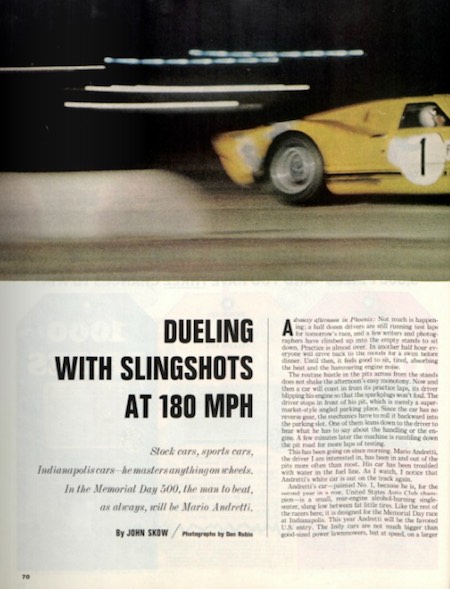
We catch up with Mario Andretti in the May/June 2017 issue of The Saturday Evening Post. Subscribe today to read “Mario Andretti,” the story of how a young Italian immigrant with a big dream became one of the greatest race car drivers of all time.
This article is featured in the May/June 2017 issue of The Saturday Evening Post. Subscribe to the magazine for more art, inspiring stories, fiction, humor, and features from our archives.
An Interview with Pierce Brosnan
Pierce Brosnan is literally back in the saddle. Thirty years after Remington Steele, he stars in AMC’s new Western series The Son. With a gray beard and a Texas accent, Brosnan portrays what he describes as “the most complex and fierce man I’ve ever played.”
The star mastered his way around guns as James Bond. “To many, I’ll always be him,” he chuckles. Though the 63-year-old likes to kid about “not being a spring chicken,” he is startlingly handsome, quick to laugh, and has a sparkle in his eyes and a star presence that magically grabs your attention.
Jeanne Wolf: In previewing The Son, I watched you shoot down a slew of rough enemies, do a romantic love scene, and make boots and a hat look like a fashion statement. The director raves that you do your own stunts. What’s the secret?
Pierce Brosnan: Oh, that depends on the side of the bed you get out of. There’s the side of grace and the side of pain the next day. I’ve thrown this body of mine around. I’ve fallen off of plenty of horses. There’s the knees and the back and the shoulders. So I exercise and stretch and watch the diet. You have to maintain yourself somehow. I have to because I have a young family and a young wife.
JW: You have four sons. Would you consider yourself a good dad?
PB: I question myself over the years. Am I doing the right thing? Should I be the disciplinarian? Should I put my foot down? Why didn’t I make this decision? So yes, there’s a constant constructing and destroying of one’s emotions as a father. I’m proud of my sons. Some of them have put me through the ringer, but they’ve come out gloriously. Tender hearts are they, and strong. They have the understanding and commitment of life. They’ve seen how hard it is and how hard they must work and how hard I’ve worked as a father to, you know, do the right thing.
JW: You’ve needed strength through many tragic events in your own life. [Brosnan’s first wife, Cassandra, and their daughter, Charlotte, both died of ovarian cancer in their early 40s.] I always see you end up with optimism. Where does that come from?
PB: You know, I think it’s faith — the Irish Catholic of my youth is deeply engrained in my DNA. Having a kind of existence of being the only child of a fractured family and having to survive and get by on one’s own resources. I’ve had great luck and I learned that you need the capacity for the joy of life and not to be bitter. There’s always going to be the grudges and the times that you get kicked to the curb. You have to find yourself again and onwards you go, because otherwise you get mangled by resentment and bitterness and disappointment. The patriarch I play in The Son has been the last man standing too many times to count. That resonated in my own heart as a man who’s been around the block and has family and life and loss of love. And, remember, you have to be tough as old boots to be an actor.
JW: You have to be tough just to make it in our complex society today.
PB: It hurts my heart what I see going on the world here, and I love America. I’m an American citizen, and when I came here I felt incredibly fortunate and lucky and exhilarated to be in this country and to make a living and be accepted as an actor. Now, there’s a real strong ambivalence in my heart. I want it to be good and I have best efforts and fortitude of it being politically good, but I don’t see it happening. My wife, Keely, and I have worked for years on behalf of the environment. We see the violence every day — every day. It creates a damaging effect on our young people. There’s so little stability in our society now. I don’t have any answers for this except to find the higher ground and the good people in life and try to do good things — grace under pressure with a sense of humor about it.
JW: You’ve played such a variety of different men. Have these characters you’ve played taught you lessons about life?
PB: They’re all so much a part of my own psyche and my own being. They come from me. I only have my own life to draw on and sensibilities as a man who has experienced highs and lows within his own life. They’re all part of me and I am part of them, whether it be James Bond or Eli or Thomas Crown or Remington Steele. So they’re all emblems of Pierce Brosnan. I was taught as an actor to transform, and I was taught that method of acting that was all about transformation. When I came here and I did Remington Steel, I just got away with it all.
JW: People are making a very big deal that you’re back to television. Does it, in the end, feel very different from making a movie?
PB: No, of course not. You have the same principles — a camera and actors, lights, it’s all the same. I had been actively looking to come back to TV, so it was in my peripheral vision to find work because it’s so exhilarating what’s happening on TV, and everyone watches movies on TV. The writing is brilliant, and this came at the most opportune moment. It’s not exactly the same as making a movie — it’s faster paced, but I like that pace.
JW: In The Son, your newest character, you had to go back to a different era and a brutal mentality. You were working in Texas in hundred-degree weather, and a lot of it on a horse.
PB: It’s always daunting, no matter what it is. You’re exhilarated by the material, so you say yes and then you have to stand up and do the work. I ride horses. I’ve enjoyed the company of horses and being on a horse. The accent was a challenge. I’d never done a Texan accent before, but because I came in at the 11th hour to this piece, I had no room to second guess myself. I listened to recordings and watched videos from Waylon Jennings to Rick Perry and Willie Nelson, and I just jumped in. Then, of course, I go to Texas, where a lot of people are talking with the accent. There I am in Austin in a saddle. That’s the joy of acting. It’s the challenge to be able to try to pull it off and make it look natural and make it look believable. That’s what you live for as an actor.
I was lucky with the horses because some of the wranglers I knew from a movie I did with Liam Neeson, and these guys knew I could ride. Nevertheless, I’ve fallen off the damn things enough times. I’m no spring chicken. I didn’t want to hurt myself. Anyway, I rode to the best of my abilities. I even surprised myself sometimes.
JW: What’s the end game for you?
PB: I want them to look back one day and say, “He wasn’t too bad! He was all right.” It’s just the joy of doing what I do and going to work. It’s exhilarating.
An abridged version of this interview is featured in the May/June 2017 issue of The Saturday Evening Post. Subscribe to the magazine for more art, inspiring stories, fiction, humor, and features from our archives.
Peach Pie, a Koi Pond, and an Outdoor Shower
I found my late husband in a book about how to construct an outdoor shower. Oh, there was no photograph of him, soaped up and singing. He wasn’t the book’s author, either. And it was not one of those personal ads that have become all the rage lately on the internet. Had you told me 20 years ago that people would one day run want ads for lovers or advertise their sexual preferences online — a word that didn’t even exist then — I would have told you straight up you had a screw loose … or two. But I’m pushing 80 now, and I’ve seen a good many things that boggle the brain.
At any rate, what led me to my husband, who has been dead now two years next month, was, quite simply, a recipe for peach pie scrawled on a scrap of brown grocery bag — so unremarkable, really, that I could just as easily have tossed it into my trash basket and moved on with my work of re-shelving.
You see, for 41 years, I worked at the local library. Which means I’ve touched many thousands of books, held millions and millions of words in my hands, shelved and re-shelved tons of literature — and when I say tons, I do mean the measure of weight as opposed to the figure of speech for “a lot of.” Some books I probably re-shelved hundreds of times, the most popular titles. I enjoy handling books that other people have held and read and loved so dearly that the corners of the hardcovers wear through like the ear tips of a child’s favorite stuffed animal, or the Skin Horse in The Velveteen Rabbit. Funny I should say that, as I’ve never had children. By the time I found the peach pie recipe, I was well past my child-bearing years and headed for hot flashes. But that’s another story.
The scrap of paper on which the recipe was written was limp and soft as suede. Running up the left edge, I noticed, were nine other words, these written in a different hand. They read: She loved this. SAVE. The word SAVE was in all caps, underlined twice, and encircled. I lifted the paper to my nose and inhaled, thinking perhaps I might discern the aroma of peaches or buttery crust. But I quickly lowered it again, my face flushing a little, afraid a coworker might have seen me in the act of sniffing a well-used bookmark. I started to drop it into my trash basket, when I noticed something on the back. It was a crude sketch of an outdoor shower, based on one from the book. And below the sketch were a few more words: She always wanted one of these, followed by an arrow arcing up toward the sketch, and below that, five more words: And now it’s too late.
Those last words were what made me surreptitiously slip the recipe into my purse. Normally, I would not dwell on a well-fingered scrap of grocery bag that god-knows-who-all had used as a bookmark. But on that particular day, November seventh to be exact, I was closing in on 50 and had resigned myself to being single the rest of my days. Or so I thought.
Now let me say right here that as a librarian you find a lot of interesting items forgotten in returned books. The usual grocery lists, business cards, and ratty receipts. Sometimes it’s one of those fast-food ketchup packets, squeezed empty of course, but still disgusting: a foodstuff in such close proximity to a book. Now and then it’s money, usually well-circulated singles, although I once found a Benjamin — a crisp $100 bill that smelled brand new. Then there are the unusual objects: strands of long hairs braided together, a single key sandwiched inside a folded sticky note, broken off fingernails with the polish still intact, segments of dental floss, some cinnamon flavored, a gold necklace made of links so miniscule it bordered on thread. One time, I found a male prophylactic — unused, thank goodness — but lying there like some deflated, fish-shaped balloon. I slammed the book shut fast, but the little tip poked up — air-filled now and bulging above the pages for all to see. I hurried to the trash and shook it off, then washed my hands in the staff bathroom — several times.
At any rate, when I found the peach pie recipe, I decided to do a little research on this person who had saved a scrap of grocery sack that obviously meant so much and then managed to lose it in the book return. I also wondered about the affiliated she, who liked peach pie, had always wanted an outdoor shower, and was, apparently, now gone. Quite possibly dead. It was a silly notion, I know, but everybody longs for a little love in their life.
Now, many people assume all librarians to be boring, bookwormish types, wearing our hair up in too-tight buns, spectacles perched upon our bony noses, down which we peer at patrons while pursing our thin lips. Well, I do prefer a bun, I’ll admit that right here, but it’s because a bun kept my hair — now all gone gray, of course — from getting caught up in my work: stacks of books, card catalogue drawers, pencil sharpeners, those ink pads we once used to stamp return dates. But I don’t consider myself boring. And I’ve known more than one librarian who might have looked the prudish part, but could let her hair down — literally and figuratively — at the right moment. One Sunday shortly before I came across the pie recipe, I walked in on a younger coworker “assisting” a patron atop the desk in the second-floor reading room. I closed the door quietly, returned downstairs, and didn’t say a word to anyone. But I must confess I felt a slight twinge of envy. I’d always been terribly awkward around men, no doubt the reason I was pushing 50 and still single.
To start with, I looked up in the library records the name of the borrower who’d most recently checked out the book about outdoor showers. The name was Jack O’Donnell — clearly a male, and most likely Irish. I recall feeling a small thrill rise in my abdomen. Oddly, there was no mailing address listed, which was most unusual, because back then we sent late notices via post, instead of by email. Had the internet been available, I would have Googled this Mr. O’Donnell, as they say these days. (How does such an odd name become a household verb that sounds very close to giggle, but means nothing of the sort?) But back then, I turned next to the phone book, another relic of the pre-digital era. No listing. At one point, I panicked, thinking perhaps he was dead. After all, there was no date on the recipe. It could have been languishing in the book for years, this Jack O’Donnell having nothing at all to do with it. But by then I’d built up this ridiculous image in my head of a handsome middle-aged Irishman standing in a newly constructed outdoor shower — singing, smelling of wet cedar, and slippery with soap. I’m embarrassed to even admit that. But it gets worse. I actually rode my bicycle around town on cold mornings scanning the air above houses for a telltale column of rising steam that I hoped would reveal the location of the outdoor shower, with the occupant engaged in the act. Alas, no luck.
I finally resorted to running a slightly white-lie want-ad in the local newspaper, advertising fresh baked peach pies, above my phone number. And what do you know? The ad worked! The phone rang one evening as I was just finishing supper.
“I’m calling about your pies,” a man’s voice said.
“Peach?” I chirped, almost choking on a mouthful of mashed potatoes.
“Are there other flavors?” he asked.
“Oh, no. No. Just peach. Is that your favorite?” I immediately regretted adding the last bit, and, hearing silence, feared he might hang up.
“Yes, I like peach,” the voice continued. “But where are you getting them fresh this time of year? The peaches?” My face went hot. I’d not thought that through. It was November, the peach season long gone. My ad had indeed read, Fresh Baked Peach Pies.
“Oh, well, I, uh …” I stammered.
“Canned?” he offered.
“Oh, yes! That’s it! Canned!”
“They’re not as good.” His voice had gone flat.
“Oh, I know. You’re absolutely right. Nothing like being fresh. Peaches, I mean!”
Another long pause, then he said, “Can I get one? Tomorrow?”
“By all means. I’ll have it ready, still warm. With whipped cream, too, on the side, if you like.”
“Do you deliver?”
A blade of fear knifed up inside me. What if this was some sort of sexual deviant? I regretted my addendum about whipping cream. Shoot! How to reply?
“Hello?” he said.
“Sure!” I squeaked. “I can deliver it. Where? And what time?”
“Six p.m. would be ideal,” he said, then rattled off an address and a few quick directions. I thanked him and hung up, my heart loud in my ears. Then I realized I’d forgotten to ask his name.
The next morning, I called in sick, exaggerating a nasty cough, then drove around town procuring ingredients while wearing sunglasses and a floppy hat in case I ran into a coworker. I’d never made a peach pie, and my track record with pies of any sort was less than exemplary, so I purchased enough ingredients to make a half-dozen, in hopes one might border on perfection. Flying around my kitchen, I dropped a cube of butter, dumped a can of peaches into the sink instead of the colander, managed to mangle three different crusts, and spilled flour all over the floor. But by five thirty, I had two pies that looked passable. I decided to take them both; at the rate I was going I figured the chance of dropping one on the way was quite high.
I showered, dressed, and set off a few minutes before six. It was bitter cold out and getting dark. I feared the pies sitting beside me on the vinyl seat of my Gremlin would be ice cold by the time I arrived. When I pulled up at the house and saw a wisp of steam rising above the far side of the roof, I lowered the window fast, to get a better view, and some fresh air. My breath drifted off white down the street, but I was perspiring. The windows of the house held yellow light. My fear about this man being some sort of serial sexual predator resurfaced, and I considered driving away with my cooling pies. But I told myself I had nothing to fear; the man simply liked peach pies. I decided to take a quick peek in the backyard to determine the source of the steam. But what I saw was not my fantasy man soaped up and singing. It was some sort of small fishpond, the water aglow with an underwater light, and steam rising from its surface. No sign of an outdoor shower at all. I returned to the street, confirmed the address, composed myself, then ascended the front porch steps — one pie balanced on each palm. I pressed the doorbell with my elbow and stepped back.
The porch light popped on, and a red-headed man about my age opened the door. I recognized his voice as soon as he said, “Must be my pie, and right on time.”
“I brought two,” I blurted. “Just in case.” I held the pies up, as if he couldn’t see them just fine where they were. That’s when I realized how foolish I must have appeared: bringing two pies when he’d ordered only one, and probably lived alone. So I quickly added: “But you don’t need to take them both, of course. I just thought, well, you know, peach might be your favorite. Pie, I mean. That’s what you said, right? Canned, of course. I mean fresh. I mean …” I shrugged, both pies going up, then down.
He smiled and dug for his wallet. “What do I owe you?”
I’d not thought this far. What was a pie worth? I’d never purchased one. My mind tangled. Words backed up at the base of my throat. This was why I was still single — I seized up around males. Then I remembered the sketch on the bookmark and blurted: “An outdoor shower?” His eyebrows rose. His head pulled back. And I felt my face flush red and hot. My mouth started spouting apologies through my teeth. I almost dropped one of the pies, but he caught it. “Free!” I blurted, handing him the other one, too. “Both! On me. I’m so sorry.”
I was halfway down the steps when I felt the paper in my coat pocket and stopped. For some reason, at that moment, I thought of the prophylactic I’d found in that book, of my coworker in the reading room, and of the fact I would be 50 in a few weeks. I pulled the scrap of paper out, turned, and went back up. “Here,” I said, placing it on one of the pies. “I work at the library and found this in a book I believe you borrowed about how to build an outdoor shower. I’m terribly sorry.” I hurried back down the steps.
As I approached my car, I heard him call out, “I haven’t built the shower yet, but I have a koi pond in the back yard, if you’d care to see it, and stay for some pie. It appears I have plenty.” He was standing silhouetted by the porch light, his arms spread wide, a pie in each hand.
So there you have it. How I met Jack O’Donnell, who became my husband for nearly 25 years. I miss him, every day. On nice mornings, I sit out back and watch the koi. Now and then, I bake a pie, in his honor. Peach, of course. And I use the outdoor shower we built all the time. One day last winter when it snowed, I stood in the steaming shower eating a slice of warm pie with vanilla ice cream, crying. It was fabulous.
News of the Week: Passenger Planes, Pulitzer Prizes, and Popsicle Bikes
Sky Maul
Why did the guy get dragged from his airline seat? That’s not the start of a riddle, it’s an actual question millions of people around the world are asking this week. You’ve probably heard about the 69-year-old man who was accosted and dragged from his United Airlines seat because he wouldn’t get off the plane after the crew notified passengers that they needed four seats for airline employees. The plane wasn’t even “overbooked” in the traditional sense; they needed the seats so those employees could get to other United planes, which makes the situation even worse. What, they couldn’t get the employees to Louisville, Kentucky, some other way? They couldn’t offer a ton of money to the passengers instead of dealing with a multi-million-dollar PR nightmare? Maybe the default position for airlines to take, even if a passenger is wrong, should be “don’t drag paying customers off of your plane, especially when every other passenger has a camera.”
Of course, social media lit up, with complaints pointed toward United Airlines’ Twitter account, jokes for new slogans, and memes for United Airlines movie lines. Several people have made the Harrison Ford “Get Off My Plane!” joke.
United CEO Oscar Munoz, after a couple of press releases that just made things worse, went on Good Morning, America on Wednesday morning to address the issue.
It’s almost as if United was trying to win the “Who Can Create a Bigger PR Nightmare Contest?” this week. The other finalists were Pepsi, for their tone-deaf Kendall Jenner commercial, and White House press secretary Sean Spicer, for his comments about Hitler (it’s always a good idea to just never talk about Hitler). This isn’t even the only United controversy this month. Another incident happened in Hawaii last week.
I’m so glad I don’t have to fly that often. Air travel isn’t what it used to be. Though if I do fly and United wants my seat, my going price is $2,000, a night in a nice hotel, and maybe one of those travel bags with the United logo on it.
And the Winners Are…
The 2017 Pulitzer Prizes were handed out this week, and it’s impossible to mention all of the winners and finalists (you can find a complete list here), but a few that stand out are David A. Fahrenthold of The Washington Post for National Reporting, The Salt Lake Tribune staff for Local Reporting, and Peggy Noonan of The Wall Street Journal for Commentary. The Fiction winner was Colson Whitehead for The Underground Railroad.
RIP J. Geils, Tim Pigott-Smith, Peter Hansen, Glenn O’Brien, Charlie Murphy, Chelsea Brown, and Dorothy Mengering
I was rather amazed by how many people online think that J. Geils, who passed away Tuesday at the age of 71, was the singer for The J. Geils Band. No, that would be Peter Wolf. But Geils founded the band in 1967 and played guitar on many of their hits, including “Love Stinks,” “Freeze Frame,” and “Centerfold.”
Tim Pigott-Smith was a veteran actor who appeared in TV shows like Jewel in the Crown, The Chief, and Doctor Who, as well as movies like Quantum of Solace, RED 2, V For Vendetta, Alexander, Victory, and Clash of the Titans. He passed away last week at the age of 70.
Peter Hansen was also a veteran actor. He played Lee Baldwin on General Hospital for close to 40 years. He also appeared in shows like Perry Mason, The Lone Ranger, Sea Hunt, Matlock, Magnum, P.I., and The Golden Girls, and in the movies When Worlds Collide, Branded, A Cry in the Night, and The War of the Roses. Hansen died Sunday at the age of 95.
Glenn O’Brien wrote the “Style Guy” column for GQ for 15 years, leaving in 2015 after a dispute with editors. He got his start working with Andy Warhol, wrote for other magazines, co-wrote Madonna’s book Sex, and was once the creative director at Barney’s. He passed away last week at the age of 70.
Charlie Murphy was Eddie Murphy’s brother and a fine comedian in his own right. He was a performer and writer on Chappelle’s Show, where he was famous for his funny “Charlie Murphy’s True Hollywood Stories” segments. Murphy died earlier this week of leukemia at the age of 57.
Chelsea Brown was a cast member on the classic ’60s sketch show Rowan & Martin’s Laugh-In. She also appeared on The Flying Nun, Mission: Impossible, Marcus Welby, M.D., Police Story, and the bizarre horror-comedy movie The Thing with Two Heads. She passed away on March 27 at the age of 69–74 — sources can’t seem to agree on her exact age.
You might not know the name Dorothy Mengering, but you know her son, David Letterman. Dave’s mom lived in Indiana and appeared on his TV shows many times over the years, reporting from various Olympic Games or appearing during holidays, where she would make a couple of her famous pies and Dave would try to guess what pies she had made that year (one of the great annual traditions on the show). She even wrote a cookbook, Home Cookin’ with Dave’s Mom. She passed away Tuesday at the age of 95.
Strike!
Where were you during the writers strike of 2007? If you miss those days when production of TV shows was shut down, or maybe you don’t even remember a 2007 strike, we may soon be getting a sequel. The Writers Guild of America is going up against The Alliance of Motion Picture and Television Producers for various reasons and may vote to go on strike on May 2.
A strike authorization vote will take place next week. Obviously this is a complex issue, but Ken Levine has two posts on his site that summarize it rather well, including a post that outlines what you should know about the strike and one that gives an issue-by-issue rundown on why the strike might happen.
Like Ken, I support the writers.
Popsicle Bike?
Every once in a while, we get a Wheel of Fortune answer that boggles the mind. Just two weeks ago, we had the guy who thought A Streetcar Named Desire was actually A Streetcar Naked Desire, which made host Pat Sajak remark that he’d rather see the contestant’s play than the original. Last week, the show had couples on and … well, I’ll just have Jimmy Kimmel explain what happened next. Watch the whole clip; he gives the couple a gift:
Maybe Wheel of Fortune could take this and use it as the basis for a “Really Difficult Puzzle” round on the show. The answers could be anything random. Monkey Crayons! Pickle Tables! Triscuit Envelopes! Make the money amounts on the wheel really outrageous since it will be harder for the contestants to guess what the answers are.
Happy Birthday, Turner Classic Movies
A few weeks ago I was thinking, if I could watch only one TV channel, what would that channel be? I could have picked one of the major networks because there are so many shows that I watch on them, or I could have picked one of the news channels because I would need to keep track of the news. But then I thought, I don’t need it to be one of the news channels because I could watch the news on one of the major networks.
Then I threw all of that away in my mind and settled on Turner Classic Movies. That’s the one channel that, if it went away, I would truly miss.
TCM celebrates its 23rd birthday today. They’re showing some classic films later today (well, they show classic films every day), including Mildred Pierce, Picnic, Magnificent Obsession, and Cat on a Hot Tin Roof. On Monday night, actor William Daniels will be a guest programmer, introducing the films A Thousand Clowns, 1776, and Dodsworth.
This Week in History
Joseph Pulitzer born (April 10, 1847)
The man whose name is engraved on the awards mentioned above was born in Hungary and passed away in Charleston, South Carolina in 1911.
President Lincoln Assassinated (April 14, 1865)
Saturday Evening Post Archives Director Jeff Nilsson looks at a Post editorial, titled “The Murder of President Lincoln,” that appeared in the pages of the magazine just seven days after the assassination.
This Week in Saturday Evening Post History: “Late Night Hat Check” (April 13, 1957)
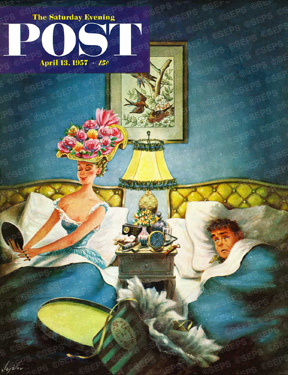
I’m trying to figure out what’s going on in this cover by Constantin Alajálov that appeared 60 years ago this week. Is the husband confused because his wife is waking him up in the middle of the night by doing something as silly as trying on her Easter hat? Or is he slowly coming to the realization that, oh, great, my wife spent money on another hat? Probably both.
National Eggs Benedict Day
I worked at a breakfast and lunch place for several years, and one of my least favorite things to make was Eggs Benedict. The eggs had to be poached just right, the English muffins couldn’t be too soggy, and if I let the hollandaise sauce sit around for too long it would thicken up, and I’d have to whip it up again furiously so I could pour it on top. I love Eggs Benedict myself, but I often thought, standing in that hot kitchen, do you really have to order this? How about some toast or maybe a nice bowl of fruit instead?
This Sunday is National Eggs Benedict Day, which is appropriate because Eggs Benedict is a very Sunday-ish thing to have (and it’s Easter). Here’s a classic recipe from Allrecipes, including a recipe for the hollandaise sauce. If you want a variation on the classic recipe, swap some spinach for the Canadian bacon to make Eggs Florentine, or make Eggs Hemingway by using salmon. If you want to keep the toppings the same, you could try replacing the English muffin with something like a buttermilk biscuit, bagel, corn muffin, or a Krispy Kreme chocolate doughnut.
Just kidding about the doughnut — although, if you go that route, let us know how it comes out.
Next Week’s Holidays and Events
Easter (April 16)
Philip Gulley has a funny story on how the vacations he used to take as a kid around Easter have really changed.
Patriots’ Day (April 17)
The holiday is only officially celebrated in Massachusetts, Wisconsin, and Maine, though the way it’s celebrated in each state is different. And to make it even more confusing, the punctuation on the holiday name is slightly different in Maine.
Newspaper Columnists Day (April 18)
You can celebrate this day in many ways. You could read your favorite columnists, buy a subscription to a newspaper, or support The National Society of Newspaper Columnists. You could even buy an expensive gift for your favorite Saturday Evening Post columnist. Even though it’s not technically a newspaper, it still counts.
Tax Day (April 18)
Because the 15th falls on a Saturday this year, and Emancipation Day will be observed on the 17th in Washington, D.C., we have an extra three days to get our taxes in the mail. If you’re like Homer Simpson, you’ll get them to the post office just before the doors close:
How the British Beat the Germans at Their Own Propaganda Game: 75 Years Ago
 Large-scale public propaganda campaigns were introduced in World War I, but they became more far more elaborate, and effective, in World War II.
In 1914, Allied propaganda consisted of simply spreading stories of German soldiers committing atrocities. Newspaper readers in both Allied and neutral nations were told that innocent men, women, and children were being maimed and killed in Belgium and France by German troops. Though never substantiated, the stories helped swing public opinion firmly against the Germans.
By World War II, Germany had become master of the art of propaganda, building one of the most sophisticated mis- and dis-information machines in the world. The Minister for Enlightenment and Propaganda, Joseph Goebbels, knew the importance of radio in spreading the Nazi message. He authorized the manufacture of inexpensive radios that would be affordable to more people. He even gave away free radios on his birthday.
Radio broadcasts played on the familiar themes of German National Socialism. Wrapped around music programming, Goebbels would include short pieces that appealed to Germans’ resentment at the outcome of the last war and their depressed standard of living, which he skillfully blamed on Jews, communists, and unpatriotic Germans. Through his efforts, the Nazi government gained the loyalty of otherwise sensible Germans and convinced them to sacrifice their efforts, fortunes, and lives for Hitler.
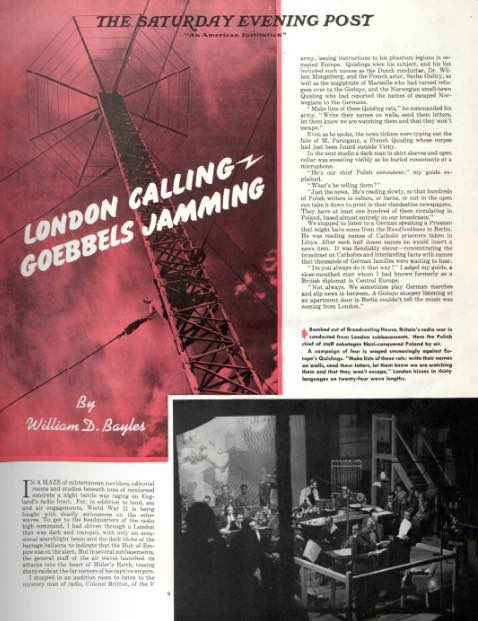
But England soon proved as adept at the game as Germany. In “London Calling — Goebbels Jamming,” William Bayles describes the impressive operations at the British Broadcasting Corporation, which provided news and persuasion throughout Europe and the Middle East.
The BBC enlisted the help of national resistance heroes like Queen Wilhelmina of Holland and Charles De Gaulle of France to speak to their conquered people over the airwaves. It also drew on a vast pool of refugees who’d sought asylum in England and who could write and speak languages of all the major nationalities in the war zones: 24 nationalities in all — from Albanians to Turks – prepared “ammunition for the radio offensive against Hitler.”
And while the Germans distorted the facts in their news, the British made a point of being honest in their reporting. They believed the blitz-propaganda machine, which repeated lies until they were believed, would someday fail. When Hitler eventually exhausted the trust of the German people, they would know where to find a more reliable source.
The British were also particularly good at using an enemy’s words against them. The BBC would edit clips from Hitler’s different radio speeches to show him repeatedly contradicting himself.
Perhaps nothing was more effective than the way the BBC ended its German broadcasts every day. Listeners heard “a clock ticking hollowly and a ghostly voice intoning: ‘Every seventh second, a German soldier dies in Russia. Every seventh second … hour after hour … day after day … Is it your husband … your son … your brother? Shot … drowned … frozen … every seventh second … seven … seven.’”
7 Wackiest Fad Diets
Do you find yourself longing for a return to the health and vitality of your salad days without the need for literal salad days? The best way to lose weight healthfully is with a gradual lifestyle change to a balanced diet and regular exercise, but where’s the fun in that? These fad diets promise mostly speedy results with little or no exercise, and we will eat our hats if they actually work.

- Cabbage Soup Diet: Since the 1980s, this scheme to shed pounds quickly has been ubiquitous in the diet world. A cabbage soup made of vegetables and broth is consumed for seven days, along with strict daily allowances of produce, milk, and beef. The low-calorie eating will likely prompt swift weight loss, but don’t expect to keep the pounds off. Unless you’re obsessed with cabbage, the diet will be difficult to sustain.
- Blood Type Diet: Naturopathic physician Peter D’Adamo insists that the answers to wellness and fitness can be found in a person’s blood type. He has been insisting for over 20 years that appropriate diets can be recommended for people based on ABO blood groups. Of course, scientific evidence for this claim is nonexistent, It is the impression of individualization, perhaps, that affords blood type diet franchises their success. Our attitude toward this diet is B-negative.
- Moon Diet: If it is true that a full moon correlates with aggressive behavior, perhaps all of the late-night lunatics are following this diet. Also known as the “werewolf diet,” this fad relies on the supposed power of the moon to stimulate weight loss. Proponents of this far-out regimen allege that fasting with juice and water for 24 hours during a full moon will take advantage of some undefined tidal effect on the human body. The moon diet can also be attempted during a new moon — and probably at any time waxing or waning as well. This fad diet eclipses the rest in terms of New Age nuttiness.
- Grapefruit Diet:
James Cagney turns a grapefruit into a weapon in The Public Enemy (1931), Warner Bros.This trend of unknown origins involves eating grapefruit along with proteins and fats such as eggs, bacon, and fish. Incarnations of the grapefruit diet are typically low in carbohydrates and starches. The surprising part? It might actually work. A 2014 study found that a similar diet in mice resulted in less weight gain and healthier blood glucose and insulin levels. As long as you aren’t taking a medication that interacts with grapefruit dangerously, the bitter citrus can be a great addition to your balanced diet.
- Detox Diet: Although detoxification is a process carried out by the liver and kidneys — or a medical team in instances of poisoning — cleanse or detox diets advise a period of fasting accompanied with daily saltwater, lemonade, and laxative tea to rid the body of toxins and promote weight loss. Perhaps the most famous of these is The Master Cleanse, in which adherents guzzle a concoction of lemon juice, cayenne pepper, and maple syrup for 10 days. Harvard Women’s Health Watch warns against detox diets, saying that a “daily laxative regimen can cause dehydration, deplete electrolytes, and impair normal bowel function.” Since no evidence exists to suggest these diets will actually detoxify your system, we’re going to skip the spicy lemonade.
- HCG Diet: Human chorionic gonadotropin (HCG) was found in weight loss supplements that were made illegal for over-the-counter use in the U.S. in 2011. The hormone is found in the placenta of pregnant women, and it was first used for weight loss in the 1950s. The most alarming aspect of the HCG diet plan is the daily intake of just 500 calories. This kind of extreme dieting is broadly rejected by doctors and scientists as hazardous behavior.
- Raw Food Diet: A raw diet might conjure images of a 1960s health food cult with a charismatic leader and strict rules about
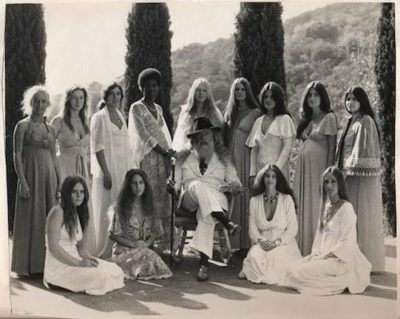
The source family of 1960s L.A. vegan notoriety. (Isis Aquarian) yeast, but The Source Restaurant in Los Angeles was just the beginning of this culture in the U.S. A raw, vegan diet consists of fruits, vegetables, grains, legumes, and seeds that have not been heated above 104 degrees Fahrenheit, since raw foodists insist that heating food diminishes its nutritional and digestive values greatly. This is true of some foods; but others, like tomatoes, asparagus, and mushrooms, release nutrients and antioxidants only when cooked. Meal preparation for a raw diet can be costly and time-consuming as well, rendering fresh, natural eating unrealistic. With daily processes like dehydration, seed-sprouting, and fermentation, reaching a healthy level of calories and fats can be a full-time job. This is a diet either for those who can afford to outsource the harvest or for folks who have spare time on the commune.
Also be sure to read Managing the Hunger Mood from the March/April issue.
Cover Gallery: Firefighters
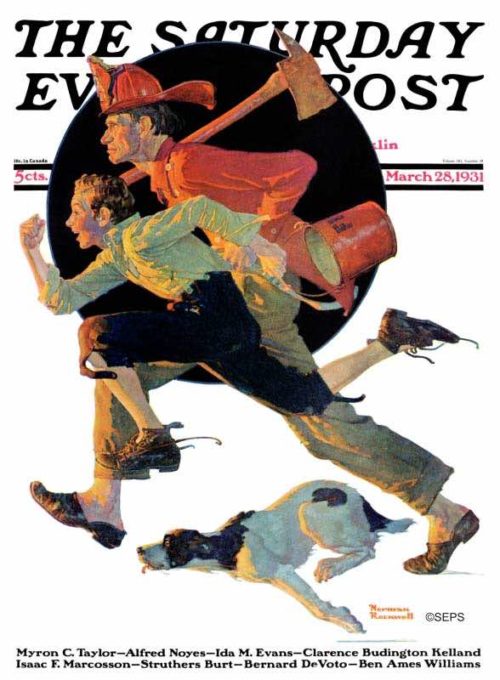
Norman Rockwell
March 28, 1931
A new approach to painting –“dynamic symmetry”- was emerging, and Rockwell’s artist friend told him that he had better begin using it or his work would crumble. His next painting, using this technique, was a disappointment to him. It depicted a stone-faced fireman with an excited lad and his dog rushing to a fire as flames lit the scene. Rockwell gave the painting to a cousin who lived in Philadelphia, and vowed never to wander from the time-tested formulas that had worked so well in the past.
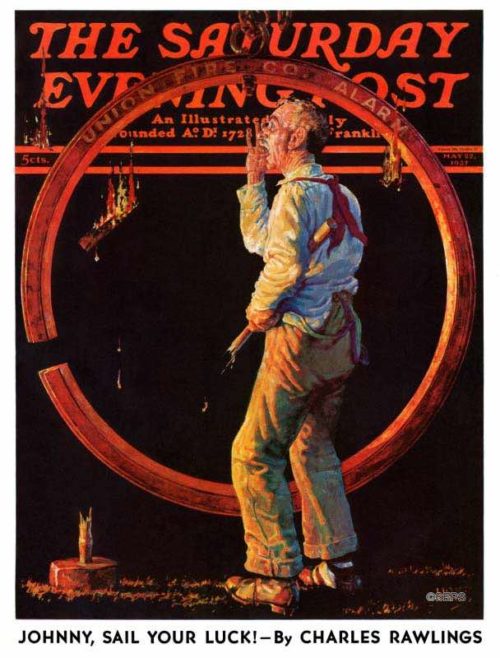
Monte Crews
May 22, 1937
Monte Crews was an illustrator, art teacher, cartoonist, and movie theater owner. Like Norman Rockwell, Crews’ covers are good examples of narrative art, where a single frame tells a detailed story. One can see the sense of urgency in this firefighter’s eyes, as he holds the broken sledge hammer while pieces of burning wood fall around him.
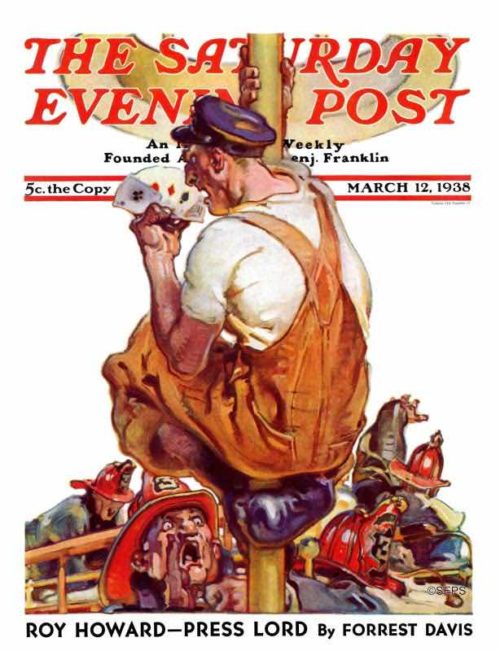
Samul Nelson Abbott
March 12, 1938
Samul Nelson Abbott was known for his intricate and realistic illustrations, and did cover work for many of the major magazines of his day, including The Saturday Evening Post, Woman’s Home Companion, and Ladies’ Home Journal. Abbott painted two covers for the Post.
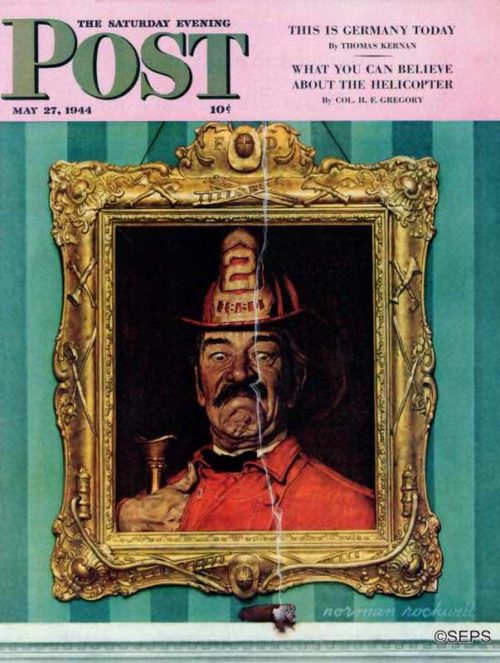
Norman Rockwell
May 27, 1944
One day in the early 1940s, while rummaging through an old junk shop, Rockwell came upon a fancy fireman’s frame. Since it was empty, and he felt he needed to fill it, he painted a cover using the frame and then put a painting into the frame. So actually, the frame generated the picture, and the picture was done for the frame.
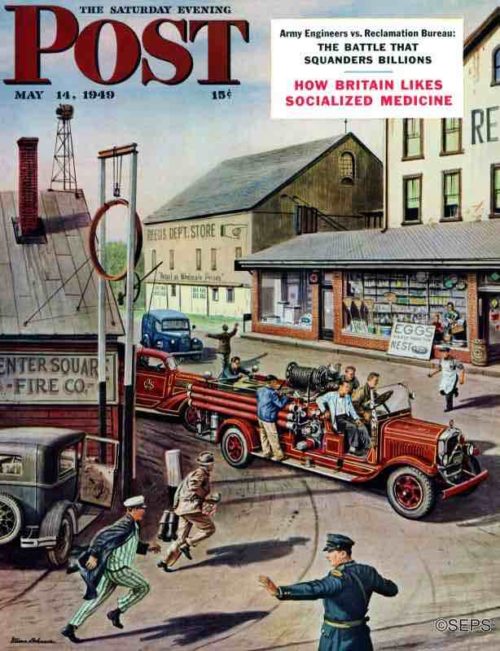
Stevan Dohanos
May 14, 1949
[From the editors of the May 14, 1949 issue] Stevan Dohanos, seeking a small-town fire department with good equipment, but not those elaborate trucks that sprout ladders when a button is pressed, found just the thing at Center Square, Pennsylvania, not far from Art Editor Kenneth Stuart’s home. When the fire boys had done posing. John Henryson, company secretary—who is dashing across the cover in pajamas—made Stuart an honorary, nonrunning member of his outfit. Will this burn up Stuart’s home-town firemen at North Wales and raise his fire-insurance rate? Incidentally, four Post artists, long fascinated by that Center Square department store, have tried to figure out a theme for coverizing it, and failed. Too bad a false alarm wasn’t turned in while they were thinking.
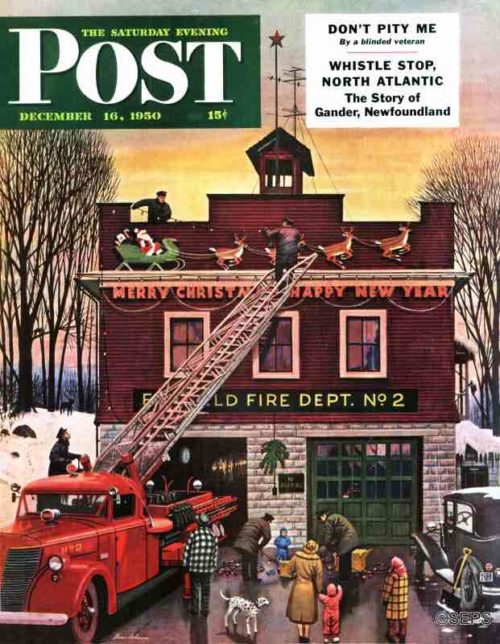
Stevan Dohanos
December 16, 1950
[From the editors of the December 16, 1950 issue] This could be the firemen of the Tunxis Hill Department in Fairfield County, Connecticut, but Stevan Dohanos is symbolizing the merry fact that fire brigades all over America know how to get extension ladders into the Christmas spirit. At this season some fire companies gather broken toys from neighborhood children and repair them for youngsters who otherwise might not find anything in their stockings; and that’s another good thing about firemen. Would it take the cheer out of this scene if the boys hung a big placard behind the brightest lights, saying, “As most of us are volunteers, and hope to stay home Christmas, kindly electrify Christmas trees safely, so that they don’t burn up”? But maybe the sign would catch fire.
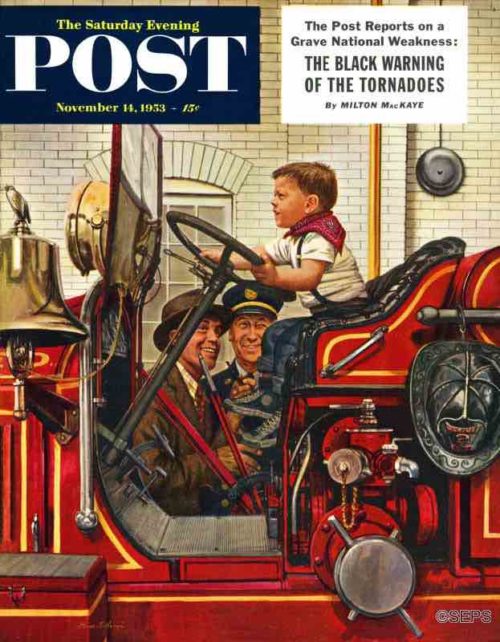
Stevan Dohanos
November 14, 1953
[From the editors of the December 16, 1950 issue] It is comforting to reflect that in spite of rocket ships, disintegrator guns and all the charming new ways of imaginatively risking life and limb, one of the biggest thrills in little lives is still a careering, rip-roaring fire engine. Sort of makes you feel that the future of America is secure. Especially as today’s little imaginers are handicapped by fire wagons no longer being towed by thundering, entrancing fire horses—are you antique enough to remember them? When the lad in the Dohanos scene has had his wonderful moment, papa will say, “Now let me sit there and show you how the pedals work”— for papa wants to play fireman too. Once, when a certain papa did that, the firebell rang, and boy! did he scram down out of there.
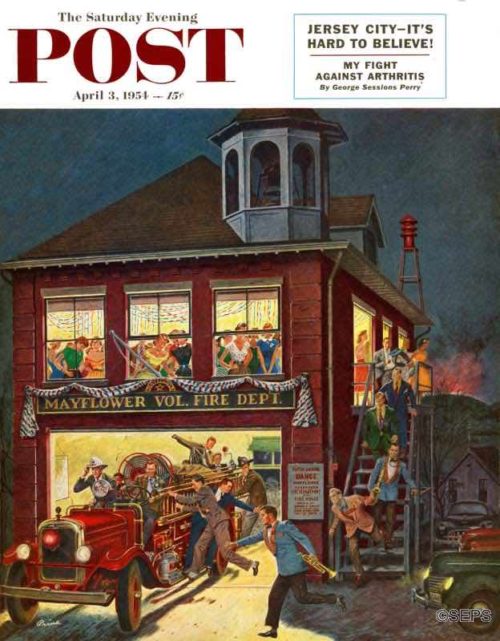
Ben Kimberley Prins
April 3, 1954
[From the editors of the April 3, 1954 issue] What gross inefficiency this is, scheduling the Vol. Fire Dept.’s annual dance the same night as the year’s big fire. The entertainment committee will hear from this, unless they leave town under cover of Ben Prins’ ruddy darkness. One toys with the notion that those flames could be a king-size bonfire organized on the other side of the hill by humorists. More likely the firemen have a grim and dangerous job to do, in which case there will be a special glow of enchantment when the men return safely and again enfold their dear ones in the dance. And then that one fellow now remaining behind with the fire belles won’t turn out to be the beau of the ball. Hey, would he by any chance be the chairman of the entertainment committee?
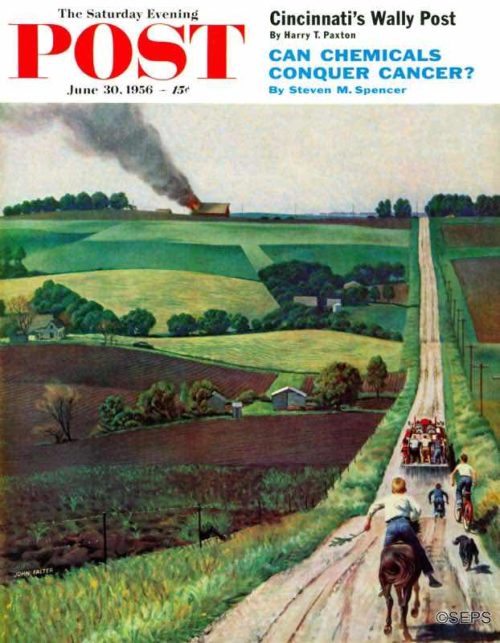
John Falter
June 30, 1956
[From the editors of the June 30, 1956 issue] The scene is out of John Falter’s boyhood, and from this hilltop that looks like an ugly fire. But Falter, having added a modem chemical fire truck which he feels certain will save the barn, reflects that when he starts a fire, he can put it out. Seriously, this evokes a fervent thank-heaven for telephones, gasoline motors, new-fashioned antifire devices, and the know-how and courage of volunteer smoke-eaters. Falter didn’t ride a horse bareback to his long-ago fire; his horse ran away and Johnny dismounted into a passing haystack. Then, finding himself alive, he proceeded on shanks’ mare. To return to 1956, three volunteer boy-models, one on a horse, helped the painter by careering down a steep California hill again and again, which astonished onlookers, as there was no fire.
Managing the Hunger Mood

I decided to take a try at the great problem of our time: how to lose weight without any effort. So I did an experiment on myself. I was ripe for it, if truth be told. Here I am eight months later and 50 pounds lighter, so something must have worked. My approach to the problem was different from the usual perspective. I’m a psychologist, not a doctor. From the start I suspected that weight regulation was a matter of psychology, not physiology.
If weight were a matter of calories in and calories out, we’d all be the weight we choose. Everyone’s gotten the memo. We all know the “eat less” principle. Losing weight should be as easy as choosing a shirt color. And yet, somehow it isn’t, and the United States grows heavier. It’s time to consider the problem through an alternative lens.
Whatever else it is, hunger is a motivated state of mind. Psychologists have been studying such states for at least a century. We all feel hungry before dinner and full after a banquet, but those moments are the tip of the iceberg. Hunger is a process that’s always present, always running in the background, only occasionally rising into consciousness. It’s more like a mood. When it slowly rises or eases back down, even when it’s beneath consciousness, it alters our decisions. It warps our priorities and our emotional investment in long-term goals. It even changes our sensory perceptions — often quite profoundly.
You sit down to dinner and say: “That tiny, little hamburger? Why do they have to make them so small? I’ll have to eat three just to break even.” That’s the hunger mood making food look smaller. If you’re full, the exact same hamburger looks enormous. It isn’t just the food itself. Your own body image is warped. When the hunger mood rises, you feel a little thinner, the diet feels like it’s working, and you can afford a self-indulgence. When satiety kicks in, you feel like a whale.
Even memory can be warped. Suppose you keep a log of everything you eat. Is that log trustworthy? Not only have you drastically misjudged the size of your meals, but you’ve almost certainly forgotten items. Depending on your hunger state, you might snarf up three pieces of bread and after the meal sincerely remember only one. One recent study found that most of the calories people eat come through snacks between meals. But when you ask people, they deny it. They’re surprised to find out just how much they snack.
The hunger mood is hard to control, precisely because it operates outside of consciousness. This might be why obesity is such an intractable problem.
Michael Graziano is a neuroscientist, novelist, and composer. He is Associate Professor of Neuroscience at Princeton University in New Jersey. His latest book is Consciousness and the Social Brain (Oxford University Press, 2013).
Purchase the digital edition for your iPad, Nook, or Android tablet:

To purchase a subscription to the print edition of The Saturday Evening Post: 
For more on dieting check out 7 Half-Baked Fad Diets.
Second Chapters: An Octogenarian in the Peace Corps
The difference between a career and a calling, according to John Guy LaPlante, is that a career occupies your time until you retire. It can be satisfactory and pleasant, but after you retire, you never do it again and you never think about it again. “When you have a calling, you do it until your last breath,” LaPlante says.
John’s calling is effecting change for the better, and he continues to strive for a better world as his 88th birthday approaches. When John was 77, he felt a calling to join the Peace Corps.
It began when John saw a concert given by a Coast Guard Academy band. After seeing so many servicemen in the audience, he felt bad having never served in the armed forces. Afterward, John said he read an article about a Peace Corps initiative to recruit senior volunteers for their wisdom, experience, and desire to give back. He met with a recruiter in Los Angeles, and — after telling his family about his somewhat zany plan — he started the yearlong process of completing the necessary paperwork and medical exams.
John speaks with a thick New England accent from spending most of his life in Massachusetts and Connecticut, but his first language was French, taught to him by his Québécois parents. John figured the Peace Corps would send him to a country where his bilingualism would be valuable — Haiti, Vietnam, maybe Northern Africa. These locations also suited his aversion to the cold; John was escaping to Southern California each winter to avoid Connecticut’s harsh weather.
He was surprised to learn he was being sent to Ukraine and needed to learn Russian. John attended daily Russian classes, and he even began waking at 4 a.m. to study before his lessons. “I was the worst Russian student the Peace Corps has ever had,” he said. “I would study at night and forget the words in the morning because I was so damn old.” He was admitted to the program nonetheless.

Just 50 miles east of Chernobyl lies Chernihiv, Ukraine, where John was assigned to teach English at a state language school. Chernihiv was no Newport Beach; the winter chill was cruel and the living standards dissimilar. He was perturbed by a young boy in his first host family who seemed to suffer a disability that rendered him unable to attend school. John connected with him and lamented that his situation was not a rare one. John was stirred to improve the lives of Chernihiv’s citizenry in any way he could.
John became a regular at the local Korolenko Library. After sensing the enthusiasm of his English students at the school, he took it upon himself to lead an English Club — soon followed by a French Club — at the library on Sunday evenings. He tutored young people one-on-one and became invested in a mission to foster their interest in reading. This proved difficult, however, in a library with no digital catalogue of its contents.
Each Peace Corps volunteer is responsible for creating and leading a project of some significance apart from their service responsibilities, and it was at the library that John got an idea for his personal project: He developed a system to digitally organize the materials of the multi-building library campus. His ambitious plan was met with some resistance by nervous librarians who feared losing their positions to such a database, but John assured them their jobs were safe.
If reorganizing the library’s database wasn’t enough, John also noticed that the complicated, multi-tiered system of buses, trains, and trolleys lacked an inclusive guide, so he made it his mission to develop one. He worked with the municipality to establish a self-sustaining directory with keys, schedules, and a visual map that still exists today in print and online.
John’s successes in the program were considerable, but he noted — usually with the phrase “jeepers creepers!” — that he experienced hardships and setbacks as well.
One winter night, as he walked to a marshrutka (small bus) station in Chernihiv, LaPlante was inadvertently caught up in a drunken couple’s argument over their last bottle of beer, and he was knocked off the sidewalk and into the road. As he lay there, dazed, a police car pulled up and the Chernihiv Militsiya approached him. “They thought I was drunk!” he said. “Probably because of my terrible Russian.” It was imperative for John to convince the officers of his sobriety since excessive drinking can be cause for disciplinary action in the Peace Corps. Only after he could produce the necessary paperwork did they believe his story and offer him a ride home.
In another instance, John’s passion for teaching his students landed him in the Dean’s office when he went off-book for his lessons. He devised exercises to teach his students American English when he felt the required textbook’s British English was inappropriate. “I thought I was doing a superior job!” he offered. His supervisor, however, urged him to follow the text more closely.
Despite his troublemaker tendencies and atrocious Russian, LaPlante was never ousted from the program as he feared he would be. In fact, he received a call from the director of Peace Corps, who informed him that, at 80 years old, he was currently the oldest Peace Corps volunteer in the world. “I asked what had happened to my predecessor,” John said, “and she said, ‘Oh, that guy had to be medically evacuated.’”
As John’s Peace Corps service neared its end, he wished to leave a final, lasting impression on the program that would rouse unity and morale in its members: an anthem. John recalled the galvanizing tunes of the military service branches that stirred in him a desire to be involved in such an institution, and he envisioned a similar song for the Peace Corps. Despite his efforts to coordinate lyricists and composers — including a plan for a selection jury — John’s call for an anthem fell on deaf ears at the Peace Corps. “They just couldn’t understand the beauty of it,” he said.
John still sings the praises of the Peace Corps, if not literally. In 2011, adding to his other travel books, he self-published 27 Months in the Peace Corps: My Story, Unvarnished, a book about his experiences as a Peace Corps volunteer.
When John speaks with others about his experience, people often tell him they contemplate serving, and he always responds, “It’s not too late.”
John blogs about his life and travels on his website, www.johnguylaplante.com.
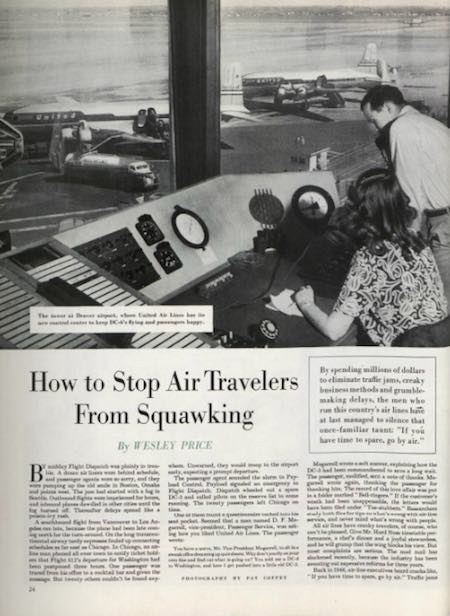
How to Stop Air Travelers from Squawking
On June 11, 1949, the Saturday Evening Post published an article called “How to Stop Air Travelers From Squawking.” The gist of the article was that airlines were going to great lengths to improve airline efficiency, with the seeming goal of making air passengers happier.
Between 1946 and 1948, on-time arrivals had improved by 65%, due to a combination of technique and technology. United led these improvements by applying assembly-line upgrades to planes and installing state-of-the-art communication systems. The United management team also went to great lengths in order to satisfy customers.
Every morning in Denver, 20 United department heads would gather to “review tactical defeats suffered in the previous twenty-four hours and plan the current day’s battle order… If United mislays your suitcase, the high command hears about it.”
This attention to customers didn’t just take place in the boardroom. A pilot, upon discovering that he had a planeload of non-English-speaking Chinese people headed to Hartford, made sure that a Chinese-speaking representative was there to meet them. When a woman bruised her leg in a car on the way to the airport, “United had a doctor intercept her plane at the Denver airport. Another doctor treated her in Chicago. A passenger agent escorted her to a hotel in New York. She would have been astonished to know that Denver had pulled the wires, and that her limp was reported to a roomful of top executives at the next day’s briefing.”
The sheer scale and logistics of modern air travel likely makes such attention to individual comfort impossible. And we are no doubt safer in the air than we were in 1949. But one can still be wistful for an era where people were treated like customers, and not cattle or criminals.
“Faithful Lovers” by Margaret Drabble
There must have been a moment at which she decided to go down the street and around the corner and into the café. For at one point she was walking quite idly, quite innocently, with no recollection or association in her head but the dimmest shadow of long-past knowledge, and within ten yards she had made up her mind that she would go and have her lunch in that place where they had had lunch together once a fortnight or so over that long and lovely year. It was the kind of place where nobody either of them knew would ever see them. At the same time, it was not impossibly inconvenient, not so very far from Holborn, where they both had good reason to be from time to time. They had felt safe there — as safe as they could ever feel — yet at the same time aware that they had not allowed themselves to be driven into grotesque precautions.
And now, after so long, after three years, she found herself there — and at lunchtime, too. She was hungry. There is nothing more to it than that, she said to herself. I happened to be near, and the fact that I wanted my lunch reminded me of this place, and moreover, there is nowhere else possible within a five-minute walk. She had done enough walking, she thought — from the Old Street tube station to the place where they had made her new tooth. She ran her tongue over the new front tooth, reassuringly, and was slightly ashamed by the immense relief that she felt at being once more presentable, no longer disfigured by that humiliating gap. She had always made much of caring little for her beauty, and was always disturbed by the accidents that brought her face to face with her own vanity — by the inconvenient pimple, by the unperceived smudge on the cheek, by the heavy cold. And that lost tooth had been something of a test case ever since she had had it knocked out, while still a child at school. Her dentist had made her the most elaborate and delicate bridge then, but the night before last she had fallen after a party and broken it. She had rung up her dentist in the morning, and he had promised her a temporary bridge to last her until he could make her a new one. When he had told her the name of the place she should go to to collect the bridge, she had noticed in herself a small flicker of recollection. He went on explaining to her, obliging yet irritable. “You’ve got that then, Mrs. Harvey? Eighty-two St. Luke’s Street? You go to Old Street station, then turn right…” And he had explained to her that she should express her gratitude to the man at the laboratory, in view of the shortness of the notice. And she had duly expressed it to the man when, ten minutes ago, he handed her the tooth.
Then she had come out and walked along this street. And as she paused at the café door, she knew that she had been thinking of him and of that other year all this time, that she could not very well have avoided the thought of him, among so much familiar scenery. There they had sat in the car and kissed, and endlessly discussed the impossibility of their kissing; there they had stood by that lamppost, transfixed, unable to move. The pavement seemed still to bear the marks of their feet. And yet it was all so long ago, so thoroughly slaughtered and decayed. It was two years since she had cared, more than two years since she had suffered.
She was content, she was occupied, she had got her tooth back, everything was under control. And in a way it made her almost happy to be back in this place, to find how thoroughly dead it all was. She saw no ghosts of him here; for a year after their parting she had seen him on every street corner, in every passing car, in shapes of heads and hands and forms of movement, but now he was nowhere anymore, not even here. For as long as she had imagined that she saw him, she had imagined that he had remembered. Those false ghosts had been in some way the projected shadows of his love; but now she knew that surely they had both forgotten.
She pushed open the door and went in. It looked the same. She went to the side of the room that they had always favored, away from the door and the window, and sat at the corner table, where they had always sat when they could, with her back to the door. She sat there and looked down at the red-veined Formica tabletop, with its cluster of sugar bowl, salt and pepper, mustard and ketchup, and an ashtray. Then she looked up at the dark yellow ceiling, with its curiously useless trelliswork hung with plastic lemons and bananas, and then at the wall, papered in a strange, delicate, dirty flowered print. On the wall hung the only thing that was different. It was a calendar, a gift from a garage, and the picture showed an Alpine hut in snowy mountains, for all that the month was May. In their day the calendar had been one donated by a fruit juice firm, and they had seen it through three seasons; she recalled the anguish with which she had seen its leaves turn, more relentless even than those leaves falling so ominously from real trees, and she recalled that at the time of their parting the calendar showed an appalling photograph of an autumn evening in a country garden, with an old couple sitting by their ivy-covered doorway.
They had both been merciless deliverers of ultimatums, the one upon the other. And she had selected in her own soul the month, and the day of that month, and had said, “Look, on the twenty-third, that’s it, and I mean it this time.” She wondered if he had known that this time it was for real. Because he had taken her at her word. It was the first time that she had not relented, nor he persisted; each other time they had parted forever, a telephone call had been enough to reunite them; each time she had left him, she had sat by the telephone biting her nails and waiting for it to ring. But this time it did not ring.
The menu, when it was brought to her, had not altered much. Though she never knew why she bothered to read menus, for she always ate the same lunch — a cheese omelette and chips. So she ordered her meal, and then sat back to wait. Usually, whenever left alone in a public place, she would read, and through habit she propped a book up against the sugar bowl and opened it. But she did not look at the words. Nor was she dwelling entirely upon the past, for a certain pleasurable anxiety about that evening’s show was stealing most of her attention, and she found herself wondering whether she had adequately prepared her piece about interior decoration for the discussion program she’d been asked to appear on, and whether David Rathbone, the producer, would offer to drive her home, and whether her hair would look all right. And most of all, she wondered if she ought to wear her gray skirt. She was not at all sure that it was not just a little bit too tight. If it wasn’t, then it was perfect, for it was the kind of thing that she always looked marvelous in. Then she said to herself: The very fact that I’m worrying about it must mean that it must be too tight after all, or the thought of its being too tight wouldn’t have crossed my mind, would it? And then she saw him.
What was really most shocking about it was the way they noticed each other simultaneously, without a chance of turning away or in any way managing the shock. Their eyes met, and they both jerked, beyond hope of dissimulation.
“Oh, God,” he said, after a second, and he stood there looking at her.
And she felt at such a loss, sitting there with her book propped up against the sugar bowl, and her head full of thoughts of skirts and false teeth, that she said, hurriedly, throwing away what might after all have been really quite a moment, “Oh, Lord, oh, well, since you’re there, do sit down.” And she moved up the wooden bench, closing up her book with a snap, averting her eyes, confused, unable to look.
And he sat down by her, and then said quite suddenly and intimately, as though perfectly at home with her after so many years of silence, “Oh, Lord, my darling Viola, what a dreadful, dreadful surprise. I don’t think I shall ever recover.”
“Oh, I don’t know, Kenneth,” she said, as though she too had discovered exactly where she was. “One gets over these things quite quickly. I feel better already, don’t you?”
“Why, yes, I suppose I do,” he said. “I feel better now that I’m sitting down. I thought I was going to faint, standing there and looking at you. Didn’t you feel some sort of slight tremor?”
“It’s hard to tell,” she said, “when one’s sitting down. It isn’t a fair test. Even of tremors.”
“No,” he said, “no.”
Then they were silent for a moment or two, and then she said, very precisely and carefully, offering her first generous signal of intended retreat, “I suppose that what is odd, really, is that we haven’t come across one another before.”
“Have you ever been back here before this?” he asked.
“No, never,” she said. “Have you?”
“Yes,” he said. “Yes, I have. And if you had been back, you might have seen me. I looked for you.”
“You’re lying,” she said quickly, elated, looking at him for the first time since he had sat down by her, and then looking away again quickly, horrified by the dangerous proximity of his head.
“No, I’m not,” he said. “I came here, and I looked for you. I was sure that you would come.”
“It’s a safe lie,” she said, “like all your lies. A lie I could never catch you out in. Unless I really had been here, looking for you, and simply hadn’t wanted to admit it.”
“But,” he said with conviction, “you weren’t here at all. I came, but you didn’t. You were faithless, weren’t you, my darling?”
“Faithless?”
“You forgot me quicker than I forgot you, didn’t you? How long did you remember me?”
“Oh, how can one say?” she said. “After all, there are degrees of remembrance.”
“Tell me,” he said. “What harm can it do to tell me now?”
She moved a little on the seat, away from him, but settling at the same time into a more comfortable pose of confidence, because she had been waiting for years to tell him.
“I suffered quite horribly,” she said. “Really quite horribly. That’s what you want to hear, isn’t it?”
“Of course it is,” he said.
“Oh, I really did,” she said. “I can’t tell you. I cried all the time, for weeks. For at least a month. And whenever the phone rang, I started, I jumped, like a fool, as though I’d been shot. It was pathetic, it was ludicrous. Each time I answered and it wasn’t you I would stand there listening, and they would go on talking, and sometimes I would say yes or no, as I waited for them to ring off. And when they did ring off I would sit down and I would cry. Is that what you want me to say?”
“I want to hear it,” he said, “but it can’t, it can’t be true.”
“It’s as true as that you came to this place to look for me,” she said.
“I did come,” he said.
“And I did weep,” she said.
“Did you ever try to ring me?” he asked then, unable to resist.
“No!” she said with some pride. “No, not once. I’d said I wouldn’t, and I didn’t.”
“I rang you, once,” he said.
“You didn’t,” she said, and became aware at that instant that her knees under the table were trembling.
“I did,” he said. “It was just over a year ago, and we’d just got back from a party — about three in the morning it was — and I rang you.”
“Oh, God,” she said, “oh, God. It’s true, it’s not a lie, because I remember it! Oliver went to answer it, and he came back saying no one was there. But I immediately thought of you. Oh, my darling, I can’t tell you how I’ve had to stop myself from ringing you, how I’ve sat there by the phone and lifted the receiver and dialed the beginning of your number, and then stopped. Wasn’t that good of me?”
“Oh,” he said, “if you knew how I’d wanted you to ring.”
“I did write to you once,” she said. “But I couldn’t bring myself to post it. But I’ll tell you what I did do: I typed out an envelope to you, and I put one of those circulars from that absurd poetry club of mine into it, and I sent it off to you, because I thought that at least it might create in you a passing thought of me. And I liked the thought of something from my house reaching your house. Though perhaps she threw it away before it even got to you.”
“I remember it,” he said. “I did think of you. But I didn’t think you sent it, because the postmark was Croydon.”
“Oh,” she said, weakly. “You got it. Oh, Lord, how alarmingly faithful we have both been.”
“Did you expect us not to be? We swore that we would be. Oh, look, my darling, here’s your lunch. Are you still eating cheese omelettes every day? Now, that really is what I call alarming consistency. And I haven’t even ordered. What about some moussaka? I always used to like that; it was always rather nice, in its own disgusting way. One moussaka, please.”
After her first mouthful, she put down her fork and said reflectively, “From my point of view, at least, the whole business was quite unnecessary. What I mean is, Oliver hadn’t the faintest suspicion. Which, considering how ludicrously careless we were, is quite astonishing. We could have gone on forever, and he’d never have known. He was far too preoccupied with his own affairs.”
“You know,” he said, “all those continual threats of separation, of ending it — that was really corrupt. I feel bad about it now, looking back. Don’t you?”
“How do you mean, bad about it?” she said.
“I feel we ought to have been able to do better than that. Though, come to think of it, it was you that did nearly all the threatening. Every time I saw you, you said it was for the last time. Every time. And I must have seen you six days in every week for over a year. You can’t have meant it each time.”
“I did mean it,” she said. “Every time I said it. I must have meant it, because I finally did it, didn’t I?”
“You mean we did it,” he said. “You couldn’t have done it without my help. If I’d rung you, if I’d written to you, it would have started all over again.”
“Do you really think so?” she said, sadly, without malice, without recrimination. “Yes, I suppose you might be right. It takes two to part, just as it takes two to love.”
“It was corrupt,” he said, “to make ourselves live under that perpetual threat.”
“Yes,” she said, “but remember how lovely it was, how horribly lovely, each time that one relented. Each time one said, ‘I’ll never see you again . . . all right, I’ll meet you tomorrow in the usual place at half-past one.’ It was lovely.”
“Lovely, but wicked,” he said.
“Oh, that sensation,” she said, “that sensation of defeat. That was so lovely, every time, every time you touched me, every time I saw you. And I felt so sure, so entirely sure that what you felt was what I felt. Lord, we were so alike. And to think that when I first knew you I couldn’t think of anything to say to you at all; I thought you came from another world, that we had nothing in common at all, nothing except, well, except you know what; I feel it would be dangerous even to mention it, even now. Oh, darling, what a disaster, our being so alike.”
“I liked it, though,” he said. “I liked breaking up together. Better than having it done to one, better than doing it.”
“Yes, but more seriously incurable,” she said. And silence threatening to fall once more, she said quickly, “Anyway, tell me what you’re doing round here. I mean to say, one has to have some reason for coming to a place like this.”
“I told you,” he said. “I was looking for you.”
“You are a liar,” she said, smiling, amazed that even here she could allow herself to be amused; indeed, could not prevent herself from smiling.
“What are you doing here, then?”
“Oh, I had a perfectly good reason,” she said. “You know that false front tooth? Well, yesterday morning I broke it, and I’ve got to do a program on television tonight, so I went to my dentist and he made me a temporary new bridge, and I had to come round here to the laboratory to pick it up.”
“Have you got it in?”
“Look,” she said, and turned to face him, smiling, lifting her upper lip.
“Well, that’s convincing enough, I guess,” he said.
“You still haven’t told me what you’re doing here,” she said. “I bet you haven’t got as good a reason as me. Mine is entirely convincing, don’t you think? I mean, where else could I have had lunch? I think my reason clears me entirely of suspicion of any kind, don’t you?”
“Any suspicion of sentiment?”
“That’s what I meant.”
He thought for a moment, and then said, “I had to call on a man about my income tax. Look, here’s his address.” And he got an envelope out of his pocket and showed her.
“Ah,” she said.
“I came here on purpose,” he said. “To think of you. I could have had lunch at lots of places between London Wall and here.”
“You didn’t come here because of me; you came here because it’s the only place you could think of,” she said.
“It comes to the same thing,” he said.
“No, it doesn’t,” she said firmly. She felt creeping upon her the familiar illusion of control, created as always before by a concentration upon trivialities; she reflected that their conversations had always followed the patterns of their times in bed, and that these idle points of contention were like those frivolous, delaying gestures in which she would turn aside, in which he would lie still and stare at the ceiling, not daring to touch her, thus merely deferring the inevitable. Thinking this, and able to live only in the deferment, for now there was no inevitable outcome that she could see, she said, eating her last chip, “And how are your children?”
“They’re fine,” he said, “fine. Saul started grammar school. We were pleased about that. What about yours?”
“Oh, they’re all right, too. I’ve had some dreadful nights with Laura recently. I must say I thought I was through with all that — I mean, the child’s five now — but she says she can’t sleep and has these dreadful nightmares, so she’s been in my bed every night for the last fortnight. It’s wearing me out. Then in the morning she just laughs. She doesn’t kick; it’s just that I can’t sleep with anyone else in the bed.”
“What does Oliver say?” he asked, and she said, without thinking, “Oh, I don’t sleep with Oliver anymore,” and wondered as she said it how she could have made such a mistake, and wondered how to get out of it. But fortunately at that instant his moussaka arrived, making it unnecessary to pursue the subject. Though once it had become unnecessary, she regretted the subject’s disappearance; she thought of saying what was the truth itself — that she had slept with nobody since she had slept with him, that for three years she had slept alone, and that she was quite prepared to sleep alone forever. But she was not entirely sure that he would want to hear it, and she knew that such a remark, once made, could never be retracted, so she said nothing.
“It looks all right,” he said, staring at the moussaka. He took a mouthful and chewed it, and then he put his fork down and said, “Oh, Lord, oh, Lord, what a Proustian experience. I can’t believe it. I can’t believe that I’m sitting here with you. It tastes of you, this stuff. Oh, God, it reminds me of you. You look so beautiful, you look so lovely, my darling. Oh, God, I loved you so much. Do you believe me — that I really loved you?”
“I haven’t slept with anyone,” she said, “since I last slept with you.”
“Oh, darling,” he said. And she could feel herself fainting and sighing away, drifting downward on that fatefully descending, eddying spiral, like Paolo and Francesca in hell, helpless, the mutually entwined drifting fall of all true lovers, unresisting. It was as though three years of solitude had been nothing but a pause, nothing but a long breath before this final acknowledgment of nature, damnation, and destiny. She turned toward him and said, “Oh, my darling, I love you. What can I do? I love you.” And he, with the same breath, said, “I love you, I all the time love you, I want you,” and they kissed there, their faces already so close that they hardly had to move.
Like many romantics, they habitually connived with fate by remembering the names of restaurants and the streets they had once walked along as lovers. Those who forget forget, he said to her later, and those who do not forget will meet again.
Babe Ruth’s Beginnings
This article and other features about baseball can be found in the Post’s Special Collector’s Edition, Baseball: The Glory Years. This edition can be ordered here.
In talking about himself, the Babe wishes to make it clear that he has been both bad and good, and that his real name is George Herman Ruth, and not Ehrhardt, as has been often stated in the question-and-answer departments of newspapers. The late Jack Dunn, owner and manager of the Baltimore ball club, called him George until the players had unanimously decided on “Babe,” and made it stick.
“In those days,” Ruth explains, “Dunn was always digging up youngsters for tryouts with his ball club. When
Brother Gilbert and myself came out of Jack’s once after they had signed me to a baseball contract 18 years ago, the players saw me from a distance. ‘There’s another one of Dunn’s babies,’ one of them remarked. The minute I put on a uniform they called me Babe and, in baseball, I have never known any other name. I’m not kicking, though. I rather like it. I was such a big fellow that the nickname of Babe struck the other boys as funny. I guess it would still be funny if we hadn’t all got used to it.”
“How long do you expect to play ball?” he was asked.
“I figure that about two more years ought to do me, but you can’t tell about that. You know how it is. Clark Griffith may have been right when he said that no ballplayer ever voluntarily quits the game until they cut the uniform to him. Anyway, I won’t be in there until I trip on my whiskers and the boys begin feeling sorry for me. I won’t have to do that.”
“What’s the most money you ever made in one year, Babe?”
He rubbed his freshly shaven face in an effort to remember. “About $130,000 — that is, counting baseball salary, exhibition work, stage appearances, syndicate writing, and so on. And, boy,” he chuckled, “you ought to see how I managed to scatter that chunk.”
“Did you ever try to figure how much you have earned altogether since you began playing professional baseball 18 years ago?”
“Oh, my average has been better than $50,000 a year. I’ve made at least a million dollars. Threw away more than half of it too. Had a lot of fun, though.”
“Did you have any aim in life, or any particular thought to the future, when you started out as a ballplayer?”
“No, of course I didn’t. I just wanted to play ball. I still like to play, even if it’s just for the fun of it. When I got my first job it seemed funny to me that anybody would pay me money to play ball.”
“Which do you get the most thrill out of — your pitching or your hitting?”
“That’s hard to say,” he replied after some thought. “I don’t believe I could ever get any more thrill than I did in pitching those scoreless innings in the 1918 World Series back in Boston. Still, anybody gets a big kick out of taking a cut at that ball and hitting it on the nose. Anyway, I know the public gets a bigger kick out of seeing a fellow hit ’em than in seeing him pitch ’em. Why, take a 60-year-old golfer, for instance. Nothing in the world gives him such a thrill as clipping that golf ball on the button with a full swing. They’ll tell you the science of the fine shots is what counts, but that’s all baloney. What counts in their lives is socking that ball and giving it a ride.
“Now, the records will show that I was a pretty good pitcher. You never hear much about that, though… The kids know me as a home-run slugger.”
During the past World Series in 1931 Ruth sat beside the writer in the grandstand at St. Louis, experting on the big games. “Mr. Ruth,” interrupted a pleasant-voiced young lady, “will you please autograph this program for me? My uncle was a ballplayer and — ”
“OK,” said the Babe, scrawling his familiar signature and passing it back over his shoulder. “Now I’m in for it,” he confided out of the corner of his mouth; “they’ll keep this up for an hour.”
And they did. Protesting ushers were swept aside in the rush. The autograph seekers were in attacking formation. They brought programs, rain checks, toy bats, notebooks, hatbands — everything — to be decorated with the Ruth signature. After a half hour his hand was so badly cramped that he demanded a rest.
“First thing you know,” he said, “ some bird will be asking me to sign his socks.”
“Listen,” Ruth finally warned his increasing admirers, “I’m going to stop when play starts. You know, I want to see some of this ball game myself.” That merely served to accelerate the rush.
The amplifiers finally announced the first batter.
“No, that’s all,” the Babe resolutely denied the next applicant. “No more till tomorrow. None after the game either.”
“Can’t you sign this baseball, Mr. Ruth?” a rather weary voice spoke behind him.
“No, no. I turned down the others. Come out before the game tomorrow. I’ve been doing this for an hour now. Got to see the ball game.”
“I’m sorry,” explained the voice. “I had to come up on crutches and just got here.”
“What’s that — crutches? Well, that’s different.” His big hand reached back for the ball and he carefully inscribed his name. “Sorry you had so much trouble. You’re welcome. That’ll get me in trouble sure,” came in an undertone from the corner of his mouth.
“Won’t you please sign this score card?” immediately spoke a feminine voice. “My father owns a baseball club out West. Won the pennant.”
“All right. Hand it over.” And down went the signature, with the added comment: “Good luck to the Indians.”
With these two exceptions he stuck to his refusal and called it a day.
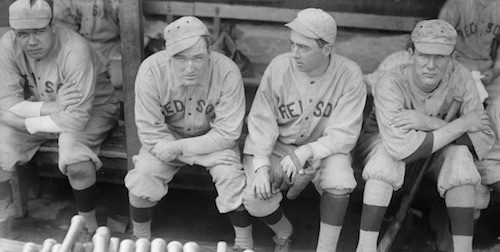
Today Ruth looks back on St. Mary’s, the orphanage where he was raised, as the real home of his early boyhood. The memories of it are very dear to him. “You know,” he said, during a later lull in the ball game, “I was not an orphan when I went to St. Mary’s. My parents were living, but they were very poor. I went to that school the first time when I was only 6 years old. The second time they sent me I stayed there. Oh, yes, I guess I was a truant, all right, and needed to be taken there, but many boys who went there were not bad boys or truants. They were sent by their parents to St. Mary’s just to learn a trade. It’s a great school.”
“What trade did they select for you?” I asked him.
“Oh, I was a shirt maker — darn good one too. That’s why they can’t fool me about shirts to this day. I know how they are cut and how the parts are put together. I worked at an electrical machine which stitches the parts of a shirt together. I was the best one in the school,” he added, with a touch of pride.
The boys at St. Mary’s were not long in discovering that George Ruth, as they knew him then, could throw a baseball harder and hit one farther than any other kid in school. Ruth is very much in doubt as to what position he played at first. “Oh, I just played ball and played in any position they’d let me. I’ve been outfielder, infielder, catcher, and pitcher. It made no difference to me. You know how it is with boys.”
In time Ruth developed so much prowess as a pitcher that he was assigned to that job regularly. It was his remarkable showing as a left-handed pitcher that influenced Brother Gilbert to speak to Jack Dunn, owner and manager of the Bal- timore club, about him. “You can bet I will never forget that day,” says Ruth. “Boy, that was a thrill! After Jack Dunn had talked to me for a few minutes they gave me a sort of tryout in the yard. I guess Jack decided that I had something.”
Brother Gilbert explained to Ruth that boys played ball for fun, but that he was now taking a man’s job that called for business arrangements. “Mr. Dunn has agreed to pay you $600 for the six months of the playing season,” Brother Gilbert told Ruth. “That is $100 a month, or about $25 a week. Would you be satisfied with that, George?”
Ruth says that he would have been satisfied to play baseball for nothing, as long as he had a place to eat. Six hundred dollars was about the largest sum of money his mind had ever contemplated. “I got a big kick out of winning my first World Series game,” he says. “It was another kick when I established that record of the most scoreless innings pitched in a World Series. And you know my feelings when I hung up that home-run record for the Yankees. But I’m telling you, the biggest kick I ever got was when I walked out on that field that day and told the other boys that I had signed a contract and was now a real, honest-to-goodness professional ballplayer and was going to get paid for it.”
Babe’s recollection is that Manager Dunn raised his salary at the end of the second month, making his total for the season $1,800. Never having known anything about the value of money and never having had possession of more than two or three dollars at a time, this $300 a month seemed to the Babe an enormous sum. The players on the Baltimore club found this big, gawky youth one of the most generous-hearted souls they had ever met. He would give them his shirt if they wanted it. If he had $100 in his pocket, he would bet it on a horse race just as quickly as if the amount had been $5. The Oriole players hated to see him go, but they knew that he was bound to go sooner or later. And they were right.
Before the end of that season — 1914 — Ruth had joined the Red Sox. In Boston they gave him a contract calling for $3,500 a season. Besides learning the finer tricks of baseball, Ruth wanted to learn what the boys in fast company did for amusement in their o hours. His education in that respect was rapid indeed. e world had opened up for the Babe and he wanted to examine its inside to see what made it tick.
Probably the greatest sense of freedom and well-being that Ruth had ever enjoyed up to that time was his first experience as a guest in the hotels patronized by the Baltimore club. The elevators fascinated him. He rode them up and down for the sheer joy of it. His first adventure into the fast life was the acquisition of a bicycle, obtained temporarily from a messenger. As a consequence, he got the habit of sneaking off for a trip of exploration occasionally, much to the worry of Manager Dunn. Finally Dunn called a stern halt to Babe’s excessive riding on elevators and bicycles.
One of the early uses for money as discovered by the Babe was an unrestrained indulgence in hot dogs. Before, during, and after the games he bought and consumed them. He would now but for a rigid diet decree that he reluctantly obeys. After Ruth became famous, one of his attacks of indigestion was attributed to his consumption of 11 hot dogs and three bottles of soda pop in one afternoon at the ball park.
One day, in a batting practice just before the game, Ruth hit a liner that cleared the right-field fence like a bullet. The grandstand buzzed with the wonder of it. Long before that, however, the players had been talking about this natural hitter with such perfect form. To the wonder of experts, this big kid could take a full swing with a bat, gripping the handle at the extreme small end, and time the ball with as much precision as if he had chopped it.
Up to that time it had been the batting theory that a full swing lessened the hitter’s accuracy and gave the pitcher all the advantage. There were a few exceptions, but most of the great hitters used the short or chop swing, and stepped forward to meet the ball in front of the plate. By taking a chop swing they could keep their eye on the ball all the time and not be thrown off balance by a violent swing. Ruth upset all that. His perfect eyesight, his sense of timing and his muscles were so coordinated that he could take a shoestring swing and throw the full weight of his big body behind the wallop with precision. Ruth’s demonstration of such power in natural rhythm was the forerunner of the home-run fad that made a revolutionary change in the game. Others began trying it, and even the kids on the sandlots caught the fence-busting craze. Even so, it was a long time before the best baseball minds thought of Ruth as a regular batter. He was regarded as a freak. They marveled at the terrific force of his drives, but continued to think of him as a pitcher rather than as a batter.
Though he developed into a masterful pitcher and holds the record of having pitched 29 consecutive scoreless innings in a World Series (1916 and 1918), Ruth was not an object of hero worship, nor did he come into riches, until he began to hit his home runs.
In 1918, Ed Barrow, a veteran baseball man, was manager of the Boston Red Sox. In Ruth he knew that he had a great pitcher, but when the Babe began to hit home runs with marked regularity in 1918, Barrow saw that he might be more effective as a hitter than as a defensive player. Also his keen mind had noted the eagerness of the fans to see Ruth bat, even when he was pitching masterfully.
Before the next season came around, the farseeing Barrow had made up his mind. The season of 1919 found Babe Ruth one of the regular out elders. All baseball watched the experiment with keen interest, a few openly doubting its success. Ruth had established a world’s record by pitching. Still, Barrow had to consider that a pitcher would be inactive about four days out of five. “Can’t keep a man like that on the bench,” decided the manager, and he was wise.
In appreciation of his work as a pitcher as well as a hitter, the Boston club raised Ruth’s salary from $7,000 to $10,000 and gave him the three-year contract. That was the contract that the New York Yankees eventually bought.
In the spring of 1919, Ruth hit 29 home runs, a new world’s record. To appreciate the impact of that accomplishment, you need only look back six years earlier. In 1913 when Frank Baker of the Athletics had hit 12 home runs, it was regarded such a marvelous performance that he earned the sobriquet of Home Run Baker.
Ruth’s longest home run of record was made in Tampa, Florida, in an exhibition game between the New York Giants and the Boston club in the spring of 1919. This game was played in a race-track inclosure. The ball hit by Ruth not only went over the outer circle of the track but cleared the distant barns and fell into a sort of park in front of the Tampa Bay Hotel. The distance covered by this long drive was so unbelievable that a group of Boston and New York writers got a tape line and measured it. From the home plate to the point where the ball struck the ground was exactly 508 feet.
At the end of the 1919 season, in which Babe Ruth had shattered all home-run records, Harry Frazee, owner of the Red Sox, was in financial straits. He agreed to turn Ruth’s contract over to the New York club for $100,000 in cash.
When the deal had been finally consummated and Ruth had become the property of the New York club, practically every newspaper in the big city carried the news on the front page under glaring headlines. New York dearly loves a hero, and here was one made to order. The fact that much was expected of him and that the eyes of a great city were upon his every move did not in the least disturb Mr. Ruth. Reporting to Manager Miller Huggins for spring practice, Ruth began hitting home runs in the exhibition games and kept it up right to the end of the season. Long before the summer was over the Bambino, as Ruth came to be called by his Italian admirers, and then by everybody, had passed his world’s record of 29 home runs and was onto a new mark. At the end of the 1920 season, Ruth had astounded all baseball by making 54 home runs. This was an average of a fraction more than one for every three games.
With his mad rampage of home-run hitting, attendance at the Yankee games increased in jumps. A few years earlier, it was considered worthy of note for a major-league ball club to play to more than 500,000 spectators in a season. With the coming of Ruth, the Yankees eventually passed the 1 million mark.
Flush with box office receipts, the owners bought a big plot of ground in the Bronx across the river from the Polo Grounds and built a stadium costing more than $2 million. Though this structure is officially called the Yankee Stadium, it is frequently, and justly, referred to as The House That Ruth Built. An architectural feature of great satisfaction to the Babe was the close proximity of the kitchen, where the hot dogs are concocted, to the players’ bench.
The Yankee owners, in appreciation of what Ruth had done for the club, voluntarily raised his salary to $30,000 for the season of 1921.
—“And Along Came Ruth” (4-part series) by Bozeman Bulger, November–December 1931
Escape from Vietnam: A Refugee‘s Story of the American Dream
I spoke my first words on a boat: “milk,” “cockroach,” and “itchy.” An unusual toddler vocabulary, perhaps, but not surprising considering that I spent the second year of my life on a freighter with thousands of other people, a floating petri dish of equal parts vomit, diarrhea, desperation, and hope. Every inch of that boat teemed with refugees: the cargo hold, hallways, and deck. Even the captain’s steering room had ceased to be a sanctuary.
I am an immigrant from Vietnam. I left the land of my birth in 1978 — just shy of my first birthday — and arrived in the U.S. a few weeks after I turned two. All of us on that boat, and hundreds of thousands of others, fled for the same reason: to escape the oppression of the communist regime. It took us more than one full year to arrive in the United States, most of that time spent on an over-packed freight ship smuggling 2,300 other refugees in a cargo hold full of festering flour and one functioning restroom.
Like many ethnic Chinese in Vietnam, my family members were merchants. My maternal grandma, who had fled to Vietnam from British-held Hong Kong as a teen to escape the Japanese invasion in the 1930s, had a fabric stall at Saigon’s Ben Thanh Market. My dad had a factory that manufactured shampoo and detergent. After the Vietnam War officially ended in April of 1975 with the fall of Southern Vietnam to the Northern Vietnamese communists, the new regime stripped our family of its livelihood, confiscating our family businesses and much of our savings. They also introduced a series of new currencies — each time capping the sum families were permitted to exchange. Anyone found with more was punished, the money confiscated.
Years later, my grandma would tell of counting her life savings, exchanging the maximum allowed, and burning the remainder. She described watching her tears fall into the flames as her money burned; just burning and crying, because what else was there to do?
Early in 1977, the year before we fled Vietnam, my mom was six months pregnant with me, and my father was in jail for “unpatriotic acts” after commissioning the building of a small junk boat he’d hoped to use for our escape. My mom visited my dad in his cell so he could help name me. He must have had money on his mind, as my name translated means gold and jade.
My grandfather had just passed away, but my maternal grandma still had five kids at home to raise. She was 4 feet 9 inches on a tall day and a breadwinning matriarch before her time. She negotiated an escape route for us on that Panamanian freight ship, but it would come at a steep cost.
There were 19 of us in total in my nuclear and extended family. Passage on the ship was purchased with luong, 1.2-ounce 24-karat gold bars. All told, 154 luong — more than $135,000 in today’s dollars — were required to smuggle my family out of Vietnam. Those bars were the culmination of a lifetime of work, coated with love and stamped with faith, molded into 24 karats of black market gold. Which is how we found ourselves part of the mass exodus that would come to be known as the “Vietnamese Boat People.”
After being denied entry at the ports of Hong Kong, Indonesia, and Brunei for temporary asylum, we floated aimlessly at sea, waiting. My mom watched over my 2-year-old brother and me while we all sat atop a 2-foot-by-2-foot table. Another family lived in a permanent crouch underneath. All around us, families staked their claims to plots of floor, sleeping upright, backs propping up backs. If someone needed to do their business or go in search of food, family members would stand vigil over the hard-won territory. Somehow, even as we were reduced to human freight, the framework of family held, in the form of “Go, I got your back.”
Eventually our freighter docked in the Philippines, but we were not allowed to disembark — all of the existing camps were full.
After a full 10 months at sea, we were finally transferred to a makeshift refugee camp on a Philippine island. My mom set me on the ground to roam and was pleased to discover that I could run.
At the camp, my parents and extended family underwent an arduous vetting process that included background checks and physical screenings with blood tests. Then came the search for a sponsoring country. A refugee who could claim a relative in another country was given priority there. Barring that, where you wound up was a crapshoot by the United Nations High Commissioner on Refugees.
My parents, my brother, and I lingered in this system for several months until a church group in Minnesota agreed to sponsor us. In one fell swoop, we were whisked from the humidity of the tropics to the subzero temperatures of a Midwestern December. The commitment and logistics of sponsoring and providing for a refugee family are significant, so the church group shared the responsibilities for clothing, sheltering, and integrating us into American life. One group of volunteers met us at the airport with donated secondhand winter jackets. Other volunteers helped us find and furnish a small two-bedroom home in the suburbs, while still others worked on getting sponsorship for the rest of our family, until all 19 of us were reunited.
Our family also relied on public social programs as we adjusted and assimilated into American society. My parents enrolled my brother and me in a Head Start preschool while they studied English, passed the GED, and took job-training classes. For a year or so, we lived on welfare and food stamps, supplemented by baffling 10-pound blocks of bright orange government cheese.
Within two years, my mom spoke English well enough to take a job in a bank, the start of a 30-year career that became our modest family livelihood. When it came time for my brother and me to think about college, we benefited from the expectation in our family that we would go. We had as role models close relatives who had recently graduated. But we also relied on programs like need-based grants, low-interest loans, and work-study programs.
We hear so much talk about individual resilience, self-reliance, and the proverbial bootstraps being the ingredients of the American Dream, and I’d like to think my family exhibited those traits in our extraordinary journey. But there is a lot more that goes into the American Dream’s promise of providing people an opportunity to improve their lives and to contribute to this great nation. Nothing exists in a vacuum, after all, and certainly not opportunity. We all rely on the springboard provided by our extended families, our communities (like those Minnesota church volunteers who made our American story possible), and, yes, government-backed immigration policies and programs like those that let us enter, fed us, and then helped us obtain an education.
Now, more than three decades and a generation after we fled Vietnam, my younger child has just turned two — the age I was when I arrived in the U.S. Her first words? Milk, mama, and dada.
Kim Luu has M.Eng. and B.S. Environmental Engineering degrees from MIT and UCLA. She works in the environmental sustainability field in Los Angeles, where she lives with her husband and two kids. She wrote this for What It Means to Be American, a partnership of the Smithsonian and Zócalo Public Square.
This article is featured in the March/April 2017 issue of The Saturday Evening Post. Subscribe to the magazine for more art, inspiring stories, fiction, humor, and features from our archives.
Tani-san at the End of the Earth
Tani-san stood like a grim little sentinel, gazing out over the wide blue ocean yet there was still no sign of the battered fishing vessel that had ferried them out to this rocky isle on the tip of the Shiretoko Peninsula. Indeed, such was her sense of imminent catastrophe that she would have gladly welcomed a Russian submarine.
“You can say what you like,” she remarked to her less impressive companion, Mrs. Ishihama, who was inclined to take a more cheerful view of their current predicament, “but my instincts are telling me that we could be stuck out here for quite some time. And as you know, they are never wrong.”
If blame was to be allocated, and it surely was, then it was to be laid at the door of their fellow castaway Mrs. Terakado, who had insisted on altering the schedule of their three-day trip to Hokkaido to take in the beauty of this tiny island, which was noted for its dazzling displays of wildflowers. Of course, what Mrs. Terakado had failed to establish was that it was also noted for its remoteness and the treachery of its surrounding waters, which was why the four little ladies had been obliged to charter a fishing boat to get them there in the first place.
“Yes, but surely they won’t have forgotten about us?” said Mrs. Ishihama, who was having to hold onto her sun hat to prevent it from blowing away.
“Well, take a moment and just think about it,” said Tani-san, all too aware that she was asking Mrs. Ishihama to do something that did not come naturally to her like asking a crane to ride a bicycle. “How many people know that we’re here?”
“Mmm. Good question,” mused her slow-witted friend as she gave the problem her full attention. “Well, there’s that fishing boat captain for a start.”
“Yes,” said Tani-san with great patience. “And who else?”
Slowly and with painstaking diligence, Mrs. Ishihama went through her mental inventory of friends, acquaintances, relatives, neighbors, TV personalities, members of the government, and all of the various shop assistants that she’d had dealings with at one time or another, crossing them off one by one until she had finally exhausted the possibilities.
“… Oh,” she said as the penny finally dropped. “I see what you mean.”
Still, it took a great deal more than hard facts to put a dent in her empty-headed optimism, as soon became apparent:
“All the same,” she said, “I wouldn’t worry too much if I were you. I’m sure the captain will be along any minute now. I, for one, have every confidence in him. He’s so rugged and fascinating, don’t you think?”
If truth be told, Mrs. Ishihama had developed a bit of a crush on the wooly-haired fisherman who had deposited them on the shores of this lonely island so her opinion of him was rather subjective to say the least.
“Well, if by ‘rugged and fascinating’ you mean utterly incompetent and blind drunk,” said Tani-san, “then yes, I would have to say that he is by far the most rugged and fascinating seafarer that I’ve ever come across.”
“Ah! So you agree with me, then!”
“No,” said Tani-san, “I most certainly do not. Apart from getting himself all tangled up in that fishing net, he somehow managed to fall off his own boat. Twice. And we hadn’t even left the harbor at that point. No, my guess is that he’ll be slumped across the wheel out cold and well on his way to Vladivostok by now. So I wouldn’t bank on a rescue coming from that quarter any time soon.”
“Oh dear,” said her dim friend, who was finally starting to appreciate the seriousness of the situation. “What are we to do?”
“Whatever we have to to survive,” said Tani-san. “And by that, I mean anything.”
Mrs. Ishihama cast her eyes over the surrounding slopes, which were copiously adorned with pretty roses, but very little else. Certainly there was nothing in their immediate vicinity that would equip them for survival as far as she could see.
“Well, couldn’t we gather some dry sticks and make a beacon to signal a passing ship?” she suggested hopefully.
“We could and we should,” concurred Tani-san, “but that would still be leaving everything to chance. I see no alternative but cannibalism.”
With that, she turned her gaze toward the other two members of their party — Mrs. Terakado and Mrs. Sekiguchi — who were sitting on a rock some distance away, chatting quietly and eating their packed lunches. The implication, it seemed, was patently obvious. All the same, it took Mrs. Ishihama a moment or two to make the connection.
“… Oh, no!” she exclaimed utterly aghast. “You can’t seriously be suggesting that we eat our dearest friends?”
“I don’t like it any more than you do,” said a stern-faced Tani-san, “but we may have no choice. Every now and then, a certain set of circumstances comes along that obliges you to eat an acquaintance. It is, perhaps, one of the more unpalatable facts of life, but there it is.”
“Yes, but I really don’t think that I could eat Mrs. Sekiguchi even if my life depended on it,” protested her friend. “Not only is she a member of my Tuesday evening flower arranging class, but she also happens to be my youngest nephew’s school teacher.”
“Well, I’m pretty sure that one flower arranger won’t be missed and you would undoubtedly rise in your nephew’s estimation,” said Tani-san. “But if that’s the way you feel about it, we shall start with Mrs. Terakado, who would have been my choice anyway. After all, it was her ineptitude that got us into this fix in the first place, aside from which there is a lot more meat on her. Her bottom alone would see us through the winter.”
Mrs. Ishihama shot a glance at Mrs. Terakado, who had just finished her miso-marinated asparagus and was about to start on a salmon rice ball.
“Even so,” she maintained, “I don’t think that I could bring myself to eat her either. As a rule, I draw the line at whale blubber. And even if I were to contemplate something so unspeakable, it would only be as a last resort.”
“Ah well, there you are, you see?” said Tani-san. “That’s where most castaways make their mistake. For some reason, they tend to regard the eating of their fellow survivors as some drastic final measure when, in fact, it should be the first thing they think of.”
“Oh?” said her puzzled counterpart. “Why’s that?”
“To conserve vital resources,” explained Tani-san. “Observe, if you will, the sheer greed with which Mrs. Terakado is devouring that salmon onigiri. You can guarantee that she is not giving a single thought to the long-term sustainability of our supplies even though we may shortly be facing extinction. In no time at all, she will have emptied that lunch box and will soon be hungry again. What will happen then, do you think? Will she expect to share in our own meager provisions thereby jeopardizing the survival of the entire group, or should she pay for her selfishness in human burgers?”
“Am I supposed to say yes or no?” asked Mrs. Ishihama, who had lost the thread of the argument after ‘vital resources.’
“Yes, of course!” said Tani-san. “To both questions! For make no mistake, things will soon start to turn nasty once the food runs out. Even now, the two of them could be plotting against us. Oh yes, it may look as if they’re just sitting there, enjoying the scenery, but who knows what they’re talking about? Why, they might be planning to turn us into sukiyaki at this very minute!”
“Well, I don’t like the sound of that,” said Mrs. Ishihama, who was rather perturbed by the idea of being talked about as the dish of the day.
“No,” said Tani-san, “neither do I, which is why it’s so important that we act first.”
“By eating our own lunch boxes, you mean?”
“What?” said Tani-san, dismayed, as always, by Mrs. Ishihama’s uncanny knack for missing the point. “How does that help to conserve resources? No, what I’m saying is that we have to get them before they get us!”
“Oh, right, I see,” said Mrs. Ishihama, who really didn’t. The confused silence that followed indicated as much:
“… But if we don’t eat those burgers soon,” she went on, “they’re bound to go off in this heat. And the last thing we need right now is a case of food poisoning.”
“WHAT B—— ?”
Tani-san stopped herself, having realized that it wasn’t worth spending the next 10 minutes going through the whole thing again. It was so much easier just to go along with it.
“You’re right,” she said. “We’ll gobble them up once we’ve dealt with those two.”
“The two lunch boxes.”
“No!” said Tani-san, rapidly approaching the limit of her self-control. “Mrs. Sekiguchi and Mrs. Terakado!”
“Ah yes, of course,” said her brainless co-conspirator with a vague nod. “And how are we going to do that?”
Surprisingly enough, it was a good question, and so Tani-san looked about for a suitable weapon. On the grassy bank to her left there were some loose rocks, but when she tried to lift even the smallest of them she found that it was too heavy for her. So she then picked up a long stick and began to swish it about in the air, yet that, too, failed to meet the necessary criteria: It was well suited to giving someone a good crack across the behind to liven them up a bit, but too thin and reedy to deal a fatal blow. Then, however, the answer came to her. So straightaway, she reached down and took off her shoe.
“I know!” she said, brandishing it in the air. “I’ll come up behind them and hit them over the head with this!”
Mrs. Ishihama looked at the shoe and then at Tani-san.
“Are you sure that’s going to work?” she asked doubtfully. “You only take a size 3.”
“Oh, yes,” said Tani-san. “I’ve done it before. The problem is that I can only hit one of them at a time, which means that I may need your help with the other one.”
Automatically, Mrs. Ishihama bent down and began to undo her shoelace.
“No, not now!” said Tani-san. “First we have to create a distraction so that they’re not ready for us. So here’s what we do: When they’ve finished eating, I will suggest that the four of us go for a walk along the cliffs. Then once we’ve reached a suitable spot, I will give you the signal and then WHAM!!”
“We all have a nice sit down,” said Mrs. Ishihama.
Tani-san took a very deep breath.
“No one sits down with a wham,” she explained very slowly, “no one, not even Mrs. Terakado. When I give you the signal, you take off your shoe and hit the person in front of you as hard as you can. That’s what I mean by wham. Got it?”
“Oh, I see. So this ‘wham’ is like a game, then,” said Mrs. Ishihama.
“Yes,” said Tani-san, “exactly like a game, but with more dead bodies.”
With that, she left Mrs. Ishihama at the water’s edge and wandered over to where the other two ladies were finishing their lunches. Tani-san sat down with them and there was a brief discussion although every so often she would look across at Mrs. Ishihama just to make sure that she was still paying attention.
When the time came for their postprandial walk, Tani-san called her over and then the four of them began heading up a narrow path towards the cape with Mrs. Sekiguchi and Mrs. Terakado leading the way. It was a tedious excursion as far as Tani-san was concerned because her three talkative traveling companions walked slowly and kept stopping all the time. Each new flower seemed to warrant some discussion. Then, just around the next headland, they chanced upon a startling rock formation that looked like a willy although everyone was too polite to say so.
It was as they were approaching a little waterfall that Tani-san saw her opportunity, so she bent down to take off her shoe, signaling to her accomplice to do the same, although I have to say that she had drastically overestimated the storage capacity of Mrs. Ishihama’s short-term memory.
“Oh yes!” said Mrs. Ishihama with great enthusiasm. “Mrs. Tani has had an excellent idea! Let’s all take off our shoes and bathe our feet in the sparkling water!”
This was met by murmurs of approval from the two prospective murder victims, so now everyone was taking off their shoes.
For all the confusion, Tani-san had the presence of mind to realize that she would have to act quickly if her plan was to be salvaged. And so stepping up behind Mrs. Terakado, she lifted her right shoe high above her head. But then just as she was about to bring it down with every bit of force that she could muster, Mrs. Ishihama stepped in to save the day:
“Oh look!” she said, pointing to the open water. “There’s the captain! We’re saved!”
And sure enough, there was the little blue-and-white fishing boat, no more than a fleck on the ocean, chugging steadily towards the bay.
With her characteristic aplomb, Tani-san turned the raised shoe gesture into a shake while making some vague remark about small stones getting into her footwear, and with that, the whole unnecessary business evaporated into thin air. Having said that, she was rather surprised that her instincts, which were usually so reliable, had turned out to be so wrong on this occasion. For the wooly-haired fisherman, whom she had so harshly criticized, had actually proved to be as good as his word.
In fact, he was only 20 minutes late.
News of the Week: Baseball Begins, Dandelion Ends, and a new Philip Marlowe Is on the Way
Play Ball!
Like last year, we’ve had a weird spring so far here in the Northeast, really not even a spring at all since it has been so cold and raw and snowy. Somehow in between the fall-like chill and two days of downpours, the Boston Red Sox got their home opener in on Monday, defeating the Pittsburgh Pirates 5-3. If your favorite team didn’t win their opener, well, I’m sorry, but this is my column and I get to mention my team winning.
If you’re a diehard baseball fan, ESPN has a schedule for every single team and every single game they’ll be playing during the 2017 season, complete with the names of the starting pitchers and links to buy tickets. If you don’t want to wait until the season is over to see who wins the World Series, my friend Will Leitch has looked into his crystal ball and predicted not only who will win everything but exactly how it will all go down.
Goodbye, Dandelion
There’s an episode of Seinfeld where Jerry, George, and Elaine are talking about George’s new girlfriend, Sienna. Elaine asks, “Sienna?” and Jerry says, “Yeah, he’s dating a crayon.”
Sienna (officially “burnt sienna”) was saved from retirement by fans in 2003. But that’s not going to happen with dandelion. Crayola has announced that they’re getting rid of that color (and if you didn’t even know there was a dandelion color in the box of 24, you’re not alone, even though it has been around for 27 years). In this Facebook video, Crayola says that the color is “retiring,” as if it’s going to go live in a toy retirement community, along with Monopoly’s boot. Maybe you should grab as many of the dandelion crayons as you can before they’re gone forever, or buy one of the many dandelion collectibles that the company has on its website.
Luckily, there are approximately 497 other crayon colors that are pretty close to dandelion, so kids and adults alike will have plenty of yellow to choose from. Crayola will unveil a new color (another shade of blue) in May, and fans will be able to help name it.
RIP Don Rickles, Jack Ziegler, Gilbert Baker, Richard Bolles, James Rosenquist, and Joe Harris
Don Rickles certainly knew how to insult someone. In fact, he was an expert at it. Besides being a standup comic for over 60 years, Rickles was also a good actor, with roles in such classic movies as Kelly’s Heroes, Casino, Run Silent, Run Deep, and the Toy Story films (he’ll reprise his Mr. Potato Head role in Toy Story 4 later this year). He also starred in his own TV shows — The Don Rickles Show, CPO Sharkey, and Daddy Dearest — and appeared on The Dick Van Dyke Show, The Andy Griffith Show, Get Smart, I Spy, The Twilight Zone, Gilligan’s Island, I Dream of Jeannie, Hot in Cleveland, and dozens more.
Rickles died yesterday at the age of 90.
He was a regular and memorable guest on The Tonight Show. Here’s a classic episode where Johnny Carson discovers that Rickles broke his cigarette box the night before, when Bob Newhart had filled in as host:
Jack Ziegler was one of the great New Yorker cartoonists, creating 1,600 cartoons for the magazine since the 1970s. Here’s a gallery of some of his work. I love the one with the guy who misses his dog.
Ziegler passed away last week at the age of 74. According to The New York Times, he’s the seventh New Yorker cartoonist to die in the past year.
Gilbert Baker created the rainbow flag that has become so symbolic in the gay community. He came up with the idea after Harvey Milk became the first openly gay person to be elected to office in California in 1977. Baker died last Thursday at the age of 65.
My sister bought me Richard Bolles’ classic career/life book What Color Is Your Parachute? in the late ’70s/early ’80s. If you are of a certain age, you’ve probably read it too (millions of copies are still sold every year). Bolles passed away on March 31 at the age of 90.
James Rosenquist was one of the pop art pioneers of the 20th century, using montages of pop culture and advertising images to create bold art. The New York Times has a gallery of some of his most famous works. Rosenquist passed away last Friday at the age of 83.
If you loved Underdog and the Trix rabbit, you have Joe Harris to thank. He drew those characters, along with Tennessee Tuxedo, Go Go Gophers, The Beagles, and Klondike Kat after forming a company with other advertising execs and creatives to make Saturday morning cartoons. They wanted to compete with the company that made Rocky and Bullwinkle. Harris passed away March 26 at the age of 89.
The Singular They
It seems like we’re getting new grammar/spelling/punctuation rules every week now. Here’s the latest.
The Associated Press has announced several changes, with the big one probably being that they will now accept the singular they in situations where saying anything else would be awkward or unclear. It has a lot to do with new gender definitions that have risen the past few years, changes I will never get used to.
Other changes to the AP Stylebook include cyberattack, which will now be one word instead of two; baby bump, which the AP says they will never use again; and the increased use of our old friend the Oxford Comma, which, the AP reminds us, has always been available when it’s needed for clarity (and it often is).
They’re also changing flier to flyer, as in the phrase frequent flyer. Funny, I’ve always spelled it flyer, which just proves that sometimes you can do something incorrectly for decades and eventually be proven right.
Hey, There’s a New Philip Marlowe
There’s an old joke that says foreigners are taking all of the jobs Americans used to do. And they are! Just look at all the American characters being played by actors from different countries in the movies and on TV. Seriously, are we going to give every action movie role to Liam Neeson?
The answer is yes. It has been announced that Neeson will be playing Raymond Chandler’s classic detective, Philip Marlowe, in a new movie based on the 2013 Benjamin Black novel The Black-Eyed Blonde. The screenplay will be written by William Monahan, who wrote the screenplay for The Departed and is a guy I had a few beers with three decades ago, but he probably doesn’t remember me.
I’m looking forward to this. I’ve been saying for a while now that we need a real private eye series on TV again, preferably in black and white, set in the ’40s and featuring Marlowe. Maybe if this movie is a big hit, they’ll think about bringing him to television again. He was played in a late-’50s series by Philip Carey and in an ’80s series by Powers Boothe. There was a pilot made for a new series in 2007, but it got bad feedback and never made it to the screen.
The star? Jason O’Mara, who’s from Ireland. Of course.
By the way, even though Raymond Chandler often griped that he wasn’t the type of writer who was published in The Saturday Evening Post or other “slick” magazines, he actually did write for us. His story “I’ll Be Waiting” appeared in our October 14, 1939, issue. Unfortunately, we no longer own the rights to republish it online for you.
The Circle
This movie could do for social media and smartphones what Jaws did for going into the water.
The Circle stars Tom Hanks as the CEO of a massive tech company that, well, controls everything online and, increasingly, offline. Emma Watson plays a new employee who starts to suspect that not everything is what it seems. It’s based on the novel by Dave Eggers and also stars John Boyega, Nate Corddry, Karen Gillan, and Patton Oswalt. It opens on April 28. Here’s the trailer:
This Week in History
Pony Express service begins (April 3, 1860)
Did you know there’s a Pony Express National Museum? There is, and it’s in St. Joseph, Missouri.
U.S. enters World War I (April 6, 1917)
In “Is World War I Relevant?,” Saturday Evening Post Archives Director Jeff Nilsson writes about a fascinating article by Corra Harris from our pages in 1915.
This Week in Saturday Evening Post History: “Hanging Clothes Out To Dry” (April 7, 1945)
My dryer broke last week. I took my wet clothes out of the washer and put them into the dryer to, well, dry and noticed there was no heat. The repairman came over that same day so I didn’t have to deal with wet clothes for more than a few hours, but it got me thinking of the clothesline we used to have when I was a kid. My mother always put clothes out to dry outside in the backyard but it’s something I haven’t done in almost 40 years. I wish I had a backyard now.
Here’s the April 7, 1945 cover by John Falter.
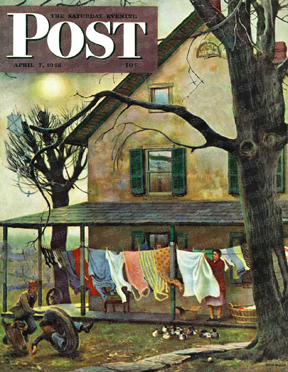 Hanging Clothes Out to Dry
John Falter
April 7, 1945
Play Ball and Eat!
I always sense a shift of eating habits when the warmer weather and baseball come around. Heavier comfort foods and drinks, like pasta with heavy sauces and chili and bourbon, give way to salads and sandwiches and refreshing iced tea. Of course, baseball stadiums seem to destroy that theory by serving pizza and nachos and beer and the aforementioned chili, so maybe there’s room in our minds and stomachs for these comfort foods in the warm months, too.
Oh, and hot dogs! Delish has more than 20 ideas on what to do with hot dogs that they call “insane and brilliant.” I don’t know if those words apply, but I do like these Hot Dog Skewers and these Taco Dogs.
Next Week’s Holidays and Events
Palm Sunday (April 9)
As this site explains, Palm Sunday is the final Sunday of Lent and the beginning of Holy Week. On this day, many services include the carrying of palm leaves that symbolize the palm branches that surrounded Jesus as he entered Jerusalem.
Passover (April 10)
Here’s a detailed description of what the Jewish holiday — called Pesach in Hebrew — means.
National Scrabble Day (April 13)
One of my favorite Scrabble words is Qi, which, according to Merriam-Webster, is “vital energy that is held to animate the body internally and is of central importance in some Eastern systems of medical treatment (as acupuncture) and of exercise and self-defense (as tai chi).” At The Daily Beast, David Bukszpan has a poem that will help you remember it and 100 other two-letter words you can use the next time you play.
The Average American Today and on the Eve of World War I
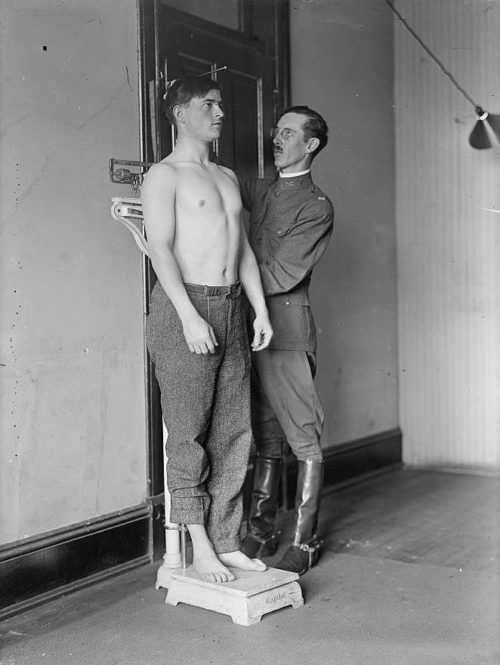
The First World War, which the U.S. entered 100 years ago today, is so far in our past that it can feel like ancient history. How can we understand the U.S. of 1917 when so much has changed since then?
One way is to compare what it means to be an “average American” then and now, though we’re fairly certain that Saturday Evening Post readers are, on the whole, above average.
If you were an average American on this day in 1917, you were one of 103 million citizens. (Today’s population is over 320 million.) Being a typical 1917 American, you would be among the 86 percent of the population that was Caucasian, and you would live on a farm or in a town with a population of 2,500 or less. Because of your rural locale, you wouldn’t have heard about that new American music called “jazz” that was brewing in the big cities; it had only been recorded for the first time in March.
Suppose you were the typical woman of 1917. You’d be between the ages of 15 and 19, but you wouldn’t get married until you were 21. You had a life expectancy of 49 years (today it’s 78.8 years). You couldn’t vote, you couldn’t obtain birth control, and you had no education beyond the eighth grade. You were living in your parents’ house. You washed your hair just once a month, and you would probably deliver all three of your babies at home.
But the typical American in 1917 was a man; the majority of Americans were male until the 1950s. As an average American, adult male, you were between 20 and 24 years old with a life expectancy of 47 years.
You worked 55 hours a week for 22 cents an hour, but your income wouldn’t go as far in 1917 as it does today. For example, you would spend 33 percent of your earnings on food (compared to 16 percent today). Every year, you would consume 11.5 pounds of lard, 14 pounds of chicken (it’s over 90 pounds today), and 88 pounds of sugar (at 4 cents a pound). Also, your clothing expenses took up 13 percent of your annual income, compared to just 3 percent today. You’d need to save up almost an entire year’s income to buy the average new car, which cost around $450 (today it’s around $34,000).
However, if you were in the fortunate minority that owned one of the 4.7 million cars on America’s roads in 1917, you would pay as much as 20 cents for a gallon of gas (the equivalent of $3.81 per gallon today). And if you lived in any city, the law would prevent you from traveling faster than 10 miles per hour.
The average new home today costs $390,000. If you had bought an average new home in 1917, it would cost $5,000 (the equivalent of $95,000 in today’s dollars), and you’d share it with four other people instead of the 2.3 others you’d share it with today.
As an average American, you wouldn’t be among the fortunate 14 percent of the population whose homes had bathtubs with running water, or the 18 percent of households with at least one live-in servant. Also, you’d have no phone in your home; that was a privilege enjoyed by only 8 percent of Americans. Instead, your long-distance communication would be done by mail, though Americans sent six times more telegrams than letters.
As a typical male in 1917, you wouldn’t have graduated from high school — only 10 percent did so — but at least you could read and write (25 percent of Americans couldn’t). You would be considered ready for military service. Before the war was over, if you were between 18 and 31, you had a 25 percent chance of serving in uniform, as either a draftee or a volunteer.
If you did end up as an average soldier in the armed forces, you would be 25 years old, 5 feet, 7½ inches tall, and a compact 144 pounds, with a 31-inch waist and 14-inch neck. Most likely, you would be among the 4 million American men who served in the American Expeditionary Forces. If so, you had a 50/50 chance of serving overseas, a 5 percent chance of being wounded in battle, and a 1.3 percent chance of being killed in the fighting. But, as a typical G.I. (a term that wouldn’t be in use until the next world war), you would not be among the 43,000 servicemen who died of influenza during and after the war.
However, when you got home in 1918 after surviving the flu epidemic and the war, you would no longer be the typical American you’d been in 1917.