Cartoons: Dining Out
With these restaurant cartoons, laughter is always on the menu!
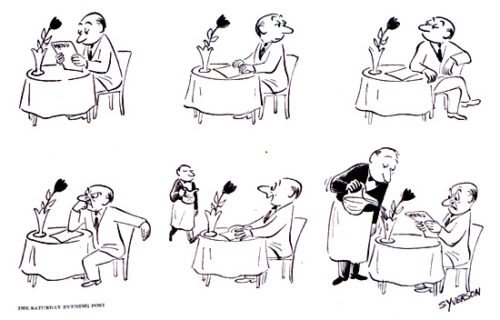
December 25, 1948
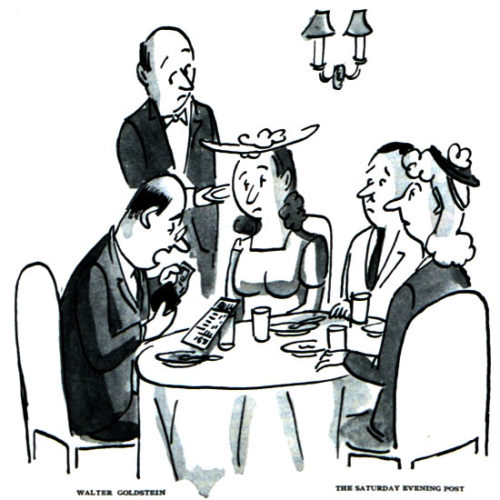
Walter Goldstein
January 1, 1949
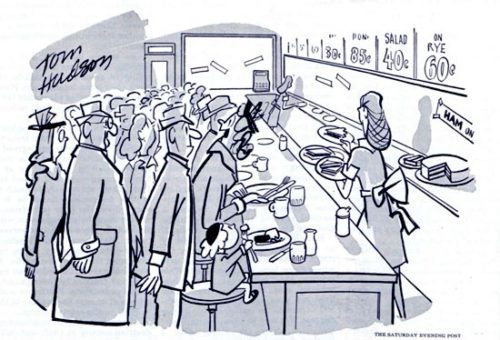
Tom Hudson
January 1, 1949
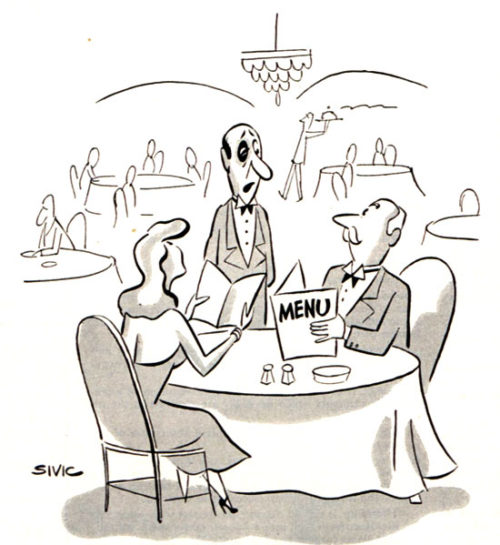
Sivic
December 31, 1949
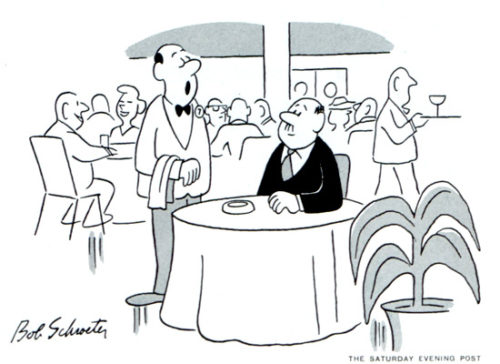
Bob Schroeter
January 5, 1963
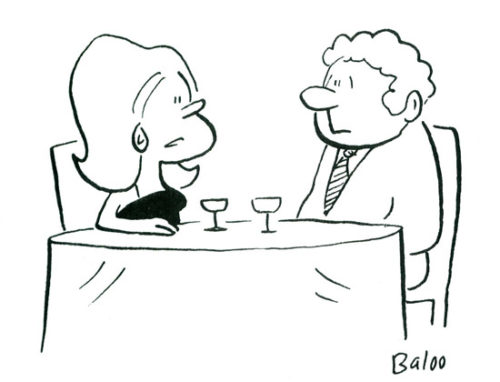
Baloo
February 1, 2013
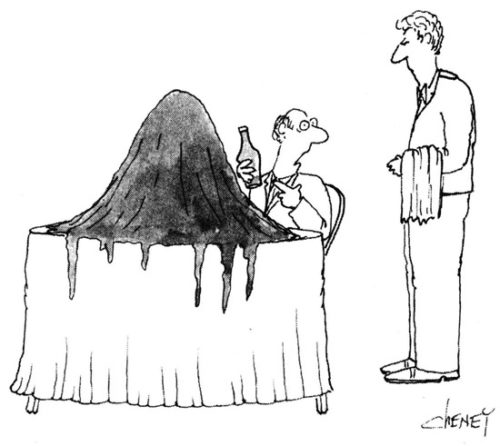
Cheney
April 1, 2002
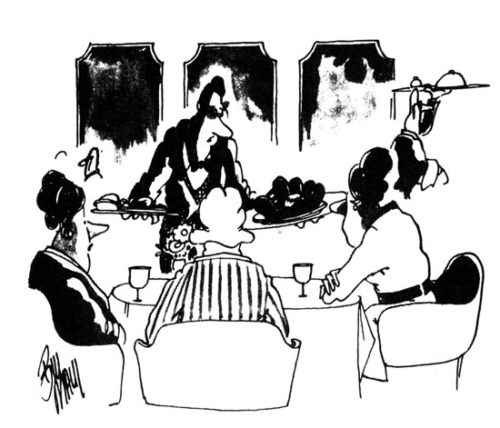
Bill Maul
February 1, 2009
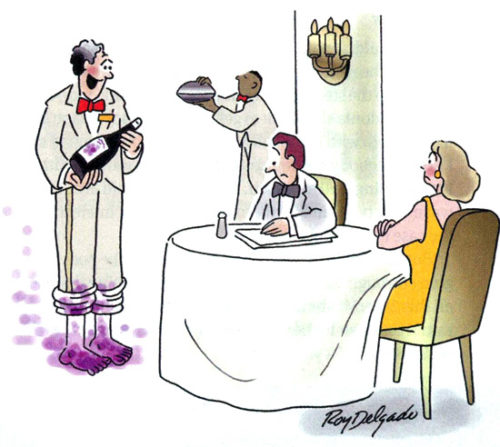
Roy Delgado
September 1, 2011
A One-Man Crusade Against Bigotry
Since November of last year, the Southern Poverty Law Center has reported over a thousand acts of assault or intimidation against minorities. Just since January, 73 Jewish community centers in 30 states have received bomb threats. News of attacks on immigrants, spray-painted swastikas, and racist rants on the internet are becoming a regular part of the news.
Americans who dread the rise of extremism in this country might feel helpless, that turning back bigotry and violence requires more financial backing and resources than they can muster.
But Gordon Hall has proved that one individual can make an enormous difference.
For 40 years, he single-handedly fought back against extremists and hate groups on both the right and left edges of the political spectrum. Beginning in the early 1950s, Hall exposed the lies and hidden agendas of these groups through thousands of speeches delivered at colleges, churches, businesses, and professional organizations.
Hall took an unlikely route to his unusual calling of denouncing extremists. Raised in poverty during the depths of the Depression, he left his home and formal education when he was 14. Drafted into the Army in 1942, he realized how little he knew about the world and politics. He was angered by communist sympathizers in the Army who challenged his faith in the country. And back in the civilian work force, he was equally outraged to find strains of anti-Semitic fascism in co-workers.
Frustrated by these anti-democratic messages from these extremists, Hall worked with a group of like-minded moderates called Friends of Democracy. He attended public meetings of hate groups, gathered their information, and learned who their members were.
When the Friends of Democracy disbanded in 1951, Hall became a self-employed speaker who traveled the country exposing the extremist threat to the American way of life. He believed that lies, fears, and bigotry shouldn’t be ignored or suppressed. They needed to be publicly exposed so Americans knew what they represented.But Hall was not rigid in his condemnation; he distinguished between liberals and conservatives on one hand and extremists on the other. The former had faith in the country and its potential. Extremists had lost their faith, hated the system, and sought violent disruption of society.
Above all, though, Hall believed fervently in the American rule of law. On two occasions, he even came to the defense of a notorious American Nazi because he felt the man’s extremist views were best managed “in the framework of the Bill of Rights and with faith in the democratic process.”
“Battler Against Bigotry,” which appeared in the December 8, 1962, issue of the Post, brought Hall valuable publicity. It led to further media exposure and an interview with Walter Cronkite on his TV show The Twentieth Century.
Hall continued to speak up in defense of democratic principles for 40 years before finally retiring. Although another Gordon Hall is needed now more than ever, no one has yet stepped into his place.
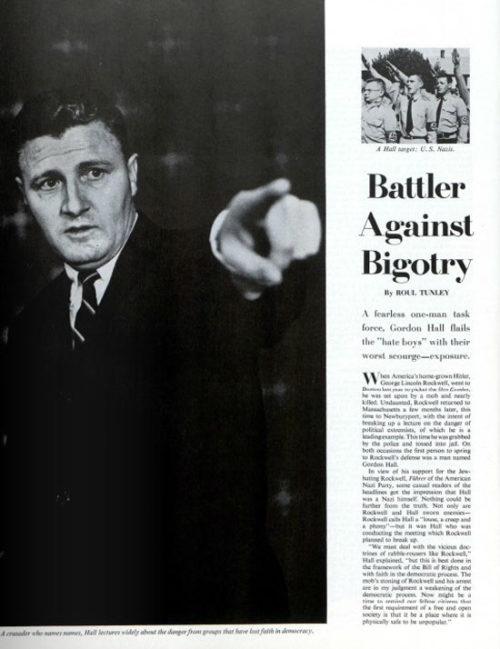
Featured image: Photo by Milton Feinberg for “Battler Against Bigotry” from the December 8, 1962, issue of the Post.
Cover Gallery: John Falter’s New York City
Illustrator John Falter was originally a country boy, but he couldn’t get enough of New York City’s stately buildings and elegant parks. These covers show Falter’s affection for New York.
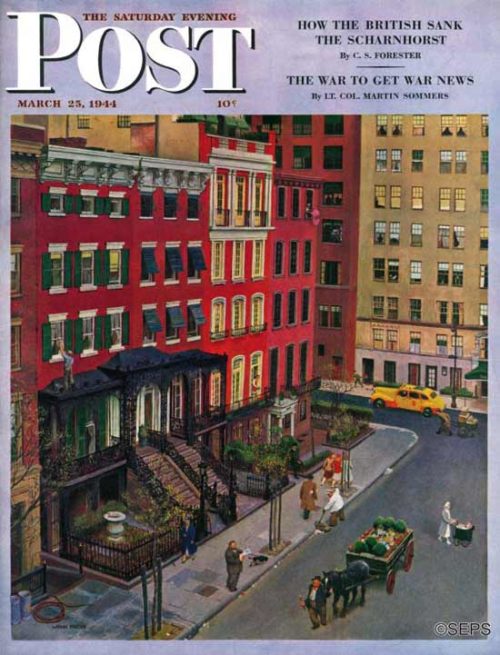
March 25, 1944
John Falter was born in Plattsmouth, Nebraska, although his family homestead was in Atchison, Kansas. He started his illustration career by selling his first artwork in 1930 to Liberty, a pulp magazine. The Liberty commission gave him the exposure he needed to gain other clients, including Gulf Oil Company, Four Roses Whiskey, Arrow Shirts, and, of course, the Saturday Evening Post, for whom he painted 129 covers. His first cover for the Post was a portrait of Ben Franklin. This painting of Gramercy Park appeared about a year later, and was followed by many more covers of New York scenes.
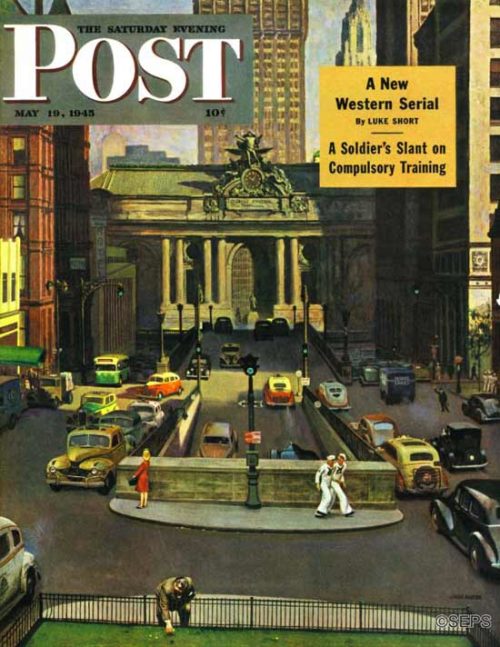
May 19, 1945
[From the editors of the May 19, 1945 issue] Pershing Square, John Falter’s cover on this week’s Post, is a view of Park Avenue, New York, looking toward the Grand Central Terminal, through which more than 62,000,000 passengers have passed in a single year. On the left is the old Murray Hill Hotel, opened in 1884 and one of Manhattan’s more elderly landmarks. Across the street on the right is a group of servicemen lined up waiting to get into the Recreation Center, to get tickets to theaters, concerts, movies and radio broadcasts which are given without charge. In the same building, New York teachers operate a canteen for enlisted men and women. Food cooked at the Food Trades High School is served free. Teachers spend their spare time here and teach the service personnel any subject they wish to learn.
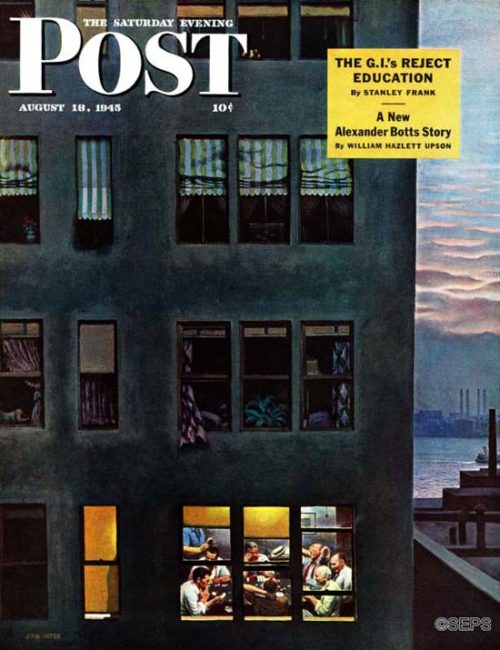
August 18, 1945
[From the editors of the August 18, 1945 issue] Not long ago a contributor’s effort to replace his gaming losses brought us a story that otherwise wouldn’t have been written. But this week’s cover is the first time getting out from behind a poker eight-ball has paid off in art work for us. One night recently John Falter became embroiled in a “little game” at The Players, during the course of which he discovered that drawing to an inside straight was much less rewarding than drawing for Post Art Editor Ken Stuart. The game was dealer’s choice, so when Falter’s turn came he decreed a round of Artists and Models and transported the game to his studio. There Falter poker player gave way to Falter artist, and he settled down to making sketches of his friends working their way through stacks of blues and reds. That’s Falter with his back to the window. It’s the first time he’s ever put himself in a painting—with or without a pat hand.
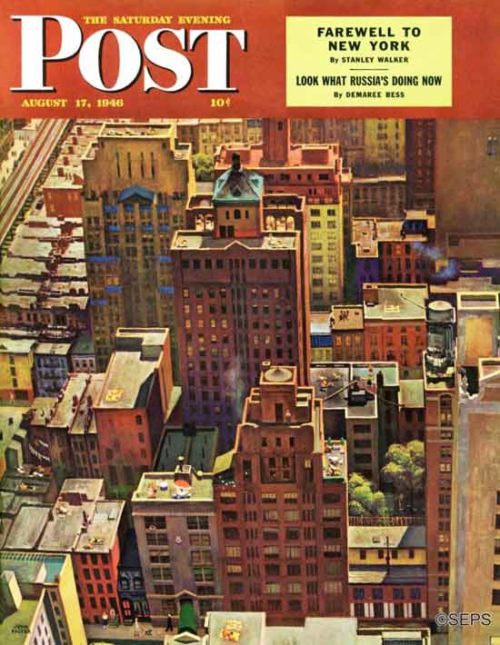
August 17, 1946
[From the editors of the August 17, 1946 issue] The enthusiasm for sun bathing is so general, these days, that the roofs of any major American city would have provided a scene such as John Falter painted for this week’s cover. He chose New York. The view is from the fifty-fourth floor of the Chrysler Building, looking south. There were sun bathers on almost every roof, stewing, frying and boiling in the early afternoon sun, some in quest of health, and more, perhaps, in quest of an expensive-looking sun tan. A good many office workers at that altitude stand prepared, in case anything really beautiful comes into view, to look more closely. They keep telescopes handy.
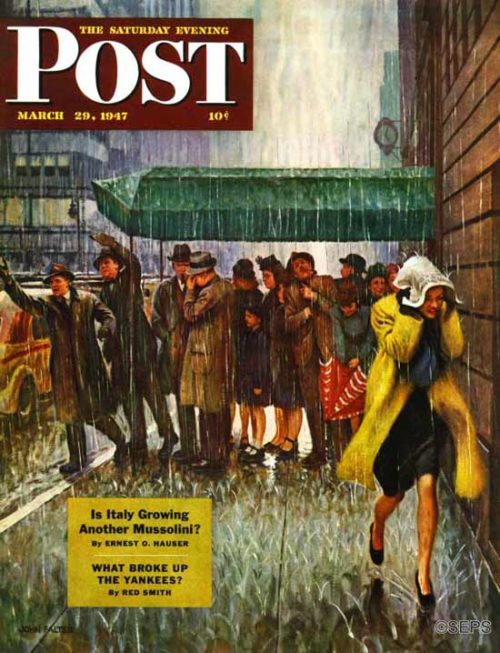
March 29, 1947
[From the editors of the March 29, 1947 issue] It is more than a spring downpour that John Falter records in this big city scene; it is a phenomenon the weather experts keep still about, probably because they can’t explain it, one of Nature’s little practical jokes. The day will be beautiful from the time thousands of men and women settle down for the day’s work until 4:55 in the afternoon; the sky smiling, not a cloud anywhere except a couple as innocent as cotton batting. But exactly at quitting time, at the moment best calculated to catch thousands between office and home, down comes the rain, like a sack of water thrown from a hotel window or a pan rigged over the door on April Fool’s Day. It quits just as punctually, when you reach home.
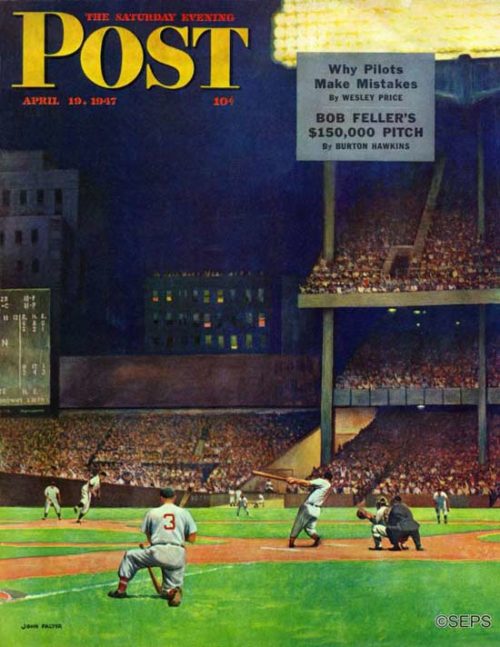
April 19, 1947
[From the editors of the April 19, 1947 issue] And you’re out, as out as the mighty Casey himself. Even without the razor-blade-advertising signs, many baseball fans will know that John Falter made his cover sketches in Yankee Stadium, a pleasant research chore that forced him to see three or four very good ball games. Instead of the winning hit or a homer, Falter selected a big moment of another kind. His subject is the satisfying moment when the visitors are at bat in a tight game, the gent with the club has two strikes on him, the home-town pitcher comes through with a beauty, the batter swings and misses. The Boston Red Sox were in town when Falter did his sketching last July, and they were on their way to the pennant.
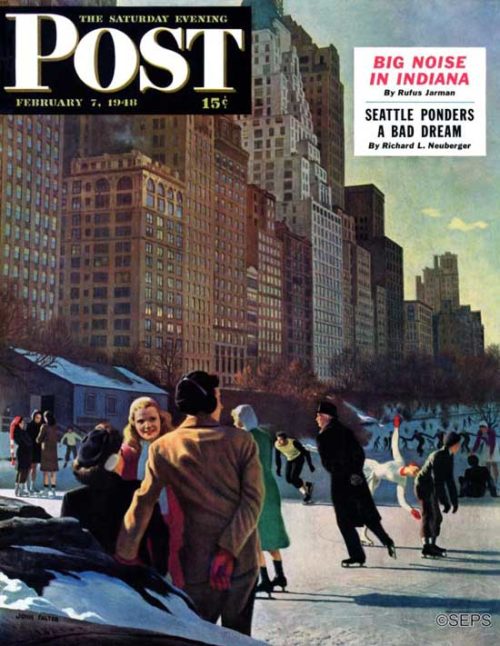
February 7, 1948
[From the editors of the February 7, 1948 issue] The scene of John Falter’s painting is Central Park, New York. Falter is a country boy, and it has always seemed strange to him that there should be skating just across the way from big-city buildings. He has also been puzzled by the variety of skating costumes he sees on the ice in Central Park—ranging from the most colorful of outdoor clothing to the most sedate business outfit. The gent in the dark overcoat, for example, must have put his skates on during a meeting of the board of directors. “But the real reason I painted the cover,” Falter said,”was to see if I could paint that many windows. I figure that if everyone who lives behind all those windows would buy a copy of the Post, the issue would be a sellout.”
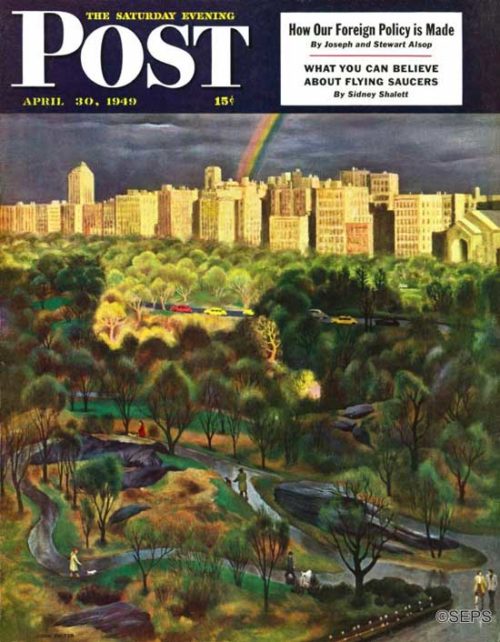
April 30, 1949
[From the editors of the April 30, 1949 issue] When John Falter’s cover painting was accepted, there was lightning trickling down the sky beside the rainbow. Presently the Art Department began to worry—do lightning and rainbows ever show up at the same time? The ever helpful Weather Bureau was asked to look at the Post‘s storm—which has just doused midtown New York and is rumbling away beyond Central Park’s man-made ramparts. “Fair and cooler,” was the comment. “But we never saw a streak of lightning in such bright daylight. Of course, where weather is concerned, anything can happen.” So the picture was delightninged, leaving only that sign of clearing weather, a patch of blue sky large enough to make a sailor a pair of breeches.
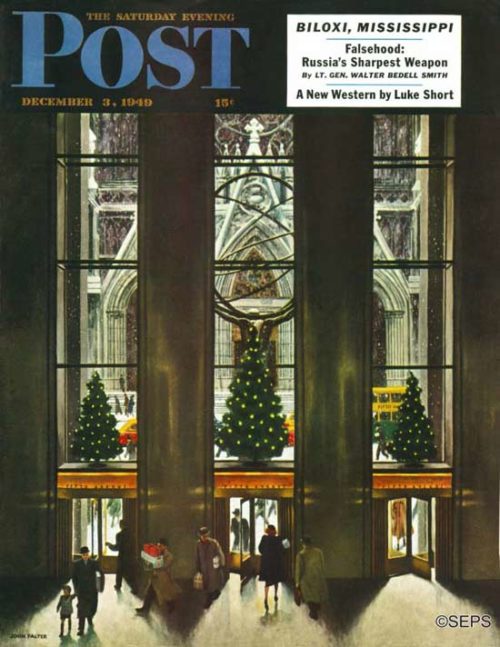
December 3, 1949
[From the editors of the December 3, 1949 issue] John Falter chose a Christmas shopping scene which New Yorkers could enjoy to the full, but are apt to miss while endeavoring not to fall downstairs. As you look at the Gothic architecture of St. Patrick’s Cathedral framed in the contrasting modern character of Rockefeller Center’s principal Fifth Avenue building, you are standing in imagination on the edge of the mezzanine floor. But you’d better watch your step or you’ll go down faster than the moving stairs do. The Christmas trees are by courtesy of Falter, who had to sweat while erecting them on his canvas, because he did the painting in steamy weather last summer. And did that whee him up to do his Christmas shopping early? The last we heard. he hadn’t bought a thing.
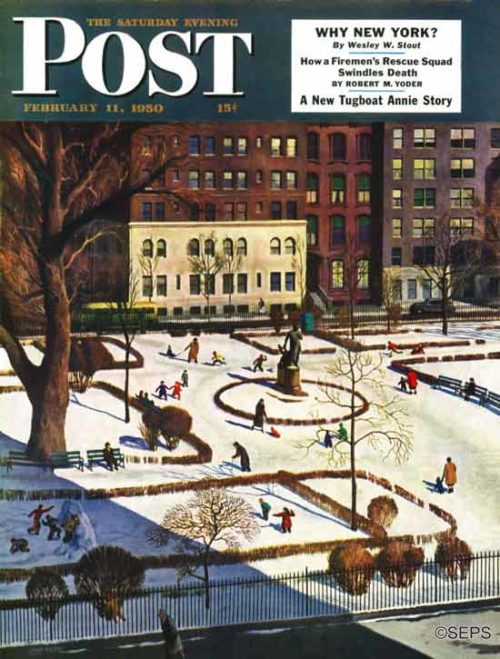
February 11, 1950
[From the editors of the February 11, 1950 issue] When John Falter runs up to New York from the open spaces of Pennsylvania’s Bucks County, he usually runs right downtown to The Players club, from where, as his painting shows, he can regard the open spaces of Gramercy Park. In the park you see the statue of Edwin Booth, the club’s founder, contemplating the citified version of a winter sports scene. Poet Percy Mackaye, a familiar figure around The Players, remembers that his great-grandfather loved to sit under the ancient tree at the left. Falter once had a studio in a building next to The Players; he says he has made his view of the park from a point about where the two buildings join, and between the third and fourth floors. Quite a stunt without a helicopter.
John Falter
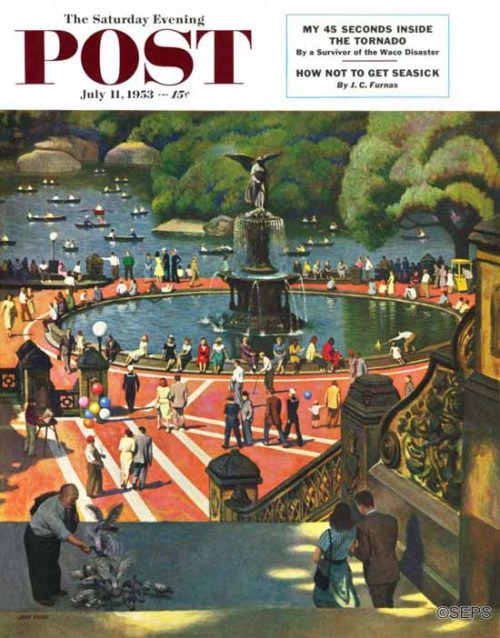
July 11, 1953
[From the editors of the July 11, 1953 issue] In New York’s famous wilderness, Central Park, you can hike, boat, bicycle, ride horseback, woo a wife, climb small mountains, get lost in small woods, and on the zoo trail meet many wild animals including people who make faces at monkeys. If you don’t think New Yorkers get more exercise than country people, buy some liniment and see how far you can trudge in the park without crying, “Help! Taxi!” To this resort go many sailors to take a vacation from water by rowing a boat weighted down by a girl—a curious phenomenon, as you would think the girl would row the sailor. That one soldier in the picture is not lost; he is following the girl. And that painter is not John Falter—John can paint without a beard.
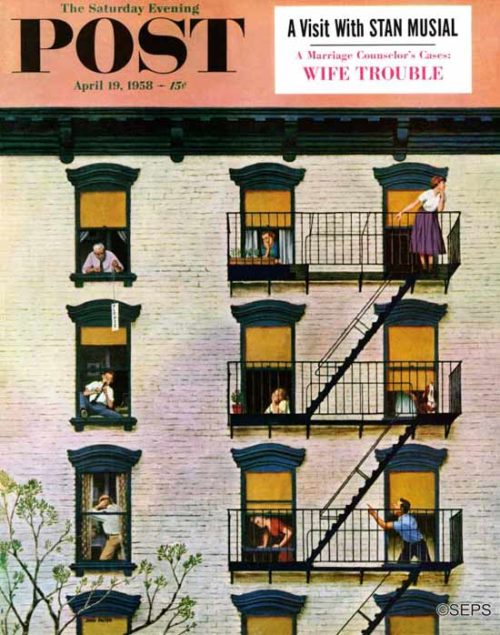
April 19, 1958
[From the editors of the April 19, 1958 issue] The day’s toil is over; the quiet magic of approaching dusk offers peace to everyone; and from the heart and clarinet of a grateful soul come the limpid strains of an evensong. They come not from afar, but from anear, and all who hear them are stirred—some in favor, some against. Numerically, the nays have it. including that man who votes Please, which doesn’t mean Please Play Louder, but Please Dry Up. The howling dog may think he is singing a tuneful duet with the clarinet or he may just be swearing at it; let’s say he votes yes, for artist John Falter is pro-clarinet (he plays one). Another way to count those votes is the way of the heart: only two people are on that cover, a boy and a girl, and to them everybody else is nowhere at all. The two are unanimous.
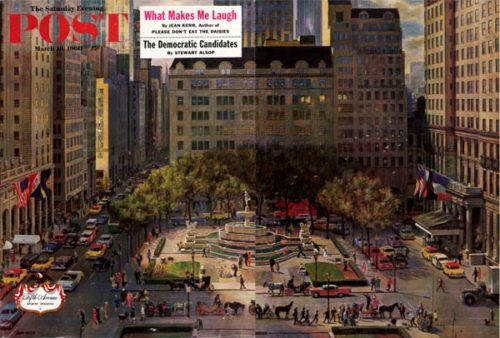
March 19, 1960
[From the editors of the March 19, 1960 issue] Fifth Avenue—showcase of fashion, hub of big industry, parade ground for visiting celebrities, home to the very rich. In her 135 blocks between Greenwich Village and Harlem are such landmarks as the Empire State Building, Rockefeller Center, St. Patrick’s Cathedral and the Metropolitan Museum of Art—but nowhere is she quite so magnificent and vivacious as here at Fifty-ninth Street, gateway to Central Park. Between the sun-splashed windows of Tiffany’s (left center) and the forlorn figure of Eloise, gazing down from her perch at the Plaza (right), artist John Falter has captured a brilliant Saturday morning in April. (After studying our scene long enough to spot the pickpocket, turn to page 126.)
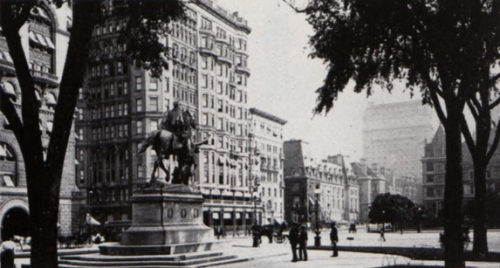
[p. 126] With this week’s gatefold-cover painting, we inaugurate a series of covers—to appear from time to time—on some of America’s more illustrious streets. Some of those under consideration: Atlanta’s Peachtree Street, Chicago’s Michigan Avenue, New Orleans’ Bourbon Street, Kansas City’s Petticoat Lane. The Fifth Avenue scene chosen by artist John Falter seemed an appropriate introduction to the series, for in this delightful panorama we can observe the beauty and vitality of today and much of the charm of the past. Only a century ago this same area was a muddy crossroads, and its most notable landmark was the ice pond and clubhouse of the New York Skating Club, on what is now the site of the Plaza Hotel. By 1904, when the photograph at left was taken, the brownstone mansion was in its glory. The Netherland and Savoy hotels (left) were only a dozen years old, and the towering St. Regis, four blocks south, was brand new. No one dreamed that Cornelius Vanderbilt’s French Renaissance château (right) would be demolished to make room for Bergdorf Goodman, the marble emporium at the center of our cover. The graceful Pulitzer Fountain seen on our cover had not yet been built, but General Sherman was already astride his bronze charger. Today the picturesque victoria carriages which line the curb along Central Park South are perhaps the most romantic link with the Fifth Avenue of the early 1900’s. Most of the stately brownstones are gone, but in their place have come equally sumptuous structures of steel and glass. “The face of the avenue has changed beyond belief,” one chronicler has written, “but its character has remained constant.”
3 Questions for Lesley Stahl, Gutsy Grandma

Lesley Stahl earned the reputation of being persistent and insistent by facing world newsmakers with direct questions and a strong point of view. “My job is making sure I got the story,” she says. “I’d call myself tenacious. My mother told me I was born that way.”
Her first book, Reporting Live, was full of her international travels, encounters with world leaders, and revelations about the White House beat. But she surprised herself when her second book revealed the life-changing experience of Becoming Grandma (Blue Rider Press, 2016). About Jordan and Chloe, her two granddaughters, she says, “You rediscover fun and reach a depth of pure loving you have never felt before.” In true Stahl style, the 60 Minutes correspondent investigates how grandmothering changes a woman’s life, interviewing other grandmas, doctors, anthropologists, scientists, and her husband, screenwriter Aaron Latham.
Jeanne Wolf: A book about grandparenting instead of your life as an influential star reporter?
Lesley Stahl: A publisher was trying to persuade me to write a book about 60 Minutes. I knew that was thankless because it would be revealing dirty linen and making enemies. I didn’t want to go there. During lunch I found myself being a typically tedious grandmother talking about my first grandchild, and he said, “That’s your book.” As a reporter who doesn’t talk about myself much, it turned out to be my biggest challenge.
JW: When your daughter, Taylor, was growing up, how did you handle worries about combining motherhood with a career that took you away from home a lot?
LS: My own mother laid a guilt trip on me. But my daughter often says, “Mom, thank God you worked.” We have a great relationship, but if I hadn’t worked, I would have hovered and tried to control her more than I did. I also had a husband who worked at home, something most young mothers don’t have. He loved, loved, loved being a parent. He actually taught me how to be a parent.
JW: You are still in the middle of the wildly changing media. Has the growth of social media and the ability of even presidents to talk directly to the audience changed the kind of journalism that made you famous?
LS: It changes everything dramatically. After network television came cable. Then we got the internet. Now with Twitter, Snapchat, and other ways for leaders to communicate, the messages feel awfully abrupt. Donald Trump and others can put out a tweet and communicate with tens of millions of people without dealing with the press. What do we do? I don’t think anyone has the answer. 60 Minutes shows you that there is an appetite for in-depth reporting. I’m lucky that it’s one of the few places where leaders come to communicate and where audiences still come to listen.
I wonder if we’re just not going to become analytical. We’re going to stand back and write think pieces and I don’t know what it’s going to do to interviewing, which is what I do for a living. I guess that’s why I’m saying, “Boy, here we are. Now what are we gonna do?”
JW: Yes, because the think pieces can be too much like the spouting pundits that we see on television and read every day.
LS: I think that’s going to be where we head. Not just punditry but long, analytical investigative stories, trend pieces. Even interviews have to be rethought. You know, so much is unrevealing – particularly if there’s a time restriction because politicians will filibuster anyway. It’s hard to say where journalism is heading.
What always surprises me is how young people are attracted to this profession. The journalism schools are brimming with brilliant students. I get calls all the time from people asking how someone could break into our world. It surprises me because it’s such an unsettled place.
JW: It’s true. I guess every place in the media is unsettled. We don’t know what’s going to happen. It can be frustrating to figure out. Well, I guess you always did – try to figure out ways to get revelation or get truth?
LS: The joys of my job, and I know I’m lucky, is that 60 Minutes is one of the few places where leaders still want to come to communicate and where the audience also still wants to come to listen and we can’t say that about a lot of other venues but ours is going strong.
JW: It’s interesting that it’s going strong at a time when everyone is saying that you gotta gimmick it up or do everything in very short bites and very short pieces.
LS: That shows you that there is a healthy appetite for long form. Where I say long form, and this too is funny, because real long form is pieces that are like 13 or 14 minutes. Long form used to be three hours! A three-hour or two-hour documentary. Now long form is 15 minutes. That’s funny in itself.
I do think there’s an appetite for depth for a large number of people. We have a huge audience. But it’s always been true that different journalistic organizations will attract eyeballs.
JW: Ideas about the future of news?
LS: The problem in many ways is financial because to mount a research project takes money. The internet can’t always support in-depth stories. A lot of the sites don’t make nearly the kind of money that network television shows did and do. I fret not just about the questions you’re asking – how will journalism survive and communicate – but how will we raise enough revenue to support the smartest kids in the class. All these things are worrisome.
—Jeanne Wolf is the Post’s West Coast editor
A shorter version of this article is featured in the March/April 2017 issue of The Saturday Evening Post. Subscribe to the magazine for more art, inspiring stories, fiction, humor, and features from our archives.
“An Apartment House Anthology” by Dorothy Parker
Dorothy Parker wrote regularly for the “Short Turns and Encores” section of the Post. A New Yorker at heart, Parker was an establishing member of the Algonquin Round Table, a group of writers, actors, and critics that included Harpo Marx and Noël Coward. Parker was known for her mordant wit and her unique portrayal of New York City. Her story “An Apartment House Anthology” from 1921 invites readers into a fictional Manhattan residence where a quirky cast of characters resides.
The Ground Floor
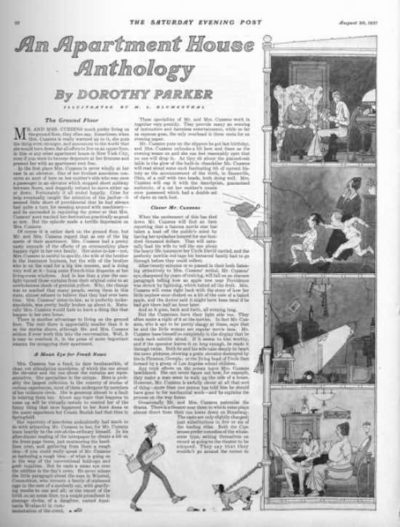
Mr. and Mrs. Cuzzens much prefer living on the ground floor, they often say. Sometimes, when Mrs. Cuzzens is really warmed up to it, she puts the thing even stronger, and announces to the world that she would turn down flat all offers to live on an upper floor, in this or any other apartment house in New York City, even if you were to become desperate at her firmness and present her with an apartment rent-free.
In the first place Mrs. Cuzzens is never wholly at her ease in an elevator. One of her liveliest anecdotes concerns an aunt of hers on her mother’s side who was once a passenger in an elevator which stopped short midway between floors, and doggedly refused to move either up or down. Fortunately it all ended happily. Cries for help eventually caught the attention of the janitor — it seemed little short of providential that he had always had quite a turn for messing around with machinery — and he succeeded in regulating the power so that Mrs. Cuzzens’ aunt reached her destination practically as good as new. But the episode made a terrific impression on Mrs. Cuzzens.
Of course it is rather dark on the ground floor, but Mr. and Mrs. Cuzzens regard that as one of the big assets of their apartment. Mrs. Cuzzens had a pretty nasty example of the effects of an oversunshiny place happen right in her own family. Her sister-in-law — not, Mrs. Cuzzens is careful to specify, the wife of the brother in the insurance business, but the wife of the brother who is on the road for a big tire concern, and is doing very well at it — hung some French-blue draperies at her living-room windows. And in less than a year the sunlight turned those curtains from their original color to an unwholesome shade of greenish yellow. Why, the change was so marked that many people, seeing them in this state, almost refused to believe that they had ever been blue. Mrs. Cuzzens’ sister-in-law, as is perfectly understandable, was pretty badly broken up about it. Naturally Mrs. Cuzzens would hate to have a thing like that happen in her own home.
There is another advantage to living on the ground floor. The rent there is appreciably smaller than it is on the stories above, although Mr. and Mrs. Cuzzens seldom if ever work this into the conversation. Well, it is easy to overlook it, in the press of more important reasons for occupying their apartment.
A Mean Eye for Freak News
Mrs. Cuzzens has a fund, to date inexhaustible, of clean yet stimulating anecdotes, of which the one about the elevator and the one about the curtains are representative. She specializes in the unique. Hers is probably the largest collection in the country of stories of curious experiences, most of them undergone by members of her intimate circle. She is generous almost to a fault in relating them too. About any topic that happens to come up will be virtually certain to remind her of the funny thing that once happened to her Aunt Anna or the queer experience her Cousin Beulah had that time in Springfield.
Her repertory of anecdotes undoubtedly had much to do with attracting Mr. Cuzzens to her, for Mr. Cuzzens leans heavily to the out-of-the-ordinary himself. In his after-dinner reading of the newspaper he cheats a bit on the front-page items, just murmuring the headlines over, and gathering from them a rough idea — if you could really speak of Mr. Cuzzens as harboring a rough idea — of what is going on in the way of the conventional holdups and graft inquiries. But he casts a mean eye over the oddities in the day’s news. He never misses the little paragraph about the man in Winsted, Connecticut, who entrusts a family of orphaned eggs to the care of a motherly cat, with gratifying results to one and all; or the report of the birth on an ocean liner, to a couple prominent in steerage circles, of a daughter, named Aquitania Wezlascki in commemoration of the event.
These specialties of Mr. and Mrs. Cuzzens work in together very prettily. They provide many an evening of instructive and harmless entertainment, while so far as expense goes, the only overhead is three cents for an evening paper.
Mr. Cuzzens puts on the slippers he got last birthday, and Mrs. Cuzzens unhooks a bit here and there as the evening wears on and she can feel reasonably sure that no one will drop in. As they sit about the grained-oak table in the glow of the built-in chandelier Mr. Cuzzens will read aloud some such fascinating bit of current history as the announcement of the birth, in Zanesville, Ohio, of a calf with two heads, both doing well. Mrs. Cuzzens will cap it with the description, guaranteed authentic, of a cat her mother’s cousin once possessed which had a double set of claws on each foot.
Clever Mr. Cuzzens
When the excitement of this has died down Mr. Cuzzens will find an item reporting that a famous movie star has taken a load off the public’s mind by having her eyelashes insured for one hundred thousand dollars. That will naturally lead his wife to tell the one about the heavy life insurance her Uncle David carried, and the perfectly terrible red tape his bereaved family had to go through before they could collect.
After twenty minutes or so passed in their both listening attentively to Mrs. Cuzzens’ recital, Mr. Cuzzens’ eye, sharpened by years of training, will fall on an obscure paragraph telling how an apple tree near Providence was struck by lightning, which baked all the fruit. Mrs. Cuzzens will come right back with the story of how her little nephew once choked on a bit of the core of a baked apple, and the doctor said it might have been fatal if he had got there half an hour later.
And so it goes, back and forth, all evening long.
But the Cuzzenses have their light side too. They often make a night of it at the movies. In fact Mr. Cuzzens, who is apt to be pretty slangy at times, says that he and the little woman are regular movie fans. Mr. Cuzzens loses himself so completely in the display that he reads each subtitle aloud. If it seems to him worthy, and if the operator leaves it on long enough, he reads it through twice. Both he and his wife take deeply to heart the news pictures, showing a grain elevator destroyed by fire in Florence, Georgia; or the living head of Uncle Sam formed by a group of Los Angeles school children.
Any trick effects on the screen leave Mrs. Cuzzens bewildered. She can never figure out how, for example, they make a man seem to walk up the side of a house. However, Mr. Cuzzens is awfully clever at all that sort of thing — more than one person has told him he should have gone in for mechanical work — and he explains the process on the way home.
Occasionally Mr. and Mrs. Cuzzens patronize the drama. There is a theater near them to which come plays almost direct from their run lower down on Broadway. The casts are only slightly changed; just substitutions in five or six of the leading roles. Both the Cuzzenses prefer comedies of the wholesome type, setting themselves on record as going to the theater to be amused. They say that they wouldn’t go around the corner to see one of those unpleasant plays, for there is enough trouble in this world, anyway. And after all, who is there that can give them any argument on that one?
Now and then they devote an evening to cards, playing a little interfamily game with Mr. Cuzzens’ married sister and her husband. The sport is kept absolutely clean. No money changes hands.
In the daytime, while Mr. Cuzzens is busy at his office — he is with a firm that makes bathroom scales, and it’s as good as settled that they are going to do something really worthwhile for him the first of the year — Mrs. Cuzzens is occupied with her own activities. She often complains that the days aren’t half long enough for her, but nothing really satisfactory has been done to remedy this, as yet. Much of her time is devoted to shopping, for there are always button molds to be matched, or a strip of linoleum for the washtubs to be priced, or a fresh supply of trick paper for the pantry shelves to be laid in. She is almost overconscientious about her shopping. It is no unusual thing for her to spend an entire day in a tour of the department stores, searching for a particular design of snap fastener or the exact match of a spool of silk. She reaches home at the end of one of these days of toil pretty well done up, but still game.
And then there are her social duties. She is one of the charter members of a bridge club which numbers just enough to fill two tables comfortably. The club meets every fortnight, giving the players a chance to compete for the brocade-covered candy box — the winner must supply her own candy, which is no more than fair — or the six embroidered, guest-room-size handkerchiefs, which the hostess donates in the interest of sport.
During these functions Mrs. Cuzzens takes part in a great deal of tense conversation about the way the skirt was gathered over the hips and came down longer in front. She also gives, and receives, ideas on novel fillings for sandwiches, effective patterns for home-knit sweaters, and simple yet snappy dishes for Sunday-night supper.
Neither Mr. nor Mrs. Cuzzens is a native of New York. Up to a year or so after their marriage they helped swell the population of a town in Illinois which at the last census had upward of one hundred thousand inhabitants. They celebrate Old Home Week by a visit to the folks every year, but they congratulate themselves heartily that Mr. Cuzzens’ business prevents their staying more than a week. For they agree that after eight years’ residence in what Mr. Cuzzens aptly calls the big city they could never bring themselves to live in a small town again.
As Mrs. Cuzzens puts it, life in New York is so much broader.
The Second Floor East
The Parmalees are always intending to move, but somehow they never get around to it. Several times Mrs. Parmalee has come out flat with the statement that the very next day she is going to look for an apartment farther downtown. But what with one thing and another coming up, she never seems to be able to make it.
Yet after all, as they argue, they might be a whole lot worse off than staying right where they are. Of course they are pretty far uptown, away from the theaters and restaurants; but everybody in their crowd, including themselves, has a car. So, to use Mr. Parmalee’s very words, they should worry! It has often been remarked of Mr. Parmalee that it is not so much what he says as the way he says it.
Again, Mrs. Parmalee points out that it doesn’t really matter much where they live, for they are hardly ever home, anyway. To which Mr. Parmalee retorts, just like a flash, that she has said a forkful!
And when you come right down to it, Mrs. Parmalee has seldom said a truer thing. It is indeed a cold night for the Parmalees when they have nothing to gather around but their own gas logs. The evening begins to hang heavy along around half past seven, and from then on things get no better rapidly.
The Parmalees are not ones to lose themselves in reading. Just let Mr. Parmalee see who won the first race, and give him a look at the financial page to ascertain whether Crucible Steel is plucking at the coverlet, and he is perfectly willing to call it a day as far as the pursuit of literature is concerned. As for Mrs. Parmalee, she masters the really novel murders and the better-class divorce cases, while for her heavier reading she depends on the current installment of the serial running in one of the more highly sexed magazines. That done with, she is through for the month.
Conversation could not be spoken of as a feature of the evening, either. Mr. Parmalee has been called, over and over again, a perfect scream when he is out on a party. But at home he doesn’t really extend himself. A couple of half-hearted assents to his wife’s comments on the shortcomings of the janitor and the unhealthful effects of such changeable weather — and that’s, as someone has phrased it, that.
Life in the Parmalee Set
So you can see for yourself about the only thing left in the way of parlor entertainment is to come to the mat. The Parmalees’ battles are not mere family events; they come more under the head of community affairs. The entire apartment house takes an interest, almost a pride in them. Take them when they get going really strong and you won’t miss a syllable, even as far off as the top-floor apartment on the other side of the house. On a clear night with the wind in the right direction the people living three houses down have been able to enjoy every word of it.
The bouts almost invariably end in a draw. Mr. Parmalee, it is true, has a somewhat broader command of language than his wife, but she has perfected a short contemptuous laugh which is the full equivalent of a nasty crack. It leaves Mr. Parmalee practically flat, with nothing more inspired to offer than an “Is that so?” or a “Yeah, you’re perfect — you are!”
But these sporting events take place only rarely. The Parmalees have little time to indulge in home pleasures. Theirs is a full and sociable life. Mr. Parmalee is in what he jocosely calls the automobile game, and most of his friends are engaged in the same pursuit. And as their wives are Mrs. Parmalee’s intimates, you can just imagine how nice and clubby that makes everything.
Their social day begins around five o’clock, when the dozen or so members of their set meet at one or another’s apartment, for cocktails. The Parmalee coterie has been seriously inconvenienced since prohibition went into what has been called effect. It means that they can no longer meet at a hotel or a restaurant, as they used to in the old days. It is badly out of their way to gather at someone’s house, for it often involves their having to go all the way downtown again for dinner. But they have to make the best of it, just like you or me.
And it is comforting to know that the gentlemen still manage, as a rule, to pick up a little something here and there before they are met by what Mr. Parmalee calls, with screaming effect, their better seven-eighths. The ladies, collectively, are usually referred to, by their husbands and by one another, as the girls — which is something of an understatement.
Up to the time of meeting, Mrs. Parmalee, like the rest of the girls, has put in a crowded afternoon at a matinee, the hairdresser’s or the manicure’s; a blinding polish on the finger nails is highly thought of by both the male and female members of the Parmalees’ set. There is usually a great deal of trying on to be done, also, which does much toward taking up Mrs. Parmalee’s time and Mr. Parmalee’s money. He likes to see his wife dressed as elaborately as the wives of his friends. He is pretty fairly reasonable about the price of her clothes, just so long as they look as if they cost a lot. Neither of the Parmalees can see the point of this thing of paying high prices for unobtrusive garments. What they are after, Mr. Parmalee says, is their money’s worth. As is only just.
Mrs. Parmalee and her friends dress with a soothing uniformity. They all hold the same ideas about style; really you’d seldom find a more congenial group in every way. All the girls, including Mrs. Parmalee, are fundamentally large and are increasing in weight almost daily. They are always going to start dieting next Monday.
In general style and get-up the girls resemble a group of very clever female impersonators. They run to rather larger and more densely plumed hats than the fashion absolutely insists upon, and they don’t go in for any of your dull depressing colors. Always heavily jeweled, they have an adroit way of mingling an occasional imitation bracelet or necklace with the genuine articles, happily confident that the public will be fooled. In the warm weather their dresses are of transparent material about the arms and shoulders, showing provocative glimpses of very pink ribbons and of lace that you could hardly tell from the real.
There is a great deal of hearty gayety at the afternoon meetings of the crowd. You couldn’t ask to see people among whom it is easier to get a laugh. Any popular line, such as “You don’t know the half of it,” or “You’d be surprised,” is a sure-fire hit, no matter in what connection it is used. You might think that these jests would lose a little of their freshness after months of repetition, but you were never so wrong in your life. They never fail to go over big.
After a couple of hours of crackling repartee and whole-hearted drinking the Parmalees and their crowd set out for dinner. They dine at a downtown restaurant, if they plan going en masse to the theater afterwards. Otherwise they group themselves in their cars — most of the motors, like Mr. Parmalee’s, are perquisites of being in the automobile game — and drive to some favorite road house, where they not only dine but get in some really constructive drinking during the evening. Mr. Parmalee is the life and soul of these parties. It is, his friends often say, as good as a show to hear him kid the waiter.
Guess-What-it-Cost Sports
Dancing occurs sporadically after dinner, but most of the time is devoted to badinage. There is much good-natured banter, impossible to take in bad part, about the attentions paid by various of the husbands to the wives of various of the other husbands.
Often the conversation takes a serious turn among the men, as they tell about how much they had to pay for the last case of it. Stories are related of the staggering prices exacted for highballs at some restaurant where they will still listen to reason; and someone is sure to tell about the dinner he gave the night before, giving the menu in full detail, and as a climax calling upon his audience to guess what the grand total of the check was. These anecdotes are told with the pride that other sportsmen exhibit in telling about the size of the fish they caught.
The ladies spend what could be figured up to be the greater part of the evening in going out to the dressing room to keep their color schemes up to the mark.
In the warmer months the Parmalees make no radical change in their way of living. But though they do not go away for any long vacation they get a welcome glimpse of nature by motoring to Long Beach for dinner three or four times a week with the rest of their crowd. They also manage to get a lot of wholesome country air and a refreshing eyeful of green grass down at the Belmont Park track.
What with all this talk of hard times and tight money wherever you go, it is cheering to see the Parmalees, who seem always to have it to spend. In his homy little chats with his wife Mr. Parmalee often gets quite worked up over where the money to meet their expenses is coming from; but he never lets it trouble him in his social life. Mr. Parmalee is a great advocate of being a good fellow when you have it. After all, as he has it figured out, the last places you can cut down are on theater tickets and restaurant checks and liquor.
It is also pleasant, in these days of change and restlessness, to think of the Parmalees going right along, never so much as thinking of wanting anything different. I wouldn’t want to be the one to say that there is never just a dash of hard feeling between certain members of the crowd; the Parmalees never claimed to be any more than human. But such little differences as may spring up from time to time are easily dissolved in alcohol, and the crowd goes right on again, as usual.
After all, it takes Mr. Parmalee, with that wit of his, to sum up their whole existence in one clear-cut phrase. He says that it is a great life if you don’t weaken.
The Second Floor West
The minute you step into her apartment you realize that Mrs. Prowse is a woman of fine sensibilities. They stick out, as you might say, all over the place. You can see traces of them in the handmade candles dripping artistically over the polychrome candlesticks; in the single perfect blossom standing upright in a roomy bowl; in the polychrome bust of Dante on the mantel — taken, by many visitors, to be a likeness of William Gibbs McAdoo; most of all in the books left all about, so that Mrs. Prowse, no matter where she is sitting, always can have one at hand, to lose herself in. They are, mainly, collections of verse, both free and under control, for Mrs. Prowse is a regular glutton for poetry. She is liable to repeat snatches of it at almost any time. There are heavier volumes, too, just as there are greater depths to Mrs. Prowse. Henry Adams, Conan Doyle in his latter manner, Blasco Ibanez, Clare Sheridan — all the boys and girls are represented.
Mrs. Prowse has not quite made up her mind as to whether it is more effective to have her books look well-thumbed or new and bright, though she rather inclines to the latter as being more decorative and less tiring. Most of the volumes are bound in red, which is, as Mrs. Prowse would put it, rather amusing with her orange curtains. If you were to pick up a book at random and go systematically through it you would find that, oddly enough, many of the pages, along after the middle, are uncut. But Mrs. Prowse’s guests are not apt to go through her books, and the effect is, as I was saying only a minute ago, great.
It is not only literature that Mrs. Prowse patronizes. Beauty in any form gets a big hand from her. She can find it, too, in places where you or I would never think of looking. The delicate brown of a spoiled peach, the calm gray of a puddle on the sidewalk — such things never escape her. Perhaps it is because she is so used to directing attention to things you might otherwise miss that Mrs. Prowse follows up the idea and coaxes you to notice those beauties which you couldn’t very well avoid. She is always putting in a good word for the sunset or the sky or the moon, never letting slip an opportunity to get in a little press work for Nature.
She feels such things considerably more than most people. Sometimes, indeed, her appreciation of the beautiful stops just short of knocking her for what is academically called a goal. In the midst of a friendly conversation, or perhaps when it is her turn to bid in a bridge game, Mrs. Prowse will suddenly be rendered speechless, and lean tensely forward, gazing hungrily out the window at a lonely star or a wind-tossed cloud. She has quite a bad time in pulling herself together on these occasions. She must start perceptibly, look dazedly around the room, and press her hand against her eyes for a moment before she can return to the commonplace.
It is a blow to Mrs. Prowse and her husband that there has never been what Mrs. Prowse refers to as the patter of little feet about the house. But she manages to get a bit of comfort out of the situation. With no children to tie her down she is free to do all the worthwhile things that beckon her. Look, for example, at what she accomplished during the past winter alone. She heard several lectures by visiting poets; went to two New Thought meetings; had her horoscope read and learned that her name should have been Valda; attended the annual luncheon of a club devoted to translating Browning into English; went to tea in Greenwich Village three times; took a lesson in lampshade making; heard a debate on whether or not a woman should take her husband’s name, and what of it; and had her hair permanently waved.
But at that, Mrs. Prowse does not feel that her time is fully occupied. What she would really like, she admits, is to work, and work hard. And there are several jobs for which she is forced to confess that she is just as well fitted as the next one.
She would consider, for instance, giving readings from the modern poets or doing selections from Maeterlinck to a soft accompaniment on the piano. She has thought, and pretty seriously, too, of the stage, which, she can’t help feeling, she could do much to raise from its present commercialism. It is really just a matter of ethics that keeps her from rushing right out and going to work at one of these positions. She doesn’t feel that it would be quite fair for her to take the job away from someone who might be in real need of the money.
You wouldn’t want to say right out that Mr. Prowse is not in sympathy with his wife’s ideas, but then again you would scarcely be justified in saying that he cheered her on. Mr. Prowse is apt to let things take their course, and not do any worrying about them.
He is fond of his business, golf, the Yankees, meat cooked rather rare, musical comedies and his friends. Mrs. Prowse accompanies him to the theater, and often tells his friends that they must come up sometime soon. But there is about her at these times an air of gentle martyrdom. You’d almost think you could hear the roar of the waiting lions, she does it so realistically.
Mr. Prowse’s policy of going about just as cheerfully as if his wife had no sensibilities whatever is a uniquely annoying one to her. Some of her most effective moods are absolutely frittered away on him. Mrs. Prowse has feelings which are almost always being severely injured; you run a chance of stepping on them if you come within ten feet of her. She is too delicately strung to come bluntly out and say what has hurt her. She seeks refuge in a brooding silence, and you must guess what it is all about.
Misunderstood but Faithful
Mr. Prowse is particularly bad at the game. He never seems to realize that anything is wrong. Sometimes she even has to call attention to her mental suffering and its cause. Even then he cannot be drawn into a really satisfactory battle. And it is, you will agree, practically impossible to work up any dramatic interest in married life when one of the principals won’t take part in the big scenes.
It is little wonder that Mrs. Prowse, though never actually saying that her marriage is anything but happy, sometimes intimates that she is not always understood.
She has always been somewhat taken with the idea of having an assortment of tame young men about her — nothing really out of the way, of course, just have them come to tea, and take her to picture galleries, and send flowers, and maybe write verses, which she could drop where her husband would find them. She has even gone so far, in the privacy of her room, as to invent a rather nice little scene, in which she mapped out what she would say to some smitten young tea-hound should he become too serious. It is a credit to Mrs. Prowse to report that her answer was to the effect that she could never forget the vows she made to Mr. Prowse at the altar.
In all the books, as it is useless to tell you, it is no trouble at all for a married woman to gather a flock of attentive young men about her. But Mrs. Prowse has found it rather rough going. The young men don’t seem to fall in with the idea. There was, it is true, a young man she met at a tea who was interested in interior decoration. In answer to her invitation he did call one afternoon — it was just by luck that she was wearing her beaded Georgette crêpe — and told her all about how she ought to live with purples. But when he found out that she really didn’t feel they could have the living room done over for another year anyway he faded gently out of her life.
And that, as a matter of fact, was about as far as Mrs. Prowse ever got along those lines.
As is no more than you would expect, Mrs. Prowse admits but few to her circle of intimates. She is constantly being disappointed in people, finding out that they have no depths. Perhaps the sharpest blow, though one frequently experienced, is in having people whom she had accepted as kindred spirits turn out to be clever on the surface, but with no soul when you came right down to it. Mrs. Prowse often says that somehow she can never bring herself to be intimate with people who are only clever.
And that really works out awfully well, for it makes it mutual.
The Third Floor East
You couldn’t find, if you were to take the thing really to heart and make a search of the city, a woman who works harder, day in and day out, than Mrs. Amy. She says so herself.
In the first place there are the two young Amys to occupy her attention. Everyone in the building is conscious of the presence of the two young Amys, but the Parmalees, in the apartment below, are most keenly aware of it.
It is in the fresh morning, when the Parmalees are striving to fulfill a normal desire for sleep, that the young Amys seem particularly near. The Amy children are early risers, and they have none of that morning languor from which office workers are so apt to suffer. Mrs. Parmalee, whose bedroom is directly beneath theirs, has often said that she would be the last one to feel any surprise if at any moment they were to come right on through.
Of course there is a resident nurse who looks after the little ones, but Mrs. Amy seems to find little or no relief in this. The nurse watches over them all day, and sleeps in the bed between their cribs at night, but, as Mrs. Amy says, she cannot worry over them as a mother would.
It is in worrying that Mrs. Amy accomplishes some of her most strenuous work. She confesses that there is scarcely a minute when her mind is at rest. Her worries even cut in on her nights, and she describes graphically how, tossing from side to side, she hears the clock strike twelve, half past twelve, one, half past one — sometimes it goes on that way up to three.
The past months have been especially trying to her, for the older Amy child has lately started school. He attends the public school around the corner, where his mother cannot help but feel that his time is devoted less to acquiring education than to running a splendid chance of contracting diseases and bringing them home, to share with his sister. During his first term Mrs. Amy has at different times detected in him symptoms of mumps, measles, chicken pox, scarlet fever, whooping cough and infantile paralysis. It is true that none of these ever developed, but that’s not the point. The thing is that his mother was just as much worried as if he had had record cases of them all.
Then there are her household cares to prey upon her. Annie, a visiting maid, arrives before breakfast and stays till after dinner, but Mrs. Amy frequently sighs that she is far from satisfactory. Twice, now, her gravy has been distinctly lumpy, and just the other day she omitted to address Mrs. Amy as “ma’am” in answering her. There may be those who can throw off such things, but Mrs. Amy takes them hard. Only the fact that she worries so over the prospect of not being able to get another maid prevents her from marching right out into the kitchen and formally presenting Annie with the air.
It seems as if there were some great conspiracy to prevent things’ breaking right for Mrs. Amy. Misfortunes pile up all through the day, so that by evening she has a long hard-luck story with which to greet Mr. Amy.
All through dinner she beguiles him with a recital of what she has had to endure that day — how the milkman didn’t come and she was forced to send out to the grocer’s; how she hurried to answer the telephone at great personal inconvenience, only to find it was someone for Annie; how the butcher had no veal cutlets; how the man didn’t fix the pantry sink; how Junior refused to take his cereal; how the druggist omitted to send the soap she ordered; how — but you get the idea. There is always enough material for her to continue her story all through dinner and carry it over till bedtime with scarcely a repetition.
Mr. Amy would be glad to do what he could to lighten her burdens, but Mrs. Amy, though she all but hints in her conversation that many of her troubles may be laid at her husband’s door, refuses to let him crash in on her sphere.
He has a confessed longing, for instance, to take the children out on the nurse’s Sundays off. But Mrs. Amy cannot be induced to see it. Her feeling is that he would be just as apt as not to take them in a street car, or to the zoo, where they would get themselves simply covered with germs. As she says, she would worry so while they were gone that she would be virtually no good by the time they got back.
Mr. Amy often seeks to persuade his wife to join him in an evening’s revelry at the movies or the theater, but she seldom consents. Her mind cannot come down to the pleasures before her when it is all taken up with what might be going on at home at that very minute. The house might burn up, the children might run temperatures, a sudden rain might come up and spoil the bedroom curtains; anything is liable to happen while she is away. So you can see how much there is on her side when she tells Mr. Amy that she feels safer at home.
Occasionally the Amys have a few friends in to dinner. Mrs. Amy obliges at these functions with one of her original monologues on the things that have gone wrong in her household during that day alone. They would entertain oftener, but what with the uncertainty of Annie’s gravy and the vagaries of the tradespeople, the mental strain is too great for Mrs. Amy.
Mr. Amy often has to take a man out for dinner, in the way of business. He used to bring his business acquaintances to dine with him at home, but it got on Mrs. Amy’s nerves to that degree that she had to put a stop to the practice.
She said it just bored her to death to have to sit there and listen to them talk about nothing but their business.
The Third Floor West
What is really the keynote of the Tippetts’ living room is the copy of the Social Register lying temptingly open on the table. It is as if Mrs. Tippett had been absorbed in it, and had only torn herself from its fascinating pages in order to welcome you.
It is almost impossible for you to overlook the volume, but if you happen to, Mrs. Tippett will help you out by pointing to it with an apologetic little laugh. No one knows better than she, she says, that its orange-and-black binding is all out of touch with the color scheme of the room; but, you see, she uses it for a telephone book and she is simply lost without it. Just what Mrs. Tippett does when she wants to look up the telephone number of her laundress or her grocer is not explained. And few people have the strength to go into the subject unassisted.
Some day when you happen to be reading the Social Register and come to the T’s, you will find that Mr. and Mrs. Tippett’s names are not there. Naturally you will take this for a printer’s error. But it is only too intentional. The Tippetts do not yet appear in the register, though they have every hope of eventually making the grade.
As soon as Mrs. Tippett feels that the one about using the Social Register as a telephone book has sunk in, she will begin to laugh off her apartment. She says that it is the greatest joke, their living way up here in this funny old house that has been made over into flats. You have no idea how the Tippetts’ friends simply howl at the thought of their living up on the West Side.
Whimsically Mrs. Tippett adds that what with so many social leaders moving down to Greenwich Village and over by the East River, it seems to her that the smart thing to do nowadays is to live in the most out-of-the-way place you can find.
Mr. Tippett will enlarge on the thing for you, if you stay until he comes home from business. Mr. Tippett solicits advertising for one of the excessively doggy magazines. There is not much in it, but it gives him an opportunity to come in contact with some awfully nice people. He will put over some perfect corkers about living so far uptown that he goes to work by the Albany boat; or he may even refer to his place of residence as Canada for you.
He bears out his wife’s statements as to their friends’ amusement at the apartment; in fact you gather from the chat that the Tippetts’ chief reason for occupying the place is the good laugh it affords their friends.
The Tippetts are exceedingly well connected, as you will learn just as soon as they get a chance to tell you. Mr. Tippett’s own cousin is not only included in the Social Register but has been referred to in the society weeklies — oh, not a breath of scandal, of course! — and often figures in the morning papers under the head of “among those present were.” The Tippetts are deeply devoted to her. She is seldom absent from their conversation. If she is ill their calls are more regular than the doctor’s. When she is away they carry her letters about and read them aloud to you at a moment’s notice. Way back in midsummer they start planning her Christmas present.
The Tippetts are kept busy the year round. Sometimes Mrs. Tippett says wistfully she almost wishes they were not quite so much in demand. Almost every day she has to keep an appointment with some friend, to have tea at one of the more exclusive hotels. She keeps a sharp lookout for any smart people that may be hanging around, so that at dinner she can breathlessly tell her husband whom they were with and what they had on.
It is great fun to be out with Mrs. Tippett. She can tell you who everybody is, where they originated, whom they married, what their incomes are, and what is going the rounds about them. From a close following of the society papers she really feels that she knows intimately all those who figure in their columns. She goes right ahead with the idea, and speaks of them by the nicknames under which they appear in the society press.
Mrs. Tippett is inclined to be a trifle overpunctual; haven’t you heard it called a good fault? She often arrives rather early for her tea engagements, and so, not being one to waste time, she dashes off a few notes on the hotel stationery while waiting.
Mr. Tippett — it may be from three years of close association — has got from her this admirable habit of catching up with his correspondence at odd times. For instance, when he drops in at some club, as the guest of a member, he frequently finds a few minutes to sit down at a desk and scribble off a letter on the convenient paper.
The Tippetts have many obligations to fulfill. They are so fond of Mr. Tippett’s cousin that they try never to disappoint her when she invites them to anything. This means they must spend two or three weekends at her country place, dine with her several times during the winter, and use her opera tickets once or even oftener. You’d really be amazed at the supply of subsequent conversation that the Tippetts can get out of any of these events.
Besides all this, they usually manage to attend one or two of the large charity affairs, for which tickets may be purchased at a not-so-nominal sum, and they always try to work in one session at the horse show.
This past season has been particularly crowded for Mrs. Tippett. Twice her volunteered aid has been accepted by a woman she met at Mr. Tippett’s cousin’s house, and she has helped arrange the counters at rummage sales. In short, things are coming along nicely with the Tippetts. They have every reason to be satisfied with their life.
Which is remarkably like Mr. Tippett’s business, in that, though there is not much in it, it brings them in contact with some awfully nice people.
The Top Floor East
There was a time when Mrs. Huff kept her own carriage and lived in a three-story house with a conservatory between the dining room and the pantry. I don’t feel that I am violating any confidence in telling you this, because Mrs. Huff would be the first one to say so.
All this was some time ago, when Mrs. Huff’s daughter Emma was still in school — in private school, Mrs. Huff is careful to say. And one good look at Mrs. Huff’s daughter Emma will convince you that her schooldays must have been indeed some time ago.
Shortly before Mr. Huff did what his widow refers to as passed on, the fortune began to meet with reverses, due mainly to Mr. Huff’s conviction that he could put Wall Street in its place during his spare time. Mrs. Huff clung as long as possible to her own carriage and the three-story house with the conservatory, but she had eventually to let them go, in the order named. For a good many years, now, she has been settled in this apartment, in the midst of as much of her palmy-days furniture as could be wedged into the place.
But to Mrs. Huff those good old days are as yesterday. They are as fresh in her mind and her conversation. She can — does, even — go on for hours about how often they had to have the palms in the conservatory replaced, and how much they paid for the fountain, which represented a little girl and boy holding a pink iron umbrella over themselves — she can see it now. From there she drifts into reminiscences of all the trouble they had with drunken coachmen before they got their old Thomas, who was with them twelve years.
Mrs. Huff and her daughter live the calm and ladylike life befitting former conservatory owners. They are attended by one maid, Hannah by name, who was once Emma’s nurse. She does the housework, washing, marketing and cooking; arranges Mrs. Huff’s hair and corsets; remodels the ladies’ clothes in the general direction of the styles; and is with difficulty persuaded to accept her wages each month — the same wages — which is rather a pretty touch of sentiment — as she was getting when she first entered Mrs. Huff’s employ. As Mrs. Huff says, Hannah is really quite a help to them.
Mrs. Huff relies chiefly for her diversion on the funerals of her many acquaintances and connections. She reads the obituary column each morning in much the same spirit that other people look over the What is Going on Today section. Occasionally if the day is fine and there is no really important funeral on hand she takes a little jaunt out to a favorite cemetery and visits various friends there.
Her minor amusements include calls on many sick and a few healthy acquaintances, and an occasional card party. Her stories of how often they had to change the palms and how much they paid for the fountain are the features of these affairs.
Miss Emma Huff suffers slightly from hallucinations; no, suffers is hardly the word. She manages to get quite a good time out of them.
She is under the impression that she is the desired of every man with whom she comes in contact. She is always arriving home fluttering from her adventure with the overzealous clerk in the shoe shop, or the bus driver who was too careful about helping her alight, or the floorwalker who almost insisted on taking her arm to direct her to the notions. Miss Huff never dares stay late at a friend’s house, for fear some man may spring from the shadows and abduct her on the way home.
Between adventures Miss Huff does a good deal of embroidery. If there were ever a contest in putting cross-stitch baskets on guest towels she would be entered scratch. Also, she is a mean hand at copying magazine covers in water colors. Last year she made all her own Christmas cards, and if all goes well she plans doing it again next Christmas.
Once or twice it has been suggested by relatives or overintimate friends that it might be rather nice for Miss Huff to commercialize her talents. Or, if her feeling for art would not allow that, she might find some light and ladylike employment — just to pass the time, is always hastily added.
Mrs. Huff awards these advisers what, in anybody else, would be a dirty look. She does not waste words to reply to any suggestion that a daughter of hers should enter the business world. For Mrs. Huff can never forget that she once kept her own carriage and lived in a three-story house with a conservatory between the dining room and the pantry.
The Top Floor West
There are, of course, a Mr. and a Mrs. Plank, but they sink indistinguishably into the background. Mrs. Plank may be roughly summarized as a woman who always knows what you ought to do for that indigestion, while Mr. Plank is continually going into a new business where “none of us is going to get much money at first.”
The real life of the Plank party is Arlette — Mrs. Plank let herself go, for the only time in her life, in the choosing of her daughter’s name.
Arlette is, at the present writing, crowding nineteen summers, and she looks every day of it. As for her mode of living, just ask anybody in the apartment house.
Arlette stopped school three years ago by her own request. She had no difficulty in convincing her mother that she had enough education to get along with anywhere. Mrs. Plank is a firm believer in the theory that, unless she is going to teach, there is no earthly use of a girl’s wasting her time in going all through high school. Men, says Mrs. Plank — and she has been married twenty-one years, so who could be a better judge? — do not select as their wives these women who are all full of education. So for the past three years Arlette’s intellectual decks have been cleared for matrimony.
But Arlette has not yet given a thought to settling down into marriage. There was a short season when she thought rather seriously of taking up a screen career, after someone had exclaimed over the startling likeness between her and Louise Lovely. But so far she has taken it out in doing her hair in the accepted movie-star manner, to look as if it had been arranged with an egg beater.
Most of Arlette’s time is spent in dashing about in motors driven by young men of her acquaintance. The cars were originally designed to accommodate two people, but they rarely travel without seven or eight on board. These motors, starting out from or drawing up to the apartment house, with their precious loads of human freight, are one of the big spectacles of the block.
The Skids for Eddie
It is remarkable how without the services of a secretary Arlette prevents her dates from becoming mixed. She deftly avoids any embarrassing overlapping of suitors. Her suitors would, if placed end to end, reach halfway up to the Woolworth Tower and halfway back.
They are all along much the same design — slim, not too tall, with hair shining like linoleum. They dress in suits which, though obviously new, have the appearance of being just outgrown, with half belts, and lapels visible from the back.
The average duration of Arlette’s suitors is five weeks. At the end of that time she hands the favored one a spray of dewy raspberries and passes on to the next in line.
The present incumbent, Eddie to his friends, has lasted rather longer than usual. His greatest asset is the fact that he is awfully dry. He has a way of saying “absotively” and “posolutely” that nearly splits Arlette’s sides. When he is introduced he says, with a perfectly straight face, “You’re pleased to meet me,” and Arlette can hardly contain herself. He interpolates a lot of Ed Wynn’s stuff into the conversation, and Arlette thinks it is just as good as the original, if not better.
Then, too, he knows a perfectly swell step. You take three to the right, then three to the left, then toddle, then turn suddenly all the way around and end with a dip; the effect is little short of professional.
But Arlette has lately met a young man who has his own car and can almost always get his father’s limousine when he takes you to the theater. Also, his father owns a chain of moving-picture houses, and he can get a pass for her.
So it looks from here as if the skids were all ready to be applied to Eddie.
Mrs. Plank worries a bit over her daughter’s incessant activities. She hears stories of the goings-on of these modern young people that vaguely trouble her, and she does wish that Arlette would take more rest. Naturally, though, she hesitates to bring the matter to her daughter’s attention. Occasionally she goes so far as to hint that Arlette might take a little interest in watching her do the housework, so that she can pick up some inside stuff on household matters that might be useful in her married life.
For all Mrs. Plank wants, she says, is to live to see her daughter making some good man happy.
Arlette’s ideas, now, seem to be more along the lines of making some good men happy.
You’re Probably Alive Because of a Moldy Cantaloupe from Peoria
On March 14, 1942, penicillin was first used in the United States to treat a bacterial infection. The good news was that it worked. The bad news was that half of all the available experimental supply was dispensed on that first patient. World War II was raging, and the War Production Board needed millions of doses for sick and wounded soldiers. The problem was that scientists hadn’t figured out how to scale production of the persnickety penicillium mold.
Enter Doctors Robert D. Coghill and Kenneth B. Raper of the Department of Agriculture’s Northern Regional Laboratory in Peoria, Illinois. According to an article by Steven M. Spencer in the August 3, 1946, issue of the Post, they “found in a cantaloupe a strain of mold which gave a much higher yield of penicillin than any of the original varieties.” They sent the mold to Dr. Milislav Demerec at Carnegie Mellon Institute, who used X-rays to achieve an even higher penicillin yield.
The spores from the moldy melon were used to seed almost all of the penicillin production facilities at the time, saving the lives of countless soldiers and civilians:
All told, the penicillin output has grown from an amount in January, 1943, sufficient to treat only ten patients a month to a volume that will today treat 1,000,000 patients a month.
Three years later, in 1946, scientists and pharmaceutical companies were still struggling to perfect the drug. Mold-growing techniques were still crude, and different strains produced dramatically different results. And even 70 years ago, researchers realized that drug-resistant germs would be a problem. The author writes, “For in our use of the modern sharpshooting chemicals we often unwittingly aid and speed up the subtle evolution forces which arrange for the survival of the fittest microbes.”
Even with its problems — both those known in 1946 and those yet undiscovered — penicillin was indeed a miracle drug, and we all owe much to that moldy melon. Without it, many of our grandparents and great-grandparents would not have lived through the war, and we, their distant offspring, wouldn’t be here at all.

Selling Cars to Women in the 1930s

John LaGatta
January 6, 1934
This article and other features about the early automobile can be found in the Post’s Special Collector’s Edition: Automobiles in America!
In 1914, the Curtis Publishing Company, parent corporation of the Post, had commissioned a study of the automobile market. Designed to help its sales force understand and capture a booming new market, it also provides today valuable insight into the thinking of the time. A follow-up study was published in 1932. The following selection from that later report documented the fact that women were not just influencing car-buying decisions but actually buying and driving cars. The modern reader may hold her nose at the presumptions made about female character, taste, and (implicitly) intelligence, but for the same reasons, this excerpt is a fascinating look, not just at car buying trends, but at gender roles and stereotypes of the 1930s.
Our 1914 marketing report said: “Whatever is bought for family use is selected largely by the wife, and the automobile is no exception. Dealers’ estimates of the proportion of sales of pleasure cars in which women are an important factor vary from 50 percent to 95 percent.” But, few women owned or drove cars in 1914. Cars were still heavy and hard-steering. Cars used by women were mostly chauffeur driven. For a woman to take a car to a service station was so unusual as to seem out of place. Driving was a novelty and a hardship; it had yet to become a matter-of-fact occurrence in woman’s everyday life.
Today, not only are women in the family the determining influence in the purchase of a car, they are at the wheel, weaving confidently through crowded traffic, driving at express-train speed along the highways, parking with the dexterity of experts, shifting gears noiselessly, and steering with one-finger control.
What has changed? Let’s begin with the self-starter, which gave the first great impetus to women’s use of the motor car. Prior to this time, the car had to be cranked by hand. Whether they would admit it or not, women were afraid of the motor car, and fear with inconvenience, discomfort, and physical inaptitude were only to give way gradually before self-starters, electric lights, cord tires, closed bodies, four-wheel brakes, easier steering, shock absorbers, and easier shifting.
Fear of the Breakdown
Good as motor cars were in 1914, there were still two bugaboos that held back the woman’s market. One was mechanical trouble and the other was tire trouble. Cars still were subject to tantrums on the road, carburetor trouble, spark plug and other ignition trouble, broken springs, leaky radiators, and a host of minor annoyances. To the dyed-in-the-wool motor car fan, these difficulties were interesting challenges to mechanical resourcefulness; to the woman they were fatal to any hope she might have to own or drive her own car. On the road mechanical trouble rendered a woman helpless. She was under obligations to the first Good Samaritan motorist passing by or at the mercy of the nearest repairman.
So, too, with tires. Jacks, rims, patches, tire cement, tire talcum, tire pumps, and tire irons were out of her line. Today with tires that frequently run over 30,000 miles without trouble, it is difficult to realize that 3,000 miles was a lot of service for some tires in the early days. With each improvement mechanically, more and more women were attracted to the utility and pleasures of car use and ownership.
Financing
With the introduction of time payments, car sales involving the woman gained new impetus. Until then sales were for cash only. To the woman who consciously or not budgeted the family expenditures, hundreds of dollars could not be spent all at one time for a motor car. It meant drawing on the family savings, or even mortgaging the home. It was beyond most women’s comprehension. Responsible for the family expenditures, women instinctively opposed so great an investment.
Broken up, however, into relatively small monthly payments, with a relatively small payment down, the purchase of a car assumed reasonable proportions. It came within the family’s ability for fulfillment without hardship. Women again came to the aid of an industry approaching “saturation.”

Closed Cars
Meanwhile another important factor had been at work. Seventy percent of all cars produced in 1922 had been open models. Good as these open models had been, certain of their features were objectionable to women. They were cold and drafty. Curtains sometimes leaked. If tops were lowered, they had to be raised — a man’s work. Side curtains had to be furled and unfurled, snapped into place and unsnapped, stored away in the summer and brought out in the winter. Their composition windows cracked and scratched easily, became opaque and made for poor visibility.
In 1922, the Fisher Body Corporation started advertising closed bodies nationally. In 1923 the Hudson Motor Car Company announced a closed coach which sold for $5 less than the corresponding open model. This small seed was to bear great fruit. But at first the obstacle was cost. The difference between the cost of a Dodge 1921 Model Touring Car and a Dodge 1921 (closed) Sedan was $865. Few women could see the desirability of paying $865 more for the same car with a little different body on it just to be comfortable. Thus, the high price of early closed cars impeded the growth of the industry and shut out a waiting multitude of year-round women drivers.
Once prices came down, that unloosed the floodgates of buying. Vast new markets opened up. A car which the whole family could use and enjoy winter or summer became its own justification. Women’s support in car purchase could be depended upon increasingly.
Of no little importance in this development were the means by which women’s interest was intrigued by advertising. Car advertising featured fine-looking modishly gowned women at the wheel. In upholstery, finish, body hardware, flower vases, vanity cases, floor coverings, and instrument hoards, body designers got away from the utilitarian and went feminine. In effect, the motor car became a drawing-room on wheels. By 1931, 92.2 percent of all cars were closed.
Color and Design
With lacquer finish it was easier to keep cars looking well. Many retained a bright and shining newness for years instead of months. The dull appearing car, to which women were more sensitive than men, was passing. Car manufacturers, meanwhile, were giving their cars better lines. Lines, color harmony, upholstery, body hardware — this was a language a woman understood.
Important as eye appeal became in attracting the favor of the woman, mechanical improvements of value in exploiting this market were not overlooked. Shorter wheel bases and easier steering that overcame woman’s difficulty in parking came in 1924, as did balloon tires with greater safety and riding comfort. Four-wheel brakes overcame the fear many women had of not being able to stop. Automatic windshield wipers that relieved her of the necessity of taking one hand off the wheel as was required by the hand operated wiper, car heaters that maintained room temperature in below zero weather, shock absorbers as regular equipment — all contributed toward increased momentum of sales to women.
Better Roads
The fear that many women drivers had of traffic and cross streets passed with easier handling cars and better traffic
control. Widened streets and roads, stop lights, stop streets, one-way streets and highways, under and over passes, and standardized traffic regulations — all these factors contributed toward making driving by women easier and more pleasurable.
Throughout all this period the building of good roads had been removing one more handicap to increased use and ownership of cars by women. In 1914, and long after, road trouble was accepted as part of the game. Tow rope, shovel, and tire chains were still necessary touring equipment. Extricating a car that was stuck in the mud or sand or that had skidded into a ditch was no work for women. Today all that is changed. A woman can drive from Michigan to Florida on an uninterrupted ribbon of paved road over 1,000 miles long. She can drive almost anywhere in the United States or Canada on roads that may be better paved than the streets in her own home city.
Skidding Reduced
Between 1914 and 1932 one of the drawbacks to increasing use and ownership of cars by women was fear of skidding. Muddy, gravelly, and slippery roads; two-wheel brakes; car weight and high center of gravity; hard steering — all contributed to this problem. It took an expert driver to pull himself out of a skid. It required strength of arm as well as quickness of action. The feeling of utter helplessness that came from a skidding car spoiled many a promising woman motorist.
With safe roads, better balanced cars with lower centers of gravity, easy operating four-wheel brakes, low-pressure tires, and easier steering, the skid largely disappeared as a menace to increased women’s use.

Easier Gear Shifting
In learning to drive a car, and in operating it afterward, many women were inclined to have some trouble with the clutch and the gear shift. Here, again, a certain knack was needed. By nature not mechanically inclined and often with no very clear idea as to exactly what these mysterious operations were all about, more women than one gave up the desire to drive at the first lesson. In 1928 easier gear shifting was introduced by Cadillac and LaSalle. Today syncro-mesh, syncro-shift, or some other form of easy gear shift is regular equipment even on low-price cars. At last here was a shift that any woman, no matter how great a novice, could operate without clashing. Another appreciated improvement that met with women’s favor had been made.
Less Noise
Another gradual improvement of considerable influence was due to increasing quietness. Grinding and clashing gears, racing and knocking motors, squealing brakes, squeaking bodies, springs, and shackles were enough to annoy, if not to unnerve, any one inclined to fear that any unfamiliar noise meant the car that cost so much money was being ruined. The fuel knock that sounded as if the car were pounding itself to pieces began to disappear in 1923 with introduction of anti-knock gasoline. Cars that run today almost as quietly as a sewing machine have everlastingly removed that barrier to woman’s use.
Her Car — A Woman’s Necessity
While from 1914 to 1931 we believe that the woman was most important as a passenger and of great influence in directing motor car purchase, from 1932 on it is our belief that her presence to the industry will be most felt as an increasing user of motor cars. In our consumer survey, women were reported as driving in 54.4 percent of the homes interviewed. The motor car today is woman’s mark of social standing.
In conclusion, between 1914 and 1931, with each new improvement in construction, that made woman’s use safer, more comfortable, or more convenient, great numbers enlisted in the ranks of women car owners and drivers. Women handle cars today easily, expertly, and fearlessly. Nervous tension has given way to relaxation and real motoring enjoyment. The road to the woman’s market at last is wide open.
—“Increasing Ownership and Use of Motor Cars by Women,”
The Passenger Car Industry, 1932
News of the Week: Robert Osborne, Rewatchable Movies, and Rockwell’s “Gossips”
RIP Robert Osborne, Paula Fox, Miriam Colon, Ric Marlow, and Tommy Page
If there’s another person who is as identifiable with a TV network as Robert Osborne, I don’t know who it is. As his colleague Ben Mankiewicz says in a tribute at The Hollywood Reporter, Osborne was the heart and soul of Turner Classic Movies for 23 years, the person you thought of whenever you thought of the channel. He actually began his career as an actor and was pushed by his friend Lucille Ball to write a book about Hollywood. He went on to write several books and to pen a column for The Hollywood Reporter, hosted films on The Movie Channel in the late ’80s to early ’90s, and was involved in TCM film festivals and cruises.
Osborne passed away Monday at the age of 84.
— TCM News (@TCMPR) March 6, 2017
TCM will air a two-day tribute to Osborne on March 18 and 19. Osborne spoke with The Saturday Evening Post a few years ago about his favorite Christmas movies.
Paula Fox was one of those writers who probably wasn’t well-known in the mainstream but was well-regarded by her peers. Her novels include Desperate Characters (made into a film starring Shirley MacLaine), The God of Nightmares, The Widow’s Children, and A Serpent’s Tale. She also wrote 20 young adult novels — winning the Newbery Medal in 1974 for The Slave Dancer — and two acclaimed memoirs, Borrowed Finery and The Coldest Winter: A Stringer in Liberated Europe.
Fox died last week at the age of 93.
Miriam Colon was a veteran actor and founder of the Puerto Rican Traveling Theater. She appeared in such movies as Scarface and The House of the Spirits and on TV shows like Playhouse 90, Peter Gunn, The Dick Van Dyke Show, Gunsmoke, NYPD Blue, Murder, She Wrote, and a million others.
She passed away last Friday at the age of 80.
Ric Marlow was an actor too, appearing in such shows as Magnum, P.I., Hawaii Five-0, Sea Hunt, Death Valley Days, and Bonanza, but he’s probably best known as the co-writer of one of the most recorded songs in history, “A Taste of Honey.” Dozens if not hundreds of people have recorded it, including The Beatles, Peggy Lee, Barbra Streisand, and Tony Bennett. But an instrumental version is probably the one you know best:
Marlow passed away at the end of February at 91.
Tommy Page was a veteran business executive and a publisher at Billboard, but he was a performer in the music industry as well. He had a number-one song in the early ’90s, “I’ll Be Your Everything,” which featured New Kids on the Block, and had songs on the Dick Tracy and Shag soundtracks. He also helped the careers of people like Josh Groban, Green Day, Michael Bublé, and Alanis Morissette.
Page passed away last Friday at the age of only 46, an apparent suicide.
The 25 Most Rewatchable Movies of All Time
My spell-check keeps telling me that rewatchable isn’t a word, but it’s the one that best describes the movies that we find ourselves watching over and over again, the movies that have that certain something that makes us love them so much we can rewatch them many, many times.
I have several movies on my list. I can watch It’s a Wonderful Life and Miracle on 34th Street every Christmas and enjoy them just as much as I did the first time I saw them. I can watch a film noir like The Big Heat or neo-noir like L.A. Confidential a dozen times (and I have), along with films like Three Days of the Condor, North By Northwest, Goldfinger, and Rio Bravo. I’d also add The Devil Wears Prada to that list. It’s on some cable channel at least once a day — a law may have been passed, I’m not sure — and whenever I’m channel-surfing and come across it I just have to stop and watch it for some reason.
FiveThirtyEight, Nate Silver’s politics, opinion, and pop culture analysis site, did a survey to find out what films readers can watch again and again. There’s a general list and lists broken down by gender. The top five in the general list are Star Wars (of course), The Wizard of Oz, The Sound of Music, The Lord of the Rings films, and Gone with the Wind. Other films on the list include It’s a Wonderful Life (yes!), The Godfather, Dirty Dancing, and Finding Nemo.
I have to admit I’m surprised by some of the films mentioned. The 2009 Star Trek reboot is a really good flick, but one of the 25 most rewatchable of all-time? I also didn’t realize Pride & Prejudice and The Notebook had such a following. Though I completely agree with You’ve Got Mail, even if I am a guy.
New Yorker Cartoon Editor Stepping Down
After 20 years, Bob Mankoff is leaving his post as editor of the New Yorker cartoons.
Mankoff will stay with the magazine though. He will continue to create cartoons — he has contributed 900 of them, including one of the most famous of all-time — and he’s currently working on The New Yorker Encyclopedia of Cartoons, which will be out next year.
Editor Emma Allen will take over for Mankoff in April.
The Brawny Woman
I don’t know if this can be considered a victory for equal rights, but The Brawny Man is now The Brawny Woman.
Don’t get used to it, though. It’s only for the month of March, which is Women’s History Month. But for the time being, you can enjoy a woman in a plaid shirt instead of the usual bearded guy in a plaid shirt (thankfully, the woman doesn’t have facial hair). No word yet if we’re going to see a Jolly Green Giant Woman or a Mrs. Whipple.
A side note: Why do so many paper towel brands only come in “Pick-A-Size” rolls? Those squares simply aren’t big enough for most tasks, and you end up having to rip off two or three sheets instead of one. The original perforations were already “Pick-A-Size,” and that size was perfect. Please stop assuming what my paper towel needs are, paper towel companies.
This Week in History
FDR Declares “Bank Holiday” (March 6, 1933)
President Roosevelt shut down the banking system for four days after a month-long run on the banks. They reopened on March 13 and the bank holiday was seen as a success.
Spanish Influenza Hits the U.S. (March 11, 1918)
What was odd and deadly about this outbreak was that it affected healthy young adults and not just the elderly, sick, or very young. It killed 50 to 100 million people worldwide. In the United States, the outbreak was first noticed at Fort Riley, Kansas; 522 soldiers ended up getting sick, and it spread from there, with over 500,000 dying in the U.S.
This Week in Saturday Evening Post History: Norman Rockwell’s “The Gossips” Cover (March 6, 1948)
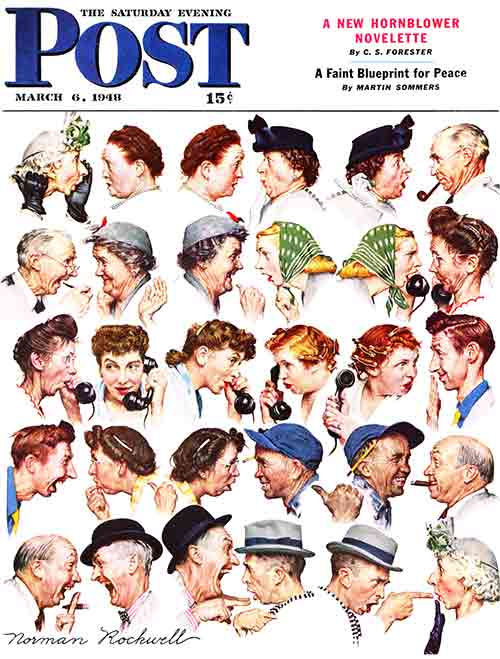
People used to spread gossip and rumors and secrets face to face or during long telephone conversations. Now we do it via social media and texting. This great Norman Rockwell cover has a really intriguing story behind it.
National Ginger Ale Day
Have you ever noticed how much ginger ale is consumed on Everybody Loves Raymond? I first noticed this a couple of years ago. Whenever Ray goes into the fridge to get a drink — which is often — he pulls out a small bottle of ginger ale. It seems to be The Official Drink of Everybody Loves Raymond™. These are the things I obsess about because I don’t have a social life.
Monday is National Ginger Ale Day, and while you can always just pop open some Canada Dry, especially if you’re not feeling well (along with tea, ginger ale is The Official Drink of People Who Are Sick™), you can also use it in recipes. It’s actually an ingredient used in many midcentury recipes, including Ginger Ale Salad, Ginger Ale Baked Ham, and Frosted Cranberry Squares. If you’re looking more for cocktails that include ginger ale, how about a Ginger Gaff or a Dark and Stormy made with ginger ale instead of ginger beer?
Next Week’s Holidays and Events
Daylight Saving Time begins (March 12)
Don’t forget to set your clocks ahead an hour before you go to bed tomorrow night. As someone who hates when it gets dark later in the day, I’m just going to grit my teeth and pray that November 5 comes quickly. That’s the day we set the clocks back again.
National Pi Day (March 14)
You can spend the day trying to remember two trillion digits, or you can just eat some pie. I know which one I’m doing.
St. Patrick’s Day (March 17)
This is the day when the beer and certain rivers flow green. Or you can make your own bookmark.
Man of Letters
It was Friday, three days into the new year, and there I sat at the breakfast table in my son Josh’s fashionable second-story apartment in Dallas, staring at the unopened letter I’d sent the Christmas before. Make that two Christmases before. There were other letters as well, besides the one in my hand. Some dating back years. They were all unopened, unread, and when I came across them and realized what they were, my heart jumped off a lonely little bridge inside my chest.
Josh had gone to the office early. We said hello and goodbye as he was walking out the door, hair still wet, smelling of soap, leather satchel slung carelessly across his shoulder. He wouldn’t be home for lunch, he told me, pausing at the threshold, so I’d have to fend for myself.
He turned to leave when his phone rang.
He raised a finger and spoke a few clipped words to whoever was on the other end. After he hung up, he slipped the phone into his pocket.
“What was that?”
“The office.”
“No, I mean the language. You speak a second language.”
“Only when I have to.”
“It was what, Spanish?”
“Portuguese.”
“You speak Portuguese? How do I not know this?”
He shrugged and returned to the topic of lunch, suggesting I poke around the neighborhood rather than depend on the pickings in the refrigerator. There were a lot of nice bistros here in Dallas, he said. Places with shaded terraces, interesting cuisines. I could buy a magazine and a decent cigar while I was out. Or get a handcrafted porter at the sports bar around the corner. Their burgers were to die for, he said. The waitresses weren’t too shabby, either.
I smiled. Told him, yes, sure. Any of those things would work. He wasn’t to worry. I was happy just being here, enjoying my time with him. The rest, I said, was cake.
He turned, paused and turned back.
“Just remembered,” he said. “There’s a new exhibit at the art museum. Dale Chihuly, the glass guy. You know him? There was a big write-up last week.”
He admitted he’d never been to the museum himself, but assured me it was a world-class operation. This was the Big D, he said. Not Port Arthur. They didn’t do half-assed here.
“Why don’t we go together?” I said. “Tomorrow’s Saturday. My plane doesn’t leave until late.”
He smiled, almost sadly. “Art glass?” He shook his head, eh. “You go. You’ll have a better time without me.”
I tried not to look as though I’d taken his dismissal personally. “Sure, sure.” I knew he wasn’t hot on galleries or museums — his social interests ran to sports and women, the occasional rock concert — but I hoped maybe just this once he’d accommodate me.
He glanced at the handsome steel watch strapped to his wrist. “Look, I gotta run. See you around 6, yes? We’ll order in tonight. Pizza or something.”
I nodded. “One last thing? Before you go?”
He raised his brow, hinting a slight impatience.
“What’s the best way to get there? The museum?”
“Easiest way’s to walk,” he said. “Cabs here are stupid expensive. Besides, it’s just as fast on foot. You’re only a mile away, down through the old historic district — ”
“No, no,” I said, embarrassed at the misunderstanding. “What I meant was, where is it? As in, what street is it on?”
He pointed to my laptop, open on the kitchen table. “Look it up online — dma.org — and Google yourself a map.”
Halfway out the door, he called over his shoulder. “Print it up on the workstation in my bedroom if you like. That way you’ll have your bearings, coming and going.”
He was right about the Chihuly exhibit. It looked impressive. There had to be 80 pieces from what I could see on the website, and they were all breathtaking. Fantastic blobs of colored glass, blown and twisted into massive dreamlike shapes. There were other exhibits, as well, including a collection of photographs by Edward Weston and Dorothea Lang. He didn’t know what he was missing.
The museum’s address was at the bottom of the page. But I remembered, in afterthought, that I needed a point of embarkation, too, if I hoped to generate a map.
I suppose his address should have leapt immediately to mind. But it didn’t. Strange surroundings, a strange bed … having to orient myself to the streets of a strange city … they had all toyed with my old man’s memory. The numbers resisted coming, and after a brief struggle to recall them I gave up and reached for the wicker basket where he kept his mail, believing I’d find a bill or credit card statement. Something that would give me the information I needed.
The first two pieces of correspondence were of no help. They’d been delivered directly to Josh’s post office box, which had a different address than his apartment. But the third envelope caught my attention. The handwriting was mine. The letter had flown out of Colorado on a different day than I had, on a different plane, but here we were, suddenly reunited. Sitting at the same kitchen table in the same neo-posh apartment in Dallas, Texas. I was thinking this and smiling when I plucked the envelope from the basket. But the smile vanished when I saw the letter had never been opened, and that there were dozens more beneath it. All from me. All sealed.
I’d sent Josh a letter every week for 40 years, a habit I acquired after his mother, Linda, and I split up. Linda was a Midwestern girl, born and bred, who hated Colorado. So when she saw the chance to move back east, she didn’t waste any time. Our divorce was barely under the judge’s gavel before she booked a flight home to Iowa, taking Josh with her. I didn’t chase after them. I saw no point. I was broke and tired of fighting, and the last person on earth I wanted to see again — besides Linda — was my attorney. I missed my son terribly when he was taken from me. But my work was in the west, my heart was in the west, and I couldn’t help but believe that when he was old enough to make the choice, Josh would come back to me of his own accord.
A letter a week, every week for 40 years. My God. What did that add up to? I couldn’t make myself do the math.
The unopened envelopes in the basket seemed to multiply before my eyes. How many more might there be in the drawers and closets, I wondered. How many of the hundreds and hundreds I’d mailed over the years were languishing in attics or basements or landfills? I drew a hard, sobering breath. I had a sudden urge to tear into the letters myself and give air to the words suffocating inside. But I didn’t dare. They were no longer my property. They belonged to Josh now, and were his to do with as he pleased.
One of the envelopes contained a greeting card. I could tell by its shape. But what occasion did the card commemorate? It was seven years old, according to the postmark. Seven. Years. I was still in my 50s seven years ago. My second wife, Stella, had just run off with a realtor who dealt in high-stakes commercial properties. His name was Douglas, and he was bald with a white beard trimmed to a pointy little Van Dyke. He was also cross-eyed, an affliction he made no effort to disguise in the photograph on his business card. Stella had met this fat little garden gnome at a software convention in Phoenix, and what started out as three-day business trip turned into a permanent change of address. She never came back, except once, to appear in court.
I wrote to Josh the day my divorce to Stella went through. It was a long, difficult missive, but I thought it would hurt less if I controlled the narrative on paper in an unbroken stream of thought. I tried to keep it straightforward and light. Compassionate, though I was feeling far from charitable at the time. I explained that Stella was young and pretty, and had always wanted a big house and money. I said the cross-eyed realtor was able to give her both, where I hadn’t been able to manage either. It was a good deal for each of them, I joked. Stella had found true happiness in a five-bedroom Federalist mansion, and the opthalmically challenged realtor had doubled his return on a cheap investment, getting two Stellas for the price of one.
I ran my thumb across the envelope’s canceled stamp now. It was a Ringling Brothers poster, in miniature, crowded with clowns and elephants and tumbling acrobats. I remembered buying the stamp — an entire sheet of them, actually — at the Capitol Hill post office in Denver. They were meant to be a mocking commemoration of the year’s events. A nod to the circus-like spectacle the divorce had been, and the endless parade of ugly little sideshows it engendered. I had hoped to be ironic, I think, affixing them to my outgoing mail. But now, seven years later, the image struck back with the cruelty of a twisted knife.
Seven years. Christ.
Yes, by all means, send in the clowns.
I couldn’t keep my thoughts in front of me, no matter how hard I tried. They kept blowing around inside my head — wild, scattered. Why would anyone keep a letter for seven years and never open it? He had his reasons, I suppose. Yet I couldn’t imagine a single explanation that would make sense to me. That wouldn’t fill me with despair. I wondered, grimly, if it was me alone whose words had been relegated to this unsettling limbo? Or did he do the same with his mother’s letters? His friends’ letters, if any of them ever wrote?
I could see the self-satisfied look on Linda’s face as she watched me suffer. Hear the smugness in her voice as she dismissed my heartache with a blunt declaration she’d kept under wraps for years. What did you expect, Brodie? You’re an afterthought in his life. A footnote. You always have been, and always will be.
I used to imagine that when Josh was out from under Linda’s influence, his life would flow back into mine, naturally, like water. Like blood running to blood. I always thought that, having read my letters, he would understand how much I loved him. How much I missed him. How eager I was to make up for what had been taken from us.
I never pushed things — I knew it would take time for him to put the divorce in perspective, to understand my reluctance to battle his mother over custody, or bicker with her over visitation — but it was the letters I’d counted on to help him come to balance in these matters. Letters were all I had. They were my proxy. They stood in for me, were me, in the most fundamental ways of parenting. Letters were my late-night bedside talks. My ball games and father-son breakfasts. They were my summer vacation road ramblings and holiday storytellings, sole witness to my devotion. But if he hadn’t read them, he would never know any of this.
I couldn’t move. Or breathe.
I thought of my own father, gone 15 years, and how I’d held his hand as he lay dying. How the veins in his fingers, which were swollen and purple from the disease, smoothed again, regaining their youthful mien after his heartbeat ceased and his breath left his body. My father died knowing I loved him, and I knew he loved me, which made the dreadful aftermath of his passing tolerable. How would Josh feel, I wondered, when I died? What would he remember about me? What would he know of me, or of my love for him? Would he be there to hold my hand?
My girlfriend, Jessica, sometimes asks about the long grinding silences between Josh and me. Why in hell don’t you just come out and ask the kid what his problem is? she says. Just say, Do you love me? Do you hate me? Is your phone broken? Did you forget how to write a letter? What? Maybe if you asked, directly, he’d tell you.
She doesn’t understand that if I started asking questions like that, Josh would never invite me into his home again. He was a quiet boy who’d grown into a soft-spoken, distant man. A man who took great care to protect his privacy. I explained it had taken more than a year to arrange this visit — three short days — and that the only reason the boy agreed was because I threatened to pull the “father card.” Show up on his doorstep unannounced. How many times did she think a stunt like that would work?
I closed my eyes. It grieved me to admit it, but the truth was, if not for a few stray and ultimately meaningless facts, my son and I were, after 40-odd years, no more than acquaintances. I knew he made good money. That he drank red wine. But what else could I say about him? What of substance? I knew he had friends he’s never introduced me to, an acoustic guitar he’s never played in my presence … that he spends his spare time in the gym (his biceps speak even when his mouth doesn’t), and that his mother, Linda, is married to a man named Carl, whom Josh may or may not call Dad. Did any of this amount to anything? What did it say about us as father and son? My heart sank when I asked myself these questions. Love me? Jesus. I didn’t even know if he liked me.
I returned the letter to the basket the same way I’d found it. Unopened. Unread. The small mysteries of my life and times, locked away forever, of interest to no one. Not even my last blood relative.
When Josh got home from work that evening we ordered a pizza and watched TV.
He opened a bottle of expensive red wine and poured two glasses.
“You see that exhibit today?”
“I did.”
“What did you think?”
“I thought it was beautiful.”
He seemed genuinely pleased. “Good, good.”
I almost suggested he see the exhibit himself, even if Chihuly’s glass wasn’t his thing. There were so many astonishing works of art in the museum. So many incredible pieces to savor and contemplate. I was certain he’d come away surprised. Maybe even moved to some unexpected appreciation of the artists’ craft. How much trouble, I thought, would it be to drop in and take a look?
We watched the news, and later, changed channels to a sports program where a panel of retired football players made predictions about the upcoming season. When the show was over, Josh sighed and reached wearily for the remote. I assumed we were finished for the evening, headed for an early bedtime. But he surprised me, asking if I would like to listen to a bit of music.
“Of course,” I said, though I didn’t get his music. “Why not.”
“I think you’ll like this,” he said as if he’d read my mind. “It’s a compilation of ballads. Old stuff.”
He got up and walked across the rug, opening the French doors to the balcony. A breeze passed into the room. The street below was lined with pecan trees, the branches of which were festooned with twinkling white lights. On the sidewalk below, revelers talked and laughed over drinks.
Josh turned on the music, and returned with another bottle of wine. “I’ll email the playlist to you,” he said, drawing the cork, “if you like.”
“Yes,” I said. “I’d like that.”
I stared out the French doors at the starlit sky, thinking about the unopened letters. Wondering how it was that so many impenetrable mysteries had come between us. But as he poured the wine I set the thought aside, too tired to worry about it anymore.
The ballads surprised me. They were tender and full of longing, and hearing them I was overtaken with an awkward self-consciousness — as if I had blundered into a dark room and stumbled upon strangers making love.
“How do you say ‘longing,’” I asked, “in Portuguese?”
He was slumped in his chair, head back. His eyes were closed and it was a moment before he replied. “Longing?”
“Yes,” I said. “The word. How do you say it in Portuguese?”
He crossed and uncrossed his legs at the ankles. But his eyes never opened.
“Saudade.”
I repeated the word. “Sow-deh-che.”
He smiled at my oafish pronunciation, and cautioned me not to think of the words as interchangeable. There was no adequate way to explain the nuances in English, he said. But in Portuguese, saudade was more complicated than just longing. It was, he said, a feeling of love steeped in deep, wistful nostalgia. A homesickness for a home that no longer existed. Or perhaps never existed at all. It was, he told me, a tender ache, and a yearning. A grief for the lost places of one’s past, real or imagined.
He paused and asked if I understood.
I didn’t know what to say.
Journalists vs. Tyrants: Murrow Crushes McCarthy
Today is the anniversary of one of the greatest journalistic takedowns ever recorded.
At the start of 1954, Senator Joseph McCarthy was a rising political star. His campaign to root out communists in the federal government had won him an approval rating of 50 percent. He was chairman of the powerful Senate Committee on Government Operations. Government officials feared him, and critics avoided speaking out against him for fear of being labeled a communist.
Yet McCarthy’s fall was even faster than his rise. By the end of 1954, he’d been censured by the Senate and shunned by other senators, the media, and much of the public.
What happened between January and December was that McCarthy lost public support. The American people became disenchanted with his endless inquiries, bullying of witnesses, accusations of treason without evidence, and questioning of the loyalty of anyone who opposed him.
Among the few prominent figures willing to challenge him was the veteran journalist Edward R. Murrow. His weekly news program, See It Now, was the forerunner of programs like 60 Minutes. Murrow relished the opportunity to report on controversial topics, and he despised the hysteria and paranoia that accompanied the hunt for communists.
On March 9, 1954, Murrow devoted an entire program to exposing McCarthy and his methods.
Murrow presented the senator in his own words and exposed McCarthy contradicting himself, boasting of his power, and bullying witnesses in congressional hearings. In concluding, Murrow added his own thoughts:
No one familiar with the history of this country can deny that congressional committees are useful. It is necessary to investigate before legislating, but the line between investigating and persecuting is a very fine one and the junior Senator from Wisconsin has stepped over it repeatedly. His primary achievement has been in confusing the public mind, as between the internal and the external threats of Communism. We must not confuse dissent with disloyalty. … We will not walk in fear, one of another. We will not be driven by fear into an age of unreason.
Murrow’s program is widely credited with “taking down” McCarthy. In fact, the broadcast simply encouraged the growing public distaste for the senator, his message, and his manner. The show prompted thousands of letters, phone calls, and telegrams to the CBS studios. For every message criticizing Murrow, there were 15 messages approving of the program.
Its reception encouraged President Eisenhower to take action against McCarthy. The president had long been disgusted with the senator but refused to criticize him publicly. In private, though, he told aides, “I just will not — I refuse — to get into the gutter with that guy.”
Now he saw the public starting to turn against McCarthy. He ordered the release of a report showing how lawyers on McCarthy’s committee had blackened the U.S. Army’s reputation to obtain favors. In public hearings, the Army’s attorney presented evidence of McCarthy’s distortions and personal vendettas. His culminating question to McCarthy, “Have you left no sense of decency?” resonated with the American public.
With the hearings concluded, the Senate voted to censure the senator.
It was not the contents of the See It Now broadcast that made the greatest impact, but the character of the reporter. Had it been presented by any other journalist, the broadcast might have been dismissed as a partisan attack. But Edward Murrow had a reputation for integrity.
Murrow Sticks to the News, from the December 10, 1949, issue of the Post, reflects some of the awe with which journalists regarded Murrow. It was written when Murrow was working in radio and still remembered for his courageous reporting under fire during the London Blitz. Americans admired his just-the-facts, no-hype style of reporting and his careful separation of opinion from facts.
The article reminds us that the ultimate argument against McCarthy wasn’t Murrow’s facts, but his character.
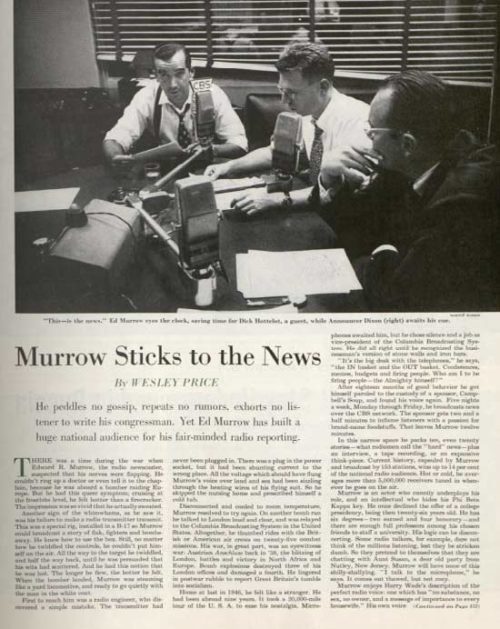
Featured image: Photo by Martin Harris for “Murrow Sticks to the News” from the December 10, 1949, issue of the Post.
Realizing the Dream of Citizenship
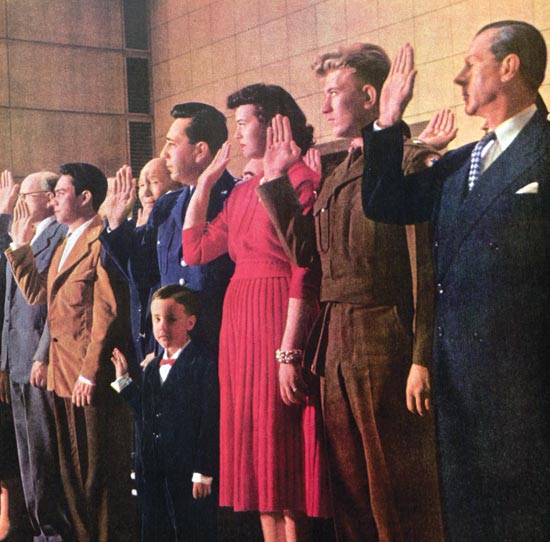
Frank Ross
This day they swear to defend the United States against all enemies. At the District Court in Washington, D.C., 141 subjects of 32 foreign nations become Americans. Wladimir the Ukrainian becomes a U.S. citizen named Walter, and Szymon the Pole plain Simon. Feige from Russia will answer to Fannie, and Liu Chia-Len to Bill. Little Dan Vega stands between Air Force Major Carl Vega and his wife, who adopted Dan in Germany and now pledge fealty to his new country on his behalf. It was a roundabout road, but Dan made it — he’s an American kid now. The strength of the United States will ensure the rights of the Constitution to each of these 141 persons. Each owes a new allegiance which he accepts “without purpose of evasion.”
The clerk of the court intones the oath, and a dream comes true.
—“Americans All”
Face of America,
June 4, 1955
This article is featured in the March/April 2017 issue of The Saturday Evening Post. Subscribe to the magazine for more art, inspiring stories, fiction, humor, and features from our archives.
No Sugar, No Tires, No Radios: Peter Drucker Predicted Shortages in 1942
Not all Americans were personally affected by the fighting in World War II, but all had to deal with wartime shortages of consumer goods. Manufacturers were diverting more of their raw materials and manpower to filling military contracts. Production of consumer items had fallen or, in some cases, stopped.
Normally, shortages drive up prices, making products unaffordable to a larger percentage of the population. In order to ensure an equal distribution of goods in limited supply, the government began rationing programs.
Just days after the Pearl Harbor attack, the Office of Price Administration (OPA) began to ration the sale of tires. America’s chief source of rubber had been lost when the Japanese seized Malaya and the Dutch East Indies. By limiting the supply of tires, the government also hoped to reduced gas consumption by motorists.
The OPA set up ration boards across the country, staffed by 7,500 volunteers, who determined who would get the rationed tires.
In January 1942, the War Production Board took a similar approach to the auto industry. It ordered an end to unregulated sales of automobiles to civilians. Ration boards would now determine who could buy any of the 500,000 new cars made before the auto industry switched completely to defense work.
Seventy-five years ago this week, in the March 7, 1942, issue, management pioneer Peter Drucker told Post readers that sugar rationing would soon begin. In his article, “When Will the Pinch Come?” he listed several goods that wouldn’t be produced until the war was over: refrigerators, vacuum cleaners, washing machines, air conditioners, sewing machines, irons, radios, and phonographs.
His article must have raised more than few eyebrows when it was published. The real shortages, said Drucker, were just beginning. They would be significant by Christmas.
The shortage of goods must have struck many Americans as ironic. They had waited through the 1930s for a return of good wages. Now, with incomes rising and money to spend, the luxuries they’d waited to buy were unavailable.
In this knowledgeable analysis, Drucker explains how rationing and the war economy would affect business. The American economy would undergo “great and violent changes” in 1942. There would be shortages, but he didn’t anticipate real hardships. At worst, he said, the average American would “live briefly as his grandfather lived all his life.”
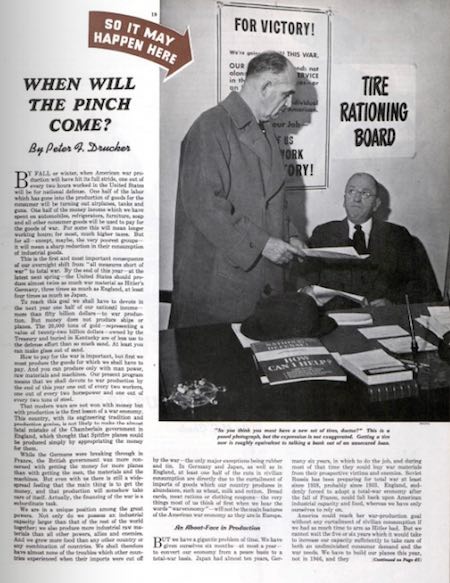
Featured image: National Archives
Cover Gallery: Women Making a Difference
These early Post covers – all published before women had the right to vote – show that they were making significant contributions to society despite their unequal treatment under the law.
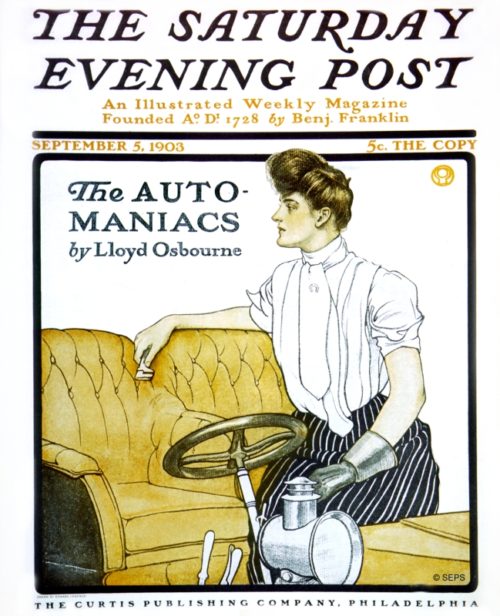
Edward Penfield
September 5, 1903
This cover was an illustration to accompany a story of a woman participating in a little insider trading in order to buy an obscenely expensive car. Is there anything more modern than that? To quote the protagonist, “If I could love a man as well as I do my Manton it would be a snap.”
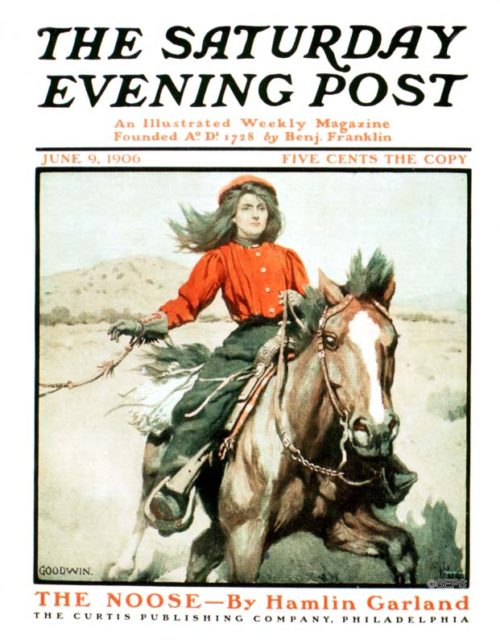
Philip R. Goodwin
June 9, 1906
This cover illustrated a short story called “The Noose.” The cowgirl at the center of the story, Fan Blondell, “was already aware of her power, too, and walked among the rough men of her acquaintance with the step of an Amazonian queen, unafraid, unabashed.”
Clarence F. Underwood
February 18, 1911
Most of Clarence Underwood’s female subjects were demure and daintily dressed. The woman on our 1911 cover is quite a different story: arms crossed, cap at a rakish angle, and sword by her side, she looks ready to take on just about anybody. In the early 1900s, however, there were almost no military or police roles open to women. Try as we might, we could not identify her uniform — can you?
Neysa McMein
May 26, 1917
Those on the home front were recruited to do everything they could for the war effort, including making socks, collecting scrap, starting gardens, and, as the woman on this cover is doing, making bandages to ship to the front lines.
Neysa McMein
August 11, 1917
Artist Neysa McMein was involved in the war efforts during World War I, travelling through Europe with Dorothy Parker to entertain the troops. She painted a number of wartime covers, including this pilot.
Clarence F. Underwood
August 18, 1917
With many men fighting the war overseas, the traditional work of men fell to the women. This included the decidedly unglamorous and backbreaking work of maintaining the family farm.
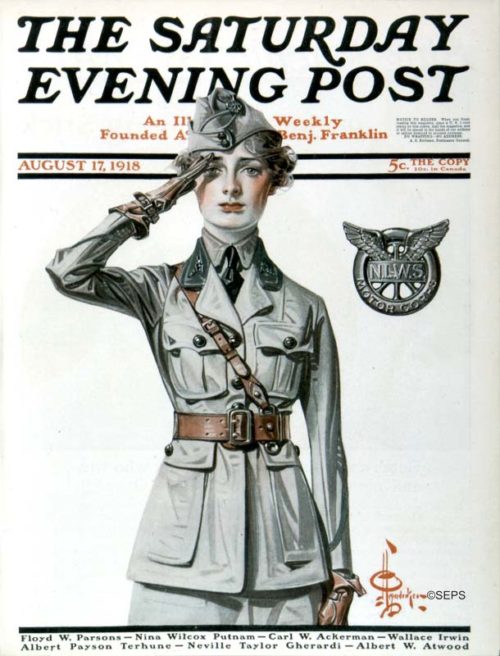
J.C. Leyendecker
August 17, 1918
The American Red Cross Motor Corps were a group of women who aided the U.S. military in transporting troops and supplies during World War I. These women did everything from running canteens and military hospitals to caring for patients of the 1918 flu pandemic.
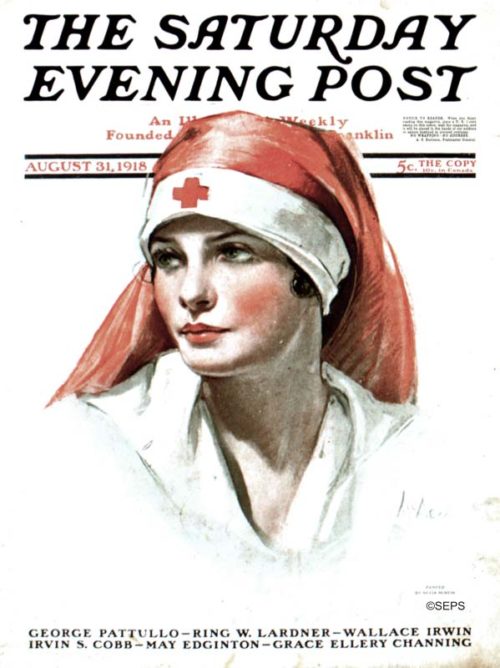
Neysa McMein
August 31, 1918
The role of the American Red Cross expanded significantly during World War I. During the war, the Red Cross mobilized more than 8 million volunteers, with one-third of all Americans serving as either volunteers or donors.
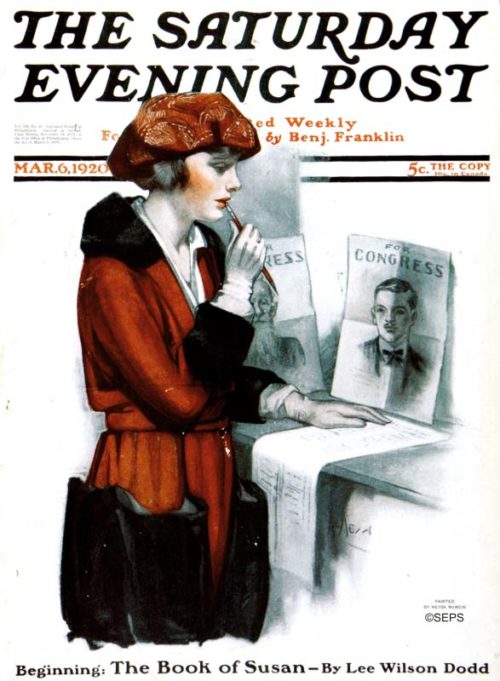
Neysa McMein
March 6, 1920
Although the 19th Amendment wasn’t ratified until August 18, 1920, women had the right to vote in 15 states. The first state or territory granting women the right to vote was Wyoming, in 1890. Twelve additional states allowed women to cast a vote for president prior to the 19th amendment.
The Taming of Liz Taylor

Elizabeth Taylor and Richard Burton had appeared as feuding spouses in the 1965 movie Who’s Afraid of Virginia Woolf?. A year later, they were back at it, making a film of The Taming of the Shrew. Frequently, their quarreling spilled over into real life.
Richard Burton to Liz: “I Love Thee Not”
By Russell Braddon
Excerpt from article published on December 3, 1966
Elizabeth Taylor, wearing no makeup and looking small and relaxed in pink slacks, sat sipping champagne in her dressing room at the movie studios outside Rome. Her husband, Richard Burton, a large, red-bearded, piratical-looking man in a 16th-century costume, was sipping a large vodka and tonic. “Seen the posters for the film?” she asked, pointing to a series of them on the dressing-room wall. The first announced:
Now on location in Rome
ELIZABETH TAYLOR in THE TAMING OF THE SHREW
and introducing Richard Burton.
“She had that specially printed,” Burton declaimed with a curl of the lip. “So I got one specially printed too.” His poster announced that Richard Burton starred in The Taming of the Shrew, which was scripted by Richard Burton, edited by Richard Burton, produced by Richard Burton and everything else-ed by Richard Burton. His wife was not even mentioned in the very small print.
Mrs. Burton had thereupon ordered a third poster:
ELIZABETH TAYLOR, ACADEMY AWARD–WINNING ACTRESS AND SHAKESPEAREAN COACH TO RICHARD BURTON IN THE TAMING OF THE SHREW
“Cheek,” was her husband’s comment.
“Take no notice of him. He’s only jealous.”
The conversation turned to the new full-blooded Taylor voice, which she had developed, without benefit of voice coach, for the role of Martha in Who’s Afraid of Virginia Woolf? “She can now, at the drop of a hat,” Burton declared, “sound like anything from a ripe old harridan to a boozy old whore.” He saluted her with his large glass of vodka. Glowing with pleasure, she saluted him back with champagne.
“Have a quail’s egg,” she suggested, offering a dish full of them.
Burton was asked how he and his wife came to be starring in a Shakespearean farce under an Italian director, Franco Zeffirelli. He flung himself back in his armchair and began:
“Well, it was like this — and can you believe it for idiocy … ?”
“What do you mean, idiocy?” demanded his wife, who knew what was to follow.
“… when Franco Zeffirelli decided that he wanted to do The Taming of the Shrew as his first film, he sent a colleague of his to see us. And this chap tells Elizabeth what Franco is planning, and that he wants her — who’s never done Shakespeare in her life — to do the Shrew. So naturally I waited for him to ask me — who had starred at the Old Vic — to do Petruchio. But not a word! Not a hint of a word! Apparently Franco didn’t think I was witty enough.” Mrs. Burton laughed callously. “It was only later, when he was taken to see my Hamlet, which was rather a witty Hamlet — not my fault, but it was — that eventually I got the job. … Everyone assumes, of course, and quite properly, that I was asked first. But incredibly I wasn’t. So we might as well get that clear for a start.”
“Absolutely not true,” Zeffirelli said, coming into the room. “Richard is very gallant to Elizabeth — well, sometimes he is very gallant to Elizabeth — but it is absolutely not true. I asked them both at the same time. Always I thought of them together. And, in the end, we even decided to produce it together. It will be the most artistic Shakepeare picture ever made,” he concluded modestly.
“But not stuffy,” Burton reminded.
“Absolutely not stuffy,” Zeffirelli agreed.
“And also, of course, there’s the fact that whilst Elizabeth and I both wanted to do this film, no outside producer, for Shakespeare, would put up the kind of money we can demand.”
Mrs. Burton looked immensely contented at the thought of the kind of money she can demand, even though, as the co-producers, she and Burton had to put up $3 million to pay for their own services.
The Burtons had arrived in Italy with a large entourage, their children, some 200 pieces of baggage, and a mad assortment of pets — “allegedly the children’s, but they’re Elizabeth’s really,” Burton claimed — that were said to include three dogs, two cats, five goldfish, three tortoises, a young rabbit, and a bird. It is a nervous habit of Zeffirelli’s that, when he first meets a person, or even meets again someone he has not seen for some time (like one day), he will admire some part of the person’s apparel. He greeted Mrs. Burton, the day she arrived at the studios, by admiring her earrings — which were of diamonds and indeed wholly admirable.
“They were a present from a director,” Mrs. Burton advised. Then she added sweetly, “It was his first film too.”
“But I think it would be very difficult,” Zeffirelli demurred, “to find something that will top those earrings.”
“No,” she murmured. “There’s a little shop on the Via Condotti called Bulgari …”
“I don’t understand your English accent,” Zeffirelli interrupted hurriedly, Bulgari being in Rome what Tiffany is in New York. “Come and look at the costumes.” But he returned the next day with a bracelet, in enamel and precious stones, that once had belonged to Napoleon’s sister, Elisa Bacciochi. Delighted, Mrs. Burton thanked him and explained that actresses give directors gifts only when their film is completed.
Paul Ronald, ©SEPS
Work began, at the studios, at 9 a.m. — which meant getting up at 6 — and this was one aspect of her work about which Mrs. Burton cared less than passionately.
“Isn’t that wife of mine here yet?” demanded Burton one day. “I swear to you, she’d be late for the last bloody judgment. A quarter of an hour late, in fact, and Liz thinks she’s early.”
Eventually Mrs. Burton arrived, looking composed, uncontrite, and professional. Immediately, Zeffirelli, who directs by playing all the parts and miming extravagantly, launched into his version of how she should act during the morning’s scene — tearing his hair, fighting, spitting and shouting.
“Franco,” she remonstrated, deadpan, “don’t do it all for me, please.”
Mrs. Burton first acted the scene for the cameras, and then — since the microphone couldn’t follow her — did it a second time for sound alone.
“Bravo,” the Italian technicians cheered as she finished. Mrs. Burton giggled, then confessed. “You feel a damned idiot doing that.”
“And to think,” her husband retorted, “that some fool in London once wrote that Elizabeth was overpaid, overweight, and undertalented.”
“Not true,” Zeffirelli assured her, his arm round her shoulder, his eye roving clinically. “You are not overpaid, and you are not undertalented.”
“Dear Franco,” she murmured, and kissed him.
Burton slapped her on her stomach. “Look at that,” he invited, and the entire studio looked. “Isn’t that belly disgraceful?”
At last she was stung. “In Egypt,” she observed coldly, “they adore it. The only trouble is, my films are banned in Egypt, so they never get to see it.”
She, Burton, and Zeffirelli discussed once again, finally, what must be done in the next scene, and then indulged in the usual banter about Zeffirelli’s demonstrativeness, Burton’s alleged pleasure in close-ups of Richard Burton, Mrs. Burton’s lateness and operations, and Mrs. Burton’s costume, the bodice of which was laced up.
“Untie the lace a little,” Zeffirelli urged.
“Franco, I can’t. There’s enough of me showing already. Any lower and my bosom’ll fall out.”
“Exactly what Columbia wants,” growled her director, and reluctantly left the bosom adequately contained.
After a long day on the set, they consoled themselves with generous libations of vodka and tonic — and the morning after, early on the set, felt quite unwell. Mrs. Burton looked glowing, but she made it very clear that she felt awful.
After one take she stood in front of her small mirror and dabbed sweat from her brow.
“Pure vodka,” she declared. Right hand supported on left wrist, she painstakingly mascaraed each eyelash; to her evident astonishment, she avoided poking an eye out.
A piece of costume jewelry clattered to the ground in the middle of his last line and ruined the first take. On the second, a bird high in the studio rafters cheeped shrilly. During the third take, Burton forgot his lines. On the fourth, a carpenter dropped a hammer and destroyed Burton’s concentration entirely, though not his good humor.
On the next three takes in a row, Burton fluffed his last line; and on the fourth he fluffed everything, but carried on, cheerfully inventing.
“That went very smoothly, I thought,” he declared as he passed the camera. “Shall we use it? Or would you like it in Welsh now?”
“Let’s go to lunch,” his wife suggested. “It’s not going to get any better.”
After lunch it went perfectly.
On the last day at the studios, Mrs. Burton asked Zeffirelli to come to her husband’s dressing room. “Tomorrow I fly to New York,” he told them, “to produce Anthony and Cleopatra at the Met. But I will miss you.”
“We’ll miss you too,” Mrs. Burton told him. “So here’s something to remember us by.” And she gave him a superb cigarette case of heavy gold decorated with a large sapphire and inscribed:
CARO FRANCO — FROM THE SHREW AND HER TAMER.
The Woman’s Rebellion: A Story of Suffrage in 1909
A decade before women gained the right to vote in the U.S., the women’s rights movement was working hard to claim incremental victories. Most progress came through quiet grit, relentless recruitment, and tireless organizing.
In 1909, there were many factions of the suffrage movement, all with varying perspectives. Some wanted only partial suffrage (victory at the municipal level), while others believed that they must fight for national suffrage. The National Women’s Party was often confrontational, organizing protests and marches. The National American Woman Suffrage Association focused on lobbying. Most work was done at the grass-roots level, with women holding luncheons, lectures, and letter-writing campaigns and traveling to state capitals to make their case.
An article by May K. Warwick from the June 12, 1909, issue of the Post applauded the headway the women’s rights movement had made. In the article, Warwick enumerates the many benefits of giving women the right to vote:
The suffragists assert that their movement has been related to that of higher education for women, and they point with pride to the seven thousand women doctors, three thousand ministers and one thousand lawyers in our country, to the three hundred occupations open to women and to the thousands of women’s organizations.
 The author notes that in the four states where women had the right to vote in 1909, regulations protecting women and children were enacted more quickly. This included laws that raised the age of consent, gave women the right to control their own income and property, and established free kindergarten.
Of course, things were still very different in 1909. While Warwick lobbied eloquently for the right to vote, she assured readers that women were not very interested in running for elected office.
The histories of the enfranchised states show that women have not rushed into office and that those they do hold are mainly educational and charitable. They will state that in all the parties women work in harmony with the men.
Warwick notes that if women were able to show equal pluck and determination after getting the right to vote as they did in petitioning for the right, they would prove a formidable force in American politics. Her article ends on an encouraging note:
The people of America have been stirred from their apathy and are thinking about suffrage. The race is indeed not always to the swift nor the battle to the strong; but some kind of worthy success always follows energy and courage.
It’s a good thing that the women had plenty of that energy and courage; the right to vote was still more than a decade away, and the road ahead would be a bumpy one. Protests continued throughout the 1910s. In 1913, the day before Woodrow Wilson’s inauguration, Alice Paul and Lucy Burns organized a suffrage parade. Opponents brought the protest to a near riot, and mounted police were called in.
Film of suffragettes marching from Newark, New Jersey to Washington, 1913.
In 1917, 200 suffragists were arrested and half were convicted following a protest at the White House. The harsh treatment of some of the women, including forced feeding in prison, bent public sympathies toward the movement.
After several false starts, the 19th amendment was eventually passed and ratified. The first presidential election in which women were permitted to vote in every state occurred in 1920. Despite this fact, many states took their sweet time ratifying the amendment. Mississippi was the last state to do so — in 1984.
Friends, Foes, and Formality: The Presidential Press Conference
Never, in its long and difficult history, has the relationship between president and press been so rancorous. Major newspapers are repeatedly challenging President Trump on his facts, and the president has referred to the country’s leading news sources as “the enemy of the American people.”
We’ve come a long way from Revolutionary days, when Thomas Jefferson said he’d rather have a free press and no government than a government and no free press.
Presidents have always worked to gain the approval of the press, knowing how newspapers can build public support for policies. But for most of our history, presidents kept their distance from reporters. In the 1900s, President Theodore Roosevelt began hosting informal press conferences, but he was selective of which reporters were invited, and he prohibited any reporter from quoting him. Presidents Harding, Coolidge, and Hoover all held formal press conferences but would only answer their choice of questions, which had to be submitted in advance.
Franklin Roosevelt broke with tradition by inviting reporters into his office and answering questions directly, setting the precedent that is still followed.
In “Mr. President!” Henry and Katherine Pringle offer a glimpse of a more decorous era in Dwight D. Eisenhower’s White House press room. It’s refreshing to read of the days when press and president could earn each other’s respect.
President Eisenhower had been dealing with the press since he was the Supreme Allied Commander in Europe during World War II. One of the chief reasons he was given that post was his ability to handle criticism and win support from his critics. Rarely did he show resentment or hostility toward people who fired questions at him. When he did speak his mind, he could show a dignified outrage, calling one question “the worst rot I have heard since I have been in this office.”
And to another, he gave what, for Ike, was a harsh critique: “I don’t think much of the question.”
Despite the occasional blunt response, Eisenhower appeared to respect the reporters, and they respected him. The current state of the White House press room is far different, and it seems unlikely that civility will make a reappearance anytime soon.