Harvesting the Wilderness
Want to pick up some “wild” eating habits? Throughout the fall, we’ll share books, classes, tips, and more to help you find safe, sustainable fare in uncultivated landscapes near you.

Would You Like Weeds with That?
In 1964, the Post joined outdoorsman Euell Gibbons as he foraged wild foods for lunch near his farm in Pennsylvania. Read more »

Something Wild: An Adventure in Foraging
Writer Andrea Cooper finds foraging for food is as satisfying to the soul as it is to the belly.
Read more »

Finders Keepers: Foraging Tips for Beginners
Notable foraging experts offer tips on how to get started.
Read more »

Foraging Classes and Tours
Find foraging experts near you who can guide you on a wild food adventure of your own.
Read more »
News of the Week: Moon Trips, Martha Stewart, and a Machine That Dispenses Pizza
To the Moon, Alice! (And Other Loved Ones)
Would you like to have your ashes scattered on the moon? Well now they can be.
Moon Express, a private company based in (of course) Cape Canaveral, Florida, has gotten permission from the U.S. government to fly to the moon and play among the stars. The flights won’t be manned at first. They’ll launch a ship the size of a washing machine to land on the moon and get soil samples and send back high-def video. The first flight is planned for 2017.
You’ll even be able to pay them to take your ashes to the moon, if being buried on the moon is something you’ve always dreamed of. Please note that this dream will cost at least $5.4 million.
It’s not Apollo 11 or Buck Rogers, but it will do for now. The lack of emphasis on manned space flight and the space program in general the past several years has been kind of depressing. We don’t have manned space flights or space shuttles anymore, but luckily we can control our toasters from our smartphones.
This Is Going to Be One Interesting Cooking Show
If you could pick two celebrities you’d never think would team up for a cooking show, who would they be? Daniel Boulud and Carrot Top? Alice Waters and Howard Stern? Wolfgang Puck and whoever the latest Bachelorette is?
How about Martha Stewart and Snoop Dogg? They’re teaming up for Martha and Snoop Dogg’s Dinner Party, a new series coming to VH-1 this fall. According to the show’s website, it will have the cooking/lifestyle icon and the rap star creating a meal for their celebrity friends.
Come on, like you’re not going to watch that.
The pairing isn’t as odd as it sounds. The two have been friends since Snoop appeared on Martha’s TV show a few years back, and they appeared together on Comedy Central’s Justin Bieber roast and The $100,000 Pyramid this year.
Presidential Soda
If we want to figure out who is going to be the next president of the United States, we should look to soda (or pop or tonic or Coke, depending on where you live).
Connecticut-based Avery’s Beverages has created two new drinks. One is called Trump Tonic (a bold grape flavor with the slogan “Make America Grape Again”), and the other is called Hillary Hooch (raspberry and strawberry with a hint of lemon). Consumers can “vote” with their taste buds.
Not that this is going to be a scientific poll — the results won’t be accurate in any way, shape, or form. If you love raspberry and hate grape, you’re not going to waste a couple of bucks on the one you hate just because it has a picture of the person you want to be president on it. You’re going to buy the one you actually like.
Though maybe it’s more accurate than we think. The company did the same thing in 2008 and 2012, and both times the Barack Obama beverage came out on top.
Max Rose
Jerry Lewis hasn’t been a regular in the movies for a while and hasn’t been seen on television since being unceremoniously dumped as host of the annual Muscular Dystrophy Association Labor Day Telethon in 2011. (I have to admit I stopped watching the telethon after he left, and the MDA ended it for good in May of 2015.) But the actor and director has a new movie coming out (filmed in 2013), and it looks pretty great. It’s called Max Rose, and it’s a dramatic role for Lewis. Here’s the trailer:
Hey, That Lucy Statue Is Done!
We’ve been following the adventures of the Lucy statue, created to honor Lucille Ball, in this column since last year. The first statue was hated — possibly because it looked like Lucy was a zombie — and nicknamed “Scary Lucy.” So they decided to get another artist to make a new one. Well, the new one is done and it looks a lot more like Lucy than the first one did.
The statue was unveiled last Saturday during the celebration of Lucy’s 105th birthday in her hometown of Celoron, New York. She’ll stand in Lucille Ball Memorial Park. By the way, if you want to see Scary Lucy, you still can. They’re actually keeping that one, too, and it will stand in another area of the park.
I swear this is the last time I’m going to write about the Lucy statue. Unless the old one suddenly comes to life and seeks revenge on its enemies.
Insert Money, Get a Pizza
Imagine it’s really late at night and you’re hungry for pizza, but all of the pizza places are closed. What do you do? Sure, you could open up your freezer and cook some Elio or Freschetta, but now that’s not going to be your only option, at least if you live in Cincinnati.
That’s where the first pizza ATM has been installed, at Xavier University. The machine holds 70 pizzas. You put your money in, the pizza is heated and put in a box and then comes out the slot all ready to eat. The machines have actually been in Europe for over a decade.
I have a friend who works at Xavier. I should email him and ask him to try it.
Now all we need is a beer ATM and we’ll be all set, though I assume there would be some legal problems with that.
National Creamsicle Day
Popsicles are like Band-Aids. Let me explain.
Band-Aids is a trademarked name. All of the “band-aids” we buy aren’t Band-Aids at all, they’re adhesive bandages. But over time we’ve come to call them all band-aids. I think it’s the same for Popsicles. It’s a registered trademark of Unilever, as are Creamsicles and Fudgsicles, but I bet a lot of people aren’t aware of that and call all freezer pops on a stick popsicles and all orange vanilla desserts on a stick creamsicles.
Sunday is National Creamsicle Day, and it’s good to see a food holiday in a month where it makes sense. If you don’t have any in your freezer (the one that probably has that frozen pizza in it) you could make your own.
Upcoming Events and Anniversaries
President Roosevelt signs Social Security Act (August 14, 1935)
Here’s a timeline on how the Social Security Act came to be.
Lawrence of Arabia born (August 16, 1888)
The British author, military strategist, and archaeologist — whose real name was Thomas Edward Lawrence — died in a motorcycle accident in 1935.
Davy Crockett born (August 17, 1786)
Saturday Evening Post Archive Director Jeff Nilsson separates the myth from the man.
Orville Wright born (August 19, 1871)
The Saturday Evening Post interviewed Wright in 1928, on the 25th anniversary of the Wright brothers’ historic first flight.
Leon Trotsky assassinated (August 20, 1940)
The revolutionary was stabbed to death with an ice pick after being exiled to Mexico.
Viking 1 launched (August 20, 1975)
It was the first spacecraft to land on Mars, arriving on the surface on July 20, 1976.
The Offer
“But what is an artist supposed to look like?” Geoffrey said, pushing aside his breakfast.
Normally a strict vegetarian, for the past six months he’d been taking his meals at Mrs. Crump’s little card table, eating bacon-and-two and even the odd dried-out pork chop. She was sitting across from him in her hairnet and old pink housecoat, having gotten up by herself without his help for the first time in a week. She was going to have to do that now, dizzy spells or no dizzy spells. She seemed so small, like a mouse in a cartoon.
“Oh, like anybody else, I expect,” she said impatiently, sweeping toast crumbs into a little pile on the plastic tablecloth. “There was just something about you that hinted otherwise. As a matter of fact, I thought you were a bit too dapper for an artist.”
She was irritable because he was leaving this morning without considering the lifeline she was holding out to him. He was deluded, he really was; a man who was no longer young, setting himself up for another failure when the obvious path was to stay here in her cozy little house. If he had the sense to stay, he could continue to take her shopping, even sponge off her if necessary, while he went to the mountains every so often to paint a glacier or whatever other nonsense he felt compelled to do. It was a fair offer, very fair indeed.
“It’ll be cold up there in the mountains,” she said, haughty suddenly as she gave her dining nook the onceover. “And that ferry, Geoffrey — wicked at this time of year, I should think.”
Built after the war, her two-bedroom bungalow was near the bay. On sunny days there was a magnificent view of Mt. Baker in Washington. But of course Mrs. Crump rarely ventured past Renault Street because of the bloody awful wind. People thought Victoria was mild, but the wind could kill you. She peered at Geoffrey through a pair of old silver-rimmed glasses (seldom would her tremor permit the use of her contacts), and recalled the afternoon he came back from the Salvation Army Thrift Store looking smashing in a perfectly good sports jacket that matched his soft brown eyes. And how perked up her little Buffy had been after Geoffrey had arrived. You wouldn’t have known the little dog was half-blind from cataracts.
“The weather,” Geoffrey said, smiling, “will be the least of my worries, Mrs. Crump. Besides, how can I complain about the cold after you’ve given me those marvelous boots?”
He nodded over his teacup at a brand-new pair of mukluks awaiting him by the door.
A shy, delicate man of 46, he had shown up on her doorstep with a referral from the social services. He seemed an unlikely personal support worker, but he was anxious to redeem himself. In the spring his sister, his only sibling, whom he’d loved more than all the world, died of bone cancer. During the final two weeks while Nancy rapidly deteriorated in a Toronto chronic care ward, he had not been as brave and comforting as an older brother should. Downright feeble, unable to look at her sunken cheeks; unable to visualize what she had looked like before her illness, when she taught English at a Cabbagetown high school.
“It’s like I’m Fan, in Scrooge,” she had joked during a lucid moment. “And you’ve come to be by my side, like Ebenezer.”
“Don’t,” he said.
He would be lost without her, and she knew it. After their elderly parents died, she was the one who had been there to buck him up. Lately it seemed like he had become an artist only in a theoretical sense. His Toronto gallery had dropped him, considering that for the past two years he’d barely lifted a brush. A paralysis had come over him; her death left him petrified.
“When I’m gone,” Nancy had told him, “I want you to take a trip. Maybe you could live in an artist’s shack on Vancouver Island, like Malcolm Lowry when he wrote Under the Volcano.”
“I will,” Geoffrey promised. “As soon as I sell something.”
“Don’t worry about that,” she said. “I’ve got a little packet coming for you.”
To his astonishment, she left him $20,000. So he came out to the coast, determined, for her sake, to go somewhere neither of them had been. He would try to paint again, however unnerving and unlikely that prospect seemed. On the way to Vancouver Island on the Nanaimo ferry, he glimpsed a spectacular crescent moon. The glow, a shade of orange, was stunning — more like a sliver of a sun than a moon. But even as he studied it he was intimidated by the thought of trying to properly capture it.
“Do you think you’d go back to it?” Mrs. Crump said to Geoffrey now, looking at the beat-up wicker chair where her little Buffy used to beg for a biscuit. “The advertising business, I mean.”
Geoffrey cleared his throat, annoyed that she chose the morning of his departure to recall this little tidbit: five years ago, deciding to paint full-time (while borrowing heavily from Nancy), he gave up a good-paying job with a graphics firm.
“No, no,” he said, a tight smile forming. “There’s no turning back. I’ve made a bargain with myself.”
“With yourself?” said Mrs. Crump, tapping her spoon. “If you call giving up a decent wage a bargain, at your age, then I’d say you got the short end of the stick.”
He could be airy-fairy, not at all like her Jim. He was always going on about having a peak experience, whatever that was. During such times she would remind him that she liked her carrots cooked, not chopped up into hard little sticks.
“This isn’t a criticism,” Mrs. Crump said. “But what will do up there in the mountains, Geoffrey? Where will you go? When I think of you leaving this nice warm house, when you could easily stay on as a boarder, and instead going up to all that … snow.”
She stifled a gasp. Mrs. Crump disliked the snow most of all. Though it was fairly safe in the past, she often mentioned the fact that her late Canadian husband, a cattleman, decided to settle in Alberta after the war when she agreed to come from England. Alberta! Imagine what that was like after good old Lancashire. And it wasn’t until after they sold the farm that they moved to Victoria, don’t forget. Then, after three short years in a decent climate, her Jim was taken from her. A stroke, that’s what happened. Three short years, and boom. After she’d been through bloody hell for nearly half a century in that dreadful, awful cold. Her only son lived in Calgary, and hardly ever came to visit. When he had noticed her tremor last year, he suggested she start thinking about an old-folks home.
And then, like a bloody miracle, Geoffrey came, and didn’t they have such nice times together? Like that afternoon when they were walking back from an exhibition he admired. Not her cup of tea — abstracts — but it had been nice out, and she had taken the liberty of buying him a glass of red wine at a cafe he fancied.
“I could have had all that,” she recalled him saying, a reference to some friends in Toronto who had done well for themselves, financially speaking, by hanging on in the ad business. The sun had been quite warm on her face during the walk home (she had taken his arm), and before she knew it she was revealing something when she should have kept her mouth shut, telling him about the time her son came home to find her daughter-in-law in bed, not with a man — but a woman!
“Rather disgusting, I should think,” she’d been forced to add, since Geoffrey had made no reply. Perhaps he was queer and she had put her foot in it. But too late, too late. She had opened her big yap. And then to top it off she went on about her son and his new wife, that they hardly ever came to visit, and that she wouldn’t go to Calgary because of the damn cold. She could never find boots that would keep her from slipping. Her neighbour, a Mrs. Flewellyn, had broken a hip last winter.
***
Mrs. Crump bundled her housecoat around her shoulders, looking very tiny indeed as she allowed Geoffrey to pour her more tea.
“I shall repeat my offer,” she said. “If it doesn’t work out up there in the mountains, or wherever you’re going, then you’re more than welcome to come back. You could stay on as a permanent boarder.”
Despite making this generous invitation, she regarded him suspiciously, as if anticipating an inquiry about her Savings & Trust account.
Geoffrey gulped some tea, washing down some beans, which were stone cold.
“You’re very kind,” he said. “But as I think we discussed yesterday, I never planned to stay beyond my contract. I believe I made that quite clear.”
“I know, I know,” she said, losing her patience. “It’s just that many people in your position would be grateful to have something to fall back on — a cushion of some sort. You’ve been kind, too, and I’m trying to reciprocate, don’t you see? It’s a fair offer, a very fair offer indeed.”
And she thought about her contact lenses, and how he had come up with the idea of using a Q-tip to shift them back when they slipped. She couldn’t do that by herself because of her tremor, could she? She loathed wearing her glasses outdoors because they made her look like an old fuddy-duddy. She remembered waiting for the bus that time and being confronted by a very rude young man, obviously a few bricks short of a load.
“Any complaints?” he had barked in a threatening tone.
“No, I shouldn’t think so,” she had replied, flustered and terrified. When she mentioned this incident to her son, he used it to re-visit the issue of the retirement home, which was certain, he pointed out, to provide a free shuttle service when lodgers needed to go shopping.
Geoffrey was putting on his big beaver hat. He didn’t like it when people spoke of doing him favors, and as he got up from the table he recalled that no matter where he had stayed over the past five years, his hosts always acted as if he never thanked them enough.
“I’d best be on my way now, Mrs. Crump,” he said. “The ferry’s in Nanaimo.”
Mrs. Crump got up too, then, with difficulty.
“Wait,” she said, surprising him by taking his arm. “Just a moment, please.”
She began to tremble, blinking up at him through her old-fashioned glasses as he stared at her.
“I know something terrible has happened to you,” she said. “A shock. With your sister, Geoffrey.”
Geoffrey stiffened. He seemed very tall in her little dining nook. He attempted a smile, but his eyes blinked rapidly. Slowly, he sat back down.
“My sister passed away in March,” he said quietly. “She had bone cancer, Mrs. Crump.”
“I know, Geoffrey. I know all about it, dear.”
His soft brown eyes, which had begun to water, looked down at the leftover beans on his plate.
“Who told you about this?”
“The social services,” Mrs. Crump said anxiously. “A very nice lady who works down there — a Mrs. Moorehouse, I recollect — telephoned the other day when you were out getting the Colonist. And she said, ‘How’s our Geoffrey, Mrs. Crump? Is he being kind to you?’ And I said, ‘Oh yes, Mrs. Moorehouse, Geoffrey’s been the world to me, good as gold.’ And she said that she was very glad to hear it, considering you’d had such a hard time with your sister.”
She continued blinking up at him.
“I would have thought you’d mention something like this, Geoffrey. I’m not a stone.”
“I didn’t see the need,” he faltered, feeling a hole in the arm of his sweater. “I came here, looking for a bit of work until I could resume my painting. The job has been completed. Now I must move on.”
He fumbled with his big hat. In his mind’s eye, suddenly, was the orange crescent moon he’d seen on the ferry. He would never get it down.
“I expect she was a lovely girl,” Mrs. Crump said, picking up her teacup. “It’s bloody awful when something like that happens.”
When her son found his wife with a woman all those years ago, he completely broke down. And for a while Mrs. Crump got her way on everything. Oh yes, after that mess everybody came out to Victoria for Christmas.
“The truth is,” Geoffrey said, smiling sadly, “I haven’t been able to sketch a bloody thing in nearly two years. I can’t seem to interpret anything. It was like Nancy’s face at the hospital. As she got more and more ill, I couldn’t see her face.”
“You must have a picture,” Mrs. Crump said, not used to being a consoler. “Before the cancer, I mean.” She groped in her housecoat pocket for her cigarettes, but they weren’t there, and she slapped her hands down on her knee.
“It’s not like that,” Geoffrey sighed. “Of course I have pictures. It’s when you’re just sitting there: her face should be plain as day. I loved her deeply my entire life. But I don’t see anything.”
Mrs. Crump looked at him. She was not daft, and yet he was talking to her as if she was.
“You won’t see her face,” she said sharply. “That’s one thing that will not happen, Geoffrey. Remember, I lost my husband. I know what it’s like.”
Satisfied that he was paying attention, she smoothed the lapels of her housecoat.
“No,” she went on, “they may never come back the way you think. Why, I remember one night, about a year after my dear Jim died, I woke up crying in my bed. And do you know what? Well, there was this light shining on the wall above my dresser. Directly above my little clock. And within this light there was a figure of a man — a very old man, you see — and he told me not to worry, that somehow everything was going to be all right in the end, even without my poor Jim. And do you know, Geoffrey, I believed him. Yes, I did. And I thanked him, and I still put faith in whatever it was to this day.”
She swept more crumbs, a little embarrassed but entirely certain of her memory.
Geoffrey leaned forward, suddenly interested.
“Can you describe that light?”
He said this in the matter-of-fact tone he used when he asked not her not to smoke when she was making a meatloaf, in case the ashes should fall into the mix.
“The light?” said Mrs. Crump, fidgeting with her lapels. “Why, what a question. I can’t say as I recall, exactly. It was just some sort of glow over my little clock. It was only momentary, you see.”
Geoffrey was nodding.
“It was your Jim.”
“Well, I’m not sure about that,” she said. “I mean, it was an old man, yes, but Jim never looked that old. I suppose it could have been him. But I should think I would have been a little frightened if it was.”
She was becoming uncomfortable talking about it.
“Do you not believe me, Geoffrey? You think I’m daft.”
Geoffrey put on his hat.
“On the contrary,” he said, emerged from his melancholy. “I would suggest you had a peak experience. And I think you saw your husband, which means there’s hope for me in terms of being able to see my sister and visualize in general.”
Her hand hit the table hard.
“Then why are you leaving!” she shouted, choking back a sob, her tremor quite noticeable. “Why is everybody leaving me?”
And she looked at the wicker chair for her little Buffy. “Mrs. Crump,” Geoffrey said gently. “Nobody really leaves anybody. You are here because this is what fate has decided. You are part of the fabric. I, on the other hand, am on a new journey.”
And with that he went over to the new pair of mukluks and started pulling them on.
“I see,” said Mrs. Crump, defeated. “And where will this journey end, Geoffrey? In the snow, with no coat?”
“My sister wanted me to see the mountains,” he answered resolutely, making the long brown laces wrap around. “When I arrive at my destination, wherever that might be, I will send you a card.”
“Lovely,” Mrs. Crump said quietly.
Soon they were out in her carport together. Mrs. Crump came out with only her housecoat and slippers, despite the crisp October air.
“It very likely was my Jim,” she said quietly. “Now that I think about it.”
He said nothing, so she patted his arm.
“You don’t have to go,” she said. “You can come back anytime you fancy it. Remember my offer.”
“It’s very kind of you,” he said.
Then she gave him some meatloaf sandwiches she’d made the day before. Geoffrey took the tiny rolled-up paper bag, thinking he would toss the bread at the seagulls that trailed the ferry.
“Goodbye,” she murmured, starting to tremble as she watched him turn smartly on the sidewalk. “Goodbye.”
He waved back to her. But his image was a blur; she couldn’t see his face. All she could make out was a glimpse of his big hat through the brown leaves of the trees.
Not So Neutral: America’s War Efforts before Pearl Harbor
Seventy-five years ago, Americans were watching their country heading into a war without declaring war. In 1939, the Neutrality Acts that prohibited the U.S. from supplying arms, ammunition, or financial aid to belligerent countries were replaced by the Lend-Lease agreement, which enabled the U.S. to loan, or give, armaments to Great Britain.
America had become the supply line that enabled Great Britain to resist Hitler, sending billions of dollars of aid in weapons, ships, and other vital needs — hardly the actions of a neutral country.
Yet we were not at war.
The U.S. had also reached an agreement with the government of Greenland to build bases and station troops there to extend America’s protection of Lend-Lease ships. American soldiers were, technically, within a few miles of the war zone.
Yet we were not at war.
In 1940, America had more than a million American men in uniform and being trained in Army camps. Congress approved funding for a 70 percent increase in America’s combat fleet, enough to create a “two-ocean” navy.
Yet we were not at war.
President Roosevelt saw the inevitable threat from the Axis powers but didn’t have enough public support for an official declaration of war. Nonetheless, as Demaree Bess points out in “Put Up or Shut Up” — published just two weeks before the attack on Pearl Harbor — the U.S. had been deeply involved in the war for a while, and it was time for Americans to stop pretending otherwise.
Put Up Or Shut Up
By Demaree Bess
Excerpted from an article originally published Nov. 22, 1941
My work in Europe was to cover the war there as a reporter for The Saturday Evening Post. I stress that word reporter because there are not too many of us left. Some of the foremost American newspaper and magazine writers have been transformed by events, or by their personal convictions, into propagandists. It is not for me to criticize them: a man who becomes converted to any cause is privileged to propagandize on its behalf.
Nevertheless, I suspect that the American people today could use more reporting and less propaganda. The function of a propagandist is to present his cause in the best possible light, while the function of a reporter is to get the facts. In search of the facts, I have covered both sides of this war as thoroughly as it was possible for me to do. I have visited both England and Germany during each of the three war years: 1939, 1940, and 1941. I watched the German army enter Paris, and since that time I have visited practically every country on the continent.
I mention these experiences because they are my credentials. Whatever information I possess has not been obtained by remote control from “secret sources” or mysterious documents or “confidential reports” to Hitler or Churchill. The only facts in my possession are those which I have observed with my own eyes or obtained from men on the spot whose judgment I trust. The only bias of which I am conscious is a pro-American bias. It is on this basis that I venture to point out how the war stands in its third winter, and how we Americans stand in relation to it.
The first and foremost fact about the war in Europe, so far as Americans are concerned, is that we are definitely in it. It is only in the United States that any doubts still continue on this matter. Every European, whether he is German or British or neutral, understands well enough that we have adopted the European war as our own, and Europeans are bewildered by evidence that some of us still shirk looking this plain fact in the face.
We Americans can appreciate our position most clearly if we accept, without further equivocation, the fact that no matter how gray this war may be, we have got ourselves into it, for better or for worse. As Hugh Johnson recently pointed out, we have even sent the first unit of our expeditionary force across the ocean to Iceland, where our soldiers are serving in cooperation with the British command.
We have taken too many belligerent actions against Germany to be able, as some of our isolationists still propose, to tell the Nazis, “Let’s forget everything; all we want now is to mind our own business.” No nation can make war its business, as we have done, without being forced to face the consequences of victory or defeat.
Some of our political leaders have repeatedly assured us that we can win the war without actually fighting it. That assurance sounded like a fairy tale when it was first advanced, and it sounds even more fabulous to anyone who, like myself, has just returned from the battlegrounds.
Every move which we have made thus far in this war has served merely to enable other nations to continue to fight on the defensive. It doesn’t seem to be generally known in this country that we have sent most of our warplanes and munitions to the Near East, and not to the British Isles. We have arranged to fly our own planes across the center of Africa, and to send our own munition ships around South Africa into the Red Sea.
But this sort of thing cannot go on forever. The British have accomplished everything which they hoped to do. They have consolidated their defenses in the British Isles, and they have managed to hold and even to extend their defensive positions in the Near East. They have played a waiting game, because they could not do anything else. What were they waiting for? They were waiting for us.
The time is now rapidly approaching when we Americans will have to put up or shut up. That is not an expression of personal opinion or a piece of propaganda; it is a cold fact. This European war, with all its infinite complications and appalling prospects, has been dumped into our laps. We are confronted now with a fact which should have been apparent to us from the outset — that no nation can get itself into a war, as we have done, without expecting to fight that war.
So where does that leave us? It still leaves us the most fortunate people in the world. We are fortunate, in the first place, because the war is not going to ruin us, no matter how it comes out. Whatever our nightmare mongers may tell us, no power or combination of powers can emerge from this cataclysmic conflict in any position to destroy the United States.
We are fortunate, in the second place, because we are the only people who still have a clear voice in shaping our own destiny. All the peoples of Europe already have had their destinies shaped for them, either by their own decisions or by circumstances beyond their control.
We still can choose, but our choice is not so wide as it was in 1939, or even in 1940. Since that time we have got into the European war, and this fact cannot be exorcised by any political hocus-pocus. Our choice today is confined within narrower limits.
From both Germany and Britain the same question will soon be directed to us: “What are you Americans going to do now?” And because of our own actions, we are now restricted to only two possible answers.
We can reply, “We are going to do just what we have been doing, edging bit by bit into the war without getting fully into it.” If that is to be our answer, then we must accept the probability that the war in Europe will end at best in stalemate and at worst in German victory. And since we have openly challenged the Germans, a German victory would mean a humiliating defeat for us.
The only other answer we can make now is, “We are going into an all-out shooting war against Germany.” If that is to be our answer, we must realize that American soldiers probably will go into action first in Africa and Asia, in those Near Eastern regions where American reinforcements will be most urgently required.
If we make this maximum choice, we should understand the price we will have to pay. The cost will be incalculable in both lives and treasure. And we shall have accepted the burdens of Europe, not for a year or a few years, but for generations.
Read the complete article, “Put Up or Shut Up.”
Put Up Or Shut Up
Originally published Nov. 22, 1941
Last summer while I was in London, one of our best-known American interventionists arrived there to make a personal inspection tour of the British Isles. Being highly regarded as a sincere and valuable propagandist for the British cause, this American was granted the opportunity to talk at length with Churchill and other cabinet ministers, as well as with chiefs of the British armed forces. From all these conversations the distinguished caller emerged in a puzzled state of mind, and therefore consulted another American, a friend of mine who has lived in London for several years.
“There is one thing I haven’t been able to find out from anybody,” explained the visitor.” Probably it is a deep military secret, but you enjoy the confidence of so many high officials here that you may know the answer. What is Britain’s grand strategy for winning this war?”
“Britain’s grand strategy,” replied my friend, “is to let the United States figure out how to win this war. The bitter truth is that there are not enough Britons in the world to beat the German army on the continent of Europe, and Britons know it.”
This grim fact is well recognized in England, and by this time it should be recognized also in this country, for the United States government has been sending a steady procession of military and technical experts to Britain to study the question of how Britain proposes to win the war. I talked with several of our investigators while in London, and learned that they all had arrived at the same conclusion. As one of these men explained to me, “The British haven’t had time even to think about how to win the war. They have had their hands full to keep from losing it.”
Another American military expert commented upon how many British staff officers express admiration for Gen. Robert E. Lee, the Confederate general who fought a defensive campaign for four years during our Civil War. They admire General Lee because they, too, have had to fight a defensive war. They have fought that defensive war marvelously, but defensive wars never lead to final victory.
This is an unpalatable fact, a fact which some our political leaders are afraid even to hint at. These statesmen talk constantly about democracy, but when it comes to a showdown, their actions suggest that they do not trust the judgment of the majority of the people, and such trust is the very essence democracy.
Denied access to the facts, our democratic debates on American foreign policy have become as remote from reality as the medieval discussion about how many angels can stand on the point of a needle. To an American who has come home after four continuous years in war-racked Europe, as I have just done, it seems almost as if our debaters had followed Alice into Wonderland.
My work in Europe was to cover the war there as a reporter for The Saturday Evening Post. I stress that word reporter because there are not too many of us left. Some of the foremost American newspaper and magazine writers have been transformed by events, or by their personal convictions, into propagandists. It is not for me to criticize them: a man who becomes converted to any cause is privileged to propagandize on its behalf.
Nevertheless, I suspect that the American people today could use more reporting and less propaganda. The function of a propagandist is to present his cause in the best possible light, while the function of a reporter is to get the facts. In search of the facts, I have covered both sides of this war as thoroughly as it was possible for me to do. I have visited both England and Germany during each of the three war years: 1939, 1940, and 1941. I watched the German army enter Paris, and since that time I have visited practically every country on the continent — the occupied countries and the satellite countries and the neutral countries. I have seen what post-Blitzkrieg Europe looks like, from Finland to Turkey, from Norway to Portugal, and from Poland to the British Isles.
I mention these experiences because they are my credentials. Whatever information I possess has not been obtained by remote control from “secret sources” or mysterious documents or “confidential reports” to Hitler or Churchill. The only facts in my possession are those which I have observed with my own eyes, or obtained from men on the spot whose judgment I trust. The only bias of which I am conscious is a pro-American bias. It is on this basis that I venture to point out how the war stands in its third winter, and how we Americans stand in relation to it.
The first and foremost fact about the war in Europe, so far as Americans are concerned, is that we are definitely in it. It is only in the United States that any doubts still continue on this matter. Every European, whether he is German or British or neutral, understands well enough that we have adopted the European war as our own, and Europeans are bewildered by evidence that some of us still shirk looking this plain fact in the face.
British Logic
To pretend that we are not in the war, merely because our Congress has made no formal declaration, is like refusing to recognize death until one has read a funeral notice. Japan and China have been fighting each other since September 19, 1931, and neither country has declared war yet. Nor did Germany and Russia bother to declare the war which broke out between them on June 22, 1941. We Americans already have gone deeper into the European war than France and Britain did up to the moment when the German Blitzkrieg hit them in May 1940. There was more “business as usual” in both those countries in the spring of 1940 than there is in this country today.
The second fact is that we got into a war which, before we got into it, was a one-sided war. The Germans were more than a match for all their other opponents, and, if we had stayed out, the Germans would have won hands down. In June 1940, when the German army cracked France wide open and drove British forces back across the English Channel, I saw for myself that the Germans were convinced that the war was virtually over, and that they had won it.
Most of the French people thought so, too, and so did most of the people in other occupied countries which I visited in the months which followed. All of Europe at that time was dazed by the extent of German conquest, and these stunned people were resignedly preparing to adjust themselves to a Europe dominated by Germany.
The third fact is that the British people, and the British people alone, stood between the Germans and complete conquest of Europe in those months which followed June 1940. At that time the Germans had no other serious opposition. Our country was not yet in the war, and Soviet Russia still was “co-operating” with Germany.
During those months the British people stood alone against the Germans: 40,000,000 people on some islands against 80,000,000 Germans with the greatest army in the world and in absolute control of the continent of Europe. Yet the British people dared to defy Germany and to refuse the peace which was offered to them. The Germans expected the British to accept peace then. Many Germans kept repeating to me, with ludicrous indignation, “The English are not logical!” But this is not the first time that Germans have failed to understand the British.
As subsequent events proved, British statesmen were entirely logical and knew exactly what they were doing. They understood how one-sided the struggle was then, and that they could not possibly hope to win the war by their own unaided efforts. They recognized that their one chance to stave off German victory was to fight a defensive war until the United States got into it. They also were too well informed about American opinion not to be aware of the risks they ran in depending upon us to come into the war.
But what alternative did they have? Their only alternative was a deal with Germany which would transform Great Britain into a second or third rate power. They had to choose between blood and tears or inferiority, and they chose the blood and tears.
And that brings us to the fourth fact, which I stated at the beginning of this article. As matters stand now, Britain is too weak to win this war. When British statesmen decided in June 1940 to fight on against Germany, they did not believe for one moment that all we Americans needed to do was to provide the tools and that they could then beat Germany singlehanded. Whatever statements they made to that effect were designed to tide over a bad period in their own country and in this country. There is ample evidence in England that British statesmen always have known, and still know, that they cannot beat Germany — barring the improbable and the unforeseeable — without tremendous outside support. They received a large measure of such support when Hitler attacked Soviet Russia. But no British leaders believed this would be enough.
The British have fought a defensive war because they have not had the means to do anything else. British inability to take the offensive was made abundantly clear when Hitler gave them their chance by throwing the major part of his forces into Russia. After the Russian war started, there was such popular clamor in England for “a war against Germany on two fronts” that the idea of some kind of invasion of the continent was seriously considered. However, the British general staff reported last July that such a diversion could lead only to “another Dunkirk.” British strategists had little confidence in the ability of Russian armies to hold out indefinitely against the Germans, and they had to consider the defense of the Near East as well as the British Isles. Most of the million and more soldiers in the British Isles had not been trained for offensive warfare; they had been trained to protect their own country from invasion.
The Nazi Strength
It is understandable that all of Germany’s enemies should look wistfully for signs that Germany is cracking under the terrific strains of total war. It would be very fine indeed for us all if the Germans would crack under the combined effect of British bombing, naval blockades, the war in Russia, and disaffection among the masses of hostile peoples in conquered countries. But everything I have seen in Europe convinces me that we are deluding ourselves by pinning our hopes upon any such outcome of the war. Every military expert I consulted in Europe concurred in the opinion that Germany will not be decisively beaten until her opponents are able to take the offensive against her armies. And Germany’s opponents in Europe simply do not possess enough soldiers to undertake such an offensive on the necessary scale.
However unpleasant these facts about the war in Europe may be, I am enough of a democrat to believe that the American people can take them. It seems to me that there is real peril to this country in concealing or playing down the real facts. There is peril also in attempts to picture the war in Europe as a simple study in black and white, with everything good on one side and everything bad on the other. There has been altogether too much of that kind of oversimplification in the past, which is one reason the American people are so confused today.
The truth is that the war in Europe is not black and white but a dirty gray. It is not a war between democracies and dictatorships, because some of the worst despotisms in Europe are now counted among Britain’s allies; and one of the few genuine democracies in Europe — Finland — has fought alongside Germany. I last visited Finland in January of this year and reported at the time that the Finns would do just what they have done, if ever they got the chance. The Finns did not fight against democracy; they fought against a totalitarian power which ravaged their country in 1940. And that same totalitarian power, Soviet Russia, had to fight later for its life against Germany, with the active encouragement of Britain and the United States.
Does that mean our government made a mistake in supporting Soviet Russia? Of course it doesn’t mean that. Such support of Russia, under existing circumstances, was coldly realistic. Since we have got ourselves into this war, we are compelled by the logic of war to support anybody who fights our chosen enemy. But it is not necessary to drag in such red herrings as religious freedom in militantly atheistic Russia to cover up our awkward predicament. Neither do we have to fool ourselves that, so far as Europe is concerned, this is a crusade for the four freedoms. It is one of the most confused civil wars in Europe’s long history, and is certain to result in the savage aftermath of all such civil wars.
We Americans can appreciate our position most clearly if we accept, without further equivocation, the fact that no matter how gray this war may be, we have got ourselves into it, for better or for worse. As Hugh Johnson recently pointed out, we have even sent the first unit of our expeditionary force across the ocean to Iceland, where our soldiers are serving in cooperation with the British command.
We have taken too many belligerent actions against Germany to be able, as some of our isolationists still propose, to tell the Nazis, “Let’s forget everything; all we want now is to mind our own business.” No nation can make war its business, as we have done, without being forced to face the consequences of victory or defeat. Our only choice today is which outcome we prefer and, such being the case, it may naturally be assumed that we want to win. How are we going to accomplish this?
When we ask ourselves that question, we find ourselves once more back in Wonderland. Some of our political leaders have repeatedly assured us that we can win the war without actually fighting it. That assurance sounded like a fairy tale when it was first advanced, and it sounds even more fabulous to anyone who, like myself, has just returned from the battlegrounds.
I was in London at the time of the Roosevelt-Churchill meeting. It is difficult to exaggerate the disappointment among all sections of the British people which resulted from that conference. When the British first heard rumors of the meeting, they were delighted. The British people have long regarded President Roosevelt as their champion in this country. When they learned that our president had arranged to meet Mr. Churchill, they said, “ Now Roosevelt has figured out some way to bring the United States completely into the war.”
When the so-called Atlantic Charter finally was announced, some Britons almost burst into tears. They were sick and tired of words; they were hoping for nothing less than all-out action from us. And when President Roosevelt told newspapermen, upon his return to home shores, that he did not believe the meeting had brought us closer to a fighting war, then the British cup of woe overflowed. That is the only occasion when I ever have heard Mr. Roosevelt criticized by Englishmen.
According to a credible report circulated at that time in London, the British prime minister returned from his meeting with Roosevelt more depressed than he has been for some time. He was startled to discover, in conversations with our president, that Roosevelt still hoped that the war could be won without American troops. Churchill knew that some Americans still clung to this hope, but he had not imagined that President Roosevelt was among them.
If that report was true, it is possible that our president has changed his mind by this time. Perhaps Mr. Churchill gave him convincing facts to support the view which is held by almost all the best-informed men in Europe — the view that Britain can never hope to fight any kind of war except a defensive war unless the American people back her up with armies as well as with armaments.
Every move which we have made thus far in this war has served merely to enable other nations to continue to fight on the defensive. That is just as true of the Russians as it is of the British and as it was of the French. And meanwhile the Germans succeeded in entrenching themselves upon the continent of Europe as never before in history. They have transformed that continent into a German empire, and they are prepared to strike with the utmost ruthlessness — as recent events in Czechoslovakia and Yugoslavia proved — at any attempts to challenge their rule. They have so thoroughly ringed the European continent with steel that they have convinced a large number of Europeans that they cannot be beaten. This explains why so many Europeans have decided that the best thing they can do for themselves and their countries is to get in as charter members of Germany’s “new order.”
The recent disorders in Europe inspired the usual false optimism in this country. Yet it should be obvious that mass civil revolts under present conditions are suicidal.
That is well understood by the émigré governments in London. President Benes and Foreign Minister Masaryk, of Czechoslovakia, broadcast appeals from London to their homeland beseeching patriots there to bide their time rather than lose their lives in a premature, fruitless move against Germany. The Polish, Norwegian, and other governments in exile also have tried to restrain their hotheaded countrymen from wasting potential strength in hopeless revolts.
Slav Solidarity
Whence, then, came the inspiration for recent disorders? They were almost certainly directed from Soviet Russia, which desperately needed diversions. The Russians prepared underground organizations for years in every European country, and Stalin relied upon the support of thousands of fanatical followers. Moreover, Russia’s sympathizers were not limited to these organized communists. They included many non-communist Slavs who make up most of the population of Czechoslovakia, Yugoslavia, Bulgaria, and Poland.
In London last September, I attended a diplomatic luncheon at which I sat next to one of the ministers in the Czech government there. In the course of our conversation, I said to him, “As I understand it, about ten percent of the Czech people were members of the Communist Party before the Munich conference. Is that correct?”
He replied, “I don’t know what percentage of our people were communists. But I do know that they were nearly all pro-Russian, and they still are. It is Russia we rely upon to smash Germany far more than we rely upon the British.”
I consider that a typical expression of Slav sentiment in Europe. I have heard similar statements from Poles and Serbs. Due to the nature of this war, European Slays are more stirred by pan-Slav feeling than they have been conscious of for generations. The German Nazis, with their racial theories of Slav inferiority, have driven the Slav peoples passionately together.
The Germans are well aware of this growing Slav solidarity. Hitler has warned the Germans that if they lose the war, the Slavs will break up their country into insignificant fragments and will massacre them and their families. That is very effective propaganda for Germans, because they have guilty consciences. Since they have treated Slavs so brutally, they understand that they can expect no mercy from Slavs. And the Germans are told there is little which Britons or Americans could do to restrain the Slavs, however much they might desire to do so. Because Germans believe this, they are all the more determined to win the war. That is one of the many factors which militates against revolt inside Germany against the Nazis.
Why Hitler Turned on Russia
In as much as European Slavs relied so fervently upon Mother Russia, defeats in Russia were bound to have a disastrous effect upon morale in all Slav countries. Even before the war began, in the summer of 1939, Czech patriots in Prague assured me earnestly that Russia, and Russia alone, could save them from the German rule to which France and Britain had surrendered them. It is significant that recent disorders in Europe were confined largely to countries where pro-Russian sentiment was strongest. Hitler calculated that if he could knock Russia out of the war in Europe, then his most fanatical opponents in conquered countries would be reduced to apathy and despair. That is one reason he wanted to smash Russian armies with maximum speed.
But his chief reason for attacking Russia was that Britain’s defensive strategy had proved so successful. For that reason the German High Command decided that it was necessary to take the offensive against Britain in a new theater of war — the Near East. As a preliminary to such a campaign, the Russian threat had to be removed. It was not essential to annihilate Russia’s armies, as some military observers have suggested, but merely to break them up so thoroughly that they could be immobilized with a comparatively small portion of Hitler’s forces.
When Hitler took on Russia, he did not have to worry about his western front. During the long, peaceful winter of 1940–41, as I traveled all over Europe, I watched German soldiers and French and other prisoners of war transforming the European continent into a fortress — building coast defenses from the northern tip of Norway to the southernmost ports of France; dotting the countries of Western Europe with skillfully camouflaged aerodromes; constructing a network of motor highways to enable Hitler to rush his mechanized divisions to any part of the European coast where invasion might be attempted. The Germans were expending an enormous amount of effort to safeguard themselves from invasion, just as the British were doing in their own islands across the English Channel. And later, during the Balkan campaign in the spring of 1941, I watched Hitler consolidating his defensive position in Southeastern Europe.
There has been a widespread belief that the Russian war was a German gamble, the evidence of desperation. But it is now apparent that the German high Command chose this move as the safer of two courses. If the Germans had struck last summer into Turkey, Syria, Palestine, and Egypt, then they would have been gambling upon the chance that Russia would continue to “cooperate.” But when they hit Russia first, they did so in the belief that they were playing safe. They did not feel that they were risking war on two fronts, because they calculated correctly that the British were incapable of creating an offensive front, either in the Near East or in Europe.
Last summer I met a neutral military observer from the Near East. He said, “The British Empire should thank heaven for Russia. If Hitler hadn’t been afraid of Russia, he would have gone straight into the Near East after his Balkan campaign. And if he had done so then, there was nothing there which could have stopped him. It would have been Greece and Crete all over again. The British didn’t have the necessary warplanes or tanks or guns.”
The Near East Front
There has been so much fanfare in the United States about the Battle of Britain and the Battle of the Atlantic that the Near East may have looked to us like a sideshow. But it hasn’t looked like a sideshow either to the British or German general staffs, or to farsighted strategists in this country. Britain’s position there is better now, but it is better only because the Russian war has provided time to pour in British soldiers and American materials. It doesn’t seem to be generally known in this country that we have sent most of our warplanes and munitions to the Near East, and not to the British Isles. We have arranged to fly our own planes across the center of Africa, and to send our own munition ships around South Africa into the Red Sea. It is easier to send them from here than it is from the British Isles.
During Germany’s invasion of Russia, the British also have been concentrating their most vigorous efforts upon reinforcing their armies all through the Near East, in anticipation of a German offensive there this winter. The British government has been criticized, both in its own country and over here, for holding back too much while Russia fought. But it has been the same old story with Britain from the beginning of the war. The British have survived only because they have held back enough to resist the next blow, and the next blow in this case pointed straight toward the Near East.
The Waiting Lion
But this sort of thing cannot go on forever. The British have accomplished everything which they hoped to do. They have consolidated their defenses in the British Isles, and they have managed to hold and even to extend their defensive positions in the Near East. They have played a waiting game, because they could not do anything else. What were they waiting for? They were waiting for us.
The time is now rapidly approaching when we Americans will have to put up or shut up. That is not an expression of personal opinion or a piece of propaganda; it is a cold fact. This European war, with all its infinite complications and appalling prospects, has been dumped into our laps. We are confronted now with a fact which should have been apparent to us from the outset — that no nation can get itself into a war, as we have done, without expecting to fight that war.
There was a time when Americans could afford to follow the foreign policy summarized by Tyler Dennett in the epigram, “When we are asked to put up or shut up, we do neither.” Some of us apparently thought we could still do that. But events have proved that these Americans were mistaken. Now, since we have refused to shut up about the war in Europe, we have been compelled to put up one thing after another. And the time is at hand when we shall have to choose between putting up everything we possess, or shutting up completely so far as an effective voice in European affairs is concerned.
So where does that leave us? It still leaves us the most fortunate people in the world. We are fortunate, in the first place, because the war is not going to ruin us, no matter how it comes out. Whatever our nightmare mongers may tell us, no power or combination of powers can emerge from this cataclysmic conflict in any position to destroy the United States.
We are fortunate, in the second place, because we are the only people who still have a clear voice in shaping our own destiny. All the peoples of Europe already have had their destinies shaped for them, either by their own decisions or by circumstances beyond their control.
We still can choose, but our choice is not so wide as it was in 1939, or even in 1940. Since that time we have got into the European war, and this fact cannot be exorcised by any political hocus-pocus. Our choice today is confined within narrower limits.
From both Germany and Britain the same question will soon be directed to us: “What are you Americans going to do now?” And because of our own actions, we are now restricted to only two possible answers.
We can reply, “We are going to do just what we have been doing, edging bit by bit into the war without getting fully into it.” If that is to be our answer, then we must accept the probability that the war in Europe will end at best in stalemate and at worst in German victory. And since we have openly challenged the Germans, a German victory would mean a humiliating defeat for us. The former German consul general in New Orleans, who bluntly told us that Germans will never forget that we sided against them in this war, was speaking the plain truth.
The only other answer we can make now is, “We are going into an all-out shooting war against Germany.” If that is to be our answer, we must realize that American soldiers probably will go into action first in Africa and Asia, in those Near Eastern regions where American reinforcements will be most urgently required.
And then, if we are determined to win this war, our soldiers eventually will have to join in an assault upon the entrenched German empire in Europe. Because the German High Command has so arranged its grand strategy that if the time ever comes when their armies must make a last stand, then the decisive battle will be fought on this battleground of their own choosing.
If we make this maximum choice, we should understand the price we will have to pay. The cost will be incalculable in both lives and treasure. And we shall have accepted the burdens of Europe, not for a year or a few years, but for generations.
The Summer Olympic Games: Heroes, Hope, and Hostility
Stir your memories of Olympics past with these Post articles that highlight the hope, hard work, and often controversy that surround an athlete’s participation in the Olympic Games.
Scandal and the Olympics
By Roger Kahn
Originally published October 10, 1964
Much like today, the Tokyo Olympics of 1964 were mired in controversy, with questions of national unity and political allegiances overshadowing the athletics.
Jesse Owens Remembers the 1936 Berlin Games
By Jesse Owens
Originally published January 1, 1976
Forty years after his historic showing in Germany, the track star reflects on the 1936 Olympic Games, his gold-medal effort, and an unlikely friendship that formed along the way.
California Gold Prospects: Olympic Hopefuls in 1983
By S. Lamar Wade
Originally published July 1, 1983
A year before the 1984 Los Angeles Games, the Post highlighted a group of American Olympic hopefuls, some of whom went on to earn worldwide fame.
Jesse Owens Remembers the 1936 Berlin Games
Jesse Owens’ triumph at the 1936 Berlin Games was marked not only by his gold medals but by his grace and dignity in the face of racial hostility. In the second of a seven-part Post series he wrote in 1976 on the “spirit, courage, and enduring qualities of the Olympic Games,” the track star remarks on his unlikely friendship with an athlete from Nazi Germany.
1936: Golden Moment of Triumph
By Jesse Owens
Excerpted from an article originally published on January 1, 1976
We have to remember that more than victory itself, the Olympic Games teach us a sportsmanship that transcends all prejudices and national and racial lines. That year was a very difficult year because Hitler had declared the dominance of the German Aryan race, and we had the impudence to come over and prove him wrong in so many cases.
But there was one incident that happened in those Olympic Games which I shall never forget and which represents to me an example of how friendship and sportsmanship can transcend all obstacles when given the opportunity. The broad jump was an event that I was supposed to win with some ease because in the past I had failed only once to win first place in every track meet in which I had participated in my entire athletic career. But on this day, something was going wrong. I couldn’t imagine what was happening to spoil my jumping technique, but I had jumped only 23 feet 6 inches as a qualification effort and apparently was about to be eliminated.
But there happened to be a young German broad jumper, Lutz Long, the greatest of them all in his own country, who was watching as I took my qualifying jumps. I had already fouled twice, and it looked as though I might not even be able to survive in the competition. But he came over and remeasured my steps, remeasured my takeoff mark, and he laid out my sweatshirt right next to the takeoff board as a marker to help my jump. Thanks to his suggestions and confidence in me, I was able to produce a leap which qualified and opened up the pathway to ultimate victory.
Lutz Long jumped 25 feet 9 27/32 inches for a new Olympic record. I managed 26 feet 5 5/16 inches and so won. Lutz was second; but in my book of sportsmanship he ranks first.
You can imagine how touched I was at such sportsmanship. My friendship with Lutz Long, which commenced so brightly on the field of competition, continued after the Games. We became great friends and we corresponded regularly. But during World War II, sometime during the invasion of Poland, the last living traces of Lutz Long were obliterated in the Holocaust.
In 1951, I returned to Germany, and among a delegation which came to visit me at the hotel where I was staying, there were a woman and a boy who came up and introduced themselves to me. This boy was the son of my lost friend, Lutz Long, and his name was Kai. Lutz Long had been only 22 at the time of the Olympics, and as the preparation for World War II rushed across Germany, it transpired that this little boy had seen his father only three times in his life. And so I began to correspond with Kai, and then we developed our own friendship that arose from the father’s noble and self-sacrificing sportsmanship and generosity. Kai Long and I continue to correspond and whenever I hear from Lutz’s son, my mind goes back to that afternoon in the Olympic Stadium when an athlete sacrificed his fame and victory for the sake of pure sportsmanship. And then I know that the Olympic ideal is something that should be cherished and never forgotten.
You can read Jesse Owens’ article in its entirety here. For more of our historical coverage of the Olympic Games, check out “The Summer Olympic Games: Heroes, Hope, and Hostility.”
The Family Camping Trip
I was talking with a man not long ago who mentioned he was taking his children to Paris for summer vacation, and the only thing I could think was how grateful I was that my father never did that to me. Our vacations were spent 50 miles south of our home in Indiana, at Lane’s Camping Retreat, in a blue canvas tent our dad acquired in a trade. He acquired everything in a trade, so that wasn’t unusual. What was peculiar was his ability to convince our mom that spending a week in a tent with five kids and no plumbing would somehow be fun.
The campground had two lakes: one for fishing, the other for swimming. The swimming lake had a diving board about 300 feet high, or so it seemed when we stood at the top, and every year some kid made his way to the end of the board and then froze with fear. We’d run up the dirt lane to the camp store and fetch Mr. Lane, who would amble down to the lake and yell at the kid to jump, for crying out loud! But he never would. So Mr. Lane would climb the ladder, throw the kid over his shoulder, and climb back down. He seemed so put out, so terribly inconvenienced, one might have thought he would have taken the diving board down. Instead, every year he added to its height until it resembled an Apollo launch pad.
One year, on the way out of town, our dad stopped at the Farm Bureau Co-op and bought a tractor inner tube and then borrowed Mr. Lane’s bicycle pump and inflated it. This was a wild extravagance; we had begged him for years for something to float on, and he had resisted, claiming it would lull us into complacency and we would drown. Our looming deaths were constantly on his mind. Then, inexplicably, he bought the inner tube, which lasted several minutes before it sprang a leak and sank while my brother was on it. He would have drowned, except he was five feet tall and the water was only three feet deep, so he just stood up and walked to shore, though for a few minutes it was touch-and-go and could have gone either way.
The swimming lake had a diving board about 300 feet high, or so it seemed when we stood at the top.
After supper — we ate fish from the fishing lake every night — we walked to the camp store and got a bottle of soda or drove the eight miles into town to the Tastee-Freez for an ice cream cone. Back at the campsite, we lit a fire and arranged ourselves around it while our dad told ghost stories until we peed our pants and our mom made him stop. Then we made pudgie pies — two pieces of buttered Wonder Bread with cherry pie filling baked in a long-handled pie iron held over the fire. Mr. Lane would walk from campfire to campfire, stopping to chat, shushing the rowdies, winding down the day.
Mom would pull our towels and swimsuits from the rope she’d strung between two trees and hang them in the tent so they wouldn’t draw damp in the night. We’d sleep underneath them with the tent windows rolled up and tied off, the breeze moving the towels as if touched by ghosts. The raccoons would come out from the woods and prowl around the campfire, eating the spilled pie filling.
“What’s that?” Dad would ask. “Someone’s out there. Can you hear them? Who’s out there? Who is that?”
We would pull our sleeping bags over our heads and dream of serial killers, then awaken to the sound of birdsong and Mr. Lane, driving up and down the gravel rows in his truck, delivering wood for that day’s fires.
Lying there, at the start of day, I would count down the days left, wishing we had just arrived with the week ahead of us. Though I have never been to Paris, I couldn’t for the life of me consider myself deprived.
News of the Week: Summer Olympics, Stephen Colbert, and Sackings on Sesame Street
Keep Your Mouth Shut
There are many things I simply refuse to care about — who Taylor Swift is dating, the latest Snapchat features, the fact that I can get a great price on English muffins if I buy nine packages of them are on sale at the supermarket. And I guess I’d have to add to that list the Olympics. Sorry! I just can’t get into them, and even if I did, the coverage is all over the place and often hard to follow. I’m afraid the only reason I would watch them this year is to see which swimmers, sailors, and windsurfers get sick from the water because they didn’t keep their mouths closed.
But hey, if you like the Olympics, I can keep my mouth shut. The opening ceremonies are tonight at 7:30 p.m. ET on NBC. Over the next two weeks you’ll be able to watch events on other NBC stations as well, including USA, CNBC, Bravo, and NBC Sports Network.
Stephen Colbert Can’t Be “Stephen Colbert” Anymore
Here’s my problem with The Late Show with Stephen Colbert: I don’t think Colbert knows how to host the show.
This is what I mean. I still think he’s having a problem separating himself from the “Stephen Colbert” persona he had for so many years on Comedy Central’s The Colbert Report. You can hear it in his cadence and tone and delivery and see it in his body language and arched eyebrow. He’s still doing that ironic character even as he sits there as the real Colbert. He does a lot of political humor at his desk, and you really can’t differentiate the real Colbert from the old “Colbert.”
A new executive producer took over a few months ago, and it looks like they want to make it more Colbert Report-ish. But I don’t know if that’s what an 11:35 p.m. CBS show should be. If they want to do The Colbert Report, they should just jump in and do it 100 percent. I don’t think that’s a good idea, but at least it’s an idea. Either that or do a regular talk show. I never had a problem figuring out the “real” David Letterman or Jimmy Fallon or Jimmy Kimmel or Seth Meyers, and I’d really like to see Colbert give us the real Colbert.
When he left Comedy Central, I even suggested he stop using the fake name Colbert (with a silent “t”) and go back to his real name, Colbert (with a hard “t”), to really get away from the old character, but I guess that’s never going to happen.
This week lawyers told Colbert and CBS that he could no longer use the “Stephen Colbert” character or certain bits he used to use on Comedy Central because they’re the intellectual property of that network. Colbert had brought back the character while doing live episodes during the Republican and Democratic conventions.
I think that Stephen Colbert not being able to be “Stephen Colbert” any longer is a great thing, even if Colbert doesn’t know that. But Colbert has already gotten around the legal maneuver with a fancy maneuver of his own. He’s now portraying “Stephen Colbert’s” identical cousin “Stephen Colbert” (They’re cousins! Identical cousins!), and instead of the regular segment “The Word,” he’ll be doing “The Werd.”
I still think it’s a mistake. I don’t want The Late Show to become The Colbert Report, even if I did like The Colbert Report.
Jon Stewart’s New HBO Show
There’s news about “Colbert’s” former Comedy Central cohort, too. At the Television Critics Association tour, HBO announced what exactly Jon Stewart’s new show will be about. Not surprisingly, it’s about the news, but this one will be animated.
The new show doesn’t have a title, but it will be a parody of cable news. The HBO show will probably be seen weekly, and Stewart is also producing additional video for the show that can only be seen on the show’s website. The plan is to have it out before Election Day this November. It must be killing Stewart not to have been able to comment on this election on a regular basis.
As far as we know, attorneys will allow Stewart to use his own name on the new show.
You Might as Well Jump (Jump!)
I watched this live on Fox last weekend. At first I thought it was going to be one of those TV specials that was one hour of build-up that leads up to three minutes of nothing, but this lived up to the hype. Skydiver Luke Aikins jumping out of an airplane and landing in a net. It’s just crazy:
Guinness confirms that Aikins set a new world record for the highest skydive without a parachute: 25,000 feet.
Ouch!
Alas, not all live stunts went as smoothly this week. This happened on NBC’s America’s Got Talent. Don’t worry, he’s okay:
RIP Gloria DeHaven and David Huddleston
The actress and singer starred in several musicals and dramas, including Thousands Cheer, Three Little Words, Summer Stock, Two Girls and a Sailor, Summer Holiday, and Step Lively. She actually made her screen debut in Charlie Chaplin’s Modern Times. She later had regular roles on Nakia and Mary Hartman, Mary Hartman, and appeared on Touched by an Angel, The Love Boat, Ryan’s Hope, Falcon Crest, Police Story, Mannix, Gunsmoke, three episodes of Murder, She Wrote, and many other shows.
DeHaven died on Saturday in Las Vegas after suffering a stroke three months ago. She was 91.
David Huddleston passed away this week, too. He was the man who played The Big Lebowski, but he was in many other movies, including Blazing Saddles, Santa Claus: The Movie, Capricorn One, and Rio Lobo, as well as a ton of TV shows like The West Wing, Magnum, P.I., Bewitched, The Waltons, Bonanza, The Mary Tyler Moore Show, The Rockford Files, Gilmore Girls, and It’s Always Sunny in Philadelphia. And that’s just a partial list.
Huddleston died Tuesday of heart and kidney disease in Santa Fe, New Mexico. He was 85.
Can You Tell Me How to Get, How to Get to the Unemployment Office?
I learned so much from Sesame Street, which is probably why I eat too many cookies and live in a garbage can. We found out this week that three veteran members of the show, Bob McGrath, Emilio Delgado, and Roscoe Orman, have been let go. McGrath has been on the show since it debuted in 1969. Now there’s only one original member left, Loretta Long.
But wait! Yesterday, word came that maybe the three stars won’t be leaving the show after all. In a statement posted on Facebook, Sesame Workshop CEO Jeff Dunn said this:
Of course, it’s still not clear if the three will be seen as much as they used to be, but it’s good to see that the show intends to keep them on in some way.
National Root Beer Float Day
Tomorrow is National Root Beer Float Day. I love root beer but haven’t had a root beer float since I was a kid and I’d get one while picking up the latest Superman comics. Here’s a recipe from Rachael Ray. The ingredients are pretty simple: just root beer and vanilla ice cream. You can also try some of the variations, which use grape soda, lemon-lime soda, and ginger ale.
If you’re not a fan of beer in the root variety, you can wait a day and celebrate International Beer Day, which is Sunday.
Upcoming Events and Anniversaries
Nagasaki bombed (August 9, 1945)
This was the second atomic bomb dropped by the U.S. on Japan. The first came three days earlier at Hiroshima.
President Nixon resigns (August 9, 1974)
Here’s an interesting letter from Nixon that The Saturday Evening Post published in the fall of 1972, where he says how happy he is that there is a full record — even tape! — of his administration.
Son of Sam arrested (August 10, 1977)
Here’s Time on how the New York serial killer was caught.
Riots begin in Watts area of L.A. (August 11, 1965)
The week-long series of arson and looting incidents started when a black motorist was arrested for drunk driving.
Cecil B. DeMille born (August 12, 1881)
Here’s a site devoted to the massive set that the director built for his 1923 silent film, The Ten Commandments. The set was buried after filming but unearthed in 1983.
Goodness, in All Its Forms
Doing good was a little hard for Sarah Magnoss. She had been raised with three brothers, and competition had been drummed into her — fastest, strongest, smartest, first. She’d even had to eat fast because the boys ate faster, and if she blinked the food was gone. But she was middle-aged now, determined to decide what she herself wanted instead of grabbing for something because someone else wanted it.
She had seen an item on TV about the Altruism Project. Was it possible to change the human tendency to err? Could people learn to do better? The news item was half tongue-in-cheek, but Sarah suspected that was because the reporter was a little embarrassed to be interested. How strange. Embarrassed by the idea of deliberately doing good?
Unfortunately, she had always been sharp-tongued, mainly because she couldn’t repress a mordant wit. She had said things she’d regretted. She had wounded people. Once, she had even exulted in it, which was a sobering thing to finally admit to herself.
“Choosing good requires practice in doing good,” the Altruism Project said, and although Sarah thought it was really the other way around, she felt that any direction would be helpful. She
could at least sample what doing good was all about.
It was a one-week course. The mornings were spent in discussions that wandered through legal, spiritual, cultural, even hormonal causes and effects of altruism. It was nice that they weren’t a cult, though their optimism did dictate a kind of narrow self-congratulation. She was determined to overlook that.
At noon they went to Bryant Park, which was the perfect location for their good works — a lot of office workers, some students, people who were going to the library, tourists looking at their guidebooks, a great mix of all kinds of people. Even parents with children.
It was a lovely afternoon, warm sunshine in early autumn, the park trees still green, the light coming down through the leaves, the small tables with their chairs filled with tourists and passers-by. The park managed to slow down the New York pace, as if there were a tide rushing around the island that was Bryant Park.
The Altruism group clustered together at the east end of the park, near the wide stairs that led up to a kind of patio and above that a restaurant.
Sarah saw Sandy, one of the men in the group, confront a young couple with a stroller approaching the steps. “Can I help you up the stairs?” he asked. They shook their heads. “You don’t need help?” he asked. His voice was a little too loud, a little too jocular. “Everyone needs help. The first step to success in life is accepting help. The second step is giving help. I’m trying the second step.”
“No, we can manage, thanks,” the child’s father said.
“Though he does need a diaper change, if you’re really committed,” the mother said.
“The stairs! I was going to do the stairs!” Sandy said, backing away. He turned and hurried off in a different direction.
Sarah walked around the park, petting dogs, patting babies, asking people if she could help with anything. She said, “I belong to a cult, and I have to do two deeds or they’ll marry me off to an old man.” She was in her 30s, however, so it had no impact, and she was accidentally overheard by Gordon, who wasn’t pleased.
Being overheard by Gordon meant she probably wouldn’t rank very high in the next morning meeting, and indeed she didn’t. They discussed whether forcing the stroller up the stairs would be a “good” even if the recipients didn’t want it. This took a great deal of time, and Sarah found the discussion both interesting and funny. How could you examine something apart from the consequences — and yet some people insisted on it. Then the discussion turned to Sarah and her claims that she belonged to a cult. A joke, she said. Everyone understood it was a joke, an icebreaker. Still, they discussed appropriate and inappropriate approaches. She apologized and said she had a weird sense of humor, which she would squash in the name of charity.
Luckily, she was able to redeem herself the very next day. She was standing on the lawn at Bryant Park, looking at people walking around the perimeter, or seated at tables and chairs, or lining up at some of the kiosks, when she heard a boy’s plaintive voice. He was in his middle teens, she thought, looking over at him. He was standing near a couple at a table, and his hand was out. A beggar! she thought joyfully and hurried over before someone else in the group could claim him.
“My mom will be so mad at me,” the boy was saying. “I promised I’d be home for dinner, but they took all my money and my cell phone and now I don’t know what to do.”
“You should go to the police,” the man he was talking to said.
“Definitely. Maybe they can catch him,” his companion replied.
“What happened?” Sarah asked in her most sympathetic voice. It came out a little too interested, maybe even prurient.
“I went to the library for my term paper,” he said. “It’s got some illustrations I wanted to see. But I got mugged when I got to the subway. I put my stuff down for a second. I had a backpack.” His face crumbled a bit. “I’m such a jerk! And I promised my mom I’d be back by the time she got home. She works. She gave me $20 and it’s gone!” His lip quivered; his eyes were bright.
“I’ll make sure you get home,” Sarah said, patting his arm. “Don’t worry. It’s how you learn. I mean, we all get robbed once, right?” She looked at the couple nearby, and they nodded vaguely.
“I’ll give you my phone number,” the boy said. “Mom’s not home now but you can tell her where to send the money.” He looked immensely grateful.
Sarah looked in her purse. Two singles and a twenty. Surely the singles would be too little but the twenty maybe too much? She weighed it briefly, then handed over the twenty. “That would be great. I’ll call her tonight to make sure you got home all right.”
The boy practically skipped away.
“I didn’t see him!” someone in the group said at the next discussion. “I would have bought him lunch. Poor kid.”
“I would have rented a car and driven him home,” another claimed.
“Give Sarah credit,” Gordon said. “She did a good thing. How can we see this as an opportunity to do more outreach?”
“Well,” Deb said, “maybe he was actually a runaway and he isn’t going home.” She smiled apologetically at Sarah. “I mean, you only know what they tell you, right? But what if we got a flyer or a pamphlet or something with numbers for agencies and safe houses and whatever there is for runaways? Just in case we think someone might be one?”
Gordon was delighted and immediately encouraged this project. Personally, Sarah threw away any pamphlets that landed in her own hands. She considered telling them this and then realized that there was a hidden good in not telling them. She beamed.
This doing good stuff could rack up pretty quickly.
That afternoon didn’t go as well, however. In the park, she spotted an elderly man with a cane and two shopping bags. She actually felt a little thrill as she neared him, but just at the pivotal moment, her hand reaching out, Sandy cut her off. “May I help you?” he cried, grappling a shopping bag out of the old man’s grip and turning him quickly away from Sarah.
“I was just—,” she said, but the old man was looking up at Sandy, nodding his head. It was too late. Still, she brought it up at the next morning meeting.
“Shouldn’t we be courteous to each other?” she asked demurely. “Not interfere with another person’s attempt to do good?”
“I didn’t even see you!” Sandy protested.
“Sarah,” Gordon said gently. “Give him the benefit of the doubt. Always give people the benefit of the doubt and remember that the goal is to see the good be done, not to take credit for
it. We discuss it here, yes, because we need to see what can be done, how easily each little step can be done. But it’s not for you, not exclusively. Remember that the point of doing good is to have the good out there.”
She nodded stonily. Sandy caught her eye and grinned.
The next day, after they returned from their various experiments with enlarging the world’s store of good, Sarah made a sweet announcement.
“I released my good into the wild,” she said.
The group looked at her with interest. “What does that mean?” Gordon asked.
“A woman was sitting on a bench, and I gave her five single dollar bills. I said she could keep it or give it to someone she thought needed it more. She looked at me like she thought there was some trick, so I just walked away.”
“I’ve seen that on TV or somewhere,” Deb said. “It’s not a new idea.”
“Does it have to be new?”
“It doesn’t have to be new,” Gordon said.
At least one other person looked annoyed. “It seems like cheating,” one observed.
“How can it be cheating?” Sarah asked. “I mean, what if it isn’t an original idea? Is helping a mother with a stroller new? Not exactly. Not really. So I’m just using all my resources.”
“Five dollars,” someone muttered.
“I would love it if all of you gave me five dollars. Money is important. In our society. So sharing money is a good thing.” She felt her argument growing stronger.
“I thought we were going for the more … intangible goods,” Sandy said.
“I don’t think we’re getting the point of this exercise,” Gordon objected. “She’s giving someone else the opportunity and means to do something good. How can that be wrong? Unless you’re saying she did it to get attention? To show off? If so, show off better — with better results. The ego is inescapable. But if you train your ego to get satisfaction from doing some good in the world, that’s fine. Really, if you got rid of your ego altogether, you wouldn’t do anything at all.”
Sarah grinned, but everyone else obviously felt this was going too far.
“How can you call it good if you’re doing it to be called good?” one asked. “Isn’t that just a weird version of pride?”
“Is it?” Gordon asked. “Is it possible to do anything without pride? Isn’t it better to do something good out of pride than something bad?”
“Is it?” someone challenged.
“Would the world be a better place if everyone gave away five dollars?” Sandy asked.
“How can we know? How can anyone know? Maybe she kept it for herself.” This from Deb, who had held a coffee for a man who wanted to answer his cell phone, then dropped the coffee.
“Then one woman had five dollars as a gift. Does that result in anything bad?”
“Maybe she spent it on booze. Or she bought cigarettes. Cigarettes are evil.”
“They cost more than five dollars,” someone murmured.
“I don’t care. What I’m saying is that it might not have been used for good purposes.”
Sarah noted that there were two people agreeing with Sandy every time he spoke. But Gordon agreed with her.
The group was falling apart. The competitiveness was so obvious that by the fifth day, Gordon was begging them all to calm down and not force their concept of good on everyone else.
“Are you saying good is relative?” one of Sandy’s friends — Chris — said.
“Of course it’s relative,” Gordon said, a little edgy. “Giving shoes to the shoeless is good. Giving homes to the homeless is better. Training the marginalized for good jobs and good incomes is even better. It’s all good. It’s just that some of it has longer benefits.”
They stared at him, annoyed. They shifted in their chairs. What was the point of trying to be good if they couldn’t be best? Gordon grabbed his chin with his left hand. He was doing that often.
The next day Sarah was just getting out of the subway when she heard a familiar voice saying he had been robbed and he was supposed to be home and his mom would be so mad at him. It was Saturday afternoon, the penultimate day of the workshop. She stopped dead in her tracks. That liar! That cheat! That thief! She didn’t stop to argue herself into a more perfect frame of mind. She felt the need for vengeance. She headed toward the voice, chuffing and invigorated.
“Don’t listen to him!” she cried to the couple who were already checking their pockets. (So fast? Were they tourists?) “He told me the same damn crap a few days ago, the exact same story! And he couldn’t even think to move to another spot! Don’t you know people have patterns, you idiot? What do you think, everyone but you comes here once and goes home?”
She was panting. The tourists were already backing away. She saw Sandy just a little way down the street, coming toward her but slowing down. Obviously sizing up the situation. She
appealed to him. “This guy is a thief! I just caught him in the act! Help me!”
Surprisingly, Sandy sped up. The kid was swinging his backpack over his shoulder, prepared to dart for the subway, but Sarah was in front of him. Sandy blocked the other route. He bolted straight ahead, willing to take a nosedive into traffic, but a stroller blocked him just at the last moment. God bless strollers!
“Grab him! Thief!” Sarah cried, and two young men passing by reached out and grabbed him. He resisted weakly and began to cry. Sarah saw someone on a cell phone call 911, and within minutes an officer came running out of the park.
The kid was crying harder. She told herself that’s probably what he always did when he got caught. Clearly, if he kept coming back to the same spots, he must get caught often.
A crowd was gathering. The officer asked her who the kid robbed, and she said, “Well, I gave him money because he said he lost his money and had to get home, and then I heard him asking someone else for money with the same reason. I gave him $20. So he lied.”
The officer relaxed his grip a bit. “So he didn’t forcibly take money from you. He asked for it.” It wasn’t even a question.
“Yes.” This suddenly didn’t feel good. And was that Gordon and someone else from the group coming to see what was going on?
The officer turned to the kid. “Panhandling?” he asked.
The kid sensed a lack of hostility. He rubbed his eyes. “I lost the money she gave me,” he said.
“That was four days ago.” She was outraged.
“Sarah,” Gordon said, his voice raised so she would notice him.
“Was he aggressive towards you, ma’am?” the officer asked.
“No, he lied. He cheated. He ripped me off!”
“Those technically aren’t crimes. Not unless he was aggressive. So, live and learn.” He turned to the kid. “Beat it. Go somewhere else. If I see you here, I’ll follow you around like a hawk. Like a hungry hawk.” He nodded, satisfied with his threat, and the kid took off quickly.
“Sarah,” Gordon repeated. He was in front of her now. “How do you think you handled that?”
She gaped at him. Was she supposed to feel foolish? She was saving people from being ripped off. She took a breath, however. She was going to do this right. She saw that a few more people from the group had joined Gordon and Sandy. “I did the tourists good by defending them from a lying panhandler who would only take their money,” she said. “I did him some good by showing him there are consequences to his actions. I did myself good by standing up for what’s right. I did the group good by demonstrating that this is not a passive activity.” She couldn’t think of anything else.
“That’s what you think,” he said. “How do you feel?”
The tourists were looking at her, as well as a few office workers, and Gordon and her own group, too, all of them watching her. It was odd to be so watched. She remembered the sound of the kid’s pleading voice, liar though he was, and she almost regretted spoiling things for him. Why should she regret it? She had done the right thing, the proper thing, the good thing, the thing that was setting the world back into its legal orbit. Gordon, of course, believed that if anyone asked
you for money, you should give them money, out of respect for whatever need they had, real or not. Some people imagined they were poor; some people saw success as a beggar as success in life. Maybe the boy felt emotionally abandoned. Should she have to figure that out? Should she also have sympathy for the beggars with guns and the needy who broke windows? For the lonely with a hard-on following quickening steps down a dark street? How far did it go, this desire to be good and love the fallen? She was sure Gordon wanted her to repent, but she wouldn’t. She saw the curious eyes looking at her, reaching a conclusion, and then moving on with their lives. Untouched by this little morality play. Unmoved by the implications, such as they were. Hearing the moderate, sensible tone of Gordon asking her how she felt, and hearing her silence.
Well, how did she feel? She lifted her chin. “I feel good,” she said. “Really, really good.”
Backwoods Politicking in Georgia
Many Americans are shaking their heads in disbelief at the spectacle of the current presidential campaigns, as if the U.S. had a long tradition of sedate, well-behaved political campaigns. At times, electioneering has been more raucous than restrained. Although presidential campaigns have, in general, become more respectable in modern times, state elections have continued to offer a traditional mix of inflamed oratory and country entertainment.
The “medicine shows” of Eugene Talmadge’s gubernatorial campaigns in the 1930s and ’40s are a case in point. His pandering to rural voters and the orchestrated outbursts from the public during his campaign speeches won him the governor’s seat in Georgia four times. The following Post excerpt — from Rufus Jarman’s “Wool-Hat Dictator” — outlines some of the tactics that won over farmers and sharecroppers.

Wool-Hat Dictator
By Rufus Jarman
Excerpted from an article originally published on June 27, 1942
There is one type of Georgian who loves Gene Talmadge with a deep and undying love — the small farmer, the tenant farmer and sharecropper, men with bearded, sun-scorched faces, who wear overalls and big black hats, stiff with the sweat and grease of 20 summers. They’re called the “Wool-Hat Boys,” down in Georgia. …
His campaign was loaded with sure-fire appeal for the Wool-Hat Boys from hill and hollow.
He painstakingly constructed a masterpiece of a rabble-rouser as a campaign address and delivered it 200 times. A mobile claque always traveled with him from one speechifying to another, and the inner guard saw to it that recruits hit the Talmadge sawdust trail at the proper moment. Stooges included the Tree-Climbing Haggards From Danielsville. Of varying shapes and sizes, the numerous Haggards shinnied up pines near the platform and shouted down such encouragements as: “Tell us about Ole Sargon Tom Hardwick, Gene.” While serving a previous term as governor, Hardwick had endorsed the patent medicine Sargon, and the ethically fastidious Talmadge never allowed him to forget it.
Others of the troupe shrilled, “You tell ’em, Gene! Take off your coat, Gene!” This allowed Talmadge to display his political trademark, red galluses [suspenders]. Once an elderly stooge had fallen asleep when the time came to respond to Talmadge’s cue, “What do you think of that, brother?” The question was twice repeated, but the old fellow could only emit an unintelligible gobble. His false teeth had slipped out and fallen into the sand.
Another stooge, an old woman wearing a Mother Hubbard, tried to save the situation by instantly quavering into a Talmadge campaign song:
“Talmadge red, Talmadge blue, I wish my name was Talmadge too.”
The star of Gene’s vaudeville troupe was Fiddlin’ John Carson, a hillbilly bard who played a 225-year-old fiddle while his daughter, Moonshine Kate, accompanied on the guitar. They assembled the crowds with such selections as the Three-Dollar Tag song, to the tune of Hesitation Blues. It went:
I gotta Eugene dog, gotta Eugene cat,
I’m a Talmadge man from ma shoes to ma hat.
Farmer in the cawnfield hollerin’ whoa, gee, haw,
Kain’t put no thutty-dollar tag on a three-dollar car.
Arriving when the crowd was sufficiently large and enthusiastic, Talmadge attacked the fertilizer companies and praised the “pore folks.” Then came a description of an imaginary baseball game in which Talmadge listed his nine opponents in fielding positions, himself at bat.
His two strongest opponents, John Holder and Tom Hardwick, were pitcher and catcher. The crowd went into ecstasies when Gene told how Catcher Hardwick would slap his mitt and shout, “Honest Jawn, Honest Jawn, th’ow Ole Gene that ole croo-o-oked ball.” Talmadge assured his hearers that he’d knock that “ole croo-o-oked ball” out of the lot — a bit of humor that went over bigger in rural Georgia than anything since Punch and Judy.
Reaching his climax when he got around to his legal troubles, Talmadge shouted, “I bin afightin’ so hard up in Atlanta for you all, and I wouldn’t quit till finally they drug of me down to the jailhouse and shuk of the keys in ma face.”
Then he would pause, tuck in his shirt, brush his hair from his forehead, and conclude softly, “My fellow countrymen, the constitution makes the governor of Georgia immune from the processes of the courts. I want you to put me where they can’t enjoin me or mandamus [impel by court order] me. If you’ll just put me where they can’t law with me, I’ll run the rogues out of Georgia and make it a place where a decent man can make a livin’. They’s a big rock house out on a hill there in Atlanta that the state has provided for its governor to live in. And when Miss Mitt and me move in there, I want you boys to come to see us and bring us a ham.”
The Wool-Hat Boys swept Talmadge into the governorship, and they brought him hams — so many that he built a smokehouse back of the mansion. He grazed a milch cow on the gubernatorial lawn, and planted cotton in a small parkway in fashionable Ansley Park, “to show the people of Atlanta what cotton looks like, growin’.”
Read the full article “Wool-Hat Dictator” to learn more about the successes, shortcomings, and shenanigans of Eugene Talmadge’s political career.
Wool-Hat Dictator
In 1940, Eugene Talmadge was elected governor of Georgia for the third time, in spite of the fact that he admitted to stealing from the treasury, that he overrode the democratic process, and that he generally ran the state as an autocrat. In “Wool-Hat Dictator,” Rufus Jarman outlines some of the often-questionable tactics Talmadge used to build and maintain his popularity.
Talmadge was elected to the governorship a fourth time in 1946 but died before his January inauguration.
Originally Published June 27, 1942
The people who hope to stop Gov. Eugene Talmadge’s march to dictatorship of Georgia at the polls this fall believe Ole Gene once characterized himself more accurately than anybody else could hope to do.
This was last fall, when Gene was groggier than he’s ever been, except for the time he took on Franklin Delano Roosevelt and lost by a knockout. Ole Gene had kicked out half the members of the state board of regents because they vigorously protested his having fired two prominent educators on the ground that they advocated coracial education in Georgia.
The regents felt that Gene had acted simply to set ablaze anti-Negro sentiment for political purposes. The Southern Association of Colleges and Secondary Schools, a powerful accrediting body, voted to suspend Georgia colleges from membership on grounds of “political interference” by Talmadge — an action professionally damaging to graduates of the institutions.
The situation was serious. Talmadge disappeared from Atlanta into a retreat where he hoped to find restoratives for his faith in Talmadge. At this point he asked a reporter what his enemies were thinking about him in connection with the university row. “Do they think I’m a damned fool?” he wanted to know.
“Well, governor,” the reporter opined, “some think you’re a damned fool, some think you’re a dictator, some think you’re a demagogue, and some think you’re just a plain crook. A lot of others think you’re just as mean as hell.”
“I am,” said Talmadge; “I’m just as mean as hell.”
Among those who agree are Georgia university students, who hung Gene in effigy on the capitol lawn last fall and booed him from a football game; labor leaders, who will never forget that he broke the 1934 textile strike with troops; New Dealers, and a large section of middle-class Georgians.
But there is one type of Georgian who loves Gene Talmadge with a deep and undying love — the small farmer, the tenant farmer and sharecropper, men with bearded, sun-scorched faces, who wear overalls and big black hats, stiff with the sweat and grease of 20 summers. They’re called the “Wool-Hat Boys,” down in Georgia.
Talmadge has yelled so often about helping the “pore man” that they firmly believe him, although the Georgia poor man apparently grows poorer, no matter who is governor. They love Talmadge for his campaigns — gigantic medicine shows with whining fiddle music, corn likker, barbecue, watermelons, and a trained cast of performing stooges, topped off by Talmadge discussing state and national issues in homely cracker dialect.
Talmadge goes after the countryman’s vote because a county-unit system in Georgia allows three small counties to offset the vote of such counties as Fulton — Atlanta — with almost half a million people. Gene has often said he never cared to carry a county that had a streetcar.
Georgia Lullaby
The Country people shake their heads and say how smart Ole Gene was back in 1932 when an opposing gubernatorial candidate was speaking at Carrollton. A Talmadge cohort set fire to a field of dry grass on the edge of town, and the crowd streamed away from the speech to follow the fire engine, leaving the candidate an empty square.
And again in the 1940 campaign: The three candidates for governor spoke on the same program at several rallies. Talmadge always contrived to arrive with a company of followers after one of his opponents had begun his speech. Talmadge’s arrivals were greeted with cheers that shook the ground and drowned the speaker’s voice, although the crowds were made up of supporters of all three. Finally someone discovered that when Gene arrived a confederate slyly cut the speaker from the amplifying system, substituted a record of crowd noises, and turned the apparatus on full blast.
In appearance, Talmadge is lean and raw, with cold, suspicious eyes staring through horn-rimmed glasses. A shock of black hair hangs across his forehead. He has a jutting jaw and ham-brown complexion. His wide flat mouth clutches a black cigar and emits soothing words to the Georgia countryman. It’s a sort of lullaby for his poverty when he hears Talmadge shout:
“My fellow countrymen, when the big daily newspapers write me up as a great man and a great governor, you can bet your bottom dollar that Talmadge has sold you out. But when you see the smoke creepin’ out of the cracks and crevices, and when you hear weepin’ and wailin’ and gnashin’ of teeth comin’ outa the state capitol, I want you to pray for me to have strength to endure. For when that happens, I’m adoin’ somethin’ for the common people.”
Talmadge learned technique in a tough school of small-town politics at McRae, Telfair County, in the steamy reaches of Southeast Georgia, where the smoke from turpentine stills perfumes the air. Telfair was settled by turpentine and timber men from North Carolina, who brought the section a political dynasty which rules the county ruthlessly.
Talmadge, born of respected parents in Central Georgia, came to Telfair in 1908 after graduating from the University of Georgia Law School and a year of unspectacular practice in Atlanta. He was ambitious, but the local dynasty regarded him as an interloper. Although he lived in the section 18 years, Talmadge was never elected to county office. He was appointed solicitor of the city court of McRae in 1918 by Gov. Hugh M. Dorsey, a friend of his father. Later the state legislature abolished the court at the request of the county political ring.
After that Talmadge gained office again by supporting the only independent candidate to defeat the Democratic nominee in the history of Telfair. This happened because the Democratic nominee for county commissioner informed the courthouse janitor that he intended to give the cleaning job to someone else. The janitor, Ole Bill Harrell, was a poor man in dollars, but rich in relatives. They organized to save Bill’s job by backing for commissioner an independent, J.C. Thrasher, who at the time was having trouble holding his own job as county convict warden. Thrasher won the election with the support of Talmadge and the Clan Harrell.
The new commissioner named Talmadge county attorney. From then on, Gene ran the county — ran it, the grand jury said two years later, from assets of $15,000 to a deficit of $90,000. The jurors characterized the Talmadge-Thrasher administration as guilty of “ inefficiency and questionable transactions.” The state legislature again came to the rescue and abolished the offices of Gene and the commissioner.
When Talmadge was elected state commissioner of agriculture several years later he repaid his political debt to Thrasher by making him state pure food and drug inspector. Thrasher, a man with a huge stomach, performed the duties of his office by attending fairs and carnivals, and sampling food at every counter. He died several years ago.
Talmadge won the agriculture commissionership through some devious maneuvering involving the support of his old Telfair enemies. They backed him in the hope that he might be elected, move away to Atlanta and leave Telfair in their hands. Talmadge and his old enemies held several make-up meetings in the Odd Fellows’ Hall at McRae. They advised him to needle the incumbent commissioner of agriculture into a joint debate in McRae, population 1,500. They said they’d do the rest.
Watermelon Oratory
The commissioner was J.J. Brown, political boss of Georgia for 10 years by virtue of a machine made up of several hundred fertilizer and oil inspectors he appointed. Five opponents announced against Brown in 1925. Talmadge, probably least known of all, shouted loudest. Brown, thinking he had a straw man primed for his torch, challenged Gene to three joint debates, the first to be held in McRae.
Gene’s friends, including almost everyone he’d ever represented in court, swarmed to the speaking grove, and several loads of watermelons were hauled there for their refreshment. Telfair officials were given seats on the platform and lines to recite.
Brown, a big, bearlike old fellow with a walrus mustache, long hair and a heavy gold watch chain across his middle, strode onto the platform, battle plumes waving. He denounced Talmadge’s records in office and attacked his legal ability.
After an hour of oratory, Commissioner Brown trundled himself to his seat with the air of a conqueror who has swept his enemy from the field. But his moment of triumph was brief.
Gene took his stance and bellowed a single sentence: “How many of you have I represented in the courts and what do you think of me as a lawyer?”
A chorus of eulogies burst; it appeared that Eugene Talmadge probably had given Mr. Justice Holmes instruction in the law. The Telfair officials chimed in. Even those not given parts in the scenario gave tongue. “Be ye sure your sins will find ye out!” old man Quitman Cook, Telfair’s most devout citizen, screamed at Brown.
The perspiring Brown came close to tears of humiliation. News of his slaughter spread rapidly. Talmadge was the David who had felled Georgia’s Goliath. On election day he carried 140 counties to Brown’s 21.
With a group of cronies, Gene caught the returns over the radio. As his totals piled higher and the bottle passed faster, he strode here and there, pounding the backs of one and all, and shouting, “Look at them votes roll in! Ain’t I a runnin’ fool! I’m Talmadge — the Talmadge!”
The day he took office, June 26, 1927, Gene fired every employee of the commission of agriculture except the Negro porter, who couldn’t be located. Action was the new commissioner’s watchword; he immediately imposed stricter fertilizing regulations and sought higher tariffs on imports competing with Georgia products.
Gene’s efforts to impose a higher tax on dried milk and butter substitutes resulted in a Federal Court case in which there was considerable reference to the vitamins in butter substitutes and dried milk as compared with regular dairy products. One evening Talmadge, grouped with counsel around a bottle of Scotch, suddenly inquired, “Just what are these here vitamins?”
“Why, Gene,” a lawyer replied,” vitamins are something in food besides the regular nourishment. They make you feel good. They make you slick; make your hair shine.”
Man About Town
Next day while Talmadge was on the witness stand, the presiding judge asked, “Mr. Talmadge, your counsel has made repeated references to vitamins. Can you tell this court what vitamins are?”
Counsel for Talmadge suffered a collective heart attack.
The witness crossed his knees, spat hard and true at a distant gaboon, and gave forth. “Well, judge, I had a hound dog once that was run down and pore, lean and sick. Then I began feedin’ him sweet milk and clabber — both rich in vitamins — and he picked right up. His coat got slick and fine. That was because of vitamins, judge. They make you look slick; make your hair shine. I’m glad, judge, you asked me about vitamins.”
Talmadge’s six-year career as commissioner was notable for extracurricular activities, which drew an investigation by the state senate. When Gene moved to Atlanta he left down on the farm near Sugar Creek his three children and his wife, known as “Miss Mitt.” She wore overalls, rode horseback over the place, and yelled orders to Negro workers from atop a tall tree stump. Meanwhile, in Atlanta, Gene attended sporting events far and near, and was fast building a reputation as a man about town. Talmadge’s personal expenses charged against the state were some years more than six times those of his predecessor, the senate investigating committee charged.
Legislators were especially chagrined because Gene charged trips to the Kentucky Derby and other national sports events against the state.
The commissioner had a ready explanation. “I stopped all along the way and made inquiries about agriculture. You’ve got to keep up with things in agriculture these days.”
Peregrinating Pork
But the senate was most outraged over $14,136.68 which, it was charged, Talmadge lifted from the treasury to “put the state in the hog business.” This probably was a sincere effort on Gene’s part to raise the price of pork, rather than to empty the political pork barrel. But Gene’s technique indicated that no matter how bad a lawyer he may have been, he knew a good deal more about law than about hogs.
Acting as a broker, the commissioner of agriculture rounded up 82 carloads of hogs and shipped them North to market. At the first stop, the price was too low, so the undaunted commissioner ordered the stock shipped to another, and another, and another. The pigs lost so much weight in their travels that the experiment went in the red $10,000, which Talmadge blithely paid from state funds. He said he used the rest of the $14,136.68 to pay department salaries.
The senate demanded impeachment, but the legislature had enough Talmadge men. Instead, they demanded that Gene run for governor the next year. His campaign was loaded with sure-fire appeal for the Wool-Hat Boys from hill and hollow.
The candidate promised to reduce all automobile and truck license tags to three dollars. About the embarrassing matter of the $14,136.68, he told countrymen, “Yas, I tuck the money. But if I stole it, I stole it for you.”
He painstakingly constructed a masterpiece of a rabble-rouser as a campaign address and delivered it 200 times. A mobile claque always traveled with him from one speechifying to another, and the inner guard saw to it that recruits hit the Talmadge sawdust trail at the proper moment. Stooges included the Tree-Climbing Haggards From Danielsville. Of varying shapes and sizes, the numerous Haggards shinnied up pines near the platform and shouted down such encouragements as: “Tell us about Ole Sargon Tom Hardwick, Gene.” While serving a previous term as governor, Hardwick had endorsed the patent medicine Sargon, and the ethically fastidious Talmadge never allowed him to forget it.
Others of the troupe shrilled, “You tell ’em, Gene! Take off your coat, Gene!” This allowed Talmadge to display his political trademark, red galluses [suspenders]. Once an elderly stooge had fallen asleep when the time came to respond to Talmadge’s cue, “What do you think of that, brother?” The question was twice repeated, but the old fellow could only emit an unintelligible gobble. His false teeth had slipped out and fallen into the sand.
Another stooge, an old woman wearing a Mother Hubbard, tried to save the situation by instantly quavering into a Talmadge campaign song:
“Talmadge red, Talmadge blue, I wish my name was Talmadge too.”
The star of Gene’s vaudeville troupe was Fiddlin’ John Carson, a hillbilly bard who played a 225-year-old fiddle while his daughter, Moonshine Kate, accompanied on the guitar. They assembled the crowds with such selections as the Three-Dollar Tag song, to the tune of Hesitation Blues. It went:
I gotta Eugene dog, gotta Eugene cat,
I’m a Talmadge man from ma shoes to ma hat.
Farmer in the cawnfield hollerin’ whoa, gee, haw,
Kain’t put no thutty-dollar tag on a three-dollar car.
Arriving when the crowd was sufficiently large and enthusiastic, Talmadge attacked the fertilizer companies and praised the “pore folks.” Then came a description of an imaginary baseball game in which Talmadge listed his nine opponents in fielding positions, himself at bat.
His two strongest opponents, John Holder and Tom Hardwick, were pitcher and catcher. The crowd went into ecstasies when Gene told how Catcher Hardwick would slap his mitt and shout, “Honest Jawn, Honest Jawn, th’ow Ole Gene that ole croo-o-oked ball.” Talmadge assured his hearers that he’d knock that “ole croo-o-oked ball” out of the lot — a bit of humor that went over bigger in rural Georgia than anything since Punch and Judy.
Reaching his climax when he got around to his legal troubles, Talmadge shouted, “I bin afightin’ so hard up in Atlanta for you all, and I wouldn’t quit till finally they drug of me down to the jailhouse and shuk of the keys in ma face.”
Then he would pause, tuck in his shirt, brush his hair from his forehead, and conclude softly, “My fellow countrymen, the constitution makes the governor of Georgia immune from the processes of the courts. I want you to put me where they can’t enjoin me or mandamus [impel by court order] me. If you’ll just put me where they can’t law with me, I’ll run the rogues out of Georgia and make it a place where a decent man can make a livin’. They’s a big rock house out on a hill there in Atlanta that the state has provided for its governor to live in. And when Miss Mitt and me move in there, I want you boys to come to see us and bring us a ham.”
The Wool-Hat Boys swept Talmadge into the governorship, and they brought him hams — so many that he built a smokehouse back of the mansion. He grazed a milch cow on the gubernatorial lawn, and planted cotton in a small parkway in fashionable Ansley Park, “to show the people of Atlanta what cotton looks like, growin’.”
Talmadge struck swiftly when an unfriendly legislature refused to authorize his promised three-dollar license tag. The day after adjournment he legalized it by executive decree. The rush for cheap tags was terrific. Temporary license desks were set up all over the building, and Talmadge spoke from a balustrade.
The three-dollar tag became famous nationally. Thrifty motorists as far away as Brooklyn sent for them — and so saved several dollars a year, until the hometown police got wise.
The tag battle won, Talmadge sat as judge and jury for 19 days, trying members of the state public service commission, and ended by firing them all. He explained, “The big utilities companies paid high-powered lawyers to intimidate the old commissioners. I’ll appoint some high-powered damn fools to combat ’em.”
The members of the state highway board were next. They tried to fight back through the courts, but were escorted from office by troops when Talmadge proclaimed martial law.
Meanwhile, Talmadge was not neglecting his own entertainment, and expanded his country-boy-come-to-town good times. He traveled to Miami, New York, Cuba, and other pleasure spots, and was wined and dined in fashionable Atlanta homes. He once attended a formal reception leading a lean hound, apparently for future campaign use in case his social activities should reach the ears of the Wool-Hat Boys.
Gene’s most celebrated adventure was his trip to the Kentucky Derby in 1934 with W.E. Wilburn, state highway board chairman, and Taxi John Whitley, his favorite highway contractor and sugar daddy for many gubernatorial junkets. Entraining for Atlanta after the race, the three found no diner aboard, and dispatched the porter for sandwiches and coffee. He returned, saying the manager of the station restaurant had nothing big enough to hold the amount of coffee desired. Whitley took the Negro back to the restaurant and purchased a large urn of coffee. He returned in time to see the train sliding out of the Louisville station.
Clutching his urn and accompanied by the worried porter, Whitley hailed a taxicab and told the driver to catch the train at its first stop. They arrived too late. There followed a wild ride through the night as the flying cab attempted to overtake the train at Knoxville. The cab was stopped in one small town by the sheriff, who held the occupants for suspected kidnapping.
Aboard the train His Excellency and the highway chairman were having their own troubles. Whitley had the tickets for all three, and the conductor demanded payment. Talmadge refused, and the debate grew heated.
Back up the road, Whitley talked his way from the sheriff’s clutches. Over the long-distance phone he persuaded a rail official to hold the train at Etowah, Tennessee. His careening cab arrived some hours later to find a train waiting. But, unhappily, the official had ordered the wrong one held. Whitley instructed his driver to proceed to Atlanta by slower stages, and next morning drew up before the mansion in the dusty cab with the dreary Negro and the cold urn of coffee.
Talmadge easily won his second term in 1934 on the momentum of his first administration. His medicine show played a very successful return engagement. Sometimes his meetings were picketed by striking textile workers. He took this good-naturedly until the votes were in. Then he mobilized 2,270 guardsmen and crushed the strike within a few days. Later, the legislature refused to pass an appropriations bill. Talmadge ran the state on a cash basis, after ejecting the state comptroller general and treasurer. He smashed the treasury vault that the ousted treasurer had locked with an 82-hour time lock.
Having thus carried out for almost four years his march through Georgia, the state grew too small for Gene. He took a look at the national scene and began to belabor the Roosevelt Administration with the vigor he had used on his Georgia opponents.
Withered Grass Roots
Gene called the New Deal a combination of “wet nursin’, frenzied finance, and plain damn foolishness.” He inquired whether the president thought the American people “were dead or asleep or drunk.”
“You can’t borrow prosperity, nor drink yourself sober,” he said. The noise he made attracted the Liberty League, which saw in the wild Georgian an anti-administration stooge deep in the heart of Dixie. The league financed nationwide radio addresses and trips for Talmadge. Gene, now really on the big time, was mentioned not infrequently as presidential timber.
A much-publicized meeting in Macon, known as the “Grass Roots Convention of Goober Democrats,” was to consolidate Talmadge’s Southern following. A throng from all the old Confederate states was slated to attend, but actually only about 3,000 showed up, most of them Talmadge hirelings and Wool-Hat Boys. Speakers included the Rev. Gerald L.K. Smith, of the old Long mob; Thomas Dixon, author of The Klansman; and one bewhiskered old fellow who was not on the program, but who took the floor at the end of the meeting to announce that his daddy had “killed a sight of damn Yankees,” and he “wished he’d killed some more.”
Gene “gave it to ’em,” and “poured it on ’em,” but despite all his oratory, the meeting was a decided flop. People forgot about Talmadge as a possible President after that, and he was badly beaten that fall in his race for the U.S. Senate against the incumbent, Richard B. Russell Jr.
Two years later, Gene again ran for the Senate, saying no evil of the New Deal, but advocating a program of “40 acres and a mule,” which he was never able to explain. He lost by an eyelash to Walter F. George.
The Battle of the Three R’s
The field was fertile when he announced he would run for a third term as governor in 1940. Georgia was tired of the free-handed administration of E.D. Rivers, and Talmadge’s opposition was divided. The Wool-Hat Boys still loved him, although he was not the Talmadge of old. He had grown bony and wrinkled, and looked old. His clothes draped loosely. He was so ill that his advisers were afraid he could not finish the campaign. But politics acts as a tonic on Talmadge, and he won hands down, after a red-hot campaign.
The Wool-Hat Boys swarmed to town at Gene’s invitation to come and “tromp down the grass on the governor’s lawn.” One old cracker walked the 60 miles from Cartersville to Atlanta to bring Gene a live ’possum. They cheered when Gene ended his inaugural address: “Well, boys, I guess that’s about all. I gotta git in that office now and start some politics.”
Apparently encouraged by his landslide election, Gene flashed his old personality for several months. He dominated the legislature and engineered the defeat of a bill allowing construction of a gasoline pipeline that the president had declared essential to national defense. He increased the governor’s term from two years to four, effective next election. He secured the right to fire the state treasurer and comptroller general, both elective positions, and he got the power to appoint the state auditor. He awarded contracts almost at will, and secured power to transfer funds from one department to another. “I reckon,” he said, “I’m what you’d call a minor dictator. But did you ever see anybody who was much good who didn’t have a little dictator in him?”
Then came the fight with the regents. As it became apparent that Georgia colleges might lose their rating because of him, Talmadge became obviously worried. Perhaps he saw the shadow of another disaster similar to his anti–New Deal crusade. He talked vaguely of a “college education for every able-bodied boy and girl in Georgia.” Talmadge’s position became critical when the Southern Association suspended the Georgia schools. Then, at the depth of his difficulties, war came and Gene lost himself in the sound of gunfire. Crying out for a greater war effort, and so on, he diverted attention from the school situation. Bullets have been kinder to Eugene Talmadge than to his old pal, Huey Long, who once considered asking Talmadge to be his presidential running mate.
The Kingfish decided against Talmadge finally, and was reported as having said, “Gene Talmadge is all right, but he is too dumb for his ambition.”
Scandal and the Olympics
The 2016 Rio Olympics is off to a bumpy beginning, and not a single starting line has been crossed yet: Zika virus, doping scandals, political corruption, and construction delays. In short, it’s just another year at the Olympics.
Today, we’re taking a peek at the history of controversy in the Games. In October 1964, sports writer Roger Kahn argued in the Post that America should not only resist the political controversies of the Olympics with protest, but quit them altogether in defiance of “dictators, propagandists, and manipulators.”
Let’s Pull Out of the Olympics
Excerpt from article originally published October 10, 1964
By Roger Kahn
It is the theory of certain somber sportsmen that World War III will begin at an Olympiad. This is not so much hysterical as extreme. The brutal quality of Olympic events brings out the worst in most nations and the combative in all, but the games have been with us, on and off, since 776 BC, and all that happens in the end is that everybody goes home sullen. We should quit this corruptive mess, this sweaty hypocrisy, before the damage to our spirit becomes irremediable.
History teaches that civilization and Tokyo will both survive the forthcoming Olympics. It also indicates that these games, like so many in the past, will be ludicrous, wasteful, filled with petty feuding, small cruelties, and overlaid with a patina of pomposity.
“The Olympic ideal.” We shall have to hear that phrase, played and replayed as if it were a chord from heaven, even though the original Olympic ideal involved pagan worship, commercialism, and the casual murder of women. (Only men were allowed to observe the ancient games. Intruding women were hurled over a nearby cliff.) …
If the Olympics were merely ludicrous, merely anachronistic, there would be no point in urging American withdrawal. It is the right of every American to be as ludicrous and anachronistic as he wants, provided that he violates no laws. But the Olympics ultimately are something more. Inevitably they become a political tool.
In antiquity, Nero crashed the Olympics of 66 AD, accompanied by 5,000 personal bodyguards. Oddly enough, whatever event the emperor entered, he won. As the bodyguards cheered, Nero was acclaimed best singer, best musician, best herald and winner of the chariot race. This was simply crude. Refined manipulation of the Olympic Games was splendidly demonstrated in 1936.
Then, as you may remember, the barbarity called Nazism was generally recognized. So to whom were the 1936 games awarded by the International Olympic Committee? Why, to that dandy little sportsman from Austria, wearing brown shirt and black moustache, the crowd-pleasing Adolf Hitler. …
Did freedom-loving Olympians protest? The president of the American Olympic Committee stated: “Certain Jews must now realize that they cannot use these games as a weapon in their boycott against the Nazis.” Placards advocating murder of Jews were banned in Berlin while the Olympic Games were going on. But at the very least, the games sanctioned Hitler as a member of the civilized community, which he was not.
The years since World War II have been filled with competition for so-called uncommitted nations and struggles for international prestige. Who has found Olympic fields a perfect stage for propaganda? The North and South Koreans, the East and West Germans, the Formosan and mainland Chinese, and that gentleman from Georgia, Josef Stalin and, later, the ubiquitous butterball from the Ukraine, Nikita Khrushchev. …
To what purpose, then, do we continue to compete? Unlike Communist society, we have a free and vibrant literature, complex art, unsubsidized music. These things are functions of the human spirit brave and free. Muscle? Any anemic elephant can lift more than a half dozen men. Marathons? My money would be on stampeding buffalo.
In 393 AD the Roman emperor Theodosius considered the ancient Olympic mess briefly. “Unchristian,” remarked the emperor, a newcomer to the faith, and ordered the games abolished. Presently earthquakes and floods all but abolished the Olympic site in Greece. Zeus was on the wane but he still got across a message from which we can profit.
For Kahn’s predictions of the 1964 Olympics and more on political corruption throughout Olympic history, read the entire article “Let’s Pull Out of the Olympics.”
Speaking Out: Let’s Pull Out of the Olympics
Originally published October 10, 1964
It is the theory of certain somber sportsmen that World War III will begin at an Olympiad. This is not so much hysterical as extreme. The brutal quality of Olympic events brings out the worst in most nations and the combative in all, but the games have been with us, on and off, since 776 BC, and all that happens in the end is that everybody goes home sullen. We should quit this corruptive mess, this sweaty hypocrisy, before the damage to our spirit becomes irremediable.
History teaches that civilization and Tokyo will both survive the forthcoming Olympics. It also indicates that these games, like so many in the past, will be ludicrous, wasteful, filled with petty feuding, small cruelties, and overlaid with a patina of pomposity.
“The Olympic ideal.” We shall have to hear that phrase, played and replayed as if it were a chord from heaven, even though the original Olympic ideal involved pagan worship, commercialism, and the casual murder of women. (Only men were allowed to observe the ancient games. Intruding women were hurled over a nearby cliff.)
Realistically, rather than idealistically, here are some of the things that lie ahead in Tokyo:
A Hungarian water-polo player will attempt to drown a Russian.
A Russian wrestler will thumb a Hungarian’s eye.
A Romanian 800-meter runner will slam his elbow into a Yugoslav’s ribs, hiss “deviationist,” lose his breath and drop out of the race.
A Russian woman shot-putter will say she owes her strength to wheat from the Ukraine, milk from collective cows and faith in the Theory of Surplus Value.
An Indian neutralist will make a speech about sports transcending politics.
A Polish girl gymnast will defect, announcing that she has always wanted to work for the CIA.
A Soviet “assistant coach,” attempting to kidnap the Polish gymnast, will suffer a ruptured disc in the scuffle.
An American distance runner, new to saki [sic], will stand in the middle of the Ginza, Tokyo’s main street, and sing, “Let’s Remember Pearl Harbor (as we go to meet the foe).”
Tokyo officials will issue a statement denying police brutality.
The Japanese cabinet will sputter, totter, and finally right itself as Americans get back to the business of following football (not an Olympic sport).
In Tokyo there will also be footraces, fencing, fistfights, pistol shoots, weight throws, and the marathon. Why a marathon?
It seems that in 490 BC a Greek runner sprinted about 26 miles from the plain of Marathon to the Athenian marketplace with word of victory over invading Persians. “Rejoice, we conquer,” cried the runner. He then died, apparently of a coronary occlusion.
I would say that once is enough. That Greek runner demonstrated beyond argument that a 26-mile run can kill a seemingly well-conditioned man. But Olympic officials disagree. Thus at Tokyo a large field of marathon runners will set forth, followed in automobiles by cardiologists taking notes and officials reminiscing about the courage of the ill-fated runner of the first “marathon.”
If the Olympics were merely ludicrous, merely anachronistic, there would be no point in urging American withdrawal. It is the right of every American to be as ludicrous and anachronistic as he wants, provided that he violates no laws. But the Olympics ultimately are something more. Inevitably they become a political tool.
In antiquity, Nero crashed the Olympics of 66 AD, accompanied by 5,000 personal bodyguards. Oddly enough, whatever event the emperor entered, he won. As the bodyguards cheered, Nero was acclaimed best singer, best musician, best herald and winner of the chariot race. This was simply crude. Refined manipulation of the Olympic Games was splendidly demonstrated in 1936.
Then, as you may remember, the barbarity called Nazism was generally recognized. So to whom were the 1936 games awarded by the International Olympic Committee? Why, to that dandy little sportsman from Austria, wearing brown shirt and black moustache, the crowd-pleasing Adolf Hitler.
Did freedom-loving Olympians protest? The president of the American Olympic Committee stated: “Certain Jews must now realize that they cannot use these games as a weapon in their boycott against the Nazis.” Placards advocating murder of Jews were banned in Berlin while the Olympic Games were going on. But at the very least, the games sanctioned Hitler as a member of the civilized community, which he was not.
The years since World War II have been filled with competition for so-called uncommitted nations and struggles for international prestige. Who has found Olympic fields a perfect stage for propaganda? The North and South Koreans, the East and West Germans, the Formosan and mainland Chinese, and that gentleman from Georgia, Josef Stalin and, later, the ubiquitous butterball from the Ukraine, Nikita Khrushchev.
Soviet invasion of the Olympics began in 1952 at Helsinki. By 1956 in Melbourne, Red athletes were suddenly as good as Americans. By 1960 in Rome, they were better. In all, the Russians, with no Olympic tradition whatsoever, have won more than 100 gold medals in the last three Olympiads.
Two reactions are possible. One can call the Russians a dirty bunch of Communists, who don’t understand amateurism, sportsmanship, and the Olympic ideal. Or one can grow up.
By definition, the Olympic Games are for amateur athletes only. That is incomplete. It next requires a definition of amateurism. … Generally, I would say that an amateur athlete is one who does not accept checks.
A southwestern football player who signs a contract with a university, receives thousands of dollars in academic aid and a fraudulent job from a prosperous alumnus is an amateur in America. A hockey player who earns less than a specified sum is an amateur in Canada. And everybody is an amateur in the Soviet Union because, Soviet spokesmen explain patiently, “No such thing as professional in a People’s State.”
It is difficult to find two Americans who agree precisely on what constitutes an amateur. Is it likely, or even possible, that Americans will agree with Australians, Koreans, and Russians?
In the Soviet state there is no confusion at all. Anyone who might possibly win an Olympic medal at anything is an amateur. Nikolai Sologubov, the Russian hockey captain in 1960, was an army officer who had one military duty: “Play hockey.” He followed orders so well he was made a captain. Igor Ter-Ovanesyan, their best broad-jumper, has been attending a Moscow physical-fitness institute on what sounds like one of the best athletic scholarships in history, as good as anything a Big Ten quarterback enjoys. It includes an apartment and a car; he is a hero of his country and he is getting an advanced university degree for his ability to broad-jump. Understandably, many Americans are outraged at such things. But their fury takes a marathon route to absurdity. Let’s make the Russians toe the mark, they say. If we could, it might make sense to begin with something other than sports — say, nuclear disarmament. But we cannot. Obviously we can’t get the Russians to adopt our economy at large. But further, we cannot get them to accept what we mean by amateurism when we ourselves don’t know what we mean.
I am an amateur softball player. I love to play and I have never accepted a cent for my services, primarily because I have never had an offer. You may be a perfect amateur at golf or tennis. But when someone unlike us reaches an exalted level of competence in America, others become willing to pay “expenses” to watch him play. Did you ever try to explain an expense account to a Marxist?
The Russians are not merely non-understanding. Someone high up in the Soviet state decided 15 years ago that it was time for Russians to show the world their muscles. Result: Muscles became the property of The State. Additional result: Valery Brumel, the greatest high-jumper in the world.
Now, say, Americans, between bickerings about the meaning of amateurism, why can’t we do that? The answer is simple. We have a free society. American muscles, like American minds, are the property of the individual. Any candidate advocating a change would make Alf Landon look like a big winner.
We have, as European borrowers bemoan, a materialistic society. We also have, as no other vast, free nation, a natural inclination to participate in sports. We did not need a president with a bad back to remind us to keep fit. For all the visible flabbiness, Americans from coast to coast are deeply involved in squash and bowling and golf and tennis, and softball games where grown men, wearing shorts, slide home. The brutal sport, boxing, is dying. Without benefit of Olympic nonsense, we are doing fine.
Consider our best athletes. There’s Mickey Mantle, who can hit a baseball higher, harder, farther than an ordinary man will with two swings. Mick is not eligible for the Olympics. Baseball, where many of our great athletes go, is not an Olympic sport. Besides, Mantle commits the sin of earning $100,000. He is thus un-Olympic and corrupt.
Jimmy Brown can certainly run with more determination than anyone else. He plays for the Cleveland Browns, who pay him well. Thus he is not allowed to participate in the Olympics.
Have you ever seen Bill Russell leap to clear a backboard? Russell, the best basketball player in the world, is kept out of the Olympic basketball tournament because Olympic tradition argues that any athlete using his gifts to feed his children is impure. Have you ever seen Willie Mays overtake a twisting line drive, 410 feet from home plate? It is a truly thrilling moment in sport. Have you ever watched Arnold Palmer crash a fairway wood on a rising line dead toward the hole? Or seen Pancho Gonzalez slam an ace into a corner of the service box?
Mays, Palmer, and Gonzalez are three of our finest athletes. At their sports, they are clearly the best in the world. But do they get to compete? Not on your life; instead we have kayak rowing, Greco-Roman wrestling, you name it. We may defeat the Russians at Tokyo, as we defeated the Nazis at Berlin 28 years ago. But if so, what do we achieve? Hitler charged that the Berlin victory, footwork of such stars as Jesse Owens, showed only that the United States employed Black Auxiliaries. To this a Nazi pamphlet added: “Among inferior races, Jews have done nothing in the athletic sphere. They are surpassed even by the lowest Negro tribes.” Thus victory was polluted and turned worthless. If we put the Reds to rout in Tokyo — which is not likely — we can expect similar libels, and we’ll cry “professionalism” if they win.
To what purpose, then, do we continue to compete? Unlike Communist society, we have a free and vibrant literature, complex art, unsubsidized music. These things are functions of the human spirit brave and free. Muscle? Any anemic elephant can lift more than a half dozen men. Marathons? My money would be on stampeding buffalo.
In 393 AD the Roman emperor Theodosius considered the ancient Olympic mess briefly. “Unchristian,” remarked the emperor, a newcomer to the faith, and ordered the games abolished. Presently earthquakes and floods all but abolished the Olympic site in Greece. Zeus was on the wane but he still got across a message from which we can profit.
3 Questions for Bob Costas

With three-and-a-half decades at NBC, Bob Costas ranks as one of the most valuable players for TV coverage of major sporting events, from the Super Bowl and World Series to the Kentucky Derby and Ryder Cup. Then there’s the Olympics, where Costas has been on the scene since Seoul in ’88 and a prime-time host since Barcelona in ’92. He says with a chuckle, “I’m talking to 22-year-old competitors who were not alive when I did the ’92 Olympics, but they say that, growing up, they dreamt not only of winning but coming in to talk to me if they did.”
Costas, who has scored 27 Emmys, ruefully admits that he got too much attention during the last Winter Olympics for donning dark glasses as he struggled to overcome a serious case of pink eye. “When I came home, hundreds of strangers would stop me on the street or yell from a cab window, ‘Bob, how are the eyes?’”
Jeanne Wolf: What’s going to be different about Rio?
Bob Costas: Rio will be the first Olympics in South America. I have my fingers crossed that they’ll be able to surmount the various challenges, because it will provide one of the most breathtaking settings for the Olympics anyone has ever seen. Rio is a beautiful, beautiful city. There’s a postcard everywhere you look.
JW: Watching victors and those who came up short, what elements make an Olympic champion?
BC: You have to start with natural talent, but then you need the willingness to train tirelessly with total discipline. Then you have to have an ability to get the adrenaline going but also to harness it and not be overwhelmed by it. It is about simultaneously being energized and calm, which is almost a contradictory state but that’s where you have to be. Now, most of the 10,000 athletes competing in the games have no realistic shot to take home a medal. Their moment is when they’re marching into the Olympic Stadium. For that one night, they’re equal to the greatest sprinter, the greatest swimmer in the world. They’re on equal footing with LeBron James because every one of them is an Olympian marching under their country’s flag. Now that may sound corny, but it isn’t to them. We can never become so cynical that we don’t feel that emotion that they’re feeling.
JW: Any special memories from covering the Olympics over the years?
BC: There are too many great moments, but if I had to pick one, the one that continues to resonate with me is Muhammad Ali lighting the torch in the stadium in Atlanta in 1996. It was a big surprise. Only a handful of people even knew. The way they staged it, he stepped out of the shadows and you heard something you never hear in a stadium, an audible gasp before the thunderous applause. It was exciting but also poignant because here is someone who was once the most famous athlete in the world and a beautiful athlete. Even though boxing is a brutal sport, he somehow made it beautiful. He was controversial, but I think people who resented him at the height of his career saw his humanity in that moment. There was a moment of reconciliation. I still get goose bumps thinking about it.
News of the Week: The Dog Days of Summer, Delivery Drones, and Dating Dos and Don’ts
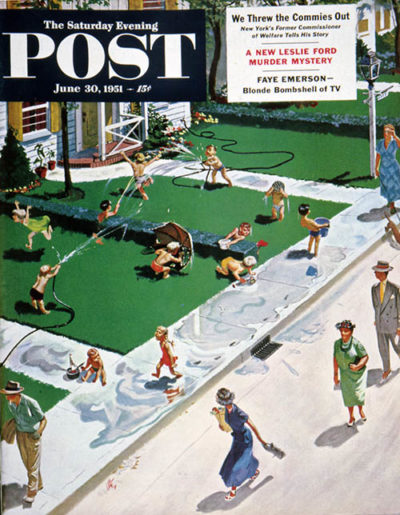
Thornton Utz
June 30, 1951
And It’s Not a Dry Heat
It’s 147 degrees where I live. Okay, that’s an exaggeration. It’s 91 degrees and humid. It only feels like 147.
These are “the dogs days of summer,” and the saying actually doesn’t have anything to do with dogs being lazy in July and August. It has to do with Sirius. That’s the dog star in the sky and not the satellite music channel. Though they once used a dog in their logo too. But I think it’s one of those sayings that changed over time and for all intents and purposes that’s what it means now.
Here are some classic covers of The Saturday Evening Post that celebrate these summer days. My favorite is 1951’s Water Fight by Thornton Utz. There’s so much going on in that picture.
Knock Knock. Who’s There? Amazon. Amazon Who?
I don’t know if I ever want to open my front door and see a flying machine in front of it with my order from Amazon. How would that even work? Does a metal arm come out and ring your doorbell or knock on the door? Does a robotic voice call you on the phone and say “Hey, I’m outside!” or yell through an open window?
The company is testing drone delivery in Britain. Right now the tests, which aren’t allowed in the U.S., will be conducted under 400 feet, in rural and suburban areas.
These drones probably can’t deliver an 80-inch HDTV to you, but it might be great if you need socks.
Political Conventions on TV: A History
The Democrat and Republican conventions are officially over. We now return you to regular programming.
Atlas Obscura, a terrific site that explores the nooks and crannies of the world and its history, has an interesting piece about the first televised Democratic convention. It was in 1948 and it was the last one that didn’t have air conditioning (it was probably 147 degrees in there). And like this year’s Democratic convention, it was held in Philadelphia.

Goodbye VCRs!
I gave up my VCR years ago, which was probably an odd thing to do since I have many, many videotapes of TV shows that will probably never be on DVD or online (and I like the old commercials that are on the shows as well). I also don’t understand DVRs. They’re great and convenient, but more than once I’ll have a bunch of episodes of a TV show on them I want to catch up on and then my cable box will die, and I’ll have to give my cable company back the box, and I lose everything I’ve recorded. Is there an easy way to transfer stuff on my DVR to DVD or my computer?
After 40 years, VCRs are going away! Funai, the last company to make the devices, has announced that they will stop making them because not many people want them anymore and the parts are hard to get.
What’s interesting is that there were 750,000 VCRs sold last year, so somebody is still buying them. I’ll probably buy another at some point. Maybe they’ll become hip again, like vinyl records and flip phones and typewriters.
RIP Marni Nixon, Jack Davis, Richard Thompson, and Miss Cleo
Marni Nixon’s voice was known more than her name, even though you didn’t know she was singing. Does that sentence make sense? Nixon was the singing voice for various actresses in many movies over the years, including Audrey Hepburn in My Fair Lady, Natalie Wood in West Side Story, and Deborah Kerr in The King and I. Her voice can also be heard in Cheaper By the Dozen, An Affair to Remember, Mulan, and other films. She passed away in New York City at the age of 86.
I didn’t realize that Nixon was the mother of Andrew Gold, who wrote and performed the hit song “Lonely Boy” and also wrote “Thank You for Being a Friend,” later used as the theme song to The Golden Girls. He died in 2011.
Jack Davis was one of the more influential pop culture artists of the 20th century. He was a cartoonist and illustrator and worked in many fields, from comic books and movie posters to album covers and magazines like TV Guide and Mad, where he was one of the founding artists in 1952. He was the last remaining EC Comics (Tales from the Crypt, etc.) artist. Davis passed away Wednesday at the age of 91.
Another cartoonist died this week too. Richard Thompson did the comic Cul de Sac until he had to retire because of Parkinson’s Disease in 2009. He was only 58.
Youree Dell Harris passed away this week too. You knew her better as Miss Cleo, the host of late night infomercials for The Psychic Readers Network. She died of cancer at 53.
Star Trek: Discovery
I know, I know, Star Trek posts two weeks in a row, but this is big news in Trekker-dom. At Comic-Con, CBS announced the name of the new series that will debut on the network’s streaming service All-Access in January (after the first episode is shown on CBS). The new show will be called Star Trek: Discovery (the U.S.S. Discovery is the name of the ship).
The show won’t follow the new timeline of the current big-screen movies, and executive producer Bryan Fuller says that each season of the show will focus on one story and won’t be episodic. Fuller also says the rumors going around that Discovery will take place before Star Trek: The Next Generation are false. No cast members have been announced yet.
Did You Miss Me?
Also coming in 2017 is season — or series, if you’re in England — four of Sherlock. Very excited. Here’s the trailer:
Smelly Apartments Are a Deal Breaker
One of my favorite episodes of Friends — it’s actually one of the greatest sitcom episodes, period — is “The One with the Dirty Girl.” Not only does it come in the middle of two of the show’s great story arcs (Chandler falling in love with Joey’s girlfriend; Monica and Phoebe doing their catering service), it’s also the episode where Ross dates a really attractive woman (Rebecca Romijn) and finds out she has a truly disgusting apartment, with garbage everywhere and rats running around. As the kids say, it’s LOL funny.
I thought of that episode when reading this list of the top dating dos and don’ts. The list comes from Wayfair, the home furnishing company that appears to have nine different jingles in their commercials. The thing that guys and girls equally hate the most about potential dates? Smelly apartments. Other deal breakers include grimy bathrooms, bad plumbing, poorly behaved pets, and lack of privacy.
Men and women also seem to hate ripped upholstery. Honestly, this is something I’ve never thought of when considering who I will date.

National Cheesecake Day
When I was a kid I hated cheesecake. Looking back it wasn’t because I didn’t like the taste. In fact, I don’t think I ever had cheesecake as a kid. It was more of a “Cheese? In a dessert?!?” type of attitude. But as an adult I learned to love it. Probably too much. But a lot of people love cheesecake too much. I mean, to keep up with demand there have been entire factories built just for their production.
Tomorrow is National Cheesecake Day. Here’s a recipe for chocolate chip cheesecake from Bake or Break, and here’s a classic no-bake version from Kraft that uses Philadelphia Cream Cheese. If it’s 147 degrees where you are, you might not want to turn on the oven.
A convention in Philadelphia and Philadelphia Cream Cheese. This was a theme week.
Upcoming Events and Anniversaries
I Want My MTV! (August 1, 1981)
Here’s the very first video that was broadcast on the network.
Germany and Russia go to war (August 1, 1914)
Is the Great War still relevant?
Iraq invasion of Kuwait (August 2, 1990)
After Iraq defied United Nations sanctions and orders, the United States and Coalition forces launched an attack on January16, 1991.
Ernie Pyle born (August 3, 1900)
The great war correspondent was born in Dana, Indiana, and was killed near Okinawa, Japan, in 1945.
First issue of The Saturday Evening Post published (August 4, 1821)
SEP Archives Director Jeff Nilsson takes a look at some of our earliest issues.
Marilyn Monroe dies (August 5, 1962)
Here’s a terrific profile of the actress by Pete Martin, from the May 5, 1956, issue of The Saturday Evening Post.