Jimmy’s Hammer: How President Carter Got Started with Habitat for Humanity
This story was originally published by Raw Story. Republished with permission.
My instructions were as clear as they were daunting: meet the former president of the United States in the Presidential Suite of New York City’s Waldorf Astoria.
It was early April 1984, and I had just turned 25. I had never been in the presence of anyone close to that stature. And when Jimmy Carter suddenly emerged from his room, flanked by burly Secret Service agents, it was as if someone stuck a vacuum cleaner hose into my mouth and sucked out all the moisture.
Graciously, the former leader of the free world, just three years out of office, put me at ease by thanking me for the invitation and saying he looked forward to seeing the project. We then proceeded to a seemingly unlikely destination: an abandoned six-story building on the Lower East Side of Manhattan.
Why was Carter here, with me?
I was the founding executive director of the New York City affiliate of Habitat for Humanity. The title was far more exalted than the position. Of the small band of volunteers seeking to do an initial Habitat project in New York, I was the most available — aka unemployed. With the help of neighborhood church crews, we began work on a burned-out building known in its glory days as Mascot Flats at 742 E. Sixth St. in a neighborhood known as Alphabet City. Our treasure chest contained a whopping $10,000. The project would eventually cost more than a million dollars. None of us had experience fundraising at that scale.
Even more daunting: navigating city bureaucracy. And that’s before grappling with the engineering and construction complications of converting a hulking mess of a building into 19 units of housing for poor, hard-working local families — people who would leave Wednesday evening Bible studies and return to apartments with no heat or hot water, with rats biting their infants as they slept on mattresses on the floor.
Today, the Lower East Side is an uber-hip neighborhood to which young New York City newcomers gravitate. But during the 1980s it more readily resembled Beirut or postwar Berlin. Block after block had been arsoned to rubble — at times, by greedy or desperate landlords who filled the bathtubs with bricks so their torched buildings would be sure to collapse, allowing full compensation by their insurers. The area was in the 9th Police Precinct, which had the highest homicide rate in the city. Narcotics were far and away the most lucrative form of local enterprise; on my own block a few streets away, where I lived in a bathtub-in-the-kitchen tenement freely roamed by uninvited members of the animal kingdom, drug dealers sold three different brands of heroin day and night.
In short: a perfect location for Habitat’s first major urban project.
* * *
Forty years ago, few people had ever heard of Habitat for Humanity. But its headquarters in Americus, Georgia, was about eight miles from Carter’s home in Plains. Carter and his wife, Rosalynn, had expressed interest in helping Habitat. One day, Millard Fuller, Habitat’s charismatic and workaholic founder, visited the Carters in their living room.
“Mr. President, I’m talkin’ to you as a neighbor,” Fuller began in his deep Alabama drawl. “I want you to tell me if you’re interested — or if you’re very interested. If you tell me you’re interested, I’ll be happy with whatever you do. But if, say, you’re very interested … I’m gonna be on your case all the time.”
The Carters exchanged glances, and then Jimmy said, “Millard, Rosalynn and I are very interested.”
He added: “And we’re perfectly capable of saying ‘no.’”
Months later, I picked up a copy of the New York Daily News and saw a small item that indicated Carter would be in New York City to celebrate the 25th anniversary of the installation of Greek Archbishop Iakovos, a personal friend. I clipped the story and mailed it to Fuller, noting how splendid it would be if the president could visit our East Sixth Street project. I assumed he wouldn’t.
At worst, Carter would have the opportunity to show himself “perfectly capable of saying ‘no.’”
Shockingly, Carter said “yes.”
So on a Sunday morning in April, I found myself in a sedan driven by Secret Service and sitting in the back seat next to the man who, 39 months before, had been the most powerful human on the planet. On the drive from Park Avenue to East Sixth Street, just 15 minutes but a world away, Carter asked about the pending sale of the city-owned building to Habitat. I told him we were still negotiating the price. Carter, who long had a contentious relationship with New York’s then-Mayor Ed Koch, said, “Maybe I’ll call him and suggest that he increase the price. Then he’ll give it to you.”
We arrived at the building and the Secret Service could not have been less pleased. We were asking the president to climb six stories up a temporary wooden staircase that volunteers had constructed the day before. This was necessary because, long before Habitat had arrived on the scene, junkies had removed the marble slats in the original staircase. To further gut the building, our volunteers had climbed like monkeys up what was left of the framing. But we couldn’t ask Jimmy Carter to do that, and his detail would have nixed it even if we had.
That staircase turned out to be pivotal. It allowed us to reach the roof, which itself was full of holes. But as he surveyed the rubbled savannah in the immediate neighborhood, the president could see Wall Street and the World Trade Center less than three miles to the south, and the office towers of Midtown Manhattan to the north. Then, peering over the edge of the building into the back lot, he saw an elderly woman cooking her breakfast over an open fire.
He would talk — and write — about that scene for years afterward. (“Here in the richest city in the richest country on earth …”)
Back down on the steps of the building, Carter spoke briefly with a handful of press and then walked over to his car to return, much to the relief of his security detail, to Midtown. Turning to me he said, “Rob, Millard Fuller is my boss. If there’s anything I can do to help you here, just let him know.”
Over the years, I’ve been credited for “recruiting” Jimmy Carter for his first Habitat for Humanity work party. It’s a misconception. While Habitat is now a major charity and has drawn at least a few hours of volunteer work by several sitting presidents, the notion then that even a former president would do so was unfathomable.

So I blurted out, “Thank you, Mr. President. Maybe you can send some volunteer carpenters up from your church.”
“We’ll think about it,” he said with a grin.
The next day, Carter called Fuller and said that not only was he going to send some carpenters — he was going to be one of the carpenters.
* * *
Five months later, a chartered Trailways Bus from Georgia rolled up to Metro Baptist Church on West 40th Street, hard by the Port Authority Bus Terminal in Manhattan’s Hell’s Kitchen.
On the bus was an animated, if travel-weary, crew of volunteers — including Carter. The church, which had sleeping quarters with bunk beds on its upper floors, would, for the next week, be home to the first Jimmy Carter Habitat work party.
The Associated Press had reported on the former president’s plans to work on the New York project. Many other news organizations followed up, initially with queries full of incredulity. The assumption: Carter would show up at the site, engage in a few ceremonial hammer swings — and leave the real work to the Georgia volunteers he had cobbled together. Surely he wouldn’t spend the entire week on the project, sleeping on a church bunk bed at night and arriving early in the morning with everyone else.
But that’s what happened. Each evening, Carter was the last person to leave the work site. The media couldn’t get enough of it. Aside from a few media interviews, all Carter did was eat, sleep, and work. Carter’s hammer swings were heard around the world and, just like that, Habitat for Humanity became a household name.
The Hidden History of Pneumatic Tubes
In the 2003 holiday film, Elf, Will Ferrell, as the titular elf, Buddy, finds himself working in a mailroom, proclaiming the pneumatic tube system to be “very sucky.”
Away from the movies, pneumatic tubes represent the bygone analog technologies of yesteryear, and like other devices from that era — think typewriters, fountain pens, and rotary phones — people can be downright sentimental about them. Growing up, I loved the sucking and slaps they made at the drive-through at the bank when my mom would deposit a check. More recently, at our local kids’ museum, I’ve probably had more fun with the small demonstration tube system than most of the actual kids.
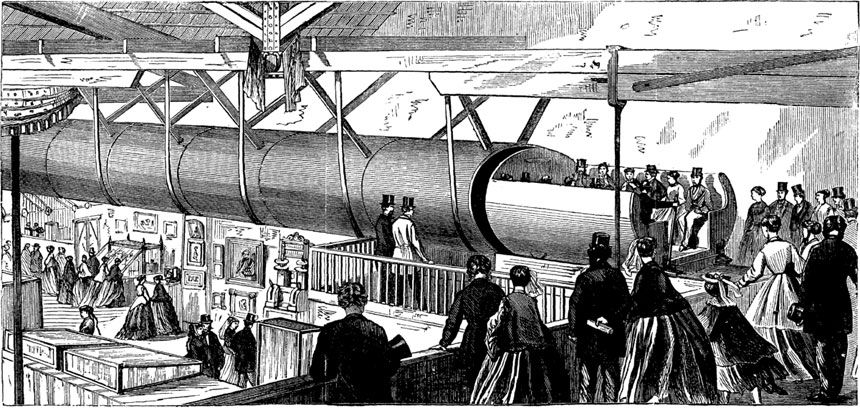

Pneumatic tubes were used to move mail in New York City, London, Germany, and Washington, D.C., and even transport food, cats, and yes, people. Tubes were the future, before they became part of the past. The scale of these systems covered dozens of blocks in sprawling cities. There was even a demonstration line in New York that pneumatically pushed people down about the length of a football field. While the human-carrying version didn’t last beyond the 1870s, pneumatic tubes that spanned cities were a reality by the early 20th century.
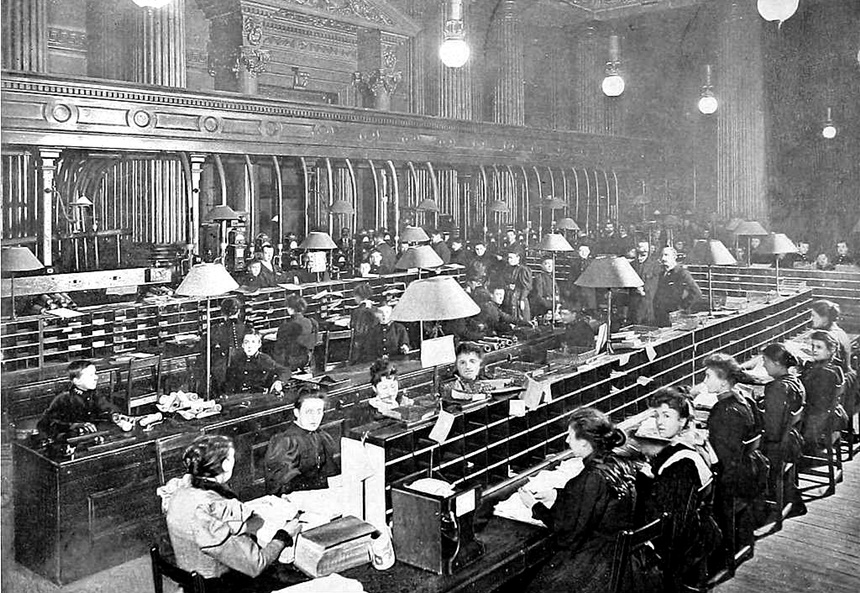
But pneumatic tubes haven’t gone away entirely, and are still used in places such as hospitals, where they quickly move supplies and samples from faraway parts of vast buildings to various departments. Sweden uses them to whisk away trash and recycling. And building planners are finding new ways to incorporate them in their plans.
Northwestern Memorial Hospital in Chicago uses pneumatic tubes to deliver IV bags, blood, and medications through four miles of tubes connecting seven buildings (Uploaded to YouTube by CBS Chicago)
But there’s more to the story: Their fun, infrastructural history (and potential) is rooted not just in banks and mailrooms, but also newsrooms.
Pneumatic Tubes and Newsrooms
Pneumatic tubes were once part of the hidden infrastructure of the modern newspaper office, helping to tie these complex production spaces together. For most of the 20th century, newsrooms were essentially news factories, production facilities that pushed out a daily, industrialized product, more akin to milk than cars, perhaps, due to its perishable nature. Efficiency was critical.
While some ways of moving copy around newspaper buildings just involved gravity — i.e. dropping paper down chutes or pipes — pneumatic tubes used preset routes and metal pipes with compressed air or a partial vacuum to push (or suck) paper enclosed in a cylinder through newspaper buildings, both within newsrooms, for editing (from reporters to copy editors, for example), and then to printing facilities for final layout and production. They allowed reporters and editors to remain in place and to continue their jobs instead of having to spend time walking a piece of copy from one room to another, or from one building to another.
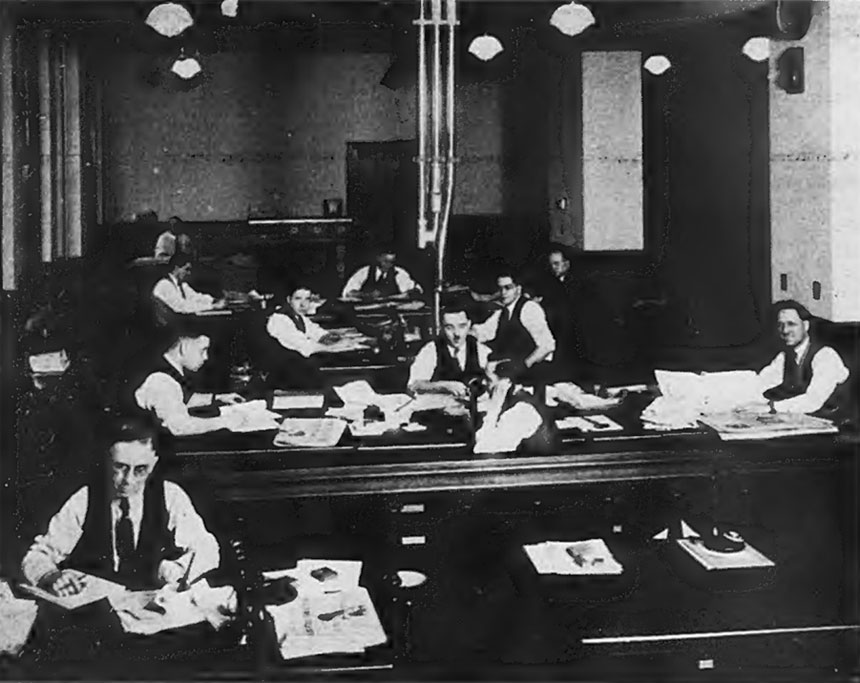
In Chicago, for example, the City Press news network, a cooperative news agency that connected the Associated Press, the Chicago American, the Chicago Daily News, the Chicago Sun-Times, and the Chicago Tribune, used a pneumatic tube system that was nearly 15 miles long and carried nearly 269,000 messages a year, ranging from photos to press releases to story drafts, often to copydesks for further processing. These tubes moved copy through crowded, busy newsroom spaces bustling with human labor, and led by editors obsessed with getting the news out at quickly as possible.
Like a body’s circulatory system, tubes carried the daily data of the newspaper’s newsroom throughout the building. In addition to newspaper copy, occasional mice, felt hats, and billiard balls arrived with a whoosh and a bang, according to Eddie Kitch, who wrote about tube antics in a January 1954 Quill article. The system used minimal electricity and space (at least compared to many of the other machines used to manufacture the news, especially later in the 20th century).
From the 1910s through the 1950s, their use was gradually reduced as newsrooms and newspaper buildings were renovated. By the 1960s and 1970s , many of these systems, in Chicago and elsewhere, were phased out as fax machines, voicemail, and early intranet messages (and later email) supplanted them.
Showing Off the Power of “New” Technology
But for a few glorious years, pneumatic tubes were the pride of many a newspaper. They were highlighted in newsroom profiles in journalism trade publications such as Quill and Editor & Publisher as state-of-the-art tools that showed that newspapers were at the forefront of innovation. Publishers were proud to discuss the latest gadgets installed in their new or newly renovated newspaper buildings, and rank-and-file news workers were equally eager to share how they made their working lives easier. A $4 million ($72 million today) renovation of the Pittsburgh Press in 1927 bragged about the inclusion of pneumatic tubes as part of a modern, “straight-line process.”
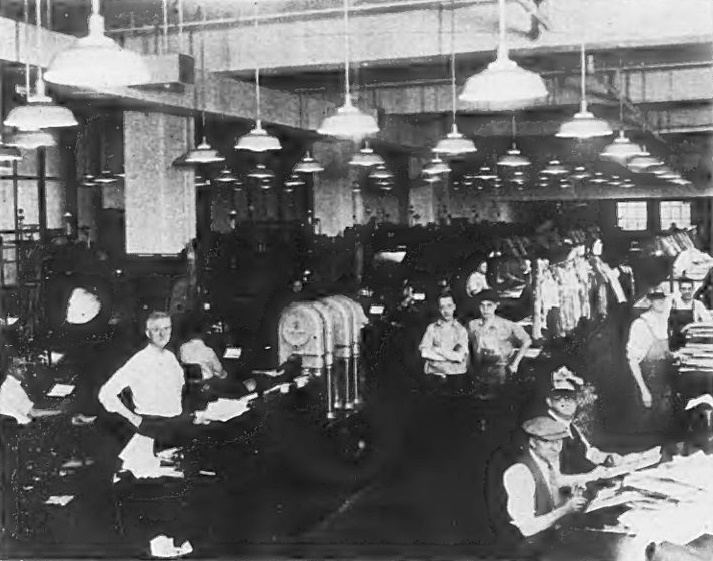
And a 1927 profile in Editor & Publisher highlighted pneumatic tubes in a more modest renovation of the newsroom of the Akron Beacon-Journal in Ohio (valued at $1 million, or $18 million today). The article emphasized the value of “communication with editorial and advertising departments” in the center of the newsroom, likely as part of an attempt to streamline the placement of the vital ad copy that provided the majority of the paper’s profits. The movement of ads, along with stories, was one of the main uses of tube systems.
As late as 1957, pneumatic tubes were still seen as innovative, especially for large, increasingly multisite newspapers such as the Chicago Sun-Times. A newspaper might have a primary newsroom, but also a number of other facilities on site, including a printing plant, a business office, and storage (and, in some cases, a motor pool for its delivery trucks).
Showing Off Newsroom Efficiency
In many cases, pneumatic-tube systems were heralded not just as a technology showcase, but as a means toward the ideal of productivity. Stairs were enemies of efficiency; tubes were the solution
Pneumatic tubes that could shave off as few as 45 seconds from the copy-transmission process were highlighted as important developments, according to a December 1930 Editor & Publisher article. At especially massive newspapers, such as the Los Angeles Times, tubes would connect the editor-in-chief and managing editor to the telegraph, news, and city editors, the copy desk, and then on down the chain of command, in newsrooms that had hundreds of desks and offices. Marketing and editorial coverage of such technologies emphasized their physical power – driven by “100 pounds” of air pressure – and their capacity to connect different facets of an increasingly sprawling news ecosystem, according to an August 1935 Editor & Publisher story.
“The time saving is considerable,” editor Eugene Pulliam observed: “The wear and tear on nerves even more so.” Back in Chicago at the City Press network, a 1954 Quill story noted that “The carriers are placed in the tubes and are sucked to their destinations where they land with a bang that long acclimated rewrite men, editors, and copyreaders no longer even hear – loud as it is.” The aural environment of the newsroom would, in time, grow quieter, but these bangs, thumps, and bumps literally conveyed the movement of news around the buildings and centers of news production for more than half a century. Perhaps only teletypes and typewriters were more iconic in terms of their workaday noise and their contribution to the soundscapes of the newsroom.
The Legacy of Pneumatic Tubes at Newspapers
For the majority of the 20th century pneumatic tubes did the job, admirably, fading only with the advent of computerization and then the internet itself.
Pneumatic tubes were an antecedent technology to our still-hybrid analog-digital information society. These tubes handled the copious and unrelenting data traffic generated by the newsrooms of the early- to mid-twentieth century. These spaces were the harbingers of the kinds of information-society companies we take for granted today.
Sometimes “old” technologies work well, complementing rather than being totally supplanted by the new. UK hospitals and Swedish trash companies recognized that sometimes older technologies can be repurposed for our modern needs.
Pneumatic tubes, in their way, remain with us, and will for some time to come.
Name Three Songs: How Band Tees Became Cultural Symbols
In 1976, the Ramones’ presidential seal t-shirt was designed by Arturo Vega, the band’s creative director. While the t-shirt was created to promote the band, its simple yet specific design established it as a garment independent of its origins. At most shows, the Ramones sold more t-shirts than records. Some people wore them to show they had been to the concert; others wore them solely to be associated with the band.
The band t-shirt has since become a ubiquitous fashion staple, and you don’t necessarily have to be a fan of a classic group like the Ramones to walk around in their merch. In early days, band tees were much harder to get ahold of. Today, you can buy the same Ramones shirt anywhere, from Etsy to Walmart. Does the fact that anyone can wear it — regardless of whether they love the music or even know anything about Joey, Dee Dee, Johnny, and Tommy — alter the meaning of wearing a Ramones t-shirt?
The band t-shirt would be inconceivable without the popularization of the t-shirt in general. In 1951, Marlon Brando appeared on the silver screen as Stanley Kowalski in A Streetcar Named Desire. Wearing blue jeans and a white tee, Brando’s Kowalski is remembered for his charisma, brutality, and working-class style. The t-shirt, once associated with military attire, took center stage as a rebellious, macho signifier. Young men were drawn to this powerful new depiction of the working class.
But long before Streetcar made its cinematic debut, t-shirts got their start at the end of the 19th century with the union suit, one-piece long underwear. The union suit fell out of use at the beginning of the 20th century due to its incompatibility with warmer weather. According to the BBC, male workers redefined their uniforms by cutting them, with the top half being slightly longer to tuck into the bottom. Noticing the trend, in 1904 the Cooper Underwear Company started manufacturing what it called bachelor undershirts, a buttonless version of the top half of the union suit — essentially a modern t-shirt.
Bachelor undershirts were sometimes worn as outerwear, but because of their origin as an undergarment, this new style caused the wearer to appear rebellious. In 1938, hoping to tap into the trend, American retailer Sears began producing white cotton t-shirts. While t-shirts were becoming more readily available, it wasn’t until Brando’s performance that these garments became everyday wear.
In the late 1950s, an Elvis Presley fan club created the first known band t-shirt. As a result, talent manager Colonel Parker agreed on a deal with merchandiser Hank Saperstein, through Saperstein’s company Special Products Inc., to commercially promote Elvis on merchandise. In 1956, a line of Presley-endorsed merch came out, including a t-shirt.
Following close behind, the Beatles put on their first U.S. tour in 1964, producing a mass of concert t-shirts. The tour generated over $1 million of revenue, likely due in part to the band merchandise.
At around the same time, rock concert promoter Bill Graham was making a name for himself, working with other notable promoters like Chet Helms. In the early 1970s, in collaboration with Dell Furano, owner of the Winterland Ballroom, Graham founded Winterland Productions, the first music merchandising company in the pop culture industry.
The production company offered a design that would soon become classic — the band’s logo on the front and their touring schedule on the back. By the 1980s, Winterland employed a 25-person art department.
As the band t-shirt was on the rise, so was the concept of being a teenager. Emerging as a distinct class in the 1940s, the teenager became a definitive social group in the 1960s. With this novel classification came the desire for certain identity markers. Teenagers wanted to fit in. To distinguish themselves, teenagers turned the band t-shirt into a status symbol. Its wearer was not only a fan of the band’s music but a believer in the message of that band. Subsequently, the band t-shirt’s power as a social medium was born.
By the mid-1970s, Graham’s t-shirt designs for bands such as The Grateful Dead and Jefferson Airplane allowed fans to take home a piece of their experience and to connect to other fans. Through color palettes and logos, band t-shirts distinctly placed their wearers into cultural subgroups. Within these subcultures, context mattered. Identifying with a band and its rhetoric became more than just a way to advertise fandom. Wearers, now less invested in the bands themselves, wore band t-shirts to project an aura. People who may not have listened to any of The Velvet Underground’s album Peel Slowly and See were wearing “Banana t-shirts” because of its association with Andy Warhol. Issues of authenticity arose, especially when aspects of the wearer’s identity noisily challenged the shirt’s meaning. This tension is summarized in the colloquial challenge, “Name three songs,” often used to question the legitimacy of someone’s connection to a band or its culture.
The followers of punk rock felt this tension acutely. In the early punk scene, t-shirts were created and sold mainly by listeners for listeners at shows. The shift to wholesale distribution — with production companies such as Winterland — raised questions about a t-shirt’s and its wearer’s authenticity. For punk, the genre was — and arguably still is — heavily tied to unmistakable political and sociocultural beliefs that celebrate non-conformity and scorn “sell-outs,” so that merch for punk bands like Black Flag being hawked in a retail store like Hot Topic seem paradoxical.
But punk isn’t the only music genre with an authenticity problem. Today, stores like H&M, Primark, and Forever 21 sell Rolling Stones and Nirvana t-shirts. Similarly, luxury retailers like Barney’s have sold t-shirts for the bands Misfits and Black Sabbath at $175 apiece. The American apparel market, which has grown faster than the GDP, makes the band t-shirt’s role a multifaceted one. The garment was previously used to denote fandom or tie its wearer to a subculture; now it’s simply trendy.
When band t-shirts become fast fashion, perhaps its true worth is dictated only by the garment’s origins and the wearer’s passions. A sun-faded, stained Rolling Stones t-shirt worn by someone who’s been to a dozen concerts beats its Urban Outfitters counterpart every time.
Though the authenticity of a clothing item is important to some, many wearers simply do not care. Regardless, the band t-shirt remains a classic medium of self-expression.
When ’70s TV Went to the Movies
Editor’s Note: Shortly before posting this piece, we became aware of the passing of Linda Lavin, TV’s Alice. A performer since childhood, Lavin starred on Broadway, television, and in film. Her accolades included three Drama Desk awards, a Tony, two Golden Globes (for Alice), and induction into the American Theater Hall of Fame. As she figures prominently in this story, we at the Post wish to extend our condolences to her family, friends, and fans.
When you think of Martin Scorsese, you probably think of the great director’s penchant for crime films, or his long-standing relationships with actors like Robert De Niro and Leonardo DiCaprio. A lesser-known achievement is how he paved the way for a long-running TV comedy in 1974, and he was far from the only moviemaker that decade watching their work jump from the big screen to the small one. For Scorsese, the journey started with a single mom who worked in a diner.
Ellen Burstyn was filming The Exorcist when Warner Brothers wanted to lock her in for another movie. Burstyn’s agent brought her the script for Alice Doesn’t Live Here Anymore, which Warner had agreed to make. When the studio asked about her choice of director, she wanted to find someone who was newer on the scene. Francis Ford Coppola suggested Burstyn watch Mean Streets, which was still pending release. Burstyn lined up a screening and decided she wanted to meet that movie’s young director, Martin Scorsese, for Alice. Burstyn asked, “What do you know about women?” and Scorsese’s answer, “Nothing, but I’d like to learn,” got him the job. Alice would be Scorsese’s first big studio film.
The trailer for Alice Doesn’t Live Here Anymore (Uploaded to YouTube by World of Warner Bros)
The story of a suddenly widowed mom who plans to take her son, Tommy (Alfred Lutter) to California and restart a singing career resonated with audiences. Alice takes a waitressing job at a diner run by Mel (Vic Tayback), working alongside Flo (Diane Ladd), and Vera (Valerie Curtin). Kris Kristofferson played Alice’s new love interest. Famous faces in supporting roles included a young Jodie Foster, Harvey Keitel, and a little girl with an ice cream cone played by Ladd’s daughter, Laura Dern. The film did very well and earned a Best Actress Oscar for Burstyn, a Best Supporting Actress nomination for Ladd, and a Best Screenplay nom for Robert Getchell.
After the success of the film, Getchell created a TV version of the series. Vic Tayback continued his role as Mel, but the rest of the roles were recast as the film actors passed on reprising them. Linda Lavin played Alice, Polly Holliday took on the role of Flo, and Beth Howland played Vera. Lutter did play Tommy in the pilot episode, but the role was recast with Philip McKeon. Alice ran for nine seasons from 1976 to 1985, spending four of those seasons in the top ten most-watched shows on television.
But Alice didn’t go to TV alone.
McCloud (1970-1977): McCloud debuted with a TV movie pilot on February 17, 1970. The premise had Deputy Marshal Sam McCloud (Dennis Weaver) escorting a prisoner from his normal base in New Mexico to New York City. McCloud would be embroiled in solving a murder case, and thereafter end up on loan to the NYPD as a special investigator. That basic plot had its roots in the 1968 Clint Eastwood film, Coogan’s Bluff; Herman Miller, who wrote the story for Bluff, is credited as McCloud’s creator. Response to the pilot was strong enough that McCloud was selected as one of four programs for NBC’s Four in One, an ongoing “wheel” program where episodes alternated with other series in the same timeslot. McCloud ran for seven successful seasons.
The trailer for the M*A*S*H film (Uploaded to YouTube by Rotten Tomatoes Classic Trailers)
M*A*S*H (1972-1983); Trapper John, M.D. (1979-1985): One movie that’s responsible for two different TV shows! The original M*A*S*H film was an Oscar nominee in 1970, and it begat the beloved 1972 series. It was also behind Trapper John, M.D., which followed that character (now played by Pernell Roberts) years after having left Korea.
Shaft (1973-1974): Toward the end of 1973, a famous fictional detective made the jump from the big screen to the small. Yes, we’re just talkin’ ’bout Shaft. John Shaft first appeared in the series of novels by Ernest Tidyman (and later, David F. Walker) that began in 1970. Shaft went to the movies in a big way in 1971, with Richard Roundtree in the title role and Gordon Parks in the director’s chair. The film was a zeitgeist-shaking hit, and Isaac Hayes’s “Theme from Shaft” won an Oscar. Shaft was seen as a crucial advancement for Black talent in Hollywood, and spawned two immediate theatrical sequels: Shaft’s Big Score! and Shaft in Africa. In October 1973, Roundtree took the character to CBS as part of The New CBS Tuesday Night Movie wheel. A new 90-minute Shaft TV film debuted every third week on that schedule, ultimately delivering seven installments.
Planet of the Apes (1974): 1968’s Planet of the Apes remains an unabashed science fiction film classic. While its four sequels showed some diminished returns as they ran through 1973, the producers thought there was some life left on television. On September 13, 1974, CBS launched Planet of the Apes, using much of the costuming and remaining sets from the films. Roddy McDowall returned for the show as a new character, Galen. The series only aired 13 of its 14 filmed episodes before being cancelled. In 1981, McDowall recorded new intros and outros for a series of five TV movies that were made by editing the episodes of the TV series together. It’s also notable that in 1975, the producers turned to TV animation with NBC’s Return to the Planet of the Apes, which hewed closely to the film series in terms of characters and continuity; it also lasted a single season.
The Cowboys (1974): The 1972 John Wayne vehicle of the same name (which is probably most well-known as the movie where Bruce Dern’s character murders Wayne’s) underwent a small-screen translation two years after its release. Robert Carradine, A Martinez, and Clay O’Brien made the move to the TV show after appearing in the film. In an unusual move, ABC made the Western a 30-minute show.
Serpico (1976-1977): Based on the hit Al Pacino film, Serpico follows the exploits of real-life cop Frank Serpico (here, David Birney) as he tangles with crooked cops. The show eked out fourteen episodes before being cancelled and replaced by the long-running Quincy, M.E.
What’s Happening!! (1976-1979): The comedy-drama Cooley High was a box office hit in 1975. ABC attempted a direct adaptation, but the network didn’t like the resulting pilot. The network chief, Fred Silverman, ordered the idea worked as a sitcom with a different name and characters. The result was What’s Happening!! The show ran for three years but was cancelled after the stars, notably Fred “Rerun” Berry clashed with the network over pay. A sequel series, What’s Happening Now!!, ran in syndication from 1985 to 1988; most of the cast returned, although Berry was fired after the first season due to another salary dispute.
The trailer for the film, Logan’s Run (Uploaded to YouTube by Rotten Tomatoes Classic Trailers)
Logan’s Run (1977-1978): The dystopian 1967 novel of the same name by William F. Nolan and George Clayton Johnson provided the basis for the film, which earned a Special Academy Award for Visual Effects. The story dug deep into themes of resource scarcity and post-apocalyptic society while presenting as an action film. Nolan co-wrote the pilot episode, and the series maintained the theme of Logan and Jessica on the run through various locations on the future Earth. However, the series didn’t “run” for very long, as it was cancelled before all of the filmed episodes aired.
National Lampoon’s Animal House (1978): John Landis’s frat comedy was a massive hit, so of course executives wanted to find a way to extend it. The show inspired not one, not two, but three TV series in the wake of its success, though only one was “official.” That was 1979’s Delta House, which saw five cast members make the jump from film to television: Stephen Furst (Flounder); Bruce McGill (D-Day); James Widdoes (Hoover); John Vernon (Dean Wormer); and Priscilla Lauris (Dean Wormer’s secretary, Miss Leonard). The show actually got off to a good start in the ratings after its January 18th debut, but producers Ivan Reitman and Matty Simmons had endless fights over ABC’s content guidelines; those battles resulted in the show’s early cancellation.
As for the other two imitators, Brothers and Sisters launched on NBC three days after Delta House. Co-Ed Fever followed on CBS on February 4. Like Delta House, Brothers and Sisters limped along for a few months of behind-the-scenes content fights before getting yanked. Co-Ed Fever only aired one episode in the U.S. before its poor ratings and viewer complaints over content saw it snuffed; the six episodes that had been filmed were shown on Canadian TV, and the show’s frat house set was repurposed into Eastland for a new sitcom, The Facts of Life.
The Bad News Bears (1979-1980): Like Planet of the Apes before it, The Bad News Bears was a successful, multi-installment film franchise. The first film following an occasionally foul-mouthed kids’ baseball team was a big hit in 1976, followed by two sequels with diminishing returns (1977’s The Bad News Bears in Breaking Training and 1978’s The Bad News Bears Go to Japan). The Bears were spun into a CBS sitcom that lasted two seasons. It’s primarily notable for the young cast, none of whom jumped over from the films; it included Corey Feldman, Billy Jayne, Meeno Peluce, and future The Young & The Restless stars Tricia Cast and Kristoff St. John.
Moonrunners/The Dukes of Hazzard (1979-1985): You’ve gotta love Bob Clark. In addition to directing wildly different classics like pioneering slasher Black Christmas, teen sex comedy Porky’s, and holiday staple A Christmas Story, he executive produced Moonrunners, which was turned into The Dukes of Hazzard on TV. Some character names were changed (Grady and Bobby Lee became Bo and Luke, but Uncle Jesse was still Uncle Jesse), and the only character to make the transition was The Balladeer, essayed by Waylon Jennings. The film is mainly remembered for one terrific car chase, but Dukes became huge hit on TV, running from 1979 to 1985.
Doctor’s Note: The Fire Is So Delightful — Winter Heating and Your Health
When the weather outside is frightful, the fire is so delightful. The image of a roaring fire in the hearth is a tradition — a staple of holiday songs, movies, and greeting cards. And while you may or may not actually have a fireplace, we all must heat our home one way or another.
In the U.S., most homes are primarily heated with natural gas, with electricity and fuel oil as the next most common heat sources. Most homes also have supplemental heat sources such as fireplaces and space heaters. These are life-giving sources of warmth, but they’re not without risk. Over 30,000 fires and 165 deaths occur due to home heating each year in the U.S., and over 100,000 emergency room visits and 400 deaths result from carbon monoxide (CO) poisoning.
First, let’s talk about household fire safety. Heating fires are much less common than cooking fires, but are more likely to be deadly. What can we do to protect ourselves from home fires?
Always keep flammable materials away from heat sources, especially large appliances like the fireplace, furnace, and water heaters. Plug space heaters directly into the wall; never connect them to an extension cord or power strip. Extinguish fires and turn off portable heaters when leaving the room. Have chimneys and vents inspected and cleaned annually.
Smoke detectors have been mandatory in residences built in the U.S. since 1976. This has contributed to a roughly 3-fold decrease in home fires and fire deaths between 1980 and 2018. Make sure your home has working smoke detectors, and if your smoke detectors give a low battery chirp you should change the batteries right away.
That said, not every smoke detector is also a carbon monoxide detector. Carbon monoxide (CO) is a poisonous gas produced by combustion, as in a fireplace, stove, furnace, or gasoline or diesel engine. Electrical heating doesn’t produce CO. Unlike smoke, CO is odorless, colorless, and non-irritating. CO neither rises nor sinks in air, but can distribute evenly through an enclosed air space.
Inhaling CO results in the gradual buildup of carboxyhemoglobin, which prevents proper oxygen release from the bloodstream. The symptoms of acute CO poisoning resemble a flu or stomach virus, with headache, nausea and vomiting, dizziness, rapid heart rate, lethargy, or malaise. High-level CO poisoning could progress to seizures, coma, and death within hours. Chronic low-level CO poisoning can result in vague symptoms like fatigue, depression, sleep, memory, or vision changes. Smokers are more susceptible to CO poisoning due to the fact that they are constantly exposed to small amounts of CO from cigarette smoke.
48 out of 50 states – all but Kansas and Hawaii – require carbon monoxide detectors in new homes and apartments. But since many U.S. residences were built before these laws were passed, about 36 percent of U.S. homes lack CO detectors as of 2024. Some states and municipalities require landlords to install and maintain CO detectors, but this is not true everywhere. If you’re a homeowner, you are responsible for maintaining your own CO detectors. The U.S. Consumer Product Safety Commission (CSPC) recommends that every home have at least one carbon monoxide alarm for each floor of the home, preferably placed near the sleeping areas.
One common cause of carbon monoxide poisoning is the use of unintentional heating appliances to heat the home. It may seem tempting to use a gas-burning stove or oven to heat the home, but these appliances are not designed for indoor heating. Their ventilation may hold up to a few hours of cooking, but they’re insufficient for prolonged daily use. The same applies to using a gas-burning clothes dryer for home heating. If you need more heat than your furnace can provide, use something like a space heater that’s designed for indoor heating.
So, I wish you all a merry Christmas and a Happy New Year. May your days be filled with joy, and may your home be safe and warm!
Preview Our January/February 2025 Issue
The Lost Art of Waiting
As a child growing up in Florida in the ’80s, I went with my family to Walt Disney World many times. The main thing I remember is the seemingly endless waits for rides. My sisters and I would peevishly whine to our parents as we shuffled along, waiting and waiting. Occasionally, a lackadaisical Disney employee dressed as Goofy would wander by, but distractions were minimal. The experience of boredom was physical, like an itch.
Since then, Walt Disney Attractions has spent a great deal of time trying to alleviate the stubborn human experience of waiting. “It’s our number-one guest complaint,” remarked Dale Stafford, vice president of development and planning in the ’90s. Disney now refers to the places where you queue for rides as “scene ones” — as in, the first part of the performance.
Indeed, last time I took my children to Disney World, the waits were so carefully managed that they felt like part of the experience. We were greeted at the entrance to the Buzz Lightyear attraction by a cast member who declared, “There’s hardly a wait at all!” The display board gave an estimated time of 10 minutes. As the line tracked back and forth, television screens broadcast battle scenes between Buzz and his large purple nemesis Zurg. Every few seconds came the promising pings of cartoon weaponry. The lighting was low, to increase anticipation. Soon, we were shuffling onto the moving sidewalk that delivered us to our rocket ship. Had it only been ten minutes? Everything about this queue had been designed to prevent us from experiencing the real passage of time.
Waiting isn’t what it used to be. These days, we expect to be able to avoid the dullness of it — and not just when we are spending a day at a theme park. Nearly every moment of interstitial time can be filled with entertainment or communication. We turn to our smartphones to check email, text a friend, or play Candy Crush. It feels good to remove oneself mentally from the reality of waiting; our new and boundless capacity to escape tedium can feel like a micro-revolution. But the problem with revolutions is that they sometimes devour their children.
If the experience of waiting has changed — does that mean we have, too?
The novelist Milan Kundera once described speed as “the form of ecstasy the technical revolution has bestowed upon man,” and he is correct about its pleasures. Speed is often an improvement, a boon that eliminates the bane of “wasted time.” But what he, and we, might not have predicted is how quickly speed raises our expectations, how impatient we get if everything happens quickly.
In 2009, Forrester Research studied how long online shoppers were willing to wait for a page to load and found two seconds was the magic number; three years earlier, people had been willing to wait four seconds. In other words, even a few years into the internet’s short life, our expectations for how long it should take to get something have changed dramatically. In the early days of the internet, in 2006, Amazon claimed that for every 100 milliseconds of time saved loading its pages, the company increased revenue by 1 percent. A millisecond is a thousandth of a second. Meanwhile, Google’s engineers engaged in a race against that millisecond; they found in 2012 that even a delay of 400 — about the time it takes the eye to blink — is too long for people to wait for search results.
A decade on, where has this left us?
As life gets faster, we have become more impatient about everything, including the interactions of daily life. Not long ago, New York Times technology reporter Nick Bilton wrote a screed against what he called “time-wasting forms of communication.” For Bilton, who uses X to stay in touch with his mother, this includes most of the things that used to be called pleasantries.
“In the age of the smartphone, there is no reason to ask once acceptable questions: the weather forecast, a business phone number, a store’s hours. But some people still do,” he complains, before quoting a source who confesses: “I have decreasing amounts of tolerance for unnecessary communication because it is a burden and a cost.”
The problem isn’t that Bilton and others prefer a world without pleasantries; such people have always existed. It’s their expectation that efficiency in human interactions is innately superior, an ideal that society should embrace. As technology scholar Evan Selinger has written, this model “turns maintaining important relationships into mere to-do list items.”
But though the speed of computer processing power can be measured quantitatively, the transformations in a culture’s tolerance for delay are qualitative. It is only when we step back — or, more likely, when we are forced into a situation where we must wait without distraction — that we are reminded of other ways of doing things.
Located about one hour south of Louisville, Kentucky, the Abbey of Gethsemani is home to a small community of Trappist monks. I visited in order to gain a different understanding of time — aware that this instinct was slightly cliché. As Brother Benet Tvedten of the Blue Cloud Abbey in South Dakota has noted: “Very few people want to enter monasteries these days, but it seems more and more people want to visit them.” It’s the opposite of the urge that takes us to Disney World; instead of seeking stimulation, you’re trying to escape it.
On our first evening at the abbey, a monk named Father Carlos greeted us by saying: “What is the main cause of our sins? Convenience. Seeking for ourselves convenience. Ease. Seeking to make things easier. Or entertaining.”
There is nothing easy or entertaining about life in the monastery. The prayer schedule is rigorous, and begins
3.15 a.m. Vigils
5:45 a.m. Lauds
6:15 a.m. Eucharist
And so on. The monks keep to the same routine every day, every year, until death. They dress in the same clothes and eat the same food and share the same largely unadorned space. Much of the literature of monastic life emphasizes that this way of living forces you to confront yourself — your inner demons, restlessness, and wayward thoughts.
But this lifestyle also fosters a completely different understanding of what it means to wait.
To be kept waiting is generally viewed as a negative experience; to make someone wait often denotes hierarchy, dominance, or power in a relationship. And in many ways, this is the form the monks’ waiting takes: They subordinate themselves and their time to God’s work. The monks wait because they are listening for the voice of God, and they accept that it might take a lifetime before they hear it. Other religious traditions have waiting built into their rituals of worship — Quakers practice “expectant waiting” during silent meeting, for example. At the heart of these practices is the inculcation of patience, and the habit of listening.
I asked Father Carlos how he and his fellow monks balanced the demands of daily life — which at the monastery includes manual labor and community service — with contemplation. “Make time every day for silence,” he said. “And don’t make it a chore. Just sit in silence. This allows you to listen to God.”
Waiting, here, is a positive experience. The monks at Gethsemani are not merely longing to hear the voice of God. They are joyfully anticipating it, and so their wait isn’t painful but pleasurable. But in a world where a second is too long to wait for a video to load and a minute feels like an eternity, we’ve lost sight of how much joy we can get from anticipation, not only in a spiritual context.
A study of more than 1,000 Dutch subjects in 2010 examined the links between happiness and vacations. Researchers found, not surprisingly, that people looking forward to taking a trip were happier than those without vacation plans. More intriguingly, however, they also found that people who’d just been on vacation were no happier than those that hadn’t.
The researchers theorized that anticipation played a crucial role in explaining this difference; planning, reading about, and arranging the details of a trip was a pleasurable experience for most people. Ultimately, it wasn’t the vacation itself that made people happy; it was looking forward to the vacation that made them happy. In other words, waiting for it.
But now that we have so many ways to fill even the smallest increments of time, opportunities for anticipation disappear. In fact, we are more likely to experience waiting as delay than anticipation — something negative, and inconvenient.
The fact is, the experience of waiting forces a negotiation between our present and future selves. Our present self wants immediately to devour that Cinnabon pastry we smell wafting through the airport. Our future self may need us to resist it, to maintain a healthy weight. And when people see their time as a valuable, fleeting resource, they become less likely to patiently pursue long-term goals.
We, as a society, are losing our ability to delay gratification, to patiently plan ahead. We value the new and the now, which is having a disturbing impact on — among other things — the realm of public discourse. In the media, we have come to prefer reaction to deliberation. We respect expertise less, because it takes time to develop and mature. In a culture used to immediate, brief responses, considered responses are often drowned out by a chorus of louder, less-informed voices.
Patience is a virtue. Good things come to those who wait. These phrases are cliché, but the evidence suggests they’re true. We benefit from appreciating that the most important things in life take time. From accepting that waiting is inescapable, no matter how much technology views it as a problem to be solved.
Being human means coping with those in-between moments, when we must do what is uneasy or uncomfortable, from tolerating a boring meeting, to bearing witness to another’s illness, to simply being stuck on a bus. But all these experiences present opportunities, as well as challenges — to daydream, to anticipate pleasure, to listen to a loved one, or to confront our own selves.
Christine Rosen is a senior fellow at the American Enterprise Institute, a columnist for Commentary magazine, and a fellow at the Institute for Advanced Studies in Culture at the University of Virginia.
Excerpted from The Extinction of Experience: Being Human in a Disembodied World. Copyright ©2024 by Christine Rosen. Used with permission of the publisher, W.W. Norton & Company, Inc. All Rights Reserved.
This excerpt may not be reproduced, stored in a retrieval system, or transmitted in any form by any means without the prior written permission of the publisher.
This article is featured in the January/February 2025 issue of The Saturday Evening Post. Subscribe to the magazine for more art, inspiring stories, fiction, humor, and features from our archives.
The Wild Weaver
Edward hated hand-driving. He found the practice to be imprecise and dangerous, and his index finger always trembled whenever he pressed on the manual steering option in his car. It was not lost on him that his nerves only made his driving ability worse, while cars, with their zero-point-zero-zero-something collision rate and real-time satellite monitoring from Dragon, possessed no nerves. Thankfully, there were few hand-drivers on the road these days outside of the occasional hobbyist, so Edward found solace in the fact that even if his clumsy human system did send him hurtling through a red light, the other cars around him — the normal, precise, auto-driving cars — would be able to swerve him to avoid a sloppy death.
Edward was only hand-driving because he was on the job. He knew that his customers were not simply paying for a luxury product but for an entire luxury product delivery experience. These human details mattered. His attention to these details were what put him a cut above the other agents at the agency and brought him repeat customers. So, until the State stopped caving in to the petulant hand-driving enthusiast lobby and outlawed this reckless activity outright, Edward was going to be out there, taking himself and his product from his agency office in the city all the way up a series of increasingly desolate mountain roads, putting his life into his own hands.
The car instructed him to turn, perhaps chidingly as it wasn’t in control like it was supposed to be, and Edward cranked the vehicle up an unpaved path. Next to him on the passenger seat, the antique black leather suitcase containing the product slid and thunked against the door. Edward steadied it, his heart pounding. If the product got damaged, he would arguably be in a worse position with the agency than if he sustained an injury to his own flesh and bones.
Mercifully, this final stretch of road soon deposited him at a high, camera-mounted stone wall with a steel gate that automatically yawned open as he neared. Beyond it, past a pebbled driveway as wide as an apartment block, was a three-story white house with gray roofs and marble colonnades. As he maneuvered his vehicle down the driveway, feeling every bump and crunch of the pebbles reverberate in his bones, he allowed himself to wonder if he would eventually be able to afford a home half as spacious as this one. His latest customer, Kevin Clemson III, was the grandson of a Dragon co-founder, and one of the corporation’s current senior vice presidents. Old money. Maybe with enough hard work selling to these types, he, Edward, would be able to break free of his agency and build a new empire.
He parked in the shade of a genuine olive tree and exhaled the breath he hadn’t realize he had been holding. He grabbed the suitcase from the passenger seat and exited the car.
Outside, the air was even cooler than in his car, thanks to the property’s localized climate control system. He took a moment for the soft wind to calm his heated face, and walked up to the door. A Harry-model Dragon ro-butler answered, its single blue eye scanning him. This amused Edward; for all the rich’s desire to surround themselves with humanmade luxury goods, of course they were not going to pass up on every convenience of modern life. He imagined the matrix in the ro-butler’s domed head analyzing the sight of him: his serious angular face framed by silver-black hair, his crisp modern suit laser-tailored to fit his trim frame, the antique suitcase clutched in his hand. “Come with me to the study, Mr. Lerner,” the ro-butler intoned, and rolled down the hallway into the house.
Edward followed the ro-butler, watching its wheels leaving soft pale indentations in the plush ivory carpeting. On the walls hung freeform ceramic sculptures and woven tapestries and textured abstract paintings. These were all decorative items that the Warehouse had stopped manufacturing for the masses decades ago because the Dragon’s algorithm had proven them to be unprofitable; Kevin Clemson III’s collection was almost certainly all humanmade.
The ro-butler led Edward to a closed door, knocked with a padded arm, and announced that Mr. Lerner had arrived. A muffled male voice sounded from within — “Let him in, Harry!” — and the ro-butler opened the door.
Kevin Clemson III, a stocky, ruddy-faced man in his fifties dressed in an old-fashioned black turtleneck and blue jeans, was standing at a conference table in a synthwood-lined study. “Heya, Eddie, what’s up?” he said.
Kevin was predictably friendly — the rich loved to play up personality quirks like casual charm and idiosyncratic vernacular to show that they were educated by private human teachers instead of by Dragon’s standardized school program. But Edward was careful to remember his decorum — while he often walked among high society, he was technically not one of them, not yet.
As he entered the study, Kevin made small talk. Did Edward want a home-brewed beer? No, he didn’t want to risk damaging the product. How was the traffic from the city? Smooth, thanks to Dragon’s real-time satellite traffic control. How did everything look on the road? Pleasant, thanks to the car’s enhanced-view windshield that overlaid a meadow of beautiful flowers over the scars of last month’s wildfire.
“It’s in times like these that I’m reminded of my good fortune,” Kevin sighed, gazing out of his window into his rustling grove of climate-controlled olive trees. Then he turned to Edward and rubbed his hands together. “I’m ready to see it now.”
Edward could tell that Kevin was eager. This was his first purchase of this kind; Kevin had undoubtedly heard about the market from friends who were already seasoned collectors, and had decided not to be outdone in matters of taste.
But first things first. Making no move to open the suitcase, Edward nodded to the open doorway where the robot still hovered, its blue eye scanning placidly. “The ro-butler’s still here.” It made no difference one way or the other to Edward, but he wanted to show Kevin that he was being mindful of his customer’s luxury investment.
And sure enough, Kevin grinned in gratitude. “Leave us alone, you peeping Harry,” he called, and the ro-butler gamely rolled off, closing the door behind it.
“Now. Are you ready?” Edward asked.
Kevin sank into a chair and nodded.
Edward took a seat next to him and placed the suitcase on top of the table. He slid open the gold clasps with his thumbs and lifted the lid; inside were two pairs of white microsuede gloves and a thick yellow manila envelope with its top flap held shut by a maroon wax seal. He noted with relief that the swerving and bumping of the drive only added minor dents in the corners of the envelope — dents that one could argue actually added to the product’s visual charm.
Kevin’s face was beaming.
Edward slipped on one pair of gloves and gestured for Kevin to put on the other. The product was already bought and paid for, and it didn’t matter to Edward now how Kevin handled it. But again, it was this experience that Edward was known to provide. This human ritual. Kevin had already yanked on his gloves and was flexing his chubby fingers in anticipation.
Edward lifted out the envelope and handed it to Kevin. “You should do it,” he said.
Kevin reverently took the envelope and ran his gloved hand over the wide surface, bending an ear to the soft rasp. “Listen to that, the sound of real paper,” he said. “It sounds like skin on skin.”
“Mm,” Edward replied. In moments like these he was careful not to give too much of his personal opinion in order to let the product speak for itself.
“And the smell,” Kevin said, giving the surface a few tentative sniffs. “It’s so — it’s indescribable.”
“The envelope’s over a hundred years old.”
“Ah. Wonderful.” Kevin turned his attention to the red seal, ready to move on. “So do I …?”
“Yes, just break it open.”
Kevin worked his thumb under the flap and fumbled hesitatingly with the seal. Eventually, with a soft ripping sound, it detached from the envelope in one piece. He opened the flap, reached inside, and pulled out his million-dollar acquisition.
The manuscript was about twenty sheets of paper thick and hand-written in black ink in a bubbly, girlish hand. The title and author name at the top of the first page were written big enough to be legible to Edward from his position:
The Wild Weaver
By Rita Chong
Not that Edward needed to reread it to know what it was. He had already combed through the entire manuscript several times for quality assurance before sealing it up and listing it for sale.
Kevin’s mouth parted in awe as his eyes roved over the first page. “The Wild Weaver, by Rita Chong. ‘On the anniversary of her tenth year in the tower, Rosemary decided she had no other choice but to kill him …’ My God, Ed, so this story really is …”
“Human-written, yes,” Edward finished. “Rita’s my most talented writer client. This latest work of hers is exquisite. It’s about a weaver-woman imprisoned in a stone tower who makes a plan to kill her captor and escape.” He smiled. “Congratulations on owning your first humanmade short story, Mr. Clemson.”
Kevin let out a low whistle. “Unbelievable that one person can just sit in a chair and pull an entire story out of thin air by themselves.”
“Our agency strives to keep the ancient art alive.”
“Incredible.” And then he peered at Edward with an impishly raised brow. “You didn’t just generate a story out of Dragon, have a worker jot it down, and pass it off as humanmade, did you?”
Edward knew Kevin wasn’t really suspicious — his agency, roster of writers, and high-security writer dormitories had already been rated the highest score possible by the Humanmade Council, guaranteeing that all the products created within were made free from the use of artificial generators. His agency even went so far as to guarantee that up until the moment of delivery, the product remained virgin.
Just a single, unique, hand-written story. Unscraped, unscrubbed, and untouched by the almighty Dragon.
“If you doubt the product’s originality, Mr. Clemson, you can always call Harry back to scan the pages and verify it,” Edward said, playing along, knowing that he wouldn’t.
“Ha! The moment you verify a document with Dragon, the moment you risk feeding it into our database to be used by our art-con generators. My friends tell me the value of a scraped manuscript can drop as much as fifty percent.” Kevin took off one of his gloves and ran his bare hand down the side of the stack of papers. “No, I want my first humanmade story to remain … mine.”
And with that, Kevin dove in to read.
Edward sat back, watching the man’s eyes scan back and forth over Rita’s inky words looping along the paper’s subtle embossed lines; he had no other deliveries to make that day, and he was happy to wait. Waiting also gave him the opportunity to personally gauge his customer’s reaction, which he could later pass on as feedback to Rita for her next story.
After a few minutes, Kevin lifted his head, his eyes shining. “Even in the first few sentences you can already tell that human-written just feels different than art-con. Listen — the weaver calls the tower guard her ‘gaunt-cheeked captor.’ What a term.”
“Mm,” Edward replied.
Kevin ducked back to the manuscript and continued reading. Soon, his face took on the mesmerized slackness of someone lost in another world. Edward was pleased but not surprised; Rita was indeed a rare talent, and this was her best work so far. He watched as Kevin flipped through page after page, breathing rapidly through the exciting sequences, chuckling appreciatively at Rita’s occasional smudges or crossed-out corrections, gasping at the unexpected twists.
When he was done reading, Kevin placed the manuscript almost reverently on the table and looked up. He appeared windblown, as if the wildfires beyond his climate-controlled fiefdom had just flurried through his soul.
“My God, Ed,” he breathed, “this story is phenomenal. The way the weaver weaved her escape plans into her wall hangings was genius! And then when her captor uncovered her plot and she had to convince him otherwise while he was confronting her — I thought my heart was going to leap out of my chest. And then that twist at the end! How she had everything lined up, from her weapons to her alibi, but at the last moment she didn’t end up killing him and escaping! Because she ultimately realized that by doing what she loved she was free, and that by keeping him her captor she was making him even more of a prisoner to the tower than she was.…” Kevin shook his head. “Powerful.”
“You seem satisfied with your purchase,” Edward said, allowing himself a smile.
“You don’t get these kinds of stories with art-con. Stories that make you feel this much.”
“Well, artificially generated content lacks the element of surprise. When the algorithms are designed to give the consumer what they want, the stories turn out to be expected. Lacking that imperfect humanmade rawness —” Edward stopped himself. He was selling past the sale, as they say, and in his zeal he had forgotten who he was speaking to: one of the senior vice presidents of Dragon itself. “Not — not to say artificial content isn’t perfectly pleasant to consume. I’m watching three different streamies generated by Dragon —”
Kevin gave an amiable snort. “Art-con’s programmed to be that way. After a long day in the Warehouse, our workers want to be entertained, not challenged. They want something to recharge their productivity, not slow it down.” He gazed at the manuscript before him on the table. “No, they wouldn’t want to read something like this.”
“Stories like this would be lost on them anyway,” Edward agreed.
“You know that in the past, the arts and entertainment sector flushed away billions trying to service the masses with humanmade content? They didn’t have any art-con generators running algorithms analyzing exactly what the masses needed — they just hired hordes of expensive human writers and painters and God knows what else, and just — hoped for the best. Ha! The whole endeavor was chaos, I tell you. Inefficient, expensive chaos.”
“Society would still be taking these stabs in the dark if your corporation’s art-con generators hadn’t come along.”
“No doubt about that.”
They sat for a moment in silence, both continuing to stare at the manuscript. Now that it had been thoroughly read, its pages were splayed out and mussed and disheveled, like unbrushed hair upon a pillow. “I feel an immense privilege,” Kevin said, “being the recipient of a luxury like this.”
“A man of your accomplishments deserves it.”
“And now that I own my first story, Ed, I can finally understand what my collector friends were talking about. That weight of responsibility that they — we — feel. We are now guardians of an ancient art, tasked to keep it alive for posterity and shield it from corruption. You think I’m a worthy protector of The Wild Weaver, Ed?”
“Yes.”
Suddenly, Kevin swiveled his eyes to him, and Edward flinched at his unexpected intensity. “Here’s just one problem, though. You’ve read it too.”
“Yes …”
“You know the full story. You and Rita Chong both. When I let you walk out of here today, what would be preventing you from telling her to write an identical manuscript and just passing it off as an original to your next unsuspecting customer?”
“Mr. Clemson, I can assure you —”
“No, you can’t. Not when nothing’s been uploaded to the database for verification. I paid a cool million for this story, and now I only have your word.”
Edward felt his heart slamming against his ribcage in double-time. He felt as if he was back hand-driving on the mountains, death-trapped within a metal prison while at the mercy of his own scrabbling humanity. Kevin Clemson III was one of the senior vice presidents of Dragon, while he was nothing but a boutique agent of stories for the ultra-rich — a Worker in the luxury market, but only a Worker nonetheless. There were a million ways Kevin could bring down a Dragon-sized hammer on him and the entire agency, annihilating him personally, professionally — permanently.
Edward swallowed. “I can assure you that your story is and will remain original, Mr. Clemson.”
“Yeah, and you haven’t answered my question: how?”
“How? Rita and I won’t be able to remember enough of it to replicate it.”
“You won’t be able to remember it?”
“No, Mr. Clemson. We’re only human.”
Slowly, steadily, a smile spread on Kevin’s face. “That’s a damn good point.”
“It’s the truth.”
“I was just joking with you anyway.”
“I could tell.”
“I did my research before contacting you, Eddie. And my friends and I — we all talk to each other, you know. Not even the avid collectors have gotten a duplicate story.”
“Ah.” The car had righted itself from the jagged mountainside and was now gliding back onto smooth paved road. “With discerning customers such as yourself, there’s no way an unscrupulous agency would survive in this marketplace.”
“Thank you. I mean it. You delivered me an outstanding first product today,” Kevin said, and clapped him on the back with a meaty palm.
Edward had been through enough of these deliveries to know that Kevin was hoping to wrap up the visit now. Send him away so that he could be alone with his story, to read and reread and luxuriate in its elevated humanmade exclusivity.
It was time for Edward’s final parting touch. He stood, peeling off his microsuede gloves and slipping them into his pocket. “Well, I’ve taken up enough of your valuable time. I should return to the agency now.”
“Take care on your drive back,” Kevin said. “I noticed on the cameras that you were hand-driving. It’s rare these days to find a man of taste.”
“That’s very kind.” With that, Edward made a show of looking down at the suitcase on the table. “You know what, Mr. Clemson? Since this was your first purchase, why don’t you keep the suitcase, free of charge? It holds the space for many more stories.”
This was how Edward was the most popular agent at the agency — he not only delivered the product, but set himself up for future sales. Collectors were almost never satisfied with simply one story, and Edward hoped to position himself firmly in the wings by the time the inevitable hunger pangs arrived.
And sure enough, he saw that the gears were already turning in Kevin’s head as the man gazed into the suitcase’s empty velvet-lined interior. “You have my contact information saved,” Edward continued. “You can ping me anytime.”
“You can be sure I will.”
It was important for an agent not to overstay his welcome. Edward said his goodbyes and made his way to the door. He was almost there when Kevin’s voice brought him to a stop. “Wait. What’s she like?”
Edward turned. “Who?”
“The writer of my story, Rita Chong. What’s she like? Where does she live? How in the world did she come up with the idea for The Wild Weaver?”
Edward was at a loss as to how to answer. Nobody had asked him about one of his writers before. Then again, this is what human-written stories tended to do to their readers — they tended to stir up strange and unusual detours of the mind that art-con stories never did.
“Well … Rita’s … Rita. She lives in the agency’s writer dormitories with our other writer clients. To ensure that our stories are human-written, we block the facilities from any connection to Dragon. We bring our writers antique paper books and humanmade films for creative inspiration. We give them a day off every week. And we make regular in-person visits to check in on the progress of their writing.”
“Okay, and is she happy?”
“Is she — happy?”
“Yeah. Happy.”
“I … I don’t know. I don’t know why she wouldn’t be.”
Closing his eyes, Kevin held the manuscript up to his face and breathed in slow and deep. A faint smile touched his lips. Edward suddenly felt uncomfortable, as if he were a trespasser on someone else’s dream. Even though he knew the man could no longer see him, he smiled tightly in return, and hurried out.
Outside in his car, Edward slumped limply into the driver seat and jabbed on the auto-drive. Once the product was out of his hands, he allowed himself to drop the mask to take a much-needed break. These human-to-human interactions were draining, and even successful ones like today left him on edge. Not long now, he reminded himself. Once he made enough story sales at the agency, he would no longer be a glorified Worker that needed to put himself through these deliveries — like Kevin Clemson III, he too, would be an Owner.
He blacked out the windows and threw a custom-programmed art-con streamie onto the windshield. It was a lighthearted office comedy about an employee’s trials and tribulations in his quest to climb the corporate ranks, and as Edward settled in to watch, a thought crept unbidden into his mind. Where did Rita get the idea of The Wild Weaver from? The story genre most popular with collectors these days was not thriller, but romance, so the agency had been requiring all of its writers to consume romantic content for artistic inspiration. There was nothing in either the mandatory reading or the watch lists that could have even come close to inspiring the story of an imprisoned weaver and her “gaunt-cheeked captor.”
Edward started to ponder more on this most perplexing thing, his mind swirling with fleeting images of paper, ink, and Rita’s tears. But the art-con streamie playing out before him was far too amusing not to give his full attention to, and as he felt the soothing safe rumble of the road beneath his body, his question soon receded into the distance beyond his caring.
2025 Great American Fiction Contest: Meet the Winners!
Meet the Winner! Gary Wadley
Read Gary Wadley’s story, “Magic Bus.”
“I had to read your email several times, and even now don’t fully comprehend that I won,” says Wadley on learning that his short story “Magic Bus” won first place in the 2025 Great American Fiction Contest and a prize of $1,000. “When I saw that I had won, I called my wife over, showed her your communication, and we had a little hug fest!”
In the winning story, two strangers — one young, one old — share one thing in common: both are heading west to put distance between the past and the future.
“‘Magic Bus’ is about a journey of leaving and arriving,” the writer says. “Many of us (at times) think of leaving everything behind and starting over — for better or worse, by impulse or plan. It may be inward or outward, may be applauded or condemned, and probably both. There are many reasons to just go away.”
In writing the short story, he “saw the interstate highways as our rivers of today, their exits as eddies, snags, and boulders. … I think of the thousands of stories that pass our houses and offices every day on these rivers of asphalt. I wanted to explore one of these stories.”
Wadley, who earned his BFA from Florida Atlantic University, says he “dabbles in this and that” — including photography, graphic design, acting, and writing — “anything to keep my creative spark kindled.” He has written several short plays and is two-time winner of the Academy Arts Short Story Contest. Wadley is also the author of three self-published books — Cedar Key Stories, Psalms of Cedar Key, and Poems: Life, Death.
When does he find time to write? “I just know it is time to write when I have something to say, even if only to myself,” he says. “I need to seek a little clarity through the distillation of words. I suppose a short story is a sort of microscope, revealing hidden things that live between the lines.”
Meet the Runners-Up
Each runner-up receives $200 and publication of their work on our website. We salute these fine writers and the more than 250 others who entered our 2025 contest. —The Editors
James Kerr

TITLE: Ruthie’s Garden
STORYLINE: When the time is right, he will tell her. But sometimes there is no right time.
BIO: Kerr earned an MFA in creative writing from Temple University. His work has appeared in Sewanee Review and other literary publications. This is his first story published by a national consumer magazine. More at peaceableman.com.
Scott Davis Hendrix
TITLE: The Breakout
STORYLINE: The boy was 12 years old and had never been fishing. Chief would change all that, and so much more.
BIO: Hendrix holds a B.A. in communications from Mississippi State University. The author recently completed his third selfpublished novel. This is his first story published by a national consumer magazine. More at scottdavishendrix.com.
Dana Jaye Cadman

TITLE: The Winds
STORYLINE: Aunt M was a witch, but love was the one thing magic couldn’t do anything about.
BIO: An assistant professor and director of creative writing for Pace University, Cadman holds an MFA in creative writing from Rutgers-Newark. She is currently at work on two novels and a collection of short stories.
Dana Formby

TITLE: Orion’s Belt
Storyline: For the children living in Open Plains Mobile Home Park, many questions go unanswered.
BIO: Dana holds an MFA in playwriting from Ohio University. Her full-length play American Beauty Shop was published by Bloomsbury Methuen. She is currently at work on her first novel, Just Another Trailer Park Fairytale. More at narrativemonster.com.
Katrina Hutchins

TITLE: Exasperated Children
STORYLINE: Every Thursday, Mary drove her daughter Sam to piano lessons, but who were the lessons really for?
BIO: Hutchins graduated from Hobart and William Smith college. She lives in Arlington, Virginia, with her husband and 2-year-old son. This is her first work of fiction ever published.
This article appears in the January/February 2025 issue of The Saturday Evening Post. Subscribe to the magazine for more art, inspiring stories, fiction, humor, and features from our archives.
The Most Popular Cartoons of 2024
1. Hangover Humor
You might have felt like the life of the party the night before, but the morning misery is a whooooole different story.

2. Cold War Comics
It’s a relief we don’t have to worry about these things anymore.

3. Back to the Office
Enjoy these mid-century workplace wisecracks!

4. Winter Wonderland
When the weather gets chilly, it’s time to be silly!

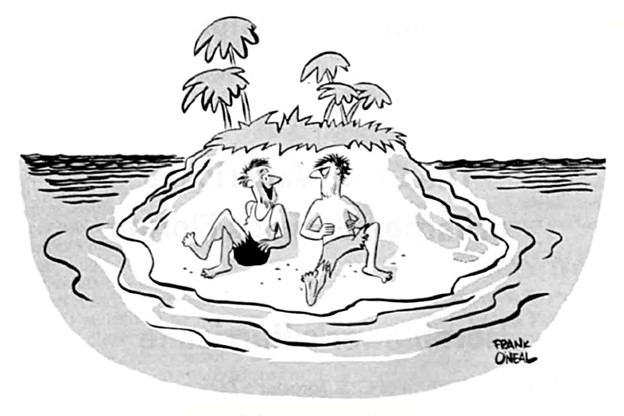
5. Desert Island Dalliances
Take a person or two, mix with a tropical island, and enjoy!
6. Slope Smiles
These cartoons are ski-lightful!

7. Wrecking Breakfast
Stir a little humor into your morning coffee!

8. Happy Father’s Day!
These cartoons are dedicated to Dear Old Dad!

9. Back to School for Everyone
Whether you’re a student, teacher, principal, librarian, or custodian, it’s time to step into those hallowed, humorous halls of learning.
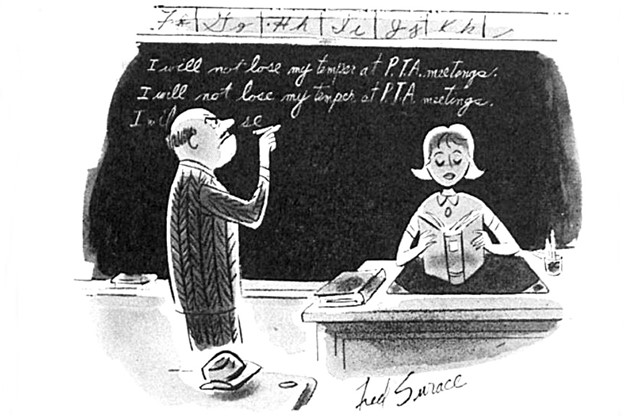
10. Links Hijinks
Guffawing at the grievous game of golf!

Want even more laughs? Subscribe to the magazine for cartoons, art, inspiring stories, fiction, humor, and features from our archives.
News of the Week: Resolutions, Sesame Street, and the Hot New Drink Is Actually 60 Years Old
This Year Is Gonna Be Different
Every year around this time I review the resolutions I made the first week of the year. Looking back at January of 2024 I see that I’m … one for six. That’s a terrible batting average.
But this year I’m really going to keep more of those resolutions! Especially if I change the definition of the word “keep.”
There are those who say they don’t make New Year’s Resolutions. I call these people “liars.” They may not officially make any resolutions, call them “resolutions,” or make a list. But at the end of the year isn’t it natural to think about one’s life, and the new plans you have to make for the new year? If you have anything you want to accomplish or change or think about for 2025, that’s a resolution, whether you call it that or not.
And if your plan is to not make any resolutions this year? Hey, that’s a resolution.
What are yours?
Can Sesame Street Be Saved?
Imagine a world where Sesame Street has to be “saved.”
But that seems to be the situation right now, as HBO and Max have decided not to renew the deal to make new episodes after the 55th season launches (though old episodes will still be available).
I bet it finds a home, though it worries me that the production company wants to “reimagine” the show, with longer narrative arcs instead of the format that, you know, made the show popular with kids and parents for a half century.
Hot Dr Pepper
There’s a new trend on the socials (I try to sound hip by saying “socials”), but if you’re someone who dives into the Post archives regularly (which you can do with a subscription!), you already know it’s several decades old.
It’s a Hot Dr Pepper, which was advertised in the pages of the Post back in the mid-’60s.
Those We Lost in 2024
This is the time of the year for lists. Unfortunately, along with the best-of and worst-of lists, we also have a rundown of the people that have died over the past 12 months. The New York Times has a nice write-up of some notables, and Turner Classic Movies has released their annual video tribute.
Uploaded to YouTube by Turner Classic Movies
CBS will have their tribute video up this Sunday on this page.
RIP Rickey Henderson, Art Evans, Alfa Anderson, Woody Fraser, Slim Dunlap, and Marisa Paredes
Rickey Henderson was a Hall of Famer and the baseball’s all-time stolen base leader. He died last week at age 65.
Art Evans was probably best known as Barnes, the air traffic controller who helps Bruce Willis in Die Hard 2. He also had roles in A Soldier’s Story, School Daze, Fright Night, Ruthless People, Metro, and Tales from the Hood. He died Saturday at the age of 82.
Alfa Anderson was one of the lead vocalists for Chic, known for such songs as “Le Freak.” She died last week at the age of 78.
Woody Fraser was a veteran producer who created such shows as Good Morning America and The Mike Douglas Show. He died Saturday at the age of 90.
Slim Dunlap was a guitarist for The Replacements. He died last week at the age of 73.
Marisa Paredes was an actress who appeared in several Pedro Almodóvar films. She died last week at the age of 78.
This Week in History
Humphrey Bogart Born (December 25, 1899)
The Post had an extensive feature on the actor in the August 2, 1952 issue. He died less than five years later at the age of 57.
Indian Ocean Earthquake (December 26, 2004)
The 9.3 magnitude quake caused a tsunami that killed 230,000 people. It was one of the biggest disasters in recorded history.
This Week in Saturday Evening Post History: Falls City, Nebraska, at Christmas by John Falter (December 21, 1946)

Falls City is where Falter spent his childhood. His father had a clothing store on this street and he worked there as a boy. Kids used to sleep on the big water tower seen in the distance. It was 75 feet in the air so authorities eventually told them to stop doing that.
New Year’s Eve at Home
New Year’s Eve is the most overrated night of the year.
I remember in the ’80s getting together with friends for the night, maybe at someone’s house, but I’ve never really gone out on a New Year’s Eve. Running around in freezing temperatures and dealing with crowds and drunks? That’s why I stay home and watch TV and drink a few cocktails.
Like the Negroni, made with gin, sweet vermouth, and Campari. Or a classic Old Fashioned, made with rye whiskey/bourbon, sugar, and bitters. For something different, how about a Frozen Chocolate Martini, a Campfire Mule, or a Kir Royale?
(And don’t forget the Hot Dr Pepper.)
You’ll need some food, so try some of these appetizers: a Spicy Chex Mix, Fried Deviled Eggs, this BLT Dip, a Buffalo Chicken Dip, or always popular Pigs in a Blanket.
And if you are at home watching TV all day, TCM will have a marathon of the Thin Man movies starting at 9:15 a.m. ET and ending at 7:45 p.m. (they liked their cocktails too). After that, it’s The Apartment, the classic Billy Wilder film that’s set during the holidays. And after the ball drops (which several channels will cover), you can catch Repeat Performance, a New Year’s Eve-themed time travel film noir I bet you haven’t seen.
Next Week’s Holidays and Events
Bowl Games (Late December/early January)
Here’s a list of the college bowl games and where you can watch them. There’s a Pop-Tarts Bowl!
New Year’s Day (January 1)
This is the day you can start on those resolutions.
Bill Newcott’s Top Movies for 2024
As the year-end movie blockbusters suck all the oxygen from America’s multiplexes, these five flicks remain my favorite movies of the past year.
The Brutalist
(In Theaters)
When the Best Picture, Actor, Supporting Actor, Director, Cinematography, and Original Screenplay Oscar nominations are announced, it’s a safe bet cowriter/director Brady Corbet’s sprawling tale of tortured genius, naked ambition, and social stratification will be on every one of them. Adrien Brody is haunting as László, a dark-eyed Hungarian immigrant, Holocaust survivor, and architect, who stumbles into a monumental but thankless commission from a Philadelphia millionaire (Guy Pearce). László is thankful for the job, of course — until his boss, who projects himself as a having a common touch, reveals himself to be as condescendingly patriarchal as they come.
Ghostlight
(Streaming)
The year’s most heartfelt family drama stars a cast of Chicago-based actors you’ve probably never heard of — but you will never forget the shatteringly authentic human performances they give in this deeply moving and stubbornly hopeful story of the healing power of art. Keith Kupferer stars as Dan, a construction worker who finds escape from his trying family situation by secretly taking up with a community theater, where a series of implausible yet believable events lands him in the role of Shakespeare’s Romeo. At first, Dan feels understandably ridiculous playing the teenaged tragic hero, but soon he embraces the part — and we likewise fall into line. Kupferer’s actress/wife, Katherine Mallen Kupferer, costars as Dan’s spouse, and their daughter Tara Mallen plays the couple’s troubled teen. But don’t go screaming “Nepotism!” The three form an authentic, touching triad in the year’s most organic acting ensemble.
Conclave

(In Theaters and Streaming)
Big-studio filmmaking at its best, Conclave — the story of a particularly messy Papal election — combines peerless star power (Ralph Fiennes, Stanley Tucci, John Lithgow, Isabella Rossellini) with taut direction, lush production design, and even the first musical soundtrack in years that I’ve actually sought out to re-hear. Unfolding in a painstakingly authentic Sistine Chapel setting, Conclave is a tense, closed-doors drama with career-best performances and a twist ending that I guarantee you’ll never see coming. (Forget those spoilsports who complain the final switcheroo is too manipulative — being manipulative is what art is all about!)
Hit Man

(Streaming on Netflix)
Too often, Best Pictures of the Year nominations largely ignore early-year masterpieces and instead focus on the Best Pictures of the Last Month or Two. Case in point: The great crime of this awards season is the way cowriter/director Richard Linklater’s universally acclaimed comedy thriller has largely disappeared into 2024’s Cinematic Awards Memory Hole, mostly because it arrived in theaters way back in June. Glen Powell is charmingly sweet as Gary, a mild-mannered philosophy professor who is enlisted by the cops to supply his insights as they try to ensnare people who are looking for hired assassins. As Gary explains to us in an early voice-over, “Hit men don’t really exist.” But that doesn’t stop a procession of hapless saps from trying to enlist Gary to do away with spouses, partners, and other inconvenient people. Of course, Gary eventually falls for one of his marks (Adria Arjona), who insists she needs to kill her hubby before he kills her. Or is she just playing Gary for a patsy? Linklater’s breezy storytelling style and the cast’s relentless good will make Hit Man the year’s most enjoyable cinematic bon-bon.
Honorable Mentions
The Piano Lesson (Streaming on Netflix) A compelling mix of family and historical drama starring Samuel L. Jackson and Danielle Deadwyler.
Saturday Night (Streaming) Co-writer/director Jason Reitman collects a spot-on cast to re-imagine the 90 frantic minutes before the first episode of SNL aired in 1975.
Flow (In Theaters) Majestically rendered and lovingly animated, this wordless tale from Latvia traces the adventures of a handful of disparate animals as they cling to survival in a wooden boat adrift in a post-apocalyptic, sea-covered world.
We Grown Now (Streaming) A testament to the persistence of childhood, writer/director Minhal Baig’s tightly focused drama follows two young boys as they navigate Chicago tenement life with a sense of innocent adventure and impish abandon worthy of Huck Finn and Tom Sawyer.
Remembering Gene Wilder (Streaming) Wilder’s 40-year career of classic films (and forgettable misfires) speaks for itself. But this adoring documentary from director Ron Frank offers a tender coda; a welcome reminder that those emotionally unpredictable but essentially decent souls Wilder played in films like The Producers and Young Frankenstein got their authenticity from being, at heart, a lot like him.
September/October 2024 Limerick Laughs Winner and Runners-up
To be back when those leaves brought such joy,
Such good times for a dog and his boy.
Now, with years having past,
On my list they are last:
As the raker, they now just annoy.
Congratulations to Domenic Sette of Missoula, Montana, who won $25 for this limerick based on Leaf Pile, John Clymer’s October 16, 1954, Post cover.
If you’d like to enter the Limerick Laughs Contest for our upcoming issue, submit your limerick via our online entry form.
Here are some more great limerick entries from this contest, in no particular order:
Raking leaves brought enjoyment and glee,
But regrettably she did not see:
While enjoying the chore,
It caused her to ignore
That her child fell out of the tree.
—Bob BobbeHe was having some fun for a while,
But terror soon wiped off that smile.
As the leaves got so deep,
Johnny heard a low beep.
“Mom, I lost my cell phone in this pile!”
—Brian FedericoHey son, why not give Mom a break?
Get up, take a turn with the rake.
This is painstaking work,
So stop being a jerk.
Your allowance just night be at stake.
—Dolores M. SahelianWhile my raking of leaves was ’most done,
Along came my dog and my son …
As they plowed through the leaves
I thought, now, if I please,
I might as well join in the fun!
—Stephen GinterSorry, I don’t mean to be bad,
But adventures just need to be had;
So if me and the pup
Straighten everything up,
Will you promise me you won’t tell Dad?
—Jim StrossmanHey, Dude, I can see from your smile,
You’ve been playing and romping a while.
Here’s one of my peeves:
Start raking some leaves
So Mommy can rest in the pile!
—Lorraine RayIt’s a dog’s life, they say, and they’re right.
I buried a bone here last night,
And now I can’t find it.
I know she’s behind it.
She’s raking those leaves just for spite.
—Rudy LandesmanTo help in the yard, they were hired,
But soon boy and dog were both fired.
“My back is aching
And, as for your raking,
It leaves much to be desired.”
—Scott Talbot EvansShe called her assistants, did Bess,
To tackle the leaves (more or less).
“I’ll make a big pile,”
She said with a smile,
“And you two will make a big mess.”
—Sjaan VandenBroeder
The Most Popular Articles of 2024
1. Common Threads: The Rise (and Rise, and Rise) of the Mini Skirt


More than any other clothing item, the mini became a symbol of the changing cultural attitudes and the growing impact of youth that defined the 1960s.
2. Our Better Nature: Put the Brakes on Honey Bees – Our Future Depends on It
By Paul Hetzler

Honey bees are causing grave – and in some cases irreversible – harm to the environment.
3. What Makes a Good Life?
By Ken Budd

As director of the longest-running study on human happiness, Dr. Robert Waldinger has some simple essential advice for feeling good: Make friends, keep friends, treasure friends.
4. The Origin of Grades in American Schools
By Josh Eyler
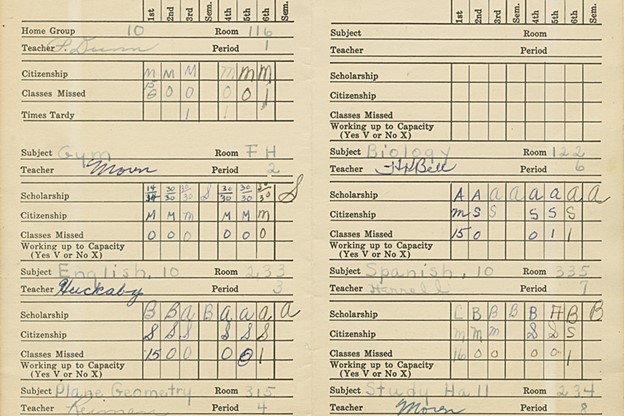
You may not have heard of Ezra Stiles, but he’s the reason students today get grades – and the system hasn’t changed much in 250 years.
5. The Story of Saint Patrick Is Way Weirder Than You Think


His name wasnʻt Patrick, he spent years as a slave, and he wasn’t even Irish.
6. Before Taylor and Travis, There Was Helen and John


She was an actress. He was a shortstop. We can learn from the press parade around this 19th-century power couple.
7. Blazing Saddles: Five Funny Facts at 50

Mel Brooks turned a parody Western into comedy gold.
8. By the Numbers: Bob Marley and the Wailers’ Legend

Let’s get together and review the stats.
9. “Climbing” Mount Sunflower, the Highest Point in Kansas

The western Kansas prairie can be windy, dusty, and, well…flat. But the Sunflower State also boasts beautiful sunsets, friendly folks, and low-key adventure, like finding your way to the state’s highest point via country roads.
10. These Total Solar Eclipse Towns Can’t Wait to Take the Spotlight
By Bill Newcott

In an arc from Texas to Maine, little burgs are making big plans.
Cartoons: Outdoor Winter Fun
Want even more laughs? Subscribe to the magazine for cartoons, art, inspiring stories, fiction, humor, and features from our archives.
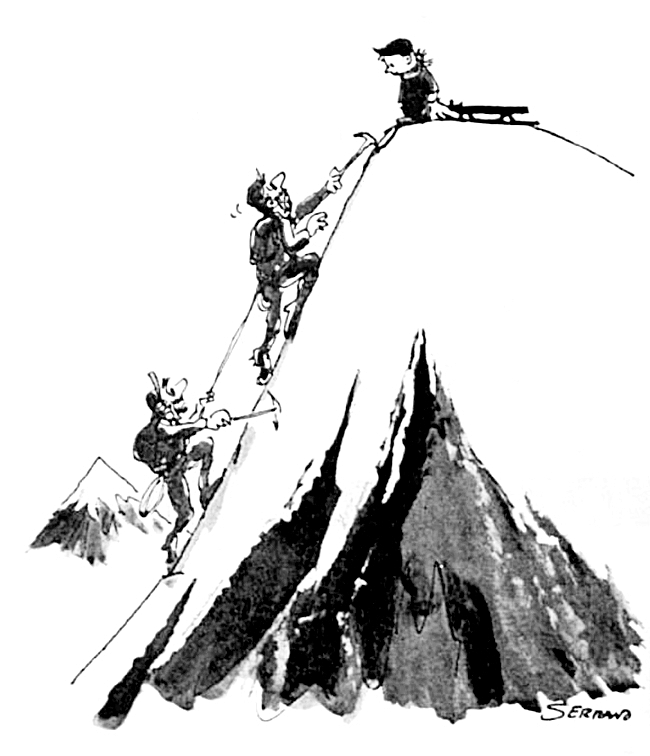
November 4, 1961

Larry Katzman
May 6, 1961
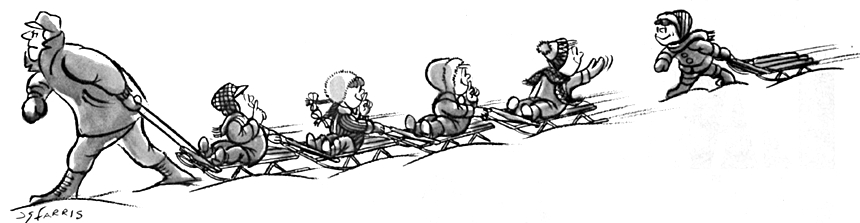
February 3, 1962
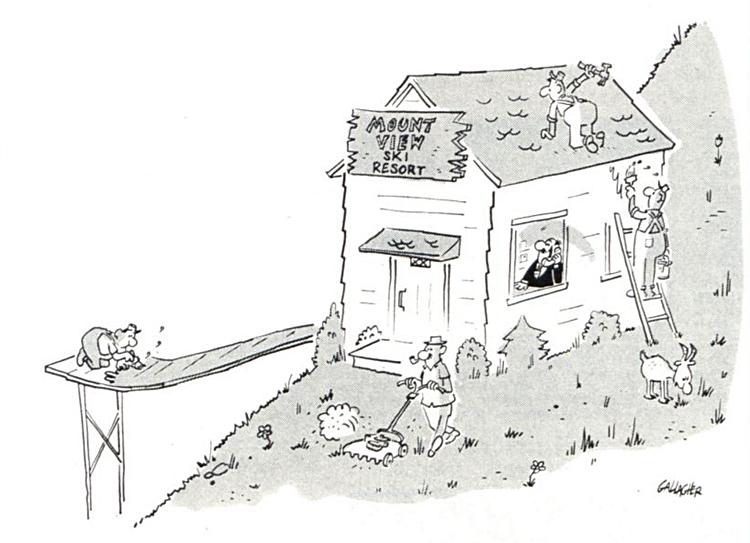
John Gallagher
January 29, 1966
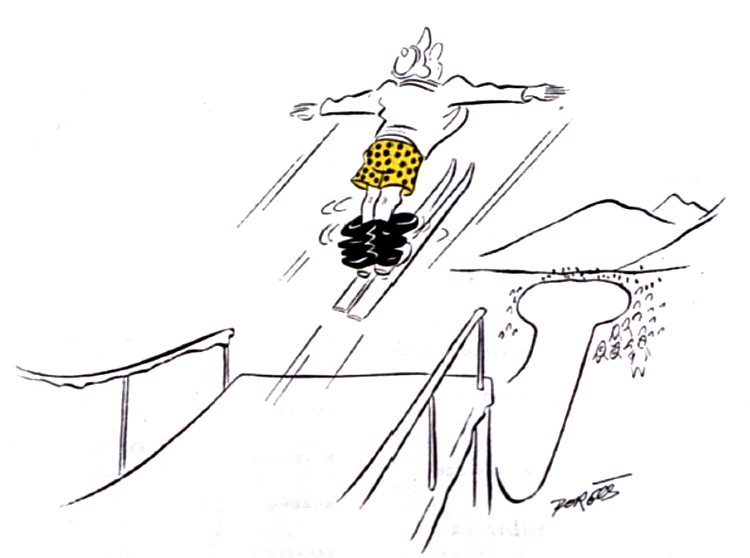
Janaury 28, 1961
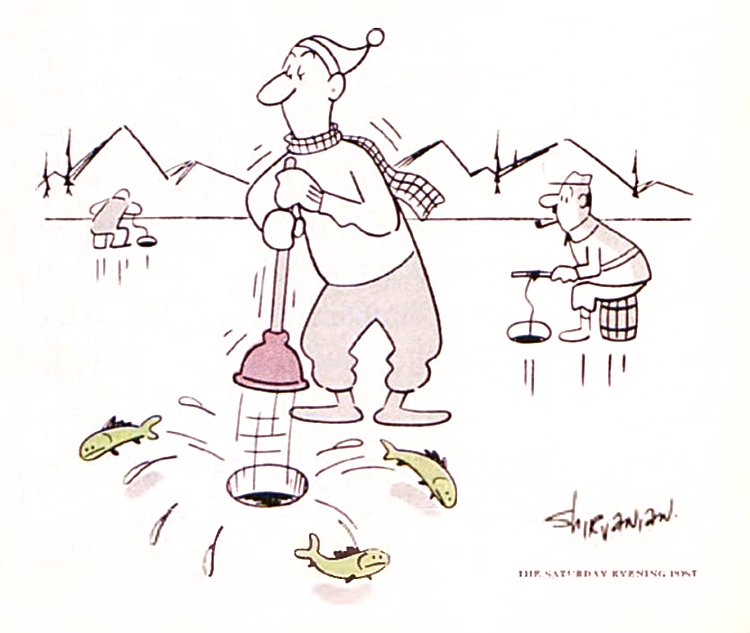
November 12, 1960

Jack Tippit
December 22, 1962

Joseph Zeis
December 5, 1959
Want even more laughs? Subscribe to the magazine for cartoons, art, inspiring stories, fiction, humor, and features from our archives.
Our Better Nature: Think Snow — Forests and Fields Need It
In her poem “It Sifts from Leaden Sieves,” Emily Dickinson lauds the sublime splendor of new snow that fills nooks and crannies in the yard and leaves wind-sculpted ringlets around trees and fence posts. While I find the poet’s sense of wonder inspirational, a blanket of white stuff is less magical when you have to extricate your car from it before risking a slushy drive to work, and Dickinson’s “alabaster wool” loses its charm when the plow wings a mountain of it onto the driveway you just cleared.
In early December of this year, a lake-effect storm brought as much as six feet of snow within just 48 hours to parts of Ohio, Michigan, Pennsylvania, and New York. When frigid air passes over the relatively warm, open waters of the Great lakes, those living to the east and south of the lakes regularly get several feet of snow at a time until the lakes ice over. It’s why Syracuse, New York is the snowiest city in the country, with an average snowfall of 114.3 inches annually.
But that’s nothing compared to mountainous regions out West. In Washington State, Mount Rainier gets a yearly snow dose of around 640 inches, and in some parts of the Rockies, 400 to 500 inches of snow every winter is normal. I imagine no one who lives near those places bothers to dream about a white Christmas – they can count on it.
Over 70 percent of the continental U.S. gets significant snow each winter. But regardless of how much you get in your neck of the woods, snow does a lot more than make skiers happy and pedestrians and commuters miserable. Where ecosystems have evolved with annual snow cover, they need it to stay healthy. This is in large part because snow carries with it trace elements crucial to plant life.
Most important is the fact that snow contains plant-available forms of nitrogen, a nutrient often in short supply. When snow releases a whole winter’s worth of nutrients in the spring, it can make a difference to trees and crops. Some people even call snow “the poor person’s fertilizer.”
Since air is 78 percent nitrogen, you’d think plants would have all they need. But atmospheric nitrogen, N2, is a stable, inert molecule that plants are unable to absorb. Lightning can zap nitrogen gas and change it to a plant-friendly form, but this accounts for very little of a plant’s nutrient budget.
The majority of nitrogen used by plants is made by soil bacteria that break apart gaseous nitrogen, converting it to water-soluble forms that plants can slurp up. Ironically, the process of breaking N2 into compounds plants can use is called nitrogen fixation.
Snow is a better fertilizer today than it was years ago. There’s an outfit called the National Atmospheric Deposition Program (NADP) that measures stuff that falls out of the sky that isn’t some form of water. According to the NADP, the vast majority of today’s snow-borne nitrogen is from pollution.
Coal-burning power plants and motor vehicles spew out various nitrogen oxides, which are not great for us to breathe, but when they get washed into the soil, they act as fertilizers. Ammonia, another type of plant-available nitrogen, escapes from manure piles and lagoons. How much fertilizer a winter’s worth of snow contains varies by region. Due to wind patterns, the Northeast and upper Midwest get more nitrogen in their snow than the national average, around 10-12 pounds of nitrogen per acre. Compared to the high nitrogen requirements of corn, which needs about 200 pounds of nitrogen per acre, this is small potatoes (which also need 200 pounds per acre). But it’s not chopped liver, either, which is high in nitrogen but not an ideal soil amendment.
Snow-based nitrogen won’t replace the nitrogen needed by most agricultural crops, but it can be a significant boon to ecosystems on marginal soils. In a year with abundant snowfall, maple-sugar bushes, timber lands, and pastures benefit from “poor person’s fertilizer.” Snow also brings a fair bit of sulfur, an essential plant nutrient. In northern states where glacial action resulted in soils unable to offset the acidifying effects of sulfur, it can be a mixed blessing if it makes the pH drop below what is ideal for crops.
We depend on the moisture from snow as well. In most years, snow melts gradually, with nearly all the moisture going into the soil. This gentle percolation is in contrast to summer rains, a percentage of which – sometimes a large portion – runs off and doesn’t benefit the soil.
When topsoil is saturated, or at field capacity, excess water seeps down through the soil profile. Eventually it becomes groundwater, raising water tables and recharging our aquifers. In general, most water wells tap into unconfined aquifers, meaning water that goes into the ground in a given location is the water that comes out of the well there. Such aquifers depend on snowmelt for recharge. Unfortunately, winters are on average getting warmer and shorter, thanks to climate change. As snow packs dwindle, groundwater recharge in spring will diminish.
Gardeners, farmers, and nature-lovers should take heart at the mounting snowbanks, not despair of them. Unless they’re up to your second-story windows, in which case you have a right to complain.