
Writer Flannery O’Connor once told a friend that “There won’t be any biographies of me because, for only one reason, lives spent between the house and the chicken yard do not make exciting copy.”
In this year when O’Connor would have turned 100, many of her adoring fans would surely disagree with this assessment, finding nothing but fascination in the life of a woman who, in just 39 short years, produced two novels and 31 short stories so powerful they practically grab readers by the shoulder and shake them. And yes, at least one biography exploring O’Connor’s life has been written: Brad Gooch’s 2009 authoritative study, Flannery.
Flannery did live a very quiet life on a farm in Georgia, where she tended to chickens, geese, ducks, and (most famously) peacocks. But out of that quiet life, she produced a distinguished — and much beloved — body of work that continues to fascinate the generations who have followed her. Contemporary luminaries such as singers Bruce Springsteen and Bono and the filmmakers Ethan and Joel Coen have all credited O’Connor as influencing their own work.
O’Connor’s Unorthodox Work
What immediately strikes readers of O’Connor is how very unusual her fiction really is. In her stories, a variety of characters, many of them thoroughly unlikeable, follow courses of action that — to put it mildly — end badly for them, and sometimes even violently: A smug and self-righteous woman is gored to death by a runaway bull; another woman’s wooden leg is stolen by a hypocritical Bible salesman who’s lured her into the hayloft of a barn; an entire family lost on a backroad during a trip — parents, children, and an extremely annoying grandmother — are shot to death by an escaped convict.
Because of these unorthodox tales, O’Connor’s work is frequently classified as “Southern Gothic.” O’Connor herself disliked being pigeonholed into this category, preferring the word “grotesque” to describe her stories and characters. As she once said, “Whenever I’m asked why Southern writers particularly have a penchant for writing about freaks, I say it is because we are still able to recognize one.”
Just as strong an element in O’Connor’s fiction are the vivid descriptions of the rural Georgia setting where she lived — its places, its people, and their speech patterns. Another element — O’Connor’s strong Catholic faith — pervades all of her work. Themes of grace and redemption underlie her unusual stories, showing the presence of God at work in the world and also depicting how even the most flawed individuals can be transformed through faith. Or not: Her characters often turn their backs on redemption.
O’Connor’s caustic wit can create dark humor and even laugh-out-loud moments. Her offbeat witticisms are perhaps most apparent in her correspondence, collected in the 1979 volume The Habit of Being, compiled by her close friend Sally Fitzgerald. O’Connor once offered this tongue-in-cheek advice to a writer friend on how to approach the laborious task of rewriting: “Buy yourself a bunch of carrots and when you must eat, eat them raw, making as much noise as you can. The nearer you can sound like Bugs Bunny, the better.”
The Places She Called Home
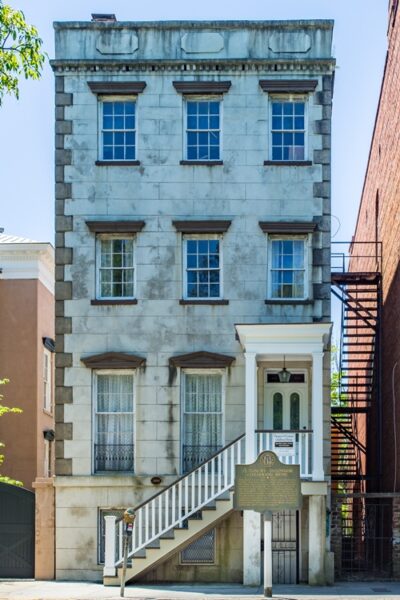
In this centennial year, there is no better way for devotees of O’Connor’s work to learn more about her than to visit the places she lived. She began her life as Mary Flannery O’Connor on March 25, 1925, in Savannah, the only child of Edward and Regina Cline O’Connor. Their home on Lafayette Square still stands and is open to the public. Visitors will see much of the family’s furniture and personal effects on display, including photographs and an exquisitely designed perambulator with O’Connor’s initials gilded on the side. Several of O’Connor’s childhood books can also be seen with her handwritten assessments scrawled on the title pages, including one she called “the worst book I have read next to Pinnochio.[sic]” As an only child, she was doted upon by her parents. She was especially close to her father, creating little poems and drawings for him that she’d leave under his breakfast plate.
Her fascination with birds of all sorts began at an early age. She even created outfits for the chickens the family raised in their backyard. One of those chickens brought the young Flannery a moment of national fame. At the age of 6, she taught the chicken to walk backwards, and learning of this, a film crew traveled from New York to shoot a newsreel of this remarkable accomplishment. The stubborn chicken refused to cooperate, but the enterprising film crew saved the day by shooting it walking normally and then playing the film in reverse. Of this event, O’Connor wryly wrote later in life, “I was just there to assist the chicken, but it was the high point in my life. Everything since has been an anticlimax.”
Uploaded to YouTube by British Pathé
In 1937, her father was diagnosed with lupus, a chronic autoimmune disease, and as his condition deteriorated, the family moved to her mother’s home town of Milledgeville in central Georgia, residing in a rambling ancestral family home with many members of her mother’s huge extended family. Lupus claimed her father’s life in 1941 when she was 15, but her mother and O’Connor persevered, with O’Connor graduating from high school in Milledgeville and then from the Georgia State College for Women (now Georgia College & State University (GCSU), also in Milledgeville.
After receiving her bachelor’s degree, O’Connor traveled for graduate work to the University of Iowa and was accepted into the prestigious Iowa Writers’ Workshop, where her early work brought encouragement from her instructors. It was also during her time in Iowa that she dropped her first name of Mary and became known simply as Flannery. After she received her MFA, O’Connor spent some time at Yaddo, an acclaimed artists’ colony in upstate New York, where she befriended the poet Robert Lowell and continued to work on Wise Blood, her first novel. O’Connor then spent several unhappy months in New York City before accepting an invitation to reside with friends Robert and Sally Fitzgerald in rural Connecticut, according to Gooch’s book Flannery.
At Christmas time in 1951, O’Connor was feeling unwell but still traveled by train to see her family in Georgia. Her condition worsened during the journey, and an uncle who picked her up at the train station was shocked at her appearance, saying later that she looked “like a shriveled old woman.” She was hospitalized immediately and was diagnosed with lupus, the same condition that had killed her father. Her mother at first refused to share news of the diagnosis with O’Connor, fearing the shock would be too great. It was her friend Sally Fitzgerald who broke the news to O’Connor sometime later, according to Flannery.
After only four short years away from home, O’Connor was back in Georgia to live out the remainder of her days. To save O’Connor from having to deal with the many stairs inside the Milledgeville home, she and her mother moved to a large farm owned by the family six miles outside of town with the magical name of Andalusia. There, Regina managed the day-to-day operations of a herd of dairy cattle and Flannery rigorously applied herself to her writing.
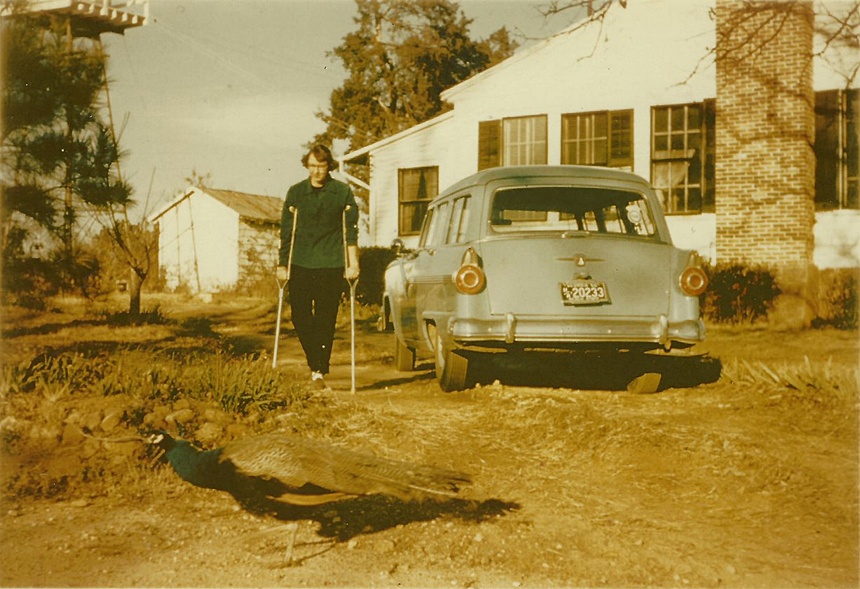
Because advancements in treatment for lupus had been made since her father’s day, primarily with the use of cortisone, O’Connor managed to have relatively good health for the next 13 years, even frequently traveling to universities across the country to deliver speeches. The most visible characteristic of her weakened state was her reliance on crutches, or her “aluminum legs” as she called them. She also tired easily, so she wrote in the morning when she had the most energy and spent her afternoons and evenings reading, resting, or entertaining frequent guests.
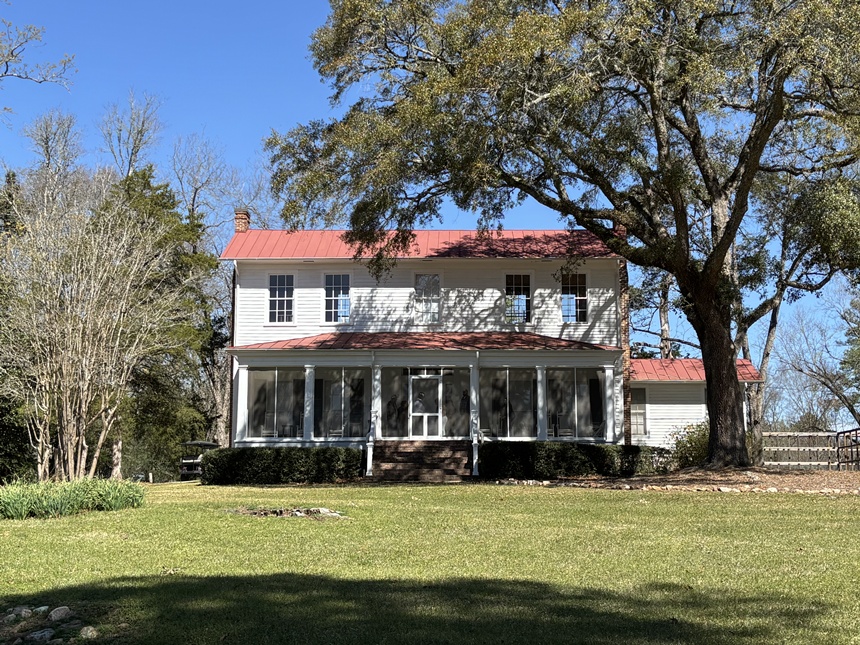
The white frame, red-roofed farmhouse with a screened front porch lined with rocking chairs, as well as many of the barns and other outbuildings at Andalusia still stand, and it’s here where serious devotees of O’Connor’s work will get the strongest sense of what her final and most productive years were like. When O’Connor died in 1964 after a few months of worsening health, her mother moved out almost immediately, returning to the family house in the center of Milledgeville and leaving almost everything in the farmhouse she’d shared with her daughter just as it was. For this reason, Cassie Munnell, the curator at Andalusia, estimates that 95 percent of what visitors will see was in place when Flannery and Regina resided there, right down to the spices and mayonnaise jars in the kitchen to the whimsical peacock draperies Regina made and hung in the dining room.
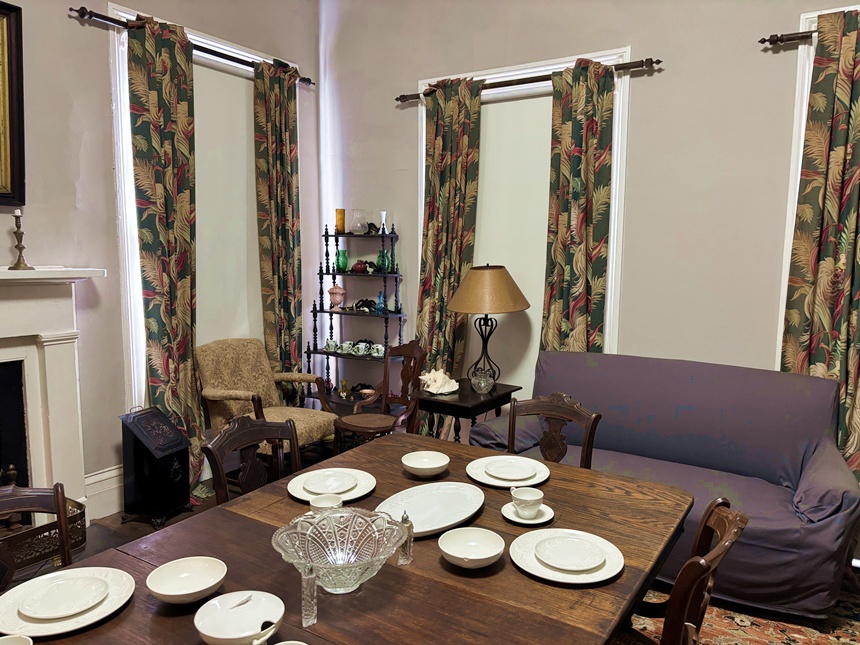
Tour guides who’ve undergone extensive training point out things like the stove and refrigerator O’Connor purchased after the 1957 television adaptation of her story “The Life You Save May Be Your Own,” starring Gene Kelly. (O’Connor loathed the production but was happy to receive the substantial payment.) They also discuss the strong bond between mother and daughter, although Regina, a conventional Southern woman who wore a hat and white gloves nearly everywhere she went, was perplexed by her daughter’s work and frequently wondered aloud why O’Connor couldn’t write “nice” stories. Our guide told us how mother and daughter, both strong willed women, often “butted heads,” but never doubted one another’s devotion.
The guide also told us the story of O’Connor’s private audience with Pope Pius XII in 1958, where the author asked for the blessing of good stories, rather than good health. We also learned about her brief romantic encounter with Erik Langkjaer, a Danish textbook salesman who, in Brad Gooch’s biography, likened their one brief kiss to the sensation of kissing a skeleton and returned to Denmark shortly afterward. Is it possible that the smarmy Bible salesman in “Good Country People” was inspired by Langkjaer?
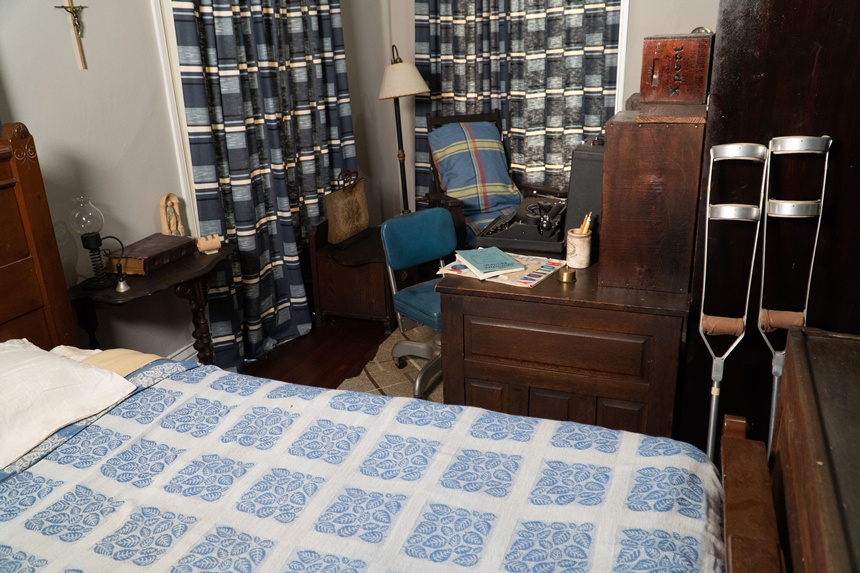
The most moving experience at Andalusia, however, is a visit to O’Connor’s bedroom/study, where most of her unforgettable work was composed — her desk and typewriter turned away from the windows to minimize distractions. Although the typewriter on the desk is a replica, little else has changed, right down to a vial of holy water and a bottle of cortisone on the fireplace mantel to the curtains she always kept drawn and the bedspread on her narrow single bed. Her actual crutches are propped against the chifforobe where she kept her clothes.
Outside, a peacock named Astor and a peahen named Mrs. Shortley (named for characters in O’Connor’s story “The Displaced Person”) serve as surrogates for the 30 to 40 beloved peafowl that roamed freely at Andalusia during O’Connor’s lifetime. Even just a quick walk around the farm makes it possible to wonder if these landscapes were the actual ones that fired O’Connor’s imagination. Is the huge pasture adjacent to the farmhouse the one where she visualized a runaway bull rampaging in “Greenleaf?” Or is it the field she had in mind where the Polish refugee Mr. Guizac was run over by a tractor in “The Displaced Person?” And is the hayloft in the barn out back the one she had in mind when she composed the famous seduction scene in “Good Country People?” Clearly, O’Connor didn’t need to look far from home for sources of inspiration for her stories.
Examining the Manuscripts
Those who want to make a deep dive into O’Connor’s actual manuscripts can do just that in the Special Collections of the Ina Dillard Russell Library at Georgia College & State University, where the 7,000 pages of O’Connor’s manuscripts housed there include most of her short stories, as well as early drafts of her second novel, The Violent Bear It Away, and fragments of her unfinished third novel Why Do the Heathen Rage? Additionally, manuscripts of the talks O’Connor gave at universities across the country can be seen, as well as the approximately 700 books O’Connor had in her personal library at Andalusia, including many with handwritten annotations. The museum also displays one of O’Connor’s typewriters, a variety of photographs, and the cartoons O’Connor produced for the college newspaper and literary magazine when she was a student there.
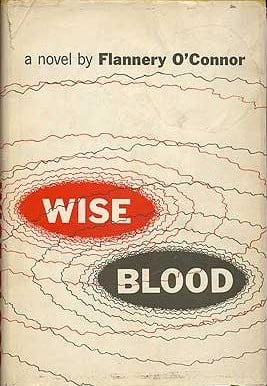
The collection reveals what an exacting and meticulous editor of her own work O’Connor really was, not only laboring over just the right words but also striking out long portions and completely reworking them. Her first novel, Wise Blood, for example, took O’Connor more than five years to get to a point where she felt it was fit for publication, and many of the short stories took her weeks or even months to complete.
“Whenever people come in and want to see a sample of O’Connor’s manuscripts, I frequently give them the two folders containing drafts of “The Life You Save May Be Your Own,” says Holly Croft, the associate director at the archives. In these folders, visitors can see O’Connor’s edits, including portions she crossed out, as well as several alternate endings for the story she considered. But whenever someone comes in and says they want to see manuscripts of O’Connor’s novels, Croft tells them “No, you don’t. We’ve got more than a hundred folders of the novels and that’s more than the average person wants to look at. Many people just want to take a peek at the wizard behind the curtain, but they don’t want to be overwhelmed.”
Around Milledgeville
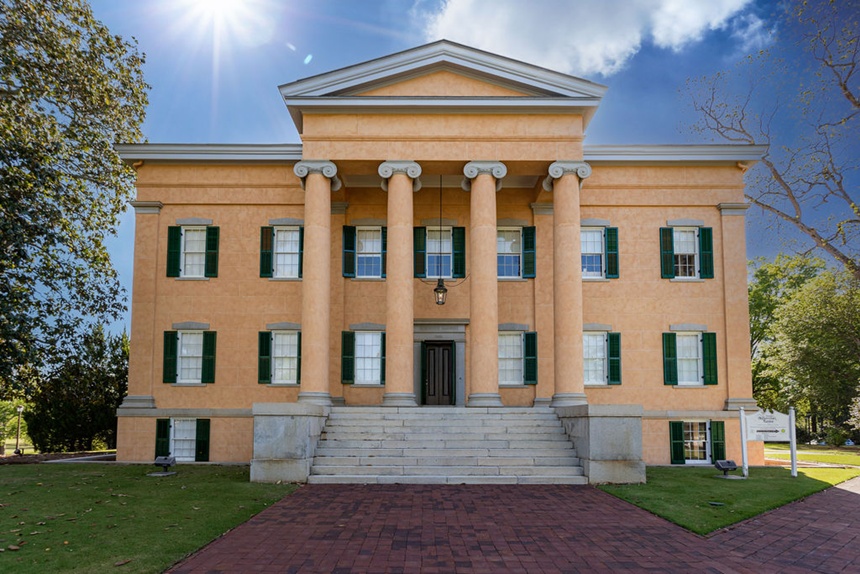
The charming small town of Milledgeville, little changed since O’Connor’s day, also warrants exploration because of its many associations with the writer. The capital city of Georgia from 1807 to 1868, Milledgeville’s tree-lined streets feature stately antebellum homes, including the ornate former governor’s mansion, which Civil War General William Tecumseh Sherman used as headquarters during his infamous March to the Sea. O’Connor also would have been intimately familiar with the historic buildings near her alma mater.
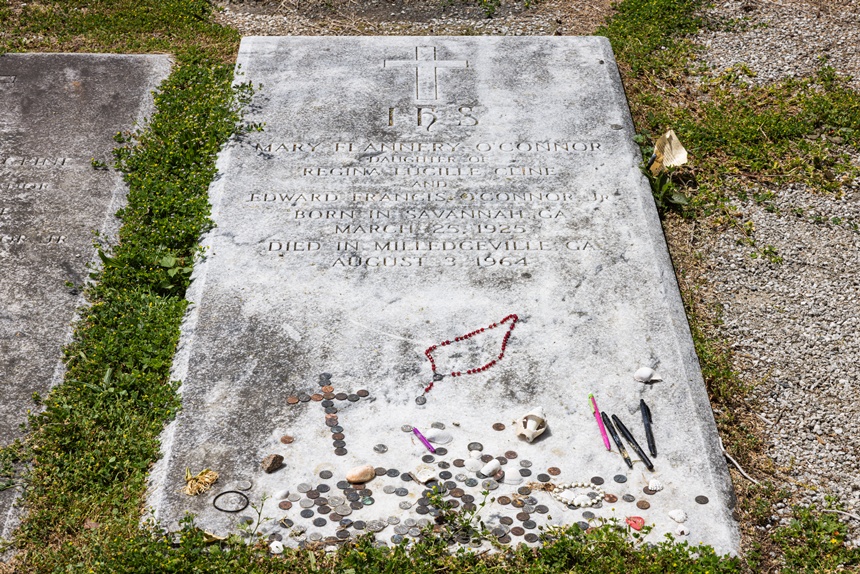
O’Connor and her mother also frequently lunched at what’s now called the Brown-Stetson-Sanford House. In O’Connor’s lifetime, it was known simply as the (now-closed) Sanford House Tea Room, and from all accounts, O’Connor was especially fond of their Peppermint Chiffon Pie. The Gothic Revival Sacred Heart Catholic Church on Jefferson Street is where O’Connor dutifully attended mass each morning at 7 a.m. It was founded in 1874 by members of two different branches of Regina O’Connor’s ancestors. Literary pilgrims will also want to pay their respects at O’Connor’s burial site in Memory Hill Cemetery, where the writer is interred alongside her parents. Her flush-to-the-ground gravestone is frequently strewn with coins, fountain pens, and even rosaries.
A New Discovery
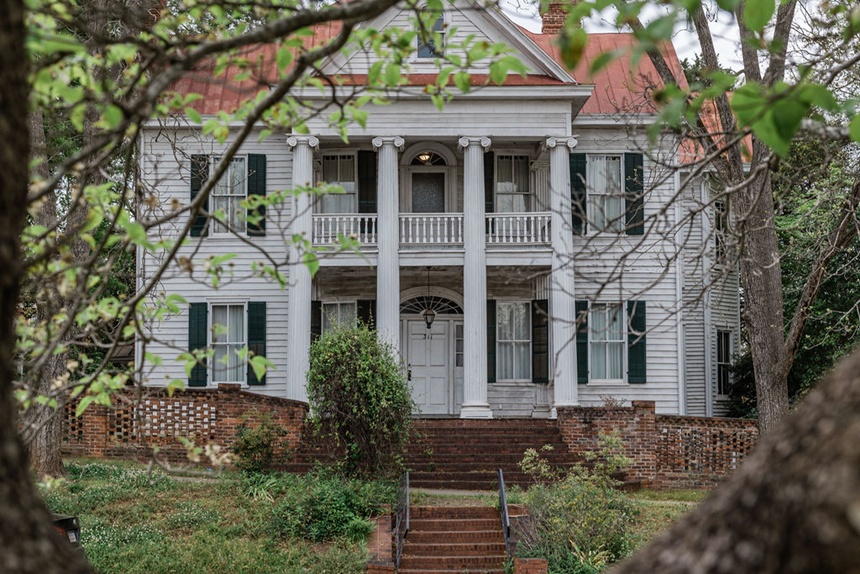
O’Connor would have been a frequent visitor to the ancestral family home on Greene Street, where her mother’s family had resided for many decades and where O’Connor herself also lived when her family moved from Savannah. The rambling clapboard mansion remained in the family until 2023, when O’Connor’s cousin, Louise Florencourt, passed away at age 97, willing it to GCSU. Almost immediately upon taking possession, representatives from the university began making surprising discoveries.
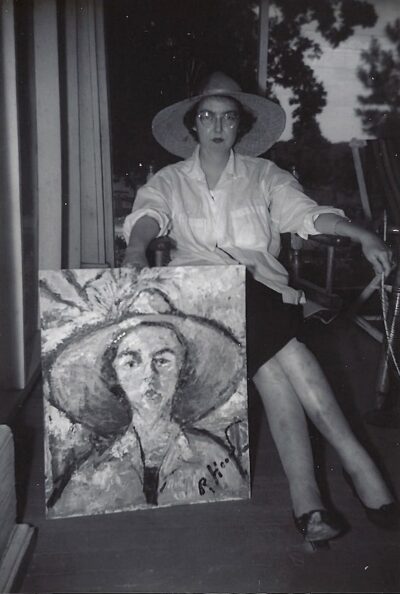
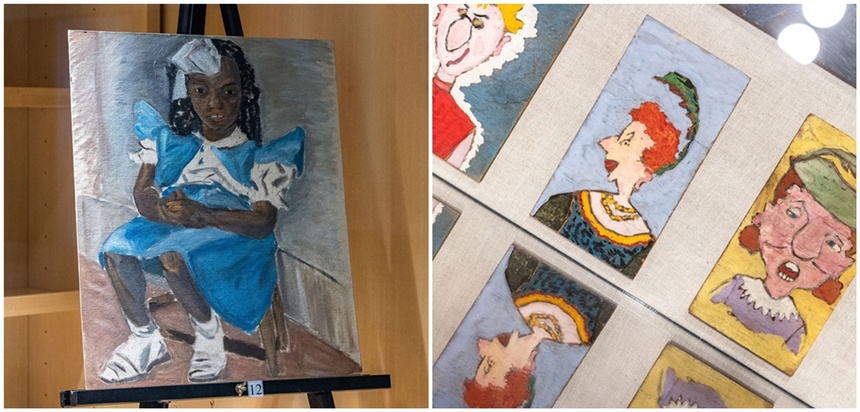
One of those discoveries, reported in the New York Times in March of 2025, shined a spotlight on a little-known secret about O’Connor: She was a visual artist as well as a literary one. In the Greene Street home’s attic, two barrels were discovered containing painted woodcut caricatures O’Connor had created in her younger days. Elsewhere, a trove of oil paintings she created during her adult years at Andalusia were found offsite in a rental storage facility.
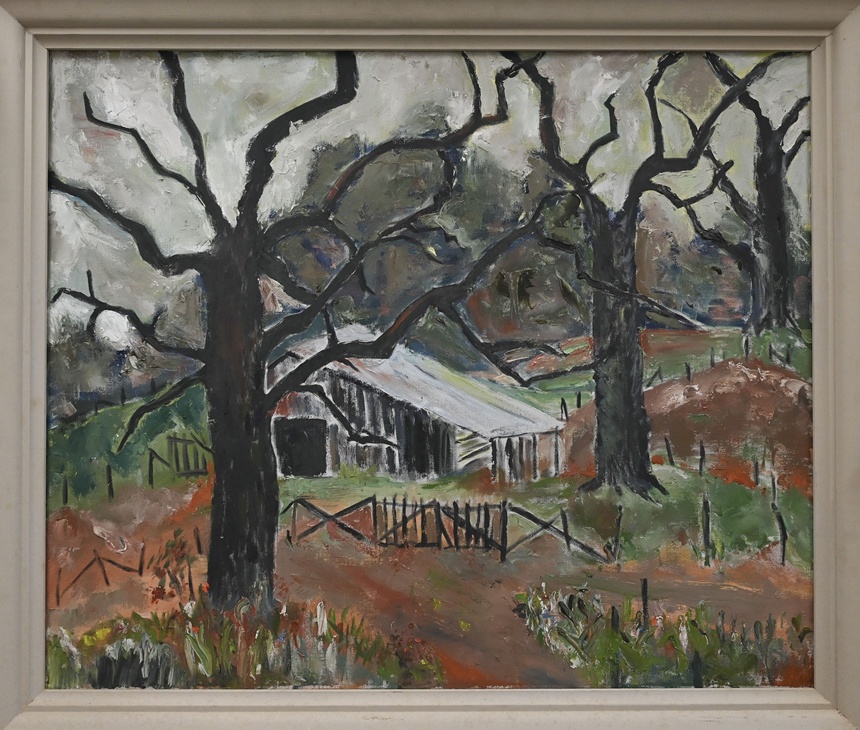
For the remainder of this year, a major portion of those pieces of art are on display at the Interpretive Center at Andalusia, the first large-scale exhibition of O’Connor’s artwork anywhere. More than 70 of her works painted on both wood and canvas are on hand. Examples of her caricatures include a woman smoking a pipe, another woman with freckles and a huge nose, an almost cubist looking man in a bowler hat, and a portrait of a couple that some surmise are O’Connor’s parents. Among the quite striking oil paintings, there are landscapes of Andalusia, a number of still lifes, a variety of birds, and portraits of a young child wearing her Sunday best and a woman sewing beside a window.
One of her most striking pieces is a self-portrait showing O’Connor staring fixedly, almost savagely, straight ahead, a sun hat on her head resembling a large golden halo. Beside her, an almost demonic pheasant complete with pointy ears similarly glares at the viewer.
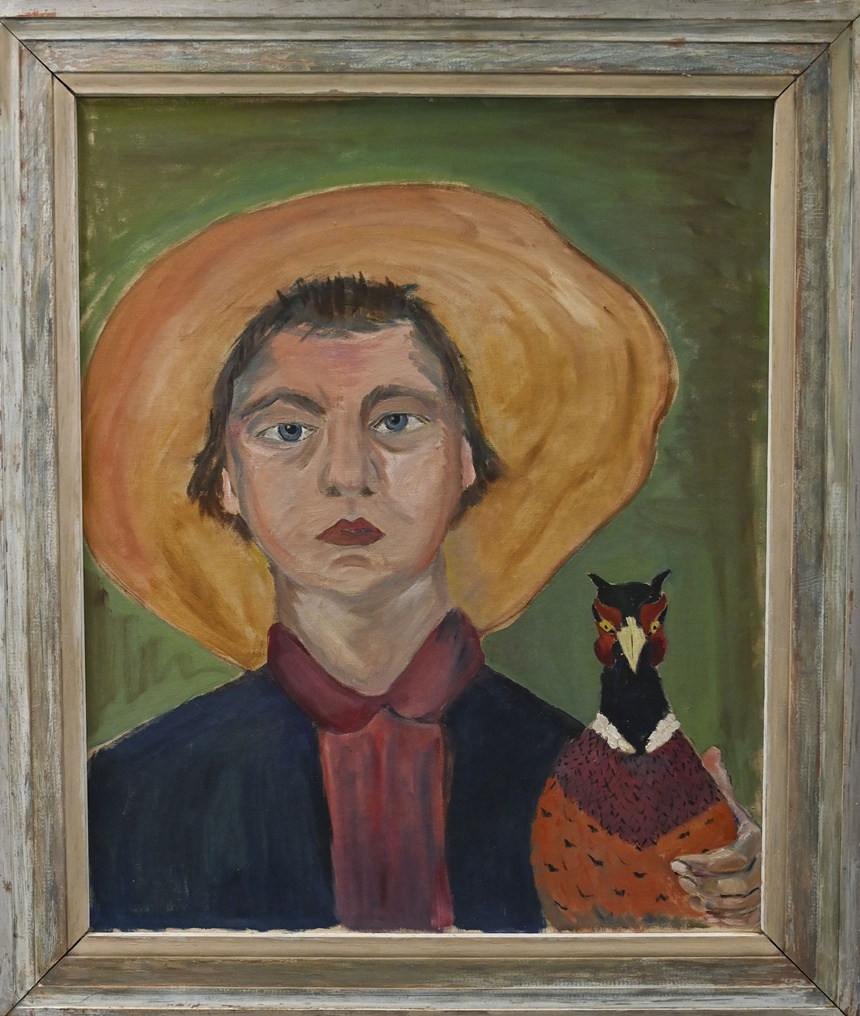
Regarding O’Connor’s talent as a visual artist, Professor Robert Donahoo noted in an essay included with the exhibit booklet that O’Connor’s paintings “communicate visually and aesthetically… Like her prose, these painting reach for deeper layers than their surfaces suggest — often through their small details.”
Valerie Aranda, a professor of art at GCSU, says O’Connor’s paintings remind her both of the Impressionists, especially Matisse and Bonnard, and, in the darker paintings, German Expressionism. “There’s an emotional quality in these paintings — a rawness, an intensity, and an honesty that I really like,” Aranda says.
No one can know for sure, but the fact that the almost accidental discovery of the artwork in the attic of the Cline Mansion leads to speculation if anything further is yet to be uncovered there. O’Connor’s family lived in the house for generations, and by all reports it’s still chockfull of family photos, letters, papers, and clothing just waiting for present-day scholars to sort through and make sense of. Even more than 60 years after her death, is it possible we might still uncover more new discoveries about O’Connor’s amazing life?
Become a Saturday Evening Post member and enjoy unlimited access. Subscribe now
_1st_edition_cover.jpg)
Comments
Oh thank you for this! I’m a writer myself and I love O’Connor’s work. I didn’t know about the paintings and drawings!
A fascinating article, for which I thank you. Her letters collection, The Habit of Being, is one of my favorite books. You don’t have to have read her two novels to get much out of it because her heart wasn’t in writing those novels. It was story writing which she loved, and you’ll be in a much better frame of mind to read her letters ( a couple of other collections have been published in recent years, but it’s The Habit of Being which is clearly the standard ) if you’ve read her stories first.