Considering History: 10 Events That Shaped the First Quarter of the 21st Century
This series by American studies professor Ben Railton explores the connections between America’s past and present.
Impossible as it might be to believe, the math doesn’t lie, and the math tell us that with the end of 2025 we have completed one quarter of the 21st century. We’ve faced more than our share of historic events across the past 25 years, and while each has felt unprecedented, they all nonetheless echo and extend prior American histories. So for a special quarter-century Considering History column, I offer contexts for ten of the most significant political, social, and cultural events and trends of the last two and a half decades.
The Supreme Court’s Decision in Bush v. Gore (2000)
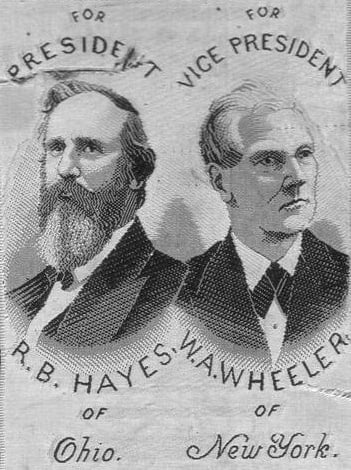

The Supreme Court had never before directly intervened in a U.S. presidential election, and their hugely controversial decision set the stage for the Court’s increasingly (if not newly) political role in the 21st century. But our two prior most contested presidential elections offer important, contrasting contexts for 2000: the election of 1800, which came down to a vote in the House of Representatives to elect Thomas Jefferson over Aaron Burr, but which was followed by a peaceful transition that reinforced the fledgling nation’s commitment to democracy; and the election of 1876, which was so close that it required the creation of a new Electoral Commission that then handed all 20 contested electors to Rutherford B. Hayes in a process so clearly politicized and potentially corrupted that it remains infamous to this day.
9/11 and the Afghanistan and Iraq Wars
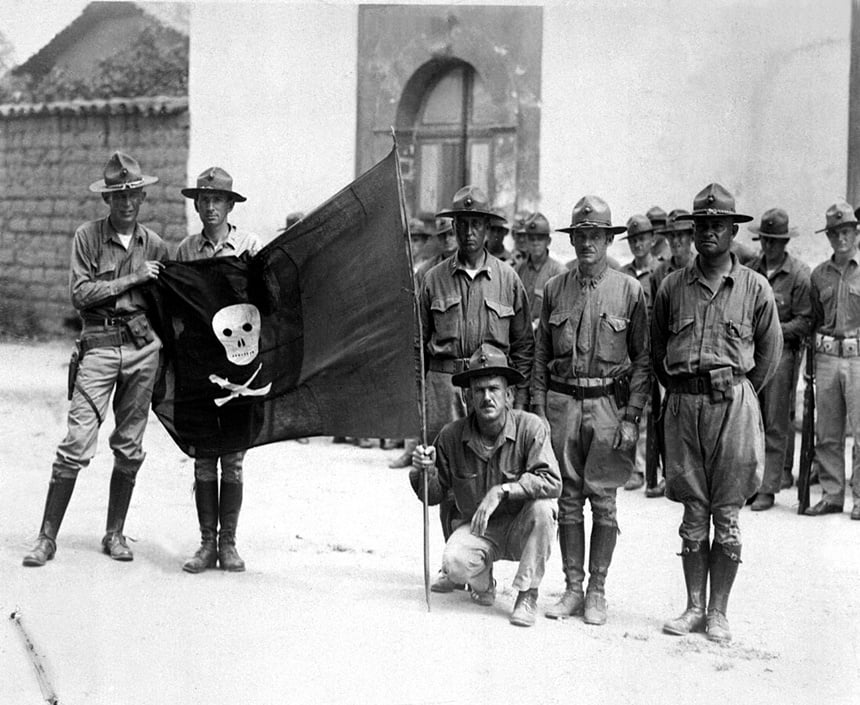

The most destructive terrorist attack on U.S. soil produced countless changes in the decades that followed, but none more significant than the “War on Terror” narrative that led to two of the longest military conflicts in our history. Perhaps the most relevant historical parallel for those effects is the early 20th century U.S. occupation of and guerrilla war in the Philippines, an occupation that began with a different conflict (the Spanish-American War) but that morphed into a brutal multi-decade quagmire. But that’s just one of the many foreign occupations that the U.S. undertook in the first decades of the 20th century, including two distinct occupations of Nicaragua alone and another of Haiti that lasted nearly two decades, each of which reshaped these nations while dividing the American people over their legality, constitutionality, and morality.
Hurricane Katrina
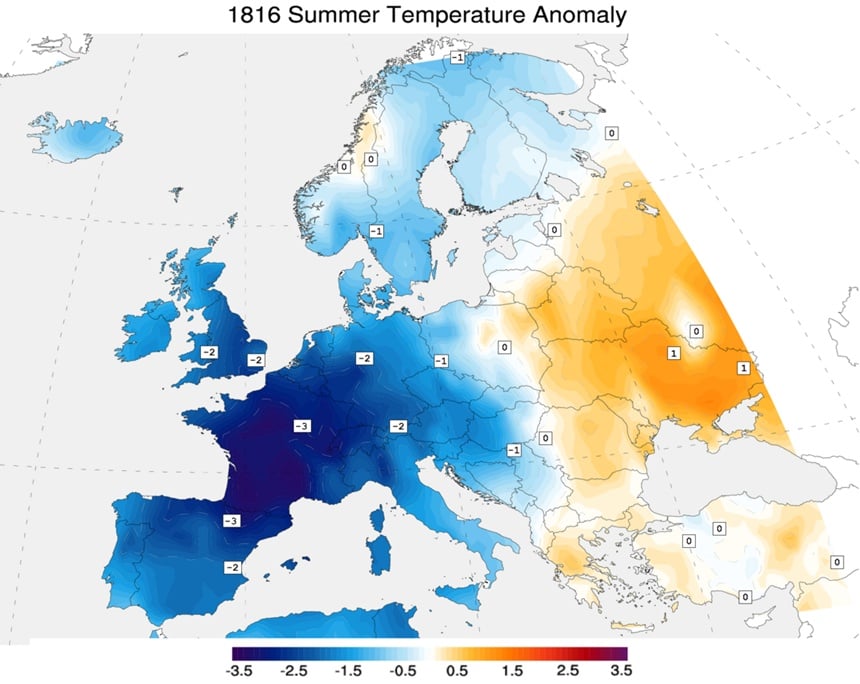

I wrote multiple recent columns, here and elsewhere, for the 20th anniversary of one of the worst natural disasters (and man-made aftermath) to ever hit the U.S. Other similarly historic and destructive disasters can help contextualize Katrina, including the Great Galveston hurricane of 1900, known as the “deadliest natural disaster in United States history”; and the Great Mississippi Flood of 1927, which was not only our most destructive river flood but which also in its aftermath reflected the realities of racial segregation and prejudice. But if we take a step back and look at Katrina among the worsening environmental disasters that have accompanied the climate crisis, another historical event offers an even more relevant summer: 1816’s “Year without a Summer,” a profound climate crisis that affected the entire world, produced widespread economic, political, and social changes, and presents models for how societies can respond to such environmental effects.
The Great Recession of 2008
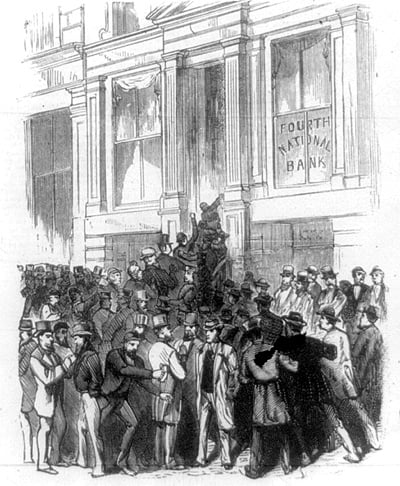
The late-2007 mortgage and housing crashes produced America’s deepest economic crisis since the Great Depression, and that 21st century Great Recession has thus often been compared to America in the 1930s. But there are also striking and illuminating parallels to two 19th century economic crises: the Panic of 1837, which resulted from both rampant land speculation (similar to the 21st century mortgage crisis) and predatory banking facilitated by President Andrew Jackson’s opposition to federal banking oversight (like the pre-2008 period of federal deregulation); and the Panic of 1873, which greatly amplified the wealth disparities that led to the Gilded Age (highly relevant as our Second Gilded Age deepens) and that contributed to the rising anti-immigrant sentiments that led to the Chinese Exclusion Act and a period of profound xenophobia and exclusion.
President Obama
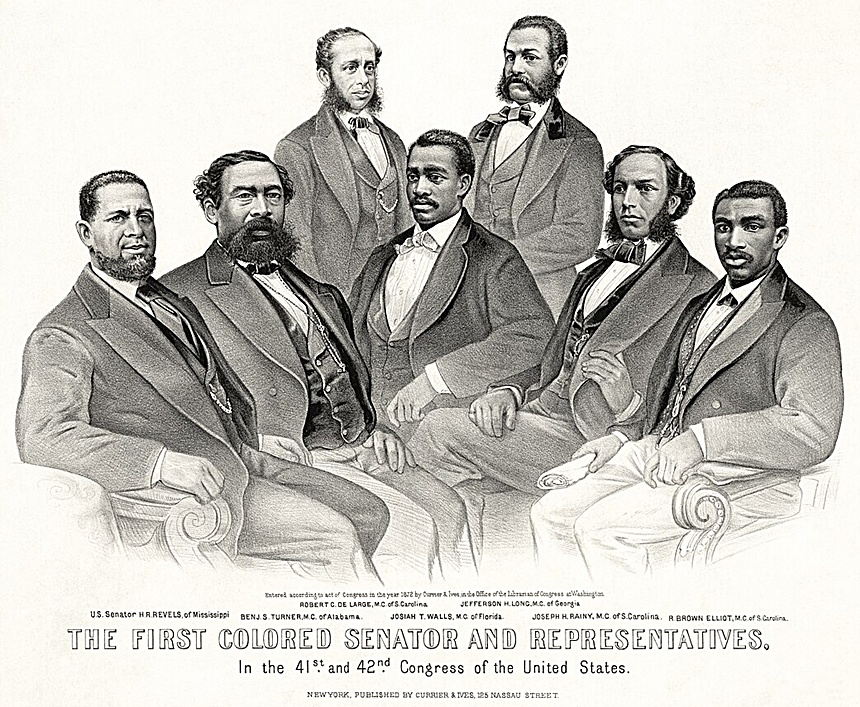

The President elected amidst that 2008 economic crisis offered a potent vision of hope and change, not only for those current realities but also as the first Black President; sadly his administration produced a period of intense reactionary and white supremacist backlash that included a widespread conspiracy theory that he was not even an American. While both Obama’s presidency and the backlash were certainly unprecedented in many ways, there was a similar two-part historic moment: the post-Civil War Reconstruction era, which has become known as the Second Founding due to the genuinely revolutionary models for a more inclusive and just nation offered by (for example) the three Constitutional Amendments passed during those years; and the presidency of Andrew Johnson, who embodied and amplified the white supremacist backlash to Reconstruction and whose reactionary policies paved the way for the neo-Confederate forces that would dominate American politics and society for many years to come.
Marriage Equality
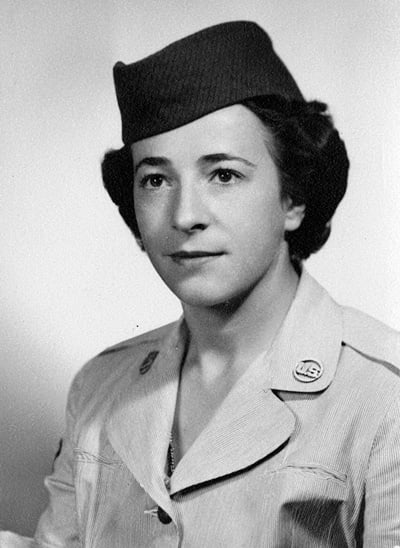

After years of debates and state laws and court cases, in 2015 the Supreme Court ruled, in the landmark Obergefell v. Hodges decision, that the fundamental right to marry was guaranteed to same-sex couples by the 14th Amendment. That right remains enshrined in federal law, but recent years have seen significant erosions of other civil rights for LGBTQ+ Americans, and particularly for transgender folks. Two under-remembered 20th century events offer contexts for both advances and the continued challenges that follow them: the establishment of the groundbreaking Society for Human Rights, which when created in 1924 by German immigrant and U.S. World War I veteran Henry Gerber, became the nation’s first gay rights organization; and Executive Order 10450, signed by President Eisenhower in April 1953, which banned gay and lesbian federal employees, encouraged both private contractors and U.S. allies abroad to fire their own gay and lesbian employees, and led directly to the Lavender Scare, the McCarthy era purge of federal employees based solely on rumors, allegations, or accusations about their sexuality.
#BlackLivesMatter
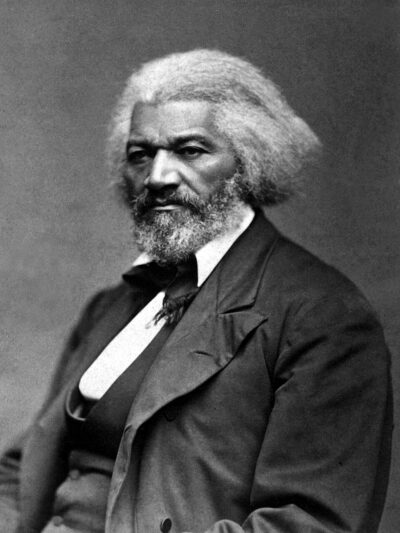
In the same years that marriage equality became the law of the land, America also saw the creation and spread of the #BlackLivesMatter movement, the largest collective push for civil rights since at least the heyday of the 1960s (if not in all of our history), and one that as a hashtag activist movement utilized new technologies such as social media and smartphones. The movement’s focus on organizing massive marches to both bring people together and spread the message to audiences around the world echoes the longstanding March on Washington movement, a civil rights activist effort that began as early as A. Philip Randolph and Bayard Rustin’s groundbreaking 1941 march designed to challenge racial segregation in the workforce during World War II. And its reliance on new technologies and media parallels the vital role that newspapers and other periodicals played for the early 19th century abolitionist movement, with publications like William Lloyd Garrison’s The Liberator and Frederick Douglass’s The North Star both sharing arguments with audiences far and wide and offering a space where activists could connect to one another and build the collective movement.
Covid
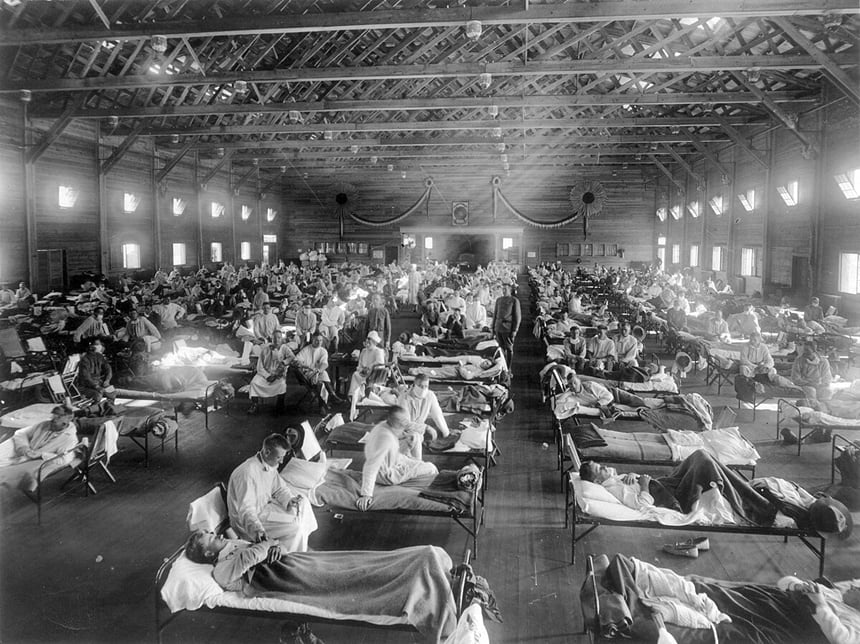

The clearest historical parallel to the global COVID-19 pandemic suggests that it is far from a given that we will remember it as fully as we should. The influenza pandemic of 1918-20 likewise affected every corner of the globe, and was hugely devastating in the United States, where it afflicted 25 percent of the total population and where 675,000 people lost their lives (more than the combined casualties of World War I, World War II, the Korean War, and the Vietnam War). And yet the pandemic would be almost entirely absent from 1920s cultural works, particularly when contrasted with World War I, which affected far fewer Americans but would play a central role in such iconic 1920s works by T.S. Eliot, Ernest Hemingway, and F. Scott Fitzgerald. It’s easy to understand the collective psychological need to memory-hole such a horrific period, but that doesn’t make such amnesia any less dangerous.
January 6th
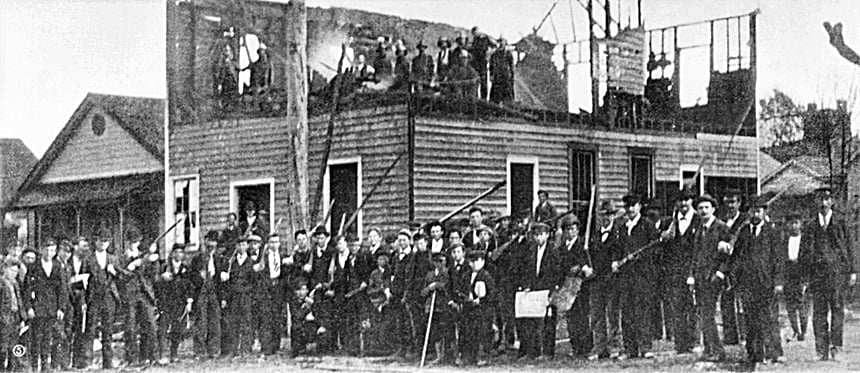

Almost exactly five years ago, thousands of people attacked the U.S. Capitol in Washington, D.C., hoping to stop the certification of the 2020 presidential election. Much of the reporting and analysis of the event called it the first break from our foundational tradition of a peaceful transfer of power. However, the events of January 6th parallel what happened in Wilmington, North Carolina in November 1898: an overt coup d’etat, with the city’s democratically elected government replaced by force by an armed mob; and a seemingly spontaneous “riot” that was in fact carefully planned and led by both local political leaders and organized militias who had come to the city from far and wide. And as extreme as Wilmington was, it was likewise not singular, and instead simply a particularly telling example of the longstanding intersection of white supremacist violence and election interference.
Social Media and A.I.
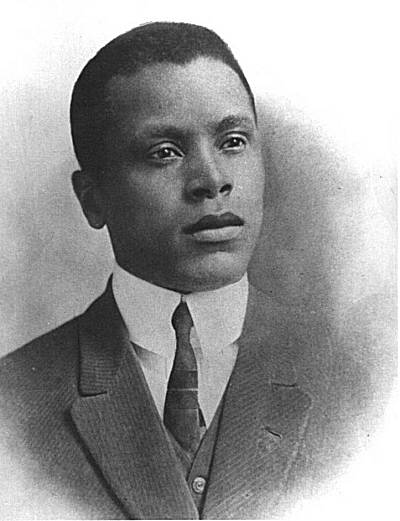

Most of the 21st century events I’ve highlighted in this list took place, or at least were initially created, in a particular moment. But the most influential trends of the 21st century were those associated with the interconnected pair of new technologies that have come to dominate society over the last 25 years: the internet and smartphones. Those two technologies have combined to produce social media, the most widespread form of community for most contemporary Americans; and are instrumental in the rise of generative A.I., the most striking and divisive invention of the last few years. While these technologies are genuinely new to the 21st century, they can still be contextualized with prior developments like the rise of motion pictures almost exactly a century ago. It reminds us both of the terrifying power of such technologies to be used for propagandistic purposes, as we can see with the central role the first blockbuster film The Birth of a Nation (1915) played in the creation of the Second Ku Klux Klan; and of the ways that inspiring voices can resist and challenge those trends, as with the work of groundbreaking Black filmmaker Oscar Micheaux, whose 1920 film Within Our Gates offered a direct and potent response to Birth of a Nation’s racism.
Wherever the next quarter-century takes us, two things are certain: There will be historical precedents and parallels for these current events; and remembering and engaging with them will remain vital goals if we are to navigate them as successfully as possible.
Vintage Ads: New Year’s Resolutions
New Year’s Resolutions usually require you to give up something. But in mid-century America, advertisers used resolutions to encourage you to get something – maybe a new watch, a new car, or a new brand of cigarette. These ads all appeared in the pages of The Saturday Evening Post.
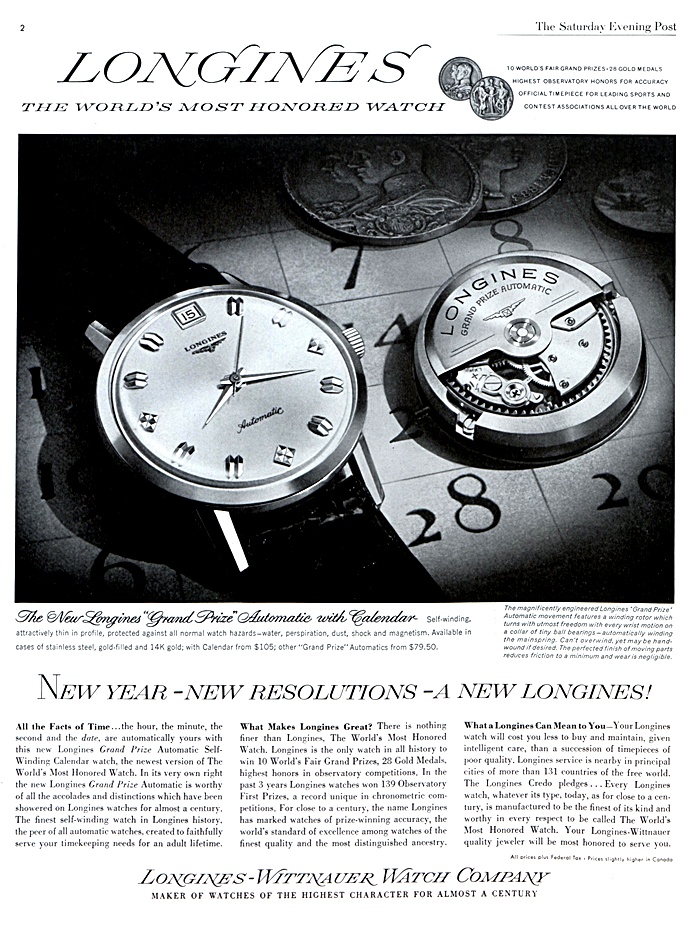
January 5, 1963
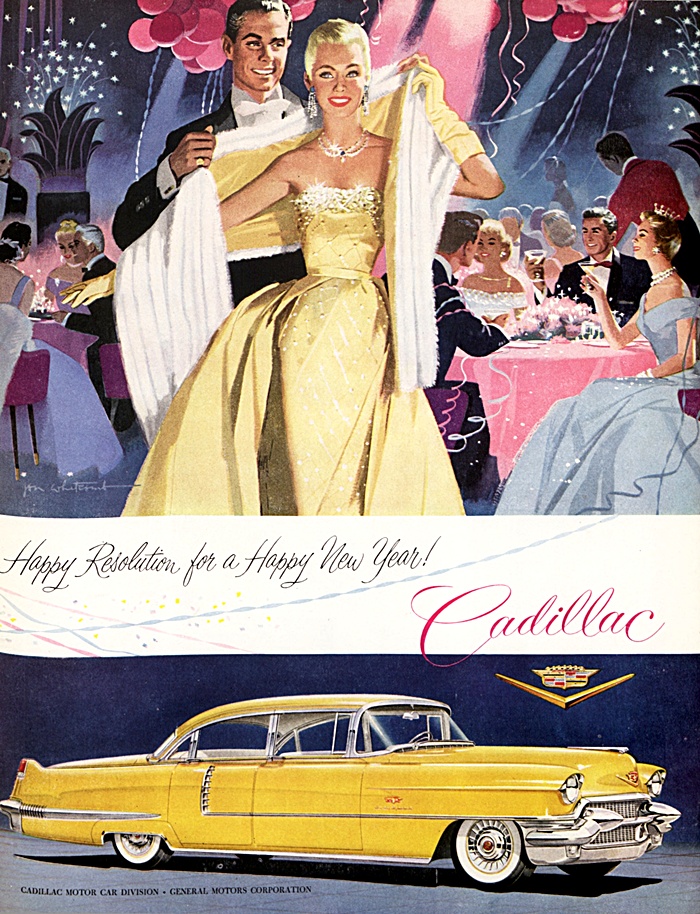
January 7, 1956

January 20, 1951
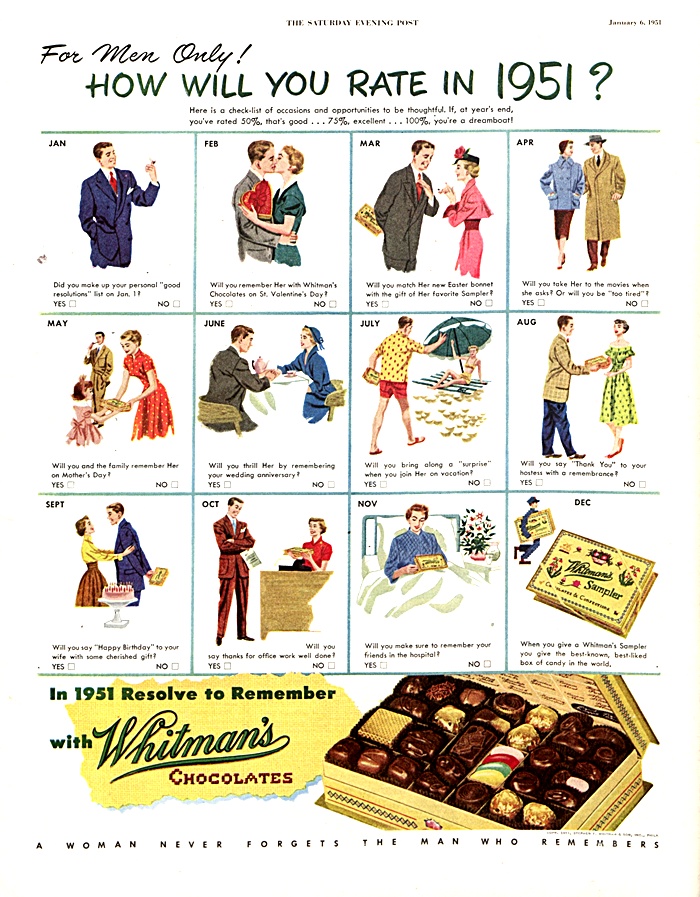
January 6, 1951
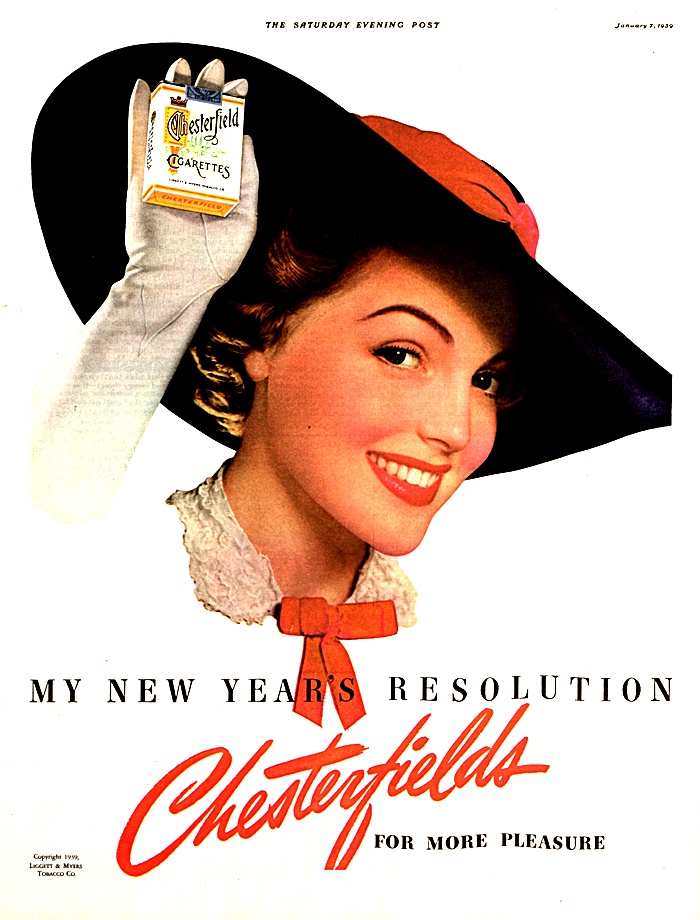
January 7, 1939
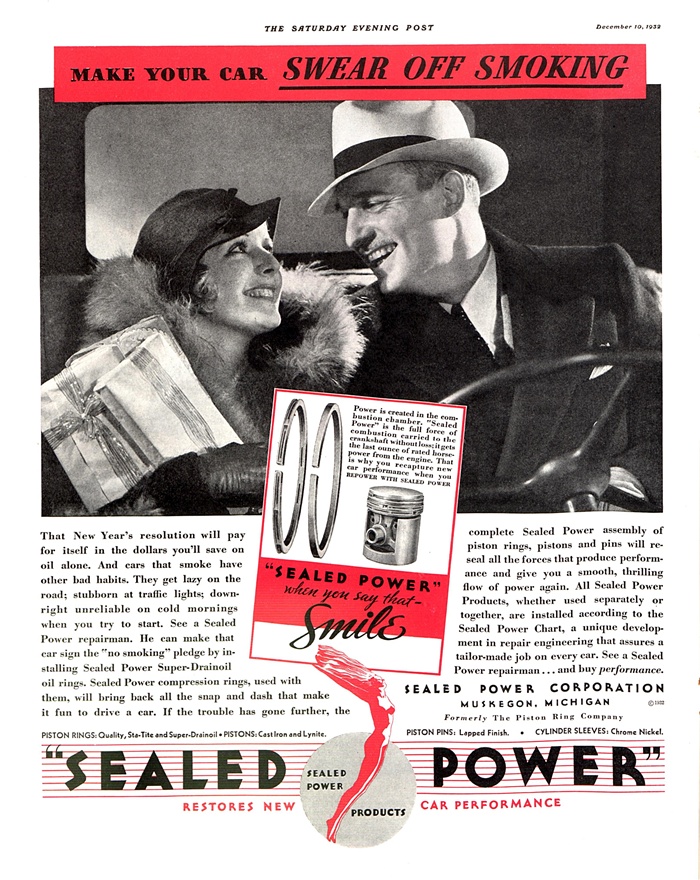
December 10, 1932
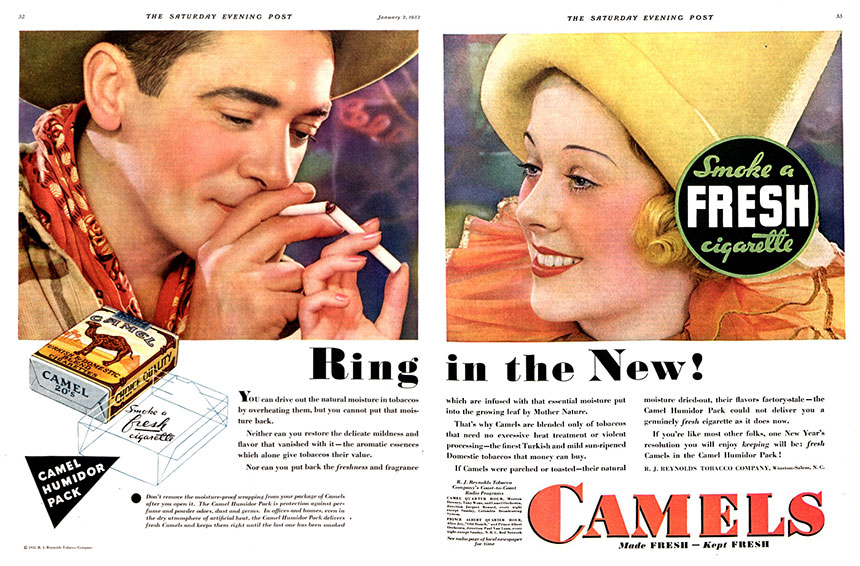
January 2, 1932
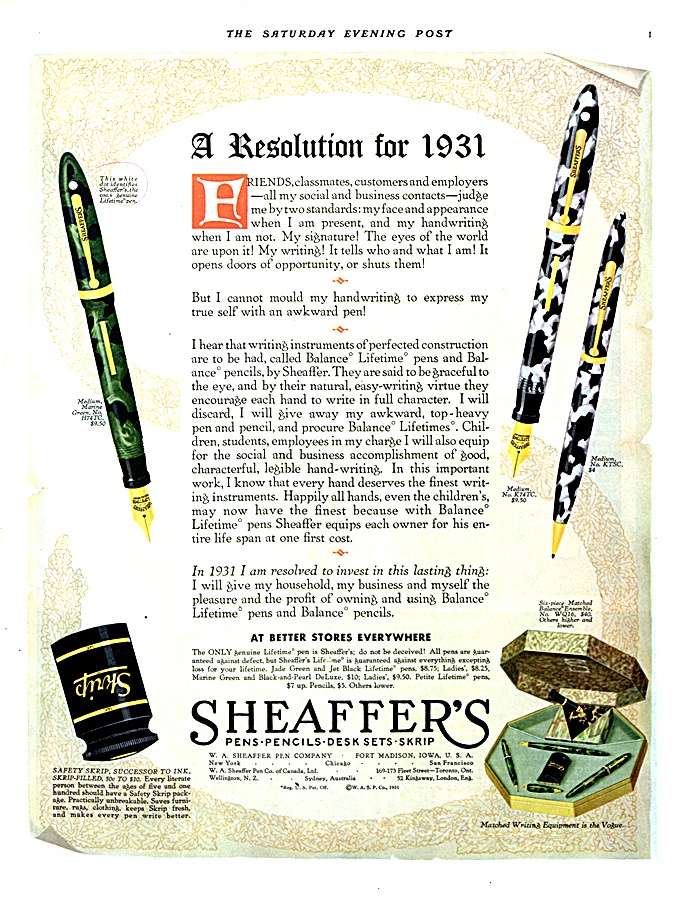
January 3, 1931
Cartoons: Party Line
Want even more laughs? Subscribe to the magazine for cartoons, art, inspiring stories, fiction, humor, and features from our archives.
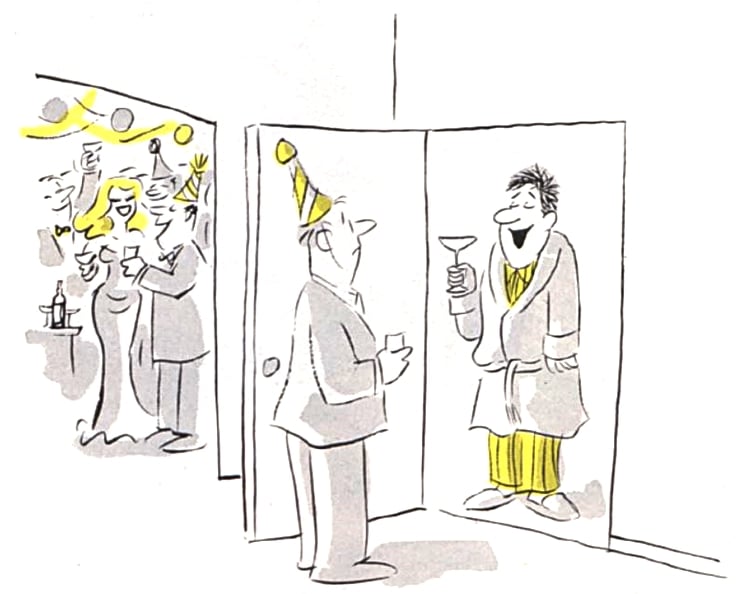
Jerry Marcus
October 22, 1960

Stan Hunt
October 22, 1960
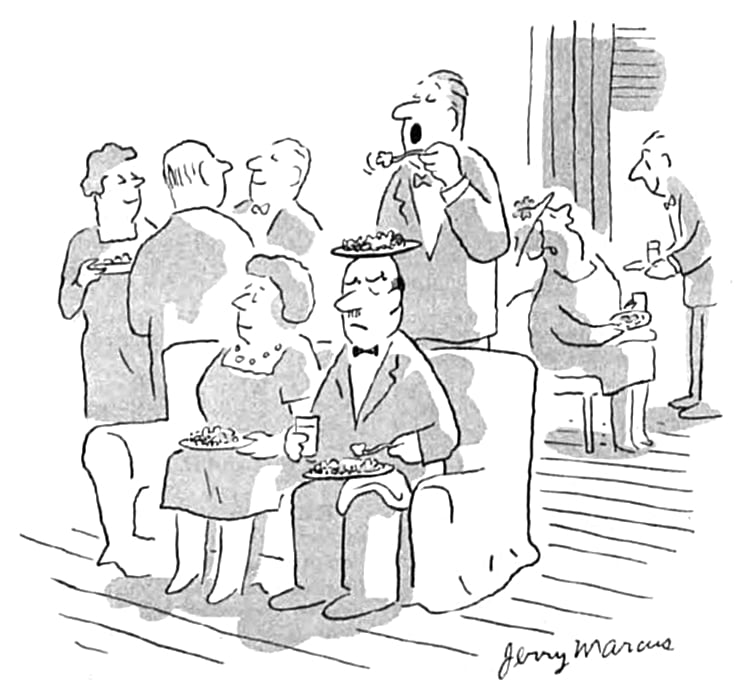
October 12, 1957
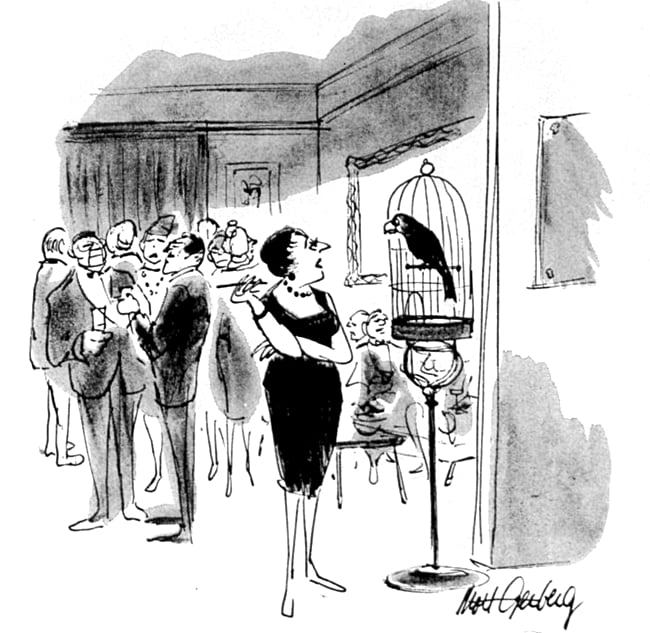
Mort Gerberg
July 17, 1965
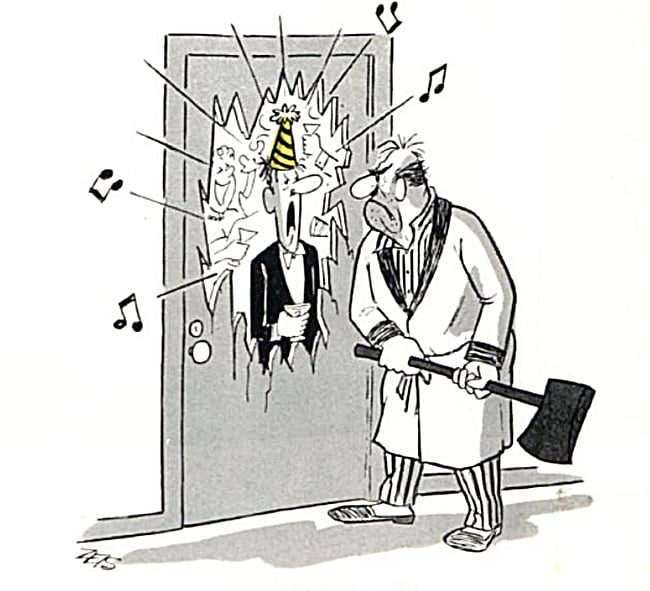
Joseph Zeis
June 9, 1962
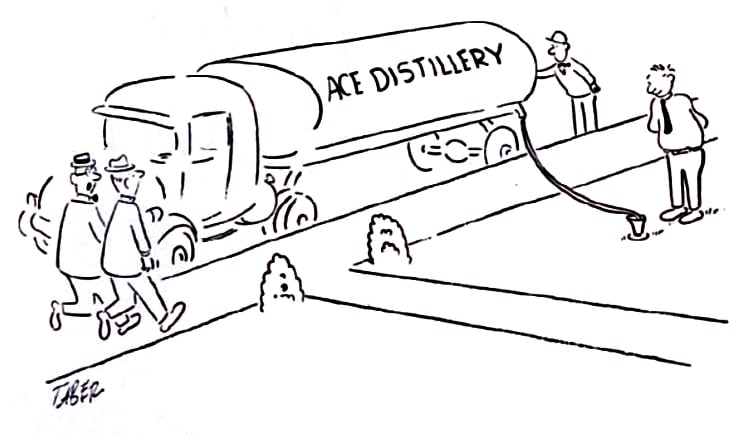
Scott Taber
May 4, 1957
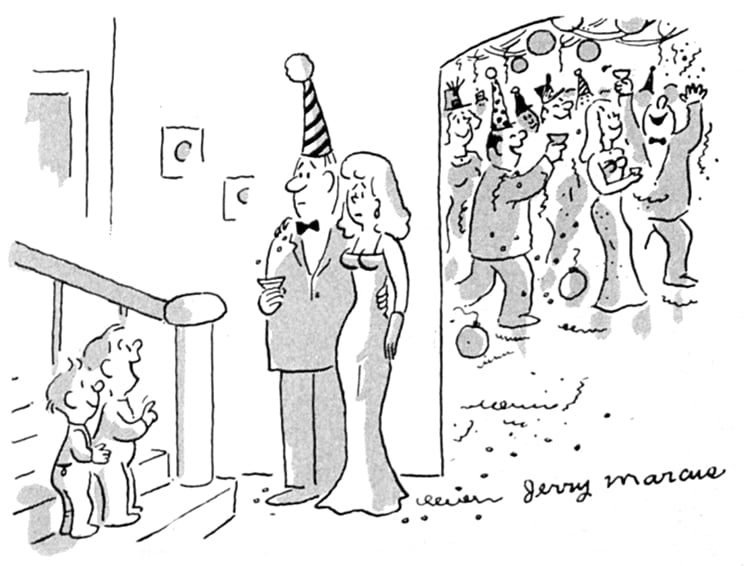
Jerry Marcus
December 19, 1964
Want even more laughs? Subscribe to the magazine for cartoons, art, inspiring stories, fiction, humor, and features from our archives.
Our Better Nature: The Unboring Subject of Boredom
Kids get what it means to feel bored starting at a young age, and like all of us, they don’t like it. I recall a day near the end of summer vacation when my brother and I began to mope around and whine that there was nothing to do. Pretty soon, Mom cured us (of announcing our boredom, not our ennui) by marching us off to wash windows. That’s when we discovered you can have stuff to do and still feel bored.
This fact hit especially hard during the COVID-19 pandemic when public spaces closed and we got stuck indoors for long periods. Most of us had video streaming services, apps for our phones, and maybe a few dusty jigsaw puzzles in the closet, and yet we were still bored. News media began to report on this shared challenge, which is how I learned some stimulating things about boredom.
In early 2021, I happened to catch a radio segment about a boredom lab located at Toronto’s York University in Canada. It turns out there are other such labs, including well-established ones in Gainesville, Florida, College Station, Texas, and Waterloo, Ontario (not far from Toronto, oddly enough). All of them predate the pandemic, by the way.
As any student who’s ever doodled in class rather than taken notes can affirm, boredom isn’t a lack of things to do. It’s the unmet need for activity we can deeply relate to. Many of us are scheduled to the max, but if we’re not invested in those tasks, they can become a dull pantomime, and we’re simply going through the motions.
In fact, some of the things we do to assuage our boredom can actually make us even more bored. A recent finding that came out of York University’s lab is that if we rapidly switch from one digital platform to another in a quest for a distraction, our experience of boredom intensifies.
Boredom, while unpleasant, is a normal feeling, and can be a sign that we need to make a positive change in our lives, whether it’s an attitude, a routine, or even a career. Feeling bored can be viewed as an invitation to delve more deeply into what really matters to us. Dr. James Danckert, a researcher at the University of Waterloo’s boredom lab, agrees that ennui can help us, but only if we see it as a messenger, cautioning that by itself it won’t inspire us. Once we recognize what it’s telling us – that we’re not engaged with our present situation – it’s our job to find creative solutions.
But boredom is tricky. First, not everyone feels or responds to it in the same way. People with narcissistic personality traits or who struggle with self-control are more prone to boredom than average. These individuals are more likely to espouse extreme political views (of all stripes) and be drawn to conspiracies as coping tools. Another caveat is that we must feel a sense of agency for boredom to become an ally. For example, prisoners kept in solitary confinement for long stretches may suffer permanent neurological damage.
Given that we’re still unlocking how boredom affects us, it’s no surprise that even less is known about what ennui does to non-human animals. For hundreds of years, Western science was rather frantic in its efforts to distance us from other animal species, bristling at the suggestion that elephants, dogs, ravens, and whales might feel grief, joy, and other familiar emotions.
These sad attempts to reject “anthropomorphic projections” persisted into the mid-1900s. Much in the way that it took decades to convince doctors to wash their hands between patients, we were pitifully late to acknowledge that birds, reptiles, and mammals like to have fun, and that they do feel emotions such as grief, boredom, joy, and fear.
Boredom and depression are distinct yet related in all animals. When an environment lacks adequate stimulus, animals can get bored, but as long as their motivation stays high, they’ll usually find ways to create interest in their situation. Long-term enforced monotony, though, can push humans and other animals into depression. Without enough intellectual, social, and physical stimuli, captive animals often turn to stereotyped activities like self-harm and pacing.
Dr. Barbara J. King, professor emerita of anthropology at the College of William and Mary in Virginia, says in a 2017 article that many animals feel boredom. King holds that even the best-designed enclosures at zoos fall short of giving animals the variety of their native habitat. She says well-loved pets can also suffer from uniformity in their environment.
King points to the work of Dr. Charlotte C. Burn, a biologist at The Royal Veterinary College in the UK. According to Burn, any animal can get bored if it has nothing to do that is relevant to its species. For example, grazing animals like cows that evolved to selectively pick through grasses all day have little to do when they’re fed a high-energy grain mix and kept in a barn.
Human and non-human boredom came face-to face during COVID-19, as lots of people adopted so-called pandemic pets to keep them company. Now that home-based work has largely returned to the office, leaving many pets alone all day, with less to keep them occupied.
Common signs that your pet may be bored include destructive behaviors like chewing or clawing your stuff, as well as changes in appetite, excessive sleeping, relieving themselves indoors, and vocalizing more than usual. Variety is the spice of life, and also a cure for pet boredom. Among other remedies, mentally stimulating toys, foods of varied textures and shapes, and food puzzles (or safaris) that require pets to search for hidden food, can help.
Due to recent surgery, I can’t drive again until late February, 2026, and my physical activity is quite restricted. Turns out I’m pretty good at just hanging out all day. Maybe I could apply for a job at one of those boredom labs.
GPS Is My Co-Pilot
As revolutions go, this one began quietly, with a buy rather than a bang. Location: Hunters Hill, a Sydney suburb so small you’d be hard pressed to pinpoint it on a map of Australia — unless you had the right kind of map. Which, until relatively recently, you almost certainly did not.
It was there, in the opening days of 2004, that four guys who ran a start-up called Where2Tech sold their company to Google, which saw an opportunity. Weeks later, the pioneering technology — rebranded as Google Maps — was introduced to the public by its new American owners. Within 24 hours, Google Maps had been viewed 10 million times. The satellite-navigation revolution was officially underway.
It’s estimated that today, in the United States, some 230 million of us rely on GPS maps for turn-by-turn guidance to everywhere that has been photographed from a satellite, even if that “where” has seldom seen human visitors. The technology has transformed the way we see our planet and, more importantly, how each of us can find our way around it. No more getting hopelessly lost.
“Before Google Maps, I wandered the earth aimlessly, discovering villages and hamlets untouched by the 20th or 21st centuries. Toothless inhabitants would surround my car in wide-eyed wonder and ask if I fell from outer space,” my friend John Oliver, a New York writer, recently posted on Substack. He was exaggerating for impact. I think.
The fact of the matter is that most of us would just as soon embark on a journey without some sort of small navigation device as walk out the front door pants-less. The big guys in this space include Google Maps, of course, but also Apple Maps, Waze, and TomTom. As a navigationally challenged American, I rely on four sat-nav services, on my phone and in my car. Each has its particular strengths: details about dining specials along my route, or scenic paths, or just cool on-screen graphics.
Some folks claim they’ve become emotionally attached to the voice they selected for their GPS’s spoken directions. Not an issue for me. But a Californian I know told me he’s addicted to Chaka Khan’s soothing tones on his in-car system: “Relax your mind … turn left … we’re gonna get there. I freaking love her,” he said.
It’s no surprise that most car buyers in 2026 say they won’t even consider a model unless it has a wireless sat-nav system, such as CarPlay, onboard. GPS guidance is no longer merely a convenience; today, it’s central to a lifestyle that demands our total surrender to the ever-expanding embrace of microchips.
Even so, there remains a subset of folks who refuse to crumple up their old paper maps. Some of those were indeed things of cartographic beauty and, in their era, trusted companions. AAA’s iconic TripTik finally went digital a while ago, but those spiral-bound — and once indispensable — Thomas Guides on the West Coast still serve a coterie of hangers-on.
What’s the downside of satellite navigation? Well, for one, imagine what would happen if the system suddenly collapsed, even for just a few days. The technology is responsible for billions of dollars of economic benefit to the country due to the logistical efficiencies it’s enabled. Without it, the super-swift deliveries we’ve grown accustomed to could not happen. (Imagine if you will: no Amazon.)
Next up? Universal navigation of indoor spaces. It’s a work in progress. Give it maybe five years, experts say.
In the last issue, Cable Neuhaus wrote about baseball caps as personal statements.
This article is featured in the January/February 2026 issue of The Saturday Evening Post. Subscribe to the magazine for more art, inspiring stories, fiction, humor, and features from our archives.
Red China Promotes American Country Music
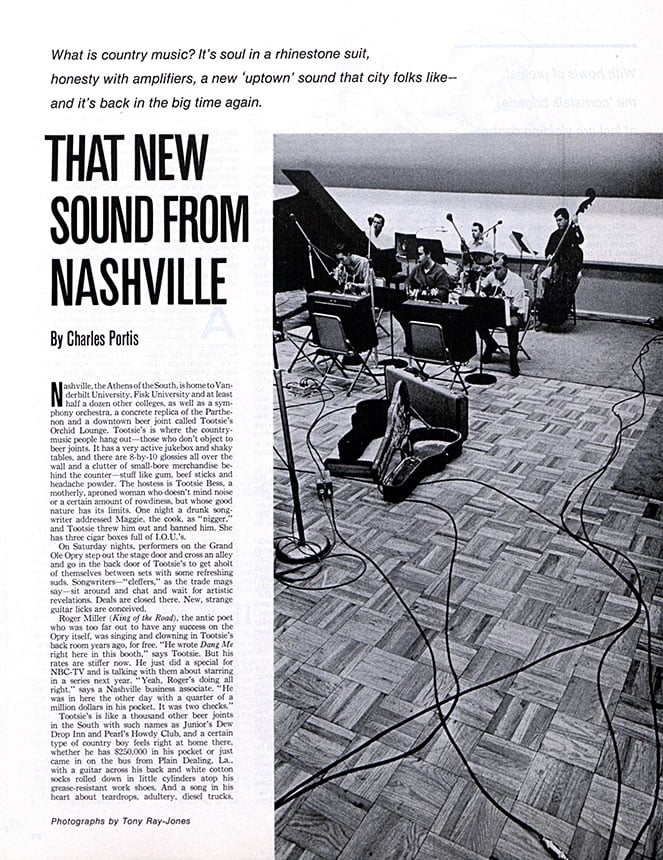
—“That New Sound from Nashville” by Charles Portis, from the February 12, 1966, issue of The Saturday Evening Post
Country and Western music didn’t get off the ground nationally until World War II, when the northern boys and city boys got strong doses of it in barracks and on decks and in southern camp towns. Some of the city boys developed a tolerance for it, a few even came to like it. In 1944 the USO polled GIs in Europe to determine the most popular singer and, lo, Roy Acuff’s name led all the rest.
It was much the same in Korea. There were few rifle companies in that war without a wind-up record player and a well-worn 78 rpm record of Hank Williams’s “Lovesick Blues.” The Chinese even used the music in an attempt to make the American troops homesick, or maybe it was their idea of torture. For whatever reason, they set up giant speakers and boomed ditties like “You Are My Sunshine” across the valleys in the long watches of the night.
This article is featured in the January/February 2026 issue of The Saturday Evening Post. Subscribe to the magazine for more art, inspiring stories, fiction, humor, and features from our archives.
Women’s Work: How Two Grandmotherly Painters Captured America’s Past
In October 1953, the Washington, D.C., Evening Star newspaper’s Sunday magazine This Week ran an advertisement inviting readers to send in for a print of Over the River to Grandmother’s House by the artist Grandma Moses. The headline, “How to get your copy of this Grandma Moses Christmas Original,” invited readers to mail $1 (about $12 today) to claim a copy, allowing people across the country to enjoy the work. The image, across a two-page spread, showed a hilly, snow-covered landscape dotted with farms and farmhouses, where tiny people walked or rode in a horse-drawn sleigh, a scene that felt like the holidays Americans remembered or imagined. “The Christmas-season picture,” the advertisement proclaimed, “is one of her earliest and best.”
In the 1950s, Anna Maria Robertson Moses’s work was everywhere. Americans had embraced the story and art of the former farmwife who began painting in earnest only at age 78, captivated by scenes that felt familiar and comforting. In November 1940, the year she turned 80, Gimbels Department Store in New York City made Moses a centerpiece of their Thanksgiving celebration, referring to her as both a “great American artist” and “a great American housewife,” the kind that made home the place to be at the holidays. By 1947, the connection between Grandma Moses’s artwork and holiday celebrations went a step further when Hallmark gained the license to create greeting cards from the images. In the decade-and-a-half after World War II, Grandma Moses’s work was not only on prints and greeting cards, but had also been reproduced as fabrics, plates, and shortening cans and displayed across the country and in Europe, embedding the images into everyday and holiday life.

Grandma Moses saw connections between the past and memory in her painting. In 1953, she told a Time magazine reporter, “I like to paint oldtimy [sic] things — something real pretty. Most of them are daydreams, as it were.” This echoed her autobiography published a year earlier, where she wrote, “Memory is history recorded in our brain, memory is a painter, it paints pictures of the past and of the day.” Moses’s artistic themes, and perhaps her age and her identity as a simple farmwife, drew millions of people to her work. In the decades around World War II, it seemed that Americans, too, were interested in remembering the world she depicted in her art.

Halfway across the country, Americans were also being drawn to another self-taught, grandmotherly artist: Clementine Hunter. Like Moses, Hunter began painting later in life, translating memory and experience into vivid images of her world. In 1939, Hunter began painting scenes from the cotton fields around Louisiana’s Cane River. She depicted images of life at Hidden Hill Plantation, where she had been born in the 1880s, and Melrose Plantation, where she lived and worked as an adult. “I tell my stories by marking pictures. The people who lived around here and made the history of this land are remembered in my paintings.…My paintings tell how we worked, played and prayed,” she once explained. Hunter’s art focused on people and their activities, such as doing laundry, going to church, or picking cotton. Religious scenes from African American life and the Bible were not uncommon.


Though the two artists began painting around the same time in the 1930s, Hunter was more than 20 years younger and lived 1,500 miles away. Both artists, however, offered Americans their own visions of the nation’s past. Moses’s name and work appeared regularly in newspapers nationwide, and she received an award from President Eisenhower. Hunter’s work traveled more slowly, with exhibitions in St. Louis, New Orleans, and other places in Louisiana. When Northwestern State College in Natchitoches exhibited her work in 1955, segregation laws kept Hunter from attending during viewing hours, according to Anne Hudson Jones’s 1987 article in Woman’s Art Journal. By the 1970s, Hunter’s work was reaching new audiences, though never at the scale of Moses’s.
In a 1985 interview, Hunter said, “I used to pick up little pieces of board and all kinds of little pieces of paper. Painted on everything. I didn’t know if I was doing right or wrong, but I was painting. And I gave it all away. I liked what I was painting.”
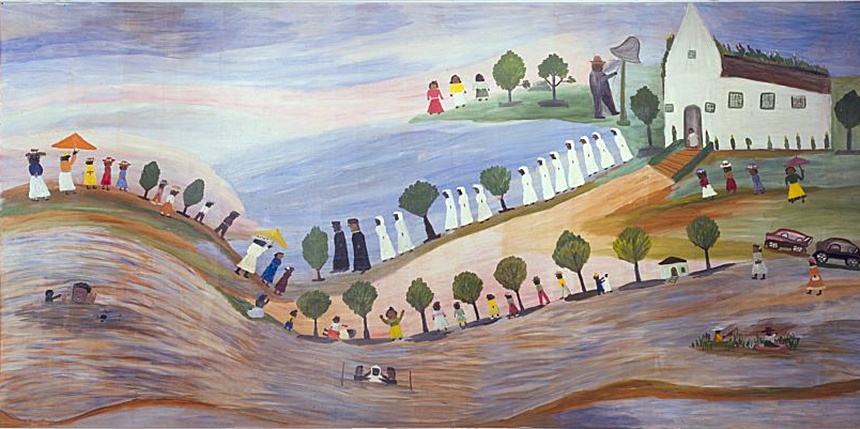
Moses and Hunter were both American artists who gained respect and admiration for their images of American life and memory, but timing, audience, and other factors shaped how widely their work circulated. On December 18, 1961, Grandma Moses died at the age of 101, with President Kennedy remarking that “her work and her life helped our nation renew its pioneer heritage and recall its roots in the countryside and on the frontier.” In 1988, Clementine Hunter died, having also reached the age of 101. By 1985, her work was being sold for thousands of dollars.
Today, museums exhibit both artists’ works: the Smithsonian American Art Museum recently opened a Grandma Moses exhibit, while the National Museum of African American History and Culture and the African American Museum in Dallas feature Hunter’s paintings. The American Folk Art Museum in New York City includes art by both artists in its collection: one painting by Grandma Moses and 23 by Clementine Hunter. Today, it’s still possible to purchase holiday cards featuring Grandma Moses’s work, or Hunter’s work as Christmas ornaments.
Both Moses’s and Hunter’s depictions show how our ability to feel, recall, and connect with the past can depend on who encounters the work, and when. The two women lived and worked at the same time, but their lives reflect the vast range of the American experience. They remind us that memories continue to resonate, long after the artists first put brush to canvas.
September/October 2025 Limerick Laughs Winner and Runners-up
They weren’t scared by the witches with hats,
Nor by goblins or guano from bats,
Nor by monsters or ghouls,
Nor by crazies with tools.
They were scared by a couple of cats!
Congratulations to Ryan Tilley of Longwood, Florida, who won $25 for this limerick based on Halloween Scare, Frederic Stanley’s Post cover from November 2, 1935.
If you’d like to enter the Limerick Laughs Contest for our upcoming issue, submit your limerick via our online entry form.
Here are some of our other favorite limericks from this contest, in no particular order:
In the old days a pumpkin carved well,
Would make normal folk say, “That’s swell!”
But today’s youth need more —
Photographs by the score
And TikTok merchandise you can sell.
—Bob Turvey, Stoke Bishop, United KingdomMonster tales told by Martin and Ed
Had each bro scared right out of his head.
They had no way to mask
Their embarrassing ask:
“Mom and Dad, can we sleep in your bed?”
—Edward Perley, Downingtown, PennsylvaniaAll Hallows is noted for scaring,
But how were these two young lads faring?
They went out to scare others,
But in those ghostly covers,
Their hair raised the sheets they were wearing!
—J.E. Johnston, Poland, OhioCroaked big brother, quite tremulously,
“There is nothing to fear, you will see.
I won’t leave you alone,
So there’s no need to moan.”
Said the smaller boy, “That wasn’t me.”
—Sjaan VandenBroeder, Stockton, CaliforniaWe meant no offense when we said
That you frightened us out of our bed.
We know you can’t see,
But the cats do agree,
Mr. Crane, we found you a head.
—Laurel Cordier, Camano Island, WashingtonIn our pumpkin no candle is glowing,
And there’s no electricity flowing,
So we can’t understand
What invisible hand
Has ignited this beam that it’s throwing.
—Mark L. Levinson, Herzliya, Israel“What was that? I’m sure I heard somethin’.”
“Are you scared? You’re jumpin’ at nothin’!”
Then a growl in the night
From a beast out of sight:
“Okay boys, where’d you pick up the pumpkin?”
—Skip Russell, Venice, FloridaJack o’ lantern, lit up, led the way
To our porch, but then suddenly — hey!
There’s two cats on the prowl!
And that hoot? It’s an owl!
Dare we still venture forth, or just pray?
—Jean McEwen, Minneapolis, MinnesotaHalloween is so great, they are told,
But they’re scared as they stand in the cold.
Scary noises so near
Make them tremble in fear.
But there’s candy, so now they are sold!
—Justin O’Connor, Leeds, Massachusetts
News of the Week: The Year in Review, Snowplow Names, and The Life of Jimmy Stewart
The Year in Review
A lot happened in 2025. So let’s talk about the politics of the past year and how it all factors into the midterm elections coming up next year and the presidential race in 2028.
Just kidding! There are plenty of places online to find (and argue about) news and politics, so let’s get to the stuff that’s really important.
Books of the Year. Here are lists from NPR, The New York Times, Esquire, and The Wall Street Journal.
Films of the Year. Here are lists from Time, The Hollywood Reporter, IndieWire, and Will Leitch and Tim Grierson.
TV of the Year. Here are lists from The New York Times, The Guardian, Sight & Sound, and Rolling Stone.
If you’re the type of person who’d rather read about the worst of the year, here are Variety’s list of the worst films, TVLine’s worst TV list, and Literary Hub’s worst books.
And if there’s something I missed, such as music and podcasts, the Year End Lists site has you covered.
250 Years of the USPS
Jane Austen celebrated 250 years in 2025, and America will celebrate the milestone in 2026. Another semiquincentennial (please don’t make me have to spell that word again) we need to mention is one we talked about a few months ago, the United States Postal Service. But it’s okay to mention it again because CBS did a nice feature about it.
Uploaded to YouTube by CBS Mornings
Name a Snowplow
A lot of cities have “Name a Snowplow” contests, but I really do think that Boston kids come up with some of the best names. This year’s winners include Thaw Patrol, Flake Maye, Sleet Caroline, and (my favorite) Clearopathra.
Another winner is You’re Killing Me, Squalls, which…well, if you get the reference you get the reference.
Jimmy
This biopic about Jimmy Stewart looks great, and it’s rare for an actor to even try getting the voice of a famous person exactly right without overdoing it.
Uploaded to YouTube by ONE Media
RIP Peter Arnett, Chris Rea, James Ransone, May Britt, and Betty Reid Soskin
Peter Arnett was a Pulitzer Prize-winning foreign correspondent for CNN and The Associated Press. He died last week at the age of 91.
Chris Rea was a British blues/pop artist known for such songs as “Fool (If You Think It’s Over),” “Driving Home for Christmas,” “Let’s Dance,” and “The Road to Hell.” He died Monday at the age of 74.
James Ransone appeared in such movies as It: Chapter 2, Inside Man, Old Boy, and The Black Phone films, as well as TV shows like The Wire, Treme, Bosch, and SEAL Team. He died last week at the age of 46.
May Britt was an actress who appeared in such films as The Blue Angel, The Young Lions, and Murder, Inc. She was the wife of Sammy Davis Jr. She died earlier this month at the age of 91.
Betty Reid Soskin was the oldest park ranger in the U.S. She died Sunday at the age of 104.
This Week in History
“White Christmas” Debuts (December 25, 1941)
It was first sung by Bing Crosby on his NBC radio show The Kraft Music Hall.
Time‘s “Man of the Year” is the Personal Computer (December 26, 1982)
Okay, technically, it was “Machine of the Year.”
This Month in Saturday Evening Post History: “Santa at a Computer” by Scott Gustafson (December, 1982)
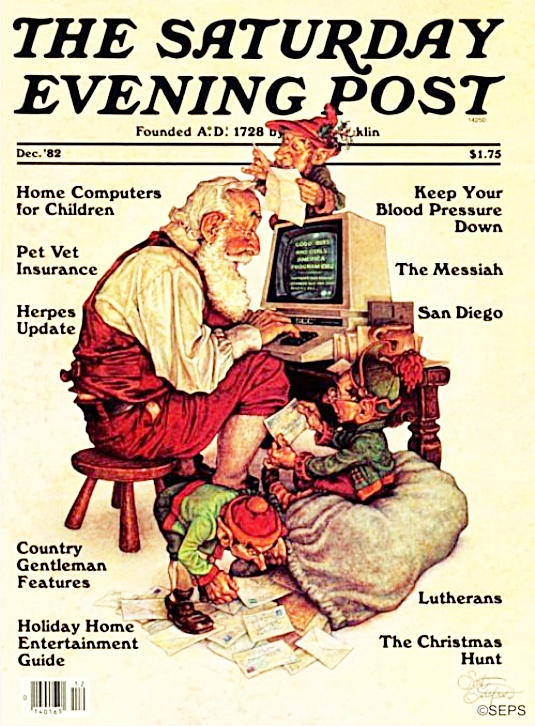
Even before Time declared the computer important, the Post had Santa using one on the cover.
New Year’s Eve Recipes
New Year’s Eve remains the most overrated holiday. Given the choice of staying home where it’s warm and comfortable or going out in the cold to a crowded place where people are probably going to be drunk? The former wins every single time.
So stay home with your family and/or friends and make something. Like these Deviled Potato Bites or these Bacon Cheese Straws from The Pioneer Woman. The New York Times has Pigs in a Blanket, Delish has a Buffalo Chicken Dip, and Southern Living has classic Cocktail Meatballs.
If you’d like a cocktail to go along with the appetizers, try a Poinsettia or a Cocoa Martini, both from Country Living, or the Blackberry Fizz from Total Wine.
Making breakfast or brunch the next day? Here are recipes from Smitten Kitchen for Breakfast Slab Pie, Crispy Crumbly Potatoes, and Twisty Cinnamon Buns.
Happy New Year!
Next Week’s Holidays and Events
Bowl Games (late December/early January)
Here’s a complete list of the college bowl games coming up (and the ones you might have missed, sorry). There’s a Duke’s Mayo Bowl!
National Hangover Day (January 1)
Of course this is celebrated on the first day of the year. Here are some remedies, though I can’t vouch for any of them.
Review: Song Sung Blue — Movies for the Rest of Us with Bill Newcott
Song Sung Blue
⭐️ ⭐️ ⭐️
Rating: PG-13
Run Time: 2 hours 13 minutes
Cast: Hugh Jackman, Kate Hudson
Co-Writer/Director: Craig Brewer
Hugh Jackman’s new musical docudrama about a fondly remembered Milwaukee Neil Diamond tribute act from the 1990s could be a little shorter, the script could be a bit less maudlin, and the songs could be more seamlessly incorporated into the story.
But on the strength of knockout performances by Jackman and Kate Hudson, plus a fully committed ensemble – not to mention the diabolical earworm that is Diamond’s song catalog – Song Sung Blue will leave you humming “I’m a Believer.”
A direct line can be drawn between Song Sung Blue and Jackman’s last Christmastime film release, 2017’s The Greatest Showman, albeit a line that traverses the entire spectrum of show biz success from lavishly produced immortality to no-budget, let’s-put-on-a-show scrappiness. In that earlier film Jackman was P.T. Barnum, rising from poverty with dreams of a show biz career unmatched on the planet. Here, he’s Mike Sardina, by day a car mechanic, by night a two-bit Wisconsin State Fair singer who goes by the name of Lightning – and whose dream of glory extends no further than one day headlining at a Milwaukee area casino lounge.
On the State Fair stage, Mike meets Claire, a talented keyboardist and Patsy Cline imitator. The two hit it off – and not just because they’re both Forever in Blue Jeans: Claire offers to help Mike, who usually performs as himself, rebrand himself as a Neil Diamond tribute act. And just like that, this Solitary Man is making a Beautiful Noise with his new Heartlight.
Mike keeps the name Lightning. Claire becomes known as Thunder. And with this A Little Bit Me, a Little Bit You philosophy, the two fashion a full-blown stage show, enlisting local musicians with whom Mike has worked over the years to create a mighty tight music ensemble. Before long, Lightning & Thunder – cracklin’ like Rosie and going down like a glass of Red Red Wine – are the tribute band that made Milwaukee famous.
Unspeakable tragedy ensues all too soon, with both Lightning and Thunder facing life-threatening challenges. There’s even a point where Love’s on the Rocks, and it looks like the pair’s marriage will be Done Too Soon. But love prevails, and – in this telling, anyway – Lightning & Thunder are rewarded with every tribute band’s dream: personal recognition by their real-life hero.
Jackman’s Mike is a bouncing bubble of enthusiasm with an easy laugh and a frequently choked-back sob. The star’s gigawatt smile is turned up to 11 here; his fine singing voice doesn’t really approximate Diamond’s gravelly baritone, but as Mike points out early on, this isn’t an imitation; it’s a tribute. Hudson has the more challenging role as Claire, providing endless support while navigating tough realities that exist only at the perimeter of Mike’s consciousness.
Excellent as the two stars are, it’s the large supporting cast that breathes life into the story, including longtime Scorsese and Spike Lee collaborator Michael Imperioli, Fisher Stevens (as Mike’s dentist/manager), Jim Belushi and, as the couple’s three kids, Ella Anderson, Hudson Hensley, and King Princess.
Co-writer/director Craig Brewer – who drew from Eddie Murphy a career-best performance in Dolomite is My Name – has a nice way of letting actors be themselves while also etching vivid characters. His loose director style works against him some here, as Brewer never seems quite ready to call it quits on a scene that has already wandered past one or two likely cutaways.
Still, Song Sung Blue deftly – perhaps shamelessly – toggles its audience between laughter and tears. It’s an irresistible story of appealing people making the most of what life has handed them.
Only in America. If You Know What I Mean.
Vintage Advertising: Hepburn Meets Tracy
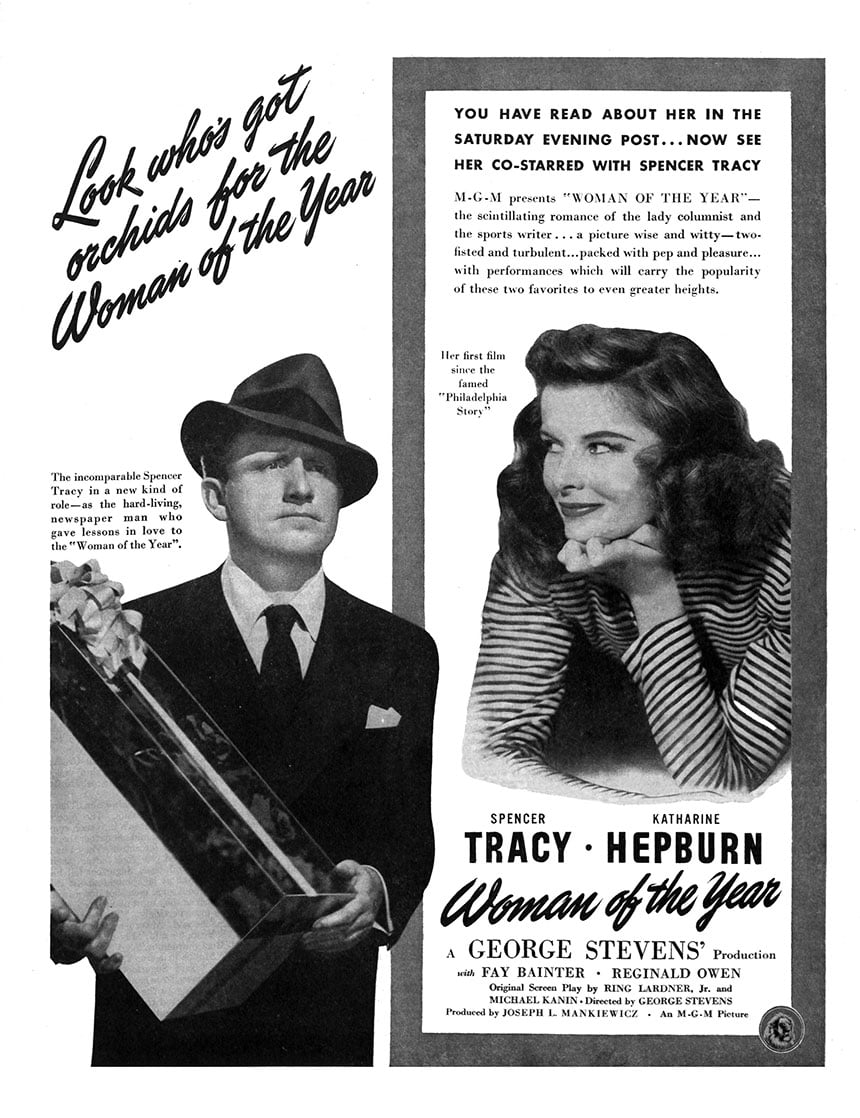
Katharine Hepburn first met Spencer Tracy on the set of Woman of the Year. In the movie, she plays a multilingual international-affairs journalist who reports on the situation in wartime Europe. Her character was partially modeled on Dorothy Thompson, who’d been reporting for the Post on the rise of fascism in Germany. She filed such unflinching reports on the Nazis that she became the first reporter ejected from the country.
Tracy plays a sports reporter who marries Hepburn. Unusual for a 1940s film, the story doesn’t end with Hepburn’s journalist giving up her career to become a homemaker.
When Hepburn first walked up to Tracy, she noticed she was an inch taller than him. She said, “I’m afraid I’m a bit tall for you, Mr. Tracy.” The producer who was introducing them said, “Don’t worry, Kate, he’ll cut you down to size.” It was the beginning of a long working relationship, and romance, that continued through nine films.
This article is featured in the January/February 2026 issue of The Saturday Evening Post. Subscribe to the magazine for more art, inspiring stories, fiction, humor, and features from our archives.
Rockwell Files: An Inner Warmth
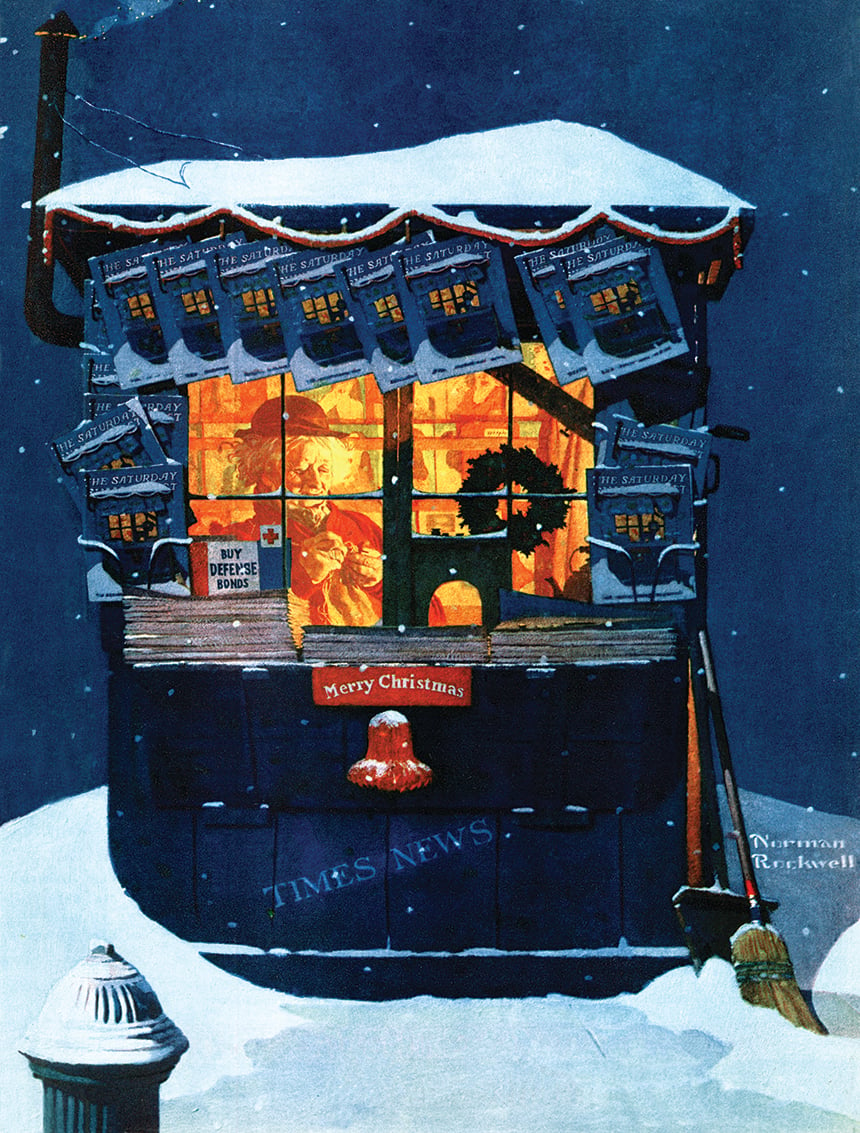
Norman Rockwell has left us scores of nostalgic images on Christmas covers of the Post. But for the 1941 holiday cover, it was unintentional. He painted an enclosed newspaper stand in winter, a sight that would’ve been familiar to Post readers at the time. Today, it would have sentimental appeal, at least for older Americans who remember these enclosed newsstands and the people who ran them.
Once a common site on city streets, newsstands have almost disappeared. Modern versions can be found at airports, but you’ll have to look hard today to find a vendor who opens the stand early in the morning and remains with it until the day’s last edition.
In this example, the owner/operator is a woman who contentedly knits in her booth while bathed in the warm glow of what is presumably a small coal fire, whose smoke is escaping from the chimney. Her stand is surrounded by a dark, chilly night that emphasizes the cozy warmth inside, evoking the inner warmth of the holiday season. It might have been a comforting image for readers when it appeared just two weeks after America entered the Second World War.
This article is featured in the November/December 2025 issue of The Saturday Evening Post. Subscribe to the magazine for more art, inspiring stories, fiction, humor, and features from our archives.
In a Word: Word of the Year Round-up
Senior managing editor and logophile Andy Hollandbeck reveals the sometimes surprising roots of common English words and phrases. Remember: Etymology tells us where a word comes from, but not what it means today.
It has become an annual tradition at year’s end for the makers of the world’s English dictionaries to take a look back at the previous year’s language use and choose one Word of the Year (WotY). Exactly what elevates a word to WotY status — common use, overuse, top slang — varies from dictionary to dictionary, as does how the word was chosen.
As in recent years, the Words of the Year for 2025 tend to focus on life in the Digital Age. Here is a round-up of the top dictionaries’ choices and how they arrived at the “winning” word:
Merriam-Webster Dictionaries: slop
slop (n): digital content of low quality that is produced usually in quantity by means of artificial intelligence
Merriam-Webster is the gold standard American dictionary, tracing its lexicological heritage back to Noah Webster’s dictionary. M-W takes a data-driven approach to choosing its WotY, analyzing lookup data from its online dictionary to see what words people are most curious about. WotY candidates aren’t simply the most-looked-up words (love is usually up there), but the ones that have seen the greatest increase in lookups compared to previous years.
M-W considered seven other candidates for its WotY:
- conclave (n): “a meeting of Roman Catholic cardinals secluded continuously while choosing a pope”
- gerrymander (v): “to divide or arrange (a territorial unit) into election districts in a way that gives one political party an unfair advantage”
- performative (adj): “made or done for show (as to bolster one’s own image or make a positive impression on others)”
- six seven (interj): a nonsensical expression, which has no specific, permanent meaning
- tariff (n): “a schedule of duties imposed by a government on imported or in some countries exported goods”
- touch grass (v): “to participate in normal activities in the real world especially as opposed to online experiences and interactions”
- Lake Chargoggagoggmanchauggagoggchaubunagungamaugg (proper n): Thanks to the Roblox game, this lake on the border of Connecticut and Massachusetts has seen a spike in lookups this year. M-W’s lexicographers note that they are rather impartial to the place’s more common name: Webster Lake.
Slop, though, won out, and for good reason: There’s just so much of it out there. (And for the record, none of the words written in this or any other In a Word column were written by artificial intelligence.)
Oxford University Press: rage bait
rage bait (n): Online content deliberately designed to elicit anger or outrage by being frustrating, provocative, or offensive, typically posted in order to increase traffic to or engagement with a particular web page or social media account.
The keepers of England’s historical Oxford English Dictionary, as well as their more useful reference dictionaries, pulled together a group of language experts, who created a shortlist of three WotY candidates, which were then voted on by Instagram users. In three days, more than 30,000 votes were cast, and rage bait came out on top.
Oxford’s two runners-up were
- aura farming (n): “the cultivation of an impressive, attractive, or charismatic persona or public image by behaving or presenting oneself in a way intended subtly to convey an air of confidence, coolness, or mystique”
- biohack (v): “To attempt to improve or optimize one’s physical or mental performance, health, longevity, or wellbeing by altering one’s diet, exercise routine, or lifestyle, or by using other means such as drugs, supplements, or technological devices”
Cambridge Dictionary: parasocial
Parasocial (adj): involving or relating to a connection that someone feels between themselves and a famous person they do not know, a character in a book, film, TV series, etc., or an artificial intelligence
Like at Merriam-Webster, the folks at Cambridge (another British dictionary) choose a WotY by poring over online search data and pulling out the words people have shown great interest in. Parasocial originally comes from the world of psychology but has been popping up more and more in online interactions. Without knowing the word, many people have had parasocial experiences over the last year, including the parasocial joy at the engagement of Taylor Swift and Travis Kelce, or the parasocial grief for the loss of Jane Goodall or Malcolm Jamal-Warner.
Other contenders for the Cambridge WotY were
- memeify (v): “to turn something into a meme”
- pseudonymization (n): “a process in which information that relates to a particular person, for example, a name or email address, is changed to a number or name that has no meaning so that it is impossible to see who the information relates to”
- slop (n): “content on the internet that is of very low quality, especially when it is created by artificial intelligence,” and also Merriam-Webster’s WotY
Collins Dictionary: vibe coding
vibe coding (n): the use of artificial intelligence prompted by natural language to assist with the writing of computer code
An internal team of logophiles and lexicographers at Collins Dictionary — which creates dictionaries in quite a few languages — chose this WotY. Though the criteria for consideration aren’t clear, the newness of a word seems to be one quality under consideration, which is evident from the (rather long) shortlist they were working from:
- aura farming (n): “the deliberate cultivation of a distinctive and charismatic persona”
- biohacking (n): “the activity of altering the natural processes of one’s body in an attempt to improve one’s health and longevity”
- broligarchy (n, usually derogatory): “a small clique of very wealthy men who exert political influence”
- clanker (n): “a derogatory term for a computer, robot, or source of artificial intelligence.” The word comes straight from Star Wars, and one commenter has referred to it as “the N-word for robots.”
- coolcation (n): “a holiday in a place with a cool climate” — which is becoming more common as world temperatures rise
- glaze (v): “to praise or flatter excessively, often undeservedly”
- The acronym HENRY: “high-earner, not rich yet”
- micro-retirement (n): “a break taken between periods of employment in order to pursue personal interests,” though some argue that this is just a fancy-schmancy word for “a day off work”
- taskmasking (n): “the act of giving a false impression that one is being productive in the workplace”
But coming out on top was vibe coding, which, to its detractors, is the coding equivalent of A.I. “art” — tell a generative A.I. system what you want, and the A.I. will create it for you.
Macquarie Dictionary: A.I. slop
A.I. slop (n): low-quality content created by generative AI, often containing errors, and not requested by the user
Down in Australia, the Macquarie Dictionary is the dictionary of choice. Each year a select committee convenes to create a shortlist for the WotY. Not only does the committee itself select the Committee’s Choice Word of the Year, but the public at large votes as well on the People’s Choice Word of the Year. This year, the groups agreed on A.I. slop, which bears a more focused definition than Merriam-Webster’s for slop.
Macquarie’s shortlist wasn’t all that short; it included
- attention economy (n): “an economy in which human attention is treated as a major commodity, especially in advertising, in which the aim is to maximize the time a customer spends viewing a product”
- BAL rating (n): “system of assessing a building’s potential exposure to ember attack, radiant heat, and direct flame of a bushfire; the rating serving to determine the construction requirements for the structure” — BAL stands for “bushfire attack level”
- bathroom camping (n): “the act of isolating oneself in a bathroom or bathroom cubicle for a period of time, as to seek solitude, avoid work, regulate emotions after overstimulation, anxiety or stress, etc.”
- femgore (n): “a subgenre of horror in which female protagonists are given agency over the narrative, and while still victimized, objectified, or exploited to an extent, are not passive; often becoming the characters who commit the acts of violence, especially in retaliation or retribution to the stereotypical system they are fighting against”
- medical misogyny (n): “entrenched prejudice against females in the context of medical treatment and knowledge, especially in the area of reproductive health, as by medical professionals minimizing or dismissing reports of symptoms, lack of research into gynecological conditions, etc.”
- Roman Empire (n): “any of various events, interests, subjects, etc., that one finds themselves frequently thinking about, especially one considered unusual.” This comes from a TikTok trend in which men were asked how often they thought about the Roman Empire.
Dictionary.com: 67
67 (interj): a viral, ambiguous slang term that is largely nonsensical, though some argue it means “so-so” or “maybe this, maybe that,” especially when paired with a hand gesture where both palms face up and move alternately up and down
If you’ve looked at what dictionaries have said about this word, you’ll note two things: 1) it’s a thing kids say that doesn’t seem to have a definite meaning; and 2) exactly how it should be represented in text is still up for question. It can be 67, 6 7, 6-7, six seven, or six-seven. All we know for certain is that it is definitely not “sixty-seven.” This writer hopes that the fad word disappears from common use quickly enough that a standardized spelling will be purely academic.
The word comes from a Skrilla song called “Doot Doot (6 7),” and it represents one of the first slang words to be adopted and widely spread by Generation Alpha — those born between roughly 2010 and 2020.
To choose its WotY, Dictionary.com’s experts “analyzed a large amount of data including newsworthy headlines, trends on social media, search engine results, and more to identify words that made an impact on our conversations, online and in the real world.” Here are some of the other words they considered:
- agentic (adj): “(of artificial intelligence) capable of acting independently to accomplish a goal or task; acting like a human agent”
- Gen Z stare (n): “a vacant look that [those in Gen Z] are said to give people when it seems like a response is warranted”
- overtourism (n): “a situation in which too many tourists travel to a popular destination, causing the place to suffer negative environmental, economic, and sociocultural impacts”
- tradwife (a shortening of traditional wife) (n): “a married woman who chooses to be a homemaker as a primary occupation and adheres to or embodies traditional femininity and female gender roles, often associated with conservative or alt-right political values”
Hallmark Christmas Movies by the Numbers
Some people really look forward to all of the holiday trappings. Others greet the Yuletide with existential terror. A similar division applies to Hallmark Channel’s “Countdown to Christmas.” Some can’t wait for it, and others view it like Thanos’s speech in Avengers: Infinity War: “Dread it. Run from it. Destiny arrives all the same. And now, it’s here.” Whatever camp you’re in, you can’t deny that the rise of these made for-television-films is a pop culture phenomenon. Let’s break it down.
118 Years
The company that would be Hallmark first came into existence in 1907. Founded as the Norfolk Post Card Company by siblings Joyce Clyde Hall, Rollie Hall, and William Hall, the business operated out of Hall Book Store in Norfolk, Nebraska. In 1912 after a move to Kansas City, the business model shifted to greeting cards. The brothers invented what would be considered the modern version of wrapping paper in 1917 and began printing original designs by 1919. The company started using Hallmark as a brand name in 1928, and would finally adopt the name for the entire company in 1954.
81 Emmys
Hallmark got involved in TV in a big way for the first time in 1951. On December 24 of that year, NBC aired the first installment of Hallmark Television Playhouse. Two years later, the recurring series of special presentations changed to the now familiar name of Hallmark Hall of Fame. The program, which has featured everything from musicals to Shakespeare plays to novel adaptations, has collected many awards, including 81 Emmys, in its lengthy history. Glenn Close was a multi-nominee for her lead role and producing credits for the Sarah Plain and Tall films. During the same year that George C. Scott refused his Academy Award for Patton (1971), he accepted an Emmy for Hallmark’s production of Arthur Miller’s The Price.
4 Networks into 1 (Sort of)
The Hallmark Channel as we know it officially launched in 2001. However, that was only the latest permutation of a series of cable endeavors that were known by other names going back to 1984. American Christian Television System went live in 1984; in 1988, Vision Interfaith Satellite Network began operations. In 1992, they began to share satellite channel space as ACTS/VISN. The combined networks became the Faith and Values Channel in 1993; it became Odyssey in 1996. In 1998, The Jim Henson Company and Hallmark Entertainment both bought into Odyssey; the channel began to lean into more secular programming, including children’s material like Henson’s Fraggle Rock. In a final reorganization in 2001, the network would become the Hallmark Channel.
2009: The Countdown Is On
Hallmark’s “Countdown to Christmas 2025” trailer… from October 17 (Uploaded to YouTube by Hallmark Channel)
Throughout the early 2000s, Hallmark Channel starting picking up ratings by leaning into original romance films. In a cable landscape that thrived on anti-heroes like Don Draper and Walter White and was one year out from unleashing an audience-devouring zombie apocalypse in the form of The Walking Dead, Hallmark went in a decidedly different direction by declaring an annual “Countdown to Christmas.” The event would offer new, original holiday movies, with four dropping that first year.
How Many Movies?
While it’s hard to find an exact number of Hallmark Christmas movies (IMDB.com has an unconfirmed list of 503), we can safely say that they have produced and aired more than 330. In 2025, an additional 24 entered the rotation. Some of the confusion comes from the fact that other networks like Lifetime and Great American Family have gotten into the original Christmas TV-movie game. The general similarity in tone, plots, and occasional casting lends to a common perception that any romantically tinged holiday movie is done by Hallmark.
The Queens of (Hallmark) Christmas

The queen of Hallmark Movies may in fact be Lacey Chabert; Chabert first got noticed as Claudia in Party of Five, was immortalized trying to make “Fetch” happen in Mean Girls, and even found time to voice both DC and Marvel heroines in two exemplary animated series (Zatanna in Young Justice and Quake in Avengers: Earth’s Mightiest Heroes). She’s knocked out over 40 Hallmark films; about 15 are specifically Christmas, though she’s also a staple of the channel’s Crossword Mysteries and Wedding Veil films.
Candace Cameron Bure, who first broke on Full House, was a staple of Hallmark films for years; she made around 30 movies for the network, ten of which were specifically Christmas-themed. She switched to Great American Family in 2022, and has made at least five since the jump. Bure has also executive produced, starred, or voice-acted in at least four other Christmas projects for different studios.
Danica McKellar, who knows she will always be Winnie Cooper from The Wonder Years, also made numerous Hallmark films, including several mysteries and around seven Christmas productions. Like Bure, she shifted to Great American Family and continues to work in the Christmas genre there.
Cartoons: Santa Flaws
Want even more laughs? Subscribe to the magazine for cartoons, art, inspiring stories, fiction, humor, and features from our archives.
John Ruge
December 22, 1962
A. Richardson
December 22, 1962

Walt Lardner
December 15, 1962
December 15, 1951
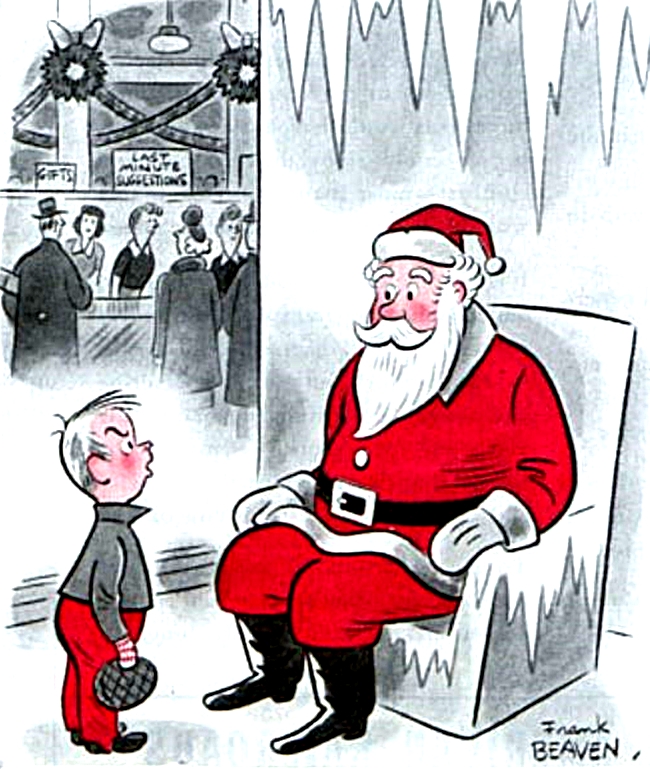
Frank Beaven
December 28, 1940
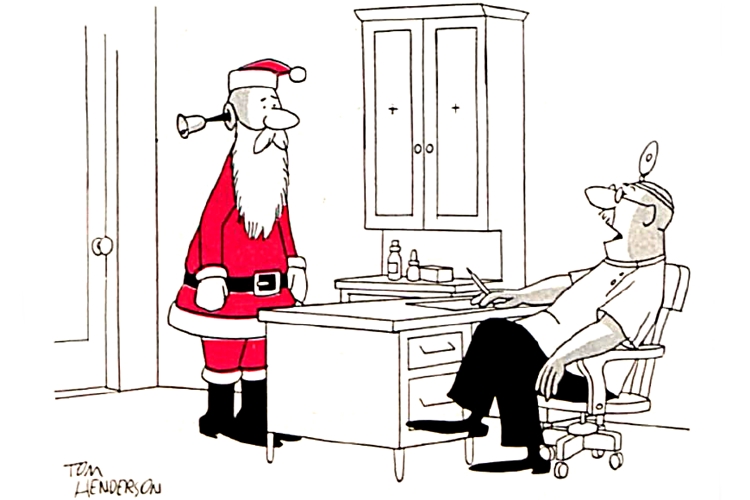
Tom Henderson
December 19, 1959
Want even more laughs? Subscribe to the magazine for cartoons, art, inspiring stories, fiction, humor, and features from our archives.
What We’re Reading This Winter
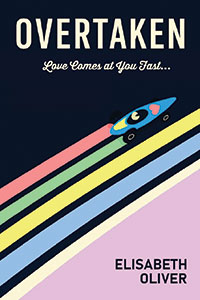
Overtaken
by Elisabeth Oliver
If you prefer your romance heroines relatable, witty, and even a bit gritty (literally), then Cam Wexford is your gal. A mechanic for an IndyCar racing team, Cam is the only woman working in the often-enraging boys’ club environment of Gasoline Alley. The big news at the garage is that a new driver will be joining the racing team: Loic Chalumeau, a Formula 1 superstar with a reputation for cool arrogance. He and Cam have crossed paths before under unfortunate circumstances, and Cam wants to avoid him at all costs. Of course, fate has other plans. Against the heart-pounding background of IndyCar racing and a cast of entertaining supporting characters, the author peels back layers to reveal why Cam is so set on avoiding Loic, Loic’s motivations for leaving F1, and what it takes to succeed in racing — and in romance.
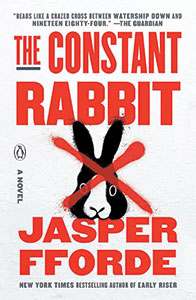 The Constant Rabbit
by Jasper Fforde
On the night of August 12, 1965, 18 rabbits grew to roughly human-sized proportions in what became known as the Spontaneous Anthropomorphic Event. Their size wasn’t the problem; it was their newfound intellect, self-awareness, and ability to speak — all qualities that once belonged only to humanity. At first, the new sapient species was welcomed, and Rabbits were treated well. But in modern times, leporiphobic extremist organizations, like the U.K. Anti Rabbit Party and TwoLegsGood, have risen to places of power. Beatrix Potter meets George Orwell in this whimsical yet biting satire of our current political and social climate, as an officer in the Rabbit Compliance Taskforce must come to terms with his role in the government’s subjugation of a peaceful population. It’s the cutest dystopia you’ll ever meet.
 Everything Is Tuberculosis
by John Green
Tuberculosis is not only treatable, but curable. How, then, does it remain the world’s deadliest infectious disease? This is the question that spurred The Fault in Our Stars author’s obsession with TB. What he argues is that, while Myobacterium tuberculosis may be the medical cause of TB, healthcare inequities — created by human choices — are ultimately what allow this disease of poverty to continue to infect the planet. While TB is a worldwide problem, at the heart of this book are stories of individuals, real people with real problems. Yes, those stories tell of unnecessary pain, suffering, and death, but they’re not without humor, and Green’s outlook is fundamentally hopeful. A solution is available; we simply must choose to use it.
This article is featured in the January/February 2026 issue of The Saturday Evening Post. Subscribe to the magazine for more art, inspiring stories, fiction, humor, and features from our archives.