This series by American studies professor Ben Railton explores the connections between America’s past and present.
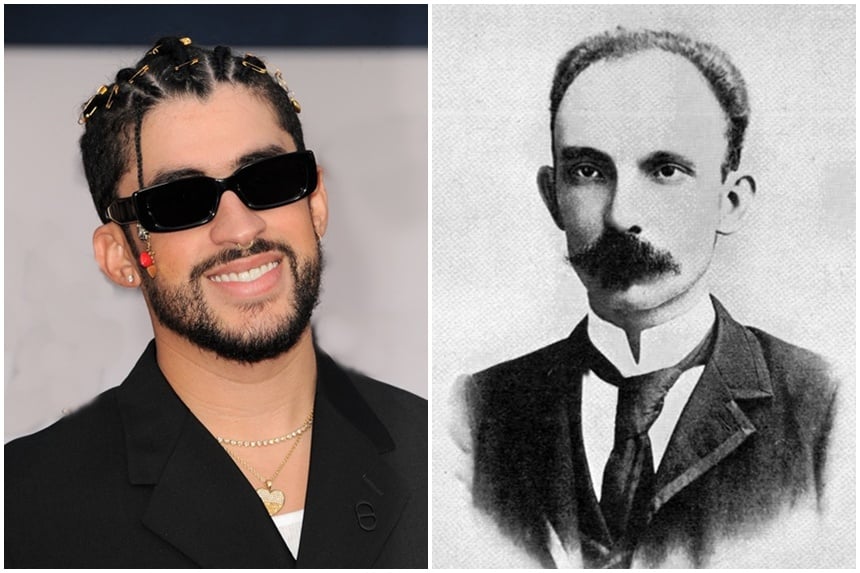
This year’s Super Bowl game was not a particularly memorable one, but the halftime show most definitely was. Watched by an estimated 135 million viewers (making it the most-watched halftime show of all time), Bad Bunny’s performance combined a number of hits from his Grammy-winning recent album, extended set pieces about layers of Puerto Rican, Caribbean, and Latin American culture and society (which were produced with the help of a historical advisor), and cameos from Lady Gaga and Ricky Martin. At the show’s conclusion, while holding a football with a message reading “Together we are America,” Bad Bunny stated “God Bless America,” and then went on to name just about every nation in the Western Hemisphere, while dancers behind him carried flags from all those countries.
In this Considering History column for the 200th anniversary of the Monroe Doctrine, I traced the long history of a hemispheric vision of the United States: not a narrative in which the U.S. dominates or dictates to other Western Hemisphere countries, as the Monroe Doctrine implied and the recent Donroe Doctrine has made explicit; but, as I trace in that column, the alternative perspective advanced by the French Martiniquais poet and scholar Édouard Glissant, a vision of the process of “creolization” that links U.S. experiences, identities, and histories to those of its peers across the hemisphere.
In this column, inspired by that Super Bowl performance from one of our moment’s most famous Caribbean young men, I want to share the story of one of history’s most prominent such figures: José Martí (1853-1895). A Cuban poet, activist, and revolutionary who spent much of his life in exile and more than a third of it in the United States, Martí’s identity and perspective offer a vital lens on the United States, both as a complex part of hemispheric history and as an expression of ideals that can inspire the world’s best.
Born in Havana in January 1853, Martí’s young life in Spanish Cuba featured a number of radicalizing moments. One of the first was the assassination of Abraham Lincoln in April 1865, an event mourned by Martí and his friends who were already ardent abolitionists (Spain still practiced slavery throughout its imperial territories at the time). A second was the Ten Years’ War for Cuban independence, which began on the island in 1868, and which the teenage Martí supported through writing and publishing poetry and journalism, including the verse drama “Abdala,” which he published in his own pro-independence newspaper, La Patria Libre (The Free Homeland).
Publishing that newspaper was one of many actions that got the teenage Martí in trouble with the Spanish authorities, and in October 1869 he was arrested, accused of treason, and imprisoned in the national jail. After spending more than a year in Cuban prisons, Martí was exiled to Spain, in the hopes that he could become a loyal subject of the empire through further education there. While he did pursue and receive a law degree, he also continued to publish anti-Spanish writing, such as his July 1871 tract Political Imprisonment in Cuba. When he graduated in 1874, he returned to the Western Hemisphere and would spend the next few years moving between Mexico, Guatemala, and Cuba, getting married and having a son but also continuing to build his career as a revolutionary author and activist.
One of those revolutionary activities was to help lead a new organization for Cuban independence centered in the United States, the Comité Revolucionario Cubano de Nueva York. Martí had begun spending a good bit of time in New York in the late 1870s, and in 1880 he would fully move to that city, making a home near Union Square that would become a headquarters for the next 15 years of his life. During these years he connected to U.S. society and culture in a variety of compelling ways: writing a fascinating article on the 1881 trial of President Garfield’s assassin Guiteau; working for the publisher Appleton & Co. translating, and publishing new editions of important texts like Helen Hunt Jackson’s Ramona (1884); and traveling up and down the East Coast, speaking on Cuban independence, workers’ rights, and more at Cuban American clubs, newspaper offices, and factories everywhere from Philadelphia and Baltimore to Tampa and Key West.
Through these extended experiences with the United States, Martí developed what I would define as an exemplary critical patriotic perspective on the nation — one that recognized and critiqued its flaws and shortcomings, while praising and working to push the nation closer to its ideals. For example, as historian John Kirk traces in this 1977 Latin American Studies article, Martí was highly critical of the power of elites in Gilded Age America, arguing that they “pulled the main political strings behind the scenes” and represented the most prominent threat to the “ideals with which the United States was first conceived.” But he was at the same time impressed that Gilded Age social movements such the labor movement and women’s suffrage reflected the “inviolable right of freedom of speech which all U.S. citizens possessed,” even when making the same “call for revolution” that had led to his political imprisonment. This well-traveled young man noted that, although he was “never surprised in any country of the world [he had] visited,” here he was surprised by what he found.
Martí would pull together all these threads of his critical patriotism and his hemispheric experiences in one of his most important pieces of writing: “Nuestra América [Our America],” published in both the Mexican journal El Partido Liberal and the New York newspaper Revista Illustrada in January 1891. That essay offers a clear-eyed take on the United States’s often paternalistic if not downright prejudiced views of its hemispheric neighbors, its frequent inability to “look with charity, from its still uncertain eminence, upon those less favored by history who in heroic stages are ascending the path that all republics travel.” But he also makes a compelling case for “the hymn of unanimity” across the hemisphere, arguing that “the problem can, for the peace of the centuries, be resolved by timely study and the urgent, wordless union of the continental soul.”
That continental soul was on full display in Santa Clara during the Super Bowl halfway show, the hymn of unanimity heard loud and clear. From Martí to Glissant to Bad Bunny, we have no shortage of models for a hemispheric vision of Our America.
Become a Saturday Evening Post member and enjoy unlimited access. Subscribe now