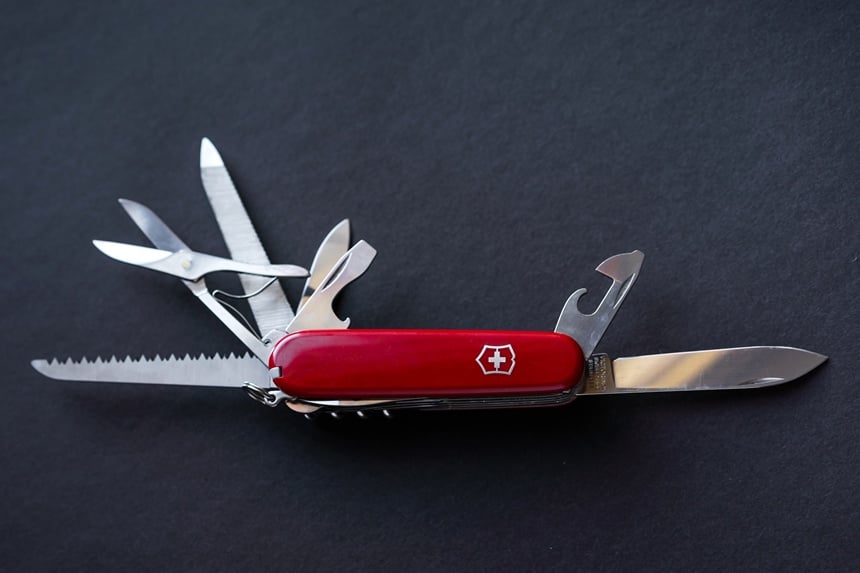
Most people can picture a Swiss Army knife instantly: the red handle, the tiny scissors, the corkscrew folded neatly alongside blades and screwdrivers, and the unmistakable white cross-and-shield emblem stamped on the side.
For generations, the pocket-sized tool has shown up everywhere from scouting activities to kitchen junk drawers to glove compartments. Some people carry one every day, alongside a wallet and keys. They’re often a rite-of-passage gift accompanying a first fishing trip or a milestone birthday. Astronauts even brought Swiss Army knives into space.
The Swiss Army knife feels so familiar that it’s easy to forget it came from somewhere specific — and that someone had to invent it in the first place.
I’d never really stopped to consider why a Swiss Army knife is called a Swiss Army knife until I wandered into the Victorinox store in Brunnen, Switzerland. Inside were rows of the familiar pocket tools in nearly every imaginable color and size, from classic red models to neon hues to whimsical printed wraps.
And yet, despite the endless variations and customization options, the basic idea remains remarkably unchanged: a compact, practical tool designed to solve problems wherever you might happen find them.
History of the Swiss Army Knife
The story begins in the late 1800s, when Swiss cutlery maker Karl Elsener set out to create a folding utility knife for Swiss soldiers. In 1884, he opened a cutlery workshop in the canton of Schwyz and delivered his first major supply of knives to the Swiss Army in 1891.
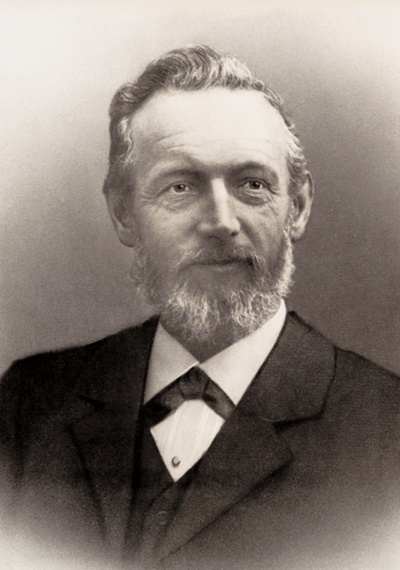
Elsener continued refining the design, and in 1897, he patented what he called the “Original Swiss Officer’s and Sports Knife,” the multi-tool that would eventually become known around the world as the Swiss Army knife.
The Story Behind the Name
Although outdoor enthusiasts and collectors may recognize the Victorinox name, many casual users may not connect the dots between Victorinox and the Swiss Army knife. Elsener originally named the company Victoria in honor of his mother, who supported his business from the beginning. In 1909, he registered the now-familiar cross-and-shield emblem as a trademark.
After the invention of stainless steel in 1913 — known as “inox” in French — the company name evolved into Victorinox, combining Victoria with inox. More than a century later, the name and emblem remain closely tied to one of the world’s most recognizable pocket tools.
From Military Tool to Cultural Icon
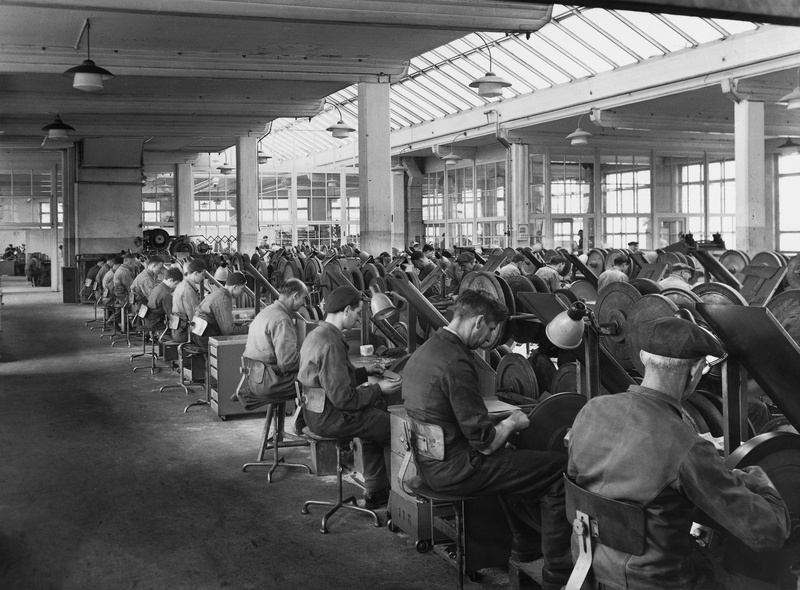
Over the decades, the Swiss Army knife evolved from military utility tool to cultural icon without losing the basic functionality that made it famous in the first place.
Its distinctive design became so recognizable that a Swiss Army knife was added to the permanent design collection at New York City’s Museum of Modern Art. In 2017, Victorinox marked the production of its 500 millionth knife, a staggering number for a tool first designed for soldiers in the late 19th century. Five years later, the company celebrated the knife’s 125th anniversary.
What began as a military utility tool had become something far broader: part outdoor gear, part design object, part cultural shorthand for preparedness and ingenuity.
Knives in Space (and Everywhere Else)
If ever there was a group of people who needed to make repairs with limited tools and no Home Depot nearby, it’s astronauts.
In 1978, NASA ordered 50 Victorinox Master Craftsman knives for use on space missions. The multi-tools quickly became standard equipment for astronauts, valued for their compact design and versatility in cramped spacecraft conditions.
Swiss Army knives have traveled aboard multiple NASA. Canadian astronaut Chris Hadfield has spoken about using one during his time in orbit – most notably to break into the Mir space station – reinforcing the knife’s reputation as a practical tool capable of handling unexpected problems far from Earth.
The knives have also accompanied adventurers in hot air balloons, to the tops of mountains, and even to the North Pole, where they continued functioning in temperatures as low as -58°F.
For a pocket tool originally designed for Swiss soldiers more than a century ago, that kind of durability is a remarkable legacy. Then again, if a Swiss Army knife can survive outer space and Arctic conditions, it’s more than up for the task of tightening a loose screw or opening a bottle of wine while camping.
The Swiss Army knife also forged a lasting place in pop culture. In the 1980s television series MacGyver, the title character famously used his Swiss Army knife — along with creativity and whatever random materials happened to be on hand — to escape danger and solve seemingly impossible problems, all before the end of the episode.
The character became so associated with clever improvisation that “MacGyver” eventually earned a spot in everyday vernacular as a verb meaning to solve a problem creatively with limited resources.
You Can Build Your Own Swiss Army Knife (But It Probably Involves a Plane Ride)
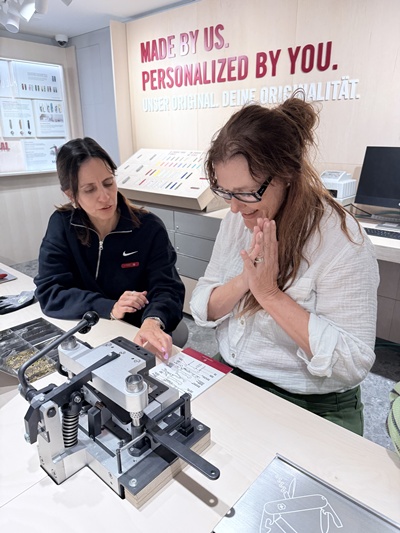
If you want an experience that goes beyond ordering a knife online or buying one in an outdoor store, book a knife assembly experience at the Victorinox flagship store in Brunnen, which is about 30 miles from Zurich and minutes from Elsner’s original store in Schwyz. Versions of this experience are also available at the Victorinox stores in Geneva and London.
If assembling a knife sounds like a learned skill, let me reassure you that just about anyone can do this. It adds a fun element of personalization that goes beyond picking out a color and custom engraving. Don’t let the high-tech worktable with its trays of internal knife parts and complex-looking equipment intimidate you. The experience is guided enough that you can’t mess your knife up, and if you do, you’ve got someone sitting next to you who can help you correct course before the final assembly of your knife is complete, yet tactile enough that you feel that you’re actually doing the work.
Seeing how the tiny springs and blades are seamlessly layered together gives you an immense respect for the clever yet simple engineering of this knife. I’m not much of a “Wow, that’s how things look when you take them apart” kind of person, yet I was fascinated with what my knife looked like from the inside out. And, there’s nothing like that satisfying “snap” sound that comes when you properly click the pieces together, and really, it’s surprisingly easy.
Why a Knife Matters
But the experience isn’t just about mechanics. For many people, the Swiss Army knife carries decades of memories and personal history.
That emotional connection is something Maya Mettler, manager of the Victorinox store in Brunnen, sees regularly.
“I love the stories of the customers who come into the store and tell us how they came to have their Swiss Army knife,” Mettler said. “There was an elderly gentleman from India who had carried his knife forever, and his grandson brought him here to Brunnen. He became emotional seeing the origins of the knife he carried in his pocket every day.”
“It’s incredible to see how people are connected to this,” she said.
Buying a Swiss Army knife in Switzerland is unquestionably cool but building a Swiss Army knife just a few miles from where the first knife was developed feels like being a little part of the brand’s history. A Swiss Army knife is often a special gift that marks a rite of passage; assembling one near where it all started is next level. For an object so familiar, there’s something satisfying about tracing it back to the place where the story began.
Become a Saturday Evening Post member and enjoy unlimited access. Subscribe now



Comments
I am 65 years old and have carried a medium size one since I was 16 or younger. I still have the first one i was given. And it still works!
Currently I carry a very large version daily. I’ve lost count of the many times it has saved me when i was in need.
Cheers to the people
who make these!
Thank you for the article about the Swiss Army knife. I have taken it for granted as an integral part of my necessities. I will now regard it with more respect!
Jill, I’d like to assemble my own Swiss Army knife just as you did. Enjoyed learning about the history of the knife and the Victorinox company. Still a trip abroad to build one myself is not in my immediate plans though one can always dream.