- If These Walls Could Rock
⭐️ ⭐️ ⭐️
Run Time: 1 hour 33 minutes
Stars: Bruce Springsteen, Ringo Starr, Sheryl Crow, Cyndi Lauper
Directors: Tyler Measom, Craig A. Williams
Every major city had its 1960s rock-and-roller hotel. In New York it was the Chelsea. Memphis had the Lorraine. Seattle’s Edgewater housed everyone from the Beatles to Pearl Jam.
In Los Angeles, center of the show biz universe, anyone with any rock credentials at all knew exactly where to check in: The Sunset Marquis, a nondescript two-story hotel with a modest pool flanked by a few forlorn palm trees.
Not much to look at, but the owner, land developer George Rosenthal, nurtured at the Marquis an anything-goes, look-the-other-way vibe that, from the moment its doors opened in 1963, proved irresistible to the likes of the Kinks, The Byrds, the Doors, and The Who (drummer Keith Moon famously drove his motorcycle through the lobby). Most of the Beatles stayed there (individually).
Through vintage footage, new animation, and an evocative soundtrack, If These Walls Could Rock traces the raucous history of the Marquis from its grungy inception to its current status as one of Hollywood’s most exclusive boutique hotels. It’s a long and winding road, and this telling of that story is studded with cameos by some of the hotel’s most notable guests, including Bruce Springsteen, Ringo Starr, Cyndi Lauper, Sheryl Crow, Dave Grohl, Roger Daltrey, Gloria Estefan (and her husband, Emilio), Guns N’ Roses’ Slash, John Oates, Darius Rucker, Gene Simmons, Nancy Wilson, and Michael Des Barres (who conducts his rambling, languid interview lounging on the floor of a seemingly trashed Marquis suite).
All have stories of furniture hurled off balconies, naked balcony-to-swimming-pool swan dives, bacchanals amidst the lounge chairs, and all-night-all-day-all-the-next-night drug-fueled marathons.
Still, the celeb guests hint, all that is just the tip of the Marquis’ scurrilous story. More than one begins to relate an anecdote, then stops short, and shakes their head (they seem particularly reluctant to tell what sort of stuff happened in the hotel hot tub). Likewise, most of the now-septuagenarian-and-beyond musicians somberly acknowledge the friends they lost directly due to the excesses that played themselves out inside the Marquis (Grohl, now in his late 50s, can barely get through his recollections of former Nirvana bandmate Kurt Cobain).
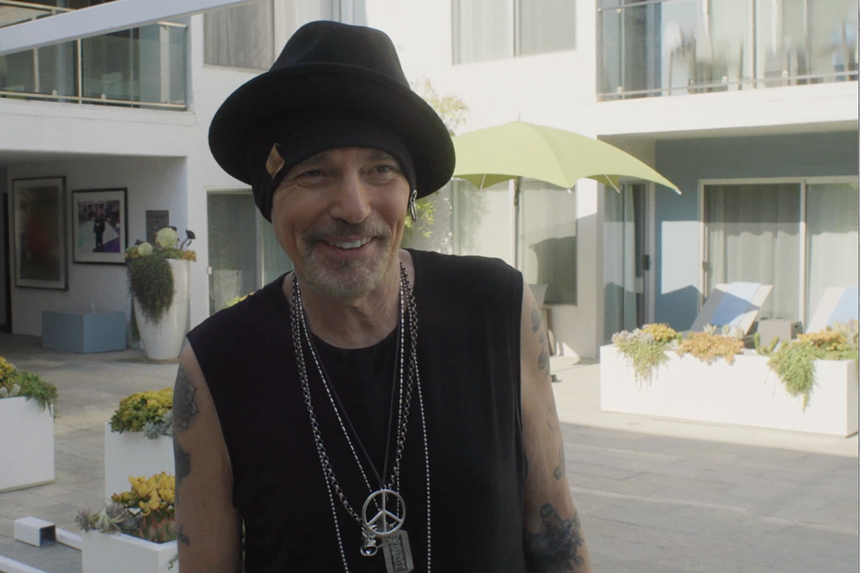
Also on hand, acting as something of a guide, is musician/Oscar-winning actor Billy Bob Thornton, who chose to live at the Marquis even though he owned a 3,600-square-foot house nearby. He walks us through the now-expanded hotel grounds, sneering in disgust at the thought of Matthew McConaughey renting out a hotel suite for a month, as if the presence of a mere actor somehow cheapens the Marquis’ rowdy history.
If you’ve never seen An Honest Liar, co-director Tyler Measom’s piercing portrait of magician/debunker James Randi, drop what you’re doing and find it now. Measom has a wonderful knack for finding the larger meaning in cultural phenomena – and here he and co-director Craig A. Wiliams settle in on the Marquis not only as a touchstone in popular culture, but also as the encapsulation of the story of a father and his son.
Interviewed here in his office, Marquis founder George Rosenthal seems like a pleasant enough 95-year-old patriarch. And while he may, indeed, have softened up a bit over the past few decades, he was for three quarters of a century among America’s most dynamic real estate moguls: His Raleigh Enterprises is responsible for some 10 million square feet of real estate worldwide (The Marquis is generally recognized as America’s first all-suite hotel).
So, it’s no surprise that he was largely an absentee father, jetting around the world to oversee his properties, hobnobbing with celebrities and world leaders, and romancing a string of available women.
Still, Rosenthal named the Marquis after his young son, Mark (Dad called his son “Markie”) who grew up nurturing equal helpings of love and resentment for the Old Man. Mark now runs the hotel, and was responsible for renewing the property when it fell into near-decrepitude in the early 2000s. He bought an adjacent lot and doubled the Marquis’ size, building a palm-tree-shaded annex that affords extra levels of privacy to his more reclusive guests (like McConaughey). Dad seems proud, and Mark seems gratified to earn that respect.
The film would have benefitted from more music performed by the hotel’s legendary guests, but the harsh realities of music licensing fees most likely made that impossible for an indie film. Still, If These Walls rocks with a spirit that echoes with the wild abandon of a cultural moment when the bad boys ruled, and nothing could stop them…until they stopped themselves.
Become a Saturday Evening Post member and enjoy unlimited access. Subscribe now