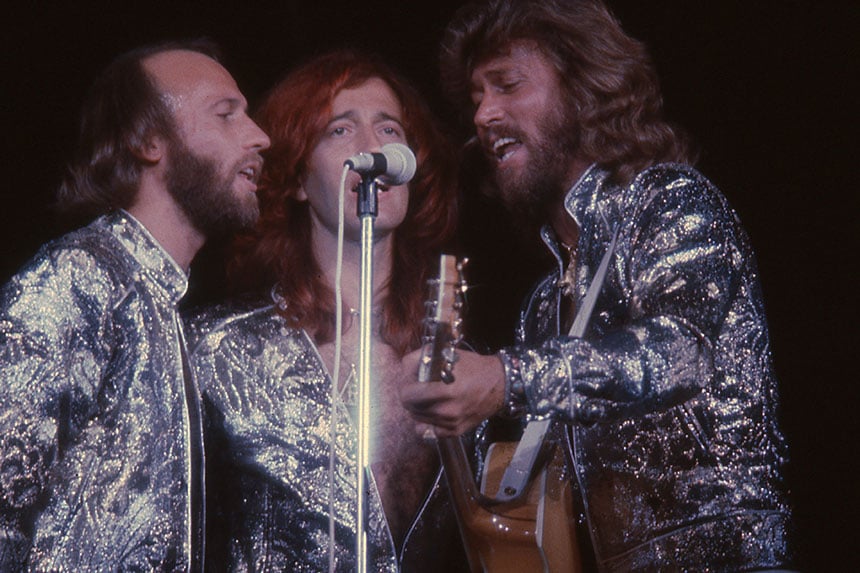
It’s said that hindsight is 20/20, but it can also cloud your vision. Take music for example. Decades of compilation albums, songs played in film or TV or commercials, and the enduring popularity of some artists can paint a skewed picture of the past, leaving us to believe that something that was popular with us was equally popular for everyone else. But reality tells a very different story. What you thought were the biggest hits of the ’70s may have barely registered on the charts, and some of the actual biggest hits you may not remember at all. Let’s take a look at the true hits of the 1970s.
The Methodology
Until the advent of better tracking technology like SoundScan in the 1990s, Billboard magazine calculated their charts from a data set that included mail-in forms and phone calls. Billboard personnel would call in to major radio stations and record stores to find out what was playing/selling that week. Alternatively, those same outlets could fill out forms and return them to Billboard to provide them with information. Using that data, Billboard would tabulate their various weekly charts. We’ll be focusing strictly on the top singles of the 1970s.
How Many #1s?
Billboard tracked 252 #1 songs between 1970 and 1979. Of those tunes, 124 held the top spot for a single week. For our purposes, we’ll be starting with songs that spent at least FIVE weeks at #1. That takes the total number down to 18 tunes that were the biggest-selling — and, arguably, most played on radio —songs of the decade.
“I’ll Be There” by The Jackson 5 (Uploaded to YouTube by Starforce Production LLC)
The Funky Fives
Appropriately enough, the first song of the decade to spend five weeks at #1 was The Jackson 5’s “I’ll Be There;” it took the top spot in October of 1970. The next one was also a boy band of brothers; that would be The Osmonds. They took “One Bad Apple” to the top in February of 1971. That year also saw two “double A-sides” take the top spot in the forms of Carole King (with “It’s Too Late”/ “I Feel the Earth Move”) and Rod Stewart (“Maggie May”/ “Reason to Believe”). Roberta Flack held “Killing Me Softly with His Song” for a five-count in 1973. Wings took a jab that John Lennon made at Paul McCartney in an interview and transformed it into “Silly Love Songs,” which perched at the top in 1976. The final two five-week wonders were influenced by the decade’s disco explosion: “Best of My Love” by The Emotions (which was written by Maurice White and Al McKay of Earth, Wind & Fire) and “Bad Girls” by Donna Summer were #1 for five weeks in 1977 and 1979, respectively.
“Bridge Over Troubled Water” by Simon & Garfunkel (Uploaded to YouTube by BEEMOG 비목)
The Super Sixes
Six songs spent six weeks at #1 throughout the decade. The first, hitting the top in February of 1970, would go on to win five Grammys; that was Simon and Garfunkel’s “Bridge Over Troubled Water.” In April of 1971, Three Dog Night took “Joy to the World” to the top. Roberta Flack’s “The First Time Ever I Saw Your Face” landed in April of 1972, giving her, with her previous five-week entry, a combined 11 weeks at the top in the 1970s. “Alone Again (Naturally)” by Gilbert O’Sullivan had its run beginning in April of 1972. “Le Freak” by Chic shook dance floors in 1978. And the song credited with the beginning of the end of disco’s domination, The Knack’s “My Sharona,” began its six-week run in August of 1979.
“Shadow Dancing” by Andy Gibb (Uploaded to YouTube by JR2CLASSICSDISCO)
The Single Seven
Only one tune topped the chart for seven weeks in the ’70s, and that was “Shadow Dancing” by Andy Gibb. The song, written by Gibb with his older brothers, the Bee Gees, and Albhy Galuten, was the artist’s third #1 in a row, the previous two having been “I Just Want to Be Your Everything” and “(Love Is) Thicker Than Water.”
“Night Fever” by Bee Gees (Uploaded to YouTube by Bee Gees)
The Epic Eights
Two tracks held the distinction of being at #1 for eight weeks during the decade. The first was “Tonight’s the Night (Gonna Be Alright)” by Rod Stewart. Stewart wrote the song and cut the track at the storied Muscle Shoals Sound Studio in Alabama. It was the longest-running of Stewart’s four #1 songs to date. The other eight-week stretch was occupied by “Night Fever” by Bee Gees. The tune was, of course, part of the chart-devouring Saturday Night Fever soundtrack. It was one of three #1s on the album written and performed by Bee Gees, along with “Stayin’ Alive” and “How Deep Is Your Love;” a fourth number one, also written by the brothers Gibb, was “If I Can’t Have You,” performed by Yvonne Elliman.
“You Light Up My Life” by Debby Boone (Uploaded to YouTube by Classic Sounds 70s)
Only One at Ten
If you lived through the 1970s, you might have had a building suspicion as to what the longest-running #1 tune was. And for a song that’s so innocent-sounding and, well, treacly, it had a lot of ignominious stuff going on behind the scenes. Written for a film of the same name, the number one song of the 1970s was “You Light Up My Life” as recorded by Debby Boone. But that’s hardly the end of the story.
Joseph Brooks wrote and directed the film in addition to writing the song itself. For the movie, the tune was recorded by Kvita Cisyk, also known as Kasey Cisyk. Cisyk thrived as a background singer, working with artists like Carly Simon and producers like Quincy Jones. She also worked in commercials. As it was decided that actress Didi Conn would lip-sync to pre-recorded vocals in the film, Cisyk was tapped for the job. However, she was initially not credited for her work on the soundtrack. Brooks allegedly avoided paying her, and pivoted toward a single release recorded by a different artist. That artist would be Debby Boone.
The child of famous performer Pat Boone, Debby Boone started touring with her parents and sisters when she was 14. In 1975, she made the Adult Contemporary charts when she covered “When the Lovelight Starts Shining Through His Eyes” by The Supremes. Boone recorded her version of “You Light Up My Life,” but had little creative control. Brooks coached her to match the Cisyk performance as closely as possible. When Boone’s take was released as a single, it was a smash.
Cisyk fought for her proper recognition and sued for her missing payments. She would eventually receive her payout. However, Brooks cut her name from the film’s credits; the soundtrack version also simply listed the cast of the film in the performer slot. But that wasn’t the worst thing that Brooks did.
In 2009, Brooks was arrested on 11 charges of rape and sexual assault. Shawni Lucier, Brooks’s assistant, was charged as an accomplice. Allegedly part of a “casting couch” scheme wherein women were lured in by Brooks’s promises of auditions and roles and then assaulted, Brooks was indicted in June of 2009. Brooks took his own life before the trial began, though he never admitted wrongdoing. Lucier, however, pled guilty to 10 counts of criminal facilitation.
On the brighter side, Cisyk went on to have a major career in commercial jingles, recording ads for every major TV network and some of the biggest brands in the world, like multiple major airlines and both Coca-Cola and Pepsi. In the 1980s, she became a star in Ukraine (her parents were immigrants) recording albums in Ukrainian that won multiple awards. She passed in 1998 after battling cancer.
Debby Boone had a lengthy career following the success of “You Light Up My Life,” but not in mainstream pop. She pivoted to country after the song’s success and did well on the charts while also earning the 1977 Academy of Country Music award for Top New Female Vocalist. Boone segued into greater success in contemporary Christian music, winning two GMA Dove Awards. Boone has also acted on stage and screen and has written an autobiography (Debby Boone So Far) and a number of children’s books. In 2005, she released the successful album Reflections of Rosemary, a tribute to her late mother-in-law, the legendary Rosemary Clooney.
Unanswered Questions
It might seem strange at the summation of the most successful songs of the 1970s to see some of the best-loved songs of the decade missing from the list. Where’s “Dreams” or “Go Your Own Way” by Fleetwood Mac? What about “Hotel California?” Where’s Zeppelin? Well, there are two answers for that. The first is that while all of those songs and artists charted, they simply didn’t have the #1 staying power that the others did. And the second is that the 1970s ended 46 years ago and some songs have grown larger in our minds due to classic rock radio and the prevalence of certain artists used in commercials, films, and television. So whereas, say “More Than a Feeling” by Boston did peak at #5, its legacy is much greater because of endless airplay, inclusion in other media (episodes of Scrubs, the Guitar Hero video games, etc.), and its life on streaming platforms. “Stairway to Heaven” had a much greater afterlife than “You Light Up My Life” despite never cracking the Hot 100 on its initial release. Such is the way of things. What is certain is that the 18 songs above dominated radios and record players during the 1970s, and they leave a snapshot of an era that’s fun to revisit even if our cultural tastes may have changed.
Become a Saturday Evening Post member and enjoy unlimited access. Subscribe now
Comments
Keith, thanks for your research and for educating us with this new information. I found it quite interesting.
To Mark Scott, regarding some of the artists you mention that weren’t Top 25 of the 70’s. I did some Billboard Magazine research, and, upon further review, discovered that Kool & The Gang were the 13th biggest act of the 1980s, while Rolling Stones made the 1960s list, also coming in at #13 for their decade. BTW, the top 3 acts of the 1960s were Beatles, Elvis and Supremes; for the 1980s it was Michael Jackson, Madonna and Hall & Oates.
Yeah. I remember the local radio staion in Chattanooga wore out “You Light Up My Life.” Thankfully, XM 70s on 7 channel plays it very little nowadays.
Also, I’m not sure if anyone else who reads this agrees with me but I was so happy when Disco did a nose dive in the late 1970s.
Keith, I agree with you wholeheartedly. Where is K.C. and the Sunshine Band, Kool and the Gang, Led Zeppelin, Steppenwolf and the Rolling Stones? These acts were pulling huge audiences as well as concerts.
The 70’s were Elton’s decade and Paul’s. The Bee Gees were hot as was Andy had he lived he would have owned those charts with his good looks and Barry as his song writer.
According to Billboard, these are the Top 25 musical acts of the 1970s:
25. Spinners
24. James Brown
23. Earth, Wind & Fire
22. Barbra Streisand
21. Aretha Franklin
20. Rod Stewart
19. Helen Reddy
18. Gladys Knight & The Pips
17. Donna Summer
16. Tony Orlando & Dawn
15. Diana Ross
14. John Denver
13. Eagles
12. Barry Manilow
11. Elvis Presley
10. Neil Diamond
9. Olivia Newton-John
8. Three Dog Night
7. Stevie Wonder
6. Chicago
5. Jackson 5
4. Carpenters
3. Bee Gees
2. Paul McCartney
1. Elton John
While I agree with most of the list, I don’t understand how the Carpenters & Elvis rank as high as they do, and Rod Stewart so low. And where are K.C. & The Sunshine Band? Fellow readers, what are your thoughts?