
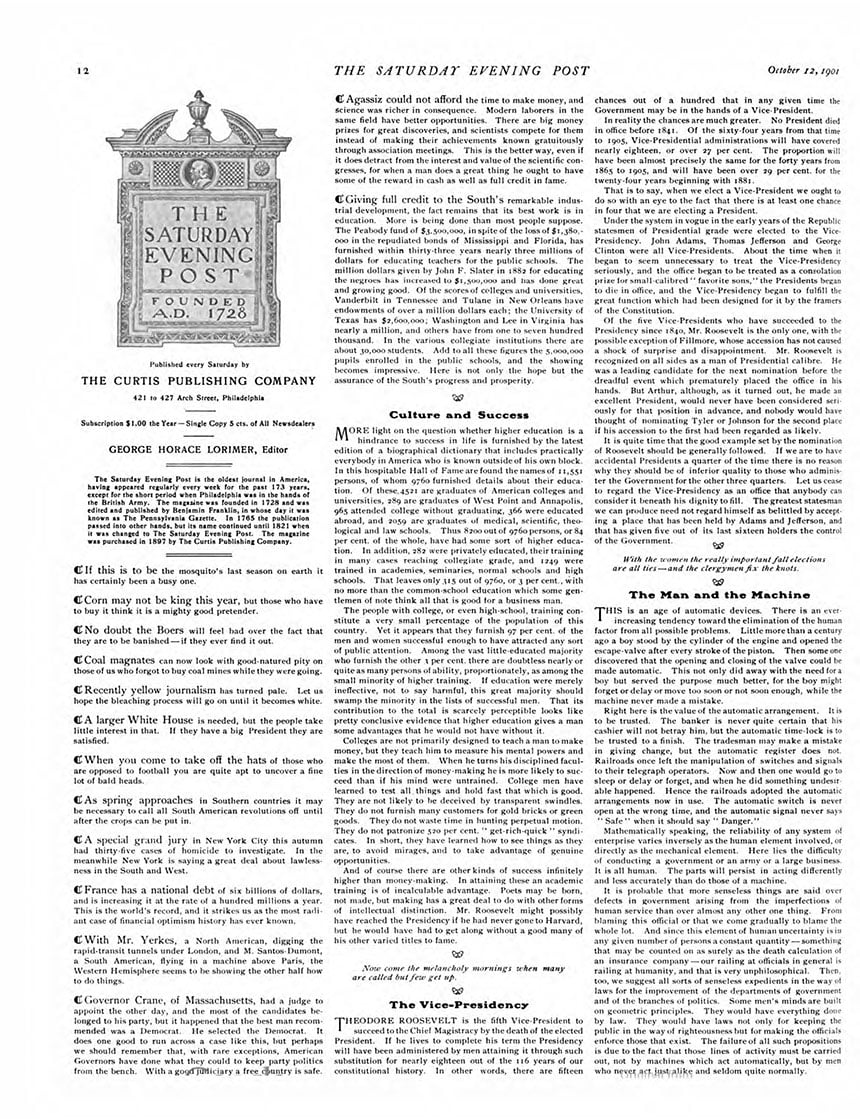
In 1901, many Americans still viewed higher education with suspicion or denounced it as a waste of time. College diplomas were a rarity; only around 4 percent of students had the chance to attend university. But, as the Post’s editors point out, a college education was proving essential to success in the new century. Of the thousand people named in a recent dictionary of successful Americans, 97 percent had received some higher education.
Some gentlemen of note think the common-school education is all that’s good for a business man. [But there is] pretty conclusive evidence that higher education gives a man some advantages that he would not have without it.
Colleges are not primarily designed to teach a man to make money, but they teach him to measure his mental powers and make the most of them. College men have learned to test all things and hold fast that which is good. They are not likely to be deceived by transparent swindles. They have learned how to see things as they are, to avoid mirages, and to take advantage of genuine opportunities.
—From “Culture and Success,” Editorial, from the October 12, 1901, issue of The Saturday Evening Post
This article is featured in the September/October 2026 issue of The Saturday Evening Post.
Become a Saturday Evening Post member and enjoy unlimited access. Subscribe now



Comments
Sadly with so much unforced indoctrination going on in many colleges & university by unbridled professors there are many degrees that just don’t carry a lot of weight nowadays. It seems from what I have been able to learn an A.S. (or A.A.S. in some cases) degree from a community college or a certificate similar from a technical school better prepares the young folks for a promising career. There are flocks of young men and women that I know have attended the lineman training school in North GA and have careers now in the electrical or telecommunications fields. The same goes for plumbers. My son is an example. He is earning excellent money as a plumber and really seems to enjoy his job. My daughter on the other hand earned a B. A. Degree in Education from a reputable university in Chattanooga. After about three years teaching, she quit (the kids were largely disrespectful and ill mannered) and started her own small business. According to my son-in-law who is a middle school principal in the area, she earns more with her small business than he does as a principal.