In the 1950s, Elvis Presley’s manager, Col. Tom Parker, helped create the rock T-shirt, displaying green-and-black images of the King of Rock ’n’ Roll singing with his guitar in front of a record. But what the colonel really wanted to sell was everything else — lunchboxes, lipstick, cologne, and stuffed hound dogs. He really wanted to sell Elvis scarves, purchasing 10,000 but not selling a single one — until, before a concert, Parker instructed screaming fans to wave them so Elvis “knows where you’re at.”
“And he sold out all the scarves,” says Doc McGhee, manager of KISS, who heard the story from Parker, his friend, before the colonel’s death in 1997.
As Presley was taking off, rock ’n’ roll concert T-shirts were still a niche item, sold primarily to members of the King’s fan club, as McGhee recalls. T‑shirts themselves had been invented between 1898 and 1913, issued by the U.S. Navy as undershirts, and in the ’50s, Marlon Brando and James Dean were just starting to make the white ones fashionable in films like The Wild One and Rebel Without a Cause. Not even Col. Parker could have envisioned, back then, that consumers in 2023 would purchase $13.4 billion in music-merchandise products —mainly T-shirts — or that the market could grow to $16.3 billion by 2030, as research group MIDiA recently predicted.
The Beatles produced T-shirts, too, along with their own candy bars and lunchboxes, for their debut U.S. tour in 1964, as did the Monkees a few years later, but the rock T-shirt business didn’t truly kick in until the early ’70s. When the Allman Brothers Band prepared to play a 1973 show at the Nassau Coliseum in New York, promoters at Cross Country Concerts instructed advertising agent Ira Sokoloff to design a full-page Village Voice spot in advance, according to the 2007 book The Art of the Band T-Shirt. Sokoloff then printed the ad on 12 T-shirts, intended for the band and its managers. Impressed, the Allman Brothers asked Sokoloff to sell the T-shirts at the concert.
Barry Drinkwater heard this Allman Brothers story a slightly different way. As founder and executive chairman of Global Merchandise Services, Drinkwater has handled merch for artists from the Spice Girls to the Grateful Dead over his 40-year career. Drinkwater, who today works with Iron Maiden, Mötley Crüe, and many others, says the late San Francisco promoter Bill Graham put on an Allman Brothers show in the early ’70s and realized afterward the band had left behind some T-shirts made for family and friends. He turned to one of his employees, Dave Furano, and said: “See if you can sell them.”
“They flew out the door,” Drinkwater says. “Fifteen hundred pieces.”
Furano and his brother, Dell, soon founded Graham’s merch company, Winterland Productions. Because Graham was so focused on putting on the famous concerts by rising ’60s and ’70s stars, including the Jimi Hendrix Experience, The Who, and the Dead, he delegated all T-shirt concerns to the Furanos. “Go talk to Dell,” he would say. It was Dell Furano, working with the Dead, the Rolling Stones, and others, who created the innovation of listing artists’ tour dates on the backs of their shirts, according to McGhee: “They started coming up with the concept of ‘I was there.’”
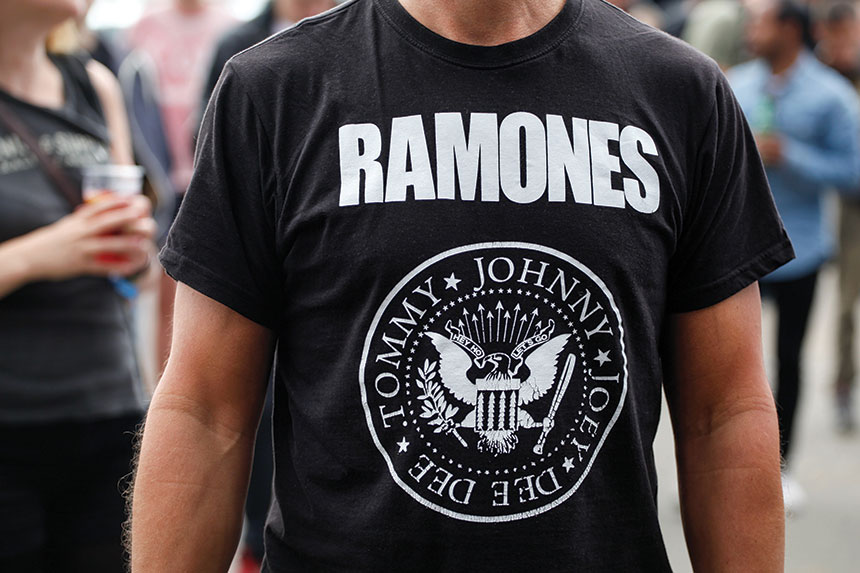
Over time, T-shirts evolved into big business — and a way for music stars, big and small, to distinguish themselves visually. In 1976, the Ramones’ art director, Arturo Vega, was touring with the band, painting backdrops and lights. He created their distinctive “seal” — the musicians’ names in block letters circling an eagle holding an apple-tree branch and a baseball bat. He stamped the logo on T-shirts to sell to fans and pay for his travel. In Vega’s 2013 New York Times obituary, Ramones manager Danny Fields said, “They sold more T-shirts than records, and probably they sold more T-shirts than tickets.”
The T-shirt business evolved slowly, thanks in part to early developments like iron-on transfers, which enabled faster production. “It was just another product that people were buying,” Drinkwater says. “You’d sell 1,000 button badges and maybe 20 T-shirts, and it picked up momentum as the printing got better. Celebrities started wearing them.”
Sex, the London clothing store that launched the Sex Pistols and punk rock in general, sold fashionably torn T-shirts stuck with safety-pins in the ’70s; Joy Division, a band that never had a hit during its lifetime, introduced an iconic T-shirt featuring a bumpy, white-on-black pulsar image lifted from the Cambridge Encyclopedia of Astronomy; Fugazi, Nirvana, and Primus introduced irony to T-shirts in the ’90s, from “This Is Not a Fugazi T-shirt” to “Primus Sucks” to Nirvana’s blinkered smiley face. Today, DJ Ross One, a hip-hop collector, displays T-shirt designs — like Run-DMC’s block white logo with the horizontal orange lines and A Tribe Called Quest’s circular image with a pair of bare green feet at the center — in two book volumes titled Rap Tees. And Taylor Swift sold an estimated $200 million worth of merchandise — mainly T-shirts — on her Eras Tour in 2022 and 2023, according to concert-business trade magazine Pollstar.
It’s impossible to imagine the concert experience today without this crucial, lucrative keepsake. “We are all in the business of selling the black T-shirt,” Chris Nilsson, president of Mötley Crüe’s management company, once told Billboard. “The rock T-shirt has long been a badge of honor to exhibit what lifestyle you live.”
Steve Knopper is a former Rolling Stone contributing editor, frequent New York Times contributor, and author of books, including Appetite for Self-Destruction: The Spectacular Crash of the Record Industry in the Digital Age.
This article is featured in the September/October 2026 issue of The Saturday Evening Post.
Become a Saturday Evening Post member and enjoy unlimited access. Subscribe now