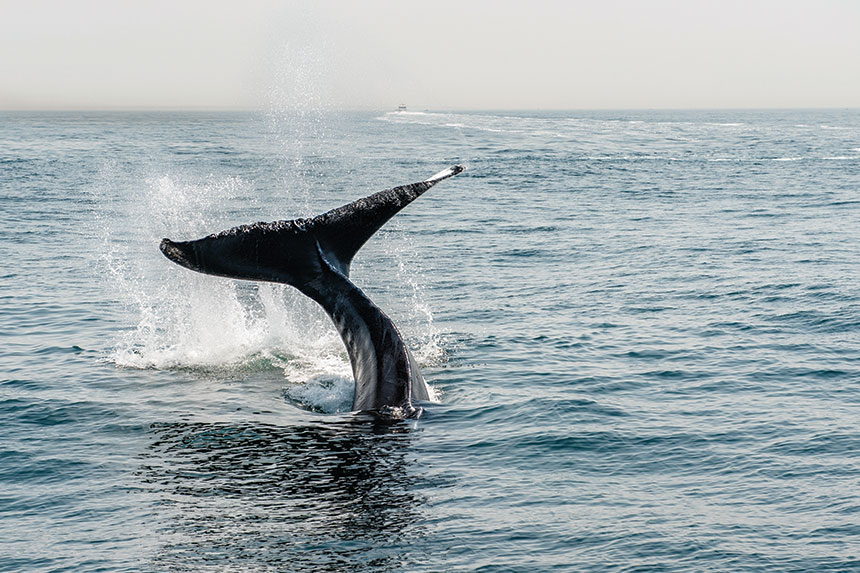
Bundled against the offshore cool of an early Nantucket spring, I scanned the round-nosed shoreline at the island’s southeastern tip. Waves of daffodils bloomed at my back. In front of me were 3,000 miles of open sea. I was primed to spot a telltale dorsal sliver; ready to holler “there she blows!” at the first vaporous puff. I was looking, anyhow, for a whale, one of the humpbacks, finbacks, and right whales who summer, snowbird-like, in the nutrient-rich waters that make New England an all-you-can-eat-buffet for the plankton enthusiast.
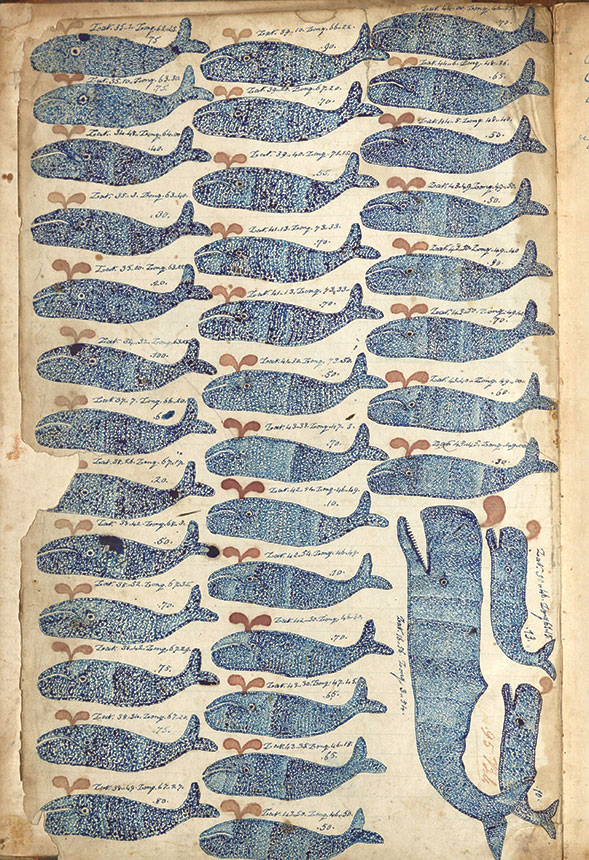
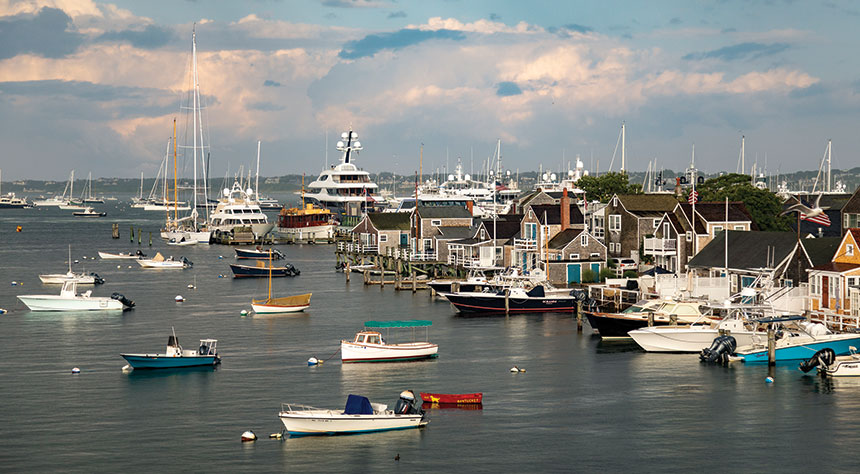
The morning’s ocean was blank to the mist-smudged horizon. Yet Siasconset, where I stood, is the place 17th-century Nantucketers established one of America’s first shore-whaling stations. Paddling small wooden boats, they pursued right whales straight from the beach. In mere decades, Nantucket’s coastal waters emptied. The islanders paddled farther. And by the middle of the 18th century, they turned this boomerang curve of sand into the whaling capital of the world — the hub of a growing American industry.
When I traveled to Nantucket on the fast ferry from Cape Cod the day before, it was the first stage in a trip along the Massachusetts Whale Trail — a collection of nearly 40 whale-themed sites across the state, spanning maritime museums, historic homes, and aquariums. By following it, I hoped to better understand how whaling changed the ocean, and our world. In place of a map, I carried a borrowed paperback copy of Moby-Dick. My guide on the Whale Trail, I’d decided, would be Herman Melville, the whaler-turned-novelist who published his masterpiece 175 years ago.
It’s not that I am a whaling fan, per se. Like most people — like you, perhaps — I wish for a world with more whales, for oceans busy with breaching blues and flipping fin whales. Driving south from Vermont to the Massachusetts coast, I’d played the best-selling 1970 album Songs of the Humpback Whale. The recordings left me awestruck and a little shy, like I was eavesdropping on a submarine lullaby. I can see why the album helped spark a global movement to save the whales. Even in Melville’s day, whaling had a bloody reputation. It “has somehow come to be regarded among landsmen as a rather unpoetical and disreputable pursuit,” Melville wrote. Some 175 years later, staring at a too-quiet sea, it’s easy to think of whalers as downright villains.
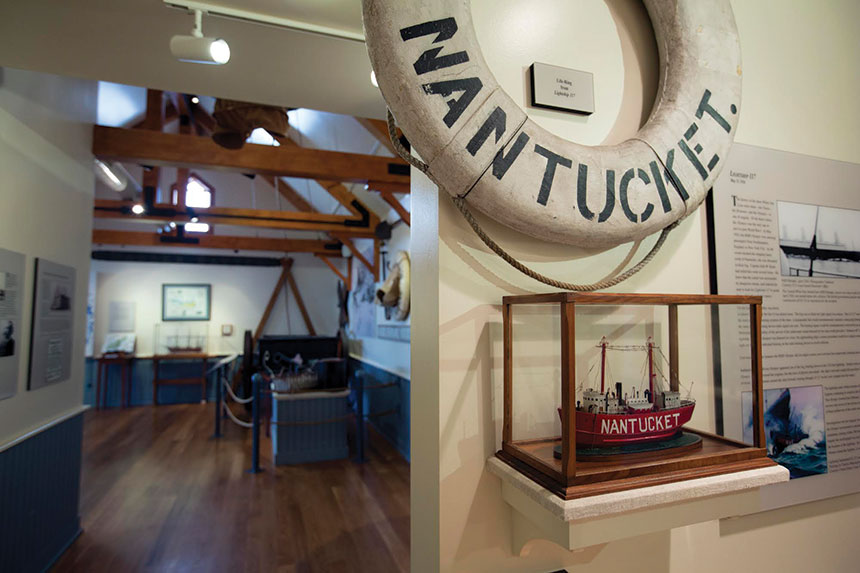
Yet colonial America saw whales as a seemingly inexhaustible resource. “They lit our cities and homes,” explained Miranda Dale of the Nantucket Whaling Museum, as we walked through the restored 1847 Hadwen & Barney Candle Factory that contains part of the museum’s collections. Here, islanders used spermaceti — a waxy substance found inside the heads of sperm whales — to make high-priced candles prized for their pure light, minus the stink and smoke of tallow. Towering on the museum’s second floor was a two-story press for extracting and purifying whale oil brought to land in great wooden barrels. Lamps using such oil illuminated London nights so brightly they were widely credited with reducing crime in the city, though they left a faint, fishy odor lingering in the streets by dawn.
As I followed Dale through the museum, I recalled Melville’s fierce interjections in whalers’ defense. “Almost all the tapers, lamps, and candles that burn round the globe, burn, as before so many shrines, to our glory!” he wrote. He was indignant the industry was ignored or shunned in drawing rooms lit by sailors’ difficult, dangerous work.
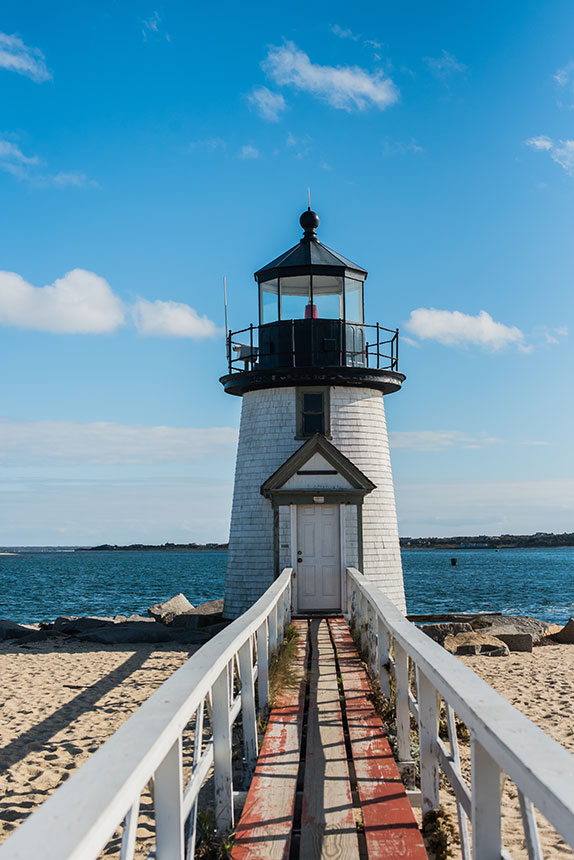
From the museum, I walked the coast to Brant Point Light, a station established in 1746. It marks the entrance to shallow and shoaly Nantucket Harbor — a nail-biting place to navigate a whaleship laden with precious oil. That’s one reason an upstart neighbor, New Bedford, disrupted Nantucket’s reign by the 1830s. And so, the next day, I stepped back on the ferry to head northwest, and to the younger, deep-water harbor with access to a growing network of mainland roads and rails.
“In New Bedford, fathers, they say, give whales for dowers to their daughters,” wrote Melville. “They have reservoirs of oil in every house.” It was from here, not Nantucket, that a 21-year-old Melville set out aboard the whaler Acushnet, later drawing on his experiences during that voyage to write the epic novel Moby-Dick. The city is eager to claim the writer and his fictional whale. Walking the cobblestoned lanes of its old center, I passed the Moby Dick Brewing Co.
Attentive readers of its draft list will notice Melville-inspired pours, like the amber-hued “Ishm-ale” (as in “call me”) or the “Quick Eternity,” a hoppy IPA. A “quick eternity,” Melville wrote, is all early whalers thought they’d achieve by hunting the sperm whale, a larger and fiercer prey than the right whales they first learned to harpoon off Nantucket. A few blocks from the brewery, at the New Bedford Whaling Museum, I began to see why.
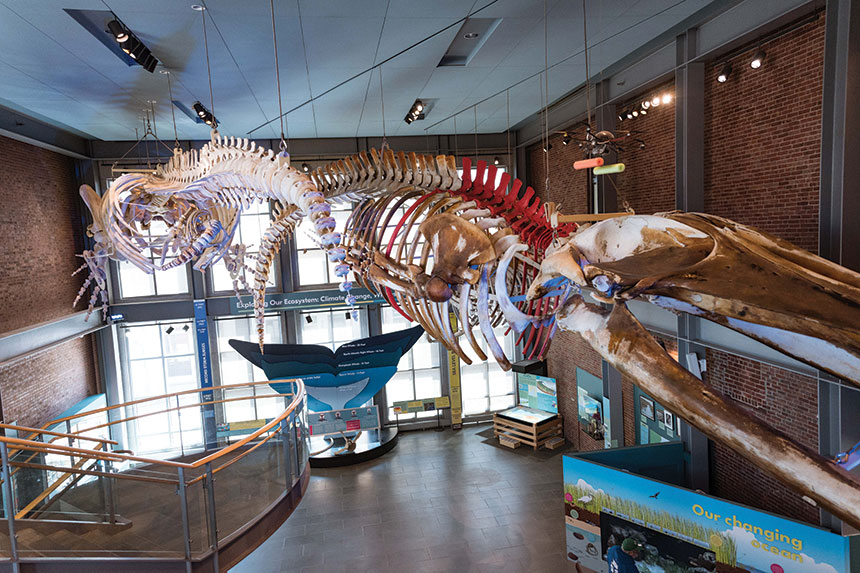
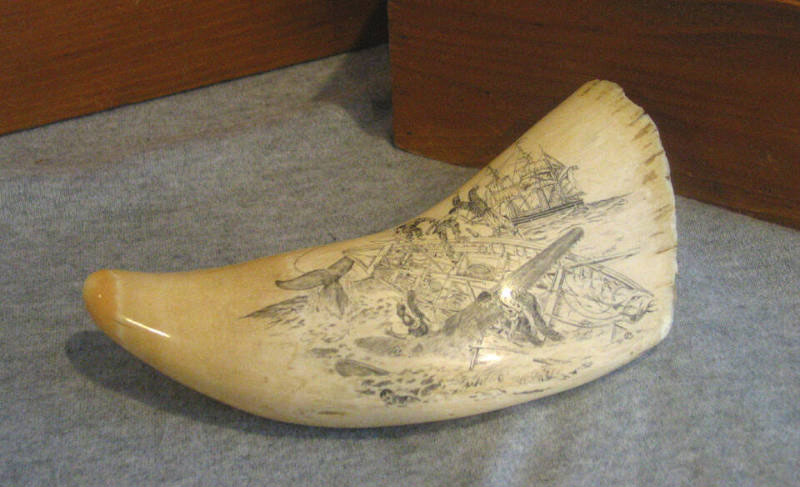
(top) accidentally killed by a tanker in 1998, as well as the largest collection of scrimshaw in the world. (Courtesy New Bedford Whaling Museum)
In one of its rooms, I found the bleached skeleton of a sperm whale longer than a city bus. As his species goes, he was relatively dainty. He nonetheless dwarfed the 20-foot wooden whale boat on display nearby. Whalers hunting offshore kept watch from the tip of tall masts, where sailors would call out at the sight of flukes, fins, or spouts. (“There she blows” serves only for the plume whales release upon exhaling; on other occasions, you might shout “there go flukes!”)
With a whale in their sights, sailors lowered double-ended, open row boats and gave chase — the subsequent wild hunt is preserved in scrimshaw etchings in the museum’s collection. On one engraved ivory tooth, I saw the chaotic wave-tossed moment when a harpooner threw his iron weapon at a fierce-looking whale. Harpoons were attached to the boats with long ropes. The terrifying experience of being towed at speed behind an injured whale, frenzied with pain, became known as a “Nantucket sleigh ride.”
“They used their bodies to capture the whale,” said Janine da Silva, of the New Bedford Whaling National Historic Park just around the corner from the museum — the only national park to preserve America’s whale-hunting legacies. It was violence at close quarters. At a time when American hunters employed high-powered rifles to kill bison from trains, whaling must have seemed archaic in comparison. I thought of cave paintings where men gripping flint-tipped spears faced mastodons.
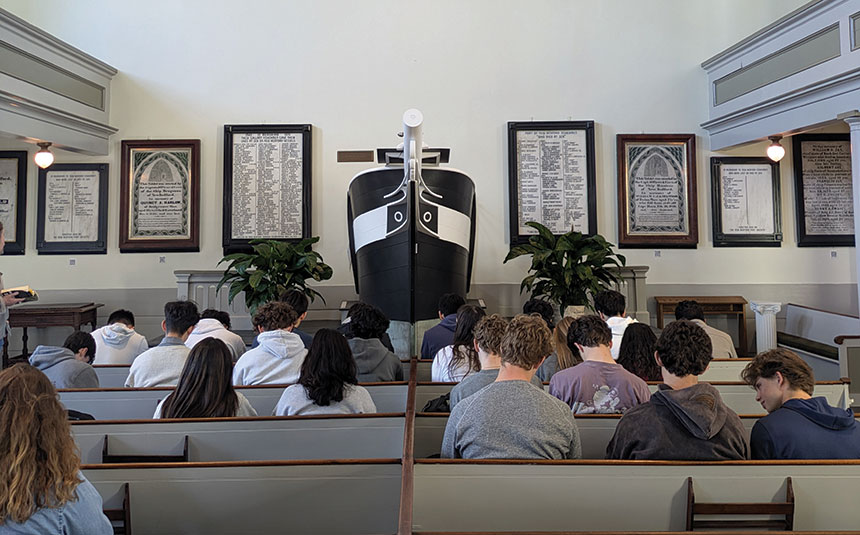
Many died at sea. Some sailors are remembered with cenotaphs — empty tombs — at New Bedford’s 1831 Seaman’s Bethel, a nondenominational sanctuary dedicated to the city’s mariners. “In memory of Captain William Swain,” reads one 1844 memorial. “This worthy man, after fastning to a whale, was carried overboard by the line and drowned.” On Memorial Day each year, the bethel still holds services for the drowned. “It’s very sacred for the fishing community,” said Philip Oliveira, president of the New Bedford Port Society that cares for the bethel, as well as the adjoining Mariners’ Home.
When I stepped into the whitewashed chapel, I found a high-school class seated in the wooden pews, taking turns reading from Moby-Dick. In the book’s early chapters, before setting off to sea, the narrator, Ishmael, visits the bethel. The students’ heads were tipped forward over their thick volumes, and they stumbled sometimes on Melville’s serpentine phrases.
“With what feelings, on the eve of a Nantucket voyage, I regarded those marble tablets, and by the murky light of that darkened, doleful day read the fate of the whalemen who had gone before me,” read one student seated between a cenotaph and the chapel’s pulpit, which resembles a ship’s prow. His voice had an adolescent wobble. He was just a few years younger than some of the mariners memorialized on the walls.
Downhill from the Seaman’s Bethel, at the city’s wharves, ranks of wooden whaling ships disgorged great barrels filled with whale oil, ready for sale on the booming market. Back then, the place smelled of blubber and smoke. Now it has the salt whiff of a modern-day fishing port. Walk uphill to County Street and the historical whaleship-owners’ mansions of County Street, and the sea aroma fades.
“Nowhere in all America will you find more patrician-like houses; parks and gardens more opulent, than in New Bedford,” Melville wrote, sounding a bit like a visitors-bureau brochure. However distant the faraway whaling grounds, such mansions owed their wealth to the hunt. “All these brave houses and flowery gardens came from the Atlantic, Pacific, and Indian oceans,” he wrote. “One and all, they were harpooned and dragged up hither from the bottom of the sea.”
One is the 1834 Greek revival mansion commissioned by whaling merchant William Rotch Jr. — now the Rotch-Jones-Duff House and Garden Museum. In summer, its elegant gardens bloom with colonial-era roses, and heirloom fruit dangles from lines of apple trees. Like many of the whaling elite, Rotch was a Quaker. They valued aesthetic simplicity even when stock prices soared. “It was a house built by shipwrights,” said Dawn Salerno, the museum’s executive director, pointing to curved doors and sinuous handrails evoking a ship’s tight quarters.
“We’re a modest mansion,” Salerno said, wryly. From a glassed-in cupola, we looked down at the coast, savoring a shipowner’s view of the waterfront. I considered that perspective the next day, as I drove away from the coast and to the next stop on the Whale Trail — the historic Berkshires farm, called Arrowhead, where Melville lived in the years when he wrote Moby-Dick.
The dirty, dangerous work of whaling must have seemed far away to Melville then, much as it does to a modern reader like me. He liked to start each day by visiting his horse and his cow. A whaling harpoon lay propped in his study, but the writer only used it to poke at burning logs.
Melville’s Berkshires neighbors, from Boston and New York, built their fortunes on mills and railways, not blubber. Yet the surrounding fields undulate in waves amid an ocean of trees. “I have a sort of sea-feeling here in the country,” he wrote in an 1850 letter. “I look out my window in the morning when I rise as I would out of a porthole of a ship in the Atlantic.” From his desk, Melville could watch the whale-like profile of Mount Greylock turn snowy white in winter.
Just a few years after Melville published Moby-Dick, American whaling began a slump: gradual at first, then swift. Whale populations were declining, pushing captains into longer and more dangerous voyages. In 1859, petroleum was found in Pennsylvania, giving America a cheaper and easier fuel source. Harper’s Weekly published a cartoon of tuxedoed whales popping champagne to celebrate. “Oils well that ends well,” read a banner in the background.
American whaling was forever diminished. This year, the world marks four decades since the International Whaling Commission passed a global moratorium on whaling (though whaling continues in a few places, including Norway, Iceland, and Japan). Instead of harpoon-wielding sailors, sperm whales today face modernity’s more diffuse and prosaic violence: snarled fishing gear, ocean noise, boat strikes, oil spills, climate change.
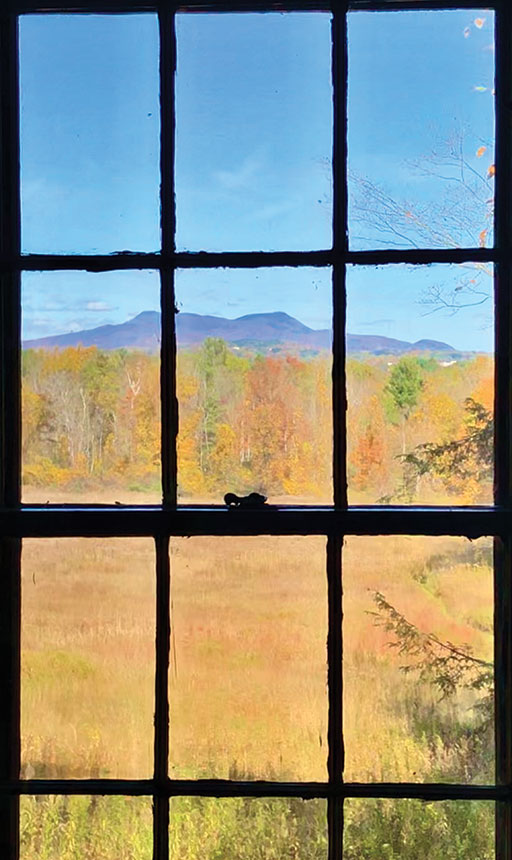
For his part, Melville was bullish on whale futures. “We account the whale immortal in his species,” he wrote. And there are reasons for hope.
This spring, researchers spotted several blue whales — the largest cetaceans of all — in waters off Nantucket. On the same day, a solitary sperm whale grazed amid the canyons and seamounts to the island’s southeast. North Atlantic right whales, though critically endangered, are slowly increasing. Perhaps one was even passing by when I began my trip on a Nantucket beach, and let loose his breath the moment I left.
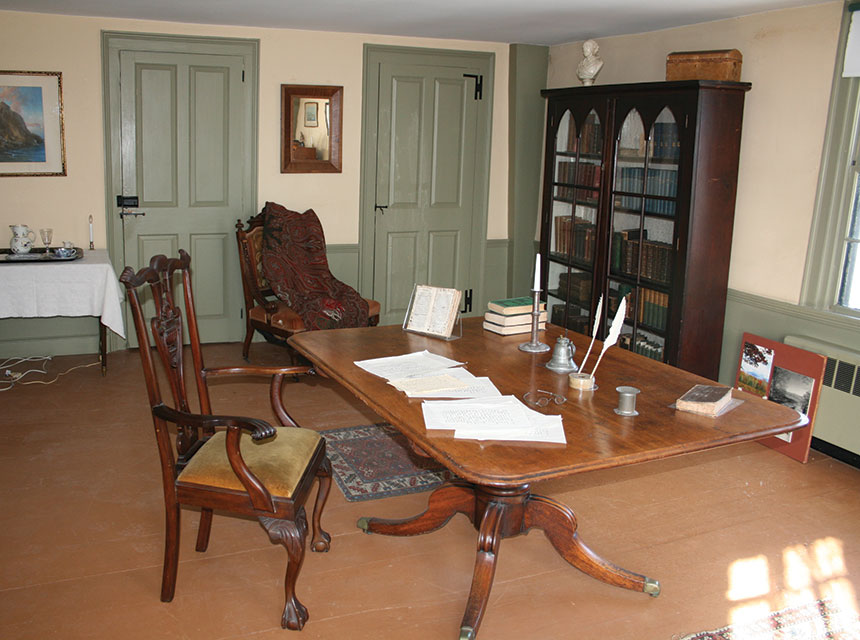
“The eternal whale will still survive, and … spout his frothed defiance to the skies,” Melville wrote. At the end of his book, it was the whale who swam away. I’ll raise an IPA to that.
Jen Rose Smith has written for The Washington Post, CNN Travel, Condé Nast Traveler, AFAR, Rolling Stone, USA Today, and Outside Online and is the author of six travel guidebooks to Vermont and New England. For more, visit jenrosesmith.com.
This article is featured in the September/October 2026 issue of The Saturday Evening Post.
Become a Saturday Evening Post member and enjoy unlimited access. Subscribe now