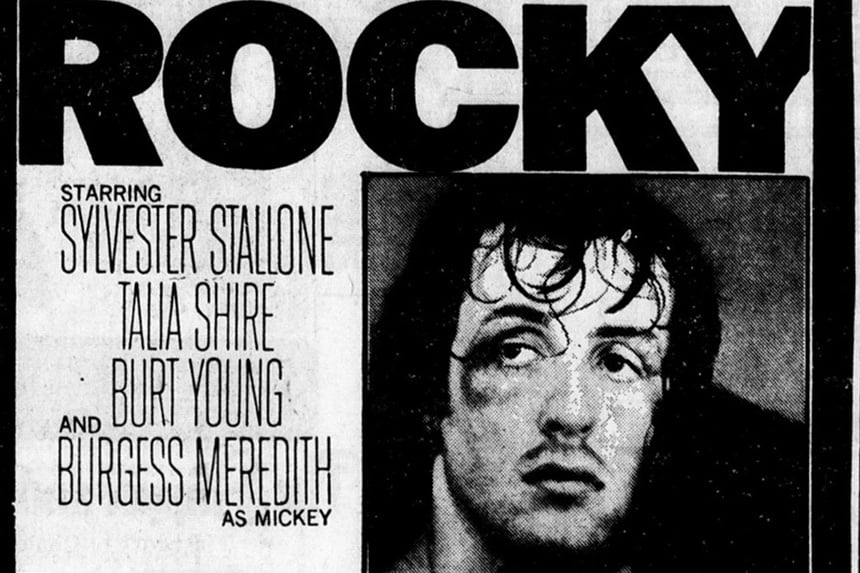
“It’s tempting to forget how good the original Rocky was,” wrote film critic Roger Ebert in 1985, in his review of Rocky IV, with its Cold War clash between Rocky and Soviet stooge Ivan Drago. On the eve of Rocky’s 50th anniversary, and with the release of the mythologizing and nostalgia-driven I Play Rocky hitting the theaters and Sylvester Stallone’s inspirational memoir The Steps hitting bookshelves, it is hard to escape – let alone forget – the cultural ubiquity of Rocky, with its familiar fanfare, iconic Philly steps, and 15 knock-down-drag-out rounds of boxing with Apollo Creed.
This year, there will also be a limited theatrical release of Rocky. I will get to see it on the big screen for the first time. In an age of handheld devices and endless home streaming services, it’s tempting to forget the intensity of images projected to larger-than-life dimensions. I cannot wait to sit alone in a room full of strangers, watching the letters R-O-C-K-Y pan across that screen and hear Bill Conti’s “Gonna Fly Now” theme reverberating within the four chambers of my heart.
It’s tempting to forget what that magnitude feels like.
I’ve watched Rocky dozens of times. I’ve written about it and I’ve spoken about it. Yet every time I sit down and watch it, I find something new and so much I have forgotten. Rocky becomes, for me, something akin to Heraclitus’s river – I cannot seem to watch the same Rocky twice. Although there is so much easily remembered, I find myself – like Roger Ebert – tempted to forget.
It’s tempting to forget that the movie opens on a shot of Jesus’s face, His hand extended in offering the Eucharist, a mural on the wall of the Resurrection A.C., presumably in the basement of a local Catholic church. In Stallone’s screenplay, the hall is said to resemble “a large unemptied trashcan.”
Rocky opening scene (Uploaded to YouTube by MaximRecoil)
It’s tempting to forget the fact that Rocky, which would go on to win the Academy Award for Best Picture (beating out stiff competition: All the President’s Men, Bound for Glory, Network, and Taxi Driver), was initially dismissed by many critics. “It’s as if Mr. Stallone had studied the careers of Martin Scorsese and Francis Ford Coppola,” quipped Vincent Canby in the New York Times, “and then set out to copy the wrong things.” Stallone himself was nominated for two Academy Awards: Best Screenplay and Best Actor, a rare combination only achieved twice before him, by Orson Welles and Charlie Chaplin.
It’s tempting to forget how quickly the movie was filmed, the crew often shooting without permits, a fact that accounts for the emptiness of the Philadelphia streets. Budget constraints and forced errors helped shape the movie’s visual vocabulary by imbuing scenes with darkness, isolation, and social distance. When they couldn’t afford extras, they re-wrote Rocky and Adrian’s date to take place in an empty ice skating rink. Later, when Rocky sees his poster hanging in the stadium before the fight, he comments to the promoter that the shorts are the wrong color. “It doesn’t really matter, does it?” the promoter replies. The mistake was made in real life, however, and the filmmakers simply worked it into the script. The same is true when Rocky comments that his robe seems baggy while walking to the ring; producers had ordered the wrong size. Film critic Pauline Kael decried John G. Avildsen’s “strictly-from-hunger” direction of Rocky, calling him “a poor man’s Sidney Lumet.”
It’s tempting to forget the bad jokes Rocky tells Adrian. He rehearses nervously in the mirror the night before. After he delivers the joke, he tells a much better one, unrehearsed and likely unintended, when Gloria, the pet shop manager, scolds him for shoplifting a jar of turtle food. Rocky retorts absentmindedly, “Crime don’t pay, Gloria. You know that,” unaware perhaps of the layered humor of his pun.
Rocky talks to Adrian in the pet shop. (Uploaded to YouTube by Recently Viewed)
It’s tempting to forget Jimmy Gambina, a real-life boxing personality, who played Mike, the idiosyncratic assistant to trainer Mickey. When Rocky says “Whaddya deaf?” he responds, “No, I’m short.”
It’s tempting to forget we meet Paulie combing his hair in a dive bar bathroom. “I’d like to kill the jerk who broke the mirror,” he laments. This is a pattern for Paulie – blaming someone else for his own questionable behavior and choices (who insists on combing their hair in such a dive, anyway?). Rocky sets a pattern here as well. He brings in a bottle of beer and wordlessly pours Paulie half a glass, which Paulie accepts without acknowledgement. The message is clear: Rocky is a giver, Paulie is a taker. You can see it in the way Paulie pushes the hanging sides of beef in the freezer box of the meat packing plant, only ever pushing that which cannot push back. It’s Paulie who punches the meat first, and Rocky only follows suit in an effort to prove that he too has frustrations and unspoken problems, same as his friend. After the big fight, when Rocky is crying out for Adrian, it is Paulie who finally redeems himself by distracting the ring security guards while discreetly lifting the ropes so she can climb through.
It’s tempting to forget that when Rocky is invited to Thanksgiving dinner, he tells Paulie that he and his turtles (Cuff and Link) ate Spam the year before. Stallone kept the turtles and featured them once again in 2018’s Creed.
It’s tempting to forget the chaos of Rocky’s bachelor apartment. There are beer bottles stuffed between couch cushions and knives plunged into the walls (which Rocky repurposes as hat racks). He drops ice on the floor that he doesn’t pick up, and the menu he offers Adrian (soda, doughnuts, a couple of cupcakes) is equally chaotic. In the screenplay, she is taken aback by “the bleakness” of the room.
It’s tempting to forget that when Rocky takes Adrian out on a date, he pressures her into coming up to his apartment. It’s a testament to the film’s character development that we, the audience, trust Rocky in these fraught, personal moments. Inside the apartment, he pressures her to sit with him, to stay when she asks to leave. He corners her near the door, and we are acutely aware of the physical difference between the boxer Rocky and the mousy Adrian. And yet with 50 years of feminist discourse on consent and the Me Too movement, we are still able to trust Rocky because we have seen his kindness, his empathy, and his disinclination toward violence.
It’s tempting to forget that the offer for Rocky to fight Apollo Creed comes almost a full hour into the movie, almost exactly its halfway point. When Rocky is offered the fight, he initially turns it down. He knows he doesn’t deserve the fight, and we never hear him say yes; his assent is given off screen, in a hard cut between Rocky overwhelmed in the promoter’s office and Rocky overwhelmed on television, appearing with Creed in a press conference.
It’s tempting to forget that Rocky, Adrian, and Paulie watch the press conference on television. As they watch, each one holds a single prop. Rocky holds a knife, symbolically phallic and violent, but which he uses only to slice an apple. Paulie holds a beer can, caressing it almost obsessively before crushing it into a pile of other cans on the table next to him. Adrian keeps a tea cup and saucer balanced on the arm of the couch, effeminate, domestic, and stable.
Rocky, Adrian, and Paulie watch the press conference on TV. (Uploaded to YouTube by Recently Viewed)
It’s tempting to forget that just as Rocky accepting the fight comes at the movie’s halfway mark, Rocky sits halfway through a century of cinematic pugilism, 50 years preceding and 50 more following. The gritty realism of Rocky’s first half reflects the first 50 years of boxing cinema: hard-nosed noirs more focused on the losers than the champions, including The Champ (1931), The Setup (1949), The Harder They Fall (1956), Requiem for a Heavyweight (1962), and Fat City (1972). Much the first half of Rocky carries on from Fat City, picking up the mantle of the loser, the chewed-up and spit-out fighter, the leading man who echoes that famous line spoken by Marlon Brando in On the Waterfront: “I coulda been a contender. Instead of a bum, which is what I am.” After the Rocky franchise went into high gear, five movies in 14 years, the trajectory of the boxing movie genre would be forever altered to reflect the magic realism of Rocky’s second half. Boxing pictures remained star vehicles for actors and directors, but gritty noirs took a backseat to inspirational biopics such as The Hurricane (1999), Ali (2001), Cinderella Man (2005), The Fighter (2010), Hands of Stone (2016), and Bleed for This (2016). Million Dollar Baby, the Clint Eastwood 2004 adaptation of F.X. Toole’s short story collection, was the first boxing movie to win the Oscar for Best Picture since Rocky.
It’s tempting to forget that Rocky’s most enduring image – that of him ascending the steps outside the Philadelphia Museum of Art – actually happens twice in the movie. The first time comes after he drinks that cupful of raw eggs. He barely makes it to the top that first time, wheezing and holding his cramped abdomen in a shot so dark that his grey sweat suit is nearly indistinguishable from the stone itself.
It’s tempting to forget that Rocky did not invent the montage. Training montages had been a staple in boxing movies prior to Rocky, but never before had they been integrated so completely into the plot and theme of the movie. As Rocky makes his triumphal run through the Italian Market, they were still filming without a permit, the film crew making an unexpected spectacle of themselves. The extras, who were simply working the market or doing their shopping, stare back at the camera. They watch Stallone with wide eyes, inadvertently giving the perfect performance, signaling Rocky’s shift from a nobody into a somebody. When Rocky finally ascends the steps that second time, we – the audience – feel as though we are climbing alongside him.
Rocky’s training montage, including running through the Italian Market and ascending the steps at the Philadelphia Museum of Art (Uploaded to YouTube by Movieclips)
It’s tempting to forget what the film critic A. O. Scott wrote in 2010, regarding the release of The Fighter, that few genres are “more strictly governed by conventions – or enslaved by cliches, if you prefer – than the boxing picture.” Rocky makes a habit of twisting the genre’s cliches rather than merely reproducing them: Rocky’s resident gangster, Gazzo the loan shark, doesn’t want to fix the fight. Instead, he gives Rocky $500 to cover training expenses, asking nothing in return. He even promises to be there ringside.
It’s tempting to forget that just before the big fight with Apollo, one of the ringside commentators says it will be a battle between the caveman and the cavalier, a term pulled from the boxiana vernacular of half a century earlier. There’s plenty of other boxing slang in Rocky, such as when Rocky tells Creed’s people that he can’t fight the champ because he’s only “a ham and egger.”
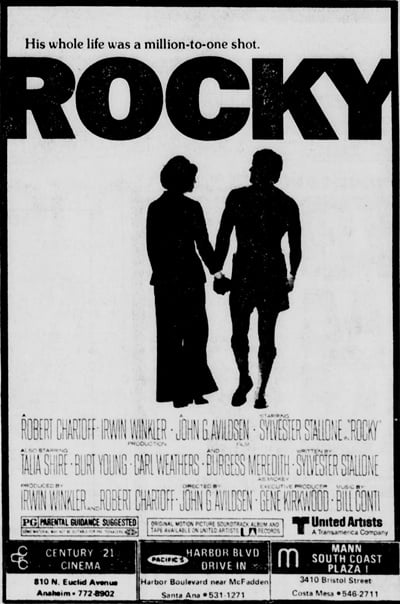
It’s tempting to forget that the original posters for the movie featured a shot of Rocky and Adrian holding hands with their backs to the audience, an image filmed as they walked from the ring where Rocky went the distance but lost the decision, an image not seen in the final movie, lost forever to the cutting room floor.
It’s tempting to forget so much, tempting to leave a movie like Rocky behind without a second thought, the main character written off as mere palooka, an undeserving subject for our attention, our fascination, our measured consideration.
I remember the old bromide: Those who forget the past are doomed to repeat it. Perhaps this is the temptation that led to the Rocky sequels’ increasingly flat and cartoonish presentation. They forget the depth of the first movie’s character study.
To remember is to resist the temptation to simplify.
Watching Rocky 50 years on, especially on the big screen as I plan to, is to seat ourselves in the half-light space between remembering and forgetting. The movie’s re-release has the opportunity to act as more than simple fan service; it becomes an occasion to challenge ourselves to sit once more before the familiar, to test our open eyes.
To remember better.
Become a Saturday Evening Post member and enjoy unlimited access. Subscribe now