Senior managing editor and logophile Andy Hollandbeck reveals the sometimes surprising roots of common English words and phrases. Remember: Etymology tells us where a word comes from, but not what it means today.
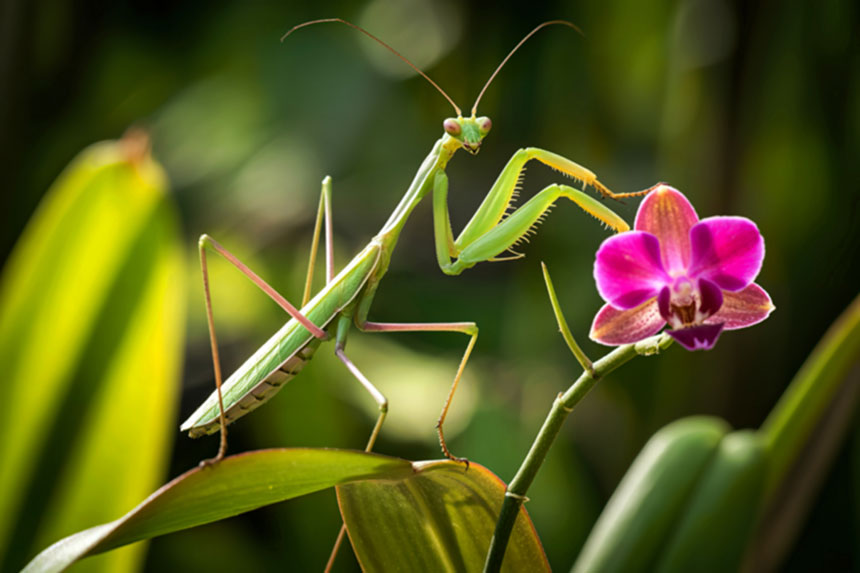
Though some people mistakenly believe that the creature pictured above is a preying mantis, perhaps because they know it to be carnivorous, it is, in fact, a praying mantis, a name from the latter half of the 19th century that is based entirely on its appearance. It’s called a praying mantis because it appears to be praying.
Praying mantis is most often used to in reference to the European mantis (Mantis religiosa), but all the species in the order Mantodea — the mantids — share to some degree the same look: a pair of front legs that appear folded in prayer. (In truth, they use those legs to hold their living prey while they dine.) Those legs are probably how the mantids got their name in the first place.
Mantis and mantid are both the result of New Latin, the Renaissance-era resurgence and expansion of Classical Latin that was used for scientific and scholastic work. It finds its roots in the ancient Greek mainesthai “to be inspired.” The ancient Greek word mantis described some type of elongated insect, but it also meant “seer, prophet, diviner”; some physical resemblance might have connected the latter with the former.
Mantis in the sense of a diviner also gave English — after making the journey through Latin and Middle French — the combining form -mancy, indicating some type of divination, foreseeing, or magic. It’s been a productive combining form, too. Here are just a smattering of the names humans have given for the many ways they have leaned on supernatural forces for information, or at least claimed they did, and the Greek roots from which they came:
- aleuromancy, divination by means of flour — from aleuron “flour”
- astragalomancy, divination by means of dice or bones — from astrágalos, which can refer to “dice made from the talus bones of hoofed animals,” “vertebra,” “the ball of the ankle joint,” or “molding at the top of an Ionic column.”
- chiromancy, palm reading, more often calmed palmistry these days — from cheir “hand”
- entomancy, divination by means of insect appearance or movement, what you would be doing if you used a praying mantis to tell the future — from entomon “insect”
- ichthyomancy, divining by means of fish, either their movement or their entrails — from ichthys “fish”
- necromancy, divination by conjuring the dead or the spirit of the dead — from nekrós “cadaver”
- oneiromancy, divination by way of dreams — from oneiros “dream”
- ornithomancy, divination by watching the flights of birds — from ornis “bird”
- pyromancy, divination by flame (stare into that campfire!) — from pyr “fire”
- rhabdomancy, divining with a rod or wand — from rhábdos “rod”
- stichomancy, divining by randomly selecting passages from a book — from stikhos “line, verse”
To add another level of depth, there is some weirdness with the Greek mainesthai, or maínesthai, depending on who’s writing it. I wrote before that it means “to be inspired.” Another way to put that is “to be touched by divine madness,” or, to take it a bit further, “to be out of one’s mind.” My sources aren’t in definitive agreement about whether the “inspired” and “insane” senses are the same word or two different words (maybe they’re homographs), but they agree that there is familial relationship there. And while one of them gave us mantids and -mancies, the other one gave us the combining form -mania.
And in a practical sense, there may be little difference between, say, a pyromancer and a pyromaniac.
Become a Saturday Evening Post member and enjoy unlimited access. Subscribe now