Senior managing editor and logophile Andy Hollandbeck reveals the sometimes surprising roots of common English words and phrases. Remember: Etymology tells us where a word comes from, but not what it means today.
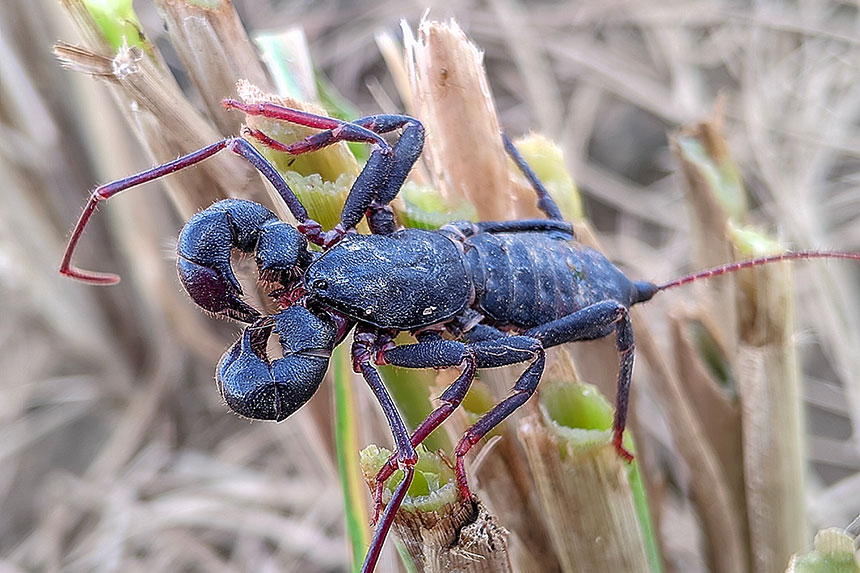
It being Halloween time, I had originally planned to write about creepy eight-legged creatures in general. While researching, I learned about the vinegarroon, and a part of me wishes I hadn’t. The creature looks like something out of a sci-fi horror movie. But there is so much etymological goodness in the creature’s various names that I thought it deserved its own column.
Before we get to the language, a bit about the animal itself: The vinegarroon is not a true scorpion, but it resembles one in that it has eight legs and two pincers. But instead of that arching tail with the scary stinger, it has a thin, whip-like tail. This is why it’s also known as a whip scorpion.
At the base of that tail is a gland that, when the animal feels threatened, sprays acid!
Before you get too amazed: It sprays specifically acetic acid. Acetic acid is the active ingredient in vinegar, though the vinegarroon’s version is about 15 times more concentrated than what’s in that jug under your kitchen sink. It’s harmless to humans (I wouldn’t start adding it to salad dressings, though), but it does a decent job of clearing the area of other pests.
That acetic acid spray smells like vinegar, which is how the creature got its name: It’s from the Mexican Spanish word for vinegar, vinagra, with an augmentative ending, making vinagrón, which became vinegarroon in English. These words and vinegar all trace back to the Old French vin “wine” + aigre “sour.” Vinegar is wine that has gone sour.
Interestingly, that French aigre derives from the Latin acere “to be sharp or sour,” which is also the source for the words acetic and acid.
But there’s more!
Vinegarroons belong to the order Uropygi. (If you’re familiar with the term callipygian, you’re halfway to cracking this word.) The two halves to this word are New Latin — the Latin that arose in and for scientific and scholarly papers during the Renaissance — and both trace back to Greek. The uro- comes from ouros “tail” and the –pygi from pygē “rump, buttocks.” Uropygi is “tail-butt” — because it’s got a tail sticking out of its butt.
Vinegarroons are classified in the genus Thelyphonus. Thely is Greek for “female.” Though phonus looks a lot like it’s from the Greek phōnē meaning “sound, voice” — which shows up in words like telephone, francophone, and saxophone — this is actually from phonos, which means “murder.” Thelyphonus breaks down to “woman-killer.”
I haven’t been able to figure why or how these critters ended up with that name. Perhaps they recognized that they had a future in horror and simply found a really good publicist.
This Halloween, may your dreams be haunted by tail-butted woman-killing big-sour-wine creepy crawlies.
Become a Saturday Evening Post member and enjoy unlimited access. Subscribe now