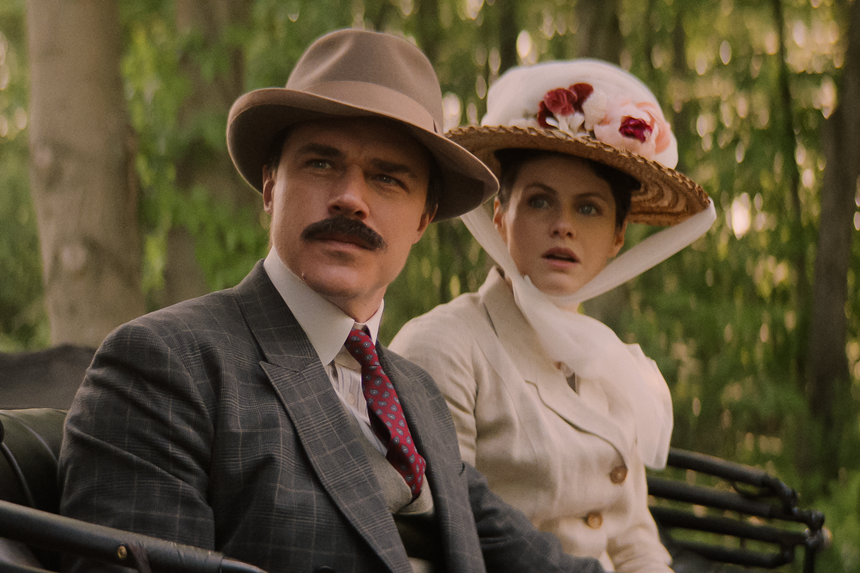
Hershey
⭐️ ⭐️
Rating: PG
Run Time: 1 hour, 50 minutes
Stars: Finn Wittrock, Alexandra Daddario
Writers: Bubba Fulcher, Will Hardy, Timothy Michael Hayes
Director: Mark Waters
Biographical movies seldom succeed when the keepers of the subject’s legacy are breathing down the filmmakers’ necks – and that is certainly the case with Hershey, a blandly flavored trifle that manages to turn one of the 20th century’s most extraordinary lives into a Parents’ Day Pageant of barely-sketched-out episodes.
There was good reason to expect more of this biography of World Champion Chocolatier Milton Hershey, who rose from abject poverty, failed spectacularly at numerous businesses, then hit upon an economical candy formula that brought chocolate – formerly a rich-folks-only extravagance – to the masses.
Director Mark Waters previously crafted the ingeniously twisted House of Yes and the edgy modern classic Mean Girls. Milton is played by the charming Finn Wittrock (American Crime Story), and White Lotus Emmy nominee Alexandra Daddario costars as Hershey’s beloved and inspiring wife, Kitty. The supporting cast is first-rate, including the always-welcome Richard Kind (Only Murders in the Building) as a jovial candy maker and Alan Ruck (Succession) as Hershey’s absentee dad.
Still, every step of the way, their efforts are undermined by a maddeningly superficial script by a trio of newcomers who seem to have labored in the shadow of the Hershey estate which, according to the estate’s website, collaborated “to ensure an authentic portrayal of Milton’s life.”
Uh-oh. Minute to minute, one can sense the writers pulling back from possibly conflicted moments, hearing whispers of “Oh, Milton would never say that…” or “Kitty would never complain about this…” hissing in their ears.
So, in this telling, Milton’s early, numerous failures can only be the result of his unbridled, ahead-of-its-time genius. There’s not a reluctant lender whose rejection cannot be reversed by a taste of Hershey’s candy. The fact that Milton goes years and years without noticing that his doting wife is regularly collapsing in mind-bending pain is chalked up to his jaunty focus on the future. Time and again, the movie version of Hershey stoically refuses to cut his workers’ hours or salaries – despite the unmentioned fact that in 1937 a riot ensued at the factory after he did just that.
Even Hershey’s most socially consequential accomplishments – building an entire, picture-perfect town around his factory and establishing a boarding school for orphans – are seemingly accomplished simply by Hershey saying, à la the late Patrick Stewart, “Make it so.”
Unfortunately, the inevitable road bumps to each goal – the conflicts that would give the movie weight – are here wished away. Was everyone really thrilled with living in a town – even a very nice one – where there was no elected government and the Boss ruled by fiat? History tells us no; in fact, resentment among Hershey’s residents at times ran deep. A scene or two of Hershey struggling with that reality would have done justice both to him and the people who worked for him.
Similarly, in one scene, Milton and Kitty encounter a couple of orphans on a street corner – in the next they’re hosting an army of them on their mansion’s veranda, welcoming them to their new home and school. In reality, Hershey, who had only a fourth-grade education, faced fierce opposition to his unusual family-style orphanage/school plans, and at first could attract only four or so students. (The laudatory scroll at the film’s end fails to mention that Hershey’s school, established specifically for “poor, healthy, white male orphans,” didn’t admit minority children until 1968.)
I’m not insisting that a family-friendly depiction of a famous figure has to be a warts-and-all affair. But everyone’s life is at least a little messy. Complications arise. Previously held assertions must be confronted. Even a madly in-love couple can find themselves approaching problems from different perspectives.
The simplified narrative of Hershey is so linear it’s as if each chapter exists in a vacuum – Milton’s awful childhood almost certainly informed his decision to help disadvantaged boys – but here he doesn’t seem to give the matter a single thought until his chance encounter with two plucky orphans (and, yes, in the world of Hershey all orphans seem to have inherited the Little Orphan Annie “Sun’ll come out tomorrow” gene).
The thing is, in the movies – as in real life – while complications may not be totally welcome, they are in the end what make a story interesting. When your hero is on a single-minded rocket to success and he’s always right about everything and he never experiences a moment of ethical conflict and everyone around him just nods all the time and marvels at his prescient genius, that’s not a film biography, that’s an episode of Dudley Do-Right.
By the time Hershey reached its final shot – a silly image of the old man in a Colonel Sanders suit, his feet dangling from the same impossibly high, clumsily rendered CGI water tower on which we met his childhood version two hours earlier – I was less inspired by the real Hershey than sorry for him.
Milton Hershey led a life that was anything but boring. But this too-timid movie somehow made it so.
Become a Saturday Evening Post member and enjoy unlimited access. Subscribe now



Comments
Usually when critics rank a movie low, it means it was up to their specific taste. I’m gonna see this movie for myself and form my own opinion.