Brad Wallis is apologizing for the night sky.
“We’ve had some high cloud cover and also quite a bit of smoke from the wildfires,” says Wallis, referring to a persistent patch of blazes that have been popping up south of where we stand, on a flat mountaintop just outside of Ridgway in Southwest Colorado. “So for the past week or so, the night sky has been kind of obscured.”
“It’s the dry lightning strikes,” agrees his friend Geoff Tischbein. “They really wreak havoc when you have the kind of dryness we’ve been experiencing. It’s too bad.”
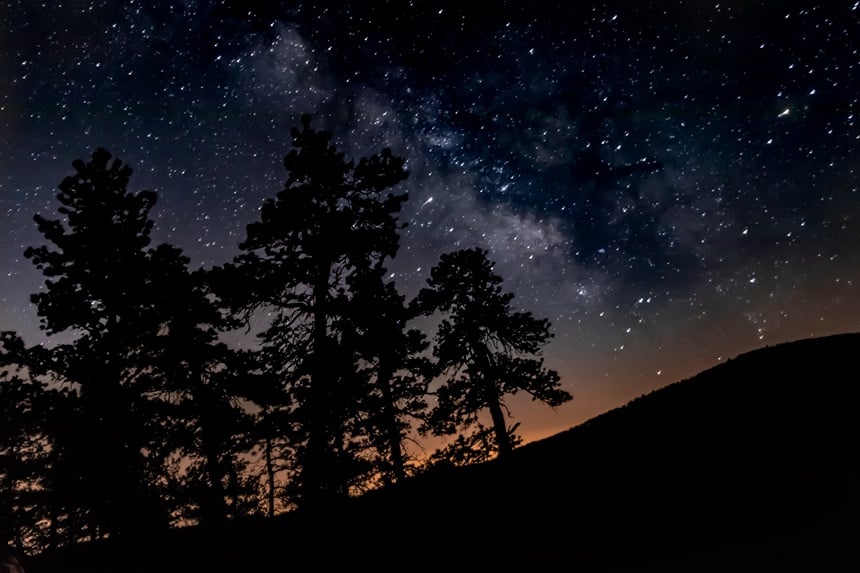
Meanwhile, I am rendered speechless by the canopy of stars that hangs above us, a sparkling spectacle the likes of which I have not witnessed in years. I live in southern Delaware, which is still largely farm country. But even there, upward-pointing lighting has rendered the night sky largely a “greatest hits” album of familiar constellations, brighter planets, and the phasing moon.
Here, expanses of sky that in the eastern U.S. would be dark spaces have been filled in with what looks like glitter on black felt. They say that on the darkest night, the maximum number of visible stars is about 10,000. But tonight, on this Colorado mountaintop, that seems like a severe undercount.
“It could be better,” says Brad.
“Not bad,” adds Geoff, as the path of the Milky Way dimly emerges. “But some nights…” and he runs out of words.
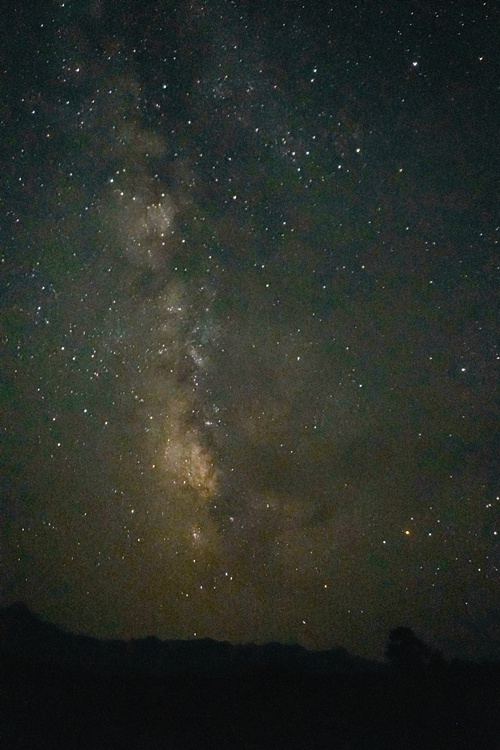
Raised in too-well-lit northern New Jersey, I have been obsessed with skies like this since childhood, when a family vacation to a remote Canadian lake revealed to me just how glorious the dome of the universe can be. But over the ensuing six decades, my life has been marked by one bitter night sky disappointment after another: long flights and drives and occasional hikes to remote spots “guaranteed” to provide a Panavision sky show – nearly all of them dampened by unexpected clouds, invasive “light domes” from cities closer than I thought they’d be, or blazing, starlight-absorbing full moons (admittedly, I should have checked a lunar phase calendar before heading out those nights).
The trouble with hit-or-miss attempts like that: If you stick around in one locale waiting for the view to improve, after a day or two you will inevitably run out of things to see and do while the sun is shining. So, for this trip I have devised what I believe to be the closest thing to a sure-fire stargazing itinerary: Over five nights in southwestern Colorado, one of America’s darkest regions, I’ll trace an arc of five stargazing destinations, each a very different kind of place with its own unique appeal. This way, even if I get skunked every single night by bad conditions, at least my days will be filled with new discoveries.
Night 1: Ridgway
I’ve flown into Montrose, Colorado, just beyond the western flank of the San Juan Mountains, the northernmost point of my trip. It’s a 40-minute drive south to Ridgway, along the wide valley called Uncompahgre, past collections of loitering cattle and rows of planted pinto beans and onions. Ridgway proper is an appealingly touristy ranching town, its chief claim to pop culture fame being John Wayne’s home in his Oscar-winning movie True Grit (posted around town are permanent signs directing visitors to sites from the movie, most notably the train depot, where you can still see the barred “jail wagon” created for the film).
Just a few feet from my hotel – the Chipeta Lodge Resort, a cozy inn with spectacular mountain view hot tubs – spreads Hartwell Park, in the center of town. It’s a gloriously green expanse shaded by towering cottonwood trees, many of them planted on Arbor Day, 1892. This happens to be the weekend of the Ridgway Rendezvous Arts Festival, and artists from Colorado and beyond are patiently manning canopied booths of their works.
Given my nighttime mission here in Ridgway, I’m drawn to a framed paper collage of a gray mountain range thrusting upward into a blanket of five-pointed stars. I mention the significance of the piece to the artist, Kris Batchelder, and she laughs.

“I use stars all the time. I love stars,” she says, guiding me from one collage to another: stars above a trailer home by a river…stars above a cowboy in his duster…a winged buffalo soaring through a sea of stars.
“Stars, stars, stars,” she smiles. Batchelder grew up in Colorado. For her, like so many people here, the night sky is as much a part of the landscape as the mountains and the streams.
My eye is drawn to a collage hanging above the rest, of a woman standing under a star-strewn sky, naked from the back except for a pair of cowboy boots (don’t judge me).
Batchelder laughs. “For me,” she says, “that sort of represents all those nights camping in the wilderness when you have to get up in the middle of the night, but you can’t be bothered digging through your tent in the dark for your clothes. So, you just throw on your boots, head out – and after a while you just find yourself standing there, entranced by the starry sky.”
Because Ridgway has laws that require darkness-friendly lighting, the locals are used to walking home at night under a splendidly starry sky. But if they really want to immerse themselves, they drive up an old logging road to Top of the Pines. At about 8,500 feet elevation, this former Girl Scout camp is now a protected dark sky county park, operated by a nonprofit group headed by my new friends Brad Wallis, the chairman, and Geoff Tischbein, the vice-chair.
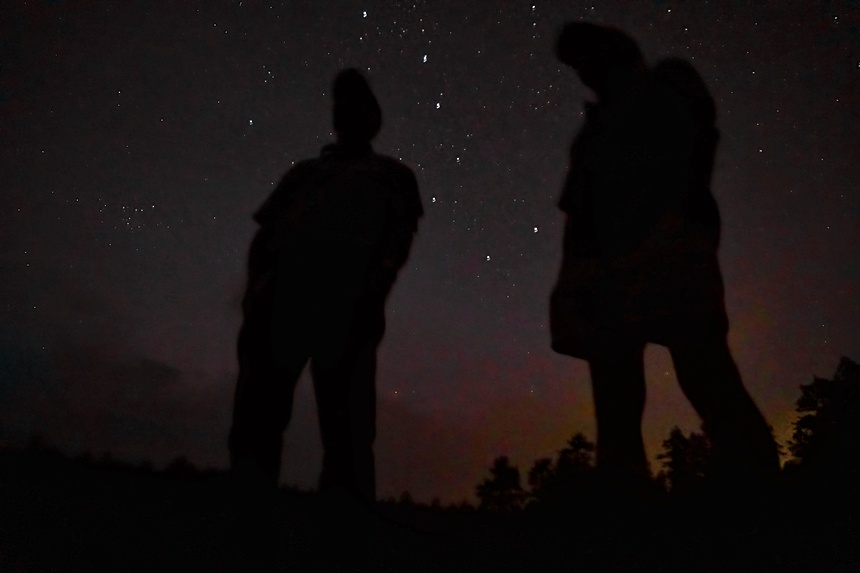
The three of us have picked our way to the center of a wide, oval meadow, which during some months of the year is filled by a spring-fed pond watched over by ponderosa pines. On this night the ground is dry, the air is cool, and the stars and planets – beginning with ever-bright Venus to the west – are coming into view. Despite their misgivings regarding the smoke-smudged sky, they fall into the same reverential silence I’m gripped with.
We talk to pass the darkening minutes. About the world’s vanishing stars. About satellites obscuring the view. About how people in general need to stop looking down at their phones and, instead, up at the sky.
And then, like a rising column of white smoke, it appears: the Milky Way, our home galaxy, rising over the silhouetted peak of distant Whitehouse Mountain.
“I’m a little surprised,” says Wallis. And then we say nothing.
Night 2: Gunnison National Park
I’m just a few miles from the entrance to Black Canyon of the Gunnison National Park, east of Montrose, when I’m compelled to pull over at the sight of what seems like a downtown lifted from a 19th century daguerreotype: a white wooden church, a log cabin mercantile, a one-room red schoolhouse, a proud-looking Second Empire house, the kind rich immigrants built out here to remind themselves of life in the Old Country.
The place is called Adobe Flats, but this is no organic western town: It’s a fanciful name adopted by the Museum of the Mountain West for its 6-acre conglomeration of 28 historic buildings brought here by the museum’s founder, Richard E. Fike.
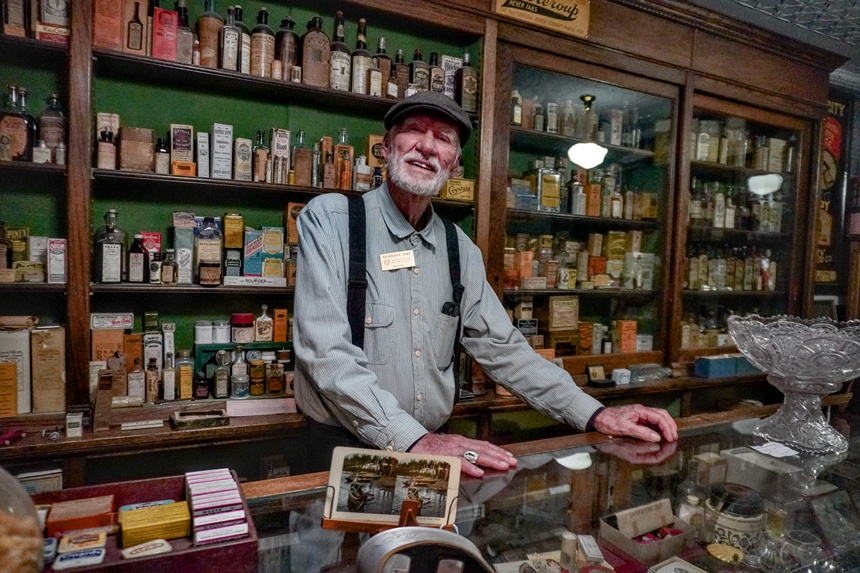
“I had my first museum when I was 8,” says Fike, a career archaeologist for the U.S. Bureau of Land Management who retired in 2003 and has devoted every minute of his time since then preserving and collecting relics of the West’s vanishing history.
“Everybody who comes in here is fascinated by the place,” says Fike, sitting behind the desk of his artifact-crammed office. “Just today we’ve had two busloads.”
He leads me out of the office and takes his place behind the fully-stocked counter of the circa 1890 Furman Drug Store, framed by boxes of Peacock’s Bromides, Decker’s Mineral Water Crystals (“from Texas”) and Climax Castor Oil. Standing there in his black suspenders and brimmed cap, Fike seems completely in context.
“There are something like 400 museums in Colorado,” he says with stirring conviction. “And I’ve been told this is one of the top 10!”
By the time I reach the visitor’s center of Black Canyon of the Gunnison National Park, the darkness is nearly total. But it’s still easy to pick out Bryan Cashion, president of the Black Canyon Astronomical Society, and his impressive-looking Celestron telescope.
Cashion has set up shop just outside the now-closed visitor center, and inevitably his contraption has drawn a small crowd of stargazers.
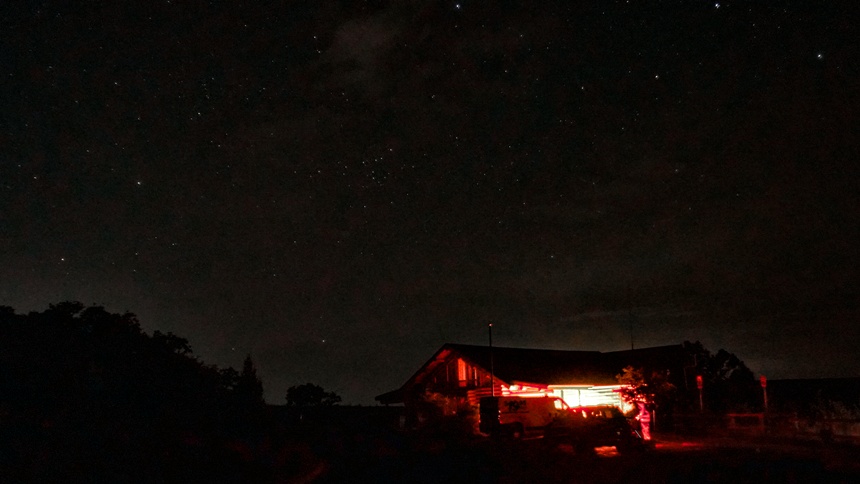
“Gunnison has been a dark sky park since 2015,” he says. “Right now, Dark Sky International lists about 200 dark sky locations around the world, like this one.”
We are right now at around 8,000 feet in elevation. Just a few yards from here, invisible in the dark, a nearly sheer cliff plunges 2,700 feet to the Gunnison River. From the back porch of the visitor center, I can see the rolling line where the starry sky meets the opposite canyon wall. If I listen carefully, I can hear the river’s rapids rushing below.
There are patches of cloud above, providing a dramatic frame for the stars behind them. The Milky Way plays hide-and-seek among them, dipping beyond the roof of the visitor center, whose security lights softly glow red so as not to blind stargazers.
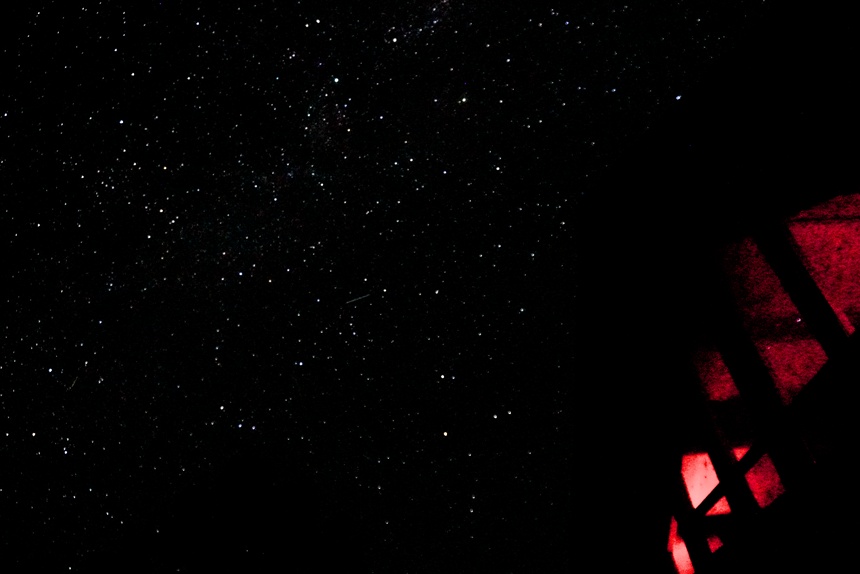
When I return to Cashion and his telescope, he is surrounded by a family consisting of two parents and – I’m not kidding – 11 children. They have all just tumbled out of a large van. All are lined up for a peek at a nebula through the Celestron.
Cashion smiles at me and shrugs. This happens all the time. But I’m not really here to look through a telescope, anyway. The Gunnison night sky, streaked by racing clouds or not, is best appreciated as a widescreen spectacle.
Night 3: Lake City
A sudden rainfall is slapping the tin roof of Jacqui Wonnacott’s patio, making it a little hard for us to hear each other as we sit there on this humid afternoon.
“The way it works here,” she says, “it rains like this for about an hour, then it stops, and then you go about your day.”
Wonnacott is the manager of G&M Cabins, where I’m spending the night, and where I am experiencing what it was like to be an early-adopter motor tourist in the 1930s. That’s when “auto camps” like this – clusters of individual rental cabins – flourished. Lake City is home to more than a few of those remnants of early auto tourism, lined up along Gunnison Avenue on the way to 11,300-foot-high Slumgullion Pass, where tonight I’ll visit a popular stargazing party, sponsored by the Lake Fork Valley Conservancy and led by local astronomer Phil Virden.
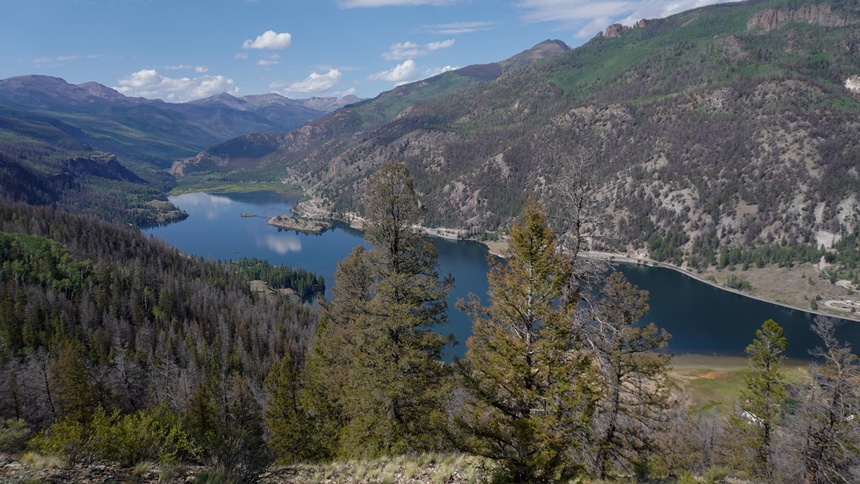
But first I’ll take a drive around nearby Lake San Cristobal – the lake that gives the town its name. About 850 years ago, this lake did not exist. Then a slow-moving landslide rolled across the Gunnison River, blocking its flow. The land is still moving around here: Atop the original slide, another mass of land crawls about 23 feet downhill every year.
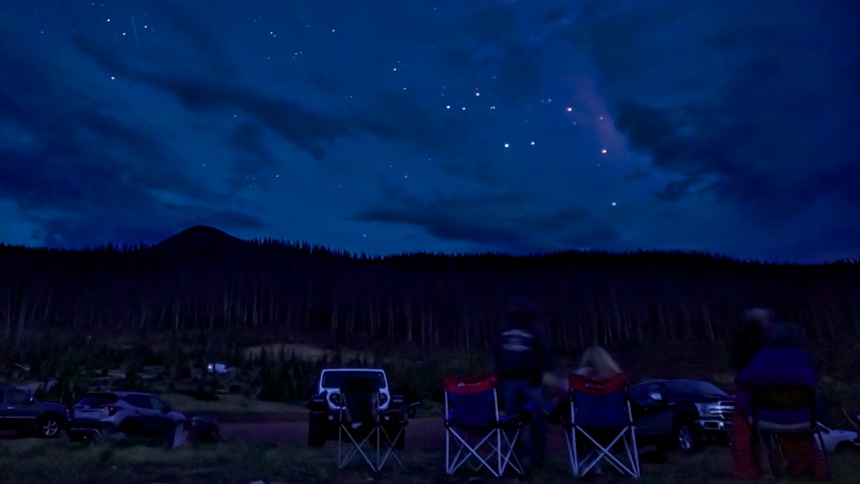
It’s unusually cold for August, and a brisk breeze is zipping through Slumgullion Pass. Still, a dozen or so hardy stargazers have assembled here in their folding chairs to hear Phil Virdon narrate the night sky. A natural showman, Virdon – a longtime Lake City real estate agent – opened the region’s only movie theater, the Mountaineer, in 1975. He introduces every screening, conducts regular in-theater raffles – and brings similar enthusiasm for astronomy to his frequent stargazing events.
Tonight there’s a special attraction: The annual Perseids meteor shower is at its height, and Virdon’s usual guided tour of the constellations, nebulas, and galaxies is occasionally punctuated by exclamations of “There’s one!” followed by the turning of heads and the groaning realization that the meteor has already vanished from view.
“Just go ahead!” he laughs, his voice deadened in the echoless night air. “Yell it out! That’s fantastic!”
Earlier, over dinner at Lake City’s Climb Eatery, across the parking lot from his theater, Virdon told me, “Stargazing is an experience that goes beyond sitting under the stars.
“When I wake up after a night of stargazing, all of life seems different. A hummingbird is extra special. I remember that we are all part of this incredible universe; a trillion galaxies, each with billions of stars.
“That kind of realization can’t help but change you.”
Night 4: Great Sand Dunes National Park
A 30-square-mile expanse of drifting sand – stopped in its windblown tracks by the wall of the Sangre de Cristo mountains and forced to pile up in mounds topping 700 feet – Great Sand Dunes National Park and Preserve is a natural stargazing spot. Every night, the dunes are dotted with astronomy enthusiasts, some lying on blankets, others bent over their telescopes.
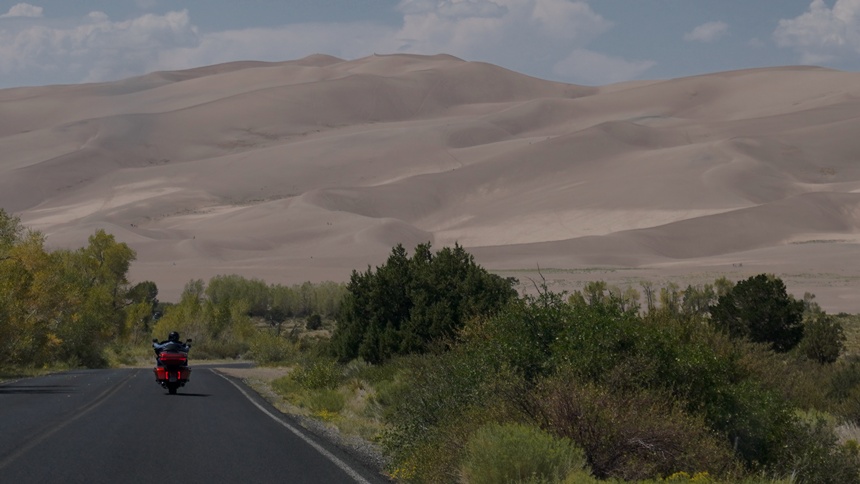
From my vantage point – the place I’ll be staying tonight – the dunes are a long, tan ribbon at the foot of the mountain range, about 10 miles to the east. And this spot will do just fine, thank you – seeing as I’m gazing through the transparent hemisphere of a one-room dome cabin.
Dune Glamping is a collection of four generously spaced geodesic domes, each one outfitted with a comfy large bed, complete plumbing, an outdoor soaking tub, and an unbeatable through-the-wall vista of sand and sky.
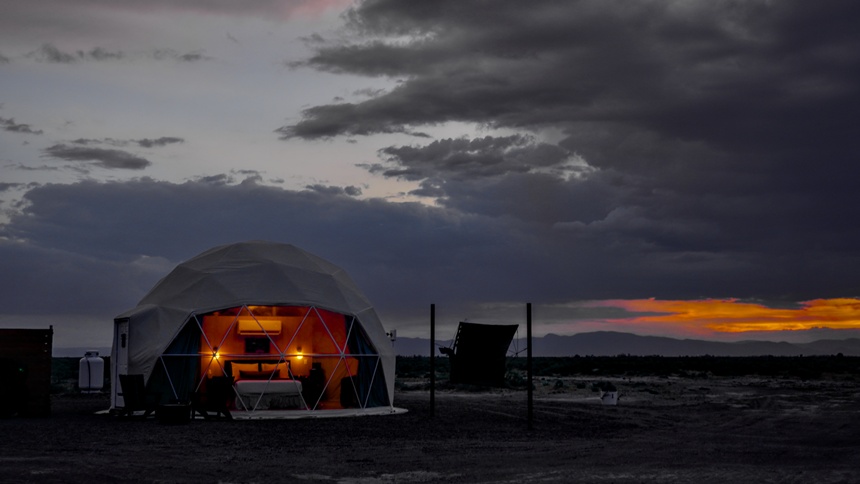
Awakening here in the middle of the night, the sense is akin to finding myself having bedded down in an open garage on an asteroid. I cannot resist the urge to venture outside and fill that tub with hot water. Soaking there in the dark a thought occurs to me: I know exactly how that cowgirl felt in Kris Batchelder’s collage.
The rising sun pours through the dome’s front, and it’s time to brazenly don my I-don’t-care-if-it’s-tacky-I’m-a-tourist hat. I drive a few miles north to, no kidding, Colorado Gators, a roadside attraction that would seem more at home somewhere near Orlando, Florida.
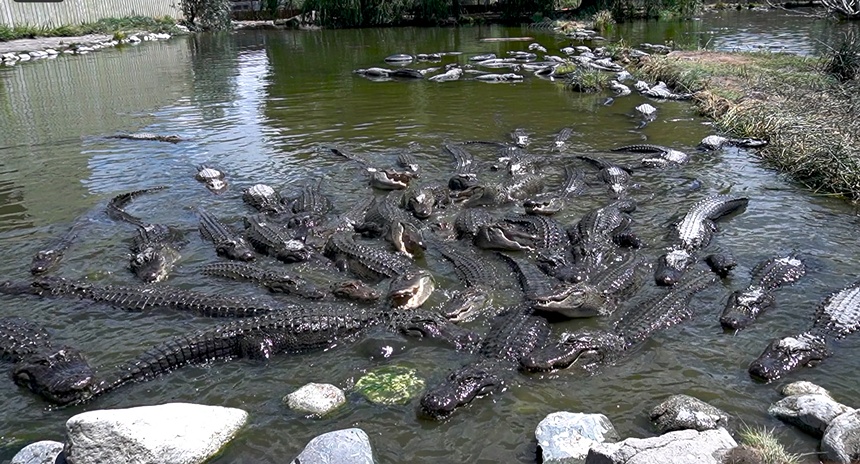
The helpful young man in the gift shop explains it all to me: In the 1970s, this was a thriving tilapia fish farm. Too thriving, in fact: The farm hatched so many fish, supply outpaced demand, and the owners needed to do something about that.
“So, they brought in alligators to eat the fish,” the clerk tells me. “And people started coming here to watch.”
Besides sating gator/fish bloodlust, the farm became a gator rescue center, as people who had repented of the notion that alligators make excellent pets started dropping them off. Today, hundreds of enormous gators ply the farm’s numerous ponds, eating fish and also pellets of gator food that visitors can buy.
Driving south on State Route 17, I’m feeling like there could be no odder attraction out here than Colorado Gators. I am, of course, wrong: I catch a glimpse of a bald, saucer-eyed, gangly limbed space alien waving from the roadside. Veering to the right, I pull down the gravel drive to the alien’s home base: The UFO Watchtower.
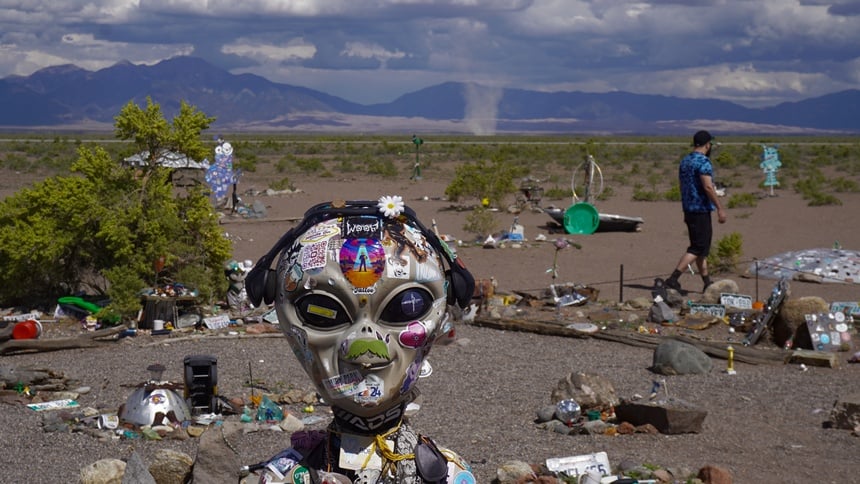
The concept behind the watchtower – actually a yellow, raised metal viewing stand with a gift shop/museum downstairs – is simple: Bring your most outlandish beliefs regarding aliens, psychic vortexes, and paranormal activity onto these grounds without fear of judgment from anyone. Then just wait to see what happens. Up on the platform and down in the shop, there’s an undeniable buzz of excitement among the visitors.
I don’t have time to linger at the Watchtower, but I do take a moment to wander through the “Famous Healing Garden,” a barren patch of rocks and trinkets left behind by visitors: license plates, dolls, toys, disco balls, beads and bumper stickers…you name it. There’s an undeniable vibe of expectation here – magnified on this day by the sight of a tall, swirling dust devil spinning across the desert a mile or so away. Vortexes, indeed.
Night 5: Brown’s Canyon
On the last night of my stargazing odyssey, I will sleep in a transparent tent on the bank of the Arkansas River, just outside the river town of Buena Vista. First, though, I will see the river up-close, on a raft trip through one of America’s newest national monuments, Browns Canyon.
“Do you want to paddle or do you just want to ride?” asks my guide, Travis Hochard, who is also the general manager of River Runners in Salida. I sheepishly explain that, in my experience, with a paddle in my hand I tend to do more harm than good. He smiles understandingly.
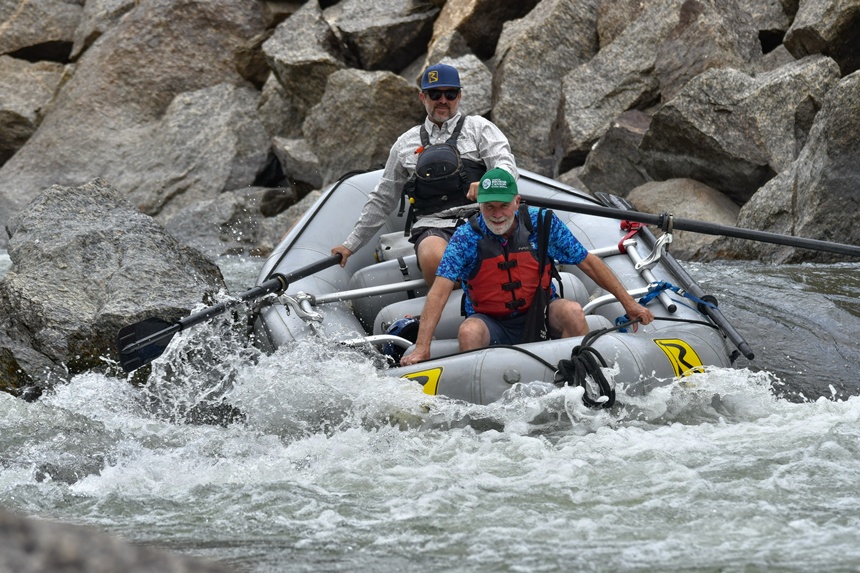
Thanks to its easy access and dramatic 3,000-foot cliffs, Browns Canyon is one of America’s most popular whitewater rafting destinations. On this day, though, with late-summer water levels low and most kids back in school, Hochard and I pretty much have the river to ourselves. Our splashy trip through the lower half of the canyon speeds by so quickly we reach the pull-out point before our driver arrives.
Bill Newcott rafts the Arkansas River with River Runners in Salida, Colorado.
After a quick dinner at Deerhammer Distillery in Buena Vista (trust me, the half-order of fish and chips is sufficient), I head a few miles south, cross the river, and follow a narrow gravel road to Ruby Mountain Campground. Waiting for me there is Joe Bissonnette, standing with notable pride next to a pup tent-like shelter.
Bissonnette lives in Buena Vista, where he runs an outfitting shop – and where he sells his remarkable invention, a tent that he calls the Sky View.
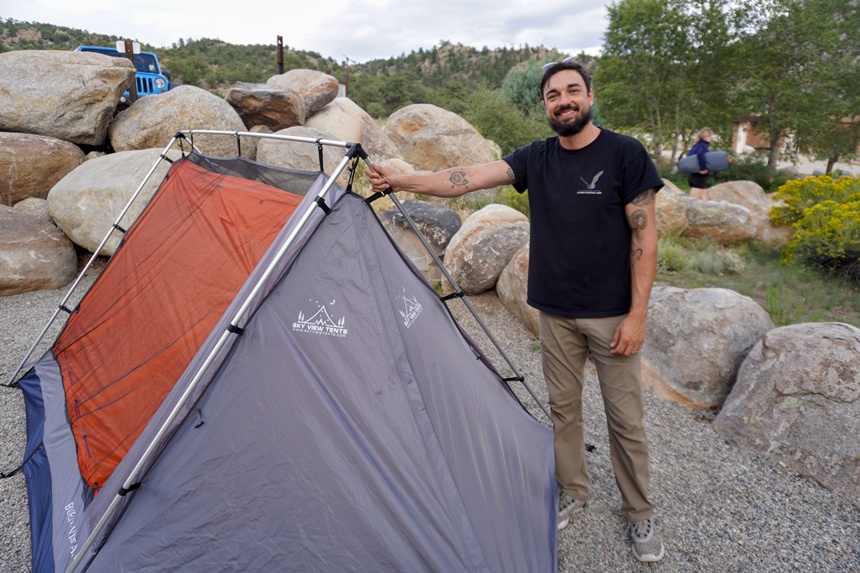
“I wanted to create a tent for stargazers, one that they could see through all night but could also button down if it started to rain,” he tells me as we sit in folding chairs, sipping beers as the Arkansas gurgles below. “There just wasn’t anything like this out there.”
Bissonnette came up with a solution that is, essentially, one tent inside another. The outer one is made of a super-fine nylon mesh that, when viewed from the inside, is virtually invisible. Inside that is a more traditional waterproof fabric tent that remains stowed out of sight at the head end. Should a camper wake up at night feeling those first few drops of rain, they can simply reach up, pull the solid tent forward, fasten a few hooks and, voila! The rain stays out where it belongs.
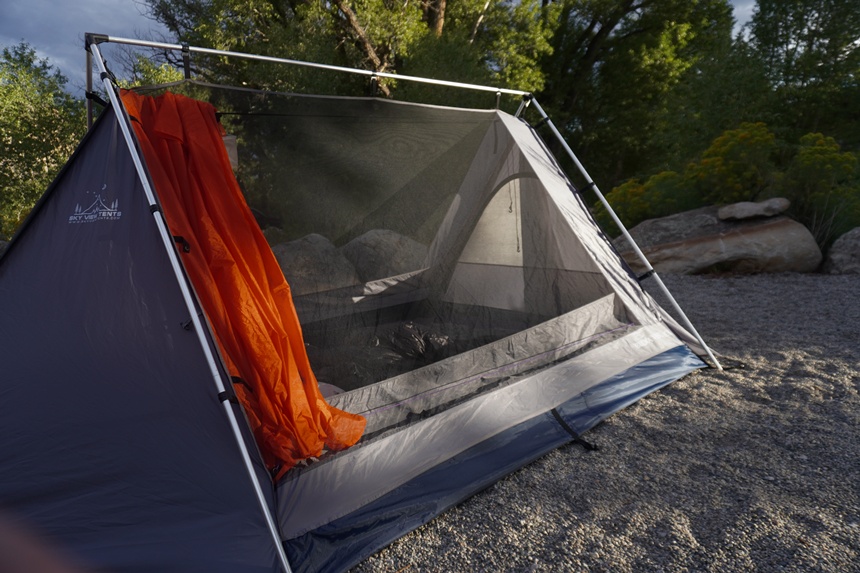
Bissonnette bids me goodnight and heads home. The thing about camping in a spot where cell service is spotty at best is there’s not much to do after dark but go to bed. I lie there on my back, tracing imaginary lines among the patterns of stars, thrilling at the occasional streak of a meteor, discerning between the sounds of the river below and the wind through the trees around me. I drift off. Occasionally, I open my eyes to what seems to be an infinite planetarium.
I don’t know what time it is when I feel the first raindrop. But I know what to do. I reach up. The inner tent slides into place like a manual sunroof. The hooks engage without a hitch. I lie back down, and in a few moments the light patter of rain becomes the sound of a firehose.
Dry and content, I’m lulled back to sleep by the white noise of a downpour.
I came to Colorado to fool-proof my search for a clear night sky. And here, on my last night, the rain has finally arrived, as if to affirm I’ve made all the right choices.
It was in the stars.
Become a Saturday Evening Post member and enjoy unlimited access. Subscribe now