
Fall Out of Favor
Some folks love autumn best of all. This writer begs to differ.
Some folks love autumn best of all. This writer begs to differ.
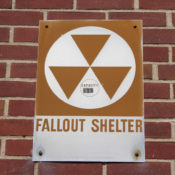
For years, the U.S. military claimed atmospheric fallout from bomb tests wasn’t particularly dangerous, but as a 1959 Post article made clear, that notion was dead wrong.
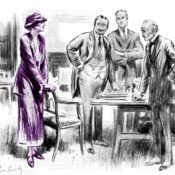
“Of course, they’re all dears, my family, but as fiction material there is nothing to them; no drama, you know; no color; just nice, ordinary, unimaginative dears.”

After a director and a writer teamed up on sports comedies, they turned to horror… and made history.

In the news for the week ending September 13, 2019, are lake monsters, space invaders, chicken kissers, cow babies, and much more.
A stranger asks for help, with a promise to return the favor.
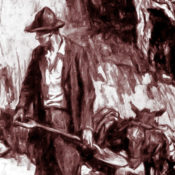
“When they put his first-born in his arms a strange nausea suffused this father’s frame and he handed the warm little bundle back to his sister hastily, as if it were hot.”

Professor Mulligan has been hiding his true identity for 60 years. The world may be ready for him to reveal his secret, but is he?
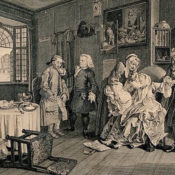
As the country struggles with a terrible opioid crisis, we remember a similar epidemic that raged through the U.S. in the 1800s.

How a self-described city slicker, who used to swat at anything buzzy, learned to love and appreciate the honeybee.
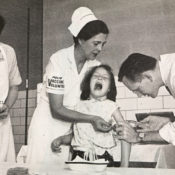
Since its earliest issues in the 1820s, The Saturday Evening Post has reported on the development of — and protests against — vaccines to prevent illness like smallpox and polio.

Jeff Buckley completed just one album before his untimely death, but it has proven to be a classic.
“Not a muscle of her face quivered. Her mouth didn’t even twitch at the corners. But two tears welled into her motherly gray eyes, trickled unheeded down her cheeks.”

Dr. Zipes shares some curious new studies on the prevalence of text neck and the relationship between acid reducers and allergies.

Seventy-five years ago, the U.S. admitted the first large group of refugees: 982 people from 18 different countries, most of whom had escaped from concentration camps. Those refugees developed a special relationship with the residents of Oswego, New York.

Think beach reads are a contemporary phenomenon? A look back at 19th-century publishing shows a far different origin story.