Celebrate a Norman Rockwell Christmas
To help you get into the Christmas spirit, we’re sharing some of our favorite vintage Christmas illustrations from The Saturday Evening Post. These funny, heartwarming paintings by Norman Rockwell, J.C. Leyendecker, and other artists will fill you with Christmas cheer in no time.
The Art of the Post: The Rockwell Cover that Led to a Marriage
Modern art critics have often looked down their noses at Norman Rockwell’s realistic style of painting, dismissing his painstaking details as unnecessary and old fashioned. But for at least one person, the details in Rockwell’s painting led to a life-altering experience.
In this 1944 Post cover, Rockwell painted a pretty young girl asleep in bed at midnight on New Year’s Eve. Rather than go out partying, she dreams about her soldier boy overseas.
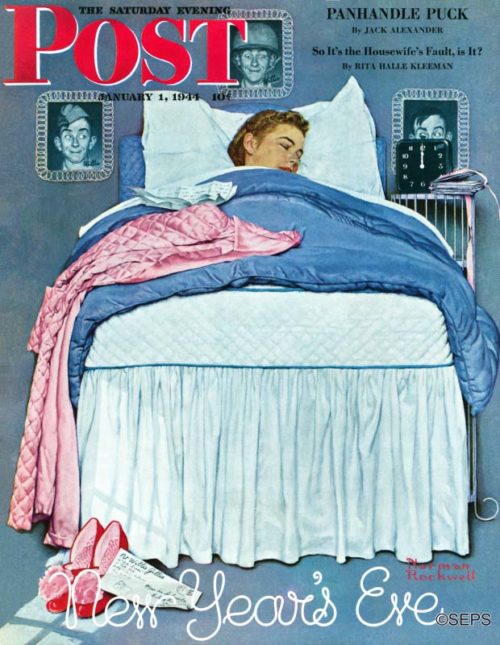
Rockwell literally selected the girl next door for his model. He asked his close friend and fellow illustrator, Mead Schaeffer, if Schaeffer’s sixteen-year-old daughter Lee would pose for the cover. Schaeffer lived just up the street from Rockwell in Vermont.
Ever the perfectionist, Rockwell also selected just the right details to tell his story. That clock on the bedside table shows us that it is midnight and the young girl is not out celebrating in those fancy party shoes. The photos of her boyfriend — none other than Rockwell’s favorite GI, Willie Gillis — on the wall tell us why. But do extra details such as the envelope on the floor really make any difference?
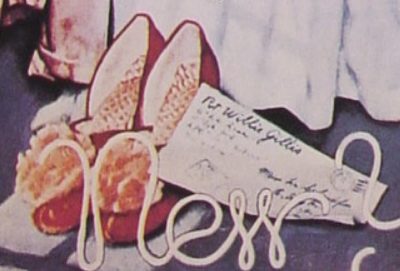
Rockwell was such a stickler for detail, when he painted that envelope he used Lee Schaeffer’s actual address. He assumed it would be too small and blurry to be legible when it was finally reproduced on the cover of the Post. The address was just one of the many details that Rockwell captured purely for his own satisfaction.
Unfortunately, Rockwell underestimated the resourcefulness of our young G.I.s. Soldiers were so smitten by the lovely Lee that they got out their magnifying glasses. Before long, letters started streaming in to Lee Schaeffer at home. Lee’s mother became quite upset with Rockwell for putting her daughter’s address on the cover of the Post. She made sure that all of Lee’s fan mail went unanswered.
But that’s not the end of the story. A few years later, a young veteran named Bob Goodfellow, recently back from serving in the U.S. Navy Reserve on Iwo Jima, saw the famous cover. Like others before him, he fell in love with the slumbering girl. But unlike other soldiers, Goodfellow had an advantage. His fraternity brother knew the Schaeffer family and happened to be dating Lee’s sister Patricia. Goodfellow kept pestering his fraternity brother to arrange an introduction, and finally his persistence paid off. The fraternity brother gave in and arranged a double date with Lee and Patricia in New York City. Goodfellow met Lee on a blind date on December 3, 1949. Goodfellow must have made a good first impression because he was able to wrangle an invitation to Mead Schaeffer’s New Year’s party. There, Lee introduced Goodfellow to her parents, he passed the test, and the courtship began.
Goodfellow and Lee Schaeffer were married on March 16, 1951, and they remain happily married in Vermont today. Next March will be their 67th anniversary. The famous Rockwell cover of the Post that started it all is framed and hanging on the wall above Goodfellow’s desk.
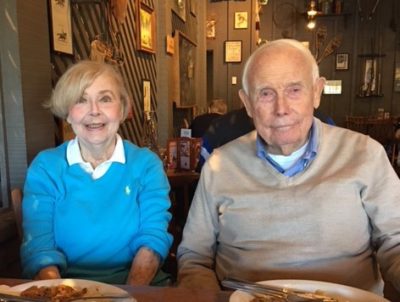
Many modern art critics have insisted that the tiny details in Rockwell’s paintings are pointless. They should keep their eyes and minds open. You can never tell where paying attention might lead.
Rockwell Video Minute: Freedom from Want
We celebrate Thanksgiving with one of Norman Rockwell’s most famous paintings, “Freedom from Want.”
See all of the videos in our Rockwell Video Minute series at saturdayeveningpost/rockwell-video.
Rockwell Finally Appears as Himself in Triple Self-Portrait
© SEPS
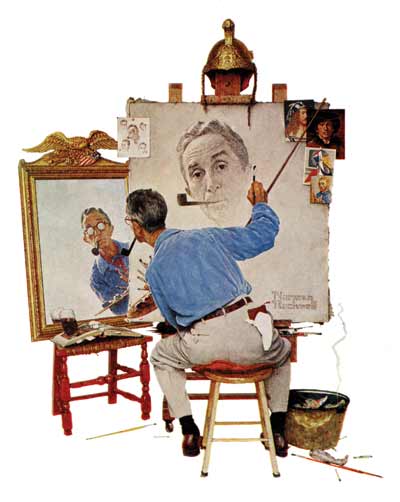
In 1960, Norman Rockwell produced one of the most famous self-portraits in American art. A naturally modest man, he clearly had some reservations about making himself the subject of a cover. He’d put himself on covers before, but usually only as a cameo, never the central figure.
In describing this work, Rockwell explained why his glasses look opaque. “I had to show that my glasses were fogged, and that I couldn’t actually see what I looked like — a homely, lanky fellow — and therefore, I could stretch the truth just a bit and paint myself looking more suave and debonair than I actually am.”
As visual reinforcement of his intentions, at the top of the easel, Rockwell has included a reminder to himself not to be taken in by appearances. He bought this helmet in a Paris antique shop, thinking it was the headdress of an ancient Greek or Roman soldier. Carrying it back to his hotel, he stopped to watch a firefighter working to save a burning building and realized that all French firemen wore helmets identical to the one he’d just purchased.
For all Rockwell’s self-deprecation, the painting is regarded by many as a thoughtful portrait of the artist’s three selves: the painter, the observer, and the public person.
This article is featured in the November/December 2017 issue of The Saturday Evening Post. Subscribe to the magazine for more art, inspiring stories, fiction, humor, and features from our archives.
Rockwell Video Minute: Wanderlust
Norman Rockwell often yearned to get away from work, a longing reflected in many covers, but none more so than the image of a hiker with his faithful dog.
See all of the videos in our Rockwell Video Minute series at www.saturdayeveningpost/rockwell-video.
Fall Video Gallery: Vintage Baseball Covers
From classic Cubs to the Bronx Bombers, our vintage baseball covers by Norman Rockwell, Stevan Dohanos, and other notable artists capture perfect moments in America’s game.
See more videos from The Saturday Evening Post at www.saturdayeveningpost.com/video.
Rockwell Video Minute: Runaway
Norman Rockwell turns the cliché of a runaway child into a heartwarming moment in one of his most well-known paintings.
See all of the videos in our Rockwell Video Minute series at www.saturdayeveningpost/rockwell-video.
The Rockwell Files: Sweet Memories
Norman Rockwell, © SEPS.
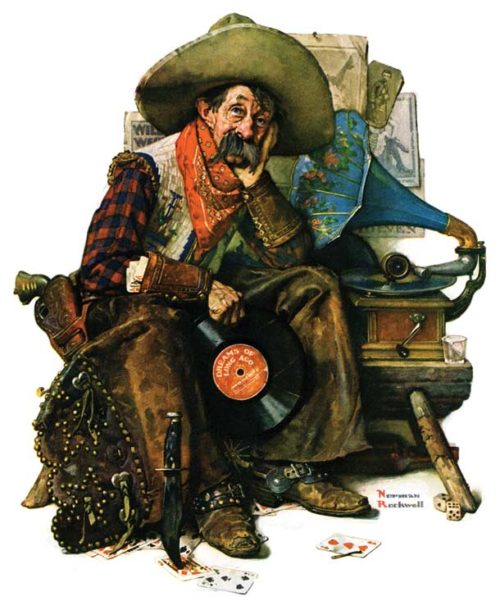
This cover idea came to Norman Rockwell when he paid a surprise visit to one of his favorite models, James Van Brunt.
The 80-year-old widower lived in a tiny but well-kept room in a run-down boarding house. Rockwell arrived to find the old man seated in a wicker chair, listening to an old gramophone and looking down at a few kernels of popping corn in his palm with “a sad, dreaming expression.”
Van Brunt welcomed him and extended his open palm. “You see this popping corn? It’s from a bag I bought my wife, Annabella, at the World’s Columbian Exposition in Chicago in 1893. When I look at it, I remember our trip and the Exposition and her.”
In this illustration, Rockwell recaptures that mood of bittersweet reminiscence by portraying Brunt as a cowboy tearfully listening to old records. He holds a recording of “Dreams of Long Ago,” a song written by Enrico Caruso. Its lyrics include the lines, “Summer’s gone and life grows cold / Still in dreams you’re mine
of old.”
This article is featured in the September/October 2017 issue of The Saturday Evening Post. Subscribe to the magazine for more art, inspiring stories, fiction, humor, and features from our archives.
Illustrations: Clowning Around
They might conjure fond memories of circus antics or be your worst nightmare, but clowns were a popular subject for Saturday Evening Post covers, due largely in part to the popularity of circuses in the first half of the twentieth century. We looked through our archive to find clown illustrations by some of our best known artists, including Norman Rockwell and J.C. Leyendecker. Most of our clowns are charming (or at least not frightening), but we did find one particularly scary clown from an image illustrating a short story. The clown in the picture might not be central to the story, but he more than makes up for it in creepiness.
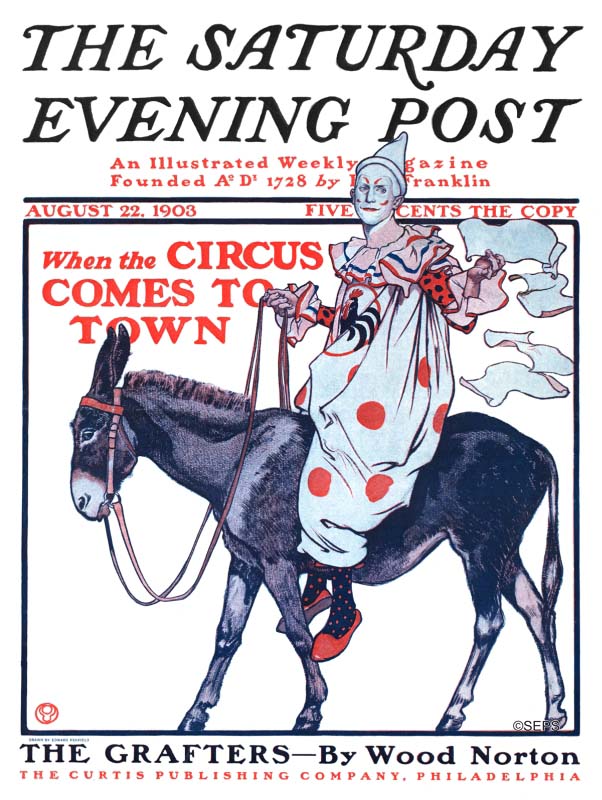
Edward Penfield
August 22, 1903
This not-so-cheery clown has been stuck with the job of handing out circus flyers. The artist is Edward Penfield, known as the father of the art poster. His first posters were created to advertise issues of Harper’s magazine from the late 1800s. He later created 20 covers for the Post, using his signature strong lines and bold style.
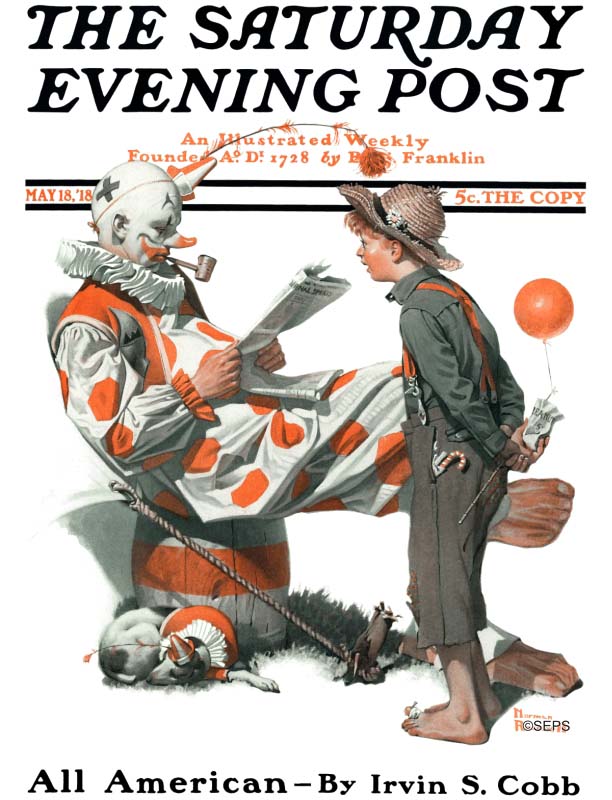
Norman Rockwell
May 18, 1918
Norman Rockwell painted several circus-themed covers, including this one fairly early in his career. Here, the world-weary clown, his newspaper folded “subway style,” ignores the awestruck country boy. The dog in the illustration is Lambert, Rockwell’s own pet. Rockwell recalls that Lambert was a thoughtful model, who, when placed in position on the stand, would sit for hours with his head cocked to one side.
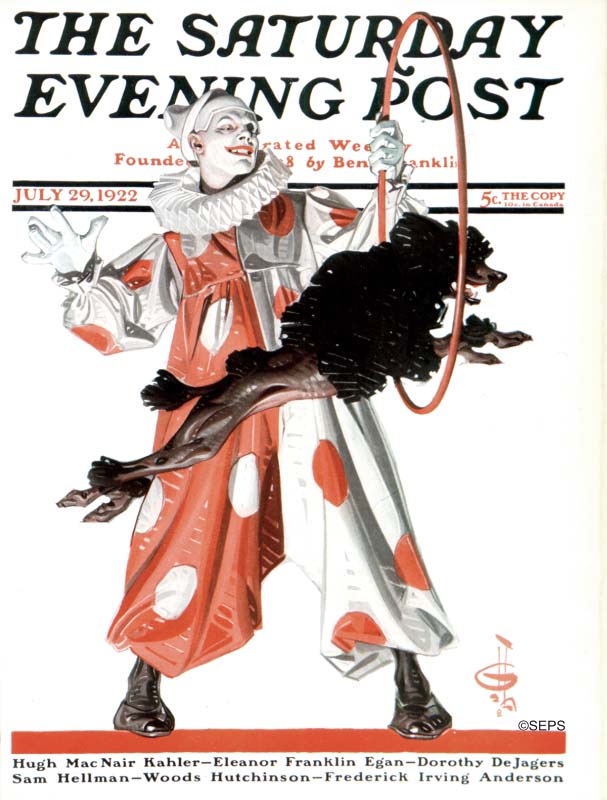
J.C. Leyendecker
July 29, 1922
In the mid-1800s, the Standard Poodle became a popular circus performer because of its intelligence and stamina. Leyendecker painted six circus-themed covers for the Post, with our poodle friend making a second appearance in one of them.
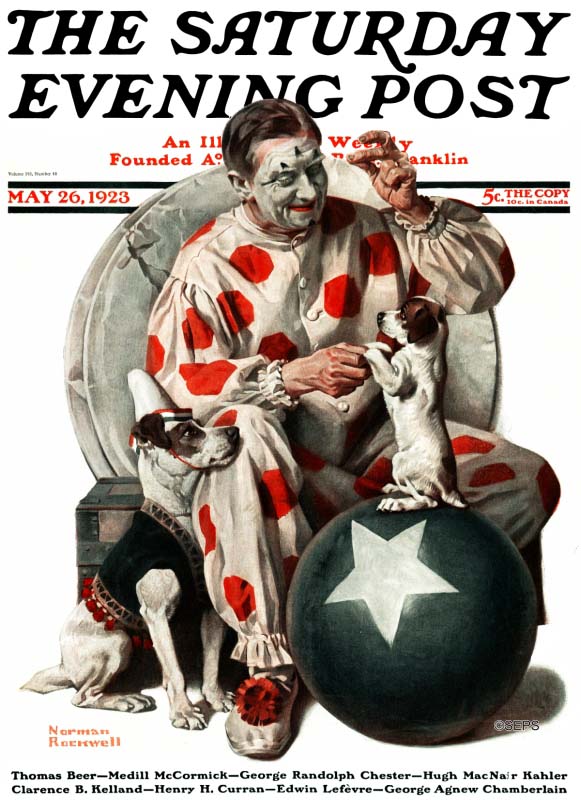
Norman Rockwell
May 26, 1923
A look behind the scenes at the big top reveals the house of disciplined practice that result in a show that delights the circus-goers in the ring. The pup learns his lesson under the stern eye of the older dog, who manages a degree of dignity despite the absurdity of the costume.
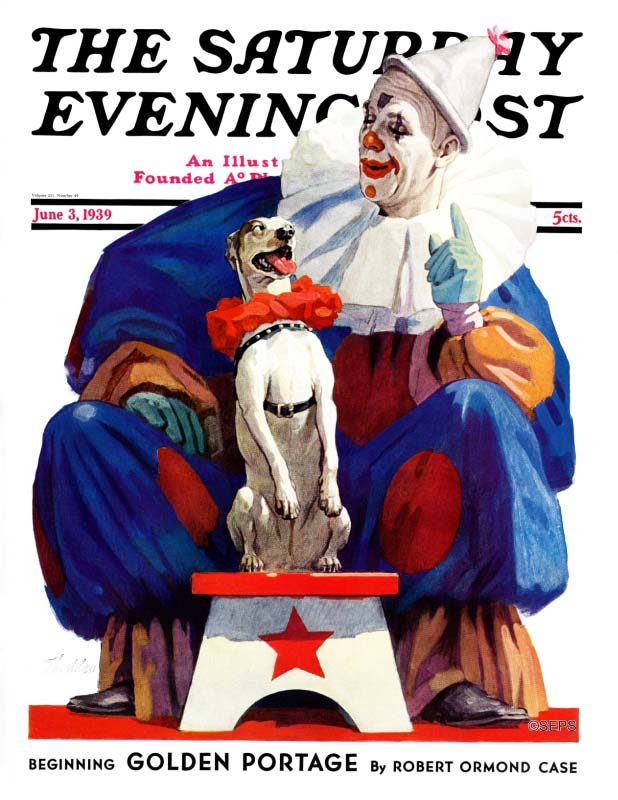
John E. Sheridan
June 3, 1939
From 1931 to 1939 Sheridan illustrated thirteen covers for Post with predominant sporting and military themes, so this vivid picture of a clown and his dog was quite the departure for him.
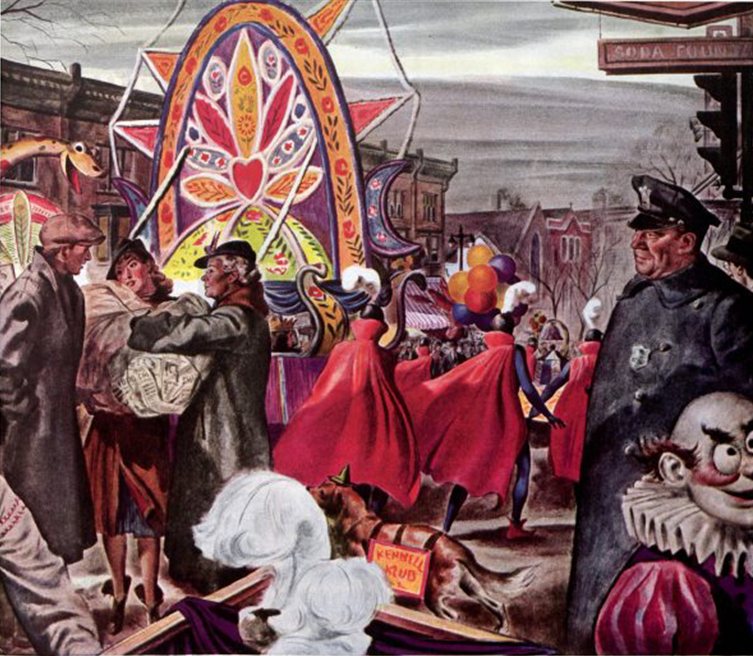
Ben Stahl
January 3, 1942
Ah, here is the inside illustration we warmed you about! The major action is taking place on the left side of the illustration, with the policeman looking on with concern. But that clown! His intentions seems to be more Stephen-Kingian and less Norman-Rockwellian.
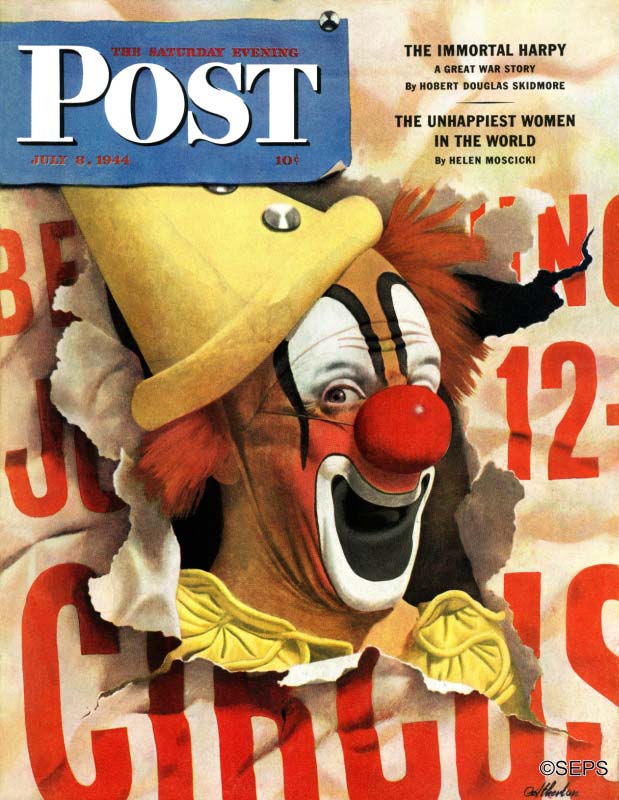
John Atherton
July 8, 1944
World War II was raging, and the pages of this issue were filled with advertisments supporting the war and stories of soldiers in battle. The Post must have thought that its readers needed a little respite; this John Atherton cover was the result.
News of the Week: Buttered Rolls, Marilyn Monroe, and Rockwell at the Swimming Hole
Only in New York?
Another week, another controversy that breaks the internet. Sometimes you can see them coming, like that Google manifesto that has the left and the right taking sides, or weird/funny videos that go viral. But sometimes something takes over the web that you could never predict, like that dress a couple of years ago that no one knew the color of (I knew it was black and blue!) Yes, there was a day when everyone online was arguing about the color of a dress.
Now we have a new controversy: buttered rolls!
This New York Times piece by Sadie Stein extols the virtues of the buttered roll, which she and many other people say is a thing unique to New York City. Now, you might have the same first reaction that I and many other people online had: Can’t you get buttered rolls, well, everywhere?
Apparently not! Not like the ones in New York! To be fair, it seems like Stein’s talking about a certain type of roll (a big hard roll with butter in the middle, almost like a butter sandwich) that you get in certain places, like bodegas and carts and delis, and you eat it for breakfast with your morning coffee. I’ve never had one of these, but they still seem like, you know, a roll with butter. I’ve had a lot of those.
This paragraph stands out:
Though of course bread and butter are eaten all over, the buttered roll (or roll with butter, as it is known in parts of New Jersey) is a distinctly local phenomenon. Mention its name outside the New York metropolitan area and you would very likely be met with blank incomprehension.
I very much doubt that, even if our buttered rolls aren’t “buttered rolls.” But what do I know? The article has a lot of defenders, including Stein’s New York Times cohort Pete Wells, and detractors, like BuzzFeed’s Tom Gara. Stein knew there would be people who didn’t understand:
In response to inevitable carping…yes, NYers are incurable solipsists. AND the specific buttered roll discussed here is a specific thing.
— Sadie Stein (@SadieStein) August 2, 2017
David Letterman Is Back!
I knew he wouldn’t stay away. As soon as I heard him talking about how he wished he had thought of Comedians In Cars Getting Coffee and noticed that he had started to do more interviews and podcasts, I knew he would be the anti–Johnny Carson and actually come out of retirement to do another show. Letterman just signed with Netflix to do six episodes of a new talk show starting in 2018. Instead of many guests, Letterman will sit down with one guest for the entire show. I’m thinking it’s going to be more Charlie Rose, less The Late Show.
But Dave, please, shave off that beard.
Speaking of Netflix…
Pop quiz: Who’s going to play Lucille Ball in a new biopic Aaron Sorkin (The West Wing, The Social Network, A Few Good Men) is writing for the streaming service?
- Cate Blanchett
- Meryl Streep
- Debra Messing
- Tea Leoni
- Amy Adams
Here’s the answer. Now we can all make our predictions on who should play Desi Arnaz.
Does America Have a Tattoo Problem?
I was watching an episode of The Dick Van Dyke Show a while back. Sally was telling Rob and Buddy that she would date a guy who had a mustache even though she never liked them before. She then said the next thing she was going to be into was tattoos, which shows how rare it was for men to have them back then (unless you were in the military).
How times have changed. You can’t leave the house without seeing at least one man (or woman) who has at least one tattoo. This piece at The Federalist argues that America has a tattoo problem.
I’ve never been tempted to get a tattoo. I did think about getting my ear pierced for about five minutes back in the ’80s. I’d have to get a really subtle tattoo, small and in a place no one could see it, because, well, they can get out of hand.
A Modern-Day Norman Rockwell Painting
This is proof that Twitter isn’t completely annoying: a photo taken at a recent Boston Red Sox game at Fenway Park that could pass, as Maury Brown says, as a Rockwell:
This is an absolute modern day Norman Rockwell painting. pic.twitter.com/SxYF6JRkof
— Maury Brown (@BizballMaury) August 4, 2017
RIP Glen Campbell, Barbara Cook, Robert Hardy, Don Baylor, Darren Daulton, Daniel Licht, Ty Hardin, Haruo Nakajima
Glen Campbell not only performed such classic songs as “Wichita Lineman,” “Rhinestone Cowboy,” and “Gentle on My Mind,” he was also a member of the famous group of session musicians known as The Wrecking Crew and played guitar on many other songs, including The Beach Boys’ “I Get Around” and “Help Me, Rhonda,” Ricky Nelson’s “Hello, Mary Lou,” Wayne Newton’s “Danke Schoen,” and Frank Sinatra’s “Strangers in the Night.” He died Tuesday after a battle with Alzheimer’s Disease. He was 81.
Barbara Cook was the Broadway soprano who won a Tony for The Music Man and appeared in other classic musicals like Candide and She Loves Me. She passed away Tuesday at the age of 89.
Robert Hardy was a veteran actor who played Cornelius Fudge in the Harry Potter movies and appeared in many other movies and TV shows, including several in which he portrayed Winston Churchill. He died last Thursday at the age of 91.
Don Baylor and Darren Daulton were two baseball favorites who passed away this week. Baylor was not only the 1979 MVP, he led the league in getting hit by pitches: seven times in his career. He died Monday at the age of 68. Daulton was an All-Star catcher for the Philadelphia Phillies. He died Sunday at the age of 55.
Daniel Licht did the music for Dexter and many other TV shows and films. He died last Wednesday at the age of 60.
Ty Hardin played Bronco Layne on the 1958–62 CBS Western Bronco and also appeared in movies like PT 109, The Chapman Report, and Merrill’s Marauders. He died last Thursday at the age of 87.
You wouldn’t recognize Haruo Nakajima because his face was usually hidden inside a suit. The Godzilla suit, to be exact. He was the first person to put it on and stomp around Japan in 1954 and played the monster in 11 more films. Nakajima died Monday at the age of 88.
This Week in History
Marilyn Monroe Dies (August 5, 1962)
The last professional photos of Marilyn Monroe, taken by George Barris three weeks before her death, went up for auction this week. The auction ends at 12:07 p.m ET today, so get your bid in quick.
President Nixon Resigns (August 9, 1974)
Nixon was really excited about taping his Oval Office meetings for posterity, but the practice eventually led to this:
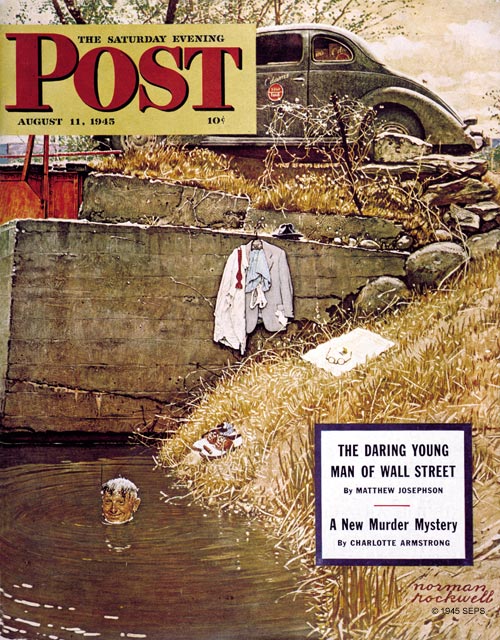
This Week in Saturday Evening Post History: “Swimming Hole” (August 11, 1945)
Norman Rockwell
August 11, 1945
© SEPS 1945
Here’s an actual Norman Rockwell cover, one where he shows a salesman taking an impromptu dip on a hot summer day. I’m trying to find his pants, though. I see his shirt, jacket, tie, shoes, and even glasses, but I can’t find the pants.
Paninis
August is National Panini Month. Food Network has 50 panini recipes you can try, which means you can have two every day for the rest of the month without repeating a recipe. If you don’t own a panini press, you’ll have to use a heavy pan to press it down in the skillet.
If a panini is too much work for you, you could just make a regular, old-fashioned sandwich, because it also happens to be National Sandwich Month. You could even have a sandwich on a roll.
You know, with butter.
Next Week’s Holidays and Events
International Left Hander’s Day (August 13)
If you’re right-handed and have always looked at left-handers as “different,” Sunday’s the day you can treat them as if they were normal.
National Roller Coaster Day (August 16)
I’m not a roller coaster fan. I’ve been on one, years ago at Canobie Lake Park in New Hampshire, and I’ll never go on one again. But National Roller Coaster Day is the day to get on one and ride it again and again and again.
Rockwell Video Minute: Triple Self-Portrait
In 1960, Norman Rockwell produced one of the most famous self-portraits in American art.
See all of the videos in our Rockwell Video Minute series at www.saturdayeveningpost.com/rockwell-video.
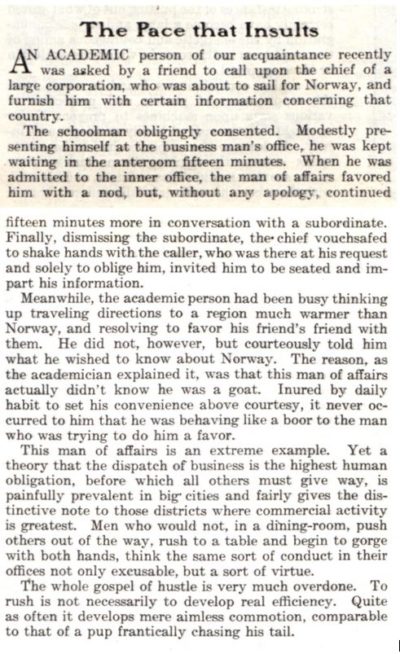
The Rude Pace of Life…in 1907
Men who would not, in a dining-room, push others out of the way, rush to a table, and begin to gorge with both hands, think the same sort of conduct in their offices not only excusable, but a sort of virtue.
The whole gospel of hustle is very much overdone. To rush is not necessarily to develop real efficiency. Quite as often it develops mere aimless commotion, comparable to that of a pup frantically chasing his tail.
This article is featured in the July/August 2017 issue of The Saturday Evening Post. Subscribe to the magazine for more art, inspiring stories, fiction, humor, and features from our archives.
Rockwell Video Minute: Losing the Game
Norman Rockwell captures the drama of everyday events in the form of three stunned cheerleaders after a basketball game that didn’t go the home team’s way.
See all of the videos in our Rockwell Video Minute series at www.saturdayeveningpost/rockwell-video.
Rockwell Video Minute: The Fourth of July
To celebrate the Independence Day, Norman Rockwell painted an iconic image of America, but with his own unique twist.
See all of the videos in our Rockwell Video Minute series at www.saturdayeveningpost.com/rockwell-video.
Can You Identify the 31 Jobs in Rockwell’s “Rosie to the Rescue”?
Norman Rockwell
September 4, 1943
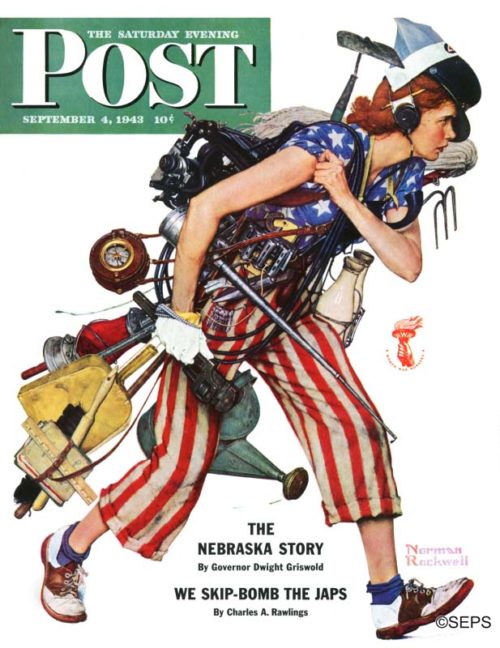
In 1943, several major magazines agreed to salute the women war workers of America on their September covers. The Post gave the assignment to Rockwell, who’d already created an iconic tribute to women defense workers with Rosie the Riveter.
For this new cover, he wanted to acknowledge the wide range of jobs that 15 million women had taken up as men went off to war. The result was Rosie to the Rescue, which showed a woman bearing the symbols and tools of several trades hurrying off to her next job. The Post editors claimed 31 different occupations were represented on this cover. Some were jobs traditionally associated with women: cleaning, farming, nursing, and clerical work. Others, indicated by tools such as an electric cable and a monkey wrench, referred to industrial occupations that women were starting to enter in great number.
The cover not only acknowledges women war workers, it also recalls occupations of the 1940s that once employed thousands. Post readers of the day would have instantly recognized the bus-driver’s ticket punch, a taxi-driver’s change dispenser, a milkman’s bottle rack, a switchboard operator’s headset, and the blue cap of a train conductor. The railroad industry was also represented by the railroad section hand’s lantern, the locomotive engineer’s oil can, and that round object swinging on a shoulder strap — a clock used by night watchwomen in railway yards.
Here is what the Post editors had to say about this image in the “Keeping Posted” section of our September 4, 1943 issue:
At least thirty-one wartime occupations for women are suggested by Norman Rockwell’s remarkable Labor Day Post cover. Perhaps you can think of more. The thirty-one we counted, suggested by articles the young lady is carrying or wearing, are: boardinghouse manager and housekeeper (keys on ring); chambermaid, cleaner and household worker (dust pan and brush, mop); service superintendent (time clock); switchboard operator and telephone operator (earphone and mouthpiece); grocery-store woman and milk-truck driver (milk bottles); electrician for repair and maintenance of household appliances and furnishings (electric wire); plumber and garage mechanic (monkey wrench, small wrenches); seamstress (big scissors); typewriter-repair woman, stenographer, typist, editor and reporter (typewriter); baggage clerk (baggage checks); bus driver (puncher); conductor on railroad, trolley, bus (conductor’s cap); filling-station attendant and taxi driver (change holder); oiler on railroad (oil can); section hand (red lantern); bookkeeper (pencil over ear); farm worker (hoe and potato fork); truck farmer (watering can); teacher (schoolbooks and ruler); public health, hospital or industrial nurse (Nurses’ Aide cap). —“Keeping Posted: The Rockwell Cover,” September 4, 1943.
This article is featured in the July/August 2017 issue of The Saturday Evening Post. Subscribe to the magazine for more art, inspiring stories, fiction, humor, and features from our archives.
Cover Gallery: Happy Father’s Day!
We’re celebrating dads and everything they teach us.
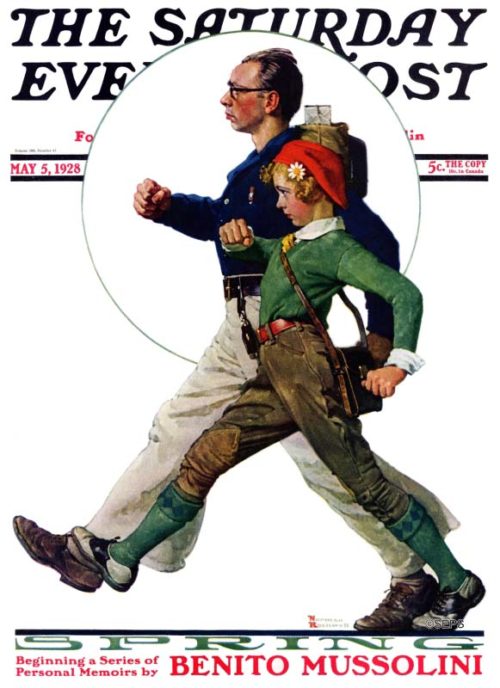
Norman Rockwell
May 5, 1928
This father and daughter duo was painted by the Post’s most famous artist, Norman Rockwell. With their matching strides, these two are ready for their Spring walk.
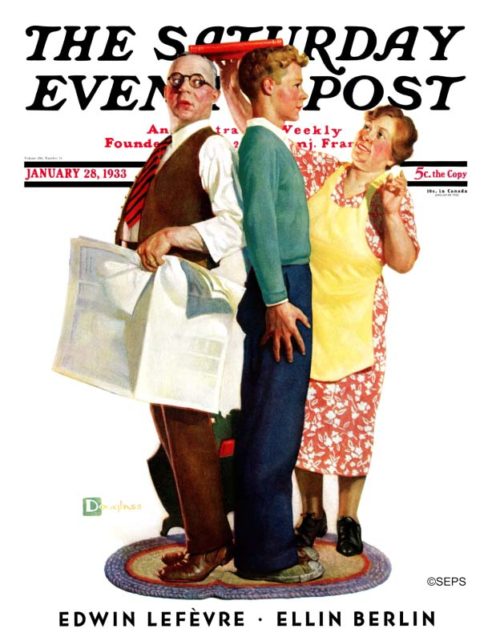
Douglas Crockwell
January 28, 1933
This 1933 cover was done by Post artist Douglas Crockwell. If the name didn’t confuse readers, this cover certainly did. Many people thought it was a Rockwell because of its close attention to detail, like the mother’s patterned dress.
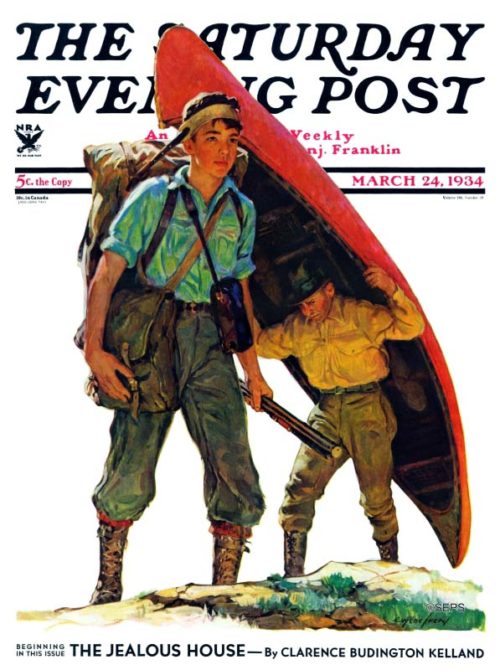
Eugene Iverd
March 24, 1934
This cover was painted by Eugene Iverd. Iverd typically painted children or boys at play, like this father and son ready to go canoeing. He also painted landscapes, which he signed with his birth name, George Erickson.
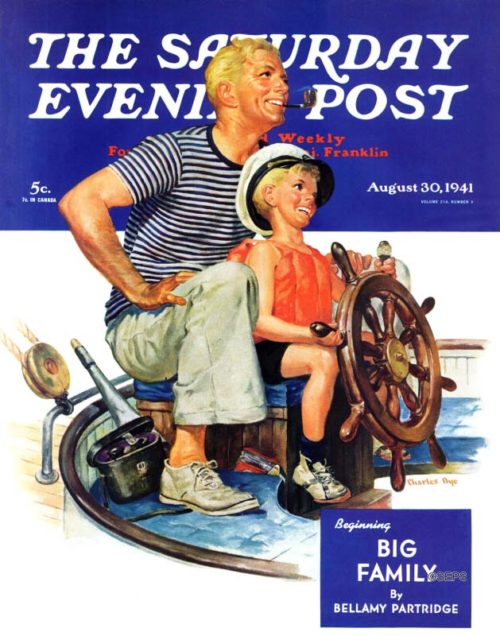
Charles Dye
August 30, 1941
These father and son sailors are the subjects of Charles Dye’s only cover for the Saturday Evening Post.
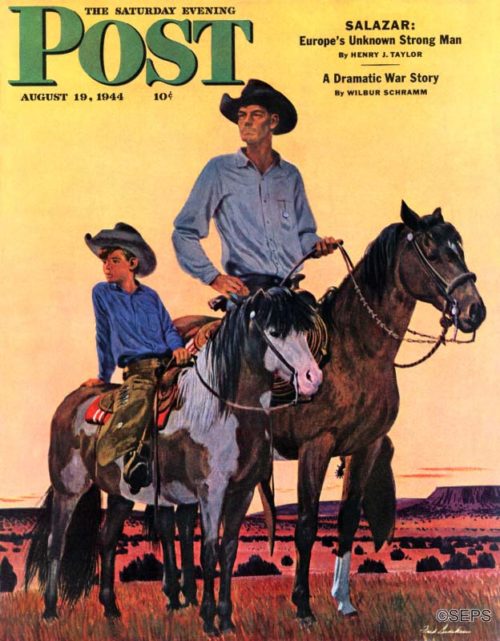
Fred Ludekens
August 19, 1944
These two ranchers fit in perfectly with Fred Ludekens’ other Post covers. Horses were typically a major theme in his cover art, as well as people hard at work.
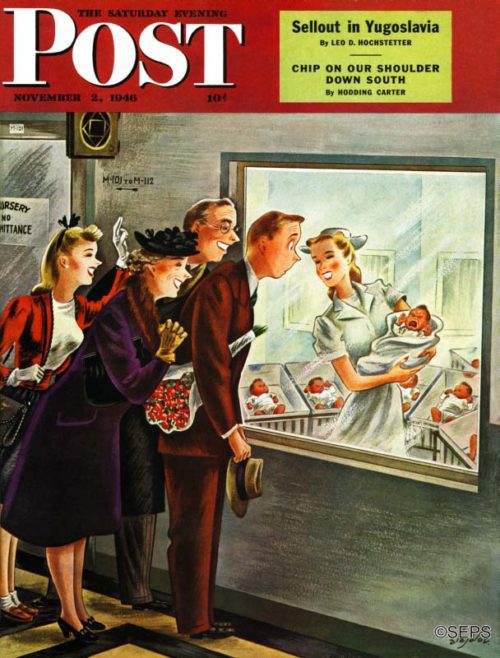
Constantin Alajalov
November 2, 1946
“That your baby you’re drawing?” a spectator asked artist Constantin Alajalov. “Yes,” said Alajalov, in a nice mixture of pride and modesty. He sketched another. “That one, too?” the onlooker asked in surprise. “Yes,” said Alajalov, and sketched in a third. The spectator wouldn’t ask about that one, and when the artist began sketching the fourth, the onlooker left.
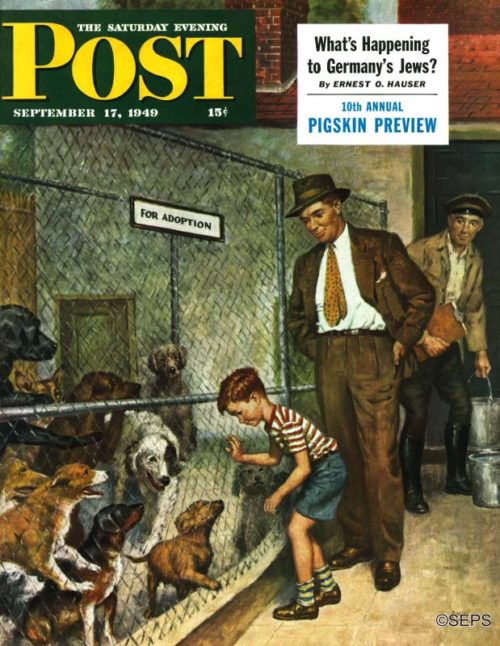
Amos Sewell
September 17, 1949
Amos Sewell has set this theme for his first Post cover at the Shelter, a refuge for homeless dogs conducted in Jamaica. Long Island, by the S.P.C.A. After Sewell had finished sketching and photographing detailshe found himself thinking awfully hard about one particular dog in the ”for-adoption” pen. But he resolutely pulled himself together and went back home alone-to the four Sewell cats.
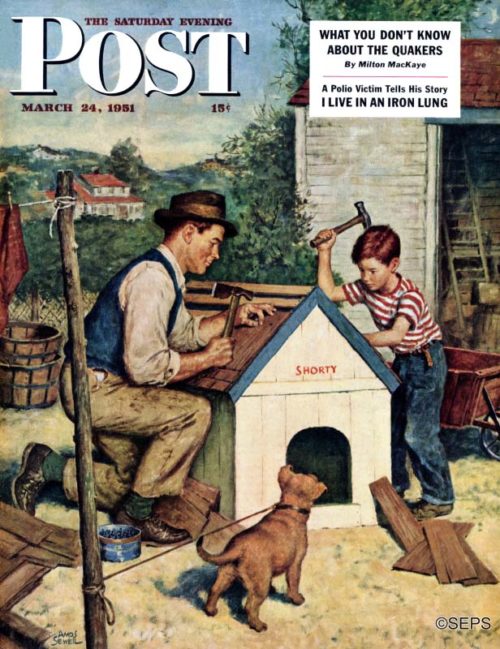
Amos Sewell
March 24, 1951
Sewell’s theory about this pleasant scene is that Shorty was adopted, not purchased, his previous home probably having been one of the SPCA’s shelters for homeless dogs. Shorty will hereafter have two homes, the big house where his favorite human beings live, and his own house, where he can retire when he wishes to be quite alone for unhindered rest or meditation.
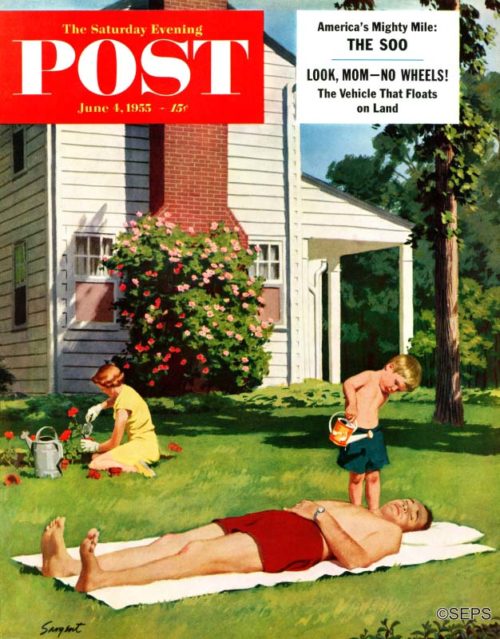
Richard Sargent
June 4, 1955
While dad bares his lily-white flesh, little does he dream that presently a sun shower will invigorate him.
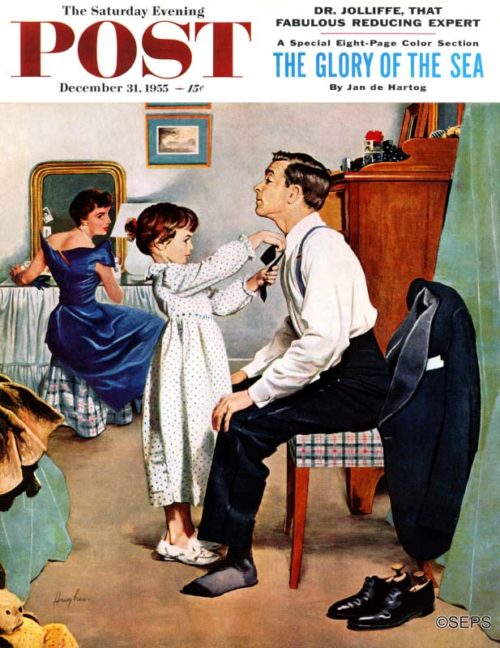
George Hughes
December 31, 1955
George Hughes painted this pre-New-Year party scene, where even the little one can participate in the celebration.