Craft Video: Tinfoil Ball Ornament
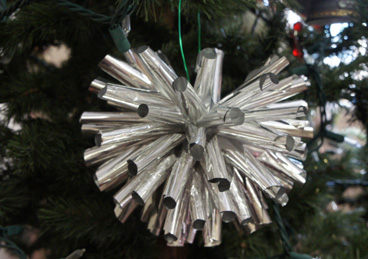
This sparkly ornament will add a touch of charm to the boughs of any evergreen. Who would have thought so much loveliness could come out of tinfoil? Watch the video below to learn to make this snazzy doodad or follow the instructions below.
Tinfoil Ball Ornament
Materials
- Tinfoil
- Lid from large coffee can
- Chopstick
- Scissors
- 12″ piece of wire
- 2 beads
- Needle nose pliers
Directions
- Roll out enough tinfoil to lay coffee can lid on top. With chopstick, create a mark along edge of lid on opposite side from edge of tinfoil.
- Using mark, fold tinfoil 9 times to make 10 pieces of foil.
- Cut folded foil from roll.
- Trace lid of coffee can on foil. Cut around line to make 10 circles.
- Peel apart circles.
- Take 1 circle and fold in half 3 times to form a shape that looks like piece of pie.
- From the tip of the piece of pie, measure ¼-inch and make a mark with your fingernail. Fold tip on mark.
- Open circle and cut along each fold line, from edge of circle to center fold line.
- Roll each flap around chopstick to form a circle. Note: Whichever side (matte or shiny) faces down will be outside of ornament.
- Repeat steps 6 through 9 with each tinfoil circle.
- Tie a knot on one end of wire. Place bead on wire.
- Poke wire through center of each circle.
- Once complete, place second bead on wire. Push down to shape foil into ball.
- Loop top of wire and place end into bead.
Curtis Stone’s Roasted Pork Loin with Rosemary Salt, Shallots, Potatoes, Carrots, and Parsnips
A proper pork roast, cooked in a pan full of vegetables, gives off a tantalizing, old-fashioned aroma. The combination of meat juices and roasted vegetables is heaven on a plate. As for the rosemary salt, it is a great trick that you can use with other cuts of meat and other herbs. Try a thyme salt on your next roast beef. For extra flavor, order a roast with a 1/4-inch layer of fat on top.
Roasted Pork Loin with Rosemary Salt, Shallots, Potatoes, Carrots, and Parsnips
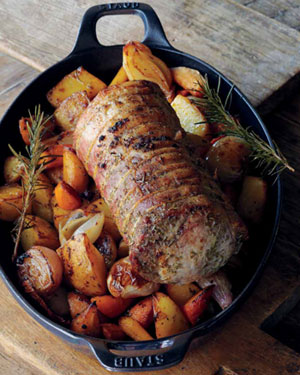
Photo © Quentin Bacon
(Makes 6 servings)
Ingredients
- 2 pounds medium Yukon Gold potatoes, scrubbed and quartered
- 1 pound shallots, cut in half
- 3 carrots, cut crosswise on the diagonal into 2-inch pieces
- 3 parsnips (the same size as the carrots), peeled and cut diagonally into 2-inch pieces
- 4 garlic cloves, finely chopped
- 1 teaspoon smoked paprika (hot or sweet)
- ¼ cup olive oil
- Kosher salt and freshly ground black pepper
- 4 sprigs of fresh rosemary
- One 2 ½-pound boneless pork loin roast, preferably with top layer of fat still intact
- ⅔ cup reduced-sodium chicken broth
Directions
- Preheat oven to 450°F.
- Put potatoes, shallots, carrots, parsnips, and garlic in large heavy roasting pan, sprinkle with smoked paprika, and toss with 3 tablespoons of olive oil to coat. Season with salt and pepper. Spread vegetables evenly over bottom of pan. Place 2 rosemary sprigs on top.
- Finely chop enough of remaining 2 rosemary sprigs to equal 2 teaspoons. In small bowl, combine 1 tablespoon salt and chopped rosemary. Rub mixture together with your fingertips for about 1 minute, or until fragrant.
- Using sharp knife, score fat that covers top of pork by cutting shallow slashes (about ¼ inch deep) at 1-inch intervals, cutting into fat but not flesh. Rub pork all over with remaining 1 tablespoon olive oil. Rub rosemary salt all over pork, working it into score marks, if desired, tie pork crosswise with kitchen twine in three or four places to help maintain its shape while roasting.
- Place pork fat side up on top of bed of vegetables. Roast for about 40 minutes, or until pork is golden brown and an instant-read thermometer inserted into center reads 125°F. Transfer pork to serving platter. Tent with aluminum foil and let rest for 10 minutes before slicing (pork will continue to cook as it rests).
- Meanwhile, stir vegetables in pan and continue roasting them for about 10 minutes, or until tender and golden brown. Transfer vegetables to the platter with pork.
- Add broth to hot roasting pan and bring to boil over medium-high heat, stirring with wooden spoon to scrape up browned bits in bottom of pan. Season with salt and pepper. Pour pan juices into sauceboat.
- Untie pork if necessary. Slice pork and serve it with roasted vegetables and pan juices.
 © 2013 Curtis Stone, published by Random House; photo © Quentin Bacon.
Smoothie Recipe: Raspberry Lime Chia Cooler
This creamy and refreshing beverage is bursting with sweetness, tang, and texture. What’s more, the addition of fresh raspberries promotes fat loss, and coconut water keeps you hydrated! Woo-hoo!
For more smoothie recipes, check out our Pinterest page!
Raspberry Lime Chia Cooler
(Makes about one 16-ounce serving)
Time: 10 minutes (includes prep time)
Equipment: Blender
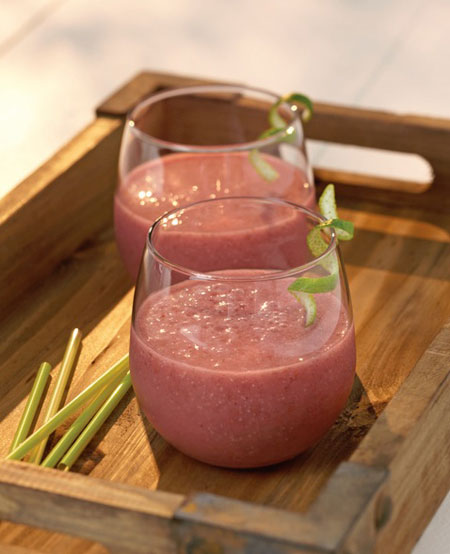
Ingredients
- 1 cup raspberries
- 1 medium lime, juiced, about 2 tablespoons
- 1 tablespoon chia seeds
- 1 cup coconut water
- ¼ cup coconut milk
- 5 ice cubes
Directions
- Using Vitamix or other high-speed blender, combine all ingredients and blend for 1 minute on high. Enjoy immediately.
Did You Know?
Chia seeds (yes, as in the Chia Pet) are a relative of the mint family and are one of the most nutrient-dense foods available to us. These powerful little seeds have been enjoyed in South America for thousands of years and were revered by ancient warriors for promoting energy sustainability and hydration. Chia seeds offer a perfect 3:1 omega-3 to omega-6 ratio, 35 percent dietary fiber by weight, loads of antioxidants, and all the essential amino acids, making them a complete protein.
When combined with liquid, they expand to nine times their size, providing volume and emulsification for smoothies, dressings, puddings, and other desserts. When mixed with juice or coconut water, they create a refreshing tonic that increases and helps maintain hydration.
Photo and recipe courtesy Balanced Raw: Combine Raw and Cooked Foods for Optimal Health, Weight Loss, and Vitality Burst: A Four-Week Program
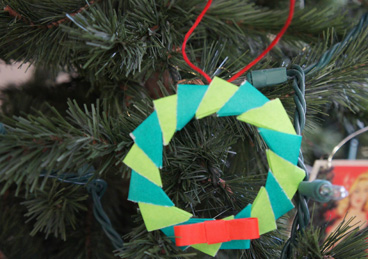
Craft Video: Christmas Wreath Ornament
Trim your tree with this adorable little wreath. Watch the video to learn to make the origami Christmas wreath ornament or follow the instructions below.
Christmas Wreath Ornament
Materials
- 2 light green paper squares (3″ x 3″)
- 2 dark green paper squares (3″ x 3″)
- 1 red paper rectangle (4 ½” x 1″)
- Craft glue
- Needle and string
- Scissors
Directions
- Fold 1 green square in half, then open and fold each side of square to center fold line.
- Open square and tear each crease to make 4 separate rectangular pieces.
- Repeat steps 1 and 2 with remaining 3 green squares. There should be 16 rectangles.
- Take 1 green rectangle and fold in half crosswise.
- Open, then fold one side of rectangle so top edge meets center fold line. Do the same to other side.
- Flip over and fold flap into center to create a small triangle. Do the same to the other side.
- Fold each triangle in half to create smaller triangle.
- Fold triangle once more to make an even smaller triangle—there should be 2 flaps on one side, and 2 pockets on the other.
- Repeat steps 4 through 8 with remaining 15 green rectangles.
- Start piecing 16 triangles together: Place flaps of one triangle into pockets of other, alternating colors, until all 16 triangles are put together.
- Start to curve pieces into a circle. Connect final 2 triangles to complete circle.
- Bead layer of glue on one side of circle to secure pieces. Let dry.
- Fold red rectangle in half lengthwise, then open and fold each side to center fold line.
- Cut 1 inch from length of rectangle.
- With longer piece, make a circle and tuck one side in the other. Wrap 1-inch piece around center of circle. Dab glue to hold in place. Let dry. (This will be the bow for your wreath.)
- Dab glue on bow and attach to wreath. Let dry.
- Using needle and string, poke hole in top-most corner of wreath and pull string through. Remove needle, and tie knot. Tuck knot in triangle, and hang ornament on tree.
Smoothie Recipe: Minty Piña Fresca
Sip on this island-inspired mocktail and let digestive enzymes do their cleansing work. Calming mint, sweet coconut water, and tangy lime juice pair beautifully with enzyme-rich and succulent pineapple.
For more smoothie recipes, check out our Pinterest page!
Minty Piña Fresca
(Makes about one 16-ounce serving)
Time: 5 minutes (includes prep time)
Equipment: Blender
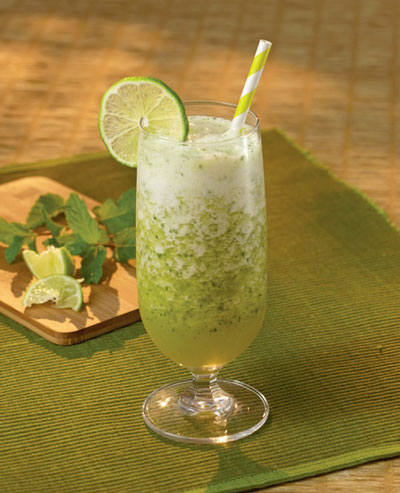
Ingredients
- 1 cup coconut water
- 1 cup fresh or frozen pineapple chunks
- ¼ cup mint leaves, packed
- Juice of 1 lime, about 2 tablespoons (28 ml)
- 4 or 5 ice cubes
Directions
- In Vitamix or other high-speed blender, combine coconut water, pineapple, mint, lime, and ice.
- Blend for 30 seconds and enjoy.
Did You Know?
There is more to pineapple than its sweet and succulent juice and flavor. It contains bromelain, an enzyme that breaks down proteins into smaller molecules, aiding in digestion. According to the University of Maryland Medical Center, South Americans have been enjoying this tropical fruit for centuries to reduce inflammation and to treat indigestion. To boost digestive activity, delight in fresh pineapple prior to a meal or immediately after for dessert.
Photo and recipe courtesy Balanced Raw: Combine Raw and Cooked Foods for Optimal Health, Weight Loss, and Vitality Burst: A Four-Week Program
Craft Video: Paper Christmas Tree Ornament
This easy-to-make Christmas tree ornament is a fun and festive way to add a personal touch to your family’s tree this holiday season. Watch the video or follow the instructions below.
Paper Christmas Tree Ornament
Materials
- Greeting cards or scrap paper (enough for 3 circles with 6-, 4-, and 2-inch diameters)
- Scissors
- 12″ piece of wire
- Needle nose pliers
- 1 bead
Directions
- Cut 3 paper circles, 6-, 4-, and 2-inch diameter.
- Fold 1 circle in half, then in half again.
- Open circle, so that fold lines form an X shape, then fold in half once more.
- Open circle and push sides inward to create two accordion folds.
- Snip very top corner of paper with scissors.
- Repeat steps 1 through 4 with each circle.
- Loop bottom of wire and push through top of each circle, layering largest circle on bottom to smallest on top.
- Put bead on wire. Bend wire to create a loop and wrap additional wire around to keep in place.
Holiday Ornament Tutorials
Christmas tree ornaments start lining the shelves of stores long before we even celebrate Halloween. The choices are infinite: glass balls, wooden snowflakes, even singing characters. This year, save your money and get creative–make your own ornaments!
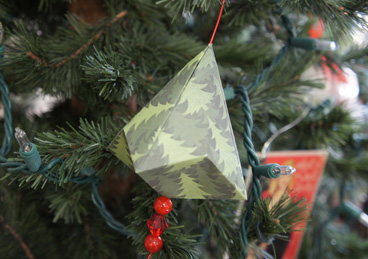
We have four ornament crafts to get you started. Each ornament is made from items that you probably have sitting around your house. Click the photos or images below to watch the tutorials and learn to make a three-tiered paper tree, a tinfoil ball, a German bell, and a wreath!
Paper Christmas Tree Ornament

Tinfoil Ball Ornament
German Bell Ornament
Christmas Wreath Ornament
The Story of a College Football Fix

On March 23, 1963 the Post ran an exposé on college football, The Story of a College Football Fix, charging that James Wallace “Wally” Butts Jr.—the University of Georgia’s athletic director and former football coach—had given away game secrets to Alabama head coach Paul “Bear” Bryant that affected the outcome of a 1962 Georgia-Alabama game.
“The corrupt here were not professional ballplayers gone wrong …,” the story reads. “The corrupt were not disreputable gamblers, as in the scandals continually afflicting college basketball. The corrupt were two men–Butts and Bryant–employed to educate and to guide young men.” As a result, both Bear Bryant and Wally Butts sued the Post for libel, each man asking for $10 million in damages.
Click here to read the entire article.
Craft Video: German Bell Ornament
This German bell adds a personal touch to your holiday décor. Watch the video or follow the instructions below.
German Bell Ornament
Materials
- 1 6″ x 6″ piece of paper
- 1 12″ piece of wire
- 3 beads
- Needle nose pliers
Directions
- Take piece of paper and fold in half. Open up and fold in half again.
- Open up and fold in half diagonally. Repeat folding the other way.
- Open up and fold corner in to meet center fold. Repeat with all four corners of paper.
- Push in along four sides to create a four sided star. Push all corners up to meet in a point.
- Push bottom out to create shape of bell.
- Glue 3 pointed tips together. Let dry.
- Place beads on bottom of wire and loop end of wire with pliers to hold in place.
- Insert wire through bottom point of bell up through top.
- Loop top of the wire to form a hook.
- Glue last point to finish.
Cookies for Good: Sugarsnap’s Bittersweet Orange Chocolate Cookies
This cookie recipe comes from Sugarsnap, a farm-to-table company in Burlington, Vermont. The sales of Sugarsnap’s Bittersweet Orange Chocolate Cookie, along with its eight other cookie varieties, benefits Burlington’s homeless through a program called “Cookies for Good,” launched by Sugarsnap owner Abbey Duke and her friends—Roberta MacDonald (senior vice president of marketing at Cabot Creamery) and Rita Markley (executive director of the Committee on Temporary Shelter). While Abbey Duke’s cookie team makes these cookies by the hundreds, her talented executive chef Laura Kanya has scaled down the recipe for the rest of us.
Sugarsnap’s Bittersweet Orange Chocolate Cookie Recipe
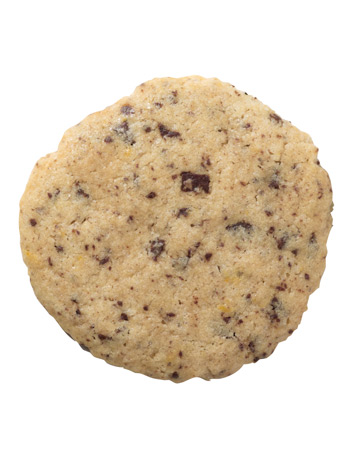
Photo courtesy Cookies for Good.
(Makes 1 ½ dozen cookies — each about 3 inches across)
Ingredients
- 2 sticks Cabot unsalted butter, room temperature
- 1 cup Domino’s granulated sugar
- 3 tablespoons orange zest
- 1 egg, fresh, room temperature
- 4 cups all-purpose King Arthur flour, unsifted
- 1 tablespoon + 1 teaspoon baking powder
- 1 ½ teaspoons sea salt
- ¼ pound Callebaut Bittersweet Chocolate, chopped into dime-sized pieces
Directions
- In large mixer, cream butter, sugar, and orange zest until just combined to dissolve sugar. Add egg. Scrape down paddle and sides of mixer bowl.
- In large mixing bowl, whisk together dry ingredients, then add to mixer bowl until just combined.
- Add in chocolate, and mix. Be careful not to over-mix, or cookies will be tough.
- Using small 1 ½-inch cookie scoop, scoop even-sized balls of dough onto sheet pan. Leave 3 inches (4 fingers) between each cookie. Bake cookies at 350°F until golden on the edges, about 7 to 10 minutes.
Cookies for Good: How to Get Involved
If you know anyone who owns a busy restaurant, a few friends with free time and the names and addresses of local businesses and social organizations, you may be able to bake enough cookies to help your local homeless shelter this winter. What’s more, Cabot Creamery, a farmers’ co-op made up of 1,200 family farms in New England and northern New York, will help you with your bake sale. Cabot’s will donate 500 pounds of butter — on a first-come, first-served basis, up to 40,000 pounds per year — to help launch your project.
Click here for detailed information on how to get involved. Or contact [email protected].
A Surprisingly Popular Presidency
This is the fourth installment of our series “Reconstructing Kennedy.”
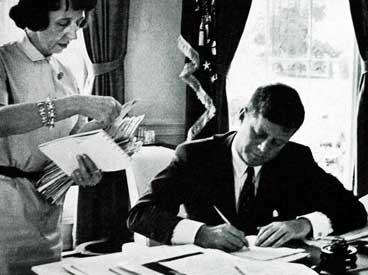
“I myself believe that he will be remembered as one of the great Presidents.” So wrote Post journalist Joseph Alsop in “The Legacy of John F. Kennedy,” (November 21, 1964), as he considered the late president’s legacy. Kennedy, he asserted, had “courage, energy and common sense, clear-mindedness, practicality, a hearty dislike for slogans of whatever kind, and a flat refusal to admit defeat.”
Such praise seems overdone today, after half a century of investigations into Kennedy’s presidency and personal life. Today, we know he hid the facts of his precarious health from the nation; his many adulterous affairs are common knowledge. We suspect he wanted to assassinate Castro, and we have read of his seemingly reckless actions regarding the Bay of Pigs. Some historians still hold him responsible for our ultimately disastrous involvement in the Vietnam War.
Yet even in hindsight, it’s hard to evaluate a president without considering how his contemporaries viewed him. And a great many Americans in the early 1960s, as we’ve found in Post articles, regarded Kennedy with a limitless admiration. He had charm, humor, intelligence, and unflappable poise.
But there was something more to his appeal.
Although he was a conservative Republican, the Post’s political editor, Stewart Alsop, was just as captivated by Kennedy as his even more conservative brother Joseph, who was actually a personal friend of the president’s. In the September 16, 1961 issue of the Post, Alsop reviewed Kennedy’s first year in the White House (“How’s Kennedy Doing?”)—several months after the president’s disastrous Bay of Pigs invasion. “He had done the impossible. At forty-three he was the youngest President ever elected, and the first Catholic. To do what he had done, he had taken a whole series of breath-taking risks. Often it had seemed that he might lose… But always he had won in the end. Is it any wonder that many of his followers had come to believe in a Kennedy star, to believe that, when the chips were down, Jack Kennedy would always win in the end?”
The next year, Alsop conducted a country-wide survey “to get some notion of how real Kennedy’s popularity is and how deep it goes.” The results of his interviews, which appeared in the Post as “The Mood of America” on September 22, 1962, summed the opinions of 500 voters.
According to the results, Kennedy was maintaining his support. More than half of the interviewees had voted for him, and said they would support him in the next election. Several people who had voted Republican also said they would vote for Kennedy’s re-election. Alsop believed many of these swing voters were people who had overcome their objection to a Catholic in the White House.
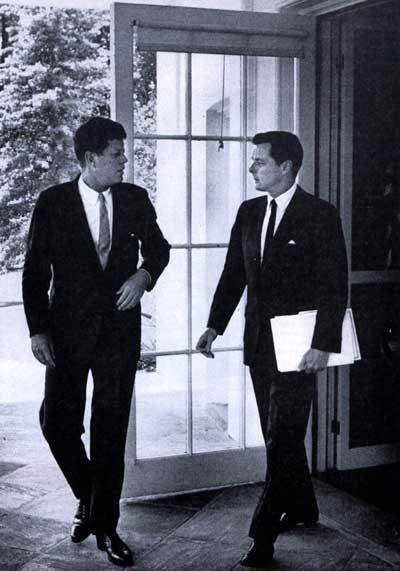
Kennedy’s supporters most often described him as “dynamic,” “straightforward,” and “well-educated.’” The chief criticism among those who didn’t support him was, as Alsop expressed it, “He’s rich and knows nothing about the problems of the poor.” The other common objections? “He’s reaching out for too much power”; “He flies off the handle too much”; “Too much family.” This last objection referred to Kennedy’s very politically involved family, including his brothers who served as a state senator and as the nation’s attorney general.
Many of these 500 Americans were also still concerned about the Cold War. Since the end of World War II, America had seen one country after another fall under Soviet rule; some by occupation, as in Eastern Europe, some by invasion, as in Korea.
The Soviet Union seemed to always be one step ahead of the Americans. We didn’t learn the Russians had stolen details of our atomic bomb plans until they detonated their own in 1949. And we only learned how far their space program had advanced after they had successfully launched the first man into space. Russia was training revolutionaries who were now stirring insurrections in Africa, Central America, and Southeast Asia. And now their power had spread to Cuba, where the Russian army was pointing missile launchers at America, just a few hundred miles away.
But according Alsop’s interviews, “only one in five of the interviewees thought there was a ‘big’ danger of war.” Many believed “there would be no war ‘so long as we remain strong.”
Still, many Americans worried the nation was losing its global prominence, as well as the Cold War. They wanted a president who would be tough, someone who wouldn’t back down from a confrontation.
They got what they wanted just a few days after Alsop’s survey appeared in the Post when President Kennedy ordered the U.S. Navy to block Russian ships from delivering missiles to Cuba. He put all branches of the military on highest alert, anticipating the Soviets would retaliate for the blockade. The world never came so close to nuclear war as it did between October 14 and October 28, 1962. Kennedy remained firm but approachable, and ultimately maneuvered the Russians into withdrawing their missiles.
Voters liked Kennedy’s tactics against the communists, even when they weren’t successful. After the Bay of Pigs fiasco—an outright disaster—his approval ratings rose from 78% to 83%. And in the aftermath of the missile crisis, his approval ratings rose from 62% to 74%.
This sense of America regaining the initiative in the Cold War may explain why so many Post articles and editorials were generous with praise for the president. It might explain why Joseph Alsop believed Kennedy had ushered in, “a time of renovation and renewal, when our country found a new and better course after long years of search… He had a vision of this nation’s greatness, which he somehow conveyed to the rest of us.”
Hospice Girl Friday | ‘These Four Walls’
Devra Lee Fishman’s dear friend and college roommate, Leslie, died from breast cancer one month shy of her 46th birthday after a four-year battle with the disease. Being with Leslie and her family at the end of her life inspired Devra to help care for others who are terminally ill. Each week, she documents her experiences volunteering at her local hospice in her blog, Hospice Girl Friday.

When I arrive for my weekly hospice shift I always take a few minutes to review the list of patients, their diagnoses, and any notes made by other volunteers. Then I walk around and introduce myself to the patients and ask if there is any way I can help.
Electra Goodwin* was in room 101. Age 41. Metastasized breast cancer. I knocked on her open door and started talking as I walked in.
“Good afternoon, Miss Goodwin. I’m Devra, the Friday afternoon volunteer.”
She was sitting in a chair next to the bed with her back to the door, slowly unloading the contents of a small black tote bag onto the table in front of her. I watched her pull out a bottle of lavender scented hand lotion, an unread newspaper, and a pen. Miss Goodwin didn’t turn around so I repeated myself, not wanting to surprise or frighten her by simply appearing in her line of sight.
As I approached I noticed an oxygen tube stretching between her and a wall socket behind the bed, about 6 feet away from where she was sitting. When I got closer I heard the low burble of the oxygen that was secured around the pastel floral silk scarf on Miss Goodwin’s head. The open end of the tube rested just under her nose.
I read in the patient notes that she had a 3-year-old son, which explained the stuffed gray rabbit and open package of toddler Pull-Ups that were on the dresser. I wondered how soon after giving birth had Miss Goodwin been diagnosed; how long did she get to enjoy being a mother before her life started to end?
I moved in front of Miss Goodwin and squatted down to talk to her, resting my hand on hers. She was petite, but not frail, and beautiful. Her face looked like it was carved from an exotic piece of polished mahogany.
“How are you doing today?” I asked, doing a quick physical check. Her skin was smooth and warm to the touch. Her eyes clear and focused. All good. But she heaved and gulped for air before she spoke each word of her response.
“(GULP) I … (GULP) am … (GULP) fine … (GULP), thank … (GULP) you.”
I had to stifle my impulse to take a deep breath for her as I watched her struggle to speak, and I hoped she wouldn’t feel my pulse quicken through my hand, which was still resting on hers. Even though I did not want to engage her in a conversation because she seemed to have difficulty speaking, I had to ask, “Is there anything I can get for you?”
She paused, nodded, and, still gulping before each word she replied, “Yes … please. Do … you … have … any … books?”
“Yes, we do,” I responded. “Any particular kind?”
“Some … sort … of … psychological … thriller … that … I … can … get … lost … in.”
“Let me see what I can find,” I said, standing up. “I’ll be back in few minutes.”
The hospice in-patient unit has an open-plan living room with a sitting area, flat-screen television, two large round dining tables with chairs and, in one corner, several shelves full of books, games, DVDs, CDs, and toys donated by previous patients and their families.
I walked over and scanned the book titles. Among the collection were autobiographies, bibles, even a Chicken Soup for the Soul, but not the kind of book Miss Goodwin described. Then I remembered the library in the nursing home, which was located in the same building as the hospice. That’s where I found Devil in the White City by Erik Larsen, a murder mystery page-turner I read and loved a few years earlier. I was excited that I found the perfect book for Miss Goodwin and rushed back to tell her.
“Hi again,” I said as I knocked and walked into Miss Goodwin’s room. She was still in her chair, but she stood up when she saw me.
“Sorry I took so long, but I found a book for you,” I said, holding up Devil in the White City for her to see. I felt like a prizefighter with a trophy. “I had to walk over to the library in the nursing home. That’s where I found it.”
She took the book from me, turning it over to read the back cover. I kept talking, probably so she wouldn’t have to. “It’s a psychological thriller based on a true story about the Chicago World’s Fair, sometime in the late 1800s. I couldn’t put it down. I think you’ll really like it.”
Finally, she spoke, gulping the air. “How … far … away … is … the …library?”
“Oh, it’s just down the hall on the other side of the building. Not too far.”
“May … I … return … the … book … and … look … for … another … when … I’m … done?”
My smile froze for a split second as I looked past Miss Goodwin to the wall above her bed. I scrambled for a response and tried to recover, but I was too late. Miss Goodwin looked down at the oxygen tube that was under her nose and slowly followed it to where it tethered her to the wall. She turned back and looked at me, tears brimming in her eyes and mine, and then she crumpled into her chair, hugging the book.
“Let me see what we can do,” I said, trying to sound cheerful. “We might have a portable oxygen tank.” But, as I backed out of the room I could tell she wasn’t really listening. She had just realized the same thing I did—that she was never going to leave her room. Instead of helping Miss Goodwin take her mind off of her situation, I had just caused her to be unable to think of anything else.
I went back to check on Miss Goodwin toward the end of my shift and to tell her I was still trying to locate a portable oxygen tank. I wanted to leave her with some kind of hope, but she was asleep in her chair, still hugging the book.
My first thought when I drove home that night was one of gratitude—I am healthy and can go anywhere and do anything I want to, unlike Miss Goodwin. Then I was struck with sadness and shame that I was celebrating my freedom instead of feeling compassion. Holding these mixed emotions at the same time is never easy, and I struggle with it every week as I transition between my everyday life and the hospice unit.
*Names have been changed to protect patient privacy
Previous post: Why I Became a Hospice Volunteer Next post: Receiving Thanks
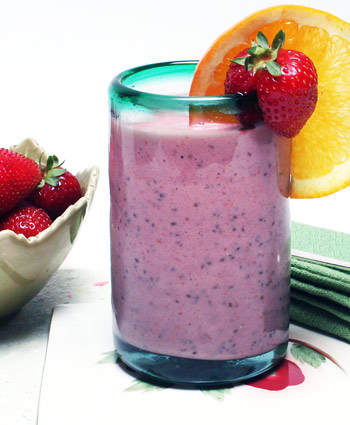
Strawberry Chia Smoothie
Chia seeds are amazing. Resembling poppy seeds, these seeds, native to Latin America, are loaded with fiber, rich in omega-3s, and are a good source of protein. They also produce a creamy, thick texture. In 4 teaspoons, the chia seeds give you 5 grams of fiber, plus the useful omega-3s, all for just 60 calories. By comparison, bananas make a smoothie thick and sweet and provide 3 grams of fiber, but they add 105 calories.
Strawberry Chia Smoothie
(Makes 1 serving)
Ingredients
- ¾ cup skim milk
- 4 teaspoons chia seeds
- 1 cup fresh strawberries
- 1 tablespoon strawberry fruit spread, or to taste
- 2 teaspoons orange zest
- ½ teaspoon chopped fresh ginger
- ½ teaspoon vanilla extract
Directions
- In blender, place milk and chia seeds and let sit while measuring remaining ingredients.
- Add strawberries, preserves, orange zest, ginger, and vanilla to blender. Whirl on high speed until smoothie is blended and creamy, about 1 minute. Pour smoothie into tall glass and serve immediately.
Nutrition Facts
Per serving
Calories: 249
Total fat: 5 g
Saturated fat: <1 g
Carbohydrate: 44 g
Fiber: 9 g
Protein: 9 g
Sodium: 90 mg
The Cans That Saved Choir
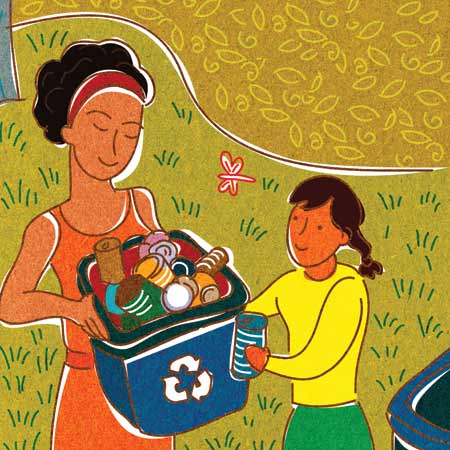
(Photo courtesy Shutterstock)
Cling … Clang … Clank. From inside my apartment, I winced at the noise my parents were making as they sorted bottles and cans out on the cramped balcony. With as much enthusiasm as I could muster, I called to my mother in Chinese, “How many do you have this time?”
“Eight hundred and six pieces, that’s $40.30!” she answered. “That makes it $309.55 in total — a decent month’s salary back home!”
I’d been living in my West Los Angeles apartment for a little over four years when my parents came for a six-month visit from the town in northeastern China where I grew up. Just a few weeks into their stay, my mother had appointed herself CFO of recycling. I’d casually mentioned that the plastic water bottle and aluminum can they’d noticed on the curb were worth 5 cents each. I had no idea that simple revelation would open such a can of worms —“golden” worms as far as my parents were concerned.
For the next several months, my building endured the clutter and clamor of my parents’ enthusiastic recycling. At dinnertime, Mom and Dad took turns recounting a list of perfectly usable things they had seen being thrown out that day. When their stay with us ended, I must confess that I felt free and relieved (and then guilty). I suspect my neighbors noticed their absence immediately. My balcony reverted to its role as a tiny garden.
Little did I know, though, that only a few months later I would be cluttering that balcony right up again and informing my parents that they had inspired me to start a recycling fundraiser at my daughter’s school. I named it the Green for Green program. To date it has brought in — bottle by bottle, can by can — more than $15,000.
When I was growing up in China, parental involvement at school was limited to attending parent-teacher conferences to discuss academic issues. Schools were free but with very limited resources (no library, gym, or science labs) and huge class sizes: up to 60 students. Students helped clean and make simple repairs. Schools operated within their means, and fundraising didn’t exist.
By the time I had a daughter of my own and she began school, I had lived in America for six years and become an American citizen. Although I considered myself pretty well assimilated, I was confused and skeptical when I first heard that I was expected to raise funds for the school. If American public schools are free, how come they keep asking for money? While fundraising for public school was a foreign concept to me, recycling was not. Wastefulness (langfei in Chinese) has been considered a vice since the earliest Chinese cultures. My parents, like most Chinese people of their generation, use everything to death, beyond the point of any possible salvage, and then they still save it just in case. Reduce, Reuse, and Recycle was a principle of survival. One of the first children’s rhymes I learned was, “Every grain of rice represents a drop of farmer’s sweat.”
During years of strict rationing in the 1970s, my mom even saved her shoelaces, unraveling them into yarn to knit mittens for me. Many of my clothes were altered hand-me-downs from my mom, aunts, and grandmother. Every scrap of cloth was used as a patch, a doll’s dress, or a rag. Dogs and cats ate people’s leftovers, and restaurants raised pigs in the backyard to feed on customers’ leftovers. When a junk collector came through the neighborhood with a wheelbarrow, chanting “Shou po lan!” (“Junk collection!”), my neighbors would chase him down with saved-up cardboard, paper, glass, metal — and sometimes even hair — to exchange for money. We went to the market with our own baskets and carried our grains and flour home in cloth bags made from used bedsheets.
When I first arrived in the U.S., I was amazed by garage sales and what they suggested: waves of new purchases rolling in, and waves of old purchases, now unwanted clutter, rolling out. Although many conscientious Americans make an effort to recycle at home, I have seen little public infrastructure set up here to make it as easy as consuming and wasting — not even, to my astonishment, in schools. We sometimes seem to be too wealthy for our own good.
But economic setbacks hit us too. During the recent economic recession, my daughter’s school, the Los Angeles Center for Enriched Studies (LACES), lost hundreds of thousands of dollars in state and federal support, including $300,000 in Title I funding (earmarked to help schools with a large percentage of students from low-income families).
I felt heavy pressure to help raise funds for my daughter’s school. At the same time, I have long felt strongly about environmental education. How could I get the whole community excited about “Reduce, Reuse, Recycle” during such a stressful and cash-strapped time? That’s when it hit me: how about uniting the two? LACES has more than 1,600 students, teachers, and staff. If my two elderly parents could raise $300 in six months from recycling, why couldn’t our school multiply that number by at least 800?
And so I approached the president of the LACES parent organization. She put me in touch with key adults: the principal, the plant manager, the school police officer, the student leadership teacher, and a few motivated parents. I found a recycling center a mile away from LACES, and its manager agreed to pick up our recyclables at our school. I ordered more recycle bins from the city, got free stickers and posters from calrecycle.ca.gov, and wrote a speech to motivate parents and teachers. The LACES principal, Harold Boger, authorized me to create and manage a Green Team page on the school’s website. I recruited volunteers at parent meetings and created an account at signupgenius.com to manage scheduling.
Next, I went to talk to the students. The leadership students at LACES are eloquent, confident, and academically successful. They have been hearing the “Reduce, Reuse, Recycle” slogan since they were in kindergarten, and they were eager to take responsibility and lead a change. However, they wanted to take charge of the outreach themselves. So we agreed the parent team would simply provide the materials and arrange to haul loads to the recycling center to redeem them.
After all that work, our first two trips to the recycling center yielded $114. I went back to the drawing board. My committee and I organized a day for students and parents to bring bottles and cans directly to school. We called it the Green for Green drive. The first one raised only $145. But I scheduled more drives. With each one, the numbers started to look better: $145 … $400 … $481. Now we were getting somewhere!
We kept improving the system. We put locks on the campus recycle bins and cut bottle-size holes on the top of each bin so students could drop bottles in and scavengers couldn’t take them out. I kept on campaigning, with heartfelt pleas, educational and funny YouTube video clips, and poems. We scheduled student assemblies. I got a parent to donate a large banner to hang in front of the school building. I went to neighborhood council meetings. The principal added a reminder about our Green for Green drives to his weekly, automated phone calls home. I made a math-themed slogan: 1,666 students x 12 bottles or cans x $.05 = $1,000.
The more success we had, the more people joined our team. Eventually, we began to save, crush, sort, and bag returnables like a well-oiled machine. Today, LACES teachers keep boxes in their classrooms for bottles and cans. Leadership students collect recyclables and store them in locked bins. Parents collect at their offices and sporting events. We’re working on getting donations from a local office building. On many occasions LACES parents have told me about their own cluttered balconies and garages and how they no longer see litter, they see money.
Getting parents together to share some dirty work at the school twice a month has also turned out to be a marvelous community-building exercise. A year ago, my daughter’s school friends told her they felt weird bringing their used containers to school. Now, I see them helping unload bags from their parents’ cars as they are dropped off at school. Hundreds of people — parents, students, and occasionally people from the neighborhood — bring bags of returnables with them from all over the city. Twenty parent volunteers sort and bag, chatting about the latest news at the school and meeting new friends. In an hour, a pile of plastic bottles, aluminum cans, and clear, green, and brown glass bottles are neatly sorted by material type and bagged for pickup.
Since the LACES Green for Green program started in Fall 2011, LACES students and parents have raised approximately $15,500 for the school and recycled about 75,000 pounds of waste. I know that $15,500 is a drop in a bucket, but for us it means 5 percent of the funding for over 20 programs, including our school choir, Math Mania, general scholarships, technology support, school buses, and nurse days. I take great satisfaction in knowing that this modest program motivates the community to extract money from waste and that everyone, no matter their financial means, can contribute.
Looking back, I see that although I spearheaded the charge, success requires community. I believe that most people want to contribute, but it’s a lot more motivating when you feel that you belong to something bigger, that your effort is matched by the others in the community, and that the result is multiplied. During the past two years, news of Green for Green’s success has spread to other school communities through word of mouth. I have received emails and phone calls from parents at other schools asking to share what wisdom I have gained. I’m proud to think that the LACES recycling effort may have snowballed.
I used to laugh at my parents’ frugality when I was young, having never experienced starvation or rationing like they did. I laughed again at their recycling project during their six-month visit here. Now I laugh at myself for having benefited from their wisdom. They may never have intended to influence anyone beyond their family, but their small effort has led to bigger change, one that inspires family, friends, children, co-workers, and even strangers.
Who knows what they’ll inspire on their next visit—a solution to L.A.’s water shortage?
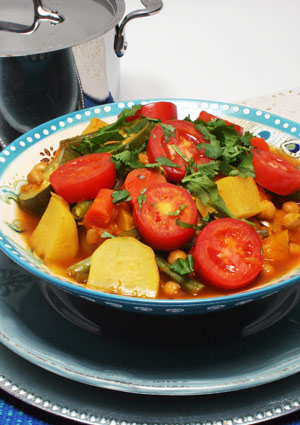
Moroccan Seven Vegetable Tagine

Stewing—one of the easiest ways to cook—is used in nearly every culinary tradition, from Ireland’s basic kettle of meat, potatoes, onions, and carrots to sophisticated French coq au vin. Besides turning tough meat enjoyably tender, this wet-cooking method infuses bland ingredients with flavor and lets you serve vegetables in their nutrient-rich, flavor-intensified juices.
Moroccan tagines are among the most delicious stews. Tagines often include olives and/or salt-preserved lemons, but one of my favorites is a simple combination of vegetables and chickpeas. Right now, most farmers’ markets will have all the vegetables in this meatless feast. Happily, so does every supermarket, so you can easily enjoy it year round.
Moroccan Seven Vegetable Tagine
(Makes 6 servings)
Ingredients
- 2 white turnips, peeled and quartered
- 1 cup sliced carrots, in ¾-inch slices
- 1 cup finely chopped onion
- 1 ½ teaspoons ground cumin
- 1 teaspoon ground sweet paprika
- ½ teaspoon ground ginger
- ½ teaspoon ground turmeric
- Pinch of cayenne pepper
- 1 ½ cups reduced-sodium vegetable broth, divided
- 2 ½ cups butternut squash, in 1-inch cubes
- 1 cup chopped zucchini, in ¾-inch pieces
- ¼ pound string beans, trimmed and cut in 1 ½-inch lengths
- 1 (15 ounce) can no salt added chickpeas, drained
- ¾ teaspoon salt
- Freshly ground black pepper
- 3 plum tomatoes, cut crosswise into ¾-inch slices
- ¼ cup chopped cilantro
- ¼ cup chopped flat-leaf (Italian) parsley
Directions
- In medium Dutch oven, combine turnips, carrots, onion, cumin, paprika, ginger, turmeric, and cayenne. Pour in 1 cup broth. Cover and simmer over medium heat for 10 minutes.
- Add butternut squash, zucchini, string beans, chickpeas, and remaining broth. Add salt and 3-4 grinds of pepper. Cover and cook until vegetables are tender, 20 minutes. Arrange tomato slices on top of the vegetables, cover, and cook until tomatoes are just soft, 5 minutes. Add cilantro and parsley and let tagine sit, covered, for 10 minutes to allow flavors to meld. Serve hot, directly from pot. This dish improves when reheated so, if desired, cool, cover, and refrigerate for up to 2 days. Reheat, covered, over medium heat.
Nutrition Facts
Per serving (1 ½ cup)
Calories: 149
Total fat: 2 g
Saturated fat: < 1 g
Carbohydrate: 30 g
Fiber: 8 g
Protein: 7 g
Sodium: 485 mg
The Rookie
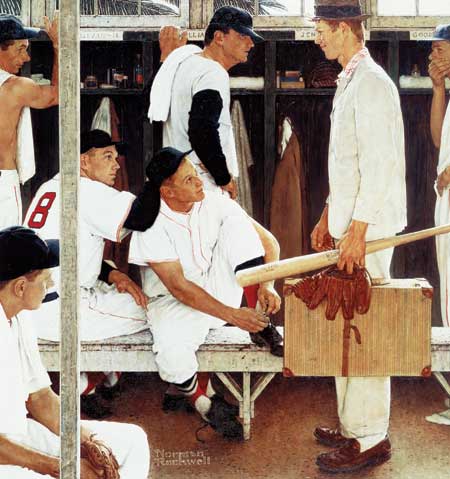
When Sherman “Scotty” Safford walked into the Pittsfield High School cafeteria in 1956, he spotted a mysterious man sitting at a nearby table. “He had a Bing Crosby-type pipe, very wavy hair, and a receding chin,” recalls Scotty, now 75. “I knew he was somebody special, because nobody smoked in that place.”
The mystery man was Norman Rockwell, and he came to Pittsfield High in search of a model for a baseball spring training painting in the works. “I was a tall, gangly string bean of a kid,” says Scotty. “At 6-foot-4, I towered over everybody else, and obviously this caught his eye.”
Rockwell met Scotty, shared his cover idea, and invited the athlete to pose as the talented “hayseed” who shows up on his first day in the major leagues with bat, glove, and suitcase in hand, convinced he’s there to save the team. “As a 17-year-old kid, I couldn’t have been more thrilled,” Scotty recalls.
By the time the issue hit newsstands in March 1957, Scotty was in the Army and stationed at Fort Dix. His mother called with the news, telling him to run to the post exchange and buy as many copies as he could carry.
“I went AWOL,” says Scotty, who wasn’t allowed out of the barracks without a pass. “When I came back, my company commander was there; the executive officer was there; the first sergeant was there. My sergeant was standing at the top of the stairs in front of the door and growled, ‘This better be good, mister!’ I had an armload of magazines and I handed him one and said, ‘I’m on the cover of the Post this week.’ And I walked right by him and went upstairs.”
Only later did the impact of his actions sink in.
“The next morning at zero-dark thirty, we’re standing there, and it’s pitch dark,” Scotty says. “The company commander comes up with the magazine and says, ‘Private Safford, would you sign this for me?’”
Scotty never saw Rockwell again, but The Rookie became an instant classic.
“I’ve had so much fun with this over the years,” Scotty says. “It means so much to me, probably more so as time goes on because I realize how special it was.”