Outrageous: The History of Comedy, Culture Wars, and Kissing Contestants
In olden days, a glimpse of stocking
Was looked on as something shocking
But now, God knows
Anything goes
–Cole Porter
America is a tough room. You can’t joke about anything anymore.
Or so we’re told. “We’re in this place where everyone’s like, ‘You can’t say this, you can’t say that,’” Whitney Cummings told Matt Wilstein on The Last Laugh podcast. “I think it’s particularly worrying at the moment because you can only create in an atmosphere of freedom, where you’re not checking everything you say critically before you move on,” legendary Monty Python’s Flying Circus member John Cleese told an interviewer.
Kliph Nesteroff has heard all this before. As he chronicles in his new book, Outrageous: A History of Showbiz and the Culture Wars, the comedy historian and author of the essential book, The Comedians, maintains that America has not suddenly lost its sense of humor. The so-called culture wars have been waged for centuries.
In the colonial era, he writes, the Continental Congress passed a law decreeing the closure of all places of public entertainment. In the 1870s, 1880s, and 1890s, dance shows were raided if too much leg was shown. Decades before Will Smith slapped Chris Rock at the Oscars, a female audience member attacked Welsh comedian Ossie Morris after he uttered two profanities. In the 1950s, when Desi Arnaz wanted to work his wife Lucille Ball’s pregnancy into I Love Lucy, sponsor Philip Morris told him, “You cannot show a pregnant woman on television.” (You couldn’t even say the word; the episode itself was titled, “Lucy Is Enceinte.”)
“The idea you that can’t say anything anymore is hyperbolic,” Nesteroff says in a phone interview. “Lenny Bruce, George Carlin, and Richard Pryor were each arrested for the language they used onstage. Mae West went to jail. Today, even if a comedian caused outrage, nobody would be arrested. It’s disrespectful to those who came before and blazed this path when you really couldn’t say certain things.”
As a complement to his book, Nesteroff has recently been posting on X (formerly Twitter) contemporaneous letters to the editor from irate TV viewers who were shocked and offended by what they were seeing in prime time. Like viewer Bernie Splim, who protested the food fight on a 1986 Thanksgiving episode of Cheers: “Couldn’t they have had Sam [Malone] open the bar to feed the homeless?” he complained.
Nesteroff believes that social media is fueling the misperception that we are overly sensitive these days. “In the days before the Internet, people’s reactions to show business was very similar to the reaction we see on social media,” he says. “The difference was if 100 people wrote 100 letters to the editor, only one or two would be published. Today, letters to the editor exist without the editor. They are sent out as tweets or Instagram posts and all 100 are posted. I don’t believe this conceit that people are more sensitive or easily offended today. It’s just now there is no filter. In reality, people were probably much more sensitive in the past because we had far greater taboos when it came to sex, religion, politics, and language.”
Today, at least five of George Carlin’s “Seven Words You Can Never Say on Television,” can be heard in prime time. “There is more freedom of speech and freedom of expression today,” Nesteroff maintains. “But we’re being told the opposite.”
For example, Nesteroff points to controversial films in cinema. While D.W. Griffith’s Birth of a Nation advanced cinema as an art form, it also glorifies the Ku Klux Klan. Gone With the Wind may be one of the most honored and beloved films of all time, yet it presents a benign view of the antebellum South. But as Nesteroff writes, America did not just suddenly get more sensitive toward these controversial films (HBO Max temporarily pulled Wind in 2020). They were banned or protested at the time of release in 1915 and 1939, respectively.
Outrageous is not officially dedicated to comedian Gilbert Gottfried, who died last April, but some stories in the book were absolutely included with Gottfried in heart and mind, Nesteroff says. For instance, Nesteroff writes in Outrageous about game show fans being “repulsed” by Family Feud host Richard Dawson’s penchant for kissing female contestants on the mouth. In response, the show instituted a policy by which male and female contestants had to undergo a mouth test for herpes and other diseases.
“Part of including that is the spirit of Gilbert Gottfried and what would make him laugh or make his jaw drop on the floor,” Nesteroff says. “The Richard Dawson herpes test is one I never got to share with him. I guarantee that if he were alive, I would lead with that on my next podcast appearance.” (Nesteroff was a popular guest on Gilbert Gottfried’s Amazing Colossal Podcast, which was devoted to old school show business with eager digressions into entertainers behaving badly.)
Gottfried himself had “multiple controversies” throughout his career, Nesteroff says, “and I wanted to have at least one Gilbert story in the book.” That story is Gottfried’s 1991, well, outrageous, appearance on the Emmy Awards, which coincided with Paul Reubens’ arrest in an adult movie theater (in comedy, timing is everything). “Gilbert was supposed to read material off the teleprompter, but he went rogue and did a series of jokes about masturbation,” Nesteroff says. “He got huge laughs, but the show’s writers said they were disgusted by his performance. Michael Medved singled out Gilbert as an example of what he called Hollywood’s contempt for middle America.”
That seems to be a recurring line of attack in the culture wars: us vs. them. Perhaps one of the key lines in Outrageous is Nesteroff’s observation that “While the showbiz of a hundred years ago may seem remote, it is remarkable how similar the issues of the past are to the concerns of today.” For example, there’s this quote: “We must take our country back…cleaning up what I think is the dismal swamp, draining that swamp.” Donald Trump in 2016? No, presidential candidate Pat Buchanan in 2000.
The culture wars rage on. Nesteroff hopes people can chill out a bit. “I do not care for these doomsday prophecies that the world is coming to an end,” he says. “People used to say this in reference to the tango, the jitterbug, rock and roll, and comic books. You hear the same thing today when people refer to drag queen story time, The 1619 Project, or a comedian making a joke you don’t like. Every generation thinks that everything happening in their day is unprecedented. You feel the hysteria that is sent to us intentionally and unintentionally on the Internet. But controversies quickly dissipate as the years pass. We’re still here.”
Outrageous: A History of Showbiz and the Culture Wars is now available from Bookshop and other retailers.
In a Word: Black Record, White Album
Senior managing editor and logophile Andy Hollandbeck reveals the sometimes surprising roots of common English words and phrases. Remember: Etymology tells us where a word comes from, but not what it means today.
Way back in the spring of 2019, I briefly mentioned that the word anthology stems from Greek roots that mean “flower gathering.” The first anthologies were collections of flowers.
Anthologies these days are usual collections of songs, often from a single musical group. But before a band can put out their “Greatest Hits” anthology, they need to have published several albums — at least, that’s how it went in the days before streaming music.
The history of that word album starts way outside the world of music. During classical antiquity, Roman authorities would inscribe public notices in black on a board colored white. The Latin word for “white” is albus, so the board on which these decrees were displayed was called an album, literally “whiteness.” This type of album was common enough that the color sense of the word faded; it took on more a sense of “a register or record.”
As Latin faded, the word album got less and less use. But Latin was still the language of academia, and in the 1500s, German scholars brought the word back — in its “register” sense — in the phrase album amicorum. This “register of friends” that was essentially a blank book in which they collected colleagues’ autographs or other souvenirs.
By the 1650s, album was used to describe any type of blank souvenir book. By the 1860s, those “souvenirs” included a newfangled type of physical medium: photographs. So we began to see photo albums, which are generally rather large and square-ish, with stiff pages to keep the photos from bending.
Then came long-playing gramophone records. Their cardboard containers were also square-ish and stiff, which is why those record jackets were also called albums, a term that transferred to the records themselves. This didn’t happen as long ago as you probably think, though: Long-play musical records weren’t called albums until shortly after the end of World War II.
For most of the 20th century, musical albums were primarily made from black vinyl, which is somewhat ironic considering the word album traces back to a word meaning “white.” This also means that when people refer to the Beatles’ self-titled release as “the White Album,” they are, etymologically speaking, calling it “the White Whiteness.”
Review: Fingernails — Movies for the Rest of Us with Bill Newcott
Fingernails
⭐️ ⭐️ ⭐️ ⭐️
Rating: R
Run Time: 1 hour 53 minutes
Stars: Jessie Buckley, Riz Ahmed, Jeremy Allen White
Writers: Christos Nikou, Sam Steiner, Stavros Raptis
Director: Christos Nikou
Streaming on Apple TV+
Reviewed at the Toronto International Film Festival
A fable about an alternate 1980s world where a brutal form of technology can determine if two people are actually in love, Fingernails is a dystopian rom-com with a touch of wacked-out social satire and a pinch of sober cautionary drama.
That’s a tricky mix, but in a movie that trades on the intersecting uncertainties of technology, love, and social trends, the formula bubbles with energetic originality. For his first English-language film, Greek director and co-writer Christos Nikou goes to absurdist lengths examining the most basic of human quandaries: Is love really a thing?
Anna (Women Talking’s Jessie Buckley) works for a company that owns a technology that can scientifically determine if two people who think they are in love really are, or if they’re just kidding themselves. The process is quite simple, really: You and your supposed loved one just have to each allow a technician to yank out a fingernail and place them in a clunky microwave-like device. Thirty seconds later a computer screen offers one of three results: 1) You’re both 100 percent in love; 2) Neither of you is in love with the other; or 3) Only one of you is in love (maddeningly, there’s no telling which partner is the one feeling love).
For reasons not explained (and perhaps that’s for the best) the world at large has adopted this love compatibility test as a social necessity. At dinner parties, in restaurants, in public parks, couples all have the same question for each other: “Have you been tested?” Of course, no one’s forcing anyone to be screened for mutual love. But then again, the assumption is any pair who have not been issued a Certificate of Love by an authorized testing agency is just living in denial.
Anna and her partner, Ryan (The Bear’s Jeremy Allen White) are a couple who’ve seemingly got it all: They’re beautiful, they’re happy, and they’ve got their love certificate. Anna’s job at the compatibility institute involves putting couples who suspect they’re in love through rigorous love-enhancing exercises — a process that supposedly improves their chances of passing that nail-pulling screening test. The increasingly outrageous drills range from tandem skydiving to being blindfolded and told to sniff out their special someone in a room full of people who have not showered for three days.
Despite the rigorous screening process, as the company’s owner (a suitably clueless Luke Wilson) observes, barely 80 percent of couples prove to be a love match.
But is this quantified love a forever thing? That’s Anna’s question as, while still fond of her partner Ryan, she finds herself falling for her new co-worker, Amir (Sound of Metal’s Riz Ahmed).
Needless to say, it’s going to take a lot of fingernail pulling to sort this out.
Essential to the success of the film, Nikou’s cast plays the quirky premise perfectly straight. Buckley, with an adorable smile and earnest demeanor, pulls us willingly into Anna’s unlikely circumstances, making us truly care about the kind of happiness that lies in her future. In somewhat less rewarding roles, Allen and Ahmed wander helplessly in this Brave New World of romance.
Perhaps the true genius in Fingernails is Nikou’s choice to wrap his sci-fi premise in a pre-Internet past, bathing his scenes in an amber, almost nostalgic light. The resulting film plays as a futuristic memory, reminding us that no matter how advanced we may think we are, in a few years we will remember this as a Stone Age.
It’s clear that Nikou watched Michel Gondry’s Eternal Sunshine of the Spotless Mind — another surreal tale of runaway technology messing with people’s minds — more than once. I wish that, rather than dwelling on his improbable invention, Nikou had come down more on Gondry’s winking acknowledgement that the film’s bells and whistles exist only in the service of making a larger point. There are whispers here of Andrew Niccol’s Gattaca, and echoes of the COVID-19 testing era are, of course, inescapable.
There’s no question that technology dictates how we live our lives. As his characters scream through their fingernailectomies and sweat over their fateful readouts, Nikou’s question is, why do we let it?
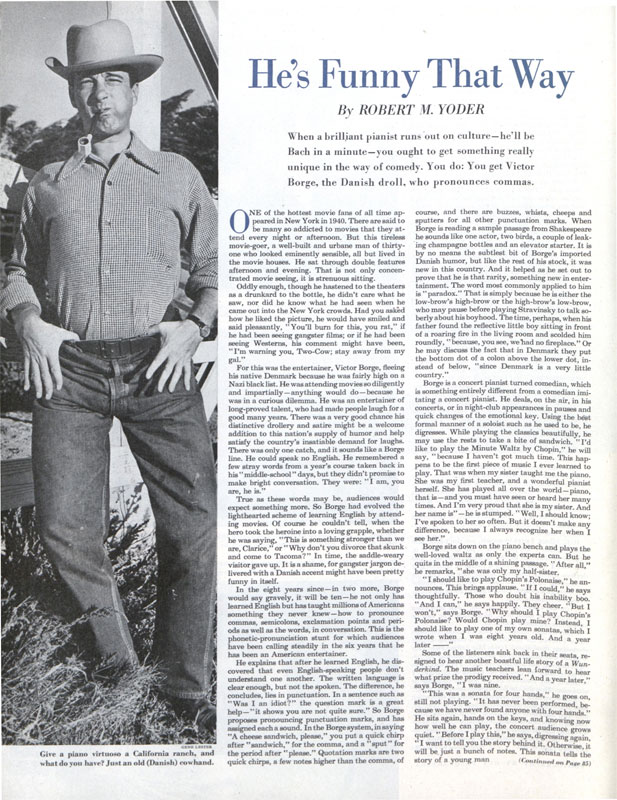
Victor Borge: Clown Prince of Denmark
—From “He’s Funny That Way” by Robert M. Yoder, in the December 18, 1948, issue of The Saturday Evening Post
One of the hottest movie fans of all time appeared in New York in 1940. This was the entertainer Victor Borge, fleeing his native Denmark because he was fairly high on a Nazi black list. Borge is a concert pianist turned comedian, which is something entirely different from a comedian imitating a concert pianist. He deals in pauses and quick changes of the emotional key. Using the best formal manner of a soloist such as he used to be, he digresses.
“This is a sonata for four hands. It has never been performed, because we have never found anyone with four hands.” Borge sits, hands on the keys, and knowing now how well he can play, the concert audience grows quiet.
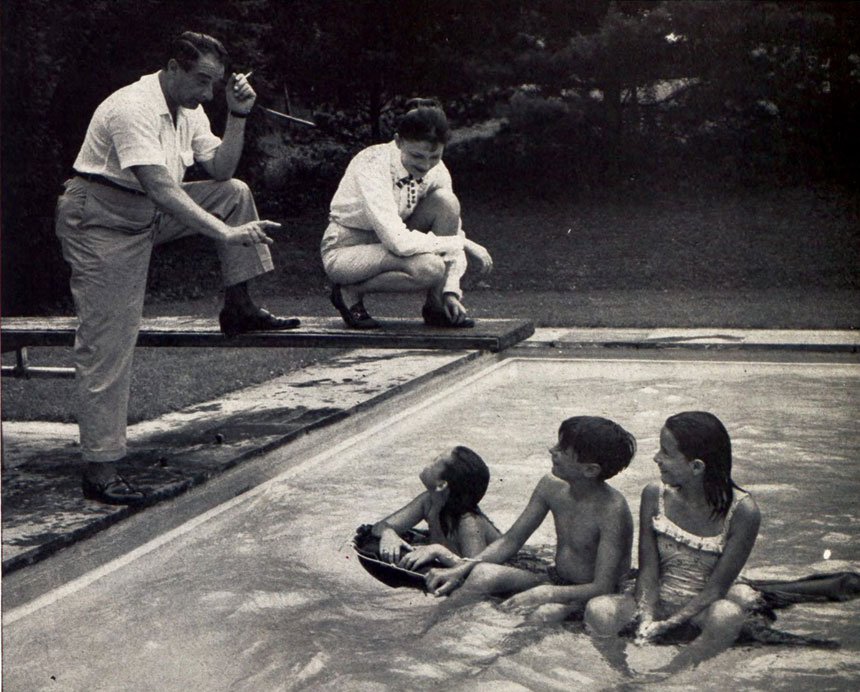
“Before I play this,” he says, digressing again, “I want to tell you the story behind it. Otherwise, it will be just a bunch of notes. This sonata tells the story of a young man and a young girl. Well, she isn’t so young, but she’s all right. The boy’s mother — who, by the way, is much older than he is, of course — disapproves of him fooling around with this girl. So he assures his mother he ain’t fooling.”
Borge goes on, telling of each movement, until finally the boy saves the girl from drowning in the fourth movement, and they live unhappily ever after.
Borge ponders, and decides not to play. “Now that you’ve heard the story,” he says, “you don’t need the music; it’s merely repetition. Another thing is it takes too long to play it. It would take an hour and a half to play it with one hand alone. So you can imagine — with both hands and the orchestra, it would take weeks.”
Best of Borge
“I know two numbers, that’s all. One is Clair de Lune, and the other one isn’t. … Clair de Lune — English translation: ‘Clear the saloon.’”
“My sister is the brightest person in the family … into which she married. “
“My grandfather invented the burglar alarm. It was stolen from him. … He invented the cure for which there was no disease. His wife later caught the cure and died. … He always experimented. Once he crossed an Idaho potato with a sponge. It tasted horrible. But it sure held a lot of gravy!”
“Laughter is the closest distance between two people.”
“I don’t mind going back to daylight saving time. With inflation, the hour will be the only thing I’ve saved all year.”
“I wish to thank my parents for making it all possible … and I wish to thank my children for making it necessary.”
This article is featured in the November/December 2023 issue of The Saturday Evening Post. Subscribe to the magazine for more art, inspiring stories, fiction, humor, and features from our archives.
Cartoons: What a Card
Want even more laughs? Subscribe to the magazine for cartoons, art, inspiring stories, fiction, humor, and features from our archives.
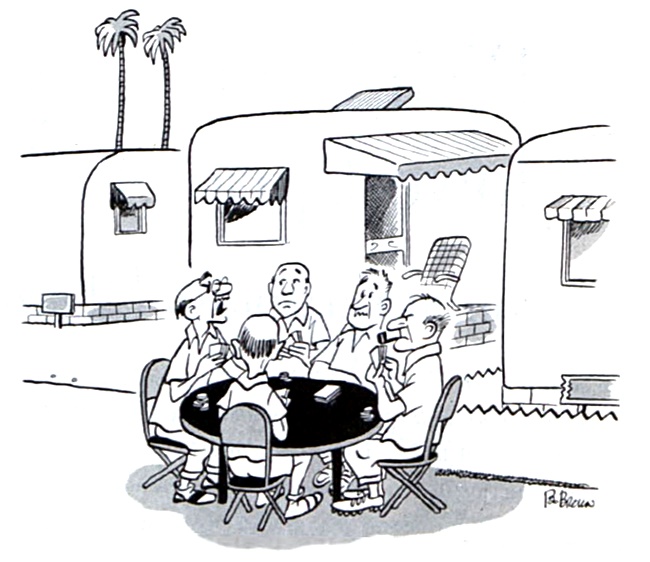
B. Brown
October 3, 1959
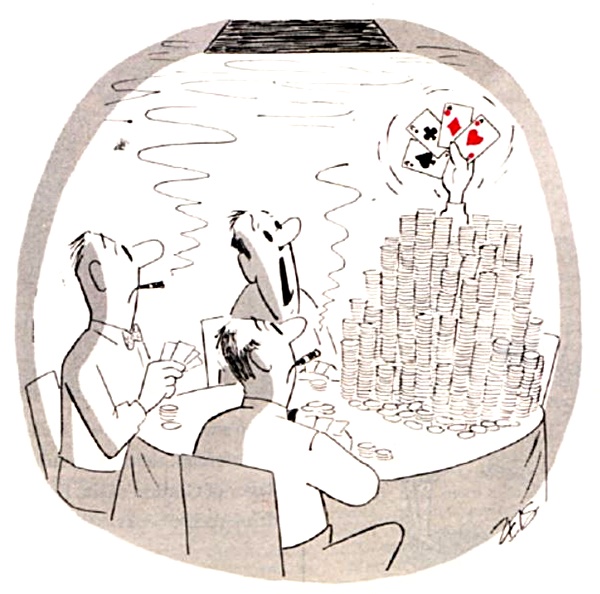
Joseph Zeis
August 15, 1959
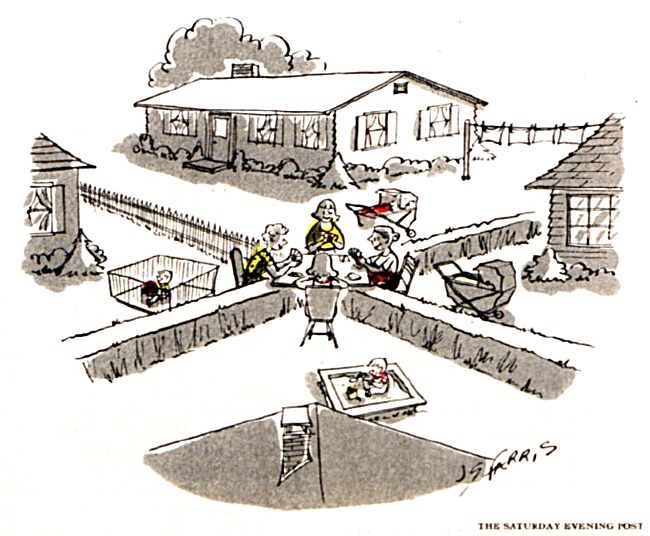
July 25, 1959
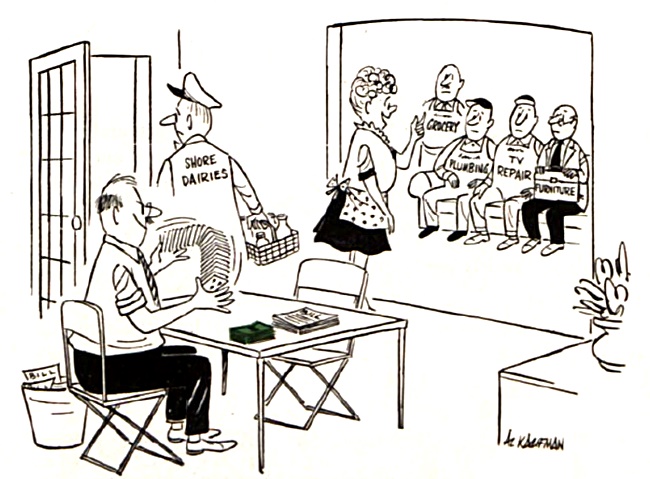
Al Kaufman
April 6, 1957
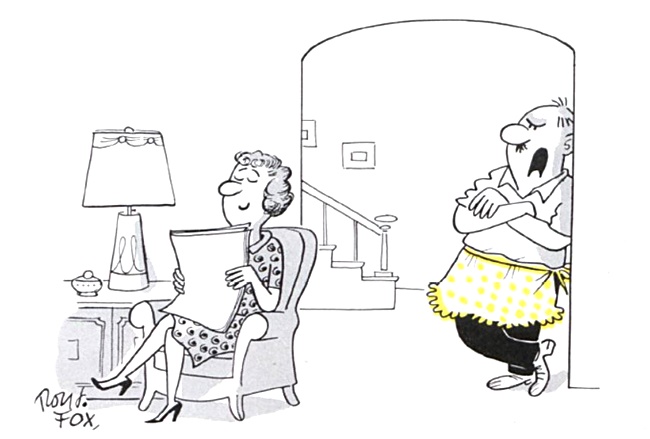
Roy Fox
April 1, 1961
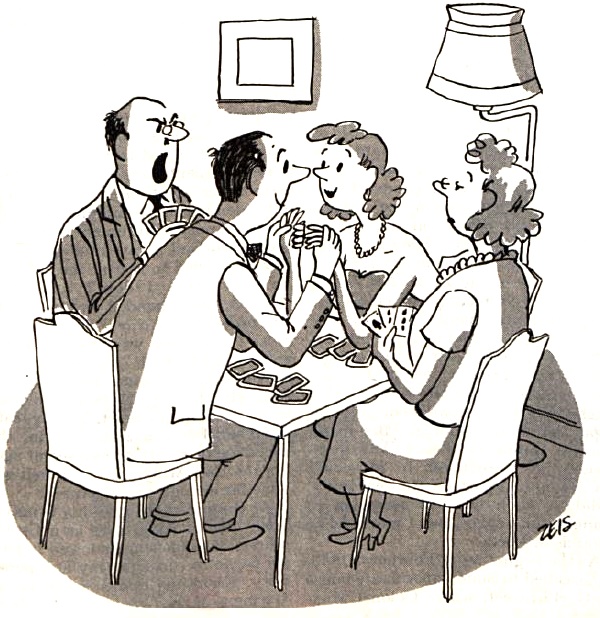
Joseph Zeis
November 20, 1954
Jeffrey Monahan
November 3, 1962
Want even more laughs? Subscribe to the magazine for cartoons, art, inspiring stories, fiction, humor, and features from our archives.
The History of the National Christmas Tree
The White House has experienced numerous firsts around the celebration of Christmas, sometimes establishing holiday traditions that spread nationwide. Benjamin Harrison, in 1889, became the first president to set up a holiday tree inside the White House for the pleasure of family, staff, and visitors. Five years later, Grover Cleveland replaced the decorative candles traditionally used to illuminate the White House tree with a string of electric lights, an innovation made possible by the introduction of electricity to the White House in 1891. The public took notice, and before long, family Christmas trees around the country were similarly decorated.
It wasn’t until 1923, however, that a Christmas tree was placed in proximity to the White House for the public to enjoy. That tree, complete with lights and decorations, came to be known as the National Christmas Tree, and this December will mark a century since that first tree lighting, and 100 consecutive years of a cherished ceremony.
A Christmas tree for the people was the brainchild of Lucretia Walker Hardy, acting director of the D.C. Community Center Department. On November 30, 1923, Hardy reached out to C. Bascom Slemp, secretary to President Calvin Coolidge, regarding a national Christmas celebration.
“Hardy wanted to place a tree on the White House grounds, but First Lady Grace Coolidge suggested that it might be best if it was held on the Ellipse near the White House,” notes National Park Service archivist David Krause. “The tree was a 48-foot balsam fir gifted to President Coolidge by Middlebury College in Vermont.”
The first tree-lighting ceremony, on Christmas Eve, drew more than 6,000 visitors, who sang Christmas carols on the South Grounds of the White House. Additional entertainment was provided by the Epiphany Church choir, which performed with the U.S. Marine Band. President Coolidge was present to light the tree but, true to his nickname Silent Cal, made no public remarks.
In response to a national movement led by the American Forestry Association (AFA) to use live trees for community Christmas trees, it was decided that the National Christmas Tree should be a live tree as well. So in 1924, a Norway blue spruce (donated by the AFA) was planted on the west side of Sherman Park, near the east entrance of the White House. That tree was a highlight of the Christmas celebration until 1929, when it was determined that the decorations and hot lights had caused significant damage. Another Norway spruce was planted in Sherman Park in May, and decorators used scaffolding rather than ladders to protect its branches. Despite these efforts, the tree was found to be in rough shape just two years later and was replaced yet again.
The tree lighting was essentially a local event until 1925, when NBC broadcast carols and the president’s remarks nationally via radio for the first time. The first television coverage occurred in 1946, though it remained regional. Both NBC and the Dumont Television Network broadcast the festivities nationwide the following year.
Construction around Sherman Plaza in 1934 forced the relocation of the National Christmas Tree to Lafayette Park, a seven-acre tract north of the White House on H Street. The tree returned to the Ellipse in 1939, then moved to the White House grounds in 1941 at the request of President Roosevelt, and it still grows there. “A pair of Oriental spruce trees were planted, and one remains today at the southeast corner,” says Krause. “We have a retired National Christmas Tree in the park, which we’re really proud of.”
For 18 years starting in 1954, cut trees were delivered to the Ellipse from various states, many from national or state forests. In 1973, a living tree was reintroduced with the planting of a Colorado blue spruce on the north side of the Ellipse. The current tree, a white fir, was planted there in 2021.
As its popularity grew, the National Christmas Tree celebration expanded over the decades. The lighting ceremony was pushed back to early December, and various activities were added, such as a live nativity, a puppet show for children, and a burning yule log, reports Matthew Costello, vice president and senior historian with the White House Historical Association. However, some activities, such as the blazing yule log, proved problematic and were eventually discontinued.
In an effort to make the celebration around the National Christmas Tree more than just a few hours of carols and speeches, a multi-week, peace-themed celebration was proposed by Edward M. Kirby of the Washington Board of Trade. The first Christmas Pageant of Peace took place in December 1954 and featured a life-size nativity with live animals, exhibition booths, nightly entertainment, and a visit from Santa Claus. The Pageant of Peace continues today, as does the equally popular Pathway of Peace, consisting of 58 smaller Christmas trees, decorated with student-designed ornaments, representing each state, the five inhabited territories, the District of Columbia, and schools managed by the Department of the Interior Bureau of Indian Education and the Department of Defense Education Activity.
The National Christmas Tree lighting was always a huge event, and from 1926 to 1933, a flare was sent into the sky to let the public know. “When they saw the flare, Boy Scouts would trumpet throughout D.C. to let the community know the tree was officially lit,” says Chelsea Sullivan, Public Affairs Specialist with the National Park Service. “And from 1937 to 1942, the Women’s Council of the Washington Federation of Churches placed more than 200 Christmas trees around D.C. to extend the holiday celebration throughout the area.”
Every president since Calvin Coolidge has participated in the annual tree-lighting ceremony, though not always in person. Harry Truman “lit” the tree from his home in Independence, Missouri, during a couple of holiday vacations. In 1981, at the urging of the Secret Service following the attempt on the president’s life in March, Ronald Reagan lit the tree from the East Room of the White House.
Family and colleagues typically join the president during the tree-lighting ceremony, and on occasion others have lit the tree in the president’s stead. In 1961, for example, John Kennedy asked Vice President Lyndon Johnson to take his place because Kennedy had to rush to Florida to be at his ailing father’s bedside. Members of the public are also sometimes invited to participate. In 1983, 7-year-old Amy Benham of Westport, Washington, was invited to light the tree in response to her letter to the Make-A-Wish Foundation.
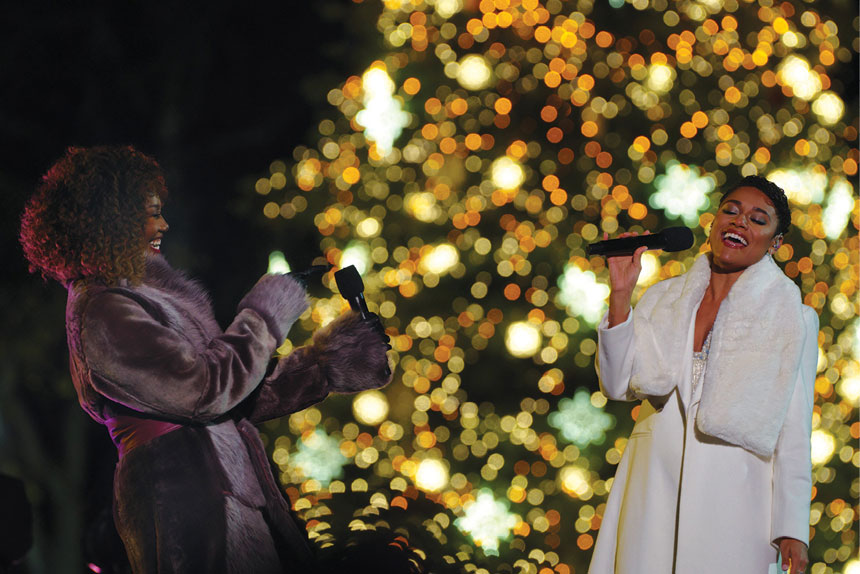
Though the National Christmas Tree is a joyous tribute to the winter holidays, the celebration around it often reflects issues of the day. From 1942 to 1944, for example, the tree was decorated but not lit out of security concerns. The tree also remained unlit, aside from the top ornament, during the 1979 and 1980 holiday seasons in honor of the 52 Americans held hostage in Iran, though in 1980, in a special tribute sponsored by the National Broadcasters Association, the tree was fully lit for 417 seconds — one second for each day the hostages were in captivity. On January 20, 1981 — Reagan’s inauguration day — the tree was decorated and then illuminated the moment the aircraft returning the former hostages cleared Iranian airspace.
The National Christmas Tree festivities have lost none of their pizzazz over the past century and attract thousands of attendees and big-name entertainers. “The lighting of the tree is important because it’s one of the few national traditions that has never been canceled,” observes Krause, who has attended every tree lighting since 1983. “It’s also an important opportunity for the president to address the nation and weave some of the concerns of the day into his Christmas message. It’s a chance to reflect on the past, look forward to the future, and honor the traditions of the holiday as best we can.”
For information on the 2023 National Christmas Tree celebration, visit thenationaltree.org.
Don Vaughan is a freelance writer whose work has appeared in Writer’s Digest, Mad, Scout Life, VFW Magazine, and elsewhere. To learn more, visit donaldvaughan.com.
This article is featured in the November/December 2023 issue of The Saturday Evening Post. Subscribe to the magazine for more art, inspiring stories, fiction, humor, and features from our archives.
I Learned to Ski in My Fifties: Why It’s Never Too Late to Pick Up a New, Adventurous Hobby
“Why are you…doing all this stuff?“ a friend asked me. “Is it some kind of midlife crisis thing?”
I’d posted a picture of myself preparing for ski school in Colorado. I was 54, and it was my first time on the slopes. My ski debut came on the heels of summer river rafting in West Virginia and off-roading in a UTV on a farm a few miles from my home. It had been an adventurous year, and like all good Gen-Xers, I’d documented my pursuits on social media.
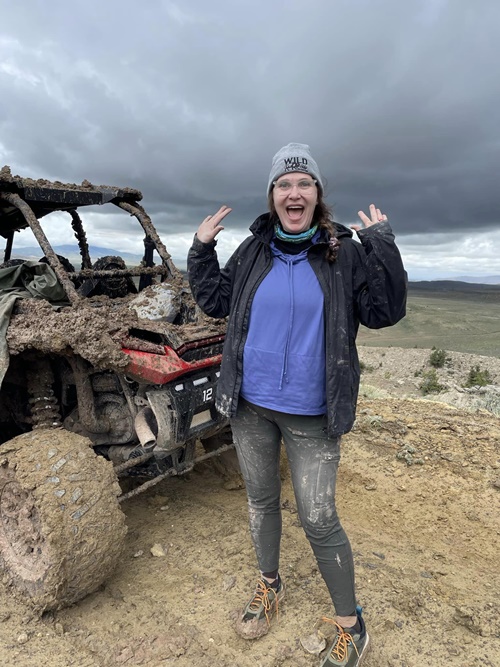
My fifties have shaped into a surprising season of adventure — and also Advil. Some days I have the energy of a thirty-year-old, and other days, everything either hurts or makes me tired. Taking age out of the equation, I wouldn’t describe trying a few new hobbies as pointing to any sort of crisis, but perhaps the natural reaction when a person of a certain age tries something perceived as outside the box, we look for a reason to explain it or suggest they shouldn’t.
My early exposure to skiing was limited to seeing the sport on television. Everyone remembers the epic “Agony of Defeat” ski jump spill in the opening credits of ABC’s Wide World of Sports, which didn’t spark any “Wow, that looks amazing, I want to try!” sentiments. I grew up in Texas, which isn’t exactly known for its opportunities for winter sports. I brought home a flyer in ninth grade describing my high school youth group’s organized ski trip to Colorado, and my dad gave me a swift “no” when he saw the price. I remember being miffed, but that had more to do with not doing what my friends were doing than any genuine desire to barrel down a snowy mountain with two skinny sticks attached to my feet.
Other than an occasional passing interest in the Winter Olympics, snow sports weren’t part of my childhood landscape. As I got older and experienced more of the world, I met people from New England and the Rockies who grew up on skis. I learned about putting kids on skis as soon as they could walk and vacations completely centered around days on the slopes. While interesting, none of these ski stories left me lamenting that I’d left a box unchecked.
But now I was unexpectedly presented with the opportunity to ski with my 11-year-old son, who runs circles around me when it comes to athleticism. He was stoked, and while I was more enthralled with the mountain scenery and the après ski options, which had always sounded so glamorous, I was game to finally join the ranks of people who casually prefaced stories with statements like “The last time we went skiing.” We each had a day of group ski instruction, he with kids his age and me with five other first-time adults in their twenties and thirties, followed by a day with a private ski instructor together.
I thought being a first-time skier at 54 was highly unusual based on the demographics of my ski class, but it turns out that’s not entirely true. According to Whistler Blackcomb Snow School Manager Paul Sauvé, later-life ski adopters are common. Sauvé estimates that the average age of the adult beginner at the Snow School is 45-ish.
“The joy of seeing older skiers ‘get it’ when they accomplish a new ski move or a harder run is as good as watching a kid smile from their first time accomplishing something,” says Sauvé.
While I wish I could report that I took to skiing like a duck to water, and my agility on the slopes caused me to believe that I could have had a stellar Olympic career if only I’d grown up in Aspen or my dad had said yes to that ski trip back in ninth grade, I am a below average skier. They say practice makes perfect, but I’ll settle for practice makes better than the time before.
My first day of skiing involved tears, a lot of falling, and knocking over a small child. For me, the lessons with a young adult group weren’t the best fit, and I got more out of the private lessons I took with my son, even though the kid skied circles around me. I’m planning my next ski trip and will take a one-on-one lesson, which I think is better for me. Sauvé says choosing individual versus group lessons depends on the skier’s disposition. I didn’t ask a lot of questions before signing up for group classes, and while it gave me the basics, I think I’d have rather had the instructor’s full attention because I was slower to pick things up than the rest of my group and found that experience stressful.
The child I ran into was unharmed, by the way, but hopefully I won’t knock any kids off their feet next time. While younger, fearless skiers might get the hang of things faster, I don’t regret not getting to this earlier, and I believe I learned at the right time for me.
I’m immensely proud that I stepped out of my comfort zone to try something new. Athletic I am not. My sense of satisfaction came from being brave enough to show up for lessons, not that resort skiing is a particularly courageous endeavor.
I’m not sure questioning whether you’re too old to do something is some kind of aging rite of passage, but I have noticed a nagging little voice in my thoughts, telling me that perhaps the time to attempt something new has passed. I try to ignore self-doubt, but I also think it’s important to acknowledge that it creeps up on me. Lack of confidence is something everyone experiences.
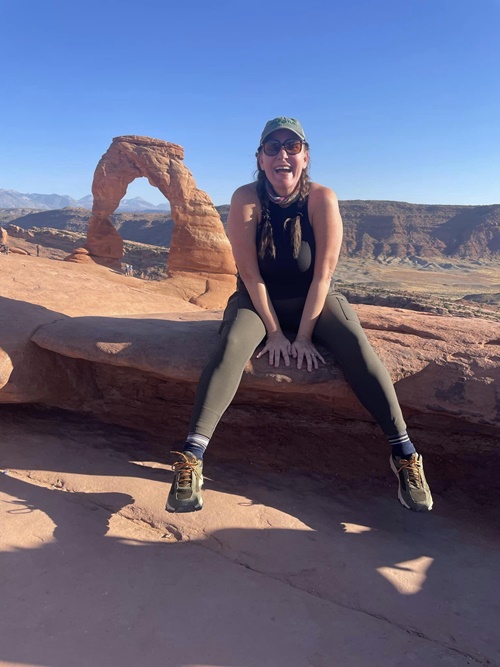
Despite the presence of that voice, I’ve had opportunities to do things I hadn’t previously considered trying and thought, “Well, why not?” There’s a sense of comfort in knowing I’m still curious and can still look forward to firsts. I’m not reckless, and I wouldn’t call myself a thrill seeker, but I do get satisfaction from pushing myself to do something that I perceive as difficult or scary. Besides, exercise is healthy, no matter how uncoordinated or silly you think you look. It’s the movement that matters.
“Engaging in new forms of physical activity can help improve mood and reduce symptoms of anxiety and depression,” says physical therapist John Gallucci. “Not only that, but being active can also help with social engagement and can be a great opportunity to interact with other people and feel a sense of community.”
Gallucci goes on to praise skiing for being a great cardiovascular workout. “Skiing works multiple muscle groups such as the core, quads, and calf muscles and also can help with balance and coordination and joint health.”
Although the past three years have brought me several adventurous firsts in addition to skiing, like whitewater rafting, off-roading, and hot-air ballooning, I’m not working off a bucket list, trying to fight time or prove anything to myself or anyone else.
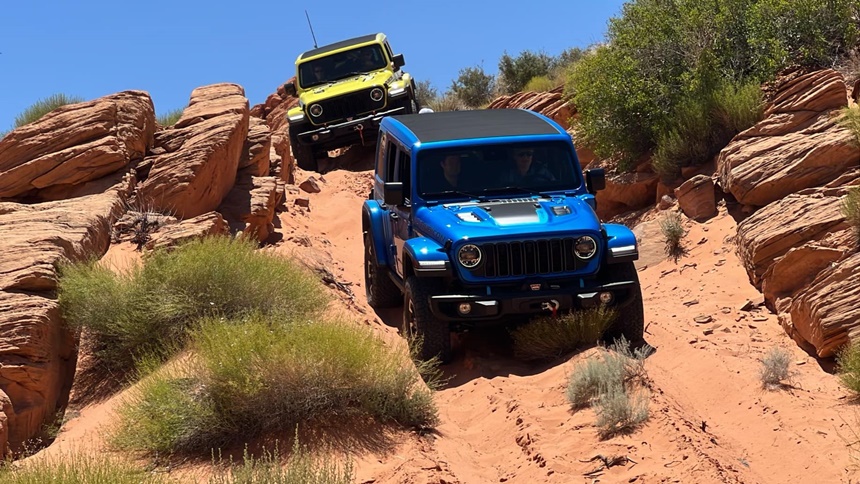
If there’s something you’ve always wanted to do, look for the opportunity to make it happen. Don’t jump to the “I’m too old” opt-out because, chances are, you probably aren’t too old, or there’s a way to modify or adjust an activity to make it safe or comfortable for you. The number of spins you’ve taken around the sun isn’t an automatic roadblock.
And trying something new to you – at any age – doesn’t equate to a mid-life crisis. Whether you’re talking yourself out of something you want to try or discouraging someone else who is interested in a new adventurous hobby, how about instead changing the narrative that what we do should be based on age?
So, back to the question: “Why are you…doing all this stuff?“ The answer is that I wanted to. Because I can. Because it looked like fun. All of those things.
There are times when a rocking chair on the front porch sounds like the perfect place to be, but that’s not where I want to be all the time. I know I can change my mind at any point and adopt a more sedate lifestyle or take up bridge or crocheting if I have the urge for something new and different, but I hope I keep to the path I’m on.
There Are Tiny Critters Who Live on Your Face and Eat Your Dead Skin at Night. But That’s Not the Worst Part.
Years ago, the worst thing that could happen to you from kissing a lot was chapped lips, or perhaps a case of mononucleosis. Just recently, however, scientists have found that sucking face has a whole new meaning when applied to microscopic skin mites.
It was news to me that our faces are like high-rise condos for Demodex folliculorum, a species of skin mite that resides in our hair follicles and sucks out the yummy, gummy skin flakes that accumulate within. In that sense I guess they’re like remoras for people, unseen hitchhikers that live on the dead cells they clean off us.
If that is not unsettling enough for you, picture these tiny critters slipping out of your greasy facial pores at night and crawling across your sleeping mug to fornicate.
Unlike all other mite species, the male D. folliculorum has a penis in the middle of his back. It’s toward the front, like a wee dorsal fin. The menacing score from the film Jaws would set the stage perfectly as a male skin mite emerges under a female in slow-motion (which happens to be their top speed) and does the mite-baby dance right under your nose. Literally, in this case.
Outside of the unfortunate detail that you’re now aware of these facts, D. folliculorum generally do not cause us any harm. Although in some instances, people with immune imbalances can develop an allergy to skin mites, scientists think they actually help us by keeping pores open.
But here’s the part I find even creepier than dorsal penises and nocturnal mite-sex on my face: There’s good evidence to suggest D. folliculorum will eventually become part of our faces. In a study published in June 2022 in the journal Molecular Biology and Evolution, authors G. Smith and A. Manzano-Marín et al tell the world that skin mites are in the process of merging their DNA with ours. That’s right – they are on track to become one with us. Compared to that, Yoda’s Jedi skills and Spock’s Vulcan mind-meld are mere parlor tricks.
If there was only one thing in the world you could eat, and you found a place that served it for free, it’s logical that you might want to move in as long as no one complained. Dead, sloughed-off skin cells from humans are the sole item listed on D. folliculorum’s menu. For them, dog skin won’t do, and cat dander isn’t dandy, either. But while relocating to an all-night eatery makes sense, becoming part of the establishment itself is just plain weird.
One aspect of skin mites that makes this sort of merger possible is that they have a bare-bones genome, if no actual bones. After a bazillion generations on people’s faces (and to a lesser extent, human chests), free of any predators or competitors, and with food right outside their door, the cushy lifestyle of D. folliculorum has allowed it to strip away unneeded genetic material. For example, they come out only at night, because somewhere along the line they lost the genes that code for UV-protectant pigments. These guys are in the same boat as vampires in terms of sunlight exposure.
Skin mites also went right to the bottom where mobility is concerned. Their eight legs, which are all clustered near the head, are operated by single-cell muscles. This makes me feel a lot better about my own scrawny legs, whose muscles surely contain at least two cells apiece. D. folliculorum muscles also have fewer kinds of proteins than those of other mite species.
Here is perhaps the strongest evidence pointing to a human-mite chimera in the far-off future: An organism like this has what’s called an incomplete life cycle. It matures in discrete stages, molting or shedding its skin as it moves on to the next phase. Normally, there are more cells in each successive stage. However, our face-dwelling friends do it backwards.
Not like Benjamin Button exactly, as the intermediate (nymph) phase is bigger than the larval stage. But adults have considerably fewer cells than nymphs. To me, this is just another of their quirks. But for biologists, it signals that D. folliculorum has taken the first evolutionary step toward becoming internal human symbionts, the way that mitochondria did in our distant past. The main difference would be that we’d all die without mitochondria, whereas we’d only have a bit more acne without D. folliculorum.
Don’t fret, though. Researchers point to our long association with skin mites as evidence that they play a small but beneficial role in our lives. Years ago, we didn’t know how vital a robust and diverse gut flora was to our mental and physical health. Perhaps there are other benefits of skin mites yet to be discovered. There mite be.
The author, a former Cornell Extension educator, washes his face more after this revelation.
Ask the Vet: Chew This, Not That
Question: We’re thinking of giving our son’s new dog a fresh marrow bone for Christmas, but would a sterilized bone be healthier?
Answer: Bones are harder than teeth, so whether fresh or sterilized, chew bones can break a dog’s teeth, as can antlers, cow hooves, nylon and hard plastic bones, and even ice cubes. Dogs chomp using their carnassial teeth, large, multirooted teeth near the back of the mouth. If a carnassial tooth breaks, bacteria can enter the pulp canal and cause a painful tooth root abscess requiring a root canal or extraction — either procedure substantially more expensive than buying a chew toy that won’t break teeth. Safe chew toys have some “give” — if you can indent it with your fingernail, it’s safe to chew. To add to the fun, choose a toy with a hollow center where you can hide a small treat. Another fun gift idea is a food puzzle, a toy that delivers treats when a dog manipulates it or rolls it around. Rope toys and dental chews complete the list my dogs sent to Santa this year.
Ask the Vet is written by veterinarian Lee Pickett, VMD. Send questions to [email protected] and read more at saturdayeveningpost.com/ask-the-vet.
This article is featured in the November/December 2023 issue of The Saturday Evening Post. Subscribe to the magazine for more art, inspiring stories, fiction, humor, and features from our archives.
News of the Week: Old News, Black Friday Blues, and Would You Watch Hallmark Movies for $2,500?
This Just In…
The American Farm Bureau Federation says the price of stuffing is down 2.8 percent. So I guess everyone can stuff their turkey this year.
The “some food prices are up, some are down!” story is just one of the holiday stories I’ve gotten sick of hearing about on the local and national news (as if people would resort to stuffing their turkey with rocks if they had to pay a little bit more for stuffing). There are also the stories that tell us “the day before Thanksgiving will be busy on the roads!”
Shocking!
Today suggests that if Brussels sprouts are too expensive, just substitute with green beans! Why, because they’re both green? (I don’t think Today understands how food preferences work.)
And what’s with the daily gas price updates on the news? The price for a gallon was $2.32 last week but this week it’s $2.41? “Sorry Aunt Sara. The price of gas went up 9 cents so we won’t be coming for Thanksgiving after all.”
Tryptophan makes you sleepy! (Actually, it doesn’t.) The day before Thanksgiving is a big travel day! (Duh.) Black Friday is the best day for deals! (See below.)
Year after year after year with these stories. They’re the fall/winter equivalent of the “make sure you wear sunscreen!” and “wear long sleeves so mosquitoes won’t bite you!” stories we see during the summer.
By the way, Brussels sprouts apparently taste better these days. Well, they certainly couldn’t taste any worse.
Is Black Friday Still a Big Deal?
I haven’t heard as many stories the past few years about people getting into fights in stores on Black Friday. What is the day for if not crowds of unreasonable people punching each other over the last toaster on the shelf? Is that because people are more civilized now or is Black Friday not such a big thing anymore?
This is only anecdotal, but it doesn’t seem to me that people are as excited about Black Friday as they used to be. Oh, sure, people will still head out on Friday looking for the best deals and they’ll get coupons in their email inbox, but they’re not lining up at midnight in the same numbers they used to.
Another reason it’s not as special anymore is because stores have made it that way. The entire month is now called “Black November,” and every place has sales all the time (this has always been the case, which is why Black Friday has never really been a big deal for people who keep their eyes and ears open the 364 other days of the year). I swear I saw Black Friday commercials in October.
Black Friday is also Buy Nothing Day, if you want to be a rebel.
The 98-Year-Old Social Media Star
Once in a great while there’s a story that makes you say, “hey, maybe there is something worth seeing on social media.” Dorothy Wiggins loves New York City, and she has become an unlikely social media icon (even if she isn’t thrilled with social media and smartphones).
Watch Movies, Get Paid
If you love Hallmark Christmas movies, have I got the dream job for you.
Christmas TV
Some Hallmark Christmas movies aired in the heat of July, which seems rather pointless and cruel to me.
But the normal holiday TV schedule starts right about…now. If you want to see when Rudolph will save the day or when Santa will come to town or when Frosty the Snowman will melt and die, head on over to Christmas TV Schedule or Mostly Christmas for a complete guide to when everything will air.
If your taste runs more to classic films like Christmas in Connecticut and Holiday Affair, check out the schedule for Turner Classic Movies. For classic TV episodes, here’s Me-TV’s schedule.
RIP Rosalynn Carter, A.S. Byatt, Joss Ackland, Ken Squier, Roger Kastel, George Brown, Suzanne Shepherd, and Tim Woodward
Rosalynn Carter was married to Jimmy Carter for 77 years and was a major force behind his campaign for president. She was also an advocate for mental health and helped build homes for Habitat for Humanity. She died Sunday at the age of 96.
A.S. Byatt was the acclaimed author, critic, and poet known for such novels as Possession and The Children’s Book. She died last week at the age of 87.
You remember Joss Ackland as the bad guy in Lethal Weapon 2. He also appeared in White Mischief, The Hunt for Red October, The Mighty Ducks, and Bill and Ted’s Bogus Journey, as well as many TV shows and plays. He died Sunday at the age of 95.
Ken Squier was the veteran voice of CBS NASCAR broadcasts for many years. He died last week at the age of 88.
Roger Kastel was an artist who did the posters for Jaws and The Empire Strikes Back. He died earlier this month at the age of 92.
George Brown was the drummer for Kool & the Gang, known for such hits as “Celebration,” “Too Hot,” and “Ladies’ Night.” He died last week at the age of 74.
Suzanne Shepherd played Carmela’s mother on The Sopranos. She also appeared in films like Goodfellas, Jacob’s Ladder, and Trees Lounge. She died last week at the age of 89.
Tim Woodward appeared in such British shows as Wings and Piece of Cake and American shows like The Equalizer (he was the son of star Edward Woodward). He was also in many movies. He died last week at the age of 70.
This Week in History
A Christmas Story Released (November 18, 1983)
To make you feel old, it’s the 40th anniversary of the movie TNT and TBS show for 24 hours straight every December 24.
President Kennedy Assassinated (November 22, 1963)
CBS has an interesting story on one of the cameras that played an important role in their TV coverage of the assassination.
This Month in Saturday Evening Post History: “Freedom from Want for Waltons” (November 1973)
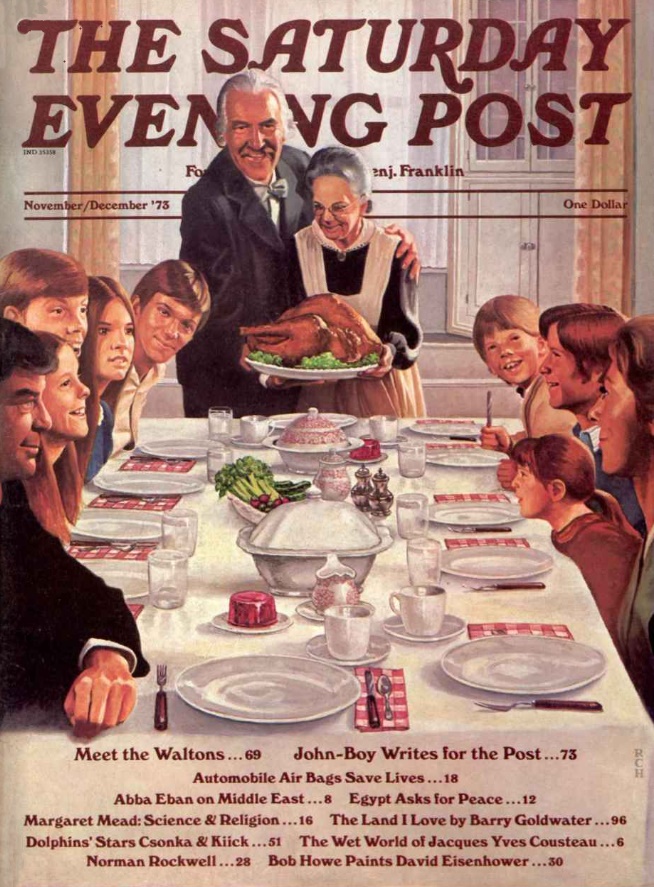
Hey kids, stop looking at the artist and move some stuff so I can put this turkey down!
Leftovers!
I don’t have any leftovers yet. I’m having Thanksgiving dinner on Saturday. But when I do, maybe I’ll make one of these.
Family Favorite Recipes has a Thanksgiving Leftover Casserole, while The Pioneer Woman has this Pumpkin Mac and Cheese and Cranberry Scones. Mel’s Kitchen Cafe has The Best Leftover Turkey Soup, Food Network has Leftover Thanksgiving Nachos, Bon Appétit has Stuffing Fried Rice, and the New York Times has a Shepherd’s Pie.
And of course, the ultimate thing to make with leftovers is the Moist Maker Sandwich from Friends.
Next Week’s Holidays and Events
Small Business Saturday (November 25)
Okay, if you must buy something this weekend try to do it at a local shop or other small business.
Rockefeller Center Tree Lighting (November 29)
The 91st annual event will air on NBC at 8 p.m. ET, with some local stations having an additional hour starting at 7.
Purple Mountain, Majesty
Objects blurred past, castoffs swept to the margins behind the white shoulder line. Hana, temple pressed against the sweaty window, captured each one in her peripheral vision and added it to a mental catalog: a teddy bear, one beetle-shiny eye dangling by a string. A gold sandal. A tiny red-and-black sneaker. A dented hubcap leopard-spotted with rust. A purple fleece glove. Balled-up sweatpants.
Orphans.
Like us.
The thought rose unbidden, an algae bloom in a heatwave, and Hana sat up, sucking a shock of cold air through her teeth when it hit. Guiltily, she imagined pressing a palm against it, bracing her full weight behind her shoulder, and plunging it back into the murky depths. “Stay down,” she whispered.
In the rearview mirror, she caught her father’s eye, one brow lifted in a question mark half-hidden under a flop of dark hair. She pinched her lips between her teeth, hard, and slumped back against the glass.
He was right there. Obviously. And their mother … she was back there somewhere, way beyond the reach of the rearview. Hopefully.
Hana rolled her shoulders to loosen the pressure clamping her ribs. No, they weren’t orphans. They were something else. Something new. In that sense, too, they were heading somewhere they’d never been.
Next to her, Ethan squirmed in an uneasy nap. Hana reached across the middle seat and tucked the pink satin edge of his blankie back between his shoulder and cheek. Wiping a streak of drool from his chin and smearing it off on the car seat, she settled back in to watch the empty miles between the things that had washed up on the shoulder. A soccer cleat. A doll with a tire print streaked across her pinafore. A yellow binkie. Kids lose so much, she thought. Guess we haven’t learned to hold on tight yet.
Ethan mumbled his way from dream to waking. He had dropped his blankie again. Hana draped it back over him, but this time he was too close to the surface. Up in the mirror her father’s gaze found her again. The chisel-sharp crease between his eyes deepened; the afternoon sun couldn’t reach the bottom. Her breath shallowed.
“Shh,” she hummed, breaking mirrored eye contact and reaching over to rub her brother’s foot through the flannel. “Better go back to sleep.”
“Hnn-uh.” Kicking her hand off, he scrubbed his face against his shoulder. A sleep-damp lock of hair stuck up from his forehead, and Hana sat on her hand to keep from smoothing it back down. “Where are we? How much longer?”
She glanced back up front. Her father’s hands gripped the steering wheel, his knuckles pulsing white with each squeeze.
“We’re getting closer.” She kept her voice low. “I think we’re almost to Vantage. Remember the metal horses on the hill? If you watch out your window, maybe you’ll see them.”
A soft lie, she thought. She had no idea where they were or where they were heading. Hills of dead grass and sagebrush stretched, landmarkless, in all directions. They had been driving for hours. Long enough for radio signals to dissolve into static, and for static to swell into waves that built and broke against the rumble of the road beneath them. Long enough for sweat to glue the backs of her thighs to the vinyl seats and her butt bones to ache from stillness. Long enough for her mouth to grow dusty and sour with thirst and the hunger pangs she’d felt several lost objects ago to dwindle to prickles.
“But I’m hungry,” Ethan said. “And I hafta go potty.” His voice pitched higher on its way to a whine.
Hana chewed her lip. “Dad? Hey, Dad?” she repeated louder. “Are we going to stop soon? Ethan needs the bathroom.”
“Is it, like, an emergency?” he asked.
Ethan nodded vigorously. “Yeah,” she relayed.
He unclenched one hand from the wheel and rubbed his forehead. “Okay, okay. I just … a quick one, right? We’ve got to … got to get a bit further.”
Hana nodded, too. Even without knowing the destination or the plan, the need for distance felt imperative. Primal.
* * *
At the truck stop, Hana peeled her legs from the seat, unbuckled Ethan’s booster, and led him through the overbright aisles to the bathroom. She stood outside until the toilet flushed and she could hear his thin voice sing a tuneless ABCs. “Two times through,” she reminded him through the door.
He came out, trailing drips of water from his hands and a square of toilet paper from his left shoe. “How high do you think you can count before I’m done?” she challenged him, bending to pull the paper from his sneaker.
“Seventy-two.”
“Ooh. High bar. Let’s see if you can get there.” She took her turn quickly and only washed her hands to one ABCs, worried Ethan would wander off.
“Seventy-eight!” he crowed when she opened the door, wiping her hands on her shorts.
“Way to go!” She slapped him a damp high five. “Let’s find Dad.”
Hand in hand, they walked a circuit. They skimmed past the Skittles, corn nuts, jerky, gum. Past the motor oil and sunglasses and ice scrapers. Past the diapers and dish soap and tampons. Past the canned alcohol and caffeine. Past the hot dogs dripping grease in their lamp-lit cage. No sign of him. No familiar stance. No tight-clipped voice at the register. Gripping each other’s hands harder, they lapped the shelves again, faster, letting the packaging blur into kaleidoscopic chaos.
He hadn’t wanted to stop, had he? Hana thought of his hesitation, discomfort throbbing off him even as he turned into the parking lot. Thinking of the trail of cast-off objects they’d passed on the road, wondering if the two of them had joined their ranks, she rushed Ethan to the door and peered out through the smudged glass.
For a hollow beat, she drew a blank, the space between her shoulder blades abruptly numb with fear. But then—
“There!” said Ethan, pointing to a spot in front of the propane tanks.
Their father leaned out the driver’s side window as they pushed open the door, and Hana’s back tingled with the rush of blood returning. “’Bout time,” he said. “Buckle up.” He tossed a pair of cellophane-wrapped sandwiches onto the seat between them as they climbed back in.
“Thanks,” she mumbled. Mom said never to leave a store without her. To stay inside no matter what. Mom … Hana shook the thought away and worked a fingernail under the edge of the plastic on the first sandwich. She handed it to Ethan and double-checked the buckle on his booster seat as they pulled out of the parking spot.
The grin he took his first bite through turned upside down and then inside out, a damp hunk of sandwich falling into his lap and his eyes filling with tears. Hana took the sandwich back and peered inside to find a smear of yellow on one stale slice of bread. Sighing, she unwrapped her own sandwich and swapped the pieces around so she had two mustards and he got two mayos. “Boom,” she whispered, handing it back to him. “Problem solved.”
He gave her a watery smile, and she bit into her own disappointing dinner.
“What’s the matter now?” their father asked.
“Nothing,” she said. And then, because he was still staring her down in the mirror, “I think the mustard was too spicy for Ethan. I fixed it. We’re good.” It was the most they’d talked since they left. The back of his jaw flexed as he chewed his own sandwich. Outside, the last sliver of sun slipped behind the hills. “Are we going to keep driving all night?” Hana asked cautiously, feeling the ache in her backside radiate out in every direction. Watching the mirror for his answer, she could see, too, that his eyes were bloodshot in the corners, that dark smudges had gathered underneath. He was tired, too. They were all so dismally tired.
His jaw kept clenching, although he must have already swallowed his mouthful. “No. Better not.” And by the time Hana had forced down the rest of her sandwich, they had pulled into the gravel lot of a run-down motel.
Their father emerged from the office with a key, grabbed the single suitcase from the trunk, and hustled them up a metal staircase to a room at the end of the row. The suitcase had toothbrushes but no toothpaste, clean underwear and socks but no pajamas. Hana pawed through it again to make sure she hadn’t overlooked anything. She ran her tongue over her teeth, tasting the rank echoes of mustard and baloney.
“Hey, Dad?” He was sitting at the tiny table, his head propped on his fist. Beneath the surface his foot tapped with ferocious speed. “Can we see if the office has toothpaste?”
“No.” He didn’t even bother to turn around. Didn’t even hesitate.
It was so abrupt that Hana didn’t have time to stop herself from asking why.
“Because I took you, goddamn it.” The remote jumped from the force of his fist on the table, and Hana jumped, too, on a split-second delay. “I packed the two of you in the car and just … took off. If she’s notified the authorities, and you can bet your little butt she has, they’re going to call it child abduction. If I use a card, they can track it. If we make a phone call, they can track it. If they’ve put out an Amber Alert with our pictures or the license plate number … we have to be careful. We have to lie low until we’ve had a chance to think.” He stood up and paced, his shoes tracing the threadbare tracks countless pairs of other feet had stepped before. “I did what I had to do. I had to do it.” His voice dropped to a mutter, and Hana knew these words weren’t for her.
Later, though, as she lay back on the stiff bedspread and let the day wash over her, she worried those words like a palmful of smooth stones. Across the room, despite his earlier agitation, her dad clicked off the bedside lamp and dropped into a sudden snoring sleep. But Hana could still feel the rumble and twist of the road under her, could still feel the strain of pressing down all the words she couldn’t say, of speeding away from the wreck she had caused but didn’t understand. With Ethan sprawled next to her in clean underwear and his dirty T-rex T-shirt, she closed her eyes and watched the morning spool out behind her lids like the rerun of a terrible TV show.
* * *
It had been later than usual when she shuffled into the kitchen, still waterlogged from her dreams. A tinny jingle threaded in from the living room where Ethan was watching a cartoon, and their mom was already wrist deep in the dishpans. Wrist deep in suds, and waist deep in fury. Hana had felt the sizzle of it before she reached the table and froze mid-step. Every nerve felt electrified; her dreams evaporated in its heat, leaving her alone in the line of fire.
“Get enough beauty rest after your late night?” Hana could only see her mom’s back, but she could hear the left-sided curl of her lip from the way her voice dragged through the word beauty.
“L-late night?”
“I got a call from Wanda this morning, trying to sell me a coupon book for her son’s baseball team. And you know what she told me?” Hana couldn’t get her lips around the no fast enough to give it voice. It didn’t matter. “She told me it was so cute to see you and the little Hawkins boy holding hands in the park last night.”
The tips of her ears burned. Jon was learning magic tricks out of a book he’d found at a garage sale and wanted to practice palm reading. Pitching his voice low and slow, he’d informed her that because of her extra-long love line, she would have seven children, but the life line that dead-ended under her ring finger suggested she would die an early and fiery death in an industrial explosion. The skin of her palm tingled where his finger traced the creases. A matching tingle fluttered somewhere behind her belly button, and she advised him, reclaiming her hand, that his customers were going to want their money back if he told them such nonsense. And as a matter of fact, she wanted her money back, too.
“You didn’t pay me anything,” he had said, aggrieved.
“Well, then, I want my five minutes back,” she replied.
In the morning light, refracted through her mother’s retelling, the memory of that moment turned ugly. Whatever had fluttered inside her last night died and crumbled to dust. She took a careful step toward the sink, heel-toe, the way she had when she found an injured raccoon in the yard last year. The nubby bottoms of her monkey slippers squeaked softly on the tile. “We weren’t—”
“Don’t give me that!” An arc of soapy water flew behind the wooden spoon her mom brandished as she spun to face Hana. “Sleeping in. Leaving me to do your chores. And now, going off in the woods with boys. Your laziness is one thing, but I refuse to have it said that I’m raising a heinous little slut.”
“Christ, Laura. She’s only ten,” her father said from the doorway. He said it softly, like a suggestion.
Head fixed downward, Hana swiveled until she could see his feet. The tile reflected his brown work shoes; the polish of his shoes reflected the tile. Tiny mirrors reflecting blank spaces. She wished she could disappear into them.
“You’re never to speak to that boy again. The park is off limits for you indefinitely. Now go get dressed.” Hana heard the spoon slap the dishwater and knew the conversation was over.
But — “I didn’t do anything wrong.”
Hana looked up as she spoke, looked up just in time to see the blue enameled lid take flight. Just in time to see her dad take a step between them. To see his head snap sideways on impact. To see the trail of suds on the floor, casting tiny rainbows reflected in the tile, in those perfectly shined shoes. The lid rolled elliptically, a metal clang reverberating long after it settled into stillness. Hana’s breath, already shallow from the confrontation, sped up until she was gasping silently.
“Wait!” her mom yelled. Hana watched as furious ropes knotted in her mom’s jaw, above her eyebrows, in her forearm. Her empty hand still gripped the air, suspended at the point of release. “It was an accident. I didn’t mean it, goddamn it. It was an accident.” Her father grabbed Hana by the wrist and dragged her into the hall. Neither of them answered, so they could clearly hear the kitchen door scuff the threshold, hear her say, “Everything’s always my fault with you guys. I just … I can never do anything right,” could hear the sob grab in her throat and the silence after the latch caught the slamming door.
“Go get your brother. We’re leaving,” her father said, dropping her wrist. His breath was loud and ragged. A trickle of blood traced a thin line down his jaw, and a bloom of red radiated away from it. He took the stairs two at a time, paused halfway up, and bounded back down to grip Hana’s shoulder. “Has she ever done that before?” he asked, his eyes boring into her.
“Has she ever —” Hana repeated, at a loss.
“Has she ever hurt you before?”
Yes, often. Often with you in the room. No, never, not if that lid was really meant to hit me. She thought of the thousand sharp shards of words that wounded with nothing to show. Of nails that cut a half year’s worth of half moons into her skin. Of trying to navigate her mother’s moods, walking a balance beam stretched across great gaps of uncertainty. Which hurts counted? “Not quite like that,” she mumbled, and pulled free from his grip to gather Ethan from the living room. She held her breath, listening as he hesitated, waiting for his steps to retreat up the stairs.
* * *
Now, in the hotel room, Hana listened to the intermittent snores from the other bed and considered those words again. He did what he had to do … but which part? Stepping in or walking out? She wondered when he would change his mind, and whether he would leave them behind or pull them along like flotsam in his wake. She inhaled deeply and caught a whiff of baloney on Ethan’s water-brushed breath. Turning onto her other side, still clicking the thoughts against each other, still feeling the motion of the road, Hana slid into shallow dreams.
The next morning, half-washed (shampoo, no conditioner; soap, no comb) and dressed, Hana emerged from the bathroom to find their father looming over Ethan at the small table.
“What is it now?” At first Hana just heard the impatience, but there was something else at the edge of her father’s voice. She’d heard it last night, too, in those words that weren’t meant for her — a kind of desperation, a not-knowing that set her heart racing.
Ethan’s arms were crossed over the same dirty T-shirt, his bottom lip protruding with a tremble. Even though he was really too old for it, Hana could feel the tantrum brewing in him, sweltering and humid. On the table in front of him was an individual box of cereal with a spoon stuck in. Next to it, milk foam clung to the tattered lip of a tiny carton.
There was power in having knowledge her father didn’t, and she felt her heart settle back into rhythm as understanding clicked into place. “He can’t have milk,” Hana said softly, pulling up the other chair. She opened the box of Cheerios at the seam and pinched the bag apart, passing it to Ethan and pulling his quietly fizzling Rice Krispies toward herself. She took a bite. It tasted subtly of cardboard and victory.
“No mustard. No milk.” Her father raked his fingers through his own uncombed hair. “Anything else I should know about?”
Most kids didn’t like spicy things, and maybe he couldn’t be expected to know that. But the milk … “He really can’t have it. It’s not going to kill him or anything, but, well … it’s not pretty.” She’d had to clean the toilet often enough to know what would happen.
“Crap. I should have known that.” He shook his head and turned away, throwing clothes back into the suitcase with one hand and tossing back dry cereal with the other, retreating into himself again.
If yesterday’s drive had been quiet with tension, today’s was silent with trepidation. The sagebrush turned to scrub pines and then full-fledged forests. A river threaded through a chasm below the highway. And still, despite the changing scenery, there was no suggestion of a destination, no hint of a safe landing.
“Where are we going?” Ethan asked between fitful naps.
Hana felt the I don’t know come off her father in a current as strong and unyielding as the one in the river below. She searched the seats for a book, a toy, any distraction, but once again came up empty-handed.
“Did you know that way back when, the river was filled with gold?” It was so unexpected that Hana did a double take.
“It was filled with gold,” their dad continued, “and so people flocked to the region from all over the country, convinced they were about to get filthy rich. Soon enough, the riverbanks were crowded with people panning for gold, fighting over their finds and stealing from each other in the dead of night. They caught the forests on fire and polluted the water with their poop.”
Ethan giggled.
The eyes in the mirror crinkled at the edges. “It was a real problem. The river turned brown and sad as the people sucked the life out of it from every direction. So the river and the woods and the forest creatures held a council of war to decide how to stop them.”
“What did they do?” Hana asked, drawn in despite herself.
“They appointed guardians. Look for yourself.” He pointed out the passenger window. “You can still see them over that way, across the river. Hunched up over the water there.”
She looked where he was pointing, then squinted to see further, but found only the familiar landscape on the other side of the window. “The mountains?” Hana asked. She knew it was only a story, but still she felt her heart deflate.
“Oh, no. They only look like mountains. That’s part of their disguise. But when you relax your eyes just right, you can see that really it’s the fur of a great shaggy beast, stretched out along the shore to protect the river from intruders. In fact, so many beasts signed up for the job that they had whole ranks of them lining the river. So many that beyond the green ones are blue ones standing by to provide a second line of defense. Entire legions of guardians. That’s where we’re heading.” He pointed again, to a crevice in the foothills between the blue and the green. “Right at the feet of the great protectors.”
Hana slid her eyes out of focus, and like magic, the mountains cloaked themselves in ragged plush. A tightness strung through her chest. Hoping against hope, against her better sense, she imagined the three of them stepping around the roots and rocks, searching for a place to settle, beasts curled around them like cats by a fireplace.
“What about the purple ones?” Ethan asked, pointing higher on the horizon. “Can’t we go to the purple ones? Please?”
Part of her wanted to beg alongside Ethan. The purple was farther away. It would be safer. Those gentler folds, hazy with distance, would envelop them. They could rest at last. But she was older than Ethan, too, and she knew what she wouldn’t say to him: that the purple was an illusion made up of evaporating water and light, that as they got closer, the purple, too, would become blue and then green, that the shaggy beasts would perpetually retreat toward the horizon, seeking other orphans to shelter.
Their dad turned around and glanced at Ethan directly. When he smiled, the purpling lump on his jaw, furred over with day-old whiskers, lifted gently.
“That’s the third line,” he said. “The protectors of the protectors. They’ll keep standing watch at a distance.”
The highway turned a corner and the mountains disappeared behind a screen of trees. Ethan started whimpering, his eyes flooding again. “Where’d they go? Turn around. We have to get back to the beasts,” he sobbed, twisting in his booster seat to catch another glimpse.
“Hey, now,” said their dad. “They’re just through this tunnel of trees. I’ll bet by the time you count to fifty, they’ll be back again.” Hana flushed to hear him use her trick with Ethan.
When he got to forty-seven, the trees thinned and they emerged on the other side. The shaggy beasts lined up for miles, staggered peaks in diminishing blues stretching until they dissolved into sky. And there, rising above them all, was a snow-capped stony peak, remote and cold, standing guard in the distance. Hana felt the string in her chest snap, felt something crack open wide, and she pulled hard to get the air past the catch in her throat.
“What’s that one?” asked Ethan.
In the rearview mirror, Hana held the eyes superimposed over the mountain. “That one?” she breathed. “That’s their king.”
Review: Rustin — Movies for the Rest of Us with Bill Newcott
Rustin
⭐️ ⭐️ ⭐️ ⭐️
Rating: PG 13
Run Time: 1 hour 46 minutes
Stars: Colman Domingo, Chris Rock, Aml Ameen, Jeffrey Wright
Writers: Julian Breece, Dustin Lance Black
Director: George C. Wolfe
In theaters and streaming on Netflix
Reviewed at the Toronto International Film Festival
Martin Luther King had a dream, but he might have delivered his iconic 1963 March on Washington speech to a deserted National Mall if not for a man named Bayard Rustin, who gets long-overdue recognition in this inspiring, at times infuriating, historical drama.
Most people have never heard of Rustin, a master organizer and logistician for the 1960s civil rights movement. That is more or less by design: It was Rustin’s job to remain behind the scenes, making the movement’s marquee figures look and sound good, and delivering the crowds who would carry their message to the world.
He was also gay — and not in that ’60s under-the-radar, marry-a-woman-and-raise-a-family-despite-everything way. Flamboyant and outspoken, Rustin floated through life as if his particular genius and fiercely held convictions would somehow elevate him above the decade’s sexual norms.
He was, of course, wrong. Often shunned even by those who admired him — including King himself — Rustin persisted to deliver the goods for the good of his people.
If you’re putting together a short list of Best Actor Oscar nominees, save a spot for Colman Domingo, who grabs the role of Rustin with both hands and does not let go. A longtime New York theater stalwart and cult TV favorite (Fear the Walking Dead), Domingo sears the screen with his portrayal of Rustin, a man whose passion for freedom and genius for organization barely outweigh his self-destructive tendencies, fueled by resentment for a world that rejects him, inside and out.
When last we encountered director George C. Wolfe, he was behind the camera for 2020’s Ma Rainey’s Black Bottom, a tuneful, if mournful, tale of 1927 Chicago that also proved to be the last appearance of the wonderful Chadwick Boseman. Advancing a few decades, Wolfe lands squarely in Harlem, Rustin’s chosen base of operations. As in his prior film, Wolfe creates a grittily immersive sense of place — but it is in his leading man that he captures the radical urgency and unprecedented opportunity of the 1960s civil rights movement.
The 21st century take on the March on Washington goes something like this:
Martin Luther King: “Hey, let’s get 2.5 million people to come stand on the mall while I make a speech that will change the world!”
Everyone Else: “Yeah!”
But as the energetic script by Julian Breece and Oscar winner Dustin Lance Black (Milk) explains, Rustin felt the march would give the movement a spectacular shot in the arm, but his idea was bitterly opposed by many of the era’s most influential Black activists, including NAACP head Roy Wilkins (played by a dour and intimidating Chris Rock) and New York Congressman Adam Clayton Powell Jr. (an insufferably pompous Jeffrey Wright). Even Rustin’s old friend King (Aml Ameen), estranged from Rustin for fear of his sexuality discrediting the movement, leans toward the incremental approach that, to Rustin, seems to be accomplishing little more than getting Freedom Riders killed in the South.
When the powers that be reluctantly give Rustin the go-ahead to organize the march, the film shifts into high gear, which is to say we get a good half-hour of fly-on-the-wall scenes, witnessing Rustin alternately cajoling, bullying, and begging his eager young volunteers to scratch up cash, commandeer buses, and, most importantly, somehow enlist millions of people to make the trip to D.C. in the dog days of August.
Of course, we know how this story ends, so much of the fun here is in watching the pieces fall into place — and how Rustin serves as the glue that holds them all together.
Still, it’s hard not to share the man’s trepidation as, on the day of the march, after months of projecting brash confidence, Domingo’s Rustin stands on the steps of the Lincoln Memorial, squints into the morning sun, and mutters, “Lord, I hope and pray they come today.”
It’s a moment that captures perfectly the spirit of a man oozing with confidence, yet secretly aware that the world does not always reward outsiders, no matter how righteous their mission.
In a Word: Turkey: A Head of the Game
Senior managing editor and logophile Andy Hollandbeck reveals the sometimes surprising roots of common English words and phrases. Remember: Etymology tells us where a word comes from, but not what it means today.
While a perfectly roasted turkey can be a beautiful sight on Thanksgiving, there’s little argument that turkeys themselves, when they’re still alive, can be quite ugly. Their heads — covered with wrinkled flesh, bulbous protuberances, and weird dangly bits — look as if someone forgot to put skin on them.
But the fun part of all that odd avian anatomy is that each of those things on a turkey’s head has a name that’s fun to use and fun to say. This week, for Thanksgiving, we’ll break down those bits that make a turkey’s head so distinctive.
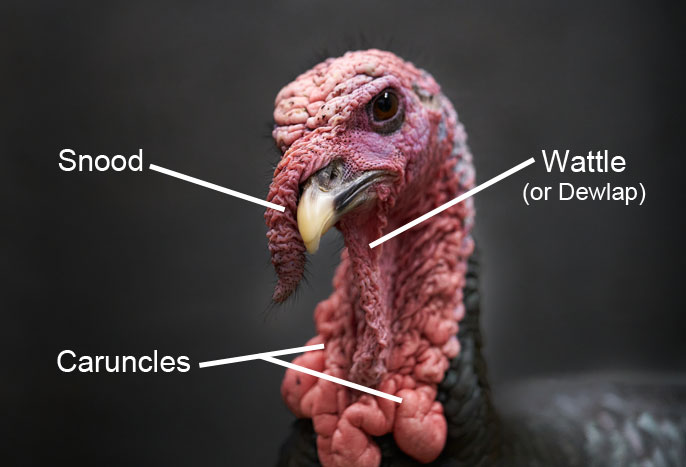
Snood
Along the top of the base of a turkey’s beak, a sac-like fleshy protuberance grows. As the turkey ages, it gets larger or longer and can dangle down below the beak. This is called the turkey’s snood. Both male (toms) and female (hens) turkeys have a snood, but it’s more prominent on males. What’s more, during mating season, blood rushes to the toms’ snoods, turning them bright red — a color that is apparently attractive to hens.
Turkey’s aren’t the only things that have snoods; your grandmother might have one, too.
The word snood traces to the Old English snod, meaning “a ribbon for the hair,” which in turn comes from a proto-Germanic root that meant “string or cord.” During the Middle Ages, women — and especially young, unmarried women — would tie their hair up in the back with a snood, presumably into something similar to a ponytail.
Over time, women not only tied their hair up but, in some situations, placed some netting or a thin bag over the hair as well. By the 1930s, snood referred specifically to this type of bag or hair net that enwrapped a woman’s ponytail at the back of her head.
Now imagine that a woman’s snood wasn’t dangling at the back of her head but at the front; now imagine it’s not a woman but a turkey. Enough people made this visual connection that snood came to be applied to this feature of a turkey’s face.
Wattle
Fans of the late-’90s TV series Ally McBeal will remember that Richard Fish (played by Greg Germann) was obsessed with women’s wattles. Like a snood, a wattle is something your grandmother might have, though this time it’s the same for turkeys and people. Wattle is the loose flesh that hangs below a mouth or beak.
The term is usually applied to birds — chickens and some pheasants have wattles, too — but, as you can see, the meaning has expanded into the human realm to describe loose flesh under someone’s chin.
It’s unclear where the word wattle came from. It can also be called a dewlap, from the Old English lappe “loose piece,” though where the dew part comes from is unclear.
Caruncle
A caruncle is a naked fleshy outgrowth or protuberance. Technically, a wattle is a type of caruncle, but a turkey can have much more caruncle than just the wattle.
The word caruncle traces to the Latin word caruncula, a diminutive of caro “meat” — which is also the source of carnivore and carnival. It came through the French caruncule to become, by the early 17th century, the English caruncle.
Caruncle also has a usage within the human world, but it’s medical and can be uncomfortable to talk about. Suffice it to say, while it’s fine for your grandmother to wear a snood and have a wattle, if she’s got a caruncle, she might want to have a doctor look at it.
If you’ve ever wondered why the bird associated with Thanksgiving bears the same name as a country in Asia Minor, I explored that history several years ago in “A Tale of Two Turkeys.”
Considering History: Six Inspiring Figures from American History to Be Thankful For
This series by American studies professor Ben Railton explores the connections between America’s past and present.
In early October 1863, with the Civil War still decimating every corner of American society, President Abraham Lincoln issued a proclamation. In it, he invited “my fellow-citizens in every part of the United States, and also those who are at sea and those who are sojourning in foreign lands, to set apart and observe the last Thursday of November next as a Day of Thanksgiving.” Even amidst one of the most divided and destructive moments in American history, Lincoln argued for the value of giving thanks, of collectively reflecting on those things for which we are grateful.
I couldn’t agree more. There’s a great deal for which I’m thankful in 2023, including loved ones about whom I’ve had the chance to write in this space, colleagues near and far, and you, Saturday Evening Post readers and friends. But as an American Studier, I’m also profoundly thankful for inspiring figures from our history, individuals who remind us of the best of our community and ideals. Here are my brief thanks for six such figures.
William Apess (1798-1839)
For last year’s Thanksgiving column, I highlighted Wamsutta James and Native American efforts to reframe the holiday as a National Day of Mourning. William Apess, the fiery Pequot minister and activist who offered “An Indian’s Looking-Glass for the White Man” and a “Eulogy on King Philip,” would certainly share that sense of mourning and alternative vision of the holiday. But Apess never stopped fighting for a better and more just future for every one of his beloved communities, from the Native American town of Mashpee to the United States of America. I’m thankful for William Apess’s critical patriotic fight for the best of us.
Susie King Taylor (1848-1912)
Of the many things that folks who want to minimize our teaching of African American history get wrong, high on the list is that such histories can serve only to cause pain or shame. Those and all other hard emotions are certainly part of our histories and need to be engaged, but so too are the most inspiring effects — like those caused by the story of a young woman who escaped slavery as a teenager during the Civil War, became a nurse and educator for U.S. Colored Troops regiments, and worked as a lifelong advocate for fellow Civil War nurses, publishing a moving autobiography about the experience in the process. I’m thankful for all the ways Susie King Taylor refutes our worst prejudices.
Albion Tourgée (1838-1905)
A U.S. Army Civil War veteran from Ohio who moved to North Carolina to work as a judge during Reconstruction, an author who wrote historical novels about that era and the fight for African American rights and equality, a lawyer who represented Homer Plessy before the Supreme Court in his fight against racial segregation, and an anti-lynching activist who was Ida B. Wells’s most consistent friend in that national campaign, Albion Tourgée quite simply exemplifies what it means to be an ally. I’m thankful for his lifelong modeling of such solidarity.
Abraham Cahan (1860-1951)
It’s all too easy to see the fights on behalf of different oppressed American communities as distinct, and even perhaps at odds. But throughout his life and career, the Russian Jewish immigrant turned radical journalist, editor, and author Abraham Cahan pulled together a number of such fights — for the working class and against Gilded Age stratification, for Jewish Americans and against anti-Semitism, for immigrant communities and against xenophobia. In his best works, from short stories like “A Sweatshop Romance” to his advice column “The Bintel Brief” in the Yiddish-language newspaper he founded, Cahan pulled together all those issues with humor and humanity. I’m thankful for his voice.
Yuri Kochiyama (1921-2014)
While imprisoned at a World War II internment camp with her family, Yuri Kochiyama created a community of fellow young people to share letters with Japanese American soldiers. While fighting for her community with Asian Americans for Action in 1960s New York, Kochiyama befriended and fought alongside Malcolm X. While leading the successful 1970s and ’80s campaign to secure reparations for interned families and their descendants, Kochiyama took part in a takeover of the Statue of Liberty on behalf of Puerto Rican independence. In her final decades of life, Kochiyama opposed the War on Terror and took controversial positions on political prisoners around the world. I’m thankful for a life of incessant, impassioned activism against wrongs and injustices everywhere.
Edward Said (1935-2003)
For all of us teachers, academics, and scholars hoping to add our voices and ideas to public conversations, there’s no better 20th century American model than the literary critic, theorist, professor, and public intellectual Edward Said. Said’s 1978 book Orientalism established not just that titular concept (of a mythological “Orient” in the Western imagination) but an entire field of study, and is just the tip of the iceberg when it comes to his influential ideas. And nothing on that list is more important nor more relevant here in late 2023 than Said’s lifelong scholarship on and advocacy for the people of his native Palestine. I’m thankful for a powerful reminder that public scholarship and public engagement can and should go hand in hand.
As we take the opportunity this week to reflect on all we’re grateful for, amidst another moment nearly as divided and in need of those reflections as was Lincoln’s, let’s make sure to include the best of our shared histories and inspiring stories.
Now That’s What I Call Music! by the Numbers
Almost everyone agrees that television has too many commercials, and almost everyone can name a commercial that they’ve seen too many times. One such set of ads belongs to the seemingly endless Now That’s What I Call Music compilation series. The U.K.-created collection of hit pop tunes has been dropping installments for an improbable 40 years. Here’s a look at the numbers behind the Now.
1983: Now That’s What I Call Music originated in the U.K. office of Virgin Records, the label launched by Simon Draper, Nik Powell, Tom Newman, and billionaire Richard Branson in 1972. The compilation came together through a series of conversations with Jon Webster (then general manager), Stephen Navin (then head of licensing and business affairs), Draper (managing director), and Peter Jamieson (then managing director of EMI Records).
1920s: The name of the series came from an advertising poster for . . . bacon? Branson had originally purchased the 1920s poster (which featured a pig saying “Now, that’s what I call music” to a singing chicken) as a joke to hang on the wall behind Draper’s desk; apparently the managing director was famously grumpy if he hadn’t had his breakfast. The pig would become a recurring mascot for the music series, appearing sporadically in cover art as recently as 2021.
“(Keep Feeling) Fascination” music video (Uploaded to YouTube by The Human League)
30 Tracks: The first volume of Now included 30 hit songs from both sides of the Atlantic. Some of the ’80s staples included were “Total Eclipse of the Heart” (Bonnie Tyler), “The Safety Dance” (Men Without Hats), “Down Under” (Men at Work), “Karma Chameleon” (Culture Club), “Is There Something I Should Know” (Duran Duran), “Candy Girl” (New Edition), and “(Keep Feeling) Fascination” (The Human League). The album went platinum in the U.K. three times, owing to the diversity and density of the song selection. Like any piece of media, success guaranteed a sequel.
116?!: The U.K. Now series has produced 116 volumes in the main line, with the most recent arriving just days ago (November 17, 2023). The original series has also created several sub-lines, like Dance, Country, and Christmas. The Special Edition series includes volumes like Smash Hits, Disney, Eurovision, and more. After the U.K. series had been rolling for a few years, it began to branch out into other countries, including both local artists and imported international hits; over 30 countries and geographic regions (for example, Southeast Asia) have their own series.
1998: The Now series finally arrived in America in 1998. That was a particularly interesting time for popular music in the States, as it was something of a bridge time between musical movements. The alternative explosion of the early 1990s was in decline and Nu Metal was ascending. There was turnover in hip-hop following the recent deaths of superstars Tupac Shakur and Notorious B.I.G. The curious Swing boom would soon die out. However, on the (very high) heels of the Spice Girls, straightforward pop was about to experience a massive moment.
The original U.S. Now commercial (Uploaded to YouTube by Now That’s What I Call Music (US))
The first U.S. Now volume included the Spice Girls with “Say You’ll Be There,” along with Backstreet Boys (“As Long As You Love Me”), All Saints (“Never Ever”), and Hanson (“MMMBop”). The next few volumes would be propelled by Backstreet Boys and the emerging Britney Spears, along with the likes of NYSNC and Destiny’s Child. Certainly, rock and other styles were represented, but Millennial pop soared on the back on the Now series. The series peaked with its fifth volume, which notched four million copies sold. That installment truly demonstrated the prevailing pop/teen pop winds by including Spears, Backstreet, Destiny’s Child, NSYNC, Mandy Moore, Jessica Simpson, 98 Degrees, Aaron Carter, Mýa, BBMak, and others on the same volume.
Dua Lip performing “Levitating” at the AMAs (Uploaded to YouTube by Dua Lipa)
88: As of October of 2023, 88 U.S. Now installments have dropped. A Special 25th Anniversary U.S. edition was also released in October. Hits stretch from 2003 (Britney’s “Toxic”) and 2005 (Coldplay’s “Fix You”) to the 2020s (“Driver’s License” by Olivia Rodrigo, “Levitating” by Dua Lipa, and “STAY” by The Kid LAROI and Justin Bieber).
So what does the massive ongoing success of the Now brand mean? Honestly, it means the same thing that K-tel once meant to Boomers and Gen-Xers: it’s appealing to buy a bunch of songs that you like in one place. It’s the same wisdom that befits Greatest Hits collections and rolled onward with what K-tel started in the mid-’60s by putting a bunch of hit songs together on vinyl. When you’re a consumer (especially a young consumer) who doesn’t have a lot of money, you frequently want the biggest bang for your buck. Now gives the added bonus of being almost ruthlessly current, packing in songs that are still on regular radio and high-level streaming rotation. It’s easy to dismiss the artistic value of something that’s frequently been sold via TV and internet ads in addition to music stores, but it’s nothing that older generations haven’t done. Yes, it’s what young people may listen to now, but considering how long Now has lasted, it essentially qualifies as then, too.
Cartoons: Critter Conversations
Want even more laughs? Subscribe to the magazine for cartoons, art, inspiring stories, fiction, humor, and features from our archives.
Chon Day
January 4, 1958
J.B. Handelsman
November 24, 1962
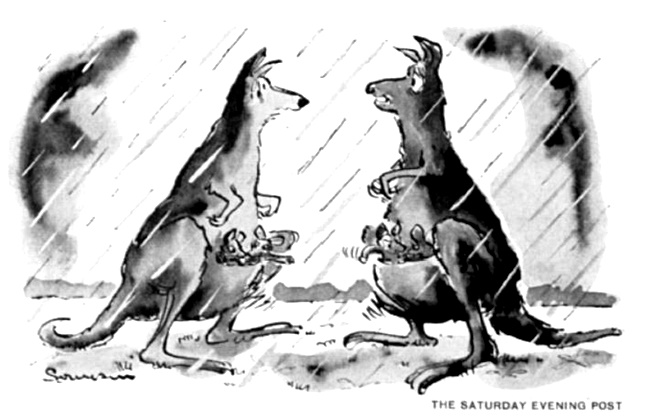
November 24, 1962
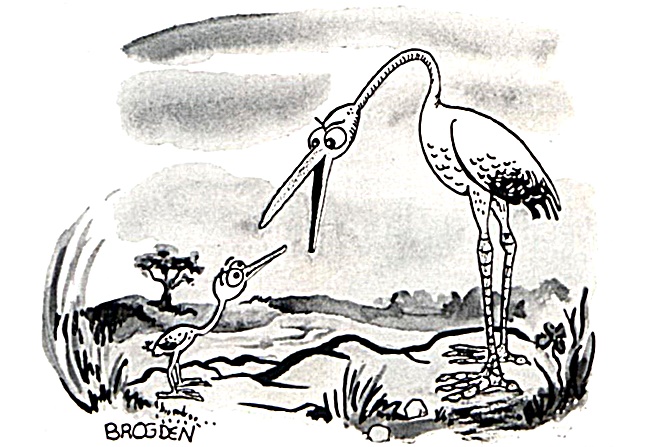
Robert Brogden
November 10, 1962
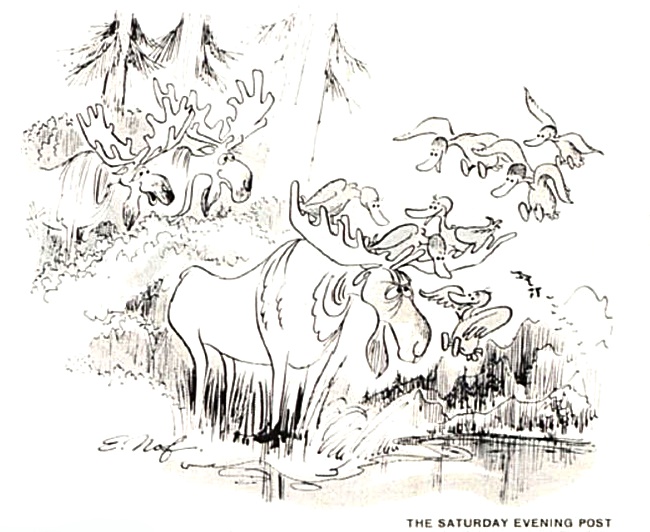
Ed Nofziger
November 10, 1962
James Simpkins
February 22, 1964
Ray Helle
May 8, 1950
Al Johns
April 11, 1964
Want even more laughs? Subscribe to the magazine for cartoons, art, inspiring stories, fiction, humor, and features from our archives.