Nuremberg
⭐️ ⭐️ ⭐️ ⭐️
Rating: R
Run Time: 2 hours 28 minutes
Stars: Russell Crowe, Rami Malek, Colin Hanks, Richard E. Grant
Writers: Jack El-Hai, James Vanderbilt
Director: James Vanderbilt
Reviewed at the Toronto International Film Festival
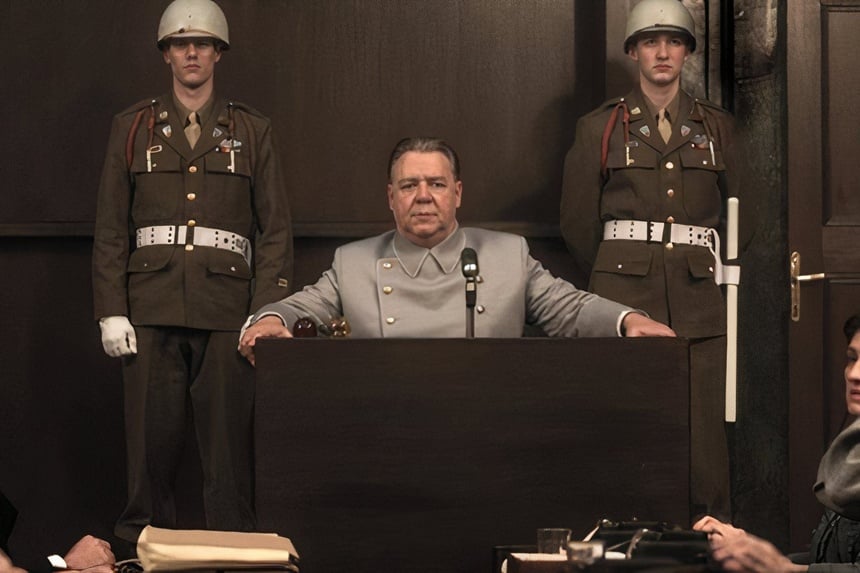
A taut psychological drama framed by a pivotal historical event, Nuremberg is a welcome throwback to old-fashioned Hollywood-style epics like The Longest Day and How the West Was Won; films that invited galaxies of stars to cosplay as major political and military figures.
In Nuremberg you’ll spot Colin Hanks as a psychiatrist, Richard E. Grant as the British lead counsel, Michael Shannon as the U.S. Supreme Court Justice who envisioned the trial in the first place, John Slattery as the U.S. officer in charge, and Leo Woodall (The White Lotus) as a young U.S. Army translator with a consequential secret.
And just like in those old historical potboilers, to avoid a total Boys Club vibe, a couple of women are introduced into the mix: A British reporter (Lotte Verbeek) and an aide-de-camp (Wrenn Schmidt of TV’s For All Mankind).
Jostling for attention in those old historical blockbusters, few stars managed to stand out. Here, though, there’s no diluting the compelling turns of the two leads: Rami Malek (Bohemian Rhapsody) as Douglas Kelley, a U.S. Army psychiatrist assigned to determine to mental state of defeated Nazi leaders awaiting trial, and Russell Crowe, in a later career-defining performance, as the strutting, specious Hermann Göring, Hitler’s second-in-command.
Malek is wonderful as the conflicted lawyer who strategizes a way to ingratiate himself to Göring — then discovers he’s being sucked under the influence of the manipulative Nazi leader. But don’t blame him. Crowe masterfully manages to draw us into Göring’s’ dark charismatic cloud, as well: charming, logical, practical, plain-spoken. He has an easy smile and a hearty laugh — but the magic in Crowe’s performance is that while he lulls us into kind of enjoying Göring’s company, he never, not for one second, masks the truth that we are in the presence of a monster.
It’s among the most dominant screen performances of the past decade from an actor who, for several years, has been largely slumming in roles and films undeserving of his particular sort of screen genius.
The cat-and-mouse game between the two leads provides the meat of the film, but director/co-writer James Vanderbilt (who guided Robert Redford through his fine late-career turn as Dan Rather in 2015’s Truth), keeps the monumental context of the Nuremberg trials — and scorching moral stakes for a postwar world — front and center. After about two hours of high drama, Vanderbilt brings the proceedings to a screeching halt to present five minutes of silent footage — it seems like an hour — taken at the liberation of Hitler’s concentration camps. The grotesqueries on display are unspeakable. Aside from Alain Resnais’ Night and Fog (1956) and Alfred Hitchcock’s long-lost documentary Memory of the Camps (1945), I suspect almost none of this footage, grisly and gut-wrenching, has been seen by a large audience.
Prepare yourself, but know also there are probably people waiting right now to declare it all A.I. fakery. Once each generation, it is perhaps essential that we all bear witness to the depths humanity is capable of plumbing, and to recognize the societal blind spots that enable men like Göring and Hitler to ascend.
Become a Saturday Evening Post member and enjoy unlimited access. Subscribe now



Comments
My previous comment is a response to Midnight_Rider_1961’s comment dated 11/8/2025.
FYI: https://en.wikipedia.org/wiki/Judgment_at_Nuremberg reports that the 1961 movie “Judgement at Nuremberg” with Burt Lancaster. Spencer Tracy, Werner Kempler . . . is a ” fictionalized version – with fictional characters – of the Judges’ Trial of 1947.” “Judgement at Nuremberg” also focuses on a different aspect of the Nuremberg events – the Judges’ Trial of 1947. This new film “Nuremberg” focuses on the Allies insistence on a trial, a psychologist’s mental wrestling with Goering, and the ethical issues that arose in these actions.
This is NOT to say that “Judgement at Nuremberg” it is not a good movie. It is saying that it is a fictionalized version.
Both movies can be good movies.
I like Russell Crowe, but I doubt I would waste my time, money, and efforts to watch this movie. “Judgement at Nuremberg” with Burt Lancaster. Spencer Tracy, Werner Kempler, and other notable stars made in the early 1960s is the best you’ll ever see and the outcomes are accurate. In fact, I would recommend that particular movie to anyone who wishes to learn about that dark part of world history.