Much has been made of the significant and symbolic successes of the U.S. Men’s National Team (USMNT) at the ongoing 2026 FIFA World Cup. After the team’s group-clinching victory over Australia, the Trump administration’s Department of Homeland Security posted a picture with the captions “Defend the Homeland” and “OUR SOIL.” In response, many commenters have noted that the three USMNT players included in that picture are all immigrants or the children of immigrants, a pair of categories that together define more than half of the team’s 26 total players.
The USMNT’s successes give us an opportunity to engage with the history of American soccer, as my Saturday Evening Post colleague Malak Kassem did in this March column (featuring the expertise of Society for American Soccer History President Kevin Tallec Marston). That history reflects striking parallels between American soccer and baseball, making clear that both sports have been and remain national pastimes that capture our diverse, contested, and evolving shared stories.
Baseball is seen as our national pastime in large part because it was the first team sport to develop in the post-Revolution United States, while soccer is rightly known as a more international sport. But the two sports’ 19th-century origins are actually much more parallel than that. Baseball’s contested 1840s and ’50s origin points include a number of similar English games such as “stoolball” and “trap ball,” along with the distinct early versions of the sport played in local American communities like Dedham, Massachusetts and New York and at colleges like Amherst and Williams. Soccer (then generally known as “football”) was first formally organized by English associations in the same mid-19th century moment, but likewise quickly made its way to American communities in those years, including the distinct early versions of the sport played in communities like Hartford (CT) and Waukesha (WI) and at colleges like Yale and Princeton.
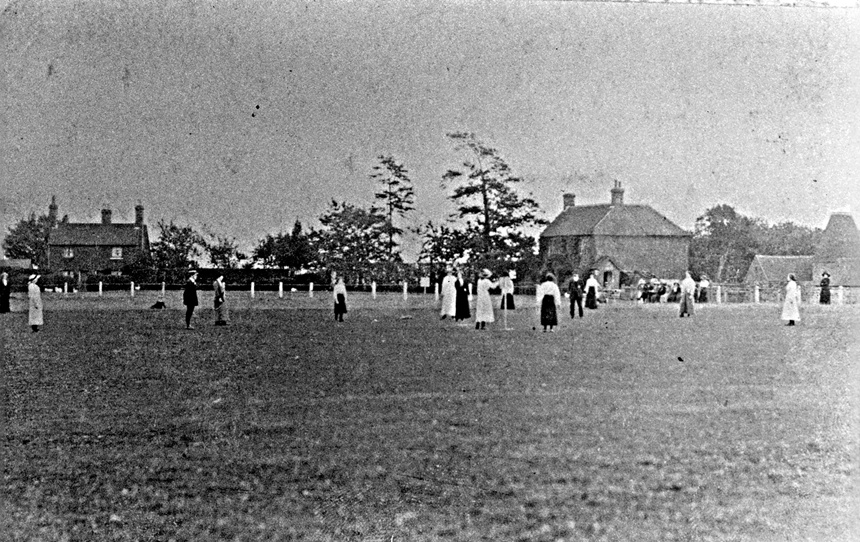
Both sports grew in presence and popularity across the final few decades of the 19th century, especially through local semi-pro leagues based around communities of immigrants. In this column, as well as in season one of my podcast Baseball, Bigotry, and the Battle for America, I discussed an exemplary such late 19th century semi-pro baseball team, the Celestials, organized in the late 1870s as part of New England’s semi-pro leagues and featuring Chinese American young men from Hartford’s Chinese Educational Mission. Over the next decade, multiple regional semi-pro soccer leagues were created around communities of immigrant workers, including the Bristol County League, founded in connection with Fall River’s textile industry in 1883, and the St. Louis League, organized in 1891 by the Catholic Church in that city.
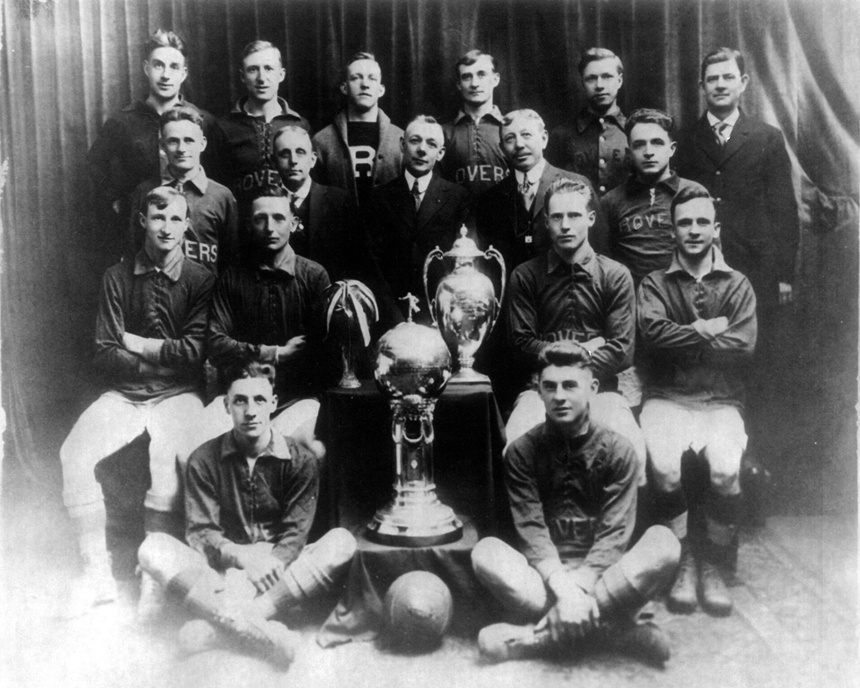
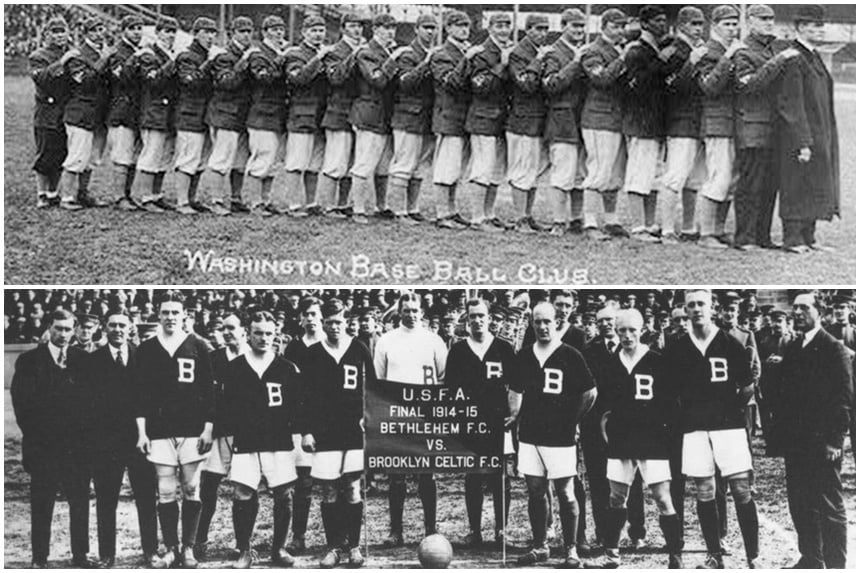
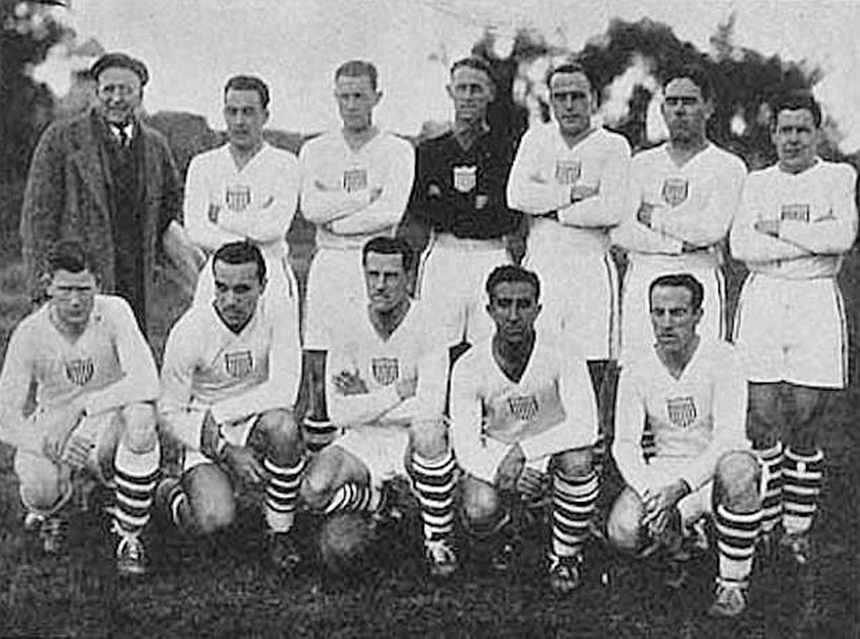
Those local and semi-pro leagues were as diverse as the nation in which they developed. But when more fully professional baseball and soccer leagues began to dominate the sports landscape in the early 20th century, they did so with explicit policies of racial segregation that featured almost entirely white players. The story of Major League Baseball’s early 20th century segregation is well known, as is the resulting rise of alternative professional organizations like the Negro Leagues. Both the United States Football Association, an organization established in 1913, and the American Soccer League, a professional league formed in 1921, similarly restricted their rosters to mostly players of European heritage (along with international players from Northern Europe). When the U.S. Men’s National Team made it to the semifinal round of the first FIFA World Cup, held in Uruguay in 1930, it did so with a roster that was largely composed of Northern European Americans.
Yet those segregated professional leagues were far from the whole story of these sports in early 20th century America. In multiple recent Considering History columns, as well as season two of my podcast, I focus on Japanese American semi-pro baseball in the early 20th century, one of the sport’s most prominent communities and one that became a powerful form of resistance in the World War II incarceration camps. Integrated school, local, and semi-pro soccer leagues represented a similarly popular alternative form of organized soccer throughout the early to mid-20th century, and a few of their players were even able to break through into the national ranks as iconic members of USMNT teams. For instance, Billy Gonçalves, a Portuguese American from Fall River known as “the Babe Ruth of football,” was part of the 1930 squad; and Joe Gaetjens, born in Haiti, starred while a student at Columbia University and scored the only goal in the USMNT’s stunning 1-0 win over England at the 1950 World Cup.
The gradual integration of professional baseball and soccer leagues in the second half of the 20th century has allowed those leagues to more fully reflect their sports’ and nation’s foundational diversity as we have moved into the 21st century. Baseball has evolved from pioneers like Jackie Robinson and Bobby Balcena to into a truly multicultural league where Hispanic, Asian American, and international players form a core of every team (while efforts to rebuild the Black American presence in professional baseball continue). Similarly, the groundbreaking North American Soccer League (1968-1984) brought many of the world’s best players (most famously Pelé) to compete alongside diverse American talent such as the immigrant and naturalized citizen Carlos Metidieri and American-born superstar Kyle Rote Jr.; their legacies can be seen in the increasing diversity of the USMNT over the last few decades.
As we cheer on the current USMNT (or whatever your favorite team is) at the World Cup, we can celebrate this impressively diverse squad, giving the sport its rightful place alongside baseball as a second national pastime.
Become a Saturday Evening Post member and enjoy unlimited access. Subscribe now