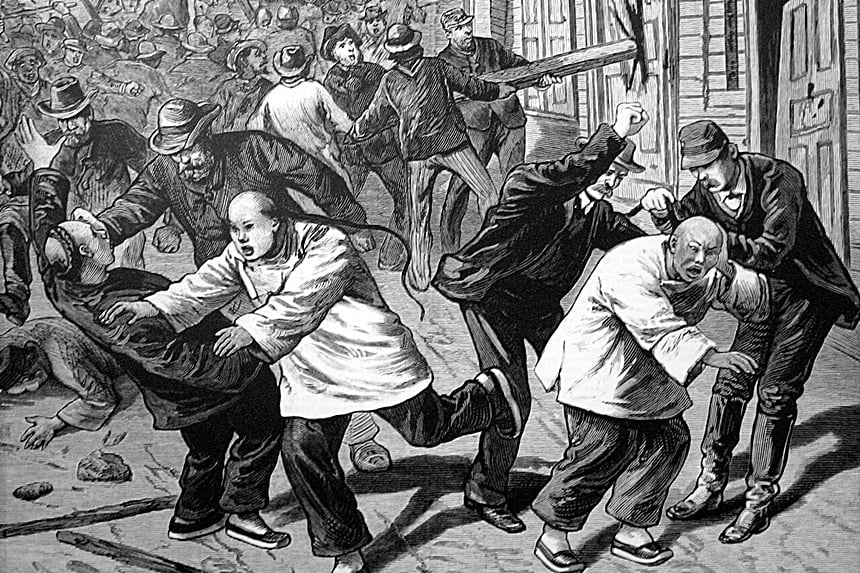
On July 4th, the Trump administration’s 18 months of critiques of the Smithsonian Institution culminated in a controversial document: the White House Domestic Policy Council’s 162-page report entitled “Saving America’s Story: How Ideological Capture at the Smithsonian Institution’s National Museum of American History Erases Our Heritage.” The report presents, as a key piece of evidence for its argument, the Many Voices, One Nation exhibit’s accompanying text “Negotiating Inclusion,” specifically calling out the sentence “when thousands of Chinese journeyed to the American West, encouraged by the promise of gold rush opportunity, their race…troubled white Americans,” leading to the 1882 Chinese Exclusion Act, “the first of many restrictive immigration laws.” The report critiques this sentence for “portraying restrictive immigration laws as a tool of white supremacy.”
In two of my earliest Considering History columns, my first one in January 2018 and this follow-up in May 2018, I traced at length just how much the Chinese Exclusion Act, its related laws and policies, and its effects were indeed white supremacist. It defined a specific national and ethnic community as “illegal immigrants” (creating that new category in the process) and targeting them for exclusion; it sought not only to restrict new arrivals but also to destroy an existing, longstanding, and sizeable American community; and it did all of that through overt arguments that, as Supreme Court Justice John Marshall Harlan put it in defending the Exclusion Act and related laws as Constitutional, “this is a race utterly foreign to us and never will assimilate with us.”
Those details of the Chinese Exclusion Act and its many related laws offer clear and compelling rebuttals to the White House report’s arguments. But it’s equally important to examine the multi-decade lead-up to the Exclusion Act. Racist narratives, white supremacist hate, and more targeted laws ultimately led to the Chinese Exclusion Act and its overarching white supremacist laws, policies, and practices.
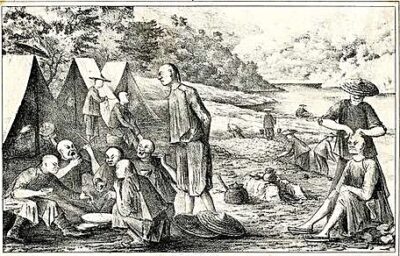
We can trace those origins all the way back to some of the earliest encounters between the expanding United States and Chinese American communities. The California Gold Rush of 1848 brought countless new arrivals to the territory, from China and the Eastern United States alike (among many other places), and led directly to the annexation of California as a state in 1850. And one of the first laws passed by the legislature of that new state was the Foreign Miners’ Tax Act of 1850, which levied a tax of $20 a month on Chinese American and Latin American miners (many of whom were already present when the U.S. annexed California). When that tax proved impossibly steep and the first Act was repealed, a second Foreign Miners’ Tax of $4/month was passed in 1852, with tax collectors focusing almost entirely on Chinese American miners. From a very early point in their evolving story, this American community was treated as “foreign” by such discriminatory laws.
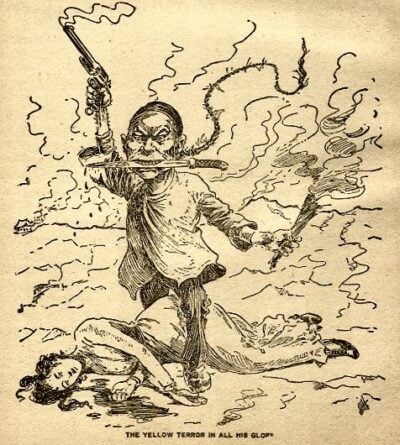
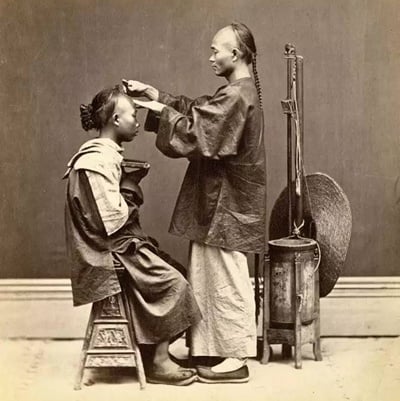
Over the next couple decades, those laws and the discriminatory attitudes underlying them evolved into an overarching set of prejudices and fears captured by the phrase “the yellow peril.” In this excellent recent Saturday Evening Post column on the history of American Chinatowns, Sena Ho traces and contextualizes that “yellow peril” narrative at length, arguing that “such anxieties furthered the belief that Chinese immigrant communities would be unable to assimilate into American culture.” These prejudices were often rationalized through a focus on aspects of Chinese American identity that were perceived as especially “foreign,” such as men’s queues (ponytails); we can see that attitude and its hateful results clearly in an October 1855 diary entry from a California man named Charles De Long that reads, “Went down the river in the night, collected all of the way. Had a great time, Chinamen tails cut off.”
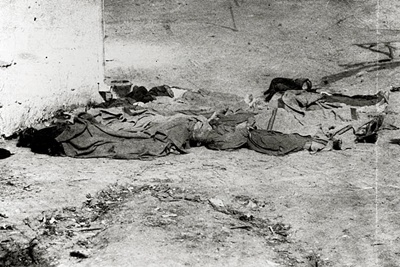
Those kinds of individual acts of racist violence targeting Chinese Americans were ubiquitous in this era, but they also could expand into collective white supremacist terrorism on a much larger scale. A tragic case in point was the Los Angeles Chinatown massacre, which took place on October 24th, 1871. Ostensibly responding to an ambiguous individual act of violence toward a local white rancher and turning it into a rumor that Chinese Americans were “killing whites wholesale,” a white mob targeted the city’s entire Chinese American community for destruction. The mob rampaged through an afternoon and night of theft, arson, and mass lynching that resulted in the murders of 19 Chinese Americans, more than 10 percent of the community’s population at the time of 172. While a handful of rioters were tried and convicted for individual crimes, in 1873 the California Supreme Court overturned the convictions, and no rioter served any time in prison.
Alongside such illegal and violent attempts to destroy Chinese American communities, the 1870s also featured evolving arguments for national laws that would likewise attack that existing community. One of the most vocal advocates for those laws was California Congressman Horace F. Page, who began his first term in March 1873 and less than two years later authored the Page Act, a bill overtly intended “to end the danger of cheap Chinese labor and immoral Chinese women.” When the Page Act was passed in 1875 it became the first federal immigration law, and one that restricted Chinese arrivals overall and entirely prohibited single Chinese women immigrants. And no less of a leader than President Ulysses Grant echoed the Act’s framing in his December 1875 annual message to Congress: ““I invite the attention of Congress to another evil — the importation of Chinese women, but few of whom are brought to our shores to pursue honorable or useful occupations.”
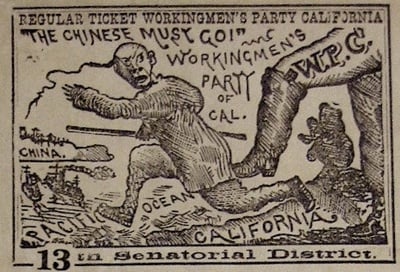
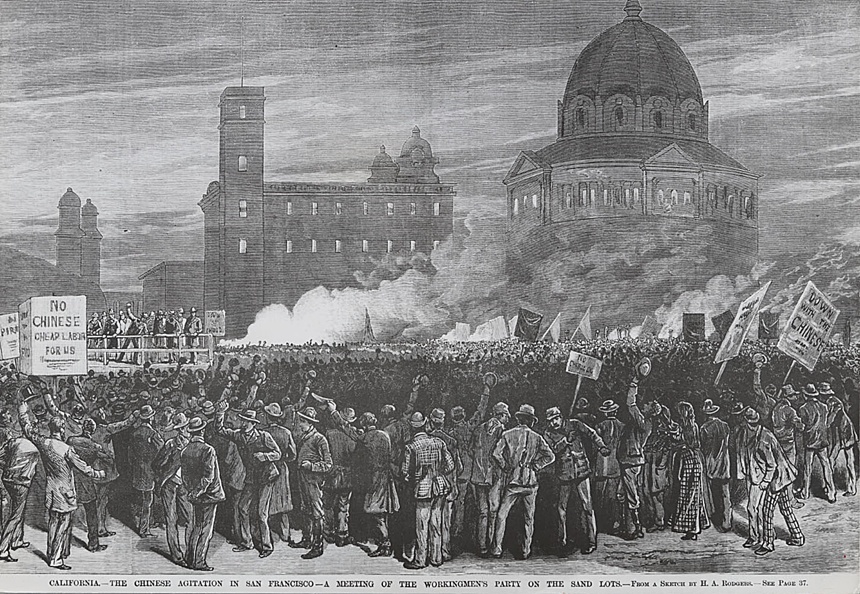
All of these forces coalesced in in late 1870s San Francisco. It was there that Irish immigrant, businessman, and blossoming labor leader Denis Kearney founded the Workingmen’s Party of California, a political party that chose as its central slogan “The Chinese Must Go!” There that a July 1877 Workingmen’s Party rally at the gathering ground known as “the Sandlot” turned into a multi-day riot and massacre that left much of the city’s historic Chinatown burned to the ground and much of the Chinese American community dead, wounded, or exiled. And there that Kearney began delivering his famous anti-Chinese stump speech that he would turn into editorials for newspapers around the country, take on the road to places as distant as New York and Boston, and make into the national face of the movement that culminated with the passage of the 1882 Chinese Exclusion Act.
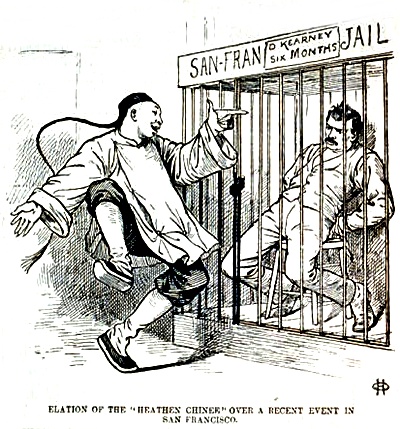
In a series of late 1880s letters to the prominent Irish politician James Bryce, who had attacked Kearney in writing as a “contemptible demagogue” and an “ignorant man,” Kearney proudly defended himself and his role in that movement and the Exclusion Act’s origins. He touted his “constancy of purpose to keep it up until I accomplished what I wanted, viz — the putting of a stop to Chinese immigration.” He argued that he had shifted the anti-Chinese movement “from a local to a great national question.” And he added that “my next fight will be to get Canada to pass an anti-Chinese exclusion law…I am in hopes of living long enough to see the Asiatic hordes excluded from the Continent, from Cape Horn to Icy Cape.”
Kearney did not succeed at that goal, no more than the forces of white supremacist exclusion ever have at turning us into the nation they imagine. But there’s no way to tell the story of either the Chinese Exclusion Act specifically or the United States overall without confronting fully and responding forcefully to such voices and forces, past and present alike.
Become a Saturday Evening Post member and enjoy unlimited access. Subscribe now



.jpg)
Comments
Ben: Too bad we all can’t agree to disagree and tolerate others views regardless of our values and/or how we feel about them. My apologies if I happen to have ruffled your left-wing, liberal, snowflake feathers but I stand by my conservative views & values and won’t back down brother. As a Christian, I can pray for you to be more open minded to others’ views even though you may not agree with them and I too pledge to be more open minded but not such that my brains fall out. Have a Blessed Day.
Midnight, unfortunately for you (and, yeah, for me), I’ve read every single word of every single comment you’ve left on my columns over these 8.5 years. Every closed-minded comment. Yes, even the ones that were quickly deleted because they were extra closed-minded and bigoted (like the homophobic hateful rant you left on my LGBTQ+ Americans in the military column). I take this job very seriously, and so I read every single word of every single comment. Even yours.
Dwell on that, and maybe, just maybe, learn something more, brother.
Ben: I completely disagree with you and will overlook your assumptions because you don’t really know me nor the education I received while a student in high school or The University of Alabama from which I graduated with highly distinguished honors. I can overlook your ignorance of my personal education’s resume. I can attest though that my B.S. degree I earned there took me places and opened doors which many degrees earned today simply do not do. So you can run your mouth all you want but I know that from small minds come false narratives and convenient omissions from all aspects of US History. Dwell on that brother.
Midnight, the only thing I will add is this:
I will bet every penny of my sons’ college tuitions that you did not learn “all facts” about the histories I included in this post in that high school in the 70s. Every. single. penny.
Ben
The only thing I will add is this: When you fail to study and learn from all aspects of history, you are doomed to repeat it. Thankfully, I was raised in the rural South and attended a small, rural high school graduating in the 1970s before many teachers became left-leaning political activists attempting to indoctrinate students with woke ideas filling their minds with false narratives that suited their own agendas. I had US and World History teachers that never neglected to teach us all the facts regardless of how you felt about it. Perhaps that is what’s wrong. Teaching all facts has been neglected while preferred narratives are being pushed instead.
“it is not right and completely unfair to attempt to rewrite history to satisfy some sort of narrative you don’t necessarily agree with”
“the War Between the States”
My goodness, the audacity to complain about anyone attempting to rewrite history whilst referring to the Civil War as the “War Between the States.”
Regardless of what is happening at the Smithsonian, it is not right and completely unfair to attempt to rewrite history to satisfy some sort of narrative you don’t necessarily agree with. Likewise, it is a disservice not to teach the whole facts of history to all students. For example, all aspects of the War Between the States are no longer taught in most high schools, especially those in urban areas. Knowledge is power. Not teaching history as it should be means we have a generation who some day may be doomed to repeat it.