This series by American studies professor Ben Railton explores the connections between America’s past and present.
If you watch Wheel of Fortune and Jeopardy! every evening as my wife and I do, or likely if you watch any TV at any time of day, you’ve no doubt been bombarded by political campaign ads over the last few months, with the frequency only intensifying as Election Day approaches on November 3rd. At their best, such campaign ads offer a vision of one candidate as more worthy of our vote; at their worst (which is to say, the vast majority of the time), they depict the other candidate as unworthy not only of our vote, but also of a place in civil society. To say that this election season’s ads have ramped up the extreme and ugly attacks is to significantly understate the case.
Of course, each specific election is a choice between candidates, and the details of those individuals matter in a variety of ways. But in a representative democracy like ours, elections are also always about what kind of government we’re going to have and what kind of country we’re going to be. And more exactly, as the 2026 election illustrates pitch-perfectly, an essential goal of our elections is to protect our Constitutional principles.
Perhaps the most defining of those principles was given voice by the American Revolution’s most impassioned advocate, Thomas Paine. In his January 10, 1776 pamphlet Common Sense, which consolidated many of his arguments for both separation from England and the new nation that it would produce, Paine writes:
But where says some is the King of America?…Let a crown be placed thereon, by which the world may know, that so far as we approve of monarchy, that in America the law is king. For as in absolute governments the King is law, so in free countries the law ought to be King; and there ought to be no other. But lest any ill use should afterwards arise, let the crown at the conclusion of the ceremony be demolished, and scattered among the people whose right it is.
The idea that the United States would have no kings was not just a rejection of the English monarchy, but a radical reframing of where power would lie in the new nation.
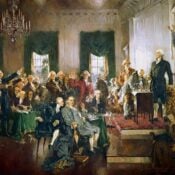
As I traced at length in this prior Considering History column, just over a decade later, when the Constitutional Convention’s delegates debated the powers and limits of the government’s executive branch, they explicitly considered how to challenge the president if that person sought monarchical powers (among other potential abuses). The answer they came up with was impeachment, as the best answer to a pair of questions posed by delegate George Mason: “Shall any man be above Justice? Above all shall that man be above it, who can commit the most extensive injustice?”
At the time that the Constitution was drafted, ratified, and became the supreme law of the land, it’s unfortunate but necessary to say that the law did not apply equally to nor protect all Americans. But the Constitution was designed to be a living and evolving document, and many subsequent Amendments have explicitly sought to redress such flaws. The most overt extension of the law to all Americans can be found in the 14th Amendment, the first Section of which reads in full:
All persons born or naturalized in the United States, and subject to the jurisdiction thereof, are citizens of the United States and of the State wherein they reside. No State shall make or enforce any law which shall abridge the privileges or immunities of citizens of the United States; nor shall any State deprive any person of life, liberty, or property, without due process of law; nor deny to any person within its jurisdiction the equal protection of the laws.
The phrase “any person” in the final two clauses makes clear that this guarantee of equal protection under the law is extended to every person in the U.S., regardless of citizenship status.
The first sentence of the 14th Amendment’s Section 1 likewise guarantees birthright citizenship as a Constitutional right. While federal recognition of that element of an inclusive America has evolved along with the Constitution, another such element was present from the nation’s founding moments and documents: the guarantee of religious freedom. In this prior Considering History column, I highlighted the Constitution’s Article VI, which prohibits religious tests for those seeking office; both that genuinely radical clause and the First Amendment’s equally significant emphasis on religious freedom were inspired by other foundational documents, including Thomas Jefferson’s 1786 Virginia Statute for Religious Freedom, which guaranteed that all Virginians “shall be free to profess, and by argument to maintain, their opinions in matters of religion, and that the same shall in no wise diminish, enlarge, or affect their civil capacities.”
In a recent Considering History column, I made the case for remembering the Revolutionary-era state constitutions alongside the federal one. Indeed, many of those state constitutions helped inspire key features of the U.S. Constitution and the federal government it created, including the concept of a government with multiple branches that would provide checks and balances on each other’s powers. While initially it was the legislative branch that offered the most consistent such checks and balances on the executive, over time the judicial has evolved into a fully independent and equal third branch, with the core concept of judicial review a particularly important mechanism for the courts to challenge and counter overreach by an authoritarian executive.
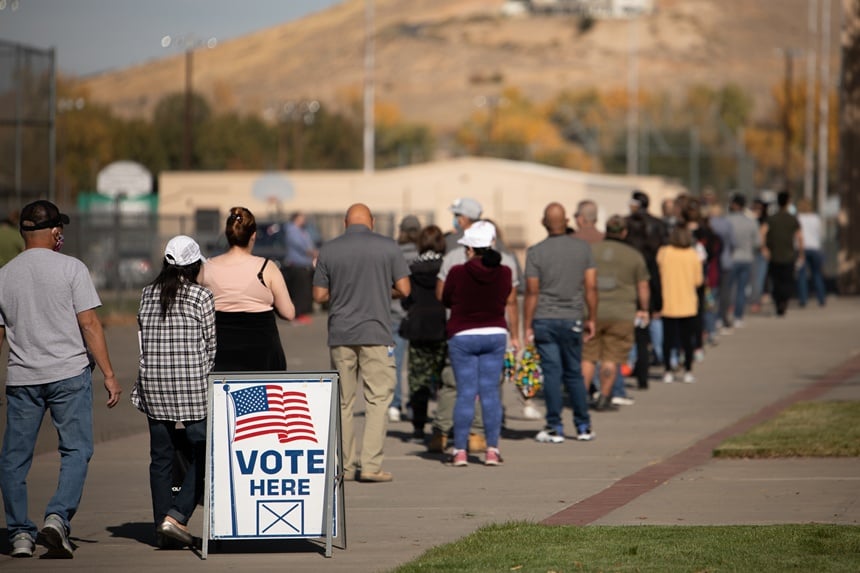
Finally, there’s the foundational ideal of free and democratic elections themselves. The Constitution details the electoral process in extensive detail, but frustratingly did not explicitly guarantee Americans’ right to vote in those elections. A number of the Revolutionary state constitutions did guarantee that right, however (and all but one of them now guarantee it), and over time Constitutional Amendments and congressional laws alike have extended suffrage to more and more Americans and made clear that the right to vote is both guaranteed and a crucial part of our equality under the law. And it’s more than that — it’s one of the most important ways that every American can ensure that we continue to protect and expand our foundational principles and ideals, here in 2026 as in every election year.
Become a Saturday Evening Post member and enjoy unlimited access. Subscribe now