This series by American studies professor Ben Railton explores the connections between America’s past and present.
The 2026 Major League Baseball playoffs started last week, but regular-season NFL games and pre-season NBA stories occupy the top spots on ESPN’s website as I write this. For a variety of reasons that analyzed for decades, baseball is clearly no longer America’s “national pastime.” But when it comes to the sport’s ability to reflect upon the arc of American history, I’m still with Terence Mann (James Earl Jones) in Field of Dreams: “America has rolled by like an army of streamrollers. It’s been erased like a blackboard, rebuilt, and erased again. But baseball has marked the time.”
It’s not just that baseball has been here for nearly 200 years, played across the country in countless local communities, schools, barnstorming circuits, and semi-professional as well as professional leagues. It’s that we can drill down on so many of the sport’s individual stories and find the worst and best of American history. One striking such moment took place 100 years ago, in the autumn of 1926, when three baseball championships reflected the sport’s segregated realities but also its inspiring ideals.
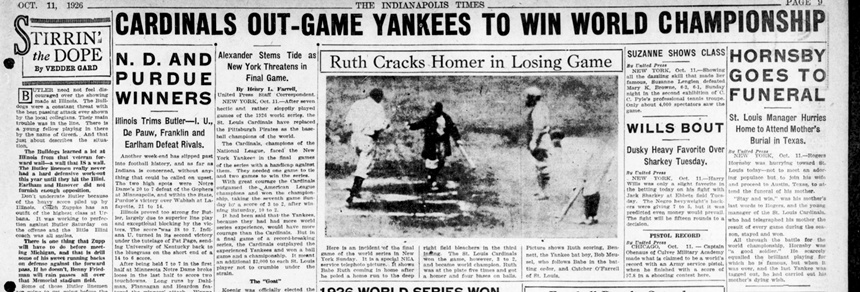
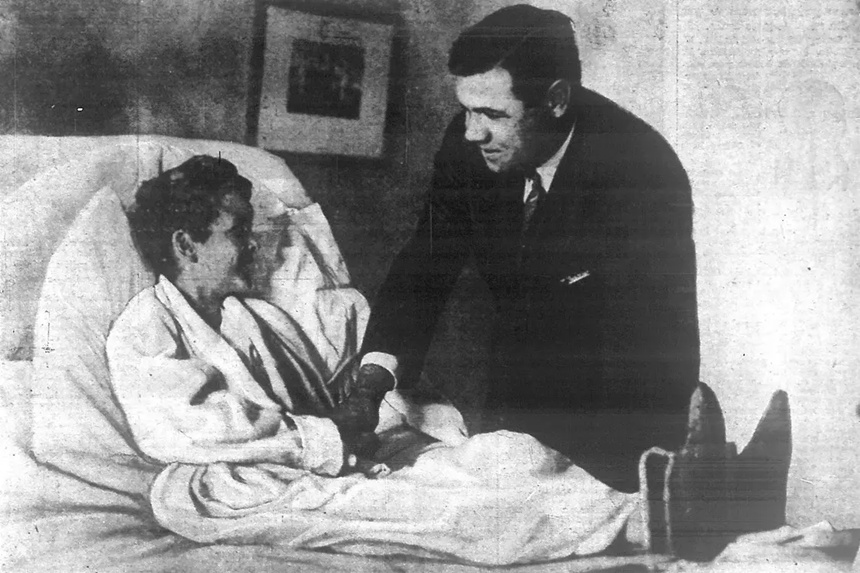
Major League Baseball had been playing a season-ending World Series since 1903, but the 1926 World Series between the St. Louis Cardinals of the National League and the New York Yankees of the American League was perhaps the most exciting and certainly the most symbolic yet. It was a hard-fought back-and-forth series, one in which the underdog Cardinals took the final two games to defeat the perennial favorite Yankees four games to three (and bring St. Louis its first professional sports championship of any kind). But the series would be best remembered as a break-out moment for one of the sport’s most defining legends, Babe Ruth — not only as a Hall of Fame talent but also and especially as baseball’s first true celebrity. When a hospitalized 11-year-old New Jersey boy named Johnny Sylvester wrote to the Yankees asking for an autographed Babe Ruth baseball, Ruth wrote back, “I’ll knock a homer for you Wednesday.” And Ruth did far more than that, hitting a World Series record three home runs in that game. Ruth would visit Sylvester at home after the series, cementing the Bambino’s emerging larger-than-life status.
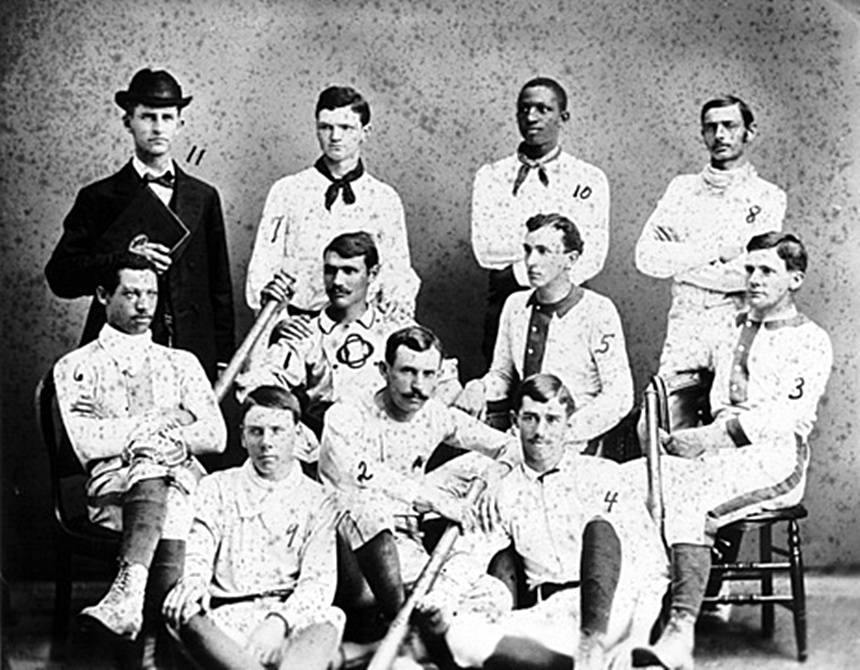
As well-played and exciting at that 1926 World Series was, it could have been even more so if Major League Baseball had not excluded athletes of color from its rosters. As I traced in this Considering History column, during the late 19th century emergence of the first fully professional baseball leagues, Black players like the legendary Walker brothers (Moses Fleetwood and Weldy Wilberforce) were part of those leagues, alongside other ballplayers of color like the Penobscot Native American Louis Sockalexis. But in 1887, major and minor league team owners, influenced by the rising tide of Jim Crow racial segregation and other exclusions, adopted a “gentlemen’s agreement” to offer no new contracts to African American players. By 1900, there were no Black players in any professional league in America.
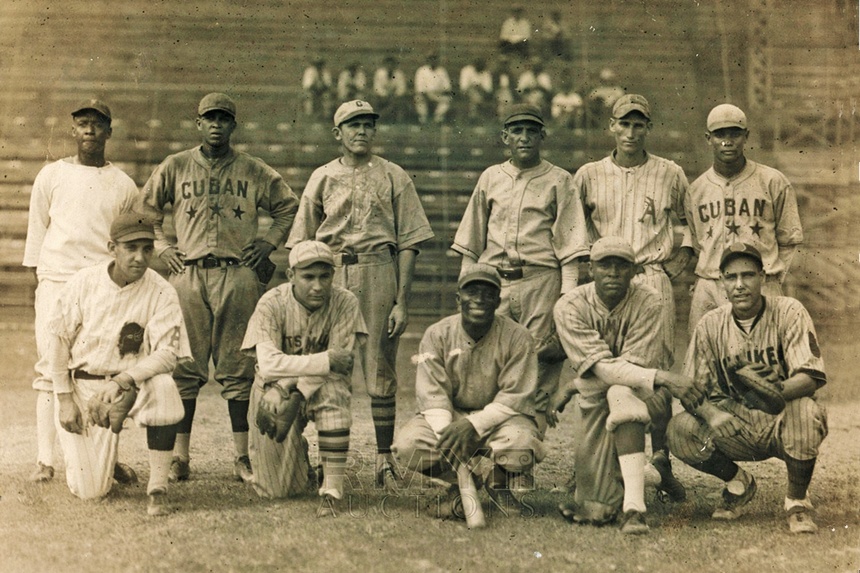
It would be 60 years from that dishonorable agreement before the first African American ballplayer joined a major league roster. But over those same decades, Black players, Black businesspeople, and their allies in sport would create the multilayered, thriving system that came to be known as the Negro Leagues. And in the mid-1920s, two of the most prominent such leagues, the Negro National League and the Eastern Colored League, began playing an annual Colored World Series, counter-scheduling it at almost exactly the same time as the MLB World Series. 1926’s was the third such annual Colored World Series, a best-of-nine-games affair between the Chicago American Giants of the NNL and the Atlantic City Bacharach Giants of the ECL, and it was just as hard-fought as the MLB series, with Chicago taking the final three games at home to win the series 5-4. The Colored World Series featured an even more striking individual accomplishment than Ruth’s big game: In Game 3, Bacharach’s pitcher Claude “Red” Grier tossed a no-hitter, the first in any baseball championship and the only one for another 30 years (and only one of three in all of professional baseball history).

As I’ve written about recently, there was another early 20th century American community for whom baseball was perhaps an even more central pastime: Japanese Americans. While the 1887 “gentleman’s agreement” did not explicitly exclude Japanese players from the Major Leagues (likely because at that time most were playing in Hawaii, which was not yet part of the U.S.), the fact remains that none of the countless Japanese American stars who gained renown across the first decades of the 20th century were given an opportunity to play in MLB. And so, like their African American counterparts, Japanese American players and their communities took it upon themselves to form their own leagues, creating an impressive system of professional, semi-professional, barnstorming, and local team across the West Coast. One of the first fully organized leagues bringing together such teams was the California Japanese Baseball League, which formed in March 1926 and which, at the end of that inaugural season, crowned its first champion, the Fresno Athletic Club.
The star of that Fresno team was also its founder and a towering figure in the sport: Kenichi Zenimura, “The Father of Japanese American Baseball.” And Zenimura’s efforts to build solidarity and create legacies in baseball went far beyond any one community, as between 1920 and the early 1940s he organized a series of games between Fresno All-Stars and Negro Leagues teams. Earlier in the 1926 season, over the 4th of July weekend, Fresno took a pair of games from Lon Goodwin’s famous Los Angeles White Sox. None of the players who starred in those July 4th games were able to play in Major League Baseball in 1926, reminding us of baseball’s multifaceted, meaningful role in American history.
Listen to Ben Railton’s podcast, Baseball, Bigotry, and the Battle for America.
Become a Saturday Evening Post member and enjoy unlimited access. Subscribe now


.webp)
