This series by American studies professor Ben Railton explores the connections between America’s past and present.
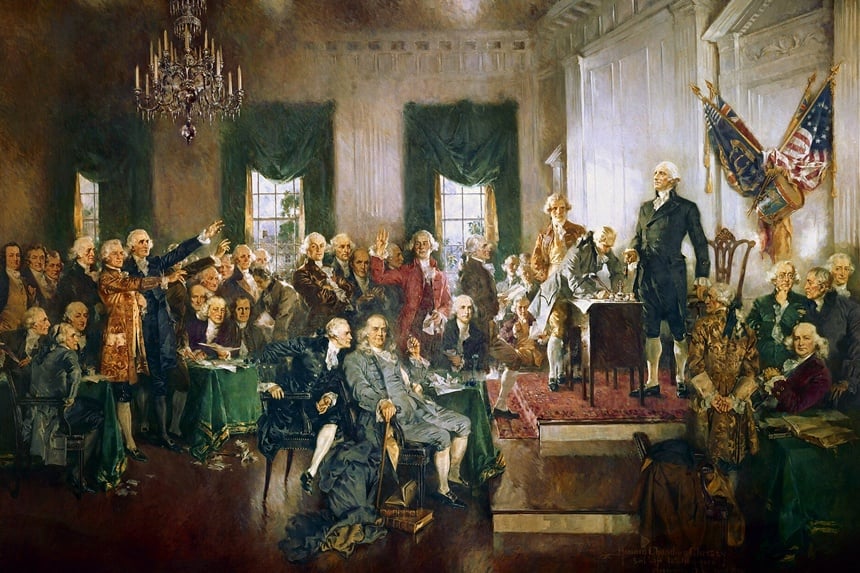
On September 17th, 1787, the delegates to the Constitutional Convention in Philadelphia signed the final draft of the U.S. Constitution, beginning the ratification process that would make this founding document the law of the land. On this year’s Constitution Day, there are many elements of that document we should be concerned about regarding our laws, policies, and norms. Those include limits on federal corruption, from the specific (the presidential emoluments clause) to the overarching (impeachment); the separation of powers, which tasks the legislative branch (Congress) with such vital roles as collecting taxes and duties and regulating commerce with foreign nations (such as through tariffs) and declaring war; and other neglected Constitutional concepts that could help guide our discourse in 2026.
Making the case for a return to the Constitution’s founding principles gets more complicated, however, when we acknowledge that in some key ways the document fell far short of creating an egalitarian or inclusive federal government or vision of “We the People.” Most overtly, while the Constitution did include a clause that would make it possible for Congress to outlaw the foreign slave trade in twenty years’ time (a form of partial, future progress to be sure), it not only allowed the system of slavery to continue but also defined enslaved African Americans as 3/5s of a person for purposes of state representation. Moreover, while the Constitution outlined electoral procedures such as the Electoral College, it did not guarantee voting rights and indeed entirely avoided the question of who would be legally able to vote in this new nation, thus allowing voting laws that restricted the franchise to propertied white men to remain fully Constitutional.
Fortunately for those of us seeking foundational models for the best of America’s inclusive ideals, the federal Constitution isn’t the only option. Here in the ongoing 250th anniversary of the Declaration of Independence and the birth of the United States, it’s worth remembering a pair of state constitutions from 1776: Pennsylvania’s and New Jersey’s went far further than did the federal one. And a few years later, the Revolutionary state constitution in Massachusetts would produce a groundbreaking state Supreme Court decision that expressed our inclusive ideals as well as any legal document ever has.
First, it’s important to note that even those 1776 state constitutions that were not as radical as Pennsylvania’s and New Jersey’s nonetheless featured groundbreaking elements that directly inspired the U.S. Constitution a dozen years later. One of the earliest approved state constitutions, New Hampshire’s (signed into law in January 1776), created a groundbreaking two-chambered state legislature with specific responsibilities that checked and balanced the executive branch (such as giving all economic powers to the House of Representatives). And Delaware’s state constitution (signed into law in September 1776) abolished the slave trade entirely in the state: “No person hereafter imported into this State from Africa ought to be held in slavery under any presence whatever; and no negro, Indian, or mulatto slave ought to be brought into this State, for sale, from any part of the world.”
Delaware’s constitutional abolition of the slave trade was an important step and one that foreshadowed the U.S. Constitution. But another document approved in that same month of September 1776, the Pennsylvania state constitution, went much further still, featuring in its 8th clause a legal guarantee “That every member of society hath a right to be protected in the enjoyment of life, liberty and property.” This protection would lead directly to the state’s March 1780 Act for the Gradual Abolition of Slavery, the first passed by any state legislature. And that was only one way that this groundbreaking state constitution made the state “perhaps the most vital participatory democracy in the world,” including both its unique Declaration of Rights (which explicitly guaranteed the right to vote, among many other protected rights) and its impressively radical 28th clause (which affirmed that “equality of rights under the law shall not be denied or abridged in the Commonwealth of Pennsylvania because of the sex of the individual”).
Two months earlier, on July 2nd, 1776, New Jersey had approved its own equally groundbreaking state constitution. In a single vital clause, Article 4, the New Jersey constitution brought together a voting rights guarantee and an affirmation of gender equality: “That all Inhabitants of this Colony of full Age, who are worth Fifty Pounds proclamation Money clear Estate in the same, & have resided within the County in which they claim a Vote for twelve Months immediately preceding the Election, shall be entitled to vote for Representatives in Council & Assembly.” The gender-neutral “all Inhabitants” in that Article was quite purposeful, as New Jersey’s Constitution gave the vote to women, or at least to widows who were worth fifty pounds (unmarried and married women could not own their own property in any state at this time, and remained unable to do for more than a half-century). While that context is important to note, the fact remains that thanks to its constitution women could vote in New Jersey in 1776, nearly a century before Wyoming’s famous 1869 Suffrage Act and nearly 150 years before the 19th Amendment was ratified.
Eight states in total passed constitutions in 1776, and the remainder would do the same over the course of the Revolution. Massachusetts was one of the last to draft a constitution, passing its first in March 1780. But as I’ve highlighted in a number of past Considering History columns, the first clause of that 1780 Constitution’s Article I, “All men are born free and equal,” would become decisive to the legal arguments of a pair of enslaved people, Elizabeth Freeman and Quock Walker, who with their allies successfully argued that under this constitution slavery must be abolished. In his groundbreaking and inspiring 1783 ruling on their joint case, Massachusetts Supreme Judicial Court Chief Justice William Cushing argued that “Slavery is in my judgment as effectively abolished as it can be by the granting of rights and privileges wholly incompatible and repugnant to its existence.”
On this Constitution Day, it’s worth remembering and celebrating the breadth of founding documents that granted such rights and privileges, including the state constitutions that helped create the lineage and legacy of a more inclusive America.
Become a Saturday Evening Post member and enjoy unlimited access. Subscribe now