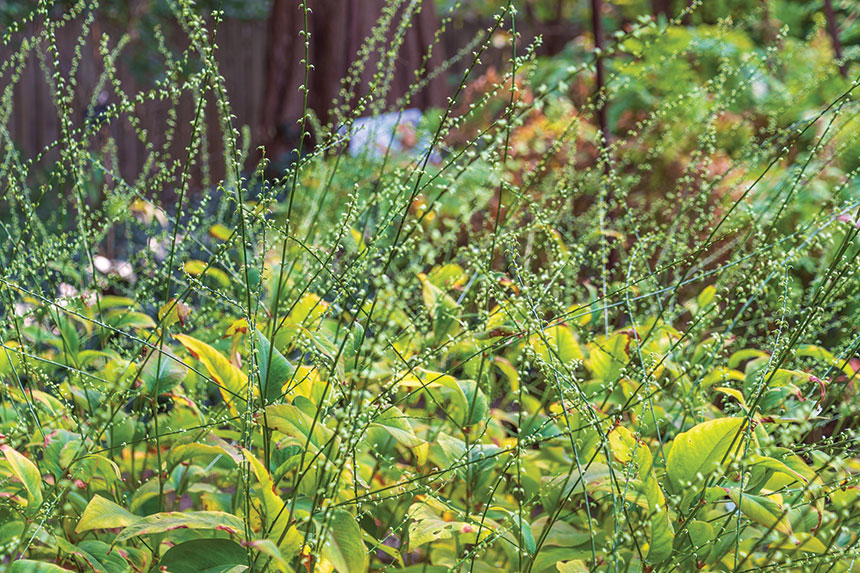
In an undergraduate ecology class in Indianapolis, we were assigned to document a plant-animal interaction. While many students struggled — it was not quite fall, so trees on campus had already flowered with little else in bloom — my mind immediately turned to the swath of native Virginia knotweed, or jumpseed, that had begun its determined march toward my back patio. Months of negligence — thanks to a particularly brutal few semesters — meant it was covered in scores of tiny white blooms, alive with activity. Bees worked their way methodically along the stems, flies hovered in place, and on one summer afternoon, I even caught a hummingbird darting in for a visit.
Colloquially named for the way its seeds “jump” when touched, this aggressive native plant tends to crowd out competition thanks to its underground network of rhizomes that, if damaged, respond with a burst of new growth. But while this tough customer is not my favorite addition to my yard, I leave some of it alone every year. Why? The summer dearth.
Dearth has a heavy provenance, tracing back to 14th-century Middle English, when food was too dear to afford during times of famine. Today, beekeepers and farmers use the term to describe a seasonal shortage of nectar. By late summer, the problem is not just whether something is blooming; it’s whether enough is. A handful of flowers simply cannot carry an entire landscape through the hottest months of the year. This is where consciously planting with seasonality in mind becomes key.
Picture your typical four-season American yard, front-loaded with spring and early summer blooms — an unmistakable attempt to put winter firmly to bed. Then, picture autumn, when native goldenrods and asters can be found in native-forward gardens and natural areas. But in late summer, it’s hot and dry, lawns are dying or being unsustainably watered; what is there for the pollinators?
Nonnative honeybees get most of the summer dearth headlines; these bees are managed and economically important. But these patterns also point to a broader ecological problem. One study found that honeybees foraged farther in summer, and that August had the highest share of bees returning empty-handed — evidence that the greenest part of the year isn’t always the most productive. Further, that challenge is not limited to honeybees. By late summer, many landscapes simply don’t offer enough rewarding flowers, making it harder for pollinators of all kinds to get what they need.
In some cases, native plants help fill that gap: Enter the humble jumpseed and other oft-overlooked native species. Research in reconstructed prairie habitats has shown that honeybees increasingly rely on native flowers later in the season. But there’s a catch. Even when native plants are preferred, they are often too sparse to make much of a difference. Across much of the Midwest, species that can sustain pollinators during late summer are present, but scattered and outnumbered by lawns, pavement, agricultural land, and a handful of nonnative blooms.
For gardeners looking to support pollinators through the late summer lull, resources that highlight bloom times, like those from Homegrown National Park, can help identify what’s missing and what to plant next. Planting for pollinators goes beyond choosing the right species. It’s about timing, density, and making sure that when the earlier abundance fades, something is still there to take its place.
Looking back, that ecology assignment wasn’t just about observation; it was about availability. My backyard with its unassuming jumpseed offered a pollinator feast, while other landscapes offered something closer to famine. Because in the end, it’s not just what blooms, it’s whether enough does.
—Mary Margaret Moffett is an ecologist and Advanced Indiana Master Naturalist
This article is featured in the July/August 2026 issue of The Saturday Evening Post.
Become a Saturday Evening Post member and enjoy unlimited access. Subscribe now