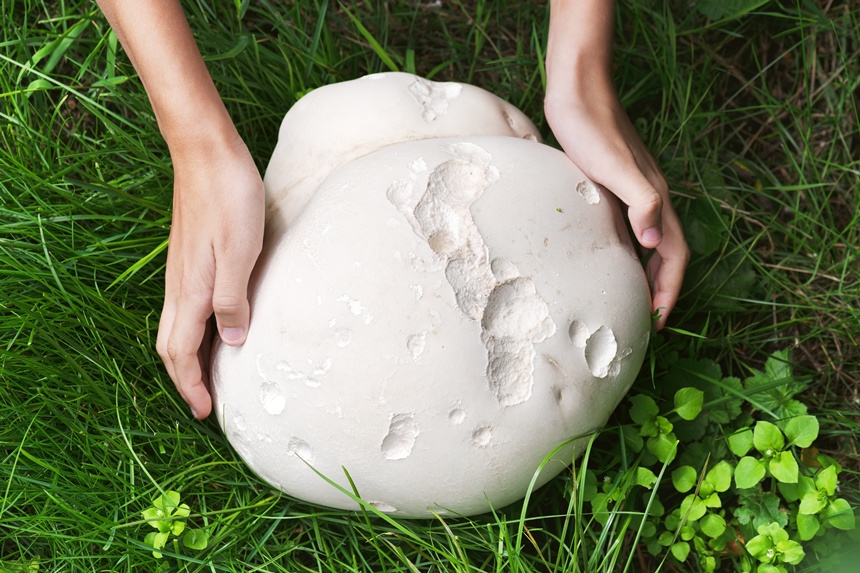
“Never eat anything bigger than your head.” I don’t know if cartoonist Bernard Kliban came up with that line, or if it’s a nugget of old folk wisdom. I agree that you shouldn’t eat more than a head-equivalent meal, not without at least chewing it some. But if you like mushrooms, a trip to the country can yield edible and easy-to-identify giant puffballs that can in fact be much larger than your head. Keeping the aforementioned health advice in mind, slice them before eating.
As summer gives way to fall, soil moisture typically rises because it’s often a time of more frequent rains, and without the heat of summer, soils don’t dry out as fast. This extra moisture tends to put many soil-dwelling fungi in the mood to reproduce, and they send up spore-bearing structures, or fruiting bodies, that we know as mushrooms or toadstools. While spring is best for finding morel mushrooms, autumn brings out delicious fare like chanterelles, honey mushrooms, hen-of-the-woods, king boletes, and giant puffballs.
These brilliant white globes, the baby-making apparatus of a fungus that lives unseen below ground, can be found in pastures and deciduous forests, and occasionally in lawns as well. They seem to magically appear overnight, and generally range from 10 to 20 inches in diameter. They sometimes get a heck of a lot bigger. In 1987 near Montreal, Canada, a giant puffball was found that weighed nearly 50 pounds and was 2.7 feet in diameter, which is bigger than the heads of all but the most conceited individuals.
To be sure, fresh puffballs are inflated and puffy, but their name comes from what happens after they turn brown and dry out. In that condition, a smoke-like stream of brown spores will jet from the top of a dry puffball any time it is disturbed. A puffball can produce as many as seven trillion spores, or in scientific terms, “a heap-ton,” which is why it can puff seemingly forever. Back when we were kids, my brother and I used to think it was a riot to step on these. More than likely, there’s now a more convenient, not to mention hypoallergenic, cell phone app to do that.
A man stomps on puffballs to release the spores (Uploaded to YouTube by Bitynas)
All wild mushrooms are edible. The trick is finding those you can eat twice. While most are benign, a few can cause irreversible liver failure, so it’s a big deal to mess up. Certain Amanita species, notably the so-called “Death Cap,” as well as a group of others dubbed the “Destroying Angels,” are the world’s most lethal mushrooms. They are to blame for about 90 percent of all fatal mushroom poisonings. Unfortunately, many edible mushrooms have poisonous look-alikes. A few can cause organ damage, although most of the toxic look-alikes produce gastric discomfort ranging from mild to spectacular. I know a couple of self-taught mushroom hunters with decades of experience who in rare cases have made a mistake and ended up in abdominal distress. Even morels and chanterelles, considered easy to identify, have dangerous doppelgängers.
It would take real talent to misidentify a giant puffball, but I suppose a determined soul might be able to do it. If you’re new to foraging, only pick mushrooms with an experienced guide. The beauty of giant puffballs is that no other mushroom looks even remotely like them. If you follow a few simple rules, it is genuinely not possible to mistake a giant puffball for anything else.
First, avoid small ones. Remember that “giant” is part of its name. The problem is, a toxic Amanita mushroom when newly emerged before its cap unfolds can resemble an undersized puffball. So only select puffballs six inches in diameter or bigger.
Cut open your oversize treasure, and if its flesh is as white as the driven, pre-Industrial Age snow, it’s perfect. If its “best by” date has passed, the center will be slightly yellow, indicating that it has become too mature. Eating it at this stage is not dangerous, but it won’t taste very good. Also, it might give you a belly ache.
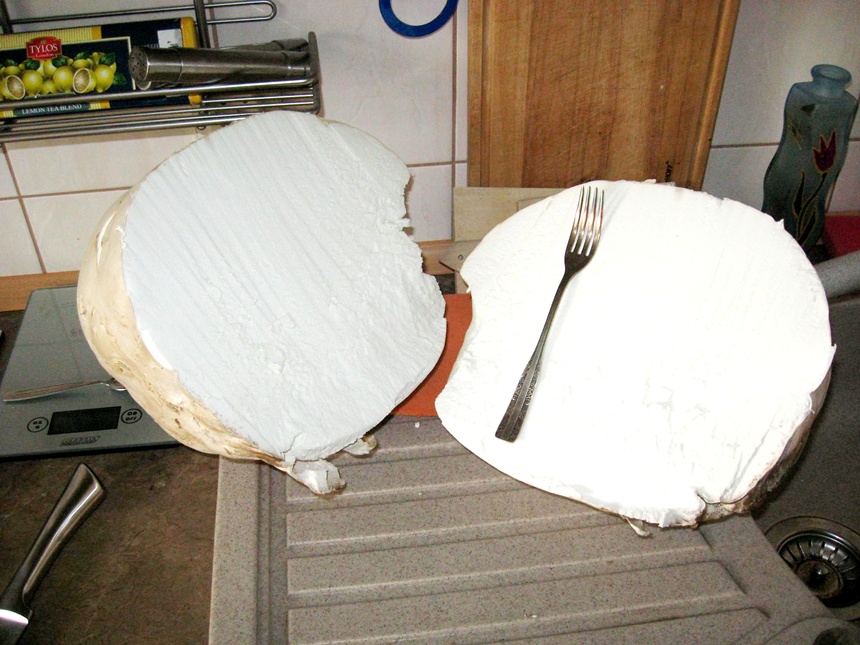
“Homogenous is next to Godliness,” as they say. Actually, no one says that, but if you pick a small-ish giant puffball and its interior is not uniform, that’s a very bad sign. Any hint of an outline of a stem, gills or still-folded cap means it’s dangerous. Back away slowly in case it tries any sudden moves. If you follow the rule about only picking large puffballs, though, this will never be the case. When your puffball is large, and uniformly white inside, it is the real deal – congratulations!
No one claims puffballs are as delectable as a morel or hen-of-the-woods, but I think they’re on par with the mushrooms you buy at a grocery store. They can be cut into strips and sautéed just like commercial mushrooms. Puffballs can also be sliced and frozen for later, which is great in light of that head-size restriction mentioned earlier.
Growing up, my father used to relate how, when he was a kid, his mother would pan-fry large, thin puffball slices and serve them with maple syrup like they were pancakes. “Heavenly,” was how he always described this dish. One day I brought him a fresh puffball so he could replicate his storied delicacy. The result was edible, but we both agreed that puffballs with maple syrup fell a few steps short of Nirvana. Much better in sauce or a stir-fry, I think.
Become a Saturday Evening Post member and enjoy unlimited access. Subscribe now